Search Results: "mako"

10 November 2006

Jordi Mallach: GECS, the GEGL's happy cousin

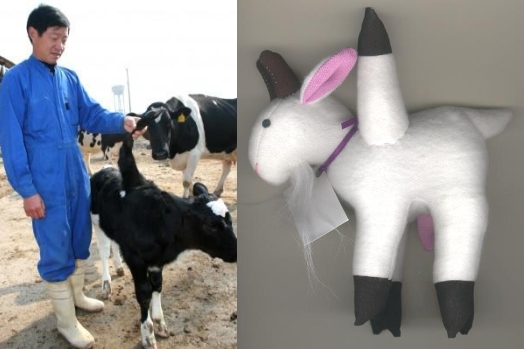
Via Mako and Mika I learned about the discovery of a living close relative of GNOME's GEGL. Her name is GECS for obvious reasons, lives in China and she seems to be very happy with her blue daddy.


Cow or goat, equally cute! (Brought to you by yet another shocking URL posted by mika)

9 November 2006

Benjamin Mako Hill: Value

Mountain View is quite far from San Francisco International Airport so my shuttle to to UDS-MTV was expensive, but worth it. In any case, I'll be reimbursed for the ride by Mark Shuttleworth.

8 November 2006

Benjamin Mako Hill: iRony RockBox Installer

In my blog post yesterday I described iRony, an install party I helped organize for iPods. In the post, I pointed folks to some resources for holding similar parties. To help with mass installs at our party, I wrote a simple installer for RockBox in Python that would run on GNU/Linux. With a few modifications, the script could be relatively easily converted to also run on Mac OS X. While an unofficial installer exists for Windows, my installer, simply called the iRony RockBox Installer, seems to be the first installer for GNU/Linux. Of course, the installer is still largely rough and untested and is definitely unsupported by the RockBox team. If you get around to trying it, please send me feedback, advice, or and patches. You can grab it (and future version) here: http://mako.cc/projects/irony/

Benjamin Mako Hill: iPod Liberation!

About a month ago, I announced an iPod liberation party (i.e., an install-fest for free/open source software onto iPods). The summary, now several weeks after the fact, was that the party was a total success. More than fifty people attended and several dozens iPods were liberated. Pictures and information on the event are now online. Over the past few weeks, I've been polishing a RockBox installer that I wrote for the event, writing up an article published on NewsForge today, and documenting the process for those that want to hold their own similar events. If you are unconvinced on the subject of iPod liberation, read the NewsForge article written with others from my research group and Harvard Free Culture. Most of the rest of the information on our party and information on throwing your own party exists in sub-pages from the iPod Liberation page in the Free Culture wiki. I'm looking forward to seeing a whole string of similar parties run by LUGs and other interested groups. It's a great way to get out a message about software freedom, DRM and about freedom on devices other than computers.

7 November 2006

Benjamin Mako Hill: By the power of...

I was very happy to hear that the Masters of the Universe (MOTU) loved my suggestion and named their nascent governing board Council Grayskull.

4 November 2006

Benjamin Mako Hill: GECS Lives

I wasn't the only one to notice the striking similarly between the abnormal cow born recently in China and the unofficial mascot of one of my favorite free software projects. Thanks for the link Mika! See for yourself:
/copyrighteous/images/geglgecl.jpg
True, it's neither a goat nor particularly large, but it seems we can't far away. A very auspicious sign for free software!

David Moreno Garza: Yum

Am I the only one who craves Mako’s pasta and am I the only one jealous of his satisfaction expression on it? :)

3 November 2006

Benjamin Mako Hill: Noodles & News

/copyrighteous/images/someny_noodles-small.jpg

Someny noodles, so little time.

If you live in the bay area and you are still willing to talk to me after that pun, please get in contact with me. While it's been a while since I've been in San Francisco, I've got a flight out Saturday for the Ubuntu Developer Summit in Mountain View. I will have some time especially next weekend to hang out.

Benjamin Mako Hill: Akismet Plugin for PyBlosxom

I apologize for boring the vast majority of my readers who do not use PyBlosxom but I'm trying to at least mention each "released" projects here once for the sake of completeness even if it's only interesting to a small number of them. I posted a note a few months ago mentioning a stronger CAPTCHA I had created to deal with blog spam. A few friends pointed out that they were having excellent luck with Akismet which filters using a model similar to some of those old collaborative spam filters. Building off earlier work, I build an Akismet plugin for PyBlosxom. I've gone through a couple of iterations on the PyBlosxom lists and the results have been great. If you use don't use PyBlosxom, there are plugins for Wordpress (where the system originated) and I imagine for other blogging systems as well. Its an effective and attractive alternative to a CAPTCHA. You can grab my plugin on my PyBlosxom hacks page

1 November 2006

Benjamin Mako Hill: Revelation

Once, a friend of mine was cleaning a small tube and asked me to pass him a pipe cleaner. Immediately and simultaneously, I both realized that I had never questioned the name of my favorite craft supply and understood the answer to the question completely. Moments like this are like tiny tastes of enlightenment.

30 October 2006

Benjamin Mako Hill: Software Freedom Curriculum

About a year ago, I was working on OLPC during most of the time and thinking a lot about software freedom in the context of the project. My blog post on OLPC and Charges of Technological and Cultural Imperialism from last December is a great example of my thinking out loud about some of the issues. The attractive thing to me about OLPC was the idea of students getting a real, free software, free hardware, truly open platform unlike phones, calculators, and eBooks: closed paternalist platforms that seem to be the only real alternatives. This is a goal that OLPC has not achieved yet but has already come quite close to. People say that because modifying technology is often difficult, only a small percentage of users -- especially young users -- will take advantage of the malleability or "hackability" of a product. They are probably right. But part of why this happens is because when computers are employed in education, we use them as tools to accomplish predefined and preprogrammed tasks. Even when students learn to program, it's in a window (quite literally in a box) separate from the rest of the things that the computer does. And for someone working on a project in part so that they can spread technological freedom, this is a problem. Consider the fact that with only a small number of exceptions, the only advocates of software freedom I know are programmers or hackers. I don't think that this is because of some "programmer's sensibility" but rather because programmers understand a set of things about the malleability of software and the nature, effect, and context of computation that gives them perspective to understand how a concept like freedom might apply to something like software. In other words, to understand software freedom, you must first understand -- really understand -- what software is and what it is not, how it makes things possible and impossible, and how changing it can have important effects. The mentality I've described is currently a "hacker's sensibility" but I don't believe that you need to be a hacker to understand why software freedom is important. Proof, I think, is the fact that people think that a free press is important even if they don't publish or write very well. As an exercise, I took it on myself to write the beginning of a curriculum that teachers could use to teach students about software freedom and the concepts that I think are key to understanding it. It tries to come up with models for framing discussions and a series of activities to help teachers teach relatively young (i.e., middle school students) about issues of computation, information goods, and ultimately about software freedom. I wrote the curriculum about a year ago, showed it to a few teachers and colleagues, and then sat on it because I wasn't sure what to do with it and because I was concerned by my own lack of experience teaching outside of Universities. I'm still not entirely sure about incredibly basic things like what form a curriculum should take for this age group. I noticed recently that Wikiversity launched in August and it seems like the perfect place to put my curriculum for consumption by the world and for collaboration, discussion, and further development. You can see what I've got from this page and the pages linked from it:
http://en.wikiversity.org/wiki/Software_Freedom
The project still needs lots of work. It needs to be threshed out on its own terms and it needs to be broken down and integrated into Wikiversity as a series of learning projects, learning activities, etc. I've looked at the documentation around Wikiversity and I can neither understand how to do this nor find examples of large curricula in Wikiversity to which this has already been done. If you have experience on Wikiversity, your help would be welcome. If you are interested in using part of the curriculum, I would love to hear from you and to see your edits on the wiki.

Jurij Smakov: Papers, please ?

Today I have witnessed an incident which involved a person getting kicked from #debian-devel, when he refused to disclose his real name (I did not notice any other disruptive behavior on his part). When I objected to that, I was quite surprised to find that quite a lot of people found this an acceptable administrative measure (the channel rules wiki page was promptly created to reflect that). While I find it totally acceptable, that a person must reveal his/her real name when becoming a Debian Developer, I think that having such a requirement in place for an unrestricted public Debian channel is completely inappropriate. In my opinion, the right to remain anonymous is fundamental, and I don’t care about the person’s real name, as long as he/she has something useful to contribute. I also believe that protection of this right is a part of the core Debian philosophy, as we refuse to recognize software as free, if it impedes on the person’s right to remain anonymous (”Dissident test” in the DFSG FAQ). Therefore, the support of fellow DDs (some of them actively involved in NM process) for such measures looks like nothing but pure hypocrisy to me. I have added a note stating my disagreement on this issue to the wiki page.

29 October 2006

Benjamin Mako Hill: Myopia

Maybe I'm just uncultured but when I first heard the name of the Myopia Hunt Club, my thoughts leaned more toward my vice president than a golf club. Apparently, I wasn't too far off etymologically.

27 October 2006

Benjamin Mako Hill: I MIT Libraries

There are many things at MIT that I find I want to distance myself from (e.g., much of the military related research). Recently though, the MIT Libraries have been giving me a number of reasons to be proud to be an MIT graduate student. MIT has taken the brave step of the being one of the first major research universities to throw a stone at the publishers in the whole Open Access, scholarly publishing debate. The libraries have put up a bunch of information on open access issues and have created a copyright amendment form for all scholarly publication that will allow the institute and its authors to retain copyright over their work for publication in the institute archives, on the author's website, or even in an open access repository like PubMed Central. More importantly, MIT Libraries are offering to do all of the negotiation with the publishers on behalf of the authors. When it is MIT as a whole, and not just the one graduate student, post-doc, or professor on their own, it puts the authors in a much stronger to retain the openness of their work. It's not victory, but it's an important and essential step toward open access for scholarly publishing. But that's not it! The libraries have also recently stood up to Hoover's Online's attempt to hold the libraries responsible for, "activity Hoovers deemed or even suspected was fraudulent." When Hoover's gave the libraries the choice of saying yes to a set of unreasonable terms or walking away from an important research tool, MIT Libraries made the difficult but correct choice and walked away. Making a choice like that will surely get the libraries a lot of flak from MIT scholars who use Hoover's. But MIT made the right decision by standing up for their principles. The effect of large, powerful institution like MIT is usually to maintain the status quo. There's clearly a lot of external pressure from funders, politicians, etc. and internal pressure from academics and students who are doing well by the current system. MIT Libraries are using their power to make the whole system better and I haven't ever been as proud to be an MIT student.

26 October 2006

Benjamin Mako Hill: MVS

About a 6 weeks ago, I uploaded a great piece of software into Debian. The package is libwww-mediawiki-client-perl but you can also get it by installing the package mvs. The software seems to be a couple years old -- but it's new to me and I'm been thrilled with it so I thought I would share. The package is a library but its usefulness to me centers around a cute little command-line wrapper to the library called mvs. mvs essentially provides a simple CVS-like interface to an instance of Mediawiki that facilitates offline editing of Mediawiki pages and much more. Here's a quick little walk-through that I wrote for the README.Debian file that might give someone a pretty good description of how the software works:
Step 1: make a directory to store pages from this Mediawiki instance:
mkdir en-wp
cd en-wp
Step 2: log in to the host with your username/password:
mvs login -d wikipedia.org -l en -u 'Benjamin Mako Hill' -p password
Step 3: download a page that you want to edit by adding ".wiki" to the end:
mvs update Granrojo.wiki
Step 4: edit the file to make changes:
vim Granrojo.wiki
Step 5: preview your changes:
mvs preview Granrojo.wiki
Step 6: commit your changes into the wiki:
mvs commit --minor yes -m 'made spelling fix' Granrojo.wiki
And that's all there is to it! It brings a whole series of things that were almost prohibitively difficult through the web interface into reach (e.g., diffing two different pages to see if they've diverged) and its changed the way that I interact with Wikipedia in some exciting ways. Thanks to Mark Jaroski for writing and maintaining the software!

25 October 2006

Christoph Berg: DPL candidates wishlist

My wishlist for the next DPL election ballot: (in random order, and incomplete)

Benjamin Mako Hill: PyBlosxom Hacks Page

Since my weblog catastrophe a few months ago, I've been spending a little more time getting my PyBlosxom setup on copyrighteous into shape. Initially, my efforts were focused on a series of patches to PyBlosxom and to several important plugins. As I became a little more familiar with the code base, I realized that in an evening or a little bit of downtime, I can pretty easily create my own plugins. I've already managed to accumulate a few of them. I've created a page on my website to hosts these and have put what I've got publishable so far up there. I've got two more that I'm still in the process of vetting on the PyBlosxom mailing list but that I'll post there (and announce on this blog) soon. The first plugin that I've published there is a very simple plugin I wrote to display ads (I am experimenting with Google ads but it should work with other ad providers or even for non-ads) but only to those who get to my old blog entries by searching for them. My thinking was inspired by an old post by my friend Evan where he described setting up Google advertisements in a way that would not affect his core readership but might allow him to use blogging to make his activism financially sustainable. While I suspect (and hope!) that most my own readership's Internet experience is mediated by Adblock and Filterset.G, the plugin will spare even those that don't while showing ads to those I don't know yet.

24 October 2006

Evan Prodromou: 2 Brumaire CCXV

As a little side project I got interested in adding a MicroID extension for MediaWiki. MicroID is a teensy little format for asserting that the owner of a particular Web user account is also the owner of another account (like an email account or an OpenID). Adding support to MediaWiki means that Wikitravel users can verify their accounts with claimID or other similar services. Fun stuff, relatively easy, and useful for everyone -- the best kind of hacks. tags:

Confidential to Mako So, one thing that makes a Web site WebSoftwareFriendly is making sure (as best as possible) that each page has one and only one URL. It makes it easier when doing summaries and statistics and such for Web software to know that one page has One True Identity. Otherwise, it divides that page&aposs count of hits, incoming links, citations, etc. etc. between the two (or more) different URLs. The Web software then has an incorrect view of the world and is less useful for human beings. Planet Debian is a site like that. You can get to the same front page either through http://planet.debian.org/ or http://planet.debian.net/ . It may be a good idea to use a 301 redirect (moved permanently) to tell browsers and other Web software that one or the other URL is the definitive one. (I&aposm partial to the .net one, but not for any good reason). The following code somewhere in the Apache configuration for Planet Debian should do the trick:
RewriteCond % HTTP_HOST    !^planet\.debian\.net [NC]
RewriteCond % HTTP_HOST    !^$
RewriteRule ^/(.*)         http://planet.debian.net/$1 [L,R=301]
It just says, "If the client requests an URL that doesn&apost use our preferred hostname, redirect them with a 301 HTTP code to the same URL at the right hostname." Web software like blog aggregators, Firefox (or Iceweasel) extensions, or any other software that does HTTP stuff at a low level will benefit. tags:

Geograph Quick link here: the Geograph British Isles project is totally cool. Creative Commons-licensed photos for every map square in the wt:United Kingdom and wt:Ireland. Their coverage is already quite good. tags:

21 October 2006

Jurij Smakov: Useful geek tips

For a while I’ve been looking for something to put under my laptop when using it on the couch or bed (it has vents on the bottom and runs pretty hot). I don’t have any large books, and the original idea to buy a cutting board for this purpose has failed spectacularly. All boards I could find in the nearby stores were either too small, or priced way higher than I was willing to pay. Determined to resolve this fundamental problem, I visited a local Home Depot today, and found an excellent solution: a 1′x1′ marble tile. It works beautifully, and is much more aesthetically pleasing than anything else I could come up with.

Benjamin Mako Hill: PLoStitution

I went to two talks yesterday about PLoS ONE, an exciting new project by the Public Library of Science. I'm thrilled to see PLoS moving in this direction. During his talk, Chris Surridge mentioned that the the publishing platform/CMS that PLoS ONE is using is based on Fedora. I mentioned that Fedora, last I checked, wasn't exactly a CMS, a fact that he acknowledged but responded to by saying that I would need to talk to their tech team for details. Today I found out that neither ideological affinity nor geographic proximity to Red Hat kept the University of Virginia from choosing the wrong name for their Institutional Repository (IR) software. But at least yesterday's confusion is put to rest. Also, Surridge had a slide with this quote and challenged the audience to come up with the utterer:
The most valuable commodity I know of is information.
I did a quick "I'm feeling lucky" search and was thrilled to see that I came up with this page informing me that I, "do not have rights to view the article" containing the answer but that the information could be mine for a cool GBP 13.00 (plus a handling charge of GBP 1.50 and VAT where applicable). The phrase, it turns out, belongs to Gordon Gekko, a corporate raider character in the 1987 film Wall Street. Finally, and least importantly, I object to this image:
/copyrighteous/images/openaccess20.gif

Next.

Previous.