Search Results: "jam"

5 August 2014

Francesca Ciceri: Just Rockin' and Rollin'!

[Warning: quite a bit of pics in this post] [Edit: changed the post title, while I love the music, the actual lyrics of "Shake Rattle and Roll" made me facepalm. Ronnie Dawson's song is better :)] Last weekend I've been in Senigallia for the 15th edition of Summer Jamboree.
It was my first time there, and it was epic. Really.
If you are into roots music and early rock'n'roll and/or into vintage 40s and 50s clothes, go there.
You won't regret it! (You have time until August 10th, hurry up!) If you follow my identi.ca account (whooo! shameless plug!), you may know that I love music in general and Blues, Jazz and Rockabilly in particular.
If you read my blog, you may know that I make clothes - particularly reproductions of 50s and retro clothes.
So, it's not much of a surprise that going to the Summer Jamboree has been a mindblowing experience to me.
What surprised me it's that I've felt the very same wonder of my first Debconf: the amazing feeling that you are not alone, there are other people like you out there, who love the same things you love, who are silly about the same little details (yes, I equally despise historically innacurate pin up shoes and non free software), who dance - metaphorically and not - at your same beat.
Same wonder I felt when I first read some authors - Orwell and David Foster Wallace, just to mention a couple - or when I first delved in anarchist thinkers.
By nature I'm not much of a social person, and I tend to live and love alone. But that sense of being part of something, to find like-minded people always blows me away. I'm not much of a blog writer, so I won't probably be able to give you a good impression of the awesomness of it.
But hey, watch me trying. The Vintage Market I spent most of the morning travelling by train to reach Senigallia (and met the most beautiful French girl ever in the process, who sketched me in her notebook because, hey!, I was already in full Rockabilly gear).
The hotel was pretty close to the station, and to the part of the city where the festival was taking place, so I spent a couple of hours sleeping, then started the adventure.
The festival takes place mostly near the Rocca Roveresca, a beautiful fifteenth century castle, and on its gardens, but the all the other venues are in walking distance.
All around the Rocca there is a market with vintage clothes, records, shoes, retro jewelry. A special mention for two fantastic dressmakers: Laura of Bloody Edith Atelier from Rome and Debora of The Black Pinafore from Sarzana. I bought just a piece from each of them, but I was able to do that only with a huge amount of self restraint. Guitars! Tattoos! Yes, I may have spent a bit drooling on the Gibson Cherry Red, and I tried (without amp, though) that beautiful orange Gretsch Electromatic. guitars! And Greg Gregory of the Travel Ink Tattoo Studio from UK was there, with his shiny Airstream. The airstream of Travel Ink Tattoo I also spent a while among the records in the Bear Family Records booth. They are a Germany based independent record label specialised in reissues of country and 50s rock'n'roll. Couldn't resist, and I bought a beautiful Sun Records' tshirt. Just Rockin' and Rollin'. Aka: dance time After that, it was time to dance. I missed the dance camp of the afternoon, but the DJ sets were fantastic, all 40s and 50s stuff, and I fell in love with Lindy Hop and Boogie Woogie, and well, obviously, Jive. I could have spent hours watching the people dancing, and clumsily trying the most basic moves myself. people dancing more dancers People And the people, did I mention the people?
They were cosplaying the 40s and 50s so wonderfully I couldn't help but take some photos (and find a new fetish of mine: men in 40s clothes. Sexy as hell). For instance, Angelo Di Liberto, artistic director of the festival with the beautiful burlesque artist Grace Hall. Angelo Di Liberto and Grace Hall Or the amazingly dressed German couple I met in via Carducci. A beautifully dressed couple And this couple too, was pretty cool. And another very in-character couple The Prettiest Smile award goes to these lovely ladies! Smiling lovely ladies Cars Who knows me, can tell that I don't love cars.
They stink, they are noisy, they are big.
But these ones where shiny and looked beautiful. Oldtimer cars Also, the black Cadillac had the terrible effect on me of putting "Santa Claus is Back in Town" in my head (or, more precisely, Elvis tomcatting his way through the song, singing "Got no sleigh with reindeer / No sack on my back / You're gonna see me comin' in a big black Cadillac"). the big black cadillac cadillac detail Music! Sadly, I missed Stray Cat's Slim Jim Phantom but I was just in time for Ben E. King.
It was lovely: backed by the house band (The Good Fellas), he sang a lot of old Drifters hits, from On Broadway to Save the Last Dance for Me to - obviously - the great Stand By Me. Then a bit of hillbilly country, with Shorty Tom and the Longshots, a French combo consisting of a double bass, a rhythm guitar and a steel guitar. Shorty Tom and the Longshots And, well, more dancing: the dj sets on the three stages went on until 3 am. Day 2 The next morning I took advantage of the early opening of Rocca Roveresca to visit it. The Rocca itself is beautiful and very well maintained, and hosts various exhibitions.
"Marilyn In White" shows the incredible photos taken by George Barris on the set of "The Seven Year Itch" as well as some taken in 1962. Beautiful, really, especially the series on the beach. photos from the exhibition But the ones moving me were the pics from "Buddy Holly, The Day The Music Dies": a collection of photos taken by Bill Francis during the (sadly brief) career of Buddy Holly from the very beginnings to his death. After that, it was time to come back to year 2014, but really I felt like I've walked for a while in another decade and planet. And the cool thing is that I could enjoy the great 40s and 50s music and dances (and clothes!) without the horrible stereotypes and cultural norms of the time period. A total win. :) So, ehm, that's it. I'm a bit sad to be back, and to cheer myself up I'm already planning to attend Wanda Jackson gig in Aarburg (CH) next month.
And take Lindy Hop and Boogie lessons, obviously.


1 August 2014

Raphaël Hertzog: My Free Software Activities in July 2014

This is my monthly summary of my free software related activities. If you re among the people who made a donation to support my work (548.59 , thanks everybody!), then you can learn how I spent your money. Otherwise it s just an interesting status update on my various projects. Distro Tracker Now that tracker.debian.org is live, people reported bugs (on the new tracker.debian.org pseudo-package that I requested) faster than I could fix them. Still I spent many, many hours on this project, reviewing submitted patches (thanks to Christophe Siraut, Joseph Herlant, Dimitri John Ledkov, Vincent Bernat, James McCoy, Andrew Starr-Bochicchio who all submitted some patches!), fixing bugs, making sure the code works with Django 1.7, and started the same with Python 3. I added a tox.ini so that I can easily run the test suite in all 4 supported environments (created by tox as virtualenv with the combinations of Django 1.6/1.7 and Python 2.7/3.4). Over the month, the git repository has seen 73 commits, we fixed 16 bugs and other issues that were only reported over IRC in #debian-qa. With the help of Enrico Zini and Martin Zobel, we enabled the possibility to login via sso.debian.org (Debian s official SSO) so that Debian developers don t even have to explicitly create their account. As usual more help is needed and I ll gladly answer your questions and review your patches. Misc packaging work Publican. I pushed a new upstream release of publican and dropped a useless build-dependency that was plagued by a difficult to fix RC bug (#749357 for the curious, I tried to investigate but it needs major work for make 4.x compatibility). GNOME 3.12. With gnome-shell 3.12 hitting unstable, I had to update gnome-shell-timer (and filed an upstream ticket at the same time), a GNOME Shell extension to start some run-down counters. Django 1.7. I packaged python-django 1.7 release candidate 1 in experimental (found a small bug, submitted a ticket with a patch that got quickly merged) and filed 85 bugs against all the reverse dependencies to ask their maintainers to test their package with Django 1.7 (that we want to upload before the freeze obviously). We identified a pain point in upgrade for packages using South and tried to discuss it with upstream, but after closer investigation, none of the packages are really affected. But the problem can hit administrators of non-packaged Django applications. Misc stuff. I filed a few bugs (#754282 against git-import-orig uscan, #756319 against wnpp to see if someone would be willing to package loomio), reviewed an updated package for django-ratelimit in #755611, made a non-maintainer upload of mairix (without prior notice) to update the package to a new upstream release and bring it to modern packaging norms (Mako failed to make an upload in 4 years so I just went ahead and did what I would have done if it were mine). Kali work resulting in Debian contributions Kali wants to switch from being based on stable to being based on testing so I did try to setup britney to manage a new kali-rolling repository and encountered some problems that I reported to debian-release. Niels Thykier has been very helpful and even managed to improve britney thanks to the very specific problem that the kali setup triggered. Since we use reprepro, I did write some Python wrapper to transform the HeidiResult file in a set of reprepro commands but at the same time I filed #756399 to request proper support of heidi files in reprepro. While analyzing britney s excuses file, I also noticed that the Kali mirrors contains many source packages that are useless because they only concern architectures that we don t host (and I filed #756523 against reprepro). While trying to build a live image of kali-rolling, I noticed that libdb5.1 and db5.1-util were still marked as priority standard when in fact Debian already switched to db5.3 and thus should only be optional (I filed #756623 against ftp.debian.org). When doing some upgrade tests from kali (wheezy based) to kali-rolling (jessie based) I noticed some problems that were also affecting Debian Jessie. I filed #756629 against libfile-fcntllock-perl (with a patch), and also #756618 against texlive-base (missing Replaces header). I also pinged Colin Watson on #734946 because I got a spurious base-passwd prompt during upgrade (that was triggered because schroot copied my unstable s /etc/passwd file in the kali chroot and the package noticed a difference on the shell of all system users). Thanks See you next month for a new summary of my activities.

One comment Liked this article? Click here. My blog is Flattr-enabled.

23 July 2014

Michael Prokop: Book Review: The Docker Book

Docker is an open-source project that automates the deployment of applications inside software containers. I m responsible for a docker setup with Jenkins integration and a private docker-registry setup at a customer and pre-ordered James Turnbull s The Docker Book a few months ago. Recently James he s working for Docker Inc released the first version of the book and thanks to being on holidays I already had a few hours to read it AND blog about it. :) (Note: I ve read the Kindle version 1.0.0 and all the issues I found and reported to James have been fixed in the current version already, jey.) The book is very well written and covers all the basics to get familiar with Docker and in my opinion it does a better job at that than the official user guide because of the way the book is structured. The book is also a more approachable way for learning some best practices and commonly used command lines than going through the official reference (but reading the reference after reading the book is still worth it). I like James approach with ENV REFRESHED_AT $TIMESTAMP for better controlling the cache behaviour and definitely consider using this in my own setups as well. What I wasn t aware is that you can directly invoke docker build $git_repos_url and further noted a few command line switches I should get more comfortable with. I also plan to check out the Automated Builds on Docker Hub. There are some references to further online resources, which is relevant especially for the more advanced use cases, so I d recommend to have network access available while reading the book. What I m missing in the book are best practices for running a private docker-registry in a production environment (high availability, scaling options, ). The provided Jenkins use cases are also very basic and nothing I personally would use. I d also love to see how other folks are using the Docker plugin, the Docker build step plugin or the Docker build publish plugin in production (the plugins aren t covered in the book at all). But I m aware that this are fast moving parts and specialised used cases upcoming versions of the book are already supposed to cover orchestration with libswarm, developing Docker plugins and more advanced topics, so I m looking forward to further updates of the book (which you get for free as existing customer, being another plus). Conclusion: I enjoyed reading the Docker book and can recommend it, especially if you re either new to Docker or want to get further ideas and inspirations what folks from Docker Inc consider best practices.

11 June 2014

Daniel Pocock: Protest or Uber marketing stunt?

London's taxi "strike" today has been so successful that Uber claims to have had an 850% increase in new customer registrations this week. Well, that is a big success if you believe the strike may have been a guerrilla marketing tactic organised by Uber itself. No sympathy Personally, I have no sympathy for the taxi drivers. There is no city I have ever visited where I haven't encountered at least one taxi driver who tried to overcharge me. Honest drivers who give their customers value for money have less to fear from new technology than those who are unscrupulous. When I broke a leg a few years ago and was getting about on crutches for 6 weeks we decided to go out for dinner one night. This was the first time I went anywhere after having a long stint in hospital followed by a period of time I was confined to the house. The taxi driver deliberately skipped two turns leading directly to the restaurant, went another 1km past it and then followed a small street that winds back and forth and eventually demanded I pay him double what the fare should have been. This is exactly the type of abusive and despicable practice that is being eradicated by Uber's live GPS mapping technology. Although not every driver behaves so shamefully, this type of abuse of the weak or vulnerable is replicated in one way or another the world over. For example, in Melbourne, Australia, wheelchair taxis that have worked out they can make more money collecting families with suitcases at the airport leave genuine wheelchair users without a ride. Will Google be targeted next week? Google has just announced a step-change in plans to build their own self driving cars. Will Google offices around the world, including London be targetted by these crude blockades too? Political protest or anti-competitive mischief? Why were taxi drivers not arrested for their protest today? Given that the roads are the place where taxis and their competitors do business, can this blockade really be considered a political protest or is it an anti-competitive practice in blatant disregard of the law? Weapons of mass destruction Before even having breakfast you could probably find 10,000 cyclists in central London willing to sign a petition declaring taxis are a weapon of mass destruction. Once again, while there are honest drivers, there is a more than trivial number of taxi drivers who are a genuine danger to the lives of cyclists, scooters, motorcycles and occasionally pedestrians. I have personally experienced one of these thugs ramming my bicycle from behind (his hard-nosed insurer eventually paid up but without admitting liability). The police who attended the incident even told me they had seen so many accidents like this they wouldn't dare cycle themselves. The web is full of examples that appear to show malicious and criminal behavior by taxi drivers, thanks to Youtube and helmet cams: Will hotels protest about AirBNB? Now the taxi drivers have had their chance to cause mayhem, will hotel operators be next? What could they do though? Will they seek out AirBNB apartments and try to obstruct them somehow? Making mischief outside somebody's home is not a good way to make a point. Chances are, they would be prosecuted or served with restraining orders. So why do the taxi drivers get to jam up whole cities and get away with it? The Uber taxi meter loophole Will the courts decide that the Uber app is a taxi meter? This is actually a tough question. Even if courts rule against apps that perform live metering, Uber could simply remove all metering functions from the app itself and perform the metering calculations in the cloud. The app would just send start and finish locations to the cloud and the cloud would send a message back to the phone confirming the charge. The phone is then nothing more than a communication and positioning device. Remember the elevator man? When the automobile was first invented, laws were made requiring every car to be accompanied through public streets by a man carrying a flag. That job, like many others, no longer exists. elevator attendant In the good old days, every elevator had a man or woman who would sit on a stool and press buttons to operate the doors and motors. Some up-market department stores and hotels still have an elevator man to add a touch of nostalgia. The vast majority, however, have eliminated these jobs thanks to automatic elevators. Now, even aircraft can land automatically on a ship at sea. Look at all those people manning the deck in the video and contemplate how many of them might potentially be out of a job too in 50 years time as Terminator-style automated battleships patrol the seas. Technology, like the Terminator, is not going to stop.

7 June 2014

Russ Allbery: Summer haul

More books. More reading is not yet happening, but I have hope. This particular set is quite random, mostly an excuse to pad out an order since My Real Children came out. Philip Ball Bright Earth (non-fiction)
Anthony Doerr All the Light We Cannot See (mainstream)
Leslie Jamison The Empathy Exams (non-fiction)
Dava Sobel Longitude (non-fiction)
Gore Vidal Julian (historical)
Jo Walton My Real Children (sff)
Markus Zusak The Book Thief (sff, sort of) My immediate inclination is to mark any book in which Death appears as a literal character as at least fantasy, but The Book Thief comes out of the mainstream genre, so we'll see what I think about the genre after reading it.

23 May 2014

Emanuele Rocca: A (very) brief history of Australia

This post is mostly a sum-up of the Wikipedia page History of Australia, with some content taken from History of the British Empire. Both texts are available under the Creative Commons Attribution-ShareAlike License. I do not seem to be able to learn about a new topic without taking notes: in this case I have decided to publish my work, hoping that someone will find it useful. Some very important themes such as the Gold Rush and Australian History during the World Wars have been impudently ignored.
Indigenous Australians The ancestors of Indigenous Australians are believed to have arrived in Australia 40,000 to 60,000 years ago, and possibly as early as 70,000 years ago. By 1788, the population of Australia existed as 250 individual nations, many of which were in alliance with one another, and within each nation there existed several clans, from as few as five or six to as many as 30 or 40. Each nation had its own language and a few had multiple, thus over 250 languages existed, around 200 of which are now extinct. Permanent European settlers arrived at Sydney in 1788 and came to control most of the continent by end of the 19th century. Bastions of largely unaltered Aboriginal societies survived, particularly in Northern and Western Australia into the 20th century, until finally, a group of Pintupi people of the Gibson Desert became the last people to be contacted by outsider ways in 1984.
European explorers Terra Australis (Latin for South Land) is one of the names given to a hypothetical continent which appeared on European maps between the 15th and 18th centuries. Although the landmass was drawn onto maps, Terra Australis was not based on any actual surveying of such a landmass but rather based on the hypothesis that continents in the Northern Hemisphere should be balanced by land in the south. The first documented European landing in Australia was made in 1606 by a Dutch ship led by Willem Janszoon. Hence the ancient name "Nova Hollandia". The same year, a Spanish expedition had landed in the New Hebrides and, believing them to be the fabled southern continent, named the land: "Terra Austral del Espiritu Santo". Hence the current name "Australia". Although various proposals for colonisation were made, notably by Pierre Purry from 1717 to 1744, none was officially attempted. Indigenous Australians were less able to trade with Europeans than were the peoples of India, the East Indies, China, and Japan. The Dutch East India Company concluded that there was "no good to be done there". In 1769, Lieutenant James Cook tried to locate the supposed Southern Continent. This continent was not found, and Cook decided to survey the east coast of New Holland, the only major part of that continent that had not been charted by Dutch navigators. Cook charted and took possession of the east coast of New Holland. He noted the following in his journal:
"I can land no more upon this Eastern coast of New Holland, and
 on the Western side I can make no new discovery the honour of
 which belongs to the Dutch Navigators and as such they may lay
 Claim to it as their property, but the Eastern Coast from the
 Latitude of 38 South down to this place I am confident was never
 seen or viseted by any European before us and therefore by the
 same Rule belongs to great Brittan."
Colonisation The American Revolutionary War (1775-1783) saw Great Britain lose most of its North American colonies and consider establishing replacement territories. The British colony of New South Wales was established with the arrival of the First Fleet of 11 vessels in January 1788. It consisted of over a thousand settlers, including 778 convicts (192 women and 586 men). A few days after arrival at Botany Bay the fleet moved to the more suitable Port Jackson where a settlement was established at Sydney Cove on 26 January 1788. This date later became Australia's national day, Australia Day. Between 1788 and 1868, approximately 161,700 convicts (of whom 25,000 were women) were transported to the Australian colonies of New South Wales, Van Diemen's land and Western Australia. Early colonial administrations were anxious to address the gender imbalance in the population brought about by the importation of large numbers of convict men. In 1835, the British Colonial Office issued the Proclamation of Governor Bourke, implementing the legal doctrine of terra nullius upon which British settlement was based, reinforcing the notion that the land belonged to no one prior to the British Crown taking possession of it and quashing any likelihood of treaties with Aboriginal peoples, including that signed by John Batman. Its publication meant that from then, all people found occupying land without the authority of the government would be considered illegal trespassers. A group in Britain led by Edward Gibbon Wakefield sought to start a colony based on free settlement and political and religious freedoms, rather than convict labour. The South Australia Act [1834], passed by the British Government which established the colony reflected these desires and included a promise of representative government when the population reached 50,000 people. Significantly, the Letters Patent enabling the South Australia Act 1834 included a guarantee of the rights of 'any Aboriginal Natives' and their descendants to lands they 'now actually occupied or enjoyed'. In 1836, two ships of the South Australia Land Company left to establish the first settlement on Kangaroo Island. The foundation of South Australia is now generally commemorated as Governor John Hindmarsh's Proclamation of the new Province at Glenelg, on the mainland, on 28 December 1836. By 1851 the colony was experimenting with a partially elected council.
Development of Australian democracy Traditional Aboriginal society had been governed by councils of elders and a corporate decision making process, but the first European-style governments established after 1788 were autocratic and run by appointed governors. The reformist attorney general, John Plunkett, sought to apply Enlightenment principles to governance in the colony, pursuing the establishment of equality before the law. Plunkett twice charged the colonist perpetrators of the Myall Creek massacre of Aborigines with murder, resulting in a conviction and his landmark Church Act of 1836 disestablished the Church of England and established legal equality between Anglicans, Catholics, Presbyterians and later Methodists. In 1840, the Adelaide City Council and the Sydney City Council were established. Men who possessed 1,000 pounds worth of property were able to stand for election and wealthy landowners were permitted up to four votes each in elections. Australia's first parliamentary elections were conducted for the New South Wales Legislative Council in 1843, again with voting rights (for males only) tied to property ownership or financial capacity. Voter rights were extended further in New South Wales in 1850 and elections for legislative councils were held in the colonies of Victoria, South Australia and Tasmania. Women became eligible to vote for the Parliament of South Australia in 1895. This was the first legislation in the world permitting women also to stand for election to political office and, in 1897, Catherine Helen Spence became the first female political candidate for political office, unsuccessfully standing for election as a delegate to the Federal Convention on Australian Federation. Western Australia granted voting rights to women in 1899. Early federal parliamentary reform and judicial interpretation sought to limit Aboriginal voting in practice, a situation which endured until rights activists began campaigning in the 1940s.
Road to independence Despite suspicion from some sections of the colonial community (especially in smaller colonies) about the value of nationhood, improvements in inter-colonial transport and communication, including the linking of Perth to the south eastern cities by telegraph in 1877, helped break down inter-colonial rivalries. New South Wales Premier Henry Parkes addressed a rural audience in his 1889 Tenterfield Oration, stating that the time had come to form a national executive government:
"Australia [now has] a population of three and a half millions,
 and the American people numbered only between three and four
 millions when they formed the great commonwealth of the United
 States. The numbers were about the same, and surely what the
 Americans had done by war, the Australians could bring about in
 peace, without breaking the ties that held them to the mother
 country."
Though Parkes would not live to see it, his vision would be achieved within a little over a decade, and he is remembered as the "father of federation". The Commonwealth of Australia came into being when the Federal Constitution was proclaimed by the Governor-General, Lord Hopetoun, on 1 January 1901. Australia took part in WWI. The contributions of Australian and New Zealand troops during the 1915 Gallipoli Campaign against the Ottoman Empire had a great impact on the national consciousness at home, and marked a watershed in the transition of Australia and New Zealand from colonies to nations in their own right. The countries continue to commemorate this occasion on ANZAC Day. Australia achieved independent Sovereign Nation status after World War I, under the Statute of Westminster, which defined Dominions of the British empire in the following way:
"They are autonomous Communities within the British Empire, equal
 in status, in no way subordinate one to another in any aspect of
 their domestic or external affairs, though united by a common
 allegiance to the Crown, and freely associated as members of the
 British Commonwealth of Nations."
The parliaments of Canada, Australia, New Zealand, the Union of South Africa, the Irish Free State and Newfoundland (currently part of Canada) were now independent of British legislative control, they could nullify British laws and Britain could no longer pass laws for them without their consent. The Australia Act 1986 removed any remaining links between the British Parliament and the Australian states.

18 May 2014

Benjamin Mako Hill: Installing GNU/Linux on a 2014 Lenovo Thinkpad X1 Carbon

I recently bought a new Lenovo X1 Carbon. It is the new second-generation, type 20A7 laptop, based on Intel s Haswell microarchiteture with the adaptive keyboard. It is the version released in 2014. I also ordered the Thinkpad OneLink Dock which I have returned for the OneLink Pro Dock which I have not yet received. The system is still very new, challenging, and different, but seems to support GNU/Linux reasonably well if you are willing to run a bleeding edge version and/or patch your kernel and if you are not afraid to spend an afternoon or two tweaking things. What follows are my installation notes for Debian testing (jessie) when I installed it in early May 2014. My general impressions about the laptop as a GNU/Linux system and overall are at the end of this write-up.
System Description The X1 Carbon I ordered included the 512GB SSD, the 14.0 inch WQHD (2560 1440) 260 nit touchscreen, and the maximum 8GB of memory. I believe the rest is not particularly negotiable but includes a 720p HD Camera, a 45.2Wh battery, and an Intel Dual Band Wireless 7260AC with Bluetooth 4.0. For those that are curious Here is the output of lspci on the system:
00:00.0 Host bridge: Intel Corporation Haswell-ULT DRAM Controller (rev 0b)
00:02.0 VGA compatible controller: Intel Corporation Haswell-ULT Integrated Graphics Controller (rev 0b)
00:03.0 Audio device: Intel Corporation Haswell-ULT HD Audio Controller (rev 0b)
00:14.0 USB controller: Intel Corporation Lynx Point-LP USB xHCI HC (rev 04)
00:16.0 Communication controller: Intel Corporation Lynx Point-LP HECI #0 (rev 04)
00:16.3 Serial controller: Intel Corporation Lynx Point-LP HECI KT (rev 04)
00:19.0 Ethernet controller: Intel Corporation Ethernet Connection I218-LM (rev 04)
00:1b.0 Audio device: Intel Corporation Lynx Point-LP HD Audio Controller (rev 04)
00:1c.0 PCI bridge: Intel Corporation Lynx Point-LP PCI Express Root Port 6 (rev e4)
00:1c.1 PCI bridge: Intel Corporation Lynx Point-LP PCI Express Root Port 3 (rev e4)
00:1d.0 USB controller: Intel Corporation Lynx Point-LP USB EHCI #1 (rev 04)
00:1f.0 ISA bridge: Intel Corporation Lynx Point-LP LPC Controller (rev 04)
00:1f.2 SATA controller: Intel Corporation Lynx Point-LP SATA Controller 1 [AHCI mode] (rev 04)
00:1f.3 SMBus: Intel Corporation Lynx Point-LP SMBus Controller (rev 04)
BIOS/Firmware The BIOS firmware is non-free and proprietary as it the case with all ThinkPads and nearly all laptops. According to this thread there is a bug in the default BIOS that means that suspend to RAM is broken in GNU/Linux. You can get updated BIOS at the Lenovo s ThinkPad X1 Carbon (Type 20A7, 20A8) Drivers and software page by looking in the the BIOS section. Honestly, the easiest approach is probably to download the Windows BIOS Update utility (documentation is here) which you can use to run the BIOS update from within Windows before you install GNU/Linux. If that s not an option (e.g., if you ve already installed GNU/Linux) the best method is to download the bootable CD ISO from the same page. Of course, since the X1 Carbon has no optical media, you have to find another way to boot the CD image. I struggled to get the ISO to boot from USB using the usually reliable dd method. This message suggest that the issue had to do with the El Torito wrapper:
I had to dump the eltorito image from the ISO they provide, after that I was able to dd the resulting image to a flash drive and the bios update went well, no cdrom needed.
I updated to version 1.13 of the BIOS which fixes the suspend/resume bug. By the time you read this, there may be newer versions that fix other things so check the Lenovo website.
Installing Debian I installed Debian testing using the March 19, 2014 Alpha 1 release of the Debian Installer for Jessie (currently testing). I installed in graphical mode. With the WQHD screen, everything was extremely tiny but it worked flawlessly. I downloaded the amd64 net install image from the normal place and installed the rest of the system using the built-in Ethernet port which required no firmware or extra drivers. I did the normal dd if=FILENAME.iso of=/dev/sdX method of getting the installer onto the a USB stick to boot. I turned off restricted boot in BIOS first. In general, the latest version of the Debian installation guide is always a good source of guidance on installing Debian. I used the Debian installer wizard to partition and selected Use entire disk and partition it for LVM and encrypted data which kept the UEFI partitions around. The system installed with no errors or issues and booted up normally afterward. The grub menu is hilariously narrow on the WQHD screen. If you want to use the built-in wireless and/or Bluetooth, you will need to install the non-free iwlwifi firmware package. It is very lame that we still have to do this to use hardware we have purchased.
What Works and Doesn t The following stuff works the first time I booted into the GNOME 3 desktop and logged in:
  • The WQHD 2560 1440 screen
  • The touchscreen
  • Both the TrackPoint and the touchpad
  • Built-in e1000e Ethernet using the dongle
  • The keyboard plus the adaptive row of F1-F12 keys.
  • External monitor using the full HDMI or mini-DisplayPort connectors
  • Audio (both speakers and microphone)
  • The camera/webcam
The following stuff works if you install non-free firmware:
  • Internal Wireless
  • Bluetooth 4.0
The following stuff works with qualifications:
  • Suspend to RAM Works once you have updated the firmware.
  • The adaptive keyboard The F1-F12 keys work but the button that theoretically lets you switch to different sets of function buttons (e.g., volume, brightness) does nothing.
  • Disabling the touchpad There is a BIOS option to disable the touchpad. It works in Windows and does nothing at all in GNU/Linux.
I have not tried:
  • The fingerprint reader
Disabling the touchpad As a long-term ThinkPad user, I love the TrackPoint pointing stick. If you plan on using this, the built-in touchpad is incredibly aggravating because it is very easy to brush against it while using the TrackPoint. In BIOS, there is an option to disable the touchpad. Although this works in Windows, it does absolutely nothing in GNU/Linux. Part of the issue is that, unlike the older X1 Carbon and other ThinkPads, there are no TrackPoint buttons. Instead of buttons, there are regions at the top of the touchpad which are configured, in software, to act like buttons. If you want to be able to click, the touchpad can never be truly turned off. This is not problem unique to the Haswell X1 Carbon and a number of people have been struggling with this issue on other Lenovo laptops. Essentially, what you need to do is configure your touchpad so that the buttons are where you want them and so that it ignores any input for the purposes of cursor movement. There are a few ways of doing this but this answer from an askubuntu.com question has the solution I ended up using:

Open file /usr/share/X11/xorg.conf.d/50-synaptics.conf for edit.

Find Section InputClass which the following line is Identifier Default clickpad buttons .

Edit option for SoftButtonAreas to values 64% 0 1 42% 36% 64% 1 42%, this is size of the right and middle button.

Enable option AreaBottomEdge and change value to 1, this will disable touchpad movement.

If everything done right, your class should looks like:

Section "InputClass"
     Identifier "Default clickpad buttons"
     MatchDriver "synaptics"
     Option "SoftButtonAreas" "64% 0 1 42% 36% 64% 1 42%"
     Option "AreaBottomEdge" "1"
EndSection
Essentially, the first Option line will create a middle button that is 32% of the width and 42% of the height, and a right button that is 32% of the width and 42% of the height. The synaptics manpage (man synpatics) will give you more detail on the general way this works. Of course, something does feel very wrong about editing a file in /usr/share.
Fixing the Adaptive Keyboard The most wild feature of the laptop is the adaptive keyboard strip. The strip is a back-lit LCD that looks almost like E Ink screen and acts as a touchscreen keyboard. The default mode gives you the F1-F12 keys. If you press the keys (since they aren t buttons, you just put your finger on top of them) they act like normal F-keys. You can Ctrl-Alt-F1, etc., to switch to virtual terminals out of the box. There are four modes: Function (i.e., normal F-keys), Home, Web, and Chat. The last three overlap quite a bit (e.g., they all have brightness and volume). You can play with an example on the Lenovo homepage. In Windows, switching programs will apparently change these keys so that an appropriate set of buttons is shown for the application you are using. You can also change these keys manually with a big Fn button at the far left of the adaptive keyboard strip. As I write this this, released kernels do not support the adaptive keyboard Fn button which means you cannot use anything other than the F-keys out of the box. I believe it also means that resuming from suspend to RAM breaks these keys. That said, Shuduo Sang from Canonical has released several versions of a patch to to the thinkpad_acpi kernel module which adds support for the Home mode. The other modes (web and chat) do not seem to be supported. The latest version of the patch is on on the Linux Kernel Mailing List and the relevant commits are:
330947b save and restore adaptive keyboard mode for suspend and,resume
3a9d20b support Thinkpad X1 Carbon 2nd generation's adaptive keyboard
Although this is not supported in Debian testing at the time of writing, a bug was filed in Debian and quickly fixed by Ben Hutchings in Debian kernel version 3.14.2-1 which is currently in sid/unstable. As a result, if you install the latest version kernel from Debian unstable (3.14.2-1 or later), the adaptive keyboard just works. If you aren t using Debian and if kernel you are using does not have support, you might be patching your kernel.
General Impressions As I have described in my interview with The Setup, I have been a user of ThinkPad X-series laptops for many years. This is my sixth X-series ThinkPad. Overall, I quite like the hardware! Once things mature a little bit, I think that this will be a great laptop for running GNU/Linux. That said, I ordered the laptop without realizing that the X1 Carbon had gone through a major revision! The keyboard was quite a suprise. I think that changing a system so radically without changing the model name/number is a very bad move on Lenovo s part. There are two remaining issues with the system I m still struggling with: (1) the keyboard layout is freaky and weird, and (2) the super high resolution screen breaks many things. The quality of the keyboard itself is great and worthy of the ThinkPad name. That said, there are two ways in which it is strange. The first is the adaptive keyboard strip. Overall, it works surprisingly well and I think it is a clever idea. My sense is that the strip is more annoying in Windows because it changes out from under you all the time. In GNU/Linux, only manual changing of modes is supported. This, in my opinion, is a feature. I do miss the real feedback you get from pressing keys but for F-keys and volume-keys that I don t use often this isn t too important. On the downside, I have realized several times that I had been holding down a button for several seconds and not noticed. The more annoying issue with the keyboard is the way that the other keys have moved around. Getting rid of the CapsLock is wonderful! How has this taken so long? Replacing it with a split Home and End keys is nuts. I ve remapped the Home and End to put Control back where it should be. My right Control to now Home but I still don t have an End key. The split Backspace and Delete is not a problem for me. The tilde/apostrophe is in a very bad place. There is no Insert, Print Screen/SysRq, Scroll Lock, Pause/Break or NumLock. They are all just gone. Surprisingly, I haven t missed any of them. The second issue is the 2560 1440 resolution on the 14 inch screen. I use a 27 inch external monitor with the same native resolution laptop but, by my arithmetic, the pixel density on the laptop is 210 DPI instead 109 DPI on the external monitor. The result is the scaling problem and it s a huge pain that seems mostly unsolved on any operating system. Fonts and widgets that look good on the laptop look huge on my external monitor. Stuff that looks good on my external monitor looks minuscule on the laptop. I routinely move windows between my laptop screen and my large monitor. Until I find a display system that can handle this kind of scaling effectively, this requires changing font size and zooming all the time. At the moment, I m shrinking and expanding my font size using the built in hot keys in Emacs, Gnome Terminal, and Firefox/Iceweasel. I love the high resolution screen but the current situation is crazy-making. Finally, this setup will not get you into the Church of Emacs and it s not about to find its way onto the FSF s list of endorsed hardware. For one, I paid the Windows tax. Beyond that, there is the non-free BIOS and the need for non-free firmware to use the wireless and Bluetooth. This is standard for ThinkPads but it isn t getting any easier to swallow. There are alternatives in the form of Gluglug s X60 laptops running CoreBoot, Lemote Yeelong laptops, Bunnie Huang s Novena and others that are better in these regards. I am very excited for these projects but, for a number of reasons, these just weren t an option for the laptop I use for my research computing.

12 May 2014

Benjamin Mako Hill: Google Has Most of My Email Because It Has All of Yours

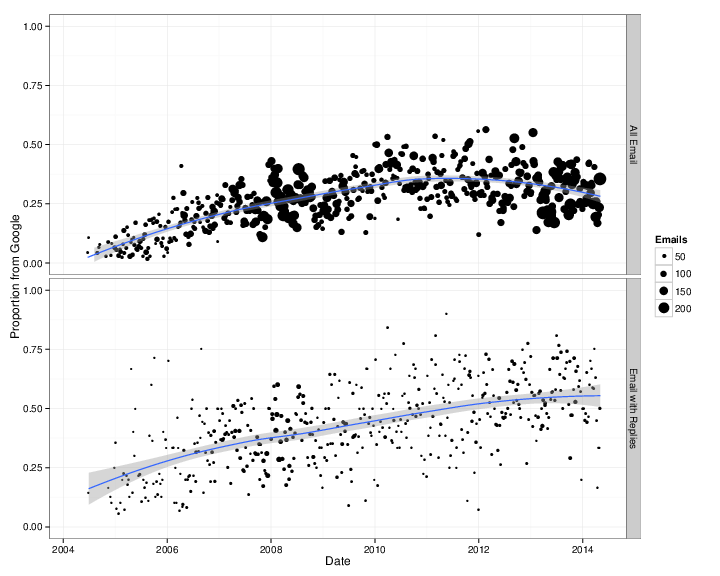
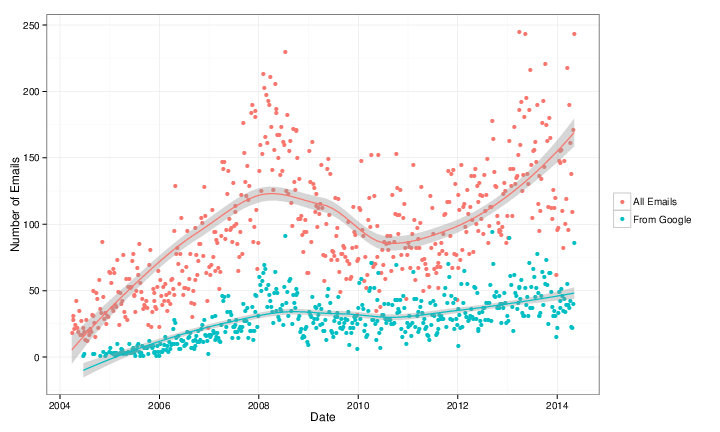
Republished by Slate. Translations available in French (Fran ais), Spanish (Espa ol), Chinese ( ) For almost 15 years, I have run my own email server which I use for all of my non-work correspondence. I do so to keep autonomy, control, and privacy over my email and so that no big company has copies of all of my personal email. A few years ago, I was surprised to find out that my friend Peter Eckersley a very privacy conscious person who is Technology Projects Director at the EFF used Gmail. I asked him why he would willingly give Google copies of all his email. Peter pointed out that if all of your friends use Gmail, Google has your email anyway. Any time I email somebody who uses Gmail and anytime they email me Google has that email. Since our conversation, I have often wondered just how much of my email Google really has. This weekend, I wrote a small program to go through all the email I have kept in my personal inbox since April 2004 (when Gmail was started) to find out. One challenge with answering the question is that many people, like Peter, use Gmail to read, compose, and send email but they configure Gmail to send email from a non-gmail.com From address. To catch these, my program looks through each message s headers that record which computers handled the message on its way to my server and to pick out messages that have traveled through google.com, gmail.com, or googlemail.com. Although I usually filter them, my personal mailbox contains emails sent through a number of mailing lists. Since these mailing lists often hide the true provenance of a message, I exclude all messages that are marked as coming from lists using the (usually invisible) Precedence header. The following graph shows the numbers of emails in my personal inbox each week in red and the subset from Google in blue. Because the number of emails I receive week-to-week tends to vary quite a bit, I ve included a LOESS smoother which shows a moving average over several weeks. Emails, total and from GMail, over timeFrom eyeballing the graph, the answer to seems to be that, although it varies, about a third of the email in my inbox comes from Google! Keep in mind that this is all of my personal email and includes automatic and computer generated mail from banks and retailers, etc. Although it is true that Google doesn t have these messages, it suggests that the proportion of my truly personal email that comes via Google is probably much higher. I would also like to know how much of the email I send goes to Google. I can do this by looking at emails in my inbox that I have replied to. This works if I am willing to assume that if I reply to an email sent from Google, it ends up back at Google. In some ways, doing this addresses the problem with the emails from retailers and banks since I am very unlikely to reply to those emails. In this sense, it also reflects a measure of more truly personal email. I ve broken down the proportions of emails I received that come from Google in the graph below for all email (top) and for emails I have replied to (bottom). In the graphs, the size of the dots represents the total number of emails counted to make that proportion. Once again, I ve included the LOESS moving average. Proportion of emails from GMail over timeThe answer is surprisingly large. Despite the fact that I spend hundreds of dollars a year and hours of work to host my own email server, Google has about half of my personal email! Last year, Google delivered 57% of the emails in my inbox that I replied to. They have delivered more than a third of all the email I ve replied to every year since 2006 and more than half since 2010. On the upside, there is some indication that the proportion is going down. So far this year, only 51% of the emails I ve replied to arrived from Google. The numbers are higher than I imagined and reflect somewhat depressing news. They show how it s complicated to think about privacy and autonomy for communication between parties. I m not sure what to do except encourage others to consider, in the wake of the Snowden revelations and everything else, whether you really want Google to have all your email. And half of mine. If you want to run the analysis on your own, you re welcome to the Python and R code I used to produce the numbers and graphs.

29 April 2014

Russell Coker: Autism and the Treatment of Women Again

Background I ve previously written about the claim that people use Autism as an excuse for bad behavior [1]. In summary it doesn t and such claims instead lead to people not being assessed for Autism. I ve also previously written about empathy and Autism in the context of discussions about conference sexual harassment [2]. The main point is that anyone who s going to blame empathy disorders for the widespread mistreatment of women in society and divert the subject from the actions of average men to men in minority groups isn t demonstrating empathy. Discussions of the actions of average men are so often derailed to cover Autism that the Geek Feminism Wiki has a page about the issue of blaming Autism [3]. The Latest Issue Last year Shanley Kane wrote an informative article for Medium titled What Can Men Do about the treatment of women in the IT industry [4]. It s a good article, I recommend reading it. As an aside @shanley s twitter feed is worth reading [5]. In response to Shanley s article Jeff Atwood wrote an article of the same title this year which covered lots of other things [6]. He writes about Autism but doesn t seem to realise that officially Asperger Syndrome is now Autism according to DSM-V (they decided that separate diagnosis of Autism, Asperger Syndrome, and PDD-NOS were too difficult and merged them). Asperger Syndrome is now a term that refers to historic issues (IE research that was published before DSM-V) and slang use. Gender and the Autism Spectrum Jeff claims that autism skews heavily towards males at a 4:1 ratio and cites the Epidemiology of Autism Wikipedia page as a reference. Firstly that page isn t a great reference, I fixed one major error (which was obviously wrong to anyone who knows anything about Autism and also contradicted the cited reference) in the first section while writing this post. The Wikipedia page cites a PDF about the Epidemiology of Autism that claims the 4.3:1 ratio of boys to girls [7]. However that PDF is a summary of other articles and the one which originated the 4.3:1 claim is behind a paywall. One thing that is worth noting in the PDF is that the section containing the 4.3:1 claim also references claims about correlations between race and Autism and studies contradicting such claims it notes the possibility of ascertainment bias . I think that anyone who reads that section should immediately consider the possibility of ascertainment bias in regard to the gender ratio. Most people who are diagnosed with Autism are diagnosed as children. An Autism diagnosis of a child is quite subjective, an important part is an IQ test (where the psychologist interprets the intent of the child in the many cases where answers aren t clear) to compare social skills with IQ. So whether a child is diagnosed is determined by the psychologist s impression of the child s IQ vs the impression of their social skills. Whether a child is even taken for assessment depends on whether they act in a way that s considered to be obviously different. Any child who is suspected of being on the Autism Spectrum will be compared other children who have been diagnosed (IE mostly boys) and this will probably increase the probability that a boy will be assessed. So an Aspie girl might not be assessed because she acts like other Aspie girls not like the Aspie boys her parents and teachers have seen. The way kids act is not solely determined by neuro-type. Our society expects and encourages boys to be louder than girls and take longer and more frequent turns to speak, this is so widespread that I don t think it s possible for parents to avoid it if their kids are exposed to the outside world. Because of this boys who would be diagnosed with Asperger Syndrome by DSM-IV tend to act in ways that are obviously different from other kids. While the combination of Autism and the the social expectations on girls tends to result in girls who are quiet, shy, and apologetic. The fact that girls are less obviously different and that their differences cause fewer difficulties for parents and teachers makes them less likely to be assessed. Note that the differences in behavior of boys and girls who have been diagnosed is noted by the professionals (and was discussed at a conference on AsperGirls that my wife attended) while the idea that this affects assessment rates is my theory. Jeff also cites the book The Essential Difference: Male And Female Brains And The Truth About Autism by Professor Simon Baron-Cohen (who s (in)famous for his Extreme Male Brain theory). The first thing to note about the Extreme Male Brain theory are that it depends almost entirely on the 4.3:1 ratio of males to females on the Autism Spectrum (which is dubious as I noted above). The only other evidence in support of it is subjective studies of children which suffer from the same cultural issues this is why double blind tests should be used whenever possible. The book Delusions of Gender by Cordelia Fine [8] debunks Simon Baron-Cohen s work among other things. The look inside feature of the Amazon page for Delusions of Gender allows you to read about Simon Baron-Cohen s work [9]. Now even if the Extreme Male Brain theory had any merit it would be a really bad idea to cite it (or a book based on it) if you want to make things better for women in the IT industry. Cordelia s book debunks the science and also shows how such claims about supposed essential difference are taken as exclusionary. The Problem with Jeff Atwood Jeff suggests in his post that men should listen to women. Then he and his followers have a huge flame-war with many women over twitter during which which he tweeted Trying to diversify my follows by following any female voices that engaged me in a civil, constructive way recently . If you only listen to women who agree with you then that doesn t really count as listening to women. When you have a stated policy of only listening to women who agree then it seems to be more about limiting what women may feel free to say around you. The Geek Feminism wiki page about the Tone Argument [10] says the following: One way in which the tone argument frequently manifests itself is as a call for civility. A way to gauge whether a request for civility is sincere or not is to ask whether the person asking for civility has more power along whatever axes are contextually relevant (see Intersectionality) than the person being called incivil , less power, or equal power. Often, people who have the privilege of being listened to and taken seriously level accusations of incivility as a silencing tactic, and label as incivil any speech or behavior that questions their privilege. For example, some men label any feminist thought or speech as hostile or impolite; there is no way for anybody to question male power or privilege without being called rude or aggressive. Likewise, some white people label any critical discussion of race, particularly when initiated by people of color, as incivil. Writing about one topic is also a really good idea. A blog post titled What Can Men Do should be about things that men can do. Not about Autism, speculation about supposed inherent differences between men and women which are based on bad research, gender diversity in various occupations, etc. Following up a post on What Can Men Do with discussion (in blog comments and twitter) about what women should do before they are allowed to join the conversation is ridiculous. Jeff s blog post says that men should listen to women, excluding women based on the tone argument is gross hypocrisy. Swearing Jeff makes a big deal of the fact that Shanley uses some profane language in her tweets. This combines a couple of different ways of silencing women. It s quite common for women to be held to a high standard of ladylike behavior, while men get a free pass on doing the same thing. One example of this is the Geek Feminism article about the results of Sarah Sharp s request for civility in the Linux kernel community [11]. That s not an isolated incident, to the best of my recollection in 20+ years my local Linux Users Group has had only one debate about profanity on mailing lists in that case a woman (who is no longer active in the group) was criticised for using lesser profanity than men used both before and after with no comment (as an experiment I used some gratuitous profanity a couple of weeks later and no-one commented). There is also a common difference in interpretation of expressions of emotion, when a woman seems angry then she invariably has men tell her to change her approach (even when there are obvious reasons for her anger) while when a man is angry the possibility that other people shouldn t make him angry will usually be considered. The issues related to the treatment of women have had a large affect on Shanley s life and her friend s lives. It s quite understandable that she is angry about this. Her use of profanity in tweets seems appropriate to the situation. Other Links Newsweek s Gentlemen in Technology article has a section about Jeff [12], it s interesting to note his history of deleting tweets and editing his post. I presume he will change his post in response to mine and not make any note of the differences. Jacob Kaplan-Moss wrote a good rebuttal to Jeff s post [13]. It s a good article and has some other relevant links that are worth reading.

14 April 2014

Chris Lamb: Race report: Cambridge Duathlon 2014

(This is my first race of the 2014 season.)


I had entered this race in 2013 and found it was effective for focusing winter training. As triathlons do not typically start until May in the UK, scheduling earlier races can be motivating in the colder winter months. I didn't have any clear goals for the race except to blow out the cobwebs and improve on my 2013 time. I couldn't set reasonable or reliable target times after considerable "long & slow" training in the off-season but I did want to test some new equipment and stategies, especially race pacing with a power meter, but also a new wheelset, crankset and helmet. Preparation was both accidentally and deliberately compromised: I did very little race-specific training as my season is based around an entirely different intensity of race, but compounding this I was confined to bed the weekend before. Sleep was acceptable in the preceding days and I felt moderately fresh on race morning. Nutrition-wise, I had porridge and bread with jam for breakfast, a PowerGel before the race, 750ml of PowerBar Perform on the bike along with a "Hydro" PowerGel with caffeine at approximately 30km.
Run 1 (7.5km) A few minutes before the start my race number belt the only truly untested equipment that day refused to tighten. However, I decided that once the race began I would either ignore it or even discard it, risking disqualification. Despite letting everyone go up the road, my first km was still too fast so I dialed down the effort, settling into a "10k" pace and began overtaking other runners. The Fen winds and drag-strip uphill from 3km provided a bit of pacing challenge for someone used to shelter and shorter hills but I kept a metered effort through into transition.
Time
33:01 (4:24/km, T1: 00:47) Last year: 37:47 (5:02/km)
Bike (40km) Although my 2014 bike setup features a power meter, I had not yet had the chance to perform an FTP test outdoors. I was thus was not able to calculate a definitive target power for the bike leg. However, data from my road bike suggested I set a power ceiling of 250W on the longer hills. This was extremely effective in avoiding going "into the red" and compromising the second run. This lends yet more weight to the idea that a power meter in multisport events is "almost like cheating". I was not entirely comfortable with my bike position: not only were my thin sunglasses making me raise my head more than I needed to, I found myself creeping forward onto the nose of my saddle. This is sub-optimal, even if only considering that I am not training in that position. Overall, the bike was uneventful with the only memorable moment provided by a wasp that got stuck between my head and a helmet vent. Coming into transition I didn't feel like I had really pushed myself that hard probably a good sign but the time difference from last year's bike leg (1:16:11) was a little underwhelming.
Time
1:10:45 (T2: 00:58)
Run 2 (7.5km) After leaving transition, my legs were extremely uncooperative and I had great difficulty in pacing myself in the first kilometer. Concentrating hard on reducing my cadence as well as using my rehearsed mental cue, I managed to settle down. The following 4 kilometers were a mental struggle rather than a physical one, modulo having to force a few burps to ease some discomfort, possibly from drinking too much or too fast on the bike. I had planned to "unload" as soon as I reached 6km but I didn't really have it in me. Whilst I am physiologically faster compared to last year, I suspect the lack of threshold-level running over the winter meant the mental component required for digging deep will require some coaxing to return. However, it is said that you have successfully paced a duathlon if the second run faster than the first. On this criterion, this was a success, but it would have been a bonus to have really felt completely completely drained at the end of the day, if only from a neo-Calvinist perspective.
Time
32:46 (4:22/km) / Last year: 38:10 (5:05/km)

Overall
Total time
2:18:19
A race that goes almost entirely to plan is a bit of a paradox there's certainly satisfaction in setting goals and hitting them without issue, but this is a gratification of slow-burning fire rather than the jubilation of a fireworks display. However, it was nice to learn that I managed to finish 5th in my age group despite this race attracting an extremely strong field: as an indicator, the age-group athlete finishing immediately before me was seven minutes faster and the overall winner finished in 1:54:53 (!). The race identified the following areas to work on:
  • Perform an outdoors FTP on my time-trial bike outdoors to develop an optimum power plan.
  • Do a few more brick runs, at least to re-acclimatise the feeling.
  • Schedule another bike fit.
Although not strictly race-related, I also need to find techniques to ensure transporting a bike on public transport is less stressful. (Full results & full 2014 race schedule)

13 April 2014

Jeff Licquia: My Heart Bleeds (or, What s Going On With Heartbleed)

[en] One of the big news stories of the week has been the Heartbleed bug . If you know a techie person, you might have noticed that person looking a bit more stressed and tired than usual since Monday (that was certainly true of me). Some of the discussion might seem a bit confusing and/or scary; what s worse, the non-tech press has started getting some of the details wrong and scare-mongering for readers. So here s my non-techie guide to what all the fuss is about. If you re a techie, this advice isn t for you; chances are, you already know what you should be doing to help fix this. (If you re a techie and you don t know, ask! You might just need a little education on what needs to happen, and there s nothing wrong with that, but you ll be better off asking and possibly looking foolish than you will be if you get hacked.) If you re not inclined to read the whole thing, here are the important points:
  • Don t panic! There are reports of people cleaning out their bank accounts, cutting off their Internet service, buying new computers, etc. If you re thinking about doing anything drastic because you re scared of Heartbleed, don t.
  • You ll probably need to change a lot of your passwords on various sites, but wait until each site you use tells you to.
  • This is mostly a problem for site servers, not PCs or phones or tablets. Unless you re doing something unusual (and you d know if you were), you re fine as long as you update your devices like you usually do. (You do update your devices, right?)
So what happened? There s a notion called a heartbeat signal , where two computers talking to each other say Hey, you there? every so often. This is usually done by computer #1 sending some bit of data to computer #2, and computer #2 sending it back. In this particular situation, the two computers actually send both a bit of data and the length of that bit of data. Some of you might be asking so what happens if computer #1 sends a little bit of data, but lies and says the data is a lot longer than that? In a perfect world, computer #2 would scold computer #1 for lying, and that s what happens now with the bug fix. But before early this week, computer #2 would just trust computer #1 in one very specific case. Now, computers use memory to keep track of stuff they re working on, and they re constantly asking for memory and then giving it back when they re done, so it can be used by something else. So, when you ask for memory, the bit of memory you get might have the results of what the program was doing just a moment ago things like decrypting a credit card using a crypto key, or checking a password. This isn t normally a problem, since it s the same program getting its own memory back. But if it s using this memory to keep track of these heartbeats, and it s been tricked into thinking it needs to send back the word HAT, which is 500 characters long , then character 4 and following is likely to be memory used for something just a moment ago. Most of that recycled memory would be undecipherable junk. But credit cards, crypto keys, and passwords tend to be fairly easy to pick out, unfortunately. And that, by the way, is where the name comes from: the heartbeat signal bleeds data, so Heartbleed . There s been some fascinating commentary on how well this bug has been marketed, by the way; hopefully, we in the techie community will learn something about how to explain problems like this for future incidents. Does this affect every site? No. Only sites using certain newer versions of crypographic software called OpenSSL are affected by this. OpenSSL is very popular; I ve seen estimates that anywhere from a third to a half of all secure Internet sites use it. But not all of those sites will have the bug, since it was only introduced in the last two years. How do we know this? OpenSSL is open source, and is developed in public . Because of that, we know the exact moment when the bug was introduced, when it was released to the world, and when it was fixed. (And, just for the record, it was an honest mistake. Don t go and slam on the poor guy who wrote the code with the bug. It should have been caught by a number of different people, and none of them noticed it, so it s a lot more complicated than it s his fault! pitchforks and torches! ) What should I do? Nothing, yet. Right now, this is mostly a techie problem. Remember that bit about crypto keys? That s the part which puts the little lock icon next to the URL in your browser when you go to your bank s Web site, or to Amazon to buy things, or whatever. The crypto keys make sure that your conversation with your bank about your balance is just between you and your bank. That s also the part which is making techies the world over a little more stressed and tired. You see, we know that the people who found the bug were good guys and helped to get the bug fixed, but we don t know if any bad guys found the bug before this week. And if a bad guy used the bug to extract crypto keys, they would still have those crypto keys, and could still use them even though the original bug is fixed. That would mean that a bad guy could intercept your conversation with your bank / Amazon / whoever. Since we don t know, we have to do the safe thing, and assume that all our keys were in fact stolen, That means we have to redo all our crypto keys. That s a lot of work. And because your password is likely protected with those same crypto keys, if a bad guy has Amazon s key, they d be able to watch you change your password at Amazon. Maybe they didn t even have your old password, but now they have your new one. Oops. You re now less secure than you were. Now, it s important to make sure we re clear: we don t know that this has happened. There s really no way of knowing, short of actually catching a bad guy in the act, and we haven t caught anyone yet. So, this is a safety measure. Thus, the best thing to do is: don t panic. Continue to live life as usual. It might be prudent to put off doing some things for a few days, but I wouldn t even worry so much about that. If you pay your bills online, for example, don t risk paying a bill late out of fear. Remember: so far, we have no evidence yet that anyone s actually doing anything malicious with this bug. At some point, a lot of sites are going to post a notice that looks a lot like this:
We highly recommend our users change the password on their Linux Foundation ID which is used for the logins on most Linux Foundation sites, including our community site, Linux.com for your own security and as part of your own comprehensive effort to update and secure as many of your online credentials as you can.
(That s the notice my employer posted once we had our site in order.) That will be your cue that they ve done the work to redo their crypto keys, and that it s now safe to change your password. A lot of sites will make statements saying, essentially, we don t have a problem . They re probably right. Don t second-guess them; just exhale, slowly, and tick that site off your list of things to worry about. Other sites might not say anything. That s the most worrying part, because it s hard to tell if they re OK or not. If it s an important site to you, the best course of action might be to just ask, or search on Google / Bing / DuckDuckGo / wherever for some kind of statement. What about your site? Yup, I use OpenSSL, and I was vulnerable. But I m the only person who actually logs in to anything on this site. I ve got the bugfix, but I m still in the process of creating new keys. Part of the problem is that everyone else is out there creating new keys at the same time, which creates a bit of a traffic jam. So yeah, if you were thinking of posting your credit card number in a comment, and wanted to make sure you did it securely well, don t do that. EVER. And not because of Heartbleed.

C.J. Adams-Collier: When was the last time you upgraded from squeeze to wheezy?

Wow. 3G delta. I haven t booted this laptop for a while I think I m finally ready to make the move from gnome2 to gnome3. There are bits that still annoy me, but I think it s off to a good start. Upgrading perl from 5.10 to 5.14.

cjac@calcifer:~$ sudo apt-get dist-upgrade
Reading package lists... Done
Building dependency tree       
Reading state information... Done
Calculating upgrade... Done
The following packages will be REMOVED:
  at-spi capplets-data compiz compiz-gnome compiz-gtk defoma deskbar-applet g++-4.3 gcc-4.3 gcj-4.4-base gcj-4.4-jre gcj-4.4-jre-headless gcj-4.4-jre-lib
  gdm3 gir1.0-clutter-1.0 gir1.0-freedesktop gir1.0-glib-2.0 gir1.0-gstreamer-0.10 gir1.0-gtk-2.0 gir1.0-json-glib-1.0 glade-gnome gnome-about
  gnome-accessibility gnome-applets gnome-core gnome-panel gnome-utils-common lib32readline5-dev libbrasero-media0 libclass-mop-perl libdb4.7-java
  libdb4.8-dev libdevhelp-1-1 libdigest-sha1-perl libdirectfb-dev libebook1.2-9 libecal1.2-7 libedata-book1.2-2 libedata-cal1.2-7 libedataserverui1.2-8
  libepc-1.0-2 libepc-ui-1.0-2 libept1 libgcj10 libgcj10-awt libgd2-noxpm libgstfarsight0.10-0 libgtkhtml-editor0 libjpeg62-dev libmetacity-private0
  libmono-accessibility1.0-cil libmono-bytefx0.7.6.1-cil libmono-cairo1.0-cil libmono-cil-dev libmono-corlib1.0-cil libmono-cscompmgd7.0-cil
  libmono-data-tds1.0-cil libmono-data1.0-cil libmono-debugger-soft0.0-cil libmono-getoptions1.0-cil libmono-i18n-west1.0-cil libmono-i18n1.0-cil
  libmono-ldap1.0-cil libmono-microsoft7.0-cil libmono-npgsql1.0-cil libmono-oracle1.0-cil libmono-peapi1.0-cil libmono-posix1.0-cil
  libmono-relaxng1.0-cil libmono-security1.0-cil libmono-sharpzip0.6-cil libmono-sharpzip0.84-cil libmono-sqlite1.0-cil libmono-system-data1.0-cil
  libmono-system-ldap1.0-cil libmono-system-messaging1.0-cil libmono-system-runtime1.0-cil libmono-system-web1.0-cil libmono-system1.0-cil
  libmono-webbrowser0.5-cil libmono-winforms1.0-cil libmono1.0-cil libmtp8 libnautilus-extension1 libpango1.0-common libperl5.10 libpolkit-gtk-1-0
  libpulse-browse0 librpm1 librpmbuild1 libsdl1.2-dev libsdl1.2debian-pulseaudio libseed0 libstdc++6-4.3-dev libtelepathy-farsight0 libupnp3 libvlccore4
  libxmlrpc-c3 linphone-nox linux-headers-2.6.32-5-amd64 linux-sound-base metacity mono-2.0-devel mono-devel mysql-client-5.1 mysql-query-browser
  mysql-server-5.1 mysql-server-core-5.1 openoffice.org-base-core openoffice.org-core openoffice.org-gcj openoffice.org-report-builder-bin
  openoffice.org-style-andromeda php5-suhosin portmap python-beagle python-brasero python-docky python-encutils python-evince python-gnomeapplet
  python-gtop python-mediaprofiles python-metacity python-totem-plparser seahorse-plugins smbfs speedbar totem-coherence tqsllib1c2a unixcw vlc
  xserver-xorg-video-nv
The following NEW packages will be installed:
  accountsservice acl aisleriot apg aptdaemon-data aptitude-common asterisk-core-sounds-en asterisk-modules asterisk-moh-opsound-gsm at-spi2-core
  ax25-node bluez btrfs-tools caribou caribou-antler chromium chromium-inspector colord console-setup console-setup-linux cpp-4.6 cpp-4.7 crda
  cryptsetup-bin cups-filters db-util db5.1-util dconf-gsettings-backend dconf-service dconf-tools distro-info-data docutils-common docutils-doc enchant
  extlinux finger folks-common fonts-cantarell fonts-droid fonts-freefont-ttf fonts-horai-umefont fonts-lg-aboriginal fonts-liberation fonts-lyx
  fonts-opensymbol fonts-sil-gentium fonts-sil-gentium-basic fonts-sipa-arundina fonts-stix fonts-takao fonts-takao-gothic fonts-takao-mincho
  fonts-thai-tlwg fonts-tlwg-garuda fonts-tlwg-kinnari fonts-tlwg-loma fonts-tlwg-mono fonts-tlwg-norasi fonts-tlwg-purisa fonts-tlwg-sawasdee
  fonts-tlwg-typewriter fonts-tlwg-typist fonts-tlwg-typo fonts-tlwg-umpush fonts-tlwg-waree fonts-umeplus fuse g++-4.7 g++-4.7-multilib gcc-4.6
  gcc-4.6-base gcc-4.7 gcc-4.7-base gcc-4.7-multilib gcj-4.7-base gcj-4.7-jre gcj-4.7-jre-headless gcj-4.7-jre-lib gconf-service gcr
  gir1.2-accountsservice-1.0 gir1.2-atk-1.0 gir1.2-atspi-2.0 gir1.2-caribou-1.0 gir1.2-clutter-1.0 gir1.2-clutter-gst-1.0 gir1.2-cogl-1.0
  gir1.2-coglpango-1.0 gir1.2-evince-3.0 gir1.2-folks-0.6 gir1.2-freedesktop gir1.2-gck-1 gir1.2-gconf-2.0 gir1.2-gcr-3 gir1.2-gdesktopenums-3.0
  gir1.2-gdkpixbuf-2.0 gir1.2-gee-1.0 gir1.2-gkbd-3.0 gir1.2-glib-2.0 gir1.2-gmenu-3.0 gir1.2-gnomebluetooth-1.0 gir1.2-gnomekeyring-1.0
  gir1.2-gst-plugins-base-0.10 gir1.2-gstreamer-0.10 gir1.2-gtk-3.0 gir1.2-gtkclutter-1.0 gir1.2-gtksource-3.0 gir1.2-gtop-2.0 gir1.2-gucharmap-2.90
  gir1.2-javascriptcoregtk-3.0 gir1.2-json-1.0 gir1.2-mutter-3.0 gir1.2-networkmanager-1.0 gir1.2-notify-0.7 gir1.2-panelapplet-4.0 gir1.2-pango-1.0
  gir1.2-peas-1.0 gir1.2-polkit-1.0 gir1.2-rb-3.0 gir1.2-soup-2.4 gir1.2-telepathyglib-0.12 gir1.2-telepathylogger-0.2 gir1.2-totem-1.0
  gir1.2-totem-plparser-1.0 gir1.2-upowerglib-1.0 gir1.2-vte-2.90 gir1.2-webkit-3.0 gir1.2-wnck-3.0 gir1.2-xkl-1.0 git-man gjs gkbd-capplet glchess
  glib-networking glib-networking-common glib-networking-services glines gnect gnibbles gnobots2 gnome-bluetooth gnome-contacts gnome-control-center-data
  gnome-desktop3-data gnome-font-viewer gnome-icon-theme-extras gnome-icon-theme-symbolic gnome-online-accounts gnome-packagekit gnome-packagekit-data
  gnome-shell gnome-shell-common gnome-sudoku gnome-sushi gnome-themes-standard gnome-themes-standard-data gnome-user-share gnome-video-effects gnomine
  gnotravex gnotski gnuplot gnuplot-nox grilo-plugins-0.1 groff growisofs gsettings-desktop-schemas gstreamer0.10-gconf gtali guile-2.0-libs gvfs-common
  gvfs-daemons gvfs-libs hardening-includes hwdata iagno ienglish-common imagemagick-common ioquake3 ioquake3-server iputils-tracepath ipxe-qemu iw
  keyutils kmod krb5-locales lib32itm1 lib32quadmath0 lib32tinfo-dev lib32tinfo5 libaacplus2 libaacs0 libabiword-2.9 libaccountsservice0 libamd2.2.0
  libapache-pom-java libapol4 libapt-inst1.5 libapt-pkg4.12 libaqbanking-plugins-libgwenhywfar60 libaqbanking34 libaqbanking34-plugins libaqhbci20
  libaqofxconnect7 libarchive12 libasprintf0c2 libassuan0 libatk-adaptor libatk-adaptor-data libatk-bridge2.0-0 libatkmm-1.6-1 libatkmm-1.6-dev
  libatspi2.0-0 libaudiofile1 libavahi-ui-gtk3-0 libavcodec53 libavcodec54 libavformat53 libavformat54 libavutil51 libbabl-0.1-0 libbind9-80 libbison-dev
  libblas3 libbluray1 libboost-iostreams1.49.0 libboost-program-options1.49.0 libboost-python1.49.0 libboost-serialization1.49.0 libboost-thread1.49.0
  libbrasero-media3-1 libcairo-gobject2 libcairo-script-interpreter2 libcamel-1.2-33 libcanberra-dev libcanberra-gtk3-0 libcanberra-gtk3-module
  libcanberra-pulse libcapi20-3 libcaribou-common libcaribou-gtk-module libcaribou-gtk3-module libcaribou0 libccrtp0 libcdio-cdda1 libcdio-paranoia1
  libcdio13 libcfg4 libchamplain-0.12-0 libchamplain-gtk-0.12-0 libcheese-gtk21 libcheese3 libclass-factory-util-perl libclass-isa-perl libclass-load-perl
  libclass-load-xs-perl libclutter-1.0-common libclutter-gst-1.0-0 libclutter-gtk-1.0-0 libclutter-imcontext-0.1-0 libclutter-imcontext-0.1-bin
  libcluttergesture-0.0.2-0 libcmis-0.2-0 libcogl-common libcogl-pango0 libcogl9 libcolord1 libcommons-parent-java libconfdb4 libcoroipcc4 libcoroipcs4
  libcpg4 libcryptsetup4 libcrystalhd3 libcupsfilters1 libcw3 libdata-alias-perl libdatetime-format-builder-perl libdatetime-format-iso8601-perl
  libdb-java libdb5.1 libdb5.1-dev libdb5.1-java libdb5.1-java-jni libdbus-c++-1-0 libdbus-glib1.0-cil libdbus1.0-cil libdconf0 libdee-1.0-4
  libdevel-partialdump-perl libdevhelp-3-0 libdevmapper-event1.02.1 libdistro-info-perl libdmapsharing-3.0-2 libdns88 libdotconf1.0 libdvbpsi7
  libebackend-1.2-2 libebml3 libebook-1.2-13 libecal-1.2-11 libecore1 libedata-book-1.2-13 libedata-cal-1.2-15 libedataserver-1.2-16
  libedataserverui-3.0-1 libeina1 libemail-valid-perl libencode-locale-perl libepc-1.0-3 libepc-ui-1.0-3 libept1.4.12 libescpr1 libev4
  libeval-closure-perl libevdocument3-4 libevent-2.0-5 libevent-perl libevs4 libevview3-3 libexiv2-12 libexosip2-7 libexporter-lite-perl
  libexttextcat-data libexttextcat0 libfakechroot libfarstream-0.1-0 libfdk-aac0 libfdt1 libfile-basedir-perl libfile-desktopentry-perl
  libfile-fcntllock-perl libfile-listing-perl libfile-mimeinfo-perl libfltk-images1.3 libfltk1.3 libfolks-eds25 libfolks-telepathy25 libfolks25
  libfont-afm-perl libgail-3-0 libgcj13 libgcj13-awt libgck-1-0 libgconf-2-4 libgconf2-doc libgcr-3-1 libgcr-3-common libgd2-xpm libgdata13
  libgdata2.1-cil libgdict-common libgdk-pixbuf2.0-0 libgdk-pixbuf2.0-common libgdk-pixbuf2.0-dev libgegl-0.2-0 libgeocode-glib0 libgettextpo0 libgexiv2-1
  libgirepository-1.0-1 libgjs0b libgkeyfile1.0-cil libgladeui-2-0 libgladeui-common libglapi-mesa libglew1.7 libglib2.0-bin libgmime-2.6-0
  libgmime2.6-cil libgmp10 libgnome-bluetooth10 libgnome-desktop-3-2 libgnome-keyring-common libgnome-media-profiles-3.0-0 libgnome-menu-3-0 libgnomekbd7
  libgnutls-openssl27 libgnutlsxx27 libgoa-1.0-0 libgoa-1.0-common libgphoto2-l10n libgraphite2-2.0.0 libgrilo-0.1-0 libgs9 libgs9-common libgssdp-1.0-3
  libgstreamer-plugins-bad0.10-0 libgtk-3-0 libgtk-3-bin libgtk-3-common libgtk-3-dev libgtk-3-doc libgtk-sharp-beans-cil libgtk-vnc-2.0-0
  libgtkhtml-4.0-0 libgtkhtml-4.0-common libgtkhtml-editor-4.0-0 libgtkmm-3.0-1 libgtksourceview-3.0-0 libgtksourceview-3.0-common libgucharmap-2-90-7
  libgudev1.0-cil libgupnp-1.0-4 libgupnp-av-1.0-2 libgupnp-igd-1.0-4 libgusb2 libgvnc-1.0-0 libgweather-3-0 libgwenhywfar-data libgwenhywfar60 libgxps2
  libhcrypto4-heimdal libheimbase1-heimdal libhtml-form-perl libhtml-format-perl libhttp-cookies-perl libhttp-daemon-perl libhttp-date-perl
  libhttp-message-perl libhttp-negotiate-perl libhunspell-1.3-0 libicu48 libimobiledevice2 libio-aio-perl libisc84 libisccc80 libisccfg82 libiscsi1
  libiso9660-8 libisoburn1 libitm1 libjavascriptcoregtk-1.0-0 libjavascriptcoregtk-3.0-0 libjbig0 libjs-sphinxdoc libjs-underscore libjson0 libjte1
  libkadm5clnt-mit8 libkadm5srv-mit8 libkarma0 libkdb5-6 libkmod2 libkpathsea6 liblapack3 liblavfile-2.0-0 liblavjpeg-2.0-0 liblavplay-2.0-0 liblcms2-2
  liblensfun-data liblensfun0 liblinear-tools liblinear1 liblinphone4 liblockfile-bin liblogsys4 liblvm2app2.2 liblwp-mediatypes-perl
  liblwp-protocol-https-perl liblwres80 liblzma5 libmaa3 libmagick++5 libmagickcore5 libmagickcore5-extra libmagickwand5 libmath-bigint-perl
  libmath-round-perl libmatroska5 libmediastreamer1 libmhash2 libminiupnpc5 libmission-control-plugins0 libmjpegutils-2.0-0 libmodule-implementation-perl
  libmodule-runtime-perl libmono-2.0-1 libmono-2.0-dev libmono-accessibility4.0-cil libmono-cairo4.0-cil libmono-codecontracts4.0-cil
  libmono-compilerservices-symbolwriter4.0-cil libmono-corlib4.0-cil libmono-csharp4.0-cil libmono-custommarshalers4.0-cil libmono-data-tds4.0-cil
  libmono-debugger-soft2.0-cil libmono-debugger-soft4.0-cil libmono-http4.0-cil libmono-i18n-cjk4.0-cil libmono-i18n-mideast4.0-cil
  libmono-i18n-other4.0-cil libmono-i18n-rare4.0-cil libmono-i18n-west4.0-cil libmono-i18n4.0-all libmono-i18n4.0-cil libmono-ldap4.0-cil
  libmono-management4.0-cil libmono-messaging-rabbitmq4.0-cil libmono-messaging4.0-cil libmono-microsoft-build-engine4.0-cil
  libmono-microsoft-build-framework4.0-cil libmono-microsoft-build-tasks-v4.0-4.0-cil libmono-microsoft-build-utilities-v4.0-4.0-cil
  libmono-microsoft-csharp4.0-cil libmono-microsoft-visualc10.0-cil libmono-microsoft-web-infrastructure1.0-cil libmono-npgsql4.0-cil
  libmono-opensystem-c4.0-cil libmono-oracle4.0-cil libmono-peapi4.0-cil libmono-posix4.0-cil libmono-rabbitmq4.0-cil libmono-relaxng4.0-cil
  libmono-security4.0-cil libmono-sharpzip4.84-cil libmono-simd4.0-cil libmono-sqlite4.0-cil libmono-system-componentmodel-composition4.0-cil
  libmono-system-componentmodel-dataannotations4.0-cil libmono-system-configuration-install4.0-cil libmono-system-configuration4.0-cil
  libmono-system-core4.0-cil libmono-system-data-datasetextensions4.0-cil libmono-system-data-linq4.0-cil libmono-system-data-services-client4.0-cil
  libmono-system-data-services4.0-cil libmono-system-data4.0-cil libmono-system-design4.0-cil libmono-system-drawing-design4.0-cil
  libmono-system-drawing4.0-cil libmono-system-dynamic4.0-cil libmono-system-enterpriseservices4.0-cil libmono-system-identitymodel-selectors4.0-cil
  libmono-system-identitymodel4.0-cil libmono-system-ldap4.0-cil libmono-system-management4.0-cil libmono-system-messaging4.0-cil
  libmono-system-net4.0-cil libmono-system-numerics4.0-cil libmono-system-runtime-caching4.0-cil libmono-system-runtime-durableinstancing4.0-cil
  libmono-system-runtime-serialization-formatters-soap4.0-cil libmono-system-runtime-serialization4.0-cil libmono-system-runtime4.0-cil
  libmono-system-security4.0-cil libmono-system-servicemodel-discovery4.0-cil libmono-system-servicemodel-routing4.0-cil
  libmono-system-servicemodel-web4.0-cil libmono-system-servicemodel4.0-cil libmono-system-serviceprocess4.0-cil libmono-system-transactions4.0-cil
  libmono-system-web-abstractions4.0-cil libmono-system-web-applicationservices4.0-cil libmono-system-web-dynamicdata4.0-cil
  libmono-system-web-extensions-design4.0-cil libmono-system-web-extensions4.0-cil libmono-system-web-routing4.0-cil libmono-system-web-services4.0-cil
  libmono-system-web4.0-cil libmono-system-windows-forms-datavisualization4.0-cil libmono-system-windows-forms4.0-cil libmono-system-xaml4.0-cil
  libmono-system-xml-linq4.0-cil libmono-system-xml4.0-cil libmono-system4.0-cil libmono-tasklets4.0-cil libmono-web4.0-cil libmono-webbrowser2.0-cil
  libmono-webbrowser4.0-cil libmono-webmatrix-data4.0-cil libmono-windowsbase4.0-cil libmount1 libmozjs10d libmozjs17d libmozjs185-1.0 libmpeg2encpp-2.0-0
  libmplex2-2.0-0 libmtdev1 libmtp-common libmtp-runtime libmtp9 libmupen64plus2 libmusicbrainz-discid-perl libmusicbrainz5-0 libmutter0 libmx-1.0-2
  libmx-bin libmx-common libmysqlclient18 libnatpmp1 libnautilus-extension1a libnet-domain-tld-perl libnet-http-perl libnet-ip-minimal-perl libnetcf1
  libnetfilter-conntrack3 libnettle4 libnewtonsoft-json4.5-cil libnice10 libnl-3-200 libnl-genl-3-200 libnl-route-3-200 libnm-glib4 libnm-gtk-common
  libnm-gtk0 libnm-util2 libnotify4 libnspr4 libnss-winbind libnss3 libnuma1 libnunit2.6-cil liboauth0 libodbc1 liboobs-1-5 libopal3.10.4 libopenal-data
  libopus0 libosip2-7 libp11-2 libp11-kit-dev libp11-kit0 libpackage-stash-xs-perl libpackagekit-glib2-14 libpam-cap libpam-modules-bin libpam-winbind
  libpanel-applet-4-0 libparams-classify-perl libpcre3-dev libpcrecpp0 libpeas-1.0-0 libpeas-common libperl5.14 libpipeline1 libpload4 libpodofo0.9.0
  libpoe-component-resolver-perl libpoppler-glib8 libpoppler19 libportsmf0 libpostproc52 libprocps0 libpst4 libpt2.10.4 libptexenc1 libpython2.7
  libqt4-declarative libqtassistantclient4 libqtdbus4 libqtwebkit4 libquadmath0 libquicktime2 libquorum4 libquvi-scripts libquvi7 libraptor2-0 librasqal3
  libraw5 libregexp-reggrp-perl libreoffice libreoffice-base libreoffice-base-core libreoffice-calc libreoffice-common libreoffice-core libreoffice-draw
  libreoffice-emailmerge libreoffice-evolution libreoffice-filter-binfilter libreoffice-filter-mobiledev libreoffice-gnome libreoffice-gtk
  libreoffice-help-en-us libreoffice-impress libreoffice-java-common libreoffice-math libreoffice-officebean libreoffice-report-builder-bin
  libreoffice-style-galaxy libreoffice-style-tango libreoffice-writer libresid-builder0c2a librest-0.7-0 librest-extras-0.7-0 librhythmbox-core6 librpm3
  librpmbuild3 librpmio3 librpmsign1 libruby1.9.1 libsaamf3 libsackpt3 libsaclm3 libsaevt3 libsalck3 libsam4 libsamsg4 libsane-common
  libsane-extras-common libsatmr3 libsbsms10 libseed-gtk3-0 libsidplay2 libsigsegv2 libsocialweb-client2 libsocialweb-common libsocialweb-service
  libsocialweb0 libsocket-getaddrinfo-perl libsocket-perl libsonic0 libsoundtouch0 libsox2 libspeechd2 libspice-client-glib-2.0-1
  libspice-client-gtk-2.0-1 libspice-server1 libssl-doc libssl1.0.0 libstdc++6-4.7-dev libsvm-tools libswitch-perl libswscale2 libsystemd-daemon0
  libsystemd-login0 libtagc0 libtelepathy-farstream2 libtelepathy-logger2 libtest-warn-perl libtinfo-dev libtinfo5 libtirpc1 libtokyocabinet9 libtotem-pg4
  libtotem0 libtqsllib1 libtracker-sparql-0.14-0 libtree-dagnode-perl libts-dev libucommon5 libumfpack5.4.0 libunique-3.0-0 libupnp6 libusbredirhost1
  libusbredirparser0 libv4lconvert0 libverto-libev1 libverto1 libvisio-0.0-0 libvlccore5 libvo-aacenc0 libvo-amrwbenc0 libvorbisidec1 libvotequorum4
  libvpx1 libvte-2.90-9 libvte-2.90-common libwacom-common libwacom2 libwebkitgtk-1.0-0 libwebkitgtk-1.0-common libwebkitgtk-3.0-0 libwebkitgtk-3.0-common
  libwebp2 libwebrtc-audio-processing-0 libwildmidi-config libwireshark-data libwireshark2 libwiretap2 libwnck-3-0 libwnck-3-common libwpd-0.9-9
  libwpg-0.2-2 libwps-0.2-2 libwsutil2 libwv-1.2-4 libwww-robotrules-perl libx11-doc libx11-protocol-perl libx264-123 libx264-124 libx264-130 libx264-132
  libxalan2-java libxcb-composite0 libxcb-glx0 libxcb-shape0 libxcb-shm0-dev libxcb-util0 libxen-4.1 libxml-commons-external-java
  libxml-commons-resolver1.1-java libxml-sax-base-perl libxmlrpc-c++4 libxmlrpc-core-c3 libxz-java libyajl2 libyaml-0-2 libyaml-perl libyelp0 libzrtpcpp2
  libzvbi-common libzvbi0 lightsoff linphone-nogtk linux-headers-3.2.0-4-amd64 linux-headers-3.2.0-4-common linux-headers-amd64 linux-image-3.2.0-4-amd64
  linux-image-amd64 linux-kbuild-3.2 live-boot-doc live-config-doc live-manual-html mahjongg memtest86+ minissdpd mono-4.0-gac mono-dmcs mscompress
  multiarch-support mupen64plus-audio-all mupen64plus-audio-sdl mupen64plus-data mupen64plus-input-all mupen64plus-input-sdl mupen64plus-rsp-all
  mupen64plus-rsp-hle mupen64plus-rsp-z64 mupen64plus-ui-console mupen64plus-video-all mupen64plus-video-arachnoid mupen64plus-video-glide64
  mupen64plus-video-rice mupen64plus-video-z64 mutter-common mysql-client-5.5 mysql-server-5.5 mysql-server-core-5.5 mythes-en-us openarena-081-maps
  openarena-081-misc openarena-081-players openarena-081-players-mature openarena-081-textures openarena-085-data openarena-088-data packagekit
  packagekit-backend-aptcc packagekit-tools planner-data planner-doc poppler-data printer-driver-all printer-driver-c2050 printer-driver-c2esp
  printer-driver-cjet printer-driver-escpr printer-driver-foo2zjs printer-driver-gutenprint printer-driver-hpcups printer-driver-hpijs
  printer-driver-m2300w printer-driver-min12xxw printer-driver-pnm2ppa printer-driver-postscript-hp printer-driver-ptouch printer-driver-pxljr
  printer-driver-sag-gdi printer-driver-splix psutils python-aptdaemon.gtk3widgets python-aptdaemon.gtkwidgets python-bzrlib python-dbus-dev
  python-debianbts python-defer python-dnspython python-fpconst python-gi python-gi-cairo python-gi-dev python-gobject-2 python-gobject-2-dev
  python-keyring python-launchpadlib python-lazr.restfulclient python-lazr.uri python-liblarch python-liblarch-gtk python-magic python-oauth
  python-packagekit python-pyatspi2 python-pyparsing python-repoze.lru python-routes python-setools python-simplejson python-soappy python-speechd
  python-spice-client-gtk python-wadllib python-webob python-zeitgeist python2.7 python2.7-dev python2.7-minimal qdbus quadrapassel remmina-common
  rhythmbox-data rpcbind rtkit ruby ruby1.9.1 shotwell-common smartdimmer software-properties-common sound-theme-freedesktop speech-dispatcher
  sphinx-common sphinx-doc swell-foop syslinux-themes-debian syslinux-themes-debian-wheezy tdb-tools telepathy-haze telepathy-logger telepathy-rakia
  tex-gyre ttf-marvosym wireless-regdb xbrlapi xorg-sgml-doctools xorriso xserver-xorg-input-mouse xserver-xorg-input-vmmouse xulrunner-17.0 yelp-xsl
  zeitgeist-core zenity-common
The following packages have been kept back:
  acroread-debian-files db4.8-util hibernate ia32-libs ia32-libs-gtk libboost-dev libboost-serialization-dev opensc wine
The following packages will be upgraded:
  abcde abiword abiword-common abiword-plugin-grammar abiword-plugin-mathview acpi acpi-fakekey acpi-support acpi-support-base acpid acroread-data
  acroread-dictionary-en acroread-l10n-en adduser alacarte alsa-base alsa-utils amb-plugins anacron analog ant ant-optional apache2 apache2-doc
  apache2-mpm-prefork apache2-utils apache2.2-bin apache2.2-common app-install-data apt apt-file apt-utils apt-xapian-index aptdaemon aptitude
  aqbanking-tools aspell aspell-en asterisk asterisk-config asterisk-core-sounds-en-gsm asterisk-doc asterisk-voicemail astyle at audacity audacity-data
  augeas-lenses augeas-tools autoconf autoconf-doc automake automake1.9 autopoint autotools-dev avahi-autoipd avahi-daemon avidemux avidemux-common
  avidemux-plugins aview ax25-tools banshee baobab base-files base-passwd bash bash-completion bc bind9-doc bind9-host bind9utils binfmt-support binutils
  bison bluez-cups bogofilter bogofilter-bdb bogofilter-common brasero brasero-common bridge-utils browser-plugin-gnash bsd-mailx bsdmainutils bsdutils
  busybox buzztard buzztard-data bwidget bzip2 bzr bzrtools ca-certificates calibre calibre-bin ccache cd-discid cdebootstrap cdparanoia cdrdao
  checkpolicy cheese cheese-common chromium-browser chromium-browser-inspector cifs-utils cl-asdf cli-common clisp comerr-dev common-lisp-controller
  console-common console-data console-tools consolekit coreutils cowbuilder cowdancer cpio cpp cpp-4.4 cpufrequtils cracklib-runtime crawl-common
  crawl-tiles cron cryptsetup cups cups-bsd cups-client cups-common cups-driver-gutenprint cups-pk-helper cups-ppdc cupsddk curl curlftpfs cvs cw dash
  dasher dasher-data dbus dbus-x11 dc dcraw dctrl-tools debconf debconf-i18n debhelper debian-archive-keyring debian-faq debian-keyring debianutils debirf
  debootstrap desktop-base desktop-file-utils devhelp devhelp-common devscripts dialog dict dictionaries-common diffstat diffutils djtools dkms dmidecode
  dmsetup dnsmasq-base dnsutils doc-debian docbook docbook-dsssl docbook-to-man docbook-utils docbook-xml docbook-xsl docbook-xsl-doc-html docky dosemu
  dosfstools dpatch dpkg dpkg-dev dput dvd+rw-tools dvi2ps dynagen dynamips e2fslibs e2fsprogs ebtables ed eject ekiga emacs23-bin-common emacs23-common
  emacs23-nox emacsen-common emdebian-archive-keyring empathy empathy-common eog epiphany-browser epiphany-browser-data epiphany-extensions esound-common
  espeak espeak-data ethtool evince evince-common evolution evolution-common evolution-data-server evolution-data-server-common evolution-exchange
  evolution-plugins evolution-webcal exif exiftags exim4 exim4-base exim4-config exim4-daemon-light exiv2 f-spot fakechroot fakeroot fancontrol fceu
  fcrackzip fdupes feynmf file file-roller finch findutils firmware-iwlwifi firmware-linux-free firmware-linux-nonfree flac flashrom fldigi flex
  fontconfig fontconfig-config foo2zjs foomatic-db foomatic-db-engine foomatic-db-gutenprint foomatic-filters fping freedesktop-sound-theme freeglut3
  freetds-common ftp fuse-utils g++ g++-4.4 g++-4.4-multilib g++-multilib gawk gcalctool gcc gcc-4.4 gcc-4.4-base gcc-4.4-doc gcc-4.4-multilib
  gcc-doc-base gcc-multilib gcj-jre gcj-jre-headless gconf-defaults-service gconf-editor gconf2 gconf2-common gddrescue gdebi gdebi-core gedit
  gedit-common gedit-plugins genisoimage geoclue geoclue-hostip geoclue-localnet geoclue-manual geoclue-yahoo geoip-database gettext gettext-base
  ghostscript ghostscript-cups gimp gimp-data git git-buildpackage git-core git-svn gitk gksu glade gnash gnash-common gnash-opengl
  gnome-accessibility-themes gnome-applets-data gnome-backgrounds gnome-cards-data gnome-common gnome-control-center gnome-control-center-dev
  gnome-desktop-data gnome-dictionary gnome-disk-utility gnome-do gnome-do-plugins gnome-doc-utils gnome-games gnome-games-data gnome-games-extra-data
  gnome-icon-theme gnome-js-common gnome-keyring gnome-mag gnome-media gnome-menus gnome-nettool gnome-orca gnome-panel-data gnome-pkg-tools
  gnome-power-manager gnome-rdp gnome-screensaver gnome-screenshot gnome-search-tool gnome-session gnome-session-bin gnome-session-canberra
  gnome-session-common gnome-settings-daemon gnome-settings-daemon-dev gnome-system-log gnome-system-monitor gnome-system-tools gnome-terminal
  gnome-terminal-data gnome-user-guide gnomint gnu-fdisk gnucash-docs gnuchess gnumeric gnumeric-common gnupg gnupg-agent gocr google-talkplugin gparted
  gpgv gpredict gpscorrelate grep groff-base grub-common grub-legacy gsfonts-x11 gsmartcontrol gstreamer0.10-alsa gstreamer0.10-buzztard
  gstreamer0.10-buzztard-doc gstreamer0.10-doc gstreamer0.10-ffmpeg gstreamer0.10-ffmpeg-dbg gstreamer0.10-fluendo-mp3 gstreamer0.10-gnonlin
  gstreamer0.10-gnonlin-dbg gstreamer0.10-gnonlin-doc gstreamer0.10-nice gstreamer0.10-plugins-bad gstreamer0.10-plugins-bad-dbg
  gstreamer0.10-plugins-bad-doc gstreamer0.10-plugins-base gstreamer0.10-plugins-base-apps gstreamer0.10-plugins-base-dbg gstreamer0.10-plugins-base-doc
  gstreamer0.10-plugins-good gstreamer0.10-plugins-good-dbg gstreamer0.10-plugins-good-doc gstreamer0.10-plugins-ugly gstreamer0.10-plugins-ugly-dbg
  gstreamer0.10-plugins-ugly-doc gstreamer0.10-pulseaudio gstreamer0.10-tools gstreamer0.10-x gtg gthumb gthumb-data gtk2-engines gtk2-engines-pixbuf
  gucharmap guile-1.6 guile-1.6-libs guile-1.8-libs gvfs gvfs-backends gvfs-bin gzip hal hamster-applet hardinfo hddtemp hdparm hfsprogs hostname hp-ppd
  hpijs hplip hplip-cups hplip-data htmldoc htmldoc-common iamerican ibritish iceweasel ifupdown ijsgutenprint imagemagick imagemagick-doc info
  initramfs-tools initscripts inkscape insserv install-info installation-report intltool iotop iproute ipsec-tools iptables iptraf iputils-ping
  ircd-hybrid irssi isc-dhcp-client isc-dhcp-common isc-dhcp-server iscsitarget-dkms iso-codes ispell jack jadetex java-common jigdo-file keyanalyze
  keyboard-configuration keychain klibc-utils kpartx krb5-admin-server krb5-auth-dialog krb5-config krb5-doc krb5-kdc krb5-kdc-ldap krb5-multidev
  krb5-pkinit krb5-user lacheck lame latex-beamer latex-xcolor less lesstif2 lesstif2-dev lib32asound2 lib32bz2-1.0 lib32gcc1 lib32gomp1 lib32ncurses5
  lib32ncurses5-dev lib32nss-mdns lib32readline5 lib32stdc++6 lib32v4l-0 lib32z1 lib32z1-dev liba52-0.7.4 libaa1 libaa1-dev libacl1 libaften0
  libaiksaurus-1.2-0c2a libaiksaurus-1.2-data libaiksaurusgtk-1.2-0c2a libaio1 libalgorithm-diff-xs-perl libany-moose-perl libanyevent-perl libao-common
  libao4 libapache-dbi-perl libapache2-mod-apreq2 libapache2-mod-dnssd libapache2-mod-perl2 libapache2-mod-php5 libapache2-mod-python
  libapache2-request-perl libappconfig-perl libapr1 libapreq2 libaprutil1 libaprutil1-dbd-sqlite3 libaprutil1-ldap libapt-pkg-perl libaqbanking-data
  libarchive-zip-perl libart-2.0-2 libart-2.0-dev libart2.0-cil libasn1-8-heimdal libasound2 libasound2-dev libasound2-plugins libaspell15 libass4
  libasync-interrupt-perl libasyncns0 libatasmart4 libatk1.0-0 libatk1.0-data libatk1.0-dev libatk1.0-doc libatspi1.0-0 libattr1 libaudio-dev libaudio2
  libaudiofile-dev libaudit0 libaugeas0 libavahi-client-dev libavahi-client3 libavahi-common-data libavahi-common-dev libavahi-common3 libavahi-core7
  libavahi-glib-dev libavahi-glib1 libavahi-gobject0 libavahi-ui0 libavc1394-0 libax25 libb-hooks-endofscope-perl libb-keywords-perl libbind9-60
  libblas3gf libblkid1 libbluetooth3 libbml0 libboo2.0.9-cil libbrlapi0.5 libbs2b0 libbsd0 libburn4 libbusiness-paypal-api-perl
  libbusiness-tax-vat-validation-perl libbuzztard0 libbz2-1.0 libc-ares2 libc-bin libc-dev-bin libc6 libc6-dev libc6-dev-i386 libc6-i386 libcaca-dev
  libcaca0 libcache-fastmmap-perl libcairo-perl libcairo2 libcairo2-dev libcairomm-1.0-1 libcairomm-1.0-dev libcanberra-gtk0 libcanberra0 libcap-ng0
  libcap2 libcap2-bin libcapture-tiny-perl libccid libcdaudio1 libcddb-get-perl libcddb2 libcdparanoia0 libcdt4 libchm-bin libchm1 libck-connector0
  libclass-c3-perl libclass-c3-xs-perl libclass-insideout-perl libclass-inspector-perl libclass-method-modifiers-perl libclass-methodmaker-perl
  libclone-perl libclutter-1.0-0 libcolamd2.7.1 libcolor-calc-perl libcomedi0 libcomerr2 libcommon-sense-perl libcommons-beanutils-java
  libcommons-collections3-java libcommons-compress-java libcommons-digester-java libcommons-logging-java libconfig-inifiles-perl libconfig-json-perl
  libconfig-tiny-perl libconsole libcontextual-return-perl libconvert-asn1-perl libcoro-perl libcorosync4 libcpufreq-dev libcpufreq0 libcrack2 libcroco3
  libcrypt-openssl-bignum-perl libcrypt-openssl-random-perl libcrypt-openssl-rsa-perl libcrypt-passwdmd5-perl libcrypt-ssleay-perl libcss-minifier-xs-perl
  libcss-packer-perl libcups2 libcupscgi1 libcupsdriver1 libcupsimage2 libcupsmime1 libcupsppdc1 libcurl3 libcurl3-gnutls libcurses-perl libcwidget3
  libdata-optlist-perl libdata-structure-util-perl libdata-visitor-perl libdatetime-format-http-perl libdatetime-perl libdatetime-set-perl
  libdatetime-timezone-perl libdatrie1 libdb-dev libdb-je-java libdbd-mysql-perl libdbi-perl libdbus-1-3 libdbus-1-dev libdbus-glib-1-2 libdbus-glib-1-dev
  libdc1394-22 libdca0 libdebian-installer-extra4 libdebian-installer4 libdevel-globaldestruction-perl libdevel-size-perl libdevel-stacktrace-perl
  libdevel-symdump-perl libdevmapper1.02.1 libdigest-hmac-perl libdirac-decoder0 libdirac-encoder0 libdirectfb-1.2-9 libdirectfb-extra libdiscid0
  libdjvulibre-text libdjvulibre21 libdns69 libdpkg-perl libdrm-dev libdrm-intel1 libdrm-nouveau1a libdrm-radeon1 libdrm2 libdv4 libdvdcss2 libdvdnav4
  libdvdread4 libedit2 libelf1 libelfg0 libemail-address-perl libenca0 libenchant1c2a libengine-pkcs11-openssl libepc-common libesd0 libesd0-dev
  libespeak1 libevolution libexception-class-perl libexempi3 libexif12 libexpat1 libexpat1-dev libexpect-perl libfaac0 libfaad2 libfcgi-perl libfcgi0ldbl
  libffi-dev libffi5 libfftw3-3 libfile-homedir-perl libfile-libmagic-perl libfile-mmagic-perl libfile-slurp-perl libfile-which-perl libfilter-perl
  libfinance-quote-perl libflac++6 libflac8 libflickrnet2.2-cil libflite1 libfltk1.1 libfluidsynth1 libfontconfig1 libfontconfig1-dev libfontenc1
  libfreetype6 libfreetype6-dev libfribidi0 libfs6 libftdi-dev libftdi1 libfuse2 libgail-common libgail-dev libgail18 libgc1c2 libgcc1 libgcj-bc
  libgcj-common libgconf2-4 libgconf2-dev libgconf2.0-cil libgcrypt11 libgcrypt11-dev libgd-gd2-noxpm-perl libgdata-common libgdbm3 libgdict-1.0-6
  libgdiplus libgdome2-0 libgdome2-cpp-smart0c2a libgdu-gtk0 libgdu0 libgee2 libgeoclue0 libgeoip1 libgfortran3 libgif4 libgimp2.0 libgio-cil libgksu2-0
  libgl1-mesa-dev libgl1-mesa-dri libgl1-mesa-glx libglade2.0-cil libgladeui-1-9 libglib-perl libglib2.0-0 libglib2.0-cil libglib2.0-data libglib2.0-dev
  libglib2.0-doc libglibmm-2.4-1c2a libglibmm-2.4-dev libglu1-mesa libglu1-mesa-dev libgnome-desktop-2-17 libgnome-desktop-dev libgnome-keyring-dev
  libgnome-keyring0 libgnome-keyring1.0-cil libgnome-mag2 libgnome-menu2 libgnome-speech7 libgnome-vfs2.0-cil libgnome2-0 libgnome2-canvas-perl
  libgnome2-common libgnome2-dev libgnome2-perl libgnome2-vfs-perl libgnome2.24-cil libgnomecanvas2-0 libgnomecanvas2-common libgnomecanvas2-dev
  libgnomedesktop2.20-cil libgnomekbd-common libgnomeui-0 libgnomeui-common libgnomeui-dev libgnomevfs2-0 libgnomevfs2-common libgnomevfs2-dev
  libgnomevfs2-extra libgnupg-interface-perl libgnutls-dev libgnutls26 libgoffice-0.8-8 libgoffice-0.8-8-common libgomp1 libgpg-error-dev libgpg-error0
  libgpgme11 libgphoto2-2 libgphoto2-port0 libgpm2 libgpod-common libgpod4 libgraph4 libgsf-1-114 libgsf-1-common libgsl0ldbl libgsm0710-0 libgsm1
  libgssapi-krb5-2 libgssglue1 libgssrpc4 libgstbuzztard0 libgstreamer-plugins-base0.10-0 libgstreamer-plugins-base0.10-dev libgstreamer0.10-0
  libgstreamer0.10-0-dbg libgstreamer0.10-dev libgtk-vnc-1.0-0 libgtk2-perl libgtk2.0-0 libgtk2.0-bin libgtk2.0-cil libgtk2.0-common libgtk2.0-dev
  libgtk2.0-doc libgtkglext1 libgtkhtml3.14-19 libgtkimageview0 libgtkmathview0c2a libgtkmm-2.4-1c2a libgtkmm-2.4-dev libgtop2-7 libgtop2-common
  libgtop2-dev libguard-perl libgudev-1.0-0 libguile-ltdl-1 libgutenprint2 libgvc5 libgweather-common libhal-dev libhal-storage1 libhal1 libhamlib2
  libhpmud0 libhsqldb-java libhtml-packer-perl libhtml-parser-perl libhtml-tableextract-perl libhtml-tagcloud-perl libhtml-template-expr-perl
  libhtml-template-perl libhtml-tree-perl libhtml-treebuilder-xpath-perl libhttp-server-simple-perl libhx509-5-heimdal libhyphen0 libical0 libice-dev
  libice6 libicu44 libicu4j-java libidl-dev libidl0 libidn11 libidn11-dev libieee1284-3 libijs-0.35 libilmbase6 libimage-exif-perl libimage-exiftool-perl
  libio-pty-perl libio-socket-inet6-perl libio-socket-ssl-perl libio-stringy-perl libio-stty-perl libipc-run-perl libiptcdata0 libisc62 libisccc60
  libisccfg62 libisofs6 libiw30 libjack0 libjasper1 libjavascript-minifier-xs-perl libjavascript-packer-perl libjaxp1.3-java libjaxp1.3-java-gcj
  libjbig2dec0 libjline-java libjpeg-progs libjpeg62 libjpeg8 libjs-jquery libjs-yui libjson-any-perl libjson-glib-1.0-0 libjson-perl libjson-xs-perl
  libjtidy-java libk5crypto3 libkadm5clnt-mit7 libkadm5srv-mit7 libkate1 libkdb5-4 libkeyutils1 libklibc libkms1 libkrb5-26-heimdal libkrb5-3
  libkrb5support0 libktoblzcheck1c2a liblapack3gf liblcms1 libldap-2.4-2 liblink-grammar4 liblircclient0 liblist-moreutils-perl liblocale-gettext-perl
  liblocales-perl liblockfile1 liblog-dispatch-perl liblog4c3 liblog4cxx10 libloudmouth1-0 liblouis-data liblouis2 liblqr-1-0 libltdl-dev libltdl7
  liblua5.1-0 liblua5.1-0-dev liblucene2-java liblwres60 liblzo2-2 libmad0 libmagic1 libmagick++3 libmagickcore3 libmagickcore3-extra libmagickwand3
  libmailtools-perl libmeanwhile1 libmime-tools-perl libmime-types-perl libmimic0 libmms0 libmng1 libmodplug1 libmodule-find-perl libmodule-starter-perl
  libmono-accessibility2.0-cil libmono-addins-gui0.2-cil libmono-addins0.2-cil libmono-c5-1.1-cil libmono-cairo2.0-cil libmono-cecil-private-cil
  libmono-corlib2.0-cil libmono-cscompmgd8.0-cil libmono-data-tds2.0-cil libmono-db2-1.0-cil libmono-i18n-west2.0-cil libmono-i18n2.0-cil
  libmono-ldap2.0-cil libmono-management2.0-cil libmono-messaging-rabbitmq2.0-cil libmono-messaging2.0-cil libmono-microsoft-build2.0-cil
  libmono-microsoft8.0-cil libmono-npgsql2.0-cil libmono-oracle2.0-cil libmono-peapi2.0-cil libmono-posix2.0-cil libmono-rabbitmq2.0-cil
  libmono-relaxng2.0-cil libmono-security2.0-cil libmono-sharpzip2.6-cil libmono-sharpzip2.84-cil libmono-simd2.0-cil libmono-sqlite2.0-cil
  libmono-system-data-linq2.0-cil libmono-system-data2.0-cil libmono-system-ldap2.0-cil libmono-system-messaging2.0-cil libmono-system-runtime2.0-cil
  libmono-system-web-mvc1.0-cil libmono-system-web-mvc2.0-cil libmono-system-web2.0-cil libmono-system2.0-cil libmono-tasklets2.0-cil libmono-wcf3.0-cil
  libmono-windowsbase3.0-cil libmono-winforms2.0-cil libmono-zeroconf1.0-cil libmono2.0-cil libmoose-perl libmouse-perl libmp3lame0 libmpc2 libmpcdec6
  libmpfr4 libmpg123-0 libmusicbrainz3-6 libmysqlclient-dev libmysqlclient16 libmythes-1.2-0 libnamespace-autoclean-perl libnamespace-clean-perl
  libncurses5 libncurses5-dev libncursesw5 libncursesw5-dev libndesk-dbus-glib1.0-cil libndesk-dbus1.0-cil libneon27 libneon27-gnutls libnet-daemon-perl
  libnet-dbus-perl libnet-dns-perl libnet-ip-perl libnet-ldap-perl libnet-libidn-perl libnet-netmask-perl libnet-oauth-perl libnet-snmp-perl
  libnet-ssleay-perl libnet1 libnet1-dev libnet6-1.3-0 libnetaddr-ip-perl libnetpbm10 libnewt0.52 libnfnetlink0 libnfsidmap2 libnl1 libnm-glib-dev
  libnm-glib-vpn-dev libnm-glib-vpn1 libnm-util-dev libnotify-dev libnotify0.4-cil libnspr4-0d libnss-mdns libnss3-1d libnunit-cil-dev libofa0 libogg0
  liboobs-1-dev libopenais3 libopenal1 libopencore-amrnb0 libopencore-amrwb0 libopenct1 libopenexr6 libopenjpeg2 libopenraw1 libopenrawgnome1 libopts25
  liborbit2 liborbit2-dev liborc-0.4-0 libortp8 libosp5 libossp-uuid-perl libossp-uuid16 libostyle1c2 libotr2 libots0 libpackage-deprecationmanager-perl
  libpackage-stash-perl libpam-cracklib libpam-gnome-keyring libpam-ldap libpam-modules libpam-p11 libpam-runtime libpam0g libpam0g-dev libpango-perl
  libpango1.0-0 libpango1.0-dev libpango1.0-doc libpangomm-1.4-1 libpangomm-1.4-dev libpaper-utils libpaper1 libparams-util-perl libparams-validate-perl
  libparse-debcontrol-perl libparse-debianchangelog-perl libparse-recdescent-perl libparted0debian1 libpath-class-perl libpathplan4 libpcap0.8
  libpcap0.8-dev libpci3 libpciaccess-dev libpciaccess0 libpcre3 libpcsc-perl libpcsclite-dev libpcsclite1 libperl-critic-perl libperlio-eol-perl
  libphonon4 libpixman-1-0 libpixman-1-dev libpkcs11-helper1 libplist1 libplot2c2 libpng12-0 libpng12-dev libpod-coverage-perl libpoe-api-peek-perl
  libpoe-component-client-http-perl libpoe-component-client-keepalive-perl libpoe-component-ikc-perl libpoe-perl libpolkit-agent-1-0 libpolkit-backend-1-0
  libpolkit-gobject-1-0 libpolkit-gobject-1-dev libpoppler-glib4 libpoppler5 libpopt-dev libpopt0 libportaudio2 libppi-perl libppix-regexp-perl
  libppix-utilities-perl libpq5 libproxy0 libpstoedit0c2a libpthread-stubs0 libpthread-stubs0-dev libpulse-dev libpulse-mainloop-glib0 libpulse0
  libpurple0 libpython2.6 libqdbm14 libqpol1 libqt4-assistant libqt4-core libqt4-dbus libqt4-designer libqt4-gui libqt4-help libqt4-network libqt4-opengl
  libqt4-qt3support libqt4-script libqt4-scripttools libqt4-sql libqt4-sql-mysql libqt4-svg libqt4-test libqt4-webkit libqt4-xml libqt4-xmlpatterns
  libqtcore4 libqtgui4 libraptor1 libraw1394-11 librdf0 libreadline-dev libreadline5 libreadline6 libreadline6-dev libreadonly-perl libreadonly-xs-perl
  librecode0 libregexp-assemble-perl libregexp-common-perl libregexp-java libresample1 libroken18-heimdal librpc-xml-perl librpcsecgss3 librsvg2-2
  librsvg2-2.18-cil librsvg2-common librtmp0 libruby1.8 libsamplerate0 libsane libsane-extras libsane-hpaio libsasl2-2 libsasl2-modules
  libschroedinger-1.0-0 libsctp1 libsdl-image1.2 libsdl-ttf2.0-0 libsdl1.2debian libselinux1 libselinux1-dev libsemanage-common libsemanage1
  libsensors-applet-plugin0 libsensors4 libsepol1 libsepol1-dev libservlet2.5-java libsetools-tcl libsgutils2-2 libshout3 libsigc++-2.0-0c2a
  libsigc++-2.0-dev libslang2 libslang2-dev libslp1 libslv2-9 libsm-dev libsm6 libsmbclient libsmi2ldbl libsndfile1 libsnmp-base libsnmp15
  libsoap-lite-perl libsocket6-perl libsofia-sip-ua-glib3 libsofia-sip-ua0 libsoup-gnome2.4-1 libsoup-gnome2.4-dev libsoup2.4-1 libsoup2.4-dev
  libsox-fmt-all libsox-fmt-alsa libsox-fmt-ao libsox-fmt-base libsox-fmt-ffmpeg libsox-fmt-mp3 libsox-fmt-oss libsox-fmt-pulse libsp1c2 libspandsp2
  libspectre1 libspeex1 libspeexdsp1 libsqlite0 libsqlite3-0 libsqlite3-dev libsrtp0 libss2 libssh-4 libssh2-1 libssl-dev libstartup-notification0
  libstartup-notification0-dev libstdc++6 libstdc++6-4.4-dev libstrongswan libsub-exporter-perl libsub-identify-perl libsub-install-perl libsub-name-perl
  libsub-uplevel-perl libsvga1 libsvga1-dev libsvn-perl libsvn1 libsybdb5 libsysfs-dev libsysfs2 libt1-5 libtag1-vanilla libtag1c2a libtaglib2.0-cil
  libtalloc2 libtar libtasn1-3 libtasn1-3-dev libtdb1 libtelepathy-glib0 libtemplate-perl libterm-readkey-perl libterm-size-perl
  libtest-checkmanifest-perl libtest-class-perl libtest-deep-perl libtest-exception-perl libtest-mockobject-perl libtest-pod-perl libtext-aspell-perl
  libtext-charwidth-perl libtext-csv-perl libtext-csv-xs-perl libtext-iconv-perl libtext-template-perl libthai-data libthai0 libtheora0 libtidy-0.99-0
  libtie-cphash-perl libtie-toobject-perl libtiff4 libtime-format-perl libtool libtotem-plparser17 libtry-tiny-perl libts-0.0-0 libtwolame0 libudev-dev
  libudev0 libuniconf4.6 libunique-1.0-0 libunistring0 libuniversal-can-perl libuniversal-isa-perl libupower-glib-dev libupower-glib1 liburi-perl
  libusb-0.1-4 libusb-1.0-0 libusb-1.0-0-dev libusb-dev libusbmuxd1 libustr-1.0-1 libutempter0 libuuid-perl libuuid1 libv4l-0 libva-x11-1 libva1
  libvamp-hostsdk3 libvariable-magic-perl libvcdinfo0 libvde0 libvdeplug2 libvirt-bin libvirt0 libvisual-0.4-0 libvlc5 libvorbis0a libvorbisenc2
  libvorbisfile3 libvpb0 libvte-common libvte0.16-cil libvte9 libwant-perl libwavpack1 libwbclient0 libwebkit1.1-cil libwildmidi1 libwind0-heimdal
  libwmf0.2-7 libwnck-common libwnck-dev libwnck2.20-cil libwnck22 libwrap0 libwvstreams4.6-base libwvstreams4.6-extras libwww-mechanize-perl libwww-perl
  libwxbase2.8-0 libwxgtk2.8-0 libx11-6 libx11-data libx11-dev libx11-xcb1 libx86-1 libxapian22 libxau-dev libxau6 libxaw7 libxcb-dri2-0 libxcb-keysyms1
  libxcb-randr0 libxcb-render-util0 libxcb-render-util0-dev libxcb-render0 libxcb-render0-dev libxcb-shm0 libxcb-xv0 libxcb1 libxcb1-dev libxcomposite-dev
  libxcomposite1 libxcursor-dev libxcursor1 libxdamage-dev libxdamage1 libxdg-basedir1 libxdmcp-dev libxdmcp6 libxdot4 libxenstore3.0 libxerces2-java
  libxerces2-java-gcj libxext-dev libxext6 libxfixes-dev libxfixes3 libxfont1 libxft-dev libxft2 libxi-dev libxi6 libxinerama-dev libxinerama1
  libxkbfile-dev libxkbfile1 libxklavier-dev libxklavier16 libxml-feedpp-perl libxml-libxml-perl libxml-parser-perl libxml-regexp-perl
  libxml-sax-expat-perl libxml-sax-perl libxml-simple-perl libxml-twig-perl libxml-xpathengine-perl libxml2 libxml2-dev libxml2-doc libxml2-utils libxmu6
  libxmuu1 libxp-dev libxp6 libxpm4 libxrandr-dev libxrandr2 libxrender-dev libxrender1 libxres-dev libxres1 libxslt1-dev libxslt1.1 libxss1 libxt-dev
  libxt6 libxtst6 libxv1 libxvidcore4 libxvmc1 libxxf86dga1 libxxf86vm-dev libxxf86vm1 libyaml-syck-perl libzbar0 libzephyr4 liferea liferea-data
  link-grammar-dictionaries-en links linphone linphone-common lintian linux-base linux-headers-2.6-amd64 linux-headers-2.6.32-5-common
  linux-image-2.6-amd64 linux-image-2.6.32-5-amd64 linux-libc-dev linux-source-2.6.32 live-build lm-sensors lmodern locales lockfile-progs login logjam
  logrotate lsb-base lsb-release lsof luatex lvm2 lwresd lzma m4 make make-doc makedev makepasswd man-db manpages manpages-dev mawk mdadm
  media-player-info mencoder menu mercurial mercurial-common mesa-common-dev mesa-utils metacity-common mic2 mime-support mingw32-binutils mjpegtools
  mktemp mlocate mobile-broadband-provider-info modemmanager module-init-tools mono-2.0-gac mono-csharp-shell mono-gac mono-gmcs mono-mcs mono-runtime
  mono-xbuild mount mousetweaks mozilla-plugin-gnash mpg123 mtd-utils mtools mupen64plus mutt myspell-en-us mysql-client mysql-common mysql-server nano
  nautilus nautilus-data nautilus-sendto nautilus-sendto-empathy nbd-client ncftp ncurses-base ncurses-bin ncurses-term ndisc6 net-tools netatalk netbase
  netcat-openbsd netcat-traditional netenv netpbm network-manager network-manager-dev network-manager-gnome network-manager-openvpn
  network-manager-openvpn-gnome network-manager-vpnc network-manager-vpnc-gnome nfs-common nfs-kernel-server nmap node normalize-audio notification-daemon
  ntp ntpdate nvclock obex-data-server obexd-client odbcinst odbcinst1debian2 open-iscsi openarena openarena-data openarena-server openbios-ppc
  openbios-sparc openbsd-inetd openhackware openjade openocd openoffice.org openoffice.org-base openoffice.org-calc openoffice.org-common
  openoffice.org-draw openoffice.org-emailmerge openoffice.org-evolution openoffice.org-filter-binfilter openoffice.org-filter-mobiledev
  openoffice.org-gnome openoffice.org-gtk openoffice.org-help-en-us openoffice.org-impress openoffice.org-java-common openoffice.org-math
  openoffice.org-officebean openoffice.org-style-tango openoffice.org-thesaurus-en-us openoffice.org-writer openprinting-ppds openssh-blacklist
  openssh-blacklist-extra openssh-client openssh-server openssl openssl-blacklist openvpn openvpn-blacklist orbit2 org-mode os-prober oss-compat p7zip
  p7zip-full parted passwd patch patchutils pavucontrol pavumeter pbuilder pbzip2 pciutils pcmciautils pcsc-tools perl perl-base perl-doc perl-modules
  perlmagick perltidy pgf php-pear php-services-json php5-cli php5-common php5-dev pidgin pidgin-data pidgin-otr pidgin-sipe pinentry-gtk2 pkg-config
  planner pm-utils po-debconf po4a policycoreutils policykit-1 policykit-1-gnome poppler-utils popularity-contest powertop ppp ppp-dev pristine-tar
  procmail procps ps2eps psmisc pstoedit pulseaudio pulseaudio-esound-compat pulseaudio-module-x11 pulseaudio-utils purifyeps pwgen python python-apt
  python-apt-common python-aptdaemon python-aptdaemon-gtk python-axiom python-beautifulsoup python-brlapi python-cairo python-cddb python-central
  python-chardet python-cherrypy3 python-chm python-clientform python-coherence python-configobj python-crypto python-cssutils python-cups
  python-cupshelpers python-dateutil python-dbus python-debian python-demjson python-dev python-django python-django-tagging python-docutils
  python-evolution python-eyed3 python-feedparser python-gconf python-gdata python-gdbm python-glade2 python-gmenu python-gnome2 python-gnome2-desktop-dev
  python-gnome2-dev python-gnome2-doc python-gnomedesktop python-gnomekeyring python-gobject python-gobject-dev python-gpgme python-gst0.10 python-gtk-vnc
  python-gtk2 python-gtk2-dev python-gtk2-doc python-gtkglext1 python-gtksourceview2 python-html5lib python-httplib2 python-imaging python-iniparse
  python-ipy python-jinja2 python-libvirt python-libxml2 python-louis python-lxml python-mako python-markdown python-markupsafe python-mechanize
  python-minimal python-nevow python-notify python-numpy python-ogg python-old-doctools python-opengl python-openssl python-pam python-paramiko
  python-pexpect python-pkg-resources python-pyasn1 python-pyatspi python-pycurl python-pygments python-pykickstart python-pyorbit python-pypdf
  python-pysqlite2 python-pyvorbis python-qt4 python-rdflib python-renderpm python-reportbug python-reportlab python-reportlab-accel python-roman
  python-rpm python-rsvg python-selinux python-semanage python-sepolgen python-serial python-sip python-software-properties python-sphinx python-sqlite
  python-sqlitecachec python-support python-tagpy python-twisted-bin python-twisted-conch python-twisted-core python-twisted-web python-uno
  python-utidylib python-vte python-webkit python-wnck python-xapian python-xdg python-zope.interface python2.6 python2.6-dev python2.6-minimal
  qemu-keymaps qemu-kvm qemu-system qemu-user-static qemu-utils qt4-qtconfig quagga quagga-doc quilt radeontool rdesktop readline-common realpath recode
  remmina reportbug resolvconf rhythmbox rhythmbox-plugins rinse ripit rpm rpm-common rpm2cpio rsync rsyslog samba samba-common samba-common-bin samba-doc
  sane-utils scons screen seabios seahorse sed selinux-policy-default sensible-utils sensors-applet setools sflphone-daemon sflphone-data sflphone-gnome
  sgml-base sgml-data shared-mime-info sharutils shorewall-core shorewall6 shotwell siege signing-party simple-scan slapd smartmontools smbclient smistrip
  snd snd-gtk-pulse snmp software-center software-properties-gtk sound-juicer soundmodem sox sp spidermonkey-bin squashfs-tools ssh-krb5 sshfs ssl-cert
  strace strongswan strongswan-ikev1 strongswan-ikev2 strongswan-starter subversion sudo svn-buildpackage swat synaptic synergy syslinux syslinux-common
  system-config-printer system-config-printer-udev system-tools-backends system-tools-backends-dev sysv-rc sysvinit sysvinit-utils tar tasksel
  tasksel-data tcl tcl8.4 tcl8.5 tcpd tcpdump telepathy-gabble telepathy-mission-control-5 telepathy-salut telepathy-sofiasip tex-common texinfo
  texlive-base texlive-binaries texlive-common texlive-doc-base texlive-extra-utils texlive-font-utils texlive-fonts-recommended
  texlive-fonts-recommended-doc texlive-generic-recommended texlive-latex-base texlive-latex-base-doc texlive-latex-recommended
  texlive-latex-recommended-doc texlive-luatex texlive-metapost texlive-metapost-doc texlive-pstricks texlive-pstricks-doc texlive-xetex tidy time tinymce
  tipa tk tk8.4 tk8.5 tofrodos tomboy toshset totem totem-common totem-mozilla totem-plugins traceroute transfig transmission-cli transmission-common
  transmission-gtk trustedqsl tsconf ttf-ancient-fonts ttf-dejavu ttf-dejavu-core ttf-dejavu-extra ttf-freefont ttf-lg-aboriginal ttf-liberation ttf-lyx
  ttf-opensymbol ttf-sil-gentium ttf-sil-gentium-basic ttf-takao ttf-takao-gothic ttf-takao-mincho ttf-thai-arundina ttf-thai-tlwg ttf-umefont ttf-umeplus
  ttf-unifont twm twolame tzdata ucf udev udisks ufraw-batch unattended-upgrades unetbootin unetbootin-translations unifont unixodbc uno-libs3 unp unrar
  unzip update-inetd update-manager-core update-manager-gnome update-notifier update-notifier-common upower ure usbmuxd usbutils util-linux vde2 vflib3
  vgabios vim-common vim-tiny vino virt-manager virt-viewer virtinst vlc-data vlc-nox vlc-plugin-notify vlc-plugin-pulse vpnc vzctl w3m wamerican wdiff
  wget whiptail whois winbind wireless-tools wireshark wireshark-common wordnet wordnet-base wordnet-gui wpasupplicant wvdial wwwconfig-common x11-apps
  x11-common x11-session-utils x11-utils x11-xfs-utils x11-xkb-utils x11-xserver-utils x11proto-composite-dev x11proto-core-dev x11proto-damage-dev
  x11proto-dri2-dev x11proto-fixes-dev x11proto-fonts-dev x11proto-gl-dev x11proto-input-dev x11proto-kb-dev x11proto-print-dev x11proto-randr-dev
  x11proto-render-dev x11proto-resource-dev x11proto-video-dev x11proto-xext-dev x11proto-xf86dri-dev x11proto-xf86vidmode-dev x11proto-xinerama-dev xauth
  xbase-clients xbitmaps xca xclip xdemorse xdg-user-dirs xdg-user-dirs-gtk xdg-utils xen-tools xen-utils-common xenstore-utils xfonts-100dpi
  xfonts-100dpi-transcoded xfonts-75dpi xfonts-75dpi-transcoded xfonts-a12k12 xfonts-ayu xfonts-baekmuk xfonts-base xfonts-bitmap-mule
  xfonts-biznet-100dpi xfonts-biznet-75dpi xfonts-biznet-base xfonts-cyrillic xfonts-efont-unicode xfonts-efont-unicode-ib xfonts-encodings
  xfonts-jisx0213 xfonts-kaname xfonts-kapl xfonts-mathml xfonts-mona xfonts-naga10 xfonts-scalable xfonts-terminus xfonts-terminus-dos
  xfonts-terminus-oblique xfonts-thai xfonts-thai-etl xfonts-thai-manop xfonts-thai-nectec xfonts-thai-poonlap xfonts-thai-vor xfonts-tipa xfonts-unifont
  xfonts-utils xfonts-wqy xindy xindy-rules xinit xkb-data xml-core xorg xorg-docs-core xoscope xsane xsane-common xserver-common xserver-xephyr
  xserver-xorg xserver-xorg-core xserver-xorg-dev xserver-xorg-input-all xserver-xorg-input-evdev xserver-xorg-input-synaptics xserver-xorg-input-wacom
  xserver-xorg-video-apm xserver-xorg-video-ark xserver-xorg-video-ati xserver-xorg-video-chips xserver-xorg-video-cirrus xserver-xorg-video-fbdev
  xserver-xorg-video-i128 xserver-xorg-video-intel xserver-xorg-video-mach64 xserver-xorg-video-mga xserver-xorg-video-neomagic
  xserver-xorg-video-openchrome xserver-xorg-video-r128 xserver-xorg-video-radeon xserver-xorg-video-rendition xserver-xorg-video-s3
  xserver-xorg-video-s3virge xserver-xorg-video-savage xserver-xorg-video-siliconmotion xserver-xorg-video-sis xserver-xorg-video-sisusb
  xserver-xorg-video-tdfx xserver-xorg-video-trident xserver-xorg-video-tseng xserver-xorg-video-vesa xserver-xorg-video-vmware xserver-xorg-video-voodoo
  xsltproc xterm xtightvncviewer xtrans-dev xutils-dev xz-utils yelp yum zenity zip zlib1g zlib1g-dev
2160 upgraded, 944 newly installed, 133 to remove and 9 not upgraded.
Need to get 90.5 MB/2,928 MB of archives.
After this operation, 1,287 MB of additional disk space will be used.
Do you want to continue [Y/n]? 

12 April 2014

Russ Allbery: Accumulated haul

Wow, it's been a while since I've done this. In part because I've not had much time for reading books (which doesn't prevent me from buying them). Jared Bernstein & Dean Baker Getting Back to Full Employment (non-fiction)
James Coughtrey Six Seconds of Moonlight (sff)
Philip J. Davis & Reuben Hersh The Mathematical Experience (non-fiction)
Debra Dunbar A Demon Bound (sff)
Andy Duncan & Ellen Klages Wakulla Springs (sff)
Dave Eggers & Jordan Bass The Best of McSweeny's (mainstream)
Siri Hustvedt The Blazing World (mainstream)
Jacqueline Koyanagi Ascension (sff)
Ann Leckie Ancillary Justice (sff)
Adam Lee Dark Heart (sff)
Seanan McGuire One Salt Sea (sff)
Seanan McGuire Ashes of Honor (sff)
Seanan McGuire Chimes at Midnight (sff)
Seanan McGuire Midnight Blue-Light Special (sff)
Seanan McGuire Indexing (sff)
Naomi Mitchinson Travel Light (sff)
Helaine Olen Pound Foolish (non-fiction)
Richard Powers Orfeo (mainstream)
Veronica Schanoes Burning Girls (sff)
Karl Schroeder Lockstep (sff)
Charles Stross The Bloodline Feud (sff)
Charles Stross The Traders' War (sff)
Charles Stross The Revolution Trade (sff)
Matthew Thomas We Are Not Ourselves (mainstream)
Kevin Underhill The Emergency Sasquatch Ordinance (non-fiction)
Jo Walton What Makes This Book So Great? (non-fiction) So, yeah. A lot of stuff. I went ahead and bought nearly all of the novels Seanan McGuire had out that I'd not read yet after realizing that I'm going to eventually read all of them and there's no reason not to just own them. I also bought all of the Stross reissues of the Merchant Princes series, even though I had some of the books individually, since I think it will make it more likely I'll read the whole series this way. I have so much stuff that I want to read, but I've not really been in the mood for fiction. I'm trying to destress enough to get back in the mood, but in the meantime have mostly been reading non-fiction or really light fluff (as you'll see from my upcoming reviews). Of that long list, Ancillary Justice is getting a lot of press and looks interesting, and Lockstep is a new Schroeder novel. 'Nuff said. Kevin Underhill is the author of Lowering the Bar, which you should read if you haven't since it's hilarious. I'm obviously looking forward to that. The relatively obscure mainstream novels here are more Powell's Indiespensible books. I will probably cancel that subscription soon, at least for a while, since I'm just building up a backlog, but that's part of my general effort to read more mainstream fiction. (I was a bit disappointed since there were several months with only one book, but the current month finally came with two books again.) Now I just need to buckle down and read. And play video games. And do other things that are fun rather than spending all my time trying to destress from work and zoning in front of the TV.

10 April 2014

Andrew Pollock: [life] Day 72: The Workshops, and zip lining into a pool

Today was jam packed, from the time Zoe got dropped off to the time she was picked up again. I woke up early to go to my yoga class. It had moved from 6:15am to 6:00am, but was closer to home. I woke up a bunch of times overnight because I wanted to make sure I got up a little bit earlier (even though I had an alarm set) so I was a bit tired. Sarah dropped Zoe off, and we quickly inspected our plaster fish from yesterday. Because the plaster had gotten fairly thick, it didn't end up filling the molds completely, so the fish weren't smooth. Zoe was thrilled with them nonetheless, and wanted to draw all over them. After that, we jumped in the car to head out to The Workshops Rail Museum. We were meeting Megan there. We arrived slightly after opening time. I bought an annual membership last time we were there, and I'm glad we did. The place is pretty good. It's all indoors, and it's only lightly patronised, even for school holidays, so it was nice and quiet. Megan and her Dad and sister arrived about an hour later, which was good, because it gave Zoe and I a bit of time to ourselves. We had plenty of time on the diesel engine simulator without anyone else breathing down our neck wanting a turn. The girls all had a good time. We lost Megan and Zoe for a little bit when they decided to take off and look at some trains on their own. Jason and I were frantically searching the place before I found them. There was a puppet show at 11am, and the room it was in was packed, so we plonked all three kids down on the floor near the stage, and waited outside. That was really nice, because the kids were all totally engrossed, and didn't miss us at all. After lunch and a miniature train ride we headed home. Surprisingly, Zoe didn't nap on the way home. Jason was house sitting for some of his neighbours down the street, and he'd invited us to come over and use their pool, so we went around there once we got back home. The house was great. They also had a couple of chickens. The pool was really well set up. It had a zip line that ran the length of the pool. Zoe was keen to give it a try, and she did really well, hanging on all the way. They also had a little plastic fort with a slippery slide that could be placed at the end of the pool, and the girls had a great time sliding into the pool that way. We got back home from all of that fun and games about 15 minutes before Sarah arrived to pick Zoe up, so it was really non-stop day.
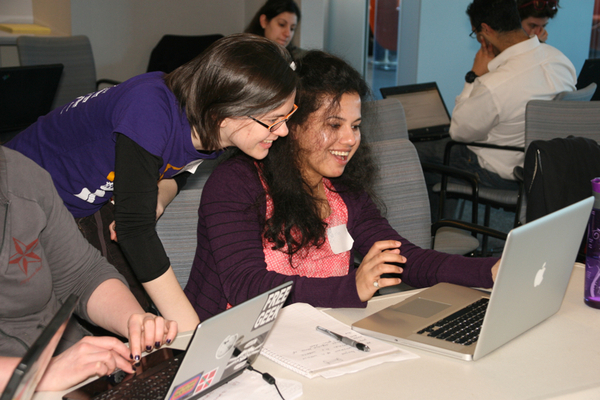
9 April 2014

Petter Reinholdtsen: S3QL, a locally mounted cloud file system - nice free software

For a while now, I have been looking for a sensible offsite backup solution for use at home. My requirements are simple, it must be cheap and locally encrypted (in other words, I keep the encryption keys, the storage provider do not have access to my private files). One idea me and my friends had many years ago, before the cloud storage providers showed up, was to use Google mail as storage, writing a Linux block device storing blocks as emails in the mail service provided by Google, and thus get heaps of free space. On top of this one can add encryption, RAID and volume management to have lots of (fairly slow, I admit that) cheap and encrypted storage. But I never found time to implement such system. But the last few weeks I have looked at a system called S3QL, a locally mounted network backed file system with the features I need. S3QL is a fuse file system with a local cache and cloud storage, handling several different storage providers, any with Amazon S3, Google Drive or OpenStack API. There are heaps of such storage providers. S3QL can also use a local directory as storage, which combined with sshfs allow for file storage on any ssh server. S3QL include support for encryption, compression, de-duplication, snapshots and immutable file systems, allowing me to mount the remote storage as a local mount point, look at and use the files as if they were local, while the content is stored in the cloud as well. This allow me to have a backup that should survive fire. The file system can not be shared between several machines at the same time, as only one can mount it at the time, but any machine with the encryption key and access to the storage service can mount it if it is unmounted. It is simple to use. I'm using it on Debian Wheezy, where the package is included already. So to get started, run apt-get install s3ql. Next, pick a storage provider. I ended up picking Greenqloud, after reading their nice recipe on how to use S3QL with their Amazon S3 service, because I trust the laws in Iceland more than those in USA when it come to keeping my personal data safe and private, and thus would rather spend money on a company in Iceland. Another nice recipe is available from the article S3QL Filesystem for HPC Storage by Jeff Layton in the HPC section of Admin magazine. When the provider is picked, figure out how to get the API key needed to connect to the storage API. With Greencloud, the key did not show up until I had added payment details to my account. Armed with the API access details, it is time to create the file system. First, create a new bucket in the cloud. This bucket is the file system storage area. I picked a bucket name reflecting the machine that was going to store data there, but any name will do. I'll refer to it as bucket-name below. In addition, one need the API login and password, and a locally created password. Store it all in ~root/.s3ql/authinfo2 like this:
[s3c]
storage-url: s3c://s.greenqloud.com:443/bucket-name
backend-login: API-login
backend-password: API-password
fs-passphrase: local-password
I create my local passphrase using pwget 50 or similar, but any sensible way to create a fairly random password should do it. Armed with these details, it is now time to run mkfs, entering the API details and password to create it:
# mkdir -m 700 /var/lib/s3ql-cache
# mkfs.s3ql --cachedir /var/lib/s3ql-cache --authfile /root/.s3ql/authinfo2 \
  --ssl s3c://s.greenqloud.com:443/bucket-name
Enter backend login: 
Enter backend password: 
Before using S3QL, make sure to read the user's guide, especially
the 'Important Rules to Avoid Loosing Data' section.
Enter encryption password: 
Confirm encryption password: 
Generating random encryption key...
Creating metadata tables...
Dumping metadata...
..objects..
..blocks..
..inodes..
..inode_blocks..
..symlink_targets..
..names..
..contents..
..ext_attributes..
Compressing and uploading metadata...
Wrote 0.00 MB of compressed metadata.
# 
The next step is mounting the file system to make the storage available.
# mount.s3ql --cachedir /var/lib/s3ql-cache --authfile /root/.s3ql/authinfo2 \
  --ssl --allow-root s3c://s.greenqloud.com:443/bucket-name /s3ql
Using 4 upload threads.
Downloading and decompressing metadata...
Reading metadata...
..objects..
..blocks..
..inodes..
..inode_blocks..
..symlink_targets..
..names..
..contents..
..ext_attributes..
Mounting filesystem...
# df -h /s3ql
Filesystem                              Size  Used Avail Use% Mounted on
s3c://s.greenqloud.com:443/bucket-name  1.0T     0  1.0T   0% /s3ql
#
The file system is now ready for use. I use rsync to store my backups in it, and as the metadata used by rsync is downloaded at mount time, no network traffic (and storage cost) is triggered by running rsync. To unmount, one should not use the normal umount command, as this will not flush the cache to the cloud storage, but instead running the umount.s3ql command like this:
# umount.s3ql /s3ql
# 
There is a fsck command available to check the file system and correct any problems detected. This can be used if the local server crashes while the file system is mounted, to reset the "already mounted" flag. This is what it look like when processing a working file system:
# fsck.s3ql --force --ssl s3c://s.greenqloud.com:443/bucket-name
Using cached metadata.
File system seems clean, checking anyway.
Checking DB integrity...
Creating temporary extra indices...
Checking lost+found...
Checking cached objects...
Checking names (refcounts)...
Checking contents (names)...
Checking contents (inodes)...
Checking contents (parent inodes)...
Checking objects (reference counts)...
Checking objects (backend)...
..processed 5000 objects so far..
..processed 10000 objects so far..
..processed 15000 objects so far..
Checking objects (sizes)...
Checking blocks (referenced objects)...
Checking blocks (refcounts)...
Checking inode-block mapping (blocks)...
Checking inode-block mapping (inodes)...
Checking inodes (refcounts)...
Checking inodes (sizes)...
Checking extended attributes (names)...
Checking extended attributes (inodes)...
Checking symlinks (inodes)...
Checking directory reachability...
Checking unix conventions...
Checking referential integrity...
Dropping temporary indices...
Backing up old metadata...
Dumping metadata...
..objects..
..blocks..
..inodes..
..inode_blocks..
..symlink_targets..
..names..
..contents..
..ext_attributes..
Compressing and uploading metadata...
Wrote 0.89 MB of compressed metadata.
# 
Thanks to the cache, working on files that fit in the cache is very quick, about the same speed as local file access. Uploading large amount of data is to me limited by the bandwidth out of and into my house. Uploading 685 MiB with a 100 MiB cache gave me 305 kiB/s, which is very close to my upload speed, and downloading the same Debian installation ISO gave me 610 kiB/s, close to my download speed. Both were measured using dd. So for me, the bottleneck is my network, not the file system code. I do not know what a good cache size would be, but suspect that the cache should e larger than your working set. I mentioned that only one machine can mount the file system at the time. If another machine try, it is told that the file system is busy:
# mount.s3ql --cachedir /var/lib/s3ql-cache --authfile /root/.s3ql/authinfo2 \
  --ssl --allow-root s3c://s.greenqloud.com:443/bucket-name /s3ql
Using 8 upload threads.
Backend reports that fs is still mounted elsewhere, aborting.
#
The file content is uploaded when the cache is full, while the metadata is uploaded once every 24 hour by default. To ensure the file system content is flushed to the cloud, one can either umount the file system, or ask S3QL to flush the cache and metadata using s3qlctrl:
# s3qlctrl upload-meta /s3ql
# s3qlctrl flushcache /s3ql
# 
If you are curious about how much space your data uses in the cloud, and how much compression and deduplication cut down on the storage usage, you can use s3qlstat on the mounted file system to get a report:
# s3qlstat /s3ql
Directory entries:    9141
Inodes:               9143
Data blocks:          8851
Total data size:      22049.38 MB
After de-duplication: 21955.46 MB (99.57% of total)
After compression:    21877.28 MB (99.22% of total, 99.64% of de-duplicated)
Database size:        2.39 MB (uncompressed)
(some values do not take into account not-yet-uploaded dirty blocks in cache)
#
I mentioned earlier that there are several possible suppliers of storage. I did not try to locate them all, but am aware of at least Greenqloud, Google Drive, Amazon S3 web serivces, Rackspace and Crowncloud. The latter even accept payment in Bitcoin. Pick one that suit your need. Some of them provide several GiB of free storage, but the prize models are quite different and you will have to figure out what suits you best. While researching this blog post, I had a look at research papers and posters discussing the S3QL file system. There are several, which told me that the file system is getting a critical check by the science community and increased my confidence in using it. One nice poster is titled "An Innovative Parallel Cloud Storage System using OpenStack s SwiftObject Store and Transformative Parallel I/O Approach" by Hsing-Bung Chen, Benjamin McClelland, David Sherrill, Alfred Torrez, Parks Fields and Pamela Smith. Please have a look. Given my problems with different file systems earlier, I decided to check out the mounted S3QL file system to see if it would be usable as a home directory (in other word, that it provided POSIX semantics when it come to locking and umask handling etc). Running my test code to check file system semantics, I was happy to discover that no error was found. So the file system can be used for home directories, if one chooses to do so. If you do not want a locally file system, and want something that work without the Linux fuse file system, I would like to mention the Tarsnap service, which also provide locally encrypted backup using a command line client. It have a nicer access control system, where one can split out read and write access, allowing some systems to write to the backup and others to only read from it. As usual, if you use Bitcoin and want to show your support of my activities, please send Bitcoin donations to my address 15oWEoG9dUPovwmUL9KWAnYRtNJEkP1u1b.

Andrew Pollock: [life] Day 71: Tumble Tastics trial, painting and plaster fun

Zoe slept in even later this morning. I'm liking this colder weather. We had nothing particular happening first thing today, so we just snuggled in bed for a bit before we got started. Tumble Tastics were offering free trial classes this week, so I signed Zoe up for one today. She really enjoyed going to Gold Star Gymnastics in the US, and has asked me about finding a gym class over here every now and then. Tumble Tastics is a much smaller affair than Gold Star, but at 300 metres from home on foot, it's awesomely convenient. Zoe scootered there this morning. It seems to be physically part of what I'm guessing used to be the Church of Christ's church hall, so it's not big at all, but the room that Zoe had her class in still had plenty of equipment in it. There were 8 kids in her class, all about her size. I peeked around the door and watched. Most of the class was instructor led and mainly mat work, but then part way through, the parents were invited in, and the teacher walked us all through a course around the room, using the various equipment, and the parents had to spot for their kids. The one thing that cracked me up was when the kids were supposed to be tucking into a ball and rocking on their backs. Zoe instead did a Brazilian Jiu-Jitsu break-fall and fell backwards slapping the mat instead. It was good to see that some of what she learned in those classes has kicked in reflexively. She really enjoyed the rope swing and hanging upside down on the uneven bars. The class ran for 50 minutes (I was only expecting it to last 30 minutes) and Zoe did really well straight off. I think we'll make this her 4th term extra-curricular activity. We scootered home the longer way, because we were in no particular hurry. Zoe did some painting when we got home, and then we had lunch. After lunch we goofed off for a little bit, and then we did quiet time. Zoe napped for about two and a half hours, and then we did some plaster play. I'd picked up a fish ice cube tray from IKEA on the weekend for 99 cents (queue Thrift Shop), and I bought a bag of plaster of Paris a while back, but haven't had a chance to do anything with it yet. I bribed Zoe into doing quiet time by telling her we'd do something new with the ice cube tray I'd bought. We mixed up a few paper cups with plaster of Paris in them and then I squirted some paint in. I'm not sure if the paint caused a reaction, or the plaster was already starting to set by the time the paint got mixed in, but it became quite viscous as soon as the paint was mixed in. We did three different colours and used tongue depressers to jam it into the tray. Zoe seemed to twig that it was the same stuff as the impressions of her baby feet, which I thought was a pretty clever connection to make. After that, there was barely enough time to watch a tiny bit of TV before Sarah arrived to pick Zoe up. I told her that her plaster would be set by the time she got dropped off in the morning. I procrastinated past the point of no return and didn't go for a run. Instead I decided to go out to Officeworks and print out some photos to stick in the photo frame I bought from IKEA on the weekend.

31 March 2014

Russell Coker: Links March 2014

Typing Animal wrote an interesting article about the dangers of stainless steel in a medical environment [1]. Apparently silver and copper are best due to the oligodynamic effect. Instead of stainless steel drinking bottles they should sell silver plated drinking bottles for kids, I m sure that lots of parents would pay extra for that. Mark Kendall gave an interesting TED talk about a replacement for the hypodermic syringe in vaccinations [2]. His invention can reduce the cost of immunisation while increasing the effectiveness and avoiding problems with people who have a needle phobia. The TED blog has an interesting interview with Will Potter about the use of the war on terror to silence journalists and the invention of the term eco terrorism for non-violent people who are politically active [3]. The TED blog has an interesting article by Kate Torgovnick May about designing products for sustainability [4]. It links to an insightful TED talk by Leyla Acaroglu about some of the complex issues related to sustainability [5]. Manoush Zomorodi wrote an informative article about How one college went from 10% female computer-science majors to 40% [6]. Slate has an interesting article by Jamelle Bouie showing the way that support for capital punishment in the US is linked to racism [7]. The Southern California Public Radio blog has an interesting article by Josie Huang about Suey Park and her success in using twitter to oppose racism [8]. Andrew Solomon wrote an insightful interview with the father of Adam Lanza for the New Yorker [9]. Waleed Aly wrote an insightful article about George Brandis attempt to change the Racial Discrimination Act specifically to allow Andrew Bolt to be racist [10]. He describes it as the whitest piece of proposed legislation I ve encountered which is significant in a country with as much racism as Australia. Really we need stronger laws against racism, there should be no right to be bigoted. A German Court has ruled that non commercial licenses don t permit non-commercial organisations to re-publish material [11]. This seems bogus to me, I d be happy to have my non-commercial licensed work published by a non-commercial publishing organisation just as long as they don t run adverts on the page. Professors Woolley and Malone wrote an interesting article about their research into group performance, apparently having more women in a group improves the collective intelligence of a group, but having smarter men in the group doesn t [12]. Susie Hill wrote an article about the SPARX computer game that is designed to treat adolescent depression [13]. They are working on a rainbow edition for GLBT kids and a version for Maoris. Unfortunately their web site is down right now and the version at archive.org says that it s currently only available to participants in a clinical trial. Tim Chevalier wrote an insightful article explaining why people who campaign against equality shouldn t be given senior positions in corporations [14]. Zeynep Tufekci wrote an insightful article about how French High Theory and Dr. Seuss can help explain gender problems in geek communities [15]. Hannah Levintova wrote an informative article for Mother Jones about how the US based hate group the World Congress of Families incites homophobic violence in Russia [16]. Josh Sanburn wrote an article for Time about people in the Deep South who claim to be Christian giving away guns to encourage people to attend church [17]. This is the same part of the world where people who claimed to be Christian used their religion as an excuse for supporting slavery. I m quitting bourbon, too much evil comes from that part of the world and I m not buying anything that comes from there.

19 March 2014

Russ Allbery: WebAuth 4.6.0

I was going to put out some of these changes in a 4.5.6 release late last year, but that didn't happen, and then more things kept coming up. So this release is rather large. The major new feature is a new WebAuthCookiePath directive for mod_webauth, which allows path-scoped WebAuth cookies so that different portions of a site can maintain separate authentication credentials. There are various caveats, and support will get better later, but it's a beginning. There are two bug fixes from Benjamin Coddington: WebAuthOptional should now work with Apache 2.4, and internal notes management in the module is now done better, which should prevent some cases where the user was redirected to WebLogin twice. Eventually, the things WebAuth uses notes for should become request context data, but that's for a later change. There are multiple changes to keyring handling to let mod_webauth and mod_webkdc work properly with the ITK Apache MPM, which allows each virtual host to run as a different user. Previously, all virtual hosts shared one in-memory keyring, which meant leaking authentication keys between virtual hosts. Now, each virtual host gets its own, lazily loaded from the keyring on disk when it's first needed. This allows ITK users to configure separate keyrings for each virtual host. To make this easier, keyring files are now locked for write, and writing a keyring preserves the ownership and permissions if possible. WebLogin now supports a new remctl-based password change protocol, which I developed for Stanford to work around some problems with the kpasswd when password change takes too long. All the tools for this will eventually be available outside of Stanford when I have a chance to polish them up and release them. There are a few other, more minor bug fixes. mod_webauth and WebLogin are now more aggressive about telling web browsers to really not cache pages. WebLogin also now uses the authenticated identity returned by the WebKDC for multifactor, since it may have canonicalized the user's identity. The correct template variable is now set when the user doesn't enter a code on the WebLogin multifactor page. Better error messages are returned for invalid principals and unknown realms. The workaround for invalid XML returned by the WebKDC should now actually work. And WebLogin logs a more detailed error message on password change failures. You can get the latest release from the official WebAuth distribution site or from my WebAuth distribution pages.

16 March 2014

Benjamin Mako Hill: Community Data Science Workshops in Seattle

Photo from the Boston Python Workshop   a similar workshop run in Boston that has inspired and provided a template for the CDSW.

Photo from the Boston Python Workshop a similar workshop run in Boston that has inspired and provided a template for the CDSW.

On three Saturdays in April and May, I will be helping run three day-long project-based workshops at the University of Washington in Seattle. The workshops are for anyone interested in learning how to use programming and data science tools to ask and answer questions about online communities like Wikipedia, Twitter, free and open source software, and civic media. The workshops are for people with no previous programming experience and the goal is to bring together researchers as well as participants and leaders in online communities. The workshops will all be free of charge and open to the public given availability of space. Our goal is that, after the three workshops, participants will be able to use data to produce numbers, hypothesis tests, tables, and graphical visualizations to answer questions like: If you are interested in participating, fill out our registration form here. The deadline to register is Wednesday March 26th. We will let participants know if we have room for them by Saturday March 29th. Space is limited and will depend on how many mentors we can recruit for the sessions. If you already have experience with Python, please consider helping out at the sessions as a mentor. Being a mentor will involve working with participants and talking them through the challenges they encounter in programming. No special preparation is required. If you re interested, send me an email.

10 March 2014

Jaldhar Vyas: 7DRL 2014/Procedural Death Jam

Each year the 7DRL competion gives me an opportunity to abandon developing a roguelike game part way through. This year I am going to strive mightily to actually complete a playable game though owing to family commitments I have already gotten off to a rocky start which does not bode well. But enough negativity... So this year 7DRL coincides with the first ever Procedural Death Jam. This is a similar type of thing except the genre is Procedural Death Labyrinth. Procedural Death Labyrinths are a subset of Roguelikes (or is it the other way round?) If you have taken advantage of the wonderful offer Valve has given to Debian developers, you can find a number of examples of Procedural Death Labyrinths on Steam. The most important part of any software development project is of course choosing a cool name. My game is called "The Girl Who Played With The Dragons Nest" (Can you guess what I've been reading?) It is written in C++ with the Curses toolkit. It will of course be open source. I intend to blog my progress here if you care to follow along.

Next.

Previous.