Search Results: "ina"

14 December 2025

Dirk Eddelbuettel: BH 1.90.0-1 on CRAN: New Upstream

Boost Boost is a very large and comprehensive set of (peer-reviewed) libraries for the C++ programming language, containing well over one hundred individual libraries. The BH package provides a sizeable subset of header-only libraries for (easier, no linking required) use by R. It is fairly widely used: the (partial) CRAN mirror logs (aggregated from the cloud mirrors) show over 41.5 million package downloads. Version 1.90.0 of Boost was released a few days ago following the regular Boost release schedule of April, August and December releases. As before, we packaged it almost immediately and started testing following our annual update cycle which strives to balance being close enough to upstream and not stressing CRAN and the user base too much. The reverse depends check revealed only one really minor issue among the over three hundred direct reverse dependencies. And that issue was addressed yesterday within hours by a truly responsove maintainer (and it helped that a related issue had been addressed months earlier with version 1.89.). So big thanks to Jean-Romain Roussel for the prompt fix, and to Andrew Johnson for the earlier test with 1.89.0. As last year with 1.87.0, no new Boost libraries were added to BH so the (considerable) size is more or less unchanged. It lead to CRAN doing a manual inspection but as there were no other issues it sailed through as is now in the CRAN repository. The short NEWS entry follows.

Changes in version 1.90.0-1 (2025-12-13)
  • Upgrade to Boost 1.90.0, patched as usual to comment-out diagnostic suppression messages per the request of CRAN
  • Minor upgrades to continuous integration

Via my CRANberries, there is a diffstat report relative to the previous release. Comments and suggestions about BH are welcome via the issue tracker at the GitHub repo.

This post by Dirk Eddelbuettel originated on his Thinking inside the box blog. If you like this or other open-source work I do, you can now sponsor me at GitHub.

12 December 2025

Freexian Collaborators: Debian Contributions: Updates about DebConf Video Team Sprint, rebootstrap, SBOM tooling in Debian and more! (by Anupa Ann Joseph)

Debian Contributions: 2025-11 Contributing to Debian is part of Freexian s mission. This article covers the latest achievements of Freexian and their collaborators. All of this is made possible by organizations subscribing to our Long Term Support contracts and consulting services.

DebConf Video Team Sprint The DebConf Video Team records, streams, and publishes talks from DebConf and many miniDebConfs. A lot of the infrastructure development happens during setup for these events, but we also try to organize a sprint once a year to work on infrastructure, when there isn t a DebConf about to happen. Stefano attended the sprint in Herefordshire this year and wrote up a report.

rebootstrap, by Helmut Grohne A number of jobs were stuck in architecture-specific failures. gcc-15 and dpkg still disagree about whether PIE is enabled occasionally and big endian mipsen needed fixes in systemd. Beyond this regular uploads of libxml2 and gcc-15 required fixes and rebasing of pending patches. Earlier, Loongson used rebootstrap to create the initial package set for loong64 and Miao Wang now submitted their changes. Therefore, there is now initial support for suites other than unstable and use with derivatives.

Building the support for Software Bill Of Materials tooling in Debian, by Santiago Ruano Rinc n Vendors of Debian-based products may/should be paying attention to the evolution of different jurisdictions (such as the CRA or updates on CISA s Minimum Elements for a Software Bill of Materials) that require to make available Software Bill of Materials (SBOM) of their products. It is important then to have tools in Debian to make it easier to produce such SBOMs. In this context, Santiago continued the work on packaging libraries related to SBOMs. This includes the packaging of the SPDX python library (python-spdx-tools), and its dependencies rdflib and mkdocs-include-markdown-plugin. System Package Data Exchange (SPDX), defined by ISO/IEC 5962:2021, is an open standard capable of representing systems with software components as SBOMs and other data and security references. SPDX and CycloneDX (whose python library python3-cyclonedx-lib was packaged by prior efforts this year), encompass the two main SBOM standards available today.

Miscellaneous contributions
  • Carles improved po-debconf-manager: added checking status of bug reports automatically via python-debianbts; changed some command line options naming or output based on user feedback; finished refactoring user interaction to rich; codebase is now flake8-compliant; added type safety with mypy.
  • Carles, using po-debconf-manager, created 19 bug reports for translations where the merge requests were pending; reviewed and created merge requests for 4 packages.
  • Carles planned a second version of the tool that detects packages that Recommends or Suggests packages which are not in Debian. He is taking ideas from dumat.
  • Carles submitted a pull request to python-unidiff2 (adapted from the original pull request to python-unidiff). He also started preparing a qnetload update.
  • Stefano did miscellaneous python package updates: mkdocs-macros-plugin, python-confuse, python-pip, python-mitogen.
  • Stefano reviewed a beets upload for a new maintainer who is taking it over.
  • Stefano handled some debian.net infrastructure requests.
  • Stefano updated debian.social infrastructure for the trixie point release.
  • The update broke jitsi.debian.social, Stefano put some time into debugging it and eventually enlisted upstream assistance, who solved the problem!
  • Stefano worked on some patches for Python that help Debian:
    • GH-139914: The main HP PA-RISC support patch for 3.14.
    • GH-141930: We observed an unhelpful error when failing to write a .pyc file during package installation. We may have fixed the problem, and at least made the error better.
    • GH-141011: Ignore missing ifunc support on HP PA-RISC.
  • Stefano spun up a website for hamburg2026.mini.debconf.org.
  • Rapha l reviewed a merge request updating tracker.debian.org to rely on bootstrap
    version 5.
  • Emilio coordinated various transitions.
  • Helmut sent patches for 26 cross build failures.
  • Helmut officially handed over the cleanup of the /usr-move transition.
  • Helmut monitored the transition moving libcrypt-dev out of build-essential and bumped the remaining bugs to rc-severity in coordination with the release team.
  • Helmut updated the Build-Profiles patch for debian-policy incorporating feedback from Sean Whitton with a lot of help from Nattie Mayer-Hutchings and Freexian colleagues.
  • Helmut discovered that the way mmdebstrap deals with start-stop-daemon may result in broken output and sent a patch.
  • As a result of armel being removed from sid , but not from forky , the multiarch hinter broke. Helmut fixed it.
  • Helmut uploaded debvm accepting a patch from Luca Boccassi to fix it for newer
    systemd.
  • Colin began preparing for the second stage of the OpenSSH GSS-API key exchange package split.
  • Colin caught and fixed a devscripts regression due to it breaking part of Debusine.
  • Colin packaged django-pgtransaction and backported it to trixie , since it looks useful for Debusine.
  • Thorsten uploaded the packages lprng, cpdb-backend-cups, cpdb-libs and ippsample to fix some RC bugs as well as other bugs that accumulated over time. He also uploaded cups-filters to all Debian releases to fix three CVEs.

11 December 2025

Dirk Eddelbuettel: #056: Running r-ci with R-devel

Welcome to post 56 in the R4 series. The recent post #54 reviewed a number of earlier posts on r-ci, our small (but very versatile) runner for continunous integration (CI) with R. The post also introduced the notion of using a container in the matrix of jobs defined and running in parallel. The initial motivation was the (still ongoing, and still puzzling) variation in run-times of GitHub Actions. So when running CI and relying on r2u for the fast, easy, reliable: pick all three! provision of CRAN packages as Ubuntu binaries, a small amount of time is spent prepping a basic Ubuntu instance with the necessary setup. This can be as fast as maybe 20 to 30 seconds, but it can also stretch to almost two minutes when GitHub is busier or out of sorts for other reasons. When the CI job itself is short, that is a nuisance. We presented relying on a pre-made r2u4ci container that adds just a few commands to the standard r2u container to be complete for CI. And with that setup CI runs tend to be reliably faster. This situation is still evolving. I have not converted any of my existing CI scripts (apart from a test instance or two), but I keep monitoring the situation. However, this also offered another perspective: why not rely on a different container for a different CI aspect? When discussing the CI approach with Jeff the other day (and helping add CI to his mmap repo), it occurred to me we could also use on of the Rocker containers for R-devel. A minimal change to the underlying run.sh script later, this was accomplished. An example is provided as both a test and an illustration in the repo for package RcppInt64 in its script ci.yaml:
    strategy:
      matrix:
        include:
          -   name: container, os: ubuntu-latest, container: rocker/r2u4ci  
          -   name: r-devel,   os: ubuntu-latest, container: rocker/drd  
          -   name: macos,     os: macos-latest  
          -   name: ubuntu,    os: ubuntu-latest  

    runs-on: $  matrix.os  
    container: $  matrix.container  
This runs both a standard Ubuntu setup (fourth entry) and the alternate just described relying on the container (first entry) along with the (usually commented-out) optional macOS setup (third entry). And line two brings the drd container from Rocker. The CI runner script now checks for a possible Rdevel binary as provided inside drd (along with alias RD) and uses it when present. And that is all that there is: no other change on the user side; tests now run under R-devel. You can see some of the initial runs at the rcppint64 repo actions log. Another example is now also at Jeff s mmap repo. It should be noted that this relies on R-devel running packages made with R-release. Every few years this breaks when R needs to break its binary API. If and when that happens this option will be costlier as the R-devel instance will then have to (re-)install its R package dependencies. This can be accomodated easily as a step in the yaml file. And under normal circumstances it is not needed. Having easy access to recent builds of R-devel (the container refreshes weekly on a schedule) with the convenience of r2u gives another option for package testing. I may continue to test locally with R-devel as my primary option, and most likely keep my CI small and lean (usually just one R-relase run on Ubuntu) but having another option at GitHub Actions is also a good thing.

This post by Dirk Eddelbuettel originated on his Thinking inside the box blog. If you like this or other open-source work I do, you can now sponsor me at GitHub.

8 December 2025

Thorsten Alteholz: My Debian Activities in November 2025

Debian LTS/ELTS This was my hundred-thirty-seventh month that I did some work for the Debian LTS initiative, started by Raphael Hertzog at Freexian and my eighty-eighth ELTS month. As the LTS- and ELTS-teams have been merged now, there is only one paragraph left for both activities. During my allocated time I uploaded or worked on: I also attended the monthly LTS/ELTS meeting and did a week of LTS/ELTS frontdesk duties. I also stumbled upon a bug in python3-paramiko, where the parsing of include statements in the ssh_config does not work. Rather annoying but already fixed in the newest version, that only needs to find its way to my old VM. Debian Printing This month I uploaded a new upstream version or a bugfix version of: I also uploaded cups to Trixie, to fix bug #1109471 related to a configuration problem with the admin panel. This work is generously funded by Freexian! Debian Astro This month I uploaded a new upstream version or a bugfix version of: Debian IoT This month I uploaded a new upstream version or a bugfix version of: Debian Mobcom This month I uploaded a new upstream version or a bugfix version of: misc This month I uploaded a new upstream version or a bugfix version of: On my fight against outdated RFPs, I closed 30 of them in November. I started with about 3500 open RFP bugs. and after working six months on this project, I have closed 183 bugs. Of course new bugs appeared, so the overall number of bugs is only down to about 3360. Though I view this as a successful project, I also have to admit that it is a bit boring to work on this daily. Therefore I close this diary again and will add the closed RFP bugs to my bug logbook now. I also try to close some of these bugs by really uploading some software, probably one package per month. FTP master This month I accepted 236 and rejected 16 packages. The overall number of packages that got accepted was 247.

7 December 2025

Vincent Bernat: Compressing embedded files in Go

Go s embed feature lets you bundle static assets into an executable, but it stores them uncompressed. This wastes space: a web interface with documentation can bloat your binary by dozens of megabytes. A proposition to optionally enable compression was declined because it is difficult to handle all use cases. One solution? Put all the assets into a ZIP archive!

Code The Go standard library includes a module to read and write ZIP archives. It contains a function that turns a ZIP archive into an io/fs.FS structure that can replace embed.FS in most contexts.1
package embed
import (
  "archive/zip"
  "bytes"
  _ "embed"
  "fmt"
  "io/fs"
  "sync"
)
//go:embed data/embed.zip
var embeddedZip []byte
var dataOnce = sync.OnceValue(func() *zip.Reader  
  r, err := zip.NewReader(bytes.NewReader(embeddedZip), int64(len(embeddedZip)))
  if err != nil  
    panic(fmt.Sprintf("cannot read embedded archive: %s", err))
   
  return r
 )
func Data() fs.FS  
  return dataOnce()
 
We can build the embed.zip archive with a rule in a Makefile. We specify the files to embed as dependencies to ensure changes are detected.
common/embed/data/embed.zip: console/data/frontend console/data/docs
common/embed/data/embed.zip: orchestrator/clickhouse/data/protocols.csv 
common/embed/data/embed.zip: orchestrator/clickhouse/data/icmp.csv
common/embed/data/embed.zip: orchestrator/clickhouse/data/asns.csv
common/embed/data/embed.zip:
    mkdir -p common/embed/data && zip --quiet --recurse-paths --filesync $@ $^
The automatic variable $@ is the rule target, while $^ expands to all the dependencies, modified or not.

Space gain Akvorado, a flow collector written in Go, embeds several static assets:
  • CSV files to translate port numbers, protocols or AS numbers, and
  • HTML, CSS, JS, and image files for the web interface, and
  • the documentation.
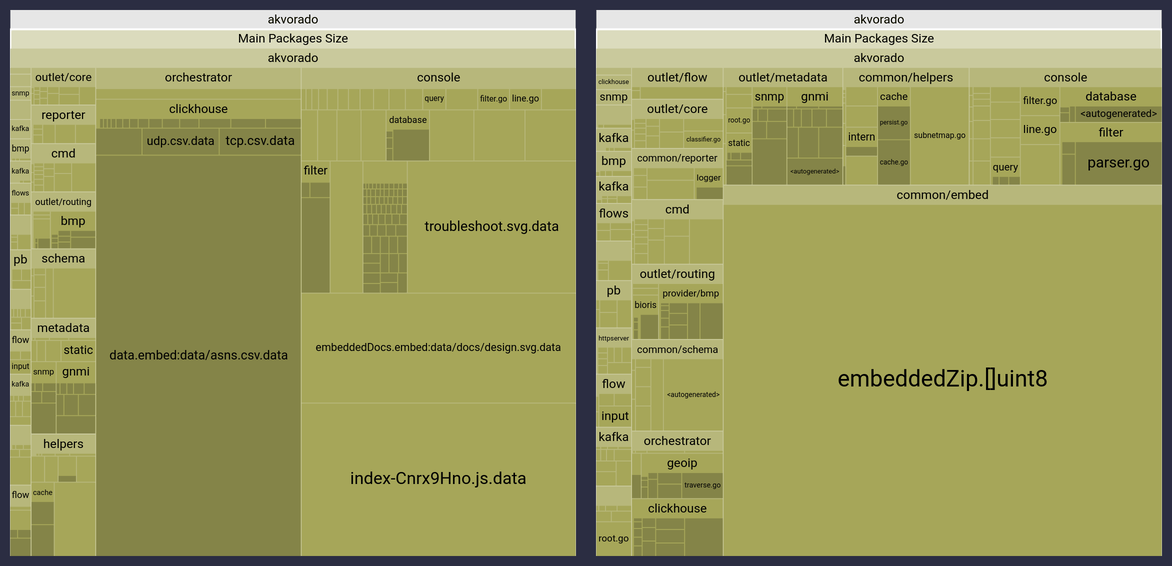
Breakdown of space used by each package before and after introducing embed.zip. It is displayed as a treemap and we can see many embedded files replaced by a bigger one.
Breakdown of the space used by each component before (left) and after (right) the introduction of embed.zip.
Embedding these assets into a ZIP archive reduced the size of the Akvorado executable by more than 4 MiB:
$ unzip -p common/embed/data/embed.zip   wc -c   numfmt --to=iec
7.3M
$ ll common/embed/data/embed.zip
-rw-r--r-- 1 bernat users 2.9M Dec  7 17:17 common/embed/data/embed.zip

Performance loss Reading from a compressed archive is not as fast as reading a flat file. A simple benchmark shows it is more than 4 slower. It also allocates some memory.2
goos: linux
goarch: amd64
pkg: akvorado/common/embed
cpu: AMD Ryzen 5 5600X 6-Core Processor
BenchmarkData/compressed-12     2262   526553 ns/op   610 B/op   10 allocs/op
BenchmarkData/uncompressed-12   9482   123175 ns/op     0 B/op    0 allocs/op
Each access to an asset requires a decompression step, as seen in this flame graph:
🖼 Flame graph when reading data from embed.zip compared to reading data directly
CPU flame graph comparing the time spent on CPU when reading data from embed.zip (left) versus reading data directly (right). Because the Go testing framework executes the benchmark for uncompressed data 4 times more often, it uses the same horizontal space as the benchmark for compressed data. The graph is interactive.
While a ZIP archive has an index to quickly find the requested file, seeking inside a compressed file is currently not possible.3 Therefore, the files from a compressed archive do not implement the io.ReaderAt or io.Seeker interfaces, unlike directly embedded files. This prevents some features, like serving partial files or detecting MIME types when serving files over HTTP.
For Akvorado, this is an acceptable compromise to save a few mebibytes from an executable of almost 100 MiB. Next week, I will continue this futile adventure by explaining how I prevented Go from disabling dead code elimination!

  1. You can safely read multiple files concurrently. However, it does not implement ReadDir() and ReadFile() methods.
  2. You could keep frequently accessed assets in memory. This reduces CPU usage and trades cached memory for resident memory.
  3. SOZip is a profile that enables fast random access in a compressed file. However, Go s archive/zip module does not support it.

6 December 2025

Simon Josefsson: Reproducible Guix Container Images

Around a year ago I wrote about Guix Container Images for GitLab CI/CD and these images have served the community well. Besides continous use in CI/CD, these Guix container images are used to confirm reproducibility of the source tarball artifacts in the releases of Libtasn1 v4.20, InetUtils v2.6, Libidn2 v2.3.8, Libidn v1.43, SASL v2.2.2, Guile-GnuTLS v5.0.1, and OATH Toolkit v2.6.13. See how all those release announcements mention a Guix commit? That s the essential supply-chain information about the Guix build environment that allows the artifacts to be re-created. To make sure this is repeatable, the release tarball artifacts are re-created from source code every week in the verify-reproducible-artifacts project, that I wrote about earlier. Guix s time travelling feature make this sustainable to maintain, and hopefully will continue to be able to reproduce the exact same tarball artifacts for years to come. During the last year, unfortunately Guix was removed from Debian stable. My Guix container images were created from Debian with that Guix package. My setup continued to work since the old stage0 Debian+Guix containers were still available. Such a setup is not sustainable, as there will be bit-rot and we don t want to rely on old containers forever, which (after the removal of Guix in Debian) could not be re-produced any more. Let this be a reminder how user-empowering features such as Guix time-travelling is! I have reworked my Guix container image setup, and this post is an update on the current status of this effort. The first step was to re-engineer Debian container images with Guix, and I realized these were useful on their own, and warrant a separate project. A more narrowly scoped project makes will hopefully make it easier to keep them working. Now instead of apt-get install guix they use the official Guix guix-install.sh approach. Read more about that effort in the announcement of Debian with Guix. The second step was to reconsider my approach to generate the Guix images. The earlier design had several stages. First, Debian+Guix containers were created. Then from those containers, a pure Guix container was created. Finally, using the pure Guix container another pure Guix container was created. The idea behind that GCC-like approach was to get to reproducible images that were created from an image that had no Debian left on it. However, I never managed to finish this. Partially because I hadn t realized that every time you build a Guix container image from Guix, you effectively go back in time. When using Guix version X to build a container with Guix on it, it will not put Guix version X into the container but will put whatever version of Guix is available in its package archive, which will be an earlier version, such as version X-N. I had hope to overcome this somehow (running a guix pull in newly generated images may work), but never finished this before Guix was removed from Debian. So what could a better design look like? For efficiency, I had already started experimenting with generating the final images directly from the Debian+Guix images, and after reproducibility bugs were fixed I was able to get to reproducible images. However, I was still concerned that the Debian container could taint the process somehow, and was also concerned about the implied dependency on non-free software in Debian. I ve been using comparative rebuilds using similar distributions to confirm artifact reproducibility for my software projects, comparing builds on Trisquel 11 with Ubuntu 22.04, and AlmaLinux 9 with RockyLinux 9 for example. This works surprisingly well. Including one freedom-respecting distribution like Trisquel will detect if any non-free software has bearing on artifacts. Using different architectures, such as amd64 vs arm64 also help with deeper supply-chain concerns. My conclusion was that I wanted containers with the same Guix commit for both Trisquel and Ubuntu. Given the similarity with Debian, adapting and launching the Guix on Trisquel/Debian project was straight forward. So we now have Trisquel 11/12 and Ubuntu 22.04/24.04 images with the same Guix on them. Do you see where the debian-with-guix and guix-on-dpkg projects are leading to? We are now ready to look at the modernized Guix Container Images project. The tags are the same as before:
registry.gitlab.com/debdistutils/guix/container:latest
registry.gitlab.com/debdistutils/guix/container:slim
registry.gitlab.com/debdistutils/guix/container:extra
registry.gitlab.com/debdistutils/guix/container:gash
The method to create them is different. Now there is a build job that uses the earlier Guix+Trisquel container (for amd64) or Guix+Debian (for arm64, pending Trisquel arm64 containers). The build job create the final containers directly. Next a Ubuntu reproduce job is launched that runs the same commands, failing if it cannot generate the bit-by-bit identical container. Then single-arch images are tested (installing/building GNU hello and building libksba), and then pushed to the GitLab registry, adding multi-arch images in the process. Then the final multi-arch containers are tested by building Guile-GnuTLS and, on success, uploaded to the Docker Hub. How would you use them? A small way to start the container is like this:
jas@kaka:~$ podman run -it --privileged --entrypoint=/bin/sh registry.gitlab.com/debdistutils/guix/container:latest
sh-5.2# env HOME=/ guix describe # https://issues.guix.gnu.org/74949
  guix 21ce6b3
    repository URL: https://git.guix.gnu.org/guix.git
    branch: master
    commit: 21ce6b392ace4c4d22543abc41bd7c22596cd6d2
sh-5.2# 
The need for --entrypoint=/bin/sh is because Guix s pack command sets up the entry point differently than most other containers. This could probably be fixed if people want that, and there may be open bug reports about this. The need for --privileged is more problematic, but is discussed upstream. The above example works fine without it, but running anything more elaborate with guix-daemon installing packages will trigger a fatal error. Speaking of that, here is a snippet of commands that allow you to install Guix packages in the container.
cp -rL /gnu/store/*profile/etc/* /etc/
echo 'root:x:0:0:root:/:/bin/sh' > /etc/passwd
echo 'root:x:0:' > /etc/group
groupadd --system guixbuild
for i in $(seq -w 1 10); do useradd -g guixbuild -G guixbuild -d /var/empty -s $(command -v nologin) -c "Guix build user $i" --system guixbuilder$i; done
env LANG=C.UTF-8 guix-daemon --build-users-group=guixbuild &
guix archive --authorize < /share/guix/ci.guix.gnu.org.pub
guix archive --authorize < /share/guix/bordeaux.guix.gnu.org.pub
guix install hello
GUIX_PROFILE="/var/guix/profiles/per-user/root/guix-profile"
. "$GUIX_PROFILE/etc/profile"
hello
This could be simplified, but we chose to not hard-code in our containers because some of these are things that probably shouldn t be papered over but fixed properly somehow. In some execution environments, you may need to pass --disable-chroot to guix-daemon. To use the containers to build something in a GitLab pipeline, here is an example snippet:
test-amd64-latest-wget-configure-make-libksba:
  image: registry.gitlab.com/debdistutils/guix/container:latest
  before_script:
  - cp -rL /gnu/store/*profile/etc/* /etc/
  - echo 'root:x:0:0:root:/:/bin/sh' > /etc/passwd
  - echo 'root:x:0:' > /etc/group
  - groupadd --system guixbuild
  - for i in $(seq -w 1 10); do useradd -g guixbuild -G guixbuild -d /var/empty -s $(command -v nologin) -c "Guix build user $i" --system guixbuilder$i; done
  - export HOME=/
  - env LANG=C.UTF-8 guix-daemon --build-users-group=guixbuild &
  - guix archive --authorize < /share/guix/ci.guix.gnu.org.pub
  - guix archive --authorize < /share/guix/bordeaux.guix.gnu.org.pub
  - guix describe
  - guix install libgpg-error
  - GUIX_PROFILE="//.guix-profile"
  - . "$GUIX_PROFILE/etc/profile"
  script:
  - wget https://www.gnupg.org/ftp/gcrypt/libksba/libksba-1.6.7.tar.bz2
  - tar xfa libksba-1.6.7.tar.bz2
  - cd libksba-1.6.7
  - ./configure
  - make V=1
  - make check VERBOSE=t V=1
More help on the project page for the Guix Container Images. That s it for tonight folks, and remember, Happy Hacking!

Taavi V n nen: How to import a new Wikipedia language edition (in hard mode)

I created the latest Wikipedia language edition, the Toki Pona Wikipedia, last month. Unlike most other wikis which start their lives in the Wikimedia Incubator before the full wiki is created, in this case the community had been using a completely external MediaWiki site to build the wiki before it was approved as a "proper" Wikipedia wiki,1 and now that external wiki needed to be imported to the newly created Wikimedia-hosted wiki. (As far as I'm aware, the last and previously only time an external wiki has been imported to a Wikimedia project was in 2013 when Wikitravel was forked as Wikivoyage.) Creating a Wikimedia wiki these days is actually pretty straightforward, at least when compared to what it used to be like a couple of years ago. Today the process mostly involves using a script to generate two configuration changes, one to add the basic configuration for a wiki to operate and an another to add the wiki to the list of all wikis that exist, and then running a script to create the wiki database in between of deploying those two configuration changes. And then you wait half an hour while the script to tell all Wikidata client wikis about the new wiki runs on one wiki at a time. The primary technical challenge in importing a third-party wiki is that there's no SUL making sure that a single username maps to the same account on both wikis. This means that the usual strategy of using the functionality I wrote in CentralAuth to manually create local accounts can't be used as is, and so we needed to come up with a new way of matching everyone's contributions to their existing Wikimedia accounts. (Side note: While the user-facing interface tries to present a single "global" user account that can be used on all public Wikimedia wikis, in reality the account management layer in CentralAuth is mostly just a glue layer to link together individual "local" accounts on each wiki that the user has ever visited. These local accounts have independent user ID numbers for example I am user #35938993 on the English Wikipedia but #4 on the new Toki Pona Wikipedia and are what most of MediaWiki code interacts with except for a few features specifically designed with cross-wiki usage in mind. This distinction is also still very much present and visible in the various administrative and anti-abuse workflows.) The approach we ended up choosing was to re-write the dump file before importing, so that a hypothetical account called $Name would be turned $Name~wikipesija.org after the import.2 We also created empty user accounts that would take ownership of the edits to be imported so that we could use the standard account management tools on them later on. MediaWiki supports importing contributions without a local account to attribute them to, but it doesn't seem to be possible to convert an imported actor3 to a regular user later on which we wanted to keep as a possibility, even with the minor downside of creating a few hundred users that'll likely never get touched again later. We also made specific decisions to add the username suffix to everyone, not to just those names that'd conflicted with existing SUL accounts, and to deal with renaming users that wanted their contributions linked to an existing SUL account only after the import. This both reduced complexity and thus risk from the import phase, which already had much more unknowns compared to the rest of the process, but also were much better options ethically as well: suffixing all names meant we would not imply that those people chose to be Wikimedians with those specific usernames (when in reality it was us choosing to import those edits to the Wikimedia universe), and doing renames using the standard MediaWiki account management tooling meant that it produced the normal public log entries that all other MediaWiki administrative actions create. With all of the edits imported, the only major thing remaining was doing those merges I mentioned earlier to attribute imported edits to people's existing SUL accounts. Thankfully, the local account -based system makes it actually pretty simple. Usually CentralAuth prevents renaming individual local accounts that are attached to a global account, but that check can be bypassed with a maintenance script or a privileged enough account. Renaming the user automatically detached it from the previous global account, after which an another maintenance script could be used to attach the user to the correct global account.

  1. That external site was a fork of a fork of the original Toki Pona Wikipedia that was closed in 2005. And because cool URIs don't change, we made the the URLs that the old Wikipedia was using work again. Try it: https://art-tokipona.wikipedia.org.
  2. wikipesija.org was the domain where the old third-party wiki was hosted on, and ~ was used as a separator character in usernames during the SUL finalization in the early 2010s so using it here felt appropriate as well.
  3. An actor is a MediaWiki term and a database table referring to anything that can do edits or logged actions. Usually an actor is a user account or an IP address, but an imported user name in a specific format can also be represented as an actor.

3 December 2025

Reproducible Builds: Reproducible Builds in November 2025

Welcome to the report for November 2025 from the Reproducible Builds project! These monthly reports outline what we ve been up to over the past month, highlighting items of news from elsewhere in the increasingly-important area of software supply-chain security. As always, if you are interested in contributing to the Reproducible Builds project, please see the Contribute page on our website. In this report:

  1. 10 years of Reproducible Build at SeaGL
  2. Distribution work
  3. Tool development
  4. Website updates
  5. Miscellaneous news
  6. Software Supply Chain Security of Web3
  7. Upstream patches

10 years of Reproducible Builds at SeaGL 2025 On Friday 8th November, Chris Lamb gave a talk called 10 years of Reproducible Builds at SeaGL in Seattle, WA. Founded in 2013, SeaGL is a free, grassroots technical summit dedicated to spreading awareness and knowledge about free source software, hardware and culture. Chris talk:
[ ] introduces the concept of reproducible builds, its technical underpinnings and its potentially transformative impact on software security and transparency. It is aimed at developers, security professionals and policy-makers who are concerned with enhancing trust and accountability in our software. It also provides a history of the Reproducible Builds project, which is approximately ten years old. How are we getting on? What have we got left to do? Aren t all the builds reproducible now?

Distribution work In Debian this month, Jochen Sprickerhof created a merge request to replace the use of reprotest in Debian s Salsa Continuous Integration (CI) pipeline with debrebuild. Jochen cites the advantages as being threefold: firstly, that only one extra build needed ; it uses the same sbuild and ccache tooling as the normal build ; and works for any Debian release . The merge request was merged by Emmanuel Arias and is now active. kpcyrd posted to our mailing list announcing the initial release of repro-threshold, which implements an APT transport that defines a threshold of at least X of my N trusted rebuilders need to confirm they reproduced the binary before installing Debian packages. Configuration can be done through a config file, or through a curses-like user interface. Holger then merged two commits by Jochen Sprickerhof in order to address a fakeroot-related reproducibility issue in the debian-installer, and J rg Jaspert deployed a patch by Ivo De Decker for a bug originally filed by Holger in February 2025 related to some Debian packages not being archived on snapshot.debian.org. Elsewhere, Roland Clobus performed some analysis on the live Debian trixie images, which he determined were not reproducible. However, in a follow-up post, Roland happily reports that the issues have been handled. In addition, 145 reviews of Debian packages were added, 12 were updated and 15 were removed this month adding to our knowledge about identified issues. Lastly, Jochen Sprickerhof filed a bug announcing their intention to binary NMU a very large number of the R programming language after a reproducibility-related toolchain bug was fixed.
Bernhard M. Wiedemann posted another openSUSE monthly update for their work there.
Julien Malka and Arnout Engelen launched the new hash collection server for NixOS. Aside from improved reporting to help focus reproducible builds efforts within NixOS, it collects build hashes as individually-signed attestations from independent builders, laying the groundwork for further tooling.

Tool development diffoscope version 307 was uploaded to Debian unstable (as well as version 309). These changes included further attempts to automatically attempt to deploy to PyPI by liaising with the PyPI developers/maintainers (with this experimental feature). [ ][ ][ ] In addition, reprotest versions 0.7.31 and 0.7.32 were uploaded to Debian unstable by Holger Levsen, who also made the following changes:
  • Do not vary the architecture personality if the kernel is not varied. (Thanks to Ra l Cumplido). [ ]
  • Drop the debian/watch file, as Lintian now flags this as error for native Debian packages. [ ][ ]
  • Bump Standards-Version to 4.7.2, with no changes needed. [ ]
  • Drop the Rules-Requires-Root header as it is no longer required.. [ ]
In addition, however, Vagrant Cascadian fixed a build failure by removing some extra whitespace from an older changelog entry. [ ]

Website updates Once again, there were a number of improvements made to our website this month including:

Miscellaneous news

Software Supply Chain Security of Web3 Via our mailing list, Martin Monperrus let us know about their recently-published page on the Software Supply Chain Security of Web3. The abstract of their paper is as follows:
Web3 applications, built on blockchain technology, manage billions of dollars in digital assets through decentralized applications (dApps) and smart contracts. These systems rely on complex, software supply chains that introduce significant security vulnerabilities. This paper examines the software supply chain security challenges unique to the Web3 ecosystem, where traditional Web2 software supply chain problems intersect with the immutable and high-stakes nature of blockchain technology. We analyze the threat landscape and propose mitigation strategies to strengthen the security posture of Web3 systems.
Their paper lists reproducible builds as one of the mitigating strategies. A PDF of the full text is available to download.

Upstream patches The Reproducible Builds project detects, dissects and attempts to fix as many currently-unreproducible packages as possible. We endeavour to send all of our patches upstream where appropriate. This month, we wrote a large number of such patches, including:

Finally, if you are interested in contributing to the Reproducible Builds project, please visit our Contribute page on our website. However, you can get in touch with us via:

Michael Ablassmeier: libvirt 11.10 VIR_DOMAIN_BACKUP_BEGIN_PRESERVE_SHUTDOWN_DOMAIN

As with libvirt 11.10 a new flag for backup operation has been inroduced: VIR_DOMAIN_BACKUP_BEGIN_PRESERVE_SHUTDOWN_DOMAIN. According to the documentation It instructs libvirt to avoid termination of the VM if the guest OS shuts down while the backup is still running. The VM is in that scenario reset and paused instead of terminated allowing the backup to finish. Once the backup finishes the VM process is terminated. Added support for this in virtnbdbackup 2.40.

2 December 2025

Dirk Eddelbuettel: duckdb-mlpack 0.0.5: Added kmeans, version helpers, documentation

A new release of the still-recent duckdb extension for mlpack, the C++ header-only library for machine learning, was merged into the duckdb community extensions repo today, and has been updated at its duckdb mlpack extension page. This release 0.0.5 adds one new method: kmeans clustering. We also added two version accessors for both mlpack and armadillo. We found during the work on random forests (added in 0.0.4) that the multithreaded random number generation was not quite right in the respective upstream codes. This has by now been corrected in armadillo 15.2.2 as well as the trunk version of mlpack so if you build with those, and set a seed, then your forests and classification will be stable across reruns. We added a second state variable mlpack_silent that can be used to suppress even the minimal prediction quality summary some methods show, and expanded the documentation. For more details, see the repo for code, issues and more, and the extension page for more about this duckdb community extension.

This post by Dirk Eddelbuettel originated on his Thinking inside the box blog. If you like this or other open-source work I do, you can sponsor me at GitHub.

Fran ois Marier: Recovering from a broken update on the Turris Omnia

The recent Turris OS update from 7.2.3 to 9.0.0 took down my WiFi entirely. The wired network still works fine, but wireless is completely broken.

Factory reset It turns out the Omnia has an extensive (and fast) factory reset / recovery mode via the hardware reset button. Unfortunately, the factory image didn't work for me, possibly because I don't use the stock WiFi radios anymore.

Rolling back with schnapps Thanks to the fact that the Omnia uses a btrfs root filesystem, and the liberal use of snapshots around updates, I was able to rollback to the pre-9.0.0 state. First, I connected to the router using ssh:
ssh root@192.168.1.1
Then I listed the available snapshots:
$ schnapps list
#   Type        Size          Date                          Description
------+-----------+-------------+-----------------------------+------------------------------------
  500   post           15.98MiB   2025-08-09 11:27:48 -0700     Automatic post-update snapshot (TurrisOS 7.2.2 - hbs)
  506   pre            17.92MiB   2025-09-12 03:44:32 -0700     Automatic pre-update snapshot (TurrisOS 7.2.2 - hbs)
  507   post           17.88MiB   2025-09-12 03:45:14 -0700     Automatic post-update snapshot (TurrisOS 7.2.3 - hbs)
  515   time           20.03MiB   2025-11-02 01:05:01 -0700     Snapshot created by cron
  516   time           20.05MiB   2025-11-09 01:05:01 -0800     Snapshot created by cron
  517   time           20.29MiB   2025-11-16 01:05:00 -0800     Snapshot created by cron
  518   time           20.64MiB   2025-11-23 01:05:01 -0800     Snapshot created by cron
  519   time           20.83MiB   2025-11-30 01:05:00 -0800     Snapshot created by cron
  520   pre            87.91MiB   2025-11-30 07:41:10 -0800     Automatic pre-update snapshot (TurrisOS 7.2.3 - hbs)
  521   post          196.32MiB   2025-11-30 07:48:11 -0800     Automatic post-update snapshot (TurrisOS 9.0.0 - hbs)
  523   pre             4.44MiB   2025-11-30 20:47:31 -0800     Automatic pre-update snapshot
  524   post          224.00KiB   2025-11-30 20:47:43 -0800     Automatic post-update snapshot
  525   rollback      224.00KiB   2025-12-01 04:56:32 +0000     Rollback to snapshot factory
  526   pre             4.44MiB   2025-11-30 21:04:19 -0800     Automatic pre-update snapshot
  527   post          272.00KiB   2025-11-30 21:04:31 -0800     Automatic post-update snapshot
  528   rollback      272.00KiB   2025-12-01 05:13:38 +0000     Rollback to snapshot factory
  529   pre             4.52MiB   2025-11-30 21:28:44 -0800     Automatic pre-update snapshot
  530   single        208.00KiB                                 
  531   rollback      224.00KiB   2025-12-01 05:29:47 +0000     Rollback to snapshot factory
Finally, I rolled back to the exact state I was on before the 9.0.0 update:
$ schnapps rollback 520
Current state saved as snapshot number 532
Rolled back to snapshot 520

Full wipe As an aside, it turns out that the factory reset functionality is implemented as a brtfs rollback to a special factory snapshot. This is why is so fast, but it also means that doing a simple factory reset doesn't wipe the data on your router. If you are planning to sell your device or otherwise dispose of it, you also need to delete all btrfs snapshots

Conclusion While this update was very disappointing, especially since it's never happened before with major updates on Turris OS, it made me discover just how great the recovery tools are. It would be pretty tricky to fully brick one of these devices.

30 November 2025

Utkarsh Gupta: FOSS Activites in November 2025

Here s my monthly but brief update about the activities I ve done in the FOSS world.

Debian
Whilst I didn t get a chance to do much, here are still a few things that I worked on:
  • Did a few sessions with the new DFSG team to help kickstart things, et al.
  • Assited a few folks in getting their patches submitted via Salsa.
  • Mentoring for newcomers.
  • Moderation of -project mailing list.

Ubuntu
I joined Canonical to work on Ubuntu full-time back in February 2021. Whilst I can t give a full, detailed list of things I did, here s a quick TL;DR of what I did:
  • Successfully released Resolute Snapshot 1!
    • This one was particularly interesting as it was done without the ISO tracker and cdimage access.
    • There are some wrinkles that need ironing out for the next snapshot.
  • Resolute Raccoon is now fully and formally open.
  • Assisted a bunch of folks with my Archive Admin and Release team hats to:
    • review NEW packages for Ubuntu Studio.
    • remove old binaries that are stalling transition and/or migration.
    • LTS requalification of Ubuntu flavours.
    • bootstrapping dotnet-10 packages.
    • removal of openjdk-19 from Jammy, which sparked some interesting discussions.

Debian (E)LTS
This month I have worked 22 hours on Debian Long Term Support (LTS) and on its sister Extended LTS project and did the following things:
  • wordpress: There were multiple vulnerabilities reported in Wordpress, leading to Sent Data & Cross-site Scripting.
    • [bookworm]: Roberto rightly pointed out that the upload to bookworm hadn t gone through last month, so I re-uploaded wordpress/6.1.9+dfsg1-0+deb12u1 to bookworm-security.
    • This is now released as DSA 6075-1.
  • ruby-rack: There were multiple vulnerabilities reported in Rack, leading to DoS (memory exhaustion) and proxy bypass.
    • [ELTS]: Last month I had backported fixes for CVE-2025-46727 & CVE-2025-32441 to buster and stretch but the other backports were being a bit tricky due to really old versions.
    • I spent a bit more time but there s a lot to demystify. Gonna take a bit of break from this one and come back to this after doing other updates. Might even consider sending a RFH to the list.
  • libwebsockets: Multiple issues were reported in LWS causing denial of service and stack-based buffer overflow.
  • mako: It was found that Mako, a Python template library, was vulnerable to a denial of service attack via crafted regular expressions.
    • [LTS]: For bullseye, these were fixed via 1.1.3+ds1-2+deb11u1. And released as DLA 4393-1.
    • Backporting tests was an interesting exercise as I had to make them compatible with the bullseye version. :)
  • ceph: Affected by CVE-2024-47866, using the argument x-amz-copy-source to put an object and specifying an empty string as its content leads to the RGW daemon crashing, resulting in a DoS attack.
    • [LTS]: Whilst the patch is straightforward, backports are a bit tricky. I ve prepared the update but would like to reach out to zigo, the maintainer, to make sure nothing regresses.
    • [ELTS]: Same as LTS, I d like to get a quick review and upload to LTS first before I start staging uploads for ELTS.
  • [LTS] Attended the monthly LTS meeting on IRC. Summary here.
    • It was also followed by a 50-minute post-meeting technical discussion/question session.
  • [E/LTS] Monitored discussions on mailing lists, IRC, and all the documentation updates. Thanks, Sylvain, for a great documentation summary.

Until next time.
:wq for today.

Otto Kek l inen: DEP-18: A proposal for Git-based collaboration in Debian

Featured image of post DEP-18: A proposal for Git-based collaboration in DebianI am a huge fan of Git, as I have witnessed how it has made software development so much more productive compared to the pre-2010s era. I wish all Debian source code were in Git to reap the full benefits. Git is not perfect, as it requires significant effort to learn properly, and the ecosystem is complex with even more things to learn ranging from cryptographic signatures and commit hooks to Git-assisted code review best practices, forge websites, and CI systems. Sure, there is still room to optimize its use, but Git certainly has proven itself and is now the industry standard. Thus, some readers might be surprised to learn that Debian development in 2025 is not actually based on Git. In Debian, the version control is done by the Debian archive itself. Each commit is a new upload to the archive, and the commit message is the debian/changelog entry. The commit log is available at snapshots.debian.org. In practice, most Debian Developers (people who have the credentials to upload to the Debian archive) do use Git and host their packaging source code on salsa.debian.org the GitLab instance of Debian. This is, however, based on each DD s personal preferences. The Debian project does not have any policy requiring that packages be hosted on salsa.debian.org or be in version control at all.

Is collaborative software development possible without git and version control software? Debian, however, has some peculiarities that may be surprising to people who have grown accustomed to GitHub, GitLab or various company-internal code review systems. In Debian:
  • The source code of the next upload is not public but resides only on the developer s laptop.
  • Code contributions are plain patch files, based on the latest revision released in the Debian archive (where the unstable area is equivalent to the main development branch).
  • These patches are submitted by email to a bug tracker that does no validation or testing whatsoever.
  • Developers applying these patches typically have elaborate Mutt or Emacs setups to facilitate fetching patches from email.
  • There is no public staging area, no concept of rebasing patches or withdrawing a patch and replacing it with a better version.
  • The submitter won t see any progress information until a notification email arrives after a new version has been uploaded to the Debian archive.
This system has served Debian for three decades. It is not broken, but using the package archive just feels well, archaic. There is a more efficient way, and indeed the majority of Debian packages have a metadata field Vcs-Git that advertises which version control repository the maintainer uses. However, newcomers to Debian are surprised to notice that not all packages are hosted on salsa.debian.org but at various random places with their own account and code submission systems, and there is nothing enforcing or even warning if the code there is out of sync with what was uploaded to Debian. Any Debian Developer can at any time upload a new package with whatever changes, bypassing the Git repository, even when the package advertised a Git repository. All PGP signed commits, Git tags and other information in the Git repository are just extras currently, as the Debian archive does not enforce or validate anything about them. This also makes contributing to multiple packages in parallel hard. One can t just go on salsa.debian.org and fork a bunch of repositories and submit Merge Requests. Currently, the only reliable way is to download source packages from Debian unstable, develop patches on top of them, and send the final version as a plain patch file by email to the Debian bug tracker. To my knowledge, no system exists to facilitate working with the patches in the bug tracker, such as rebasing patches 6 months later to detect if they or equivalent changes were applied or if sending refreshed versions is needed. To newcomers in Debian, it is even more surprising that there are packages that are on salsa.debian.org but have the Merge Requests feature disabled. This is often because the maintainer does not want to receive notification emails about new Merge Requests, but rather just emails from bugs.debian.org. This may sound arrogant, but keep in mind that these developers put in the effort to set up their Mutt/Emacs workflow for the existing Debian process, and extending it to work with GitLab notifications is not trivial. There are also purists who want to do everything via the command-line (without having to open a browser, run JavaScript and maintain a live Internet connection), and tools like glab are not convenient enough for the full workflow.

Inefficient ways of working prevent Debian from flourishing I would claim, based on my personal experiences from the past 10+ years as a Debian Developer, that the lack of high-quality and productive tooling is seriously harming Debian. The current methods of collaboration are cumbersome for aspiring contributors to learn and suboptimal to use for both new and seasoned contributors. There are no exit interviews for contributors who left Debian, no comprehensive data on reasons to contribute or stop contributing, nor are there any metrics tracking how many people tried but failed to contribute to Debian. Some data points to support my concerns do exist:
  • The contributor database shows that the number of contributors is growing slower than Debian s popularity.
  • Most packages are maintained by one person working alone (just pick any package at random and look at the upload history).

Debian should embrace git, but decision-making is slow Debian is all about community and collaboration. One would assume that Debian prioritized above all making collaboration tools and processes simpler, faster and less error-prone, as it would help both current and future package maintainers. Yet, it isn t so, due to some reasons unique to Debian. There is no single company or entity running Debian, and it has managed to operate as a pure meritocracy and do-cracy for over 30 years. This is impressive and admirable. Unfortunately, some of the infrastructure and technical processes are also nearly 30 years old and very difficult to change for the same reason: the nature of Debian s distributed decision-making process. As a software developer and manager with 25+ years of experience, I strongly feel that developing software collaboratively using Git is a major step forward that Debian needs to take, in one form or another, and I hope to see other DDs voice their support if they agree.

Debian Enhancement Proposal 18 Following how consensus is achieved in Debian, I started drafting DEP-18 in 2024, and it is currently awaiting enough thumbs up at https://salsa.debian.org/dep-team/deps/-/merge_requests/21 to get into CANDIDATE status next. In summary, the DEP-18 proposes that everyone keen on collaborating should:
  1. Maintain Debian packaging sources in Git on Salsa.
  2. Use Merge Requests to show your work and to get reviews.
  3. Run Salsa CI before upload.
The principles above are not novel. According to stats at e.g. trends.debian.net, and UDD, ~93% of all Debian source packages are already hosted on salsa.debian.org. As of June 1st, 2025, only 1640 source packages remain that are not hosted on Salsa. The purpose of DEP-18 is to state in writing what Debian is currently doing for most packages, and thus express what among others new contributors should be learning and doing, so basic collaboration is smooth and free from structural obstacles. Most packages are also already allowing Merge Requests and using Salsa CI, but there hasn t been any written recommendation anywhere in Debian to do so. The Debian Policy (v.4.7.2) does not even mention the word Salsa a single time. The current process documentation on how to do non-maintainer uploads or salvaging packages are all based on uploading packages to the archive, without any consideration of using git-based collaboration such as posting a Merge Request first. Personally I feel posting a Merge Request would be a better approach, as it would invite collaborators to discuss and provide code reviews. If there are no responses, the submitter can proceed to merge, but compared to direct uploads to the Debian archive, the Merge Request practice at least tries to offer a time and place for discussions and reviews to happen. It could very well be that in the future somebody comes up with a new packaging format that makes upstream source package management easier, or a monorepo with all packages, or some other future structures or processes. Having a DEP to state how to do things now does not prevent people from experimenting and innovating if they intentionally want to do that. The DEP is merely an expression of the minimal common denominators in the packaging workflow that maintainers and contributors should follow, unless they know better.

Transparency and collaboration Among the DEP-18 recommendations is:
The recommended first step in contributing to a package is to use the built-in Fork feature on Salsa. This serves two purposes. Primarily, it allows any contributor to publish their Git branches and submit them as Merge Requests. Additionally, the mere existence of a list of Forks enables contributors to discover each other, and in rare cases when the original package is not accepting improvements, collaboration could arise among the contributors and potentially lead to permanent forks in the general meaning. Forking is a fundamental part of the dynamics in open source that helps drive quality and agreement. The ability to fork ultimately serves as the last line of defense of users rights. Git supports this by making both temporary and permanent forks easy to create and maintain.
Further, it states:
Debian packaging work should be reasonably transparent and public to allow contributors to participate. A maintainer should push their pending changes to Salsa at regular intervals, so that a potential contributor can discover if a particular change has already been made or a bug has been fixed in version control, and thus avoid duplicate work. Debian maintainers should make reasonable efforts to publish planned changes as Merge Requests on Salsa and solicit feedback and reviews. While pushing changes directly on the main Git branch is the fastest workflow, second only to uploading all changes directly to Debian repositories, it is not an inclusive way to develop software. Even packages that are maintained by a single maintainer should at least occasionally publish Merge Requests to allow new contributors to step up and participate.
I think these are key aspects leading to transparency and true open source collaboration. Even though this talks about Salsa which is based on GitLab the concepts are universal and will work also on other forges, like Forgejo or GitHub. The point is that sharing work-in-progress on a real-time platform, with CI and other supporting features, empowers and motivates people to iterate on code collaboratively. As an example of an anti-pattern, Oracle MySQL publishes the source code for all their releases and is license-compliant, but as they don t publish their Git commits in real-time, it does not feel like a real open source project. Non-Oracle employees are not motivated to participate as second-class developers who are kept in the dark. Debian should embrace git and sharing work in real-time, embodying a true open source spirit.

Recommend, not force Note that the Debian Enhancement Proposals are not binding. Only the Debian Policy and Technical Committee decisions carry that weight. The nature of collaboration is voluntary anyway, so the DEP does not need to force anything on people who don t want to use salsa.debian.org. The DEP-18 is also not a guide for package maintainers. I have my own views and have written detailed guides in blog articles if you want to read more on, for example, how to do code reviews efficiently. Within DEP-18, there is plenty of room to work in many different ways, and it does not try to force one single workflow. The goal here is to simply have agreed-upon minimal common denominators among those who are keen to collaborate using salsa.debian.org, not to dictate a complete code submission workflow. Once we reach this, there will hopefully be less friction in the most basic and recurring collaboration tasks, giving DDs more energy to improve other processes or just invest in having more and newer packages for Debian users to enjoy.

Next steps In addition to lengthy online discussions on mailing lists and DEP reviews, I also presented on this topic at DebConf 2025 in Brest, France. Unfortunately the recording is not yet up on Peertube. The feedback has been overwhelmingly positive. However, there are a few loud and very negative voices that cannot be ignored. Maintaining a Linux distribution at the scale and complexity of Debian requires extraordinary talent and dedication, and people doing this kind of work often have strong views, most of the time for good reasons. We do not want to alienate existing key contributors with new processes, so maximum consensus is desirable. We also need more data on what the 1000+ current Debian Developers view as a good process to avoid being skewed by a loud minority. If you are a current or aspiring Debian Developer, please add a thumbs up if you think I should continue with this effort (or a thumbs down if not) on the Merge Request that would make DEP-18 have candidate status. There is also technical work to do. Increased Git use will obviously lead to growing adoption of the new tag2upload feature, which will need to get full git-buildpackage support so it can integrate into salsa.debian.org without turning off Debian packaging security features. The git-buildpackage tool itself also needs various improvements, such as making contributing to multiple different packages with various levels of diligence in debian/gbp.conf maintenance less error-prone. Eventually, if it starts looking like all Debian packages might get hosted on salsa.debian.org, I would also start building a review.debian.org website to facilitate code review aspects that are unique to Debian, such as tracking Merge Requests across GitLab projects in ways GitLab can t do, highlighting which submissions need review most urgently, feeding code reviews and approvals into the contributors.debian.org database for better attribution, and so forth. Details on this vision will be in a later blog post, so subscribe to updates!

29 November 2025

Freexian Collaborators: Monthly report about Debian Long Term Support, October 2025 (by Roberto C. S nchez)

The Debian LTS Team, funded by Freexian s Debian LTS offering, is pleased to report its activities for October.

Activity summary During the month of October, 21 contributors have been paid to work on Debian LTS (links to individual contributor reports are located below). The team released 37 DLAs fixing 893 CVEs. The team has continued in its usual rhythm, preparing and uploading security updates targeting LTS and ELTS, as well as helping with updates to oldstable, stable, testing, and unstable. Additionally, the team received several contributions of LTS uploads from Debian Developers outside the standing LTS Team. Notable security updates:
  • https-everywhere, prepared by Markus Koschany, deals with a problem created by ownership of the https-rulesets.org domain passing to a malware operator
  • openjdk-17 and openjdk-11, prepared by Emilio Pozuelo Monfort, fixes XML external entity and certificate validation vulnerabilities
  • intel-microcode, prepared by Tobias Frost, fixes a variety of privilege escalation and denial of service vulnerabilities
Notable non-security updates:
  • distro-info-data, prepared by Stefano Rivera, updates information concerning current and upcoming Debian and Ubuntu releases
Contributions from outside the LTS Team:
  • Lukas M rdian, a Debian Developer, provided an update of log4cxx
  • Andrew Ruthven, one of the request-tracker4 maintainers, provided an update of request-tracker4
  • Christoph Goehre, co-maintainer of thunderbird, provided an update of thunderbird
Beyond the typical LTS updates, the team also helped the Debian community more broadly:
  • Guilhem Moulin prepared oldstable/stable updates of libxml2, and an unstable update of libxml2.9
  • Bastien Roucari s prepared oldstable/stable updates of imagemagick
  • Daniel Leidert prepared an oldstable update of python-authlib, oldstable update of libcommons-lang-java and stable update of libcommons-lang3-java
  • Utkarsh Gupta prepared oldstable/stable/testing/unstable updates of ruby-rack
The LTS Team is grateful for the opportunity to contribute to making LTS a high quality for sponsors and users. We are also particularly grateful for the collaboration from others outside the time; their contributions are important to the success of the LTS effort.

Individual Debian LTS contributor reports

Thanks to our sponsors Sponsors that joined recently are in bold.

28 November 2025

Simon Josefsson: Container Images for Debian with Guix

The debian-with-guix-container project build and publish container images of Debian GNU/Linux stable with GNU Guix installed. The images are like normal Debian stable containers but have the guix tool and a reasonable fresh guix pull. Supported architectures include amd64 and arm64. The multi-arch container is called: registry.gitlab.com/debdistutils/guix/debian-with-guix-container:stable It may also be accessed via debian-with-guix at Docker Hub as: docker.io/jas4711/debian-with-guix:stable The container images may be used like this:
$ podman run --privileged -it --hostname guix --rm registry.gitlab.com/debdistutils/guix/debian-with-guix-container:stable
root@guix:/# hello
bash: hello: command not found
root@guix:/# guix describe
  guix c9eb69d
    repository URL: https://gitlab.com/debdistutils/guix/mirror.git
    branch: master
    commit: c9eb69ddbf05e77300b59f49f4bb5aa50cae0892
root@guix:/# LC_ALL=C.UTF-8 /root/.config/guix/current/bin/guix-daemon --build-users-group=guixbuild &
[1] 21
root@guix:/# GUIX_PROFILE=/root/.config/guix/current; . "$GUIX_PROFILE/etc/profile"
root@guix:/# guix describe
Generation 2    Nov 28 2025 10:14:11    (current)
  guix c9eb69d
    repository URL: https://gitlab.com/debdistutils/guix/mirror.git
    branch: master
    commit: c9eb69ddbf05e77300b59f49f4bb5aa50cae0892
root@guix:/# guix install --verbosity=0 hello
accepted connection from pid 55, user root
The following package will be installed:
   hello 2.12.2
hint: Consider setting the necessary environment variables by running:
     GUIX_PROFILE="/root/.guix-profile"
     . "$GUIX_PROFILE/etc/profile"
Alternately, see  guix package --search-paths -p "/root/.guix-profile"'.
root@guix:/# GUIX_PROFILE="/root/.guix-profile"
root@guix:/# . "$GUIX_PROFILE/etc/profile"
root@guix:/# hello
Hello, world!
root@guix:/# 
Below is an example GitLab pipeline job that demonstrate how to run guix install to install additional dependencies, and then download and build a package that pick up the installed package from the system.
test-wget-configure-make-libksba-amd64:
  image: registry.gitlab.com/debdistutils/guix/debian-with-guix-container:stable
  before_script:
  - env LC_ALL=C.UTF-8 /root/.config/guix/current/bin/guix-daemon --build-users-group=guixbuild $GUIX_DAEMON_ARG &
  - GUIX_PROFILE=/root/.config/guix/current; . "$GUIX_PROFILE/etc/profile"
  - guix describe
  - guix install libgpg-error
  - GUIX_PROFILE="/root/.guix-profile"; . "$GUIX_PROFILE/etc/profile"
  - apt-get install --update -y --no-install-recommends build-essential wget ca-certificates bzip2
  script:
  - wget https://www.gnupg.org/ftp/gcrypt/libksba/libksba-1.6.7.tar.bz2
  - tar xfa libksba-1.6.7.tar.bz2
  - cd libksba-1.6.7
  - ./configure
  - make V=1
  - make check VERBOSE=t V=1
The images were initially created for use in GitLab CI/CD Pipelines but should work for any use. The images are built in a GitLab CI/CD pipeline, see .gitlab-ci.yml. The containers are derived from official Debian stable images with Guix installed and a successful run of guix pull, built using buildah invoked from build.sh using image/Containerfile that runs image/setup.sh. The pipeline also push images to the GitLab container registry, and then also to Docker Hub. Guix binaries are downloaded from the Guix binary tarballs project because of upstream download site availability and bandwidth concerns. Enjoy these images! Hopefully they can help you overcome the loss of Guix in Debian which made it a mere apt-get install guix away before. There are several things that may be improved further. An alternative to using podman --privileged is to use --security-opt seccomp=unconfined --cap-add=CAP_SYS_ADMIN,CAP_NET_ADMIN which may be slightly more fine-grained. For ppc64el support I ran into an error message that I wasn t able to resolve:
guix pull: error: while setting up the build environment: cannot set host name: Operation not permitted
For riscv64, I can t even find a Guix riscv64 binary tarball for download, is there one anywhere? For arm64 containers, it seems that you need to start guix-daemon with --disable-chroot to get something to work, at least on GitLab.com s shared runners, otherwise you will get this error message:
guix install: error: clone: Invalid argument
Building the images themselves also require disabling some security functionality, and I was not able to build images with buildah without providing --cap-add=CAP_SYS_ADMIN,CAP_NET_ADMIN otherwise there were errors like this:
guix pull: error: cloning builder process: Operation not permitted
guix pull: error: clone: Operation not permitted
guix pull: error: while setting up the build environment: cannot set loopback interface flags: Operation not permitted
Finally on amd64 it seems --security-opt seccomp=unconfined is necessary, otherwise there is an error message like this, even if you use --disable-chroot:
guix pull: error: while setting up the child process: in phase setPersonality: cannot set personality: Function not implemented
This particular error is discussed upstream, but I think generally that these error suggest that guix-daemon could use more optional use of features: if some particular feature is not available, gracefully fall back to another mode of operation, instead of exiting with an error. Of course, it should never fall back to an insecure mode of operation, unless the user requests that. Happy Hacking!

27 November 2025

Valhalla's Things: PDF Planners 2026

Posted on November 27, 2025
Tags: madeof:atoms, madeof:bits, craft:bookbinding
A few years ago I wrote some planner generating code to make myself a custom planner; in November 2023 I generated a few, and posted them here on the blog, in case somebody was interested in using them. In 2024 I tried to do the same, and ended up being even more late, to the point where I didn t generate any (uooops). I did, however, start to write a Makefile to automate the generation (and got stuck on the fact that there wasn t an easy way to deduce the correct options needed from just the template name); this year, with the same promptness as in 2023 I got back to the Makefile and finished it, so maybe next year I will be able to post them early enough for people to print and bind them? maybe :) Anyway, these are all of the variants I currently generate, for 2026. The files with -book in the name have been imposed on A4 paper for a 16 pages signature. All of the fonts have been converted to paths, for ease of printing (yes, this means that customizing the font requires running the script, but the alternative also had its drawbacks). In English:
daily-95 186-en.pdf
blank daily pages, 95 mm 186 mm;
daily-A5-en.pdf daily-A5-en-book.pdf
blank daily pages, A5;
daily-A6-en.pdf daily-A6-en-book.pdf
blank daily pages, A6;
daily-graph-A5-en.pdf daily-graph-A5-en-book.pdf
graph paper (4 mm) daily pages, A5;
daily-points4mm-A5-en.pdf daily-points4mm-A5-en-book.pdf
pointed paper (4 mm), A5;
daily-ruled-A5-en.pdf daily-ruled-A5-en-book.pdf
ruled paper daily pages, A5;
week_on_two_pages-A6-en.pdf week_on_two_pages-A6-en-book.pdf
weekly planner, one week on two pages, A6;
week_on_one_page-A6-en.pdf week_on_one_page-A6-en-book.pdf
weekly planner, one week per page, A6;
week_on_one_page_dots-A6-en.pdf week_on_one_page_dots-A6-en-book.pdf
weekly planner, one week per page with 4 mm dots, A6;
week_health-A6-en.pdf week_health-A6-en-book.pdf
weekly health tracker, one week per page with 4 mm dots, A6;
month-A6-en.pdf month-A6-en-book.pdf
monthly planner, A6;
And the same planners, in Italian:
daily-95 186-it.pdf
blank daily pages, 95 mm 186 mm;
daily-A5-it.pdf daily-A5-it-book.pdf
blank daily pages, A5;
daily-A6-it.pdf daily-A6-it-book.pdf
blank daily pages, A6;
daily-graph-A5-it.pdf daily-graph-A5-it-book.pdf
graph paper (4 mm) daily pages, A5;
daily-points4mm-A5-it.pdf daily-points4mm-A5-it-book.pdf
pointed paper (4 mm), A5;
daily-ruled-A5-it.pdf daily-ruled-A5-it-book.pdf
ruled paper daily pages, A5;
week_on_two_pages-A6-it.pdf week_on_two_pages-A6-it-book.pdf
weekly planner, one week on two pages, A6;
week_on_one_page-A6-it.pdf week_on_one_page-A6-it-book.pdf
weekly planner, one week per page, A6;
week_on_one_page_dots-A6-it.pdf week_on_one_page_dots-A6-it-book.pdf
weekly planner, one week per page with 4 mm dots, A6;
week_health-A6-it.pdf week_health-A6-it-book.pdf
weekly health tracker, one week per page with 4 mm dots, A6;
month-A6-it.pdf month-A6-it-book.pdf
monthly planner, A6;
Some of the planners include ephemerids and moon phase data: these have been calculated for the town of Como, and specifically for geo:45.81478,9.07522?z=17, because that s what everybody needs, right? If you need the ephemerids for a different location and can t run the script yourself (it depends on pdfjam, i.e. various GB of LaTeX, and a few python modules such as dateutil, pypdf and jinja2), feel free to ask: unless I receive too many requests to make this sustainable I ll generate them and add them to this post. I hereby release all the PDFs linked in this blog post under the CC0 license. You may notice that I haven t decided on a license for the code dump repository; again if you need it for something (that is compatible with its unsupported status) other than running it for personal use (for which afaik there is an implicit license) let me know and I ll push decide on a license higher on the stack of things to do :D Finishing the Makefile meant that I had to add a tiny feature to one of the scripts involved, which required me to add a dependency to pypdf: up to now I have been doing the page manipulations with pdfjam, which is pretty convenient to use, but also uses LaTeX, and apparently not every computer comes with texlive installed (shocking, I know). If I m not mistaken, pypdf can do all of the things I m doing with pdfjam, so maybe for the next year I could convert my script to use that one instead. But then the planners 2027 will be quick and easy, and I will be able to publish them promptly, right?

26 November 2025

Dirk Eddelbuettel: tidyCpp 0.0.8 on CRAN: Maintenance

Another maintenance release of the tidyCpp package arrived on CRAN this morning, the first in about two years. The packages offers a clean C++ layer (as well as one small C++ helper class) on top of the C API for R which aims to make use of this robust (if awkward) C API a little easier and more consistent. See the (now updated, see below) vignette for motivating examples. This release contains mostly internal upkeep of the usual type: refreshing continuous integration, updating links, switching to Authors@R. But as we wrap the C API of R here too, changes made in R-devel this week affected the two reverse-dependencies (i.e. downstream ) packages (of mine) using this. So we commented-out the definitions for the five now-hidden accessors so that these downstream packages can build again under R-devel. The NEWS entry follows.

Changes in tidyCpp version 0.0.8 (2025-11-25)
  • Updated continuous integration setup several times
  • Updated README.md documentation with link to R API site
  • Updated example snippets to use of Protect
  • Updated documentation in defines.h header
  • Updated internals.h header reflecting in R API changes

As it happens, hours after the release at CRAN a helpful issue ticket was opened detailing more than a handful of typos in the vignette. This has been corrected, and I am not exporting the vignette via GitHub Pages so the motivating examples vignette contains the corrections. Thanks to my CRANberries, there is also a diffstat report for this release. For questions, suggestions, or issues please use the issue tracker at the GitHub repo. If you like this or other open-source work I do, you can now sponsor me at GitHub.

This post by Dirk Eddelbuettel originated on his Thinking inside the box blog. Please report excessive re-aggregation in third-party for-profit settings.

25 November 2025

Russell Coker: EDID and my 8K TV

I previously blogged about buying a refurbished Hisense 65u80g 8K TV with the aim of making it a large monitor [1] and about searching for a suitable video card for 8k [2]. After writing the second post I bought an Intel Arc B580 which also did a maximum of 4096*2160 resolution. This post covers many attempts to try and get the TV to work correctly and it doesn t have good answers. The best answer might be to not buy Hisense devices but I still lack data. Attempts to Force 8K I posted on Lemmy again about this [3] and got a single response, which is OK as it was a good response. They didn t give me the answer on a silver platter but pointed me in the right direction of EDID [4]. I installed the Debian packages read-edid, wxedid, and edid-decode. The command get-edid > out.edid saves the binary form of the edid to a file. The command wxedid out.edid allows graphical analysis of the EDID data. The command edid-decode out.edid dumps a plain text representation of the output, the command edid-decode out.edid grep VIC cut -d: -f2 sort -n shows an ordered list of video modes, in my case the highest resolution is 4096 2160 which is the highest that Linux had allowed me to set with two different video cards and a selection of different cables (both HDMI and DisplayPort).
xrandr --newmode 7680x4320 1042.63  7680 7984 7760 7824  4320 4353 4323 4328
xrandr --addmode HDMI-3 7680x4320
xrandr --output HDMI-3 --mode 7680x4320
I ran the above commands and got the below error:
xrandr: Configure crtc 0 failed
At this time I don t know how much of this is due to the video card and how much is due to the TV. The parameters for xrandr came from a LLM because I couldn t find any Google results on what 8K parameters to use. As an aside if you have a working 8K TV or monitor connected to a computer please publish the EDID data, xrandr, and everything else you can think of. I found a Github repository for EDID data [5] but that didn t have an entry for my TV and didn t appear to have any other entry for an 8K device I could use. Resolution for Web Browsing I installed a browser on the TV, Chrome and Firefox aren t available for a TV and the Play Store program tells you that (but without providing a reason) when you search for them. I tried the site CodeShack What is my Screen Resolution [6] which said that my laptop is 2460*1353 while the laptop display is actually 2560*1440. So apparently I have 100 pixels used for the KDE panel at the left of the screen and 87 pixels used by the Chrome tabs and URL bar which seems about right. My Note 9 phone reports 384*661 out of it s 2960*1440 display so it seems that Chrome on my phone is running web sites at 4/15 of the native resolution and about 16% of the height of the screen is used by the system notification bar, the back/home/tasklist buttons (I choose buttons instead of swipe for navigation in system settings), and the URL bar when I have Screen zoom in system settings at 1/4. When I changed Screen zoom to 0/4 the claimed resolution changed to 411*717 (2/7 of the native resolution). Font size changes didn t change the claimed resolution. The claimed Browser Viewport Size by CodeShack is 1280*720 which is 1/6 of the real horizontal resolution and slightly more than 1/6 of the vertical resolution, it claims that the Pixel Density is 2* and a screen resolution of 970*540 which means to imply that the browser is only working at 1920*1080 resolution! Netflix When I view Netflix shows using the Netflix app running on the TV is reports 4K which doesn t happen on Linux PCs (as they restrict 4K content to platforms with DRM) and in the Device setting it reports Device Model as Hisense_SmartTV 8K FFM so the Netflix app knows all about 4K content and knows the text string 8K . YouTube When I view a YouTube video that s described as being 8K I don t get a request for paying for YouTube Premium which is apparently what happens nowadays when you try to play actual 8K video. I turn on State for Nerds and one line has Viewport / Frames 1920 1080*2.00 and another has Current / Optimal Res 3840 2160@60 / 3840 2160@60 so it seems that the YouTube app is seeing the screen as 4K but choosing to only display FullHD even when I have Quality set to 2160p60 HDR . It declares the network speed to be over 100mbit most of the time and the lowest it gets is 60mbit while 50mbit is allegedly what s required for 8K. I installed a few Android apps to report hardware capabilities and they reported the screen resolution to be 1920*1080. Have I Been Ripped Off? It looks like I might have been ripped off by this. I can t get any app other than Netflix to display 4K content. My PC will only connect to it at 4K. Android apps (including YouTube) regard it as 1920*1080. The AI Upscaling isn t really that great and in most ways it seems at best equivalent to a 4K TV and less than a 4K TV that runs Android apps with an actual 4K display buffer. Next Steps The next things I plan to do are to continue attempts to get the TV to do what it s claimed to be capable of, either an Android app that can display 8K content or a HDMI input of 8K content will do. Running a VNC client on the TV would be an acceptable way of getting an 8K display from a Linux PC. I need to get a somewhat portable device that can give 8K signal output. Maybe a mini PC with a powerful GPU or maybe one of those ARM boards that s designed to drive an 8K sign. Then I can hunt for stores that have 8K TVs on display. It would be nice if someone made a USB device that does 8K video output NOT a USB-C DisplayPort alternative mode that uses the video hardware on the laptop. Then I could take a laptop to any place that has an 8K display to show and connect my laptop to it. The one thing I haven t done yet is testing 8K MP4 files on a USB stick. That s mainly due to a lack of content and the fact that none of the phone cameras I have access to can do 8K video. I will try displaying 8K PNG and JPEG files from a USB stick. Most people would give up about now. But I am determined to solve this and buying another large TV isn t out of the question.

24 November 2025

Dirk Eddelbuettel: RcppQuantuccia 0.1.3 on CRAN: Micro Maintenance

A minor release of RcppQuantuccia arrived on CRAN moments ago. RcppQuantuccia started from the Quantuccia header-only subset / variant of QuantLib which it brings it to R. This project validated the idea of making the calendaring functionality of QuantLib available in a more compact and standalone project which we now do with qlcal which can be seen as a successor package to this earlier package. qlcal tracks QuantLib (releases) closely and provides approximately quarterly updates. Switching to using qlcal is generally recommended. This release, the first in almost exactly two years, only updates internals (as detailed below). Notably it switches to Authors@R to avoid a nag from CRAN on two platforms. The complete list changes for this release follows.

Changes in version 0.1.3 (2025-11-24)
  • A badge URL and link have been updated in README.md
  • The continuous integration sript switched first to r-ci-setup and then to the r-ci action with embedded setup
  • The DESCRIPTION file now uses Authors@R

Courtesy of CRANberries, there is also a diffstat report relative to the previous release. More information is on the RcppQuantuccia page. Issues and bugreports should go to the GitHub issue tracker. If you like this or other open-source work I do, you can now sponsor me at GitHub.

This post by Dirk Eddelbuettel originated on his Thinking inside the box blog. Please report excessive re-aggregation in third-party for-profit settings.

22 November 2025

Dirk Eddelbuettel: RcppArmadillo 15.2.2-1 on CRAN: Upstream Update, OpenMP Updates

armadillo image Armadillo is a powerful and expressive C++ template library for linear algebra and scientific computing. It aims towards a good balance between speed and ease of use, has a syntax deliberately close to Matlab, and is useful for algorithm development directly in C++, or quick conversion of research code into production environments. RcppArmadillo integrates this library with the R environment and language and is widely used by (currently) 1286 other packages on CRAN, downloaded 42.6 million times (per the partial logs from the cloud mirrors of CRAN), and the CSDA paper (preprint / vignette) by Conrad and myself has been cited 659 times according to Google Scholar. This versions updates to the 15.2.2 upstream Armadillo release made two days ago. It brings a few changes over the RcppArmadillo 15.2.0 release made only to GitHub (and described in this post), and of course even more changes relative to the last CRAN release described in this earlier post. As described previously, and due to both the upstream transition to C++14 coupled with the CRAN move away from C++11, the package offers a transition by allowing packages to remain with the older, pre-15.0.0 legacy Armadillo yet offering the current version as the default. During the transition we did not make any releases to CRAN allowing both the upload cadence to settle back to the desired about six in six months that the CRAN Policy asks for, and for packages to adjust to any potential changes. Most affected packages have done so (as can be seen in the GitHub issues #489 and #491) which is good to see. We appreciate all the work done by the respective package maintainers. A number of packages are still under a (now formally expired) deadline at CRAN and may get removed. Our offer to help where we can still stands, so please get in touch if we can be of assistance. As a reminder, the meta-issue #475 regroups all the resources for the transition. With respect to changes in the package, we once more overhauled the OpenMP detection and setup, following the approach take by package data.table but sticking with an autoconf-based configure. The detailed changes since the last CRAN release follow.

Changes in RcppArmadillo version 15.2.2-1 (2025-11-21)
  • Upgraded to Armadillo release 15.2.2 (Medium Roast Deluxe)
    • Improved reproducibility of random number generation when using OpenMP
  • Skip a unit test file under macOS as complex algebra seems to fail under newer macOS LAPACK setting
  • Further OpenMP detection rework for macOS (Dirk in #497, #499)
  • Define ARMA_CRIPPLED_LAPACK on Windows only if 'LEGACY' Armadillo selected

Changes in RcppArmadillo version 15.2.1-0 (2025-10-28) (GitHub Only)
  • Upgraded to Armadillo release 15.2.1 (Medium Roast Deluxe)
    • Faster handling of submatrices with one row
  • Improve OpenMP detection (Dirk in #495 fixing #493)

Changes in RcppArmadillo version 15.2.0-0 (2025-10-20) (GitHub Only)
  • Upgraded to Armadillo release 15.2.0 (Medium Roast Deluxe)
    • Added rande() for generating matrices with elements from exponential distributions
    • shift() has been deprecated in favour of circshift(), for consistency with Matlab/Octave
    • Reworked detection of aliasing, leading to more efficient compiled code
  • OpenMP detection in configure has been simplified

Courtesy of my CRANberries, there is a diffstat report relative to previous release. More detailed information is on the RcppArmadillo page. Questions, comments etc should go to the rcpp-devel mailing list off the Rcpp R-Forge page.

This post by Dirk Eddelbuettel originated on his Thinking inside the box blog. If you like this or other open-source work I do, you can sponsor me at GitHub.

Next.

Previous.