Search Results: "gwolf"

13 September 2008

Gunnar Wolf: A society coerced into fear

A common trait of virtually all of the media in Mexico -and, as far as I have been able to see, in Latin America- is the push for society to be afraid. The government and the media (which go hand-in-hand, mainly due to a series of favors owed to each other - currently stemming from the government's illegitimacy and lack of trust from the general population) wants us all to think the country is as violent and as dangerous as it has never been before.
And yes, I cannot and won't try to deny that there are many critical points that need attention - But the answer cannot be militarization, cannot be further restraining the civil liberties, cannot be criminalization.
The only way to prevent crime is to reduce poverty. And poverty is not reduced by giving foreign "investors" (bah, ask people living on cities that border the USA if the maquilas have brought any kind of investment or somehow bettered the living conditions of the population!) access to segments of the economy so far limited to the government - Poverty will only be reduced when the government starts reviewing the tax systems to remove the legal loopholes that make it possible for a large enterprise to get tax exemptions on most of their income, and make the lower income people pay zero taxes, even get social aid.
But back to the topic: Since the 1994 crisis (the "decembrine errors"), we are being constantly bombed about the raging insecurity in Mexico. Maybe we have been bombed with that same ideas for more time, but I was not very politically conscious before that. When things go a bit smoother on the political side, the media relaxes the "we are so fucked" mantram.
When our de facto president current ruler took power, on December 2006, he had so much opposition he could not for months attend a single public event. So far, he is still avoiding them; everywhere he goes, the place must be cleared and sanitized of anybody who might show he just does not agree with the imposition we had. What was his first government action? To decree that every branch of the government would get a 10% budget cut on the salaries - but the security forces (the army, the different police corporations) would have a 46% raise.
After almost two years of ineptitude, they keep chanting the old "oh, we are living such dangerous times" mantra. The security forces recently got yet another raise, and everybody in the media says this country cannot be lived in anymore.
And people buy that crap.
Up to a month or two ago, the general outcry is that the drug lords had taken over the country - And, yes, in several areas of Mexico, their presence is bigger than the official security, or the security agencies are completely coopted by them. But not even His Majesty Felipe Calder n I "El Ileg timo" can say with a straight face that "we are winning the war against the drug lords" (a war brought by himself, of course - Think of it as Mexico's Irak. Think of Calder n as Mexico's Bush.) - A new attention sink was needed.
Of course, this country is not safer than Finland. But crimes do happen there as they happen here. Here, we have got a tremendous movement because of one brutal kidnapping in August, and everybody now thinks that everybody is at risk of dying kidnapped.
So today, after over a month of bombarding us with fear about kidnaps, I am sick of reading stupid reactions. What made me post this was a request for ideas at a local Free Software-related portal about monitoring known potential criminals. Of course, such a proposal would violate the right to anonimity and to lead a personal life even a convicted criminal has. And, of course, the cries of people that think the society should castrate rapists and kill kidnappers, basically going back 4000 years in history. People, let me hand you a stone and a stick so you can club the whole society to death.
The first step towards getting out of this security nightmare perception we have is to be critical towards what the media tells us - and to understand (and _really_ understand. I won't buy your argument that "it's easier to rob somebody for MX$4000 than to work a full day for MX$100", as it's only easier on one level, but it is a tremendous cost on many others) what makes good people act against the society.

12 September 2008

Gunnar Wolf: Long time without biting... But the name is:

I stopped playing so-called memetic games a long time ago. But I liked this one - Thanks to Nicol s Valcarcel.
So, what are the current names?
Netbook
aikoa (temporary name, /methinks)
Laptop
malenkaya
Work desktop
mosca
Home server
cajita (yes, not very imaginative - it's a Mac Mini)
Main work server
lafa
Virtualization host
pulpo
Work firewall
joma
Other current machines have much less exciting names. Some of the older machines I have named (and with which I worked enough time to remember them) include shmate, lactop, conetontli, tepancuate, tlamantli... And many other long forgotten.
Oh, and... About a pattern? No, don't try to find it. Of course, if you do find it, I'd be delighted to know! :)

5 September 2008

Gunnar Wolf: Awesome!

For about eight years, I was a very happy WindowMaker user. It was very lightweight, aesthetically pleasing, and I had interiorized its behaviour and keybindings so much, I didn't feel I'd ever switch away. I periodically tried (forced myself even!) to use any of the other, more en vogue environments... Experimented using Gnome for a week, KDE for a week, XFCE for a week (so I would have enough time to learn their ways)... And always came back to my good, well-known wmaker.
In 2006, when we held DebConf6 in Mexico, I saw how other people worked with ion3. I fell immediately in love with it. Not because it is prettier, snappier or has nicer widgets than other window managers - but because it is enormously more usable. Quoting Tuomo Valkonen, the ion3 author,
Ion is not perfect and certainly not for everyone, but neither is any user interface. Usability is subjective.
Using a keyboard-oriented, tiling window manager represented -for the first time in 20 years (I had my first contact with a Macintosh in 1986)- a radical user interface change. For my way of working, I just don't need a desktop, I don't need having a background space or overlapping windows. What I need is a way to functionally organize the windows I have open at any given time, quickly switch between them (and not depending on the mouse, please!), maximizing screen space and all that. ion3 was godsent.
Now, in 2007 there was (yet another) huge flamefest. Valkonen basically does not want distributors distributing any version of ion3 that's not the latest, and introducing changes not approved by him - He basically demands ion to be non-free. So, it was moved to the non-free section of Debian where only Womble decided to keep giving it support. And, of course, by September 2007 Julien Danjou announced he had written another window manager: Awesome.
My main motivation for switching away from ion3 is that... I don't want to use non-free software. But I was very comfortable with ion3. It was only after I saw many other people using Awesome at DebConf8 I decided to bite the bullet and switch. It looked at least as comfortable as ion3.
But... Well, I cannot come up with better phrasing than what Joey said when he switched to Awesome, almost exactly a month ago. When changing between the mainstream window managers, the differences are mostly cosmetic. But with these really different window managers... I cannot but reproduce Joey's words:
I wish I had a good analogy to explain to my nontechnical readers what changing to a new window manager is about.
One way to think about it is that it's like driving a car down the road, and suddenly swapping the steering wheel and brakes out for a tiller and gear shifter. And having to downshift for braking until you learn that the brakes moved to the turn indicator lever. By trial and error.
But that's really only part of it. Another way to look at it is adopting a new philosophy. Or, in some cases a cult. (In some cases, with crazy cult leaders.) Whether they use Windows or a Mac, or Linux, most computer users are members of a big established religion, with some implicit assumptions, like "thy windows shall be overlapping, like papers on the desktop, and thou shalt move them with thy mouse".
So, changing to a new window manager is a process of being dumped into a different environment, where nothing works like you've come to expect, and trying to construct a mental model that you can use to make sense of it. But it's also a process of modifying that environment to behave the way you like.
And when done whole-heartedly, this doesn't just mean trying to make it like the environment you were used to before. It means trying to absorb the underlying philosopy of the window manager, and think up new ways of doing things, inspired by that philosopy, and modify the environment to allow doing those things.
So ideally, "I switched to a new window manager" doesn't mean "my screen has some different widgets on it now". It means "I'm looking at the screen with new eyes."
So, what's so different?
Besides learning some new keybindings (expected, of course), Awesome has several suggested layouts to help you organize your workflow, usually (although not always) consisting of a main area and a side area, tiled side by side (or one above the other, or several stranger ways). This sounds rigid, but it is incredibly comfortable - and I've only been an Awesome user for three days!
But what sets Awesome apart from basically anything else is the concept of tags. Whey you see an Awesome session, you recognize something similar to the very well known workspaces concept we have had in any Unix-like environment for many years, right? Well, but they are not workspaces. They are tags. What is the difference?
When I work with workspace, each of my windows can be in a different workspace. So in one, I'll have my mail-related stuff. In another one, I might be browsing. In another one, I have my development things, and I might be following some logfiles in yet another one.
Awesome allows you to use tags for categorization in much a more flexible way.
For example: I am mostly a web-oriented developer. I usually need four things when developing a system: A browser, Emacs, the log for my development server, and a console where I can peek and poke at my objects and interactions. Of course, cramming them all into the same screen makes no sense - It would be better to follow the good ol' desktop metaphore, and just switch the focus and raise the window, right?
In Awesome, I can have them all set to the maximum screen size - _and_ use the most common combinations as well. Each of the windows can be tagged to more than one workspace (and yes, this is immensely more flexible than the always visible hint on traditional WMs).
To begin with, I'll give each major process a tag to itself, to work full-screen. Emacs is on tag 1, my browser on tag 2. The log and the console share a terminal (i.e. via screen or terminator).
This console by itself is not too useful, so I'll set it to tag 4, and we will go back to it later.
So if I'm building a view or following online documentation, I will add tag 3 to both Emacs and the browser.
I'm also setting tag 4 to the browser - That allows me to use it next to my terminal, following the results of my website-clicking.
And, of course, tag 5 will be set to Emacs and to the console, so I can quickly check any quick API-related question that does not need the documentation or look at a newly written method.
By the way, have you noticed CapsLock is the most stupid key invented, ever? Ok, I gave a good use to it: It's called Mod4. Imagine it is just an extra Ctrl, Alt or Meta key.
So, Mod4-1 gives me Emacs. Mod4-2 gives me the browser. Mod4-3 gives Emacs+browser, Mod4-4 gives browser+console, and Mod4-5 gives Emacs+console. And, of course, the handy Mod4-0 gives me all of my open windows tiled side by side.
Even this is a pattern of being a newbie, I know - I could keep 4 and 5 free, and just tag several simultaneous tags to be active. How? Switch to tag 1 exclusively (Mod4-1), and activate tag2 as well (Ctrl-Mod4-2). There, I have Emacs and browser side by side. Want to get the console instead of the browser? Simple. Ctrl-Mod4-2 (toggle off tag 2), Ctrl-Mod4-3 (toggle on tag 3).
Anyway - As you can see, I am excited at finding a very new and nice tool to help me work better. Today I was playing a bit with the Awesome widgets, but that's something to be talked about later.
In Debian, we are at a crossing point: Awesome is just reaching ion3's popularity. And I'm adding my two main machines' votes to Awesome.
This is Awesome. Quoting (yes, one last quote) the official Awesome site, This gonna be LEGEN... wait for it... DARY!.

1 September 2008

Gunnar Wolf: Think little

Back from Argentina, back from DebConf. As always, the ~3 weeks I spent there were really great, in as many fronts as I can imagine or describe. But I won't go into that now - For the purposes of this posting, the single thing that I got out of DebConf was looking with envy at all the people that had something that used to be called a sub-notebook some time ago, and now morphed into the more modern(?) name netbook.
Several people were seen with their tiny Asus Eee machines, of various models. And I definitively decided I want one - I was quite close to buying one in Argentina, as they are readily for sale there (surprisingly, in Mexico Asus sells motherboards, but no netbooks)... But I've always prefered waiting or paying a little premium for having an on-country seller and warranty.

Back home, Pooka told me that several stores in Mexico do sell the Acer Aspire One. After a little research, I decided to go for it. Office Depot sells the AAO for MX$4500 (around US$450). The only model they carry comes with Windows XP installed (instead of Linpus Linux), which is a shame I thoroughly repeated to the vendor - But it does come with 1GB RAM and 120GB HDD, much better for my needs than the other model, with 512MB RAM and 8GB SSD. This is, after all, a full (although very small) machine. It has an Intel Atom 270 CPU - I haven't yet measured how it fares, but it feels quite responsive so far for typical desktop tasks.
But what made me really happy about it is the Debian support. The only tricky part was to get the installer going, as it does not have a CD drive to boot from (and I didn't want to completely overwrite my only available USB stick's data). Don't try installing Debian Etch, as its kernel will not support the built-in Realtek RTL8101E network card (maybe etch-and-a-half's kernel does?). My greatest ally in this was, of course, the wiki.debian.org article on the Acer One - I rebooted with Lenny's debian-installer, and everything was smooth from that point on. Propietary firmware is required for the wireless AR5007 card and webcam, but -exactly as documented in the wiki- they are covered respectively by madwifi and linux-uvc.
I did a very regular install, with basically the default desktop and notebook setup. I continue to be amazed... Everything just works! It is not even fun, there are no funny drivers to recompile, no bang-your-head-against-the-wall... Even suspend-to-RAM. It just works.
The only glitch I found so far is that, after suspend-to-RAM, the madwifi module must be removed and reloaded to have wireless network. This is a well-known glitch that can be easily worked around. But besides that, it is... as easy as it gets. And, at such a price, and under 1Kg weight... This computer will get used to go out with me quite often! Battery life is just 2 hours, but for most situations, it's more than enough.

6 August 2008

Kartik Mistry: I AM DD now!


* I think it will take time to have updated status on my NM status page but I can’t resist myself because, - kartik@debian.org works - I updated db.debian.org - Added uid in my GPG key and synchronized it with Debian Keyserver - Updated Developers location So, in short, all these things means: I AM DD NOW! Many thanks to My family (Koki, Mom, Papa, brother Rinit and Little Kavin for supporting and encouraging me during this long journey), Jaldhar Vyas for advocating my application, my AM Mohammed Adn ne Trojette (adn), all kind and helpful sponsors of my n number of packages (jaldhar, mones, adn, daniel (special thanks for number of uploads), pabs, joeyh for Festival upload, rkrishnan, acid, tolimar, twerner, bubulle, nijel, bernat, marillat, akumar, hertzog and finally gwolf). Special mention and thanks to bubulle and sam - for coming down and having nice meet at BLR during foss.in/2007, that gave my power back to continue my work when I was frustrated with certain situations. Another special thanks to dear friends - nirav, pradeepto, tuxmaniac and atul chitnis for always encouraging me for my Debian work. In short, you all people rocks! Now, what next? I will keep continue doing my packging work as it is, I have plan to get involve more in near future, but as of now - I first need give time and focus RC bugs for Lenny :P

24 July 2008

Steve Kemp: I think I'll take this back

KVM Utility
Gunnar Wolf made an interesting post about KVM today which is timely. He points to a simple shell script for managing running instances of KVM which was a big improvement on mine - and so is worth a look if you're doing that stuff yourself. Once I find time I will document my reasons for changing from Xen to KVM, but barring a few irritations I'm liking it a lot.
Chronicle Theme Update
I made a new release of the chronicle blog compiler yesterday, mostly to update one of the themes. That was for purely selfish reasons as I've taken the time to update the antispam protection site I'm maintaining. There have been some nice changes to make it scale more and now it is time for me to make it look prettier. (A common theme - I'm very bad at doing website design.) So now the site blog matches the real site.
ObQuote: Resident Evil

23 July 2008

Gunnar Wolf: Virtually having fun

Several weeks ago, the people in charge of maintaining the Windows machines in my institute were desperate because of a series of virus outbreaks - Specially, as expected, in the public lab - but the whole network smell virulent. After seeing their desperation, I asked Rolman to help me come up with a solution. He suggested me to try replacing the Windows workstations by substituting local installations by a server having several virtual machines, all regenerated from a clean image every day, and exporting rdesktop sessions. He suggested using Xen for this, as it is the virtualization/paravirtualization solution until now best offered and supported by most Linux distributions (including, of course, RedHat, towards which he is biased, and Debian, towards I am... more than biased, even bent). So far, no hassle, right?
Of course, I could just stay clear of this mess, as everything related to Windows is off my hands... But in October, we will be renewing ~150 antivirus licences. I want to save that money by giving a better solution, even if part of that money gets translated to a big server.
Get the hardware
But problems soon arose. The first issue was hardware. Xen can act in its paravirtualization mode on basically any x86 machine - but it requires a patched guest kernel. That means, I can paravitualize many several different free OSs on just any computer I lay my hands on here, but Windows requires full- or hardware-assisted- virtualization. And, of course, only one of the over 300 computers we have (around 100 of which are recent enough for me to expect to be usable as a proof-of-concept for this) has a CPU with VT extensions - And I'm not going to de-comission my firewall to become a test server! ;-)
When software gets confused for hardware
So, I requested a Intel Core 2 Quad Q9300 CPU, which I could just drop in any box with a fitting motherboard. But, of course, I'm not the only person requiring computer-related stuff. So, after pestering the people in charge for buying stuff on a daily basis for three weeks, the head of acquisitions came smiling to my office with a little box in his hands.
But no, it was not my Core 2 Quad CPU.
It was a box containing... Microsoft Visio. Yes, they spent their effort looking for the wrong computer-related thingy :-/ And meanwhile, Debconf 8 is getting nearer and nearer. Why does that matter? Because I have a deadline: By October, I want the institute to decide not to buy 150 antivirus licenses! Debconf will take some time off that target from me.
Anyway... The university vacations started on July 5. The first week of vacations I went to sweat my ass off at Monterrey, by Monday 14 I came back to my office, and that same day I finally got the box, together with two 2GB DIMMs.
Experiences with a nice looking potential disaster
Anyway, by Tuesday I got the CPU running, and a regular Debian install in place. A very nice workhorse: 5GB RAM, quad core CPU at 2.5GHz, 6MB cache (which seems to be split in two 3MB banks, each for two cores - but that's pure speculation from me). I installed Lenny (Debian testing), which is very soon going to freeze and by the time this becomes a production server will be very close to being a stable release, and I wanted to take advantage of the newest Xen administration tools. Of course, the installation was for AMD64 - Because 64 bitness is a terrible thing to waste.
But I started playing with Xen - And all kind of disasters stroke. First, although there is a Xen-enabled 2.6.25 Linux kernel, it is -686 only (i.e. no 64 bit support). Ok, install a second system on a second partition. Oh, but this kernel is only domU-able (this is, it will correctly run in a Xen paravirtualized host), but not dom0-able (it cannot act as a root domain). Grmbl.
So, get Etch's 2.6.18 AMD64 Xen-enabled kernel, and hope for the best. After all, up to this point, I was basically aware of many of the facts I mentioned (i.e. up to this point I did reinstall once, but not three times)... And I hoped the kernel team would have good news regarding a forward-port of the Xen dom0 patches to 2.6.25 - because losing dom0 support was IMO a big regression.
But quite on time, this revealing thread came up on the debian-devel mailing list. In short: Xen is a disaster. The Xen developers have done their work quite far away from the kernel developers, and the last decent synchronization that was made was in 2.6.18, over two years ago. Not surprisingly, enterprise-editions of other Linux distributions also ship that kernel version. There are some forward-patches, but current support in Xen is... Lacking, to say the least. From my POV, Xen's future in the Linux kernel looks bleakish.
Now, on the lightweight side...
Xen is also a bit too complicated - Of course, its role is also complicated as well, and it has a great deal of tunability. But I decided to keep a clean Lenny AMD64 install, and give KVM, the Kernel Virtual Machine a go. My first gripe? What a bad choice of name. Not only Google searches for KVM gives completely unrelated answers (to a name that's already well known, even in the same context, even in the same community).
KVM takes a much, much simpler approach to virtualization (both para- and full-): We don't need no stinkin' hypervisors. The kernel can just do that task. And then, kvm becomes just another almost-regular process. How nice!
In fact, KVM borrows so very much from qemu that it even refers to qemu's manpage for everything but two command-line switches.
Qemu is a completely different project, which gets to a very similar place but from the other extreme - Qemu started off as Bochs, a very slow but very useful multi-architecture emulator. Qemu started adding all kinds of optimizations, and it is nearly useful (i.e. I use it in my desktop whenever I need a W2K machine).
Instead of a heavyweight framework... KVM is just a modprobe away - Just ask Linux to modprobe kvm, and kvm -hda /path/to/your/hd/image gets you a working machine.
Anyway - I was immediatly happy with KVM. It took me a week to get a whole "lab" of 15 virtual computers (256MB RAM works surprisingly well for a regular XP install!) configured to start at boot time off a single master image over qcow images.
KVM's shortcomings
Xen has already been a long time in the enterprise, and has a nice suite of administrative tools. While Xen depends on having a configuration file for each host, KVM expects them to be passed at the command line. To get a bird-eye view of the system, xen has a load of utilities - KVM does not. And although RedHat's virt-manager is said to support KVM and qemu virtualization (besides its native Xen, of course), it falls short of what I need (i.e. it relies on a configuration file... which lacks expresivity to specify a snapshot-based HD image).
To my surprise, KVM has attained much of Xen's most amazing capabilities, such as the live migration. And although it's easier to just use fully virtualized devices (i.e. to use an emulation of the RTL8139 network card), as they require no drivers extraneous to the operating system, performance can be greatly enhanced by using the VirtIO devices. KVM is quickly evolving, and I predict it will largely overtake Xen's (and of course, vmware and others) places.
Where I am now
So... Well, those of us that adopt KVM and want to get it into production now will have some work of building the tools to gracefully manage and report it, it seems. I won't be touching much my setup until after Debconf, but so far I've done some work over Freddie Cash's kvmctl script. I'm submitting him some patches to make his script (IMHO) more reliable and automatizable (if you are interested, you can get my current version of the script as well). And... Starting September, I expect to start working on a control interface able to cover my other needs (such as distributing configuration to the terminals-to-be, or centrally managing the configurations).

17 July 2008

Gunnar Wolf: Kept silent for a week...

Last week (July 7-13) was basically hell on Earth, for me and for the group that somehow got the name Cabras locas, of which I am part since I joined the National Pedagogical University, where I worked full-time 2003-2005.
It was, yes, the first of my officially three weeks of Summer holiday at IIEc-UNAM, so no problems here. So, why hell on Earth? Because we were in charge basically of anything related with information flow, retrieval and manipulation at the 11th International Congress on Mathematical Education, in Monterrey.
What we thought would basically be one or two days of hard work followed by six days of relaxed vacations (we had even planned to have an internal seminar, showing off the shiny stuff each of us is working on) became... A mind-boggling eight day experience where we worked over 12 hours a day on being human replacements for Google, SQL engines, full-text parsers, report generators, printer watchdogs, and in general lines, just a bunch of unhappy firemen, ready to be called off for whatever task was necessary.
We did have, of course, several calm periods every now and then. We even had to learn how to look busy while doing something compeltely unrelated (that would explain, for example, a couple of low-hanging bugs I fixed for Debian, or some dozens of lines of code I could get off my head).
But my advice for whoever reads this: Don't trust people with long database-handling experience. Specially when they insist that hand-capturing a thousand registers is preferrable (i.e. less error-prone) than parsing three separate databases and discarding duplicates. And, of course, specially when this person is your boss, which is enough of an argument to have it his way.

16 July 2008

Gunnar Wolf: If it happens, it's your fault

At the Cola de Caballo waterfall, near Monterrey, Nuevo Le n, Mexico

4 July 2008

Gunnar Wolf: Wordle

Via Planetalinux.mx, I read this post by C sar Espino refering to Wordle.
Quoting from Wordle's main page:
Wordle is a toy for generating word clouds from text that you provide. The clouds give greater prominence to words that appear more frequently in the source text. You can tweak your clouds with different fonts, layouts, and color schemes. The images you create with Wordle are yours to use however you like. You can print them out, or save them to the Wordle gallery to share with your friends.
I could not resist it. I even went to a computer with a Java runtime installed.

The application is very nice and usable, although its startup time is frankly irritating (specially as there is no feedback on why it's not loading). Anyway, the results are quite beautiful!

26 June 2008

Stefano Zacchiroli: firefox 3 un-ranting

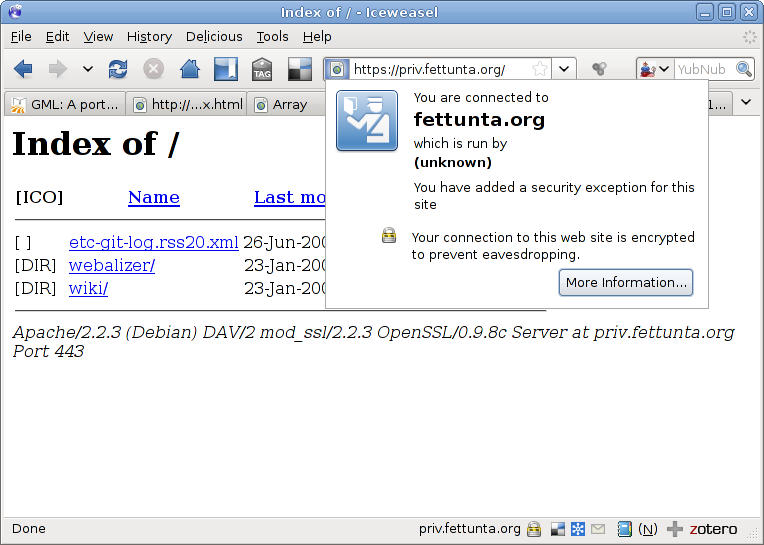
Gunnar, have a look at this: iceweasel-ssl.png. So your example using the Penta website was just a bad one, and I personally agree with the "INVALID" resolution of your bug report. In fact, showing a partially encrypted connection as an insecure one is an overall advantage for (l)user securities, as with the browser interfaces we are used to use, we don't know which parts are actually sent encrypted and which are not. As you can see in the example above a fully encrypted connection is properly reported as such by Firefox 3.0. FWIW: I'm overall satisfied with Firefox 3.0, especially about the new URL bar Wouther is disliking. Yes it is a bit slower than before, but even on my 4-year old laptop it is perfectly usable. The HTML title shown there? Well, it is rather handy when I start typing bugs.debian.org and then I've to discriminate among tons of almost identical bug report URLs ... Is the about:config hand-holding dialog worst than the pop-up the first time you "have provided unencrypted information" in a random form? It is not, we have probably just forgot about the first time we unchecked the corresponding checkbox. All in all, the only "feature" of the new Firefox I found incredibly stupid is the SSL certificate exception mechanism. Installing the untrusted certificate is what? ... 5 click-away from the initial page? That is just dumb. (And as it is well-known that habits form anyhow, getting the habits harder to form is just a way to piss-off users.)

25 June 2008

Mike Hommey: Pissing users off

It seems some people don’t like the new about:config warning in Firefox 3.0. The sad thing is this message was not intended to piss people off. The localization note intended for translaters reads:
<!– LOCALIZATION NOTE: aboutWarningTitle.label should be attention grabbing and playful –>
It’s not even necessarily talking about warranty in other locales:
<!ENTITY aboutWarningTitle.label “Attention, danger !”> (fr)
<!ENTITY aboutWarningTitle.label “ Zona hostil para manazas!”> (es-ES)
<!ENTITY aboutWarningTitle.label “Here be dragons!”> (en-GB)
Seems like the en-US version has a strange definition of playful.

Gunnar Wolf: Firefox suckyness

I have to agree with Wouter regarding Firefox Iceweasel 3's suckyness. It might be a superior product in many fronts (I prefer it overall to its predecesor), but were it not for the usefulness of its many available extensions (most notably Web Developer, which has become an integral part of my everyday life), I'd have jumped ship for basically any other browser.
I'm just... adding an <AOL>ME TOO!</AOL> on Wouter's comments... WTF, just go to about:config...

So... Are you telling me that Firefox (even if it were the original, Mozilla-blessed version) has a warranty? No? Didn't think so... Go to about:license. You will see the very familiar and expected:
7. Disclaimer of warranty
Covered code is provided under this license on an "as is" basis, without warranty of any kind, either expressed or implied, including, without limitation, warranties that the covered code is free of defects (...)
Other than this downright stupid issue (which by and large goes against the regular Free Software culture), my main gripe is the number of active regions in the location-entry boxes - Yes, I can jump straight to the search box with Ctrl-K and to the location bar with Ctrl-L, but if I happen to try to move between them with good ol' Tab, why must it be inconsistent?
What do I mean? Go to the search field, press Tab. As expected, you are in the Location entry. Now, press Shift-Tab. For 5 points, where are you now? Bzzzt, no, you are not back where you began - You are in a stupid button which looks like your favicon giving you the identity information about the page you are looking at.
Having this button is a great idea - but why does it have to sit in the way of my tabulation? Were it because, in an inspired moment, the Firefox interface designers decided that buttons should be keyboard-accessible, I'd be most happy (it is by far my most mouse-intensive application, and I hate that... But it's just a button embedded in what should be a clean text-entry box.
And for that matter, it is not even a consistent button - Shift-tabbing from the search field will not get you to the search engine selector. And no key combination will lead you to the noisy (and also, mutually inconsistent) iconic buttons at the far right of both fields... Which, again, have no reason to be inside a text entry field!
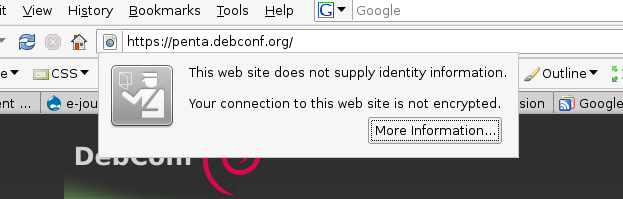
Oh, and I found another pretty little jewel: Go to any site which has a self-signed SSL certificate. Of course, Firefox will go to great lengths to make sure you understand how unsafe is it for you to trust anybody who didn't pay big bucks to Verisign... But this is enough reason for me to send a bug report:

I am connecting through a crypted HTTPS connection. The site is providing identity information - not certified, right, but it does provide something. And the connection is crypted. Firefox/Iceweasel 2 showed me the URL in a light-yellow background showing the connection was secure - Now it just denies penta.debconf.org the right to call itself secure.
(Yes, I am not an interface designer... But it seems neither are they)
[update]Bug filed. Any comments will be welcome in Bugzilla. The bug with the Debconf site (and I do regard it as a bug) is that Iceweasel displays that Your connection to this web site is not encrypted because some of the elements (i.e. the CSS, images..) are sent in the clear - Even though the real information is crypted. Ever heard of data/visualization decoupling?

18 June 2008

Gunnar Wolf: eSATA, USB and friends

Andrew asks about Linux-friendly eSATA controllers. A long time ago, I also looked for some - but basically no one seems to know about that, or will try to rip your eyes for it.
In January, however, I looked for (and bought) an external USB enclosure for SATA disks. As portability was more important than speed, I only asked for USB. Good, got the kit, paid for it.
The external enclosure had an external eSATA port. Not only that, it shipped with a standard PC expansion slot bracket and adaptor - Yes, it connects to your internal SATA port, and provides an external eSATA port. And, of course, it will work with your current kernel painlessly. And, of course, it is even cheaper than a SATA controller with an external port.

13 June 2008

Gunnar Wolf: Freedom itches

In this Free Software movement we have many mottos - One of which, describing what motivates us to work writing code, is scratch where it itches.
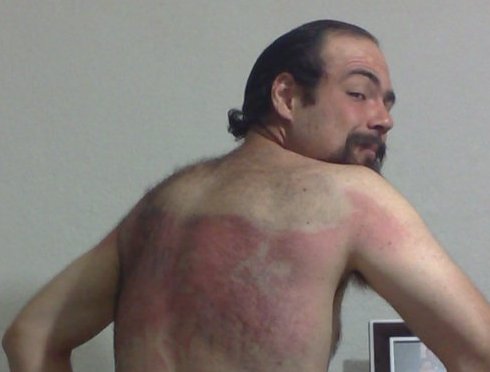
Of course, I could not keep it to myself - Almost a week ago, I took part of the World Naked Bike Ride. What I didn't tell you... Is that it became obvious I cannot reach most of by back - And it's because I'm mostly careless. When the WNBR started, it was still quite cloudy, even starting to rain... so I was mostly careless.
If you opened the newspaper PDF I attached to my previous post, you'll surely remember (not an easy sight to get out of your head, I guess) I had painted on my back "Veh culo libre de emisiones" - Emissions-free vehicle (and yes, it's strictly true: My bike is zero emissions. The animal riding it might not be... But that's a different story). Add incomplete sunblock to the equation, and...

Were it not for the poor lighting conditions under which I took the photo, you'd clearly appreciate the words "libre de" on my back.
And... Well, one week later, my freedom itches.
Badly.

12 June 2008

Jordi Mallach: Naked bike ride

Knowing many people in the Debian community, I knew others would be there too. And Gunnar confirmed it yesterday via Planet Debian. Yes, I participated in the World Naked Bike Ride, although at the time I didn't know about the campaign, I thought people were doing it just because we can mostly. So, after being invited to the ride the week before, 5 of our colla were in the old T ria's river bed, near the Fira Alternativa's scenary at the scheduled time. Not having done anything like this before, we were a bit expectant to see how many people would actually do it, before deciding to join them. After a while, more and more people seemed to gather, and it finally took off. Pants off, and there we go! The insane amount of photographing and filming that was going on around us at the beginning was a bit uncomfortable, but after a while we had mostly forgotten we were riding our bikes naked through the commercial arteries of Val ncia. The ride was too long for my taste, covering the whole Fira, Pla a d'Am rica, carrer Colom just in front of El Corte Ingl s (I wonder how many known people saw me there), X tiva, Russafa, back to X tiva, Town Hall, Ciutat Vella, river margin and Blasco Ib ez. Even if it was a sunny day, the chilly wind made me feel really cold, but overall it was quite fun, and an interesting experience I might or might not repeat. I'm certainly not becoming a naturism activist or anything like this. I do think we have way too many taboos, and every time I get rid of one, I feel a lot better. :)

11 June 2008

MJ Ray: More driving and cycling

Jeff Bailey asked:
"Heya Brits! Any of you still driving cars at ~ 1.15 according to the Daily Mail"
Yes, I am. I drove on Monday (at 1.18/l) because it was the least bad option for the journey. I try to avoid it and I felt bad afterwards (literally - it was too damn hot and each part of the journey was too short for the cab to cool down), but the car was available and the other choices involved not attending some events. On Sunday, I used my bike instead, but I was I wondering if the world is full of Sunday drivers today or whether I was really riding that badly. You name a junction on my route and I seemed to get into a conflict with a car at it. Today's bike trip went much better, even getting thanks from a coach for pulling aside halfway up an incline, but I had to take avoiding action as I re-entered the village because of a police car. I'm pretty damn sure that wasn't my fault, but I do wonder when it's the police. I'm still riding without a helmet, without ill effects. Gunnar Wolf was getting a breeze through a different kind of helmet but I think it's telling that cyclists "feel naked" rather than actually being naked (usually, at least). Have we got too used to being cocooned in metal boxes while out on the roads? I've always ridden and walked a lot - is this why I don't miss the hat much? I must remember to drink more in summer without it, though. I share Criag Sanders's scepticism about the protests and Chrisitan Perrier's enthusiasm for bike-pools. I don't agree with many of Russel Coker's views on oil prices but they are interesting reading, even so. I'm taking part in JamBustingJune for the West of England region and BikeWeek 14-21 June 2008

Gunnar Wolf: No, it's not

Several people have approached me (or I've stumbled upon their sites) asking me about something called Debian 5.0 Beta 2.
It. Is. Not. That.
Please read clearly the announcement for Debian Installer lenny beta 2 - Yes, I understand this reached many people who are not involved in Debian but are enthusiastic users nevertheless. In short: The only thing that reached the beta is the debian-installer program (usually called just d-i), the amazing piece of code that handles a Debian installation in your system. And yes, it is meant for wide testing and work.
But please, do not take this as a preview of the new Debian release - it is not. If you install a system using this version of d-i, you will be tracking the Testing branch of Debian, and your system will be in a continuous state of flux. Yes, we do expect a freeze of Lenny in the next couple of weeks, after what it will be quite close to a Beta release (i.e. almost no new versions, no fresh software, just bug fixes). But hey - A Beta is supposed to be close to release quality. And if you look at the release-critical bugs affecting the Testing branch (green line), you will clearly see we have over 400 bugs to fix before Lenny is allowed to be called stable. And that's only one of the criteria needed to reach Lenny - Glance over at the Debian Release Management page to quickly understand the nature of changes still to come.
Oh, and of course - Even if it is not necessarily up-to-date, I have found the Wiki page created by Peter Eisentraut as an excellent place to start working whenever I have some free time: Lenny Release Goals.
so... If you are not yet working towards making Debian the best distribution ever, and Lenny the best Debian release ever, you now know where we need your help ;-)
(side note: d-i team, maybe the next announcement could use some words pointing out we are not doing a Debian beta program, just a d-i beta release?)

10 June 2008

Gunnar Wolf: Nekkid city - yet again!

After thinking it over a couple of times, I did it. I told you here about the World Naked Bike Ride. Thousands of bikers, in over 130 cities around the world, voiced their concerns about the lack of caution drivers have towards us, about the abuse of fossil fuels for urban transportation, about the easy we are not to be seen. Many among us have been run over by careless drivers (in my case, no consequences except a broken helmet - And yes, MJ: although the impact was on the flat surface of the road and not on the kerb, the strength of the impact still amazes me). We feel naked against the motorized traffic. So, the WNBR decides to show it by taking the streets of our many cities - Naked.
It was a completely different experience of the massive naked Spencer Tunick photo, as we were there not just to show our freedom and enjoy, but to get the people to look at us. There were some of the same elements of comradeship and trust we had there (and, of course, that many of us learnt in Finland when we became GNUdists at DebConf 5's unforgettable saunas).
Anyway... I did not make the full route (I rode Chapultepec-Z calo-Diana, ~15Km, but missed the Diana-Gandhi-Cibeles part, maybe some 5Km) as I had an appointment I was already late for. But it was a unique, great experience. If you are interested, we got a fair share of press coverage. Oh, and I must say: I am famous now. And in my favorite newspaper, nothing less :).

Gunnar Wolf: Running, biking, and the like

Bubulle's improvements on running make me envy him. Of course, I'm nowhere close to Dirk's (or for that matter, I can only hope never to be as insane as Mauricio).
I must admit that I have heavily reduced my running. This is in no small part due to the fact that it's not easy to find decently-priced running shoes of the right size in Mexico - But well, that's only an excuse after all. But yes, if I run over 7Km with my current shoes, I get blisters, invariably. And I'm a bit short on money right now...
Partly, I've been moving my preferred excercise to biking - I don't do heavy biking, of course, but I do try to get at least 15Km every day (and as I bike to and from work, I only have to take small extra detours to reach that point - although splitting an excercise session in several sub-sessions is very close to cheating on myself) and at least a longer, continuous, 25-30Km ride every weekend. But yes, I've lowered my rythm.
Also, I'm running less because of where I am currently living - Very close to my usual area, but quite a bit more hilly, and it has made my knees ache every now and then.... And by far, it is not as nice and friendly area.
I do hope to work on this - And, of course, the Debconf Morning Jog is one of the events I most look forward to. Running in Edinburgh was, after all, my favorite and most productive way to get to know the city.

Next.

Previous.