Search Results: "ghe"

30 June 2016

Chris Lamb: Free software activities in June 2016

Here is my monthly update covering a large part of what I have been doing in the free software world (previously):
Debian My work in the Reproducible Builds project was covered in our weekly reports. (#58, #59 & #60)
Debian LTS

This month I have been paid to work 18 hours on Debian Long Term Support (LTS). In that time I did the following:
  • "Frontdesk" duties, triaging CVEs, etc.
  • Extended the lts-cve-triage.py script to ignore packages that are not subject to Long Term Support.

  • Issued DLA 512-1 for mantis fixing an XSS vulnerability.
  • Issued DLA 513-1 for nspr correcting a buffer overflow in a sprintf utility.
  • Issued DLA 515-1 for libav patching a memory corruption issue.
  • Issued DLA 524-1 for squidguard fixing a reflected cross-site scripting vulnerability.
  • Issued DLA 525-1 for gimp correcting a use-after-free vulnerability in the channel and layer properties parsing process.

Uploads
  • redis (2:3.2.1-1) New upstream bugfix release, plus subsequent upload to the backports repository.
  • python-django (1.10~beta1-1) New upstream experimental release.
  • libfiu (0.94-5) Misc packaging updates.


RC bugs

I also filed 170 FTBFS bugs against a7xpg, acepack, android-platform-dalvik, android-platform-frameworks-base, android-platform-system-extras, android-platform-tools-base, apache-directory-api, aplpy, appstream-generator, arc-gui-clients, assertj-core, astroml, bamf, breathe, buildbot, cached-property, calf, celery-haystack, charmtimetracker, clapack, cmake, commons-javaflow, dataquay, dbi, django-celery, django-celery-transactions, django-classy-tags, django-compat, django-countries, django-floppyforms, django-hijack, django-localflavor, django-markupfield, django-model-utils, django-nose, django-pipeline, django-polymorphic, django-recurrence, django-sekizai, django-sitetree, django-stronghold, django-taggit, dune-functions, elementtidy, epic4-help, fcopulae, fextremes, fnonlinear, foreign, fort77, fregression, gap-alnuth, gcin, gdb-avr, ggcov, git-repair, glance, gnome-twitch, gnustep-gui, golang-github-audriusbutkevicius-go-nat-pmp, golang-github-gosimple-slug, gprbuild, grafana, grantlee5, graphite-api, guacamole-server, ido, jless, jodreports, jreen, kdeedu-data, kdewebdev, kwalify, libarray-refelem-perl, libdbusmenu, libdebian-package-html-perl, libdevice-modem-perl, libindicator, liblrdf, libmail-milter-perl, libopenraw, libvisca, linuxdcpp, lme4, marble, mgcv, mini-buildd, mu-cade, mvtnorm, nose, octave-epstk, onioncircuits, opencolorio, parsec47, phantomjs, php-guzzlehttp-ringphp, pjproject, pokerth, prayer, pyevolve, pyinfra, python-asdf, python-ceilometermiddleware, python-django-bootstrap-form, python-django-compressor, python-django-contact-form, python-django-debug-toolbar, python-django-extensions, python-django-feincms, python-django-formtools, python-django-jsonfield, python-django-mptt, python-django-openstack-auth, python-django-pyscss, python-django-registration, python-django-tagging, python-django-treebeard, python-geopandas, python-hdf5storage, python-hypothesis, python-jingo, python-libarchive-c, python-mhash, python-oauth2client, python-proliantutils, python-pytc, python-restless, python-tidylib, python-websockets, pyvows, qct, qgo, qmidinet, quodlibet, r-cran-gss, r-cran-runit, r-cran-sn, r-cran-stabledist, r-cran-xml, rgl, rglpk, rkt, rodbc, ruby-devise-two-factor, ruby-json-schema, ruby-puppet-syntax, ruby-rspec-puppet, ruby-state-machine, ruby-xmlparser, ryu, sbd, scanlogd, signond, slpvm, sogo, sphinx-argparse, squirrel3, sugar-jukebox-activity, sugar-log-activity, systemd, tiles, tkrplot, twill, ucommon, urca, v4l-utils, view3dscene, xqilla, youtube-dl & zope.interface.

FTP Team

As a Debian FTP assistant I ACCEPTed 186 packages: akonadi4, alljoyn-core-1509, alljoyn-core-1604, alljoyn-gateway-1504, alljoyn-services-1504, alljoyn-services-1509, alljoyn-thin-client-1504, alljoyn-thin-client-1509, alljoyn-thin-client-1604, apertium-arg, apertium-arg-cat, apertium-eo-fr, apertium-es-it, apertium-eu-en, apertium-hbs, apertium-hin, apertium-isl, apertium-kaz, apertium-spa, apertium-spa-arg, apertium-tat, apertium-urd, arc-theme, argus-clients, ariba, beast-mcmc, binwalk, bottleneck, colorfultabs, dh-runit, django-modeltranslation, dq, dublin-traceroute, duktape, edk2, emacs-pdf-tools, eris, erlang-p1-oauth2, erlang-p1-sqlite3, erlang-p1-xmlrpc, faba-icon-theme, firefox-branding-iceweasel, golang-1.6, golang-defaults, golang-github-aelsabbahy-gonetstat, golang-github-howeyc-gopass, golang-github-oleiade-reflections, golang-websocket, google-android-m2repository-installer, googler, goto-chg-el, gr-radar, growl-for-linux, guvcview, haskell-open-browser, ipe, labplot, libalt-alien-ffi-system-perl, libanyevent-fcgi-perl, libcds-savot-java, libclass-ehierarchy-perl, libconfig-properties-perl, libffi-checklib-perl, libffi-platypus-perl, libhtml-element-library-perl, liblwp-authen-oauth2-perl, libmediawiki-dumpfile-perl, libmessage-passing-zeromq-perl, libmoosex-types-portnumber-perl, libmpack, libnet-ip-xs-perl, libperl-osnames-perl, libpodofo, libprogress-any-perl, libqtpas, librdkafka, libreoffice, libretro-beetle-pce-fast, libretro-beetle-psx, libretro-beetle-vb, libretro-beetle-wswan, libretro-bsnes-mercury, libretro-mupen64plus, libservicelog, libtemplate-plugin-datetime-perl, libtext-metaphone-perl, libtins, libzmq-ffi-perl, licensecheck, link-grammar, linux, linux-signed, lua-busted, magics++, mkalias, moka-icon-theme, neutron-vpnaas, newlisp, node-absolute-path, node-ejs, node-errs, node-has-flag, node-lodash-compat, node-strip-ansi, numba, numix-icon-theme, nvidia-graphics-drivers, nvidia-graphics-drivers-legacy-304xx, nvidia-graphics-drivers-legacy-340xx, obs-studio, opencv, pacapt, pgbackrest, postgis, powermock, primer3, profile-sync-daemon, pyeapi, pypandoc, pyssim, python-cutadapt, python-cymruwhois, python-fisx, python-formencode, python-hkdf, python-model-mommy, python-nanomsg, python-offtrac, python-social-auth, python-twiggy, python-vagrant, python-watcherclient, python-xkcd, pywps, r-bioc-deseq2, r-bioc-dnacopy, r-bioc-ensembldb, r-bioc-geneplotter, r-cran-adegenet, r-cran-adephylo, r-cran-distory, r-cran-fields, r-cran-future, r-cran-globals, r-cran-htmlwidgets, r-cran-listenv, r-cran-mlbench, r-cran-mlmrev, r-cran-pheatmap, r-cran-pscbs, r-cran-r.cache, refind, relatorio, reprotest, ring, ros-ros-comm, ruby-acts-as-tree, ruby-chronic-duration, ruby-flot-rails, ruby-numerizer, ruby-u2f, selenium-firefoxdriver, simgrid, skiboot, smtpping, snap-confine, snapd, sniffles, sollya, spin, subuser, superlu, swauth, swift-plugin-s3, syncthing, systemd-bootchart, tdiary-theme, texttable, tidy-html5, toxiproxy, twinkle, vmtk, wait-for-it, watcher, wcslib & xapian-core.

19 June 2016

Paul Tagliamonte: Go Debian!

As some of the world knows full well by now, I've been noodling with Go for a few years, working through its pros, its cons, and thinking a lot about how humans use code to express thoughts and ideas. Go's got a lot of neat use cases, suited to particular problems, and used in the right place, you can see some clear massive wins. I've started writing Debian tooling in Go, because it's a pretty natural fit. Go's fairly tight, and overhead shouldn't be taken up by your operating system. After a while, I wound up hitting the usual blockers, and started to build up abstractions. They became pretty darn useful, so, this blog post is announcing (a still incomplete, year old and perhaps API changing) Debian package for Go. The Go importable name is pault.ag/go/debian. This contains a lot of utilities for dealing with Debian packages, and will become an edited down "toolbelt" for working with or on Debian packages. Module Overview Currently, the package contains 4 major sub packages. They're a changelog parser, a control file parser, deb file format parser, dependency parser and a version parser. Together, these are a set of powerful building blocks which can be used together to create higher order systems with reliable understandings of the world. changelog The first (and perhaps most incomplete and least tested) is a changelog file parser.. This provides the programmer with the ability to pull out the suite being targeted in the changelog, when each upload was, and the version for each. For example, let's look at how we can pull when all the uploads of Docker to sid took place:
func main()  
    resp, err := http.Get("http://metadata.ftp-master.debian.org/changelogs/main/d/docker.io/unstable_changelog")
    if err != nil  
        panic(err)
     
    allEntries, err := changelog.Parse(resp.Body)
    if err != nil  
        panic(err)
     
    for _, entry := range allEntries  
        fmt.Printf("Version %s was uploaded on %s\n", entry.Version, entry.When)
     
 
The output of which looks like:
Version 1.8.3~ds1-2 was uploaded on 2015-11-04 00:09:02 -0800 -0800
Version 1.8.3~ds1-1 was uploaded on 2015-10-29 19:40:51 -0700 -0700
Version 1.8.2~ds1-2 was uploaded on 2015-10-29 07:23:10 -0700 -0700
Version 1.8.2~ds1-1 was uploaded on 2015-10-28 14:21:00 -0700 -0700
Version 1.7.1~dfsg1-1 was uploaded on 2015-08-26 10:13:48 -0700 -0700
Version 1.6.2~dfsg1-2 was uploaded on 2015-07-01 07:45:19 -0600 -0600
Version 1.6.2~dfsg1-1 was uploaded on 2015-05-21 00:47:43 -0600 -0600
Version 1.6.1+dfsg1-2 was uploaded on 2015-05-10 13:02:54 -0400 EDT
Version 1.6.1+dfsg1-1 was uploaded on 2015-05-08 17:57:10 -0600 -0600
Version 1.6.0+dfsg1-1 was uploaded on 2015-05-05 15:10:49 -0600 -0600
Version 1.6.0+dfsg1-1~exp1 was uploaded on 2015-04-16 18:00:21 -0600 -0600
Version 1.6.0~rc7~dfsg1-1~exp1 was uploaded on 2015-04-15 19:35:46 -0600 -0600
Version 1.6.0~rc4~dfsg1-1 was uploaded on 2015-04-06 17:11:33 -0600 -0600
Version 1.5.0~dfsg1-1 was uploaded on 2015-03-10 22:58:49 -0600 -0600
Version 1.3.3~dfsg1-2 was uploaded on 2015-01-03 00:11:47 -0700 -0700
Version 1.3.3~dfsg1-1 was uploaded on 2014-12-18 21:54:12 -0700 -0700
Version 1.3.2~dfsg1-1 was uploaded on 2014-11-24 19:14:28 -0500 EST
Version 1.3.1~dfsg1-2 was uploaded on 2014-11-07 13:11:34 -0700 -0700
Version 1.3.1~dfsg1-1 was uploaded on 2014-11-03 08:26:29 -0700 -0700
Version 1.3.0~dfsg1-1 was uploaded on 2014-10-17 00:56:07 -0600 -0600
Version 1.2.0~dfsg1-2 was uploaded on 2014-10-09 00:08:11 +0000 +0000
Version 1.2.0~dfsg1-1 was uploaded on 2014-09-13 11:43:17 -0600 -0600
Version 1.0.0~dfsg1-1 was uploaded on 2014-06-13 21:04:53 -0400 EDT
Version 0.11.1~dfsg1-1 was uploaded on 2014-05-09 17:30:45 -0400 EDT
Version 0.9.1~dfsg1-2 was uploaded on 2014-04-08 23:19:08 -0400 EDT
Version 0.9.1~dfsg1-1 was uploaded on 2014-04-03 21:38:30 -0400 EDT
Version 0.9.0+dfsg1-1 was uploaded on 2014-03-11 22:24:31 -0400 EDT
Version 0.8.1+dfsg1-1 was uploaded on 2014-02-25 20:56:31 -0500 EST
Version 0.8.0+dfsg1-2 was uploaded on 2014-02-15 17:51:58 -0500 EST
Version 0.8.0+dfsg1-1 was uploaded on 2014-02-10 20:41:10 -0500 EST
Version 0.7.6+dfsg1-1 was uploaded on 2014-01-22 22:50:47 -0500 EST
Version 0.7.1+dfsg1-1 was uploaded on 2014-01-15 20:22:34 -0500 EST
Version 0.6.7+dfsg1-3 was uploaded on 2014-01-09 20:10:20 -0500 EST
Version 0.6.7+dfsg1-2 was uploaded on 2014-01-08 19:14:02 -0500 EST
Version 0.6.7+dfsg1-1 was uploaded on 2014-01-07 21:06:10 -0500 EST
control Next is one of the most complex, and one of the oldest parts of go-debian, which is the control file parser (otherwise sometimes known as deb822). This module was inspired by the way that the json module works in Go, allowing for files to be defined in code with a struct. This tends to be a bit more declarative, but also winds up putting logic into struct tags, which can be a nasty anti-pattern if used too much. The first primitive in this module is the concept of a Paragraph, a struct containing two values, the order of keys seen, and a map of string to string. All higher order functions dealing with control files will go through this type, which is a helpful interchange format to be aware of. All parsing of meaning from the Control file happens when the Paragraph is unpacked into a struct using reflection. The idea behind this strategy that you define your struct, and let the Control parser handle unpacking the data from the IO into your container, letting you maintain type safety, since you never have to read and cast, the conversion will handle this, and return an Unmarshaling error in the event of failure. Additionally, Structs that define an anonymous member of control.Paragraph will have the raw Paragraph struct of the underlying file, allowing the programmer to handle dynamic tags (such as X-Foo), or at least, letting them survive the round-trip through go. The default decoder contains an argument, the ability to verify the input control file using an OpenPGP keyring, which is exposed to the programmer through the (*Decoder).Signer() function. If the passed argument is nil, it will not check the input file signature (at all!), and if it has been passed, any signed data must be found or an error will fall out of the NewDecoder call. On the way out, the opposite happens, where the struct is introspected, turned into a control.Paragraph, and then written out to the io.Writer. Here's a quick (and VERY dirty) example showing the basics of reading and writing Debian Control files with go-debian.
package main
import (
    "fmt"
    "io"
    "net/http"
    "strings"
    "pault.ag/go/debian/control"
)
type AllowedPackage struct  
    Package     string
    Fingerprint string
 
func (a *AllowedPackage) UnmarshalControl(in string) error  
    in = strings.TrimSpace(in)
    chunks := strings.SplitN(in, " ", 2)
    if len(chunks) != 2  
        return fmt.Errorf("Syntax sucks: '%s'", in)
     
    a.Package = chunks[0]
    a.Fingerprint = chunks[1][1 : len(chunks[1])-1]
    return nil
 
type DMUA struct  
    Fingerprint     string
    Uid             string
    AllowedPackages []AllowedPackage  control:"Allow" delim:"," 
 
func main()  
    resp, err := http.Get("http://metadata.ftp-master.debian.org/dm.txt")
    if err != nil  
        panic(err)
     
    decoder, err := control.NewDecoder(resp.Body, nil)
    if err != nil  
        panic(err)
     
    for  
        dmua := DMUA 
        if err := decoder.Decode(&dmua); err != nil  
            if err == io.EOF  
                break
             
            panic(err)
         
        fmt.Printf("The DM %s is allowed to upload:\n", dmua.Uid)
        for _, allowedPackage := range dmua.AllowedPackages  
            fmt.Printf("   %s [granted by %s]\n", allowedPackage.Package, allowedPackage.Fingerprint)


Output (truncated!) looks a bit like:
...
The DM Allison Randal <allison@lohutok.net> is allowed to upload:
   parrot [granted by A4F455C3414B10563FCC9244AFA51BD6CDE573CB]
...
The DM Benjamin Barenblat <bbaren@mit.edu> is allowed to upload:
   boogie [granted by 3224C4469D7DF8F3D6F41A02BBC756DDBE595F6B]
   dafny [granted by 3224C4469D7DF8F3D6F41A02BBC756DDBE595F6B]
   transmission-remote-gtk [granted by 3224C4469D7DF8F3D6F41A02BBC756DDBE595F6B]
   urweb [granted by 3224C4469D7DF8F3D6F41A02BBC756DDBE595F6B]
...
The DM     <aelmahmoudy@sabily.org> is allowed to upload:
   covered [granted by 41352A3B4726ACC590940097F0A98A4C4CD6E3D2]
   dico [granted by 6ADD5093AC6D1072C9129000B1CCD97290267086]
   drawtiming [granted by 41352A3B4726ACC590940097F0A98A4C4CD6E3D2]
   fonts-hosny-amiri [granted by BD838A2BAAF9E3408BD9646833BE1A0A8C2ED8FF]
   ...
...
deb Next up, we've got the deb module. This contains code to handle reading Debian 2.0 .deb files. It contains a wrapper that will parse the control member, and provide the data member through the archive/tar interface. Here's an example of how to read a .deb file, access some metadata, and iterate over the tar archive, and print the filenames of each of the entries.
func main()  
    path := "/tmp/fluxbox_1.3.5-2+b1_amd64.deb"
    fd, err := os.Open(path)
    if err != nil  
        panic(err)
     
    defer fd.Close()
    debFile, err := deb.Load(fd, path)
    if err != nil  
        panic(err)
     
    version := debFile.Control.Version
    fmt.Printf(
        "Epoch: %d, Version: %s, Revision: %s\n",
        version.Epoch, version.Version, version.Revision,
    )
    for  
        hdr, err := debFile.Data.Next()
        if err == io.EOF  
            break
         
        if err != nil  
            panic(err)
         
        fmt.Printf("  -> %s\n", hdr.Name)
     
 
Boringly, the output looks like:
Epoch: 0, Version: 1.3.5, Revision: 2+b1
  -> ./
  -> ./etc/
  -> ./etc/menu-methods/
  -> ./etc/menu-methods/fluxbox
  -> ./etc/X11/
  -> ./etc/X11/fluxbox/
  -> ./etc/X11/fluxbox/window.menu
  -> ./etc/X11/fluxbox/fluxbox.menu-user
  -> ./etc/X11/fluxbox/keys
  -> ./etc/X11/fluxbox/init
  -> ./etc/X11/fluxbox/system.fluxbox-menu
  -> ./etc/X11/fluxbox/overlay
  -> ./etc/X11/fluxbox/apps
  -> ./usr/
  -> ./usr/share/
  -> ./usr/share/man/
  -> ./usr/share/man/man5/
  -> ./usr/share/man/man5/fluxbox-style.5.gz
  -> ./usr/share/man/man5/fluxbox-menu.5.gz
  -> ./usr/share/man/man5/fluxbox-apps.5.gz
  -> ./usr/share/man/man5/fluxbox-keys.5.gz
  -> ./usr/share/man/man1/
  -> ./usr/share/man/man1/startfluxbox.1.gz
...
dependency The dependency package provides an interface to parse and compute dependencies. This package is a bit odd in that, well, there's no other library that does this. The issue is that there are actually two different parsers that compute our Dependency lines, one in Perl (as part of dpkg-dev) and another in C (in dpkg). To date, this has resulted in me filing three different bugs. I also found a broken package in the archive, which actually resulted in another bug being (totally accidentally) already fixed. I hope to continue to run the archive through my parser in hopes of finding more bugs! This package is a bit complex, but it basically just returns what amounts to be an AST for our Dependency lines. I'm positive there are bugs, so file them!
func main()  
    dep, err := dependency.Parse("foo   bar, baz, foobar [amd64]   bazfoo [!sparc], fnord:armhf [gnu-linux-sparc]")
    if err != nil  
        panic(err)
     
    anySparc, err := dependency.ParseArch("sparc")
    if err != nil  
        panic(err)
     
    for _, possi := range dep.GetPossibilities(*anySparc)  
        fmt.Printf("%s (%s)\n", possi.Name, possi.Arch)
     
 
Gives the output:
foo (<nil>)
baz (<nil>)
fnord (armhf)
version Right off the bat, I'd like to thank Michael Stapelberg for letting me graft this out of dcs and into the go-debian package. This was nearly entirely his work (with a one or two line function I added later), and was amazingly helpful to have. Thank you! This module implements Debian version comparisons and parsing, allowing for sorting in lists, checking to see if it's native or not, and letting the programmer to implement smart(er!) logic based on upstream (or Debian) version numbers. This module is extremely easy to use and very straightforward, and not worth writing an example for. Final thoughts This is more of a "Yeah, OK, this has been useful enough to me at this point that I'm going to support this" rather than a "It's stable!" or even "It's alive!" post. Hopefully folks can report bugs and help iterate on this module until we have some really clean building blocks to build solid higher level systems on top of. Being able to have multiple libraries interoperate by relying on go-debian will be a massive ease. I'm in need of more documentation, and to finalize some parts of the older sub package APIs, but I'm hoping to be at a "1.0" real soon now.

13 June 2016

Rapha&#235;l Hertzog: Freexian s report about Debian Long Term Support, May 2016

A Debian LTS logoLike each month, here comes a report about the work of paid contributors to Debian LTS. Individual reports In May, 166 work hours have been dispatched among 9 paid contributors. Their reports are available: Evolution of the situation The number of sponsored hours stayed the same over May but will likely increase a little bit the next month as we have two new Bronze sponsors being processed. The security tracker currently lists 36 packages with a known CVE and the dla-needed.txt file lists 36 packages awaiting an update. Despite the higher than usual number of work hours dispatched in May, we still have more open CVE than we used to have at the end of the squeeze LTS period. So more support is always needed Thanks to our sponsors New sponsors are in bold.

No comment Liked this article? Click here. My blog is Flattr-enabled.

8 June 2016

Gunnar Wolf: University degrees and sysadmin skills

I'll tune in to the post-based conversation being held on Planet Debian: Russell Coker wonders about what's needed to get university graduates with enough skills for a sysadmin job, to which Lucas Nussbaum responds with his viewpoints. They present a very contrasting view of what's needed for students And for a good reason, I'd say: Lucas is an academician; I don't know for sure about Russell, but he seems to be a down-to-the-earth, dirty-handed, proficient sysadmin working on the field. They both contact newcomers to their fields, and will notice different shortcomings. I tend to side with Lucas' view. That does not come as a surprise, as I've been working for over 15 years in an university, and in the last few years I started walking from a mostly-operative sysadmin in an academic setting towards becoming an academician that spends most of his time sysadmining. Subtle but important distinction. I teach at the BSc level at UNAM, and am a Masters student at IPN (respectively, Mexico's largest and second-largest universities). And yes, the lack of sysadmin abilities in both is surprising. But so is a good understanding of programming. And I'm sure that, were I to dig into several different fields, I'd feel the same: Student formation is very basic at each of those fields. But I see that as natural. Of course, if I were to judge people as geneticists as they graduate from Biology, or were I to judge them as topologists as they graduate from Mathematics, or any other discipline in which I'm not an expert, I'd surely not know where to start Given I have about 20 years of professional life on my shoulders, I'm quite skewed as to what is basic for a computing professional. And of course, there are severe holes in my formation, in areas I never used. I know next to nothing of electronics, my mathematical basis is quite flaky, and I'm a poor excuse when talking about artificial intelligence. Where am I going with this? An university degree (BSc in English, would amount to "licenciatura" in Spanish) is not for specialization. It is to have a sufficiently broad panorama of the field, and all of the needed tools to start digging deeper and specializing either by yourself, working on a given field and learning its details as you go, or going through a postgraduate program (Specialization, Masters, Doctorate). Even most of my colleagues at the Masters in Engineering in Security and Information Technology lack of a good formation in fields I consider essential. However, what does information security mean? Many among them are working on legal implications of several laws that touch our field. Many other are working on authenticity issues in images, audios and other such media. Many other are trying to come up with mathematical ways to cheapen the enormous burden of crypto operations (say, "shaving" CPU cycles off a very large exponentiation). Others are designing autonomous learning mechanisms to characterize malware. Were I as a computing professional to start talking about their research, I'd surely reveal I know nothing about it and get laughed at. That's because I haven't specialized in those fields. University education should give a broad universal basis to enter a professional field. It should not focus on teaching tools or specific procedures (although some should surely be presented as examples or case studies). Although I'd surely be happy if my university's graduates were to know everything about administering a Debian system, that would be wrong for a university to aim at; I'd criticize it the same way I currently criticize programs that mix together university formation and industry certification as if they were related.

7 June 2016

Matthew Garrett: Be wary of heroes

Inspiring change is difficult. Fighting the status quo typically means being able to communicate so effectively that powerful opponents can't win merely by outspending you. People need to read your work or hear you speak and leave with enough conviction that they in turn can convince others. You need charisma. You need to be smart. And you need to be able to tailor your message depending on the audience, even down to telling an individual exactly what they need to hear to take your side. Not many people have all these qualities, but those who do are powerful and you want them on your side.

But the skills that allow you to convince people that they shouldn't listen to a politician's arguments are the same skills that allow you to convince people that they shouldn't listen to someone you abused. The ability that allows you to argue that someone should change their mind about whether a given behaviour is of social benefit is the same ability that allows you to argue that someone should change their mind about whether they should sleep with you. The visibility that gives you the power to force people to take you seriously is the same visibility that makes people afraid to publicly criticise you.

We need these people, but we also need to be aware that their talents can be used to hurt as well as to help. We need to hold them to higher standards of scrutiny. We need to listen to stories about their behaviour, even if we don't want to believe them. And when there are reasons to believe those stories, we need to act on them. That means people need to feel safe in coming forward with their experiences, which means that nobody should have the power to damage them in reprisal. If you're not careful, allowing charismatic individuals to become the public face of your organisation gives them that power.

There's no reason to believe that someone is bad merely because they're charismatic, but this kind of role allows a charismatic abuser both a great deal of cover and a great deal of opportunity. Sometimes people are just too good to be true. Pretending otherwise doesn't benefit anybody but the abusers.

comment count unavailable comments

3 June 2016

Joey Hess: electrum ssl vulnerabilities

The electrum bitcoin wallet seems to use SSL insecurely. Here are two bug reports I filed about it: ignores invalid ssl certs with CERT_NONE, allowing MITM fails to verify ssl cert hostname for cached certs

(update: Seems I was wrong about this bug) One full month after I filed these, there's been no activity, so I thought I'd make this a little more widely known. It's too hard to get CVEs assigned, and resgistering a snarky domain name is passe. I'm not actually using electrum myself currently, as I own no bitcoins. I only noticed these vulnerabilities when idly perusing the code. I have not tried to actually exploit them, and some of the higher levels of the SPV blockchain verification make them difficult to exploit. Or perhaps there are open wifi networks where all electrum connections get intercepted by a rogue server that successfully uses these security holes to pretend to be the entire electrum server network. I'm not particularly surprised to find code that's supposed to be securing a connection with SSL but actually fails to verify the SSL certificate. That's the common failure mode of SSL libraries. It is a bit surprising to find such mistakes in a bitcoin wallet though. And, electrum seems to go out of its way to complicate its SSL certificate handling, which directly led to these security holes. Kind of makes me wonder about the security of the rest of it.

30 May 2016

Daniel Stender: My work for Debian in May

No double posting this time ;-) I've got not so much spare time this month to spend on Debian, but I could work on the following packages: This series of blog postings also includes little introductions of and into new packages in the archive. This month there is: Pyinfra Pyinfra is a new project which is currently still in development state. It has been already pointed out in an interesting German article1, and is now available as package maintained within the Python Applications Team. It's currently a one man production by Nick Barrett, and eagerly developed in the past weeks (we're currently at 0.1~dev24). Pyinfra is a remote server configuration/provisioning/service deployment tool which belongs in the same software category like Puppet or Ansible2. It's for provisioning one or an array of remote servers with software packages and to configure them. Pyinfra runs agentless like Ansible, that means for using it nothing special (like a daemon) has to run on targeted servers. It's written to be used for provisioning POSIX compatible Linux systems and has alternatives when it comes to special features like package managers (e.g. supports apt as well as yum). The documentation could be found in usr/share/doc/pyinfra/html/. Here's a little crash course on how to use Pyinfra: The pyinfra CLI tool is used on the command line like this, deploy scripts, single operations or facts (see below) could be used on a single server or a multitude of remote servers:
$ pyinfra -i <inventory script/single host> <deploy script>
$ pyinfra -i <inventory script/single host> --run <operation>
$ pyinfra -i <inventory script/single host> --facts <fact>
Remote servers which are operated on must provide a working shell and they must be reachable by SSH. For connecting, --port, --user, --password, --key/--key-password and --sudo flags are available, --sudo to gain superuser rights. Root access or sudo rights of course have to be already set up. By the way, localhost could be operated on the same way. Single operations are organized in modules like "apt", "files", "init", "server" etc. With the --run option they could be used individually on servers like follows, e.g. server.user adds a new user on a single targeted system (-v adds verbosity to the pyinfra run):
$ pyinfra -i 192.0.2.10 --run server.user sam --user root --key ~/.ssh/sshkey --key-password 123456 -v
Multiple servers can be grouped in inventories, which hold the targeted hosts and data associated with them, like e.g. an inventory file farm1.py would contain lists like this:
COMPUTE_SERVERS = ['192.0.2.10', '192.0.2.11']
DATABASE_SERVERS = ['192.0.2.20', '192.0.2.21']
Group designators must be all caps. A higher level of grouping are the file names of inventory scripts, thus COMPUTE_SERVERS and DATABASE_SERVERS can be referenced to at the same time by the group designator farm1. Plus, all servers are automatically added to the group all. And, inventory scripts should be stored in the subfolder inventory/ in the project directory. Inventory files then could be used instead of specific IP addresses like this, the single operation then gets performed on all given machines in farm1.py:
$ pyinfra -i inventory/farm1.py  --run server.user sam --user root --key ~/.ssh/sshkey --key-password=123456 -v
Deployment scripts could be used together with group data files in the subfolder group_data/ in the project directory. For example, a group_data/farm1.py designates all servers given in inventory/farm1.py (by the way, all.py designates all servers), and contains the random attribute user_name (attributes must be lowercase), next to authentication data for the whole inventory group:
user_name = 'sam'
ssh_user = 'root'
ssh_key = '~/.ssh/sshkey'
ssh_key_password = '123456'
The random attribute can be picked up by a deployment script using host.data() like follows, user_name could be used again for e.g. server.user(), like this:
from pyinfra import host
from pyinfra.modules import server
server.user(host.data.user_name)
This deploy, the ensemble of inventory file, group data file and deployment script (usually placed top level in the project folder) then could be run that way:
$ pyinfra -i inventory/farm1.py deploy.py
You have guessed it, since deployment scripts are Python scripts they are fully programmable (please regard that Pyinfra is build & runs on Python 3 on Debian), and that's the main advantage point with this piece of software. Quite handy for that come Pyinfra facts, functions which check different things on remote systems and return information as Python data. Like e.g. deb_packages returns a dictionary of installed packages from a remote apt based server:
$ pyinfra -i 192.0.2.10 --fact deb_packages --user root --key ~/.ssh/sshkey --key-password=123456
 
    "192.0.2.10":  
        "libdebconfclient0": "0.192",
        "python-debian": "0.1.27",
        "libavahi-client3": "0.6.31-5",
        "dbus": "1.8.20-0+deb8u1",
        "libustr-1.0-1": "1.0.4-3+b2",
        "sed": "4.2.2-4+b1",
Using facts, Pyinfra reveals its full potential. For example, a deployment script could go like this, linux.distribution() returns a dict containing the installed distribution:
from pyinfra import host
from pyinfra.modules import apt
if host.fact.linux_distribution['name'] == 'Debian':
   apt.packages(packages='gummi', present=True, update=True)
elif host.fact.linux_distribution['name'] == 'CentOS':
   pass
I'll spare more sophisticated examples to keep this introduction simple. Beyond fancy deployment scripts, Pyinfra features an own API by which it could be programmed from the outside, and much more. But maybe that's enough to introduce Pyinfra. That are the usage basics. Pyinfra is a brand new project and it remains to be seen whether the developer can keep on further developing the tool like he does these days. For a private project it's insane to attempt to become a contender for the established "big" free configuration management tools and frameworks, but, if Puppet has become too complex in the meanwhile or not3, I really don't think that's the point here. Pyinfra follows an own approach in being programmable the way which it is. And it's definitely not harm to have it in the toolbox already, not trying to replace nothing. Brainstorm After the first package has been in experimental, the Brainstorm library from Swiss AI research institute IDSIA4 is now available as python3-brainstorm in unstable. Brainstorm is a lean, easy-to-use library for setting up deep learning networks (multiple layered artificial neural networks) for machine learning applications like for image and speech recognition or natural language processing. To set up a working training network for a classifier for handwritten digits like the MNIST dataset (a usual "hello world") just takes a couple of lines, like an example demonstrates. The package is maintained within the Debian Python Modules Team. The Debian package ships a couple of examples in /usr/share/python3-brainstorm/examples (the data/ and examples/ folders of the upstream tarball are combined here). Among them there are5: The current documentation in /usr/share/doc/python3-brainstorm/html/ isn't complete yet (several chapters are under construction), but there's a walkthrough on the CIFAR-10 example. The MNIST example has been extended by Github user pinae, and has been explained in German C't recently6. What are the perspectives for further development? Like Zhou Mo confirmed, there are a couple of deep learning frameworks around having a rather poor outlook since there have been abandoned after being completed as PhD projects. There's really no point for thriving to have them all in Debian, like the ITP of Minerva has been given up partly for this reason, there weren't any commits since 08/2015 (and because cuDNN isn't available and most likely won't). Brainstorm, 0.5 have been released 05/2015, also was a PhD project as IDSIA. It's stated on Github that the project is "under active development", but the rather sparse project page on the other side expresses the "hope the community will help us to further improve Brainstorm". This sentence much often implies that the developers are not actively working on the project. But there are recent commits and it looks that upstream is active and could be reached when there are problems, and that the project is active. So I don't think we're riding a dead horse, here. The downside for Brainstorm in Debian is, it seems that the libraries which are needed for GPU accelerated processing can't be fully provided. Pycuda is available, but scikit-cuda (an additional library which provides wrappers for CUDA features like CUBLAS, CUFFT and CUSOLVER) is not and won't be, because the CULA Dense Toolkit (scikit-cuda also contains wrappers for also that) is not available freely as source. Because of that, a dependency against pycuda, not even as Suggests (it's non-free), has been spared. Without GPU acceleration, Brainstorm computes the matrices on openBLAS using a Cython wrapper on the NumpyHandler, and the PyCudaHandler couldn't be used. openBLAS makes pretty good use of the available hardware (it distributes over all available CPU cores), but it's not yet possible to run Brainstorm full throttle using available floating point devices to reduce training times, which becomes crucial when the projects are getting bigger. Brainstorm belongs to the number of deep learning frameworks already being or becoming available in Debian. Currently there is: I've checked over Microsoft's CNTK, but although it's also set free recently I have my doubts if that could be included. Apparently there are dependencies against non-free software and most likely other issues. So much for a little update on the state of deep learning in Debian, please excuse if my radar misses something.

  1. Tim Sch rmann: "Schlangen l: Automatisiertes Service-Deployment mit Pyinfra". In: IT-Administrator 05/2016, pp. 90-95.
  2. For a comparison of configuration management software like this, see B wetter/Johannsen/Steig: "Baukastensysteme: Konfigurationsmanagement mit Open-Source-Software". In: iX 04/2016, pp. 94-99 (please excuse the prevalence of German articles in the pointers, I've just have them at hand).
  3. On the points of critique on Puppet, see Martin Loschwitz: "David gegen Goliath Zwei Welten treffen aufeinander: Puppet und Ansible". In Linux-Magazin 01/2016, 50-54.
  4. See the interview with IDSIA's deep learning guru J rgen Schmidhuber in German C't 2014/09, p. 148
  5. The examples scripts need some more finetuning. To run the data creation scripts in place the environment variable BRAINSTORM_DATA_DIR could be set, but the trained networks are currently tried to write in place. So please copy the scripts into some workspace if you want to try them out. I'll patch the example scripts to run out-of-the-box, soon.
  6. Johannes Merkert: "Ziffernlerner. Ein k nstliches neuronales Netz selber gebaut". In: C't 2016/06, p. 142-147. Web: http://www.heise.de/ct/ausgabe/2016-6-Ein-kuenstliches-neuronales-Netz-selbst-gebaut-3118857.html.
  7. See Ramon Wartala: "Tiefensch rfe: Deep learning mit NVIDIAs Jetson-TX1-Board und dem Caffe-Framework". In: iX 06/2016, pp. 100-103
  8. https://lists.debian.org/debian-science/2016/03/msg00016.html

20 May 2016

Zlatan Todori : 4 months of work turned into GNOME, Debian testing based tablet

Huh, where do I start. I started working for a great CEO and great company known as Purism. What is so great about it? First of all, CEO (Todd Weaver), is incredible passionate about Free software. Yes, you read it correctly. Free software. Not Open Source definition, but Free software definition. I want to repeat this like a mantra. In Purism we try to integrate high-end hardware with Free software. Not only that, we want our hardware to be Free as much as possible. No, we want to make it entirely Free but at the moment we don't achieve that. So instead going the way of using older hardware (as Ministry of Freedom does, and kudos to them for making such option available), we sacrifice this bit for the momentum we hope to gain - that brings growth and growth brings us much better position when we sit at negotiation table with hardware producers. If negotiations even fail, with growth we will have enough chances to heavily invest in things such as openRISC or freeing cellular modules. We want to provide in future entirely Free hardware&software device that has integrated security and privacy focus while it is easy to use and convenient as any other mainstream OS. And we choose to currently sacrifice few things to stay in loop. Surely that can't be the only thing - and it isn't. Our current hardware runs entirely on Free software. You can install Debian main on it and all will work out of box. I know I did this and enjoy my Debian more than ever. We also have margin share program where part of profit we donate to Free software projects. We are also discussing a lot of new business model where our community will get a lot of influence (stay tuned for this). Besides all this, our OS (called PureOS - yes, a bit misfortune that we took the name of dormant distribution), was Trisquel based but now it is Debian testing based. Current PureOS 2.0 is coming with default DE as Cinnamom but we are already baking PureOS 3.0 which is going to come with GNOME Shell as default. Why is this important? Well, around 12 hours ago we launched a tablet campaign on Indiegogo which comes with GNOME Shell and PureOS as default. Not one, but two tablets actually (although we heavily focus on 11" one). This is the product of mine 4 months dedicated work at Purism. I must give kudos to all Purism members that pushed their parts in preparation for this campaign. It was hell of a ride. Librem11 I have also approached (of course!) Debian for creation of OEM installations ISOs for our Librem products. This way, with every sold Librem that ships with Debian preinstalled, Debian will get donation. It is our way to show gratitude to Debian for all the work our community does (yes, I am still extremely proud Debian dude and I will stay like that!). Oh yes, I am the chief technology person at Purism, and besides all goals we have, I also plan (dream) about Purism being the company that has highest number of Debian Developers. In that terms I am very proud to say that Matthias Klumpp became part of Purism. Hopefully we soon extend the number of Debian population in Purism. Of course, I think it is fairly known that I am easy to approach so if anyone has any questions (as I didn't want this post to be too long) feel free to contact me. Also - in Free software spirit - we welcome any community engagement, suggestion and/or feedback.

9 May 2016

Mike Gabriel: Recent progress in NXv3 development

This is to give a comprehensive overview on the recent progress made in NXv3 (aka nx-libs) development. The upstream sources of nx-libs can be found at / viewed on / cloned from Github:
https://github.com/ArcticaProject/nx-libs A great portion of the current work is sponsored by the Qindel Group [1] in Spain (QINDEL FORMACI N Y SERVICIOS, S.L.). Thanks for making this possible. Planned release date: 2nd July, 2016 We aim at releasing a completely tidied up nx-libs code tree versioned 3.6.0 on July 2nd, 2016. There is still a whole bunch of work to do for this, but I am positive that we can make this release date. Goals of our Efforts There are basically two major goals for spending a considerable amount of time, money and energy on NXv3 hacking: The efforts undertaken always have the various existing use cases in mind (esp. the framework of the coming-up Arctica Project, TheQVD and X2Go). Overview on Recent Development Progress General Code Cleanups Making this beast maintainable means first of all: identifying code redundancies, unused code passages, etc. and remove them. This is where we came from (NoMachine's NX 3.5.x, including nxcomp, nxcompext, nxcompshad, nx-X11 and nxagent): 1,757,743 lines of C/C++ code.
[mike@minobo nx-libs.35 (3.5.0.x)]$ cloc --match-f '.*\.(c cpp h)$' .
    5624 text files.
    5614 unique files.                                          
    2701 files ignored.
http://cloc.sourceforge.net v 1.60  T=18.59 s (302.0 files/s, 132847.4 lines/s)
-------------------------------------------------------------------------------
Language                     files          blank        comment           code
-------------------------------------------------------------------------------
C                             3134         231180         252893        1326393
C/C++ Header                  2274          78062         116132         349743
C++                            206          20037          13312          81607
-------------------------------------------------------------------------------
SUM:                          5614         329279         382337        1757743
-------------------------------------------------------------------------------
On the current 3.6.x branch of nx-libs (at commit 6c6b6b9), this is where we are now: 662,635 lines of C/C++ code, amount of code reduced to a third of the original code lines.
[mike@minobo nx-libs (3.6.x)]$ cloc --match-f '.*\.(c cpp h)' .
    2012 text files.
    2011 unique files.                                          
    1898 files ignored.
http://cloc.sourceforge.net v 1.60  T=5.63 s (341.5 files/s, 161351.5 lines/s)
-------------------------------------------------------------------------------
Language                     files          blank        comment           code
-------------------------------------------------------------------------------
C                             1015          74605          81625         463244
C/C++ Header                   785          26992          34354         138063
C++                            122          16984          10804          61328
-------------------------------------------------------------------------------
SUM:                          1922         118581         126783         662635
-------------------------------------------------------------------------------
The latest development branch currently has these statistics: 619,353 lines of C/C++ code, another 40,000 lines could be dropped.
[mike@minobo nx-libs (pr/libnx-xext-drop-unused-extensions)]$ cloc --match-f '.*\.(c cpp h)' .
    1932 text files.
    1931 unique files.                                          
    1898 files ignored.
http://cloc.sourceforge.net v 1.60  T=5.66 s (325.4 files/s, 150598.1 lines/s)
-------------------------------------------------------------------------------
Language                     files          blank        comment           code
-------------------------------------------------------------------------------
C                              983          69474          77186         426564
C/C++ Header                   738          25616          33048         131599
C++                            121          16984          10802          61190
-------------------------------------------------------------------------------
SUM:                          1842         112074         121036         619353
-------------------------------------------------------------------------------
Dropping various libNX_X* shared libraries (and using X.org shared client libraries instead) At first, various bundled libraries could be dropped from the nx-X11 code tree. Secondly, several of the bundled X.org libraries could be dropped, because we managed to build against those libraries as provided system-wide. Then, and this undertaking is much trickier, we could drop nearly all Xlib extension libraries that are used by nxagent with its role of being an X11 client. We could sucessfully drop these Xlib extension libraries from nx-X11, because we managed to build nxagent against the matching libraries in X.org: libNX_Xdmcp, libNX_Xfixes, libNX_XComposite, libNX_Xdamage, libNX_Xtst, libNX_Xinerama, libNX_Xfont, libNX_xkbui, and various others. All these droppings happened without a loss of functionality. However, some shared X client libraries are not easy to remove without loss of functionality, or rather not removable at all. Dropping libNX_Xrender We recently dropped libNX_Xrender [2] and now build nxagent against X.org's libXrender. However, this cost us a compression feature in NX. The libNX_Xrender code has passages that do zero padding of the unused memory portions in non-32bit-depth glyphs (the NX_RENDER_CLEANUP feature). However, we have hope for being able to reintroduce that feature again later, but current efforts [3] still fail at run-time. Dropping libNX_Xext is not possible... ...the libNX_Xext / Xserver Xext code has been cleaned up instead. Quite an amount of research and testing has been spent on removing the libNX_Xext library from the build workflow of nxagent. However, it seems that building against X.org's libXext will require us to update the Xext part of the nxagent Xserver at the same time. While taking this deep look into Xext code, we dropped various Xext extensions from the nx-X11 Xserver code. The extensions that got dropped [5] are all extensions that already have been dropped from X.org's Xserver code, as well. Further investigation, however, showed, that actually the only used client side extension code from libNX_Xext is the XShape extension. Thus, all other client side extension got dropped now in a very recent pull request [4]. Dropping libNX_X11 not easy, research summary given here For the sake of dropping the Xlib library bundled with nx-libs, we have attempted at writing a shared library called libNX_Xproxy. This library is supposed to contain a subset of the NXtrans related Xlib code that NoMachine patched into X.org's libX11 (and libxtrans). Results of this undertaking [6] so far: Over the weekend, I thought this all through once more and I am pretty sure right now, that we can actually make libNX_Xproxy work and drop all of libNX_X11 from nx-libs soon. Although we have to port (i.e. copy) various functions related to the NX transport from libNX_X11 into libNX_Xproxy, this change will allow us to drop all Xlib drawing routines and use those provided by X.org's Xlib shared library directly. Composite extension backport in nxagent to version 0.4 Mihai Moldovan looked at what it needs to make the Composite extension functional in nxagent. Unfortunately, the exact answer cannot be given, yet. As a start, Mihai backported latest Composite extension (v0.4) code from X.org's Xserver into the nxagent Xserver [7]. The currently shipped Composite extension version in nxagent is v0.2. Work on the NX Compression shared library (aka nxcomp v3) Fernando Carvajal and Salvador Fandi o from the Qindel Group [1] filed three pull requests against the nxcomp part of nx-libs recently, two of them have been code cleanups (done by Fernando), the third one is a feature enhancement regarding channels in nxcomp (provided by Salva). Protocol clean-up: drop pre-3.5 support With the release of nx-libs 3.6.x, we will drop support for nxcomp versions earlier than 3.5. Thus, if you are still on nxcomp 3.4, be prepared for upgrading at least to version 3.5.x. The code removal had been issued as pull request #111 ("Remove compatibility code for nxcomp before 3.5.0") [8]. The PR has already been reviewed and merged. Fernando filed another code cleanup PR (#119 [9]) against nx-libs that also already got merged into the 3.6.x branch. UNIX Socket Support for Channels The nxcomp library (and thus, nxproxy) provides a feature called "channels". Channels in nxcomp can be used for forwarding traffic between NX client side and the NX server side (along the graphical X11 transport that nxcomp is designed for). Until version 3.5.x, nxcomp was only able to use local TCP sockets for providing / connecting to channel endpoints. We consider local TCP sockets as insecure and aim at adding UNIX file socket support to nxcomp whereever a connection is established. Salva provided a patch against nxcomp that provides UNIX socket support to channel endpoints. The initial use case for this patch is: connect to client side pulseaudio socket file and avoid enabling the TCP listening socket in pulseaudio. The traffic then is channeled to the server side, so that pulse clients can connect to a UNIX socket file rather than to a local TCP port. The channel support patch has already been reviewed and merged into the 3.6.x branch of nx-libs. Rebasing nxagent against latest X.org Ulrich Sibiller spent a considerable amount of time and energy on providing a build chain that allows building nxagent against a modularized X.org 7.0 (rather than against the monolithic build tree of X.org 6.9, like we still do in nx-libs 3.6.x). We plan to adapt and minimize this build workflow for nx-libs 3.7.x (scheduled for summer 2017). A short howto that shows how to build nxagent with that new workflow will be posted on this blog within the next days. So stay tuned. Further work accomplished Quite a lot of code cleanup PRs have been filed by myself against nx-libs. Most of them target at removal of unnecessary code from the nx-X11 Xserver code base and the nxagent DDX: The third one (PR #120) in the list requires some detailled explanation: We discovered that nxagent ships overrides some symbols from the original Xserver code base. These overrides are induced by copies of some files from some Xserver sub-directory placed into the hw/nxagent/ DDX path. All those files' names match the pattern NX*.c. These copies of code are done in a way that the C compiler suppresses throwing its 'symbol "" redefined: first defined in ""; redefined in ""' errors. The approach taken, however, requires to have quite a few 10.000 lines of redundant code in hw/nxagent/NX*.c that also gets shipped in some Xserver sub-directory (mostly dix/ and render/). With pull request #120, we have identified all code passages in hw/nxagent/NX*.c that must be considered as NX'ish. We differentiated the NX'ish functions from functions that never got changed by NoMachine when developing nxagent. I then came up with four different approaches ([13,14,15,16]) of dropping redundant code from those hw/nxagent/NX*.c files. We (Mihai Moldovan and myself) discussed the various approaches and favoured the disable-Xserver-code-and-include-into-NX*.c variant [14] over the others for the following reasons: In the long run, the Xserver portion of the patches provided via this pull request #120 are required to be upstreamed into X.org's Xserver. The discussion around this will be started when we fully dive into rebasing nxagent's Xserver code base against latest X.org Xserver. Tasks ahead before the 3.6.x Release Various tasks we face before 3.6.x can be released. Here is a probably incomplete list: Tasks ahead after the 3.6.x Release (i.e., for 3.7.x) Here is an even rougher and probably highly incomplete list for tasks after the 3.6.x release: Credits Some people have to be named here that give their heart and love to this project. Thank you guys for supporting the development efforts around nx-libs and the Arctica Project: Thanks to Nico Arenas Alonso from and on behalf of the Qindel Group for coordinating the current funding project around nx-libs. Thanks to Ulrich Sibiller for giving a great amount of spare time to working on the nxagent-rebase-against-X.org effort. Thanks to Mihai Moldovan for doing endless code reviews and being available for contracted work via BAUR-ITCS UG [17] on NXv3, as well. Thanks to Mario Becroft for providing a patch that allows us to hook into nxagent X11 sessions with VNC and have the session fully available over VNC while the NX transport is in suspended state. Also Mario is pouring some fancy UDP ideas into the re-invention of remote desktop computing process performed in the Arctica Project. Mario has been an NX supporter for years, I am glad to have him still around after so many years (although he was close to abandoning NX usage at least once). Thanks to Fernando Carvajal from Qindel (until April 2016) for cleaning up nxcomp code. Thanks to Orion Poplawski from the Fedora Project for working on the first bundled libraries removal patches and being a resource on RPM packaging. Thanks to my friend Lee for working behind the scenes on the Arctica Core code and constantly pouring various of his ideas into my head. Thanks for regularly reminding me on benchmarking things.
Folks, thanks to all of you for all your various efforts on this huge beast of software. You are a great resource of expertise and it's a pleasure and honour working with you all.
New Faces Last but not least, I'd like to let everyone know that the Qindel Group sponsors another developer joining in on NXv3 development: Vadim Troshchinskiy (aka vatral on Github). Vadim has worked on NXv3 before and we are looking forward to having him and his skills in the team soon (probably end of May 2016). Welcome on board of the team, Vadim.
[1] http://www.qindel.com
[2] https://github.com/ArcticaProject/nx-libs/pull/93
[3] https://github.com/sunweaver/nx-libs/commit/be41bde7efc46582b442706dfb85...
[4] https://github.com/ArcticaProject/nx-libs/pull/121
[5] https://github.com/ArcticaProject/nx-libs/pull/106
[6] https://github.com/sunweaver/nx-libs/tree/wip/libnx-x11-full-removal
[7] https://github.com/sunweaver/nx-libs/tree/pr/composite-0_4
[8] https://github.com/ArcticaProject/nx-libs/pull/111
[9] https://github.com/ArcticaProject/nx-libs/pull/119
[10] https://github.com/ArcticaProject/nx-libs/pull/102
[11] https://github.com/ArcticaProject/nx-libs/pull/106
[12] https://github.com/ArcticaProject/nx-libs/pull/120
[13] https://github.com/sunweaver/nx-libs/commit/9692e6a7045b3ab5cb0daaed187e... (include NX'ish code into Xserver)
[14] https://github.com/sunweaver/nx-libs/commit/3d359bfc2b6d021c1ae9c6e19e96... (include Xserver code into NX*.c)
[15] https://github.com/sunweaver/nx-libs/commit/af72ee5624a15d21c610528e37b6... (use weak symbols and non-static symbols)
[16] https://github.com/sunweaver/nx-libs/commit/7205bb8848c49ee3e78a82fde906... (override symbols with interceptions)
[17] http://www.baur-itcs.de/20-x2go/20-x2gosupport/

Norbert Preining: (Harry Potter and the Prisoner of Azkaban)

Yeah, another book finished in Japanese, the third Harry Potter book, Prisoner of Azkaban. Took me quite some time, but thanks to a good Kobo ebook reader and my own enriched dictionary reading is getting more and more fun, even if the book is in Japanese.

Harry_Potter_Prisoner_Azkaban I guess I don t have to tell the story of the book, as it is sufficiently well known. Just a good recommendation to students k of Japanese (at a bit higher level) get some books you like and start reading, the sooner the better. And read on an ebook reader with a good dictionary. This way your Japanese will improve quickly. My next book will be , as I think I actually prefer the original (English) Harry Potter, and want to read Japanese authors in Japanese. Now if Murakami would only allow to have Japanese ebooks of his works

30 April 2016

Chris Lamb: Free software activities in April 2016

Here is my monthly update covering a large part of what I have been doing in the free software world (previously):
Debian My work in the Reproducible Builds project was covered in our weekly reports. (#48, #49, #50, #51 & #52)
Uploads
  • redis (2:3.0.7-3) Adding, amongst some other changes, systemd LimitNOFILE support to allow a higher number of open file descriptors.


FTP Team

As a Debian FTP assistant I ACCEPTed 135 packages: aptitude, asm, beagle, blends, btrfs-progs, camitk, cegui-mk2, cmor-tables, containerd, debian-science, debops, debops-playbooks, designate-dashboard, efitools, facedetect, flask-testing, fstl, ganeti-os-noop, gnupg, golang-fsnotify, golang-github-appc-goaci, golang-github-benbjohnson-tmpl, golang-github-dchest-safefile, golang-github-docker-go, golang-github-dylanmei-winrmtest, golang-github-hawkular-hawkular-client-go, golang-github-hlandau-degoutils, golang-github-hpcloud-tail, golang-github-klauspost-pgzip, golang-github-kyokomi-emoji, golang-github-masterminds-semver-dev, golang-github-masterminds-vcs-dev, golang-github-masterzen-xmlpath, golang-github-mitchellh-ioprogress, golang-github-smartystreets-assertions, golang-gopkg-hlandau-configurable.v1, golang-gopkg-hlandau-easyconfig.v1, golang-gopkg-hlandau-service.v2, golang-objx, golang-pty, golang-text, gpaste, gradle-plugin-protobuf, grip, haskell-brick, haskell-hledger-ui, haskell-lambdabot-haskell-plugins, haskell-text-zipper, haskell-werewolf, hkgerman, howdoi, jupyter-client, jupyter-core, letsencrypt.sh, libbpp-phyl, libbpp-raa, libbpp-seq, libbpp-seq-omics, libcbor-xs-perl, libdancer-plugin-email-perl, libdata-page-pageset-perl, libevt, libevtx, libgit-version-compare-perl, libgovirt, libmsiecf, libnet-ldap-server-test-perl, libpgobject-type-datetime-perl, libpgobject-type-json-perl, libpng1.6, librest-client-perl, libsecp256k1, libsmali-java, libtemplates-parser, libtest-requires-git-perl, libtext-xslate-perl, linux, linux-signed, mandelbulber2, netlib-java, nginx, node-rc, node-utml, nvidia-cuda-toolkit, openfst, openjdk-9, openssl, php-cache-integration-tests, pulseaudio, pyfr, pygccxml, pytest-runner, python-adventure, python-arrayfire, python-django-feincms, python-fastimport, python-fitsio, python-imagesize, python-lib389, python-libtrace, python-neovim-gui, python3-proselint, pythonpy, pyzo, r-cran-ca, r-cran-fitbitscraper, r-cran-goftest, r-cran-rnexml, r-cran-rprotobuf, rrdtool, ruby-proxifier, ruby-seamless-database-pool, ruby-syslog-logger, rustc, s5, sahara-dashboard, salt-formula-ceilometer, salt-formula-cinder, salt-formula-glance, salt-formula-heat, salt-formula-horizon, salt-formula-keystone, salt-formula-neutron, salt-formula-nova, seer, simplejson, smrtanalysis, tiles-autotag, tqdm, tran, trove-dashboard, vim, vulkan, xapian-bindings & xapian-core.

Daniel Stender: My work for Debian in April

This month I've worked on the these things for Debian: To begin with that, I've set up a Debhelper sequencer script for dh-buildinfo1, this add-on now can be used with dh $@ --with buildinfo in deb/rules instead of having to explicitly call it somewhere in an override. Debops I've set up initial Debian packages of Debops2, a collection of fine crafted Ansible roles and playbooks especially for Debian servers (servers which run on Debian), which are shipped with a couple of helper and wrapper scripts in Python3. There are two binary packages, one for the toolset (debops), and the other for the playbooks and roles of the project (debops-playbooks). The application is easy to use, just initialize a new project with debops-init foo and add your server(s) to foo/ansible/inventory/hosts belonging to groups representing services and things you want to employ on them. For example, the group [debops_gitlab] automatically installs a complete running Gitlab setup on one or a multitude of servers in the same run with the debops command4. Other groups like [debops_mariadb_server] could be used accordingly in the same host inventory. Ansible works without agent, so you don't have to prepare freshly setup servers with nothing special to use that tool randomly (like on localhost). The list of things you could deploy with Debops is quite amazing and dozens of services are at hand. The new Debian packages are currently in experimental because they need some more fine tuning, e.g. there are a couple of minor error messages which recently occur using it, but it works well. The (early staged) documentation unfortunately couldn't be packaged because of the scattered resp. collective nature of the project (all parts have their own Github repositories)5, and also how to generate the upstream tarball remains a bit of a challenge (currently, it's the outcome of debops-init)6. I'll have this package in unstable soon. More info on Debops is coming up, then. HashiCorp's Packer I'm very glad to announce that Packer7 is ready being available in unstable, and the RFP bug could be finally closed after I've taken it over8. It's another great and much convenient devops tool which does a lot of different things in an automated fashion using only a single "one-argument" CLI tool in combination with a couple of lines in a configuration script (thanks to Yaroslav Halchenko for the tip). Packer helps creating machine images for different platforms. This is like when you use e.g. Debian installations in a Qemu box for testing or development purposes. Instead of setting up a new virtual machine manually the same way as installing Debian on another computer this process can be completely automated with Packer, like I've written about in this blog entry here9. You just need a template which contains instructions for the included Qemu builder and a preseeding script for the Debian installer, and there you go drinking your coffee while Packer does all the work: download the ISO image for installation, create the new virtual harddrive, boot the emulator, run the whole installation process automatically like with answering questions, selecting things, reboot without ISO image to complete the installation etc. A couple of minutes and you have a new pre-baked virtual machine image like from a vendoring machine, another fresh one could be created anytime. Packer10 supports a number of builders for different target platforms (desktop virtualization solutions as much as public cloud providers and private cloud software), can build in parallel, and also the full range of common provisioners can be employed in the process to equip the newly installed OSs with services and programs. Vagrant boxes could be generated by one of the included postprocessors. I'll write more on Packer here on this blog, soon. There were more then two dozens of packages missing to complete Packer11, which is the achievement of combined forces within the pkg-go group. Much thanks esp. to Alexandre Viau who have worked on the most of the needed new packages. Thanks also to the FTP masters which were always very quick in reviewing the Go packages, so that it could be proceeded to build and package the sub dependent new ones always consecutively. Squirrel3 I've didn't had the major work of that and just sponsored this for Fabian Wolff, but want to highlight here that there's a new package of Squirrel12 now available in Debian13. Squirrel is a lightweight scripting language, somewhat comparable to Lua. It's fully object-oriented and highly embeddable, it's used in a lot of commerical computer games under the hood for implementing intelligence for bots next to other things14, but also for the Internet of Things (it's embedded in hardware from Electric Imp). Squirrel functions could be called from C++15. I've filed an ITP bug for Squirrel already in 2011 (#651195), but always something else had a higher priority, and it ended up being an RFP. I'm really glad that it got picked up and completed quickly afterwards. misc There were a couple of uploads on updated upstream tarballs and for fixing bugs, namely afl/2.10b-1 and 2.11b-1, python-afl/0.5.3-1, pyutilib/5.3.2-1, pyomo/4.3.11327-1, libvigraimpex/1.10.0+git20160211.167be93dfsg-2 (fix of #820429, thanks to Tobias Frost), and gamera/3.4.2+svn1454-1. For the pkg-go group, I've set up a new package of github-mitchellh-ioprogress (which is needed by the official DigitalOcean CLI tool doctl, now RFP #807956 instead of ITP due to the lack of time, again a lot of missing packages are missing for that), and provided a little patch for dh-make-golang updating some standards16. For Packer I've also updated azure-go-autorest and azure-sdk as team upload (#821938, #821832), but it came out that the project which is currently under heavy development towards a new official release broke a lot in the past weeks (no Git branching have been used), so that Packer as a matter of fact needed a vendored snapshot, although there have been only a couple of commits in between. Docker-registry has the same problem with the new package of azure-sdk/2.1.1~beta1, so that it needed to be fixed, too (#822146). By the way, the tool ratt17 comes very handy for automatically test building down all reverse dependencies, not only for Go packages (thanks to Tianon Gravi for the tip). Finally, I've posted the needed reverse depencies as RFP bugs for Terraform18 (again quite a lot), Vuls19, and cve-dictionary20, which is needed for Vuls. I'll let them rest a while waiting to get picked up before working anything down.

26 April 2016

Matthias Klumpp: A GNOME Software Hackfest report

Two weeks ago was the GNOME Software hackfest in London, and I ve been there! And I just now found the time to blog about it, but better do it late than never  . Arriving in London and finding the Red Hat offices After being stuck in trains for the weekend, but fortunately arriving at the airport in time, I finally made it to London with quite some delay due to the slow bus transfer from Stansted Airport. After finding the hotel, the next issue was to get food and a place which accepted my credit card, which was surprisingly hard in defence of London I must say though, that it was a Sunday, 7 p.m. and my card is somewhat special (in Canada, it managed to crash some card readers, so they needed a hard-reset). While searching for food, I also found the Red Hat offices where the hackfest was starting the next day by accident. My hotel, the office and the tower bridge were really close, which was awesome! I have been to London in 2008 the last time, and only for a day, so being that close to the city center was great. The hackfest didn t leave any time to visit the city much, but by being close to the center, one could hardly avoid the London experience  . Cool people working on great stuff towerbridge2016That s basically the summary for the hackfest  . It was awesome to meet with Richard Hughes again, since we haven t seen each other in person since 2011, but work on lots of stuff together. This was especially important, since we managed to solve quite some disagreements we had over stuff Richard even almost managed to make me give in to adding <kudos/> to the AppStream spec, something which I was pretty against supporting (it didn t make it yet, but I am no longer against the idea of having that the remaining issues are solvable). Meeting Iain Lane again (after FOSDEM) was also very nice, and also seeing other people I ve only worked with over IRC or bug reports (e.g. William, Kalev, ) was great. Also lots of new people were there, like guys from Endless, who build their low-budget computer for developing/emerging countries on top of GNOME and Linux technologies. It s pretty cool stuff they do, you should check out their website! (they also build their distribution on top of Debian, which is even more awesome, and something I didn t know before (because many Endless people I met before were associated with GNOME or Fedora, I kind of implicitly assumed the system was based on Fedora  )). The incarnation of GNOME Software used by endless looks pretty different from what the normal GNOME user sees, since it s adjusted for a different audience and input method. But it looks great, and is a good example for how versatile GS already is! And for upstream GNOME, we ve seen some pretty great mockups done by Endless too I hope those will make it into production somehow.

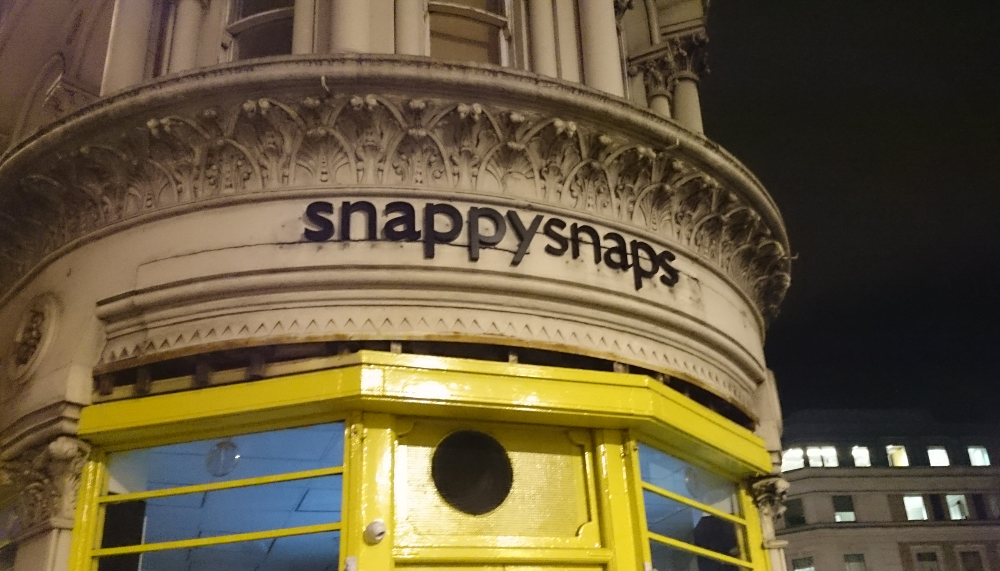
Ironically, a "snapstore" was close to the office ;-)

Ironically, a snapstore was close to the office ;-)

XdgApp and sandboxing of apps was also a big topic, aside from Ubuntu and Endless integration. Fortunately, Alexander Larsson was also there to answer all the sandboxing and XdgApp-questions. I used the time to follow up on a conversation with Alexander we started at FOSDEM this year, about the Limba vs. XdgApp bundling issue. While we are in-line on the sandboxing approach, the way how software is distributed is implemented differently in Limba and XdgApp, and it is bad to have too many bundling systems around (doesn t make for a good story where we can just tell developers ship as this bundling format, and it will be supported everywhere ). Talking with Alex about this was very nice, and I think there is a way out of the too-many-solutions dilemma, at least for Limba and XdgApp I will blog about that separately soon. On the Ubuntu side, a lot of bugs and issues were squashed and changes upstreamed to GNOME, and people were generally doing their best to reduce Richard s bus-factor on the project a little  . I mainly worked on AppStream issues, finishing up the last pieces of appstream-generator and running it against some sample package sets (and later that week against the whole Debian archive). I also started to implement support for showing AppStream issues in the Debian PTS (this work is not finished yet). I also managed to solve a few bugs in the old DEP-11 generator and prepare another release for Ubuntu. We also enjoyed some good Japanese food, and some incredibly great, but also suddenly very expensive Indian food (but that s a different story  ). The most important thing for me though was to get together with people actually using AppStream metadata in software centers and also more specialized places. This yielded some useful findings, e.g. that localized screenshots are not something weird, but actually a wanted feature of Endless for their curated AppStore. So localized screenshots will be part of the next AppStream spec. Also, there seems to be a general need to ship curation information for software centers somehow (which apps are featured? how are they styled? added special banners for some featured apps, app of the day features, etc.). This problem hasn t been solved, since it s highly implementation-specific, and AppStream should be distro-agnostic. But it is something we might be able to address in a generic way sooner or later (I need to talk to people at KDE and Elementary about it). In summary It was a great event! Going to conferences and hackfests always makes me feel like it moves projects leaps ahead, even if you do little coding. Sorting out issues together with people you see in person (rather than communicating with them via text messages or video chat), is IMHO always the most productive way to move forward (yeah, unless you do this every week, but I think you get my point  ). For me, being the only (and youngest ^^) developer at the hackfest who was not employed by any company in the FLOSS business, the hackfest was also motivating to continue to invest spare time into working on these projects. So, the only thing left to do is a huge shout out of THANK YOU to the Ubuntu Community Fund and therefore the Ubuntu community for sponsoring me! You rock! Also huge thanks to Canonical for organizing the sponsoring really quickly, so I didn t get into trouble with paying my flights.

Laney and attente walking on the Millennium Bridge after we walked the distance between Red Hat and Canonical's offices.

Laney and attente on the Millennium Bridge after we walked the distance between Red Hat and Canonical s offices.

To worried KDE people: No, I didn t leave the blue side I just generally work on cross-desktop stuff, and would like all desktops to work as well as possible

20 April 2016

Ben Hutchings: Experiments with signed kernels and modules in Debian

I've lately been working on support for Secure Boot in Debian, mostly in the packages maintained by the kernel team. My instructions for setting up UEFI Secure Boot are based on OVMF running on KVM/QEMU. All 'Designed for Windows' PCs should allow reconfiguration of SB, but it may not be easy to do so. They also assume that the firmware includes an EFI shell. Updated: Robert Edmonds pointed out that the 'Designed for Windows' requirements changed with Windows 10: The ability to reconfigure SB is indeed now optional for devices which are designed to always boot with a specific Secure Boot configuration. I also noticed that the requirements say that OEMs should not sign an EFI shell binary. Therefore I've revised the instructions to use efibootmgr instead. Background UEFI Secure Boot, when configured and enabled (which it is on most new PCs) requires that whatever it loads is signed with a trusted key. The one common trusted key for PCs is held by Microsoft, and while they will sign other people's code for a nominal fee, they require that it also validates the code it loads, i.e. the kernel or next stage boot loader. The kernel in turn is responsible for validating any code that could compromise its integrity (kernel modules, kexec images). Currently there are no such signed boot loaders in Debian, though the shim and grub-signed packages included in many other distributions should be usable. However it's possible to load an appropriately configured Linux kernel directly from the UEFI firmware (typically through the shell) which is what I'm doing at the moment. Packaging signed kernels Signing keys obviously need to be protected against disclosure; the private keys can't be included in a source package. We also won't install them on buildds separately, and generating signatures at build time would of course be unreproducible. So I've created a new source package, linux-signed, which contains detached signatures prepared offline. Currently the binary packages built from linux-signed also contain only detached signatures, which are applied as necessary at installation time. The signed kernel image (only on x86 for now) is named /boot/vmlinuz-kversion.efi.signed. However, since packages must not modify files owned by another package and I didn't want to dpkg-divert thousands of modules, the module signatures remain detached. Detached module signatures are a new invention of mine, and require changes in kmod and various other packages to support them. (An alternate might be to put signed modules under a different directory and drop a configuration file in /lib/depmod.d to make them higher priority. But then we end up with two copies of every module installed, which can be a substantial waste of space.) Preparation The packages you need to repeat the experiment: For Secure Boot, you'll then need to copy the signed kernel and the initrd onto the EFI system partition, normally mounted at /boot/efi. SB requires a Platform Key (PK) which will already be installed on a real PC. You can replace it but you don't need to. If you're using OVMF, there are no persistent keys so you do need to generate your own:
openssl req -new -x509 -newkey rsa:2048 -keyout pk.key -out pk.crt \
    -outform der -nodes
You'll also need to install the certificate for my kernel image signing key, which is under debian/certs in the linux-signed package. OVMF requires this in DER format:
openssl x509 -in linux-signed-1~exp3/debian/certs/linux-image-benh@debian.org.cert.pem \
    -out linux.crt -outform der 
You'll need to copy the certificate(s) to a FAT-formatted partition such as the EFI system partition, so that the firmware can read it. Use efibootmgr to add a boot entry for the kernel, for example:
efibootmgr -c -d /dev/sda -L linux-signed -l '\vmlinuz.efi' -u 'initrd=initrd.img root=/dev/sda2 ro quiet'
You should use the same kernel parameters as usual, except that you also need to specify the initrd filename using the initrd= parameter. The EFI stub code at the beginning of the kernel will load the initrd using EFI boot services. Enabling Secure Boot
  1. Reboot the system and enter UEFI setup
  2. Find the menu entry for Secure Boot customisation (in OVMF, it's under 'Device Manager' for some reason)
  3. In OVMF, enrol the PK from pk.crt
  4. Add linux.crt to the DB (whitelist database)
  5. Ensure that Secure Boot is enabled and in 'User Mode'
Booting the kernel in Secure Boot If all went well, Linux will boot as normal. You can confirm that Secure Boot was enabled by reading /sys/kernel/security/securelevel, which will contain 1 if it was. Module signature validation Module signatures are now always checked and unsigned modules will be given the 'E' taint flag. If Secure Boot is used or you add the kernel parameter module.sig_enforce=1, unsigned modules will be rejected. You can also turn on signature enforcement and turn off various other methods of modifying kernel code (such as kexec) by writing 1 to /sys/kernel/security/securelevel.

12 April 2016

Petter Reinholdtsen: A French paperback edition of the book Free Culture by Lawrence Lessig is now available

I'm happy to report that the French paperback edition of my project to translate the Free Culture book by Lawrence Lessig is now available for sale on Lulu.com. Once I have formally verified my proof reading copy, which should be in the mail, the paperback edition should be available in book stores like Amazon and Barnes & Noble too. This French edition, Culture Libre, is the work of the dblatex developer Beno t Guillon, who created the PO file from the initial translation available from the Wikilivres wiki pages and completed and corrected the translation to match the original docbook edition my project is using, as well as coordinated the proof reading of the final result. I believe the end result look great, but I am biased and do not read French. In addition to the paperback edition, the book is available in PDF, EPUB and Mobi format from the github project page linked to above. When enabling book store distribution on Lulu.com, I had to nearly triple the price to allow the book stores some profit. I also had to accept that I will get some revenue when a book is sold via Lulu.com. But because of the non-commercial clause in the book license (CC-BY-NC), this might be a problem. To bypass the problem I discussed how to handle the revenue with the author, and we agreed that the revenue for these editions go to the Creative Commons non-profit Corporation who handle donations to the Creative Commons project. So far they have earned around USD 70 on sales of the English and Norwegian Bokm l editions, according to Lulu.com. They will get the revenue for the French edition too. Their revenue is higher if you buy the book directly from Lulu.com instead of via a book store, so I recommend you buy directly from Lulu.com. Perhaps you would like to get the book published in your language? The translation is done using a web based translator service, so the technical bar to enter is fairly low. Get in touch if you would like to make this happen.

11 April 2016

Thomas Goirand: Announcing validated Debian packages for Mitaka

Greetings! This is a (4 days delay) copy of the announce I made on the openstack-dev@lists.openstack.org on the 8th of April 2016. I am overjoyed, thrilled and delighted to announce the release of the Debian packages for Mitaka. All of the DefCore packages were validated successfully this morning through our package-only-based Tempest CI. Content of this release
This release includes the following 23 services:
aodh 2.0.0
barbican 2.0.0
ceilometer 6.0.0
cinder 8.0.0
congress 3.0.0+dfsg1
designate 2.0.0
glance 12.0.0
gnocchi 2.0.2
heat 6.0.0
horizon 9.0.0
ironic 5.1.0
keystone 9.0.0
magnum 2.0.0
manila 2.0.0
mistral 2.0.0
murano 2.0.0
neutron 8.0.0
nova 13.0.0
trove 5.0.0
sahara 4.0.0
senlin 1.0.0
swift 2.7.0
zaqar 2.0.0 Where to find these packages
1/ Sid
All of Mitaka was uploaded to Debian Sid this week. You can use Debian Sid directly to use them. 2/ Official jessie-backports
As soon as everything migrates to Debian Testing (currently aka: Stretch), in 5 days if no RC bug is reported, it will be possible to upload all of Mitaka to the Debian official jessie-backports. 3/ Non-official Jessie and Trusty backports
In the meantime, the packages are available through Mirantis Jenkins automatic Debian Jessie backport repository. The full sources.list is available here: http://mitaka-jessie.pkgs.mirantis.com/ You can use the Trusty backports as well: http://mitaka-trusty.pkgs.mirantis.com/ To use these repositories, simply add the described sources.list to (for example) /etc/apt/sources.list.d/openstack.list, and run apt-get update. If you want to install the GPG key of the repositories, you can either install the mitaka-jessie-archive-keyring or mitaka-trusty-archive-keyring package (depending on your distribution of choice). Alternatively apt-key add the public key available at /debian/dists/pukey.gpg in these repositories. As a reminder, the URLs above contain the word Mirantis only because the service is sponsored by my employer. These repositories are straight backports from what is available in Debian Sid, without any modification. Remember that the packages listed below are maintained separately in Debian and Ubuntu, and therefore, packages are different in these distributions:
aodh, barbican, ceilometer, cinder, designate, glance, heat, horizon, ironic, keystone, manila, neutron, nova, trove, swift. All other packages (including all OpenStack libraries like Oslo and python-*clients) are maintained in Debian, with the contribution of Canonical, and then synced to Ubuntu, so they are the exact same packages (or at least, with a minimal difference). I hope we can further improve collaboration between Debian and Canonical during the Newton cycle. Bug reporting
As always, bug reports are welcome, and considered as high value contributions. Please follow the instructions available at https://www.debian.org/Bugs/Reporting to report bugs to the Debian BTS. Moving forward with higher QA and the Packaging-deb project in Newton
Currently, DefCore packages are tested through a package-only (ie: no puppet, chef, you-name-it system management involved) Tempest CI. Results can be seen at:
https://mitaka-jessie.pkgs.mirantis.com/job/openstack-tempest-ci/ Though not all packages are included in this CI. It is my intention, during the Newton cycle, to also include services like Designate, Trove, Barbican, Congress, in this CI. Individual upstream team for these services are more than welcome to approach us to get this happen quicker. Also, as we re slowing starting to get the Packaging-Deb project (ie: packaging using upstream OpenStack gerrit and gating), it is also in the pipe to use the above mentioned tempest CI system as a gate system for the packaging. Hopefully, this will lead us to a full CI/CD working from trunk. We also hope to be able to use these packages to help the Puppet team to test packaged OpenStack from trunk. Greetings
On each release, I ask myself who I should thank. This time, I would like to thank everyone, because this release was overall very nice and working well. The whole OpenStack community is always very helpful and understand the requirements of downstream distributions. Guys, you re awesome, I love my work, and I love working with you all! Cheers,

5 April 2016

Matthew Garrett: There's more than one way to exploit the commons

There's a piece of software called XScreenSaver. It attempts to fill two somewhat disparate roles: XScreenSaver does an excellent job of the second of these[2] and is pretty good at the first, which is to say that it only suffers from a disastrous security flaw once very few years and as such is certainly not appreciably worse than any other piece of software.

Debian ships an operating system that prides itself on stability. The Debian definition of stability is a very specific one - rather than referring to how often the software crashes or misbehaves, it refers to how often the software changes behaviour. Debian is very reluctant to upgrade software that is part of a stable release, to the extent that developers will attempt to backport individual security fixes to the version they shipped rather than upgrading to a release that contains all those security fixes but also adds a new feature. The argument here is that the new release may also introduce new bugs, and Debian's users desire stability (in the "things don't change" sense) more than new features. Backporting security fixes keeps them safe without compromising the reason they're running Debian in the first place.

This all makes plenty of sense at a theoretical level, but reality is sometimes less convenient. The first problem is that security bugs are typically also, well, bugs. They may make your software crash or misbehave in annoying but apparently harmless ways. And when you fix that bug you've also fixed a security bug, but the ability to determine whether a bug is a security bug or not is one that involves deep magic and a fanatical devotion to the cause so given the choice between maybe asking for a CVE and dealing with embargoes and all that crap when perhaps you've actually only fixed a bug that makes the letter "E" appear in places it shouldn't and not one that allows the complete destruction of your intergalactic invasion fleet means people will tend to err on the side of "Eh fuckit" and go drinking instead. So new versions of software will often fix security vulnerabilities without there being any indication that they do so[3], and running old versions probably means you have a bunch of security issues that nobody will ever do anything about.

But that's broadly a technical problem and one we can apply various metrics to, and if somebody wanted to spend enough time performing careful analysis of software we could have actual numbers to figure out whether the better security approach is to upgrade or to backport fixes. Conversations become boring once we introduce too many numbers, so let's ignore that problem and go onto the second, which is far more handwavy and social and so significantly more interesting.

The second problem is that upstream developers remain associated with the software shipped by Debian. Even though Debian includes a tool for reporting bugs against packages included in Debian, some users will ignore that and go straight to the upstream developers. Those upstream developers then have to spend at least 15 or so seconds telling the user that the bug they're seeing has been fixed for some time, and then figure out how to explain that no sorry they can't make Debian include a fixed version because that's not how things work. Worst case, the stable release of Debian ends up including a bug that makes software just basically not work at all and everybody who uses it assumes that the upstream author is brutally incompetent, and they end up quitting the software industry and I don't know running a nightclub or something.

From the Debian side of things, the straightforward solution is to make it more obvious that users should file bugs with Debian and not bother the upstream authors. This doesn't solve the problem of damaged reputation, and nor does it entirely solve the problem of users contacting upstream developers. If a bug is filed with Debian and doesn't get fixed in a timely manner, it's hardly surprising that users will end up going upstream. The Debian bugs list for XScreenSaver does not make terribly attractive reading.

So, coming back to the title for this entry. The most obvious failure of the commons is where a basically malicious actor consumes while giving nothing back, but if an actor with good intentions ends up consuming more than they contribute that may still be a problem. An upstream author releases a piece of software under a free license. Debian distributes this to users. Debian's policies result in the upstream author having to do more work. What does the upstream author get out of this exchange? In an ideal world, plenty. The author's software is made available to more people. A larger set of developers is willing to work on making improvements to the software. In a less ideal world, rather less. The author has to deal with bug mail about already fixed bugs. The author's reputation may be harmed by user exposure to said fixed bugs. The author may get less in the way of useful bug fixes or features because people are running old versions rather than fixing new ones. If the balance tips towards the latter, the author's decision to release their software under a free license has made their life more difficult.

Most discussions about Debian's policies entirely ignore the latter scenario, focusing more on the fact that the author chose to release their software under a free license to begin with. If the author is unwilling to handle the consequences of that, goes the argument, why did they do it in the first place? The unfortunate logical conclusion to that argument is that the author realises that they made a huge mistake and never does so again, and woo uh oops.

The irony here is that one of Debian's foundational documents, the Debian Free Software Guidelines, makes allowances for this. Section 4 allows for distribution of software in Debian even if the author insists that modified versions[4] are renamed. This allows for an author to make a choice - allow themselves to be associated with the Debian version of their work and increase (a) their userbase and (b) their support load, or try to distinguish what Debian ship from their identity. But that document was ratified in 1997 and people haven't really spent much time since then thinking about why it says what it does, and so this tradeoff is rarely considered.

Free software doesn't benefit from distributions antagonising their upstreams, even if said upstream is a cranky nightclub owner. Debian's users are Debian's highest priority, but those users are going to suffer if developers decide that not using free licenses improves their quality of life. Kneejerk reactions around specific instances aren't helpful, but now is probably a good time to start thinking about what value Debian bring to its upstream authors and how that can be increased. Failing to do so doesn't serve users, Debian itself or the free software community as a whole.

[1] The X server has no fundamental concept of a screen lock. This is implemented by an application asking that the X server send all keyboard and mouse input to it rather than to any other application, and then that application creating a window that fills the screen. Due to some hilarious design decisions, opening a pop-up menu in an application prevents any other application from being able to grab input and so it is impossible for the screensaver to activate if you open a menu and then walk away from your computer. This is merely the most obvious problem - there are others that are more subtle and more infuriating. The only fix in this case is to nuke the site from orbit.

[2] There's screenshots here. My favourites are the one that emulate the electrical characteristics of an old CRT in order to present a more realistic depiction of the output of an Apple 2 and the one that includes a complete 6502 emulator.

[3] And obviously new versions of software will often also introduce new security vulnerabilities without there being any indication that they do so, because who would ever put that in their changelog. But the less ethically challenged members of the security community are more likely to be looking at new versions of software than ones released three years ago, so you're probably still tending towards winning overall

[4] There's a perfectly reasonable argument that all packages distributed by Debian are modified in some way

comment count unavailable comments

15 March 2016

Dirk Eddelbuettel: x13binary 0.1.2

A new version of x13binary is now on CRAN. It updates the underlying X-13ARIMA-SEATS binary to build 1.1.26 which was released recently by the US Census Bureau. Our x13binary package takes the pain out of installing this, and provides it to the seasonal package upon which other packages such as gunsales or ggseas build their functionality. Things just work: Depend on x13binary and on all relevant OSs supported by R, you should have an X-13ARIMA-SEATS binary installed which will be called seamlessly by the higher-level packages. See this announcement blog post describing the initial 0.1.0 release; we had since followed up with a 0.1.1 release tightening up behaviour on two edge case OSs. Courtesy of CRANberries, there is also a diffstat report for the most recent release as well as the preceding bugfix release.

This post by Dirk Eddelbuettel originated on his Thinking inside the box blog. Please report excessive re-aggregation in third-party for-profit settings.

7 March 2016

Dirk Eddelbuettel: Rblpapi 'Release Candidate' 0.3.2.5

We have a made numerous changes to Rblpapi since the previous release 0.3.2 in early December. You can see the commits, or look at the ChangeLog or NEWS.Rd to get an indea of the changes. We have new functions, improved internals, bug fixes and more. In order to facilitate more widespread testing, I have just placed source and (Windows) binaries in the ghrr drat repo from which you can install the new version simply via
drat:::add("ghrr")          # if you have drat installed
install.packages("Rblpapi") # uses the drat version b/c higher version number than release
Alternatively you can also do
drat:::add("ghrr")          # if you have drat installed
update.packages()           # refresh all packages against all repos
We would appreciate wider testing, and feedback / bug reports / ... via the issue tracker. PRs with unit test suggestions would also be most welcome -- we now use RUnit and run the tests if a file ~/.R/rblpapiOptions.R exists which sets the options() values for automatic connection (see help(blpConnect)) as well as the blpUnitTests=TRUE option. This is needed to 'opt-in' as standard test setups at [Travis])(https://travis-ci.org/) or CRAN will not have access to a Bloomberg terminal.

This post by Dirk Eddelbuettel originated on his Thinking inside the box blog. Please report excessive re-aggregation in third-party for-profit settings.

25 February 2016

Matthew Garrett: I bought some awful light bulbs so you don't have to

I maintain an application for bridging various non-Hue lighting systems to something that looks enough like a Hue that an Amazon Echo will still control them. One thing I hadn't really worked on was colour support, so I picked up some cheap bulbs and a bridge. The kit is badged as an iSuper iRainbow001, and it's terrible.

Things seemed promising enough at first, although the bulbs were alarmingly heavy (there's a significant chunk of heatsink built into them, which seems to get a lot warmer than I'd expect from something that claims a 7W power consumption). The app was a bit clunky, but eh - I wasn't planning on using it for long. I pressed the button on the bridge, launched the app and could control the bulbs. The first thing I noticed was that they had a separate "white" and "colour" mode. White mode was pretty bright, but colour mode massively less so - presumably the white LEDs are entirely independent of the RGB ones, and much higher intensity. Still, potentially useful as mood lighting.

Anyway. Next step was to start playing with the protocol, which meant finding the device on my network. I checked anything that had picked up a DHCP lease recently and nmapped them. The OS detection reported Linux, which wasn't hugely surprising - there was no GPL notice or source code included with the box, but I'm way past the point of shock at that. It also reported that there was a telnet daemon running. I connected and got a login prompt. And then I typed admin as the username and admin as the password and got a root prompt. So, there's that. The copy of Busybox included even came with tftp, so it was easy to get copies of tcpdump and strace on there to see what was up.

So. Next step. Protocol sniffing. I wanted to know how discovery worked, so reset the device to factory and watched what happens. The app on my phone sent out a discovery packet on UDP port 18602 which looked like this:

INLAN:CLIP:23.21.212.48:CLPT:22345:MAC:02:00:00:00:00:00

The CLIP and CLPT fields refer to the cloud server that allows for management when you're not on the local network. The mac field contains an utterly fake address. If you send out a discovery packet and your mac hasn't been registered with the device, you get a denial back. If your mac has been (and by "mac" here I mean "utterly fake mac that's the same for all devices"), you get back a response including the device serial number and IP address. And if you just leave out the mac field entirely, you get back a response no matter whether your address is registered or not. So, that's a start. Once you've registered one copy of the app with the device, anything can communicate with it by just using the same fake mac in the discovery packets.

Onwards. The command format turns out to be simple. They start ##, are followed by two ascii digits encoding a command, four ascii digits containing a bulb id, two ascii digits containing the number of following bytes and then the command data (in ascii). An example is:

##05010002ff

which decodes as command 5 (set white intensity) on bulb 1 with two bytes of data following, each of which is an f. This translates as "Set bulb 1 to full white intensity". I worked out the rest pretty quickly - command 03 sets the RGB colour of the bulb, 0A asks the bridge to search for new bulbs, 0B tells you which bulbs are available and their capabilities and 0E gives you the MAC addresses of the bulbs( ). 0C crashes the server process, and 06 spews a bunch of garbage back at you and potentially crashes the bulb in a hilarious way that involves it flickering at about 15Hz. It turns out that 06 is actually the "Rename bulb" command, and if you send it less data than it's expecting something goes hilariously wrong in string parsing and everything is awful.

Ok. Easy enough, but not hugely exciting. What about the remote protocol? This turns out to involve sending a login packet and then a wrapped command packet. The login has some length data, a header of "MQIsdp", a long bunch of ascii-encoded hex, a username and a password.

The username is w13733 and the password is gbigbi01. These are hardcoded in the app. The ascii-encoded hex can be replaced with 0s and the login succeeds anyway.

Ok. What about the wrapping on the command? The login never indicated which device we wanted to talk to, so presumably there's some sort of protection going on here oh wait. The command packet is a length, the serial number of the bridge and then a normal command packet. As long as you know the serial number of the device (which it tells you in response to a discovery packet, even if you're unauthenticated), you can use the cloud service to send arbitrary commands to the device (including the one that crashes the service). One of which involves the device then doing some kind of string parsing that doesn't appear to work that well. What could possibly go wrong?

Ok, so that seemed to be the entirety of the network protocol. Anything else to do? Some poking around on the bridge revealed (a) that it had an active wireless device and (b) a running DHCP server. They wouldn't, would they?

Yes. Yes, they would.

The devices all have a hardcoded SSID of "iRainbow", although they don't broadcast it. There's no security - anybody can associate. It'll then hand out an IP address. It's running telnetd on that interface as well. You can bounce through there to the owner's internal network.

So, in summary: it's a device that infringes my copyright, gives you root access in response to trivial credentials, has access control that depends entirely on nobody ever looking at the packets, is sufficiently poorly implemented that you can crash both it and the bulbs, has a cloud access protocol that has no security whatsoever and also acts as an easy mechanism for people to circumvent your network security. This may be the single worst device I've ever bought.

I called the manufacturer and they insisted that the device was designed in 2012, was no longer manufactured or supported, that they had no source code to give me and there would be no security fixes. The vendor wants me to pay for shipping back to them and reserves the right to deduct the cost of the original "free" shipping from the refund. Everything is awful, which is why I just ordered four more random bulbs to play with over the weekend.

comment count unavailable comments

Next.

Previous.

