Search Results: "ed"

13 March 2026

Jonathan Dowland: debian swirl font glyph

When I wrote about the redhat logo in a shell prompt, a commenter said it would be nice to achieve something similar for Debian, and suggested " " (U+1F365 FISH CAKE WITH SWIRL DESIGN) which, in some renderings, looks to have a red swirl on top. This is not bad, but I thought we could do better. On Apple systems, the character " " (U+F8FF) displays as the corporate Apple logo. That particular unicode code point is reserved: systems are free to use it for something private and internal, but other systems won't use it for the same thing. So if an Apple user tries to send a document with that character in it to someone else, they won't see the Apple unless they are also viewing it on an Apple computer. (Some folks use it for Klingon). Here's a font that maps the Debian swirl to the same code point. It's covered by the Debian logo license terms. Nerd Font maps the Debian swirl logo to codepoints e77d, f306, ebc5 and f08da (all of which are also in the Private Use Area). I've gone ahead and mapped it to all those points but the last one (simply because I couldn't find it in FontForge.) Note that, unless your recipients have this font, or the Nerd Font, or similar set up, they aren't going to see the swirl. But enjoy it for private use. Getting your system to actually use the font is, I'm afraid, left as an exercise for the reader (but feel free to leave comments) Thanks to mirabilos for chatting to me about this back in 2019. It's taken me that long to get this blog post out of draft!

Dirk Eddelbuettel: RcppCNPy 0.2.15 on CRAN: Maintenance

Another maintenance release of the RcppCNPy package arrived on CRAN today, and has already been built as an r2u binary. RcppCNPy provides R with read and write access to NumPy files thanks to the cnpy library by Carl Rogers along with Rcpp for the glue to R. The changes are minor and similar to other recent changes. We aid Rcpp in the transition away from calling Rf_error() by relying in Rcpp::stop() which has better behaviour and unwinding when errors or exceptions are encountered. So once again no user-facing changes. Full details are below.

Changes in version 0.2.15 (2026-03-13)
  • Replaced Rf_error with Rcpp::stop in three files
  • Maintenance updates to continuous integration

CRANberries also provides a diffstat report for the latest release. As always, feedback is welcome and the best place to start a discussion may be the GitHub issue tickets page. If you like this or other open-source work I do, you can now sponsor me at GitHub.

This post by Dirk Eddelbuettel originated on his Thinking inside the box blog. Please report excessive re-aggregation in third-party for-profit settings.

Sven Hoexter: container image with ECH enabled curl

As an opportunity to rewire my brain from "docker" to "podman" and "buildah" I started to create an image build with an ECH enabled curl at https://gitlab.com/hoexter/ech. Not sure if it helps anyone, but setup should be like this:
git clone https://gitlab.com/hoexter-experiments/ech
cd ech
buildah build --layers -f Dockerfile -t echtest
podman run -ti echtest /usr/local/bin/curl \
  --ech true --doh-url https://one.one.one.one/dns-query \
  https://crypto.cloudflare.com/cdn-cgi/trace.cgi
fl=48f121
h=crypto.cloudflare.com
ip=2.205.251.187
ts=1773410985.168
visit_scheme=https
uag=curl/8.19.0
colo=DUS
sliver=none
http=http/2
loc=DE
tls=TLSv1.3
sni=encrypted
warp=off
gateway=off
rbi=off
kex=X25519
It also builds nginx and you can use that for a local test within the image. More details in the README.

Hellen Chemtai: One week later after the Outreachy internship: Managing Work-Life Balance

Hello world. I have been doing a lot after my internship with Outreachy. We are still working on some tasks :

  1. I am working on running locales for my native language in live images.
  2. I am also working on points to add to talk proposals for a Debian conference.

As I am moving around constantly, there are problems I had encountered when changing my networks. I had to connect my virtual machine to different networks and the network would not reflect within the machine. From terminal I edited the virtual machine XML settings:

su -
// input password
sudo virsh edit <machine_name> #its openqa for me
// Look for the interface within devices and replace this:
<interface type=&aposnetwork&apos>
<source network=&aposdefault&apos/>
#some other code in here
</interface>
// With just this then restart your machine:
<interface type=&aposuser&apos>
<model type=&aposvirtio&apos/>
</interface>

Hopefully the above will help someone out there. I am still working on a lot of tasks regarding the conference, so much to do and so little time. I am hoping I won t get any burnout during this period. I won t be updating much further till the conference. Have a nice time

Reproducible Builds (diffoscope): diffoscope 314 released

The diffoscope maintainers are pleased to announce the release of diffoscope version 314. This version includes the following changes:
[ Chris Lamb ]
* Don't run "test_code_is_black_clean" test in autopkgtests.
  (Closes: #1130402)
[ Michael R. Crusoe ]
* Reformat using Black 26.1.0. (Closes: #1130073)
You find out more by visiting the project homepage.

12 March 2026

Reproducible Builds: Reproducible Builds in February 2026

Welcome to the February 2026 report from the Reproducible Builds project! These reports outline what we ve been up to over the past month, highlighting items of news from elsewhere in the increasingly-important area of software supply-chain security. As ever, if you are interested in contributing to the Reproducible Builds project, please see the Contribute page on our website.

  1. reproduce.debian.net
  2. Tool development
  3. Distribution work
  4. Miscellaneous news
  5. Upstream patches
  6. Documentation updates
  7. Four new academic papers

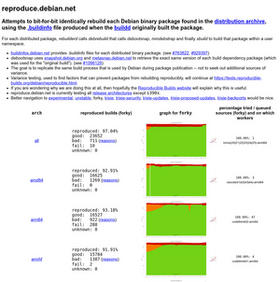
reproduce.debian.net The last year has seen the introduction, development and deployment of reproduce.debian.net. In technical terms, this is an instance of rebuilderd, our server designed monitor the official package repositories of Linux distributions and attempt to reproduce the observed results there. This month, however, Holger Levsen added suite-based navigation (eg. Debian trixie vs forky) to the service (in addition to the already existing architecture based navigation) which can be observed on, for instance, the Debian trixie-backports or trixie-security pages.

Tool development diffoscope is our in-depth and content-aware diff utility that can locate and diagnose reproducibility issues. This month, Chris Lamb made a number of changes, including preparing and uploading versions, 312 and 313 to Debian. In particular, Chris updated the post-release deployment pipeline to ensure that the pipeline does not fail if the automatic deployment to PyPI fails [ ]. In addition, Vagrant Cascadian updated an external reference for the 7z tool for GNU Guix. [ ]. Vagrant Cascadian also updated diffoscope in GNU Guix to version 312 and 313.

Distribution work In Debian this month:
  • 26 reviews of Debian packages were added, 5 were updated and 19 were removed this month adding to our extensive knowledge about identified issues.
  • A new debsbom package was uploaded to unstable. According to the package description, this package generates SBOMs (Software Bill of Materials) for distributions based on Debian in the two standard formats, SPDX and CycloneDX. The generated SBOM includes all installed binary packages and also contains Debian Source packages.
  • In addition, a sbom-toolkit package was uploaded, which provides a collection of scripts for generating SBOM. This is the tooling used in Apertis to generate the Licenses SBOM and the Build Dependency SBOM. It also includes dh-setup-copyright, a Debhelper addon to generate SBOMs from DWARF debug information, which are extracted from DWARF debug information by running dwarf2sources on every ELF binaries in the package and saving the output.
Lastly, Bernhard M. Wiedemann posted another openSUSE monthly update for their work there.

Miscellaneous news

Upstream patches The Reproducible Builds project detects, dissects and attempts to fix as many currently-unreproducible packages as possible. We endeavour to send all of our patches upstream where appropriate. This month, we wrote a large number of such patches, including:

Documentation updates Once again, there were a number of improvements made to our website this month including:

Four new academic papers Julien Malka and Arnout Engelen published a paper titled Lila: Decentralized Build Reproducibility Monitoring for the Functional Package Management Model:
[While] recent studies have shown that high reproducibility rates are achievable at scale demonstrated by the Nix ecosystem achieving over 90% reproducibility on more than 80,000 packages the problem of effective reproducibility monitoring remains largely unsolved. In this work, we address the reproducibility monitoring challenge by introducing Lila, a decentralized system for reproducibility assessment tailored to the functional package management model. Lila enables distributed reporting of build results and aggregation into a reproducibility database [ ].
A PDF of their paper is available online.
Javier Ron and Martin Monperrus of KTH Royal Institute of Technology, Sweden, also published a paper, titled Verifiable Provenance of Software Artifacts with Zero-Knowledge Compilation:
Verifying that a compiled binary originates from its claimed source code is a fundamental security requirement, called source code provenance. Achieving verifiable source code provenance in practice remains challenging. The most popular technique, called reproducible builds, requires difficult matching and reexecution of build toolchains and environments. We propose a novel approach to verifiable provenance based on compiling software with zero-knowledge virtual machines (zkVMs). By executing a compiler within a zkVM, our system produces both the compiled output and a cryptographic proof attesting that the compilation was performed on the claimed source code with the claimed compiler. [ ]
A PDF of the paper is available online.
Oreofe Solarin of Department of Computer and Data Sciences, Case Western Reserve University, Cleveland, Ohio, USA, published It s Not Just Timestamps: A Study on Docker Reproducibility:
Reproducible container builds promise a simple integrity check for software supply chains: rebuild an image from its Dockerfile and compare hashes. We built a Docker measurement pipeline and apply it to a stratified sample of 2,000 GitHub repositories that contained a Dockerfile. We found that only 56% produce any buildable image, and just 2.7% of those are bitwise reproducible without any infrastructure configurations. After modifying infrastructure configurations, we raise bitwise reproducibility by 18.6%, but 78.7% of buildable Dockerfiles remain non-reproducible.
A PDF of Oreofe s paper is available online.
Lastly, Jens Dietrich and Behnaz Hassanshahi published On the Variability of Source Code in Maven Package Rebuilds:
[In] this paper we test the assumption that the same source code is being used [by] alternative builds. To study this, we compare the sources released with packages on Maven Central, with the sources associated with independently built packages from Google s Assured Open Source and Oracle s Build-from-Source projects. [ ]
A PDF of their paper is available online.

Finally, if you are interested in contributing to the Reproducible Builds project, please visit our Contribute page on our website. However, you can get in touch with us via:

Dirk Eddelbuettel: RcppBDT 0.2.8 on CRAN: Maintenance

Another minor maintenance release for the RcppBDT package is now on CRAN, and had been built as binary for r2u. The RcppBDT package is an early adopter of Rcpp and was one of the first packages utilizing Boost and its Date_Time library. The now more widely-used package anytime is a direct descentant of RcppBDT. This release is again primarily maintenance. We aid Rcpp in the transition away from calling Rf_error() by relying in Rcpp::stop() which has better behaviour and unwinding when errors or exceptions are encountered. No feature or interface changes. The NEWS entry follows:

Changes in version 0.2.8 (2026-03-12)
  • Replaced Rf_error with Rcpp::stop in three files
  • Maintenance updates to continuous integration

Courtesy of my CRANberries, there is also a diffstat report for this release. For questions, suggestions, or issues please use the issue tracker at the GitHub repo.

This post by Dirk Eddelbuettel originated on his Thinking inside the box blog. If you like this or other open-source work I do, you can now sponsor me at GitHub.

Mike Gabriel: Debian Lomiri Tablets 2025-2027 - Project Report (Q4/2025)

On 25th Oct 2025, I announced via my personal blog and on Mastodon that Fre(i)e Software GmbH was hiring. The hiring process was a mix of asking developers I know and waiting for new people to apply. At the beginning of November 2025 / in mid November 2025, we started with 13 developers (all part-time) to work on various topics around Lomiri (upstream and downstream). Note that the below achievements don't document the overall activity in the Lomiri project, but that part that our team at Fre(i)e Software GmbH contributed to. Organizational Achievements Maintenance Development Qt6 Porting Feature Development Research [1] https://gitlab.com/groups/ubports/development/-/boards/9895029?label_name%5B%5D=Topic%3A%20Qt%206
[2] https://gitlab.com/groups/ubports/development/-/boards/10037876?label_name[]=Topic%3A%20salsa2ubports%20DEB%20syncing

11 March 2026

Sven Hoexter: RFC 9849 - Encrypted Client Hello

Now that ECH is standardized I started to look into it to understand what's coming. While generally desirable to not leak the SNI information, I'm not sure if it will ever make it to the masses of (web)servers outside of big CDNs. Beside of the extension of the TLS protocol to have an inner and outer ClientHello, you also need (frequent) updates to your HTTPS/SVCB DNS records. The idea is to rotate the key quickly, the OpenSSL APIs document talks about hourly rotation. Which means you've to have encrypted DNS in place (I guess these days DNSoverHTTPS is the most common case), and you need to be able to distribute the private key between all involved hosts + update DNS records in time. In addition to that you can also use a "shared mode" where you handle the outer ClientHello (the one using the public key from DNS) centrally and the inner ClientHello on your backend servers. I'm not yet sure if that makes it easier or even harder to get it right. That all makes sense, and is feasible for setups like those at Cloudflare where the common case is that they provide you NS servers for your domain, and terminate your HTTPS connections. But for the average webserver setup I guess we will not see a huge adoption rate. Or we soon see something like a Caddy webserver on steroids which integrates a DNS server for DoH with not only automatic certificate renewal build in, but also automatic ECHConfig updates. If you want to read up yourself here are my starting points: RFC 9849 TLS Encrypted Client Hello RFC 9848 Bootstrapping TLS Encrypted ClientHello with DNS Service Bindings RFC 9934 Privacy-Enhanced Mail (PEM) File Format for Encrypted ClientHello (ECH) OpenSSL 4.0 ECH APIs curl ECH Support nginx ECH Support Cloudflare Good-bye ESNI, hello ECH! If you're looking for a test endpoint, I see one hosted by Cloudflare:
$ dig +short IN HTTPS cloudflare-ech.com
1 . alpn="h3,h2" ipv4hint=104.18.10.118,104.18.11.118 ech=AEX+DQBBFQAgACDBFqmr34YRf/8Ymf+N5ZJCtNkLm3qnjylCCLZc8rUZcwAEAAEAAQASY2xvdWRmbGFyZS1lY2guY29tAAA= ipv6hint=2606:4700::6812:a76,2606:4700::6812:b76

Dirk Eddelbuettel: RcppDE 0.1.9 on CRAN: Maintenance

Another maintenance release of our RcppDE package arrived at CRAN, and has been built for r2u. RcppDE is a port of DEoptim, a package for derivative-free optimisation using differential evolution, from plain C to C++. By using RcppArmadillo the code became a lot shorter and more legible. Our other main contribution is to leverage some of the excellence we get for free from using Rcpp, in particular the ability to optimise user-supplied compiled objective functions which can make things a lot faster than repeatedly evaluating interpreted objective functions as DEoptim does (and which, in fairness, most other optimisers do too). The gains can be quite substantial. This release is again maintenance. We aid Rcpp in the transition away from calling Rf_error() by relying in Rcpp::stop() which has better behaviour and unwinding when errors or exceptions are encountered. We also overhauled the references in the vignette, added an Armadillo version getter and made the regular updates to continuous integration. Courtesy of my CRANberries, there is also a diffstat report. More detailed information is on the RcppDE page, or the repository.

This post by Dirk Eddelbuettel originated on his Thinking inside the box blog. If you like this or other open-source work I do, you can sponsor me at GitHub.

Bits from Debian: Infomaniak Platinum Sponsor of DebConf26

infomaniak-logo We are pleased to announce that Infomaniak has committed to sponsor DebConf26 as a Platinum Sponsor. Infomaniak is an independent, employee-owned Swiss technology company that designs, develops, and operates its own cloud infrastructure and digital services entirely in Switzerland. With over 300 employees more than 70% engineers and developers the company reinvests all profits into R&D. Its public cloud is built on OpenStack, with managed Kubernetes, Database as a Service, object storage, and sovereign AI services accessible via OpenAI- compatible APIs, all running on its own Swiss infrastructure. Infomaniak also develops a sovereign collaborative suite messaging, email, storage, online office tools, videoconferencing, and a built-in AI assistant developed in- house and as a privacy-respecting solution to proprietary platforms. Open source is central to how Infomaniak operates. Its latest data center (D4) runs on 100% renewable energy and uses no traditional cooling: all the heat generated by its servers is captured and fed into Geneva's district heating network, supplying up to 6,000 homes in winter and hot water year-round. The entire project has been documented and open-sourced at d4project.org. With this commitment as Platinum Sponsor, Infomaniak is contributing to the Debian annual Developers' conference, directly supporting the progress of Debian and Free Software. Infomaniak contributes to strengthen the community that collaborates on Debian projects from all around the world throughout all of the year. Thank you very much, Infomaniak, for your support of DebConf26! Become a sponsor too! DebConf26 will take place from 20th to July 25th 2026 in Santa Fe, Argentina, and will be preceded by DebCamp, from 13th to 19th July 2026. DebConf26 is accepting sponsors! Interested companies and organizations may contact the DebConf team through sponsors@debconf.org, and visit the DebConf26 website at https://debconf26.debconf.org/sponsors/become-a-sponsor/.

10 March 2026

Freexian Collaborators: Debian Contributions: Opening DebConf 26 Registration, Debian CI improvements and more! (by Anupa Ann Joseph)

Debian Contributions: 2026-02 Contributing to Debian is part of Freexian s mission. This article covers the latest achievements of Freexian and their collaborators. All of this is made possible by organizations subscribing to our Long Term Support contracts and consulting services.

DebConf 26 Registration, by Stefano Rivera, Antonio Terceiro, and Santiago Ruano Rinc n DebConf 26, to be held in Santa Fe Argentina in July, has opened for registration and event proposals. Stefano, Antonio, and Santiago all contributed to making this happen. As always, some changes needed to be made to the registration system. Bigger changes were planned, but we ran out of time to implement them for DebConf 26. All 3 of us have had experience in hosting local DebConf events in the past and have been advising the DebConf 26 local team.

Debian CI improvements, by Antonio Terceiro Debian CI is the platform responsible for automated testing of packages from the Debian archive, and its results are used by the Debian Release team automation as Quality Assurance to control the migration of packages from Debian unstable into testing, the base for the next Debian release. Antonio started developing an incus backend, and that prompted two rounds of improvements to the platform, including but not limited to allowing user to select a job execution backend (lxc, qemu) during the job submission, reducing the part of testbed image creation that requires superuser privileges and other refactorings and bug fixes. The platform API was also improved to reduce disruption when reporting results to the Release Team automation after service downtimes. Last, but not least, the platform now has support for testing packages against variants of autopkgtest, which will allow the Debian CI team to test new versions of autopkgtest before making releases to avoid widespread regressions.

Miscellaneous contributions
  • Carles improved po-debconf-manager while users requested features / found bugs. Improvements done - add packages from unstable instead of just salsa.debian.org, upgrade and merge templates of upgraded packages, finished adding typing annotations, improved deleting packages: support multiple line texts, add debug to see subprocess.run commands, etc.
  • Carles, using po-debconf-manager, reviewed 7 Catalan translations and sent bug reports or MRs for 11 packages. Also reviewed the translations of fortunes-debian-hints and submitted possible changes in the hints.
  • Carles submitted MRs for reportbug (reportbug --ui gtk detecting the wrong dependencies), devscript (delete unused code from debrebuild and add recommended dependency), wcurl (format help for 80 columns). Carles submitted a bug report for apt not showing the long descriptions of packages.
  • Carles resumed effort for checking relations (e.g. Recommends / Suggests) between Debian packages. A new codebase (still in early stages) was started with a new approach in order to detect, report and track the broken relations.
  • Emilio drove several transitions, most notably the haskell transition and the glibc/gcc-15/zlib transition for the s390 31-bit removal. This last one included reviewing and requeueing lots of autopkgtests due to britney losing a lot of results.
  • Emilio reviewed and uploaded poppler updates to experimental for a new transition.
  • Emilio reviewed, merged and deployed some performance improvements proposed for the security-tracker.
  • Stefano prepared routine updates for pycparser, python-confuse, python-cffi, python-mitogen, python-pip, wheel, platformdirs, python-authlib, and python-virtualenv.
  • Stefano updated Python 3.13 and 3.14 to the latest point releases, including security updates, and did some preliminary work for Python 3.15.
  • Stefano reviewed changes to dh-python and merged MRs.
  • Stefano did some debian.social sysadmin work, bridging additional IRC channels to Matrix.
  • Stefano and Antonio, as DebConf Committee Members, reviewed the DebConf 27 bids and took part in selecting the Japanese bid to host DebConf 27.
  • Helmut sent patches for 29 cross build failures.
  • Helmut continued to maintain rebootstrap addressing issues relating to specific architectures (such as musl-linux-any, hurd-any or s390x) or specific packages (such as binutils, brotli or fontconfig).
  • Helmut worked on diagnosing bugs such as rocblas #1126608, python-memray #1126944 upstream and greetd #1129070 with varying success.
  • Antonio provided support for multiple MiniDebConfs whose websites run wafer + wafer-debconf (the same stack as DebConf itself).
  • Antonio fixed the salsa tagpending webhook.
  • Antonio sent specinfra upstream a patch to fix detection of Debian systems in some situations.
  • Santiago reviewed some Merge Requests for the Salsa CI pipeline, including !703 and !704, that aim to improve how the build source job is handled by Salsa CI. Thanks a lot to Jochen for his work on this.
  • In collaboration with Emmanuel Arias, Santiago proposed a couple of projects for the Google Summer of Code (GSoC) 2026 round. Santiago has been reviewing applications and giving feedback to candidates.
  • Thorsten uploaded new upstream versions of ipp-usb, brlaser and gutenprint.
  • Rapha l updated publican to fix an old bug that became release critical and that happened only when building with the nocheck profile. Publican is a build dependency of the Debian s Administrator Handbook and with that fix, the package is back into testing.
  • Rapha l implemented a small feature in Debusine that makes it possible to refer to a collection in a parent workspace even if a collection with the same name is present in the current workspace.
  • Lucas updated the current status of ruby packages affecting the Ruby 3.4 transition after a bunch of updates made by team members. He will follow up on this next month.
  • Lucas joined the Debian orga team for GSoC this year and tried to reach out to potential mentors.
  • Lucas did some content work for MiniDebConf Campinas - Brazil.
  • Colin published minor security updates to bookworm and trixie for CVE-2025-61984 and CVE-2025-61985 in OpenSSH, both of which allowed code execution via ProxyCommand in some cases. The trixie update also included a fix for mishandling of PerSourceMaxStartups.
  • Colin spotted and fixed a typo in the bug tracking system s spam-handling rules, which in combination with a devscripts regression caused bts forwarded commands to be discarded.
  • Colin ported 12 more Python packages away from using the deprecated (and now removed upstream) pkg_resources module.
  • Anupa is co-organizing MiniDebConf Kanpur with Debian India team. Anupa was responsible for preparing the schedule, publishing it on the website, co-ordination with the fiscal host in addition to attending meetings.
  • Anupa attended the Debian Publicity team online sprint which was a skill sharing session.

9 March 2026

Isoken Ibizugbe: Starting Out in Outreachy

So you want to join Outreachy but you don t understand it, you re scared, or you don t know what open source is about.

What is FOSS anyway?

Free and Open Source Software (FOSS) refers to software that anyone can use, modify, and share freely. Think of it as a community garden; instead of one company owning the food, people from all over the world contribute, improve, and maintain it so everyone can benefit for free. You can read more here on what it means to contribute to open source.

Outreachy provides paid internships to anyone from any background who faces underrepresentation, systemic bias, or discrimination in the technical industry where they live. Their goal is to increase diversity in open source. Read their website for more. I spent a good amount of time reading all the guides listed, including the applicant guide and the how-to-apply guide.

The Secret to Applying (Spoiler: It s not a secret)

I know newcomers are scared or unsure and would prefer answers from previous participants, but the Outreachy website is actually a goldmine, almost every question you have is already answered there if you look closely. I used to hate reading documentation, but I ve learned to love it. Documentation is the Source of Truth.

  • My Advice: Read every single guide on their site. The applicant guide is your roadmap. Embracing documentation now will make you a much better contributor later.

The AI Trap: Be Yourself

Now for the part most newcomers have asked about is the initial essay. I know it s tempting to use AI, but I really encourage you to skip it for this. Your own story is much more powerful than a generated one. Outreachy and its mentoring organizations value your unique story. They are strongly against fabricated or AI-exaggerated essays.

For example, when I contributed to Debian using openQA, the information wasn t well established on the web. When I tried to use AI, it suggested imaginary ideas. The project maintainers had a particular style of contributing, so I had to follow the instructions carefully, observe the codebase, and read the provided documentation. With that information, I always wrote a solution first before consulting AI, and mine was always better. AI can only be intelligent in the context of what you give it; if it doesn t have your answer, it will look for the most similar solution (hallucinate). We do not want to increase the burden on reviewers their time is important because they are volunteers, too. This is crucial when you qualify for the contribution phase.

The Application Process

There are two main stages:

  • The initial application: Here you fill in basic details, time availability, and essay questions (you can find these on the Outreachy website).
  • The contribution phase: This is where you show you have the skills to work on the projects. Every project will list the skills needed and the level of proficiency.

When you qualify for the contribution phase:
  • A lot of people will try to create buzz or even panic; you just have to focus. Once you ve gotten the hang of the project, remember to help others along the way.
  • You can start contributions with spelling corrections, move to medium tasks (do multiple of these), then a hard task if possible. You don t need to be a guru on day one.
  • It s all about community building. Do your part to help others understand the project too; this is also a form of contribution.
  • Lastly, every project mentor has a way of evaluating candidates. My summary is: be confident, demonstrate your skills, and learn where you are lacking. Start small and work your way up, you don t have to prove yourself as a guru.

Tips
  • Watch this: This step-by-step video is a great walkthrough of the initial application process.
  • Sign up for the email list to get updates: https://lists.outreachy.org/cgi-bin/mailman/listinfo/announce
  • Be fast: Complete your initial application in the first 3 days, as there are a lot of applicants.
  • Back it up: In your essay about systemic bias, include some statistics to back it up.
  • Learn Git: Even if you don t have programming skills, contributions are pushed to GitHub or GitLab. Practice some commands and contribute to a first open issue to understand the flow: https://github.com/firstcontributions/first-contributions

The most important tip? Apply anyway. Even if you feel underqualified, the process itself is a massive learning experience.

Dirk Eddelbuettel: nanotime 0.3.13 on CRAN: Maintenance

Another minor update 0.3.13 for our nanotime package is now on CRAN, and has been uploaded to Debian and compiled for r2u. nanotime relies on the RcppCCTZ package (as well as the RcppDate package for additional C++ operations) and offers efficient high(er) resolution time parsing and formatting up to nanosecond resolution, using the bit64 package for the actual integer64 arithmetic. Initially implemented using the S3 system, it has benefitted greatly from a rigorous refactoring by Leonardo who not only rejigged nanotime internals in S4 but also added new S4 types for periods, intervals and durations. This release, the first in eleven months, rounds out a few internal corners and helps Rcpp with the transition away from Rf_error to only using Rcpp::stop which deals more gracefully with error conditions and unwinding. We also updated how the vignette is made, its references, updated the continuous integration as one does, altered how the documentation site is built, gladly took a PR from Michael polishing another small aspect, and tweaked how the compilation standard is set. The NEWS snippet below has the fuller details.

Changes in version 0.3.13 (2026-03-08)
  • The methods package is now a Depends as WRE recommends (Michael Chirico in #141 based on a suggestion by Dirk in #140)
  • The mkdocs-material documentation site is now generated via altdoc
  • Continuous Integration scripts have been updated
  • Replace Rf_error with Rcpp::stop, turn remaining one into (Rf_error) (Dirk in #143)
  • Vignette now uses the Rcpp::asis builder for pre-made pdfs (Dirk in #146 fixing #144)
  • The C++ compilation standard is explicitly set to C++17 if an R version older than 4.3.0 is used (Dirk in #148 fixing #147)
  • The vignette references have been updated

Thanks to my CRANberries, there is a diffstat report for this release. More details and examples are at the nanotime page; code, issue tickets etc at the GitHub repository and all documentation is provided at the nanotime documentation site.

This post by Dirk Eddelbuettel originated on his Thinking inside the box blog. If you like this or other open-source work I do, you can now sponsor me at GitHub.

Colin Watson: Free software activity in February 2026

My Debian contributions this month were all sponsored by Freexian. You can also support my work directly via Liberapay or GitHub Sponsors. OpenSSH I released bookworm and trixie fixes for CVE-2025-61984 and CVE-2025-61985, both allowing code execution via ProxyCommand in some cases. The trixie update also included a fix for openssh-server: refuses further connections after having handled PerSourceMaxStartups connections. bugs.debian.org administration Gioele Barabucci reported that some messages to the bug tracking system generated by the bts command were being discarded. While the regression here was on the client side, I found and fixed a typo in our SpamAssassin configuration that was failing to apply a bonus specifically to forwarded commands, mitigating the problem. Python packaging New upstream versions: Porting away from the deprecated (and now removed from upstream setuptools) pkg_resources: Other build/test failures: Other bugs: I added a manual page symlink to make the documentation for Testsuite: autopkgtest-pkg-pybuild easier to find. I backported python-pytest-unmagic, a more recent version of pytest-django, and a more recent version of django-cte to trixie for use in Debusine. Rust packaging I also packaged rust-garde and rust-garde-derive, which are part of the pile of work needed to get the ruff packaging back in shape (which is a project I haven t decided if I m going to take on for real, but I thought I d at least chip away at a bit of it). Other bits and pieces Code reviews

Sven Hoexter: Latest pflogsumm from unstable on trixie

If you want the latest pflogsumm release form unstable on your Debian trixie/stable mailserver you've to rely on pining (Hint for the future: Starting with apt 3.1 there is a new Include and Exclude option for your sources.list). For trixie you've to use e.g.:
$ cat /etc/apt/sources.list.d/unstable.sources
Types: deb
URIs: http://deb.debian.org/debian
Suites: unstable 
Components: main
#This will work with apt 3.1 or later:
#Include: pflogsumm
Signed-By: /usr/share/keyrings/debian-archive-keyring.pgp
$ cat /etc/apt/preferences.d/pflogsumm-unstable.pref 
Package: pflogsumm
Pin: release a=unstable
Pin-Priority: 950
Package: *
Pin: release a=unstable
Pin-Priority: 50
Should result in:
$ apt-cache policy pflogsumm
pflogsumm:
  Installed: (none)
  Candidate: 1.1.14-1
  Version table:
     1.1.14-1 950
        50 http://deb.debian.org/debian unstable/main amd64 Packages
     1.1.5-8 500
       500 http://deb.debian.org/debian trixie/main amd64 Packages
Why would you want to do that? Beside of some new features and improvements in the newer releases, the pflogsumm version in stable has an issue with parsing the timestamps generated by postfix itself when you write to a file via maillog_file. Since the Debian default setup uses logging to stdout and writing out to /var/log/mail.log via rsyslog, I never invested time to fix that case. But since Jim picked up pflogsumm development in 2025 that was fixed in pflogsumm 1.1.6. Bug is #1129958, originally reported in #1068425 Since it's an arch:all package you can just pick from unstable, I don't think it's a good candidate for backports, and just fetching the fixed version from unstable is a compromise for those who run into that issue.

8 March 2026

Gunnar Wolf: As Answers Get Cheaper, Questions Grow Dearer

This post is an unpublished review for As Answers Get Cheaper, Questions Grow Dearer
This opinion article tackles the much discussed issues of Large Language Models (LLMs) both endangering jobs and improving productivity. The authors begin by making a comparison, likening the current understanding of the effects LLMs are currently having upon knowledge-intensive work to that of artists in the early XIX century, when photography was first invented: they explain that photography didn t result in painting becoming obsolete, but undeniably changed in a fundamental way. Realism was no longer the goal of painters, as they could no longer compete in equal terms with photography. Painters then began experimenting with the subjective experiences of color and light: Impressionism no longer limits to copying reality, but adds elements of human feeling to creations. The authors argue that LLMs make getting answers terribly cheap not necessarily correct, but immediate and plausible. In order for the use of LLMs to be advantageous to users, a good working knowledge of the domain in which LLMs are queried is key. They cite as LLMs increasing productivity on average 14% at call centers, where questions have unambiguous answers and the knowledge domain is limited, but causing prejudice close to 10% to inexperience entrepreneurs following their advice in an environment where understanding of the situation and critical judgment are key. The problem, thus, becomes that LLMs are optimized to generate plausible answers. If the user is not a domain expert, plausibility becomes a stand-in for truth . They identify that, with this in mind, good questions become strategic: Questions that continue a line of inquiry, that expand the user s field of awareness, that reveal where we must keep looking. They liken this to Clayton Christensen s 2010 text on consulting : A consultant s value is not in having all the answers, but in teaching clients how to think. LLMs are already, and will likely become more so as they improve, game-changing for society. The authors argue that for much of the 20th century, an individual s success was measured by domain mastery, but bring to the table that the defining factor is no longer knowledge accumulation, but the ability to formulate the right questions. Of course, the authors acknowledge (it s even the literal title of one of the article s sections) that good questions need strong theoretical foundations. Knowing a specific domain enables users to imagine what should happen if following a specific lead, anticipate second-order effects, and evaluate whether plausible answers are meaningful or misleading. Shortly after I read the article I am reviewing, I came across a data point that quite validates its claims: A short, informally published paper on combinatorics and graph theory titled Claude s Cycles written by Donald Knuth (one of the most respected Computer Science professors and researchers and author of the very well known The Art of Computer Programming series of books). Knuth s text, and particularly its postscripts , perfectly illustrate what the article of this review conveys: LLMs can help a skillful researcher connect the dots in very varied fields of knowledge, perform tiring and burdensome calculators, even try mixing together some ideas that will fail or succeed. But guided by a true expert of the field, asking the right, insightful and informed questions will the answers prove to be of value and, in this case, of immense value. Knuth writes of a particular piece of the solution, I would have found this solution myself if I d taken time to look carefully at all 760 of the generalizable solutions for m=3 , but having an LLM perform all the legwork it was surely a better use of his time. Christensen, C.M. How Will You Measure Your Life? Harvard Business Review Press (2017). Knuth, D. Claude s Cycles. https://cs.stanford.edu/~knuth/papers/claude-cycles.pdf

7 March 2026

Dirk Eddelbuettel: RProtoBuf 0.4.26 on CRAN: More Maintenance

A new maintenance release 0.4.26 of RProtoBuf arrived on CRAN today. RProtoBuf provides R with bindings for the Google Protocol Buffers ( ProtoBuf ) data encoding and serialization library used and released by Google, and deployed very widely in numerous projects as a language and operating-system agnostic protocol. The new release is also already as a binary via r2u. This release brings an update to aid in an ongoing Rcpp transitions from Rf_error to Rcpp::stop, and includes a few more minor cleanups including one contributed by Michael. The following section from the NEWS.Rd file has full details.

Changes in RProtoBuf version 0.4.26 (2026-03-06)
  • Minor cleanup in DESCRIPTION depends and imports
  • Remove obsolete check for utils::.DollarNames (Michael Chirico in #111)
  • Replace Rf_error with Rcpp::stop, turn remaining one into (Rf_error) (Dirk in #112)
  • Update configure test to check for RProtoBuf 3.3.0 or later

Thanks to my CRANberries, there is a diff to the previous release. The RProtoBuf page has copies of the (older) package vignette, the quick overview vignette, and the pre-print of our JSS paper. Questions, comments etc should go to the GitHub issue tracker off the GitHub repo.

This post by Dirk Eddelbuettel originated on his Thinking inside the box blog. If you like this or other open-source work I do, you can sponsor me at GitHub.

6 March 2026

Thorsten Alteholz: My Debian Activities in February 2026

Debian LTS/ELTS This was my hundred-fortieth month that I did some work for the Debian LTS initiative, started by Raphael Hertzog at Freexian. During my allocated time I uploaded or worked on: Some CVEs could be marked as not-affected for one or all LTS/ELTS-releases. I also worked on package evolution-data-server and attended the monthly LTS/ELTS meeting. Debian Printing This month I uploaded a new upstream versions: This work is generously funded by Freexian! Debian Lomiri This month I continued to worked on unifying packaging on Debian and Ubuntu. This makes it easier to work on those packages independent of the used platform. This work is generously funded by Fre(i)e Software GmbH! Debian Astro This month I uploaded a new upstream version or a bugfix version of: Debian IoT This month I uploaded a new upstream version or a bugfix version of: Unfortunately development of openoverlayrouter finally stopped, so I had to remove this package from the archive. Debian Mobcom This month I uploaded a new upstream version or a bugfix version of: misc This month I uploaded a new upstream version or a bugfix version of: I also sponsored the upload of some Matomo dependencies. Thanks a lot to William for preparing the packages

Russell Coker: Links March 2026

Krebs has an interesting article about the Kimwolf botnet which uses residential proxy relay services [1]. cory Doctorow wrote an insightful blog post about code being a liability not an asset [2]. Aigars Mahinovs wrote an interesting review of the BMW i4 M50 xDrive and the BMW i5 eDrive40 which seem like very impressive vehicles [3]. I was wondering what BMW would do now that all the features they had in the 90s have been copied by cheaper brands but they have managed to do new and exciting things. Arstechnica has an interesting article about the recently declassified JUMPSEAT surveillance satellites that ran from 1971 to 1987 [4]. Cory Doctorow wrote an interesting blog post about OgApp which briefly allowed viewing Instagram without ads and the issues of US corporations misusing EU copyright law [5]. ZDNet has an interesting article about new planned developments for the web of trust for Linux kernel coders (and others) [6]. Last month India had a 300 million person strike, we need more large scale strikes against governments that support predatory corporations [7]. Techdirt has an insightful article on the ways the fascism is bad for innovation and a market based economy [8]. The Acknowledgements section from the Scheme Shell (scsh) reference is epic [9]. Vice has an insightful article on research about do your own research and how simple Google searches tend to reinforce conspiracy theories [10]. A problem with Google is that it s most effective if you already know the answer. Issendai has an interesting and insightful series of blog posts about estranged parents forums which seems a lot like Incel forums in the way they promote abuse [11]. Caitlin Johnstone wrote an interesting article about how the empire caused the rebirth of a real counterculture by their attempts to coerce support for Israeli atrocities [12]. Radley Balko wrote an interesting article about the courage to be decent concerning the Trump regime s attempts to scare lawyers into cooperating with them [13]. Terry Tan wrote a useful resource on the API for Google search, this could be good for shell scripts and for 3rd party programs that launch a search [14]. The Proof has an interesting article about eating oysters and mussels as a vegan [15]. All Things Linguistic has an interesting and amusing post about Yoda s syntax in non-English languages [16].

Next.

Previous.