Search Results: "dom"

9 December 2023

Simon Josefsson: Classic McEliece goes to IETF and OpenSSH

My earlier work on Streamlined NTRU Prime has been progressing along. The IETF document on sntrup761 in SSH has passed several process points. GnuPG s libgcrypt has added support for sntrup761. The libssh support for sntrup761 is working, but the merge request is stuck mostly due to lack of time to debug why the regression test suite sporadically errors out in non-sntrup761 related parts with the patch. The foundation for lattice-based post-quantum algorithms has some uncertainty around it, and I have felt that there is more to the post-quantum story than adding sntrup761 to implementations. Classic McEliece has been mentioned to me a couple of times, and I took some time to learn it and did a cut n paste job of the proposed ISO standard and published draft-josefsson-mceliece in the IETF to make the algorithm easily available to the IETF community. A high-quality implementation of Classic McEliece has been published as libmceliece and I ve been supporting the work of Jan Moj to package libmceliece for Debian, alas it has been stuck in the ftp-master NEW queue for manual review for over two months. The pre-dependencies librandombytes and libcpucycles are available in Debian already. All that text writing and packaging work set the scene to write some code. When I added support for sntrup761 in libssh, I became familiar with the OpenSSH code base, so it was natural to return to OpenSSH to experiment with a new SSH KEX for Classic McEliece. DJB suggested to pick mceliece6688128 and combine it with the existing X25519+sntrup761 or with plain X25519. While a three-algorithm hybrid between X25519, sntrup761 and mceliece6688128 would be a simple drop-in for those that don t want to lose the benefits offered by sntrup761, I decided to start the journey on a pure combination of X25519 with mceliece6688128. The key combiner in sntrup761x25519 is a simple SHA512 call and the only good I can say about that is that it is simple to describe and implement, and doesn t raise too many questions since it is already deployed. After procrastinating coding for months, once I sat down to work it only took a couple of hours until I had a successful Classic McEliece SSH connection. I suppose my brain had sorted everything in background before I started. To reproduce it, please try the following in a Debian testing environment (I use podman to get a clean environment).
# podman run -it --rm debian:testing-slim
apt update
apt dist-upgrade -y
apt install -y wget python3 librandombytes-dev libcpucycles-dev gcc make git autoconf libz-dev libssl-dev
cd ~
wget -q -O- https://lib.mceliece.org/libmceliece-20230612.tar.gz   tar xfz -
cd libmceliece-20230612/
./configure
make install
ldconfig
cd ..
git clone https://gitlab.com/jas/openssh-portable
cd openssh-portable
git checkout jas/mceliece
autoreconf
./configure # verify 'libmceliece support: yes'
make # CC="cc -DDEBUG_KEX=1 -DDEBUG_KEXDH=1 -DDEBUG_KEXECDH=1"
You should now have a working SSH client and server that supports Classic McEliece! Verify support by running ./ssh -Q kex and it should mention mceliece6688128x25519-sha512@openssh.com. To have it print plenty of debug outputs, you may remove the # character on the final line, but don t use such a build in production. You can test it as follows:
./ssh-keygen -A # writes to /usr/local/etc/ssh_host_...
# setup public-key based login by running the following:
./ssh-keygen -t rsa -f ~/.ssh/id_rsa -P ""
cat ~/.ssh/id_rsa.pub > ~/.ssh/authorized_keys
adduser --system sshd
mkdir /var/empty
while true; do $PWD/sshd -p 2222 -f /dev/null; done &
./ssh -v -p 2222 localhost -oKexAlgorithms=mceliece6688128x25519-sha512@openssh.com date
On the client you should see output like this:
OpenSSH_9.5p1, OpenSSL 3.0.11 19 Sep 2023
...
debug1: SSH2_MSG_KEXINIT sent
debug1: SSH2_MSG_KEXINIT received
debug1: kex: algorithm: mceliece6688128x25519-sha512@openssh.com
debug1: kex: host key algorithm: ssh-ed25519
debug1: kex: server->client cipher: chacha20-poly1305@openssh.com MAC: <implicit> compression: none
debug1: kex: client->server cipher: chacha20-poly1305@openssh.com MAC: <implicit> compression: none
debug1: expecting SSH2_MSG_KEX_ECDH_REPLY
debug1: SSH2_MSG_KEX_ECDH_REPLY received
debug1: Server host key: ssh-ed25519 SHA256:YognhWY7+399J+/V8eAQWmM3UFDLT0dkmoj3pIJ0zXs
...
debug1: Host '[localhost]:2222' is known and matches the ED25519 host key.
debug1: Found key in /root/.ssh/known_hosts:1
debug1: rekey out after 134217728 blocks
debug1: SSH2_MSG_NEWKEYS sent
debug1: expecting SSH2_MSG_NEWKEYS
debug1: SSH2_MSG_NEWKEYS received
debug1: rekey in after 134217728 blocks
...
debug1: Sending command: date
debug1: pledge: fork
debug1: permanently_set_uid: 0/0
Environment:
  USER=root
  LOGNAME=root
  HOME=/root
  PATH=/usr/bin:/bin:/usr/sbin:/sbin:/usr/local/bin
  MAIL=/var/mail/root
  SHELL=/bin/bash
  SSH_CLIENT=::1 46894 2222
  SSH_CONNECTION=::1 46894 ::1 2222
debug1: client_input_channel_req: channel 0 rtype exit-status reply 0
debug1: client_input_channel_req: channel 0 rtype eow@openssh.com reply 0
Sat Dec  9 22:22:40 UTC 2023
debug1: channel 0: free: client-session, nchannels 1
Transferred: sent 1048044, received 3500 bytes, in 0.0 seconds
Bytes per second: sent 23388935.4, received 78108.6
debug1: Exit status 0
Notice the kex: algorithm: mceliece6688128x25519-sha512@openssh.com output. How about network bandwidth usage? Below is a comparison of a complete SSH client connection such as the one above that log in and print date and logs out. Plain X25519 is around 7kb, X25519 with sntrup761 is around 9kb, and mceliece6688128 with X25519 is around 1MB. Yes, Classic McEliece has large keys, but for many environments, 1MB of data for the session establishment will barely be noticeable.
./ssh -v -p 2222 localhost -oKexAlgorithms=curve25519-sha256 date 2>&1   grep ^Transferred
Transferred: sent 3028, received 3612 bytes, in 0.0 seconds
./ssh -v -p 2222 localhost -oKexAlgorithms=sntrup761x25519-sha512@openssh.com date 2>&1   grep ^Transferred
Transferred: sent 4212, received 4596 bytes, in 0.0 seconds
./ssh -v -p 2222 localhost -oKexAlgorithms=mceliece6688128x25519-sha512@openssh.com date 2>&1   grep ^Transferred
Transferred: sent 1048044, received 3764 bytes, in 0.0 seconds
So how about session establishment time?
date; i=0; while test $i -le 100; do ./ssh -v -p 2222 localhost -oKexAlgorithms=curve25519-sha256 date > /dev/null 2>&1; i= expr $i + 1 ; done; date
Sat Dec  9 22:39:19 UTC 2023
Sat Dec  9 22:39:25 UTC 2023
# 6 seconds
date; i=0; while test $i -le 100; do ./ssh -v -p 2222 localhost -oKexAlgorithms=sntrup761x25519-sha512@openssh.com date > /dev/null 2>&1; i= expr $i + 1 ; done; date
Sat Dec  9 22:39:29 UTC 2023
Sat Dec  9 22:39:38 UTC 2023
# 9 seconds
date; i=0; while test $i -le 100; do ./ssh -v -p 2222 localhost -oKexAlgorithms=mceliece6688128x25519-sha512@openssh.com date > /dev/null 2>&1; i= expr $i + 1 ; done; date
Sat Dec  9 22:39:55 UTC 2023
Sat Dec  9 22:40:07 UTC 2023
# 12 seconds
I never noticed adding sntrup761, so I m pretty sure I wouldn t notice this increase either. This is all running on my laptop that runs Trisquel so take it with a grain of salt but at least the magnitude is clear. Future work items include: Happy post-quantum SSH ing! Update: Changing the mceliece6688128_keypair call to mceliece6688128f_keypair (i.e., using the fully compatible f-variant) results in McEliece being just as fast as sntrup761 on my machine. Update 2023-12-26: An initial IETF document draft-josefsson-ssh-mceliece-00 published.

6 December 2023

Reproducible Builds: Reproducible Builds in November 2023

Welcome to the November 2023 report from the Reproducible Builds project! In these reports we outline the most important things that we have been up to over the past month. As a rather rapid recap, whilst anyone may inspect the source code of free software for malicious flaws, almost all software is distributed to end users as pre-compiled binaries (more).

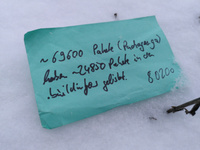
Reproducible Builds Summit 2023 Between October 31st and November 2nd, we held our seventh Reproducible Builds Summit in Hamburg, Germany! Amazingly, the agenda and all notes from all sessions are all online many thanks to everyone who wrote notes from the sessions. As a followup on one idea, started at the summit, Alexander Couzens and Holger Levsen started work on a cache (or tailored front-end) for the snapshot.debian.org service. The general idea is that, when rebuilding Debian, you do not actually need the whole ~140TB of data from snapshot.debian.org; rather, only a very small subset of the packages are ever used for for building. It turns out, for amd64, arm64, armhf, i386, ppc64el, riscv64 and s390 for Debian trixie, unstable and experimental, this is only around 500GB ie. less than 1%. Although the new service not yet ready for usage, it has already provided a promising outlook in this regard. More information is available on https://rebuilder-snapshot.debian.net and we hope that this service becomes usable in the coming weeks. The adjacent picture shows a sticky note authored by Jan-Benedict Glaw at the summit in Hamburg, confirming Holger Levsen s theory that rebuilding all Debian packages needs a very small subset of packages, the text states that 69,200 packages (in Debian sid) list 24,850 packages in their .buildinfo files, in 8,0200 variations. This little piece of paper was the beginning of rebuilder-snapshot and is a direct outcome of the summit! The Reproducible Builds team would like to thank our event sponsors who include Mullvad VPN, openSUSE, Debian, Software Freedom Conservancy, Allotropia and Aspiration Tech.

Beyond Trusting FOSS presentation at SeaGL On November 4th, Vagrant Cascadian presented Beyond Trusting FOSS at SeaGL in Seattle, WA in the United States. Founded in 2013, SeaGL is a free, grassroots technical summit dedicated to spreading awareness and knowledge about free source software, hardware and culture. The summary of Vagrant s talk mentions that it will:
[ ] introduce the concepts of Reproducible Builds, including best practices for developing and releasing software, the tools available to help diagnose issues, and touch on progress towards solving decades-old deeply pervasive fundamental security issues Learn how to verify and demonstrate trust, rather than simply hoping everything is OK!
Germane to the contents of the talk, the slides for Vagrant s talk can be built reproducibly, resulting in a PDF with a SHA1 of cfde2f8a0b7e6ec9b85377eeac0661d728b70f34 when built on Debian bookworm and c21fab273232c550ce822c4b0d9988e6c49aa2c3 on Debian sid at the time of writing.

Human Factors in Software Supply Chain Security Marcel Fourn , Dominik Wermke, Sascha Fahl and Yasemin Acar have published an article in a Special Issue of the IEEE s Security & Privacy magazine. Entitled A Viewpoint on Human Factors in Software Supply Chain Security: A Research Agenda, the paper justifies the need for reproducible builds to reach developers and end-users specifically, and furthermore points out some under-researched topics that we have seen mentioned in interviews. An author pre-print of the article is available in PDF form.

Community updates On our mailing list this month:

openSUSE updates Bernhard M. Wiedemann has created a wiki page outlining an proposal to create a general-purpose Linux distribution which consists of 100% bit-reproducible packages albeit minus the embedded signature within RPM files. It would be based on openSUSE Tumbleweed or, if available, its Slowroll-variant. In addition, Bernhard posted another monthly update for his work elsewhere in openSUSE.

Ubuntu Launchpad now supports .buildinfo files Back in 2017, Steve Langasek filed a bug against Ubuntu s Launchpad code hosting platform to report that .changes files (artifacts of building Ubuntu and Debian packages) reference .buildinfo files that aren t actually exposed by Launchpad itself. This was causing issues when attempting to process .changes files with tools such as Lintian. However, it was noticed last month that, in early August of this year, Simon Quigley had resolved this issue, and .buildinfo files are now available from the Launchpad system.

PHP reproducibility updates There have been two updates from the PHP programming language this month. Firstly, the widely-deployed PHPUnit framework for the PHP programming language have recently released version 10.5.0, which introduces the inclusion of a composer.lock file, ensuring total reproducibility of the shipped binary file. Further details and the discussion that went into their particular implementation can be found on the associated GitHub pull request. In addition, the presentation Leveraging Nix in the PHP ecosystem has been given in late October at the PHP International Conference in Munich by Pol Dellaiera. While the video replay is not yet available, the (reproducible) presentation slides and speaker notes are available.

diffoscope changes diffoscope is our in-depth and content-aware diff utility that can locate and diagnose reproducibility issues. This month, Chris Lamb made a number of changes, including:
  • Improving DOS/MBR extraction by adding support for 7z. [ ]
  • Adding a missing RequiredToolNotFound import. [ ]
  • As a UI/UX improvement, try and avoid printing an extended traceback if diffoscope runs out of memory. [ ]
  • Mark diffoscope as stable on PyPI.org. [ ]
  • Uploading version 252 to Debian unstable. [ ]

Website updates A huge number of notes were added to our website that were taken at our recent Reproducible Builds Summit held between October 31st and November 2nd in Hamburg, Germany. In particular, a big thanks to Arnout Engelen, Bernhard M. Wiedemann, Daan De Meyer, Evangelos Ribeiro Tzaras, Holger Levsen and Orhun Parmaks z. In addition to this, a number of other changes were made, including:

Upstream patches The Reproducible Builds project detects, dissects and attempts to fix as many currently-unreproducible packages as possible. We endeavour to send all of our patches upstream where appropriate. This month, we wrote a large number of such patches, including:

Reproducibility testing framework The Reproducible Builds project operates a comprehensive testing framework (available at tests.reproducible-builds.org) in order to check packages and other artifacts for reproducibility. In October, a number of changes were made by Holger Levsen:
  • Debian-related changes:
    • Track packages marked as Priority: important in a new package set. [ ][ ]
    • Stop scheduling packages that fail to build from source in bookworm [ ] and bullseye. [ ].
    • Add old releases dashboard link in web navigation. [ ]
    • Permit re-run of the pool_buildinfos script to be re-run for a specific year. [ ]
    • Grant jbglaw access to the osuosl4 node [ ][ ] along with lynxis [ ].
    • Increase RAM on the amd64 Ionos builders from 48 GiB to 64 GiB; thanks IONOS! [ ]
    • Move buster to archived suites. [ ][ ]
    • Reduce the number of arm64 architecture workers from 24 to 16 in order to improve stability [ ], reduce the workers for amd64 from 32 to 28 and, for i386, reduce from 12 down to 8 [ ].
    • Show the entire build history of each Debian package. [ ]
    • Stop scheduling already tested package/version combinations in Debian bookworm. [ ]
  • Snapshot service for rebuilders
    • Add an HTTP-based API endpoint. [ ][ ]
    • Add a Gunicorn instance to serve the HTTP API. [ ]
    • Add an NGINX config [ ][ ][ ][ ]
  • System-health:
    • Detect failures due to HTTP 503 Service Unavailable errors. [ ]
    • Detect failures to update package sets. [ ]
    • Detect unmet dependencies. (This usually occurs with builds of Debian live-build.) [ ]
  • Misc-related changes:
    • do install systemd-ommd on jenkins. [ ]
    • fix harmless typo in squid.conf for codethink04. [ ]
    • fixup: reproducible Debian: add gunicorn service to serve /api for rebuilder-snapshot.d.o. [ ]
    • Increase codethink04 s Squid cache_dir size setting to 16 GiB. [ ]
    • Don t install systemd-oomd as it unfortunately kills sshd [ ]
    • Use debootstrap from backports when commisioning nodes. [ ]
    • Add the live_build_debian_stretch_gnome, debsums-tests_buster and debsums-tests_buster jobs to the zombie list. [ ][ ]
    • Run jekyll build with the --watch argument when building the Reproducible Builds website. [ ]
    • Misc node maintenance. [ ][ ][ ]
Other changes were made as well, however, including Mattia Rizzolo fixing rc.local s Bash syntax so it can actually run [ ], commenting away some file cleanup code that is (potentially) deleting too much [ ] and fixing the html_brekages page for Debian package builds [ ]. Finally, diagnosed and submitted a patch to add a AddEncoding gzip .gz line to the tests.reproducible-builds.org Apache configuration so that Gzip files aren t re-compressed as Gzip which some clients can t deal with (as well as being a waste of time). [ ]

If you are interested in contributing to the Reproducible Builds project, please visit our Contribute page on our website. However, you can get in touch with us via:

5 December 2023

Louis-Philippe V ronneau: Montreal's Debian & Stuff - November 2023

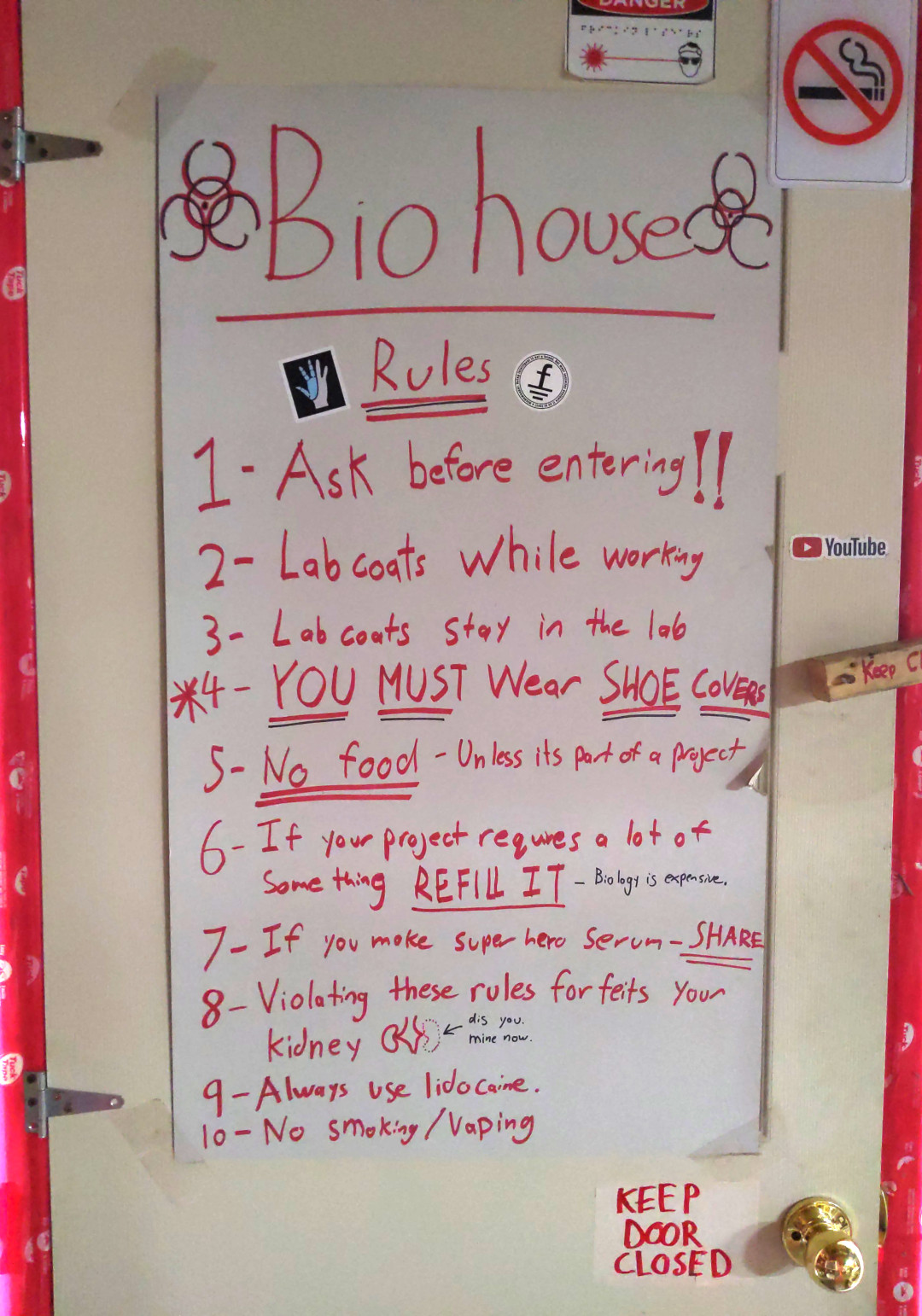
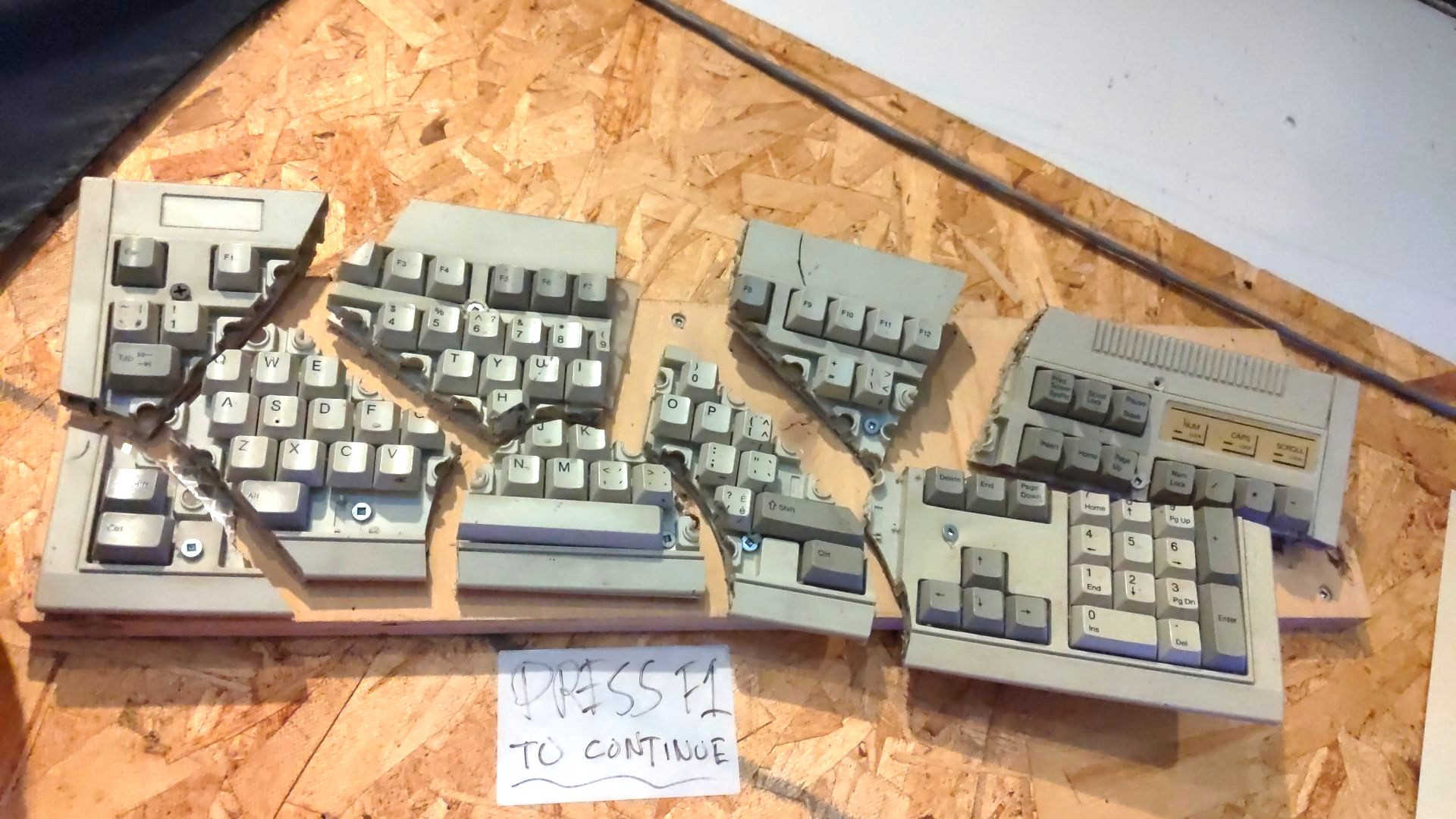
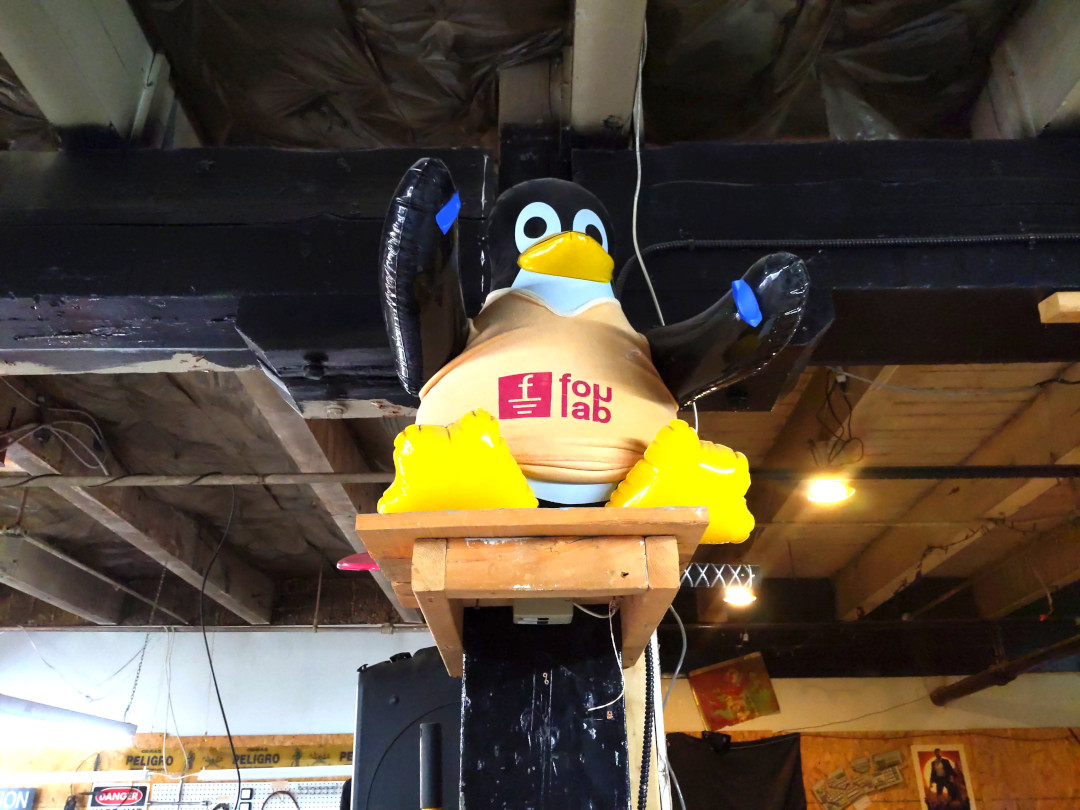
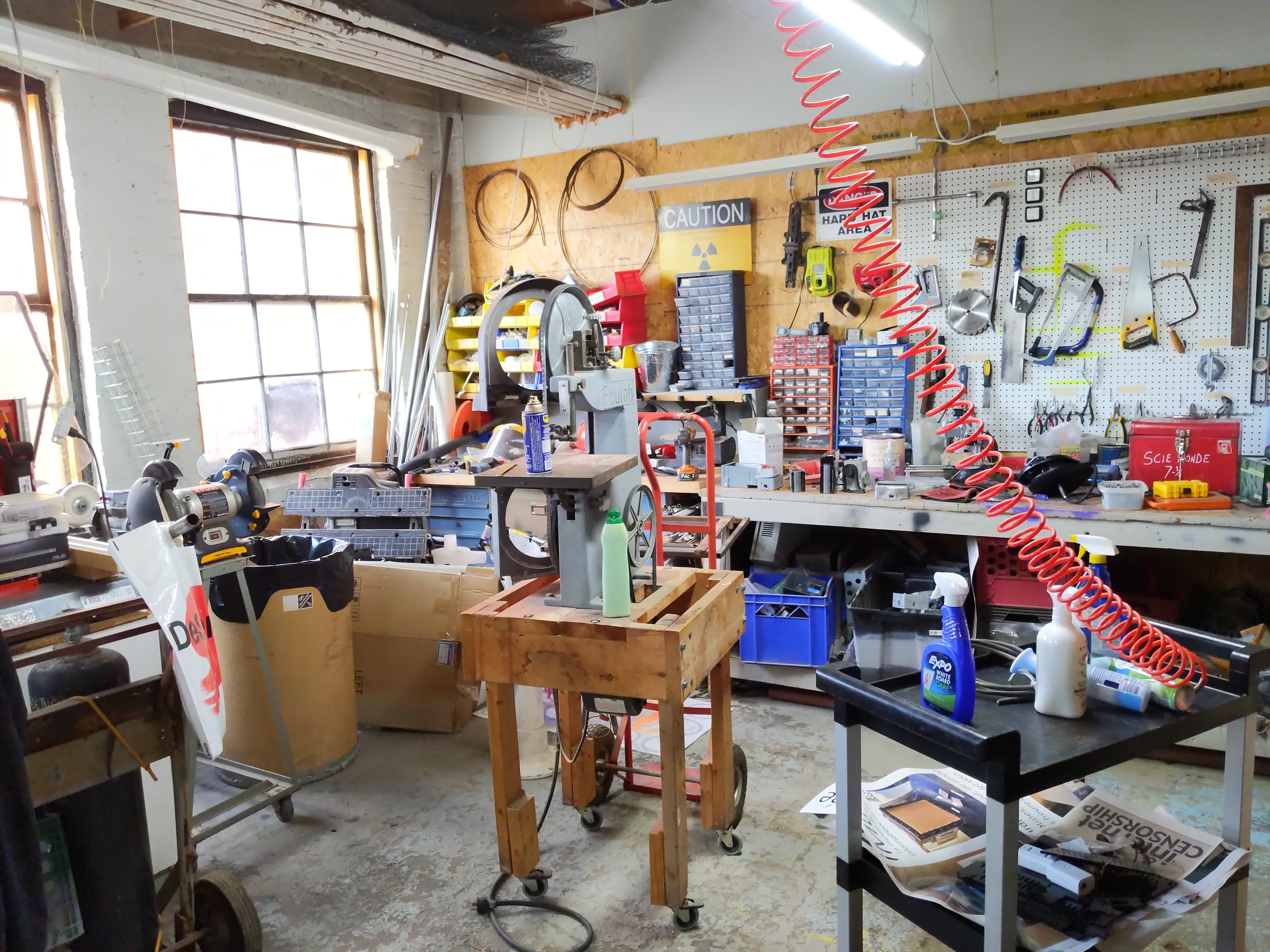
Hello from a snowy Montr al! My life has been pretty busy lately1 so please forgive this late report. On November 19th, our local Debian User Group met at Montreal's most prominent hackerspace, Foulab. We've been there a few times already, but since our last visit, Foulab has had some membership/financial troubles. Happy to say things are going well again and a new team has taken over the space. This meetup wasn't the most productive day for me (something about being exhausted apparently makes it hard to concentrate), but other people did a bunch of interesting stuff :) Pictures Here are a bunch of pictures I took! Foulab is always a great place to snap quirky things :) A sign on a whiteboard that says 'Bienvenue aux laboratoires qui rends fou' The entrance of the bio-hacking house, with a list of rules An exploded keyboard with a 'Press F1 to continue' sign An inflatable Tux with a Foulab T-Shirt A picture of the woodworking workshop

  1. More busy than the typical end of semester rush... At work, we are currently renegotiating our collective bargaining agreement and things aren't going so well. We went on strike for a few days already and we're planning on another 7 days starting on Friday 8th.

13 November 2023

Freexian Collaborators: Monthly report about Debian Long Term Support, October 2023 (by Roberto C. S nchez)

Like each month, have a look at the work funded by Freexian s Debian LTS offering.

Debian LTS contributors In October, 18 contributors have been paid to work on Debian LTS, their reports are available:
  • Adrian Bunk did 8.0h (out of 7.75h assigned and 10.0h from previous period), thus carrying over 9.75h to the next month.
  • Anton Gladky did 9.5h (out of 9.5h assigned and 5.5h from previous period), thus carrying over 5.5h to the next month.
  • Bastien Roucari s did 16.0h (out of 16.75h assigned and 1.0h from previous period), thus carrying over 1.75h to the next month.
  • Ben Hutchings did 8.0h (out of 17.75h assigned), thus carrying over 9.75h to the next month.
  • Chris Lamb did 17.0h (out of 17.75h assigned), thus carrying over 0.75h to the next month.
  • Emilio Pozuelo Monfort did 17.5h (out of 17.75h assigned), thus carrying over 0.25h to the next month.
  • Guilhem Moulin did 9.75h (out of 17.75h assigned), thus carrying over 8.0h to the next month.
  • Helmut Grohne did 1.5h (out of 10.0h assigned), thus carrying over 8.5h to the next month.
  • Lee Garrett did 10.75h (out of 17.75h assigned), thus carrying over 7.0h to the next month.
  • Markus Koschany did 30.0h (out of 30.0h assigned).
  • Ola Lundqvist did 4.0h (out of 0h assigned and 19.5h from previous period), thus carrying over 15.5h to the next month.
  • Roberto C. S nchez did 12.0h (out of 5.0h assigned and 7.0h from previous period).
  • Santiago Ruano Rinc n did 13.625h (out of 7.75h assigned and 8.25h from previous period), thus carrying over 2.375h to the next month.
  • Sean Whitton did 13.0h (out of 6.0h assigned and 7.0h from previous period).
  • Sylvain Beucler did 7.5h (out of 11.25h assigned and 6.5h from previous period), thus carrying over 10.25h to the next month.
  • Thorsten Alteholz did 14.0h (out of 14.0h assigned).
  • Tobias Frost did 16.0h (out of 9.25h assigned and 6.75h from previous period).
  • Utkarsh Gupta did 0.0h (out of 0.75h assigned and 17.0h from previous period), thus carrying over 17.75h to the next month.

Evolution of the situation In October, we have released 49 DLAs. Of particular note in the month of October, LTS contributor Chris Lamb issued DLA 3627-1 pertaining to Redis, the popular key-value database similar to Memcached, which was vulnerable to an authentication bypass vulnerability. Fixing this vulnerability involved dealing with a race condition that could allow another process an opportunity to establish an otherwise unauthorized connection. LTS contributor Markus Koschany was involved in the mitigation of CVE-2023-44487, which is a protocol-level vulnerability in the HTTP/2 protocol. The impacts within Debian involved multiple packages, across multiple releases, with multiple advisories being released (both DSA for stable and old-stable, and DLA for LTS). Markus reviewed patches and security updates prepared by other Debian developers, investigated reported regressions, provided patches for the aforementioned regressions, and issued several security updates as part of this. Additionally, as MariaDB 10.3 (the version originally included with Debian buster) passed end-of-life earlier this year, LTS contributor Emilio Pozuelo Monfort has begun investigating the feasibility of backporting MariaDB 10.11. The work is in early stages, with much testing and analysis remaining before a final decision can be made, as this only one of several available potential courses of action concerning MariaDB. Finally, LTS contributor Lee Garrett has invested considerable effort into the development the Functional Test Framework here. While so far only an initial version has been published, it already has several features which we intend to begin leveraging for testing of LTS packages. In particular, the FTF supports provisioning multiple VMs for the purposes of performing functional tests of network-facing services (e.g., file services, authentication, etc.). These tests are in addition to the various unit-level tests which are executed during package build time. Development work will continue on FTF and as it matures and begins to see wider use within LTS we expect to improve the quality of the updates we publish.

Thanks to our sponsors Sponsors that joined recently are in bold.

11 November 2023

Reproducible Builds: Reproducible Builds in October 2023

Welcome to the October 2023 report from the Reproducible Builds project. In these reports we outline the most important things that we have been up to over the past month. As a quick recap, whilst anyone may inspect the source code of free software for malicious flaws, almost all software is distributed to end users as pre-compiled binaries.

Reproducible Builds Summit 2023 Between October 31st and November 2nd, we held our seventh Reproducible Builds Summit in Hamburg, Germany! Our summits are a unique gathering that brings together attendees from diverse projects, united by a shared vision of advancing the Reproducible Builds effort, and this instance was no different. During this enriching event, participants had the opportunity to engage in discussions, establish connections and exchange ideas to drive progress in this vital field. A number of concrete outcomes from the summit will documented in the report for November 2023 and elsewhere. Amazingly the agenda and all notes from all sessions are already online. The Reproducible Builds team would like to thank our event sponsors who include Mullvad VPN, openSUSE, Debian, Software Freedom Conservancy, Allotropia and Aspiration Tech.

Reflections on Reflections on Trusting Trust Russ Cox posted a fascinating article on his blog prompted by the fortieth anniversary of Ken Thompson s award-winning paper, Reflections on Trusting Trust:
[ ] In March 2023, Ken gave the closing keynote [and] during the Q&A session, someone jokingly asked about the Turing award lecture, specifically can you tell us right now whether you have a backdoor into every copy of gcc and Linux still today?
Although Ken reveals (or at least claims!) that he has no such backdoor, he does admit that he has the actual code which Russ requests and subsequently dissects in great but accessible detail.

Ecosystem factors of reproducible builds Rahul Bajaj, Eduardo Fernandes, Bram Adams and Ahmed E. Hassan from the Maintenance, Construction and Intelligence of Software (MCIS) laboratory within the School of Computing, Queen s University in Ontario, Canada have published a paper on the Time to fix, causes and correlation with external ecosystem factors of unreproducible builds. The authors compare various response times within the Debian and Arch Linux distributions including, for example:
Arch Linux packages become reproducible a median of 30 days quicker when compared to Debian packages, while Debian packages remain reproducible for a median of 68 days longer once fixed.
A full PDF of their paper is available online, as are many other interesting papers on MCIS publication page.

NixOS installation image reproducible On the NixOS Discourse instance, Arnout Engelen (raboof) announced that NixOS have created an independent, bit-for-bit identical rebuilding of the nixos-minimal image that is used to install NixOS. In their post, Arnout details what exactly can be reproduced, and even includes some of the history of this endeavour:
You may remember a 2021 announcement that the minimal ISO was 100% reproducible. While back then we successfully tested that all packages that were needed to build the ISO were individually reproducible, actually rebuilding the ISO still introduced differences. This was due to some remaining problems in the hydra cache and the way the ISO was created. By the time we fixed those, regressions had popped up (notably an upstream problem in Python 3.10), and it isn t until this week that we were back to having everything reproducible and being able to validate the complete chain.
Congratulations to NixOS team for reaching this important milestone! Discussion about this announcement can be found underneath the post itself, as well as on Hacker News.

CPython source tarballs now reproducible Seth Larson published a blog post investigating the reproducibility of the CPython source tarballs. Using diffoscope, reprotest and other tools, Seth documents his work that led to a pull request to make these files reproducible which was merged by ukasz Langa.

New arm64 hardware from Codethink Long-time sponsor of the project, Codethink, have generously replaced our old Moonshot-Slides , which they have generously hosted since 2016 with new KVM-based arm64 hardware. Holger Levsen integrated these new nodes to the Reproducible Builds continuous integration framework.

Community updates On our mailing list during October 2023 there were a number of threads, including:
  • Vagrant Cascadian continued a thread about the implementation details of a snapshot archive server required for reproducing previous builds. [ ]
  • Akihiro Suda shared an update on BuildKit, a toolkit for building Docker container images. Akihiro links to a interesting talk they recently gave at DockerCon titled Reproducible builds with BuildKit for software supply-chain security.
  • Alex Zakharov started a thread discussing and proposing fixes for various tools that create ext4 filesystem images. [ ]
Elsewhere, Pol Dellaiera made a number of improvements to our website, including fixing typos and links [ ][ ], adding a NixOS Flake file [ ] and sorting our publications page by date [ ]. Vagrant Cascadian presented Reproducible Builds All The Way Down at the Open Source Firmware Conference.

Distribution work distro-info is a Debian-oriented tool that can provide information about Debian (and Ubuntu) distributions such as their codenames (eg. bookworm) and so on. This month, Benjamin Drung uploaded a new version of distro-info that added support for the SOURCE_DATE_EPOCH environment variable in order to close bug #1034422. In addition, 8 reviews of packages were added, 74 were updated and 56 were removed this month, all adding to our knowledge about identified issues. Bernhard M. Wiedemann published another monthly report about reproducibility within openSUSE.

Software development The Reproducible Builds project detects, dissects and attempts to fix as many currently-unreproducible packages as possible. We endeavour to send all of our patches upstream where appropriate. This month, we wrote a large number of such patches, including: In addition, Chris Lamb fixed an issue in diffoscope, where if the equivalent of file -i returns text/plain, fallback to comparing as a text file. This was originally filed as Debian bug #1053668) by Niels Thykier. [ ] This was then uploaded to Debian (and elsewhere) as version 251.

Reproducibility testing framework The Reproducible Builds project operates a comprehensive testing framework (available at tests.reproducible-builds.org) in order to check packages and other artifacts for reproducibility. In October, a number of changes were made by Holger Levsen:
  • Debian-related changes:
    • Refine the handling of package blacklisting, such as sending blacklisting notifications to the #debian-reproducible-changes IRC channel. [ ][ ][ ]
    • Install systemd-oomd on all Debian bookworm nodes (re. Debian bug #1052257). [ ]
    • Detect more cases of failures to delete schroots. [ ]
    • Document various bugs in bookworm which are (currently) being manually worked around. [ ]
  • Node-related changes:
    • Integrate the new arm64 machines from Codethink. [ ][ ][ ][ ][ ][ ]
    • Improve various node cleanup routines. [ ][ ][ ][ ]
    • General node maintenance. [ ][ ][ ][ ]
  • Monitoring-related changes:
    • Remove unused Munin monitoring plugins. [ ]
    • Complain less visibly about too many installed kernels. [ ]
  • Misc:
    • Enhance the firewall handling on Jenkins nodes. [ ][ ][ ][ ]
    • Install the fish shell everywhere. [ ]
In addition, Vagrant Cascadian added some packages and configuration for snapshot experiments. [ ]

If you are interested in contributing to the Reproducible Builds project, please visit our Contribute page on our website. However, you can get in touch with us via:

2 November 2023

Fran ois Marier: Upgrading from Debian 11 bullseye to 12 bookworm

Over the last few months, I upgraded my Debian machines from bullseye to bookworm. The process was uneventful, but I ended up reconfiguring several things afterwards in order to modernize my upgraded machines.

Logcheck I noticed in this release that the transition to journald is essentially complete. This means that rsyslog is no longer needed on most of my systems:
apt purge rsyslog
Once that was done, I was able to comment out the following lines in /etc/logcheck/logcheck.logfiles.d/syslog.logfiles:
#/var/log/syslog
#/var/log/auth.log
I did have to adjust some of my custom logcheck rules, particularly the ones that deal with kernel messages:
--- a/logcheck/ignore.d.server/local-kernel
+++ b/logcheck/ignore.d.server/local-kernel
@@ -1,1 +1,1 @@
-^\w 3  [ :[:digit:]] 11  [._[:alnum:]-]+ kernel: \[[0-9. ]+]\ IN=eno1 OUT= MAC=[0-9a-f:]+ SRC=[0-9a-f.:]+
+^\w 3  [ :[:digit:]] 11  [._[:alnum:]-]+ kernel: (\[[0-9. ]+]\ )?IN=eno1 OUT= MAC=[0-9a-f:]+ SRC=[0-9a-f.:]+
Then I moved local entries from /etc/logcheck/logcheck.logfiles to /etc/logcheck/logcheck.logfiles.d/local.logfiles (/var/log/syslog and /var/log/auth.log are enabled by default when needed) and removed some files that are no longer used:
rm /var/log/mail.err*
rm /var/log/mail.warn*
rm /var/log/mail.info*
Finally, I had to fix any unescaped characters in my local rules. For example error == NULL \*error == NULL must now be written as error == NULL \ \ \*error == NULL.

Networking After the upgrade, I got a notice that the isc-dhcp-client is now deprecated and so I removed if from my system:
apt purge isc-dhcp-client
This however meant that I need to ensure that my network configuration software does not depend on the now-deprecated DHCP client. On my laptop, I was already using NetworkManager for my main network interfaces and that has built-in DHCP support.

Migration to systemd-networkd On my backup server, I took this opportunity to switch from ifupdown to systemd-networkd by removing ifupdown:
apt purge ifupdown
rm /etc/network/interfaces
putting the following in /etc/systemd/network/20-wired.network:
[Match]
Name=eno1
[Network]
DHCP=yes
MulticastDNS=yes
and then enabling/starting systemd-networkd:
systemctl enable systemd-networkd
systemctl start systemd-networkd
I also needed to install polkit:
apt install --no-install-recommends policykit-1
in order to allow systemd-networkd to set the hostname. In order to start my firewall automatically as interfaces are brought up, I wrote a dispatcher script to apply my existing iptables rules.

Migration to predictacle network interface names On my Linode server, I did the same as on the backup server, but I put the following in /etc/systemd/network/20-wired.network since it has a static IPv6 allocation:
[Match]
Name=enp0s4
[Network]
DHCP=yes
Address=2600:3c01::xxxx:xxxx:xxxx:939f/64
Gateway=fe80::1
and switched to predictable network interface names by deleting these two files:
  • /etc/systemd/network/50-virtio-kernel-names.link
  • /etc/systemd/network/99-default.link
and then changing eth0 to enp0s4 in:
  • /etc/network/iptables.up.rules
  • /etc/network/ip6tables.up.rules
  • /etc/rc.local (for OpenVPN)
  • /etc/logcheck/ignored.d.*/*
Then I regenerated all initramfs:
update-initramfs -u -k all
and rebooted the virtual machine. Giving systemd-resolved control of /etc/resolv.conf After reading this history of DNS resolution on Linux, I decided to modernize my resolv.conf setup and let systemd-resolved handle /etc/resolv.conf. I installed the package:
apt install systemd-resolved
and then removed no-longer-needed packages:
apt purge resolvconf avahi-daemon
I also disabled support for Link-Local Multicast Name Resolution (LLMNR) after reading this person's reasoning by putting the following in /etc/systemd/resolved.conf.d/llmnr.conf:
[Resolve]
LLMNR=no
I verified that mDNS is enabled and LLMNR is disabled:
$ resolvectl mdns
Global: yes
Link 2 (enp0s25): yes
Link 3 (wlp3s0): yes
$ resolvectl llmnr
Global: no
Link 2 (enp0s25): no
Link 3 (wlp3s0): no
Note that if you want auto-discovery of local printers using CUPS, you need to keep avahi-daemon since cups-browsed doesn't support systemd-resolved. You can verify that it works using:
sudo lpinfo --include-schemes dnssd -v

Dynamic DNS I replaced ddclient with inadyn since it doesn't work with no-ip.com anymore, using the configuration I described in an old blog post.

chkrootkit I moved my customizations in /etc/chkrootkit.conf to /etc/chkrootkit/chkrootkit.conf after seeing this message in my logs:
WARNING: /etc/chkrootkit.conf is deprecated. Please put your settings in /etc/chkrootkit/chkrootkit.conf instead: /etc/chkrootkit.conf will be ignored in a future release and should be deleted.

ssh As mentioned in Debian bug#1018106, to silence the following warnings:
sshd[6283]: pam_env(sshd:session): deprecated reading of user environment enabled
I changed the following in /etc/pam.d/sshd:
--- a/pam.d/sshd
+++ b/pam.d/sshd
@@ -44,7 +44,7 @@ session    required     pam_limits.so
 session    required     pam_env.so # [1]
 # In Debian 4.0 (etch), locale-related environment variables were moved to
 # /etc/default/locale, so read that as well.
-session    required     pam_env.so user_readenv=1 envfile=/etc/default/locale
+session    required     pam_env.so envfile=/etc/default/locale
 # SELinux needs to intervene at login time to ensure that the process starts
 # in the proper default security context.  Only sessions which are intended
I also made the following changes to /etc/ssh/sshd_config.d/local.conf based on the advice of ssh-audit 2.9.0:
-KexAlgorithms curve25519-sha256@libssh.org,curve25519-sha256,diffie-hellman-group14-sha256,diffie-hellman-group16-sha512,diffie-hellman-group18-sha512,diffie-hellman-group-exchange-sha256
+KexAlgorithms curve25519-sha256@libssh.org,curve25519-sha256,sntrup761x25519-sha512@openssh.com,diffie-hellman-group16-sha512,diffie-hellman-group18-sha512

Reproducible Builds: Farewell from the Reproducible Builds Summit 2023!

Farewell from the Reproducible Builds summit, which just took place in Hamburg, Germany: This year, we were thrilled to host the seventh edition of this exciting event. Topics covered this year included:

as well as countless informal discussions and hacking sessions into the night. Projects represented at the venue included:
Debian, openSUSE, QubesOS, GNU Guix, Arch Linux, phosh, Mobian, PureOS, JustBuild, LibreOffice, Warpforge, OpenWrt, F-Droid, NixOS, ElectroBSD, Apache Security, Buildroot, Systemd, Apache Maven, Fedora, Privoxy, CHAINS (KTH Royal Institute of Technology), coreboot, GitHub, Tor Project, Ubuntu, rebuilderd, repro-env, spytrap-adb, arch-repro-status, etc.

A huge thanks to our sponsors and partners for making the event possible:
Aspiration

Event facilitation

Mullvad

Platinum sponsor


If you weren t able to make it this year, don t worry; just look out for an announcement in 2024 for the next event.

1 November 2023

Paul Wise: FLOSS Activities October 2023

Focus This month I didn't have any particular focus. I just worked on issues in my info bubble.

Changes

Issues

Review
  • Debian wiki: RecentChanges for the month
  • Debian BTS usertags: changes for the month
  • Debian screenshots:

Administration
  • Debian IRC: rescue obsolete/unused #debian-wiki channel
  • Debian servers: rescue data from an old DebConf server
  • Debian wiki: approve accounts

Communication
  • Respond to queries from Debian users and contributors on the mailing lists and IRC

Sponsors The SWH, golang-ginkgo, DBD-ODBC, sqliteodbc work was sponsored. All other work was done on a volunteer basis.

22 October 2023

Ravi Dwivedi: Software Freedom Day at sflc.in

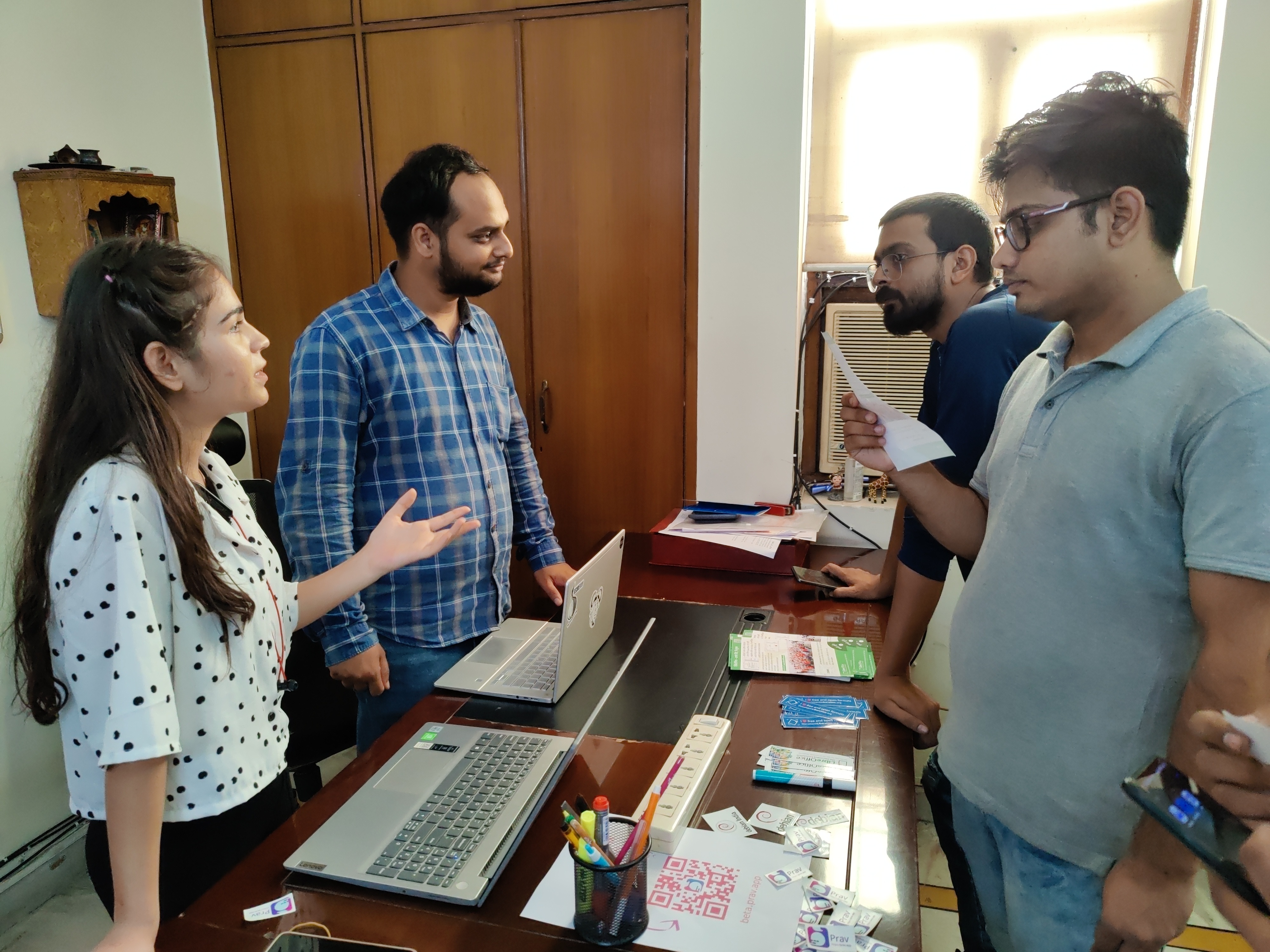
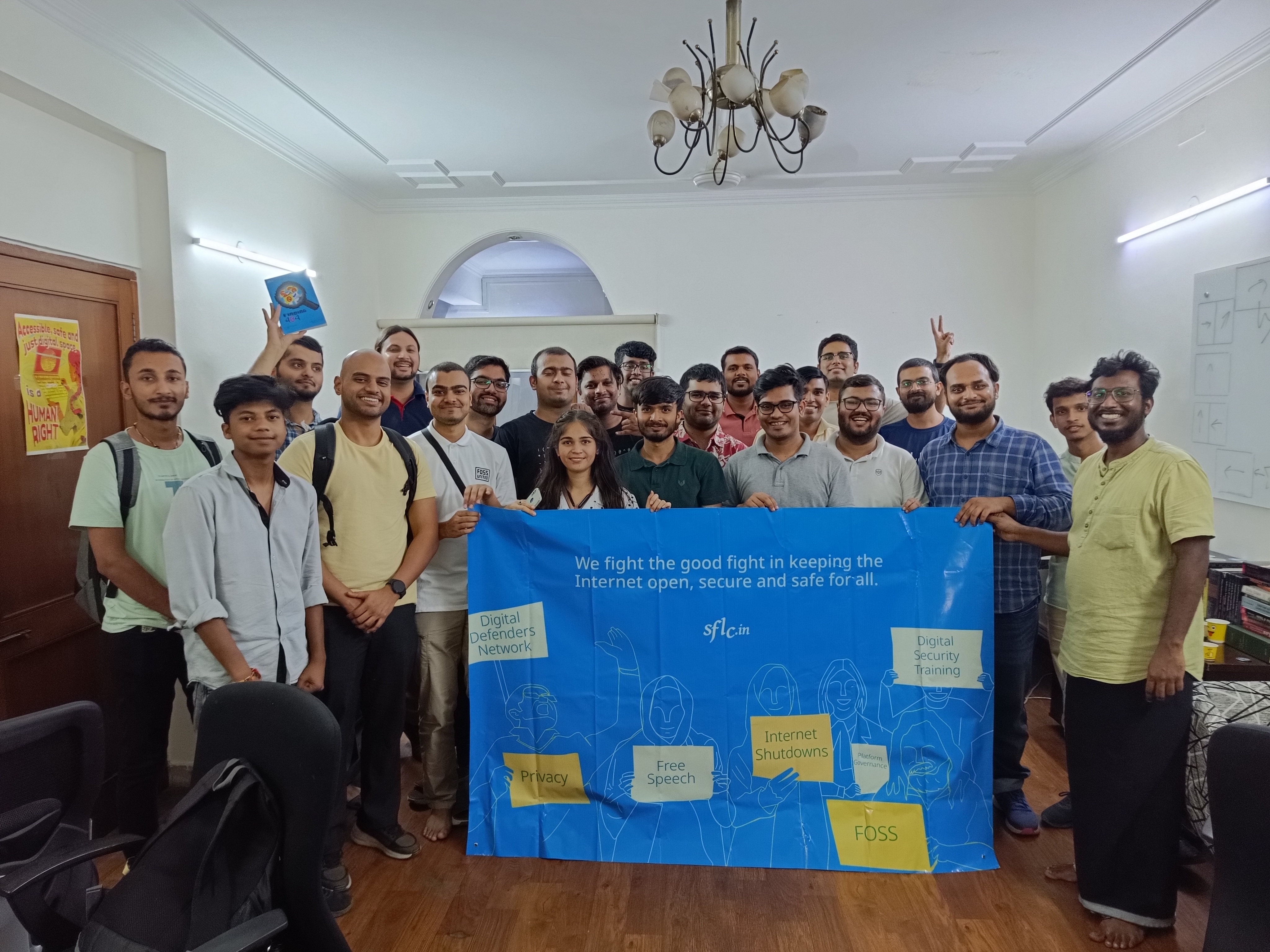
Software Freedom Law Center, India, also known as sflc.in, organized an event to celebrate the Software Freedom Day on 30th September 2023. Me, Sahil, Contrapunctus and Suresh joined. The venue was at the SFLC India office in Delhi. The sflc.in office was on the second floor of what looked like someone s apartment:). I also met Chirag, Orendra, Surbhi and others. My plan was to have a stall on LibreOffice and Prav app to raise awareness about these projects. I didn t have QR code for downloading prav app printed already, so I asked the people at sflc.in if they can get it printed for me. They were very kind and helped me in getting a color printout for me. So, I got a stall in their main room. Surbhi was having an Inkscape stall next to mine and gave me company. People came and asked about the prav project and then I realized I was still too tired to explain the idea behind the prav project and about LibreOffice (after a long Kerala trip). We got a few prav app installs during the event, which is cool.
My stall. Photo credits: Tejaswini.
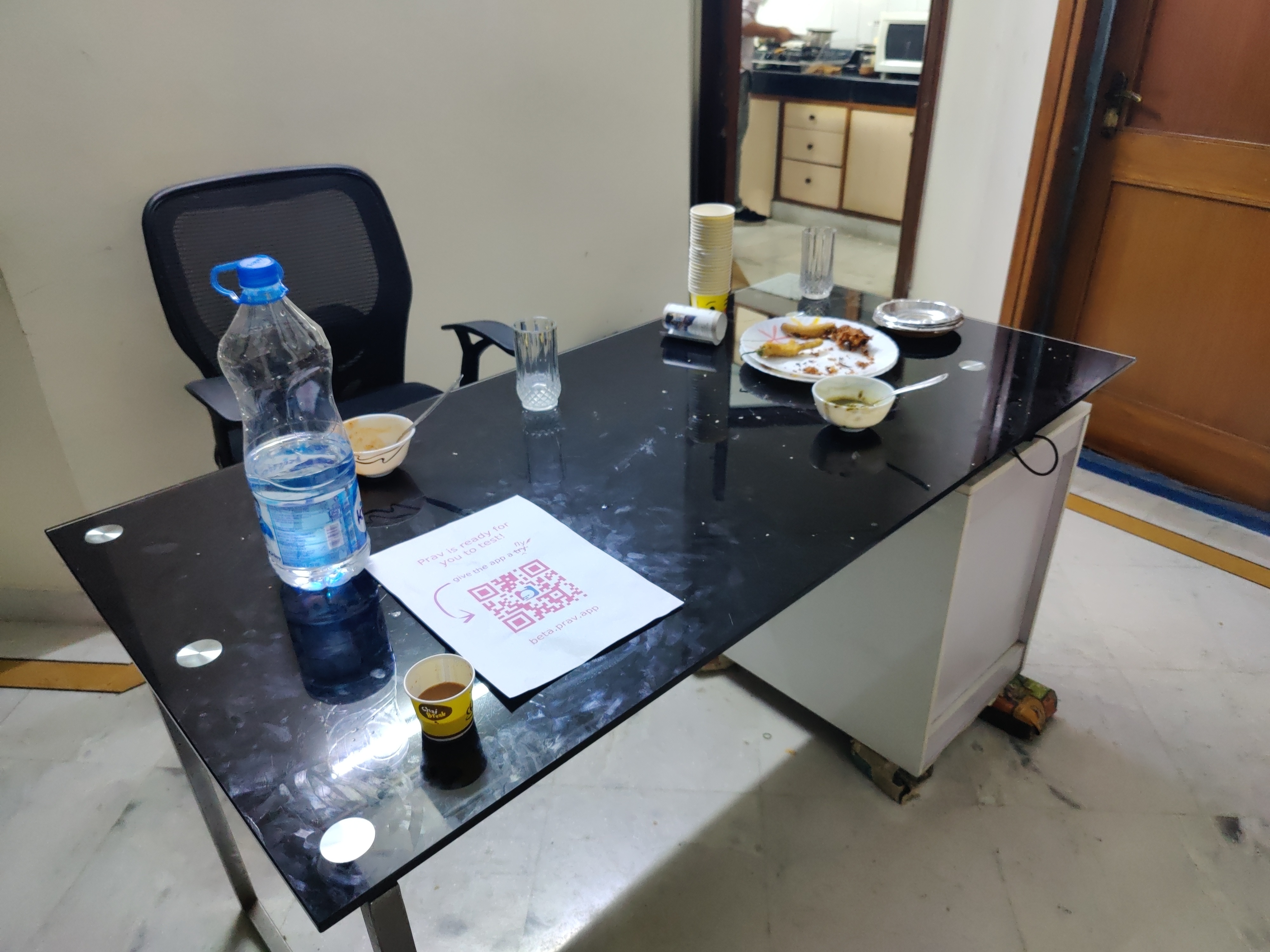
Sahil had Debian stall and contrapunctus had OpenStreetMap stall. After about an hour, Revolution OS was screened for all of us to watch, along with popcorn. The documentary gave an overview of history of Free Software Movement. The office had a kitchen where fresh chai was being made and served to us. The organizers ordered a lot of good snacks for us.
Snacks and tea at the front desk. CC-BY-SA 4.0 by Ravi Dwivedi.
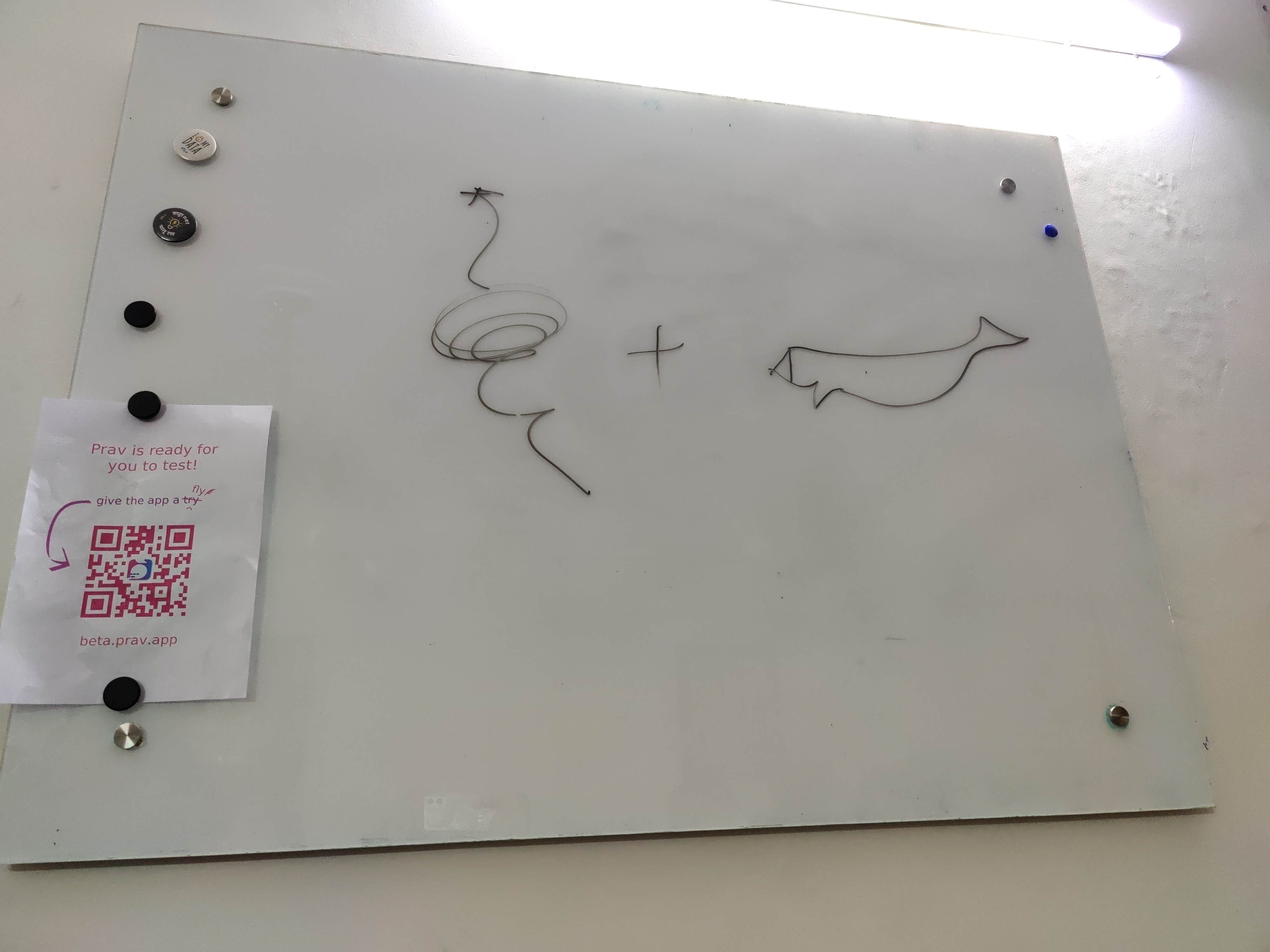
I came out of the movie hall to take more tea and snacks from the front desk. I saw a beautiful painting was hanging at the wall opposite to the front desk and Tejaswini (from sflc.in) revealed that she had made it. The tea was really good as it was freshly made in the kitchen. After the movie, we played a game of pictionary. We were divided into two teams. The game goes as follows: A person from a team is selected and given a term related to freedom respecting software written on a piece of paper, but concealed from other participants. Then that person draws something on the board (no logo, no alphabets) without speaking. If the team from which the person belongs correctly guesses the term, the team gets one step ahead on the leader board. The team who reaches the finish line wins. I recall some fun pictionaries. Like, the one in the picture below seems far from the word Wireguard and even then someone from the team guessed that word. Our team won in the end \o/.
Pictionary drawing nowhere close to the intended word Wireguard :), which was guessed. Photo by Ravi Dwivedi, CC-BY-SA 4.0.
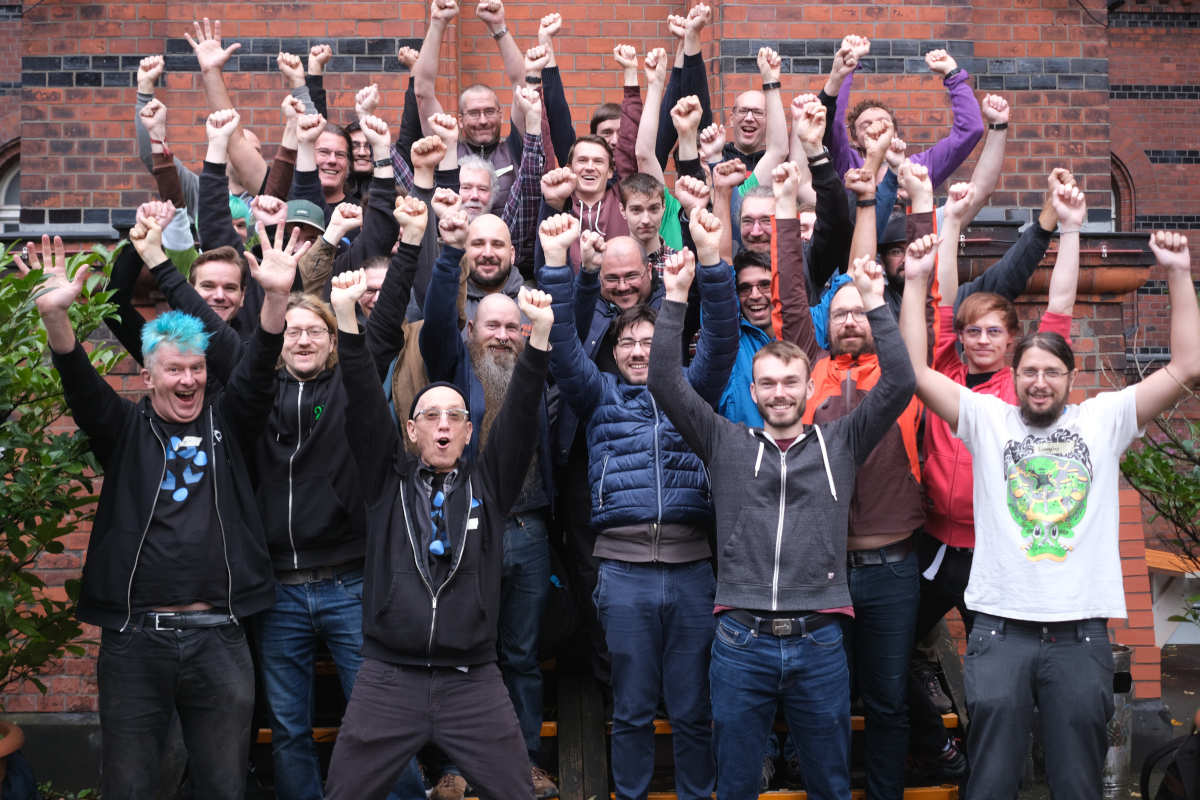
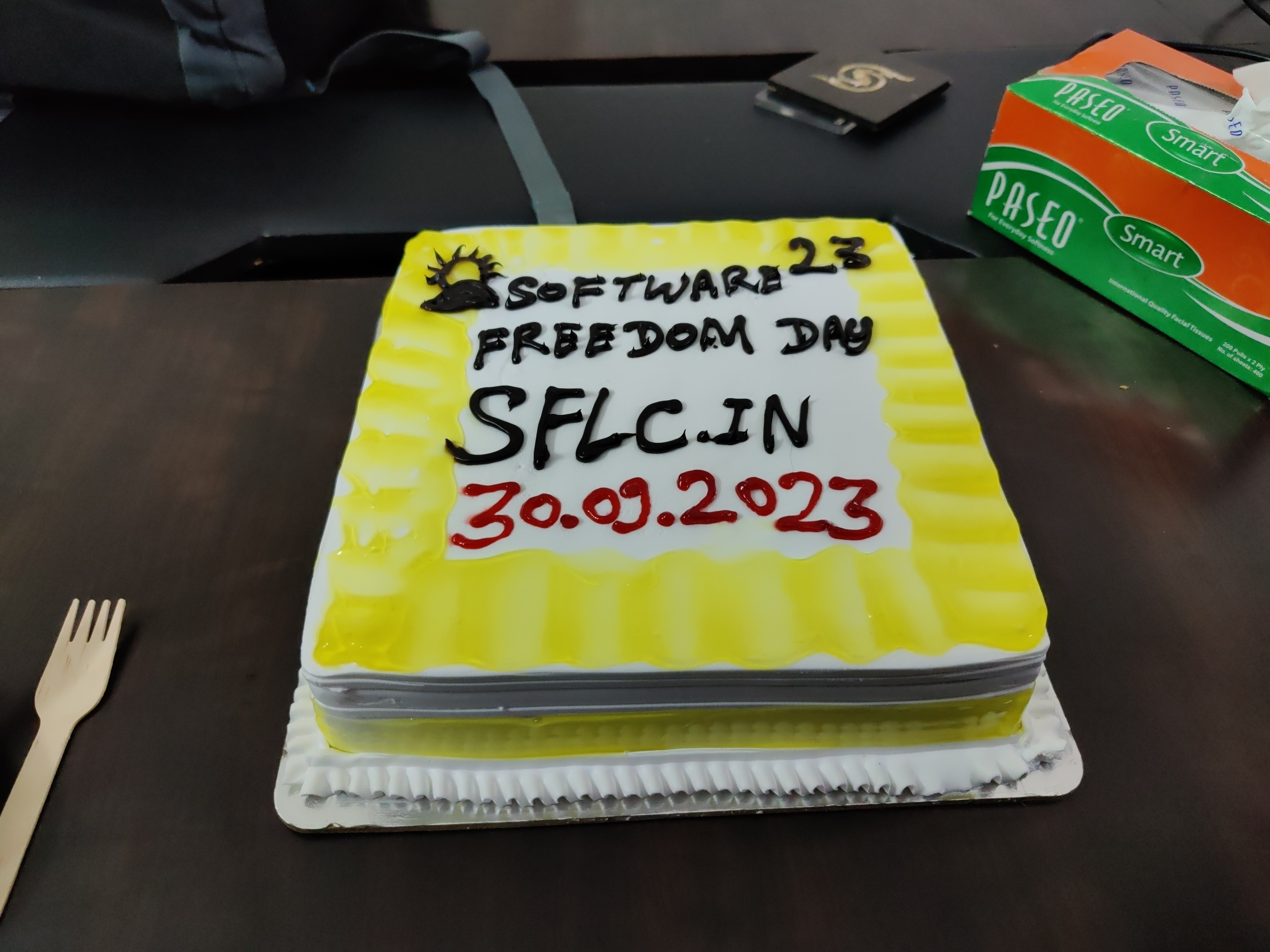
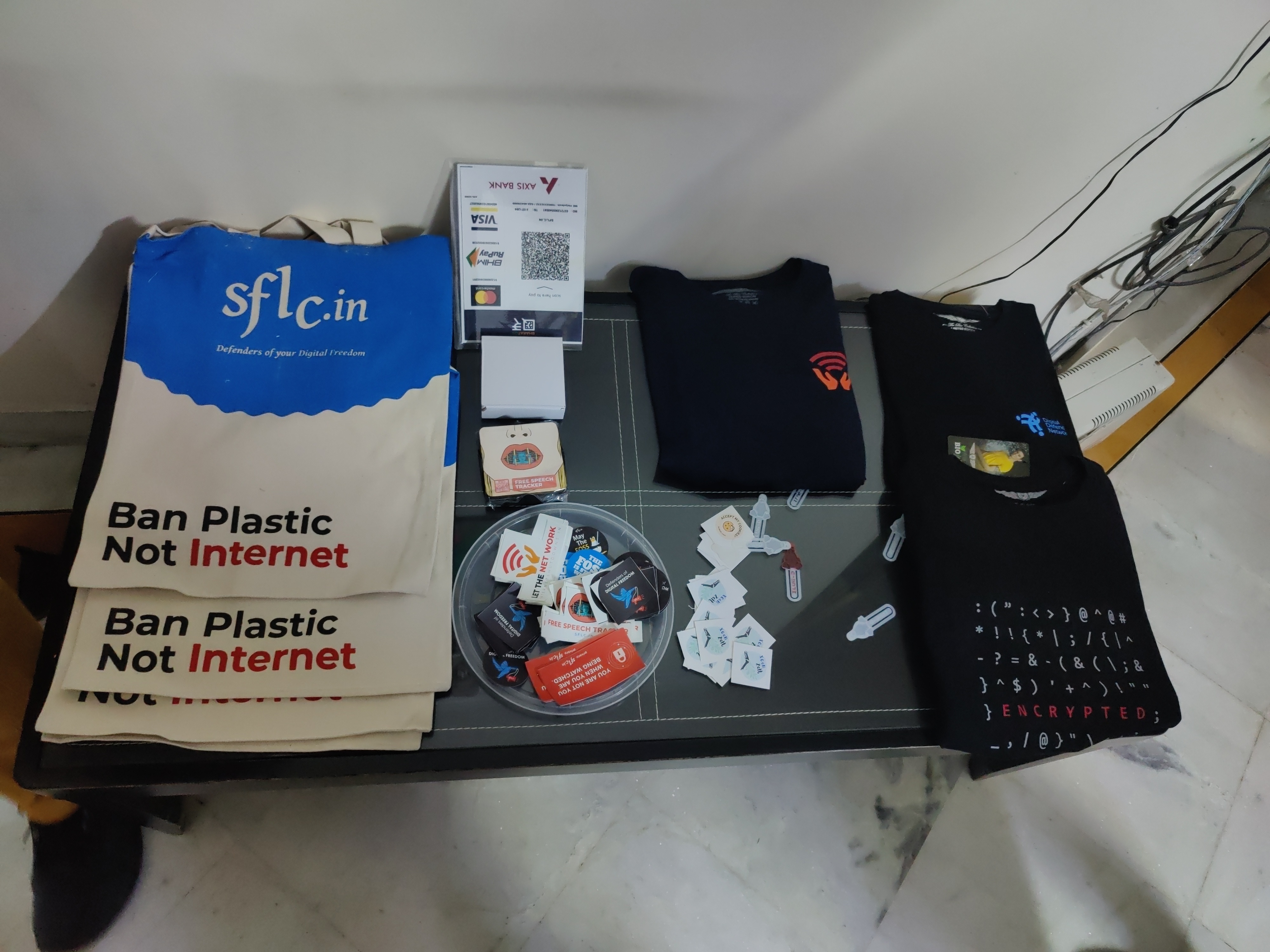
Then, we posed for a group picture. At the end, SFLC.in had a delicious cake in store for us. They had some merchandise - handbags, T-shirts, etc. which we could take if we donate some amount to SFLC.in. I bought a handbag with Ban Plastic, not Internet written on it in exchange for donation. I hope that gives people around me a powerful message :) .
Group photo. Photo credits: Tejaswini.
Tasty cake. CC-BY-SA 4.0 by Ravi Dwivedi.
Merchandise by sflc.in. CC-BY-SA 4.0 by Ravi Dwivedi.
All in all, a nice event by sflc.in :)

Ian Jackson: DigiSpark (ATTiny85) - Arduino, C, Rust, build systems

Recently I completed a small project, including an embedded microcontroller. For me, using the popular Arduino IDE, and C, was a mistake. The experience with Rust was better, but still very exciting, and not in a good way. Here follows the rant. Introduction In a recent project (I ll write about the purpose, and the hardware in another post) I chose to use a DigiSpark board. This is a small board with a USB-A tongue (but not a proper plug), and an ATTiny85 microcontroller, This chip has 8 pins and is quite small really, but it was plenty for my application. By choosing something popular, I hoped for convenient hardware, and an uncomplicated experience. Convenient hardware, I got. Arduino IDE The usual way to program these boards is via an IDE. I thought I d go with the flow and try that. I knew these were closely related to actual Arduinos and saw that the IDE package arduino was in Debian. But it turns out that the Debian package s version doesn t support the DigiSpark. (AFAICT from the list it offered me, I m not sure it supports any ATTiny85 board.) Also, disturbingly, its board manager seemed to be offering to install board support, suggesting it would download stuff from the internet and run it. That wouldn t be acceptable for my main laptop. I didn t expect to be doing much programming or debugging, and the project didn t have significant security requirements: the chip, in my circuit, has only a very narrow ability do anything to the real world, and no network connection of any kind. So I thought it would be tolerable to do the project on my low-security video laptop . That s the machine where I m prepared to say yes to installing random software off the internet. So I went to the upstream Arduino site and downloaded a tarball containing the Arduino IDE. After unpacking that in /opt it ran and produced a pointy-clicky IDE, as expected. I had already found a 3rd-party tutorial saying I needed to add a magic URL (from the DigiSpark s vendor) in the preferences. That indeed allowed it to download a whole pile of stuff. Compilers, bootloader clients, god knows what. However, my tiny test program didn t make it to the board. Half-buried in a too-small window was an error message about the board s bootloader ( Micronucleus ) being too new. The boards I had came pre-flashed with micronucleus 2.2. Which is hardly new, But even so the official Arduino IDE (or maybe the DigiSpark s board package?) still contains an old version. So now we have all the downsides of curl bash-ware, but we re lacking the it s up to date and it just works upsides. Further digging found some random forum posts which suggested simply downloading a newer micronucleus and manually stuffing it into the right place: one overwrites a specific file, in the middle the heaps of stuff that the Arduino IDE s board support downloader squirrels away in your home directory. (In my case, the home directory of the untrusted shared user on the video laptop,) So, whatever . I did that. And it worked! Having demo d my ability to run code on the board, I set about writing my program. Writing C again The programming language offered via the Arduino IDE is C. It s been a little while since I started a new thing in C. After having spent so much of the last several years writing Rust. C s primitiveness quickly started to grate, and the program couldn t easily be as DRY as I wanted (Don t Repeat Yourself, see Wilson et al, 2012, 4, p.6). But, I carried on; after all, this was going to be quite a small job. Soon enough I had a program that looked right and compiled. Before testing it in circuit, I wanted to do some QA. So I wrote a simulator harness that #included my Arduino source file, and provided imitations of the few Arduino library calls my program used. As an side advantage, I could build and run the simulation on my main machine, in my normal development environment (Emacs, make, etc.). The simulator runs confirmed the correct behaviour. (Perhaps there would have been some more faithful simulation tool, but the Arduino IDE didn t seem to offer it, and I wasn t inclined to go further down that kind of path.) So I got the video laptop out, and used the Arduino IDE to flash the program. It didn t run properly. It hung almost immediately. Some very ad-hoc debugging via led-blinking (like printf debugging, only much worse) convinced me that my problem was as follows: Arduino C has 16-bit ints. My test harness was on my 64-bit Linux machine. C was autoconverting things (when building for the micrcocontroller). The way the Arduino IDE ran the compiler didn t pass the warning options necessary to spot narrowing implicit conversions. Those warnings aren t the default in C in general because C compilers hate us all for compatibility reasons. I don t know why those warnings are not the default in the Arduino IDE, but my guess is that they didn t want to bother poor novice programmers with messages from the compiler explaining how their program is quite possibly wrong. After all, users don t like error messages so we shouldn t report errors. And novice programmers are especially fazed by error messages so it s better to just let them struggle themselves with the arcane mysteries of undefined behaviour in C? The Arduino IDE does offer a dropdown for compiler warnings . The default is None. Setting it to All didn t produce anything about my integer overflow bugs. And, the output was very hard to find anyway because the log window has a constant stream of strange messages from javax.jmdns, with hex DNS packet dumps. WTF. Other things that were vexing about the Arduino IDE: it has fairly fixed notions (which don t seem to be documented) about how your files and directories ought to be laid out, and magical machinery for finding things you put nearby its sketch (as it calls them) and sticking them in its ear, causing lossage. It has a tendency to become confused if you edit files under its feet (e.g. with git checkout). It wasn t really very suited to a workflow where principal development occurs elsewhere. And, important settings such as the project s clock speed, or even the target board, or the compiler warning settings to use weren t stored in the project directory along with the actual code. I didn t look too hard, but I presume they must be in a dotfile somewhere. This is madness. Apparently there is an Arduino CLI too. But I was already quite exasperated, and I didn t like the idea of going so far off the beaten path, when the whole point of using all this was to stay with popular tooling and share fate with others. (How do these others cope? I have no idea.) As for the integer overflow bug: I didn t seriously consider trying to figure out how to control in detail the C compiler options passed by the Arduino IDE. (Perhaps this is possible, but not really documented?) I did consider trying to run a cross-compiler myself from the command line, with appropriate warning options, but that would have involved providing (or stubbing, again) the Arduino/DigiSpark libraries (and bugs could easily lurk at that interface). Instead, I thought, if only I had written the thing in Rust . But that wasn t possible, was it? Does Rust even support this board? Rust on the DigiSpark I did a cursory web search and found a very useful blog post by Dylan Garrett. This encouraged me to think it might be a workable strategy. I looked at the instructions there. It seemed like I could run them via the privsep arrangement I use to protect myself when developing using upstream cargo packages from crates.io. I got surprisingly far surprisingly quickly. It did, rather startlingly, cause my rustup to download a random recent Nightly Rust, but I have six of those already for other Reasons. Very quickly I got the trinket LED blink example, referenced by Dylan s blog post, to compile. Manually copying the file to the video laptop allowed me to run the previously-downloaded micronucleus executable and successfully run the blink example on my board! I thought a more principled approach to the bootloader client might allow a more convenient workflow. I found the upstream Micronucleus git releases and tags, and had a look over its source code, release dates, etc. It seemed plausible, so I compiled v2.6 from source. That was a success: now I could build and install a Rust program onto my board, from the command line, on my main machine. No more pratting about with the video laptop. I had got further, more quickly, with Rust, than with the Arduino IDE, and the outcome and workflow was superior. So, basking in my success, I copied the directory containing the example into my own project, renamed it, and adjusted the path references. That didn t work. Now it didn t build. Even after I copied about .cargo/config.toml and rust-toolchain.toml it didn t build, producing a variety of exciting messages, depending what precisely I tried. I don t have detailed logs of my flailing: the instructions say to build it by cd ing to the subdirectory, and, given that what I was trying to do was to not follow those instructions, it didn t seem sensible to try to prepare a proper repro so I could file a ticket. I wasn t optimistic about investigating it more deeply myself: I have some experience of fighting cargo, and it s not usually fun. Looking at some of the build control files, things seemed quite complicated. Additionally, not all of the crates are on crates.io. I have no idea why not. So, I would need to supply local copies of them anyway. I decided to just git subtree add the avr-hal git tree. (That seemed better than the approach taken by the avr-hal project s cargo template, since that template involve a cargo dependency on a foreign git repository. Perhaps it would be possible to turn them into path dependencies, but given that I had evidence of file-location-sensitive behaviour, which I didn t feel like I wanted to spend time investigating, using that seems like it would possibly have invited more trouble. Also, I don t like package templates very much. They re a form of clone-and-hack: you end up stuck with whatever bugs or oddities exist in the version of the template which was current when you started.) Since I couldn t get things to build outside avr-hal, I edited the example, within avr-hal, to refer to my (one) program.rs file outside avr-hal, with a #[path] instruction. That s not pretty, but it worked. I also had to write a nasty shell script to work around the lack of good support in my nailing-cargo privsep tool for builds where cargo must be invoked in a deep subdirectory, and/or Cargo.lock isn t where it expects, and/or the target directory containing build products is in a weird place. It also has to filter the output from cargo to adjust the pathnames in the error messages. Otherwise, running both cd A; cargo build and cd B; cargo build from a Makefile produces confusing sets of error messages, some of which contain filenames relative to A and some relative to B, making it impossible for my Emacs to reliably find the right file. RIIR (Rewrite It In Rust) Having got my build tooling sorted out I could go back to my actual program. I translated the main program, and the simulator, from C to Rust, more or less line-by-line. I made the Rust version of the simulator produce the same output format as the C one. That let me check that the two programs had the same (simulated) behaviour. Which they did (after fixing a few glitches in the simulator log formatting). Emboldened, I flashed the Rust version of my program to the DigiSpark. It worked right away! RIIR had caused the bug to vanish. Of course, to rewrite the program in Rust, and get it to compile, it was necessary to be careful about the types of all the various integers, so that s not so surprising. Indeed, it was the point. I was then able to refactor the program to be a bit more natural and DRY, and improve some internal interfaces. Rust s greater power, compared to C, made those cleanups easier, so making them worthwhile. However, when doing real-world testing I found a weird problem: my timings were off. Measured, the real program was too fast by a factor of slightly more than 2. A bit of searching (and searching my memory) revealed the cause: I was using a board template for an Adafruit Trinket. The Trinket has a clock speed of 8MHz. But the DigiSpark runs at 16.5MHz. (This is discussed in a ticket against one of the C/C++ libraries supporting the ATTiny85 chip.) The Arduino IDE had offered me a choice of clock speeds. I have no idea how that dropdown menu took effect; I suspect it was adding prelude code to adjust the clock prescaler. But my attempts to mess with the CPU clock prescaler register by hand at the start of my Rust program didn t bear fruit. So instead, I adopted a bodge: since my code has (for code structure reasons, amongst others) only one place where it dealt with the underlying hardware s notion of time, I simply changed my delay function to adjust the passed-in delay values, compensating for the wrong clock speed. There was probably a more principled way. For example I could have (re)based my work on either of the two unmerged open MRs which added proper support for the DigiSpark board, rather than abusing the Adafruit Trinket definition. But, having a nearly-working setup, and an explanation for the behaviour, I preferred the narrower fix to reopening any cans of worms. An offer of help As will be obvious from this posting, I m not an expert in dev tools for embedded systems. Far from it. This area seems like quite a deep swamp, and I m probably not the person to help drain it. (Frankly, much of the improvement work ought to be done, and paid for, by hardware vendors.) But, as a full Member of the Debian Project, I have considerable gatekeeping authority there. I also have much experience of software packaging, build systems, and release management. If anyone wants to try to improve the situation with embedded tooling in Debian, and is willing to do the actual packaging work. I would be happy to advise, and to review and sponsor your contributions. An obvious candidate: it seems to me that micronucleus could easily be in Debian. Possibly a DigiSpark board definition could be provided to go with the arduino package. Unfortunately, IMO Debian s Rust packaging tooling and workflows are very poor, and the first of my suggestions for improvement wasn t well received. So if you need help with improving Rust packages in Debian, please talk to the Debian Rust Team yourself. Conclusions Embedded programming is still rather a mess and probably always will be. Embedded build systems can be bizarre. Documentation is scant. You re often expected to download board support packages full of mystery binaries, from the board vendor (or others). Dev tooling is maddening, especially if aimed at novice programmers. You want version control? Hermetic tracking of your project s build and install configuration? Actually to be told by the compiler when you write obvious bugs? You re way off the beaten track. As ever, Free Software is under-resourced and the maintainers are often busy, or (reasonably) have other things to do with their lives. All is not lost Rust can be a significantly better bet than C for embedded software: The Rust compiler will catch a good proportion of programming errors, and an experienced Rust programmer can arrange (by suitable internal architecture) to catch nearly all of them. When writing for a chip in the middle of some circuit, where debugging involves staring an LED or a multimeter, that s precisely what you want. Rust embedded dev tooling was, in this case, considerably better. Still quite chaotic and strange, and less mature, perhaps. But: significantly fewer mystery downloads, and significantly less crazy deviations from the language s normal build system. Overall, less bad software supply chain integrity. The ATTiny85 chip, and the DigiSpark board, served my hardware needs very well. (More about the hardware aspects of this project in a future posting.)

comment count unavailable comments

20 October 2023

Iustin Pop: How to set a per-app locale in MacOS

After spending ~20+ years with a Linux desktop, I m trying to expand my desktop setup to include MacOS (well, desktop/laptop, I mean end user in general). And to my surprise, there s no clear repository of MacOS info. Man pages yes, some StackOverflow, some Apple forums, but no canonical version. Or, I didn t find it, please enlighten me Another issue is that Apple apparently changes behaviour without clearly documenting it. In this specific case, the region part of the locale went through significant churn lately. So, my goal: In Linux, this would simply mean running the app with the correct environment variables. But MacOS deprecated this a while back (it used to work). After reading what I could, the solution is quite easy, just not obvious:
% defaults read .GlobalPreferences grep en_
    AKLastLocale = "en_CH";
    AppleLocale = "en_CH";
% defaults read -app FooBar
(has no AppleLocale key)
% defaults write -app FooBar AppleLocale en_US
And that s it. Now, the defaults man page says the global-global is NSGlobalDomain, I don t know where I got the .GlobalPreferences. But I only needed to know the key name (in this case, AppleLocale - of course it couldn t be LC_ALL/LANG). One day I ll know MacOS better, but I try to learn more for 2+ years now, and it s not a smooth ride. Old dog new tricks, right?

Ravi Dwivedi: More

19 October 2023

Russ Allbery: Review: The Cassini Division

Review: The Cassini Division, by Ken MacLeod
Series: Fall Revolution #3
Publisher: Tor
Copyright: 1998
Printing: August 2000
ISBN: 0-8125-6858-3
Format: Mass market
Pages: 305
The Cassini Division is the third book in the Fall Revolution series and a fairly direct sequel (albeit with different protagonists) to The Stone Canal. This is not a good place to start the series. It's impossible to talk about the plot of this book without discussing the future history of this series, which arguably includes some spoilers for The Star Fraction and The Stone Canal. I don't think the direction of history matters that much in enjoying the previous books, but read the first two books of the series before this review if you want to avoid all spoilers. When the Outwarders uploaded themselves and went fast, they did a lot of strange things: an interstellar probe contrary to all known laws of physics, the disassembly of Ganymede, and the Malley Mile, which plays a significant role in The Stone Canal. They also crashed the Earth. This was not entirely their fault. There were a lot of politics, religious fundamentalism, and plagues in play as well. But the storm of viruses broadcast from their transformed Jupiter shut down essentially all computing equipment on Earth, which set off much of the chaos. The results were catastrophic, and also politically transformative. Now, the Solar Union is a nearly unified anarchosocialist society, with only scattered enclaves of non-cooperators left outside that structure. Ellen May Ngewthu is a leader of the Cassini Division, the bulwark that stands between humans and the Outwarders. The Division ruthlessly destroys any remnant or probe that dares rise out of Jupiter's atmosphere, ensuring that the Outwarders, whatever they have become after untold generations of fast evolution, stay isolated to the one planet they have absorbed. The Division is very good at what they do. But there is a potential gap in that line of defense: there are fast folk in storage at the other end of the Malley Mile, on New Mars, and who knows what the deranged capitalists there will do or what forces they might unleash. The one person who knows a path through the Malley Mile isn't talking, so Ellen goes in search of the next best thing: the non-cooperator scientist Isambard Kingdom Malley. I am now thoroughly annoyed at how politics are handled in this series, and much less confused by the frequency with which MacLeod won Prometheus Awards from the Libertarian Futurist Society. Some of this is my own fault for having too high of hopes for political SF, but nothing in this series so far has convinced me that MacLeod is seriously engaging with political systems. Instead, the world-building to date makes the classic libertarian mistake of thinking societies will happily abandon stability and predictability in favor of their strange definition of freedom. The Solar Union is based on what Ellen calls the true knowledge, which is worth quoting in full so that you know what kind of politics we're talking about:
Life is a process of breaking down and using other matter, and if need be, other life. Therefore, life is aggression, and successful life is successful aggression. Life is the scum of matter, and people are the scum of life. There is nothing but matter, forces, space and time, which together make power. Nothing matters, except what matters to you. Might makes right, and power makes freedom. You are free to do whatever is in your power, and if you want to survive and thrive you had better do whatever is in your interests. If your interests conflict with those of others, let the others pit their power against yours, everyone for theirselves. If your interests coincide with those of others, let them work together with you, and against the rest. We are what we eat, and we eat everything. All that you really value, and the goodness and truth and beauty of life, have their roots in this apparently barren soil. This is the true knowledge. We had founded our idealism on the most nihilistic implications of science, our socialism on crass self-interest, our peace on our capacity for mutual destruction, and our liberty on determinism. We had replaced morality with convention, bravery with safety, frugality with plenty, philosophy with science, stoicism with anaesthetics and piety with immortality. The universal acid of the true knowledge had burned away a world of words, and exposed a universe of things. Things we could use.
This is certainly something that some people will believe, particularly cynical college students who love political theory, feeling smarter than other people, and calling their pet theories things like "the true knowledge." It is not even remotely believable as the governing philosophy of a solar confederation. The point of government for the average person in human society is to create and enforce predictable mutual rules that one can use as a basis for planning and habits, allowing you to not think about politics all the time. People who adore thinking about politics have great difficulty understanding how important it is to everyone else to have ignorable government. Constantly testing your power against other coalitions is a sport, not a governing philosophy. Given the implication that this testing is through violence or the threat of violence, it beggars belief that any large number of people would tolerate that type of instability for an extended period of time. Ellen is fully committed to the true knowledge. MacLeod likely is not; I don't think this represents the philosophy of the author. But the primary political conflict in this novel famous for being political science fiction is between the above variation of anarchy and an anarchocapitalist society, neither of which are believable as stable political systems for large numbers of people. This is a bit like seeking out a series because you were told it was about a great clash of European monarchies and discovering it was about a fight between Liberland and Sealand. It becomes hard to take the rest of the book seriously. I do realize that one point of political science fiction is to play with strange political ideas, similar to how science fiction plays with often-implausible science ideas. But those ideas need some contact with human nature. If you're going to tell me that the key to clawing society back from a world-wide catastrophic descent into chaos is to discard literally every social system used to create predictability and order, you had better be describing aliens, because that's not how humans work. The rest of the book is better. I am untangling a lot of backstory for the above synopsis, which in the book comes in dribs and drabs, but piecing that together is good fun. The plot is far more straightforward than the previous two books in the series: there is a clear enemy, a clear goal, and Ellen goes from point A to point B in a comprehensible way with enough twists to keep it interesting. The core moral conflict of the book is that Ellen is an anti-AI fanatic to the point that she considers anyone other than non-uploaded humans to be an existential threat. MacLeod gives the reader both reasons to believe Ellen is right and reasons to believe she's wrong, which maintains an interesting moral tension. One thing that MacLeod is very good at is what Bob Shaw called "wee thinky bits." I think my favorite in this book is the computer technology used by the Cassini Division, who have spent a century in close combat with inimical AI capable of infecting any digital computer system with tailored viruses. As a result, their computers are mechanical non-Von-Neumann machines, but mechanical with all the technology of a highly-advanced 24th century civilization with nanometer-scale manufacturing technology. It's a great mental image and a lot of fun to think about. This is the only science fiction novel that I can think of that has a hard-takeoff singularity that nonetheless is successfully resisted and fought to a stand-still by unmodified humanity. Most writers who were interested in the singularity idea treated it as either a near-total transformation leaving only remnants or as something that had to be stopped before it started. MacLeod realizes that there's no reason to believe a post-singularity form of life would be either uniform in intent or free from its own baffling sudden collapses and reversals, which can be exploited by humans. It makes for a much better story. The sociology of this book is difficult to swallow, but the characterization is significantly better than the previous books of the series and the plot is much tighter. I was too annoyed by the political science to fully enjoy it, but that may be partly the fault of my expectations coming in. If you like chewy, idea-filled science fiction with a lot of unexplained world-building that you have to puzzle out as you go, you may enjoy this, although unfortunately I think you need to read at least The Stone Canal first. The ending was a bit unsatisfying, but even that includes some neat science fiction ideas. Followed by The Sky Road, although I understand it is not a straightforward sequel. Rating: 6 out of 10

18 October 2023

Russ Allbery: Review: Wolf Country

Review: Wolf Country, by Mar Delaney
Publisher: Kalikoi
Copyright: September 2021
ASIN: B09H55TGXK
Format: Kindle
Pages: 144
Wolf Country is a short lesbian shifter romance by Mar Delaney, a pen name for Layla Lawlor (who is also one of the writers behind the shared pen name Zoe Chant). Dasha Volkova is a werewolf, a member of a tribe of werewolves who keep to themselves deep in the wilds of Alaska. She's just become an adult and is wandering, curious and exploring, seeing what's in the world outside of her sheltered childhood. A wild chase after a hare, purely for the fun of it, is sufficiently distracting that she doesn't notice the snare before she steps in it going full speed. Laney Rosen is not a werewolf. She's a landscape painter who lives a quiet and self-contained life in an isolated cabin in the wilderness. She only stumbles across Dasha because she got lost on the snowmobile tracks taking photographs. Laney assumes Dasha is a dog caught in a poacher's trap, and is quite surprised when the pain of getting her out of the snare causes Dasha to shapeshift into a naked woman. This short book is precisely what it sounds like, which I appreciate in a romance novel. Woman meets wolf and discovers her secret accidentally, woman is of course entirely trustworthy although wolf can't know that, attraction at first sight, they have to pitch a tent in the wilderness and there's only one sleeping bag, etc. Nothing here is going to surprise you, but it's gentle and kind and fulfills the romance contract of a happy ending. It's not particularly steamy; the focus is on the relationship and the mutual attraction rather than on the sex. The best part of this book is probably the backdrop. Delaney lives in Alaska, and it shows in both the attention to the details of survival and heat and in the landscape descriptions (and the descriptions of Laney's landscapes). Dasha's love of Laney's paintings is one of the most heart-warming parts of the book. Laney has retinitis pigmentosa and is slowly losing her vision, which I thought was handled gracefully and well in the story. It creates real problems and limitations for her, but it also doesn't define her or become central to her character. Both Dasha and Laney are viewpoint characters and roughly alternate tight third-person viewpoint chapters. There are a few twists: potential parental disapproval on Dasha's part and some real physical danger from the person who set the trap, but most of the story is the two woman getting to know each other and getting past the early hesitancy to name what they're feeling. Laney feels a bit older than Dasha just because she's out on her own and Dasha was homeschooled and very sheltered, but both of them feel very young. This is Dasha's first serious relationship. Delaney does use the fated lover trope, which seems worth a warning in case you're not in the mood for that. Werewolves apparently know when they've found their fated mate and don't have a lot of choice in the matter. This is a common paranormal and fantasy romance trope that I find disturbing if I think about it too hard. Thankfully, here it's not much of a distraction. Dasha is such an impulsive, think-with-her-heart sort of character that the immediate conclusion that Laney is her fated mate felt in character even without the werewolf lore. I read this based on a random recommendation from Yoon Ha Lee when I was in the mood for something light and kind and uncomplicated, and I got exactly what I expected and was in the mood for. The writing isn't the best, but the landscape descriptions aren't bad and the characterization is reasonably good if you're in the mood for brightly curious but not particularly wise. Recommended if you're looking for this sort of thing. Rating: 7 out of 10

15 October 2023

Michael Ablassmeier: Testing system updates using libvirts checkpoint feature

If you want to test upgrades on virtual machines (running on libvit/qemu/kvm) these are usually the most common steps: As with recent versions, both libvirt and qemu have full support for dirty bitmaps (so called checkpoints). These checkpoints, once existent, will track changes to the block level layer and can be exported via NBD protocol. Usually one can create these checkpoints using virsh checkpoint-create[-as], with a proper xml description. Using the pull based model, the following is possible: The overlay image will only use the disk space for the blocks changed during upgrade: no need to create a full clone which may waste a lot of disk space. In order to simplify the first step, its possible to use virtnbdbackup for creating the required consistent checkpoint and export its data using a unix domain socket. Update: As alternative, ive just created a small utility called vircpt to create and export checkpoints. In my example im using a debian11 virtual machine with qemu guest agent configured:
# virsh list --all
 Id Name State 
 ------------------------------------------ 
 1 debian11_default running
Now let virtnbdbackup create an checkpoint, freeze the filesystems during creation and tell libvirt to provide us with a usable NBD server listening on an unix socket:
# virtnbdbackup -d debian11_default -o /tmp/foo -s
INFO lib common - printVersion [MainThread]: Version: 1.9.45 Arguments: ./virtnbdbackup -d debian11_default -o /tmp/foo -s
[..] 
INFO root virtnbdbackup - main [MainThread]: Local NBD Endpoint socket: [/var/tmp/virtnbdbackup.5727] 
INFO root virtnbdbackup - startBackupJob [MainThread]: Starting backup job.
INFO fs fs - freeze [MainThread]: Freezed [2] filesystems. 
INFO fs fs - thaw [MainThread]: Thawed [2] filesystems. 
INFO root virtnbdbackup - main [MainThread]: Started backup job for debugging, exiting.
We can now use nbdinfo to display some information about the NBD export:
# nbdinfo "nbd+unix:///vda?socket=/var/tmp/virtnbdbackup.5727" 
    protocol: newstyle-fixed without TLS, using structured packets 
    export="vda": 
    export-size: 137438953472 (128G) 
    content: 
        DOS/MBR boot sector uri: nbd+unix:///vda?socket=/var/tmp/virtnbdbackup.5727
And create a backing image that we can use to test an in-place upgrade:
# qemu-img create -F raw -b nbd+unix:///vda?socket=/var/tmp/virtnbdbackup.5727 -f qcow2 upgrade.qcow2
Now we have various ways for booting the image:
# qemu-system-x86_64 -hda upgrade.qcow2 -m 2500 --enable-kvm
image After performing the required tests within the virtual machine we can simply kill the active NBD backup job :
# virtnbdbackup -d debian11_default -o /tmp/foo -k
INFO lib common - printVersion [MainThread]: Version: 1.9.45 Arguments: ./virtnbdbackup -d debian11_default -o /tmp/foo -k 
[..]
INFO root virtnbdbackup - main [MainThread]: Stopping backup job
And remove the created qcow image:
# rm -f upgrade.qcow2

12 October 2023

Matthew Garrett: Defending abuse does not defend free software

The Free Software Foundation Europe and the Software Freedom Conservancy recently released a statement that they would no longer work with Eben Moglen, chairman of the Software Freedom Law Center. Eben was the general counsel for the Free Software Foundation for over 20 years, and was centrally involved in the development of version 3 of the GNU General Public License. He's devoted a great deal of his life to furthering free software.

But, as described in the joint statement, he's also acted abusively towards other members of the free software community. He's acted poorly towards his own staff. In a professional context, he's used graphically violent rhetoric to describe people he dislikes. He's screamed abuse at people attempting to do their job.

And, sadly, none of this comes as a surprise to me. As I wrote in 2017, after it became clear that Eben's opinions diverged sufficiently from the FSF's that he could no longer act as general counsel, he responded by threatening an FSF board member at an FSF-run event (various members of the board were willing to tolerate this, which is what led to me quitting the board). There's over a decade's evidence of Eben engaging in abusive behaviour towards members of the free software community, be they staff, colleagues, or just volunteers trying to make the world a better place.

When we build communities that tolerate abuse, we exclude anyone unwilling to tolerate being abused[1]. Nobody in the free software community should be expected to deal with being screamed at or threatened. Nobody should be afraid that they're about to have their sexuality outed by a former boss.

But of course there are some that will defend Eben based on his past contributions. There were people who were willing to defend Hans Reiser on that basis. We need to be clear that what these people are defending is not free software - it's the right for abusers to abuse. And in the long term, that's bad for free software.

[1] "Why don't people just get better at tolerating abuse?" is a terrible response to this. Why don't abusers stop abusing? There's fewer of them, and it should be easier.

comment count unavailable comments

Freexian Collaborators: Monthly report about Debian Long Term Support, September 2023 (by Santiago Ruano Rinc n)

Like each month, have a look at the work funded by Freexian s Debian LTS offering.
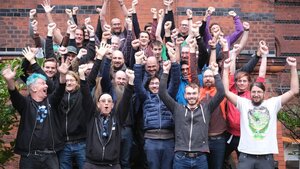
Debian LTS contributors In September, 21 contributors have been paid to work on Debian LTS, their reports are available:
  • Abhijith PA did 10.0h (out of 0h assigned and 14.0h from previous period), thus carrying over 4.0h to the next month.
  • Adrian Bunk did 7.0h (out of 17.0h assigned), thus carrying over 10.0h to the next month.
  • Anton Gladky did 9.5h (out of 7.5h assigned and 7.5h from previous period), thus carrying over 5.5h to the next month.
  • Bastien Roucari s did 16.0h (out of 15.5h assigned and 1.5h from previous period), thus carrying over 1.0h to the next month.
  • Ben Hutchings did 17.0h (out of 17.0h assigned).
  • Chris Lamb did 17.0h (out of 17.0h assigned).
  • Emilio Pozuelo Monfort did 30.0h (out of 30.0h assigned).
  • Guilhem Moulin did 18.25h (out of 18.25h assigned).
  • Helmut Grohne did 10.0h (out of 10.0h assigned).
  • Lee Garrett did 17.0h (out of 16.5h assigned and 0.5h from previous period).
  • Markus Koschany did 40.0h (out of 40.0h assigned).
  • Ola Lundqvist did 4.5h (out of 0h assigned and 24.0h from previous period), thus carrying over 19.5h to the next month.
  • Roberto C. S nchez did 5.0h (out of 12.0h assigned), thus carrying over 7.0h to the next month.
  • Santiago Ruano Rinc n did 7.75h (out of 16.0h assigned), thus carrying over 8.25h to the next month.
  • Sean Whitton did 7.0h (out of 7.0h assigned).
  • Sylvain Beucler did 10.5h (out of 17.0h assigned), thus carrying over 6.5h to the next month.
  • Thorsten Alteholz did 14.0h (out of 14.0h assigned).
  • Tobias Frost did 13.25h (out of 16.0h assigned), thus carrying over 2.75h to the next month.

Evolution of the situation In September, we have released 44 DLAs. The month of September was a busy month for the LTS Team. A notable security issue fixed in September was the high-severity CVE-2023-4863, a heap buffer overflow that allowed remote attackers to perform an out-of-bounds memory write via a crafted WebP file. This CVE was covered by the three DLAs of different packages: firefox-esr, libwebp and thunderbird. The libwebp backported patch was sent to upstream, who adapted and applied it to the 0.6.1 branch. It is also worth noting that LTS contributor Markus Koschany included in his work updates to packages in Debian Bullseye and Bookworm, that are under the umbrella of the Security Team: xrdp, jetty9 and mosquitto. As every month, there was important behind-the-scenes work by the Front Desk staff, who triaged, analyzed and reviewed dozens of vulnerabilities, to decide if they warrant a security update. This is very important work, since we need to trade-off between the frequency of updates and the stability of the LTS release.

Thanks to our sponsors Sponsors that joined recently are in bold.

11 October 2023

Russell Coker: PinePhone Status

4 months ago I got my PinePhonePro [1]. Since then I have got SE Linux working on it to the stage of allowing it to boot correctly with Debian/Unstable, login with the user_t domain (minimum privilege for the graphical user) and make and receive calls. I finished getting SE Linux working reasonably well 3 days ago and most (but not all) of the SE Linux policy is in Debian now. I ve been getting good at Github PRs and I m sending a lot of policy upstream, so the next version of Debian will have a much smaller diff from the upstream Refpolicy. I have been running the PinePhone with Plasma Mobile because I prefer KDE, I would run GNOME/Phoc if it gave significantly better functionality. 3 days ago I moved my main SIM (the one with the number that people call about work etc) to my PinePhone and tried running it as my main phone. Today I gave up on that. My Android History The last phone I had that did everything I needed was a Huawei Mate 10 Pro that I bought refurbished in June 2019 for $389. The Mate 10 Pro runs Android with the Google Play store and has been quite unremarkable which is presumably why I forgot to blog about it when I got it, it was a slight upgrade over the Huawei Mate 9 [2] that I had used for 2 years before that. In April 2022 I tried using a Huawei Nova 7i as my main phone without Google Play programs or services [3]. That experiment was a failure as I couldn t get NextCloud to work for Calendaring and Contacts. It could be that I stuffed something up when trying that, but I put more skill and effort into trying to get it to work than most people ever would. The Nova 7i is a very slick phone, faster and nicer than the Mate 10 Pro (as expected being 2 years newer) while also having ridiculously long battery life. The Nova 7i when always on running the SchildiChat Matrix client and the Conversations Jabber client it will use less than 10% battery in a 8 hour work day. As nice as the Nova 7i is for the core functions I still need to have Play Store apps for LinkedIn, Twitter, Facebook, Zoom, etc. Which meant connecting the Mate 10 Pro via Wifi. As slick as the Nova 7i is for non-Google stuff running it and the Mate 10 Pro is a medium amount of pain for a small amount of freedom. So now I have for the moment abandoned the Nova 7i and gone back to the Mate 10 Pro. What I will try to do is to either forcibly install Google Play on the Nova 7i to make it my proprietary phone or to install an open distribution of Linux (IE not Android) to make it at least a small tablet which incidentally is much more powerful than a PinePhonePro. Issues With the PinePhonePro The battery charges very slowly (as much as 50 hours estimated charge time) and discharges fast. When used in a typical way in Caffeine mode to stop suspend so I can ssh to it etc it won t come close to lasting an 8 hour day. Also it will only take 5V charging and ideally wants 5V 3A charging which most chargers won t do. The charging speed over regular USB ports is very slow, sometimes stating it will take as much as 50 hours to charge. A phone that gets below 50% charge in less than 4 hours and can t be charged at a reasonable speed from a USB port on a laptop or monitor is going to be a major pain to use in the office. I don t think this can be fixed in software, we can alleviate it by making software more CPU efficient and by enabling various hardware sleep modes more effectively but the slow charging is a hardware issue that can t be fixed. The phone call quality is poor. Usually when on a call I hear static and sometimes the person at the other end appears to hear nothing. Also the UI for calls is different from Android which makes it take longer to answer a call and gives more missed calls. The UI issue is a combination of software and habits, both of which can be changed. But the call quality may be a hardware issue. I don t know if it s a hardware issue specific to my phone or something related to the PinePhonePro on the Telstra network. Clicking on notification in the drop-down doesn t take me to the app. I don t know if this is regarded as a bug by the Plasma-Mobile developers. Also notifications aren t displayed on the lock screen and there doesn t seem to be a configuration option to enable this. The Plasma-Mobile configuration for the wifi hotspot is difficult. There is no button for it in the drop-down menu (called Quicksettings in Plasma-Mobile) and no way of easily determining whether it s in hotspot or wifi client mode. This isn t an insurmountable problem and the worst-case is that I could write a script to do it, but it s still annoying. There is apparent support in the desktop version of KDE for syncing contacts from Google and I could probably get that working (although I failed last time I tried on the desktop), but it is a pain. Conclusion Most of the problems are software related and therefore I can get involved in solving them. I plan to keep working on these things. If all the software had worked in an ideal manner then I would have spent more time investigating the hardware issues of battery life and charge time and the quality of calls. I now have my Librem5 [4] running Debian so I will be able to compare call quality with the PinePhonePro. If I m unable to get the PinePhonePro working adequately then maybe making the Librem5 my main phone will be an option. I hope that by early next year I will be able to make another test at using a FOSS phone my main phone. In the mean time I can still work on convergence and other things.

10 October 2023

Russ Allbery: Review: Chilling Effect

Review: Chilling Effect, by Valerie Valdes
Series: Chilling Effect #1
Publisher: Harper Voyager
Copyright: September 2019
Printing: 2020
ISBN: 0-06-287724-0
Format: Kindle
Pages: 420
Chilling Effect is a space opera, kind of; more on the genre classification in a moment. It is the first volume of a series, although it reaches a reasonable conclusion on its own. It was Valerie Valdes's first novel. Captain Eva Innocente's line of work used to be less than lawful, following in the footsteps of her father. She got out of that life and got her own crew and ship. Now, the La Sirena Negra and its crew do small transport jobs for just enough money to stay afloat. Or, maybe, a bit less than that, when the recipient of a crate full of psychic escape-artist cats goes bankrupt before she can deliver it and get paid. It's a marginal and tenuous life, but at least she isn't doing anything shady. Then the Fridge kidnaps her sister. The Fridge is a shadowy organization of extortionists whose modus operandi is to kidnap a family member of their target, stuff them in cryogenic suspension, and demand obedience lest the family member be sold off as indentured labor after a few decades as a popsicle. Eva will be given missions that she and her crew have to perform. If she performs them well, she will pay off the price of her sister's release. Eventually. Oh, and she's not allowed to tell anyone. I found it hard to place the subgenre of this novel more specifically than comedy-adventure. The technology fits space opera: there are psychic cats, pilots who treat ships as extensions of their own body, brain parasites, a random intergalactic warlord, and very few attempts to explain anything with scientific principles. However, the stakes aren't on the scale that space opera usually goes for. Eva and her crew aren't going to topple governments or form rebellions. They're just trying to survive in a galaxy full of abusive corporations, dodgy clients, and the occasional alien who requires you to carry extensive documentation to prove that you can't be hunted for meat. It is also, as you might guess from that description, occasionally funny. That part of the book didn't mesh for me. Eva is truly afraid for her sister, and some of the events in the book are quite sinister, but the antagonist is an organization called The Fridge that puts people in fridges. Sexual harassment in a bar turns into obsessive stalking by a crazed intergalactic warlord who frequently interrupts the plot by randomly blasting things with his fleet, which felt like something from Hitchhiker's Guide to the Galaxy. The stakes for Eva, and her frustrations at being dragged back into a life she escaped, felt too high for the wacky, comic descriptions of the problems she gets into. My biggest complaint, though, is that the plot is driven by people not telling other people critical information they should know. Eva is keeping major secrets from her crew for nearly the entire book. Other people are also keeping information from Eva. There is a romance subplot driven almost entirely by both parties refusing to talk to each other about the existence of a romance subplot. For some people, this is catnip, but it's one of my least favorite fictional tropes and I found much of the book both frustrating and stressful. Fictional characters keeping important secrets from each other apparently raises my blood pressure. One of the things I did like about this book is that Eva is Hispanic and speaks like it. She resorts to Spanish frequently for curses, untranslatable phrases, aphorisms, derogatory comments, and similar types of emotional communication that don't feel right in a second language. Most of the time one can figure out the meaning from context, but Valdes doesn't feel obligated to hold the reader's hand and explain everything. I liked that. I think this approach is more viable in these days of ebook readers that can attempt translations on demand, and I think it does a lot to make Eva feel like a real person. I think the characters are the best part of this book, once one gets past the frustration of their refusal to talk to each other. Eva and the alien ship engineer get the most screen time, but Pink, Eva's honest-to-a-fault friend, was probably my favorite character. I also really enjoyed Min, the ship pilot whose primary goal is to be able to jack into the ship and treat it as her body, and otherwise doesn't particularly care about the rest of the plot as long as she gets paid. A lot of books about ship crews like this one lean hard into found family. This one felt more like a group of coworkers, with varying degrees of friendship and level of interest in their shared endeavors, but without the too-common shorthand of making the less-engaged crew members either some type of villain or someone who needs to be drawn out and turned into a best friend or love interest. It's okay for a job to just be a job, even if it's one where you're around the same people all the time. People who work on actual ships do it all the time. This is a half-serious, half-comic action romp that turned out to not be my thing, but I can see why others will enjoy it. Be prepared for a whole lot of communication failures and an uneven emotional tone, but if you're looking for a space-ships-and-aliens story that doesn't take itself very seriously and has some vague YA vibes, this may work for you. Followed by Prime Deceptions, although I didn't like this well enough to read on. Rating: 6 out of 10

Dirk Eddelbuettel: drat 0.2.4 on CRAN: Improved macOS Support, General Updates

drat user A new minor release of the drat package arrived on CRAN today making it the first release in one and a half years. drat stands for drat R Archive Template, and helps with easy-to-create and easy-to-use repositories for R packages. Since its inception in early 2015 it has found reasonably widespread adoption among R users because repositories with marked releases is the better way to distribute code. Because for once it really is as your mother told you: Friends don t let friends install random git commit snapshots. Properly rolled-up releases it is. Just how CRAN shows us: a model that has demonstrated for two-plus decades how to do this. And you can too: drat is easy to use, documented by six vignettes and just works. Detailed information about drat is at its documentation site. Two more blog posts using drat from GitHub Actions were just added today showing, respectively, how to add to a drat repo in either push or pull mode. This release contains two extended PRs contributed by drat users! Both extended support for macOS: Joey Reid extended M1 support to pruning and archival, and Arne Johannes added bug-sur support. I polished a few more things around the edges, mostly documentation or continuos-integrations related. The NEWS file summarises the release as follows:

Changes in drat version 0.2.4 (2023-10-09)
  • macOS Arm M1 repos are now also supported in pruning and archival (Joey Reid in #135 fixing #134)
  • A minor vignette typo was fixed (Dirk)
  • A small error with setwd() in insertPackage() was corrected (Dirk)
  • macOS x86_64 repos (on big-sur) are now supported too (Arne Johannes Holmin in #139 fixing #138)
  • A few small maintenance tweaks were applied to the CI setup, and to the main README.md

Courtesy of my CRANberries, there is a comparison to the previous release. More detailed information is on the drat page as well as at the documentation site. If you like this or other open-source work I do, you can sponsor me at GitHub.

This post by Dirk Eddelbuettel originated on his Thinking inside the box blog. Please report excessive re-aggregation in third-party for-profit settings.

Next.

Previous.