Search Results: "benjamin"

25 October 2006

Benjamin Mako Hill: PyBlosxom Hacks Page

Since my weblog catastrophe a few months ago, I've been spending a little more time getting my PyBlosxom setup on copyrighteous into shape. Initially, my efforts were focused on a series of patches to PyBlosxom and to several important plugins. As I became a little more familiar with the code base, I realized that in an evening or a little bit of downtime, I can pretty easily create my own plugins. I've already managed to accumulate a few of them. I've created a page on my website to hosts these and have put what I've got publishable so far up there. I've got two more that I'm still in the process of vetting on the PyBlosxom mailing list but that I'll post there (and announce on this blog) soon. The first plugin that I've published there is a very simple plugin I wrote to display ads (I am experimenting with Google ads but it should work with other ad providers or even for non-ads) but only to those who get to my old blog entries by searching for them. My thinking was inspired by an old post by my friend Evan where he described setting up Google advertisements in a way that would not affect his core readership but might allow him to use blogging to make his activism financially sustainable. While I suspect (and hope!) that most my own readership's Internet experience is mediated by Adblock and Filterset.G, the plugin will spare even those that don't while showing ads to those I don't know yet.

21 October 2006

Benjamin Mako Hill: PLoStitution

I went to two talks yesterday about PLoS ONE, an exciting new project by the Public Library of Science. I'm thrilled to see PLoS moving in this direction. During his talk, Chris Surridge mentioned that the the publishing platform/CMS that PLoS ONE is using is based on Fedora. I mentioned that Fedora, last I checked, wasn't exactly a CMS, a fact that he acknowledged but responded to by saying that I would need to talk to their tech team for details. Today I found out that neither ideological affinity nor geographic proximity to Red Hat kept the University of Virginia from choosing the wrong name for their Institutional Repository (IR) software. But at least yesterday's confusion is put to rest. Also, Surridge had a slide with this quote and challenged the audience to come up with the utterer:
The most valuable commodity I know of is information.
I did a quick "I'm feeling lucky" search and was thrilled to see that I came up with this page informing me that I, "do not have rights to view the article" containing the answer but that the information could be mine for a cool GBP 13.00 (plus a handling charge of GBP 1.50 and VAT where applicable). The phrase, it turns out, belongs to Gordon Gekko, a corporate raider character in the 1987 film Wall Street. Finally, and least importantly, I object to this image:
/copyrighteous/images/openaccess20.gif

17 October 2006

Benjamin Seidenberg: New Debian maintainer Benjamin Seidenberg

Dear Benjamin Seidenberg! Your account ‘benjamin’ has just been created in the central LDAP database of the Debian project. Please note that it needs a bit of time until this information is synced with all developer-accessible machines. You should be able to login or upload packages after about 30-60 minutes. The password for this account can be found appended to this message, encrypted with your GPG key. Email sent to benjamin@debian.org will be forwarded to astronut@dlgeek.net, to change this visit http://db.debian.org/forward.html.
This has definately made my day. I would like to thank my sponsor and advocate, Anibal Monsalve Salazar, the Debian Cyrus Team (especially Sven and Henrique) and especially my AM, Cl ment Stenac (Zorglub). I couldn’t have asked for a better AM; he answered every mail within a day as far as I remember, was extremely supportive and helpful. I remember when I sent him the last T&S response he appologized on IRC that he couldn’t write the recommendation until that evening, whereas some AMs have taken months to do it.
For those interested in the NM queue’s proccessing time, here is an approximate summery of my progress through NM:
Waiting for advocate: 2.5 weeks (This should have been shorter, I had my advocate lined up, but then there was a question about me signing the key of the guy who signed mine, but I hadn t checked his ID).
Waiting for AM: 6 months
Going through the checks: 2.5 months. (This would have been shorter had it not been right around the end of my senior year of high school, with the mad rush to cram everything in before exams)
Waiting for FD: 1.5 Months
Waiting for DAM: 1.5 Months
Waiting for account creation after DAM approval: 2 months.

16 October 2006

Adam Rosi-Kessel: Lawyer-Bashing and the Governor’s Race

The Massachusetts race for governor has turned very ugly. Even setting my personal partisanship (and professional bias) aside, I’m certain that the blame is not equally shared on both sides. Massachusetts Lawyer’s Weekly says it better than I could, and I reproduce the entire editorial here:
Deval Patrick for governor During the 34-year history of Lawyers Weekly, the paper has never endorsed a candidate for elected office. This practice was borne out of the notion that the political, or societal, issues that dominate races typically outweigh issues that are of distinct interest to lawyers. But the race for governor in Massachusetts in 2006 is suddenly very much about what it means to be a lawyer. On the one hand, we have Democratic nominee Deval Patrick, whose stated policies on judicial independence and appointment of judges (among other issues) reflect a genuine understanding of the legal system. Conversely, Republican nominee Kerry Healey has launched a chilling assault on the practice of law. Healey is running a television ad that takes Patrick to task for his 1985 representation of a defendant accused of murdering a police officer — an ad that borders on the bizarre in its reasoning. “While lawyers have a right to defend admitted cop killers, do we really want one as our governor?” the ad asks. Last week Healey added an ad that references Patrick’s one-time support of convicted rapist Benjamin LaGuer. “What kind of person defends a brutal rapist?” the ad asks. With those misguided questions, Healey has insulted an entire profession. Here’s hoping she does not get away with it. What is Healey’s message? That criminal-defense attorneys somehow should be associated with, or blamed for, the actions of their clients? That protecting important constitutional rights is somehow a seedy business? Healey has resorted to the worst form of pandering, openly inviting voters to think of Patrick as someone who associates with criminals. Her finger-pointing has a flavor of McCarthyism, suggesting that anyone who has spent time in the criminal-defense arena should be identified, called out and avoided. The lieutenant governor proclaims herself a criminal-justice candidate who is tough on crime. Yet nearly everyone associated with the criminal-justice system, be they defense attorneys, prosecutors, police officers or otherwise, understand that the Constitution guarantees the right-to-counsel, and the right to a zealous advocate. Healey no doubt understands this as well, but conveniently ignores it as she paints Patrick a villain. Gov. Mitt Romney knows that diminishing the work of attorneys often makes for good politics. He rarely hesitates to criticize lawyers — or judges — if it suits his agenda. But even Romney has never sunk this low, to this crass sort of demagoguery. Healey has become the bully in the schoolyard, poking fun at the overweight children. Look, he’s a lawyer. He must be a second-class citizen. Deval Patrick, meanwhile, has quietly made it known that he appreciates the key components of the legal system. He favors giving judicial administrators more control over their budgets and pay increases for lawyers who do work for the state, including prosecutors. Patrick says he would devote much attention to selecting judges, returning power to the Judicial Nominating Commission. And the former civil-rights attorney has suggested that he will be careful before criticizing a judge’s decision. “Judges don’t go looking for hard decisions,” he has said. As to the LaGuer matter, Patrick missed an opportunity with a clumsy, disjointed explanation of the matter. Patrick could have simply stated that any efforts he made in helping LaGuer obtain a DNA test were in the pursuit of truth. As former Suffolk County District Attorney Ralph Martin so eloquently put it in an Oct. 8 Boston Globe op-ed article, “I never thought that serving the ideals of the Constitution made you soft or tough on crime. … Respecting the Constitution doesn’t make you soft or tough — it only makes you just and fair.” One need not be defined by one’s profession, of course, and lawyers will have other important matters (i.e., education, taxes) on their minds when they go to the polls on Nov. 7. But attorneys can rest assured that a vote for Deval Patrick guarantees an appreciation for many of the ideals that lawyers deem important — while a vote against Kerry Healey sends a message that lawyers won’t tolerate her unforgivable cheap shots. Do we really want someone who defends accused criminals as our governor? President John Adams, author of the Constitution that Healey swore to uphold as lieutenant governor, defended the accused killers in the Boston Massacre trial. Do you think Adams would have been qualified to be our governor?

15 October 2006

Benjamin Seidenberg: RC Bugs and how to not handle a transition

Thjis: This is the right time to automatically search for RC bugs. So was a year ago. Although we want the RC bug count to drop, an RC bug is still an RC bug regardless of whether we know about it or not. And many RC bugs didn’t exist a year ago. Take for example #392121. A package name change in a build-dependency caused my package to FTBFS. This bug would not have existed a year ago, but needed to get fixed for etch. Incidentally, when you go through a package rename for a development package, it would be nice to check what packages build-depend on the old package. A september changelog entry for cli-common says:
- Removed transition dependency for cli-common on cli-common-dev. (7 month for a package rename transition should be more than enough)
However, at no point in that seven months did anyone email me or file a bug report to tell me that the name changed. This bug wasn’t caught until someone rebuilding the archive noticed.
Actually, this might be a good idea for an infrastructural change. Would it be possible to set up a script that notices when packages are removed and sends a notice to the maintainers of any packages build depending on them?

Pierre Habouzit: He's gone now.

I announced it, now he did it. Denis, we will miss you, you did a damn pretty good job on many parts where you were excellent at it. I'm disgusted to see that dunc-tank pushed you out. I'm disgusted to see that people with a lot of qualities are going to do the same, and orphan a lot of packages that really need special care, and that will fall in QA for a while. That hurts, and that hurts the Project too. Edit: and now Benjamin is following his path. I feel sick. And those where not the one that get loud about it. They just don't recognize the Debian they knew. Who can blame them ?

11 October 2006

Benjamin Mako Hill: Who Gets To Be on Planet Debian?

I've been spending more time that I want to in the last week talking about should or should not be on Planet Debian. In particular, there is some disagreement on what should happen to the blogs of people who resign from the project. In the interest of my own sanity, here is the text I just posted on the wiki page that talks about Planet Debian:
Planet Debian is for any active and directly involved participant in the Debian development community. Inclusion in Planet should reflect a relationship that already exists -- it is not meant to create one. Inclusion is not restricted to people who are currently Debian developers nor are ex-developers necessarily barred from inclusion. Defining activity and direct involvement is tough and there are many ways of participating in Debian (e.g., packaging, translations, administration, etc). I am happy to consider all of these types of involvement for the purposes of inclusion in Planet. In terms of deciding what is enough activity, I am daunted by the fact that there has been academic research on the difficulties of deciding what an active member in Debian is. As a result I will continue to rely primarily on what blog owners themselves feel unless the evidence available to me points to the contrary. Planet participants should include feeds that provide stable permanent URLs so that they do not flood planet repeatedly and should include content in English only. An inability to do either of these will be grounds for exclusion from Planet until this can be fixed.
In the past, I've made incorrect assumptions about whether people did or did not want to be included in Planet. I've apologized to those involved. In the future, I will ask people that appear inactive to me or that have resigned from the project if they feel that they still qualify under the terms above. If I approach you about inclusion in Planet, please don't be offended or assume that I, or the project, doesn't want you on Planet. There are feeds in Planet Debian that annoy me but I have yet to remove a feed from Planet that I dislike.

Benjamin Mako Hill: Holidays

Yesterday was Columbus Day. It is a national holiday but is less consistently celebrated, for a variety of reasons, than any other state holiday in the United States. MIT took Columbus Day (and the day after!) off while my class at Harvard went ahead as scheduled. I saw Luis this weekend but he had to run off on Sunday because Columbia University, of all places, apparently does not celebrate Columbus day.

5 October 2006

Benjamin Mako Hill: Liberate Your iPod

I had the idea for an iPod liberation event several months ago. The idea is something similar to a GNU/Linux install-fest but for Digital Audio Players with RockBox and iPodLinux. Installers gain the ability to play Vorbis and FLAC (among many other things) and lose the ability to do DRM. I would never recommend buying an iPod but we need to face the fact that there are millions of these things now. A good reinstall with a free and open platform seems like a good start. With the help of Harvard Free Culture, Defective By Design, and Computing Counter-Culture (my recently renamed research group at the MIT Media Lab), I've finally got around to organizing an event. If you're in the Cambridge/Boston area this Friday evening (October 6) and want to liberate your iPod, you should read the details and show up. If you've already liberated your iPod and would like to help others with theirs, you should bring a laptop and get there a bit early. More information is available on the Harvard Free Culture website.

2 October 2006

Julien Danjou: DeFuBu contest #3

Bug Welcome to this 3rd issue of the DeFuBu contest, the monthly championship of the funniest bug reported to the Debian BTS. The challengers How the vote has been done Four Debian related people voted for these bugs: Pierre Machard, Pierre Habouzit, Florent Bayle and Mohammed Adn ne Trojette.
Samuel Hocevar did not vote because he was not paid for it. Full ranking Bugs Challengers The winners Notes To participate, simply drop me an email with a bug number. About DeFuBu

Benjamin Mako Hill: Working in Concert

Unfortunately, I couldn't make it to the Creative Commons Concert in New York City last weekend. All proceeds for the concert went to Creative Commons. Now I may be wrong about this and will happily stand corrected if I am, but, as far as I can tell, none of the artists performing at the benefit have ever released an album or a major piece of work under a Creative Commons license -- even the restrictive and non-free licenses. The free culture movement needs some things more than money. For example, it needs high quality creative works under permissive licenses. We'd be better off with the good press associated with one hit single under a CC BY-SA license than all of the proceeds of a benefit like Friday's. It might also be nice to highlight the great work being done by artists who are risking more secure economic models in favor of releasing their works under free licenses. Or perhaps this reminds us of another important conversation: Why are many popular musicians who are willing to support CC unwilling or unable to use the licenses? More importantly, how are we going to change this?

29 September 2006

Benjamin Mako Hill: iPain

On Wednesday, I walked into a tree branch. In what is apparently not an unusual turn of events, I ended up with a corneal abrasion (i.e., a laceration on my eyeball). It has hurt my ability to do work because it hurts intensely when I try to, well, look at things. My friend asked me what kind of tree it was. Interestingly, while my eyes (or my right eye at the very least) was open when I ran into the tree, I don't recall getting a good look at it.

27 September 2006

Benjamin Mako Hill: Who Gets to Define Freedom?

Recently, I had an opportunity to publicly discuss my projects around definitions of freedom for creative work with Lawrence Lessig at a workshop at Wizards of OS. In particular, we talked about my article Toward a Standard of Freedom in which I advance a call for a list of essential freedoms, a definition of free culture or content, and a goal around which a social movement for free creative works can be based. At WOS, Lessig and I agreed that its likely that, eventually, some standard (or standards) of freedom will take hold. Like me, Lessig seems to think that this is a good thing. We both agree that there will be, and should be, competing definitions of freedom, competing social movements, and a long conversation about what essential freedom really to creative works is before we get there. Our most fundamental differences seem to stem from a disagreement about who gets to define freedom or, perhaps more precisely, who the communities of producers should listen to in order to find out what essential freedoms in the domain of different types of creative works are. Lessig is extremely reticent to make any claims about what essential freedoms might be: he does not want to speak for creative communities that he does not intimately understand. While he seems to be suspect of any project making normative claims in this regard, he disagrees most strongly with projects like mine that offer definitions of free content and expressions that are intended to be applied broadly and outside of the explicit domain of the definition's initiators recognized experience (in our case, online encyclopedias and software). Lessig explained that he trusts musicians -- and in particular, Gilberto Gil, the progenitor of the CC Sampling license -- when it comes to defining essential freedoms for music. Similarly, he trusts programmers -- and in particular, Richard Stallman -- when it comes to defining essential freedom for software. Since Richard and I are less accomplished, less well known, and less experienced musicians, Lessig feels most comfortable erring in favor of Gil where there's a disagreement between us about the scope of essential freedom for music. While his is a convincing argument, I disagree with Lessig's position for a series of reasons I'll try to discuss here. First, it is important to remember that Gilberto Gil does not represent all musicians. There are many artists and musicians who support my definition. There are many (and probably more if the CC license usage statistics are any indication) who support Gil's lower base-line. It's worth remembering that, even though we disagree, both Gil and I are offering controversial and extreme positions. Today, most creators think that giving away their work at no cost, even non-commercially and barring derivatives, is crazy. To illustrate why this is not a problem, we can look again to free software. In the free software community, we see that Richard Stallman does not speak for the programming community at large when it comes to defining essential freedoms to code. In the mid-eighties, Stallman spoke for himself and a tiny handful of like-minded others. Today he speaks for many more but it's still a tiny fraction of all programmers. It's hard to remember when you're down in the trenches but the idea that software should be free remains a marginal and kooky idea to this day. Due to the hard work of the free software movement, many people have adopted Stallman's definition of essential freedom for software and many more will. But it is not mainstream and it didn't get here by being so. Setting an ethical standard and a goal for a social movement should not be about being popular. It should be about describing an ideal. It should be about standing up to injustice. It should be about answering the question, "what sort of world do I want to live in?" Not only is this process not a popularity contest, it will, in all likelihood, stand to make one very unpopular. Being respected or seen as an expert within a field will help with the adoption of one's ideal. Programmers trusted Richards Stallman because he'd written large parts of the very popular programming tools like GNU Emacs and GCC. However, it wasn't from his experience in programming that this insight into the importance of software freedom stemmed. It was from his desire to be a good, ethical, neighbor and member of a technical community. To this day, most great programmers continue to disagree with Richard. Second, I'm interested not only in talking about the ability of authors to choose how their works are used but in the rights of readers. You don't need to have a platinum album under your belt to have an informed and important opinion about how music should be heard, experienced and distributed. Lessig's current push for a "Read-Write Culture" is very fixated on creators and re-mixers. That's only one important piece of the community that frames and deals with this problem. Third, while I agree with Lessig that discussions around definitions of free culture must happen separately in each separate artist community, I see several compelling reasons why a single definition of freedom may be a very good idea both tactically and philosophically. For example, it provides a common rallying cry around which different creative groups can collaborate and it mirrors the common treatment of different types of works in current IP systems. More importantly, there are fundamental similarities between information goods and the way they are created, distributed, and consumed on computers and in digital networks. I've highlighted this before in quoting Eben Moglen on the ethics of creating artificial scarcity in goods with zero marginal cost. As a final note, it's worth stating that one doesn't need to feel that all works should be free to support a definition of freedom. Richard Stallman provides a great example of this. Stallman doesn't think that works of opinion or works that are designed primarily to entertain need to be free. However, he does believe that the term "free" should refer to a fixed set of freedoms so that he can take such a position. Without a definition of "free," a position on what should or should not be "free" is impossible. I believe that freedom to distribute and produce information goods like art and content and software are embedded in a set of freedoms and rights for both the producers and consumers. I think that to some degree (and quite probably a less extensive degree), Lessig agrees with this. Unlike Lessig, I don't believe that one needs extensive expertise in the creation of a particular type of creative good to make true statements about what is ethical or unethical in the production, distribution, and control of it. To use admittedly extreme analogies, you don't need to be a slave owner (or slave for that matter) to say that slavery is wrong. You don't need to be a farmer to make arguments against or in favor of vegetarianism or in favor of free range animals. I don't believe you have to be a technologist to claim that certain freedoms to technology are essential. I don't believe that you need to be an musician (successful or not) to make claims about essential rights to music. I welcomed the conversations and challenges that Lessig offered and it was encouraging to see agreement on the process of discussion and debate going forward. After the workshop, Lessig suggested that we continue the conversation. I look forward to doing just this in other venues and in other ways.

25 September 2006

Benjamin Mako Hill: Wizards of OS Wrap-up

My joint workshop with Lawrence Lessig at Wizards of OS went, in my opinion, extremely well. The worst hitch was an unfortunate series of events that conspired to keep Vera Franz from attending and moderating the session as planned. Paul Keller, who was supposed to participate in the panel, graciously (and capably) moderated in her place. The panel allowed Lessig and I to talk openly and publicly about about our disagreements for the first time while also highlighting the many places where we speak with one voice. The conversation managed to be both positive and productive without papering over issues. I usually like to post talk notes and slides after each speaking engagement. However, our WOS meeting was a "workshop" so I have nothing prepared to present here. I have, however, seen two write-ups in the press: If someone has a recording, tell me how I might get a copy. One small note: I am quoted in IP watch as saying that most CC works are under the most restrictive licenses and that there has been no shift toward less restrictive licenses with time. Mia Garlick has pointed out that the latest license usage statistics, based on admittedly imprecise linkback data, show a several percentage point decrease in the usage of licenses that block commercial use and derivatives -- when expressed as a fraction of the total number of works under CC licenses. The restrictive licenses are still the most popular but it was incorrect to say that there is no evidence of any progress whatsoever toward more free licenses. Tomorrow, I will post a summary and response to one of the points that Lessig and I talked most about.

24 September 2006

Benjamin Mako Hill: PyBlosxom and Comment Spam

Over the past few months, I've dealt with something of a blog spam nightmare on Copyrighteous: my blog running the PyBlosxom weblog software. Wiser and less stubborn individuals might given up on either PyBlosxom or the ability to receive public comments. However, I find PyBlosxom unique in its flexibility and great ReStructured Text support and am always frustrated with others' blogs that don't accept comments. At the end of the day, I couldn't bring myself to part with either. Historically, my blogspam protection has been to use a simple weak CAPTCHA and to have my blog software email me each time a comment is successfully submitted so that I can (with a built-in macro in mutt) delete each spam comment that slips in. This has worked well for the last couple years. This summer, Mika pointed out that my blog was full of Chinese link spam that I had not noticed or been notified about. Around the same time, I realized that my website had been dealt a massive spam penalty by Google and was basically not showing up in any search results. I have spent a significant amount of time over the last month repairing the damage and working to prevent it from reoccuring. I'm documenting this process here in the hopes that it might save other time and energy. Upon reflection, the situation could have been prevented the in three relatively easy ways -- all of which I have now implemented.
  • Had the PyBlosxom comment.py plugin's mail function been working properly, I would have known that I was being spammed.
  • Had PyBlosxom been configured to only make blog entries (and not comments) indexable by search engines, Google and others never would have seen the link spam.
  • Had I installed a stronger CAPTCHA, I might have blocked the spam from being submitted in the first place (although at the expense of the participation in comments by visually impaired users).
A month or so, hours of work, and a Google reinclusion request later, my website is beginning to show up in search entries again. Hopefully this message will help save others from a similar fate. Fixing PyBlosxom's Comment Notification The most critical problem was a bug in PyBlosxom's contributed comment.py plugin and its comment notification system. In short, the email based comment notification system failed silently if the body of the email -- which included the full text of the comment -- included any non-ASCII UTF-8 encoded text. I've filed a bug against PyBlosxom and included a patch that fixes this issue. However, since this is a rather critical problem and because PyBlosxom releases tend to be few and far between, it might be worth patching your system now. My patch is against version 1.3 but can easily be modified and applied to version 1.2. Hiding Comments from Search Engines The major reason that the successful spam became a problem was that it triggered Google's abuse detector, resulted in a spam penalty, and made all of the (non-spam) material on my website more difficult for others to find. A simple way to prevent this is to hide all comments from the search engines. I've done this by creating a new PyBlosxom flavor that shows comments (and allows them to be input) which is not indexed by search Engines and to remove comments altogether from the default indexable flavors. To do this, I removed all of the comment-* templates from html flavor and created a new flavor called comment.flav that included the comment templates. I also had to make the comment submit action point to the new flavor and to change the "Comments: N" link to point instead to .comment flavor rather than the .html. The rest of the template is simply symbolic links to the the HTML template. The next step is to ensure that the comment flavor is not indexed by search engines. I found two ways of doing this and did both. The first was to add a "no index" meta tag to the header of each .comment page. It looked like this:
<meta name="robots" content="noindex, nofollow">
This is necessary because the robots.txt standard, the normal way to tell search engines not to index a page, does not support wildcards. Luckily, Google (and others I imagine) do support an extension to Robots.txt that allows you to use wildcards. To take advantage of this, I created a robots.txt for mako.cc that blocks indexing all of the comment flavor. The following robot.txt did the trick for me:
User-agent: Googlebot
Disallow: /copyrighteous/*.comment$
An Improved CAPTCHA Ultimately, the best solution would be to keep the spam from showing up on the blog at all. The only decent PyBlosxom CAPTCHA is the "nospam" plugin by Steven Armstrong. It is a simple image-based CAPTCHA and I was running it when I was spammed. It uses PIL but generates purely number-based strings and does some minimum obfuscation. Basically, spambots were able to break the CAPTCHA and toward the end, I was receiving thousands of pieces of a blog spam a day. I've incorporated the PIL image generation code from Mediawiki's ConfirmEdit/FancyCaptcha extension into nospam.py with this patch which I have also sent to Steven Armstrong -- nospam.py's original author. It's much stronger. Apologies, of course, go to all of my vision impaired users. Image-based CAPTCHAs really are evil. In this situation though with many thousands of attempts of a day, the alternative is that I will turn off comments altogether -- the standard (and poor) lesser of two evils argument. Ultimately, I will write a python implementation of a new strong text-based CAPTCHA I've invented that uses commonsense knowledge and pulls off some cool data acquisition in the process. I presented this project at the Wikimania Hacking Days and at a Media Lab open house for AAAI 2006 where I got universally positive and useful feedback. CAPTCHA inventor and recent genius-grantee Luis von Ahn seemed to like the idea too. I'll write more about this on another day though.

19 September 2006

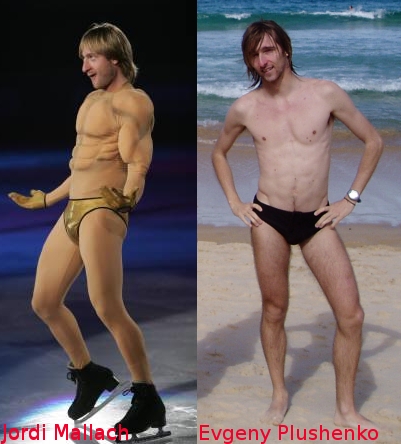
Benjamin Mako Hill: Jordi's Secret Life Uncovered

Could Debian developer and Catalan free software translator Jordi Mallach be living a secret life as champion Russian figure-skater Evgeny Plushenko? Recent photographic evidence uncovered by Mika seems to support such a theory. Decide for yourself:
/copyrighteous/images/jordi_evgeny-lookalike.jpg

Jos Parrella: BSP Venezuela: Afterparty

Last saturday around 2100 (UTC-0400) some people started joining the #debian-ve IRC channel at OFTC, in order to participate on the very first Venezuelan Bugsquashing Party. We had a lot of people interested not only in squashing but also developing for Debian and other topics. Some DD’s were around, specially An bal Monsalve Salazar (anibal) who has been very helpful on testing and uploading packages. Both me and Jos Luis Rivas (ghostbar) made a couple of NMU’s (in his case, xfe and divine; in mine, sdr and orca), fixing six RC bugs. Jos Luis is like 17 or 18 years old and has proven to be a very energetic Debian collaborator. Other maintainers from Debian Venezuela (actually, we’re eleven persons as of last week) were around but couldn’t make a NMU at the time of the event. Others weren’t even present. It was a very small BSP indeed, but we learned lots of things and hopefully our work will help improving the quality in Debian a little bit. It also settles our desires as a group to improve our knowledge and work together to improve the Project without disrupting the overall ecosystem. By the way, the Venezuelan Debconf is definitely going to happen between October 17th. and 21st. Hopefully we’ll have Benjamin Mako Hill, Enrico Zini, Alvaro Lopez Ortega (OMG! Cherokee!) and Randal Schwartz sharing a nice time with people from all parts of Venezuela and the rest of South America. Some local Debian maintainers will set up some nice workshops and demonstrations, ranging from Xen and LTSP in Debian to QA and the local GNU/Linux distribution projects. This local Debconf is part of a larger event, the World Forum on Free Knowledge, which some people at Debian Venezuela help to make. Returning to the BSP topic, I was looking out at a couple of bugs out there, but I lack the hardware and the experience to handle them. One of this is #333915 and other orca bugs, and other one is #385078 regarding a Debconf script in xserver-xorg. The morning before the BTS I was testing the MBONE tools with a friend of mine, and we were quite unhappy by the fact that sdr was almost unusable (passing the mouse cursor over some buttons resulted in annoying notices). So, if you use sdr, please test the last NMU I sent, which fixes two bugs. Just for reference, the webpage where I keep my Debian-related work is here. The case where I learned most was #386938, regarding xserver’s FTBFS in s390. Events like BSP are a great way to motivate people to participate in the Project: while trying to learn anything about this bug I ended reading documentation from IBM, asking advice from someone with an S/390, sending a couple of emails to debian-s390@lists.d.o, browsing at a DD patch in upstream, looking at buildd logs, searching the Web for opcodes lists… usually trying to explain how all this pieces join in a sane way (most times; well, some times, well, seldomly) is quite difficult for someone who tries to promote Debian, but technical events like the BSP provide a really accurate way to see how things work in and around Debian.

16 September 2006

Benjamin Seidenberg: The Debian Community

One thing that has always appealed to me about Debian is the strength of the community behind it. A somewhat recent incident has reminded me of how strong this community really is. When several members of the Debian community became concerned about a situation in the life of another member, they immediately tried to contact that member, and that member’s friends and family to insure that person would be ok. Phone calls were made halfway across the world in the middle of the night (in various timezones) to insure the well-being of a member of our community. It is a strong reminder that even though the Debian community may have vigorous arguements about technical and social issues, we still take care of our own.

15 September 2006

Benjamin Mako Hill: Wizards of OS 4

I'm in Berlin for just over 48 hours to give a workshop at Wizards of OS 4. The workshop is Free Content Licensing: Success, Challenges and the Way Forward and will be a conversation between myself, Lawrence Lessig, and Paul Keller from Waag Society and Creative Commons Netherlands. When I first published Toward a Standard of Freedom (my first article that was critical of Creative Commons) a couple years ago, I received an email from someone at Creative Commons within two hours of posting the note. The email pointed out that I had incorrectly licensed my work as the CC license I applied to my essay had the old mailing address for CC. I thanked the mail's author for pointing out my mistake but asked if, perhaps, she or someone else at CC had anything to say about the content of the article itself which was, after all, about her organization's work. I never received a reply. To date, I have not been able to engage in meaningful public discussion of my criticism of CC with CC, although I have tried several times. I'm thrilled that Volker Grassmuck and the Wizards of OS organizers have been able to put together this opportunity to start what I hope will be a longer conversation with people at CC about some of what some of us perceive as tactical shortcomings of the CC approach. It can only make our movements stronger.

12 September 2006

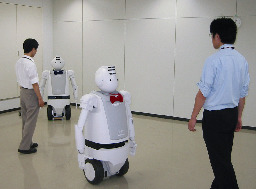
Benjamin Mako Hill: It may someday become useful...

/copyrighteous/images/crowd_robot.jpg
My philosopher Mika says:
These are robots that can walk through crowds without bumping into people. I almost feel that humans need to develop that skill rather than robots. But nonetheless, it may someday become useful to have such robots.

Next.

Previous.