Search Results: "angel"

23 August 2016

Reproducible builds folks: Reproducible Builds: week 69 in Stretch cycle

What happened in the Reproducible Builds effort between Sunday August 14 and Saturday August 20 2016: Fasten your seatbelts Important note: we enabled build path variation for unstable now, so your package(s) might become unreproducible, while previously it was said to be reproducible given a specific build path it probably still is reproducible but read on for the details below in the tests.reproducible-builds.org section! As said many times: this is still research and we are working to make it reality. Media coverage Daniel Stender blogged about python packaging and explained some caveats regarding reproducible builds. Toolchain developments Thomas Schmitt uploaded xorriso which now obeys SOURCE_DATE_EPOCH. As stated in its man pages:
ENVIRONMENT
[...]
SOURCE_DATE_EPOCH  belongs to the specs of reproducible-builds.org.  It
is supposed to be either undefined or to contain a decimal number which
tells the seconds since january 1st 1970. If it contains a number, then
it is used as time value to set the  default  of  --modification-date=,
--gpt_disk_guid,  and  --set_all_file_dates.  Startup files and program
options can override the effect of SOURCE_DATE_EPOCH.
Packages reviewed and fixed, and bugs filed The following packages have become reproducible after being fixed: The following updated packages appear to be reproducible now, for reasons we were not able to figure out. (Relevant changelogs did not mention reproducible builds.) The following 2 packages were not changed, but have become reproducible due to changes in their build-dependencies: tagsoup tclx8.4. Some uploads have addressed some reproducibility issues, but not all of them: Patches submitted that have not made their way to the archive yet: Bug tracker house keeping: Reviews of unreproducible packages 55 package reviews have been added, 161 have been updated and 136 have been removed in this week, adding to our knowledge about identified issues. 2 issue types have been updated: Weekly QA work FTBFS bugs have been reported by: diffoscope development Chris Lamb, Holger Levsen and Mattia Rizzolo worked on diffoscope this week. Improvements were made to SquashFS and JSON comparison, the https://try.diffoscope.org/ web service, documentation, packaging, and general code quality. diffoscope 57, 58, and 59 were uploaded to unstable by Chris Lamb. Versions 57 and 58 were both broken, so Holger set up a job on jenkins.debian.net to test diffoscope on each git commit. He also wrote a CONTRIBUTING document to help prevent this from happening in future. From these efforts, we were also able to learn that diffoscope is now reproducible even when built across multiple architectures:
< h01ger>   https://tests.reproducible-builds.org/debian/rb-pkg/unstable/amd64/diffoscope.html shows these packages were built on amd64:
< h01ger>    bd21db708fe91c01ba1c9cb35b9d41a7c9b0db2b 62288 diffoscope_59_all.deb
< h01ger>    366200bf2841136a4c8f8c30bdc87057d59a4cdd 20146 trydiffoscope_59_all.deb
< h01ger>   and on i386:
< h01ger>    bd21db708fe91c01ba1c9cb35b9d41a7c9b0db2b 62288 diffoscope_59_all.deb
< h01ger>    366200bf2841136a4c8f8c30bdc87057d59a4cdd 20146 trydiffoscope_59_all.deb
< h01ger>   and on armhf:
< h01ger>    bd21db708fe91c01ba1c9cb35b9d41a7c9b0db2b 62288 diffoscope_59_all.deb
< h01ger>    366200bf2841136a4c8f8c30bdc87057d59a4cdd 20146 trydiffoscope_59_all.deb
And those also match the binaries uploaded by Chris in his diffoscope 59 binary upload to ftp.debian.org, yay! Eating our own dogfood and enjoying it! tests.reproducible-builds.org Debian related: The last change probably will have an impact you will see: your package might become unreproducible in unstable and this will be shown on tracker.debian.org, while it will still be reproducible in testing. We've done this, because we think reproducible builds are possible with arbitrary build paths. But: we don't think those are a realistic goal for stretch, where we still recommend to use .buildinfo to record the build patch and then do rebuilds using that path. We are doing this, because besides doing theoretical groundwork we also have a practical goal: enable users to independently verify builds. And if they only can do this with a fixed path, so be it. For now :) To be clear: for Stretch we recommend that reproducible builds are done in the same build path as the "original" build. Finally, and just for our future references, when we enabled build path variation on Saturday, August 20th 2016, the numbers for unstable were:
suite all reproducible unreproducible ftbfs depwait not for this arch blacklisted
unstable/amd64 24693 21794 (88.2%) 1753 (7.1%) 972 (3.9%) 65 (0.2%) 95 (0.3%) 10 (0.0%)
unstable/i386 24693 21182 (85.7%) 2349 (9.5%) 972 (3.9%) 76 (0.3%) 103 (0.4%) 10 (0.0%)
unstable/armhf 24693 20889 (84.6%) 2050 (8.3%) 1126 (4.5%) 199 (0.8%) 296 (1.1%) 129 (0.5%)
Misc. Ximin Luo updated our git setup scripts to make it easier for people to write proper descriptions for our repositories. This week's edition was written by Ximin Luo and Holger Levsen and reviewed by a bunch of Reproducible Builds folks on IRC.

17 August 2016

Charles Plessy: Who finished DEP 5?

Many people worked on finishing DEP 5. I think that the blog of Lars does not show enough how collective the effort was. Looking in the specification's text, one finds:
The following alphabetical list is incomplete; please suggest missing people:
Russ Allbery, Ben Finney, Sam Hocevar, Steve Langasek, Charles Plessy, Noah
Slater, Jonas Smedegaard, Lars Wirzenius.
The Policy's changelog mentions:
  * Include the new (optional) copyright format that was drafted as
    DEP-5.  This is not yet a final version; that's expected to come in
    the 3.9.3.0 release.  Thanks to all the DEP-5 contributors and to
    Lars Wirzenius and Charles Plessy for the integration into the
    Policy package.  (Closes: #609160)
 -- Russ Allbery <rra@debian.org>  Wed, 06 Apr 2011 22:48:55 -0700
and
debian-policy (3.9.3.0) unstable; urgency=low
  [ Russ Allbery ]
  * Update the copyright format document to the version of DEP-5 from the
    DEP web site and apply additional changes from subsequent discussion
    in debian-devel and debian-project.  Revise for clarity, to add more
    examples, and to update the GFDL license versions.  Thanks, Steve
    Langasek, Charles Plessy, Justin B Rye, and Jonathan Nieder.
    (Closes: #658209, #648387)
On my side, I am very grateful to Bill Alombert for having committed the document in the Git repository, which ended the debates.

14 August 2016

Jamie McClelland: Noam use Gnome

I don't quite remember when I read John Goerzen's post about teaching a 4 year old to use the linux command line with audio on planet Debian. According to the byline it was published nearly 2 years before Noam was born, but I seem to remember reading it in the weeks after his birth when I was both thrilled at the prospect of teaching my kid to use the command line and, in my sleepless stupor, not entirely convinced he would ever be old enough. Well, the time came this morning. He found an old USB key board and discovered that a green light came on when he plugged it in. He was happily hitting the keys when Meredith suggested we turn on the monitor and open a program so he could see the letters appear on the screen and try to spell his name. After 10 minutes in Libre Office I remembered John's blog and was inspired to start writing a bash script in my head (I would have to stop the fun with Libre Office to write it so the pressure was on...). In the end it was only a few minutes and I came up with:
#!/bin/bash
while [ 1 ]; do
  read -p "What shall I say? "
  espeak "$REPLY"
done
It was a hit. He said what he wanted to hear and hit the keys, my job was to spell for him. Noam uses Gnome Terminal to talk Oh, also: he discovered key combinations that did things that were unsurprising to me (like taking the screen grab above) and also things that I'm still scratching my head about (like causing a prompt on the screen that said: "Downloading shockwave plugin." No thanks. And, how did he do that?

9 August 2016

John Goerzen: Easily Improving Linux Security with Two-Factor Authentication

2-Factor Authentication (2FA) is a simple way to help improve the security of your systems. It restricts the scope of damage if a machine is compromised. If, for instance, you have a security token or authenticator app on your phone that is required for ssh to a remote machine, then even if every laptop you use to connect to the remote is totally owned, an attacker cannot establish a new ssh session on their own. There are a lot of tutorials out there on the Internet that get you about halfway there, so here is some more detail. Background In this article, I will be focusing on authentication in the style of Google Authenticator, which is a special case of OATH HOTP or TOTP. You can use the Google Authenticator app, FreeOTP, or a hardware token like Yubikey to generate tokens with this. They are all 100% compatible with Google Authenticator and libpam-google-authenticator. The basic idea is that there is a pre-shared secret key. At each login, a different and unique token is required, which is generated based on the pre-shared secret key and some other information. With TOTP, the other information is the current time, implying that both machines must be reasably well in-sync time-wise. With HOTP, the other information is a count of the number of times the pre-shared key has been used. Both typically have a window on the server side that can let times within a certain number of seconds, or a certain number of login accesses, work. The beauty of this system is that after the initial setup, no Internet access is required on either end to validate the key (though TOTP requires both ends to be reasonably in sync time-wise). The basics: user account setup and ssh authentication You can start with the basics by reading one of these articles: one, two, three. Debian/Ubuntu users will find both the pam module and the user account setup binary in libpam-google-authenticator. For many, you can stop there. You re done. But if you want to kick it up a notch, read on: Enhancement 1: Requiring 2FA even when ssh public key auth is used Let s consider a scenario in which your system is completely compromised. Unless your ssh keys are also stored in something like a Yubikey Neo, they could wind up being compromised as well if someone can read your files and sniff your keyboard, your ssh private keys are at risk. So we can configure ssh and PAM so that a OTP token is required even for this scenario. First off, in /etc/ssh/sshd_config, we want to change or add these lines:
UsePAM yes
ChallengeResponseAuthentication yes
AuthenticationMethods publickey,keyboard-interactive
This forces all authentication to pass two verification methods in ssh: publickey and keyboard-interactive. All users will have to supply a public key and then also pass keyboard-interactive auth. Normally keyboard-interactive auth prompts for a password, but we can change /etc/pam.d/sshd on this. I added this line at the very top of /etc/pam.d/sshd:
auth [success=done new_authtok_reqd=done ignore=ignore default=bad] pam_google_authenticator.so
This basically makes Google Authenticator both necessary and sufficient for keyboard-interactive in ssh. That is, whenever the system wants to use keyboard-interactive, rather than prompt for a password, it instead prompts for a token. Note that any user that has not set up google-authenticator already will be completely unable to ssh into their account. Enhancement 1, variant 2: Allowing automated processes to root On many of my systems, I have ~root/.ssh/authorized_keys set up to permit certain systems to run locked-down commands for things like backups. These are automated commands, and the above configuration will break them because I m not going to be typing in codes at 3AM. If you are very restrictive about what you put in root s authorized_keys, you can exempt the root user from the 2FA requirement in ssh by adding this to sshd_config:
Match User root
  AuthenticationMethods publickey
This says that the only way to access the root account via ssh is to use the authorized_keys file, and no 2FA will be required in this scenario. Enhancement 1, variant 2: Allowing non-pubkey auth On some multiuser systems, some users may still want to use password auth rather than publickey auth. There are a few ways we can support that:
  1. Users without public keys will have to supply a OTP and a password, while users with public keys will have to supply public key, OTP, and a password
  2. Users without public keys will have to supply OTP or a password, while users with public keys will have to supply public key, OTP, or a password
  3. Users without public keys will have to supply OTP and a password, while users with public keys only need to supply the public key
The third option is covered in any number of third-party tutorials. To enable options 1 or 2, you ll need to put this in sshd_config:
AuthenticationMethods publickey,keyboard-interactive keyboard-interactive
This means that to authenticate, you need to pass either publickey and then keyboard-interactive auth, or just keyboard-interactive auth. Then in /etc/pam.d/sshd, you put this:
auth required pam_google_authenticator.so
As a sub-variant for option 1, you can add nullok to here to permit auth from people that do not have a Google Authenticator configuration. Or for option 2, change required to sufficient . You should not add nullok in combination with sufficient, because that could let people without a Google Authenticator config authenticate completely without a password at all. Enhancement 2: Configuring su A lot of other tutorials stop with ssh (and maybe gdm) but forget about the other ways we authenticate or change users on a system. su and sudo are the two most important ones. If your root password is compromised, you don t want anybody to be able to su to that account without having to supply a token. So you can set up google-authenticator for root. Then, edit /etc/pam.d/su and insert this line after the pam_rootok.so line:
auth       required     pam_google_authenticator.so nullok
The reason you put this after pam_rootok.so is because you want to be able to su from root to any account without having to input a token. We add nullok to the end of this, because you may want to su to accounts that don t have tokens. Just make sure to configure tokens for the root account first. Enhancement 3: Configuring sudo This one is similar to su, but a little different. This lets you, say, secure the root password for sudo. Normally, you might sudo from your user account to root (if so configured). You might have sudo configured to require you to enter in your own password (rather than root s), or to just permit you to do whatever you want as root without a password. Our first step, as always, is to configure PAM. What we do here depends on your desired behavior: do you want to require someone to supply both a password and a token, or just a token, or require a token? If you want to require a token, put this at the top of /etc/pam.d/sudo:
auth [success=done new_authtok_reqd=done ignore=ignore default=bad] pam_google_authenticator.so
If you want to require a token and a password, change the bracketed string to required , and if you want a token or a password, change it to sufficient . As before, if you want to permit people without a configured token to proceed, add nullok , but do not use that with sufficient or the bracketed example here. Now here comes the fun part. By default, if a user is required to supply a password to sudo, they are required to supply their own password. That does not help us here, because a user logged in to the system can read the ~/.google_authenticator file and easily then supply tokens for themselves. What you want to do is require them to supply root s password. Here s how I set that up in sudoers:
Defaults:jgoerzen rootpw
jgoerzen ALL=(ALL) ALL
So now, with the combination of this and the PAM configuration above, I can sudo to the root user without knowing its password but only if I can supply root s token. Pretty slick, eh? Further reading In addition to the basic tutorials referenced above, consider: Edit: additional comments Here are a few other things to try: First, the libpam-google-authenticator module supports putting the Google Authenticator files in different locations and having them owned by a certain user. You could use this to, for instance, lock down all secret keys to be readable only by the root user. This would prevent users from adding, changing, or removing their own auth tokens, but would also let you do things such as reusing your personal token for the root account without a problem. Also, the pam-oath module does much of the same things as the libpam-google-authenticator module, but without some of the help for setup. It uses a single monolithic root-owned password file for all accounts. There is an oathtool that can be used to generate authentication codes from the command line.

Reproducible builds folks: Reproducible builds: week 67 in Stretch cycle

What happened in the Reproducible Builds effort between Sunday July 31 and Saturday August 6 2016: Toolchain development and fixes Packages fixed and bugs filed The following 24 packages have become reproducible - in our current test setup - due to changes in their build-dependencies: alglib aspcud boomaga fcl flute haskell-hopenpgp indigo italc kst ktexteditor libgroove libjson-rpc-cpp libqes luminance-hdr openscenegraph palabos petri-foo pgagent sisl srm-ifce vera++ visp x42-plugins zbackup The following packages have become reproducible after being fixed: The following newly-uploaded packages appear to be reproducible now, for reasons we were not able to figure out. (Relevant changelogs did not mention reproducible builds.) Some uploads have addressed some reproducibility issues, but not all of them: Patches submitted that have not made their way to the archive yet: Package reviews and QA These are reviews of reproduciblity issues of Debian packages. 276 package reviews have been added, 172 have been updated and 44 have been removed in this week. 7 FTBFS bugs have been reported by Chris Lamb. Reproducibility tools Test infrastructure For testing the impact of allowing variations of the buildpath (which up until now we required to be identical for reproducible rebuilds), Reiner Herrmann contribed a patch which enabled build path variations on testing/i386. This is possible now since dpkg 1.18.10 enables the --fixdebugpath build flag feature by default, which should result in reproducible builds (for C code) even with varying paths. So far we haven't had many results due to disturbances in our build network in the last days, but it seems this would mean roughly between 5-15% additional unreproducible packages - compared to what we see now. We'll keep you updated on the numbers (and problems with compilers and common frameworks) as we find them. lynxis continued work to test LEDE and OpenWrt on two different hosts, to include date variation in the tests. Mattia and Holger worked on the (mass) deployment scripts, so that the - for space reasons - only jenkins.debian.net GIT clone resides in ~jenkins-adm/ and not anymore in Holger's homedir, so that soon Mattia (and possibly others!) will be able to fully maintain this setup, while Holger is doing siesta. Miscellaneous Chris, dkg, h01ger and Ximin attended a Core Infrastricture Initiative summit meeting in New York City, to discuss and promote this Reproducible Builds project. The CII was set up in the wake of the Heartbleed SSL vulnerability to support software projects that are critical to the functioning of the internet. This week's edition was written by Ximin Luo and Holger Levsen and reviewed by a bunch of Reproducible Builds folks on IRC.

Thorsten Alteholz: My Debian Activities in July 2016

FTP assistant This month I marked 248 packages for accept and rejected 60. I also sent 13 emails to maintainers asking questions. Again, this was a rather quiet month without much trouble. Debian LTS This was my twenty-fifth month that I did some work for the Debian LTS initiative, started by Raphael Hertzog at Freexian. As the number of participants increases, this month my all in all workload has been only 14.70h. Strangely enough, most of the time I choosed packages, where at the end the vulnerable code of the corresponding CVE was not present in the Wheezy version. So I could mark several CVEs for bind, libgd2 and mupfd as not-affected, without doing an upload. Nevertheless I also did two uploads to fix another two CVEs: As there arrived some new CVEs for PHP5 I didn t do an upload this month. But don t purge your testing environments, a new version is comming soon :-). This month I also had another term of frontdesk work. Other stuff For the Alljoyn framework I took care of RC-bug #829148. I also uploaded a new version of rplay to fix #805959. In the Javascript world I could close #831006

7 August 2016

Dirk Eddelbuettel: littler 0.3.1

max-heap image The second release of littler as a CRAN package is now available, following in the now more than ten-year history as a package started by Jeff in the summer of 2006, and joined by me a few weeks later. littler is the first command-line interface for R and predates Rscript. It is still faster, and in my very biased eyes better as it allows for piping as well shebang scripting via #!, uses command-line arguments more consistently and still starts faster. It prefers to live on Linux and Unix, has its difficulties on the OS X due yet-another-braindeadedness there (who ever thought case-insensitive filesystems where a good idea?) and simply does not exist on Windows (yet -- the build system could be extended -- see RInside for an existence proof, and volunteers welcome!). This release brings us fixes and enhancements from three other contributors, a couple new example scripts, more robust builds, extended documentation and more -- see below for details. The NEWS file entry is below.
Changes in littler version 0.3.1 (2016-08-06)
  • Changes in examples
    • install2.r now passes on extra options past -- to R CMD INSTALL (PR #37 by Steven Pav)
    • Added rcc.r to run rcmdcheck::rcmdcheck()
    • Added (still simple) render.r to render (R)markdown
    • Several examples now support the -x or --usage flag to show extended help.
  • Changes in build system
    • The AM_LDFLAGS variable is now set and used too (PR #38 by Mattias Ellert)
    • Three more directories, used when an explicit installation directory is set, are excluded (also #38 by Mattias)
    • Travis CI is now driven via run.sh from our fork, and deploys all packages as .deb binaries using our PPA where needed
  • Changes in package
    • SystemRequirements now mentions the need for libR, i.e. an R built with a shared library so that we can embed R.
    • The docopt and rcmdcheck packages are now suggested, and added to the Travis installation.
    • A new helper function r() is now provided and exported so that the package can be imported (closes #40).
    • URL and BugReports links were added to DESCRIPTION.
  • Changes in documentation
    • The help output for installGithub.r was corrected (PR #39 by Brandon Bertelsen)
Full details for the littler release are provided as usual at the ChangeLog page. The code is available via the GitHub repo, from tarballs off my littler page and the local directory here -- and now of course all from its CRAN page and via install.packages("littler"). Binary packages are available directly in Debian as well as soon via Ubuntu binaries at CRAN thanks to the tireless Michael Rutter. will probably have new Comments and suggestions are welcome at the GitHub repo.

This post by Dirk Eddelbuettel originated on his Thinking inside the box blog. Please report excessive re-aggregation in third-party for-profit settings.

3 August 2016

John Goerzen: All Aboard

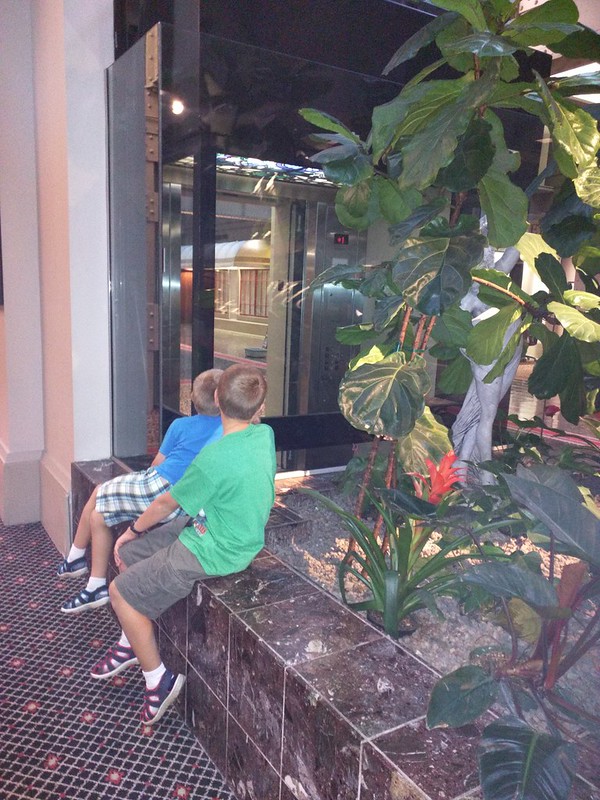
Aaaaaall Aboard! *chug* *chug* And so began a trip aboard our hotel train in Indianapolis, conducted by our very own Jacob and Oliver. IMG_20160703_101438 Because, well, what could be more fun than spending a few days in the world s only real Pullman sleeping car, on its original service track, inside a hotel? IMG_20160703_101520 We were on a family vacation to Indianapolis, staying in what two railfan boys were sure to enjoy: a hotel actually built into part of the historic Indianapolis Union Station complex. This is the original train track and trainshed. They moved in the Pullman cars, then built the hotel around them. Jacob and Oliver played for hours, acting as conductors and engineers, sending their train all across the country to pick up and drop off passengers. Opa! Have you ever seen a kid s face when you introduce them to something totally new, and they think it is really exciting, but a little scary too? That was Jacob and Oliver when I introduced them to saganaki (flaming cheese) at a Greek restaurant. The conversation went a little like this: Our waitress will bring out some cheese. And she will set it ON FIRE right by our table! Will it burn the ceiling? No, she ll be careful. Will it be a HUGE fire? About a medium-sized fire. Then what will happen? She ll yell OPA! and we ll eat the cheese after the fire goes out. Does it taste good? Oh yes. My favorite! It turned out several tables had ordered saganaki that evening, so whenever I saw it coming out, I d direct their attention to it. Jacob decided that everyone should call it opa instead of saganaki because that s what the waitstaff always said. Pretty soon whenever they d see something appear in the window from the kitchen, there d be craning necks and excited jabbering of maybe that s our opa! And when it finally WAS our opa , there were laughs of delight and I suspect they thought that was the best cheese ever. Giggling Elevators IMG_20160703_205544 Fun times were had pressing noses against the glass around the elevator. Laura and I sat on a nearby sofa while Jacob and Oliver sat by the elevators, anxiously waiting for someone to need to go up and down. They point and wave at elevators coming down, and when elevator passengers waved back, Oliver would burst out giggling and run over to Laura and me with excitement. Some history IMG_20160704_161550 We got to see the grand hall of Indianapolis Union Station what a treat to be able to set foot in this magnificent, historic space, the world s oldest union station. We even got to see the office where Thomas Edison worked, and as a hotel employee explained, was fired for doing too many experiments on the job. Water and walkways Indy has a system of elevated walkways spanning quite a section of downtown. It can be rather complex navigating them, and after our first day there, I offered to let Jacob and Oliver be the leaders. Boy did they take pride in that! They stopped to carefully study maps and signs, and proudly announced this way or turn here and were usually correct. 20160702_164754_Richtone(HDR) And it was the same in the paddleboat we took down the canal. Both boys wanted to be in charge of steering, and we only scared a few other paddleboaters. Fireworks IMG_20160704_220332 Our visit ended with the grand fireworks show downtown, set off from atop a skyscraper. I had been scouting for places to watch from, and figured that a bridge-walkway would be great. A couple other families had that thought too, and we all watched the 20-minute show in the drizzle. Loving brothers By far my favorite photo from the week is this one, of Jacob and Oliver asleep, snuggled up next to each other under the covers. They sure are loving and caring brothers, and had a great time playing together. IMG_20160702_071015

24 July 2016

Gregor Herrmann: RC bugs 2016/01-29

seems I've neglected both my blog & my RC bug fixing activities in the last months. anyway, since I still keep track of RC bugs I worked on, I thought I might as well publish the list:

Russ Allbery: Review: The Run of His Life

Review: The Run of His Life, by Jeffrey Toobin
Publisher: Random House
Copyright: 1996, 1997
Printing: 2015
ISBN: 0-307-82916-2
Format: Kindle
Pages: 498
The O.J. Simpson trial needs little introduction to anyone who lived through it in the United States, but a brief summary for those who didn't. O.J. Simpson is a Hall of Fame football player and one of the best running backs to ever play the game. He's also black, which is very relevant much of what later happened. After he retired from professional play, he became a television football commentator and a spokesperson for various companies (particularly Hertz, a car rental business). In 1994, he was arrested for the murder of two people: his ex-wife, Nicole Brown Simpson, and Ron Goldman (a friend of Nicole's). The arrest happened after a bizarre low-speed police chase across Los Angeles in a white Bronco that was broadcast live on network television. The media turned the resulting criminal trial into a reality TV show, with live cable television broadcasts of all of the court proceedings. After nearly a full year of trial (with the jury sequestered for nine months more on that later), a mostly black jury returned a verdict of not guilty after a mere four hours of deliberation. Following the criminal trial, in an extremely unusual legal proceeding, Simpson was found civilly liable for Ron Goldman's death in a lawsuit brought by his family. Bizarre events surrounding the case continued long afterwards. A book titled If I Did It (with "if" in very tiny letters on the cover) was published, ghost-written but allegedly with Simpson's input and cooperation, and was widely considered a confession. Another legal judgment let the Goldman family get all the profits from that book's publication. In an unrelated (but also bizarre) incident in Las Vegas, Simpson was later arrested for kidnapping and armed robbery and is currently in prison until at least 2017. It is almost impossible to have lived through the O.J. Simpson trial in the United States and not have formed some opinion on it. I was in college and without a TV set at the time, and even I watched some of the live trial coverage. Reactions to the trial were extremely racially polarized, as you might have guessed. A lot of black people believed at the time that Simpson was innocent (probably fewer now, given subsequent events). A lot of white people thought he was obviously guilty and was let off by a black jury for racial reasons. My personal opinion, prior to reading this book, was a common "third way" among white liberals: Simpson almost certainly committed the murders, but the racist Los Angeles police department decided to frame him for a crime that he did commit by trying to make the evidence stronger. That's a legitimate reason in the US justice system for finding someone innocent: the state has an obligation to follow correct procedure and treat the defendant fairly in order to get a conviction. I have a strong bias towards trusting juries; frequently, it seems that the media second-guesses the outcome of a case that makes perfect sense as soon as you see all the information the jury had (or didn't have). Toobin's book changed my mind. Perhaps because I wasn't watching all of the coverage, I was greatly underestimating the level of incompetence and bad decision-making by everyone involved: the prosecution, the defense, the police, the jury, and the judge. This court case was a disaster from start to finish; no one involved comes away looking good. Simpson was clearly guilty given the evidence presented, but the case was so badly mishandled that it gave the jury room to reach the wrong verdict. (It's telling that, in the far better managed subsequent civil case, the jury had no trouble reaching a guilty verdict.) The Run of His Life is a very detailed examination of the entire Simpson case, from the night of the murder through the end of the trial and (in an epilogue) the civil case. Toobin was himself involved in the media firestorm, breaking some early news of the defense's decision to focus on race in The New Yorker and then involved throughout the trial as a legal analyst, and he makes it clear when he becomes part of the story. But despite that, this book felt objective to me. There are tons of direct quotes, lots of clear description of the evidence, underlying interviews with many of the people involved to source statements in the book, and a comprehensive approach to the facts. I think Toobin is a bit baffled by the black reaction to the case, and that felt like a gap in the comprehensiveness and the one place where he might be accused of falling back on stereotypes and easy judgments. But other than hole, Toobin applies his criticism even-handedly and devastatingly to all parties. I won't go into all the details of how Toobin changed my mind. It was a cumulative effect across the whole book, and if you're curious, I do recommend reading it. A lot was the detailed discussion of the forensic evidence, which was undermined for the jury at trial but looks very solid outside the hothouse of the case. But there is one critical piece that I would hope would be handled differently today, twenty years later, than it was by the prosecutors in that case: Simpson's history of domestic violence against Nicole. With what we now know about patterns of domestic abuse, the escalation to murder looks entirely unsurprising. And that history of domestic abuse was exceedingly well-documented: multiple external witnesses, police reports, and one actual prior conviction for spousal abuse (for which Simpson did "community service" that was basically a joke). The prosecution did a very poor job of establishing this history and the jury discounted it. That was a huge mistake by both parties. I'll mention one other critical collection of facts that Toobin explains well and that contradicted my previous impression of the case: the relationship between Simpson and the police. Today, in the era of Black Lives Matter, the routine abuse of black Americans by the police is more widely known. At the time of the murders, it was less recognized among white Americans, although black Americans certainly knew about it. But even in 1994, the Los Angeles police department was notorious as one of the most corrupt and racist big-city police departments in the United States. This is the police department that beat Rodney King. Mark Fuhrman, one of the police officers involved in the case (although not that significantly, despite his role at the trial), was clearly racist and had no business being a police officer. It was therefore entirely believable that these people would have decided to frame a black man for a murder he actually committed. What Toobin argues, quite persuasively and with quite a lot of evidence, is that this analysis may make sense given the racial tensions in Los Angeles but ignores another critical characteristic of Los Angeles politics, namely a deference to celebrity. Prior to this trial, O.J. Simpson largely followed the path of many black athletes who become broadly popular in white America: underplaying race and focusing on his personal celebrity and connections. (Toobin records a quote from Simpson earlier in his life that perfectly captures this approach: "I'm not black, I'm O.J.") Simpson spent more time with white businessmen than the black inhabitants of central Los Angeles. And, more to the point, the police treated him as a celebrity, not as a black man. Toobin takes some time to chronicle the remarkable history of deference and familiarity that the police showed Simpson. He regularly invited police officers to his house for parties. The police had a long history of largely ignoring or downplaying his abuse of his wife, including not arresting him in situations that clearly seemed to call for that, showing a remarkable amount of deference to his side of the story, not pursuing clear violations of the court judgment after his one conviction for spousal abuse, and never showing much inclination to believe or protect Nicole. Even on the night of the murder, they started following a standard playbook for giving a celebrity advance warning of investigations that might involve them before the news media found out about them. It seems clear, given the evidence that Toobin collected, that the racist Los Angeles police didn't focus that animus at Simpson, a wealthy celebrity living in Brentwood. He wasn't a black man in their eyes; he was a rich Hall of Fame football player and a friend. This obviously raises the question of how the jury could return an innocent verdict. Toobin provides plenty of material to analyze that question from multiple angles in his detailed account of the case, but I can tell you my conclusion: Judge Lance Ito did a horrifically incompetent job of managing the case. He let the lawyers wander all over the case, interacted bizarrely with the media coverage (and was part of letting the media turn it into a daytime drama), was not crisp or clear about his standards of evidence and admissibility, and, perhaps worst of all, let the case meander on at incredible length. With a fully sequestered jury allowed only brief conjugal visits and no media contact (not even bookstore shopping!). Quite a lot of anger was focused on the jury after the acquittal, and I do think they reached the wrong conclusion and had all the information they would have needed to reach the correct one. But Toobin touches on something that I think would be very hard to comprehend without having lived through it. The jury and alternate pool essentially lived in prison for nine months, with guards and very strict rules about contact with the outside world, in a country where compensation for jury duty is almost nonexistent. There were a lot of other factors behind their decision, including racial tensions and the sheer pressure from judging a celebrity case about which everyone has an opinion, but I think it's nearly impossible to underestimate the psychological tension and stress from being locked up with random other people under armed guard for three quarters of a year. It's hard for jury members to do an exhaustive and careful deliberation in a typical trial that takes a week and doesn't involve sequestration. People want to get back to their lives and families. I can only imagine the state I would be in after nine months of this, or how poor psychological shape I would be in to make a careful and considered decision. Similarly, for those who condemned the jury for profiting via books and media appearances after the trial, the current compensation for jurors is $15 per day (not hour). I believe at the time it was around $5 per day. There are a few employers who will pay full salary for the entire jury service, but only a few; many cap the length at a few weeks, and some employers treat all jury duty as unpaid leave. The only legal requirement for employers in the United States is that employees that serve on a jury have their job held for them to return to, but compensation is pathetic, not tied to minimum wage, and employers do not have to supplement it. I'm much less inclined to blame the jurors than the system that badly mistreated them. As you can probably tell from the length of this review, I found The Run of His Life fascinating. If I had followed the whole saga more closely at the time, this may have been old material, but I think my vague impressions and patchwork of assumptions were more typical than not among people who were around for the trial but didn't invest a lot of effort into following it. If you are like me, and you have any interest in the case or the details of how the US criminal justice system works, this is a fascinating case study, and Toobin does a great job with it. Recommended. Rating: 8 out of 10

22 July 2016

Russell Coker: 802.1x Authentication on Debian

I recently had to setup some Linux workstations with 802.1x authentication (described as Ethernet authentication ) to connect to a smart switch. The most useful web site I found was the Ubuntu help site about 802.1x Authentication [1]. But it didn t describe exactly what I needed so I m writing a more concise explanation. The first thing to note is that the authentication mechanism works the same way as 802.11 wireless authentication, so it s a good idea to have the wpasupplicant package installed on all laptops just in case you need to connect to such a network. The first step is to create a wpa_supplicant config file, I named mine /etc/wpa_supplicant_SITE.conf. The file needs contents like the following:
network= 
 key_mgmt=IEEE8021X
 eap=PEAP
 identity="USERNAME"
 anonymous_identity="USERNAME"
 password="PASS"
 phase1="auth=MD5"
 phase2="auth=CHAP password=PASS"
 eapol_flags=0
 
The first difference between what I use and the Ubuntu example is that I m using eap=PEAP , that is an issue of the way the network is configured, whoever runs your switch can tell you the correct settings for that. The next difference is that I m using auth=CHAP and the Ubuntu example has auth=PAP . The difference between those protocols is that CHAP has a challenge-response and PAP just has the password sent (maybe encrypted) over the network. If whoever runs the network says that they don t store unhashed passwords or makes any similar claim then they are almost certainly using CHAP. Change USERNAME and PASS to your user name and password. wpa_supplicant -c /etc/wpa_supplicant_SITE.conf -D wired -i eth0 The above command can be used to test the operation of wpa_supplicant.
Successfully initialized wpa_supplicant
eth0: Associated with 00:01:02:03:04:05
eth0: CTRL-EVENT-EAP-STARTED EAP authentication started
eth0: CTRL-EVENT-EAP-PROPOSED-METHOD vendor=0 method=25
TLS: Unsupported Phase2 EAP method 'CHAP'
eth0: CTRL-EVENT-EAP-METHOD EAP vendor 0 method 25 (PEAP) selected
eth0: CTRL-EVENT-EAP-PEER-CERT depth=0 subject=''
EAP-MSCHAPV2: Authentication succeeded
EAP-TLV: TLV Result - Success - EAP-TLV/Phase2 Completed
eth0: CTRL-EVENT-EAP-SUCCESS EAP authentication completed successfully
eth0: CTRL-EVENT-CONNECTED - Connection to 00:01:02:03:04:05 completed [id=0 id_str=]
Above is the output of a successful test with wpa_supplicant. I replaced the MAC of the switch with 00:01:02:03:04:05. Strangely it doesn t like CHAP but is automatically selecting MSCHAPV2 and working, maybe anything other than PAP would do.
auto eth0
iface eth0 inet dhcp
  wpa-driver wired
  wpa-conf /etc/wpa_supplicant_SITE.conf
Above is a snippet of /etc/network/interfaces that works with this configuration.

21 July 2016

Reproducible builds folks: Reproducible builds: week 62 in Stretch cycle

What happened in the Reproducible Builds effort between June 26th and July 2nd 2016: Read on to find out why we're lagging some weeks behind ! GSoC and Outreachy updates Toolchain fixes With the doxygen upload we are now down to only 2 modified packages in our repository: dpkg and rdfind. Weekly reports delay and the future of statistics To catch up with our backlog of weekly reports we have decided to skip some of the statistics for this week. We might publish them in a future report, or we might switch to a format where we summarize them more (and which we can create (even) more automatically), we'll see. We are doing these weekly statistics because we believe it's appropriate and useful to credit people's work and make it more visible. What do you think? We would love to hear your thoughts on this matter! Do you read these statistics? Somewhat? Actually, thanks to the power of notmuch, Holger came up with what you can see below, so what's missing for this week are the uploads fixing irreprodubilities. Which we really would like to show for the reasons stated above and because we really really need these uploads to happen ;-) But then we also like to confirm the bugs are really gone, which (atm) requires manual checking, and to look for the words "reproducible" and "deterministic" (and spelling variations) in debian/changelogs of all uploads, to spot reproducible work not tracked via the BTS. And we still need to catch up on the backlog of weekly reports. Bugs submitted with reproducible usertags It seems DebCamp in Cape Town was hugely successful and made some people get a lot of work done: 61 bugs have been filed with reproducible builds usertags and 60 of them had patches: Package reviews 437 new reviews have been added (though most of them were just linking the bug, "only" 56 new issues in packages were found), an unknown number has been been updated and 60 have been removed in this week, adding to our knowledge about identified issues. 4 new issue types have been found: Weekly QA work 98 FTBFS bugs have been reported by Chris Lamb and Santiago Vila. diffoscope development strip-nondeterminism development tests.reproducible-builds.org Misc. This week's edition was written by Mattia Rizzolo, Reiner Herrmann, Ceridwen and Holger Levsen and reviewed by a bunch of Reproducible builds folks on IRC.

20 July 2016

Shirish Agarwal: Debconf 16 and My Experience with Debian

It has been often said that you should continually try new things in life so that a. Unlike the fish you do not mistake the pond to be the sea. b. You see other people, other types and ways of living and being which you normally won t in your day-to-day existence. With both of those as mantras I decided to take a leap into the unknown. I was unsure both about the visa process as well as the travel bit as I was traveling to an unknown place and although I had done some research about the place I was unsure about the authenticity of whatever is/was shared on the web. During the whole journey both to and fro, I couldn t sleep a wink. The Doha airport is huge. There are 5 Concourses, A, B , C, D, E and around 30+ gates in each Concourse. The ambition of the small state is something to be reckoned with. Almost 95% of the blue workers in the entire airport were of Asian sub-continent. While the Qatari Rial is 19 times stronger to us, the workers I suspect are worse-off than people doing similar things back home. Add to that the sharia law, even for all the money in the world, I wouldn t want to settle therein. Anyways, during the journey, a small surprise awaited me, Ritesh Raj Saraff, a DD was also traveling to Debconf. We bumped into each other while going to see the Doha City, courtesy Al-Hamad International Airport. I would probably share a bit more about Doha and my experiences with the city in upcoming posts. Cut to Cape Town, South Africa, we landed in the city half an hour after our scheduled time and then we sped along to University of Cape Town (UCT) which was to become our home for the next 13 odd days. The first few days were a whirlwind as there were new people to meet, old people whom I knew only as an e-mail id or an IRC nickname turned out to be real people and you have to try to articulate yourself in English, which is not a native language of mine. During Debcamp I was fortunate to be able visit some of the places and the wiki page had a lot of places which I knew I wouldn t be able to complete unless I had 15 days unlimited time and money to go around so didn t even try. I had gone with few goals in mind :- a. Do some documentation of the event In this I failed completely as just the walk from the venue to where the talks were energy-draining for me. Apart from that, you get swept in meeting new people and talking about one of million topics in Debian which interest you or the other person and while they are fulfilling, it is and was both physically and emotionally draining for me (in a good way). Bernelle (one of the organizers) had warned us of this phenomenon but you disregard it as you know you have a limited time-frame in which to meet and greet people and it is all a over-whelming experience. b. Another goal was to meet my Indian brethren who had left the country around 60~100 years mostly as slaves of East India company In this I was partially successful. I met a couple of beautiful ladies who had either a father or a mother who was Indian while the other was of African heritage. It seemed in them a yearning to know the culture but from what little they had, only Bollywood and Indian cuisine was what they could make of Indian culture. One of the girls, ummm women to be more truer, shared a somewhat grim tale. She had both an African boyfriend as well as Indian boyfriend in her life and in both cases, she was rejected by the boy s parents because she wasn t pure enough. This was deja vu all over again as the same thing can be seen here happening in casteism so there wasn t any advice I could give but just nod in empathy. What was sort of relevation was when their parents or grandparents came, the name and surnames were thrown off and the surname was just the place from where they belong. From the discussions it emerged that there were also lot of cases of forced conversions to Christianity during that era as well as temptations of a better life. As shared, this goal succeeded partially, as I was actually interested in their parents or grand-parents to know the events that shaped the Indian diaspora over there. While the children know only of today, yester-years could only be known by those people who made the unwilling perilous journey to Africa. I had also wanted to know more about Gandhiji s role in that era but alas, that part of history would have to wait for another day as I guess, both those goals would only have met had I visited Durban but that was not to be. I had applied for one talk My Experience with Debian and one workshop for Installation of Debian on systems. The My Experience with Debian was aimed at newbies and I had thought of using show-and-tell to share the differences between proprietary Operating Systems and a FOSS distribution such as Debian. I was going to take simple things such as changelogs, apt-listbugs, real-time knowledge of updates and upgrades as well as /etc/apt/sources.list to share both the versatility of the Debian desktop and real improvements than what proprietary Operating Systems had to offer. But I found myself engaging with Debian Developers (DD s) rather than the newbies so had to change the orientation and fundamentals of the talk on the fly. I knew or suspected rather that the old idea would not work as it would just be repeating to the choir. With that in the back of mind, and the idea that perhaps they would not be so aware of the politics and events which happened in India over the last couple of decades, I tried to share what little I was able to recollect what little I was able to remember about those times. Apart from that, I was also highly conscious that I had been given just the before lunch slot aka You are in the way of my lunch slot. So I knew I had to speak my piece as quickly as possible being as clear as can be. Later, I did get feedback that I was fast and seeing it through couple of times, do agree that I could have done a better job. What s done is done and the only thing I could do to salvage it a bit is to make a presentation which I am sharing as below. my_experience_with_debian Would be nice if somebody could come up with a lighter template for presentations. For reference the template I have taken it from is shared at https://wiki.debian.org/Presentations . Some pictures from the presentation. vlcsnap-00004 me_sharing my_experience_with_debian You can find the video at http://meetings-archive.debian.net/pub/debian-meetings/2016/debconf16/My_Experience_with_Debian.webm This is by no means the end of the Debconf16 experience, but actually the starting. I hope to share more of my thoughts, ideas and get as much feedback from all the wonderful people I met during Debconf.
Filed under: Miscellenous Tagged: #Debconf16, Doha, My talk, Qatar

19 July 2016

Michael Prokop: DebConf16 in Capetown/South Africa: Lessons learnt

DebConf 16 in Capetown/South Africa was fantastic for many reasons. My Capetown/South Africa/Culture/Flight related lessons: My technical lessons from DebConf16: BTW, thanks to the video team the recordings from the sessions are available online.

Dirk Eddelbuettel: Rcpp 0.12.6: Rolling on

The sixth update in the 0.12.* series of Rcpp has arrived on the CRAN network for GNU R a few hours ago, and was just pushed to Debian. This 0.12.6 release follows the 0.12.0 release from late July, the 0.12.1 release in September, the 0.12.2 release in November, the 0.12.3 release in January, the 0.12.4 release in March, and the 0.12.5 release in May --- making it the tenth release at the steady bi-montly release frequency. Just like the previous release, this one is once again more of a refining maintenance release which addresses small bugs, nuisances or documentation issues without adding any major new features. That said, some nice features (such as caching support for sourceCpp() and friends) were added. Rcpp has become the most popular way of enhancing GNU R with C or C++ code. As of today, 703 packages on CRAN depend on Rcpp for making analytical code go faster and further. That is up by about fourty packages from the last release in May! Similar to the previous releases, we have contributions from first-time committers. Artem Klevtsov made na_omit run faster on vectors without NA values. Otherwise, we had many contributions from "regulars" like Kirill Mueller, James "coatless" Balamuta and Dan Dillon as well as from fellow Rcpp Core contributors. Some noteworthy highlights are encoding and string fixes, generally more robust builds, a new iterator-based approach for vectorized programming, the aforementioned caching for sourceCpp(), and several documentation enhancements. More details are below.
Changes in Rcpp version 0.12.6 (2016-07-18)
  • Changes in Rcpp API:
    • The long long data type is used only if it is available, to avoid compiler warnings (Kirill M ller in #488).
    • The compiler is made aware that stop() never returns, to improve code path analysis (Kirill M ller in #487 addressing issue #486).
    • String replacement was corrected (Qiang in #479 following mailing list bug report by Masaki Tsuda)
    • Allow for UTF-8 encoding in error messages via RCPP_USING_UTF8_ERROR_STRING macro (Qin Wenfeng in #493)
    • The R function Rf_warningcall is now provided as well (as usual without leading Rf_) (#497 fixing #495)
  • Changes in Rcpp Sugar:
    • Const-ness of min and max functions has been corrected. (Dan Dillon in PR #478 fixing issue #477).
    • Ambiguities for matrix/vector and scalar operations have been fixed (Dan Dillon in PR #476 fixing issue #475).
    • New algorithm header using iterator-based approach for vectorized functions (Dan in PR #481 revisiting PR #428 and addressing issue #426, with futher work by Kirill in PR #488 and Nathan in #503 fixing issue #502).
    • The na_omit() function is now faster for vectors without NA values (Artem Klevtsov in PR #492)
  • Changes in Rcpp Attributes:
    • Add cacheDir argument to sourceCpp() to enable caching of shared libraries across R sessions (JJ in #504).
    • Code generation now deals correctly which packages containing a dot in their name (Qiang in #501 fixing #500).
  • Changes in Rcpp Documentation:
    • A section on default parameters was added to the Rcpp FAQ vignette (James Balamuta in #505 fixing #418).
    • The Rcpp-attributes vignette is now mentioned more prominently in question one of the Rcpp FAQ vignette.
    • The Rcpp Quick Reference vignette received a facelift with new sections on Rcpp attributes and plugins begin added. (James Balamuta in #509 fixing #484).
    • The bib file was updated with respect to the recent JSS publication for RProtoBuf.
Thanks to CRANberries, you can also look at a diff to the previous release. As always, even fuller details are on the Rcpp Changelog page and the Rcpp page which also leads to the downloads page, the browseable doxygen docs and zip files of doxygen output for the standard formats. A local directory has source and documentation too. Questions, comments etc should go to the rcpp-devel mailing list off the R-Forge page.

This post by Dirk Eddelbuettel originated on his Thinking inside the box blog. Please report excessive re-aggregation in third-party for-profit settings.

18 July 2016

John Goerzen: Building a home firewall: review of pfsense

For some time now, I ve been running OpenWRT on an RT-N66U device. I initially set that because I had previously been using my Debian-based file/VM server as a firewall, and this had some downsides: every time I wanted to reboot that, Internet for the whole house was down; shorewall took a fair bit of care and feeding; etc. I ve been having indications that all is not well with OpenWRT or the N66U in the last few days, and some long-term annoyances prompted me to search out a different solution. I figured I could buy an embedded x86 device, slap Debian on it, and be set. The device I wound up purchasing happened to have pfsense preinstalled, so I thought I d give it a try. As expected, with hardware like that to work with, it was a lot more capable than OpenWRT and had more features. However, I encountered a number of surprising issues. The biggest annoyance was that the system wouldn t allow me to set up a static DHCP entry with the same IP for multiple MAC addresses. This is a very simple configuration in the underlying DHCP server, and OpenWRT permitted it without issue. It is quite useful so my laptop has the same IP whether connected by wifi or Ethernet, and I have used it for years with no issue. Googling it a bit turned up some rather arrogant pfsense people saying that this is broken and poor design, and that your wired and wireless networks should be on different VLANs anyhow. They also said just give it the same hostname for the different IPs but it rejects this too. Sigh. I discovered, however, that downloading the pfsense backup XML file, editing the IP within, and re-uploading it gets me what I want with no ill effects! So then I went to set up DNS. I tried to enable the DNS Forwarder , but it wouldn t let me do that while the DNS Resolver was still active. Digging in just a bit, it appears that the DNS Forwarder and DNS Resolver both provide forwarding and resolution features; they just have different underlying implementations. This is not clear at all in the interface. Next stop: traffic shaping. Since I use VOIP for work, this is vitally important for me. I dove in, and found a list of XML filenames for wizards: one for Dedicated Links and another for Multiple Lan/Wan . Hmmm. Some Googling again turned up that everyone suggests using the Multiple Lan/Wan wizard. Fine. I set it up, and notice that when I start an upload, my download performance absolutely tanks. Some investigation shows that outbound ACKs aren t being handled properly. The wizard had created a qACK queue, but neglected to create a packet match rule for it, so ACKs were not being dealt with appropriately. Fixed that with a rule of my own design, and now downloads are working better again. I also needed to boost the bandwidth allocated to qACK (setting it to 25% seemed to do the trick). Then there was the firewall rules. The interface section is first-match-wins, whereas the floating section is last-match-wins. This is rather non-obvious. Getting past all the interface glitches, however, the system looks powerful, solid, and well-engineered under the hood, and fairly easy to manage.

17 July 2016

Michael Stapelberg: mergebot: easily merging contributions

Recently, I was wondering why I was pushing off accepting contributions in Debian for longer than in other projects. It occurred to me that the effort to accept a contribution in Debian is way higher than in other FOSS projects. My remaining FOSS projects are on GitHub, where I can just click the Merge button after deciding a contribution looks good. In Debian, merging is actually a lot of work: I need to clone the repository, configure it, merge the patch, update the changelog, build and upload. I wondered how close we can bring Debian to a model where accepting a contribution is just a single click as well. In principle, I think it can be done. To demonstrate the feasibility and collect some feedback, I wrote a program called mergebot. The first stage is done: mergebot can be used on your local machine as a command-line tool. You provide it with the source package and bug number which contains the patch in question, and it will do the rest:
midna ~ $ mergebot -source_package=wit -bug=#831331
2016/07/17 12:06:06 will work on package "wit", bug "831331"
2016/07/17 12:06:07 Skipping MIME part with invalid Content-Disposition header (mime: no media type)
2016/07/17 12:06:07 gbp clone --pristine-tar git+ssh://git.debian.org/git/collab-maint/wit.git /tmp/mergebot-743062986/repo
2016/07/17 12:06:09 git config push.default matching
2016/07/17 12:06:09 git config --add remote.origin.push +refs/heads/*:refs/heads/*
2016/07/17 12:06:09 git config --add remote.origin.push +refs/tags/*:refs/tags/*
2016/07/17 12:06:09 git config user.email stapelberg AT debian DOT org
2016/07/17 12:06:09 patch -p1 -i ../latest.patch
2016/07/17 12:06:09 git add .
2016/07/17 12:06:09 git commit -a --author Chris Lamb <lamby AT debian DOT org> --message Fix for  wit: please make the build reproducible  (Closes: #831331)
2016/07/17 12:06:09 gbp dch --release --git-author --commit
2016/07/17 12:06:09 gbp buildpackage --git-tag --git-export-dir=../export --git-builder=sbuild -v -As --dist=unstable
2016/07/17 12:07:16 Merge and build successful!
2016/07/17 12:07:16 Please introspect the resulting Debian package and git repository, then push and upload:
2016/07/17 12:07:16 cd "/tmp/mergebot-743062986"
2016/07/17 12:07:16 (cd repo && git push)
2016/07/17 12:07:16 (cd export && debsign *.changes && dput *.changes)
midna ~ $ cd /tmp/mergebot-743062986/repo
midna /tmp/mergebot-743062986/repo $ git log HEAD~2..
commit d983d242ee546b2249a866afe664bac002a06859
Author: Michael Stapelberg <stapelberg AT debian DOT org>
Date:   Sun Jul 17 13:32:41 2016 +0200
    Update changelog for 2.31a-3 release
commit 5a327f5d66e924afc656ad71d3bfb242a9bd6ddc
Author: Chris Lamb <lamby AT debian DOT org>
Date:   Sun Jul 17 13:32:41 2016 +0200
    Fix for  wit: please make the build reproducible  (Closes: #831331)
midna /tmp/mergebot-743062986/repo $ git push
Counting objects: 11, done.
Delta compression using up to 8 threads.
Compressing objects: 100% (11/11), done.
Writing objects: 100% (11/11), 1.59 KiB   0 bytes/s, done.
Total 11 (delta 6), reused 0 (delta 0)
remote: Sending notification emails to: dispatch+wit_vcs@tracker.debian.org
To git+ssh://git.debian.org/git/collab-maint/wit.git
   650ee05..d983d24  master -> master
 * [new tag]         debian/2.31a-3 -> debian/2.31a-3
midna /tmp/mergebot-743062986/repo $ cd ../export
midna /tmp/mergebot-743062986/export $ debsign *.changes && dput *.changes
[ ]
Uploading wit_2.31a-3.dsc
Uploading wit_2.31a-3.debian.tar.xz
Uploading wit_2.31a-3_amd64.deb
Uploading wit_2.31a-3_amd64.changes
Of course, this is not quite as convenient as clicking a Merge button yet. I have some ideas on how to make that happen, but I need to know whether people are interested before I spend more time on this. Please see github.com/Debian/mergebot for more details, and please get in touch if you think this is worthwhile or would even like to help. Feedback is accepted in the GitHub issue tracker for mergebot or the project mailing list mergebot-discuss. Thanks!

8 July 2016

Lior Kaplan: First uses of the PHP 5.4 security backports

I recently checked the Debian PHP 5.4 changelog and found out this message (5.4.45-0+deb7u3 and 5.4.45-0+deb7u4):
* most patches taken from https://github.com/kaplanlior/php-src
Thanks a lot to Lior Kaplan for providing them.
I was very pleased to see my work being used, and I hope this would save other time while providing PHP long term support. Also, while others do similar work (e.g. Remi from RedHat), it seems I m the only when that make this over GIT and with full references (e.g. commit info, CVE info and bug number). Comments and suggestions are always welcome either mail or even better a pull request.
Filed under: Debian GNU/Linux, PHP

3 July 2016

Joey Hess: twenty years of free software -- part 7 git-annex

My first Haskell program, and the only software I've written that was inspired by living in a particular place, git-annex has received the lion's share of my time for five years. It was written just to solve my own problem, but in a general way, that turned out to be useful in lots of other situations. So over the first half a year or so, it started attracting some early adopters who made some very helpful suggestions. Then I did the git-annex assistant kickstarter, and started blogging about each day I worked on it. Four years of funding and seven hundred and twenty one posts later, the git-annex devblog is still going. So, I won't talk about technical details in this post, they've all been covered. One thing I wondered when starting git-annex -- besides whether I would be able to write it in Haskell at all -- was would that prevent it from getting many patches. I count roughly 65 "thanks" messages in the changelog, so it gets perhaps one patch contributed per month. It's hard to say if that's a lot or a little. Part of git-annex is supporting various cloud storage systems via "special remotes". Of those not written by me, only 1 was contributed in Haskell. Compare with 13 that use the plugin system that lets other programming languages be used. The other question about using Haskell is, did it make git-annex a better program. I think it did. The strong type system did prevent plenty of bugs, although there have still been some real howlers. The code is still not taking full advantage of the power of Haskell's type system, on the other hand it uses many Haskell libraries that do leverage the type system more. I've done more small and large refactorings of git-annex than on any other program I've written, because the strong types and referential transparency makes refactoring easier and safer in Haskell. And the code has turned out to be much more flexible, for all its static types, than the kind of code I was writing before. Examples include building the git-annex assistant, which uses the rest of git-annex as a library, and making git-annex run actions concurrently, thanks to there being no global variables to complicate things (and excellent support for concurrency and parallelism in Haskell). So: Glad I wrote it, glad I used Haskell for it, estatic that many other people have found it useful, and astounded that I've been funded to work on it for four years. Next: twenty years of free software -- part 8 github-backup

2 July 2016

Russ Allbery: Review: Ashes of Honor

Review: Ashes of Honor, by Seanan McGuire
Series: October Daye #6
Publisher: DAW
Copyright: September 2012
ISBN: 1-101-59480-2
Format: Kindle
Pages: 368
This is the sixth book in the October Daye series, contains payoffs for some relationships that have been building over the whole series, and involves entangled politics set up by previous books. It's not the place to start with the series. Ashes of Honor starts, as so many of Toby's books do, with a friend asking her for help. But this request is entirely unexpected, and the help needed comes as a complete surprise: a previously unknown changeling, who has disappeared. A changeling whose powers are completely out of control, and who poses a threat to reality itself. As Toby's cases go, this involves a lot fewer horrible things happening to her and a lot more faerie politics and maneuvering than usual. I appreciated that; I'm not as fond of the books that go deep into despair or desperation. It does involve Toby getting almost killed multiple times, but, due to earlier events of the series, that isn't quite as bad as it used to be. More focus on investigation and political maneuvering and less Toby braving her way through horrors works for me. Even more notably, this book marks Toby finally figuring out that she has friends and allies who are there to help, not just be obligations she feels overwhelmed by or aid that she's not allowed to accept. This was one of her most frustrating characteristics; it's a relief to see her finally relax. This opens the way not only for deeper friendships and more complex plots but also a relationship that I've been awaiting for the entire series, and it's as much fun as I was hoping it would be. Toby started the series rather messed up and unwilling to let anyone close. It was for understandable reasons, but I like her better when she realizes why people respect her. Toby's connections with the royalty of the Bay Area also allow McGuire to tell a political story that moves farther afield from the Shadowed Hills. First in One Salt Sea and now in Ashes of Honor we see more of local politics, more of the lore of McGuire's universe, and another dangerous queen. Toby is particularly fun when she's dangerously outflanking people with considerably more power than she has. At this point, you could call it a specialty. I thought McGuire's take on San Jose and the sort of person who would be in charge of its fae was on point. We also get more of the Luidaeg, which is always a good sign for a Toby novel, and more of Tybalt, who is entangled in a major subplot of the story. Next to Luidaeg, Tybalt is my favorite of Toby's friends, so this book is full of the things that make me happy. McGuire adds some more pieces to her transplanted Celtic mythology and some tantalizing hints of what the fae have left behind. I'm hoping we see more of that in future books. (I suspect that may be what this whole series is building up to.) The story doesn't have quite as much oomph as One Salt Sea, but it's still one of the best books in the series so far. If you've enjoyed the series up to this point, keep reading. Followed by Chimes at Midnight. Rating: 8 out of 10

Next.

Previous.