Search Results: "Dirk Eddelbuettel"

31 May 2021

Dirk Eddelbuettel: inline 0.3.19: Another Update

A new release of the inline package got to CRAN today, following and further updating the recent update from earlier in the month. inline facilitates writing code in-line in simple string expressions or short files. The package was used quite extensively by Rcpp in the days before Rcpp Attributes arrived on the scene providing an even better alternative for its use cases. inline is still used by rstan and a number of other packages. This release builds on and extends the work of the recent 0.3.18 release and tweaks some of the test. We cannot fully test all platforms used by CRAN so some times iterations such as this one are needed. The package was uploaded a few days ago, but it sometimes takes a few days to clarify changes over email to the CRAN maintainers whose work is still greatly appreciated. The NEWS extract follows and details the changes some more.

Changes in inline version 0.3.19 (2021-05-25)
  • Documentation for moveDLL was updated and extended (Johannes in #22).
  • A few more tests were made conditional the test platform (Dirk in #24).

Courtesy of my CRANberries, there is a comparison to the previous release. If you like this or other open-source work I do, you can now sponsor me at GitHub.

This post by Dirk Eddelbuettel originated on his Thinking inside the box blog. Please report excessive re-aggregation in third-party for-profit settings.

30 May 2021

Dirk Eddelbuettel: td 0.0.3 on CRAN: Maintenance release

The still recent-ish td package for accessing the twelvedata API for financial data has been updated on CRAN yesterday, and is now at released version 0.0.3. A few URLs were updated to please the lint checker, and a Depends: on R 4.0.0 or later was added. We then realized (as always just after the release ) that the core issue was an incorrect version comparison which we already fixed in the git repo. The NEWS entry follows.

Changes in version 0.0.3 (2021-05-29)
  • The package now (formally) depends on R (>= 4.0.0) as it uses a recently added R function for the default config file.
  • A few URLs were updated in the README.md file

Courtesy of my CRANberries, there is a comparison to the previous release. For questions or comments use the issue tracker off the GitHub repo. If you like this or other open-source work I do, you can now sponsor me at GitHub.

This post by Dirk Eddelbuettel originated on his Thinking inside the box blog. Please report excessive re-aggregation in third-party for-profit settings.

24 May 2021

Dirk Eddelbuettel: RcppArmadillo 0.10.5.0.0 on CRAN: New Upstream

armadillo image Armadillo is a powerful and expressive C++ template library for linear algebra aiming towards a good balance between speed and ease of use with a syntax deliberately close to a Matlab. RcppArmadillo integrates this library with the R environment and language and is widely used by (currently) 865 other packages on CRAN. This new release brings Armadillo 10.5.0 which was released early on Friday. We had done one full test in the 10.5 rc1 prerelease one week earlier, and did another test on 10.5.0 and this 0.10.5.0.0 RcppArmadillo release just for added rigour. The package was then uploaded to CRAN late Friday (my timezone). The automated process flagged one NOTE as a false positive (yet another instance of the well-known (yet dreaded) issue of Suggests != Depends by one these 865 packages). This lead to a need of an inspection by one of the CRAN maintainers, and the weekend being the weekend it was only processed just now. Upstream moves at a speed that is a little faster than the cadence CRAN likes. As we had released RcppArmadillo 0.10.4.0.0 on April 13 we did not want to follow-up too soon thereafter with 0.10.4.1.0 which was thusly only a GitHub and drat release (which can always be had easily too via install.packages("RcppArmadillo", repos="https://RcppCore.github.io/drat").) The full set of changes follows. We include the aforementioned interim release as well.

Changes in RcppArmadillo version 0.10.5.0 (2021-05-21)
  • Upgraded to Armadillo release 10.5 (Antipodean Fortress)
    • added .clamp() member function
    • expanded the standalone clamp() function to handle complex values
    • more efficient use of OpenMP
    • vector, matrix and cube constructors now initialise elements to zero by default; use the fill::none specifier, eg. mat X(4,5,fill::none), to disable element initialisation
  • Added codecov.yml to exclude Armadillo from coverage analysis

Changes in RcppArmadillo version 0.10.4.1.0 (2021-04-23)
  • Upgraded to Armadillo release 10.4.1 (Pressure Cooker)
  • GitHub-only release

Courtesy of my CRANberries, there is a diffstat report relative to previous release. More detailed information is on the RcppArmadillo page. Questions, comments etc should go to the rcpp-devel mailing list off the R-Forge page. If you like this or other open-source work I do, you can sponsor me at GitHub.

This post by Dirk Eddelbuettel originated on his Thinking inside the box blog. Please report excessive re-aggregation in third-party for-profit settings.

19 May 2021

Dirk Eddelbuettel: RcppDate 0.0.3: New Upstream

RcppDate wraps the featureful date library written by Howard Hinnant for use with R. This header-only modern C++ library has been in pretty wide-spread use for a while now, and adds to C++11/C++14/C++17 what will be (with minor modifications) the date library in C++20. Our previous 0.0.2 release already contained date version 3.0.0 from last year plus some of changes accumulated since then. Now that date 3.0.1 was just released, we are providing a quick sync with this version.

Changes in version 0.0.3 (2021-05-19)
  • Updated to upstream version 3.0.1

If you like this or other open-source work I do, you can now sponsor me at GitHub.

This post by Dirk Eddelbuettel originated on his Thinking inside the box blog. Please report excessive re-aggregation in third-party for-profit settings.

Dirk Eddelbuettel: inline 0.3.18: Routine Update

A new release of the inline package got to CRAN today. inline facilitates writing code in-line in simple string expressions or short files. The package was used quite extensively by Rcpp in the days before Rcpp Attributes arrived on the scene proving an even better alternative for its use cases. inline is still used by rstan and a number of other packages. Johannes Ranke, who uses and stresses inline via his package mkin, updated the loading/unloading of DLLs which, following updates in R-devel, was failing some tests. As luck will have it, this new version appears to still fail on two of the platforms we do not actually have easy access to so another version may be coming shortly . See below for a detailed list of changes extracted from the NEWS file.

Changes in inline version 0.3.18 (2021-05-17)
  • The moveDLL code and tests were updated for changed in R-devel (Johannes in #22 fixing #21).

Courtesy of my CRANberries, there is a comparison to the previous release. If you like this or other open-source work I do, you can now sponsor me at GitHub.

This post by Dirk Eddelbuettel originated on his Thinking inside the box blog. Please report excessive re-aggregation in third-party for-profit settings.

22 April 2021

Dirk Eddelbuettel: drat 0.2.0: Now with docs/

drat user A new release of drat arrived on CRAN today. This is the first release in a few months (with the last release in July of last year) and it (finally) makes the leap to supporting docs/ in the main branch as we are all so tired of the gh-pages branch. We also have new vignettes, new (and very shiny) documentation and refreshed vignettes! drat stands for drat R Archive Template, and helps with easy-to-create and easy-to-use repositories for R packages. Since its inception in early 2015 it has found reasonably widespread adoption among R users because repositories with marked releases is the better way to distribute code. See below for a few custom reference examples. Because for once it really is as your mother told you: Friends don t let friends install random git commit snapshots. Or as we may now add: stay away from semi-random universes snapshots too. Properly rolled-up releases it is. Just how CRAN shows us: a model that has demonstrated for two-plus decades how to do this. And you can too: drat is easy to use, documented by (now) six vignettes and just works. The NEWS file summarises the release as follows:

Changes in drat version 0.2.0 (2021-04-21)
  • A documentation website for the package was added at https://eddelbuettel.github.io/drat/ (Dirk)
  • The continuous integration was switched to using r-ci (Dirk)
  • The docs/ directory of the main repository branch can now be used instead of gh-pages branch (Dirk in #112)
  • A new repository https://github.com/drat-base/drat can now be used to fork an initial drat repository (Dirk)
  • A new vignette Drat Step-by-Step was added (Roman Hornung and Dirk in #117 fixing #115 and #113)
  • The test suite was refactored for docs/ use (Felix Ernst in #118)
  • The minimum R version is now R (>= 3.6) (Dirk fixing #119)
  • The vignettes were switched to minidown (Dirk fixing #116)
  • A new test file was added to ensure NEWS.Rd is always at the current release version.

Courtesy of my CRANberries, there is a comparison to the previous release. More detailed information is on the drat page. If you like this or other open-source work I do, you can now sponsor me at GitHub.

This post by Dirk Eddelbuettel originated on his Thinking inside the box blog. Please report excessive re-aggregation in third-party for-profit settings.

20 April 2021

Dirk Eddelbuettel: Rblpapi 0.3.11: Several Updates

A new version 0.3.11 of Rblpapi is now arriving at CRAN. It comes two years after the release of version Rblpapit 0.3.10 and brings a few updates and extensions. Rblpapi provides a direct interface between R and the Bloomberg Terminal via the C++ API provided by Bloomberg (but note that a valid Bloomberg license and installation is required). This is the eleventh release since the package first appeared on CRAN in 2016. Changes are detailed below. Special thanks to James, Maxime and Michael for sending us pull requests.

Changes in Rblpapi version 0.3.11 (2021-04-20)
  • Support blpAutoAuthenticate and B-PIPE access, refactor and generalise authentication (James Bell in #285)
  • Deprecate excludeterm (John in #306)
  • Correct example in README.md (Maxime Legrand in #314)
  • Correct bds man page (and code) (Michael Kerber, and John, in #320)
  • Add GitHub Actions continuous integration (Dirk in #323)
  • Remove bashisms detected by R CMD check (Dirk #324)
  • Switch vignette to minidown (Dirk in #331)
  • Switch unit tests framework to tinytest (Dirk in #332)

Courtesy of my CRANberries, there is also a diffstat report for the this release. As always, more detailed information is on the Rblpapi page. Questions, comments etc should go to the issue tickets system at the GitHub repo. If you like this or other open-source work I do, you can now sponsor me at GitHub.

This post by Dirk Eddelbuettel originated on his Thinking inside the box blog. Please report excessive re-aggregation in third-party for-profit settings.

17 April 2021

Dirk Eddelbuettel: RcppAPT 0.0.7: Micro Update

A new version of the RcppAPT package interfacing from R to the C++ library behind the awesome apt, apt-get, apt-cache, commands and their cache powering Debian, Ubuntu and the like arrived on CRAN yesterday. This comes a good year after the previous maintenance update for release 0.0.6. RcppAPT allows you to query the (Debian or Ubuntu) package dependency graph at will, with build-dependencies (if you have deb-src entries), reverse dependencies, and all other goodies. See the vignette and examples for illustrations. The maintenance release responds to call for updates from CRAN desiring that make all implicit dependencies on packages markdown and rmarkdown explicit via a Suggests: entry. Two of the many packages I maintain were part of the (large !!) list in the CRAN email, and this is one of them. While making the update, we refreshed two other packaging details.

Changes in version 0.0.7 (2021-04-16)
  • Add rmarkdown to Suggests: as an implicit conditional dependency
  • Switch vignette to minidown and its water framework, add minidown to Suggests as well
  • Update two URLs in the README.md file

Courtesy of my CRANberries, there is also a diffstat report for this release. A bit more information about the package is available here as well as as the GitHub repo. If you like this or other open-source work I do, you can now sponsor me at GitHub.

This post by Dirk Eddelbuettel originated on his Thinking inside the box blog. Please report excessive re-aggregation in third-party for-profit settings.

16 April 2021

Dirk Eddelbuettel: Announcing Introductions to Emacs Speaks Statistics

A new website containing introductory videos and slide decks is now available for your perusal at ess-intro.github.io. It provides a series of introductions to the excellent Emacs Speaks Statistics (ESS) mode for the Emacs editor. This effort started following my little tips, tricks, tools and toys series of short videos and slide decks for the command-line and R, broadly-speaking . Which I had mentioned to friends curious about Emacs, and on the ess-help mailing list. And lo and behold, over the fall and winter sixteen of us came together in one GitHub org and are now proud to present the initial batch of videos about first steps, installing, using with spaceemacs, customizing, and org-mode with ESS. More may hopefully fellow, the group is open and you too can join: see the main repo and its wiki. This is in fact the initial announcement post, so it is flattering that we have already received over 350 views, four comments and twenty-one likes. We hope it proves to be a useful starting point for some of you. The Emacs editor is quite uniquely powerful, and coupled with ESS makes for a rather nice environment for programming with data, or analysing, visualising, exploring, data. But we are not zealots: there are many editors and environments under the sun, and most people are perfectly happy with their choice, which is wonderful. We also like ours, and sometimes someone asks tell me more or how do I start . We hope this series satisifies this initial curiousity and takes it from here. With that, my thanks to Fr d ric, Alex, Tyler and Greg for the initial batch, and for everybody else in the org who chipped in with comments and suggestion. We hope it grows from here, so happy Emacsing with R from us!

14 April 2021

Dirk Eddelbuettel: RcppArmadillo 0.10.4.0.0 on CRAN: New Upstream Plus

armadillo image Armadillo is a powerful and expressive C++ template library for linear algebra aiming towards a good balance between speed and ease of use with a syntax deliberately close to a Matlab. RcppArmadillo integrates this library with the R environment and language and is widely used by (currently) 852 other packages on CRAN. This new release brings us the just release Armadillo 10.4.0. Upstream moves at a speed that is a little faster than the cadence CRAN likes. We release RcppArmadillo 0.10.2.2.0 on March 9; and upstream 10.3.0 came out shortly thereafter. We aim to accomodate CRAN with (roughly) monthly (or less frequent) releases) so by the time we were ready 10.4.0 had just come out. As it turns, the full testing had a benefit. Among the (currently) 852 CRAN packages using RcppArmadillo, two were failing tests. This is due to a subtle, but important point. Early on we realized that it would be beneficial if the standard R control over random-number creation and seeding affected Armadillo too, which Conrad accomodated kindly with an optional RNG interface which RcppArmadillo supplies. With recent changes he made, the R side saw normally-distributed draws (via the Armadillo interface) changed, which lead to the two changes. All hail unit tests. So I mentioned this to Conrad, and with the usual Chicago-Brisbane time difference late my evening a fix was in my inbox. The CRAN upload was then halted as I had missed that due to other changes he had made random draws from a Gamma would now call std::rand() which CRAN flags. Another email to Brisbane, another late (one-line) fix back and all was good. We still encountered one package with an error but flagged this as internal to that package s setup, so Uwe let RcppArmadillo onto CRAN, I contacted that package s maintainer who was very receptive and a change should be forthcoming. So with all that we have 0.10.4.0.0 on CRAN giving us Armadillo 10.4.0. The full set of changes follows. As Armadillo 10.3.0 was not uploaded to CRAN, its changes are included too.

Changes in RcppArmadillo version 0.10.4.0.0 (2021-04-12)
  • Upgraded to Armadillo release 10.4.0 (Pressure Cooker)
    • faster handling of triangular matrices by log_det()
    • added log_det_sympd() for log determinant of symmetric positive matrices
    • added ARMA_WARN_LEVEL configuration option, to control the degree of emitted warning messages
    • reduced the default degree of warning messages, so that failed decompositions, failed saving/loading, etc, no longer emit warnings
  • Apply one upstream corrections for arma::randn draws when using alternative (here R) generator, and arma::randg.

Changes in RcppArmadillo version 0.10.3.0.0 (2021-03-10)
  • Upgraded to Armadillo release 10.3 (Sunrise Chaos)
    • faster handling of symmetric positive definite matrices by pinv()
    • expanded .save() / .load() for dense matrices to handle coord_ascii format
    • for out of bounds access, element accessors now throw the more nuanced std::out_of_range exception, instead of only std::logic_error
    • improved quality of random numbers

Courtesy of my CRANberries, there is a diffstat report relative to previous release. More detailed information is on the RcppArmadillo page. Questions, comments etc should go to the rcpp-devel mailing list off the R-Forge page. If you like this or other open-source work I do, you can sponsor me at GitHub.

This post by Dirk Eddelbuettel originated on his Thinking inside the box blog. Please report excessive re-aggregation in third-party for-profit settings.

1 April 2021

Dirk Eddelbuettel: Rcpp now used by 2250 CRAN packages!

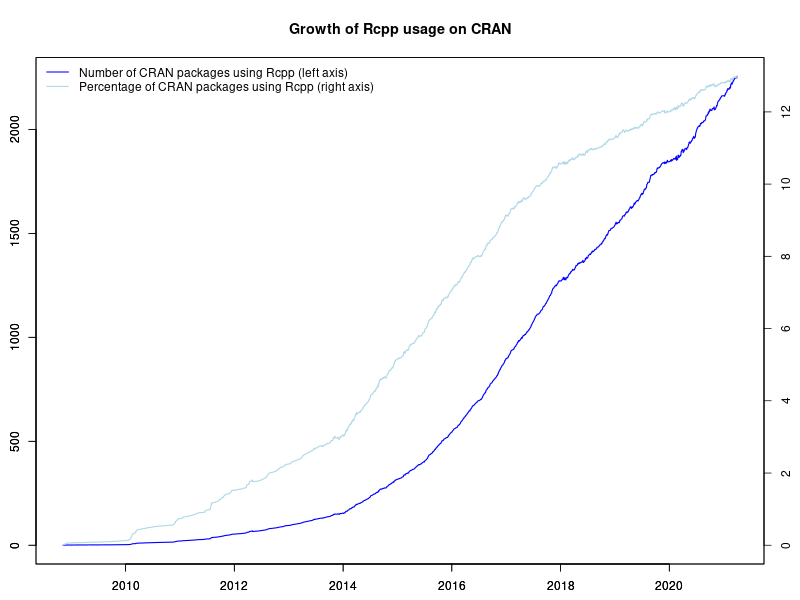
2250 Rcpp packages As of today, Rcpp stands at 2255 reverse-dependencies on CRAN. The graph on the left depicts the growth of Rcpp usage (as measured by Depends, Imports and LinkingTo, but excluding Suggests) over time. We actually crossed 2250 once a week ago, but what CRAN giveth, CRAN also taketh and counts can fluctuate. It had dropped back to 2248 a few days later. Rcpp was first released in November 2008. It probably cleared 50 packages around three years later in December 2011, 100 packages in January 2013, 200 packages in April 2014, and 300 packages in November 2014. It passed 400 packages in June 2015 (when I tweeted about it), 500 packages in late October 2015, 600 packages in March 2016, 700 packages last July 2016, 800 packages last October 2016, 900 packages early January 2017, 1000 packages in April 2017, 1250 packages in November 2017, 1500 packages in November 2018, 1750 packages in August 2019, and then the big 2000 packages (as well as one in eight) in July 2020. The chart extends to the very beginning via manually compiled data from CRANberries and checked with crandb. The next part uses manually saved entries. The core (and by far largest) part of the data set was generated semi-automatically via a short script appending updates to a small file-based backend. A list of packages using Rcpp is available too. Also displayed in the graph is the relative proportion of CRAN packages using Rcpp. The four per-cent hurdle was cleared just before useR! 2014 where I showed a similar graph (as two distinct graphs) in my invited keynote. We passed five percent in December of 2014, six percent July of 2015, seven percent just before Christmas 2015, eight percent in the summer of 2016, nine percent mid-December 2016, cracked ten percent in the summer of 2017 and eleven percent in 2018. Last year, along with passing 2000 package, we also passed 12.5 percent so one more than in every eight CRAN packages depends on Rcpp. Stunning. There is more detail in the chart: how CRAN seems to be pushing back more and removing more aggressively (which my CRANberries tracks but not in as much detail as it could), how the growth of Rcpp seems to be slowing somewhat outright and even more so as a proportion of CRAN as one would expect a growth curve to. 2250 user packages, and the continued growth, is truly mind-boggling. We can use the progression of CRAN itself compiled by Henrik in a series of posts and emails to the main development mailing list. Not that long ago CRAN itself did have only 1000 packages, then 5000, 10000, and here we are at over 17300 with Rcpp now at nearly 13.0% and still growing. Amazeballs. The Rcpp team, recently grown in strength with the addition of I aki, continues to aim for keeping Rcpp as performant and reliable as it has been. A really big shoutout and Thank You! to all users and contributors of Rcpp for help, suggestions, bug reports, documentation or, of course, code. If you like this or other open-source work I do, you can now sponsor me at GitHub.

This post by Dirk Eddelbuettel originated on his Thinking inside the box blog. Please report excessive re-aggregation in third-party for-profit settings.

30 March 2021

Dirk Eddelbuettel: x13binary 1.1.39-3 on CRAN: (Imperfect) Package Updates

A new release 1.1.39-3 of x13binary, of the X-13ARIMA-SEATS program by the US Census Bureau (with upstream release 1.1.39) is now on CRAN. The x13binary package takes the pain out of installing X-13ARIMA-SEATS by making it a fully resolved CRAN dependency. For example, when installing the excellent seasonal package by Christoph, then X-13ARIMA-SEATS will get pulled in via the x13binary package and things just work. Just depend on x13binary and on all major OSs supported by R you should have an X-13ARIMA-SEATS binary installed which will be called seamlessly by the higher-level packages such as seasonal or gunsales. With this the full power of the what is likely the world s most sophisticated deseasonalization and forecasting package is now at your fingertips and the R prompt, just like any other of the 17350+ CRAN packages. You can read more about this (and the seasonal package) in the Journal of Statistical Software paper by Christoph and myself. This release was needed because the recent M1mac build was reporting leftover detritus in the temporary directory, which we addressed with an explicit removal at end. We also addressed another CRAN Policy change since the last release, namely a conversion of the configure script from bash to sh. Now, sadly, that second aspect blew up on Solaris, and the detritus issue appears to be persist. By now Christoph and a colleague have installed R(-devel) on such an M1 machine, but still cannot reproduce. We will reach out to CRAN to learn more. A follow-up release 1.1.39-4 is likely. The good news is that the standard macOS binary works on M1 as do other binaries thanks to the translation layer. We do however lack a genuine binary for Solaris so if any of the esteemed readers of this post happens to have access to R on Solaris along with a basic Fortran compiler, we would love to hear from you. Building X-13ARIMA-SEATS from source on Solaris should be straightforward, it is on the other OSs. Courtesy of my CRANberries, there is also a diffstat report for this release showing changes to the previous release. If you like this or other open-source work I do, you can sponsor me at GitHub.

This post by Dirk Eddelbuettel originated on his Thinking inside the box blog. Please report excessive re-aggregation in third-party for-profit settings.

28 March 2021

Dirk Eddelbuettel: RcppSpdlog 0.0.5 on CRAN: New upstream versions

About three months after the last update, we can announce a new version 0.0.5 of RcppSpdlog. It contains releases 1.8.3, 1.8.4 and 1.8.5 of spdlog which were made in quick succession mid-week (while we were waiting on an update of CRAN s own machinery) and was processed yesterday and overnight. RcppSpdlog bundles spdlog, a wonderful header-only C++ logging library with all the bells and whistles you would want that was written by Gabi Melman, and also includes fmt by Victor Zverovich. The NEWS entry for this release follows.

Changes in RcppSpdlog version 0.0.5 (2020-12-11)
  • Upgraded to upstream release spdlog 1.8.5 (and 1.8.4 and 1.8.3)
  • Small enhancements to DESCRIPTION files

Courtesy of my CRANberries, there is also a diffstat report. More detailed information is on the RcppSpdlog page. If you like this or other open-source work I do, you can sponsor me at GitHub.

This post by Dirk Eddelbuettel originated on his Thinking inside the box blog. Please report excessive re-aggregation in third-party for-profit settings.

20 March 2021

Dirk Eddelbuettel: An Ode to Stable Interfaces: R and R Core Deserve So Much Praise

A few days ago, a friend and I were riffing about the wonderful stability of R and (subsets of) R packages. The rigorous ASAN/UBSAN/Valgrind/ checks, while at times frustrating for us package maintainers when we do not have easily replicable setups [1], really help in ensuring code quality. As do of course all other layers of quality control at CRAN, and for R. In passing, I mentioned there was an older blog post demonstrating a little power-law-alike behaviour between the most frequent R Core committer and everybody else. So I was intrigued. Could we just pick up a blog post I had written in August of 2007, or almost fourteen years ago, and run it as is? [2] Yes, we can. Which is truly, truly awesome. Back then I must have taken a minor shortcut and analysed just one calendar year of SVN that was pre-extracted (and a few more still exists here if one scrolls down). Maybe then I might not have had the r-devel SVN repo checkout. But these days (and for probably a decade now) I do, and just a few lines of bash get us a full log:
#!/bin/bash

## adjust as needed
svn=$ HOME /svn/r-devel

rev=$(cd $ svn  && svn info --show-item revision)
today=$(date +%Y-%m-%d)

echo -n "Extracting $ rev  revisions at $ today  ... "
(cd $ svn  && svn log --limit $ rev  )   gzip -9 > svn-log-$ today .txt.gz
echo "done"
So that leads to one code adjustments given the different input source. But otherwise the first paragraph runs as is (and now gives us 49.2% for the amazing Prof Ripley):
logfile <- "svn-log-2021-03-20.txt.gz"

## cf http://dirk.eddelbuettel.com/blog/2007/08/11/
x <- readLines(logfile)
rx <- x[grep("^r",x)]
who <- gsub(" ","",sapply(strsplit(rx,"\\ "),"[",2))
twho <- table(who)
twho["ripley"]/sum(twho)
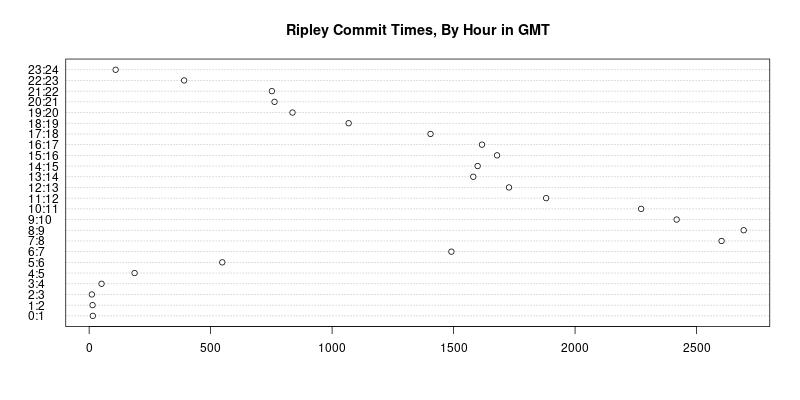
That is what one gets by trusting stable interfaces: code untouched for fourteen years runs unchanged. R itself has had well over sixty releases since then, including two major and eighteen minor releases. Yet the code just runs, including the code for two graphs one can reproduce with the exact same code as we show next.
tod <- unlist(sapply(rx,function(x)strsplit(x,split=" ")[[1]][6]))
tod <- tod[who=="ripley"]

tz <- sub(pattern=".*(-[0-9] 4 ).*",replacement="\\1",x=rx)
tz <- tz[who=="ripley"]
tz <- as.numeric(tz)/100
offset <- 3600*tz

z <- strptime(tod,format="%H:%M:%S")
hist(z,"hours",main="Ripley Commit Times in SVN TZ")

h <- z - offset
h <- format(h,format="%H")
h <- factor(as.numeric(h), levels=0:23)
## added as.vector() here to suppress a warning
dotchart(as.vector(table(h)), main="Ripley Commit Times, By Hour in GMT",
         labels=paste(0:23,1:24,sep=":"))
The code reproduces the chart from 2008, but this time uses the full twenty plus years of SVN history. I added just one as.vector() to suppress one new warning which appears under current R and which was presumably added in the fourteen years since (at the chart is produces without it too). The remainder of the code also runs. I just added one library(zoo) my blog post had omitted. No other changes.
## rather extract both  date and time
dat <- unlist(sapply(rx, function(x)  
  txt <- strsplit(x,split=" ")[[1]]
  paste(txt[5], txt[6])
 ))
## subset on Prof Ripley
dat <- dat[who == "ripley"]
## and convert to POSIXct, correcting by tz as well
datpt <- as.POSIXct(strptime(dat,format="%Y-%m-%d %H:%M:%S")) - offset

## turn into zoo -- we use a constant series of ones as each
## committ is taken as a timestamped event
library(zoo)
datzoo <- zoo(1, order.by=datpt)
## and use zoo to aggregate into commits per date
daily <- aggregate(datzoo, as.Date(index(datzoo)), sum)

## now plot as grey bars
plot(daily, col='darkgrey', type='h', lwd=2,
     ylab="Nb of SVN commits, three-week median",
     xlab="R release dates 2.5.0 and 2.5.1 shown in orange",
     main="The amazing Prof. Ripley")
## mark the two R releases of 2007
abline(v=c(as.Date("2007-04-24"),as.Date("2007-06-28")),col='orange',lwd=1.5)
## and do a quick centered rolling median
lines(rollmedian(daily, 21, align="center"), lwd=3)
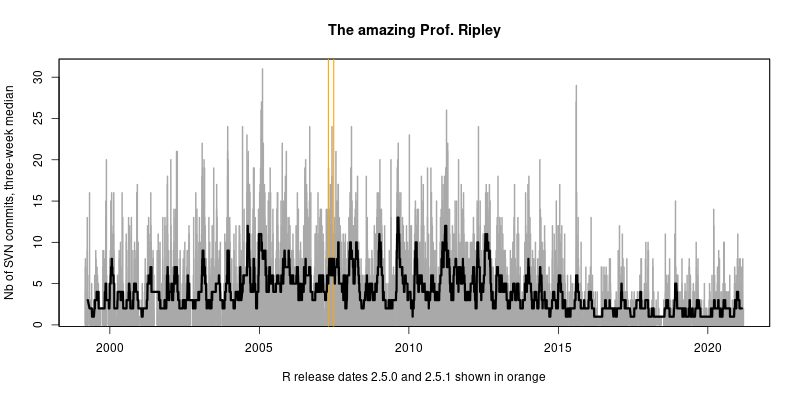
It produces this chart spanning two decades of commits. [3] The subtitle highlighting the then-most-recent releases is a little quaint now given that R has had eighten major.minor releases, and over sixty total releases, since then. Stable and rigourously maintained interfaces are a fantastic resource that is dramatically under-appreciated. Efforts such as the ten-year reproduction challenge demonstrate that this really is not a given. Maybe instead of celebrating band aides ( look, I reproduce via code I have frozen in a virtual environment / container / machine / ) we should celebrate languages, ecosystems, packages, that allow us to rely on just the code itself. Because we can. And we should strengthen and reinforce that ability. And discourage rapid changes just for changes sake. Code running for a decade, or even longer, is a huge boon to everybody relying on it. Three cheers to R Core. [1] Docker containers would be really good, and a step above the specs in the README. Winston s nice r-debug sumo container comes closest and helps a lot, and is updated regularly (which my earlier r-devel-san container is not). [2] The post owes some of its code ideas to Ben Bolker and Simon Jackman, but links to now-stale prior affiliations of theirs. [3] And the singularly impressive contributions charted remain unparalled, but were already the focus of the previous post. Yet over three times as a long period, they remain even more stunning. Edit 2021-03-21: Two minor fixes for grammar and typing.
10 March 2021

Dirk Eddelbuettel: RcppArmadillo 0.10.2.2.0 on CRAN: New Upstream Patch Release

armadillo image Armadillo is a powerful and expressive C++ template library for linear algebra aiming towards a good balance between speed and ease of use with a syntax deliberately close to a Matlab. RcppArmadillo integrates this library with the R environment and language and is widely used by (currently) 841 other packages on CRAN. This release brings us a second update within the Armadillo 10.2 series, one month after the initial release. Upstream work has commenced at a 10.3 series with first pre-releases which we are currently testing. If possible, CRAN release will continue to be at least one month apart (such as this time) but we continue to make interim releases available on the Rcpp drat repo repo. The full set of changes follows.

Changes in RcppArmadillo version 0.10.2.2.0 (2021-03-09)
  • Upgraded to Armadillo release 10.2.2 (Cicada Swarm)
    • faster handling of subcubes
    • added tgamma()
    • added .brief_print() for abridged printing of matrices & cubes
    • expanded forms of trimatu() and trimatl() with diagonal specification to handle sparse matrices
    • expanded eigs_sym() and eigs_gen() with optional shift-invert mode
  • Removed debian/ directory from repository as packaging is on salsa.debian.org.
  • Relaxed tolerance on two cube tests on Windows to accomodate new 'gcc10-UCRT' builder.

Courtesy of my CRANberries, there is a diffstat report relative to previous release. More detailed information is on the RcppArmadillo page. Questions, comments etc should go to the rcpp-devel mailing list off the R-Forge page. If you like this or other open-source work I do, you can sponsor me at GitHub.

This post by Dirk Eddelbuettel originated on his Thinking inside the box blog. Please report excessive re-aggregation in third-party for-profit settings.

1 March 2021

Dirk Eddelbuettel: RPushbullet 0.3.4: Small Update, Nicer Docs

RPpushbullet demo Release 0.3.4 of the RPushbullet package arrived on CRAN today. RPushbullet interfaces the neat Pushbullet service for inter-device messaging, communication, and more. It lets you easily send (programmatic) alerts like the one to the left to your browser, phone, tablet, or all at once. This release contains a contributed PR to better reflect an error code, and adds a mkdocs-material-based documentation site (just like a few other packages of mine). See below for more details.

Changes in version 0.3.4 (2021-03-01)
  • Return code checking using error code content if it exists (Thomas Shafer in #64).
  • Enabled GitHub Actions with encrypted JSON file for API access.
  • Added a package documentation website.

Courtesy of my CRANberries, there is also a diffstat report for this release. More details about the package are at the RPushbullet webpage and the RPushbullet GitHub repo. If you like this or other open-source work I do, you can now sponsor me at GitHub.

This post by Dirk Eddelbuettel originated on his Thinking inside the box blog. Please report excessive re-aggregation in third-party for-profit settings.

24 February 2021

Dirk Eddelbuettel: RcppSimdJson 0.1.4 on CRAN: Small Bugfix

A quick note to say that we finalized a bugfix release 0.1.5 of RcppSimdJson yesterday which got onto CRAN earlier today. RcppSimdJson wraps the fantastic and genuinely impressive simdjson library by Daniel Lemire and collaborators. Via very clever algorithmic engineering to obtain largely branch-free code, coupled with modern C++ and newer compiler instructions, it results in parsing gigabytes of JSON parsed per second which is quite mindboggling. The best-case performance is faster than CPU speed as use of parallel SIMD instructions and careful branch avoidance can lead to less than one cpu cycle per byte parsed; see the video of the talk by Daniel Lemire at QCon (also voted best talk). This version brings a small fix to Windows where temporary filenames constructed from URLs (as for example constructed by our td package) need an extra sanization for a possible ? character. We will be addressing that properly in due course but for now a simple gsub() will do. The NEWS entry follows.

Changes in version 0.1.5 (2021-02-23)
  • Temporary filenames from request URLs need an extra path sanitization on Windows as seen with package td.
  • A few #nocov tags were added to the code.

Courtesy of my CRANberries, there is also a diffstat report for this release. For questions, suggestions, or issues please use the issue tracker at the GitHub repo. If you like this or other open-source work I do, you can now sponsor me at GitHub.

This post by Dirk Eddelbuettel originated on his Thinking inside the box blog. Please report excessive re-aggregation in third-party for-profit settings.

22 February 2021

Dirk Eddelbuettel: pkgKitten 0.2.1: Now with roxygen2 support

kitten A new release 0.2.1 of pkgKitten hit CRAN earlier today, and has been uploaded to Debian as well. pkgKitten makes it simple to create new R packages via a simple function invocation. A wrapper kitten.r exists in the littler package to make it even easier. This release builds on the support for tinytest we added in release 0.2.0 by adding more optional support, this time for roxygen2. It also corrects a minor documentation snafu, and updates the CI use.

Changes in version 0.2.1 (2021-02-22)
  • A small documentation error was corrected (David Dalpiaz in #15).
  • A new option bunny adds support for roxygen2.
  • Continuous integration now use run.sh from r-ci.

More details about the package are at the pkgKitten webpage, the pkgKitten docs site, and the pkgKitten GitHub repo. Courtesy of my CRANberries site, there is also a diffstat report for this release. If you like this or other open-source work I do, you can now sponsor me at GitHub.

This post by Dirk Eddelbuettel originated on his Thinking inside the box blog. Please report excessive re-aggregation in third-party for-profit settings.

18 February 2021

Dirk Eddelbuettel: td 0.0.2 on CRAN: Updated and Expanded

The still very recent td package for accessing the twelvedata API for financial data has been updated and is now at version 0.0.2. The time_series access point is now vectorised: supply a vector of symbols, and you receive list of data.frame (or xts) objects. See this tweet teasing out the earliest support for this new featire, and showing a quick four-securities plot. We also added simpler accessors get_quote() and get_price() rounding out the basic API support. One first bug report alerting us to the fact that our use of RcppSimdJson requires an additional sanitizing of the temporary filename if used on Windows. We will fix that properly soon in new release 0.1.5 of that package; in the meantime you can get hot-fix binary 0.1.4.1 for Windows via install.packages("RcppSimdJson", repos="https://ghrr.github.io/drat") from the ghrr drat. The NEWS entry follows.

Changes in version 0.0.2 (2021-02-18)
  • The time_series is now vectorised and can return a list of return objects when given a vector of symbols
  • The use of tools::R_user_dir() is now conditional on having R 4.0.0 or later, older versions can use env.var for api key
  • New helper function store_key to save api key.
  • New simple accessors get_quote and get_price

Courtesy of my CRANberries, there is a comparison to the previous release. For questions or comments use the issue tracker off the GitHub repo. If you like this or other open-source work I do, you can now sponsor me at GitHub.

This post by Dirk Eddelbuettel originated on his Thinking inside the box blog. Please report excessive re-aggregation in third-party for-profit settings.

Dirk Eddelbuettel: dang 0.0.13: New intradayMarketMonitor

sp500 intraday monitor A new release of the dang package got to CRAN earlier today, a few months since the last relase. The dang package regroups a few functions of mine that had no other home as for example lsos() from a StackOverflow question from 2009 (!!) is one, this overbought/oversold price band plotter from an older blog post is another. This release adds one function I tweeted about one month ago. It takes a function Josh Ulrich originally tweeted about in November with a reference to this gist. I refactored this into a proper functions and polished a few edges: the data now properly rolls off after a fixed delay (of two days), should work with other symbols (though we both focused on ^GSPC as a free (!!) real-time SP500 index (albeit only during trading hours), properly gaps between trading days and more. You can simply invoke it via
dang::intradayMarketMonitor()
and a chart just like the one here will grow (though there is no state : if you stop it, or reboot, or the plot starts from scratch). The short NEWS entry follows.

Changes in version 0.0.13 (2021-02-17)
  • New function intradayMarketMonitor based on an earlier gist-posted snippet by Josh Ulrich.
  • The CI setup was generalized as a test for 'r-ci' and is used essentially unchanged with three different providers.

Courtesy of my CRANberries, there is a comparison to the previous release. For questions or comments use the issue tracker off the GitHub repo. If you like this or other open-source work I do, you can now sponsor me at GitHub.

This post by Dirk Eddelbuettel originated on his Thinking inside the box blog. Please report excessive re-aggregation in third-party for-profit settings.

Next.

Previous.