Search Results: "ron"

18 September 2013

Francois Marier: Presenting from a separate user account

While I suspect that professional speakers have separate presentation laptops that they use only to give talks, I don't do this often enough to justify the hassle and cost of a separate machine. However, I do use a separate user account to present from. It allows me to focus on my presentation and not stress out about running into configuration problems or exposing private information. But mostly, I think it's about removing anything that could be distracting for the audience. The great thing of having a separate user for this is that you can do whatever you want in your normal account and still know that the other account is ready to go and configured for presenting on a big screen.

Basics The user account I use when giving talks is called presenter and it has the same password as my main user account, just to keep things simple. However, it doesn't need to belong to any of the UNIX groups that my main user account belongs to. In terms of configuration, it looks like this:
  • power management and screen saver are turned off
  • all sound effects are turned off
  • window manager set to the default one (as opposed to a weird tiling one)
  • desktop notifications are turned off
Of course, this user account only has the software I need while presenting. You won't find an instant messaging, IRC or Twitter client running on there. The desktop only has the icons I need for the presentation: slides and backup videos (in case the network is down and/or prevents me from doing a live demo).

Web browsers While I usually have my presentations in PDF format (for maximum compatibility, you never know when you'll have to borrow someone else's laptop), I use web browsers (different ones to show that my demos work with all of them) all the time for demos. Each browser:
  • clears everything (cookies, history, cache, etc.) at the end of the session
  • has the site I want to demo as the homepage
  • only contains add-ons or extensions I need for the demos
  • has the minimal number of toolbars and doesn't have any bookmarks
  • has search suggestions turned off
  • never asks to remember passwords

Terminal and editors Some of my demos may feature coding demos and running scripts, which is why I have my terminal and editor set to:
  • a large font size
  • a color scheme with lots of contrast
It's all about making sure that the audience can see everything and follow along easily. Also, if you have the sl package installed system-wide, you'll probably want to put the following in your ~/.bashrc:
alias sl="ls"
alias LS="ls"

Rehearsal It's very important to rehearse the whole presentation using this account to make sure that you have everything you need and that you are comfortable with the configuration (for example, the large font size). If you have access to a projector or a digital TV, try connecting your laptop to it. This will ensure that you know how to change the resolution of the external monitor and to turn mirroring ON and OFF ahead of time (especially important if you never use the default window manager or desktop environment). I keep a shortcut to the display settings in the sidebar.

Localization Another thing I like to do is to set my operating system and browser locales to the one where I am giving a talk, assuming that it is a western language I can understand to some extent. It probably doesn't make a big difference, but I think it's a nice touch and a few people have commented on this in the past. My theory is that it might be less distracting to the audience if they are shown the browser UI and menus they see every day. I'd love to have other people's thoughts on this point though. Also, pay attention to the timezone since it could be another source of distraction as audience members try to guess what timezone your computer is set to.

Anything else? If you also use a separate account for your presentations, I'd be curious to know whether there are other things you've customised. If there's anything I missed, please leave a comment!

17 September 2013

Julien Danjou: Python 3.4 single dispatch, a step into generic functions

I love to say that Python is a nice subset of Lisp, and I discover that it's getting even more true as time passes. Recently, I've stumbled upon the PEP 443 that describes a way to dispatch generic functions, in a way that looks like what CLOS, the Common Lisp Object System, provides. What are generic functions If you come from the Lisp world, this won't be something new to you. The Lisp object system provides a really good way to define and handle method dispatching. It's a base of the Common Lisp object system. For my own pleasure to see Lisp code in a Python post, I'll show you how generic methods work in Lisp first. To begin, let's define a few very simple classes.
(defclass snare-drum ()
())

(defclass cymbal ()
())

(defclass stick ()
())

(defclass brushes ()
())

This defines a few classes: snare-drum, symbal, stick and brushes, without any parent class nor attribute. These classes compose a drum kit, and we can combine them to play sound. So we define a play method that takes two arguments, and returns a sound (as a string).
(defgeneric play (instrument accessory)
(:documentation "Play sound with instrument and accessory."))

This only defines a generic method: it has no body, and cannot be called with any instance yet. At this stage, we only inform the object system that the method is generic and can be then implemented with various type of arguments. We'll start by implementing versions of this method that knows how to play with the snare-drum.
(defmethod play ((instrument snare-drum) (accessory stick))
"POC!")

(defmethod play ((instrument snare-drum) (accessory brushes))
"SHHHH!")

Now we just defined concrete methods with code. They also takes two arguments: instrument which is an instance of snare-drum and accessory that is an instance of stick or brushes. At this stage, you should note the first difference with object system as built into language like Python: the method isn't tied to any class in particular. The methods are generic, and any class can implement them, or not. Let's try it.
* (play (make-instance 'snare-drum) (make-instance 'stick))
"POC!"

* (play (make-instance 'snare-drum) (make-instance 'brushes))
"SHHHH!"

* (play (make-instance 'cymbal) (make-instance 'stick))
debugger invoked on a SIMPLE-ERROR in thread
#<THREAD "main thread" RUNNING 1002ADAF23 >:
There is no applicable method for the generic function
#<STANDARD-GENERIC-FUNCTION PLAY (2)>
when called with arguments
(#<CYMBAL 1002B801D3 > #<STICK 1002B82763 >).

Type HELP for debugger help, or (SB-EXT:EXIT) to exit from SBCL.

restarts (invokable by number or by possibly-abbreviated name):
0: [RETRY] Retry calling the generic function.
1: [ABORT] Exit debugger, returning to top level.

((:METHOD NO-APPLICABLE-METHOD (T)) #<STANDARD-GENERIC-FUNCTION PLAY (2)> #<CYMBAL 1002B801D3 > #<STICK 1002B82763 >) [fast-method]

As you see, the function called depends on the class of the arguments. The object systems dispatch the function calls to the right function for us, depending on the arguments classes. If we call play with instances that are not know to the object system, an error will be thrown. Inheritance is also supported and the equivalent (but more powerful and less error prone) equivalent of Python's super() is available via (call-next-method).
(defclass snare-drum () ())
(defclass cymbal () ())

(defclass accessory () ())
(defclass stick (accessory) ())
(defclass brushes (accessory) ())

(defmethod play ((c cymbal) (a accessory))
"BIIING!")

(defmethod play ((c cymbal) (b brushes))
(concatenate 'string "SSHHHH!" (call-next-method)))

In this example, we define the stick and brushes classes as subclass of the accessory class. The play method defined will return the sound BIIING! regardless of the accessory instance that is used to play the cymbal. Except in the case where it's a brushes instance; only the most precise method is always called. The (call-next-method) function is used to call the closest parent method, in this case that would be the method returning _"BIIING!".
* (play (make-instance 'cymbal) (make-instance 'stick))
"BIIING!"

* (play (make-instance 'cymbal) (make-instance 'brushes))
"SSHHHH!BIIING!"

Note that CLOS is also able to dispatch on object instances themself by using the eql specializer. But if you're really curious about all features CLOS provides, I suggest you read the brief guide to CLOS by Jeff Dalton as a starter. Python implementation Python implements a simpler equivalence of this workflow with the singledispatch function. It will be provided with Python 3.4 as part of the functools module. Here's a rough equivalence of the above Lisp program.
import functools

class SnareDrum(object): pass
class Cymbal(object): pass
class Stick(object): pass
class Brushes(object): pass

@functools.singledispatch
def play(instrument, accessory):
raise NotImplementedError("Cannot play these")

@play.register(SnareDrum)
def _(instrument, accessory):
if isinstance(accessory, Stick):
return "POC!"
if isinstance(accessory, Brushes):
return "SHHHH!"
raise NotImplementedError("Cannot play these")

We define our four classes, and a base play function that raises NotImplementedError, indicating that by default we don't know what to do. We can then write specialized version of this function with a first instrument, the SnareDrum. We then check for the accessory type that we get, and return the appropriate sound or raise NotImplementedError again if we don't know what to do with it. If we run it, it works as expected:
>>> play(SnareDrum(), Stick())
'POC!'
>>> play(SnareDrum(), Brushes())
'SHHHH!'
>>> play(Cymbal(), Brushes())
Traceback (most recent call last):
File "<stdin>", line 1, in <module>
File "/home/jd/Source/cpython/Lib/functools.py", line 562, in wrapper
return dispatch(args[0].__class__)(*args, **kw)
File "/home/jd/sd.py", line 10, in play
raise NotImplementedError("Cannot play these")
NotImplementedError: Cannot play these
>>> play(SnareDrum(), Cymbal())
Traceback (most recent call last):
File "<stdin>", line 1, in <module>
File "/home/jd/Source/cpython/Lib/functools.py", line 562, in wrapper
return dispatch(args[0].__class__)(*args, **kw)
File "/home/jd/sd.py", line 18, in _
raise NotImplementedError("Cannot play these")
NotImplementedError: Cannot play these

The singledispatch module looks through the classes of the first argument passed to the play function, and calls the right version of it. The first defined version of the play function is always run for the object class, so if our instrument is a class that we did not register for, this base function will be called. For whose eager to try and use it, the singledispatch function is provided Python 2.6 to 3.3 through the Python Package Index. Limitations First, as you noticed in the Lisp version, CLOS provides a multiple dispatcher that can dispatch on the type of any of the argument defined in the method prototype, not only the first one. Unfortunately, Python dispatcher is named singledispatch for this good reason: it only knows to dispatch on the first argument. Guido van Rossum wrote a short article about the subject that he called multimethod a few years ago. Then, there's no way to call the parent function directly. There's no equivalent of the (call-next-method) from Lisp nor the super() function that allows to do that in Python class system. This means you will have to use various trick to bypass this limitation. So while I am really glad that Python is going toward that direction, as it's a really powerful way to enhance an object system, it really lacks a lot of more advanced features that CLOS provides out of the box. Though, improving this could be an interesting challenge. Especially to bring more CLOS power to Hy. :-)
The Hacker Guide to Python
A book I'm writing that will be launched soon, talking about designing Python applications, state of the art, and various Python tips. If you want to be the first to hear about the launch, subscribe now.

Vincent Sanders: Ever tried. Ever failed. No matter. Try Again. Fail again. Fail better.


I seem to be adhering to Beckett's approach recently but for some reason, after my previous stool attempts, despite having a functioning design I felt I had to do just one more iteration.

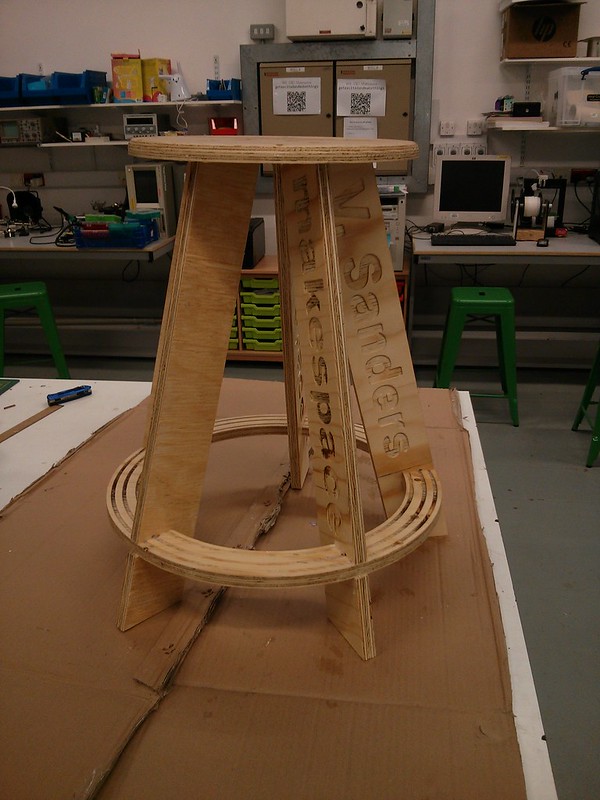
Five legged stoolGoing back to a previous concept of having five legs instead of three while this did not improve the rotational problems with the 12mm thick material, it did make the design more stable overall and less prone to tipping.

The five legged solution realised in 18mm plywood resulted in my final design for this concept. As my friend Stephen demonstrates the design is pretty solid even for those of us with a more ample frame. There are now a couple of them in use at the space alongside the three legged earlier versions.

I was finally satisfied with the result and thought I was done with furniture making for a while. My adorable wife then came up with a challenge, she wanted a practical foldable chair her requirements were:
A frame folding chair, image from wikimedia
Things for individual humans to sit on raised off the floor, or chairs as we call them, have been around for a long time. My previous research for the stool indicated that chairs have a long history with examples still surviving from the ancient egyptians. From this I assumed there would be nothing novel in this project and to quote the song it's all been done before
Foldingchairs
Given this perspective my research started with an image search for "folding chair". The results immediately showed there were two common shapes. Either the chair base was formed with a pair of linked X shapes with the seat across the top, or an A frame style where the seat is across the centre.

My initial thoughts were to replicate the IKEA style A frame design until I noticed that some designs were made from a single sheet of timber with a small number of profile cuts. I searched for pre-existing design files but found none, perhaps I had found something novel to do after all.

A frame chair  1 - Front  2 - Rear  3- seat
Some quick measurements of chairs in shops (and more weird looks, mainly from my family) suggested 900mm is generally the highest a chair ought to stand. I selected a popliteal height of 420mm as a general use compromise which is a bit less than the 430mm of most mass produced chairs. I also decided there should be a front to rear drop across the seat which ought to improve comfort a little.

Material selection was based upon what I had to hand which consisted of a couple of sheets of structural plywood (1220x606x18mm temperate softwood - probably spruce although not specified) which had not become stools yet. Allowing for edge wastage and tool width this gave me a working area from a sheet of 1196x582mm.

I sketched the side view of the chair numbering the three parts. I decided part 1 would be 1000mm total height with top and bottom cross braces 80mm high, assuming the 900mm tall target, the A frame apex would be at 820mm height.

If we assert that the apex is immediately below the top cross brace on part 1 this gives 920mm at which point we have two sides of a right angled triangle (820 and 920) from which we can calculate the top angle is 26 . This also means part 2 will be 840mm long with the same 820 height this gives an angle of 10 .

I did the maths for the seat triangle using the 36 angle and 420mm popliteal height. Having experienced how flexible 18mm plywood was in the face dimension I decided to make the frame sides 50mm wide leaving, after 6mm tool path widths, enough space for a 358mm wide seat .

Once the dimensions were decided the design went pretty quickly producing something that looked similar to the designs I had seen earlier.

CNC routers can go wrong, spot the fail
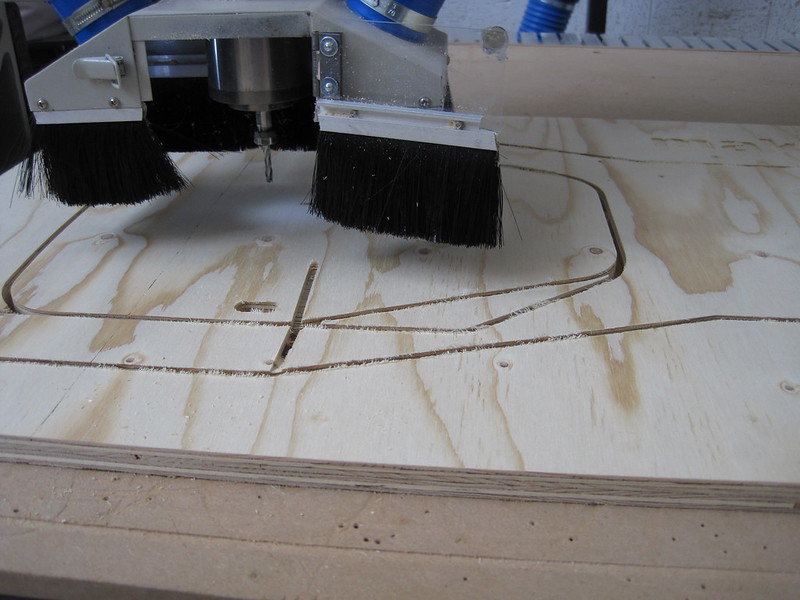
Generating toolpaths for this design proved challenging with the CAM software we had available, mainly because arranging multiple "inner" and "outer" cuts along the same path and having the tabs line up was obviously not an anticipated feature.

Things had been going far too well for me and during the routing operation our machine decided to follow an uncommanded toolpath excursion mid job (it cut a dirty great hole through the middle of my workpiece where I did not want it) ruining the sheet of material.

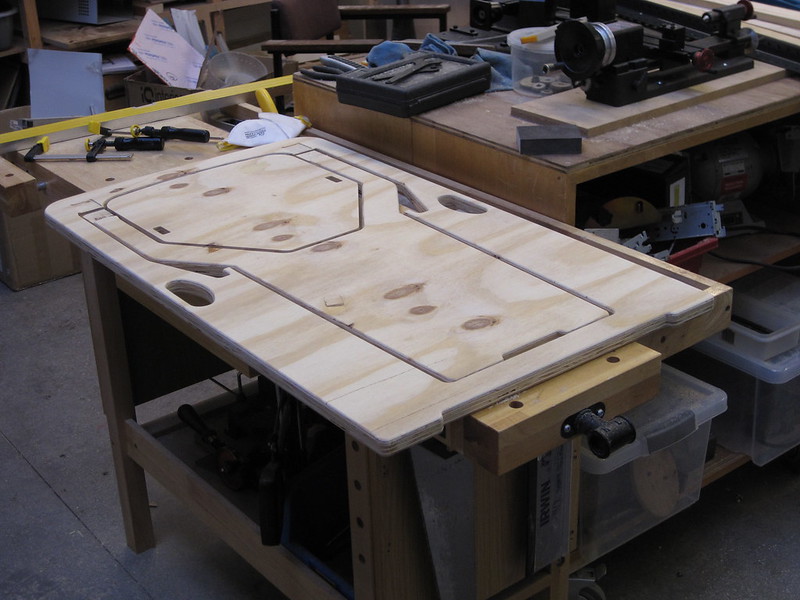
Fortunately, once factory reset and reconfigured, the machine ran the job correctly the second time although we still do not know why it went wrong. The parts were cut free of their tabs and hinges fitted.

The resulting design worked with a couple of problems:
Folding chair in 24mm plywood with edges rounded off
So time for a second iteration, this time I selected a thicker plywood to reduce the bend under large loads (OK already, I mean me). After shopping around for several days I discovered that unlike 12mm and 18mm thick plywood 24mm thick is much harder to find at a sensible price especially if you want it cut into 1220x606 sheets from the full 1220x2440.

I eventually physically went to Ridgeons and looked at what they actually had in the warehouse and got a price on a sheet of brazilian elliotis pine structural plywood for 43.96 which they cut for me while I waited. Being physically present also gave me the opportunity to pick a "less bad" sheet from the stack much to the annoyance of the Ridgeons employee for not just taking the top one.

This time I reduced the apex height by 30mm, the length of part 1 by 80mm. I also reduced the frame width by 10mm relying on the increased thickness of the plywood to maintain the strength. In area terms it is actually an increase in material (50mm*17.7mm = 885 against 40mm*22.80 = 912). I also included rebates for the top hinges within the design allowing them to be mounted flush within the sheet width.

The new design was cut (without incident this time) and the edges rounded off. I also added some simple catches to keep the seat and back inline while being transported.

While this version worked I had made a couple of mistakes again. The first was simply a radius versus diameter error on the handles which meant too much material was removed from a high stress area causing increased bending.

Third version of folding chair ready for finishing
The second error was a stupid mistake that where I had worked the latch holes in the seat to the wrong side of my measure line meaning the apex angle was 35.5 not the expected 33.6 which meant the backrest felt "too far forward"

The third version rectified those two errors and improved the seat front curve a little to further reduce the unneeded material in the back rest.

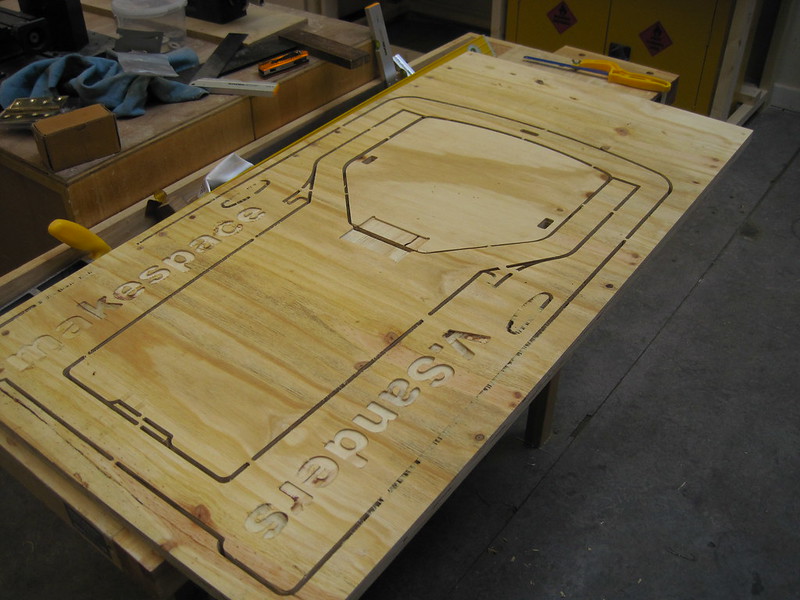
The fabrication of this design was double sided allowing for the seat hinge to be fully rebated and become flush and also adding some text similar to the stools.

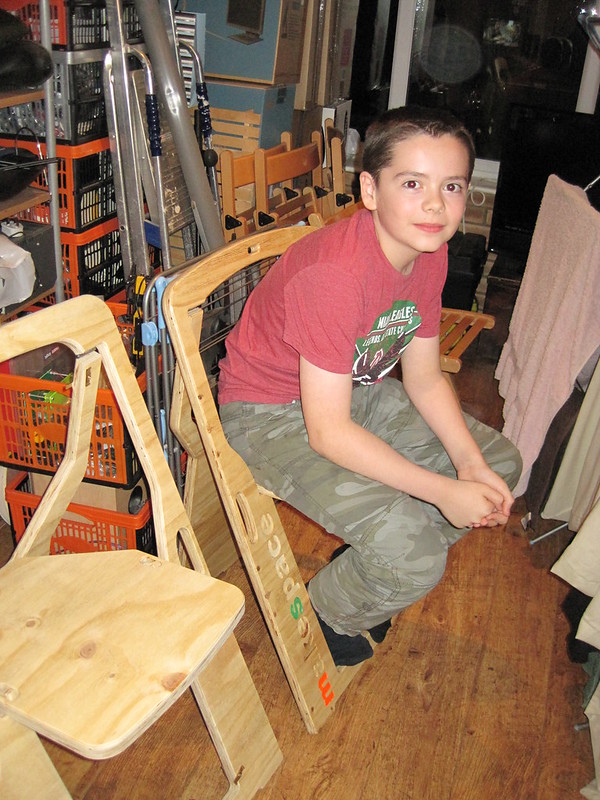
Alex sat on version 3 folding chair
This version still suffers from a backrest that is a bit too far forward and my sons complain it makes them sit up too straight. The problem is that the angle of the front face (23.6 ) means that to move the rest back 20mm means the piece needs to extend another 50mm beyond the frame apex which would probably make the chair feel tall again.

I guess this is a compromise that would take another iteration or two to solve, alas my wife has declared a moratorium on more chairs unless I find somewhere to put the failed prototypes other than her conservatory.

One other addition would be a better form of catch for transport. The ones in version 2 work but are ugly, magnets inset into the frame have been suggested but not actually implemented yet.

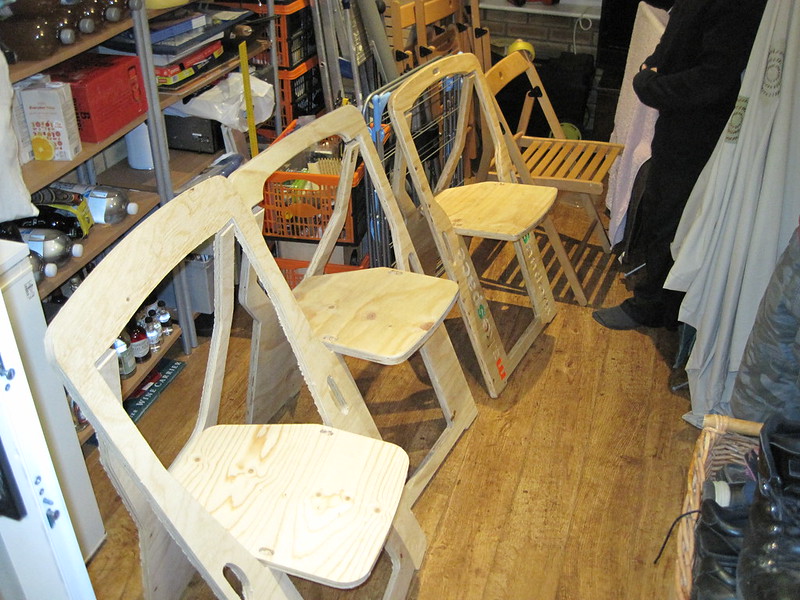
Folding chairs versions 1 to 3 and TERJE for comparison
In conclusion I think I succeeded with the original brief and am pretty pleased with the result. A neatly folding chair that can be stacked simply by having a pile of them and are easy to move and setup.

The price per chair is a little higher than I would like at 22 ( 11 for timber, 5 for hinges and screws , 5 for varnish and 1 for tool wear) plus about 2 hours labour (two sided routing plus roundover takes ages)

As previously the design files are available on github and there are plenty more images in the flikr set.

John Goerzen: Earthrise

Today I link you to a video narrated by the legendary Carl Sagan The Frontier is Everywhere. Partial quotes:
We were hunters and foragers. The frontier was everywhere. We were bounded only by the earth, and the ocean, and the sky. The open road still softly calls. Our little terraqueous globe as the madhouse of those hundred thousand millions of worlds. We, who cannot even put our own planetary home in order, riven with rivalries and hatreds; are we to venture out into space? By the time we are ready to settle even the nearest other planetary systems, we will have changed For all our failings, despite our limitations and fallibilities, we humans are capable of greatness How far will our nomadic species have wandered, by the end of the next century, and the next millennium? Our remote descendants, safely arrayed on many worlds through the solar system, and beyond, will be unified, by their common heritage, by their regard for their home planet, and by the knowledge that, whatever other life may be, the only humans in all the universe, come from Earth. They will gaze up and strain to find the blue dot in their skies. They will marvel at how vulnerable the repository of all our potential once was, how perilous our infancy, how humble our beginnings, how many rivers we had to cross, before we found our way.
Can you imagine seeing Earthrise? Earthrise, 1968 December 24 Incredible.

Cyril Brulebois: Fixing bugs

It s a somewhat strange feeling to spend time fixing things that broke instead of implementing new things, but it s not like I m a creative guy anyway For those last two points, the long term plan is: Hopefully getting this done this week (famous last words, eh?).

16 September 2013

Gunnar Wolf: My favorite (or rather, one among my favorite) non-original work Leo Masliah #encirc13

It seems I'm catching up with the pace of this course I'm following and that is compelling me to go back to posting on my blog, Arte y cultura en circulaci n: crear y compartir en tiempos digitales . This week's lesson is (again, in Spanish) Las fronteras del remix (the boundaries of remixes). An interesting text, open to everybody (regardless of whether you are signed up for the course or, I hope, whether time has passed since the course took place). And this week's homework is to find "our favorite" non-original work (I picked one among my favorite works And, yes, this is partly because I am part of the "club" of deniers of true originality: We cannot create anything without being part of a surrounding culture, without a common heritage and language with which we speak to our audience) and to find something about it, anything considered important or significative as to its antecedents. What do I like about this work, what grabs my attention. Do I consider it to be a true new creative work? Why? I am taking as an example Leo Masliah, an Uruguayan writer and musician (writer and interpreter). I have followed and enjoyed Masliah's work since 1996, and although by far I'm most familiar with his musical works, I have two books (a novel and a series of short stories). Among his facets, I most enjoy the acid, nihilistic/dadaistic streaks. I chose three of his songs to talk about I am linking to anonline resource where possible, but uploading the three songs to this blog to make his work better known, so that people understand what I talk about, and with my best intentions. Of course, if there is any request to remove the material, I will do it right away. I hope this can be seen as fair/academic use, although this blog is somewhat widely read.
La recuperaci n del unicornio
This song was in the first Masliah cassette I came across, Although musically it is an original work, the lyrics are a clear, almost line-by-line reply to the ever-repeated Unicornio song, by Silvio Rodr guez. This song (which I'm sure that every Spanish speaker reading this lines knows, like it or not It defines for me a good deal of Rodr guez hyper-sweetness and clicheness) has been analyzed over and over looking for a meaning. Silvio recorded this song in 1981, and by 1987 Masliah published this answer, mocking each of the lines.
So, this song can be seen as an original creation, as it contains no literal copy neither of the music nor of the lyrics of the original, but it cannot be understood without being familiar with Silvio's lost unicornio. It would just be an almost-dadaistic rant. But every person that has tasted Silvio Rodr guez cloying song will surely laugh with this one.
No necesitamos otro h roe Balderrama
I find this to be a very unique piece. It bonds together Argentinian folklore and USA pop.
Masliah sings the famous Argentinian song Zamba de Balderrama, (Castilla / Leguizam n), a song lamenting that the very popular bar and artist stage Balderrama, in Salta (North-Western corner of Argentina), seemed to be on the brink of closing. Of course, when Mart n, Constanza, Regina and me went to Balderrama in July 2010, the danger of closing this place had long been averted. And basically every Argentinian knows this song by heart.
The interesting part is that Masliah sings this song (as he presents it as the closing piece for one of his concerts) being short on time, and decides to present two acts together: Zamba de Balderrama and We don't need another hero, by Tina Turner, from the Mad Max soundtrack. So, of course, even if it's obvious that Masliah had to stretch bits to make them fit together, he achieved a very funny, interesting and unique blend of two completely unrelated works. He derives from one as well as from the other, but creates something unique and new.
Donna Lee
I was thinking what to write for this assignment , and had already chosen the two other songs. Yesterday, we were visiting our friends Octavio and Claudia, in Guanajuato, and I heard for the first time the original(?) version of Donna Lee, by Miles Davis (although often credited to Charlie Parker). That led me to remember Masliah's interpretation, in his Cl sicos album. This album is basically made up with similar excercises: Taking an instrumental piece, with Masliah singing over it. Some of the lyrics follow the story (i.e. the children stories), others just talk nonsense to illustrate a point (i.e. "La voz del medio", "the middle voice") follows the non-protagonist score trying not to grab much attention to the lyrics but to highlight the often ignored melody)... Donna Lee is just a fun excercise on following the melody asking what was in the head of the author that led him to invent such a strange, hard music.
Masliah is a great music performer, although often it seems he tries to hide it (i.e. by abusing the dissonances, ex-profeso singing off-key, etc), and a very funny and crazy author. Most of his works have a deep satirical tone, and it's common to find either simple winks or complete "borrowings" in a clear remix fashion, but nobody will doubt on the originality of his works.
AttachmentSize
07-Donna Lee.MP31.79 MB
16 No necesitamos otro h roe - Balderrama.mp33.49 MB
Leo Masl ah-La Recuperaci n Del Unicornio.mp31.87 MB

Petter Reinholdtsen: Third and probably last beta release of Debian Edu Wheezy

The third wheezy based beta release of Debian Edu was wrapped up today. This is the release announcement from Holger Levsen:
Hi, it is my pleasure to announce the third beta release (beta 2 for short) of Debian Edu / Skolelinux based on Debian Wheezy! Please test these images extensivly, if no new problems are found we plan to do this final Debian Edu Wheezy release this coming weekend. We are not aware of any major problems or blockers in beta2, if you find something, please notify us immediately! (More about the remaining steps for the Edu Wheezy release in another mail to the edu list tonight or tomorrow...) Noteworthy changes and software updates for Debian Edu 7.1+edu0~b2 compared to beta1:
  • The KDE proxy setup has been adjusted to use the provided wpad.dat. This also gets Chromium to use this proxy.
  • Install kdepim-groupware with KDE desktops to make sure korganizer understand ical/dav sources.
  • Increased default maximum size of /var/spool/squid and /skole/backup on the main server.
  • A source DVD image containing all source packages is now available as well.
  • Updates for chromium (29.0.1547.57-1~deb7u1), imagemagick (6.7.7.10-5+deb7u2), php5 (5.4.4-14+deb7u4), libmodplug (0.8.8.4-3+deb7u1+git20130828), tiff (4.0.2-6+deb7u2), linux-image (3.2.0-4-486_3.2.46-1+deb7u1).
Where to get it: To download the multiarch netinstall CD release you can use The SHA1SUM of this image is: 3a1c89f4666df80eebcd46c5bf5fedb866f9472f To download the multiarch USB stick ISO release you can use The SHA1SUM of this image is: 702d1718548f401c74bfa6df9f032cc3ee16597e The Source DVD image has the filename debian-edu-7.1+edu0~b2-source-DVD.iso and the SHA1SUM 089eed8b3f962db47aae1f6a9685e9bb2fa30ca5 and is available the same way as the other isos. How to report bugs For information how to report bugs please see
http://wiki.debian.org/DebianEdu/HowTo/ReportBugs About Debian Edu and Skolelinux Debian Edu, also known as Skolelinux, is a Linux distribution based on Debian providing an out-of-the box environment of a completely configured school network. Immediately after installation a school server running all services needed for a school network is set up just waiting for users and machines being added via GOsa , a comfortable Web-UI. A netbooting environment is prepared using PXE, so after initial installation of the main server from CD or USB stick all other machines can be installed via the network. The provided school server provides LDAP database and Kerberos authentication service, centralized home directories, DHCP server, web proxy and many other services. The desktop contains more than 60 educational software packages and more are available from the Debian archive, and schools can choose between KDE, Gnome, LXDE and Xfce desktop environment. This is the seventh test release based on Debian Wheezy. Basically this is an updated and slightly improved version compared to the Squeeze release. Notes for upgrades from Alpha Prereleases Alpha based installations should reinstall or downgrade the versions of gosa and libpam-mklocaluser to the ones used in this beta release. Both alpha and beta0 based installations should reinstall or deal with gosa.conf manually; there are two options: (1) Keep gosa.conf and edit this file as outlined on the mailing list. (2) Accept the new version of gosa.conf and replace both contained admin password placeholders with the password hashes found in the old one (backup copy!). In both cases all users need to change their password to make sure a password is set for CIFS access to their home directory. cheers,
Holger

Debian Med

DebConf 13 report (by Andreas Tille) General impression unofficial  Scenic Hacklab I'm beginning my DebConf report in an unofficial "Scenic Hacklab" right at the edge of the lake in Yverdon. This is the right place to memorise the last days. When I started from this place cycling to Le Camp 12 days ago I was full of great expectations and what should I say - the reality has even beaten these. Once it comes about comparing DebConfs even if it is an unfair comparison due all the differences my secret long term favourite was Helsinki very closely followed by Argentina and also very closely followed by all the other great DebConfs I joined (and I joined all in Europe). Would Le Camp be able to beat it? The short answer is: Yes, it is now my favourite DebConf while I think I do not suffer from the last-Debconf-was-the-best-DebConf-syndrome (and I realised there are others thinking the same). As you might probably know I'm a bit addicted to swimming. While Helsinki had admittedly the better conditions I was at least able to fix the distance issue using my bicycle. (Hey, those Le Camp photographers did a great job in hiding the fact that you can not actually touch the lake right from the meadow of Le Camp.) Being able to have my bicycle at DebConf scored some extra points. However, the really great view of the lake, the inspiring "Scenic Hacklab" which was my favourite place has bumped DebConf13 at first place in my personal ranking. So it comes quite natural to say: "Kudos to the great organisation team!" They did a Swiss-like precise work and perfectly succeeded in hiding any problems (I assume there were some as always) from the attendees so everything went smooth, nice and shiny for the attendees. The local team was even precise in setting up great weather conditions for DebConf. sunrise over  the lake While saying thanks to the local team I would like to also explicitly thank Luca Capello who has quite some share that this DebConf was possible at all (while I have to decrease my DebConf score one point because he was not really there - Luca to bad that you were not able to come full time!) Also thanks to Gunnar and Gannef who helped remotely (another score down because I were missing them this year as well). Even if it was my favourite DebConf I was not able to work down my todo list fully (which was not only uploading one package per day which I at least statistically fullfilled). But that's probably a general feature of todo lists anyway. One item was definitely done: Doing my daily swimming BoF. I actually was able to do the other parts of the triathlon which was skipped by Christian and have done in summary about 150km cycling with 3500m elevation and estimated 7-8km swimming (0m elevation ;-)). Considering the great view at sunrise over the lake I was not hating my "Senile bed escape" disease too much (I was every day waking up at sunset) - it was simply a great experience. I will never forget seeing water drips glimmering like gold inside the morning sun while seeing the Alps panorama in the distant. I hope I was able to help all interested swimmers with the DebConf Beach Map which was just a by-product of my activities in DebCamp. Speaking about OSM: I was astonished that the area was way less covered than I expected. Thanks to several DebConf attendees the situation became better and the map does not only show random trees in the wild but also the tracks leading to these. (Remark: It was no DebConf attendee who is responsible for plastering the map with single trees.) While I had my mapping focus basically close to the edge of the lake I was also able to even map my very own street. :-) I clearly remember one specific mapping tour when I was invited by the DPL: He convinced me to join him on a bicycle tour and since I was afraid to get fired I joined him instead to keep on hacking. Also Sorina was brave enough to join us on the tour and she did quite well. (Sorina, do you remember the agreement about your work on the installer? ;-)) Lucas described the tour as: going uphill on only asphalted roads. Sorina and me were witnessing the mighty DPL powers when we left the wood around Le Camp to reach the described road: The asphalt was just put onto the road - no doubt that it was done on the immediate demand of mighty DPL. :-) DebCamp time was flying like nose dive and a lot of known (and unknown) faces arrived at Le Camp. What I really liked a lot this year was that several really young children has pulled down the average age of DebConf attendees. I clearly remember all the discussion one year ago what to do about children. As always the issue was solved in a typical Debian way: Just do it and bring your children - they had obviously a great time as well. I think the youngest child was 2 months and the oldest "child" above 20. ;-) Actually Baptiste Perrier did great in making the C&W party a success and had obviously a nice time. (I wished my son would have been able to come as well but he needs to write his bachelor s thesis in physics. :-() It was nice to see the kids using all playing facilities and communicating with geeks. Also I would like to point out that even the very young attendees had their share at the success of DebConf: Just think of the three "bell ringing assistants" who helped me ringing the bells for lunch and dinner. I've got this cool job from Didier in the beginning of DebCamp. I must say having some real bells ringing is by far nicer than just the "lunch / dinner starts in 10 minutes" from IRC bot. The only thing I did not understand was that people did not considered ringing the bells at 8:00 for breakfast as a good idea. Regarding the food in general I would also like to send kudos to the kitchen: It was tasty, freshly prepared, regional food with a good change rate. I really liked this. Extra points for having the chance to sit outside when eating. Talks But lets have a look into the conference programme. I'd really recommend watching the videos of the talks Bits from the DPL (video) and Debian Cosmology (video). I considered both talks as entertaining and interesting. I also really hope that the effort Enrico Zini started in Debian Contributors (video) will be successful. I had some talks and BoFs myself starting with Why running a Blend (video) and I admit that (as usual) the number of attendees was quite low even if I think there is some proof (see below) that it is interesting for way more people who should consider working more "blendish" in their team. Do you know how to recruit one developer per year and relax the man power problem in your team? Feel free to watch the video. We have confirmation that ten DDs of our team have considered to join Debian only because Debian Med exists. Admittedly biology and medicine are really leaf topics inside the Debian universe. So if even this topic that has a very tiny share of the Debian users is able to attract this level of attention - how many more people could we win for multimedia, games, GIS and others? So if you feel you are quite overworked with your packaging and you have no time this is most probably wrong. The amount of time is basically a matter of priorities you set for your tasks. Try to put some higher priority onto using the just existing Blends tools I explained in my talk to attract more users and developers to your team and by doing so spread the workload over more people. It works, the prove was given in my main talk. So before you start working on a specific package you should wonder who else could have an even stronger interest to get this work done and provide him with some additional motivation and help to get the common goal done. The interesting thing is that my BoF about How to attract new developers for your team (video) - which was a simple report about some by-product of the Blends work - made it into the main talk room and got way more attention. For me this is the proof that the Blends concept itself is probably badly perceived as something like "a few outsiders are doing damn specific stuff which is not really interesting for anybody else" instead of what is really is: Smoothing the way from specific upstream applications to the end user via Debian. Once you see the video of this BoF you can observe how my friend Asheesh Laroia became more and more excited about the Blends concept and admitted what I said above: We should have more Blends for different fields. Funnily enough Asheesh asked me in his excitement to talk more about Blends. This would have been a really good suggestion ten years ago. At DebConf 3 in Oslo I had my very first talk about Blends (at this time under the name "Debian Internal Projects"). I continuously kept on talking about this (MiniDebConf Peking 2005, DebConf 5, Helsinki (video), DebConf 7, Edinburgh (video), DebConf 8, Mar del Plata (video), DebConf 9, C ceres (video), MiniDebConf Berlin 2010 (video in German), MiniDebConf Paris 2010 (not video recorded), DebConf 11, Banja Luka (video) ... and these are only (Mini)DebConfs my talks page is full of this topic) and every new year I try different ways to communicate the idea to my fellow Debianistas. I'm wondering how I could invent a title + abstract avoiding the term Blends, put "Git", "release" and "systemd versus upstart" in and being able to inform about Blends reasonably by not becoming to off topic with the abstract. I also registered the Debian Science round table. I admit we were lacking some input from remote via IRC which used to be quite helpful in the past. The attendees agreed upon the handling of citations in debian/upstream files which was invented by Debian Med team to create even stronger bounds to our upstream developers by giving their work extra reward and providing users with even better documentation (see my summary in Wiki). As usual I suggested to create some Debian Science offsprings like "Debian Astronomy", "Debian Electronics", "Debian Mathematics", "Debian Physics" etc. who could perfectly leave the Debian Science umbrella to get a more fine grained structure and a more focused team to enhance the contact to our users. Unfortunately there is nobody who volunteers to take over the lead for such Blends. I have given a short summary about this BoF on the Debian Science mailing list. In the Debian Med meeting I have given some status report. No other long term team members were attending DebConf and so I gave some kind of introduction for newcomers and interested people. I touched also the DebiChem topic which maintains some packages that are used by biologists frequently and so we have a good connection to this team. Finally I had registered three BoFs in Blends I'm actually not (or not yet) active part of. My motivation was to turn the ideas I have explained in my main talk into specific application inside these teams and helping them to implement the Blends framework. In the first BoF about Debian GIS I have shown the usual team metrics graphs to demonstrate, that the one packaging team Pkg-OSM is in danger to become MIA. There are only three persons doing actual uploads. Two of them were at DebConf but did not joined the BoF because they do not consider their contribution to Pkg-OSM as a major part of their general Debian work. I will contact the main contributor David Paleino about his opinion to move the packages step by step into maintenance of Debian GIS packaging team to try to overcome the split of two teams that are sharing a good amount of interest. At least if I might become an Uploader for one of the packages currently maintained by Pkg-OSM I will move this to pkg-grass-devel (which is the name of the packaging team of Debian GIS for historical reasons). The attendees of the BoF have considered this plan as sensible. Moreover I talked about my experiences with OSGeo Live - an Ubuntu derivative that tries to provide a full tool chain to work on GIS and OSM problems ... basically the same goal as Debian GIS has just provided by the OSGeo project. I'm lurking on OSGeo mailing list when I asked explicitly I've got the answer that they are working together with Debian GIS and are using common repository (which is IMHO the optimal way of cooperation). However, it seems that several protagonists of OSGeo Live are underestimating the resources provided by Debian. For instance there was a question about Java packaging issues but people were not aware about the existence of the debian-java mailing list. I was able to give an example how the Debian Med team managed to strengthen its ties to BioLinux that is also an Ubuntu derivative for biologists. At our first Debian Med sprint in 2011 we invited developers from BioLinux and reached a state where they are using the very same VCS on Alioth where we are maintaining our packages. At DebConf I was able to upload two packages where BioLinux developers did certain changes for enhancing the user experience. My "work" was just bumping the version number in changelog and so we did profit from the work of the BioLinux developers as well as they are profiting from our work. I plan to dive a bit more into Debian GIS and try to strengthen the connection to OSGeo Live a bit. The next BoF was the Debian Multimedia meeting. It was nice that the current leader of Ubuntu Studio Kaj Ailomaa joined the meeting. When I was explaining my ideas about cooperation with derivatives I repeated my detailed explanation about the relation with BioLinux. It seems every topic you could cover inside Debian has its related derivative. So to me it seems to be quite natural to work together with the developers of the derivative to join forces. I actually consider a Blend a derivative done the right way = inside Debian. The final work for the derivers that might be left for them is doing some shiny customising of backgrounds or something like this - but all the hard work could and should be done in common with the relevant Debian team. My dream is to raise such relevant teams inside Debian ... the Blends. Finally the last BoF of this series was the Debian Games meeting. As always I presented the team metrics graphs and the Debian Games team members who attended the BoF were quite interested. So it seems to be some unknown fact that team metrics are done for several teams in side Debian and so I repeat the link to it for those who are not yet aware of it. As a result of the BoF Debian Games team members agreed to put some more effort into maintaining their Blends tasks. Moreover Miriam Ruiz wants to put some effort into reviving Debian Jr. Regarding Debian Jr. there was an interesting talk about DouDouLinux - in case you might want to watch the video I'd recommend skipping the first 30min and rather watch the nice live demo. There was also an ad hoc BoF about Debian Jr scheduled to bring together all people interested into this cute project and Per Anderson volunteered to take over the lead. I have given a summary about this specific BoF at the Debian Jr list. For some other talks that I'd regard as remarkable for some reasons: I'd regard the talk "Debian-LAN" by Andreas Mundt as some hidden pearl because it did not got a lot of attention but after having seen the video I was quite impressed - specifically because it is also relevant for the Blends topic. Memories I also liked "Paths into Debian" by Moray Allan (and I was only able to enjoy the latter talks thanks to the great work of the video team!) because it also scratched the same topic I was concerned about in my mentoring talk. Related to this was in my opinion also "Women in Debian 2013" were we tried to find out reasons for the lack of woman compared to other projects and how to overcome this issue. Geert hovering  over the grass Besides the talks I will probably never forget two specific moments that make DebConf so special. One of these moments is recorded on an image that clearly needs no words - just see Geert hovering over the grass. Another strong moment in my personal record was in the DebConf Newbies BoF "First time at DebConf" that unfortunately was not recorded but at least for this statement it would have been very great if we would have some reference better than personal memory. Aarsh Shah a GSoC student from India suddenly raised up and said: "Four months ago I was not even aware that Free Software exists. Now I'm here with so many people who are totally equal. If I will tell my mother at home that I was standing in the same queue where the Debian Project Leader was queuing up for food she will never believe me." He was totally excited about things we are regarding as normal. IMHO we should memorise moments like this that might be part of the key to success in cultures, where Debian is widely unknown and very rarely in use. Amongst these not scheduled great moments the scheduled day trip was also a great thing. I had a really hard time to decide what tour I might join but ended up in the "long distance walking (or should I say running) group". Inspired by the "running Bubulle" who was flashing between the walking groups we went uphill with 5.4km/h which was a nice exercise. Our destination the large cliff was an exciting landscape and I guess we all enjoyed the dinner organised by the "Trout cabal". ;-) say goodby to  friends So I had a hard time to leave Le Camp and tried hard to make sure my memories will remain as long as possible. Keeping some signs attached to my bicycle, conserving the "Scenic Hacklab" sign for my private "scenic hacklab @ home" was one part. I also have cut some branches of the Buxus sempervirens in Le Camp and have put them in my garden at home (where I create some hedgerow from places where I spent some great time). These will probably build a great part of the hedgerow ... Thanks for reading this longish report. Looking forward to see you all in Germany 2015 (or earlier) Andreas. Scenic Hacklab  @ home

14 September 2013

Niels Thykier: autodie 2.21

A couple of days ago, the upstream maintainer of autodie, Paul Jamieson Fenwick (PJF), released autodie 2.21. It includes all of the performance improvements I had proposed in Optimizing autodie (plus a few extra ones authored after I wrote the post) and a small fix to one of the tests (due to changes in Carp). As mentioned in my earlier post, these improvements gives about a factor 4 load time improvement in most cases. For the sake of it, I have decided to use Lintian as an example of how good this improvement is. First off, Lintian loads uses autodie in about 75 unique files in the current git master branch.
$ grep -lr 'use autodie' lib/ checks/ collection/ frontend/lintian   wc -l
75
As a simple benchmark, lets consider the following Perl one-liner:
$ /usr/bin/time -f "%es %Us %Ss" perl -Mautodie \
  -e 'print $autodie::VERSION, " => ";' \
  -e 'eval join("\n", map  "package X$_; use autodie;"  (1..74));'
A quick-n-dirty comparison gives:
2.20 => 0.91s 0.90s 0.01s
2.21 => 0.15s 0.15s 0.00s
# NB: the times are "wall, user and sys" in that order, in case you
# are too lazy to read time(1).  :) 
So, 2.21 is now closer to a factor 6 rather than the original factor 4. I have to admit that the timings seem to be very machine dependent as my laptop shows a factor 7 improvement (from ~1.39 to ~0.22s). With at least 370 tests cases running in the Lintian testsuite, I can look forward to a reduction in user time on about 4 minutes.

Lars Wirzenius: Ending squeeze support in my software

I have upgraded all of my own computers from Debian 6.0 (squeeze) now. I no longer use it myself at all. Some of my software already doesn't work on squeeze (particularly, yarn, which is part of cmdtest). I do not want to spend my time finding ways to support, say, the python-markdown library version that is in squeeze: I would rather make functional improvements than support ancient software versions. I am hereby ending my support of squeeze in my own software. This means I will be removing squeeze from my apt repository on code.liw.fi, and will no longer test that my software works in squeeze, and will not be making packages for squeeze. (I am removing squeeze from the apt repository so that people don't wrongly assume it is being kept up to date.) This change affects users of Obnam. Obnam was not part of the squeeze release of Debian, but I have maintained packages of it for squeeze on code.liw.fi. If any of my software that is packaged in squeeze has security bugs, or bugs that would be considered release-critical by Debian, I will fix those, but only by making the minimal necessary change to the version in squeeze rather than backporting the current version. Debian is committed to support squeeze for several more months, and I will help Debian do that for my packages.

13 September 2013

Miriam Ruiz: Pink Pony: a 3D multiplayer Tron-like racing game, with ponies

The first time I found this cute game, was around 2009, but for a bunch of reasons I haven t been able to get it into the archive until now. Pink Pony is a cute game in which you have to control a pink pony who s main goal is to last in the game more time than the other ponies. You might remember the game Tron, or the film, in which there were light cycles who left a trace behind, with which the other cycles crashed. Well, this is the similar game concept, only with cute ponies instead of light cycles. You can see a video of the game in action, if you want to get a feeling of how it is. Thomas Weber (Ginko), has published a newer version of the game (1.3.1) a couple of days ago, and that is the one that has entered Debian repositories (sid) today. Thanks, Ginko, for this lovely game! Even though the game might not seem too appealing for some of the adult users of Debian or Ubuntu, maybe some of their kids will like it as much as I do. The game is quite quick, though, so very young kids might have trouble controlling the pony. I would suspect it might be all right for kids above 9 years old, but I haven t been able to test my hypothesis, so if you find out, please tell me :)

Justus Winter: cgroupfs is as cgroupy as it gets...

... at least until the cgroup interface is fixed. So, what can it do? So, what's missing? So, what's wrong with Linux cgroup API? Well for one thing the whole API is underspecified. Yes, there is Documentation/cgroups/cgroups.txt, but that is not a specification, that's a howto at best. Second, the notification API is not particularly nice:
To register a new notification handler you need to:
 - create a file descriptor for event notification using eventfd(2);
 - open a control file to be monitored (e.g. memory.usage_in_bytes);
 - write "<event_fd> <control_fd> <args>" to cgroup.event_control.
   Interpretation of args is defined by control file implementation;
Seriously? There is a POSIXly way to pass file-descriptors around, but smashing the decimal representation of it into a string is not the way to do that. Linux gets away with this hack because the kernel knows the process who wrote(2) that string in the first place, parse the string into an integer and look it up in the table of file descriptors for that process. Now the trouble for cgroupfs is, that it is not the kernel and even if it were, it wouldn't solve the problem because on Hurd there are no file descriptors (well there are, but that's only to appease all the POSIX programs out there). Instead Hurd has ports, and you can send messages to ports, and this is pretty much everything that you can do on a Mach system. Reading a file works roughly like this:
  1. You open a file and get a port X.
  2. You send a message like "I'm like really interested in the first Y bytes of that file" to X.
  3. Whoever has the receiving end of X (probably the one who gave you X in the first place) answers your request.
Ports look pretty much like file descriptors, they are (usually small) integers, you can make them, destroy them, pass them around easily (yes, ports are first class objects in the Mach messaging system). Everything is implemented atop of this mechanism. It is transport-agnostic, the other end could be on another machine and you wouldn't even know. You can create proxies or filters (in fact, that is exactly how the firewall eth-filter is implemented). It's beautiful and extensible at it's heart, like Lego bricks. So if X were a port to e.g. memory.usage_in_bytes and the cgroups interface would be less braindead^W^Wmore carefully designed so that on Hurd it could be transported like ports usually are, then cgroupfs could in fact use port X' to look up which file the caller is interested in (this is possible because cgroupfs was the one handing out the port in the first place) and generate notifications for that file. This is not possible when X is "serialized for transport" using sprintf because port names are specific for each process, so X != X'. The kernel would do the translation while sending the message, but it obviously cannot do that if the number is carried in a character array. I'm not sure what I'm going to do next week. The gsoc timeline suggests a soft-pencils-down, time to scrub code and write documentation, not sure that this is applicable to me as I have pushed most of my work upstream as early as possible. I guess I will nag Samuel so that he merges the outstanding patches and continue working on my gnumach patch.

Daniel Pocock: Calendar and Contact data with free software in the Smartphone era

Since the rise of smartphones, first Blackberry, then iPhone and now Android, the world at large has had a convenient option to fall back on for management of contact and calendar data. The data itself seems somewhat trivial: many of us software developers have worked with a plethora of obscenely more obscure schemas. It is unlikely that most people would ever have to perform an operation on their address book that requires a statistical toolkit like the R project or any of the other advanced tools we now have for data processing. In terms of data, addresses and phone numbers can appear quite boring. So why hasn't the free software community mastered it and cloud providers are currently running rampant hoovering up the data of billions of users? Ruling out LDAP One problem that people have faced is the existence of different standards. LDAP has quite a high profile and appears to be supported by default in many desktop applications. For this reason, it tends to grab people's attention but after a close look, many people find it is not the right solution. LDAP tends to work well for organisations where the data is centrally managed and in situations where fine-grained access control is not required. LDAP servers often need a capable UNIX administer to manage effectively. To top it off, LDAP itself does not provide an effective solution for two-way synchronization of data with remote and mobile users. The emergence of SyncML, CalDAV, GroupDAV and CardDAV Addressing this final problem (two-way mobile/portable device sync) has brought on the development of further standards. Initially, SyncML (now known as Open Mobile Alliance Data Synchronization and Device Management) grabbed significant attention, partly because it had been included in some of the first generation of smartphones from once-prominent vendors like Nokia. Open source server solutions for SyncML did not gain traction though. The most prominent is Funambol, however, it is not packaged in any major Linux distribution and it requires some basic Java knowledge to maintain it effectively. Like LDAP it appears to be most comfortable in enterprise use cases and doesn't appeal to the people who run a private mail and web server. SyncML has further suffered with the lack of support in more recent generations of smartphones. WebDAV was formalised in 1999 and there are now various derivative standards such as CalDAV and CardDAV which use WebDAV as a foundation. However, standards didn't arrive at this place directly: CalDAV only appeared as RFC 4791 in 2007 and CardDAV as RFC 6352 in 2011. In the meantime, some vendors experiemented with an alternative called GroupDAV. GroupDAV is largely obsolete now and GroupDAV v2 is a subset of CalDAV and CardDAV. Finally gaining traction The good news is, CardDAV and CalDAV are gaining traction, in no small part due to support from Apple and the highly proprietary iPhone. Some free software enthusiasts may find that surprising. It appears to be a strategic move from Apple, using open standards to compete with the dominance of Microsoft Exchange in large corporate networks. Both protocols are supported natively in iPhones and Mac OS X. More exciting, Apple releases their Contacts Server and Calendar Server as open source software, making it easier to look under the hood and observe any deviations from the standards. Apple's adoption of CardDAV and CalDAV has been accompanied by a similar effort in free software, however, support is more patchy. The Mozilla Lightning calendar plug-in for Thunderbird (known as the iceowl-extension plugin for icedove on Debian) has supported CalDAV for some time. In contrast, Thunderbird's address book lacks native support for CardDAV and has other limitations (discussed in detail below). Limited CardDAV support in Thunderbird can be achieved using the third-party SOGo Connector, which is not just for ScalableOGo server. The Evolution PIM appears to support both CardDAV and CalDAV relatively smoothly and appears to be more functional and easier to get started with. Free software servers are also emerging. DAViCal, despite the name, supports both CardDAV and CalDAV. It is a good solution for people who have an existing mail server and don't want to transition to an all-in-one groupware suite. Packages available in Debian make it easy to deploy and get started. It is a PHP solution, using a PostgreSQL database underneath. For people who do want a groupware suite, CardDAV and CalDAV are supported in products like ScalableOGo and Zimbra. For people who don't want a server at all and just want to sync between a desktop and a mobile device, there are options like Calypso. Mobile support: the missing link A number of people have blogged about using the Android apps CardDAV-Sync and CalDAV-Sync to complete the picture. I've tested these myself and verified that they work. However, there is one vital thing missing: the source code. Nobody knows what is inside these apps except the developer. That makes it impossible for other developers to troubleshoot them and improve them and it also makes it impossible to be certain that they do not leak information. An alternative is the aCal app for Android. Despite the name, aCal can synchronize the address book as well as the calendar. However, in my tests against DAViCal, I found that the addressbook can only be synced once and that on subsequent syncs, it fails to discover any new server-side contacts. aCal source code is available on gitorious.
aCal appears to be a compelling solution for Android users, hopefully the contact sync will be fixed soon. It only syncs once after installation and then fails to detect any new contacts. Thunderbird's limitations It has already been mentioned that the Thunderbird address book can be synchronized to a CardDAV server by adding the SOGo Connector plugin. However, this is not a perfect solution. The plugin itself is fine: the SOGo web site describes the connector (as opposed to the SOGo Integrator plugin) as a portable solution: in other words, it is vendor neutral, compatible with any standards-compliant server. The first limitation is that it is necessary to duplicate the setup process for both the calendar sync and the address book sync. This is just a question of convenience.
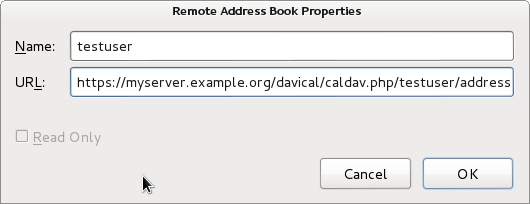
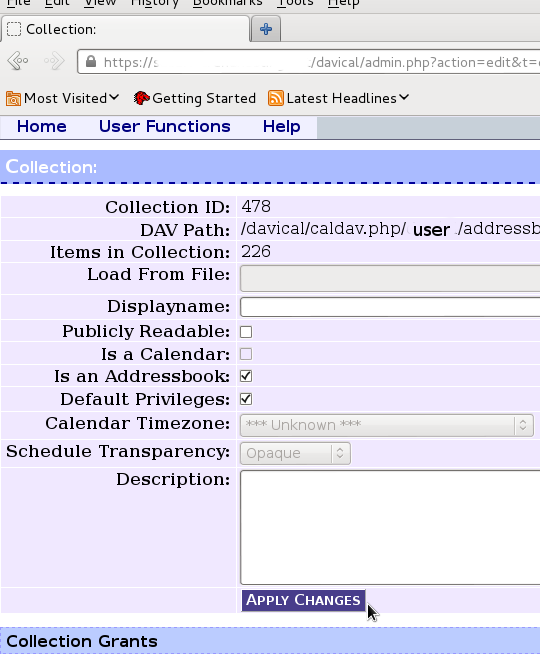
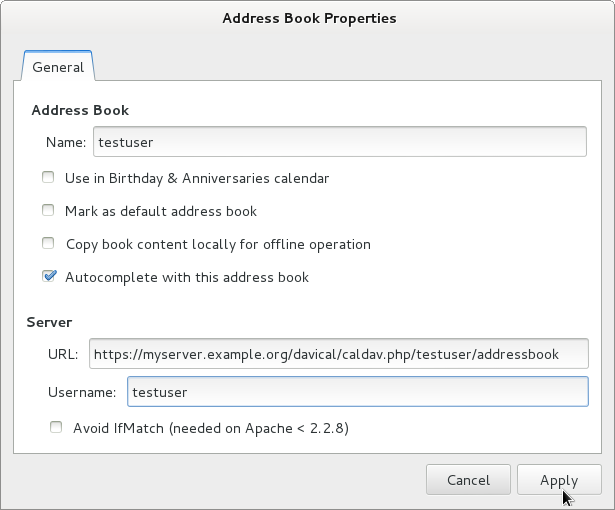
The SOGo Connector plugin configuration window is very trivial. I recommend using read-only mode to avoid the problems with multiple email addresses or telephone numbers. More serious limitations exist in the address book itself: if the CardDAV server has more than 2 email addresses, they will not appear in the Thunderbird address book. Changing an email address on the client side will result in loss of those additional email addresses on the server-side. The Mozilla team initially committed to rewrite the address book from the ground up but it is not clear whether that work is still in progress. DAViCal confusion I had been using DAViCal for quite some time as a CalDAV server before I recently decided to try and use it for CardDAV as well. As a calendar server, it had been working fine. I have a small number of users with some private calendars and also some shared calendars. When I installed the SOGo Connector plugin and went to setup the client-side configuration, it asked me for the server URL. Having used CalDAV already, I simply tried copying the existing CalDAV URL, which is of the form https://myserver.example.org/davical/caldav.php/daniel/home The URL was accepted and I could create address book entries on the client side. No errors appeared. I then tried setting up the same URL as an address book in Evolution. This time, I found I was able to create contacts and sync them to the server and access them from another copy of Evolution. It appeared DAViCal was working fine and I felt that Thunderbird or the SOGo Connector was somehow broken, because the Evolution clients were syncing but Thunderbird was not. The lack of any errors from the Thunderbird GUI further undermined my confidence in the SOGo Connector. Nonetheless, I decided to dig a little deeper, looking through the DAViCal source code. This brought me to the realisation that each URL could be flagged as either a calendar resource or an address book resource. This had not been obvious to me before. Evolution had effectively been storing the contact entries into a calendar URL and DAViCal had been happily accepting them. SOGo Connector, querying the URL, appears to have received both calendar and contact records from DAViCal and given up.
Here is where I configured the extra resource for an address book store under my user account in DAViCal In the DAViCal web management console, I created an extra resource for my user ID and set the appropriate checkbox to mark the resource as an address book. Then I put this resource URL into all the clients and found that they were all able to sync with each other. DAViCal's maintainer has explained that this is a limitation in the CardDAV/CalDAV protocols: technically, it is valid for the client to store the wrong type of objects in each URL. Clients need to be more resilient when they stumble across objects they don't expect in a particular resource. Conclusion A complete free software based contact-management solution can be easily deployed using any of the servers mentioned above, particularly if Evolution is the preferred client software. Using Thunderbird as a client, it can also work, but attention is needed to avoid data loss on sync. Thunderbird could also be used in a read-only mode to access address books maintained with Evolution. Mobile support is still patchy on Android. The closed source solution (CardDAV-Sync and CalDAV-Sync) appears to work and a promising open source close, aCal, appears to be "nearly there". Some people would obviously prefer to use a standalone contact/calendar server, while others may prefer an all-in-one groupware suite. Both approaches appear to be feasible, but the standalone contact/calendar server appears to offer a more compelling way to start quickly and have minimal administrative overhead, particularly due to the fact that DAViCal is available in a supported package.
This is the contact server configuration window in Evolution. It offers slightly more options than SOGo Connector in Thunderbird and appears to be a more finished solution overall.

12 September 2013

Steve Kemp: The blogspam code is live.

Living dangerously I switched DNS to point to the new codebase on my lunch hour. I found some problems immediately; but nothing terribly severe. Certainly nothing that didn't wait until I'd finished work to attend to. I've spent an hour or so documenting the new API this evening, and now I'm just going to keep an eye on things over the next few days. The code is faster, definitely. The load is significantly lower than it would have been under the old codebase - although it isn't a fair comparison: The old XML-RPC API is still present, but now it just proxies to the JSON-version, which is a cute hack. How long it stays alive is an open question, but at least a year I guess. God knows what my wordpress developer details are. I suspect its not worth my updating the wordpress plugin, since nobody ever seemed to love it. These days the consumers of the API seem to be, in rough order of popularity: There are few toy-users, like my own blog, and a few other similar small blogs. All told since lunchtime I've had hits from 189 distinct sources, the majority of which don't identify themselves. (Tempted to not process their requests in the future, but I don't think I can make such a change now without pissing off the world. Oops.) PS. Those ~200 users? rejected 12,000 spam comments since this afternoon. That's cool, huh?

10 September 2013

Steve Kemp: node.js is kicking me

Today I started hacking on a re-implementation of my BlogSpam service - which tests that incoming comments are SPAM/HAM - in node.js (blogspam.js) The current API uses XML::RPC and a perl server, along with a list of plugins, to do the work. Having had some fun and success with the HTTP+JSON mstore toy I figured I'd have a stab at making BlogSpam more modern: In theory this is easy, I've hacked up a couple of plugins, and a Perl client to make a submission. But sadly the async-stuff is causing me .. pain. This is my current status:
shelob ~/git/blogspam.js $ node blogspam.js
Loaded plugin: ./plugins/10-example.js
Loaded plugin: ./plugins/20-ip.js
Loaded plugin: ./plugins/80-sfs.js
Loaded plugin: ./plugins/99-last.js
Received submission:  "body":"This is my body ..","ip":"109.194.111.184","name":"Steve Kemp" 
	plugin 10-example.js said next :next
	plugin 20-ip.js said next :next
	plugin 99-last.js said spam SPAM: Listed in StopForumSpam.com
So we've loaded plugins, and each has been called. But the end result was "SPAM: Listed .." and yet the caller didn't get that result. Instead the caller go this:
shelob ~/git/blogspam.js $ ./client.pl
200 OK 99-last.js
The specific issue is that I iterate over every loaded-plugin, and wait for them to complete. Because they complete asynchronously the plugin which should be last, and just return "OK" , has executed befure the 80-sfs.js plugin. (Which makes an outgoing HTTP request). I've looked at async, I've looked at promises, but right now I can't get anything working. Meh. Surprise me with a pull request ;)

Gergely Nagy: How to monitor a directory of logfiles?

One feature of syslog-ng PE is support for wildcard file sources, meaning you can give it a wildcard, like /var/log/apache/*.log, and it will automatically notice new files being created or old ones disappearing. This is a very useful feature which has been missing from the open source edition, and one that is being worked on, but is far from complete, and will not make it into syslog-ng 3.5. However, at least on GNU/Linux, there is a way to implement something similar, although in a fairly crude manner. Yet, it works surprisingly well in most cases. You only need to abuse a few things...The trick itself is pretty easy, and is based on the same underlying kernel feature that syslog-ng PE uses under the hood: inotify(7). What we will do, is use incron to monitor a directory, and create syslog-ng config file snippets whenever a file creation event occurs. We also set up syslog-ng to include these snippets, and reload the configuration after each event received. This way, we immediately notice newly created logfiles without the need to poll the directory, and with config snippets created on the fly, we do not modify the main syslog-ng configuration file, either.To do this, we first need to create an appropriate syslog-ng configuration:
@version: 3.5
destination d_all_logs  
  file("/var/log/all.log");
 ;
include "/etc/syslog-ng/conf.d/notify-*.conf";
The config itself is a dummy: it has no sources, no logpaths, just a destination, which we will use in the snippets. Next, we create the script that will create these for us! It takes a single command-line argument: the filename of the newly created logfile.
#! /bin/sh set -e CONFDIR="/etc/syslog-ng/conf.d" SNGCTL=/usr/sbin/syslog-ng-ctl id="$(uuidgen tr '-' '_')" conffn="$ CONFDIR /notify-$ id .conf" fn="$1" cat >$ conffn <<EOF source s_$ id file("$ fn "); ; log source(s_$ id ); destination(d_all_logs); ; EOF $ SNGCTL reload
This creates the config snippet with a unique filename and source name, adds a new logpath that binds it to the d_all_logs destination defined in the main configuration file, and reloads the configuration afterwards.Now, all we need is to tell incron to call this script. Assuming we saved it as /usr/local/sbin/syslog-ng-wildcard-notify, this is how the incrontab entry would look like:
/var/log/remote.d/*.log  IN_CREATE,IN_MOVED_TO /usr/local/sbin/syslog-ng-wildcard-notify $@/$#
And that's about it! Now whenever a new file gets dropped into the directory, syslog-ng will get notified. There is a downside, however: when a file gets deleted, the configuration is not removed. That part is not so simple, though: we want syslog-ng to finish reading the file before reloading the config, so that makes it a bit trickier. But if we don't care about that, we could just add an IN_DELETE event, and write another script that looks up which snippet is responsible for the file, delete it and reload. Doing that is left as an exercise for the reader!

Julien Danjou: OpenStack Ceilometer Havana-3 milestone released

Last week, the third and last milestone of the Havana development branch of Ceilometer has been released and is now available for testing and download. This means the end of the OpenStack Havana development time is coming, and that the features are now frozen. New features
Eleven blueprints have been implemented as you can see on the release page. That's one more than during Havana-2, but it's less than was planned initially, though we had a pretty high score considering the size of our contributors team. I'm going to talk through some of them here, that are the most interesting for users. Bug fixes Fifty-six bugs were fixed, though most of them might not interest you so I won't elaborate too much on that. Go read the list if you are curious. Toward our final Havana release With the feature freeze in place, we're now focusing on fixing bugs and improving documentation. I'll try to make sure we'll get there without too much trouble for the 17th October 2013. Stay tuned!

Daniel Kahn Gillmor: Support privacy-respecting network services!

Support privacy-respecting network services! Donate to Riseup.net! There's a lot of news recently about some downright orwellian surveillance executed across the globe by my own government with the assistance of major American corporations. The scope is huge, and the implications are depressing. It's scary and frustrating for anyone who cares about civil society, freedom of speech, cultural autonomy, or data sovereignty. As bad as the situation is, though, there are groups like Riseup and May First/People Link who actively resist the data dragnet. The good birds at Riseup have been tireless advocates for information autonomy for people and groups working for liberatory social change for years. They have provided (and continue to provide) impressive, well-administered infrastructure using free software to help further these goals, and they have a strong political committment to making a better world for all of us and to resisting strongarm attempts to turn over sensitive data. And they provide all this expertise and infrastructure and support on a crazy shoestring of a budget. So if the news has got you down, or frustrated, or upset, and you want to do something to help improve the situation, you could do a lot worse than sending some much-needed funds to help Riseup maintain an expanding infrastructure. This fundraising campaign will only last a few more days, so give now if you can! (note: i have worked with some of the riseup birds in the past, and hope to continue to do so in the future. I consider it critically important to have them as active allies in our collective work toward a better world, which is why i'm doing the unusual thing of asking for donations for them on my blog.)

7 September 2013

Daniel Pocock: Evacuating Australia

With the news that Australia's 100mbit (and potentially gigabit) fibre to the home is to be abolished and replaced with a cheap 25mbps service using Europe's ADSL hand-me-downs (which will be obsolete in 5 years when the deployment is finished), I've had quite a few emails from people asking just how easy it is to move abroad.
The acoustic modem has a nice retro look Word has got out that I've been spending some time in Switzerland enjoying the world-beating rate of IPv6 deployment. That is not the only reason to leave Australia of course, nor is it the only criteria for people choosing which country will give them a better deal than either of the two non-choices we had in Australia's elections. A free $20,000 for leaving Australia The first good news is that any recent graduate with a big bad ugly HECS bill is only obliged to pay this extra tax when they earn a salary from an Australian employer and file an Australian tax return. Australians who live abroad are not automatically obliged to file tax returns and are not slogged with this extra tax for having attended university. If somebody just graduated and has this hanging over their head, or if they've just started working and seen how much is being deducted on the payslip, moving abroad could make a lot of sense financially. If you have any moral qualms about this, just reflect on the fact that while the Government intimidates students with the feeling that they have to "pay" for fulfilling an education that makes them into a productive member of society, thousands of would-be athletes are given money with no obligation to repay it. The easiest route: a second passport One in four Australians has a parent born abroad. Most of those people qualify for a passport from their parent's country of birth. In some cases this also applies to people with grandparents born abroad. With the European Union now spanning 28 countries and guaranteeing the rights of any citizen from any country to live, work and study in any of the other 27 countries, a passport from any of the EU countries gives a lot of choices, including places where I have lived myself such as the UK, Ireland, France and Switzerland. Europe's citizen-friendly immigration In other words, an Australian with an Italian parent can go up to the Italian embassy in Canberra, collect an Italian passport and immediately fly into London and start working there with no bureaucratic delays, invasive and degrading medical checks or other Government interference in their life.
London's nightlife is popular for Australians. The UK started rolling out their high speed 21CN many years before Australia started the NBN. The rights also transfer automatically to all family members (spouse and children) - an Australian with a second passport is not restricted to living in Australia simply because they are married to somebody who does not have a second passport. As long as they arrive together at a European airport, they can simply show a marriage/birth certificate (in any language) and cross the border immediately, enjoy the same rights as a citizen, including work, study, healthcare and better broadband. No paperwork is necessary, no cottage industry for otherwise unemployable immigration agents, these are basic human rights for those living in Europe.
Eiffel tower: potentially part of the wireless network for France's new 4G internet, potentially two to four times the fixed-line speed planned for Australia's crippled broadband Uncle Sam wants more Australians Although it is not widely known, the US has a fast lane for immigration from Australia. The regular programs for skilled visas in the US are usually exhausted every year, whereas 10,000 "E3" class visas for Australians are never fully taken in any year. Surely it's not that easy to go to the US? It is. To qualify, an Australian only needs a university degree and a suitable job offer. Although the visa is for 2 years, it can be renewed and Australians who meet and marry an American have in various cases have gained full residence or citizenship. Anything is possible, you could even end up becoming a NASA Astronaut.

San Francisco, home to leading technology professionals and innovators from many countries. Some US cities such as Austin and Kansas City have let Google install fibre to the home, San Francisco could follow Working holiday schemes are not just for Britain Most Australians know somebody who went to London on a "working holiday" visa. These visas are not just for the UK and Australia has similar reciprocal programs with many other countries too. These rules for these schemes are rooted in the industrial age concept of workers with punch cards. Participants are typically limited to work 20 hours per week. Of particular interest for those in IT, such rules are hard to quantify for freelancers, web designers or creative people who earn their living charging fees per-project or undertaking management work without specified working hours. Although the visas are limited to 4 years, I've heard of Australians benefiting from the open borders of mainland Europe, spending 4 years in one country and then obtaining another 4 year visa for an adjacent country and travelling freely back and forth, building up a business and lifestyle of their own design. Singapore and Hong Kong Singapore and Hong Kong have become enormously popular destinations for Australians, particularly those with special skills in IT, finance, engineering and international business.
Singapore is respected as one of the cleanest and most orderly cities in Asia while embracing significant diversity in dining, shopping, leisure and lifestyle possibilities. They have recently boosted speeds to help people get a full 100MBit over fibre. A SIM card with high speed broadband charges SGD 7 (about $5) for 1 Gigabyte. These are not necessarily destinations that a graduate can easily move to. People are measured by their salary and the Government simply assumes that anybody earning a high salary is going to make a valuable contribution to society and they are given a visa in 1 or 2 weeks. Usually 3-5 years employment experience is required before making a move to one of these countries. The Not Ordinarily Resident (NOR) scheme gives some hints about the minimum salary level that ex-pats aim for, many earn significantly more with bonuses, stock programs and properly engineered tax-free offshore pension arrangements. These countries offer particularly low taxes (around 10%) and great technology. They have some rough edges too: like Europe, spouses are automatically given a visa too, but in contrast, their visa does not permit them to work unless they also work in a profession that is highly paid. Visas are issued quickly but they are also canceled very quickly if the job is terminated or the company goes bust. There have been various stories of people paying the typical 2-month deposit on an appartment in Singapore and then finding that it is forfeited when their job and visa are canceled and they have 4 weeks to leave. The bottom line is that people moving to these locations usually have a wide professional network and confidence to change their job quickly if necessary. Freestyle immigration and the visa run Not too long ago I was at a house party in Prague, Czech Republic, which is like a Paris of eastern Europe. Somebody introduced me to some Americans who I was told had similar interests in technology. They were operating an offshore web site and living very well. They had spent 10 years in Prague living on tourist visas. Authorities seemed quite happy for them to remain as long as they left every 3 months and spent 1 night abroad, a typical visa run. That could be as simple as a train journey to Vienna, Austria and an overnight stay.
Making a visa run in comfort and style with European railways. The Railjet train pictured includes free wifi, a lot cheaper than the $20 billion Tony Abbott plans to spend rolling out yesterday's technology in Australia When European countries abolished border controls, this system became much more convoluted for those who depend on the visa run. However, it remains common in many Asian and Latin American countries and many ex-pats live this way. Officials in many of these medium sized economies recognise the value of people bringing in money from offshore business (such as web sites) and using it to pay rent, food and local services. To make this effective, the ex-pats typically need to have an international private health insurance policy (high quality offshore policies can be found quickly with a search engine) and not aspire to work in a normal 9-5 job. Conclusion Young Australians might not want to just consider travel, it may even become unavoidable. The reality is, by 2020, one in three Australians will be a retired baby boomer and one way or another, whichever Government is in office will be unable to avoid taxing those of working age to pay for the health care and pension promises made to older generations. Serious expenditure on public infrastructure such as broadband or high speed rail appears to remain a pipe dream. Moving abroad, however, is just so much fun. Look at the way multinational companies make countries compete to attract their new factories and other projects: why should any individual citizen be any less demanding in choosing where they work, play and get the best value for whatever taxes they have to pay? Some people raise questions of patriotism or responsibility to the nation. Think again. The 200,000 Australians who live abroad or travel extensively make a significant contribution to Australia's international profile, engage in new trade initiatives, bring skills back to Australia and generally represent what our country is really about much better than some of those who are paid to do so.

Uwe Hermann: Using mdadm to recover from a dead disk in a Linux RAID-1 array

2.5
Yes, it's that time of the year again. A disk in my desktop-replacement laptop with 2 disks and a RAID-1 has died. Time for recovery. This laptop has been running 24/7 for the last 3 years or such, so it's not too surprising that a disk dies. Surprisingly though, for the first time in a long series of dead disks, smartctl -a does indeed show errors for this disk. Here's a short snippet of those:
  $ smartctl -a /dev/sda
  [...]
  Error 1341 occurred at disk power-on lifetime: 17614 hours (733 days + 22 hours)
   When the command that caused the error occurred, the device was active or idle.
   After command completion occurred, registers were:
   ER ST SC SN CL CH DH
   -- -- -- -- -- -- --
   40 41 02 1f c0 9c 40  Error: UNC at LBA = 0x009cc01f = 10272799
   Commands leading to the command that caused the error were:
   CR FR SC SN CL CH DH DC   Powered_Up_Time  Command/Feature_Name
   -- -- -- -- -- -- -- --  ----------------  --------------------
   60 f8 08 20 c0 9c 40 00  41d+01:51:50.974  READ FPDMA QUEUED
   60 08 00 18 c0 9c 40 00  41d+01:51:50.972  READ FPDMA QUEUED
   ef 10 02 00 00 00 a0 00  41d+01:51:50.972  SET FEATURES [Reserved for Serial ATA]
   ec 00 00 00 00 00 a0 00  41d+01:51:50.971  IDENTIFY DEVICE
   ef 03 45 00 00 00 a0 00  41d+01:51:50.971  SET FEATURES [Set transfer mode]
  SMART Self-test log structure revision number 1
  Num  Test_Description    Status                  Remaining  LifeTime(hours)  LBA_of_first_error
  # 1  Short offline       Completed: read failure       90%     20511         156170102
  [...]
The status of the degraded RAID array looks like this:
  $ cat /proc/mdstat
  Personalities : [raid1] 
  md1 : active raid1 sdb7[1]
       409845696 blocks [2/1] [_U]
  md0 : active raid1 sda6[0] sdb6[1]
       291776 blocks [2/2] [UU]
The [_U] means that one of two disks has failed, it should normally be [UU]. There are two RAID-1s actually, a small md0 (sda6 + sdb6) for /boot and the main md1 (sda7 + sdb7) which holds the OS and my data. Apparently (at first at least), only sda7 was faulty and got kicked out of the array:
  $ dmesg   grep kick
  md: kicking non-fresh sda7 from array!
Anyway, so I ordered a replacement disk, removed the dead disk (I checked the serial number and brand before, so I don't accidentally remove the wrong one), inserted the new disk and rebooted. Note: In order for this to work you have to have (previously) installed the bootloader (usually GRUB) onto both disks, otherwise you won't be able to boot from either of them (which you'll want to do if one of them dies, of course). In my case, sda was now dead, so I put sdb into its place (physically, by using the other SATA connector/port) and the new replacement disk would become the new sdb. After the reboot, the new disk needs to be partitioned like the other RAID disk. This can be done easily by copying the partition layout of the "good" disk (now sda after the reboot) onto the empty disk (sdb):
  $ sfdisk -d /dev/sda   sfdisk /dev/sdb
Specifically, the RAID disks/partitions need to have the type/ID "fd" ("Linux raid autodetect"), check if that is the case. Then, you can add the new disk to the RAIDs:
  $ mdadm /dev/md0 --add /dev/sdb6
  $ mdadm /dev/md1 --add /dev/sdb7
After a few hours the RAID will be re-synced properly and all is good again. You can check the progress via:
  $ watch -n 1 cat /proc/mdstat
You should probably not reboot during the resync (though I'm not 100% sure if that would be an issue in practice; please leave a comment if you know). Also, don't forget to install GRUB on the new disk so you can still boot when the next disk dies:
  $ grub-mkdevicemap
  $ grub-install /dev/sdb
And it might be a good idea to use S.M.A.R.T. to check the new disk, just in case. I did a quick run for the new disk via:
  $ smartctl -t short /dev/sdb # Wait a few minutes after this.
  $ smartctl -a /dev/sdb
  [...]
  SMART Self-test log structure revision number 1
  Num  Test_Description    Status                  Remaining  LifeTime(hours)  LBA_of_first_error
  # 1  Short offline       Completed without error       00%        22         -
  [...]
Looks good. So far.

Next.

Previous.