Search Results: "ed"

28 February 2021

Dima Kogan: mrcal: principled camera calibrations

This is a big deal. In my day job I work with images captured by cameras, using those images to infer something about the geometry of the scene being observed. Naturally, to get good results you need to have a good estimate of the behavior of the lens (the "intrinsics"), and of the relative geometry of the cameras (the "extrinsics"; if there's more than one camera). The usual way to do this is to perform a "calibration" procedure to compute the intrinsics and extrinsics, and then to use the resulting "camera model" to process the subsequent images. Wikipedia has an article. And from experience, the most common current toolkit to do this appears to be OpenCV. People have been doing this for a while, but for whatever reason the existing tools all suck. They make basic questions like "how much data should I gather for a calibration?" and "how good is this calibration I just computed?" and "how different are these two models?" unanswerable. This is clearly seen from the links above. The wikipedia article talks about fitting a pinhole model to lenses, even though no real lenses follow this model (telephoto lenses do somewhat; wider lenses don't at all). And the OpenCV tutorial cheerfully says that
Re-projection error gives a good estimation of just how exact the found
parameters are. The closer the re-projection error is to zero, the more accurate
the parameters we found are.
This statement is trivially proven false: throw away most of your calibration data, and your reprojection error becomes very low. But we can all agree that a calibration computed from less data is actually worse. Right? All the various assumptions and hacks in the existing tooling are fine as long as you don't need a whole lot of accuracy out of your results. I need a lot of accuracy, however, so all the existing tools don't work for my applications. So I built a new set of tools, and have been using them with great delight. I just got the blessing to do a public release, so I'm announcing it here. The tools are mrcal does a whole lot to produce calibrations that are as good as possible, and it will tell you just how good they are, and it includes visualization capabilities for extensive user feedback. An overview of the capabilities of the toolkit (with lots of pretty pictures!) is at the tour of mrcal. There's a lot of documentation and examples, but up to now I have been the primary user of the tools. So I expect this to be somewhat rough when others look at it. Bug reports and patches are welcome. mrcal is an excellent base, but it's nowhere near "done". The documentation has some notes about the planned features and improvements, and I'm always reachable by email. Let me know if you try it out!

27 February 2021

Russ Allbery: DocKnot 4.01

DocKnot is my software documentation and release management tool. This release adds support for a global user configuration file separate from the metadata for any given project and adds support for signing generated distribution tarballs with GnuPG. Currently, the only configuration options for the global configuration file are to set the destination location of generated distributions and the PGP key to use when signing them. This release also removes some now-unnecessary helper functions, fixes docknot --help, and cleans up some documentation bugs left over from the big changes in 4.00. You can get the latest release from CPAN or from the DocKnot distribution page.

Russell Coker: Links February 2021

Elestic Search gets a new license to deal with AWS not paying them [1]. Of course AWS will fork the products in question. We need some anti-trust action against Amazon. Big Think has an interesting article about what appears to be ritualistic behaviour in chompanzees [2]. The next issue is that if they are developing a stone-age culture does that mean we should treat them differently from other less developed animals? Last Week in AWS has an informative article about Parler s new serverless architecture [3]. They explain why it s not easy to move away from a cloud platform even for a service that s designed to not be dependent on it. The moral of the story is that running a service so horrible that none of the major cloud providers will touch it doesn t scale. Patheos has an insightful article about people who spread the most easily disproved lies for their religion [4]. A lot of political commentary nowadays is like that. Indi Samarajiva wrote an insightful article comparing terrorism in Sri Lanka with the right-wing terrorism in the US [5]. The conclusion is that it s only just starting in the US. Belling Cat has an interesting article about the FSB attempt to murder Russian presidential candidate Alexey Navalny [6]. Russ Allbery wrote an interesting review of Anti-Social, a book about the work of an anti-social behavior officer in the UK [7]. The book (and Russ s review) has some good insights into how crime can be reduced. Of course a large part of that is allowing people who want to use drugs to do so in an affordable way. Informative post from Electrical Engineering Materials about the difference between KVW and KW [8]. KVA is bigger than KW, sometimes a lot bigger. Arstechnica has an interesting but not surprising article about a supply chain attack on software development [9]. Exploiting the way npm and similar tools resolve dependencies to make them download hostile code. There is no possibility of automatic downloads being OK for security unless they are from known good sites that don t allow random people to upload. Any sort of system that allows automatic download from sites like the Node or Python repositories, Github, etc is ripe for abuse. I think the correct solution is to have dependencies installed manually or automatically from a distribution like Debian, Ubuntu, Fedora, etc where there have been checks on the source of the source. Devon Price wrote an insightful Medium article Laziness Does Not Exist about the psychological factors which can lead to poor results that many people interpret as laziness [10]. Everyone who supervises other people s work should read this.

Petter Reinholdtsen: Updated Valutakrambod, now also with information from NBX

I have neglected the Valutakrambod library for a while, but decided this weekend to give it a face lift. I fixed a few minor glitches in several of the service drivers, where the API had changed since I last looked at the code. I also added support for fetching the order book from the newcomer Norwegian Bitcoin Exchange. I alsod decided to migrate the project from github to gitlab in the process. If you want a python library for talking to various currency exchanges, check out code for valutakrambod. This is what the output from 'bin/btc-rates-curses -c' looked like a few minutes ago:
           Name Pair           Bid         Ask Spread Ftcd    Age   Freq
       Bitfinex BTCEUR  39229.0000  39246.0000   0.0%   44     44    nan
        Bitmynt BTCEUR  39071.0000  41048.9000   4.8%   43     74    nan
         Bitpay BTCEUR  39326.7000         nan   nan%   39    nan    nan
       Bitstamp BTCEUR  39398.7900  39417.3200   0.0%    0      0      1
           Bl3p BTCEUR  39158.7800  39581.9000   1.1%    0    nan      3
       Coinbase BTCEUR  39197.3100  39621.9300   1.1%   38    nan    nan
         Kraken+BTCEUR  39432.9000  39433.0000   0.0%    0      0      0
        Paymium BTCEUR  39437.2100  39499.9300   0.2%    0   2264    nan
        Bitmynt BTCNOK 409750.9600 420516.8500   2.6%   43     74    nan
         Bitpay BTCNOK 410332.4000         nan   nan%   39    nan    nan
       Coinbase BTCNOK 408675.7300 412813.7900   1.0%   38    nan    nan
        MiraiEx BTCNOK 412174.1800 418396.1500   1.5%   34    nan    nan
            NBX BTCNOK 405835.9000 408921.4300   0.8%   33    nan    nan
       Bitfinex BTCUSD  47341.0000  47355.0000   0.0%   44     53    nan
         Bitpay BTCUSD  47388.5100         nan   nan%   39    nan    nan
       Coinbase BTCUSD  47153.6500  47651.3700   1.0%   37    nan    nan
         Gemini BTCUSD  47416.0900  47439.0500   0.0%   36    336    nan
         Hitbtc BTCUSD  47429.9900  47386.7400  -0.1%    0      0      0
         Kraken+BTCUSD  47401.7000  47401.8000   0.0%    0      0      0
  Exchangerates EURNOK     10.4012     10.4012   0.0%   38  76236    nan
     Norgesbank EURNOK     10.4012     10.4012   0.0%   31  76236    nan
       Bitstamp EURUSD      1.2030      1.2045   0.1%    2      2      1
  Exchangerates EURUSD      1.2121      1.2121   0.0%   38  76236    nan
     Norgesbank USDNOK      8.5811      8.5811   0.0%   31  76236    nan
Yes, I notice the negative spread on Hitbtc. Either I fail to understand their Websocket API or they are sending bogus data. I've seen the same with Kraken, and suspect there is something wrong with the data they send. As usual, if you use Bitcoin and want to show your support of my activities, please send Bitcoin donations to my address 15oWEoG9dUPovwmUL9KWAnYRtNJEkP1u1b.

Dima Kogan: horizonator: terrain renderer based on SRTM DEMs

Check this out:
example-interactive.png
I just resurrected and cleaned up an old tool I had lying around. It's now nice and usable by others. This tool loads terrain data, and renders it from the ground, simulating what a human or a camera would see. This is useful for armchair exploring or for identifying peaks. This was relatively novel when I wrote it >10 years ago, but there are a number of similar tools in existence now. This implementation is still useful in that it's freely licensed and contains APIs, so fancier processing can be performed on its output. Sources and (barely-complete-enough) documentation live here: https://github.com/dkogan/horizonator

Reproducible Builds (diffoscope): diffoscope 168 released

The diffoscope maintainers are pleased to announce the release of diffoscope version 168. This version includes the following changes:
* Don't call difflib.Differ.compare with very large inputs; it is at least
  O(n^2) and makes diffoscope appear to hang.
  (Closes: reproducible-builds/diffoscope#240)
* Don't use "Inheriting PATH of X" in debug log message; use "PATH is X".
* Correct the capitalisation of jQuery.
You find out more by visiting the project homepage.

26 February 2021

Ritesh Raj Sarraf: Wayland KDE X11

KDE Impressions These days, I often hear a lot about Wayland. And how much of effort is being put into it; not just by the Embedded world but also the usual Desktop systems, namely KDE and GNOME. In recent past, I switched back to KDE and have been (very) happy about the switch. Even though the KDE 4 (and initial KDE 5) debacle had burnt many, coming back to a usable KDE desktop is always a delight. It makes me feel home with the elegance, while at the same time the flexibility, it provides. It feels so nice to draft this blog article from Kwrite + VI Input Mode Thanks to the great work of the Debian KDE Team, but Norbert Preining in particular, who has helped bring very up-to-date KDE packages into Debian. Right now, I m on a Plamsa 5.21.1 desktop, which is recent by all standards.

Wayland Almost all the places in the Linux world these days are busy with integrating Wayland as the primary display service. Not sure what the current status on the GNOME side is but I definitely keep trying KDE + Wayland with every release. I keep trying with every release because it still is not prime for daily use. And it makes me get back to X11, no matter how dated some may call. Fact is, X11 still shines to me as an end-user. Glitches with Wayland still are (Based on this week s test on Plasma 5.21.1):
  • Horrible performance compared to X11
  • Very crashy, especially when hotplugging secondary display. Plasma would just crash. X11 is very resilient to such things, part of the reason I can think is the age of the codebase.
  • Many many applications still need to be fixed for Wayland. Or Wayland needs to accomodate them in some way. XWayland does not really feel like the answer.
And while KDE keeps insisting users to switch to Wayland, as that s where all the new enhancements and fixes are put in, someone like me still needs to stick to X11 for the time being. So to get my shiny new LG 27" 4K Monitor (3840x2160 60.00*+) to work without too much glitch, I had to live with an alias:
$ alias   grep xrandr
alias rrs_xrandr_lg='xrandr --output DP-1 --mode 3840x2160 --scale .75x.75'
18:31                    

Plasma 5.21 On the brighter side, the Plasma 5.21.1 release brings some nice enhancements in other areas.
  • I m now able to make use of tighter integration with systemd/cgroups, with better organization and management of processes overall.
  • The new Plasma theme, Breeze Twilight, is a good blend of Light + Dark.
I also appreciate the work put in by Michail Vourlakos. The KDE project is lucky to have a developer/designer like him. His vision and work into the KDE desktop is well beyond a writing by me.
$ usystemctl status plasma-plasmashell.service 
  plasma-plasmashell.service - KDE Plasma Workspace
     Loaded: loaded (/usr/lib/systemd/user/plasma-plasmashell.service; enabled; vendor preset: enabled)
     Active: active (running) since Fri 2021-02-26 18:34:23 IST; 13s ago
   Main PID: 501806 (plasmashell)
      Tasks: 21 (limit: 18821)
     Memory: 759.8M
        CPU: 13.706s
     CGroup: /user.slice/user-1000.slice/user@1000.service/session.slice/plasma-plasmashell.service
              501806 /usr/bin/plasmashell --no-respawn
             
Feb 26 18:35:00 priyasi plasmashell[501806]: qml: recreating buttons
Feb 26 18:35:21 priyasi plasmashell[501806]: qml: recreating buttons
Feb 26 18:35:49 priyasi plasmashell[501806]: qml: recreating buttons
Feb 26 18:35:57 priyasi plasmashell[501806]: qml: recreating buttons
18:36                  

OBS - Open Build Service I should also thank the OpenSUSE folks for the OBS work. It has enabled the close equivalent (or better, in my experience) of PPAs for Debian. And that is what has enabled developers like Norbert to easily and quickly be able to deliver the entire KDE suite.

OBS - Some detail Christian asked for some more details on the OBS side of things, of my view. I m updating this article with it because the comment system may not always be reliable and I hate losing content. Having been using OBS myself, and also others in the Debian community who are making use of it, I surely think we as project should consider making use of OBS. Given that OBS is Free Software, it is a perfect fit for Debian. Gitlab is another example of what we ve made available in Debian. OBS is divided into multiple parts
  • OBS Server
  • OBS DoD service
  • OBS Publisher
  • OBS Workers
  • OBS Warden
  • OBS Rep Server
For every Debian release I care about, I add an OBS project per release. So I have OBS projects for: Sid, Bullseye, Buster, Jessie. Now, say you have a package, foo . You prep your package and enable all the releases that you want to build the package for. So the same package gets built, in separate clean environments, for every release I mentioned as an example above. You don t have to manually trigger the build for every release/every architcture. You should add the release (as projects) in OBS, set their supported architectures, and then add those enabled release projets as bits to your package. Every build involves:
  • Creating a new chroot for each build
  • Building the package
Builds can be scattered across multiple hosts, known as workers in OBS terminology. Your workers are independent machine entities, supporting different architectures. The machines can be Bare-Metal ones, VMs, even containers. So this allows for very nice scale-in and scale-out. There may be auto-scaling too but that is something worth investigating. Think of things like cross architecture builds. Let s assume the cloud vendors decide to donate resources to the Debian project. We could enable OBS worker instances on the respective clouds (different architectures) and plug them into the master OBS instance that Debian hosts. Fully distributed. Similarly, big hardware vendors willing to donate compute resources could house them in their premises and Debian could just easily establish a connection to them. All of this just a TCP connection away. So when I look at the features of OBS, from the point of view of Debian, I like it more. Extensibility won t be an issue. Supporting a new Debian release would just be a matter of bootstrapping the Debian release as a project in OBS, and then all done. The single effort of setting of the target release project is a one time job, and then all can leverage it. The PPA was a long craved feature missing in Debian, in my opinion. OBS allows to not just fulfil that gap but also extend it in a very easy way. Andrew Lee had put in a nice video presentation about the same @ Debconf 20

24 February 2021

Dirk Eddelbuettel: RcppSimdJson 0.1.4 on CRAN: Small Bugfix

A quick note to say that we finalized a bugfix release 0.1.5 of RcppSimdJson yesterday which got onto CRAN earlier today. RcppSimdJson wraps the fantastic and genuinely impressive simdjson library by Daniel Lemire and collaborators. Via very clever algorithmic engineering to obtain largely branch-free code, coupled with modern C++ and newer compiler instructions, it results in parsing gigabytes of JSON parsed per second which is quite mindboggling. The best-case performance is faster than CPU speed as use of parallel SIMD instructions and careful branch avoidance can lead to less than one cpu cycle per byte parsed; see the video of the talk by Daniel Lemire at QCon (also voted best talk). This version brings a small fix to Windows where temporary filenames constructed from URLs (as for example constructed by our td package) need an extra sanization for a possible ? character. We will be addressing that properly in due course but for now a simple gsub() will do. The NEWS entry follows.

Changes in version 0.1.5 (2021-02-23)
  • Temporary filenames from request URLs need an extra path sanitization on Windows as seen with package td.
  • A few #nocov tags were added to the code.

Courtesy of my CRANberries, there is also a diffstat report for this release. For questions, suggestions, or issues please use the issue tracker at the GitHub repo. If you like this or other open-source work I do, you can now sponsor me at GitHub.

This post by Dirk Eddelbuettel originated on his Thinking inside the box blog. Please report excessive re-aggregation in third-party for-profit settings.

Rog rio Brito: Alternatives to ikiwiki?

It's been quite a long time since I last posted anything on this blog and I can say that one of the reasons for that I don't feel comfortable using ikiwiki anymore. I am actively looking for alternatives to ikiwiki that allow me, mainly, to write blog posts with the following characteristics (not necessarily in order of importance): Connected to the fact that I only can have static sites (no CGI, no forms, nothing else), I am, at this time, using Disqus to host the comments of my blog. I am also thinking of alternatives to this, like sending people to Twitter (or mastodon or email) or some site similar to Disqus, but with more of a Free Software inclination. Anyway, I am almost ready for any kind of transition, since I have already converted most posts (of course, not yet this one ) with some Python scripts to a format that I feel is a bit more format-agnostic than what ikiwiki uses.

  1. That's not to mention the myriad of hugo themes and theme authors that try to bribe you into using their hosted solutions (despite branding everything as "open source! OMG!"), like "wowchemy" you will have a hard time untangling the instructions of their so bloated themes to be usable on your local computer; so much so to the point that you give up with their convoluted configuration (which, potentially, doesn't "transfer" to other themes, if you are worried about possibly changing themes in the future).
  2. I like the style of fenced blocks that GitHub used, where you prefix the code with the name of the language to give a hint of how to highlight the code snipped.

22 February 2021

Dirk Eddelbuettel: pkgKitten 0.2.1: Now with roxygen2 support

kitten A new release 0.2.1 of pkgKitten hit CRAN earlier today, and has been uploaded to Debian as well. pkgKitten makes it simple to create new R packages via a simple function invocation. A wrapper kitten.r exists in the littler package to make it even easier. This release builds on the support for tinytest we added in release 0.2.0 by adding more optional support, this time for roxygen2. It also corrects a minor documentation snafu, and updates the CI use.

Changes in version 0.2.1 (2021-02-22)
  • A small documentation error was corrected (David Dalpiaz in #15).
  • A new option bunny adds support for roxygen2.
  • Continuous integration now use run.sh from r-ci.

More details about the package are at the pkgKitten webpage, the pkgKitten docs site, and the pkgKitten GitHub repo. Courtesy of my CRANberries site, there is also a diffstat report for this release. If you like this or other open-source work I do, you can now sponsor me at GitHub.

This post by Dirk Eddelbuettel originated on his Thinking inside the box blog. Please report excessive re-aggregation in third-party for-profit settings.

Dima Kogan: feedgnuplot: labelled bar charts and a guide

I just released feedgnuplot 1.57, which includes two new pieces that I've long thought about adding:

Labelled bar charts
I've thought about adding these for a while, but had no specific need for them. Finally, somebody asked for it, and I wrote the code. Now that I can, I will probably use these all the time. The new capability can override the usual numerical tic labels on the x axis, and instead use text from a column in the data stream. The most obvious use case is labelled bar graphs:
echo "# label value
      aaa     2
      bbb     3
      ccc     5
      ddd     2"   \
feedgnuplot --vnl \
            --xticlabels \
            --with 'boxes fill solid border lt -1' \
            --ymin 0 --unset grid
xticlabels-basic.svg
But the usage is completely generic. All --xticlabels does, is to accept a data column as labels for the x-axis tics. Everything else that's supported by feedgnuplot and gnuplot works as before. For instance, I can give a domain, and use a style that takes y values and a color:
echo "# x label y color
        5 aaa   2 1
        6 bbb   3 2
       10 ccc   5 4
       11 ddd   2 1"   \
feedgnuplot --vnl --domain \
            --xticlabels \
            --tuplesizeall 3 \
            --with 'points pt 7 ps 2 palette' \
            --xmin 4 --xmax 12 \
            --ymin 0 --ymax 6 \
            --unset grid
xticlabels-points-palette.svg
And we can use gnuplot's support for clustered histograms:
echo "# x label a b
        5 aaa   2 1
        6 bbb   3 2
       10 ccc   5 4
       11 ddd   2 1"   \
vnl-filter -p label,a,b   \
feedgnuplot --vnl \
            --xticlabels \
            --set 'style data histogram' \
            --set 'style histogram cluster gap 2' \
            --set 'style fill solid border lt -1' \
            --autolegend \
            --ymin 0 --unset grid
xticlabels-clustered.svg
Or we can stack the bars on top of one another:
echo "# x label a b
        5 aaa   2 1
        6 bbb   3 2
       10 ccc   5 4
       11 ddd   2 1"   \
vnl-filter -p label,a,b   \
feedgnuplot --vnl \
            --xticlabels \
            --set 'style data histogram' \
            --set 'style histogram rowstacked' \
            --set 'boxwidth 0.8' \
            --set 'style fill solid border lt -1' \
            --autolegend \
            --ymin 0 --unset grid
xticlabels-stacked.svg
This is gnuplot's "row stacking". It also supports "column stacking", which effectively transposes the data, and it's not obvious to me that makes sense in the context of feedgnuplot. Similarly, it can label y and/or z axes; I can't think of a specific use case, so I don't have a realistic usage in mind, and I don't support that yet. If anybody can think of a use case, email me. Notes and limitations:
  • Since with --domain you can pass in both an x value and a tic label, it is possible to give it conflicting tic labels for the same x value. gnuplot itself has this problem too, and it just takes the last label it has for a given x. This is probably good-enough.
  • feedgnuplot uses whitespace-separated columns with no escape mechanism, so the field labels cannot have whitespace in it. Fixing this is probably not worth the effort.
  • These tic labels do not count towards the tuplesize
  • I really need to add a similar feature to gnuplotlib. This will happen when I need it or when somebody asks for it, whichever comes first.

A feedgnuplot guide
This fills in a sorely needed missing part of the documentation: the main feedgnuplot website now has a page containing examples and corresponding graphical output. This serves as a tutorial and a gallery demonstrating some usages. It's somewhat incomplete, since it can't show streaming plots, or real-world interfacing with stuff that produces data: some of those usages remain the the README. It's a million times better than what I had before though, which was nothing. Internally this is done just like the gnuplotlib guide: the thing is an org-mode document with org-babel snippets that are evaluated by emacs to make the images. There's some fancy emacs lisp to tie it all together. Works great!

Charles Plessy: Containers

I was using a container for a bioinformatics tool released two weeks ago, but my shell script wrapping the tools could not run because the container was built around an old version of Debian (Jessie) that was released in 2015. I was asked to use a container for bioinformatics, based on conda, and found one that distributes coreutils, but it did not include a real version of sed. I try Debian's docker image. No luck; it does not contain ps, which my workflow manager needs. But fortunately I eventually figured out that Ubuntu's Docker image contains coreutils, sed and ps together! In the world of containers, this sounds like a little miracle.

John Goerzen: Recovering Our Lost Free Will Online: Tools and Techniques That Are Available Now

As I ve been thinking and writing about privacy and decentralization lately, I had a conversation with a colleague this week, and he commented about how loss of privacy is related to loss of agency: that is, loss of our ability to make our own choices, pursue our own interests, and be master of our own attention. In terms of telecommunications, we have never really been free, though in terms of Internet and its predecessors, there have been times where we had a lot more choice. Many are too young to remember this, and for others, that era is a distant memory. The irony is that our present moment is one of enormous consolidation of power, and yet also one of a proliferation of technologies that let us wrest back some of that power. In this post, I hope to enlighten or remind us of some of the choices we have lost and also talk about the ways in which we can choose to regain them, already, right now. I will talk about the possibilities, the big dreams that are possible now, and then go into more detail about the solutions. The Problems & Possibilities The limitations of online We make the assumption that we must be online to exchange data. This is reinforced by many modern protocols; Twitter clients, for instance, don t tend to let you make posts by relaying them through disconnected devices. What would it be like if you could fully participate in global communities without a constant Internet connection? If you could share photos with your friends, read the news, read your email, etc. even if you don t have a connection at present? Even if the device you use to do that never has a connection, but can route messages via other devices that do? Would it surprise you to learn that this was once the case? Back in the days of UUCP, much email and Usenet news a global discussion forum that didn t require an Internet connection was relayed via occasional calls over phone lines. This technology remains with us, and has even improved. Sadly, many modern protocols make no effort in this regard. Some email clients will let you compose messages offline to send when you get online later, but the assumption always is that you will be connected to an IP network again soon. NNCP, on the other hand, lets you relay messages over TCP, a radio, a satellite, or a USB stick. Email and Usenet, since they were designed in an era where store-and-forward was valued, can actually still be used in an entirely offline fashion (without ever touching an IP-based network). All it takes is for someone to care to make it happen. You can even still do it over UUCP if you like. The physical and data link layers Many of us just accept that we communicate in a few ways: Wifi for short distances, and then cable modems or DSL for our local Internet connection, and then many people are fuzzy about what happens after that. Or, alternatively, we have 4G phones that are the local Internet connection, and the same fuzzy things happen after. Think about this for a moment. Which of these do you control in any way? Sometimes just wifi, sometimes maybe you have choices of local Internet providers. After that, your traffic is handled by enormous infrastructure companies. There is choice here. People in ham radio have been communicating digitally over long distances without the support of the traditional Internet for decades, but the technology to do this is now more accessible to anyone. Long-distance radio has had tremendous innovation in the last decade; cheap radios can now communicate over several miles/km without any other infrastructure at all. We all carry around radios (Wifi and Bluetooth) in our pockets that don t have to be used as mere access points to the Internet or as drivers of headphones, but can also form their own networks directly (Briar). Meshtastic is an example; it s an instant messenger that can form a mesh over many miles/km and requires no IP infrastructure at all. Briar is similar. XBee radios form a mesh in hardware, allowing peers to reach each other (also over many miles/km) with a serial or framed protocol. Loss of peer-to-peer Back in the late 90s, I worked at a university. I had a 386 on my desk for a workstation not a powerful computer even then. But I put the boa webserver on it and could just serve pages on the Internet. I didn t have to get permission. Didn t have to pay a hosting provider. I could just DO it. And of course that is because the university had no firewall and no NAT. Every PC at the university was a full participant on the Internet as much as the servers at Microsoft or DEC. All I needed was a DNS entry. I could run my own SMTP server if I wanted, run a web or Gopher server, and that was that. There are many reasons why this changed. Nowadays most residential ISPs will block SMTP for their customers, and if they didn t, others would; large email providers have decided not to federate with IPs in residential address spaces. Most people have difficulty even getting a static IP address in the first place. Many are behind firewalls, NATs, or both, meaning that incoming connections of any kind are problematic. Do you see what that means? It has weakened the whole point of the Internet being a network of peers. While IP still acts that way, as a practical matter, there are clients that are prevented from being servers by administrative policy they have no control over. Imagine if you, a person with an Internet connection to your laptop or phone, could just decide to host a website, or a forum on it. For moderate levels of load, they are certainly capable of this. The only thing in the way is the network management policies you can t control. Elaborate technologies exist to try to bridge this divide, and some, like Tor or cjdns, can work quite well. More on this below. Expense of running something popular Related to the loss of peer-to-peer infrastructure is the very high cost of hosting something popular. Do you want to share videos with lots of people? That almost certainly is going to require expensive equipment and bandwidth. There is a reason that there are only a small handful of popular video streaming sites online. It requires a ton of money to host videos at scale. What if it didn t? What if you could achieve economies of scale so much that you, an individual, could compete with the likes of YouTube? You wouldn t necessarily have to run ads to support the service. You wouldn t have to have billions of dollars or billions of viewers just to make it work. This technology exists right now. Of course many of you are aware of how Bittorrent leverages the swarm for files. But projects like IPFS, Dat, and Peertube have taken this many steps further to integrate it into a global ecosystem. And, at least in the case of Peertube, this is a thing that works right now in any browser already! Application-level walled gardens I was recently startled at how much excitement there was when Github introduced dark mode . Yes, Github now offers two colors on its interface. Already back in the 80s and 90s, many DOS programs had more options than that. Git is a decentralized protocol, but Github has managed to make it centralized. Email is a decentralized protocol pick your own provider, and they all communicate but Facebook and Twitter aren t. You can t just pick your provider for Facebook. It s Facebook or nothing. There is a profit motive in locking others out; these networks want to keep you using their platforms because their real customers are advertisers, and they want to keep showing you ads. Is it possible to have a world where you get to pick your own app for sharing photos, and it works even if your parents use a different one? Yes, yes it is. Mastodon and the Fediverse are fantastic examples for social media. Pixelfed is specifically designed for photos, Mastodon for short-form communication, there s Pleroma for more long-form communication, and they all work together. You can use Mastodon to read Pleroma content or look at Pixelfed photos, and there are many (free) providers of each. Freedom from manipulation I recently wrote about the dangers of the attention economy, so I won t go into a lot of detail here. Fundamentally, you are not the customer of Facebook or Google; advertisers are. They optimize their site to keep you on it as much as possible so that they can show you as many ads as possible which makes them as much money as possible. Ads, of course, are fundamentally seeking to manipulate your behavior ( buy this product ). By lowering the cost of running services, we can give a huge boost to hobbyists and nonprofits that want to do so without an ultimate profit motive. For-profit companies benefit also, with a dramatically reduced cost structure that frees them to pursue their mission instead of so many ads. Freedom from snooping (privacy and anonymity) These days, it s not just government snooping that people think about. It s data stolen by malware, spies at corporations (whether human or algorithmic), and even things like basic privacy of one s own security footage. Here the picture is improving; encryption in transit, at least at a basic level, has become much more common with TLS being a standard these days. Sadly, end-to-end encryption (E2EE) is not nearly as much, perhaps because corporations have a profit motive to have access to your plaintext and metadata. Closely related to privacy is anonymity: that is, being able to do things in an anonymous fashion. The two are not necessarily equal: you could send an encrypted message but reveal who the correspondents are, as with email; or, you could send a plaintext message over a Tor exit node that hides who the correspondents are. It is sometimes difficult to achieve both. Nevertheless, numerous answers exist here that tackle one or both problems, from the Signal messenger to Tor. Solutions That Exist Today Let s dive in to some of the things that exist today. One concept you ll see in many of these is integrated encryption with public keys used for addressing. In other words, your public key is akin to an IP address (and in some cases, is literally your IP address.) Data link and networking technologies (some including P2P) P2P Infrastructure While some of the technologies above, such as cjdns, explicitly facitilitate peer-to-peer communication, there are some other application-level technologies to look at. Instant Messengers and Chat I won t go into a lot of detail here since I recently wrote a roundup of secure mesh messengers and also a followup article about Signal and some hidden drawbacks of P2P. Please refer to those articles for some interesting things that are happening in this space. Matrix is a distributed IM platform similar in concept to Slack or IRC, but globally distributed in a mesh. It supports optional E2EE. Social Media I wrote recently about how to join the Fediverse, which covered joining Mastodon, a federeated, decentralized social network. Mastodon is the largest of these, with several million users, and is something of a much nicer version of Twitter. Mastodon is also part of what is known as the Fediverse , which are applications that are loosely joined together by their support of the ActivityPub protocol. Other popular Fediverse applications include Pixelfed (similar to Instagram) and Peertube for sharing video. Peertube is particularly interesting in that it supports Webtorrent for efficiently distributing popular videos. Webtorrent is akin to Bittorrent running efficiently inside your browser. Concluding Remarks Part of my goal with this is encouraging people to dream big, to ask questions like: What could you do if offline were easy? What is possible if you have freedom in the physical and data link layers? Dream big. We re so used to thinking that it s quite difficult for two devices on the Internet to talk to each other. What would be possible if this were actually quite easy? The assumption that costs rise dramatically as popularity increases is also baked into our thought processes. What if that weren t the case could you take on Youtube from your garage? Would lowering barriers to entry lower the ad economy and let nonprofits have more equal footing with large corporations? We have so many walled gardens, from Github to Facebook, that we almost forget it doesn t have to be that way. So having asked these questions, my secondary point is to suggest that these aren t pie-in-the-sky notions. These possibilites are with us right now. You ll notice from this list that virtually every one of these technologies is ad-free at its heart (though some would be capable of serving ads). They give you back your attention. Many preserve privacy, anonymity, or both. Many dramatically improve your freedom of association and communication. Technologies like IPFS and Bittorrent ease the burden of running something popular. Some are quite easy to use (Mastodon or Peertube) while others are much more complex (libp2p or the lower-level mesh network systems). Clearly there is still room for improvement in many areas. But my fundamental point is this: good technology is here, right now. Technical people can vote with their feet and wallets and start using it. Early adopters will help guide the way for the next set of improvements. Join us!

Russ Allbery: Review: Finder

Review: Finder, by Suzanne Palmer
Series: Finder Chronicles #1
Publisher: DAW Books
Copyright: 2019
ISBN: 0-7564-1511-X
Format: Kindle
Pages: 391
Fergus Ferguson is a repo man, or professional finder as he'd prefer. He locates things taken by people who don't own them and returns them to their owners. In this case, the thing in question is a sentient starship, and the person who stole it is Arum Gilger, a warlord in a wired-together agglomeration of space habitats and mined-out asteroids named Cernekan. Cernee, as the locals call it, is in the backwaters of human space near the Gap between the spiral arms of the galaxy. One of Fergus's first encounters in Cernee is with an old lichen farmer named Mattie Vahn who happens to take the same cable car between stations that he does. Bad luck for Fergus, since that's also why Gilger's men first disable and then blow up the cable car, leaving Mattie dead and Fergus using the auto-return feature of Mattie's crates to escape to the Vahns' home station. The Vahns are not a power in Cernee, not exactly, but they do have some important alliances and provide an inroads for Fergus to get the lay of the land and map out a plan to recover the Venetia's Sword. This is a great hook. I would happily read a whole series about an interstellar repo man, particularly one like Fergus who only works for the good guys and recovers things from petty warlords. Fergus is a thoughtful, creative loner whose style is improvised plans, unexpected tactics, and thinking on his feet rather than either bluster or force (although there is a fair bit of death in this book, some of which is gruesome). About two-thirds of the book is in roughly that expected shape. Fergus makes some local contacts, maps out the political terrain, and maneuvers himself towards his target through a well-crafted slum of wired-together habitats and working-class miners. Also, full points for the creative security system on the starship that tries to solve a nearly impossible problem (a backdoor supplementing pre-shared keys with a cultural authentication scheme that can't be vulnerable to brute force or database searches). Halfway through, though, Palmer throws a curve ball at the reader that involves the unexplained alien presence that's been lurking around the system. That part of the plot shifts focus somewhat abruptly from the local power struggle Fergus has been navigating to something far more intrusive and personal. Fergus has to both reckon with a drastic change in his life and deal with memories of his early life on an Earth drowning in climate change, his abusive childhood, and his time spent in the Martian resistance. This is also a fine topic for an SF novel, but I think Finder suffered a bit from falling between two stools. The fun competence drama of the lone repossession agent striking back against petty tyrants by taking away their toys is derailed by the sudden burst of introspection and emotional processing, but the processing is not deep or complex enough to carry the story on its own. Fergus had an awful and emotionally alienated childhood followed by some nasty trauma, to which he has responded by carefully never getting close to anyone so that he never hurts anyone who relies on him. And yet, he's a fundamentally decent person and makes friends despite himself, and from there you can probably write the rest of the arc yourself. There's nothing wrong with this as the emotional substrate of a book that's primarily focused on an action plot, but the screeching change of focus threw me off. The good news is that the end of the book returns to the bits that I liked about the first half. The mixed news is that I thought the political situation in Cernee resolved much too easily and much too straightforwardly. I would have preferred the twisty alliances to stay twisty, rather than collapse messily into a far simpler moral duality. I will also speak on behalf of all the sentient starship lovers out there and complain that the Venetia's Sword was woefully underused. It had better show up in a future volume! This unsteadiness and a few missed opportunities make Finder a good book rather than a great one, but I was still happily entertained and willing to write that off as first-novel unevenness. There are a lot of background elements left unresolved for a future volume, but Finder comes to a satisfying conclusion. Recommended if you're looking for an undemanding space action story with a quick pace and decent, if not very deep, characters. Followed by Driving the Deep. Rating: 7 out of 10

21 February 2021

Erich Schubert: My first Rust crate: faster kmedoids clustering

I have written my first Rust crate: kmedoids. Python users can use the wrapper package kmedoids. It implements k-medoids clustering, and includes our new FasterPAM algorithm that drastically reduces the computational overhead. As long as you can afford to compute the distance matrix of your data set, clustering it with k-medoids is now feasible even for large k. (If your data is continuous and you are interested in minimizing squared errors, k-means surely remains the better choice!) My take on Rust so far: Will I use it more? I don t know. Probably if I need extreme performance, but I likely would not want to do everything my self in a pedantic language. So community is key, and I do not see Rust shine there.

Enrico Zini: Software development links

Next time we'll iterate on Himblick design and development, Raspberry Pi 4 can now run plain standard Debian, which should make a lot of things easier and cleaner when developing products based on it. Somewhat related to nspawn-runner, random links somehow related to my feeling that nspawn comes from an ecosystem which gives me a bigger sense of focus on security and solidity than Docker: I did a lot of work on A38, a Python library to deal with FatturaPA electronic invoicing, and it was a wonderful surprise to see a positive review spontaneously appear! : Fattura elettronica, come visualizzarla con python TuttoLogico A beautiful, hands-on explanation of git internals, as a step by step guide to reimplementing your own git: Git Internals - Learn by Building Your Own Git I recently tried meson and liked it a lot. I then gave unity builds a try, since it supports them out of the box, and found myself with doubts. I found I wasn't alone, and I liked The Evils of Unity Builds as a summary of the situation. A point of view I liked on technological debt: Technical debt as a lack of understanding Finally, a classic, and a masterful explanation for a question that keeps popping up: RegEx match open tags except XHTML self-contained tags

Dmitry Shachnev: ReText turns 10 years

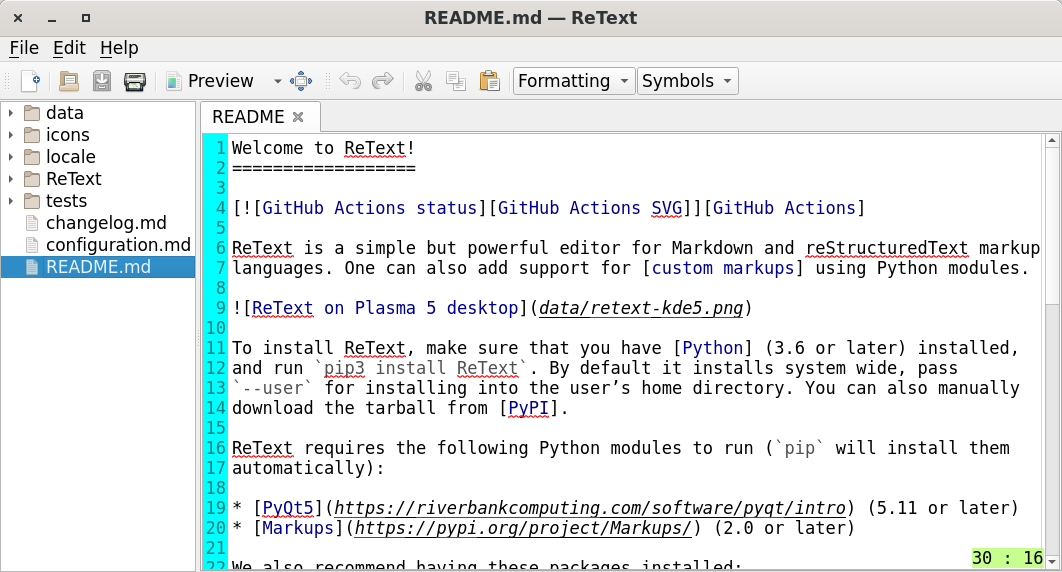
Exactly ten years ago, in February 2011, the first commit in ReText git repository was made. It was just a single 364 lines Python file back then (now the project has more than 6000 lines of Python code). Since 2011, the editor migrated from SourceForge to GitHub, gained a lot of new features, and most importantly now there is an active community around it, which includes both long-time contributors and newcomers who create their first issues or pull requests. I don t always have enough time to reply to issues or implement new features myself, but the community members help me with this. Earlier this month, I made a new release (7.2), which adds a side panel with directory tree (contributed by Xavier Gouchet), option to fully highlight wrapped lines (contributed by nihillum), ability to search in the preview mode and much more see the release page on GitHub. Side panel in ReText Also a new version of PyMarkups module was released, which contains all the code for processing various markup languages. It now supports markdown-extensions.yaml files which allow specifying complex extensions options and adds initial support for MathJax 3. Also check out the release notes for 7.1 which was not announced on this blog. Future plans include making at least one more release this year, adding support for Qt 6. Qt 5 support will last for at least one more year.

Matthew Garrett: Making hibernation work under Linux Lockdown

Linux draws a distinction between code running in kernel (kernel space) and applications running in userland (user space). This is enforced at the hardware level - in x86-speak[1], kernel space code runs in ring 0 and user space code runs in ring 3[2]. If you're running in ring 3 and you attempt to touch memory that's only accessible in ring 0, the hardware will raise a fault. No matter how privileged your ring 3 code, you don't get to touch ring 0.

Kind of. In theory. Traditionally this wasn't well enforced. At the most basic level, since root can load kernel modules, you could just build a kernel module that performed any kernel modifications you wanted and then have root load it. Technically user space code wasn't modifying kernel space code, but the difference was pretty semantic rather than useful. But it got worse - root could also map memory ranges belonging to PCI devices[3], and if the device could perform DMA you could just ask the device to overwrite bits of the kernel[4]. Or root could modify special CPU registers ("Model Specific Registers", or MSRs) that alter CPU behaviour via the /dev/msr interface, and compromise the kernel boundary that way.

It turns out that there were a number of ways root was effectively equivalent to ring 0, and the boundary was more about reliability (ie, a process running as root that ends up misbehaving should still only be able to crash itself rather than taking down the kernel with it) than security. After all, if you were root you could just replace the on-disk kernel with a backdoored one and reboot. Going deeper, you could replace the bootloader with one that automatically injected backdoors into a legitimate kernel image. We didn't have any way to prevent this sort of thing, so attempting to harden the root/kernel boundary wasn't especially interesting.

In 2012 Microsoft started requiring vendors ship systems with UEFI Secure Boot, a firmware feature that allowed[5] systems to refuse to boot anything without an appropriate signature. This not only enabled the creation of a system that drew a strong boundary between root and kernel, it arguably required one - what's the point of restricting what the firmware will stick in ring 0 if root can just throw more code in there afterwards? What ended up as the Lockdown Linux Security Module provides the tooling for this, blocking userspace interfaces that can be used to modify the kernel and enforcing that any modules have a trusted signature.

But that comes at something of a cost. Most of the features that Lockdown blocks are fairly niche, so the direct impact of having it enabled is small. Except that it also blocks hibernation[6], and it turns out some people were using that. The obvious question is "what does hibernation have to do with keeping root out of kernel space", and the answer is a little convoluted and is tied into how Linux implements hibernation. Basically, Linux saves system state into the swap partition and modifies the header to indicate that there's a hibernation image there instead of swap. On the next boot, the kernel sees the header indicating that it's a hibernation image, copies the contents of the swap partition back into RAM, and then jumps back into the old kernel code. What ensures that the hibernation image was actually written out by the kernel? Absolutely nothing, which means a motivated attacker with root access could turn off swap, write a hibernation image to the swap partition themselves, and then reboot. The kernel would happily resume into the attacker's image, giving the attacker control over what gets copied back into kernel space.

This is annoying, because normally when we think about attacks on swap we mitigate it by requiring an encrypted swap partition. But in this case, our attacker is root, and so already has access to the plaintext version of the swap partition. Disk encryption doesn't save us here. We need some way to verify that the hibernation image was written out by the kernel, not by root. And thankfully we have some tools for that.

Trusted Platform Modules (TPMs) are cryptographic coprocessors[7] capable of doing things like generating encryption keys and then encrypting things with them. You can ask a TPM to encrypt something with a key that's tied to that specific TPM - the OS has no access to the decryption key, and nor does any other TPM. So we can have the kernel generate an encryption key, encrypt part of the hibernation image with it, and then have the TPM encrypt it. We store the encrypted copy of the key in the hibernation image as well. On resume, the kernel reads the encrypted copy of the key, passes it to the TPM, gets the decrypted copy back and is able to verify the hibernation image.

That's great! Except root can do exactly the same thing. This tells us the hibernation image was generated on this machine, but doesn't tell us that it was done by the kernel. We need some way to be able to differentiate between keys that were generated in kernel and ones that were generated in userland. TPMs have the concept of "localities" (effectively privilege levels) that would be perfect for this. Userland is only able to access locality 0, so the kernel could simply use locality 1 to encrypt the key. Unfortunately, despite trying pretty hard, I've been unable to get localities to work. The motherboard chipset on my test machines simply doesn't forward any accesses to the TPM unless they're for locality 0. I needed another approach.

TPMs have a set of Platform Configuration Registers (PCRs), intended for keeping a record of system state. The OS isn't able to modify the PCRs directly. Instead, the OS provides a cryptographic hash of some material to the TPM. The TPM takes the existing PCR value, appends the new hash to that, and then stores the hash of the combination in the PCR - a process called "extension". This means that the new value of the TPM depends not only on the value of the new data, it depends on the previous value of the PCR - and, in turn, that previous value depended on its previous value, and so on. The only way to get to a specific PCR value is to either (a) break the hash algorithm, or (b) perform exactly the same sequence of writes. On system reset the PCRs go back to a known value, and the entire process starts again.

Some PCRs are different. PCR 23, for example, can be reset back to its original value without resetting the system. We can make use of that. The first thing we need to do is to prevent userland from being able to reset or extend PCR 23 itself. All TPM accesses go through the kernel, so this is a simple matter of parsing the write before it's sent to the TPM and returning an error if it's a sensitive command that would touch PCR 23. We now know that any change in PCR 23's state will be restricted to the kernel.

When we encrypt material with the TPM, we can ask it to record the PCR state. This is given back to us as metadata accompanying the encrypted secret. Along with the metadata is an additional signature created by the TPM, which can be used to prove that the metadata is both legitimate and associated with this specific encrypted data. In our case, that means we know what the value of PCR 23 was when we encrypted the key. That means that if we simply extend PCR 23 with a known value in-kernel before encrypting our key, we can look at the value of PCR 23 in the metadata. If it matches, the key was encrypted by the kernel - userland can create its own key, but it has no way to extend PCR 23 to the appropriate value first. We now know that the key was generated by the kernel.

But what if the attacker is able to gain access to the encrypted key? Let's say a kernel bug is hit that prevents hibernation from resuming, and you boot back up without wiping the hibernation image. Root can then read the key from the partition, ask the TPM to decrypt it, and then use that to create a new hibernation image. We probably want to prevent that as well. Fortunately, when you ask the TPM to encrypt something, you can ask that the TPM only decrypt it if the PCRs have specific values. "Sealing" material to the TPM in this way allows you to block decryption if the system isn't in the desired state. So, we define a policy that says that PCR 23 must have the same value at resume as it did on hibernation. On resume, the kernel resets PCR 23, extends it to the same value it did during hibernation, and then attempts to decrypt the key. Afterwards, it resets PCR 23 back to the initial value. Even if an attacker gains access to the encrypted copy of the key, the TPM will refuse to decrypt it.

And that's what this patchset implements. There's one fairly significant flaw at the moment, which is simply that an attacker can just reboot into an older kernel that doesn't implement the PCR 23 blocking and set up state by hand. Fortunately, this can be avoided using another aspect of the boot process. When you boot something via UEFI Secure Boot, the signing key used to verify the booted code is measured into PCR 7 by the system firmware. In the Linux world, the Shim bootloader then measures any additional keys that are used. By either using a new key to tag kernels that have support for the PCR 23 restrictions, or by embedding some additional metadata in the kernel that indicates the presence of this feature and measuring that, we can have a PCR 7 value that verifies that the PCR 23 restrictions are present. We then seal the key to PCR 7 as well as PCR 23, and if an attacker boots into a kernel that doesn't have this feature the PCR 7 value will be different and the TPM will refuse to decrypt the secret.

While there's a whole bunch of complexity here, the process should be entirely transparent to the user. The current implementation requires a TPM 2, and I'm not certain whether TPM 1.2 provides all the features necessary to do this properly - if so, extending it shouldn't be hard, but also all systems shipped in the past few years should have a TPM 2, so that's going to depend on whether there's sufficient interest to justify the work. And we're also at the early days of review, so there's always the risk that I've missed something obvious and there are terrible holes in this. And, well, given that it took almost 8 years to get the Lockdown patchset into mainline, let's not assume that I'm good at landing security code.

[1] Other architectures use different terminology here, such as "supervisor" and "user" mode, but it's broadly equivalent
[2] In theory rings 1 and 2 would allow you to run drivers with privileges somewhere between full kernel access and userland applications, but in reality we just don't talk about them in polite company
[3] This is how graphics worked in Linux before kernel modesetting turned up. XFree86 would just map your GPU's registers into userland and poke them directly. This was not a huge win for stability
[4] IOMMUs can help you here, by restricting the memory PCI devices can DMA to or from. The kernel then gets to allocate ranges for device buffers and configure the IOMMU such that the device can't DMA to anything else. Except that region of memory may still contain sensitive material such as function pointers, and attacks like this can still cause you problems as a result.
[5] This describes why I'm using "allowed" rather than "required" here
[6] Saving the system state to disk and powering down the platform entirely - significantly slower than suspending the system while keeping state in RAM, but also resilient against the system losing power.
[7] With some handwaving around "coprocessor". TPMs can't be part of the OS or the system firmware, but they don't technically need to be an independent component. Intel have a TPM implementation that runs on the Management Engine, a separate processor built into the motherboard chipset. AMD have one that runs on the Platform Security Processor, a small ARM core built into their CPU. Various ARM implementations run a TPM in Trustzone, a special CPU mode that (in theory) is able to access resources that are entirely blocked off from anything running in the OS, kernel or otherwise.

comment count unavailable comments

Louis-Philippe V ronneau: dput-ng or: How I Learned to Stop Worrying and Love the Hooks

As my contributions to Debian continue to grow in number, I find myself uploading to the archive more and more often. Although I'm pretty happy with my current sbuild-based workflow, twice in the past few weeks I inadvertently made a binary upload instead of a source-only one.1 As it turns out, I am not the only DD who has had this problem before. As Nicolas Dandrimont kindly pointed to me, dput-ng supports pre and post upload hooks that can be used to lint your uploads. Even better, it also ships with a check-debs hook that lets you block binary uploads. Pretty neat, right? In a perfect world, enabling the hook would only be a matter of adding it in the hook list of /etc/dput.d/metas/debian.json and using the following defaults:
"check-debs":  
    "enforce": "source",
    "skip": false
 ,
Sadly, bug #983160 currently makes this whole setup more complex than it should be and forces me to use two different dput-ng profiles pointing to two different files in /etc/dput.d/metas: a default source-only one (ftp-master) and a binary upload one (ftp-master-binary). Otherwise, one could use a single profile that disallows binary uploads and when needed, override the hook using something like this:
$ dput --override "check-debs.enforce=debs" foo_1.0.0-1_amd64.changes
I did start debugging the --override issue in dput-ng, but I'm not sure I'll have time to submit a patch anytime soon. In the meantime, I'm happy to report I shouldn't be uploading the wrong .changes file by mistake again!

  1. Thanks to Holger Levsen and Adrian Bunk for catching those and notifying me.

Russ Allbery: Review: The Fated Sky

Review: The Fated Sky, by Mary Robinette Kowal
Series: Lady Astronaut #2
Publisher: Tor
Copyright: August 2018
ISBN: 0-7653-9893-1
Format: Kindle
Pages: 380
The Fated Sky is a sequel to The Calculating Stars, but you could start with this book if you wanted to. It would be obvious you'd missed a previous book in the series, and some of the relationships would begin in medias res, but the story is sufficiently self-contained that one could puzzle through. Mild spoilers follow for The Calculating Stars, although only to the extent of confirming that book didn't take an unexpected turn, and nothing that wouldn't already be spoiled if you had read the short story "The Lady Astronaut of Mars" that kicked this series off. (The short story takes place well after all of the books.) Also some minor spoilers for the first section of the book, since I have to talk about its outcome in broad strokes in order to describe the primary shape of the novel. In the aftermath of worsening weather conditions caused by the Meteor, humans have established a permanent base on the Moon and are preparing a mission to Mars. Elma is not involved in the latter at the start of the book; she's working as a shuttle pilot on the Moon, rotating periodically back to Earth. But the political situation on Earth is becoming more tense as the refugee crisis escalates and the weather worsens, and the Mars mission is in danger of having its funding pulled in favor of other priorities. Elma's success in public outreach for the space program as the Lady Astronaut, enhanced by her navigation of a hostage situation when an Earth re-entry goes off course and is met by armed terrorists, may be the political edge supporters of the mission need. The first part of this book is the hostage situation and other ground-side politics, but the meat of this story is the tense drama of experimental, pre-computer space flight. For those who aren't familiar with the previous book, this series is an alternate history in which a huge meteorite hit the Atlantic seaboard in 1952, potentially setting off runaway global warming and accelerating the space program by more than a decade. The Calculating Stars was primarily about the politics surrounding the space program. In The Fated Sky, we see far more of the technical details: the triumphs, the planning, and the accidents and other emergencies that each could be fatal in an experimental spaceship headed towards Mars. If what you were missing from the first book was more technological challenge and realistic detail, The Fated Sky delivers. It's edge-of-your-seat suspenseful and almost impossible to put down. I have more complicated feelings about the secondary plot. In The Calculating Stars, the heart of the book was an incredibly well-told story of Elma learning to deal with her social anxiety. That's still a theme here but a lesser one; Elma has better coping mechanisms now. What The Fated Sky tackles instead is pervasive sexism and racism, and how Elma navigates that (not always well) as a white Jewish woman. The centrality of sexism is about the same in both books. Elma's public outreach is tied closely to her gender and starts as a sort of publicity stunt. The space program remains incredibly sexist in The Fated Stars, something that Elma has to cope with but can't truly fix. If you found the sexism in the first book irritating, you're likely to feel the same about this installment. Racism is more central this time, though. In The Calculating Stars, Elma was able to help make things somewhat better for Black colleagues. She has a much different experience in The Fated Stars: she ends up in a privileged position that hurts her non-white colleagues, including one of her best friends. The merits of taking a stand on principle are ambiguous, and she chooses not to. When she later tries to help Black astronauts, she does so in a way that's focused on her perceptions rather than theirs and is therefore more irritating than helpful. The opportunities she gets, in large part because she's seen as white, unfairly hurt other people, and she has to sit with that. It's a thoughtful and uncomfortable look at how difficult it is for a white person to live with discomfort they can't fix and to not make it worse by trying to wave it away or point out their own problems. That was the positive side of this plot, although I'm still a bit wary and would like to read a review by a Black reviewer to see how well this plot works from their perspective. There are some other choices that I thought landed oddly. One is that the most racist crew member, the one who sparks the most direct conflict with the Black members of the international crew, is a white man from South Africa, which I thought let the United States off the hook too much and externalized the racism a bit too neatly. Another is that the three ships of the expedition are the Ni a, the Pinta, and the Santa Maria, and no one in the book comments on this. Given the thoughtful racial themes of the book, I can't imagine this is an accident, and it is in character for United States of this novel to pick those names, but it was an odd intrusion of an unremarked colonial symbol. This may be part of Kowal's attempt to show that Elma is embedded in a racist and sexist world, has limited room to maneuver, and can't solve most of the problems, which is certainly a theme of the series. But it left me unsettled on whether this book was up to fully handling the fraught themes Kowal is invoking. The other part of the book I found a bit frustrating is that it never seriously engaged with the political argument against Mars colonization, instead treating most of the opponents of space travel as either deluded conspiracy believers or cynical villains. Science fiction is still arguing with William Proxmire even though he's been dead for fifteen years and out of office for thirty. The strong argument against a Mars colony in Elma's world is not funding priorities; it's that even if it's successful, only a tiny fraction of well-connected elites will escape the planet to Mars. This argument is made in the book and Elma dismisses it as a risk she's trying to prevent, but it is correct. There is no conceivable technological future that leads to evacuating the Earth to Mars, but The Fated Sky declines to grapple with the implications of that fact. There's more that I haven't remarked on, including an ongoing excellent portrayal of the complicated and loving relationship between Elma and her husband, and a surprising development in her antagonistic semi-friendship with the sexist test pilot who becomes the mission captain. I liked how Kowal balanced technical problems with social problems on the long Mars flight; both are serious concerns and they interact with each other in complicated ways. The details of the perils and joys of manned space flight are excellent, at least so far as I can tell without having done the research that Kowal did. If you want a fictionalized Apollo 13 with higher stakes and less ground support, look no further; this is engrossing stuff. The interpersonal politics and sociology were also fascinating and gripping, but unsettling, in both good ways and bad. I like the challenge that Kowal presents to a white reader, although I'm not sure she was completely in control of it. Cautiously recommended, although be aware that you'll need to grapple with a sexist and racist society while reading it. Also a content note for somewhat graphic gastrointestinal problems. Followed by The Relentless Moon. Rating: 8 out of 10

Next.

Previous.