Search Results: "ean"

4 April 2013

Bernhard R. Link: Git package workflows

Given the recent discussions on planet.debian.org I use the opportunity to describe how you can handle upstream history in a git-dpm workflow. One of the primary points of git-dpm is that you should be able to just check out the Debian branch, get the .orig.tar file(s) (for example using pristine-tar, by git-dpm prepare or by just downloading them) and then calling dpkg-buildpackage. Thus the contents of the Debian branch need to be clean from dpkg-source's point of view, that is do not contain any files the .orig.tar file(s) contains not nor any modified files. The easy way The easiest way to get there is by importing the upstream tarball(s) as a git commit, which one will usually do with git-dpm import-new-upstream as that also does some of the bookkeeping. This new git commit will have (by default) the previous upstream commit and any parent you give with -p as parents. (i.e. with -p it will be a merge commit) and its content will be the contents of the tarball (with multiple orig files, it gets more complicated). The idea is of course that you give the upstream tag/commit belonging to this release tarball with -p so that it becomes part of your history and so git blame can find those commits. Thus you get a commit with the exact orig contents (so pristine-tar can more easily create small deltas) and the history combined.. Sometimes there are files in the upstream tarball that you do not want to have in your Debian branch (as you remove them in debian/rules clean), then when using this method you will have those files in the upstream branch but you delete them in the Debian branch. (This is why git-dpm merge-patched (the operation to merge a new branch with upstream + patches with your previous debian/ directory) will look which files relative to the previous upstream branch are deleted and delete them also in the newly merged branch by default). The complicated way There is only a way without importing the .orig.tar file(s), though that is a bit more complicated: The idea is that if your upstream's git repository contains all the files needed for building your Debian package (for example if you call autoreconf in your Debian package and clean all the generated files in the clean target, or if upstream has a less sophisticated release process and their .tar contains only stuff from the git repository), you can just use the upstream git commit as base for your Debian branch. Thus you can make upstream's commit/tag your upstream branch, by recording it with git-dpm new-upstream together with the .orig.tar it belongs to (Be careful, git-dpm does not check if that branch contains any files different than your .orig.tar and could not decide if it misses any files you need to build even if it tried to tell). Once that is merged with the debian/ directory to create the Debian branch, you run dpkg-buildpackage, which will call dpkg-source which compares your working directory with the contents of the .orig.tar with the patches applied. As it will only see files not there but no files modified or added (if everything was done correctly), one can work directly in the git checkout without needing to import the .orig.tar files at all (altough the pristine-tar deltas might get a bit bigger).

Daniel Pocock: Comparing packaging workflows in Debian and beyond

My blog post yesterday about Debian's git packaging workflows was meant to help fill some gaps in the documentation of this process, one of the most significant being the diagram. I was surprised to find that some people felt my post argues that distribution tarballs are a must-have or that separate repositories are the optimal solution. In fact, my post was more a reflection of how things are being done, and it is great to see contributions from Joey, Russ and Thomas proposing ways to integrate the workflow in a single repository and also raising questions about the future of tarballs. Some of the changes outlined by Russ only entered the tools after many people were already using the workflow I have described. Given the rise of collaboration, through collab-maint and packaging teams, it is more important than ever that workflows and tools are easily understood and documented. This lets new contributors (including people new to Debian) jump in more quickly and with less risk of disruption. It would be great to see some of these latest ideas covered more thoroughly with diagrams and I'm happy for people to rip-off my dia source file for my own diagram and amend it as they please (under the generous terms of the GPL v3) A look at other packaging systems With the role of the tarball in people's sights, it's worth looking outside Debian for a moment:
  • Android packaging is radically different. All packages have a single integer version number. The pretty version number displayed to the user is meaningless. Due to the continuously increasing integer version, and the way that database schemas are versioned, it is not really possible to even keep multiple release branches in a repository. For an example, see the version in the Lumicall AndroidManifest.xml and the database upgrade function. Google Play/Android Market makes no rules about how a project manages its code. f-droid, the open source market for apps, builds projects like Lumicall directly from git, it relies on them having an ant build file in the standard format generated by the SDK.
  • OpenCSW does not keep upstream tarballs at all. They keep a single git repository for tracking all packages. Each package is built from a Makefile (sample), and their tool suite takes care of downloading the upstream sources (using a URL specified in the Makefile) and verifying against checksums tracked in the repository (sample). The common style of the Makefiles makes it very easy for somebody familiar with the tools to work on just about any of the packages, and anybody who knows how to write a Makefile can start quickly.
Of course, these are just a few examples. These days, software is distributed in many different ways, whether it is a runnable VM image or an embedded device implanted during surgery.

Thomas Goirand: Git packaging workflow

Seeing what has been posted recently in planet.d.o, I would like to share as well my thoughts and work-flow, and tell that I do agree with Joey Hess on many of his arguments. Especially when he tells that Debian fetishises upstream tarballs. We re in 2013, at the age of Internet, and more and more upstream authors are using Git, and more and more they don t care about releasing tarballs. I ve seen some upstream authors who simply stopped doing so completely, as a Git tag is really enough. I also fully agree than disk space and network speed isn t much of a problem these days. When there are tags available, I use the following debian/gbp.conf:
[DEFAULT]
upstream-branch = master
debian-branch = debian
upstream-tag = %(version)s
compression = xz
[git-buildpackage]
export-dir = ../build-area/
On many of my packages, I now just use Git tags from upstream if they are available. To make it more easy, I now nearly always use the following piece of code in my debian/rules files:
DEBVERS         ?= $(shell dpkg-parsechangelog   sed -n -e 's/^Version: //p')
VERSION         ?= $(shell echo '$(DEBVERS)'   sed -e 's/^[[:digit:]]*://' -e 's/[-].*//')
DEBFLAVOR       ?= $(shell dpkg-parsechangelog   grep -E ^Distribution:   cut -d" " -f2)
DEBPKGNAME      ?= $(shell dpkg-parsechangelog   grep -E ^Source:   cut -d" " -f2)
DEBIAN_BRANCH   ?= $(shell cat debian/gbp.conf   grep debian-branch   cut -d'=' -f2   awk ' print $1 ')
GIT_TAG         ?= $(shell echo '$(VERSION)'   sed -e 's/~/_/')
get-upstream-sources:
        git remote add upstream git://git.example.org/proj/foo.git   true
        git fetch upstream
        if ! git checkout master ; then \
                echo "No upstream branch: checking out" ; \
                git checkout -b master upstream/master ; \
        fi
        git checkout $(DEBIAN_BRANCH)
make-orig-file:
        if [ ! -f ../$(DEBPKGNAME)_$(VERSION).orig.tar.xz ] ; then \
                git archive --prefix=$(DEBPKGNAME)-$(GIT_TAG)/ $(GIT_TAG)   xz >../$(DEBPKGNAME)_$(VERSION).orig.tar.xz ; \
        fi
        [ ! -e ../build-area ] && mkdir ../build-area   true
        [ ! -e ../build-area/$(DEBPKGNAME)_$(VERSION).orig.tar.xz ] && cp ../$(DEBPKGNAME)_$(VERSION).orig.tar.xz ../build-area   true
Packaging a new upstream VERSION now means that I only have to edit the debian/changelog, do ./debian/rules get-upstream-source so that I get new commits and tags, then git merge -X theirs VERSION to import the changes, then finally invoke ./debian/rules make-orig-file to create the orig.tar.xz. My debian branch is now ready for git-buildpackage. Note that the sed with the GIT_TAG thing is there because unfortunately, Git doesn t support the ~ char in tags, and that most of the time, upstream do not use _ in version numbers. Let s say upstream is releasing version 1.2.3rc1, then I simply do git tag 1.2.3_rc1 1.2.3rc1 so that I have a new tag which points to the same commit as 1.2.3rc1, but that can be used for the Debian 1.2.3~rc1-1 release and the make-orig-file. All this might looks overkill at first, but in fact it is really convenient and efficient. Also, even though there is a master branch above, it isn t needed to build the package. Git is smarter than this, so even if you haven t checked out upstream master branch from the upstream remote, make-orig-file and git-buildpackage will simply continue to work. Which is cool, because this means you can store a single branch on Alioth (which is what I do).

Russ Allbery: Debian packaging of Git upstreams

Since there's a discussion of packaging software for Debian that uses Git upstream on Planet Debian right now, I wanted to weigh in and advocate for my current workflow for this situation, which I'm quite fond of. It's worth noting that I'm also upstream for quite a few of the packages I maintain, all in Git, and I use (almost) exactly the same structure for packaging my own software as for packaging anyone else's. So I have some experience with both sides of this. First off, I completely agree with Joey: if upstream is already using Git, there's no reason not to base the Debian packaging on the upstream repository, and many, many reasons to do so. One of the biggest advantages is that when repositories share a common basis and have been regularly merged, you can easily cherry-pick commits, which is wonderful for security releases and situations where you need a quick bug fix from an unreleased upstream branch. I make very heavy use of this when packaging OpenAFS. I do, however, like to base the Debian packaging on the released tarball, if for no other reason than that's the artifact that other people can more easily confirm. Yes, you can do the same thing with a Git tag, but the tarball is what upstream considers a release, so if one is available, I think it makes the most sense to base the packaging on it. I do this even for my own software. Thankfully, it's not that difficult to do both. Sam Hartman was the one who showed me this technique, and (after I used a manual script for some time for a couple of packages) Guido G nther incorporated the support into git-import-orig. The key idea is to still import the tarball into the upstream branch, but instead of making that import a simple commit, you make it a merge commit referencing the upstream release tag or commit from their Git repository. This means that you still get the exact contents of the release tarball on the upstream branch (and pristine-tar works as normal), but that branch is also based on the full upstream line of development. Therefore, so is your packaging branch (master or what have you) since you merge upstream into it. You can then charry-pick and take advantage of all of the normal Git features when following upstream development. This is dead simple to do with git-import-orig. Just add the upstream repository as a remote for your Git repository, make sure it's up to date with git fetch and you have the upstream tags, and then pass the flag --upstream-vcs-tag <tag> to git-import-orig whenever importing the upstream release tarball. git-import-orig will handle the construction of the merge commit for you and everything will just work, exactly like it normally does with git-buildpackage except with a more complete history. This support was added in git-buildpackage 0.6.0~git20120324, so it's available in unstable and testing. (I was going to update my notes on Debian packaging with Git to include this information before posting this, but I see that it will require some restructuring and quite a few changes to that document and I don't have time tonight. Hopefully soon.)

3 April 2013

Julien Danjou: Hy, Lisp in Python

I've meant to look at Hy since Paul Tagliamonte started to talk to me about it, but never took a chance until now. Yesterday, Paul indicated it was a good time for me to start looking at it, so I spent a few hours playing. But what's Hy? Python is very nice: it has a great community and a wide range of useful libraries. But let's face it, it misses a great language. Hy is an implementation of a Lisp on top of Python. Technically, Hy is built directly with a custom made parser (for now) which then translates expressions using the Python AST module to generate code, which is then run by Python. Therefore, it shares the same properties as Python, and is a Lisp-1 (i.e. with a single namespace for symbols and functions). If you're interested to listen Paul talking about Hy during last PyCon US, I recommend watching his lightning talk. As the name implies, it's only a few minutes long. <iframe allowfullscreen="allowfullscreen" class="shadow" frameborder="0" height="374" src="http://www.youtube.com/embed/1vui-LupKJI?wmode=transparent&amp;autohide=1&amp;egm=0&amp;hd=1&amp;iv_load_policy=3&amp;modestbranding=1&amp;rel=0&amp;showinfo=0&amp;showsearch=0#t=16m14s" width="500"></iframe> Does it work? I've been cloning the code and played around a bit with Hy. And to my greatest surprise and pleasure, it works quite well. You can imagine writing Python from there easily. Part of the syntax smells like Clojure's, which looks like a good thing since they're playing in the same area. You can try a Hy REPL in your Web browser if you want. Here's what some code look like:
(import requests)

(setv req (requests.get "http://hy.pault.ag"))
(if (= req.status_code 200)
(for (kv (.iteritems req.headers))
(print kv))
(throw (Exception "Wrong status code")))

This code would ouput:
('date', 'Wed, 03 Apr 2013 12:09:23 GMT')
('connection', 'keep-alive')
('content-encoding', 'gzip')
('transfer-encoding', 'chunked')
('content-type', 'text/html; charset=utf-8')
('server', 'nginx/1.2.6')
As you can see, it's really simple to write Lispy code that really uses Python idioms. There's obviously still a lots of missing features in Hy. The language if far from complete and many parts are moving, but it's really promising, and Paul's doing a great job implementing every idea. I actually started to hack a bit on Hy, and will try to continue to do so, since I'm really eager to learn a bit more about both Lisp and Python internals in the process. I've already send a few patches on small bugs I've encountered, and proposed a few ideas. It's really exciting to be able to influence early a language design that I'll love to use! Being a recent fan of Common Lisp, I tend to grab the good stuff from it to add them into Hy.

Daniel Pocock: The multiple repository conundrum in Linux packaging

I'm involved with a number of free software projects as both a developer and as the maintainer of packages for various distributions such as Debian (which also feeds packages to Ubuntu) and OpenCSW. I regularly come across the following situations:
  • Developers of great software who would like to see it packaged, distributed and promoted conveniently through platforms like Debian
  • Users of Linux distributions who are keen to use free software if it is presented in a convenient and accessible manner they are familiar with.
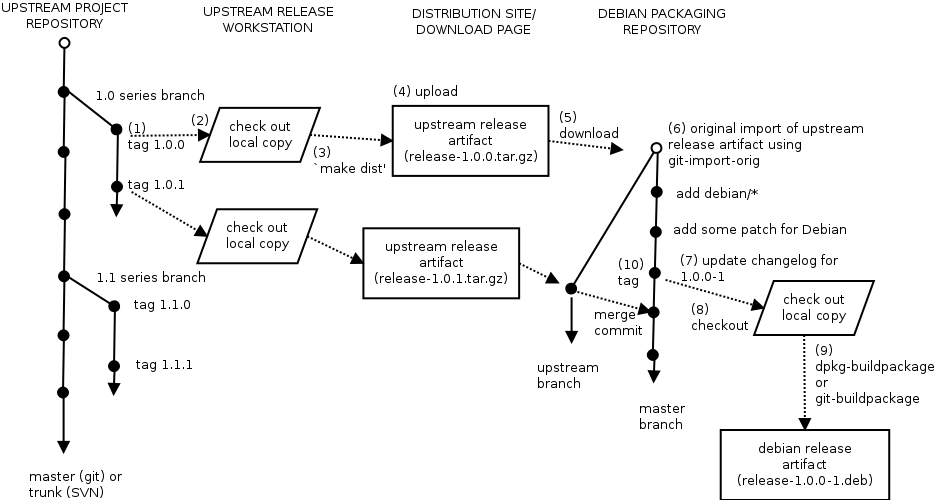
Sadly, despite everybody having the best intentions, there is sometimes a chasm separating these two groups of people. Upstream developers are often busy developing new features and don't have time to work on the intricacies of packaging. I hope that by sharing a few of my own experiences I can help more developers get their software packaged more easily. Fortunately, a number of great tools like git-buildpackage have emerged for streamlining the packaging process, but this has also created more confusion for developers who have their own git repositories and don't quite understand how the Debian git repository and patching process relates to their own repository. The autotools world Here, I focus on autotools based software, because this type of software has it's own peculiar issues when packaging. In particular, these issues appear when using a version control system to track upstream releases. Some of the concepts can be applied to the study of regular Makefile or cmake projects as well. Here is a diagram giving an overview: Let's work through each of the steps in the diagram: The upstream release
  1. The developer/release manager updates the version number in
    configure.ac
    (sometimes called configure.in) and tags the code. (Usually this tag is on a dedicated release branch.)
  2. The developer checks out a copy of the code from the tag into a fresh working directory
  3. The developer runs the autoreconf/automake tools, usually from a bootstrap script. These tools create a number of new files that don't exist in the project repository. Finally, the developer runs
    make dist
    , which puts all the files,
    including the generated files, into a distribution tarball. It is worth emphasizing this point: the tarball is not just an archive of the files from the repository/tag, it also contains a number of
    files generated by autotools.
  4. The developer uploads the tarball to a web site such as the Sourceforge download page. Usually a release announcement is made now containing checksums for the tarball.
At this point, the upstream developer's work is done and packaging teams from various projects such as Debian will take over. Sometimes, the upstream developer is also building the packages and continues
onto the next steps himself: Packaging
  1. The package is downloaded by the package maintainer
  2. If it is the first download, the maintainer creates a new git repository. If it has been packaged before, he clones the repository. The important point here is that this is not the upstream repository, it is an independent repository for Debian packaging. The maintainer uses the git-import-orig tool to import the upstream tarball into the packaging repository. The git-import-orig tool captures an exact snapshot of the upstream release tarball contents in a branch called upstream. One point where the Debian repository differs fundamentally from the upstream repository is that all files from the tarball will be tracked in the Debian git repository, even those automatically generated files that were created by autotools and don't exist in the upstream repository.
  3. The maintainer creates or updates the various artifacts for packaging. These files are kept on the master branch, and the tarball contents from the upstream branch are merged into master to create packages.
  4. When the maintainer feels the code is ready, he will check out a clean copy of the repository to build the package from.
  5. The maintainer executes a tool such as git-buildpackage or regular dpkg-buildpackage, which creates the *.deb files.
  6. The files are checked with a tool like lintian and some manual testing/installation. If all is OK, a tag is made in the packaging repository, with a suffix appended to the upstream version number to indicate which iteration of the package it applies to.
AttachmentSize
release-packaging-workflow.dia3.97 KB

2 April 2013

Jon Dowland: GSettings

With GNOME 3, if you want to override a setting with a new site default, assuming your app has been updated to use the new gsettings API and doesn't still use the old gconf one, the best guide on what to do is still Ross Burton's blog post from two years ago, although you can find most of what you need to know buried deep in the GSettings C API specification, which is not the first place I would have looked (lesson learned!) Note: In this context I'm in the role of systems administrator, rather than distributor/vendor or software author. Whereas you are generally advised to use gsettings itself and not poke at the backend (dconf for Linux), the documentation seems to point sysadmins towards dconf hackery rather than gsettings. However gsettings worked for me, and I got nowhere with dconf direct. Some caveats worth knowing about: Today I had to create 40 guest accounts on our 70-seat Linux cluster, including randomly generate passwords, set up persistent storage on our NFS server, etc.; quickly. As a nice-to-have I also wanted to add some application icons to the GNOME 3 "Favourite Apps" menu for the guests. Would you like to guess which of those jobs was the easier of the two?

Hideki Yamane: re-compress debian.tar. gz.bz2

You can use bzip2 to compress debian.tar source file in debian/source/options. But usually xz is more efficient than bzip2 (in my experience, and I love xz :) So, how about re-compressing those files with xz?

This is the result.

2.1G tar
503M current
414M xz_6e
410M xz_9e

non-compressed file is 2.1GB and we've compressed to 0.5GB. If we would use xz, it becomes 0.4GB.

debian.tar.bz2 files are 6.3M, if we would use gz, it becomes 40M, it means that package maintainers' choice is right.

6.3M bz2
40M gz
5.8M xz

Wouter Verhelst: Switching away from mutt

After having used mutt for about a decade, I decided it's time I move away from it, for various reasons that I won't go into here. I've been evaluating thunderbird^Wicedove now for a few weeks, but I can already see I won't keep using it forever, because I find too many issues with it:
  1. I can't tell the thing that I never ever ever want to write HTML-formatted emails. While there is an option "Compose messages in HTML format" in the "Account settings" dialog, that only seems to impact the behaviour of the client upon "new mail", not its reply behaviour, forcing me to go to Options->Format and switch it off.
  2. To make matters worse, the HTML editor and the plain-text editor are not the same dialog. That means it is not possible to switch on HTML formatting if it wasn't on originally (not a problem for me, but I can imagine it being a problem for others), but also that the fugly quoting style (vertical line next to the text) of the HTML editor is not removed when you switch from HTML to plain-text. Further on, it has issues when you want to remove white space, where it will remove entire quoting levels rather than just an empty line. This is horrible, horrible behaviour.
  3. While there is support for multiple email addresses connected to the same IMAP account, it does appear that there is no support for automatically choosing the right email address based on user-defined rules, such as "which mail folder are we currently in". Having to remember that I need to select the right mail address is tiresome and error-prone; e.g., when I'm in a Debian-related mail folder, I want my mail client to use my Debian mail address automatically. It appears the only way in which icedove can automatically select sender addresses is by checking the recipient list in the To: and Cc: headers for any of its configured mail addresses, and using that to decide what to put in the from: header.
Any one of the above would eventually be enough for me to grow tired of icedove and switch to something else; but the three combined mean that I'll be looking for something else fairly soon. Suggestions are, of course, welcome.

Russ Allbery: Review: An Election

Review: An Election, by John Scalzi
Publisher: Subterranean
Copyright: 2010
Printing: 2012
ISBN: 1-59606-496-X
Format: Kindle
Pages: 24
This is another story from the Subterranean Scalzi Super Bundle that probably doesn't justify a full review, particularly since this time it's a short story and not even a novelette, but as with the others it's been independently published on the Kindle (and is still available that way for 99 cents). So by my obsessive internal consistency that matters only to me, it gets a full review anyway. I was mildly surprised to find that this was actually my second reading, and now vaguely remember that Subterranean had actually sponsored the story's appearance on Scalzi's blog as an advertising experiment. So I originally read the story from Scalzi's blog, and if you don't really want to pay money for it, you still can as well. Along with a couple of ads that appear to have bit-rotted. The chief feature of An Election is the background: a world in which aliens and humans are intermingled in a political district, going about their lives against a background of rather extreme multispecies diversity. The protagonist, David, decides to run for the upcoming city council special election, despite living in a district that's minority-human and that hasn't seen a human councilor in forty-four years. (David also happens to be a gay man, which goes entirely unremarked in the story and is, in fact, entirely unremarkable given the excitingly diverse characteristics of his alien neighbors. I thought that was a nice touch.) He of course appears to stand no chance, particularly when one of the city bosses decides to run as well, but ends up with a campaign advisor almost by accident and determinedly attempts to connect with his neighbors and earn their votes. This felt quite typical to me of Scalzi's humor writing. The protagonist is a good-hearted person who gets in rather over his head but is still determined to do the right thing, while not taking anything too seriously. The background humor is never particularly threatening and tends towards slapstick and banter. I found it similar in tone to most of Agent to the Stars, although of course much shorter. As usual, Scalzi's grasp of conversational banter is probably the strongest part of the story; the dynamic between David, his husband James, and his campaign advisor brought several chuckles for me. This is slight but enjoyable. I wouldn't go out of my way to read it, but it's a good story to toss into a bundle of other work, and I remember it holding my interest when reading it on-line. (Which is rare; usually I fail to finish any fiction I try to read in a browser unless it's extremely short.) Rating: 6 out of 10

1 April 2013

Andrew Pollock: [life/repatexpat] Day #1 of repatriation

Well, we're back in Brisbane, for good. Now starts the long and involved process of bootstrapping a new life for myself. Fortunately it's slightly more familiar territory than starting up in the US was. The tenants in my Hawthorne apartment have agreed to terminate their lease early, and I should get the keys tomorrow. The lease on my Woolloongabba apartment ends on Friday I think, and all of our stuff is scheduled to be delivered there next Monday. My primary goal is to get my apartment habitable for Zoe and I as soon as possible. That means beds and a fridge, and Zoe's going to need some way of being kept entertained while I'm running around like a chook with its head cut off, which is most likely going to mean a TV and a DVD player. This week is going to be spent doing a lot of running around. I need to get a car, get a Queensland driver's licence, get the electricity on, get the ADSL on, buy appliances, furnish Zoe's room, furnish my room, heck, furnish the whole apartment, really. It's going to be very full on busy. I don't want to race out and buy anything today, even though the shops seem to be open, because I want to measure up my apartment first. The day's sole purchase was an electric screwdriver from Bunnings. There will be much Ikea assembly in my future.

Russ Allbery: Review: Echo

Review: Echo, by Jack McDevitt
Series: Alex Benedict #5
Publisher: Ace
Copyright: November 2010
Printing: November 2011
ISBN: 1-937007-00-6
Format: Mass market
Pages: 367
This is the fifth book in the ongoing Alex Benedict series, but reading the previous volumes is generally optional. While there are references to earlier events (and indeed I resorted to Wikipedia at one point to refresh my memory of the plot of the the first book in the series), they aren't critical to the plot. They mostly are background for the reactions of other characters to Benedict and his firm. Echo opens with the now-familiar prologue, giving us a fleeting and limited glimpse into the mystery that Benedict and Chase Kolpath will be pursuing for the rest of the book. This time, it features the explorer Somerest Tuttle, who has spent most of his life looking for intelligent alien life. (In the far future setting of these books, humanity has spread through a large region of the galaxy but has only encountered one other alien race.) In the twilight of his career and life, a friend who works as a tour guide for astronomical tours comes to him with a story about something she saw. What, we don't know, and won't for most of the book. But, whatever it is, Tuttle never goes public with it, which is directly contrary to what everyone would expect him to do with any news about alien life. Benedict and Kolpath get involved some years later, after Tuttle's death, when a stone slab with unknown markings that was part of his estate shows up on the future equivalent of Craigslist, free to the first person who will haul it away. Benedict finds that interesting enough to go pick up, but then is really hooked when someone else goes to considerable lengths to try to make the slab disappear before anyone can get a good look at it. This, slowly, leads into poking around Tuttle's life and connections, the star tour industry, and the possible origins of the slab. If you've read any of the previous books in this series, Echo is more of the same, and I mean that in a good way. I think McDevitt is at his best when writing this sort of cross between scientific puzzle, mystery, and non-military adventure, full of people who care deeply about knowing and understanding things and don't like to be thwarted in their efforts. There is McDevitt's trademark halting and red-herring-ridden investigation that succeeds in being engrossing and compelling, plenty of opportunities to guess what's really going on (a bit easier this book than in some others), and a bit of action that I thought was better-handled than the somewhat strained action scenes of The Devil's Eye. The book moves right along, despite multiple reversals in the progress of the investigation, and the final revelation does indeed justify the strange behavior of the various people Benedict encounters. As with McDevitt in general and this series in particular, there is one caveat: the astronomical details are often interesting, but the world building in general is not terribly believable. Despite supposedly taking place millennia into the future, the society is a straight transplant (projection would imply more change than exists) of middle-class American culture, with bonus air cars, space ships, and slightly better computers. Similarly, alien ecologies suffer from severe Star Trek problems: all the planets feel like copies of Earth with a few minor tweaks. This just goes with the territory, and if you're up to the fifth book of the series, you've probably gotten used to it, but the unrealistic lack of divergence is actually used as a plot point here. That strained my suspension of disbelief a bit. That said, this sort of extremely familiar social context does give the books an oddly calm, comfortable feeling. It's tempting to describe McDevitt as cozy science fiction. There's a bit of danger, a bit of suspense, but one is fairly certain that everything will work out in the end and the reader will leave the book knowing the solutions to most of the mysteries raised without having to work very hard at understanding the society or the puzzle. If that's what you're in the mood for (and I was when I read Echo), McDevitt delivers reliably. If you like the Alex Benedict series in general, recommended, as this is an excellent example of the type. Rating: 8 out of 10

31 March 2013

Enrico Zini: A proposal to solve gender imbalance in Debian

A proposal to solve gender imbalance in Debian We've done all we can so far: Debian Women, the Diversity Statement, the anti-harassment contact, gender neutral language, lots of education all round, but we still suffer from a strong gender imbalance in Debian. I think that the reason is that the majority group of cisgender men in the project, although they don't actively work /against/ the rest, still have /no incentive/ to be inclusive, and generally do not understand what bearing a female name online is like. I think it is about time we addressed that, and after a lot of thinking and discussing with many other concerned debianers, I think I have just the right proposal, which is twofold. The first part is this: since the goal is to have an equal gender perception in Debian, we can just decide to only approve one obviously-male-named DD for every obviously-female-named one. That's right: no new obviously-male-named DD unless an obviously-female-named DD has just been approved. It may sound like affirmative action gone wild, but please stop a moment to think about it: this would create precisely the right incentive for the currently dominant group of developers to be inclusive! People shouldn't just assume they can get a Debian account regardless of what happens around them. We already ask NM candidates to fix RC bugs and, well, gender imbalance should be treated as an RC bug, and everyone should feel compelled to join the effort to fix it! Now, of course since there currently are many male names in NM but not a single female name, it would not be reasonable to just stop the flow of new developers into the project: that would just have the effect to make us starve on personpower. So here is the second part of the proposal: the one-female-name-one-male-name policy will not be enforced for, say, a year. But during this year, everyone currently in NM or joining NM will be asked to adopt a female identity. Crazy? No, genius! It's about time people understood what it means to get advances in private every time they make a public contribution! What better way than just trying it out for themselves? On top of that, as more and more female names appear in Debian changelogs, fake or not, people will finally start to understand that it does not matter what name is used to sign the contribution, but the contribution itself. I don't know if this will give us a community where people realise female or male contributions are equally valuable, which is what I hope, or a community where people will think that everyone is a cisgender man even if they have female names. In the end, really, it does not matter. Either way, we finally get to have a community where everyone is /guaranteed/ to be treated the same. But gender imbalance isn't the only imbalance we have in Debian. People accrue a reputation over time, good or bad, and this reputation tends to stick on you for years, regardless of how you may change, for better or for worse. When we evaluate the merit a contribution, we should not be biased by the reputation of the contributor! How can new contributors be taken seriously otherwise? I believe we are loosing lots of fresh, good ideas this way. And how much damage could be wrecked on the project by a well-respected contributor, like a Debian Account Manager, who is having a funny day? I think we can address this just as I propose to address gender imbalance: let's swap identities from time to time, like it usually happens with nametags at the end of Debconfs. Let's see gregoa upload a patched versions of python3.2, and enrico upload a new upstream version of eglibc! See if we won't finally have some peer review at last! Reputation and real identities have many merits, but we have come to rely too much on them, and it is hurting us. It is time we did something about it, before it is too late!

30 March 2013

Evgeni Golov: Opera, standards and why I should have stayed in my cave

So you probably heard that I have that little new project of mine: QiFi the pure JavaScript WiFi QR Code Generator. It s been running pretty well and people even seem to like it. One of its (unannounced) features is a pretty clean stylesheet that is used for printing. When you print the result will be just the SSID and the QR code, so you can put that piece of paper everywhere you like. That works (I tested!) fine on Iceweasel/Firefox 10.0.12 and Chromium 25.0. Today I tried to do the same in Opera 12.14 and it failed terribly: the SSID was there, the QR code not. And here my journey begins First I suspected the CSS I used was fishy, so I kicked all the CSS involved and retried: still no QR code in the print-out. So maybe it s the QR code library I use that produces a weird canvas? Nope, the examples on http://diveintohtml5.info/canvas.html and http://devfiles.myopera.com/articles/649/example5.html don t print either. Uhm, let s Google for opera canvas print And oh boy I should not have done that. It seems it s a bug in Opera. And the proposed solution is to use canvas.toDataURL() to render the canvas as an image and load the image instead of the canvas. I almost went that way. But I felt that urge need to read the docs before. So I opened http://www.w3.org/html/wg/drafts/html/master/embedded-content-0.html#dom-canvas-todataurl and https://developer.mozilla.org/en-US/docs/DOM/HTMLCanvasElement and started puking:
When trying to use types other than image/png , authors can check if the image was really returned in the requested format by checking to see if the returned string starts with one of the exact strings data:image/png, or data:image/png; . If it does, the image is PNG, and thus the requested type was not supported. (The one exception to this is if the canvas has either no height or no width, in which case the result might simply be data:, .)
If the type requested is not image/png, and the returned value starts with data:image/png, then the requested type is not supported.
Really? I have to check the returned STRING to know if there was an error? Go home HTML5, you re drunk! Okay, okay. No canvas rendered to images then. Let s just render the QR code as a <table> instead of a <canvas> when the browser looks like Opera. There is nothing one could do wrong with tables, right? But let s test with the basic example first: Yes, this is 2013. Yes, this is Opera 12.14. Yes, the rendering of a fucking HTML table is wrong. Needles to say, Iceweasel and Chromium render the example just fine. I bet even a recent Internet Explorer would That said, there is no bugfixworkaround for Opera I want to implement. If you use Opera, I feel sorry for you. But that s all. Update: before someone cries ZOMG! BUG PLZ!!! , I filled this as DSK-383716 at Opera.

28 March 2013

Eddy Petri&#537;or: The sorry state of the Android universe


Update: Corrected the code name for 4.2.2 is Jelly Bean, not Ice Cream Sandwich as I initially stated. I also described in the comments why the calendar application is also crap.

I recently bought a phone based on the Android platform (version 4.2.2 aka Jelly Bean). Before the purchase I had the wrong idea that this platform - Android - is the best thing since sliced bread. Let me tell you, that idea is so wrong, it's a shame anybody thinks or has ever thought that.

My previous phone was a Nokia E71 and with its stock set of applications and in spite of its old and rusty Symbian OS, I still have a hard time to even match the basic functionalities on the Android phone even using the most praised apps from the Play Store.

The dialer is crap, there is no decent speed dialer, the focus is on the apps instead of the phone functionality, the homescreen-type-to-search-in-contacts functionality of E71 is probably impossible due to the retarded decision to forget you're using a phone, notifications, even important ones, are hidden, to the point that the ones needing attention can be missed (e.g. entering the PIN/confirmation for Bluetooth pairing must be searched for in the notification area), when looking in the agenda there is no straight one step to edit a contact, you must jump to another application and do the edit there, treating SMS conversations as one to one instant messages works until you want to reply to multiple people at once.

Volume for ringing, SMS notification and the headset are controlled all together, so if during the last conversation you turned down the volume because it was too loud, you can miss a call because our will ring at a lower volume.

And these are only broken things in the basic functionality (for a post 2008 cell phone).

Android phones are smart phones, so more advanced features are required: playing audio and video files, GPS related applications, podcasting support, email handling and web browsing are among the features that can be expected on such a phone.

Only web related functionality and simple media playing are at a reasonable level compared with my old E71, maybe due to Google being web oriented and the new phones having better screens than the old Nokia.

But I am an avid podcast listener, so I've been searching for an application that can match Nokia's Podcasts stock application, and I've come to the conclusion Android users which love podcasts either have to wait for Nokia to develop on Android (which seems unlikely) or find one or two talented developers to create a decent application.

I don't understand how can such an application not have a playlist with the downloaded episodes, not have download all new episodes or mark all/selected as listened. I have found applications that have at least one of these issues and have an average of over 4 out of 5 stars in Google Play. Poor users!

In the light of these issues, I'm having so much difficulty coming up with an excuse for Nokia losing its position as a market leader, but our seems technical superiority is not necessary or enough to dominate the mobile phone market. Sadly, that says a lot about our species, and the words aren't nice.

27 March 2013

Bits from Debian: Debian Project Leader elections 2013: interview with Moray Allan

We have asked Moray Allan, one of the three candidates for DPL elections 2013, to tell our readers about himself and his ideas for the Debian Project. You can also read the interviews to the other two candidates: Lucas Nussbaum and Gergely Nagy.
Please tell us a little about yourself. I'm Moray Allan, from Edinburgh in Scotland. I'm 32. After working in academic research for a few years, I'm now working freelance on a wide mixture of topics, with recent projects in Indonesia, Romania and Kuwait. When I'm not working, I'm likely to be found walking through a city or the countryside, or otherwise relaxing at home reading a novel in French or Spanish. What do you do in Debian and how did you started contributing? In recent years, most of my Debian time was taken up organising the annual Debian conferences. But I still have a load of packages, mostly connected to an upstream Linux-on-handheld-computers project I was working on before I joined Debian to create packages for it. Why did you decide to run as DPL? I've been involved in Debian for about 10 years now, including working for the last few years in DebConf in a way similar to how the DPL acts within overall Debian. Previously I'd ruled out running due to lack of time, but currently I'm in a more flexible work situation. It seems the right time to put myself forward, and see if the ideas in my platform interest project members. Three keywords to summarise your platform. Transparency, communication, openness. (Three ways I'd like us to think about teams in Debian.) What are the biggest challenges that you envision for Debian in the future? I think the biggest challenges are for free software in general.
End-users are moving to more closed hardware -- will our software be able to run on the phones and tablets people are shifting towards? At the same time, end-users and server users are moving to "the cloud", and often depending more heavily on non-free infrastructure outside their own control. What are, in your opinion, the areas of the project more in need of technical and/or social improvements? In my platform I give a few ideas about teams and delegations, coordination and mediation, and both internal and external communication, including more organised fundraising. These are areas where I think relatively simple changes can give big benefits. Why should people vote for you? I have proven leadership experience within Debian, as I've been working on coordination and mediation tasks for some years already. At the same time, I do regular packaging work, and work in other parts of Debian like the press and publicity teams, so I'm in touch with the experience of normal Debian contributors. People should vote for me if they support my platform, which is about coordination-level changes that I would have no mandate or authority to push through unless I am elected. Name three tools you couldn't stay without. APT, emacs, ssh. What keep you motivated to work in Debian? I've used Debian on all my computers for a long time, and by now working on the distribution myself feels a natural part of that.
Fortunately I'm constantly positively surprised by Debian and by the Debian community. Are there any other fields where you call yourself a geek, besides computers? Certainly history (such as the eastern Mediterranean region in late antiquity), languages (including dead ones) and music (especially Josquin to Monteverdi).

Benjamin Mako Hill: The Institute for Cultural Diplomacy and Wikipedia

A month ago, Mark Donfried from the Institute for Cultural Diplomacy (ICD) an organization dedicated to promoting open dialogue sent me this letter threatening me with legal action because of contributions I ve made to Wikipedia. Yesterday, he sent me this followup threat. According to the letters, Donfried has threatened me with legal action because I participated in a discussion on Wikipedia that resulted in his organization s article being deleted. It is not anything I wrote in any Wikipedia article that made Donfried so upset although Donfried is also unhappy about at least one off-hand comment I made during the deletion discussion on a now-deleted Wikipedia process page. Donfried is unhappy that my actions, in small part, have resulted in his organization not having an article in Wikipedia. He is able to threaten me personally because unlike many people I edit Wikipedia using my real, full, name. Donfried s letter is the latest step in a saga that has been ongoing since last June. It has been a frustrating learning experience for me that has made me worried about Wikipedia, its processes, and its future. In Wikipedia, debates can be won by stamina. If you care more and argue longer, you will tend to get your way. The result, very often, is that individuals and organizations with a very strong interest in having Wikipedia say a particular thing tend to win out over other editors who just want the encyclopedia to be solid, neutral, and reliable. These less-committed editors simply have less at stake and their attention is more distributed. The ICD is a non-profit organization based in Berlin. According to its own website, a large part of the organization s activities are based around arranging conferences. Its goals peace, cultural interchange, human rights are admirable and close to my heart. Its advisors and affiliates are impressive. I had never heard of the ICD before their founder, Mark Donfried, emailed me in April 2012 asking me to give a keynote address at their conference on The 2012 International Symposium on Cultural Diplomacy & Human Rights. I replied, interested, but puzzled because my own research seems very far afield of both cultural diplomacy (which I had never heard of) and human rights. I replied saying:
What would you like me to talk about I ask because I don t consider myself an expert in (or even particularly knowledgeable about) cultural diplomacy. Did someone else refer you to me?
Donfried replied with a long message seemingly copy and pasted thanking me for considering attending and asking me for details of my talk. I replied again repeating text from my previous email and asking why he was interested in me. Donfried suggested a phone call to talk about details. But by this point, I had looked around the web for information about the ICD and had decided to decline the invitation. Among things I found was a blog post by my friend James Grimmelmann that suggests that, at least in his case, the ICD had a history of sending unsolicited email and an apparently inability to take folks off their email lists even after repeated requests. I also read the Wikipedia article about the ICD. Although the Wikipedia article was long and detailed, it sent off some internal Wikipedian-alarm-bells for me. The page read, to me, like an advertisement or something written by the organization being described; it simply did not read to me like an encyclopedia article written by a neutral third-party. I looked through the history of the article and found that the article had been created by a user called Icd_berlin who had made no other substantive edits to the encyclopedia. Upon further examination, I found that almost all other significant content contributions were from a series of anonymous editors with IP addresses associated with Berlin. I also found that a couple edits had removed criticism when it had been added to the article. The criticism was removed by an anonymous editor from Berlin. Criticisms on the article included links to a website called Inside the ICD which was a website that mostly consisted of comments by anonymous people claiming to be former interns of the ICD complaining about the working conditions at the organization. There were also many very positive descriptions of work at the ICD. A wide array of pseudonymous users on the site accused the negative commenters of being liars and detractors and the positive commenters of being ICD insiders. I also found that there had been evidence on Wikipedia also removed without discussion by an anonymous IP from Berlin of an effort launched by the youth wing of ver.di one of the largest trade unions in Germany to campaign for good internships at the ICD. Although details of the original campaign have been removed from ver.di s website, the campaigned ended after coming to an agreement with the ICD that made explicit a set of expectations and created an Intern Council. Although the article about ICD on Wikipedia had many citations, many were to the ICD s own website. Most of the rest were to articles that only tangentially mentioned the ICD. Many were about people with ICD connections but did not mention the ICD at all. As Wikipedia editor, I was worried that Wikipedia s policies on conflict of interest, advertising, neutrality, and notability were not being served by the article in its state. But as someone with no real experience or knowledge of the ICD, I wasn t sure what to do. I posted a request for help on Wikipedia asking for others to get involved and offer their opinions. It turns out, there were several editors who had tried to improve the article in the past and had been met by pro-ICD editors reverting their changes. Eventually, those editors lost patience or simply moved on to other topics. By raising the issue again, I kicked off a round of discussion about the article. At the termination of that discussion, the article was proposed for deletion under Wikipedia s Articles for Deletion policy. A new Wikipedia editor began working enthusiastically to keep the article by adding links and by arguing that the article should stay. The new user edited the Wikipedia article about me to accuse me of slander and defamation although they removed that claim after I tried to explain that I was only trying to help. I spent quite a bit of time trying to rewrite and improve the article during the deletion discussion and I went link by link through the many dozens of citations. During the deletion discussion, Mark Donfried contacted me over email and explained that his representatives had told him that I was working against the ICD in Wikipedia. He suggested that we meet. We had a tentative plan to meet in Berlin on an afternoon last July but, in the end, I was too busy trying to submit my thesis proposal and neither of us followed up to confirm a particular time within the time window we had set. I have still never met him. My feeling, toward the end of the deletion discussion on Wikipedia, was mostly exasperation. Somewhat reluctantly, I voted to delete the article saying:
Delete This AFD is a complete mess for all the reasons that the article itself is. Basically: there are a small number of people who seem to have a very strong interest in the Institute for Cultural Diplomacy having an article in Wikipedia and, from what I can tell, very little else. Hessin fahem, like all the major contributors to the page, joined Wikipedia in order to participate in this issue. This article has serious problems. I have posted a detailed list of my problems on the article talk page: primary sources, conflict of interest for nearly all substantive contributions and reading like an advert are the biggest issues. My efforts to list these problems were reverted without discussion by an anonymous editor from Berlin. I have seen no evidence that the Institute for Cultural Diplomacy satisfies WP:ORG but I agree that it is possible that it does. I strongly agree with Arxiloxos that articles should always be fixed, and not deleted, if they are fixable. But I also know that Wikipedia does not deserve this article, that I don t know to fix it, and that despite my efforts to address these issues (and I ll keep trying), the old patterns of editing have continued and the article is only getting worse. This ICD seems almost entirely based around a model that involves organizing conferences and then calling and emailing to recruit speakers and attendees. A large number of people will visit this Wikipedia article to find out more about the organization before deciding to pay for a conference or to join to do an internship. What Wikipedia shows to them reads like an advert, links almost exclusively to of pages on the organizations websites and seems very likely to have been written by the organization itself. We are doing an enormous disservice to our readers by keeping this page in its current form. If somebody wants to make a serious effort to improve the article, I will help and will happily reconsider my !vote. But after quite a bit of time trying to raise interest and to get this fixed, I m skeptical this can be addressed and my decision reflects this fact. mako 05:18, 12 June 2012 (UTC)
I concluded that although the organization might be notable according to Wikipedia s policies and although the Wikipedia article about it might be fixable, the pattern of editing gave me no faith that it could be fixed until something changed. When the article was deleted, things became quiet. Several months later a new article was created again, by an anonymous user with no other edit history. Although people tend to look closely at previously deleted new pages, this page was created under a different name: The Institute of Cultural Diplomacy and was not noticed. Deleted Wikipedia articles are only supposed to be recreated after they go through a process called deletion review. Because the article was recreated out of this process, I nominated it for what is called speedy deletion under a policy specifically dealing with recreated articles. It was deleted again. Once again, things were quiet. In January, it seems, the Inside the ICD website was threatened with a lawsuit by the ICD and the maintainers of the site took it down with the following message:
Apparently, the ICD is considering filing a lawsuit against this blog and it will now be taken down. We completely forgot about this blog. Let s hope no one is being sued. Farewell.
On February 25, the Wikipedia article on ICD was recreated once again out of process and by a user with almost no previous edit history. The next day, I received an email from Mark Donfried. In the message, Donfried said:
Please note that the ICD is completely in favor of fostering open dialogue and discussions, even critical ones, however some of your activities are raising serious questions about the motives behind your actions and some even seem to be motives of sabotage, since they resulted in ICD not having any Wikipedia page at all. We are deeply concerned regarding these actions of yours, which are causing us considerable damages. As the person who initiated these actions with Wikipedia and member of the board of Wikipedia [1], we would therefore request your answer regarding our questions below within the next 10 days (by March 6th). If we do not receive your response we will unfortunately have to consider taking further legal actions with these regards against you and other anonymous editors.
I responded to Donfried to say that I did not think it was prudent to speak with him while he was threatening me. Meanwhile, other Wikipedia editors nominated the ICD article for deletion once again and unanimously decided to delete it. And although I did not participate in the discussion, Donfried emailed again with more threats of legal action hours after the ICD article was deleted:
[A]s the case of the ICD and its presentation on the Wikipedia has seriously worsened in recent days, we see no alternative but to forward this case (including all relevant visible and anonymous contributors) to our legal representatives in both USA and Europe/Germany as well as to the authorities and other corresponded organizations in order to find a remedy to this case.
Donfried has made it very clear that his organization really wants a Wikipedia article and that they believe they are being damaged without one. But the fact that he wants one doesn t mean that Wikipedia s policies mean he should have one. Anonymous editors in Berlin and in unknown locations have made it clear that they really want a Wikipedia article about the ICD that does not include criticism. Not only do Wikipedia s policies and principles not guarantee them this, Wikipedia might be hurt as a project when this happens. The ICD claims to want to foster open dialogue and criticism. I think they sound like a pretty nice group working toward issues I care about personally. I wish them success. But there seems to be a disconnect between their goals and the actions of both their leader and proponents. Because I used my real name and was skeptical about the organization on discussion pages on Wikipedia, I was tracked down and threatened. Donfried insinuated that I was motivated to sabotage his organization and threatened legal action if I do not answer his questions. The timing of his first letter the day after the ICD page was recreated means that I was unwilling to act on my commitment to Wikipedia and its policies. I have no problem with the ICD and I deeply regret being dragged into this whole mess simply because I wanted to improve Wikipedia. That said, Donfried s threat has scared me off from attempts to improve the ICD articles. I suspect I will not edit ICD pages in Wikipedia in the future. The saddest part for me is that I recognize that what is in effect bullying is working. There are currently Wikipedia articles about the ICD in many languages. For several years, ICD has had an article on English Wikipedia. For almost all of that period, that article has consisted entirely of universally positive text, without criticism, and has been written almost entirely by anonymous editors who have only contributed to articles related to the ICD. In terms of the ICD and its article on Wikipedia, I still have hope. I encourage Donfried and his representatives to create accounts on Wikipedia with their full names just like I have. I encourage them to engage in open dialogue in public on the wiki. I encourage them go through deletion review, make any conflicts of interest they have unambiguously clear, and to work with demonstrably non-conflicted editors on Wikipedia to establish notability under Wikipedia s policies. The result still can be an awesome, neutral, article about their organization. I have offered both advice on how to do this and help in that process in the past. I have faith this can happen and I will be thrilled when it does. But the general case still worries me deeply. If I can be scared off by threats like these, anybody can. After all, I have friends at the Wikimedia Foundation, a position at Harvard Law School, and am close friends with many of the world s greatest lawyer-experts on both wikis and cyberlaw. And even I am intimidated into not improving the encyclopedia. I am concerned by what I believe is the more common case where those with skin in the game will fight harder and longer than a random Wikipedian. The fact that it s usually not me on the end of the threat gives me lots of reasons to worry about Wikipedia at a time when its importance and readership continues to grow as its editor-base remains stagnant.
[1] It s a minor mistake but worth pointing out that I am not on the board of Wikipedia ; I am on its advisory board which carries no power or responsbility within the organization. Sometimes, the foundation asks for my advice and I happily give it.

Matthew Garrett: Secure Boot and Restricted Boot.

I gave a presentation at Libreplanet this weekend on the topic of Secure Boot and Restricted Boot. There's a copy of the video here - it should be up on the conference site at some point. It turned out to be excellent timing, in that a group in Spain filed a complaint with the European Commission this morning arguing that Microsoft's imposition of Secure Boot on the x86 client PC market is anticompetitive. I suspect that this is unlikely to succeed (the Commission has already stated that the current implementation appears to conform to EU law), and I fear that it's going to make it harder to fight the real battle we face.

Secure Boot means different things to different people. I think the FSF's definition is a useful one - Secure Boot is any boot validation scheme in which ultimate control is in the hands of the owner of the device, while Restricted Boot is any boot validation scheme in which ultimate control is in the hands of a third party. What Microsoft require for x86 Windows 8 devices falls into the category of Secure Boot - assuming that OEMs conform to Microsoft's requirements, the user must be able to both disable Secure Boot entirely and also leave Secure Boot enabled, but with their own choice of trusted keys and binaries. If the FSF set up a signing service to sign operating systems that met all of their criteria for freeness, Microsoft's requirements would permit an end user to configure their system such that it refused to run non-free software. My system is configured to trust things shipped by Fedora or built locally by me, a decision that I can make because Microsoft require that OEMs support it. Any system that meets Microsoft's requirements is a system that respects the freedom of the computer owner to choose how restrictive their computer's boot policy is.

This isn't to say that it's ideal. The lack of any common UI or key format between hardware vendors makes it difficult for OS vendors to document the steps users must take to assert this freedom. The presence of Microsoft as the only widely trusted key authority leaves people justifiably concerned as to whether Microsoft will be equally aggressive in blacklisting its own products as it will be in blacklisting third party ones. Implementation flaws in a (very) small number of systems have resulted in correctly signed operating systems failing to boot, requiring users to update their firmware before being able to install anything but Windows.

But concentrating on these problems misses the wider point. The x86 market remains one where users are able to run whatever they want, but the x86 market is shrinking. Users are purchasing tablets and other ARM-based ultraportables. Some users are using phones as their primary computing device. In contrast to the x86 market, Microsoft's policies for the ARM market restrict user freedom. Windows Phone and Windows RT devices are required to boot only signed binaries, with no option for the end user to disable the signature validation or install their own keys. While the underlying technology is identical, this differing set of default policies means that Microsoft's ARM implementation is better described as Restricted Boot. The hardware vendors and Microsoft define which software will run on these systems. The owner gets no say.

And, unfortunately, Microsoft aren't alone. Apple, the single biggest vendor in this market, implement effectively identical restrictions. Some Android vendors provide unlockable bootloaders, but others (either through personal preference or at the behest of phone carriers) lock down their platforms. A naive user is likely to end up purchasing a device that will, in the absence of exploited security flaws, refuse to run if any system components are modified. Even in cases where the underlying components are built using free software, there's no guarantee that the user will have the ability to assert any of those freedoms.

Why does this matter? Some of these platforms (notably Windows RT and iOS, but also some Android-based devices) will even refuse to run unsigned applications. Users are unable to write their own software and distribute it to others without agreeing to often onerous restrictions. Users with the misfortune of living in the wrong country may be forbidden from even that opportunity. The vendor may choose to block applications that compete with their own, reducing innovation. The ability to explore and tinker with the components of the system is restricted, making it harder for users to learn how modern operating systems work. If I own a perfectly functional phone that no longer receives vendor updates, I don't even have the option of paying a third party to ensure that I can't be compromised by a malicious website and risk the loss of passwords or financial details. The user is directly harmed by these restrictions.

I won't argue that there are no benefits to curated software ecosystems. I won't even argue against devices shipping with a locked down policy by default. I will strongly argue that the owner of a device should not only have the freedom to choose whether they wish to remain within those locked-down boundaries, but should also have the freedom to impose their own boundaries. There should be no forced choice between freedom and security.

Those who argue against Secure Boot risk depriving us of the freedom to make a personal decision as to who we trust. Those who argue against Secure Boot while ignoring Restricted Boot risk depriving us of even more. The traditional PC market is decreasing in importance. Unless we do anything about it, free software will be limited to a niche group of enthusiasts who've carefully chosen from a small set of devices that respect user freedom. We should have been campaigning against Restricted Boot 10 years ago. Don't delay it even further by fighting against implementations that already respect user freedom.

comment count unavailable comments

25 March 2013

Russ Allbery: kadmin-remctl 3.3

kadmin-remctl is a remctl wrapper around the kadmin protocol that we use at Stanford to provide an easier API to Kerberos administration (for Java applications in particular, but also somewhat for humans) and to use a finer-grained ACL than Kerberos kadmin provides. This package is still kind of a mess, with some Stanford-specific bits and a whole lot of messy Perl code, but we had some serious bugs that I needed to deal with. So this is mostly a bug-fix release without the much-delayed cleanup. (More on that in a moment.) The primary problem this release addresses is a very annoying network problem that we've been having at Stanford. Some interaction between our new OpenFlow fabric and our current firewalls causes some number of TCP connections to just be dropped under heavy load. Since we do a lot of kadmin queries (although we're working on various caching strategies to cut down on that), kadmin sees this a lot, which results in failures that cause user-noticable problems in various applications. After some experimentation, though, we found that most of the failures were on the original connection, so catching connection failure and retrying works around most of the problem (at the cost of a delay). That was only the beginning of the odyssey, however. When I added the retry code, I found that we were improperly configuring Heimdal::Kadm5 to actually throw exceptions. And then, even after fixing that, I found that error messages were still printed to standard error. It turns out that the underlying Heimdal libraries print warnings to standard error by default unless the application directs the log messages somewhere else, and Heimdal::Kadm5 doesn't have a look available to do that. So I ended up adding a bunch of ugly code to close standard error while doing the initial connection. This release also cleans up a bunch of the error handling, including going back to the behavior that the code always should have had: check_passwd returns a non-zero status if the password is rejected. I lost an argument with a co-worker about that years ago, but they've since left and I still think that's the right thing to do. The new code also uses IPC::Run to run commands, which makes for much shorter and saner code, and improves error reporting when trying to change the password of a disabled account with Heimdal's kpasswd. It also strips whitespace from the username in passwd_change. At some point, I'm going to rewrite this software completely, but what that really needs is a much saner underlying Kerberos module. One of the problems with all existing Kerberos Perl modules is that they all use various hacks to try to build with different Kerberos libraries within the ExtUtils::MakeMaker framework, which is totally inadequate. (That's also why there aren't any Perl modules linked with the server version of the kadmin libraries, so they're all painfully slow and require a keytab even when running directly on the KDC.) I think the answer is a brand new Perl module that incorporates my portability layer on top of Kerberos libraries and a configure script that does proper probing for Kerberos library functionality, and then integrates that Autoconf probing into a Module::Build infrastructure. There are some bits on CPAN that one could start with, but not all the proper glue, so this is a bit of a project. I also have to figure out how to link different extensions in the project with different libraries, since having separate distributions for the server and client kadmin modules (which share 95% of their code) is dumb, but they have to be separately linked with the appropriate library. Sometime, when I have some time, I'll do that, and then rebuild a remctl interface on top of that infrastructure with a much better protocol. In the meantime, you can get the latest version of kadmin-remctl from the kadmin-remctl distribution page.

Christoph Berg: How not to monitor a boolean

We were lazy and wrote a simple PostgreSQL monitoring check in shell instead of using some proper language. The code looked about this:
out=$(psql -tAc "SELECT some_stuff, t > now() - '1 day'::interval FROM some_table" some_db 2>&1)
case $out in
    *t) echo "OK: $out" ;;
    *) echo "NOT OK: $out" ;;
esac
If the string ends with 't', all is well, if it ends with 'f' or someting else, something is wrong. Unfortunately, this didn't go that well: OK: psql: FATAL: database "some_db" does not exist

Next.

Previous.