Search Results: "ana"

14 December 2012

C.J. Adams-Collier: Mumbling from Facebook

Leanne Rolston
Dear Leanne, Save your praat scripts before you run them. That way, if they take too long, you can run them from the command line and get on with work. Love, Leanne
Like 8 minutes ago near Seattle, WA C.J. Adams-Collier Yeah, by the way, the command line is usually the way to go if you want to get anything done. I get lost with all those buttons. I ve got 104 of them I keep pretty good track of. Those ones that keep moving around? Yeah, that s confusing.
6 minutes ago Like
Leanne Rolston I ve noticed. I need to add praat to my path so I can stop having to hunt it down every time I want to do something!
5 minutes ago Like
C.J. Adams-Collier also, teach me praat?
5 minutes ago Like
C.J. Adams-Collier cjac@phx1:/usr/share/wordpress/wp-content/plugins$ apt-cache search praat
praat program for speech analysis and synthesis
4 minutes ago Like
C.J. Adams-Collier oh, nevermind. my homies already taught me.
4 minutes ago Like
Leanne Rolston Sure. It s simple In the praat scripting window, there s a paste history command.. anything you want to do, do it using the buttons, paste history, and kapow!
3 minutes ago Like
C.J. Adams-Collier $ less /usr/share/doc/praat/README.Debian
3 minutes ago Like
C.J. Adams-Collier can I save the script that I put together with buttons to something I can open with emacs?
2 minutes ago Like
Leanne Rolston Yup. Just save it with a .praat extension.
about a minute ago Like
Leanne Rolston http://depts.washington.edu/phonlab/resources.htm <=- some good sample scripts, and praat has a scripting tutorial.
Phonetics Lab Department of Linguistics University of Washington
depts.washington.edu
The Phonetics Lab at UW is located in Padelford Hall, Room A-216 on the campus of UW Seattle.
a few seconds ago Like
C.J. Adams-Collier http://www.ling.lu.se/persons/Sidney/praate/frames.html

13 December 2012

Clint Adams: Then Thiruvenkadesh came for the practice of teetotalism

I'm taking a krav maga class. It seems like a good place for single guys to meet women, she hinted. Oh, good god, he sighed. Classes are a girl's last resort. I'm taking it with Bev, she continued. Is she the hot one? he asked. Second eldest, she clarified. See? he crowed. Classes are a girl's last resort.

Andrea Veri: The future is Cloudy

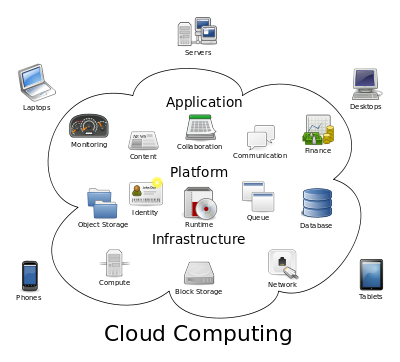
Have you ever heard someone talking extensively about Cloud Computing or generally Clouds? and have you ever noticed the fact many people (even the ones who present themselves as experts) don t really understand what a Cloud is at all? That happened to me multiple times and one of the most common misunderstandings is many see the Cloud as something being on the internet. Many companies add a little logo representing a cloud on their frontpage and without a single change on their infrastructure (but surely with a price increment) they start calling their products as being on the Cloud. Given the lack of knowledge about this specific topic people tend to buy the product presented as being on the Cloud without understanding what they really bought. But what Cloud Computing really means? it took several years and more than fifteen drafts to the National Institute of Standards and Technology s (NIST) to find a definition. The final accepted proposal:

Cloud computing is a model for enabling ubiquitous, convenient, on-demand network access to a shared pool of configurable computing resources (e.g., networks, servers, storage, applications and services) that can be rapidly provisioned and released with minimal management effort or service provider interaction.

The above definition requires a few more clarifications specifically when it comes to understand where should we focus on while checking for a Cloud Computing solution. A few key points:
  1. On-demand self-service: every consumer will be able to unilaterally provision multiple computing capabilities like server time, storage, bandwidth, dedicated RAM or CPU without requiring any sort of human interaction from their respective Cloud providers.
  2. Rapid elasticity and scalability: all the computing capabilities outlined above can be elastically provisioned and released depending on how much demand my company will have in a specific period of time. Suppose the X company is launching a new product today and it expects a very large number of customers. The X company will add more resources to their Cloud for the very first days (where they suppose the load to be very high) and then it ll scale the resources back as they were before. Elasticity and scalability permit the X company to improve and enhance their infrastructure when they need it with an huge saving in monetary terms.
  3. Broad network access: capabilities are available over the network and accessed through standard mechanisms that promote use by heterogeneous thin or thick client platforms (e.g., mobile phones, tablets, laptops, and workstations).
  4. Measured service: Cloud systems allow maximum transparency between the provider and the consumer, the usage of all the resources is monitored, controlled, and reported. The consumer knows how much will spend, when and in how long.
  5. Resource pooling: each provider s computing resources are pooled to serve multiple consumers at the same time. The consumer has no control or knownledge over the exact location of the provided resources but may be able to specify location at a higher level of abstraction (e.g., country, state, or datacenter).
  6. Resources price: when buying a Cloud service make sure the cost for two units of RAM, storage, CPU, bandwidth, server time is exactly the double of the price of one unit of the same capability. An example, if a provider offers you one hour of bandwitdh for 1 Euro, the price of two hours will have to be 2 Euros.
Another common error I usually hear is people feeling Cloud Computing just as a place to put their files online as a backup or for sharing them with co-workers and friends. That is just one of the available Cloud features , specifically the Cloud Storage , where typical examples are companies like Dropbox, Spideroak, Google Drive, iCloud and so on. But let s make a little note about the other three features :
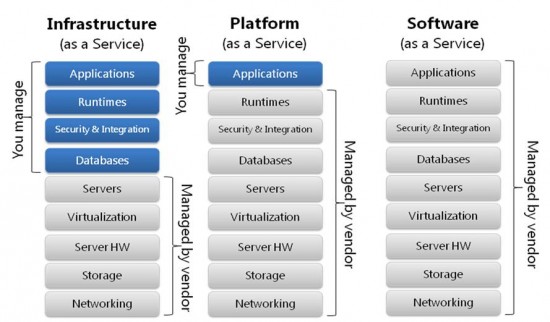
  1. Infrastructure as a Service (IaaS): the capability provided to the consumer is to provision processing, storage, networks, and other fundamental computing resources where the consumer is able to deploy and run arbitrary software, which can include operating systems and applications. In this specific case the consumer has still no control or management over the underlying Cloud infrastructure but has control over operating systems, storage, and deployed applications. A customer will be able to add and destroy virtual machines (VMs), install an operating system on them based on custom kickstart files and eventually manage selected networking components like firewalls, hosted domains, accounts.
  2. Platform as a Service (PaaS). the capability provided to the consumer is to deploy onto the cloud infrastructure consumer-created or acquired applications created using programming languages, libraries, services, and tools (like Mysql + PHP + PhpMyAdmin or Ruby on Rails) supported by the provider. In this specific case the consumer has still no control or management over the Cloud infrastructure itself (servers, OSs, storage, bandiwitdh etc.) but has control over the deployed applications and configuration settings for the application-hosting environment.
  3. Software as a Service (SaaS): the capability provided to the consumer is to use the provider s applications running on a Cloud infrastructure. The applications are accessible through various client devices, such as a browser, a mobile phone or a program interface. The consumer doesn t not manage nor control the Cloud infrastructure (servers, OSs, storage, bandwidth, etc.) that allows the applications to run. Even the provided applications aren t customizable by the consumer, which should rely on limited configuration settings.
The Cloud Computing technology is reasonably the future but can we trust Cloud providers? Are we sure that no one will ever have access to our files except us? and what about governments interested in acquiring a specific customer data hosted on the Cloud? I always suggest to read deeply both the Privacy Policy and Terms of Use of a certain service before signing in especially when it comes to choose a Cloud storage provider. Many providers have the same aspect, they seem to provide the same resources, the same amount of storage for the same price but legally they may present different problems, and that is the case of Spideroak vs Dropbox. Quoting from the Dropbox s Privacy Policy:
Compliance with Laws and Law Enforcement Requests; Protection of DropBox s Rights. We may disclose to parties outside Dropbox files stored in your Dropbox and information about you that we collect when we have a good faith belief that disclosure is reasonably necessary to (a) comply with a law, regulation or compulsory legal request; (b) protect the safety of any person from death or serious bodily injury; (c) prevent fraud or abuse of DropBox or its users; or (d) to protect Dropbox s property rights. If we provide your Dropbox files to a law enforcement agency as set forth above, we will remove Dropbox s encryption from the files before providing them to law enforcement. However, Dropbox will not be able to decrypt any files that you encrypted prior to storing them on Dropbox.
It s evident that Dropbox employees can access your data or be forced by legal process to turn over your data unencrypted. On the other side, Spideroak on its latest update to its Privacy Policy states that data stored on their Cloud is encrypted and inaccessible without user s key, which is stored locally on user s computers. And what about the latest research paper, titled Cloud Computing in Higher Education and Research Institutions and the USA Patriot Act written by the legal experts of the University of Amsterdam s Institute for Information Law stating the anti-terror Patriot Act could be theoretically used by U.S. law enforcement to bypass strict European privacy laws to acquire citizen data within the European Union without their consensus? The only requirement for the data acquisition is the provider being an U.S company or an European company conducting systematic business in the U.S. For example an Italian company storing their documents (protected by the European privacy laws and under the general Italian jurisdiction) on a provider based in Europe but conducting systematic business in the United States, could be forced by U.S. law enforcement to transfer data to the U.S. territory for inspection by law enforcement agencies. Does someone really care about the privacy of companies, consumers and users at all? or better does privacy exists at all for the millions of the people that connect to the internet every day?

11 December 2012

Francesca Ciceri: Welcome Malatesta, Goodbye Kasbah!

Kasbah, my old laptop, is almost dead. It was my first laptop, an Asus X50C, which worked like a charm and was robust like a tank. But then the screen hinges broke. Time for a new one. So, ladies and gentlemen, I'm glad to present you malatesta. Malatesta is a Lenovo Thinkpad E335. Sadly, while kasbah worked with free drivers, malatesta requires proprietary drivers both for the video card and the wifi. Which sounds a bit ironic for a laptop named after a famous anarchist. The only two problems I encountered with it were related to the video card (00:01.0 VGA compatible controller: Advanced Micro Devices [AMD] nee ATI Device 9808) and the special keys. Malatesta worked well with the kernel of Squeeze, but freezed during the boot with Wheezy. Thankfully, I stumbled upon this blogpost by Blars Blarson suggesting to use the fglrx-driver with Sid. And that solved the problem. Another little odissey was the brightness of the monitor. With kernels < 3.2.0-4-amd64 the thinkpad_acpi didn't recognize my model and I was stuck with a brightness level probably visible from the outer space. Neither xrandr nor xbacklight could help, and I was seriously considering to use sunglasses to work (a slight unusual approach to the brightness problem, I know, but I suffer of migraines and couldn't bear an hyper-bright monitor), when the upgrade to Sid solved the problem. On the bright side (pun intended) this laptop was born without Windows. (Both malatesta and kasbah were shipped with FreeDOS). Now, if you're wondering about the names: my first namescheme was "references to songs by the Clash" (and kasbah is obviously for "Rock the Casbah", with a typo). But it wasn't really scalable. Since last year, I've decided to name my systems after famous anarchists. The server is named after one of my all time favourite anarchists, Buenaventura Durruti.
madamezou@durruti:~$ cat /etc/motd
%%%%%%%%%%%%%%%%%%%%%%%%%%%%%%%%%%%%%%%%%%%%%%%%%%%%%%%%%%%%%%%%%%%%%
Llevamos un mundo nuevo en nuestros corazones;
y ese mundo est  creciendo en este instante
                        Buenaventura Durruti
%%%%%%%%%%%%%%%%%%%%%%%%%%%%%%%%%%%%%%%%%%%%%%%%%%%%%%%%%%%%%%%%%%%%%
While the new laptop's name comes from Errico Malatesta.
madamezou@malatesta:~$ cat /etc/motd 
%%%%%%%%%%%%%%%%%%%%%%%%%%%%%%%%%%%%%%%%%%%%%%%%%%%%%%%%%%%%%%%%%%%%%
We anarchists do not want to emancipate the people;
We want the people to emancipate themselves.
            Errico Malatesta, L'Agitazione (18 June 1897)
%%%%%%%%%%%%%%%%%%%%%%%%%%%%%%%%%%%%%%%%%%%%%%%%%%%%%%%%%%%%%%%%%%%%%

Michal &#268;iha&#345;: Translate toolkit supports Android resources

After several months, my patches for Android resources support in translate-toolkit has been merged. All this originally started as question on stack overflow and after some playing, I've managed to integrate it to Weblate. Right now, this is already actively used by several projects, the biggest one probably being OsmAnd.

Filed under: English Weblate 0 comments Flattr this!

Russell Coker: Links December 2012

Steven Johnson gave an interesting TED talk about where good ideas come from [1]. He starts by attributing coffee replacing alcohol as a standard drink for some good ideas and then moves on to how ideas develop. Erez Lieberman Aiden and Jean-Baptiste Michel gave an interesting and amusing TED talk about the ngram analysis of books that Google scanned [2]. Here is the link for the Google Books ngram search [3]. Clay Shirky gave an insightful TED talk about how the Internet is changing the world [4]. He cites Open Source programmers as the modern day equivalent to the Invisible College based on our supposed great ability to get along with other people on the Internet. If we really are so much better than the rest of the Internet then things must be bad out there. He ends with ways of using Git to draft legislation. Hans Rosling gave an interesting TED talk about religion and the number of babies that women have [5]. His conclusion is that it s more about income and social stability and that the world s population can stabilise at 10 billion if we provide family planning to everyone. Alexis C. Madrigal wrote an interesting interview with Genevieve Bell about her work at Intel and the way people use technology [6]. Indigogo is raising funds for the Cuddle Mattress , it s a mattress with foam slats and a special fitted sheet to allow your arm to slide between the slats [7]. So you could have your arm underneath your SO for an extended period of time without risking nerve damage. They also show that when sleeping on your side your shoulder can go between the slats to avoid back problems. Nate Silver (who is famous for predicting US elections gave an interesting TED talk about racism and politics [8]. One of his main points is to show the correlation between racism and lack of contact of members of other races. Sociological Images has an interesting article by Lisa Wade about whether marriage is a universal human value [9]. In regard to historical marriage she says women were human property, equivalent to children, slaves, servants, and employees . The general trend in the comments seems to be that there are so many types of marriage that it s difficult to make any specific claims to traditional marriage unless you count a tradition of a short period in a single geographic region. Plurality is an excellent sci-fi short movie on youtube [10]. TED has an interesting interview with Hakeem Oluseyi about his research about astrophysics and how he achieved a successful career after being a gangster as a teenager [11]. He has some good ideas about helping other children from disadvantaged environments become successful. Paul Dwerryhouse wrote an interesting blog post about his work in designing and implementing a filesystem based on a Cassandra data store with FUSE [12]. Paul also wrote a post about using Apache Zookeeper to lock metadata to permit atomic operations [13]. The documentary Monumental Myths provides an interesting and insightful analysis of the processes of creating, maintaining, and explaining monuments [14]. It focusses on some significant monuments in the US and explains both sides to each story. Howard Zinn makes the insightful point that when people present a certain point of view of history it s not controversial, as soon as you present the other side they call it controversial . That happens even in debates about current issues. Howard also says to criticise whatever the government does is not anti-America, it s anti-government, it s pro-America, it s pro the people, it s pro the country . The song that plays during the closing credits is interesting too. The music video Same Love is one of the best presentations of the argument for marriage equality [15]. Chris Samuel wrote an interesting post about systems locked down for Windows 8 and options for purchasing PCs for running Linux [16]. His solution is to buy from ZaReason. I saw his laptop in action at the last LUV meeting and it looks really nice. Unfortunately a byproduct of the extremely thin form factor is the fact that it lacks a VGA port, this meant that Chris had to use my Thinkpad T61 (which is rather clunky by comparison) for his presentation.

10 December 2012

Gerfried Fuchs: BSP Essen November 2012, Report

So it happened: the Bug Squashing Party in Essen is done. And depending on your point of view at least I would call it a success. We had in total fourteen participants. The number of release-critical bugreports touched and processed is not clear, but over 100 bugreports were looked at and either got comments added for clearification, maintainer pinged, unblock requests filed or already filed ones noted down, or NMUed. Given that we are in freeze since a while now and many easy bugreports already squashed by those who aim for a daily fix, I consider this impressive. There is also the point that we managed to get some people involved that didn't consider themself techy enough to be of help. On the contrary, they were a great help on checking these bugreports with analyzing the discussions in some lengthy bugreports and upstream bug trackers, or trying to reproduce some issues. I can just hope that the weekend left an impression deep enough to keep them in the boat. All in all, I'm quite pleased of the outcome, especially in the light of several other events catching the interest of potential participants which were going on at the same weekend. Thanks to all the people that stumbled by, and I am looking forward to maybe having another BSP at some point, but then I hope to not clash with so many other events. Thanks!

/debian permanent link Comments: 0 Flattr this

8 December 2012

Dirk Eddelbuettel: Rcpp attributes: Even easier integration of GSL code into R

Following the Rcpp 0.10.0 release, I had written about simulating pi easily by using the wonderful new Rcpp Attributes feature. Now with Rcpp 0.10.1 released a good week ago, it is time to look at how Rcpp Attributes can help with external libraries. As this posts aims to show, it is a breeze! One key aspect is the use of the plugins for the inline package. They provide something akin to a callback mechanism so that compilation and linking steps can be informed about header and library locations and names. We are going to illustrate this with an example from GNU Scientific Library (GSL). The example I picked uses B-Spline estimation from the GSL. This is a little redundant as R has its own spline routines and package, but serves well as a simple illustration---and, by reproducing an existing example, followed an established path. So we will look at Section 39.7 of the GSL manual which has a complete example as a standalone C program, generating both the data and the fit via cubic B-splines. We can decompose this two parts: data generation, and fitting. We will provide one function each, and then use both from R. These two function will follow the aforementioned example from Section 39.7 somewhat closely. We start with the first function to generate the data.
// [[Rcpp::depends(RcppGSL)]]
#include <RcppGSL.h>
#include <gsl/gsl_bspline.h>
#include <gsl/gsl_multifit.h>
#include <gsl/gsl_rng.h>
#include <gsl/gsl_randist.h>
#include <gsl/gsl_statistics.h>
const int N = 200;                              // number of data points to fit 
const int NCOEFFS = 12;                         // number of fit coefficients */
const int NBREAK = (NCOEFFS - 2);               // nbreak = ncoeffs + 2 - k = ncoeffs - 2 since k = 4 */
// [[Rcpp::export]]
Rcpp::List genData()  
    const size_t n = N;
    size_t i;
    double dy;
    gsl_rng *r;
    RcppGSL::vector<double> w(n), x(n), y(n);
    gsl_rng_env_setup();
    r = gsl_rng_alloc(gsl_rng_default);
    //printf("#m=0,S=0\n");
    /* this is the data to be fitted */
    for (i = 0; i < n; ++i)  
        double sigma;
        double xi = (15.0 / (N - 1)) * i;
        double yi = cos(xi) * exp(-0.1 * xi);
        sigma = 0.1 * yi;
        dy = gsl_ran_gaussian(r, sigma);
        yi += dy;
        gsl_vector_set(x, i, xi);
        gsl_vector_set(y, i, yi);
        gsl_vector_set(w, i, 1.0 / (sigma * sigma));
                
        //printf("%f %f\n", xi, yi);
     
    Rcpp::DataFrame res = Rcpp::DataFrame::create(Rcpp::Named("x") = x,
                                                  Rcpp::Named("y") = y,
                                                  Rcpp::Named("w") = w);
    x.free();
    y.free();
    w.free();
    gsl_rng_free(r);
    return(res);
 
We include a few header files, define (in what is common for C programs) a few constants and then define a single function genData() which returns and Rcpp::List as a list object to R. A primary importance here are the two attributes: one to declare a dependence on the RcppGSL package, and one to declare the export of the data generator function. That is all it takes! The plugin of the RcppGSL will provide information about the headers and library, and Rcpp Attributes will do the rest. The core of the function is fairly self-explanatory, and closely follows the original example. Space gets allocated, the RNG is setup and a simple functional form generates some data plus noise (see below). In the original, the data is written to the standard output; here we return it to R as three columns in a data.frame object familiar to R users. We then free the GSL vectors; this manual step is needed as they are implemented as C vectors which do not have a destructor. Next, we can turn the fitting function.
// [[Rcpp::export]]
Rcpp::List fitData(Rcpp::DataFrame ds)  
    const size_t ncoeffs = NCOEFFS;
    const size_t nbreak = NBREAK;
    const size_t n = N;
    size_t i, j;
    Rcpp::DataFrame D(ds);              // construct the data.frame object
    RcppGSL::vector<double> y = D["y"]; // access columns by name, 
    RcppGSL::vector<double> x = D["x"]; // assigning to GSL vectors
    RcppGSL::vector<double> w = D["w"];
    gsl_bspline_workspace *bw;
    gsl_vector *B;
    gsl_vector *c; 
    gsl_matrix *X, *cov;
    gsl_multifit_linear_workspace *mw;
    double chisq, Rsq, dof, tss;
    bw = gsl_bspline_alloc(4, nbreak);      // allocate a cubic bspline workspace (k = 4)
    B = gsl_vector_alloc(ncoeffs);
    X = gsl_matrix_alloc(n, ncoeffs);
    c = gsl_vector_alloc(ncoeffs);
    cov = gsl_matrix_alloc(ncoeffs, ncoeffs);
    mw = gsl_multifit_linear_alloc(n, ncoeffs);
    gsl_bspline_knots_uniform(0.0, 15.0, bw);   // use uniform breakpoints on [0, 15] 
    for (i = 0; i < n; ++i)                     // construct the fit matrix X 
        double xi = gsl_vector_get(x, i);
        gsl_bspline_eval(xi, B, bw);            // compute B_j(xi) for all j 
        for (j = 0; j < ncoeffs; ++j)           // fill in row i of X 
            double Bj = gsl_vector_get(B, j);
            gsl_matrix_set(X, i, j, Bj);
         
     
    gsl_multifit_wlinear(X, w, y, c, cov, &chisq, mw);  // do the fit 
    
    dof = n - ncoeffs;
    tss = gsl_stats_wtss(w->data, 1, y->data, 1, y->size);
    Rsq = 1.0 - chisq / tss;
    
    Rcpp::NumericVector FX(151), FY(151);       // output the smoothed curve 
    double xi, yi, yerr;
    for (xi = 0.0, i=0; xi < 15.0; xi += 0.1, i++)  
        gsl_bspline_eval(xi, B, bw);
        gsl_multifit_linear_est(B, c, cov, &yi, &yerr);
        FX[i] = xi;
        FY[i] = yi;
     
    Rcpp::List res =
      Rcpp::List::create(Rcpp::Named("X")=FX,
                         Rcpp::Named("Y")=FY,
                         Rcpp::Named("chisqdof")=Rcpp::wrap(chisq/dof),
                         Rcpp::Named("rsq")=Rcpp::wrap(Rsq));
    gsl_bspline_free(bw);
    gsl_vector_free(B);
    gsl_matrix_free(X);
    gsl_vector_free(c);
    gsl_matrix_free(cov);
    gsl_multifit_linear_free(mw);
    
    y.free();
    x.free();
    w.free();
    return(res);   
 
The second function closely follows the second part of the GSL example and, given the input data, fits the output data. Data structures are setup, the spline basis is created, data is fit and then the fit is evaluated at a number of points. These two vectors are returned along with two goodness of fit measures. We only need to load the Rcpp package and source a file containing the two snippets shown above, and we are ready to deploy this:
library(Rcpp)
sourceCpp("bSpline.cpp")                # compile two functions
dat <- genData()                        # generate the data
fit <- fitData(dat)                     # fit the model, returns matrix and gof measures
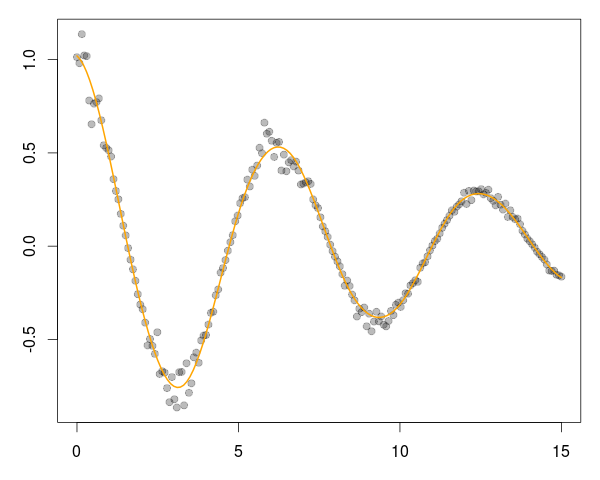
And with that, we generate a chart such as Spline fitting example from GSL manual redone with Rcpp Attributes via a simple four lines, or as much as it took to create the C++ functions, generate the data and fit it!
op <- par(mar=c(3,3,1,1))
plot(dat[,"x"], dat[,"y"], pch=19, col="#00000044")
lines(fit[[1]], fit[[2]], col="orange", lwd=2)
par(op)
The RcppArmadillo and RcppEigen package support plugin use in the same way. Add an attribute to export a function, and an attribute for the depends -- and you're done. Extending R with (potentially much faster) C++ code has never been easier, and opens a whole new set of doors.

Eddy Petri&#537;or: Consent is needed, but not the point

Russ makes a good point about a nuance of practical jokes that makes them special, the characteristic of involving a third party which is the target of the joke, and how that relates to consent. He is right, consent is an important fact, I acknowledge that. Russ also says at the end of his post that being an asshole doesn't make you responsible for somebody else's decisions, I ackowledge that, too. I even somewhat agree to the position that the employer might fire you on assholery reasons, but in this particular case, I think that's a hypocrite position. If assholery was an issue, it should have been before, too, and I don't think the employer thought of it before this sad even, as long as it meant more money for them. I think this only shows how cynical they are, the cost analysis for them showed them they now might lose more money by not firing, than by keeping them. It's just cynical.

In spite of that, my initial post, just as I wrote, was not about the DJs, the people involved, the assholery, the taste or lack thereof of the joke. That's why I was intentionally leaving out names or specific context. It was about the bigger picture, irrational reactions and how in the face of a tragedy we surrender our thinking capabilities and react in an irrational manner to the least significant things.

I have had quite recent unfortunate events happening to people close to me, and, invariably, I observe this loss of rational faculties in the face of sad events. Even when this kind of disproportionate response is shown for what it is and how it is harmful in itself, people still refuse to give up on being irrational or they do after a long struggle with the facts.

I'll finish my article with a similar question: can we, as a species, go beyond our condition and make a conscious effort to keep calm and think things through before making decisions in the face of tragedy, or are we incapable to do that?

And no, I am not advocating to drop feelings and affection, I find it sad that I have to say that again, but I am almost sure that in spite of it, I will be wrongly understood by somebody.

7 December 2012

Thorsten Glaser: Collision resolution in open addressing hashtables

Before we begin, everyone should read up on hashtables and what open addressing / closed hashing is. The context is lines 111 190 of Python s Objects/dictobject.c as of today (so we get the line numbers straight). (I ve reworded this wlog entry a bit; I originally wrote it too late at night for it to read coherent.) Basically, I ve got an application where I d like to use a hashtable for a number of things not as generic as Python, and with focus on small footprint. I d like to offer associative arrays in a scripting language, where the keys are always arbitrary byte strings excluding NUL. Also, I d like to use the hashtable as backend for indexed arrays, where the keys are uint32_t and the usual use case is sequential. Finally, I m using it for several internal tables, such as a list of keywords, one of builtins, one of special variables, etc. which is a reason for me to not use a self-balancing binary tree as data structure (reading further below might suggest that, but getting a sorted list of hashtable keys is not the focus, though not unimportant).
My questions on this are:

Why is the shift on perturb done after its first use? In my experiments (using 32-bit width everywhere), for the pathological case of an 8-element (i = 3) table with three entries 0, 0x40000000 and 0x800000000, the second round yields 1 for all three, so it cannot have to do with the upper bits. My lookup looks like:

	mask = 2  - 1;
	j = perturb = hash(key);
	goto find_first_slot;
	 find_next_slot:
	j = (j << 2) + j + perturb + 1;
	perturb >>= PERTURB_SHIFT;
	/* FALLTHROUGH */
	 find_first_slot:
	entry = table[j & mask];
	if (!match(entry)) goto find_next_empty_slot;
 

This means that my first check is always the bare hash (so only do it if needed is no reason) and, since I m using gotos, I could just move the perturb >>= PERTURB_SHIFT; line before the line recalculating the next j to use. This seems to make more sense, even in the face of Python. (I actually looked at the Python file s comments again today because I thought to use a different resolution, but they have a good rationale for using the multiplication by 5.) Why can t we just use i as the PERTURB_SHIFT? Sure, this changes a shift-right by a constant, which can possibly be encoded as immediate value in assembly (unless you re on a pre-80186, which can only do SHR AX,1 and SHR AX,CL but not SHR AX,4, but that s outside of mksh s scope) into a right-shift by a variable, but i is already known, and I think the behaviour is better (it wouldn t eat any bits; assume the same 8-entry hashtable and pathologic keys 0, 8 and 16). Again: who do I think I am to go against the wisdom of the Python people, who seem to have shed more thought on this than everyone else I saw, asked, read about (including Spammipedia). That s why I m asking here. On that reference: I don t support spammers or people nagging for donations or premium accounts, like Xing and Groundspeak/Geocaching.COM, at all. In fact, I urge others to do the same, so it really hurts them; it may be their business model, but not if they spam me. Besides, OpenCaching.DE exists. Another thing is: to avoid CVE-2011-4815, I m randomising the hash used, with one seed value per hashtable, changed before a resize operation. I originally thought to seed it with nonzero, but then I have to rehash on hashtable resize, so I ll be XORing the final hash value instead (thanks ciruZ for the idea). I m thinking of omitting that for indexed arrays, as an attacker almost certainly cannot determine the keys there. (To directly use the indexed array keys, which are already uint32_t, as hashes makes using i from even more important.) The hash I m using is a modified Jenkins one-at-a-time called NZAAT: it s my new generic standard n n-cryptographic hash, and the changes are thus: while adding a byte, another increment of the hash is done (so NUL counts), and the finaliser got prefixed with the shift-left-add+shift-right-xor sequence of the adder (but not adding any value or the +1), to get best avalanche for all bytes. I actually compiled several versions of Hash.cs on a Windows VM at work to analyse the original one-at-a-time and all of my modifications; these turned out to be the simplest ones (I originally had added 0x100 instead of 1, but the effect was the same, and +1 is usually cheaper on most CPUs). Also, to avoid people being able to get to the seed, a user will always get only a sorted list of hashtable keys (numeric for indexed arrays, ASCIIbetically otherwise; see also my thoughts on JSON from the previous wlog entry). What algorithm do I use? For strings, comparisons are much more expensive, so I d like to keep them low. Memory use is also a factor; allocating one large(r) block is better than many small ones due to the pool allocator overhead and due to portability to ancient Unic s (which is another reason for me to use a hashtable which is a small struct plus an array of pointers, and then pass the list of keys as array of string pointers, instead of a tree). For both reasons, I m thinking a relatively simple MergeSort: I need to allocate the result array anyway, so I can just get two and free the one that isn t the end result, and it s AFAICT the cheapest on comparisons other than Tree Sort (which nobody really seems to use, and which would effect to using a balanced binary tree again). Since keys are unique, stability and duplicate handling is never an issue. I d like to use only one algorithm and one data structure, not a combination, as compactness is a design goal. Please drop your thoughts on Freenode, e.g. by /msg MemoServ send mirabilos your text here or per eMail to the domains debian, freewrt or mirbsd, which are organisations, with the localpart tg. Or just contact me as usual, if you re already acquainted. Or lookup 0xE99007E0. Thanks in advance! (Especially, Python Developers thoughts are welcome.)

Joachim Breitner: Calculating the internal rate of return with hledger

For more than ten years now, I am a regular and happy user of GnuCash, the free accountancy program. Especially the integrated online banking support for HBCI that allows me not only to fetch my transactions, but also to transfer money using a cryptographic makes it a great tool. Nevertheless, it has shortcomings, especially when it comes to reports. And for some reason I never felt the urge to hack on that C/Guile code (although I recently hacked a bit on the UI).
Joey Hess blog post about Simon Michael s hledger made me look at that command line based accountancy tool. It certainly won t replace Gnucash for me, but luckily ledger, of which hledger is a re-implementation, can read GnuCash s file format and convert it to a ledger file that hledger can read as well. So now I can do analysis on my financial data in Haskell what would you want more? One report that I was missing was the internal rate of investment of some account. This is the annual rate of a hypothetical fixed interest-bearing savings account that would, given the same deposits and payouts, result in the same final value. I now implemented this as the hledger-irr command and as you would expect you can find it on hackage. See the package description for documentation and example output. It is very fresh, hardly tested code, so don t base important decisions on it yet. Also, it needs work to work correctly with multiple currencies or things with varying prices, and I am not yet sure what to do there. Update: Simon asked me to elaborate the difference to hledger-interest by Peter Simons (on which my code was initial based, but eventually I rewrote everything but the option parsing code). The difference is that hledger-interest answers the question I have this investment with this yearly interest rate (which may even change), how large are the interest payments going to be. I imagine a usecase is that you have borrowed some money to a friend at a certain (surely amicable) rate and need to figure out what he owes you, even when you gave him the money mid year and he payed you some back shortly after easter. hledger-irr serves a different purpose: Here you already know your investment payments, gains and losses and you want to have a number describing how good your investment was. One usecase might be that, at the end of a live of paying into a pension fund, you ask yourself: Given all the feeds and commissions, was this a good idea or should I just have invested the money myself? Then the internal rate of investment tells you how lucrative an alternative fixed-rate investment would have had to been to match your pension fund investment. (Or course this is not the only aspect that you should look at when comparing investments, as it totally ignores risk and possible insurance elements of the investment.)

6 December 2012

Kurt Roeckx: iDEAL and ING

For the e-webshops site I run I started implementing iDEAL because we have a lot customers in the Netherlands. iDEAL is a standard used in the Netherlands to do online payments. We needed to open a bank account for that in the Netherlands, so we did that with ING in October. It first took them a month to reject us, stating we needed to register our company in Belgium. Of course we're already registered, we couldn't be in business in the first place if we weren't. After pointing them to the government website it seems to have sorted itself out a few days later. So once we were approved I could actually start to test the software for iDEAL. It uses XML sig which I think is a horrible standard. Once I started testing it I directly ran into a problem. They give me an error back saying that the signature wasn't valid. So I contacted them about 2 weeks ago and have yet to get answer back that's useful. So far it went like this:
So I'm now back to step 1.

4 December 2012

Andrea Veri: My favorite WordPress Plugins

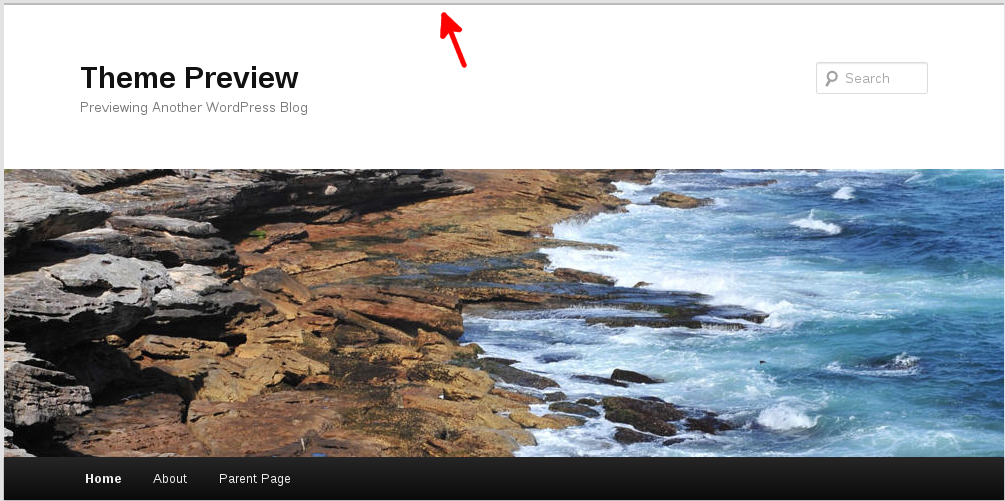
It took me a while to build a complete WordPress blog with all the things I needed, from modifying the default Twenty Eleven theme to broadcasting my posts directly on Twitter. WordPress has a nice selection of plugins and given the fact I spent a few days evaluating all the possibilities, I decided to share my own setup to speed up the process in case you are willing to build a WordPress powered blog. The plugins: And a few modifications I made on my Child theme for the Twenty Eleven theme to suit my needs: Remove the navigation buttons on the header. On the Child theme s style.css:
#access, #branding .only-search #s, .entry-header .comments-link  
display: none;
 
Remove the gray line on the top of the header s banner. On the Child theme s style.css:
#branding  
border-top: none;
 
.and a little tip about WordPress itself: have you ever wondered how you could install/update/remove a WordPress theme or plugin without FTP access? Here s how! On the config.php file:
/*** Updates WordPress without FTP credentials. ***/
define('FS_METHOD','direct');
If you know any other handy WordPress Tip or Plugin, please share!

Russ Allbery: Review: The Borrowers

Review: The Borrowers, by Mary Norton
Series: The Borrowers #1
Illustrator: Beth Krush
Illustrator: Joe Krush
Publisher: Sandpiper
Copyright: 1953
Printing: 1986
ISBN: 0-15-204737-9
Format: Trade paperback
Pages: 180
Arrietty is a 14-year-old girl who lives under the clock. Well, actually, she lives under the kitchen floor, but the entrance to her family's passageway is under the clock, from which they get their name. She sleeps in an old cigar box, her living room is wallpapered with strips cut from letters (and decorated with postage stamps), and she keeps a journal in a miniature book that's half the size she is. Arrietty, and her parents Pod and Homily, are Borrowers. The Borrowers is a classic series of children's books by Mary Norton about miniature people who, at least in this first book, live in the walls and take things. Not big things, but all the little things: the blotter paper, the pins, the stray sock, old postage stamps, empty matchboxes, and the occasional thimble. With these things, they build their furniture, their clothes, and their homes, safely hidden in the walls and other secret places, always wary of the "human beans" (as Arrietty's mother tends to call them). That life is, of course, a remarkable simulation of middle-class, class-conscious British life, which is much of the fun. Arrietty's family lives in the home of an elderly woman who's confined to bed, so it's quiet, safe, and driven entirely by routine. They only have to watch out for the maid and the gardener, and they keep regular schedules. That's just the way the Borrowers like it; predictable and quiet. Which is why they get caught entirely by surprise when a boy shows up, recovering from illness in the country, and spots Pod on one of his borrowing runs. This is technically a re-read, but I read the original series so long ago that I barely remembered it. Not that there is all that much to remember, at least in the way of plot. This first book follows one of the standard plots for children's books of this type (although it follows Arrietty as the viewpoint character rather than the more common choice of the boy): boy discovers hidden creatures, hidden creatures are afraid, boy turns out to want to make friends with them, they strike up a friendship, peril nonetheless ensues. If you've read many children's books, you've probably read this before; The Mouse and the Motorcycle is an obvious example (and, in terms of plot, a somewhat better book). Arrietty is a typical protagonist, her parents are silly (and a bit flighty, particularly her mother), and the boy is, disappointingly, almost a non-entity. But you don't read The Borrowers for the plot. The brilliance of this book is in the descriptions of what they use, how they use it, and how they construct their ingenious homes. Norton captures much of the wonder of other miniaturization stories (the movie Honey, I Shrunk the Kids is an obvious example), but takes it one step further into clever and thoughtful repurposing. The book is full of off-hand descriptions of how everyday objects become different everyday objects for miniature people, giving it the same delight that one gets from descriptions of how model railroad dioramas or hand-made doll houses are constructed. The detailed (if busy) illustrations by the Krushes help tremendously with visualization and make the descriptions even more fun. This is very much a children's book based on an exploration of a single great idea, so don't expect too much in the way of plot or deep characterization. It's also not science fiction; there isn't any realistic extrapolation of culture. The Borrowers all behave like perfectly ordinary English people without any further explanation because, of course, that's what they would do. Re-reading it as an adult, I wished there was a bit more meat to it. But the ingenuity is still a delight. It's great fun to spend a couple of hours imagining how one would construct the miniature accouterments of everyday life. Followed by The Borrowers Afield. Rating: 7 out of 10

3 December 2012

Michael Stapelberg: RC bugs

I recently worked on the following RC bugs:

Jon Dowland: Wheezy problems

I've recently replaced my laptop's HDD as the S.M.A.R.T. data suggested a potential failure. I took the opportunity to try out beta4 of debian-installer and to install a pure wheezy system. Prior to this I've been running a mostly wheezy system with some bits from sid or experimental. I've got quite a few notes about bugs I've hit in the installer, most of which I still need to file, but perhaps the most problematic appears to be known as #661789. Unless I'm reading this wrong, it would appear this show-stopper bug makes booting on an EFI system impossible without some workarounds, it's been a known problem for 9 months, and d-i beta4's images opt for EFI booting where possible. After the 8th install run I must admit I started getting angry that someone was wasting my time. Perhaps this is covered in some install notes somewhere. Anyway, I got an install working eventually (with legacy BIOS boot mode). and have been running wheezy for the last week. I've just now had a string of problems which were a fairly typical experience for me running a mixed system. Whenever I hit a problem, particularly in the GNOME3 stack, my first response was to check "am I running the latest version of the packages?" inevitably not and so I got around my problems via a reboot or something similarly drastic; updated the packages and left things. Until the next time. Just now, the following things happened: I've experienced all of the above (except for the PAM thing) more than once over the last 12 months or so since I blogged about moving to GNOME3. Now I'm running a pure wheezy system, at this point in the freeze the relevant packages are likely to be more stable. So, not running the latest version is no longer a reason to avoid fixing the problem. Time for me to start proper analysis! Debian is now in deep freeze. I've heard it said a few times that we are coming to the end of that process. Based on my experiences, in my humble opinion, we've got some work to do before we're release worthy.

Joey Hess: hledger

Apologies in advance for writing a long blog post about the dull and specialised subject of double-entry accounting from the Unix tools perspective, that ends up talking about Monads to boot. I can't believe I'm about to write such a thing, but I'm finding it an oddly interesting subject. double-entry accounting I've known of, though probably not really understood double entry accounting for a while, thanks to GnuCash. I think GnuCash did something rather special in making such a subject approachable to the layman, and I've been happy to recommend GnuCash to friends. I was stoked to find a chapter in my sister Anna's new book that happily and plausibly suggests readers use GnuCash. But for my personal use, GnuCash is clunky. I mean, I'm a programmer, but I can't bring any of my abilities to bear on it, without a deep dive into the code. The file format is opaque (and a real pain to keep checked into git with all the log files); the user interface is often confusing, but there's no benefit to its learning curve, it never seems to get better than manually entering data into its ledger, or perhaps importing data from a bank. I've never found the reports very useful. I've got perhaps a year of data in GnuCash, but it's fragmented and incomplete and not something I've been able to motivate myself to keep up with. So I have less financial data than I'd like. I'm hoping ledger will change that. ledger I've known about ledger for a while, at least since This Linux Weekly News article. It's a quintessential Unix tool, that simply processes text files. The genius of it is the simplicity of the file format, that gets the essence and full power of double entry bookeeping down to something that approaches a meme. Once you get the file format stuck in your head, you're done for.
2004/05/27 Book Store
      Expenses:Books                 $20.00
      Liabilities:Visa
starting to use hledger Now as a Haskell guy, I was immediately drawn to the Haskell clone, hledger. It's nice that there are two (mostly) compatable implementations of ledger too. So from here on, I'll be talking about hledger. I sat down and built a hledger setup for myself the other day. I started by converting the GnuCash books I have been keeping up-to-date, for a small side business (a rental property). It quickly turned into something like programming, in the best way, as I used features like: a modern unix program While I've been diving into hledger, I've been drawing all kinds of parallels between it and other modern Unix-friendly programs I use lately. I think we've gone over a bit of a watershed recently. Unix tools used to be either very simple and crude (though often quite useful), or really baroque and complex with far too many options (often due to 10-30 years of evolution). Or they were a graphical user interface, like GnuCash, and completely divorced from Unix traditions. The new unix programs have some commonalities... importing data After manually converting my GnuCash data, I imported all my PayPal history into hledger. And happily it calculates the same balance Paypal does. It also tells me I've paid PayPal $180 in transaction fees over the years, which is something PayPal certianly doesn't tell you on their website. (However, my current import from PayPal's CSV files is a hackish, and only handles USD currency, so I miss some currency conversion fees.) I also imported my Amazon Payments history, which includes all the Kickstarter transactions. I almost got this to balance, but hledger and Amazon disagree about how many hundreths of a cent remain in my account. Still, pretty good, and I know how much I paid Amazon in fees for my kickstarter, and how much was kicked back to Kickstarter as well. (Look for a cost breakdown in some future blog post.) At this point, hledger stats says I have 3700 transactions on file, which is not bad for what was just a few hours work yesterday. One problem is hledger's gotten a little slow with this many transactions. It takes 5 seconds to get a balance. The ledger program, written in C, is reportedly much faster. hledger recently had a O(n^2) slowdown fixed, which makes me think it's probably only starting to be optimised. With Haskell code, you can get lucky and get near C (language, not speed of light) performace without doing much, or less lucky and get not much better than python performance until you dive into optimising. So there's hope. harnessing haskell If there's one place hledger misses out on being a state of the art modern Unix program, it's in the rules files that are used to drive CSV imports. I found these really hard to use; the manual notes that "rules file parse errors are not the greatest"; and it's just really inflexible. I think the state of the art would be to use a Domain Specific Language here. For both my Amazon and PayPal imports I had CVS data something like:
date, description, amount, fees, gross
I want to take the feeds into account, and make a split transaction, like this:
date description
    assets:accounts:PayPal             $9.90
    expenses:transaction fees:PayPal   $0.10
    income:misc:PayPal                 -$10.00
This does not seem possible with the rules file. I also wanted to combine multiple CVS lines, to do with currency conversions, into a single transaction, and couldn't. The problem is that the rules file is an ad-hoc format, not a fully programmable one. If instead, hledger's rules files were compiled into standalone haskell programs that performed the import, arbitrarily complicated conversions like the above could be done. So, I'm thinking about something like this for a DSL.. I doubt I'll get much further than this, since I have a hacked together multi-pass importer that meets my basic needs. Still, this would be nice, and being able to think about adding thing kind of thing to a program cleanly is one of the reasons I reach for the Haskell version when possible these days. First, here's part of one of my two paypal import rules files (the other one extracts the transaction fees):
amount-field 7
date-field 0
description-field %(3) - %(4) - %(11)
base-account assets:accounts:PayPal
Bank Account
assets:accounts:checking
.*
expenses:misc:PayPal
That fills out the basic fields, and makes things with "Bank Account" in their description be categorised as bank transfers. Here's how it'd look as Haskell, carefully written to avoid the $ operator that's more than a little confusing in this context. :)
main :: IO ()
main = convert paypalConveter
paypalConverter :: [CSVLine] -> [Maybe Transaction]
paypalConverter = map convert
  where
    convert = do
        setAmount =<< field 7
        setDate =<< field 0
        setDescription =<< combine " - " [field 3, field 4, field 11]
        defaultAccounts
            "assets:accounts:PayPal" ==> "expenses:misc:PayPal"
        inDescription "Bank Account" ?
            "assets:accounts:PayPal" ==> "assets:accounts:checking"
That seems like something non-haskell people could get their heads around, especially if they didn't need to write the boilerplate function definitions and types at the top. But I may be biased. :) Internally, this seems to be using a combination Reader and Writer monad that can get at fields from a CSV line and build up a Transaction. But I really just made up a simple DSL as I went along and thew in enough syntax to make it seem practical to implement. :) Of course, a Haskell programmer can skip the monads entirely, or use others they prefer. And could do arbitrarily complicated stuff during imports, including building split transactions, and combining together multiple related CVS lines into a single transaction.

Erich Schubert: ResearchGate Spam

Update Dec 2012: ResearchGate still keeps on sending me their spam. Most of the colleagues I had that tried out RG now deleted their account there, apparently, so the invitation mails become fewer. Please do not try to push this link on Wikipedia just because you are also annoyed by their emails. My blog is not a "reliable source" by Wikipedia standards. It solely reflects my personal view of that web site, not journalistic or scientific research. The reason why I call ResearchGate spam is the weasel words they use to trick authors into sending the invitation spam. Here's the text coming with the checkbox you need to uncheck (from the ResearchGate "blog")
Add my co-authors that are already using ResearchGate as contacts and invite those who are not yet members.
See how it is worded so it sounds much more like "link my colleagues that are already on researchgate" instead of "send invitation emails to my colleagues"? It deliberately avoids the mentioning of "email", too. And according to the researchgate news post, this is hidden in "Edit Settings", too (I never bothered to try it -- I do not see any benefit to me in their offers, so why should I?). Original post below:
If you are in science, you probably already received a couple of copies of the ResearchGate spam. They are trying to build a "Facebook for scienctists", and so far, their main strategy seems to be aggressive inivitation spam. So far, I've received around 5 of their "inivitations", which essentially sound like "Claim your papers now!" (without actually getting any benefit). When I asked my colleagues about these invitations none actually meant to invite me! This is why I consider this behaviour of ResearchGate to be spam. Plus, at least one of these messages was a reminder, not triggered by user interaction. Right now, they claim to have 1.9 million users. They also claim "20% interact at least once a month". However, they have around 4000 Twitter followers and Facebook fans, and their top topics on their network are at like 10000-50000 users. That is probably a much more real user count estimation: 4k-40k. And these "20%" that interact, might just be those 20% the site grew in this timeframe and that happened to click on the sign up link. For a "social networking" site, these numbers are pointless anyway. That is probably even less than MySpace. Because I do not see any benefit in their offers! Before going on an extremely aggressive marketing campaign like this, they really should consider to actually have something to offer... And the science community is a lot about not wasting their time. It is a dangerous game that ResearchGate is playing here. It may appeal to their techies and investors to artificially inflate their user numbers in the millions. But if you pay for the user numbers with your reputation, that is a bad deal! Once you have the reputation as being a spammer (and mind it, every scientist I've talked to so far complained about the spam and "I clicked on it only to make it stop sending me emails") it's hard to be taken serious again. The scientific community is a lot about reputation, and ResearchGate is screwing up badly on this. In particular, according to researchgate founder on quora, the invitations are opt-out on "claiming" a paper. Sorry, this is wrong. Don't make users annoy other users by sending them unwanted invitations to a worthless service! And after all, there are alternatives such as Academia and Mendeley that do offer much more benefit. (I do not use these either, though. In my opinion, they also do not offer enough benefit to bother going to their website. I've mentioned the inaccuracy of Mendeleys data - and the lack of an option to get them corrected - before in an earlier blog post. Don't rely on Mendeley as citation manager! Their citation data is unreviewed. I'm considering to send ResearchGate (they're Berlin based, but there maybe also is a US office you could direct this to) a cease and desist letter, denying them to store personal information on me, and to use my name on their websites to promote their "services". They may have visions of a more connected and more collaborative science, but they actually don't have new solutions. You can't solve everything by creating yet another web forum and "web2.0izing" everything. Although many of the web 2.0 bubble boys don't want to hear it: you won't solve world hunger and AIDS by doing another website. And there is a life outside the web.

2 December 2012

Dirk Eddelbuettel: RQuantLib 0.3.9

A minor feature release RQuantLib 0.3.9 is now on CRAN and in Debian. RQuantLib combines (some of) the quantitative analytics of QuantLib with the R statistical computing environment and language. Bryan Lewis had suggested to enable another pricing engine for American Options in order to get (at least some) Greeks. This is now supported by picking engine="CrankNicolson" as shown in the default example for the AmericanOption function:
R> library(RQuantLib)
R> example(AmericanOption)
AmrcnOR> # simple call with unnamed parameters
AmrcnOR> AmericanOption("call", 100, 100, 0.02, 0.03, 0.5, 0.4)
Concise summary of valuation for AmericanOption 
  value   delta   gamma    vega   theta     rho  divRho 
11.3648      NA      NA      NA      NA      NA      NA 
AmrcnOR> # simple call with some explicit parameters
AmrcnOR> AmericanOption("put", strike=100, volatility=0.4, 100, 0.02, 0.03, 0.5)
Concise summary of valuation for AmericanOption 
  value   delta   gamma    vega   theta     rho  divRho 
10.9174      NA      NA      NA      NA      NA      NA 
AmrcnOR> # simple call with unnamed parameters, using Crank-Nicolons
AmrcnOR> AmericanOption("put", strike=100, volatility=0.4, 100, 0.02, 0.03, 0.5, engine="CrankNicolson")
Concise summary of valuation for AmericanOption 
  value   delta   gamma    vega   theta     rho  divRho 
10.9173 -0.4358  0.0140      NA      NA      NA      NA 
R> 
Thanks to CRANberries, there is also a diff to the previous release 0.3.8. Full changelog details, examples and more details about this package are at my RQuantLib page.

1 December 2012

Rapha&#235;l Hertzog: My Free Software Activities in November 2012

This is my monthly summary of my free software related activities. If you re among the people who made a donation to support my work (692.20 , thanks everybody!), then you can learn how I spent your money. Otherwise it s just an interesting status update on my various projects. Misc packaging I updated the publican package (a tool for publishing material authored in DocBook XML) with version 3.0, a major new upstream version. As with any important update, it had its share of problems and I created two patches that I sent upstream. I uploaded the package to experimental since we re in freeze. The Debian Administrator s Handbook Since the translation teams have been working for a few months, I wanted to put the result of their work online. I did it and I blogged about it on debian-handbook.info. By the way, we have a Polish translation that just started. This took quite some time because many translators were not well versed with Docbook XML and its structure. So I fixed their mistakes and asked the Weblate developer (Michal Cihar) to implement new checks to avoid those basic XML mistakes. I also added a couple of build scripts to the git repository to make it easier to rebuild translations in multiple formats. I used this opportunity to file a couple of bugs I encountered with Publican (concerning ePub output mainly, and custom brands). I also blogged about our plans to update the book for Wheezy. Roland started to work on it but I did not have the time yet. Debian France The officers (president, treasurer, secretary) have just changed and we had to organize the transition. As the new president, I got administrator access on our Gandi virtual machine (france.debian.net) as well as access to our bank account. I got also got a bunch of administrative papers retracing the history of the association. Carl Chenet (the former president) gave them to me during the mini-debconf that was organized in Paris. Indeed, Sylvestre Ledru and Mehdi Dogguy organized our second mini-debconf Paris and they did it very well. It was a great success with over 100 attendants each of the 2 days it lasted (November 24-25th). Carl managed a merchandising booth that was well stuffed (Luca Capello also brought goodies of Debian.ch) I gave small lightning talk to present the ideas behind my Librement project (it s about funding free software developers). BTW I have not been very good at it, it was only my second lightning talk and I have been a bit too verbose. The talk did not fit in my 5 minutes time slot ;-) Back from the mini-debconf, I have been trying to delegate some projects (like get a real website, improve the work-flow of members management, update our server which was still running Lenny). Julien Cristau was willing to upgrade the server did not exactly knew how to upgrade the kernel (it s a bit special since Gandi manages the kernel on the Xen hypervisor side). So I took care of this part and also did some cleanup (adding a backup with its associated remote disk, tweaking the email configuration). And Julien completed the upgrade on November 30th. Alexandre Delano volunteered to have a try at the website and Emmanuel Bouthenot has been looking a bit to see if there was something better than Galette to handle our members. It looks like we ll stay with Galette but have to take care of upgrading it to a newer version. I also processed the first membership applications and organized a vote to extend the board of administrators (since we have two vacant seats). On Monday, we should be back to 9 administrators. Librement Except for the talk during the mini-debconf, I did not do much on this project. That said I got an answer from the Autorit de Contr le Prudentiel saying that I might be eligible for the exemption case (see discussion of last month) and that I should fill out a form to get a confirmation. I also contacted Tunz.com who might be able to provide the services I need (their E-money manager product in particular). They have the required accreditation as a banking/credit institution and are willing to partner with enterprises who setup platforms where you must manage flows of money between several parties. I m now waiting for details such as the cost of their various services. I expect to have much more to show next month I m working with two developers to implement the first building blocks of all this. Thanks See you next month for a new summary of my activities.

No comment Liked this article? Click here. My blog is Flattr-enabled.

Next.

Previous.