Search Results: "will"

7 November 2015

Neil Williams: Vmdebootstrap sprint

At the miniDebConfUK in Cambridge, November 2015, there was a vmdebootstrap sprint. vmdebootstrap is written in python and the sprint built on the changes I made during DebConf15. The primary aim was to split out the code from a single python script and create modules which would be useful to other tools and make the source code itself easier to follow. Whilst doing this, I worked with Steve McIntyre to implement UEFI support into vmdebootstrap. This version reached experimental shortly after DebConf15. At the sprint, the squashfs support in vmdebootstrap was improved to be more useful in the preparation of live images rather than simply using mksquashfs as a compression algorithm for the entire image. I also improved and extended the documentation for vmdebootstrap. vmdebootstrap is now extensible and modular. Iain Learmonth used this new modular support in the development of live-build-ng which uses vmdebootstrap, live-boot and live-config to replace the role of live-build in the generation of official Debian live images by the debian-cd team. Iain Learmonth demonstrated that the new support in vmdebootstrap can be used to create working live images, including adding support for live images on any architecture supporting the Linux kernel in Debian and adding support for not only Grub but UEFI as well. A UEFI grub live image built by live-build-ng was demonstrated after only two days work on the vmdebootstrap base, wrapping support from live-boot and live-config with customisation for UEFI and grub config. vmdebootstrap and live-build-ng have been explicitly designed within the debian-cd team to remove the need to run live-build to create official Debian live images, replacing live-build with live-build-ng and the vmdebootstrap support. This brings working support for multiple architectures and UEFI to live images. To support the new functionality, the vmdebootstrap and debian-cd team have long sought a test suite for vmdebootstrap and Lars Wirzenius implemented one during the vmdebootstrap sprint. We now have fast tests with a pre-commit hook and build tests which are best with a local mirror. The test suite uses cmdtest & yarn. This test suite will be used for all future changes patches will not be accepted if the test suite fails and any substantially new code must provide working test cases. The fast tests can run without sudo, I expect to be able to sort out ci.debian.net testing for the fast tests too. There is also an outline for testing vmdebootstrap builds in (localhost) LAVA using a lava-submit.py example. All this work will arrive in unstable as vmdebootstrap 1.2 soon and is now in the master branch. The old codehelp/modules branch has been merged and removed.

Andrew Cater: Mini Debconf ARM CAmbridge 7 November 1022

Now watching Neil Williams (codehelp) on testing, continuous integration, ARM diversity and the problems of a huge spectrum of small ARM devices.

Mass testing == better for everyone using ARM but it's hard.

Betty Dall presented on HP Enterprise's The Machine as the first session: very interesting and dependent on ARM SoCs and Debian Linux. Linux running everywhere, even on huge hardware still being built.

6 November 2015

Mike Gabriel: Do Jolla Smartphones really exist?

Having ordered a Jolla smartphone in the last week of September 2015, I already accepted by now that possibly Jolla smartphones don't really exist. But today (finally!) after six weeks of acceptance... / waiting... I received a mail with the below subject:
    Subject: Jolla Shop: Shipping confirmation for order #500010511
Maybe Jolla smartphones do really exist... Let's see if that phone will be a venerable successor for my beloved N900.
\o/ .oO ( Hurray ! )
I will keep you posted, so stay tuned...
light+love
Mike

Ian Campbell: Cambridge mini-Debconf

I am currently attending the mini-Debconf being held in space generously provided by ARM's offices in Cambridge, UK. Thanks to ARM and the other sponsors for making this possible. Yesterday I made a pass through the bug list for the Xen packages. According to the replies I have received from the BTS I looked at and acted on: Phew! Today I expect more of the same, starting with seeing where the new information in #799122 takes me.

Norbert Preining: Japanese TeX User Meeting Support for Japanese in TeX (Live) present state and future?

Tomorrow the Japanese TeX User Meeting 2015 will be held in Tokyo. Since I have come to Japan I have attended more or less every year this meeting, and in 2013 we could get the (international) TeX User Group Meeting to Tokyo and had a joint conference TUG 2013, which was a great success. (update 2015-11-09: slides added at the end) Japanese-TeX
During tomorrows meeting I will give a talk on Support for Japanese in TeX (Live) present state and future?:
The support for typesetting Japanese in TeX, in particular TeX Live, has been improved over the last few years considerably, so that at the current point we can ask ourselves what is next? This talk reviews a bit of the history of Japanese typesetting support in TeX Live, and discusses future development directions.
For those interested, here is a bit of an extended abstract. With a set of Japan specific TeX engines, the Japanese TeX Users always had a hard time setting up a proper TeX environment. Besides compiling the programs for each new version again, users had to install packages from a variety of sources, which often involved complicated routines. Fortunately, due to the excellent support on the TeX Q&A these difficulties were manageable. Compiling the Japanese TeX engines was first part of the pteTeX project, which adjusted teTeX to include also the required programs. Compilation was done by obtaining the source code of teTeX, plus patches that implement the Japanese TeX engines and support in driver programs. After the end of development of teTeX, TeX Live became the main TeX distribution system, and ptexlive was born to adjust the TeX Live sources to include the Japanese TeX engines. But fundamentally the same procedure remain: Get the source code, patch in additional functionality, compile and install. The last five years have seen a step-wise inclusion of various Japan-related programs in the main TeX Live source repository. Starting with pTeX (and pbibtex etc) and adjustments to dvipdfmx, followed by upTeX, and later on also (u)pmetapost, the main TeX Live source repository now contains all (with the exception of pxdvi) programs related to the Japanese TeX environment. At the same time, developers of various packages started to upload their packages to CTAN, which automatically made these packages available in TeX Live. Thus, the current status is quite satisfactory, since a normal TeX Live installation, without the need for any compilation, provides all necessary programs and packages. What remains a problem are inter-release updates of the binaries, when bugs in various engines are found. Future developments Besides the actual development of packages, and in particular luatexja, I see possible improvements in the following area: Summing up, I am quite happy to see that both the Japanese community, as well as the Korean community, have now taken the step to make their achievements available in an easy and straightforward way for everyone using TeX Live, and I am sure that the future will bring further improvements!
The slides accompanying the talk can be downloaded here: texconf15-texlive-japan.pdf. I also talked briefly on CJK font integration for Ghostscript, these slides can be downloaded here: texconf15-cjk-gs.pdf.

5 November 2015

Steve Kemp: lumail2 approaches readiness

So the work on lumail2 is going well, and already I can see that it is a good idea. The main reason for (re)writing it is to unify a lot of the previous ad-hoc primitives (i.e. lua functions) and to try and push as much of the code into Lua, and out of C++, as possible. This work is already paying off with the introduction of new display-modes and simpler implementation. View modes are an important part of lumail, because it is a modal mail-client. You're always in one mode: This is nothing new, but there are two new modes: Each of these modes draws lines of text on the screen, and those lines consist of things that Lua generated. So there is a direct mapping:
ModeLua Function
maildirfunction maildir_view()
indexfunction index_view()
messagefunction message_view()
luafunction lua_view()
With that in mind it is possible to write a function to scroll to the next line containing a pattern like so:
function find()
   local pattern = Screen:get_line( "Search for:" )
   -- Get the global mode.
   local mode = Config:get("global.mode")
   -- Use that to get the lines we're currently displaying
   loadstring( "out = " .. mode .. "_view()" )()
   -- At this point "out" is a table containing lines that
   -- the current mode wishes to display.
    -- .. do searching here.
end
Thus the whole thing is dynamic and mode-agnostic. The other big change is pushing things to lua. So to reply to an email, populating the new message, appending your ~/.signature, is handled by Lua. As is forwarding a message, or composing a new mail. The downside is that the configuration-file is now almost 1000 lines long, thanks to the many little function definitions, and key-binding setup. At this rate the first test-release will be out at the weekend, but API documentation, and sample configuration file might make interesting reading until then.

Steinar H. Gunderson: Let's Encrypt Varnish plugin

I made a Varnish authentication plugin for the Let's Encrypt client. I dislike the huge amount of magic and layers of, well, stuff in the client, but the project is hugely important for the web, and I doubt there will be another ACME client anytime soon, so I can just as well get on the bandwagon. :-) It's really ugly. But it works for me.

Gunnar Wolf: WTF @omarfayad Should *all* computer activity be illegal now? #LeyFayad

Last week, Senator Omar Fayad presented one of the prime examples of a poorly redacted law that, if enacted, will make basically any way of computer use illegal. And yes, even if he states this is merely a draft, it has so many factual and conceptual errors that there is no way to trust sanity can be regained at any point. Oh, and before I continue with this rant: If the topic interests you, I suggest you to read the 10 key points about Ley Fayad, the worst Internet initiative in history, published by r3d.mx. [update] An English equivalent of the work at r3d, at revolution-news.com: #LeyFayad: The Worst Bill in Internet History The full text (in Spanish, of course) for the law initiative is available at the Senate webpage; the law will be called Ley Federal para Prevenir y Sancionar los Delitos Inform ticos (Federal law to prevent and punish informatic felonies<) A bad name to start with, as there are many laws already in that contested area. I started reading with the preamble (Exposici n de motivos), which already shows bad signs of imprecise redaction and is plagued with factual errors (i.e. asserting that the real danger stems from the Web migrating to the Web 2.0, from which stems that this migration and not any previous one. Or by stating that (quoting+translating a full paragraph):
Activities such as electronic commerce, digital periodism, publicity and the opinions, messages or elements written in social networks can lead to patrimonial, reputation, honor or professional activity losses for people.
He continues by stating that only 16% of the countries have some kind of cybersecurity strategy (and, of course, Mexico doesn't). That... Well, is very hard to believe, as Mexico has two separate policial groups devoted to cybersecurity, and laws regulating from electronic signatures, commerce, identity, privacy, use and abuse, and a long list. Of course, as most law proposals go, it quickly decays into a dry, boring document... And I must admit I didn't fully read it, but picked here and there. I won't copy in full the note I mentioned at the beginning at r3d.mx, but will continue with some strange points, such as:
Article 16
Every person that, without the corresponding authorization or exceeding the authorization confered, accesses, intercepts, interfers or uses an information system, will be punished by one to eight years of prision and fined by 800 to 1000 days of minimum wage
So, yes, borrowing your computer without getting explicit permission, or playing around with the options in kiosks, or tons of whatever we curious people do with systems we encounter are basis for jail. (And yes, fines in this country are expressed in "days of minimum wage", which goes at ~MX$70 per day, which is ~US$4). But it gets funkier quickly:
Article 17
Whoever fraudulently destroys, disables, damages or in any way alters the working of an informatic system or any of its components, will be punished by fice to fifteen years of jail and fined by up to a thousand minimum wage days The same punishment will be given to whoever, without authorization, destroys, damages, modifies, divulges, transfers or disables information contained in any Informatic System or any of its components. The punishment will be ten to twenty years in prision and a fine of up to a thousand days of minimum wage if the effects here mentioned are done by the creation, introduction or fraudulent transmission, by any means, of an informatic weapon or malicious code
This law is meant to protect against cyberfelonies, if such a thing exists. However, here we are putting at risk people even for accidental equipment destructions. I dropped your portable hard disk with my elbow off the table? Accuse me of acting fraudulently, and I'm up for a serious jail time. And yes, laws are meant to be interpreted... And I don't want to be at the receiving end of this one! In this last article, Fayad mentions informatic weapons, which are defined in the preamble as any informatic program, informatic system, or in general, any device or material created or designed with the purpose of committing an informatic crime. So the very next article makes me, as it should make all of my fellow students and researchers, very uneasy:
Article 18
Whoever uses informatic weapons or malicious code will be imprisioned by two to six years, and fined with 200 to 500 days of minimum wage.
Article 19
Whoever builds, distributes, commerces with informatic weapons or malicious codes will be punished by three to seven years of prision and 200 to 500 days of minimum wage.
If we need to analyze malware for our classes (or for paid work, or as a hobby), we clearly fall in article 18. If we write something that can be classified as malware (without even releasing it, as an academic excercise only!), we are covered by article 19. If I give my students code that's known to be malicious (which could be as inofensive as linking to a well-known Web comic), I'm also covered by article 19. I'll jump all the way to article 31 (reproduced only partially):
Article 31
Whoever, by any means, creates, captures, records, copies, alters, duplicates, clones or deletes the information contained in a credit or debit card (...) will be punished by 8 to 14 years of prision and 300 to 500 days of minimum wage. (...)
This clearly disincentivates any way of e-commerce. When I try to buy anything online, I have to capture+copy my (rightfully owned) credit card data. The services provider has to copy, process and then delete said information. Any e-transaction is punished by jail! Well... But thinking about this again, maybe I shouldn't be so worried about the malware distribution issue at my classes. There are clearer and more contundent articles. Say...
Article 35
Whoever convenes, organizes, is part of, or executes a cibernetic attack, will be punished by 20 to 30 years of prision and fined with 100 to 1000 days of minimum wage
Of course we have convened, organized, been part of and executed cibernetic attacks at the computer security lab at ESIME. Why would there be such a lab otherwise? Then, there are clear indications that the Senator didn't understand the topic his team was working on:
Article 37
Who manipulates the digital seals used by command of the public authority will be punished with 240 days of community work
Now... What is a digital seal? It's not a phisical one that does not allow opening the doors to a business found at fault, but something that just proves a document is legitimate and pristine. How can I manipulate them? Of course, if the seals are MD5-based, I can easily forge them (and SHA1-based, it seems they will be broken enough soon to be considered no longer trustable)... But that's about it! And there is more, lots more. I'm swamped with work, and have to get back to it. But chapters the following chapters have a lot of potential for finding holes. PS - And yes, the only use I do of Twitter is via the headlines in my blog ;-) [update] Ley Fayad is dead, yay! \o/ The senator withdrew the proposal.

Sven Hoexter: dh, dpkg-buildflags, LDFLAGS and the ugly way to stop overlinking

I just got asked by someone I help out with sponsoring uploads from time to time how to get rid of overlinking. Since wheezy or maybe even earlier dpkg-shlipdeps will complain with a warning like this:
dpkg-shlibdeps: warning: package could avoid a useless dependency if debian/
foobar/usr/bin/foobar was not linked against libatk-1.0.so.0 (it uses none of the
library's symbols)
That usually requires some build system fixes, or pkg-config fixes or something else. This one should provide a starting point if you'd like to read a bit more. But in case you're lucky, and you use debhelper, and the buildsystem is sane enough to read the LDCONFIG environment variable
export DEB_LDFLAGS_MAINT_PREPEND := -Wl,-z,defs -Wl,--as-needed
in your debian/rules can be enough. I admit that's still a bit of a hack that requires some luck to work out and can break in strange and nasty ways. But if it work's I'm fine with it. man 1 dpkg-buildflags hold the details to the mechanics in use here regarding the environment variables.

Lars Wirzenius: Obnam 1.18 released (backup software)

I have just released version 1.18 of Obnam, my backup program. See the website at http://obnam.org for details on what the program does. The new version is available from git (see http://git.liw.fi) and as Debian packages from http://code.liw.fi/debian, and uploaded to Debian, and soon in unstable. The NEWS file extract below gives the highlights of what's new in this version. Version 1.18, released 2015-11-04 Bug fixes: Minor changes:

4 November 2015

Mart n Ferrari: Tales from the SRE trenches: What can SRE do for you?

This is the fourth part in a series of articles about SRE, based on the talk I gave in the Romanian Association for Better Software. Previous articles can be found here: part 1, part 2, and part 3. As a side note, I am writing this from Heathrow Airport, about to board my plane to EZE. Buenos Aires, here I come!

So, what does SRE actually do? Enough about how to keep the holy wars under control and how to get work away from Ops. Let's talk about some of the things that SRE does. Obviously, SRE runs your service, performing all the traditional SysAdmin duties needed for your cat pictures to reach their consumers: provisioning, configuration, resource allocation, etc. They use specialised tools to monitor the service, and get alerted as soon as a problem is detected. They are also the ones waking up to fix your bugs in the middle of the night. But that is not the whole story: reliability is not only impacted by new launches. Suddenly usage grows, hardware fails, networks lose packets, solar flares flip your bits... When working at scale, things are going to break more often than not. You want these breakages to affect your availability as little as possible, there are three strategies you can apply to this end: minimise the impact of each failure, recover quickly, and avoid repetition. And of course, the best strategy of them all: preventing outages from happening at all.

Minimizing the impact of failures A single failure that takes the whole service down will affect severely your availability, so the first strategy as an SRE is to make sure your service is fragmented and distributed across what is called "failure domains". If the data center catches fire, you are going to have a bad day, but it is a lot better if only a fraction of your users depend on that one data center, while the others keep happily browsing cat pictures. SREs spend a lot of their time planning and deploying systems that span the globe to maximise redundancy while keeping latencies at reasonable levels.

Recovering quickly Many times, retrying after a failure is actually the best option. So another strategy is to automatically restart in milliseconds any piece of your system that fails. This way, less users are affected, while a human has time to investigate and fix the real problem. If a human needs to intervene, it is crucial that they get notified as fast as possible, and that they have quick access to all the information that is needed to solve the problem: detailed documentation of the production environment, meaningful and extensive monitoring, play-books1, etc. After all, at 2 AM you probably don't remember in which country the database shard lives, or what were the series of commands to redirect all the traffic to a different location. Implementing monitoring and automated alerts, writing documentation and play-books, and practising for disaster are other areas where SREs devote much effort.

Avoiding repetition Outages happen, pages ring, problems get fixed, but it should always be a chance for learning and improving. A page should require a human to think about a problem and find a solution. If the same problem keeps appearing, the human is not needed any more: the problem needs to be fixed at the root. Another key aspect of dealing with incidents is to write post-mortems2. Every incident should have one, and these should be tools for learning, not finger-pointing. Post-mortems can be an excellent tool, if people are honest about their mistakes, they are not used to blame other people, and issues are followed up by bug reports and discussions.

Preventing outages Of course nobody can prevent hard drives from failing, but there are certain classes of outages that can be forecasted with careful analysis. Usage spikes can bring a service down, but an SRE team will ensure that the systems are load-tested at higher-than-normal rates. They could also be prepared to quickly scale the service, provided the monitoring system will alert as soon as a certain threshold is reached. Monitoring is actually the key part in this: measuring relevant metrics for all the components of a system, and following their trends over time, SREs can completely avoid many outages: latencies growing out of acceptable bounds, disks filling up, progressive degradation of components, are all examples of typical problems automatically monitored (and alerted on) in an SRE team.
This is getting pretty long, so the next post will be the last one of these series, with some extra tips from SRE experience that I am sure can be applied in many places.

  1. A play-book is a document containing critical information needed when dealing with a specific alert: possible causes, hints for troubleshooting, links to more documentation. Some monitoring systems will automatically add a play-book URL to every alert sent, and you should be doing it too.
  2. Similarly to their real-life counterparts, a post-mortem is the process of examining a dead body (the outage), gutting it out and trying to understand what caused its demise.
Comment

Vincent Sanders: I am not a number I am a free man

Once more the NetSurf developers tried to escape from a mysterious village by writing web browser code.

Michael Drake, Daniel Silverstone, Dave Higton and Vincent Sanders at NetSurf Developer workshop
The sixth developer workshop was an opportunity for us to gather together in person to contribute to NetSurf.

We were hosted by Codethink in their Manchester offices which provided a comfortable and pleasant space to work in.

Four developers managed to attend in person from around the UK: Michael Drake, Daniel Silverstone, Dave Higton and Vincent Sanders.

The main focus of the weekends activities was to work on improving our JavaScript implementation. At the previous workshop we had laid the groundwork for a shift to the Duktape JavaScript engine and since then put several hundred hours of time into completing this transition.

During this weekend Daniel built upon this previous work and managed to get DOM events working. This was a major missing piece of implementation which will mean NetSurf will be capable of interpreting JavaScript based web content in a more complete fashion. This work revealed several issues with our DOM library which were also resolved.

We were also able to merge several improvements provided by the Duktape upstream maintainer Sami Vaarala which addressed performance problems with regular expressions which were causing reports of "hangs" on slow processors.

The responsiveness of Sami and the Ducktape project has been a pleasant surprise making our switch to the library look like an increasingly worthwhile effort.

Overall some good solid progress was made on JavaScript support. Around half of the DOM interfaces in the specifications have now been implemented leaving around fifteen hundred methods and properties remaining. There is an aim to have this under the thousand mark before the new year which should result in a generally useful implementation of the basic interfaces.

Once the DOM interfaces have been addressed our focus will move onto the dynamic layout engine necessary to allow rendering of the changing content.

The 3.4 release is proposed to occur sometime early in the new year and depends on getting the JavaScript work to a suitable stable state.

Dave joined us for the first time, he was principally concerned with dealing with bugs and the bug tracker. It was agreeable to have a new face at the meeting and some enthusiasm for the RISC OS port which has been lacking an active maintainer for some time.

The turnout for this workshop was the same as the previous one and the issues raised then are still true. We still have a very small active core team who can commit only limited time which is making progress very slow and are lacking significant maintenance for several frontends.

Overall we managed to pack 16 hours of work into the weekend and addressed several significant problems.

Johannes Schauer: Let's Encrypt with Pound on Debian

TLDR: mister-muffin.de (and all its subdomains), bootstrap.debian.net and binarycontrol.debian.net are now finally signed by "Let's Encrypt Authority X1" \o/ I just tried out the letsencrypt client Debian packages prepared by Harlan Lieberman-Berg which can be found here: My server setup uses Pound as a reverse proxy in front of a number of LXC based containers running the actual services. Furthermore, letsencrypt only supports Nginx and Apache for now, so I had to manually setup things anyways. Here is how. After installing the Debian packages I built from above git repositories, I ran the following commands:
$ mkdir -p letsencrypt/etc letsencrypt/lib letsencrypt/log
$ letsencrypt certonly --authenticator manual --agree-dev-preview \
    --server https://acme-v01.api.letsencrypt.org/directory --text \
    --config-dir letsencrypt/etc --logs-dir letsencrypt/log \
    --work-dir letsencrypt/lib --email josch@mister-muffin.de \
    --domains mister-muffin.de --domains blog.mister-muffin.de \
    --domains [...]
I created the letsencrypt directory structure to be able to run letsencrypt as a normal user. Otherwise, running this command would require access to /etc/letsencrypt and others. Having to set this up and pass all these parameters is a bit bothersome but there is an upstream issue about making this easier when using the "certonly" option which in princible should not require superuser privileges. The --server option is necessary for now because "Let's Encrypt" is still in beta and one needs to register for it. Without the --server option one will get an untrusted certificate from the "happy hacker fake CA". The letsencrypt program will then ask me for my agreement to the Terms of Service and then, for each domain I specified with the --domains option present me the token content and the location under each domain where it expects to find this content, respectively. This looks like this each time:
-------------------------------------------------------------------------------
NOTE: The IP of this machine will be publicly logged as having requested this
certificate. If you're running letsencrypt in manual mode on a machine that is
not your server, please ensure you're okay with that.
Are you OK with your IP being logged?
-------------------------------------------------------------------------------
(Y)es/(N)o: Y
Make sure your web server displays the following content at
http://mister-muffin.de/.well-known/acme-challenge/XXXX before continuing:
 "header":  "alg": "RS256", "jwk":  "e": "AQAB", "kty": "RSA", "n": "YYYY" , "payload": "ZZZZ", "signature": "QQQQ" 
Content-Type header MUST be set to application/jose+json.
If you don't have HTTP server configured, you can run the following
command on the target server (as root):
mkdir -p /tmp/letsencrypt/public_html/.well-known/acme-challenge
cd /tmp/letsencrypt/public_html
echo -n ' "header":  "alg": "RS256", "jwk":  "e": "AQAB", "kty": "RSA", "n": "YYYY" , "payload": "ZZZZ", "signature": "QQQQ" ' > .well-known/acme-challenge/XXXX
# run only once per server:
$(command -v python2   command -v python2.7   command -v python2.6) -c \
"import BaseHTTPServer, SimpleHTTPServer; \
SimpleHTTPServer.SimpleHTTPRequestHandler.extensions_map =  '': 'application/jose+json' ; \
s = BaseHTTPServer.HTTPServer(('', 80), SimpleHTTPServer.SimpleHTTPRequestHandler); \
s.serve_forever()" 
Press ENTER to continue
For brevity I replaced any large base64 encoded chunks of the messages with YYYY, ZZZZ and QQQQ. The token location is abbreviated with XXXX. After temporarily stopping Pound on my webserver I created the directory /tmp/letsencrypt/public_html/.well-known/acme-challenge and then opened two shells on my server, both at /tmp/letsencrypt/public_html. In one, I kept a tiny HTTP server running (like the suggested Python SimpleHTTPServer which will also work if one has Python installed). In the other I copy pasted the echo line that the letsencrypt program suggested me to run. I had to copypaste that echo command for each domain I wanted to verify. This could easily be automated, so I filed an issue about this with upstream. It seems that the letsencrypt servers query each of these tokens twice: once directly each time after having hit enter after seeing the message above and another time once all tokens are in place. At the end of this ordeal I get:
2015-11-04 11:12:18,409:WARNING:letsencrypt.client:Non-standard path(s), might not work with crontab installed by your operating system package manager
IMPORTANT NOTES:
 - If you lose your account credentials, you can recover through
   e-mails sent to josch@mister-muffin.de.
 - Congratulations! Your certificate and chain have been saved at
   letsencrypt/etc/live/mister-muffin.de/fullchain.pem. Your cert will
   expire on 2016-02-02. To obtain a new version of the certificate in
   the future, simply run Let's Encrypt again.
 - Your account credentials have been saved in your Let's Encrypt
   configuration directory at letsencrypt/etc. You should make a
   secure backup of this folder now. This configuration directory will
   also contain certificates and private keys obtained by Let's
   Encrypt so making regular backups of this folder is ideal.
I can now scp the content of letsencrypt/etc/live/mister-muffin.de/* to my server. Unfortunately, Pound (and also my ejabberd XMPP server) requires the private key to be in the same file as the certificate and the chain, so on the server I also had to do:
cat /etc/ssl/private/privkey.pem /etc/ssl/private/fullchain.pem > /etc/ssl/private/private_fullchain.pem
And edit the Pound config to use /etc/ssl/private/private_fullchain.pem. But that's all, folks! EDIT It seems that manually copying over the echo commands as I described above is not necessary. Instead of using the certonly plugin, I can use the webroot plugin. That plugin takes the --webroot-path option and will copy the tokens to there. Since my webroot is on a remote machine, I could just mount it locally via sshfs and pass the mountpoint as --webroot-path. That I didn't realize that the webroot plugin does what I want (and not the certonly plugin) can easily be explained by the only documentation of the webroot plugin in the help output and the man page generated from it being "Webroot Authenticator" which is not very helpful. Another user seems to have run into similar problems. Better documenting the plugins so that these situations can be prevented in the future is tracked in this upstream bug.

3 November 2015

Daniel Pocock: How much of Linux will be illegal in the UK?

This week I've been in the UK again, giving a talk about Lumicall and JSCommunicator in Manchester last night and a talk about Free Real-Time Communications at the mini-DebConf in Cambridge on the weekend of 7-8 November. An interesting backdrop to these activities has been a national debate about Internet privacy. The UK Government and police are demanding laws to mandate back doors in all communications products and services. It leaves me wondering about a range of issues:
  • Will overzealous UK police, reknowned for singling out and bullying people who don't conform with their idea of normality, start taking a more sinister attitude to people using software like Linux? For example, if airport security asks to inspect a laptop and doesn't see the familiar Windows or Mac OS desktop, will the owner of the laptop be delayed or told to leave it behind? Some people may feel this is extreme, but workers in these roles are known for taking initiative in their own special way, such as the infamous baby pat-down. If the owner of a Linux laptop is a Muslim, like the Texas schoolboy recently arrested because his clock looks suspicious to the untrained eye of a policeman, the chances of a rough encounter with authority probably rise even further.
  • Will developers still be able to use technologies like PGP and ZRTP in the UK? Will PGP key-signing parties become illegal or have to be held 20 miles offshore on a boat like the legendary pirate radio stations of the sixties?
  • Will Linux distributions such as Debian and Fedora have to avoid distributing packages such as Enigmail?
  • Will updates to Android and iOS on smartphones seek to automatically disable or remove apps like Lumicall?
  • Even if a user chooses a secure app like Lumicall for communication, will the vendor of the operating system be required to provide alternative ways to monitor the user, for example, by intercepting audio before it is encrypted by the app?
  • Without strong encryption algorithms, digital signatures will no longer be possible either and it will be impossible for software vendors to securely distribute new versions of their software.
  • Why should the police be the only workers to have their job done for them by Internet snooping? Why shouldn't spouses have a right to all their partner's communications to periodically verify they are not cheating and putting themselves at risk of diseases? Why shouldn't employers be able to check on employee's private communications and home computers to help prevent leaks of customer data? Why shouldn't the NHS be able to go through people's garbage to monitor what they eat given the WHO warning that bacon is more likely to kill you than a terrorist?
  • While the authorities moan about the internet being a "safe" place for terrorists and paedophiles, what is their real motivation for trying to bring in these new laws, even when their best technical advisors must surely be telling them about the risks and negative consequences for compatibility of UK systems in a global Internet? If the terrorist scare story is not so credible, is it more likely they are seeking to snoop on people who may not be paying taxes or to maintain the upper hand over rival political parties like the Greens and the UKIP in a time of prolonged and increasingly punitive austerity?
  • Australia already introduced similar laws a few weeks ago, despite widespread criticism from around the world. With cricket and rugby now over, is the UK just looking to go one up on Australia in the game of snooping?
Island mentality in the Internet age Politics aside, what would this mean from a technical perspective? The overwhelming consensus among experts is that secure technology that people use and expect in many other parts of the world, including the US, simply won't be compatible with the products and services that UK residents will be permitted to use. Bigger companies like Google and Apple may be able to offer differentiated versions of their services for the UK but smaller companies or companies who have built their reputation on technical excellence simply won't be able or willing to offer crippled versions of their products with backdoors for the UK. The UK's island geography will become a metaphor for its relationship with the global marketplace. The first thing to take note of is that encryption and authentication are closely related. Public-key cryptography, for example, simply swaps the public key and private key when being used to authenticate instead of encrypt. An effective and wide-reaching legal ban on encryption would also potentially prohibit the algorithms used for authentication. Many methods of distributing software, including packages distributed through Linux distributions or apps distributed through the Google Play store are authenticated with such algorithms. This is often referred to as a digital signature. Digital signatures help ensure that software is not corrupted, tampered with by hackers or infected by viruses when it is transmitted and stored in the public Internet. To correctly implement these mechanisms for installing software safely, every device running an operating system such as Debian, Ubuntu, Fedora or Android needs to include some software modules implementing the algorithms. In Linux, for example, I'm referring to packages like GnuPG, OpenSSL and GnuTLS. Without these components, it would be hard or even impossible for developers in the UK to contribute or publish new versions of their software. Users of the software would not be able to securely receive vital updates to their systems. An opportunity for free software? Some people say that any publicity can be good publicity. Now the Government has put the ball into play, people promoting secure solutions based on free software have an opportunity to participate in the debate too. While laws may or may not change, principles don't. It is a perfect time to remind users that many of the principles of software freedom were written down many years ago, before the opportunity for mass surveillance came into existence. These principles remain relevant to this day. The experts who developed these principles back then are also far more likely to offer insights and trustworthy solutions for the road ahead. If you'd like to discuss these issues or ask questions, please join the Free-RTC mailing list.

2 November 2015

Pau Garcia i Quiles: FOSDEM Desktops DevRoom 2016 Call for Participation

FOSDEM is one of the largest gatherings of Free Software contributors in the world and happens each February in Brussels (Belgium, Europe). One of the tracks will be the Desktops DevRoom (formerly known as CrossDesktop DevRoom ), which will host Desktop-related talks. We are now inviting proposals for talks about Free/Libre/Open-source Software on the topics of Desktop development, Desktop applications and interoperability amongst Desktop Environments. This is a unique opportunity to show novel ideas and developments to a wide technical audience. Topics accepted include, but are not limited to: Talks can be very specific, such as the advantages/disadvantages of development with Qt on Wayland over X11/Mir; or as general as predictions for the fusion of Desktop and web in 5 years time. Topics that are of interest to the users and developers of all desktop environments are especially welcome. The FOSDEM 2015 schedule might give you some inspiration. Submissions Please include the following information when submitting a proposal: How to submit All submissions are made in the Pentabarf event planning tool: https://penta.fosdem.org/submission/FOSDEM16 When submitting your talk, make sure to select the Desktops devroom as the Track . Otherwise your talk will not be even considered for any devroom. If you already have a Pentabarf account from a previous year, even if your talk was not accepted, please reuse it. Create an account if, and only if, you don t have one from a previous year. If you have any issues with Pentabarf, please contact pgquiles at elpauer dot org. Deadline The deadline for submissions is December 6th 2015. FOSDEM will be held on the weekend of January 30th and 31st 2015 and the Desktops DevRoom will take place on Sunday, January 31st 2015. We will contact every submitter with a yes or no before December 18th 2015. Recording permission The talks in the Desktops devroom will be audio and video recorded, and possibly streamed live too. By submitting a proposal you consent to be recorded and agree to license the content of your talk under a Creative Commons (CC-BY) license. If you want us to stop the recording in the Q & A part (should you have one), please tell us. We can do that but only for the Q & A part. More information The official communication channel for the Desktops DevRoom is its mailing list desktops-devroom@lists.fosdem.org. Use this page to manage your subscription: https://lists.fosdem.org/listinfo/desktops-devroom Organization The Desktops DevRoom 2016 is managed by a team representing the most notable open desktops: If you want to join the team, please contact pgquiles at elpauer dot org

Julien Danjou: OpenStack Summit Mitaka from a Telemetry point of view

Last week I was in Tokyo, Japan for the OpenStack Summit, discussing the new Mitaka version that will be released in 6 months. I've attended the summit mainly to discuss and follow-up new developments on Ceilometer, Gnocchi, Aodh and Oslo. It has been a pretty good week and we were able to discuss and plan a few interesting things. Below are what I found remarkable during this summit concerning those projects. Distributed lock manager
I did not attend this session, but I need to write something about it. See, when working in a distributed environment like OpenStack, it's almost obvious that sooner or later you end up needing a distributed lock mechanism. It started to be pretty obvious and a serious problem for us 2 years ago in Ceilometer. Back then, we proposed the service-sync blueprint and talked about it during the OpenStack Icehouse Design Summit in Hong-Kong. The session at that time was a success, and in 20 minutes I convinced everyone it was the good thing to do. The night following the session, we picked a named, Tooz, to name this new library. It was the first time I met Joshua Harlow, which became one of the biggest Tooz contributor since then. For the following months, we tried to move the lines in OpenStack. It was very hard to convince people that it was the solution to their problem. Most of the time, they did not seem to grasp the entirety of what was at stake. This time, it seems that we managed to convince everyone that a DLM is indeed needed. Joshua wrote an extensive specification called Chronicle of a DLM, which ended up being discussed and somehow adopted during that session in Tokyo. So yes, Tooz will be the weapon of choice for OpenStack. It will avoid a hard requirement on any DLM solution directly. The best driver right now is the ZooKeeper one, but it'll still be possible for operators to use e.g. Redis. This is a great achievement for us, after spending years trying to fix features such as the Nova service group subsystem and seeing our proposals postponed forever. (If you want to know more, LWN.net has a great article about that session.) Telemetry team name
With the new projects launched this last year, Aodh & Gnocchi, in parallel of the old Ceilometer, plus the change from programs to Big Tent in OpenSack, the team is having an identity issue. Being referred to as the "Ceilometer team" is not really accurate, as some of us only work on Aodh or on Gnocchi. So after discussing that, I proposed to rename the team to Telemetry instead. We'll see how it goes. Alarms
The first session was about alarms and the Aodh project. It turns out that the project is in pretty good shape, but probably need some more love, which I hope I'll be able to provide in the next months. The need for a new aodhclient based on the technologies we recently used building gnocchiclient has been reasserted, so we might end up working on that pretty soon. The Tempest support also needs some improvement, and we have a plan to enhance that. Data visualisation
We got David Lyle in this session, the Project Technical Leader for Horizon. It was an interesting discussion. It used to be technically challenging to draw charts from the data Ceilometer collects, but it's now very easy with Gnocchi and its API. While the technical side is resolved, the more political and user experience side of was to draw and how was discussed at length. We don't want to make people think that Ceilometer and Gnocchi are a full monitoring solution, so there's some precaution to take. Other than that, it would be pretty cool to have view of the data in Horizon. Rolling upgrade
It turns out that Ceilometer has an architecture that makes it easy to have rolling upgrade. We just need to write a proper documentation explaining how to do it and in which order the services should be upgraded. Ceilometer splitting
The split of the alarm feature of Ceilometer in its own project Aodh in the last cycle was a great success for the whole team. We want to split other pieces of Ceilometer, as they make sense on their own, makes it easier to manage. They are also some projects that want to use them without the whole stack, so that's a good idea to make it happen. CloudKitty & Gnocchi
I attended the 2 sessions that were allocated to CloudKitty. It was pretty interesting as they want to simplify their architecture and leverage what Gnocchi provides. I proposed my view of the project architecture and how they could leverage the more of Gnocchi to retrieve and store data. They want to go in that direction though it's a large amount of work and refactoring on their side, so it'll take time. We also need to enhance the support of extension for new resources in Gnocchi, and that's something I hope I'll work on in the next months. Overall, this summit was pretty good and I got a tremendous amount of good feedback on Gnocchi. I again managed to get enough ideas and tasks to tackle for the next 6 months. It really looks interesting to see where the whole team will go from that. Stay tuned!

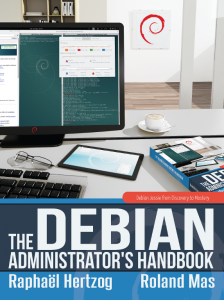
Rapha&#235;l Hertzog: The Debian Administrator s Handbook Updated for Debian 8 Jessie

Debian Handbook: cover of the jessie editionLater than what I hoped, I m still pleased to be able to announce the availability of the Jessie version of the Debian Administrator s Handbook. Check out the official announce with its special launch offer (a 15% discount on the paperback until Sunday!). The book s preface is co-signed by the last three Debian Project Leaders and it has been available through debian.org for a few months now. We are glad to have so much recognition for the hard work we have put in the book over the years. Thank you all and I hope you will enjoy this new edition! The work is not yet entirely over us for Roland and I, since we re now busy updating the French translation of the book. It should be available in the upcoming weeks. Keep posted!

3 comments Liked this article? Click here. My blog is Flattr-enabled.

Daniel Pocock: FOSDEM 2016 Real-Time Communications dev-room and lounge

FOSDEM is one of the world's premier meetings of free software developers, with over five thousand people attending each year. FOSDEM 2016 takes place 30-31 January 2016 in Brussels, Belgium. This call-for-participation contains information about:
  • Real-Time communications dev-room and lounge,
  • speaking opportunities,
  • volunteering in the dev-room and lounge,
  • related events around FOSDEM, including the XMPP summit,
  • social events (including the Saturday night dinner),
  • the Planet aggregation sites for RTC blogs
Call for participation - Real Time Communications (RTC) The Real-Time dev-room and Real-Time lounge is about all things involving real-time communication, including: XMPP, SIP, WebRTC, telephony, mobile VoIP, codecs, privacy and encryption. The dev-room is a successor to the previous XMPP and telephony dev-rooms. We are looking for speakers for the dev-room and volunteers and participants for the tables in the Real-Time lounge. The dev-room is only on Saturday, 30 January 2016 in room K.3.401. The lounge will be present for both days in building K. To discuss the dev-room and lounge, please join the FSFE-sponsored Free RTC mailing list. Speaking opportunities Note: if you used Pentabarf before, please use the same account/username Main track: the deadline for main track presentations was midnight on 30 October. Leading developers in the Real-Time Communications field are encouraged to consider submitting a presentation to the main track. Real-Time Communications dev-room: deadline 27 November. Please also use the Pentabarf system to submit a talk proposal for the dev-room. On the "General" tab, please look for the "Track" option and choose "Real-Time devroom". Other dev-rooms: some speakers may find their topic is in the scope of more than one dev-room. It is permitted to apply to more than one dev-room but please be kind enough to tell us if you do this. See the full list of dev-rooms. Lightning talks: deadline 27 November. The lightning talks are an excellent opportunity to introduce a wider audience to your project. Given that dev-rooms are becoming increasingly busy, all speakers are encouraged to consider applying for a lightning talk as well as a slot in the dev-room. Pentabarf system to submit a lightning talk proposal. On the "General" tab, please look for the "Track" option and choose "Lightning Talks". First-time speaking? FOSDEM dev-rooms are a welcoming environment for people who have never given a talk before. Please feel free to contact the dev-room administrators personally if you would like to ask any questions about it. Submission guidelines The Pentabarf system will ask for many of the essential details. Please remember to re-use your account from previous years if you have one. In the "Submission notes", please tell us about:
  • the purpose of your talk
  • any other talk applications (dev-rooms, lightning talks, main track)
  • availability constraints and special needs
You can use HTML in your bio, abstract and description. If you maintain a blog, please consider providing us with the URL of a feed with posts tagged for your RTC-related work. We will be looking for relevance to the conference and dev-room themes, presentations aimed at developers of free and open source software about RTC-related topics. Please feel free to suggest a duration between 20 minutes and 55 minutes but note that the final decision on talk durations will be made by the dev-room administrators. As the two previous dev-rooms have been combined into one, we may decide to give shorter slots than in previous years so that more speakers can participate. Please note FOSDEM aims to record and live-stream all talks. The CC-BY license is used. For any questions, please join the FSFE-sponsored Free RTC mailing list. Volunteers needed To make the dev-room and lounge run successfully, we are looking for volunteers:
  • FOSDEM provides video recording equipment and live streaming, volunteers are needed to assist in this
  • organizing one or more restaurant bookings (dependending upon number of participants) for the evening of Saturday, 30 January
  • participation in the Real-Time lounge
  • helping attract sponsorship funds for the dev-room to pay for the Saturday night dinner and any other expenses
  • circulating this Call for Participation to other mailing lists
FOSDEM is made possible by volunteers and if you have time to contribute, please feel free to get involved. Related events - XMPP and RTC summits The XMPP Standards Foundation (XSF) has traditionally held a summit in the days before FOSDEM. There is discussion about a similar summit taking place on 28 and 29 January 2016. Please see the XSF Summit 19 wiki and join the mailing list to discuss. We are also considering a more general RTC or telephony summit, potentially on 29 January. Please join the Free-RTC mailing list and send an email if you would be interested in participating, sponsoring or hosting such an event. Social events and dinners The traditional FOSDEM beer night occurs on Friday, 29 January On Saturday night, there are usually dinners associated with each of the dev-rooms. Most restaurants in Brussels are not so large so these dinners have space constraints. Please subscribe to the Free-RTC mailing list for further details about the Saturday night dinner options and how you can register for a seat. Spread the word and discuss If you know of any mailing lists where this CfP would be relevant, please forward this email. If this dev-room excites you, please blog or microblog about it, especially if you are submitting a talk. If you regularly blog about RTC topics, please send details about your blog to the planet site administrators:
http://planet.jabber.org ralphm@ik.nu
http://planet.sip5060.net daniel@pocock.pro
http://planet.opentelecoms.org daniel@pocock.pro
Please also link to the Planet sites from your own blog or web site. Contact For discussion and queries, please subscribe to the Free-RTC mailing list. The dev-room administration team:

1 November 2015

Steinar H. Gunderson: YUV color primaries

Attention: If these two videos don't both look identical (save for rounding errors) to each other and to this slide, it has broken understanding of YUV color primaries, and will render lots of perfectly normal video subtly off in color, one way or the other. Remux in MP4 instead of MPEG-TS here, for easier testing in browsers etc.: First, second. Chrome passes with perfect marks, Iceweasel segfaults on both (GStreamer's quality or lack thereof continues to amaze me). MPlayer and VLC both get one of them wrong (although VLC gets it more right if you use its screenshot function to save a PNG to disk, so check what's actually on the screen); ffmpeg with PNG output gets it right but ffplay doesn't. Edit to add: The point is the stable picture, not the flickering in the first few frames, of course. The video was encoded quite hastily.

Thorsten Alteholz: My Debian Activities in October 2015

FTP assistant This month I marked 492 packages for accept and rejected 50 of them. I had to send only 11 emails to maintainers. Up to now I accepted about 6000 packages, my first one was pexpect_3.0-1 on 20131211.
date package
1 20131211 pexpect_3.0-1
1111 20140506 dochelp_0.1
2121 20140825 cl-parse-number_1.3-1
2222 20140903 node-websocket-driver_0.3.5-1
3333 20150303 libparse-keyword-perl_0.08-1
4242 20150625 python-monotonic_0.2-1
4444 20150708 libmusicbrainz5_5.1.0+git20150707-1
5555 20150928 golang-github-yosssi-ace_0.0.4+git20150515.41.78e48a2-3
So, when do you expect accepted package number 6666, 7777, 8888 and 9999? Squeeze LTS This was my sixteenth month that I did some work for the Squeeze LTS initiative, started by Raphael Hertzog at Freexian. This month I only got a workload of 13.25h. Altogether I uploaded those DLAs: While preparing the libxml2 upload, I mixed up things for the i386 build and so [DLA 334-2] had to follow shortly after [DLA 334-1].
I also prepared a new upload of PHP5 with nine CVEs fixed. I put the i386 and amd64 versions at people.d.o and invite everybody to test them and give positive or negative feedback. The real upload to the archive will happen next week. This month I also had another term of doing frontdesk work and looked for CVEs that are important for Squeeze LTS or could be ignored. Other stuff This month I only polished some packages and uploaded: I also manually closed #711329 and #352421. After adopting package chktex I inherited #352421, which was one of my oldest bugs. It was about emacs longlines-mode support and I could close it without actually fixing something. The longlines-mode vanished from emacs. So, sorry for that

Next.

Previous.