Along with the
Rcpp 0.10.5 release yesterday,
a new minor release 0.3.920.1 of
RcppArmadillo
came out. It is based on Conrad's
Armadillo 3.920.0 plus a minor
fix, and uses some of the new
Rcpp features.
Both package is now on CRAN
and also in Debian.
This releases contains both a nice set of new Armadillo features as well as
some nice additions to RcppArmadillo,
due again mostly to Romain. Some of the changes tie into the changes
changes in Rcpp 0.10.5
as for example the ability to pass const and const
ref more efficiently (and we seem to have forgotten an entry in the
NEWS file).
The complete list of changes is below.
Changes in RcppArmadillo version 0.3.920.1 (2013-09-27)
Upgraded to Armadillo release Version 3.920.1 (Agencia Nacional Stasi)
faster .zeros()
faster round(), exp2() and log2() when using C++11
added signum function: sign()
added move constructors when using C++11
added 2D fast Fourier transform: fft2()
added .tube() for easier extraction of vectors and subcubes from cubes
added specification of a fill type during construction of Mat, Col, Row and Cube classes, eg. mat X(4, 5, fill::zeros)
Initial implementation of wrap<subview>
Improved implementation of as<>() and wrap() for sparse matrices
Converted main vignette from LaTeX style minted to lstlisting which permits builds on CRAN; removed set BuildVignettes: FALSE.
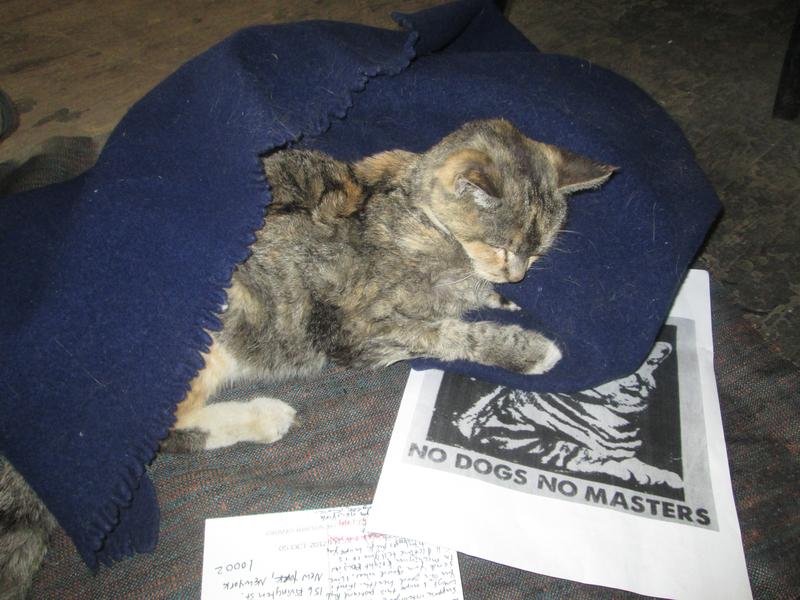
Yesterday, i said a sad goodbye to an old friend at ABC No Rio. Cookiepuss was a steadfast companion in my volunteer shifts at the No Rio computer center, a cranky yet gregarious presence. I met her soon after moving to New York, and have hung out with her nearly every week for years. She had the run of the building at ABC No Rio, and was friends with all sorts of people. She was known and loved by punks and fine artists, by experimental musicians and bike mechanics, computer geeks and librarians, travelers and homebodies, photographers, screenprinters, anarchists, community organizers, zinesters, activists, performers, and weirdos of all stripes. For years, she received postcards from all over the world, including several from people who had never even met her in person. In her younger days, she was a ferocious mouser, and even as she shrank with age and lost some of her teeth she remained excited about food. She was an inveterate complainer; a pants-shredder; a cat remarkably comfortable with dirt; a welcoming presence to newcomers and a friendly old curmudgeon who never seemed to really hold a grudge even when i had to do horrible things like help her trim her nails. After a long life, she died having said her goodbyes, and surrounded by people who loved her. I couldn't have asked for better, but I miss her fiercely.
The Freedombox
project have been going on for a while, and have presented the
vision, ideas and solution several places. Here is a little
collection of videos of talks and presentation of the project.
A larger list is available from
the
Freedombox Wiki.
On other news, I am happy to report that Freedombox based on Debian
Jessie is coming along quite well, and soon both Owncloud and using
Tor should be available for testers of the Freedombox solution. :) In
a few weeks I hope everything needed to test it is included in Debian.
The withsqlite package is already in Debian, and the plinth package is
pending in NEW. The third and vital part of that puzzle is the
metapackage/setup framework, which is still pending an upload. Join
us on IRC
(#freedombox on irc.debian.org) and
the
mailing list if you want to help make this vision come true.
After quite some delay, I got to selecting some photos for my gallery. In spring, we've spend few days in Bohemian-Moravian Highlands with Pentax Friends.
On the program there was of course taking some pictures and drinking beer or wine :-).
You can find some small but nice waterfalls:
In villages, there live wild animals:
As the weather was not really nice, we had nice opportunity to shoot some pictures in fog:
And last but not least, we've spent almost whole day taking pictures in Pilgrimage Church of Saint John of Nepomuk:
The trip was really nice, though we could use better weather as most of the morning there were really no nice conditions for taking pictures.
Just saw this ad today at my Institute's door. Rough translation:
Interim programmer sought
Requisites:
High school
One year of experience
Theorical and practical exams on the area
Familiarity handling electronic equipment, such as computers, perforators/punchers, terminals and similar.
[Yes, this is a joke post. I don't know how anybody is using such an obsolete job description. A job description at least three decades out of date]
[Well, yes, I understand it, because I knowhow that particular union works. But I cannot accept it is for real]
[...And no, please don't apply for the job. You will be miserable in the unlikely event you are chosen]
I got married! Sarah and I tied the knot on the 10th August this year.
We married in a registry office where we live and had an evening reception
on Tynemouth beach. A fantastic time was had by all.
We honeymooned in Sorrento, Italy, which was fantastic. We spent one day
visiting Pompeii (my fourth visit: about 6 hours on our feet this time, and we
walked from one side right to the other); another day in Herculaneum (my second
visit); one day visiting the village near where we were staying, where we
visited a local food festival and bought the nicest Marmelade I've ever tasted;
a few day and evenings in Sorrento town itself; but most of the time we just
relaxed, swam, snoozed, read.
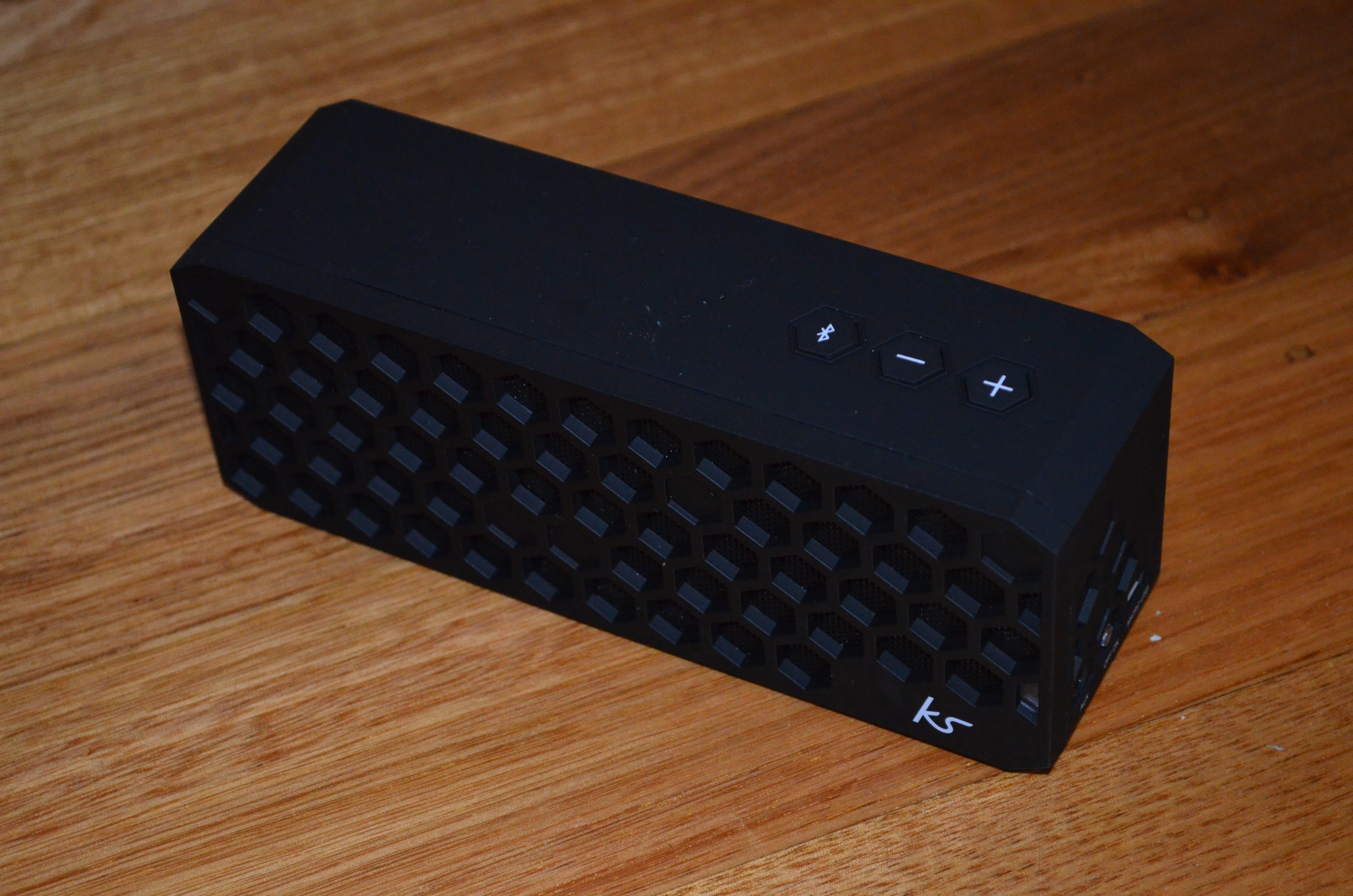
I ve just been given a set of Hive Bluetooth speakers by MobileZap (see this link for all their Bluetooth speakers) [1].
The speakers charge by a micro-USB cable so I started charging them in my car immediately after collecting them. To connect them to a phone or other Bluetooth device you just press the Bluetooth button on top and get the phone to be visible and scanning for devices, they identify themselves as Hive , after that they just work. My first test of using them was playing Ingress and the quality of the sound was impressive, I had thought that the Ingress recommendation to use headphones was due to the risk of annoying other people or alerting other players, but the quality of the sound was impressive and the internal speakers of a phone can t do it justice.
After getting home I did some tests listening to music. For watching music videos it didn t work so well as the sound was too far removed from the video, but the audio quality was very good. I listened to Vow by Garbage (a good benchmark for stereo sound) and even though the Hive speakers are only 16.5cm wide I could still notice the stereo effect when they were about 1.5m away from me. The audio quality didn t compare well with my Bose QC-15 headphones, but for affordable and portable speakers it was quite good and an obvious improvement over the speakers that are built in to any phone I ve used.
According to the Bluetooth Wikipedia page the range of a class 2 device is 10m and the range of a class 3 device is 1m. When my Samsung Galaxy Note 2 is talking to it I get a reliable range of about 5 meters and a mostly working range of 6 or 7 meters (sound randomly drops out and gets choppy). It could be that other phones would support a longer range due to having a higher transmission power (either class 1 or being closer to the limits of class 2) and a more sensitive receiver. But it doesn t seem likely that a 5m range is going to be a problem.
Volume and Quality
The speakers are rated at 5 Watt, when running at maximum volume (both through the phone volume setting and the volume control on the speakers) the sound is reasonably distortion free, as good as can be expected from playing an MP3 that s not compressed with the highest quality. Sound Meter [2] reports the sound volume as almost 85dB on a Galaxy S3 and as almost 100dB on a Galaxy Note 2, that would be somewhere between the volume of a busy street or alarm clock and the volume of a subway train or blow dryer which seems like a reasonable description, I find it very unpleasant to be within a meter of the speakers at maximum volume. With the typical amount of background noise in my house I can play music on the Hive speakers at one end of my house and hear it clearly at the other end.
These speakers are more than capable of supplying the music for any party I d want to host or attend. I m not really into wild parties, but I think that anyone who has a one room party would be more than satisfied with the Hive speakers. Obviously the sound quality of portable speakers in a box that s 16.5cm wide and 6cm high isn t going to equal that of a full size set of speakers, but I think that hardly anyone who attends a party would expect better sound quality than the Hive speakers can provide. The aim of such speakers is to be portable, not really expensive, and to provide good sound quality within those constraints. I think that they meet such aims well.
Over the years there have been many occasions when I have used a Thinkpad to provide the music for a party and found it to be quite loud enough. My current Thinkpad is a T420 which can produce 75dB according to my Galaxy S3 or 85dB according to my Galaxy Note 2. So it seems that I only really need about 10dB less than the maximum volume of the Hive speakers.
Appearance
The designers obviously made an effort on the appearance of the device. They have gone with the Hive concept and used hexagons everywhere. It really looks nice.
Unfortunately when I took the photo there was some dust on it which didn t look bad to the eye but caught the camera flash. But with a matte black device there s always the problem of light colored dust. Even with a bit of dust it still looks great as a set of speakers, the dust just detracts from the appearance in photos.
Line In
One of the features I looked for was an audio line input so I could connect it directly to a non-Bluetooth device. I m assuming that this feature works as it s something that s difficult to stuff up when designing such a product, but I haven t got around to testing it. Once I started using the device I just found that I didn t have a real need for that feature.
One thing that it might be useful for is PC desktop speakers that are powered by a USB port on the monitor. Currently I have a bearable (but not great) set of speakers for each PC and I don t need to change anything. But having the option of another set of speakers is very handy in case I suddenly need to make hardware changes.
Other People s Reviews
When I review a product I generally try and get opinions from random other people if possible. My mother and my mother-in-law were both impressed by the Hive speakers and expressed interest in owning a set. My mother-in-law was particularly interested as she uses her phone to listen to radio stations from outside Australia (I m going to get her onto Aldi for cheap 3G data ASAP so she can listen to Internet radio when travelling).
Generally the impression that other people have of this device seems to be very positive. It seems that Bluetooth speakers aren t just a Geek toy.
Conclusion
While I m very impressed by this product, at this stage I m not sure whether I would pay for this one or something cheaper if I was paying for it. MobileZap offers a range of other products that look appealing at lower price points. It really depends on how much I use it.
I ve just got a Makerbot Replicator 3D printer working and I ve found the Hive speakers very useful for the purpose of drowning out it s noise. If I keep doing that sort of thing then I ll get enough use out of the speakers to justify the price.
The third lesson of the Arte y cultura en circulaci n: crear y compartir en tiempos digitales course was quite easy, at least for me, as it's one of the topics I've been involved with for a long time: Authors' rights and ways to exercise them.
This lesson starts by talking about the paradoxes created in the reality beneath copyright mostly due to the zero-cost-for-perfect-copy reality we live in today, and then goes on to introduce the most widely spread licensing schemes for cultural works nowadays: The Creative Commons licensing schemes.
What I felt very interesting is that the lesson tackles the most common issues raised by authors choosing CC licensing: The Non-Commercial and Non-Derivatives restrictions. While authors are usually not very hard to convince about the virtues (and their personal benefit) in CC licensing, it's usually hard for authors to accept and relinquish the "locks" on non-derivability and non-commercial-use.
Now, as to the homework: This time, I have to admit it was a no-brainer to me. The homework was to take part of a "Licenciat n": Publish some work under a open or free license (a work of any kind; it can be text, photo, video, etc.; it can be a new or a pre-existing work) and argue as to why did you choose said license.
Even the act of writing this blog post means I'm releasing some work. The bottom of my blog reads, All the material found at this site is freely available, and you can use it as you wish, except when the document mentions explicitly different conditions. Yes, this is not a widely known, preexisting licensing scheme, and more or less goes along the lines of CC0 There are some good things I have posted in this blog, some things I am proud about. This post goes more towards the average quality: Not adding anything of great value to the world, just reiterating/reposting what is already said. But I know this blog is syndicated over several different places, and its content might be copied over to other places. I don't need to know or be notified about it. I just care for people to be able to reach back if they want to do it.
But, of course, if I'm asked to do a homework, I prefer not to have it so self-referential. What else to license?
We are over halfway across the Wiki Loves Monuments contest for 2013. This year I am clearly not as active on it as I was last year, but yesterday I uploaded about 60 photos from our recent trips, from historical monuments in some towns/cities within ~150Km of Mexico City: Puebla, Tlaxcala, Cacaxtla, Toluca, Santiago Tianguistenco. I intend to upload more. Those photos are licensed CC-BY-SA. Why? Mainly, because it is the defaul for the contest. One of the lessons learned working on Debian is that the less the license I choose deviates from what the upstream authors of a larger project prefer, the more useful my work will be. And being Wikimedia a host of many related projects, I prefer to completely abide by their recommendations unless there is a real, strong reason not to do so.
Also, I know that at least most the photos I am uploading are not of contest quality (although some are quite nice, but we don't take that long to take a shot, and our camera is probably too basic to get a quality shot, if not by mere chance). I am using the WLM contest as an excuse to categorize and upload my pictures Of course, I'm not including personal photos, but... If I found a building, place or landscape interesting enough to take a photo of, why not make said photo available for whoever needs it, in a canonical, easy to reach media repository (as Wikimedia Commons) is)?
And finally, I think it's time to start getting more open and forward-going with a project that I have been giving a lot of work during the past year, a project that has been even eating quite a bit of my Debian time: My upcoming book. While this book is not yet freely licensed (it is freely distributed online, but does not yet have an explicit license, and I mention it on my teaching/project page. Why? Because it still has some figures and data which are not mine, and which I have to re-elaborate to be able to legally license it.
But anyway I am writing a book on the subject of Operating Systems, and am basing my teaching on it. The first semester was basically hell for me, as I was working almost full time on it, and needed to allocate some time as well to the rest of my formal work. This second semester has been quite smoother. And there is a very important (to me) initiative to which I (or should I now start saying, we) submitted this work: The LATIn Project: An initiative to collaboratively create quality, freely redistributable text books for the university level, natively in Spanish, for their use in Latin American countries.
I was not able to propose this book due to some formalities Projects have to be proposed by professors in participant universities, and UNAM is not one of them. However, I offered this work to people in the Universidad Nacional de Rosario, Argentina, and they managed to push the project forward. Together with people from Universidad Aut noma de Aguascalientes (M xico) and Universidad del Cauca (Colombia), the project was approved by LATIn.
And this LATIn project can also be seen as a why do you agree to license your work this way? candidate: I have already written most of what I'd be happy to call a full book. Of course, I do expect my colleagues to chime in with more content, and I expect us to produce a true collaborative project. But as I am not part of the member universities, they will get paid for their contribution And not me. What do I have to gain from this?
More than anything else, the circulation of my work. I'm sure that, were I to publish from UNAM, I would have a good projection. I was (am!) thinking of looking for opportunities to present the book to teachers on the subject, as well as to computing engineering/science students, but the most attractive part (for me) for LATIn is that part of the prize will be that the book will be used to base work on for teaching at least during 2014 in the three said universities And of course, my/our work will only start then, as we will have to further circulate the work.
Anyway... I expected this post to be small. But as you can see, I am happy with important work perspectives :-)
Review: Throne of the Crescent Moon, by Saladin Ahmed
Series:
Crescent Moon Kingdoms #1
Publisher:
DAW
Copyright:
January 2013
ISBN:
0-7564-0778-8
Format:
Mass market
Pages:
367
Doctor Adoulla Makhslood is the last ghul hunter in Dhamsawaat. He's an
old man, and tired, and increasingly uncertain whether he wants to
continue putting his life in danger to fight one more fight. But there
are no replacements; his young and idealistic dervish apprentice, despite
obvious skill, is too inexperienced and uninterested in the knowledge and
investigation that makes Adoulla so good at what he does. So, when a
young boy shows up on his doorstep, a survivor of a vicious ghul attack,
he goes hunting once again. And both finds something much darker and
stronger than he expected and meets an unexpected ally: a shape-shifting
girl who is herself a survivor of something far worse than ghuls.
Throne of the Crescent Moon is a first-novel fantasy that has made
quite a splash, including a Hugo nomination (although I thought a win was
unlikely, and I was right). One of the more interesting comments I've
read about it was the observation by
Jo Walton that if it had come out in 1980, it would have been an
amazing, unusually wonderful, non-normative book. That it isn't is
evidence of the changes in fantasy since then. The field has grown.
As you might guess from the publisher's insistence on comparing it with
The Arabian Nights, and from the names mentioned above, this book
is set in an unspecified Middle Eastern culture and draws heavily from its
mythology. It does not contain any western characters; the entire story
is native to its region. The same is true of the mythology, which gave it
a refreshing originality for me. And while I'm not the best one to judge,
the presentation of that setting seemed free of the tint of the exotic.
People live here, there are factions and multiple cultures, and the
supernatural is a backdrop to most of the city.
This would be very unusual decades ago. It's a bit less unusual now, and
the story itself is a familiar ensemble fantasy, if refreshingly free of
extended map exploration journeys. Ahmed brings together five characters
with very different backgrounds and throws their varying talents at a
problem. A few of those elements are a bit too familiar: female
sexuality as a threat to male power is a world-building element that I
could do without, for example. I also found the villain completely
inadequate in its unidimensional evil (reinforced with a few more torture
scenes than I needed to read), and even the attempted complication felt
too predictable to me.
Except for one touch of perspective, I'd call Throne of the
Crescent Moon a competent, enjoyable, but somewhat forgettable fantasy
novel, albeit one that's refreshingly concerned with a city instead of
countrysides and travel. That touch is in the age of several of the
protagonists. We get sections following several of the main characters
in tight third person, but Adoulla is the first protagonist and the focus
of much of the book. And Adoulla is neither young nor inexperienced,
and is not going through the typical fantasy bildungsroman.
He's old, experienced, a bit set in his ways, cranky, cantankerous, and
deeply in love with his city. In tone, this shifts the story towards
Star Wars as seen through the eyes of Obi-Wan Kenobi instead of
Luke Skywalker. And that change I really liked, and would be happy to see
become more common in fantasy.
There was a bit of a downside for me in three of the five main characters
being older. At times, Throne of the Crescent Moon has an elegiac
tone, a feeling of life, power, and time slipping away and cultures and
ways of life being lost. That's not my favorite thematic element. I tend
to find it more depressing than I really want in my reading. But, here,
the mature perspective more than makes up for some occasional negativity.
I particularly liked how the older characters treated the likely budding
young romance, which would have been the center of many books in this
genre, with bemused detachment and playful encouragement without giving it
more significance than it deserves. There's another romance that ends up
being more significant, and which needs the weight of time and well-lived
lives to become so.
I don't think this book deserves a Hugo, but it is an enjoyable fantasy
with some interesting characters and a refreshing perspective and setting.
The villain really isn't adequate to the story, there's a bit too much
torture for my liking, and I could have done without a few of the tropes,
but it's a solid entry in its genre and a pleasant few hours of reading.
And despite being advertised as the first of a series, it comes to a
satisfying conclusion.
Rating: 7 out of 10
On a regular basis, I find myself the odd-man-out when it comes to talking
about how to work with Python on Debian systems. I'm going to write this and
post it so that I might be able to point people at my thoughts without having
to write the same email in response to each thread that pops up.
Turns out I don't fit in with the Debian hardliners (which is to say, the
mindset that pip sucks and shouldn't exist), nor do I fit in with the Python
hardliners (which is to say apt and dpkg are out of date, and neither have
a place on a Development machine).
I think our discourse on this topic has become petty and stupid in general.
Let's all try to step back and drop a bit of the attitude.
pip doesn't suck, and neither does apt.
The truth is, both sides are wrong. As with any subject, the real
answer here is much more nuanced than either side presents it. I'm going to
try and present my opinion on this, in the way that both my Pythonista self
and my Debianite self see the issue. Hopefully I can keep this short, to
the point, and caked with logic.
The case for dpkg (the Debianite in me)
In defense of dpkg and apt, imagine having to install python-gnome2
on all your systems when you install. It'd be hell on earth.
Imagine having a user try to do this. It's insane to assume that
end-users will be using pip for this purpose.
pip is fun and all, but it's also installing 100% untrusted code to your
system (perhaps as root, if you're using pip with sudo for some reason),
and hasn't been reviewed for software freeness, which is something Debian
(and Debian users) take seriously. This isn't even to mention the hell that
pip wreaks on dpkg controlled files / packages.
Try to remember how much of your system running (yes, right now) is running
because of Python or Python modules. Try to imagine how much of a pain in
the ass it'd be if you couldn't boot into GNOME to use nm-applet to connect
to wifi to pip install something. I'm sure even the most extreme pip'er
understands the need for Operating System level package management.
Debian also has a bigger problem scope - we're not maintaining a library
in Debian for kicks, we're maintaining it so that end user applications may
use the library. When we update something like Django, we have to make sure
that we don't break anything using it (although, to be honest, the fact that we
package webapps is an entire rant for later) before we get to update it to the
newest release.
Hell, with a few coffees, I could automate the process of releasing a .deb
with a new upstream release, 100% unattended. I won't, however, since this is
an insane idea. Let's go over a brief list of things I do before uploading a
new package:
Review the entire codebase for simple mistakes.
Review the entire codebase for license issues.
Review the entire codebase for files without source, and track down
(and include source for) any sourceless files (such as pickle
files, etc).
Get to know the upstream, get to know open bugs, write something using
the lib, in case I need to debug later.
Install the package.
Test the package.
Work out any Debian package issues (this is easy).
Now, a brief list of things I do before I update a package:
Review the changes between the last uploaded version (in diff format, if
it's sane, otherwise get the VCS and review), ensure all the above are still
OK.
Review for Debian-local issues (such as how it will upgrade, using
piuparts, and adequate, etc).
Check to make sure it won't break any reverse dependencies.
Review for bugfixes that I might need to bring back to the stable release.
Figure out if I should (or even can) backport the package, if API is
stable.
Review for bugs (upstream or in Debian) that I need to mention in the
debian/changelog.
Clearly, this isn't a quick-and-dirty task. It's not a matter of getting a
package updated (technically), it's a much more detailed process than that.
This is also why Debian is so highly regarded for its technical virtuosity,
and why the
ISS decided to deploy Debian in space,
despite other commercial distros such as Red Hat, or Ubuntu, and
community distros, such as Fedora or Arch.
It's also not Debian's job to package the world in the archive. This is an
insane task, and it's not Debian's place to do it. We introduce libraries
as things need them, not because we wrote some new library that someone
may find slightly useful at some point in the future. maybe.
Upstream developers and language communities (not only Python here) tend to
lose sight of why we're doing this in the first place, which
is our users. This isn't some sort of technical pissing contest to see who can
distribute the software in the best way. Debian-folk always keep end users
as our highest priority.
I quote the
Debian Social Contract, when I say
that Our priorities are our users and free software. No one's trying to
get developers to use dpkg to create software. In fact, as you'll see
below, I actively discourage using system modules for development.
The case for pip (the Pythonista in me)
In defense of pip, the idea that Debian will keep the latest versions of
packages is insane. The idea that we can keep pace with upstream releases is
nuts, and the idea that every upstream release on pypi is ready to ship is
bananas. b-a-n-a-n-a-annas.
As a developer, I don't want to support every release, and I surely don't want
other people depending on some random snapshot.
Often times, I'll put stuff up on pypi as a preview, or to release often, and
solicit feedback without having to give out instructions on using a git
checkout (it's also easier to have them try a version from pypi so I can
cross-ref the git tag to reproduce issues when they file them)
pypi is easy, ubiquitous and works regardless of the platform, which means
less of my development time is spent packaging stuff up for platforms I don't
really care about (Arch, Fedora, OSX, Windows), even though I value
feedback from users on those systems. The effort it takes to release something
is limited to python setup.py sdist upload, and it's in a place (and in a
shape) that anyone can use it without having 10 sets of platform-local
instructions.
Even ignoring all the above, when I'm writing a new app or bit of code,
I want to be sure I'm targeting the latest version of the code I depend on,
so that future changes to API won't hit me as hard. By following
along with my dependencies' development, I can be sure that my code breaks
early, and breaks in development, not production. Upstreams also tend to not
like bug reports against old branches, so ensuring I have the latest code from
pypi means I can properly file bugs.
Lastly, I prefer virtualenv based setups for development, since I'm usually
working on many things at once. This often means version mismatches in
libraries, which brings in API changes (another whole rant here as well).
I don't want to keep installing and uninstalling packages to switch between
the two projects, and using a chroot(8) means a lot of overhead and that it's
disconnected from my development environment / filesystem, so I resort to
virtualenv to isolate my Development environment.
Final notes
I don't want to keep arguing about this. Just accept that the world's a big
place and that there exist use-cases that both apt and pip need to exist
and work in the way they're working now. At the very least, try and understand
there exist smart people on both sides, and no one is trying to screw anyone
over or keep their own little private club to themselves. Hopefully, going
forward, we can make sure that the integration between these two tools gets
better, not worse.
Help make this dream a reality. Contribute to a productive tone, not a
destructive one. In short:
Use pip without sudo always. Don't tell people to use sudo.
Use apt or dpkg when deploying system-wide.
Understand people are going to package, and they will be more concerned
about software using your library then keeping your library up to date.
Understand Debian Developers and package maintainers have to do a lot of
work when updating or sponsoring an upload.
Understand upstream developers can't be bothered to fix every issue
with every release (release early, release often) with some snapshot
you introduced into unstable.
Use pip and virtualenv in development setups, so we can upgrade your
app when we upgrade the lib.
Well at least he should be according to Sartre though I am not entirely convinced the repercussions of my choice to manufacture another folding chair were entirely thought through.
After my most recent posting the urge to do "just one more iteration" became too great and I succumbed. I therefore present version 4 of my folding chair which corrects all the previously discovered issues.
The popliteal height (420mm) and buttock popliteal length (400mm) are both comfortable for a wide selection of people. The seat slopes a few degrees front to back and the back rest no longer comes further forward than the rear of the seat.
There is a small gap above where the seat folds in when flat but that is only an aesthetic issue when being stored.
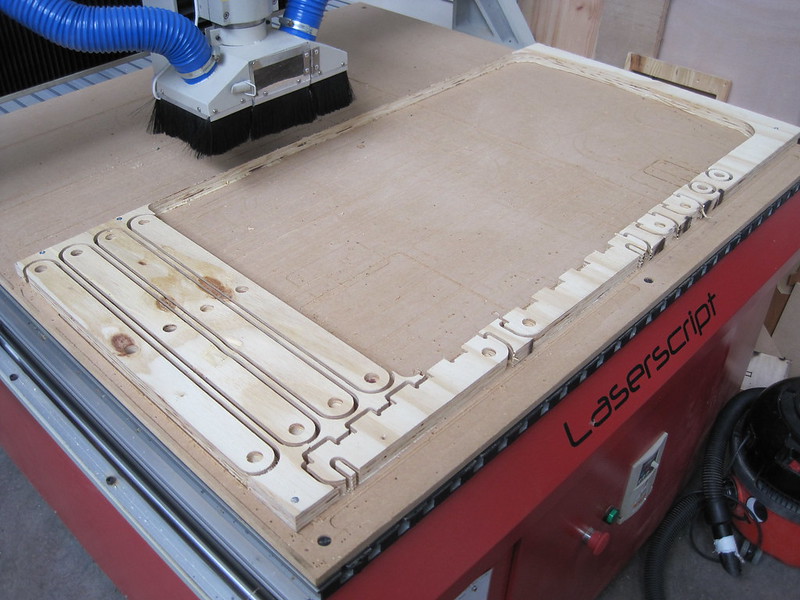
Manufacture wise the design is simple to produce although I really will have to teach our CNC router how to use the round over bit to reduce the finishing steps as currently that takes longer than the CNC operation.
In future if I make more of these I will use this design and, once she is less annoyed at me for making another chair, I am going to consult with my wife on adding some cushioning material to the seat and backrest.
And of course that concludes my furniture making for a while...yeah, right!
there have been comments which have complained about my usage of space on sheets and suggested I waste too much material. That is probably true and in my own defence I have not been working with this machine for very long and am not quite used to what I can "get away with" yet.
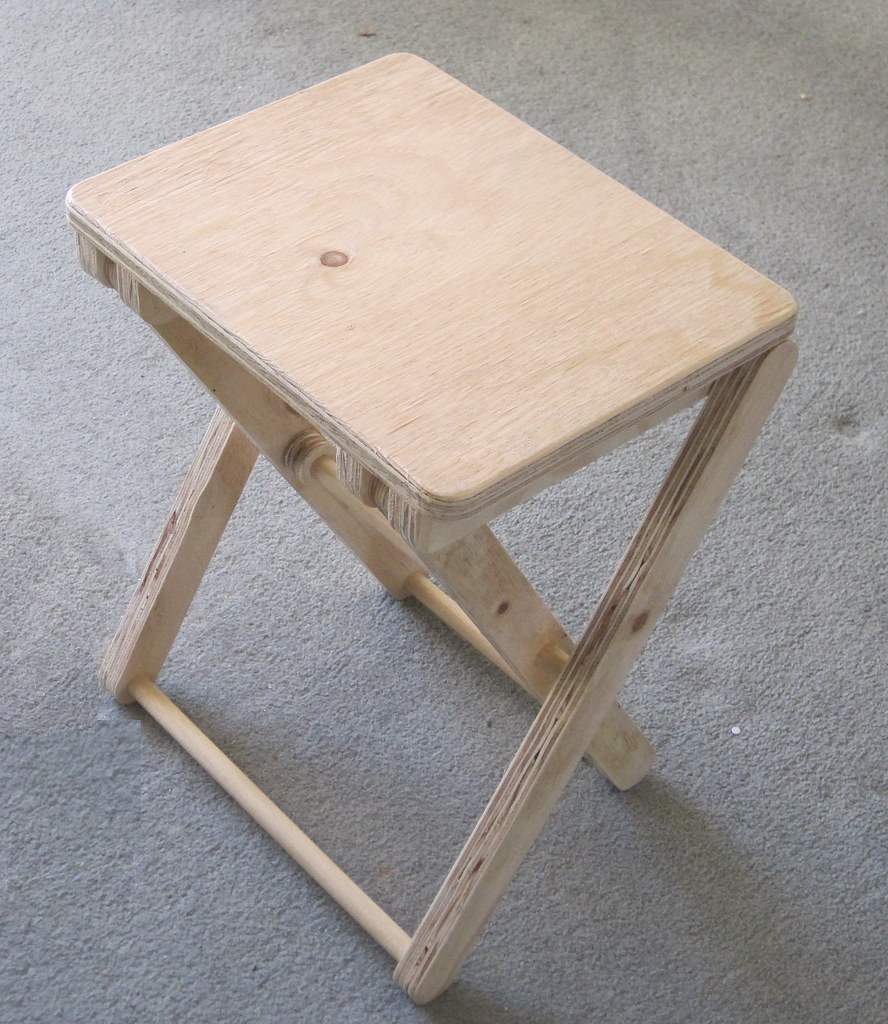
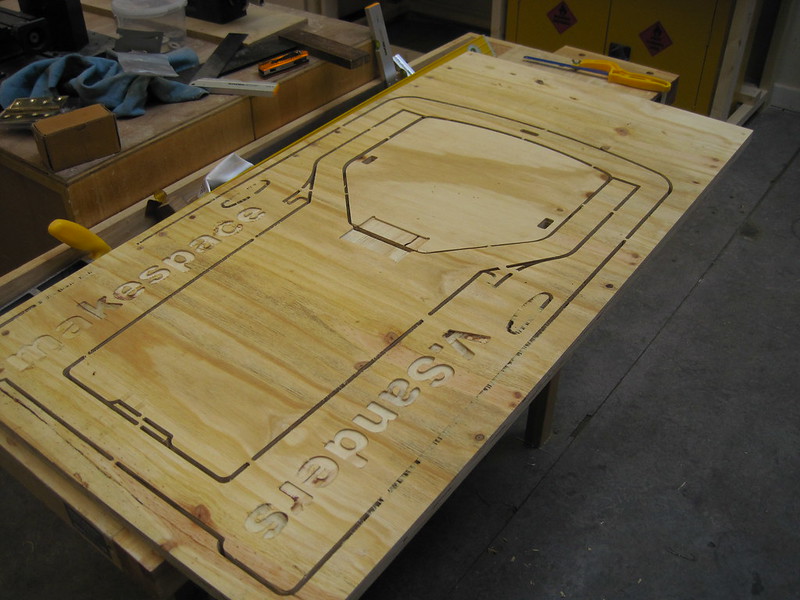
I was looking at the sheet after removing the last chair design and had a thought, I had not attempted a side X type folding design and perhaps I could squeeze one into the offcuts? I kinda got carried away, it roughly went:
Measure the available offcut space
Measured the remaining 18mm dowel leftover from my dowel hinge experiments
Found the largest width and height area I could get out of the sheet the CNC router ruined.
Sketched a design
Capture design to a DXF
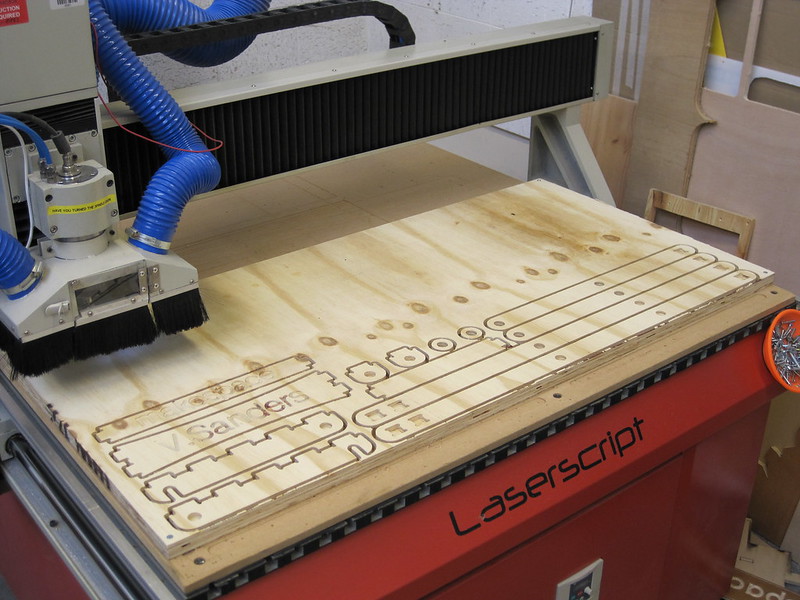
Carefully spread the pieces over the available material in the CAM software
Generate a toolpath.
Cut material
If all of that sounds like and utterly mad way to design a size X stool, you are of course correct, but it worked, and it was a very fast process taking less than four hours from idea to stool.
There are a couple of issues:
the popliteal height is 470mm ( I was aiming at 420 and missed...badly)
It uses a lot of expensive hardwood dowel (1373mm plus cutting width and only way I could get it accurate was to use the disc sander to remove fractions till the length was correct)
I used pockets for the interference seat joints rather than through cuts and discovered that you need to allow tolerance depth (the pegs are 10mm deep and the sockets need to be at least 10.2 not the 10mm I cut)
Dowel joints are great but have a small surface area so friction fit joints work loose.
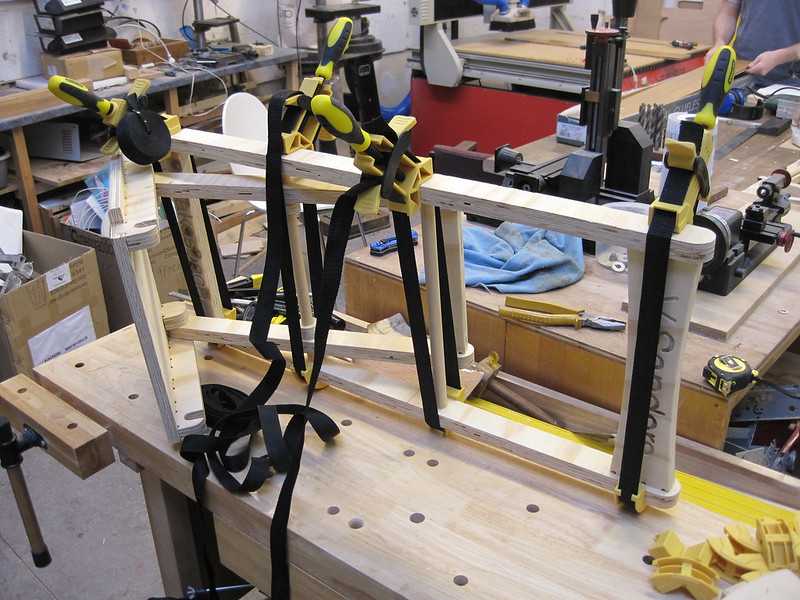
The seat went together dry fit and Paul tested it for me, however that last issue soon made me realise that this time I was going to have to resort to glue. Yes, sorry, this design needs to be glued to remain stable (I know plywood contains glue...please stop telling me that).
It is pretty simple to put together and aside from needing half the clamps in makespace to hold it in place while the glue dried, I had no trouble.
Though this is definitely not a case of use glue "sparingly" I put generous amounts in all the dowel joints and all the seat slots and got very little ooze so I guess it could have used more.
The final varnished stool is pretty robust but folds up nicely the concept of hooking to its own pivot dowel means it stays closed when flat which makes it very portable.
Total cost was an estimated 10.00 ( 4.25 dowel, 2.50 of 24mm ply, 1.75 for 18mm ply, 0.50 tool wear, 1.00 varnish) though the materials in my case could be argued to have cost nothing.
It has been suggested that I could make an entire picnic table and chairs set this way but if I did I would reduce the stool height by 50mm and examine ways to use less dowel.
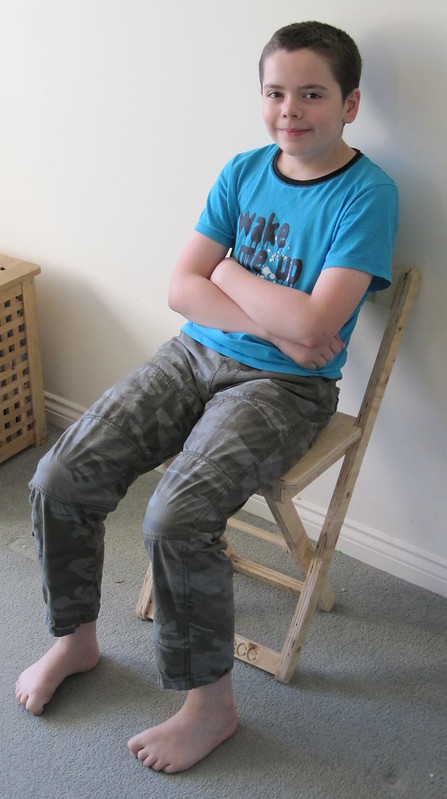
Or in this case my final (and yes I am going to do something else next) chair design. It is based on the stool, in fact it is the stool design with the outer legs extended and a back rest added.
The modified design reduces the dowel requirements to 775mm but requires a bit more sheet material (cannot get this one entirely from offcuts).
Total cost was an estimated 10.50 ( 2.50 dowel, 4.50 of 24mm ply, 1.75 for 18mm ply, 0.50 tool wear, 1.25 varnish).
Because it is based on the stool design it suffers from the height issue and in addition the back rest is a bit far back to be completely comfortable.
Neither of the side X designs have flaws that interest me enough to follow the iterative approach again to solve them. Both the designs work well enough and rounded out my adventures with folding chairs and indeed furniture for now.
I have just bought a wireless phone charging system based on the Qi Inductive Power Standard. I bought a charging device which connects to a standard micro-USB cable and receivers for the Samsung Galaxy Note 2 and Samsung Galaxy S3 phones I own. Both those phones have contacts in the back of their case that are designed for wireless charging so you can install a charging device inside them. The charging devices make the case fit a little tight, and the charging device is stuck to the phone battery with contact adhesive, this makes it impractical to change the battery on a phone with such a device and makes it a little more difficult to swap out a battery case. One nice feature of the Nexus 4 is that it has Qi charging built in, that saved me $19 and was also more convenient.
I believe that the main advantage of a wireless charger is to avoid the risk of damage to the phone if it s dropped while connected to a USB charger. This allows the phone to be charged in situations where you might need to quickly or regularly unplug it to go somewhere. One example of how I might use it is when working at an office so I could charge my phone while at my desk and then quickly take it with me if I had to go to a meeting (sadly I have worked in many offices where they have so many meetings). Another example is for sysadmin work where I have to frequently visit devices to fix them.
The wireless charging mat that I bought from Kogan connects to a standard micro-USB plug, the good thing about this is that it s easy to find cables and it can take power from any PC. The bad thing about this is that the resistance of the USB cable is a factor that limits the power that a phone can receive, when using wireless charging you have the limit of the cable resistance as well as some power loss from the wireless transmission. After any extended period of charging the charging mat feels warm to the touch and the phone that s been resting on it feels warmer than usual. The warmth is an indication of energy loss which means longer charging times, a longer charging time isn t necessarily a problem as the convenience of wireless charging can allow longer charging times, but if you want to charge your phone in a hurry before you go somewhere then wireless isn t a good choice.
In the past I ve discovered that the battery in a Samsung Galaxy S3 can t be charged if the phone is at 46C [1]. 46C might seem extremely hot to people in some parts of the world (EG northern Europe and Canada) but the temperature in even southern parts of mainland Australia can get that hot and it can be hotter in central and northern parts, so phone temperature can be a real issue. Currently my house is at 21C according to a digital thermometer, the Galaxy S3 and the Note 2 are being charged from USB and report temperatures of 27C and 23C respectively. While the thermometer in my house and those in the phones probably aren t really accurate it seems reasonable to assume that the battery of a relatively idle smart-phone that s being charged will be a few degrees warmer than the ambient temperature. The Qi charger makes things a lot worse as it even feels warm to the touch. So maybe a phone on a Qi charger would be 8 degrees warmer than the ambient temperature or more. That implies that in Australian summer weather a Qi charger won t be useful outside or in any building that lacks air-conditioning. So I think we can give up on the idea of using Qi devices to charge phones at a BBQ.
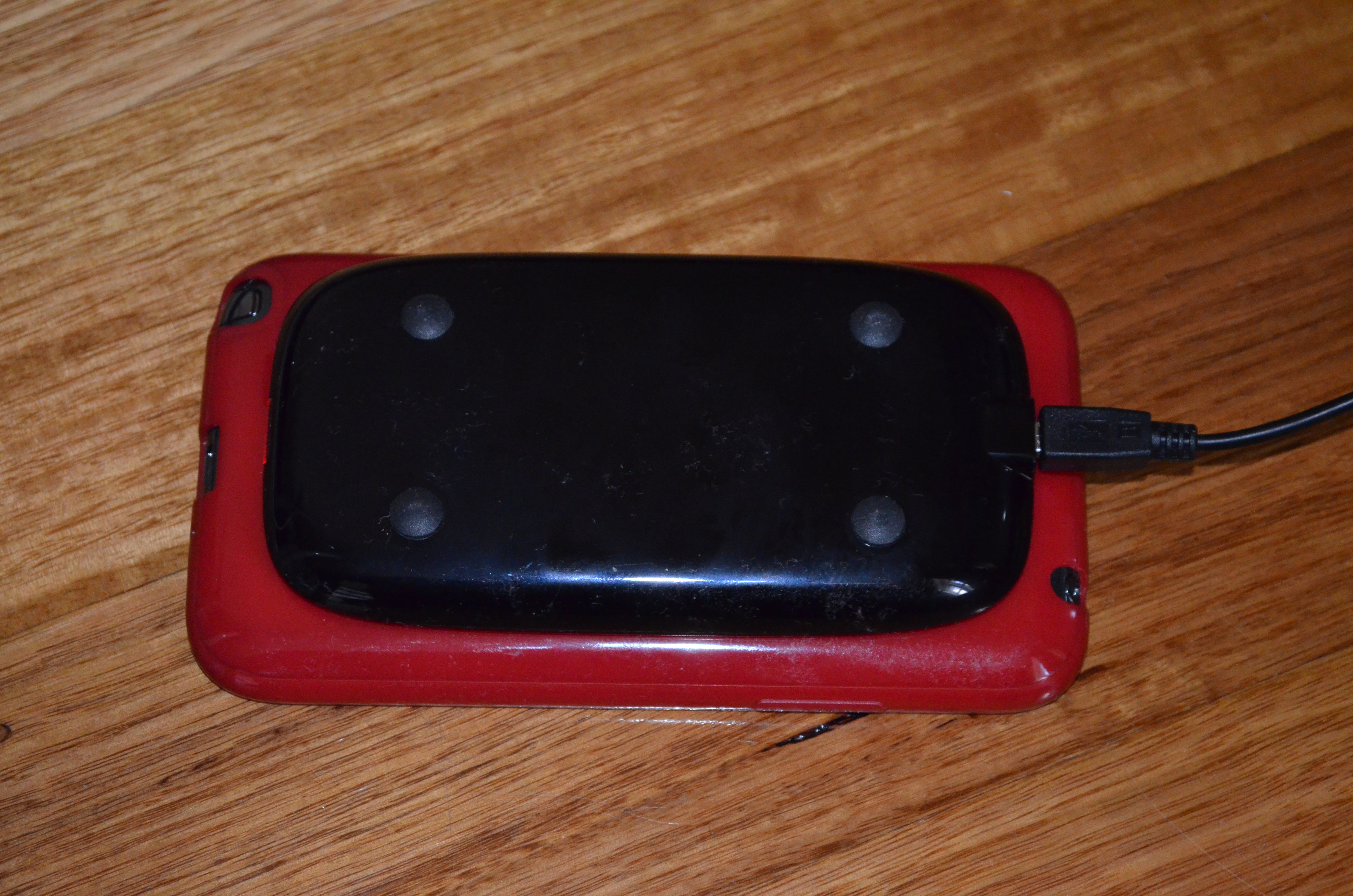
The final problem I have is that the Qi device is quite small, I took the above picture with my phone face-down because no part of the charger is visible in normal use. With that size I can t just dump a phone like a Note 2 on top of the charging mat and expect it to work. I have to carefully place it so that it balances and so that the wireless receptor inside the phone matches the transmitter in the mat, if the phone isn t placed correctly then the Qi mat won t detect it and won t supply full power to the transmitter.
Conclusion
I m fairly disappointed in this device. The waste heat makes it unsuitable for Australian summer conditions and slows charging. The difficulty of correctly placing the phone reduces the convenience which is one of the major features.
The price was $19 for each charging card for the Note 2 and the S3 and $29 for the charging mat to give a total of $67. I think it s worth the money for me to cover the risk of one of my phones having it s USB port damaged. Using a Qi charger on occasion will decrease the probability of such damage and allow the phone to be used after receiving certain types of damage.
The prices of those phones nowadays are $389 for a Galaxy S3 (Kogan price), $250 for a Nexus 4 (when it was on sale in the Google store), and probably about $500 for a Galaxy Note 2 (last time Kogan offered them). So by paying $67 for Qi charging I believe that I m getting some degree of damage insurance for just over $1100 worth of phones. It seems likely that the Nexus 5 will ship with Qi charging support and that the Galaxy Note 3 will also support an optional Qi charging card (which will probably also be $19 or some similar price) so the charging mat should be useful for a long time.
While I m disappointed I don t regret buying the device. But I would be hesitant to recommend it to other people and definitely wouldn t recommend it to someone who doesn t have a significant interest and investment in smart phones.
Google seems to try to invent new and interesting ways for spammers to spam me (and many others). I ve still not worked out a good way to block fake googlegroups which follow this method:
Make new fake gmail login
Make new fake google group
Add lots of people s email addresses to the group
Send lots of junk to these people
Repeat when it gets closed down
I m not sure why groups aren t opt-in. A rather simple and standard way to stop this exact problem.
Anyhow, the next new spammer enablement that the nice folks at Google have come up with is the mygbiz.com domain. These are temporary email addresses you can use when setting up Google apps. The only thing I have ever seen from them is spam. So I thought I d try to report some to Google. After looping around several help screens that were, despite their name, very unhelpful, I ve come to the conclusion that Google isn t too serious about fixing this problem.
If you have postfix, the solution is very simple:
vi /etc/postfix/access_sender
Add a line like mygbiz.com REJECT
postmap /etc/postfix/access_sender
postfix reload
I find the results to this method far superior to trying to get Google interested in being responsible for a domain they run. If you want to use google apps then spend the $50 and get a domain. Alternatively don t use something that spammers abuse.
Does it work? You bet it does!
Sep 18 23:26:38 elmo postfix/smtpd[19013]: NOQUEUE: reject: RCPT from mail-ye0-f208.google.com[209.85.213.208]: 554 5.7.1 <grace@sheiladolan.mygbiz.com>: Sender address rejected: Do not send from mygbiz.com domains; from=<grace@sheiladolan.mygbiz.com> to=<ME@MYDOMAIN> proto=ESMTP helo=<mail-ye0-f208.google.com>
A client has recently asked for my advice on web editing software. There are lots of programs out there for editing web sites and according to a quick Google search there are free Windows programs to do most things that you would want to do.
The first thing I m wondering about is whether the best option is to just get a Linux PC for web editing. PCs capable of running Linux are almost free nowadays (any system which is too slow for the last couple of Windows versions will do nicely). While some time will have to be spent in learning a new OS someone who uses Linux for such tasks will be able to use fully-featured programs such as the GIMP which are installed as part of the OS. While it is possible to configure a Windows system to run rsync to copy a development site to the production server and to have all the useful tools installed it s much easier to run a few apt-get or yum commands to install the software and then copy some scripts to the user s home directory.
The next issue is whether web editing is the best idea. Sites that are manually edited tend to be very simple, inconsistent, or both. Some sort of CMS seems to be the better option. WordPress is a CMS that I m very familiar with so it s easy for me to install it for a client, while I try and resist the temptation to force my favorite software on clients there is the issue that I can install WordPress quickly which therefore saves money for my client. WordPress is a CMS that supports installing different themes (and has a huge repository of free themes). The content that it manages consists of pages and posts , two arbitrary types of document. Supporting two types of document with a common look and feel and common important data in a side-bar seems to describe the core functionality used by most web sites for small businesses.
Does anyone have any other ideas for ways of solving this problem? Note that it should be reasonably easy to use for someone who hasn t had much experience at doing such things, it shouldn t take much sysadmin time to install or cost to run.
While I suspect that professional speakers have separate presentation
laptops that they use only to give talks, I don't do this often enough to
justify the hassle and cost of a separate machine. However, I do use a
separate user account to present from.
It allows me to focus on my presentation and not stress out about running
into configuration problems or exposing private information. But mostly, I
think it's about removing anything that could be distracting for the
audience.
The great thing of having a separate user for this is that you can do whatever
you want in your normal account and still know that the other account is ready
to go and configured for presenting on a big screen.
Basics
The user account I use when giving talks is called presenter and it has
the same password as my main user account, just to keep things
simple. However, it doesn't need to belong to any of the UNIX groups that my
main user account belongs to.
In terms of configuration, it looks like this:
power management and screen saver are turned off
all sound effects are turned off
window manager set to the default one (as opposed to a weird tiling one)
desktop notifications are turned off
Of course, this user account only has the software I need while
presenting. You won't find an instant messaging, IRC or Twitter client
running on there.
The desktop only has the icons I need for the presentation: slides and
backup videos (in case the network is down and/or prevents me from doing a
live demo).
Web browsers
While I usually have my presentations in PDF format (for maximum
compatibility, you never know when you'll have to borrow someone else's
laptop), I use web browsers (different ones to show that my demos work with
all of them) all the time for demos.
Each browser:
clears everything (cookies, history, cache, etc.) at the end of the session
has the site I want to demo as the homepage
only contains add-ons or extensions I need for the demos
has the minimal number of toolbars and doesn't have any bookmarks
has search suggestions turned off
never asks to remember passwords
Terminal and editors
Some of my demos may feature coding demos and running scripts, which is why
I have my terminal and editor set to:
a large font size
a color scheme with lots of contrast
It's all about making sure that the audience can see everything and follow
along easily.
Also, if you have the sl package installed system-wide, you'll
probably want to put the following in your ~/.bashrc:
alias sl="ls"
alias LS="ls"
Rehearsal
It's very important to rehearse the whole presentation using this
account to make sure that you have everything you need and that you are
comfortable with the configuration (for example, the large font size).
If you have access to a projector or a digital TV, try connecting your
laptop to it. This will ensure that you know how to change the resolution
of the external monitor and to turn mirroring ON and OFF ahead of time
(especially important if you never use the default window manager or desktop
environment). I keep a shortcut to the display settings in the sidebar.
Localization
Another thing I like to do is to set my operating system and browser
locales to the one where I am giving a talk, assuming that it is a western
language I can understand to some extent.
It probably doesn't make a big difference, but I think it's a nice touch and
a few people have commented on this in the past. My theory is that it might
be less distracting to the audience if they are shown the browser UI and
menus they see every day. I'd love to have other people's thoughts on this
point though.
Also, pay attention to the timezone since it could be another source of
distraction as audience members try to guess what timezone your computer is
set to.
Anything else?
If you also use a separate account for your presentations, I'd be curious to
know whether there are other things you've customised. If there's anything I
missed, please leave a comment!
I love to say that Python is a nice subset of Lisp, and I discover that it's
getting even more true as time passes. Recently, I've stumbled upon the
PEP 443 that describes a way to
dispatch generic functions, in a way that looks like what CLOS, the Common
Lisp Object System, provides.
What are generic functions
If you come from the Lisp world, this won't be something new to you. The
Lisp object system provides a really good way to define and handle method
dispatching. It's a base of the Common Lisp object system.
For my own pleasure to see Lisp code in a Python post, I'll show you how
generic methods work in Lisp first.
To begin, let's define a few very simple classes.
(defclasssnare-drum() ())
(defclasscymbal() ())
(defclassstick() ())
(defclassbrushes() ())
This defines a few classes: snare-drum, symbal, stick and brushes,
without any parent class nor attribute. These classes compose a drum kit,
and we can combine them to play sound. So we define a play method that
takes two arguments, and returns a sound (as a string).
(defgenericplay(instrumentaccessory) (:documentation"Play sound with instrument and accessory."))
This only defines a generic method: it has no body, and cannot be called
with any instance yet. At this stage, we only inform the object system that
the method is generic and can be then implemented with various type of
arguments. We'll start by implementing versions of this method that knows
how to play with the snare-drum.
Now we just defined concrete methods with code. They also takes two
arguments: instrument which is an instance of snare-drum and accessory
that is an instance of stick or brushes.
At this stage, you should note the first difference with object system as
built into language like Python: the method isn't tied to any class in
particular. The methods are generic, and any class can implement them, or
not.
Let's try it.
As you see, the function called depends on the class of the arguments. The
object systems dispatch the function calls to the right function for us,
depending on the arguments classes. If we call play with instances that
are not know to the object system, an error will be thrown.
Inheritance is also supported and the equivalent (but more powerful and less
error prone) equivalent of Python's super() is available via
(call-next-method).
In this example, we define the stick and brushes classes as subclass of
the accessory class. The play method defined will return the sound
BIIING! regardless of the accessory instance that is used to play the
cymbal. Except in the case where it's a brushes instance; only the most
precise method is always called. The (call-next-method) function is used
to call the closest parent method, in this case that would be the method
returning _"BIIING!".
Note that CLOS is also able to dispatch on object instances themself by
using the eql specializer.
But if you're really curious about all features CLOS provides, I suggest you
read the
brief guide to CLOS by Jeff Dalton
as a starter.
Python implementation
Python implements a simpler equivalence of this workflow with the
singledispatch function. It will be provided with Python 3.4 as part of
the functools module. Here's a rough equivalence of the above Lisp
program.
@functools.singledispatch defplay(instrument,accessory): raiseNotImplementedError("Cannot play these")
@play.register(SnareDrum) def_(instrument,accessory): ifisinstance(accessory,Stick): return"POC!" ifisinstance(accessory,Brushes): return"SHHHH!" raiseNotImplementedError("Cannot play these")
We define our four classes, and a base play function that raises
NotImplementedError, indicating that by default we don't know what to do.
We can then write specialized version of this function with a first
instrument, the SnareDrum. We then check for the accessory type that we
get, and return the appropriate sound or raise NotImplementedError again
if we don't know what to do with it.
If we run it, it works as expected:
The singledispatch module looks through the classes of the first argument
passed to the play function, and calls the right version of it. The first
defined version of the play function is always run for the object class,
so if our instrument is a class that we did not register for, this base
function will be called.
For whose eager to try and use it, the singledispatch function is
provided Python 2.6 to 3.3 through the Python Package Index.
Limitations
First, as you noticed in the Lisp version, CLOS provides a multiple
dispatcher that can dispatch on the type of any of the argument defined
in the method prototype, not only the first one. Unfortunately, Python
dispatcher is named singledispatch for this good reason: it only knows to
dispatch on the first argument. Guido van Rossum wrote a short article about
the subject that he called
multimethod a
few years ago.
Then, there's no way to call the parent function directly. There's no
equivalent of the (call-next-method) from Lisp nor the super() function
that allows to do that in Python class system. This means you will have to
use various trick to bypass this limitation.
So while I am really glad that Python is going toward that direction, as
it's a really powerful way to enhance an object system, it really lacks a
lot of more advanced features that CLOS provides out of the box.
Though, improving this could be an interesting challenge. Especially to
bring more CLOS power to Hy. :-)
A book I'm writing that will be launched soon, talking about
designing Python applications, state of the art, and various
Python tips.
If you want to be the first to hear about the launch, subscribe
now.
There is now a new wordpress plugin, for testing against my blogspam site/service.
Now time to talk about something else.
This week my partners sister & niece are visiting from Helsinki, so we've both got a few days off work, and we'll be acting like tourists.
Otherwise the job of this week is to find a local photographer to shoot the pair of us. I've shot her many, many, many times, and we also have many nice pictures of me but we have practically zero photos of the pair of us.
I spent a lot of time talking to local volunteers & models, because I like to shoot them, but I know only a couple of photographers.
Still a big city, we're bound to find somebody suitable :)
I seem to be adhering to Beckett's approach recently but for some reason, after my previous stool attempts, despite having a functioning design I felt I had to do just one more iteration.
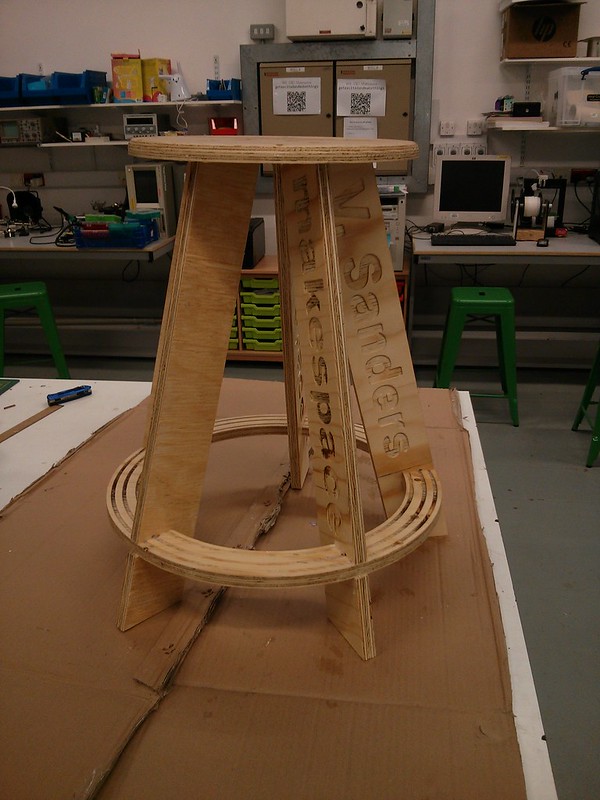
Going back to a previous concept of having five legs instead of three while this did not improve the rotational problems with the 12mm thick material, it did make the design more stable overall and less prone to tipping.
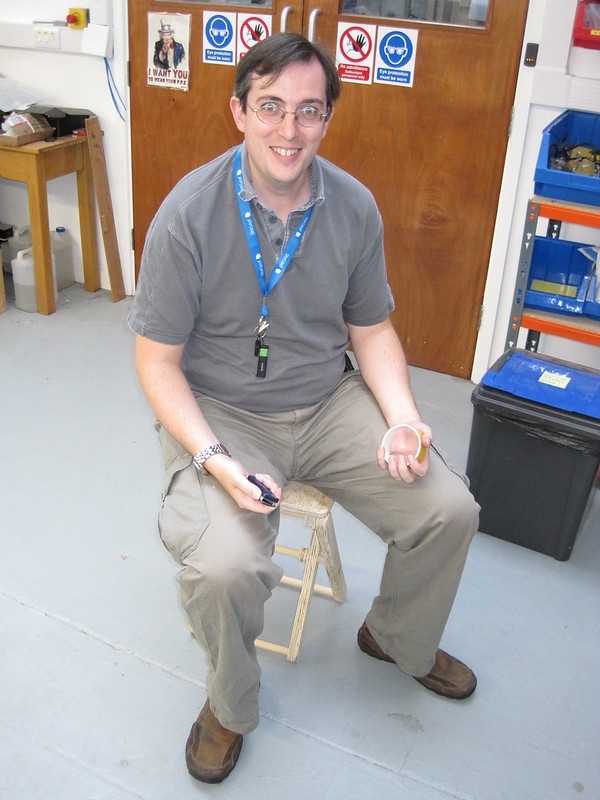
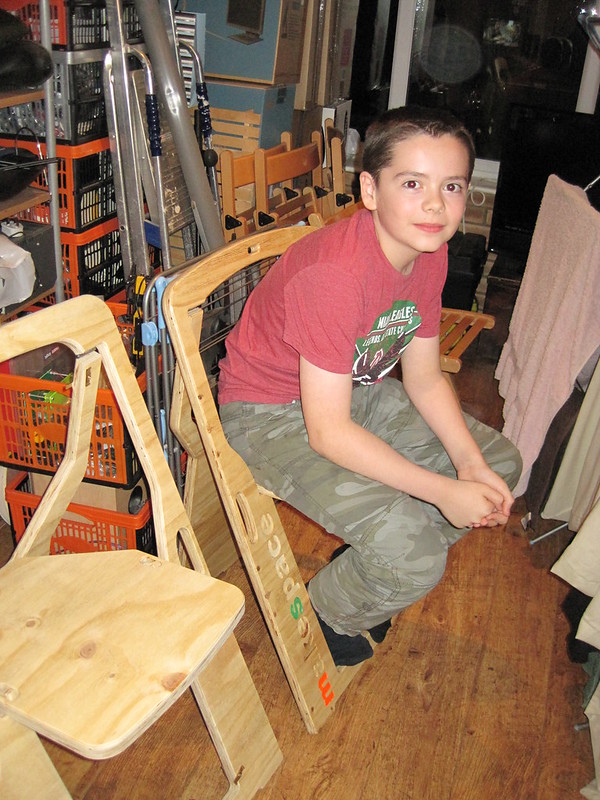
The five legged solution realised in 18mm plywood resulted in my final design for this concept. As my friend Stephen demonstrates the design is pretty solid even for those of us with a more ample frame. There are now a couple of them in use at the space alongside the three legged earlier versions.
I was finally satisfied with the result and thought I was done with furniture making for a while. My adorable wife then came up with a challenge, she wanted a practical foldable chair her requirements were:
Must be robust enough to cope with guests of all sizes
Use as little storage space as possible.
Not ugly.
Inexpensive enough they can be given as gifts.
Things for individual humans to sit on raised off the floor, or chairs as we call them, have been around for a long time. My previous research for the stool indicated that chairs have a long history with examples still surviving from the ancient egyptians. From this I assumed there would be nothing novel in this project and to quote the song it's all been done before
Given this perspective my research started with an image search for "folding chair". The results immediately showed there were two common shapes. Either the chair base was formed with a pair of linked X shapes with the seat across the top, or an A frame style where the seat is across the centre.
My initial thoughts were to replicate the IKEA style A frame design until I noticed that some designs were made from a single sheet of timber with a small number of profile cuts. I searched for pre-existing design files but found none, perhaps I had found something novel to do after all.
Some quick measurements of chairs in shops (and more weird looks, mainly from my family) suggested 900mm is generally the highest a chair ought to stand. I selected a popliteal height of 420mm as a general use compromise which is a bit less than the 430mm of most mass produced chairs. I also decided there should be a front to rear drop across the seat which ought to improve comfort a little.
Material selection was based upon what I had to hand which consisted of a couple of sheets of structural plywood (1220x606x18mm temperate softwood - probably spruce although not specified) which had not become stools yet. Allowing for edge wastage and tool width this gave me a working area from a sheet of 1196x582mm.
I sketched the side view of the chair numbering the three parts. I decided part 1 would be 1000mm total height with top and bottom cross braces 80mm high, assuming the 900mm tall target, the A frame apex would be at 820mm height.
If we assert that the apex is immediately below the top cross brace on part 1 this gives 920mm at which point we have two sides of a right angled triangle (820 and 920) from which we can calculate the top angle is 26 . This also means part 2 will be 840mm long with the same 820 height this gives an angle of 10 .
I did the maths for the seat triangle using the 36 angle and 420mm popliteal height. Having experienced how flexible 18mm plywood was in the face dimension I decided to make the frame sides 50mm wide leaving, after 6mm tool path widths, enough space for a 358mm wide seat .
Once the dimensions were decided the design went pretty quickly producing something that looked similar to the designs I had seen earlier.
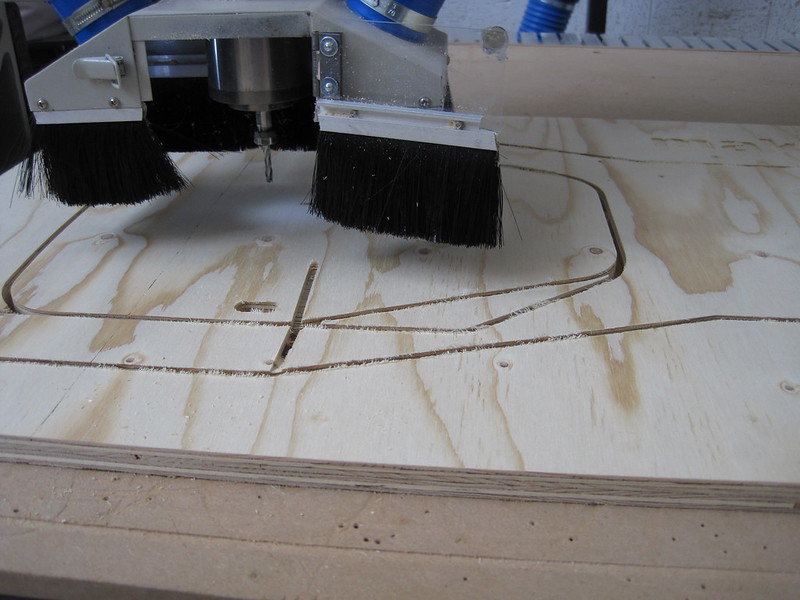
Generating toolpaths for this design proved challenging with the CAM software we had available, mainly because arranging multiple "inner" and "outer" cuts along the same path and having the tabs line up was obviously not an anticipated feature.
Things had been going far too well for me and during the routing operation our machine decided to follow an uncommanded toolpath excursion mid job (it cut a dirty great hole through the middle of my workpiece where I did not want it) ruining the sheet of material.
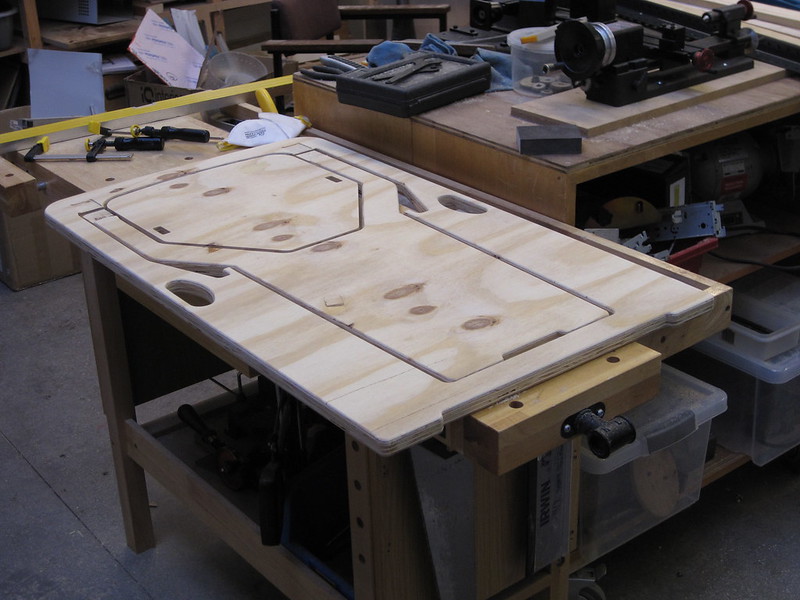
Fortunately, once factory reset and reconfigured, the machine ran the job correctly the second time although we still do not know why it went wrong. The parts were cut free of their tabs and hinges fitted.
The resulting design worked with a couple of problems:
I had made an error in my maths and added when I should have subtracted, as a result the seat slopes back to front which is not very comfortable.
The chair feels very wide and tall.
The front face (part 1) flexes alarmingly between the seat and the ground when subjected to large loads.
So time for a second iteration, this time I selected a thicker plywood to reduce the bend under large loads (OK already, I mean me). After shopping around for several days I discovered that unlike 12mm and 18mm thick plywood 24mm thick is much harder to find at a sensible price especially if you want it cut into 1220x606 sheets from the full 1220x2440.
I eventually physically went to Ridgeons and looked at what they actually had in the warehouse and got a price on a sheet of brazilian elliotis pine structural plywood for 43.96 which they cut for me while I waited. Being physically present also gave me the opportunity to pick a "less bad" sheet from the stack much to the annoyance of the Ridgeons employee for not just taking the top one.
This time I reduced the apex height by 30mm, the length of part 1 by 80mm. I also reduced the frame width by 10mm relying on the increased thickness of the plywood to maintain the strength. In area terms it is actually an increase in material (50mm*17.7mm = 885 against 40mm*22.80 = 912). I also included rebates for the top hinges within the design allowing them to be mounted flush within the sheet width.
The new design was cut (without incident this time) and the edges rounded off. I also added some simple catches to keep the seat and back inline while being transported.
While this version worked I had made a couple of mistakes again. The first was simply a radius versus diameter error on the handles which meant too much material was removed from a high stress area causing increased bending.
The second error was a stupid mistake that where I had worked the latch holes in the seat to the wrong side of my measure line meaning the apex angle was 35.5 not the expected 33.6 which meant the backrest felt "too far forward"
The third version rectified those two errors and improved the seat front curve a little to further reduce the unneeded material in the back rest.
The fabrication of this design was double sided allowing for the seat hinge to be fully rebated and become flush and also adding some text similar to the stools.
This version still suffers from a backrest that is a bit too far forward and my sons complain it makes them sit up too straight. The problem is that the angle of the front face (23.6 ) means that to move the rest back 20mm means the piece needs to extend another 50mm beyond the frame apex which would probably make the chair feel tall again.
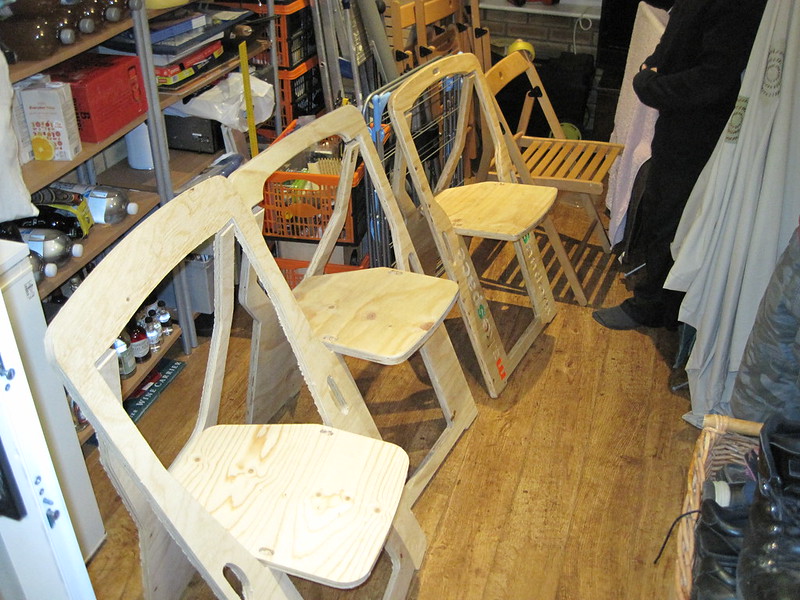
I guess this is a compromise that would take another iteration or two to solve, alas my wife has declared a moratorium on more chairs unless I find somewhere to put the failed prototypes other than her conservatory.
One other addition would be a better form of catch for transport. The ones in version 2 work but are ugly, magnets inset into the frame have been suggested but not actually implemented yet.
In conclusion I think I succeeded with the original brief and am pretty pleased with the result. A neatly folding chair that can be stacked simply by having a pile of them and are easy to move and setup.
The price per chair is a little higher than I would like at 22 ( 11 for timber, 5 for hinges and screws , 5 for varnish and 1 for tool wear) plus about 2 hours labour (two sided routing plus roundover takes ages)
Did you notice that it was gone? It's back now. Phew.
Apparently an upgrade to wheezy was scheduled for the passed week-end. This went badly with the RAID controller acting up after the upgrade. So the move to a new machine (or rather VM) was sped up. And because various policies changed, we needed to move to a dedicated database server with a new authentication scheme, get rid of the /org symlink, get rid of the buildd_* accounts, cope with a new PHP, cope with rlimits that broke a Python CGI (thanks, KiBi!), triggers that weren't tickled, and various other stuff.
Thanks to DSA for handling the underlying infrastructure despite some communication issues during heavy fire fighting.
 Along with the
Rcpp 0.10.5 release yesterday,
a new minor release 0.3.920.1 of
RcppArmadillo
came out. It is based on Conrad's
Armadillo 3.920.0 plus a minor
fix, and uses some of the new
Rcpp features.
Both package is now on CRAN
and also in Debian.
This releases contains both a nice set of new Armadillo features as well as
some nice additions to RcppArmadillo,
due again mostly to Romain. Some of the changes tie into the changes
changes in Rcpp 0.10.5
as for example the ability to pass

 Yesterday, i said a sad goodbye to an old friend at
 She had the run of the building at ABC No Rio, and was friends with all sorts of people. She was known and loved by punks and fine artists, by experimental musicians and bike mechanics, computer geeks and librarians, travelers and homebodies, photographers, screenprinters, anarchists, community organizers, zinesters, activists, performers, and weirdos of all stripes. For years, she received postcards from all over the world, including several from people who had never even met her in person. In her younger days, she was a ferocious mouser, and even as she shrank with age and lost some of her teeth she remained excited about food. She was an inveterate complainer; a pants-shredder; a cat remarkably comfortable with dirt; a welcoming presence to newcomers and a friendly old curmudgeon who never seemed to really hold a grudge even when i had to do horrible things like help her trim her nails. After a long life, she died having said her goodbyes, and surrounded by people who loved her. I couldn't have asked for better, but I miss her fiercely.
 After quite some delay, I got to selecting some photos for my











 On a regular basis, I find myself the odd-man-out when it comes to talking
about how to work with Python on Debian systems. I'm going to write this and
post it so that I might be able to point people at my thoughts without having
to write the same email in response to each thread that pops up.
Turns out I don't fit in with the Debian hardliners (which is to say, the
mindset that



 While I suspect that professional speakers have separate presentation
laptops that they use only to give talks, I don't do this often enough to
justify the hassle and cost of a separate machine. However, I do use a
separate user account to present from.
It allows me to focus on my presentation and not stress out about running
into configuration problems or exposing private information. But mostly, I
think it's about removing anything that could be distracting for the
audience.
The great thing of having a separate user for this is that you can do whatever
you want in your normal account and still know that the other account is ready
to go and configured for presenting on a big screen.
 I love to say that Python is a nice subset of Lisp, and I discover that it's
getting even more true as time passes. Recently, I've stumbled upon the

 There is now a




 Did you notice that it was gone? It's back now. Phew.
Apparently an upgrade to wheezy was scheduled for the passed week-end. This went badly with the RAID controller acting up after the upgrade. So the move to a new machine (or rather VM) was sped up. And because various policies changed, we needed to move to a dedicated database server with a new authentication scheme, get rid of the /org symlink, get rid of the buildd_* accounts, cope with a new PHP, cope with rlimits that broke a Python CGI (thanks, KiBi!), triggers that weren't tickled, and various other stuff.
Thanks to DSA for handling the underlying infrastructure despite some communication issues during heavy fire fighting.


