Search Results: "az"

17 July 2007

Marc 'Zugschlus' Haber: From the personal Inbox of the exim4 maintainer

The DDs reading this might know the situation: You are subscribed to a gazillion of mailing lists, and spend quite some time answering questions of people using your packages. That’s fine, service to your users. Occasionally, users take great pains in finding out a personal mail address (for example, by googling, and finding the webmasteridiot mail address on my personal web page) to ask their question in private e-mail. This prevents the answers from showing up in mail archives and deprives the public of a possibility to find a solution to this question themselves in the future. Today, I had this happen to me twice. In the morning, I received a question about exim4 in private e-mail. In German. I investigated the user’s problem (which looked interesting enough), found two minor issues in the Debian exim4 packages and upstream exim behaving not as expected. I fixed the two issues in the package and reported the unexpected behavior of exim to the upstream mailing list. I then reported this - in German - back to the person who asked the question. Time from incoming message to outgoing report was like 80 minutes, most of which I spent with this user’s issue. On my personal time. A short while afterwards, I found out that this person has waited a mere eleven minutes before asking the same question on pkg-exim4-users, this time in English. Had I known before, I would have drafted my answer in English as well, to have the answer publicly visible. By doing this double post, the user has deprived the public of my answer. I’m probably going to stop answering questions asked in private mail. I might draft a boilerplate answer along the lines of “I don’t answer questions asked in private mail unless I am being paid to do so. You might be better off by asking one of the numerous mailing lists that are available on the Internet. I read a lot of them, might see your question, and you might get an answer from me. But otoh, there are many more knowledgeable people on these lists, and you’d want them to see your question as well.” Or I just might hit Delete on questions in my private inbox. The “Delete” approach has become more attractive this afternoon after I pulled the following (anonymized) from my personal Inbox:
Great job breaking exim4 on my system with no easy way to fix it.
$ /etc/init.d/exim4 start
Starting MTA:DEBCONFsomethingDEBCONF found in exim configuration. This
is most probably
caused by you upgrading to exim4 4.67-3 or later without accepting the
suggested conffile changes. Please read
/usr/share/doc/exim4-config/NEWS.Debian.gz for 4.67-2 and 4.67-4
2007-07-17 11:31:57 Exim configuration error in line 25 of
/var/lib/exim4/config.autogenerated.tmp:
  malformed macro definition
Invalid new configfile /var/lib/exim4/config.autogenerated.tmp, not
installing
/var/lib/exim4/config.autogenerated.tmp to
/var/lib/exim4/config.autogenerated
I’ve been running exim4 v4.63 for awhile now and only have you bugger
exim4-config it doesn’t work.
I mean, this user has Sorry, but: How stupid can people be? I think I’m going to stop being responsive to users. They’re not worth the blood pressure.

Benjamin Mako Hill: Still Seeing Yellow

Seeing Yellow seems to have encouraged hundreds of people to contact their printer manufacturers and complain about tracking dots. Lots of reports (like this one) are popping up on blogs and being sent to me in email. There are reports in upcoming magazines. And as far as I know, nobody has been visited by the US Secret Service yet. I spent half an hour on the phone with HP. I filed a technical support request about the yellow dots and had to speak with the engineer for a while before I was able to convince him that this was definitely not a malfunctioning printer. He checked out seeingyellow.com while on the phone with me and seemed to be genuinely shocked and concerned. He said he would talk to the other technical support people in the color laser group and would write up a report to send up the chain of command. I even had him promise not to turn me into the Secret Service. Please, lets keep the calls coming! We really are making a difference. Another thing people might do is call laser printer manufacturers before they buy a printer and talk to sales representatives. Demand an assurance that the printer they sell you will not surreptitiously print intentionally identifiable information. Explain that you will buy from the first printer manufacturer who can give you such an assurance. So far, no company has. I was thinking about how it was slightly funny that Brother prints tracking dots in their color laser printers. One might say that tracking dots are courtesy of Big Brother, and Big HP, and Big Toshiba, and Big Xerox, and all the other big printer color laser printer manufacturers.

Evan Prodromou: 28 Messidor CCXV

We went camping this weekend near Nominingue, northeast of Mont Tremblant. It was fun -- we met our friends Jeff and Anne-Marie, who'd biked there from Tremblant during the day. Maj and Amita June and I brought tons of food and big tents and stuff in the car. Our drive up was nice; Amita kept saying, "Camping!" every few minutes to emphasize how excited she was about going camping. She's getting much better about longer road trips. She entertains herself, reading books or telling herself stories or looking out the window and thinking out loud. Occasionally we sing songs or color together. The night was rainy, though, and Amita June slept in a dry but loud tent all night. At about 6AM she woke up angry. "Purple house, NOW!", she said, talking about our house in Montreal, with purple trim. "Shhh, Amita!" Maj said. "We're sleeping in the sleeping bag. We're camping!" "NO CAMPING!" said Amita. So the two of them got up and walked down to Lac Nominingue, while I got some rest. Later that morning, all the people in the campgrounds around us were smiling. "No camping! Camping no!" became a pretty popular refrain. Ah, well. At least they had a sense of humour about it. tags:

Inefficient days Long day today. Brian got back from Halifax (Nova Scotia) on Friday, so we once again have a full house. Which is fun, but it makes it hard to work at home. I went out to Caff ArtJava near our house early this morning, but their le Sans Fil? connection was down. So I came home to pick up my bike to ride to La ka, but the back tire had a hole in it. And I didn't have a pump. Gar. So I spent a couple of hours working out that situation, and by that time I needed to go pick up our moving van. Maj found a great teak "wall unit" on Montreal Craigslist, and we need the shelves for our living room. So I got a van to pick up the pieces -- it was far too big to fit in our car. And, since my friend Niko wanted to go to IKEA, I traded him an afternoon with the van for help with my wall unit. He and Maj went off to IKEA as planned, and me at Amita went to the wading pool at Parc La Fontaine. It was a great time, although it's a long walk. I've had a hard time getting Amita onto the back of my bike -- she got pinched once when we were putting on her helmet, and since then she's wanted nothing to do with helmets, bikes, or nothing. If I force her helmet on and stick her in the seat, she loves it, but it's hard to trick her into it. She screams bloody murder when I try to put the helmet on her. But the pool was fun -- we chased each other up and down through the water. She fell asleep during the walk home, and I managed to get a little work done this afternoon. But Maj and Niko got back around 5:30, and Niko had a comedy show at 7PM and couldn't help me out -- the welcher! So I got Brian to come instead. The furniture was heavy -- really heavy. Teak is a heavy dang wood. Getting it out of the guy's house was really hard, and getting it up to our second-floor living room was Sisyphean. I'm amazed we didn't break any limbs. But at the end of it all, we had a great-looking new living room, and Maj had made a delicious gazpacho with polenta on the side. Yum! Hopefully the rest of the week is going to be more productive that today. Niko and I launch a new site at next week's DemoCampMontreal3 (as he so lugubriously pointed out in this blog post). And another group of partners will be launching kei.ki during Wikimania 2007, which is coming up soon. On top of that, we leave on Thursday for my brother's "commitment ceremony" in San Francisco, announced about 2 weeks in advance. We were lucky we had lots of miles so we could make the trip, but it still really cuts down on our Montreal summer experience. tags:

Joey Hess: on storing Debian packages in subversion

(Or the unfortunate story of why I am not yet participating in the Debian games or perl teams.) I'm a big fan of both the Debian games and perl teams. The games team keeps finding new and interesting games and flowing them into Debian. The perl team is responsible for a rather amazing quantity of perl modules. Since I maintain both some games and some perl modules, I've looked at participating in both teams from time to time. I think it's odd that the reason I haven't been able to do so in both cases comes down to something as basic as how they use their subversion repositories.
In the case of the perl team, they have a fairly standard use of subversion, as explained in their guide. The problem is repository layout. They chose to use the "package/ trunk,tags,branches " layout rather than the " trunk,tags,branches /package" layout. This means that it's not easy to check out the source for every package in the repo all at once. Having all the sources checked out is a prerequisite for many kinds of work that span all packages. In my work on the d-i packages, which are in a repository using the latter structure, I often grep all the packages for a problem, and fix the problem in every package. To manage this with the debian-perl repo, I'd either have to check out the whole thing, with who knows how many gigabytes of tags, or I'd have to construct and maintain an svn:externals list that checked out the trunk of every package. (Open offer to the perl team: I'd be happy to reorganise your repo for you.)
The games team uses the " trunk,tags,branches /package" repo layout, which is nice. But they have a policy of not keeping all upstream files in subversion at all. They prefer to only keep files that are patched in subversion, to save space. That looks on the surface to be a nice space optimisation, especially for space-hungry game data, but from what I tell, what it saves in space, it loses in complexity and maintainer time. And my time is much more valuable than alioth's disk space. It's also very debatable how much space this saves at all for games. I keep uqm and all its data files in one subversion repo. I have 4 years of history of all of upstream's changes to the files in there, and it takes 165 mb of data. Which sounds like a lot, but the files in trunk alone take 170 mb to check out (not counting .svn directories)! And the games team is also storing upstream tarballs in a directory on alioth. One tarball per release, often multiple releases per game, 2.0 gb of tarballs in all. Would it really use much more space in svn? Even if it used 10x the space somehow, is 20 gb even worth worrying about? I think not. (Open offer to the games team: I'd happily do the grunt work of checking in upstream sources for all the games in your repo.) (Update: I realized after posting this that while the space gains on alioth might be illusory, there is certianly a space gain for people checking the whole repo out. What's really needed is a way to keep all the upstream sources in svn, but check them out only when wanted, and check out all the debian directories for cross-game work. Hmm..)
I also checked out one other big package repo, collab-maint. The policy for collab-maint's repo uses the same structure as the perl team's repo. However, I doubt I'd ever want to check out all of collab-maint or do group maintenance across it, so that's not a big deal. The documentation also recommends not storing upstream sources in svn, although I've found a lot of packages in the repo that do. I could probably dump in ~100 mb of subversion history for 50-odd packages without anyone caring ... right?
It's interesting that all three of these big subversion repos have their own custom policies for how to use their repo. Having different policies for each repo results in more complexity and a higher learning curve. I wager that 99% of all the packages in these repos are pretty stock in their packaging and can be pretty easily understood and worked with by most Debian maintainers. We've have de-facto standards and policies that they all use. Until you get down to the repos, which, despite using subversion each seem to need to go their own way for some reason.

16 July 2007

Zak B. Elep: First Day Morphs

I seriously lack originality on that title above. Nevertheless, that gives some clues on what I’m up to: I rode my first airplane flight ever to Cebu with Jerome last Sunday to meet up with the rest of the pioneering team of Winston’s new startup, Morph Labs. Since it was a Sunday, there wasn’t much talk about work, but we did get to play with some of the new stuff we will be using, like Macbooks, iPhones, Airports, and a Mac Mini. Hint-hint indeed :P Thus began the first day, on a Monday. We got up to speed (from a 3-to-7 AM hibernate,) configuring the rest of the Macbooks, getting the HSDPA modems to work, laying out an ad-hoc WiFi net for the moment, and starting to plan out the directions the company will take. So far, so good. More to come, on Second Life Morphs. (I seriously need to express myself better.)

Uwe Hermann: Flashing a BIOS the Linux Way (tm) using flashrom

There are a gazillion HOWTOs out there for flashing a BIOS image without having to resort to ugly "boot DOS from floppy" or "run Windows *.exe file from BIOS vendor" and other ugly stuff. Unfortunately, the proposed solutions are equally ugly (e.g. creating custom CD-ROMs which contain the "floppy" with DOS/Windows flash tools). Folks, this is so much simpler than you think: The flashrom tool (GPL'd, written for LinuxBIOS purposes, but works perfectly fine with proprietary BIOSes, too) will easily do what you want, on a running Linux system. No floppy crap, no CD-ROM crap, no DOS/Windows crap, no rebooting crap. Install it:
$ apt-get install flashrom
Detect whether flashrom knows about your chipset/mainboard/BIOS chip:
$ flashrom
Read the BIOS image into a file:
$ flashrom -r backup.bin
Write a BIOS image (proprietary or LinuxBIOS) on the ROM chip:
$ flashrom -wv newbios.bin
WARNING: This will overwrite your current BIOS! Make sure you know what you're doing! For the Debian-challenged, flashrom is available in source form too, of course:
$ svn co svn://linuxbios.org/repos/trunk/util/flashrom
$ cd flashrom
$ make
The list of supported chipsets, mainboards, and ROM chips is limited of course, but it's constantly expanding. Contact us on the LinuxBIOS mailing list if you want other hardware supported (or even better: if you have patches!). In many cases adding support for new hardware is pretty easy...

Joey Hess: game week

I've been playing some computer games this week, which I don't often do. I finally tried a modern version of this Wesnoth game that everyone in Debian was playing a while ago, and have been enjoying working through the stories in it. I played glest for a few hours, and really enjoyed the 3d graphics, especially when it rained. I'm no good at real time strategy games though, and ordering units around contantly becomes wearisome. Globulation 2 might partially manage to avoid that problem, I'll have to try it a bit more sometime. Transcend is an amazing thing. After finishing a level, I found myself avoiding going on to the next level for a long time so I could spend time messing around with the thing I constructed while playing the game -- and wished there was a way to save my creation. The graphics are reminiscent of kalidoscopes and flowers. It subverts tradition, it has the trappings of a spacewar descendent, but instead of Star Control, the game turns out to be about music growing. Like tetris, it's abstract enough that I can zone out while playing it and get into a different mental state; and I can even pick which kind by making different kinds of music as I play. Wow, wow, wow.

15 July 2007

Julien Danjou: rebuildd 2.0 features

Ahaha, no sorry, no 2.0 features for rebuildd yet. I'm a bit lazy about implementing the Web interface, The problem is that everything is quite ready for it as you can see on demo server, but I can't convince myself to do HTML. I'm bad and even using mako templates and looking on different Python Web frameworks can't help me. I can't bear doing HTML pages, I don't know how to do clean things with CSS. And I don't want to learn. A friend pointed me to Paste which should do a lot of things for me, but I'm too lazy to try to read this. Actually, everything on the job-management side is quite ok. I'm just lacking of a Web interface to have a nicer overview of what's going on. Anyway, I still like to do useless coding on client eye candy: rebuildd-job stats By the way, any help would be welcome.

Stefano Zacchiroli: python debfile

DebFile: Python Library for Inspecting .deb A couple of days ago Mike Hommey blogged about "coincidences" in free software development: more than one developers are likely to have the same crazy ideas. It happened to me and Filippo last Friday. While writing the script for maintaining the OCaml status page I faced, unsuccessfully, the need of a library for extracting meta-information and actual content out of .debs of incoming. While I was getting sad for the lack of such a (Python) library Filippo contacted me on Jabber stating something like you know what? ... a cool addition for python-debian would be a library for querying .deb files ... A few days later we have something working and fitting our (disjoint) needs (it's a branch of the python-debian package which includes two brand new modules: arfile.py and debfile.py):
$ bzr branch http://people.debian.org/~zack/bzr/pkg-python-debian/

Here are some examples to wet your appetite: It is already a proposed addition to python-debian, feel free to comment about the API ... before it's too late :)

Eric Dorland: git'ing it on

A hot topic this past DebConf7 was git. I've bought into the hype, so I decided to take the plunge and move my Subversion repositories to it. A lot of people seem to be willing to part with their history when making the move, but I'm some what irrationally attached to it.

Most of my Debian packages are in one big SVN repo, which used to be one big CVS repo (I used cvs2svn to move). So I decided to pull apart each source package into its own git repository. I started with git svn clone like so:

$ git svn clone -A authors --trunk=trunk/libclass-makemethods-perl \
  --branches=branches/libclass-makemethods-perl/upstream \
  --tags=tags/libclass-makemethods-perl --no-metadata \
  file:///home/svn/debian libclass-makemethods-perl


And this gives a git repo that can track an SVN repo. But I want to go all the way, no turning back. So I made a little script to clean up this repo called clean-git-svn:

#!/bin/sh -e
tags= git branch -r   egrep 'tags/[^@]+$' 
echo "$tags"   perl -ne \
  'chomp($_); my $head = $_; s,\s+tags,debian,g; print "git tag $_ $head^\n"'
for i in $tags ; do echo "git branch -r -d $i"; done
upstream_tags= git branch -r   egrep ' +[0-9][^@]+$' 
echo "$upstream_tags"   perl -ne \
  'chomp($_); s,\s+,,g; print "git tag upstream/$_ $_^\n"'
for i in $upstream_tags ; do echo "git branch -r -d $i"; done
echo "git branch upstream current"
echo "git branch -r -d current"
echo "git branch -r -d trunk"


This will output a bunch of git commands that will make this a more "gitified" repo. I make no guarantees this will work, you should probably hand check your history with gitk to make sure this won't screw anything up. If your the part you're converting also came up from CVS, you'll probably have a bit of a mess on your hands that will need more manual cleanup. gitk is really an amazing visualization tool and can help a lot here. Once you're satisfied just pipe it into /bin/sh. Since git svn mostly can't track where you merged in your SVN repo, make sure you merge the upstream branch into master as soon as you can. It will save you a lot of conflicts later, trust me.

One thing I miss from svn is svn export. Does an equivalent command exist in git? You would think there would be an option you could pass to git clone to do this but I can't seem to find anything.

14 July 2007

Robert Collins: 14 Jul 2007

So we're here in sunny Vilnius sprinting on bzr. I thought I'd write up some of what we've achieved. On Thursday Wouter got most of the nested-trees branch merged up with bzr.dev, but about 500 tests failing ;). Jelmer has introduced a new parameter to the sprout api call on BzrDir called 'limit_to_revisions' which if supplied is a set of revisions which forms a strict limit on the amount of data to be fetched. This is intended to be the API by which the desire for limiting history - to achieve shallow branches/history horizons - is communicated at the 'bzr branch' or 'bzr checkout' stage. This API is tested so everything passes, but nothing chooses to implement it yet. I was hacking on commit (somewhat indirectly) by working on the repository-wide indexing logic we will require if we wish to move to a more free-form database with semi-arbitrary keys mapping to opaque data (at the lowest level). I got a core GraphIndex up at this point. Once complete this should drop the amount of I/O we perform during commit by half. There was some other hacking going on too - Tim Hatch did some tweaks to bzr-hg, Jelmer some bzr-svn, and so on. On Friday we carried on on the same basic targets: Wouter fixed the 500+ failing tests so now its only in the 5-10 range, and has been debugging them one by one since. Jelmer implemented the limit_to_revisions parameter all the way down to the knit level, for non-delta compressed knits (e.g. revisions.knit), which made knit1 repositories support the parameter and got the 'supports' branches of the interface tests being executed. I developed CombinedGraphIndex, and have sent the low level Index stuff up for review, and followed that up by implementing a KnitIndex implementation that layers on the GraphIndex API to allow the use of .knit files without .kndx. This new index API allows us to switch out the indexing code and format much more easily than previously - the knit index logic is decoupled from the generic indexing facilities. It also allows us to record arbitrary-parent compression chains. Finally Jelmer implemented the wishlist item for bzr-gtk of a notification area widget that can be used to enable bzr-avahi watching, and share commits with the local LAN/get notified of commits on the local LAN. Today is the last day of the sprint, and I hope that we'll get the nested tree branch passing all tests, the limit_to_revisions parameter causing delta-compressed knits to only copy data outside the listed parameters to the first full text, and have an experimental repository format that uses the new index layer for at least a couple of its knits (e.g. revisions and inventory, or revisions and signatures).

Gunnar Wolf: On collaborative maintenance

Following Zack's and Lucas' posts regarding group maintenance of packages: Do I have to AOL with you guys? Yes, I also agree with Zack's both 1 and 2. And I also want to share the bit of experience we have got in this regard in the pkg-perl group. In our case, group maintainership has often saved our collective butts. We have also debated somewhat which way should our packages' maintainership be handled. In the end, our packages' maintainer will (most usually) be the pkg-perl group itself, subscribed through an alias that reaches all of us. Then, every group member that feels identified with the package lists himself as an uploader (note that this does not necessarily have a relation with the last uploads, at least not as strongly as in what the KDE and Gnome groups do, according to Lucas' post - it's closer to the pkg-ruby-extras handling). Of course, there are some packages which I have NMUed in the group's pool - packages I prefer not to have listed in my maintainer page, as I don't usually care too much about them, but I happened to be able to fix a bug with them.
Now, what about the roles of the different group members? Each of us has some skills that make him better for part of the task - i.e., we have an amazingly knowledgeable member, Niko Tyni. He just fixes all the bugs that baffle us. Honest, my best kudos to Niko, he is a good part of our team's success. And then, we have hard-working people as Gregor Hermann, who not only fixes also nice amounts of bugs, but also writes and runs general QA tests throughout our over 300 modules. Neither of them is a DD yet. And of course, many other hard-working folks. Some of us are DDs and try to upload promptly - and, of course, also try fixing bugs. So far, we are in good shape, and we tend not to lag too much. I have taken some vacation periods (both announced and unannounced - sorry :) ), but to my surprise and amazement, my packages tend not to be buggy - Why? Because there is a real team looking after them, and in the end, we keep an eye on each other.
For the pkg-perl group, group maintenance has really worked. We collectively maintain more packages than it would be reasonable for all of us added together as individuals, and they are in a better shape. There are several things we can make better, and we do try to address them - it is not yet heaven, but... :) I'll elaborate later, when I finish a text I'm preparing for presenting at YAPC (it's not that long, of course - During Debconf, I showed advances of it to several people... I just have left it aside). Right now... Well, I have 3hr of sleep left before we leave for a daytrip to the beautiful (but hot and humid!) Veracruz Huasteca. See you on Sunday/Monday!

13 July 2007

Christian Perrier: Re-launching the DDTP effort for French

The Debian Description Translation Project is a very old project which had many adventures in the past. Indeed, working on packages descriptions translations has been my very first work in Debian l10n back in....long ago. Unfortunately, because of the servers compromise and also because of the lack of support for translated descriptions in the archive and package tools such as APT, the project slowly lost interest from translators. The revival may be dated back in 2005 when Michael Bramer revived the project and even more in 2006 when experimental support was added in APT as well as some support in the archive. While the framework is still quite crude (no offense intended for grisu who did a great job maintaining it) and not very opened to collaborative work and peer review, a few teams did a great job translating the zillions of package descriptions. And we still expect to use Pootle soon. So, as we now have a big enough handicap, it's time for the French team to beat them all in the friendly competitions we all enjoy..:-). For that reason, I began to translate dozens of packages descriptions last week and a few other French translators joined me. I somewhat expect us to slowly put all of our (wo)manpower in this and, therefore, translate as many packages descriptions as possible. The count begins with 1896 active translations, French being ranked 5th after German, Japanese, Czech and Brazilian Portuguese, even with Korean. So, the next target is the Brazilian team. Watch out your back, fellows..:-)

Eddy Petrișor: glest: a free 3D real time strategy game

After almost a year of working on and off on the package, glest is now in the new queue.

Glest is really a free 3D real time strategy game with amazing graphics and really interesting game play.

So maybe you're wondering why did it took me so long to package it. Well, glest is mainly developed on a Windows platform and GNU/Linux is the platform it was later ported to. So this came with some problems:
Since when I started the packaging work I was using a PowerBook G4 as my main machine I was upset that the game was little endian only, so I started working on a patch. I made an incomplete patch but I got stuck at some point. Time passed by and I replaced my laptop and I wasn't able to continue working on the patch. So I kind of forgot about it. Before debconf I decided is time to do the upload for little endian machines, add the endianess patch disabled.

During debconf I asked Tolimar to make an upload, and it turns out that for some reason I still don't know, the build resulted in a statically linked binary. I was amazed since I didn't recall doing any changes that might have triggered this. At some point I suspected that the build system is broken on other arches than i386 (my main machine is amd64) and halted. This until a few days ago Joey Hess added a comment in the ITP bug pointing out that the game is ok. After a couple of emails I realized that the static issue was just some strange temporary issue on my machine and now the package is in NEW.

So, that's my excuse. I hope that upstream glest issue get fixed. If not, I'll probably package glevolution, too.

12 July 2007

Christian Perrier: Lazyweb mutt

Dear Lazyweb, Can you explain me why, since the last update of mutt in unstable, I no longer have the display of percentages of the mailbox's number of message being read while Mutt is reading a mailbox when I open it? This is kinda annoying on large mailboxes as mutt now just display the number of examined message headers while one has no way to know how long it will need to read the entirre mailbox. That's probably a weird new setting, but which one? I don't feel like reporting a bug about this but this is a minor annoying regression, indeed..:-)

11 July 2007

Mike Hommey: One great thing about free software developers

… is that more than one are likely to have the same crazy ideas. A while ago, when I was fooling around with VMware ESX and wrote diskimgfs (which I hope to be able to release some day), I found another implementation of the same root idea (without partition level access, though) in dm-userspace. A few months ago, Sam posted his code for a SSH/HTTPS port sharing program, idea of which had been on my mind since a few weeks earlier. And now that I’m playing around with git, I was thinking about having a FUSE filesystem to access a git repository. Guess what, it already exists. And it actually happens quite often. This is also one of the reasons there are so many implementations of the same things (another being the NIH syndrome).

Michael Prokop: VirtualBox + USB

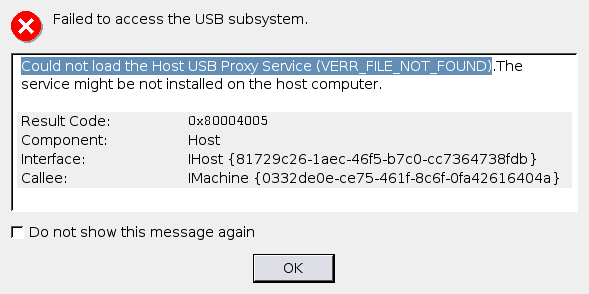
Running hot off the press 2.6.22-grml I took a look at the current version of VirtualBox. And I’m really amazed how responsive it is. Not only booting grml is rocking fast but also typing on the console is reaaaally fast - much more responsive than with VMware. (I took a look at VirtualBox several months ago already but the 64bit version did not work and I lost interest in it temporarly therefore.) Though I stumbled upon a small problem, that’s why I’m feeding google (several users don’t seem to manage the problem ;-)): Virtualbox - USB error message - screenshot of Could not load the Host USB Proxy Service (VERR_FILE_NOT_FOUND). The service might be not installed on the host computer. Result Code: 0x80004005 That’s telling you that USB might not work as expected. ;-) When straceing the process you’ll notice that VirtualBox tries to access /proc/bus/usb/devices. Nowadays /proc/bus/usb is deprecated by libusb + /dev/bus/usb but of course it’s no problem to use /proc/bus/usb anyway. So until upstream of VirtualBox moves to libusb the workaround is as simple as:
# VBOX=$(grep vboxusers /etc/group   sed 's/vboxusers:x:\(.*\):.*/\1/')
# mount -t usbfs -o devgid=$VBOX,devmode=664,nodev,noexec,nosuid none /proc/bus/usb

Jeff Bailey: How many O's?


img_8498.jpg
Originally uploaded by jbailey
Well, I've hinted at it and told enough friends, I should get around to posting it: As of the end of this month, I'll be moving on from Canonical. By my calculations, I was something around employee #30, the first support tech, and I've had a great chance to build the support organisation up to where Linux Format magazine rated us as tied with RedHat ahead of Novell in this August's issue.

So what's up?

Well, those of you following along might remember a cute little bundle of joy entering my life. A couple of months in, I've realised that I can't stay on top of being with him and growing a 7x24 operation at this critical time in Canonical's growth. I'll be taking the month of August to be with Angie and Leif, and in September will start a new job with Google in the Open Source Program Office. I don't know the details of what I'll be doing there (The Google Omert , as one friend called it... *g*), but Google as a company is well aware of what happens with brand-new parents and the mad readjustment of priorities.

Angie and I are currently selling our place in Montr al in prep for moving to San Francisco at the end of August. I want to make sure I see people before we go, and if you're interested in buying the place, give us a call. =) Also, if you're in the Bay Area, a vegan, a parent, into Yoga/fitness, speaking French, etc., we'd love to meet you for tea sometime!

10 July 2007

Zak B. Elep: Getting back to the Action

I’ve been away from blogging. I’ve been away from doing Debian and Ubuntu work (although there has been a few package updates, as well as a new one.) I’ve been away from a lot of happenings (like how the excellent Knightlust got to convince my fellow townsfolk at Lourdes College Foundation to use FOSS,) but that’s fine, since I know there will be others who can keep up the flame burning. I’ve been away because I’ve been looking at stuff. Lots of stuff. Various stuff. Stuff like Plan 9 from Bell Labs, and Inferno, and dabbling into distributed computing, working on an implementation of Plan 9’s file protocol. Stuff like thinking about programming, meditating upon it as an art, exercising a discipline of simplicity, clarity and frugality. All that stuff. I first looked at Plan 9 last March, when I was wanting to go another round at the Google Summer of Code. While I was not selected, just getting Plan 9 to run on my machines (first as a qemu terminal, then as standalone CPU server replacing my old Ubuntu dapper install on my desktop) exposed me to that other side,’ and that got me thinking about how software ought to be good. Of course, I could have just chosen to drop it all (after all, I wasn’t selected, so…) but I knew that if I stick long enough, I might just learn something. And yes, I am learning something. Like how a lot of software isn’t really simple, just appearing to be. Or how sophisticated software development methodologies rob the clear picture gained from a well-thought, clear, and simple analysis of problems. Or when push comes to shove, I will have to make a choice, between tolerating software complexity and status quo, or facing it and attempt to simplify it. Well, there’s much to tell, but I’m lazy, and I’d rather tell stories in bits. Anyway, I think I’ll have some time to spare, especially as I have accepted a new job at an up-and-coming company that, I hope and endeavor, will rock the local and international tech scene. And, while doing that, get around to make great tools to get my job done, and other people’s jobs too. I’m getting back to the action.

Nacho Barrientos Arias: Discovering new bands

Paying tribute to the girl who pointed me out to this fantastic indie band, I’d recommend listen to Move on Now, crafted by Hard-Fi. Sweet taste, deep melody. P.S.) Martin, Gazpacho sounds nice ;)

Next.

Previous.