Search Results: "pm"

17 July 2008

Russell Coker: Pollution and Servers

There is a lot of interest in making organisations “green” nowadays. One issue is how to make the IT industry green. People are talking about buying “offsets” for CO2 production, but the concern is that some of the offset schemes are fraudulent. Of course the best thing to do is to minimise the use of dirty power as much as possible. Of course the first thing to do is to pay for “green power” (if available) and if possible install solar PV systems on building roofs. While the roof space of a modern server room would only supply a small amount of the electricity needed (maybe less than needed to power the cooling) every little bit helps. The roof space of an office building can supply a significant portion of the electricity needs, two years ago Google started work on instralling Solar PV panels on the roof of the “Googleplex” [1] with the aim of supplying 30% of the building’s power needs. For desktop machines a significant amount of power can be saved if they are turned off overnight. For typical office work the desktop machines should be idle most of the time, so if the machine is turned off outside business hours then it will use something close to 45/168 of the power that it might otherwise use. Of course this requires that the OS support hibernation (which isn’t supported well enough in Linux for me to want to use it) or that applications can be easily stopped and restarted so that the system can be booted every morning. One particular corner case is that instant-messaging systems need to be server based with an architecture that supports storing messages on the server (as Jabber does [2]) rather than requiring that users stay connected (as IRC does). Of course there are a variety of programs to proxy the IRC protocol and using screen on a server to maintain a persistent IRC presence is popular among technical users (for a while I used that at a client site so that I could hibernate the PowerMac I had on my desktop when I left the office). It seems that most recent machines have BIOS support for booting at a pre-set time. This would allow the sys-admin to configure the desktop machines to boot at 8:00AM on every day that the office is open. That way most employees will arrive at work to find that their computer is already booted up and waiting for them. We have to keep in mind the fact that when comparing the minimum pay (about $13 per hour in Australia) with the typical electricity costs ($0.14 per KWh - which means that a desktop computer might use $0.14 of electricity per day) there is no chance of saving money if employee time is wasted. While companies are prepared to lose some money in the process of going green, they want to minimise that loss as much as possible. The LessWatts.org project dedicated to saving energy on Linux systems reports that Gigabit Ethernet uses about 2W more power than 100baseT on the same adapter [3]. It seems most likely that similar savings can be achieved from other operating systems and also from other network hardware. So I expect that using 100baseT speed would not only save about 2W at the desktop end, but it would also save about 2W at the switch in the server-room and maybe 1W in cooling as well. If you have a 1RU switch with 24 Gig-E ports then that could save 48W if the entire switch ran at 100baseT speed, compared to a modern 1RU server which might take a minimum of 200W that isn’t very significant. The choice of server is going to be quite critical to power use, it seems that all vendors are producing machines that consume less power (if only so that they can get more servers installed without adding more air-conditioning), so some effort in assessing power use before purchase could produce some good savings. When it comes time to decommission old servers it is a good idea to measure the power use and decommission the most power hungry ones first whenever convenient. I am not running any P4 systems 24*7 but have a bunch of P3 systems running as servers, this saves me about 40W per machine. It’s usually the case that the idle power is a significant portion of the maximum power use. In the small amount of testing I’ve done I’ve never been able to find a case where idle power was less than 50% of the maximum power - of course if I spun-down a large number of disks when idling this might not be the case. So if you can use one virtual server that’s mostly busy instead of a number of mostly idle servers then you can save significant amounts of power. Before I started using Xen I had quite a number of test and development machines and often left some running idle for weeks (if I was interrupted in the middle of a debugging session it might take some time to get back to it). Now if one of my Xen DomU’s doesn’t get used for a few weeks it uses little electricity that wouldn’t otherwise be used. It is also possible to suspend Xen DomU’s to disk when they are not being used, but I haven’t tried going that far. Xen has a reputation for preventing the use of power saving features in hardware. For a workstation this may be a problem, but for a server that is actually getting used most of the time it should not be an issue. KVM development is apparently making good progress, and KVM does not suffer from any such problems. Of course the down-side to KVM is that it requires an AMD64 (or Intel clone) system with hardware virtualisation, and such systems often aren’t the most energy efficient. A P3 system running Xen will use significantly less power than a Pentium-D running KVM - server consolidation on a P3 server really saves power! I am unsure of the energy benefits of thin-client computing. I suspect that thin clients can save some energy as the clients take ~30W instead of ~100W so even if a server for a dozen users takes 400W there will still be a net benefit. One of my clients does a lot of thin-client work so I’ll have to measure the electricity use of their systems. Disks take a significant amount of power. For a desktop system they can be hibernated at times (an office machine can be configured such that the disks can spin-down during a lunch break). This can save 7W per disk (the exact amount depends on the type of disk and the efficiency of the PSU - (see the Compaq SFF P3 results and the HP/Compaq Celeron 2.4GHz on my computer power use page [4]). Network booting of diskless workstations could save 7W for the disk (and also reduce the noise which makes the users happy) but would drive the need for Gigabit Ethernet which then wastes 4W per machine (2W at each end of the Ethernet cable). Recently I’ve been reading about the NetApp devices [5]. By all accounts the advanced features of the NetApp devices (which includes their algorithms for the use of NVRAM as write-back cache and the filesystem journaling which allows most writes to be full stripes of the RAID) allow them to deliver performance that is significantly greater than a basic RAID array with a typical filesystem. It seems to me that there is the possibility of using a small number of disks in a NetApp device to replace a larger number of disks that are directly connected to hosts. Therefore use of NetApp devices could save electricity. Tele-commuting has the potential to save significant amounts of energy in employee travel. A good instant-messaging system such as Jabber could assist tele-commuters (it seems that a Jabber server is required for saving energy in a modern corporate environment). Have I missed any ways that sys-admins can be involved in saving energy use in a corporation? Update: Albert pointed out that SSD (Solid State Disks) can save some power. They also reduce the noise of the machine both by removing one moving part and by reducing heat (and therefore operation of the cooling fan). They are smaller than hard disks, but are large enough for an OS to boot from (some companies deliberately only use a small portion of the hard drives in desktop machines to save space on backup tapes). It’s strange that I forgot to mention this as I’m about to buy a laptop with SSD.

16 July 2008

Russell Coker: Xen and EeePC

I’ve been considering the possibility of using Xen on an ASUS EeePC as a mobile test platform for an Internet service. While the real service uses some heavy hardware it seems that a small laptop could simulate it when running with a small data set (only a few dozen accounts) and everything tuned for small amounts of RAM (small buffers for database servers etc). According to the wikipedia page about the EeePC [1] the 70x and 900 versions of the EeePC use a Celeron-M CPU. According to Wikipedia that is based on the Pentium-M (which lacks PAE support and therefore can’t run Xen). The Fedora Tutorial about the EeePC has a copy of the /proc/cpuinfo data from an EeePC [2] which shows that the model in question (which is not specified) lacks PAE. Are there any 70x or 90x variants that have PAE? Intel sometimes dramatically varies the features within a range of CPUs… The 901 version and the 1000 series use an Intel “Atom” CPU. According to discussion on the Gentoo Forums some Atom CPUs have the “lm” flag (64bit) but no “vmx” flag for virtualisation [3] (which means that they can run Xen paravirtualised but no KVM or hardware virtualisation for Xen), it also has PAE. This is more than adequate. According to the Wikipedia page the Atom comes in both 32bit and 64bit variants [4]. Hopefully the 901 version and the 1000 series EeePC will have the 64bit version. The 90x versions have support for up to 4G of RAM but the 1000 series is only listed as supporting 2G, hopefully that will be 4G or more (although I wouldn’t be surprised if Intel had a chipset supporting only 4G of address space and PCI reservations limiting the machine to 3G). But even 3G will be enough for a mobile test/development platform which should make it easier to debug some problems remotely. The 901 is available in Australia for just under $700. It’s a little more expensive than previous EeePC variants ($500 is a magic number below which things can be purchased with significantly less consideration), but it still might be something that one of my clients will pay for. The prime aim is to be a mobile sys-admin platform that can be carried anywhere, running a Xen simulation of the target network is an added bonus. Any suggestions for other laptops that should be considered will be welcome. It needs to be light (1.14Kg for a 901 EeePC is more than I desire), small (a reduced display size is not a problem), and not overly expensive ($700 is more than desired). Update: JB HiFi is selling the 1000H model [5]. The 1000H has an 80G hard disk and weighs 1.45Kg. The extra 210g and slightly larger size are a down-side, as is the extra ~$50 in price. A comment was made that OpenVZ could be used. If that avoids the need for PAE then a 702 series would do the job (with some USB flash devices as extras). The 702 is a mere 920g. Update: This ZDNET review shows that the 901 can only handle 2G of RAM and has an Atom CPU that is only 32bit [6].

11 July 2008

Adam Jensen: 11 Jul 2008

Yesterday, 10 July, was the due date for the second milestone of my work on DebGraph. I am happy to report that we are roughly two weeks ahead of schedule, so meeting this milestone was not a cause for worry. We now have support for the following graph operators: The next milestone includes the development of a high-level language (or integration with an existing extension language) that streamlines the construction of complex queries using the operators listed above. We can build arbitrarily complex queries using the C++ operators, but dealing with the static typing and compiler toolchain can be very clunky. As such, I have spent the past week working on Lua bindings for DebGraph, which will enable us to query the graph of Debian packages from a clean, dynamically typed language. Lua has a powerful C API that exposes the Lua stack and lets us move DebGraph information to and from the Lua interpreter. I'm writing documentation that outlines how to use DebGraph from both C++ and Lua in order to make this work accessible to more folks. Sneak peak
As an example, we can utilize the FindCycles operator in Lua as follows:
libdg = package.loadlib("./libdebgraph.so",
"luaopen_libdebgraph")
libdg()
LoadPackages('cache')
-- 'g' is the main graph of unstable binary-arm packages
cycles = FindCycles(g)
print("Found " .. #fc .. " cycles")
for comp_key,comp in pairs(cycles) do
    comp_nodes = ""
    for node_key,node in pairs(comp) do
        prop = GetProperty(node, "Package")
        comp_nodes = comp_nodes .. prop .. " "
    end
    print("* " .. comp_nodes)
end
The above Lua script produces the following result:
reading cache/unstable/main/binary-arm/Packages
Found 61 cycles
* debconf-english debconf-i18n debconf
* perl-modules perl 
* cdebconf fontconfig-config fontconfig gsfonts-x11
libcairo2 libfontconfig1 libgtk2.0-0 libpango1.0-0
libpango1.0-common libxft2 ucf x11-utils xutils
[...]
These are the package names in the strongly connected components, shown in alphabetical order. There is still a lot of work to do before the Lua binding will achieve feature parity with the core library, but we have now laid the foundation (and a brick or two).

10 July 2008

Cyril Brulebois: SysRq trick

While building and testing LiveCDs, QEMU and VirtualBox can speed up development cycles until a bug is encountered: apt-get update hanging on a rename operation. Maybe aufs is at fault? Its author then asks for some data, including what happens when some SysRq keys are pressed. What they are is already quite extensively explained in Documentation/sysrq.txt (Linux sources), but I d like to point to a nice trick for people using emulation and virtualization tools (ever tried to send Ctrl+Alt+Delete to a virtual machine?):
# echo $letter > /proc/sysrq-trigger
where $letter is any of the supported SysRq keys. As an example:
# echo d > /proc/sysrq-trigger
# dmesg   tail -1
[558193.423427] SysRq : HELP : loglevel0-8 reBoot Crashdump tErm Full kIll
saK showMem Nice powerOff showPc show-all-timers(Q) unRaw Sync showTasks
Unmount shoW-blocked-tasks

Robert McQueen: GUADEC, Telepathy and a Party on a Boat

For everyone at GUADEC, there’s a boat party sponsored by Collabora this evening. Our sponsorship was confirmed after the program was printed so it’s listed anonymously, but it’s mostly sponsored by Collabora, of course with huge thanks to Baris and his team for the organisation, and local sponsors for food and discounted beer. The boat leaves from Kabatas at 9pm today (Thursday). It’s actually pretty close to the 3rd anniversary of Collabora’s incorporation, so I think we could call this our birthday party. :D I gave my presentation earlier today about using Telepathy to make collaborative applications. My slides are available, as well as the apps I demoed, which are the python VNC demo based on telepathy-python’s examples, Elliot’s Tic Tac Tube game, and Guillaume and Alban’s quick hack to Empathy and Vinagre to share your desktop over a stream tube. I was followed up by Senko’s presentation (slides also available) which had an overview of the libraries and APIs currently available to embed Telepathy functionality in applications on the desktop. The talks were all recorded so hopefully some videos will turn up on-line too. Speaking about collaborative stuff with Telepathy, we’re really keen to hear from the authors of applications like Abiword, Inkscape, Vinagre, Jokosher, Tomboy, Gobby, etc, to find out how we can help you integrate with Telepathy, what features you need before you can get started, or just try and convince you that it’s a good idea. :) If you’re at GUADEC, come and grab one of the Collaborans or drop by on #telepathy on FreeNode and tell us what you’d like to do and how we can help. Yesterday after the talks on Soylent and the People project, Travis and I met up with the guys behind the People project (Ali Sabil and Johann Prieur) and some of the Online Desktop team (Owen Taylor and Marina Zhurakhinskaya). We sketched out a way of plugging together Telepathy, People, Soylent and the Online Desktop to deal a lot better with meta-contacts on the desktop, providing “first-class” people objects. It all looks pretty promising and hopefully we’ll all find some time to make moves towards our vision. This afternoon at 3:30pm, Olivier is also presenting our work on Farsight 2, which is really cool stuff and should include some exciting demos of the multi-person video conferencing stuff we’ve been doing. More generally, GUADEC is awesome. I’m having a great time in Istanbul (despite it being pretty hot for a pale-faced Brit like me), and enjoying the sights and sounds of such an interesting city and culture. I’ve caught up with many of the usual suspects (like Lennart, who never turns down the chance to turn up at a conference and sample the local bars and clubs), and had some great discussions.
9 July 2008

David Welton: Google, Android, and the case of the missing communication

Like many people, I participated in the Google Android contest this spring, and like most of them, I didn't win, but I did enjoy working with the platform, and am very excited about the idea of an open source mobile platform that's relatively powerful. From the outset, due to the lack of actual source code for a lot of the system, there have been "doubters" about what Google is really up to. I'm not one of them, and am largely ok with their reasons for holding back: I buy their reasoning that the long term benefits of a strong, properly QA'ed launch probably outweigh the possibility of failure that might come from the press and the public at large that doesn't care much about software freedom seeing phones come out with half-baked, early implementations. I think most of us working with Android were ok with that strategy, and the ones who weren't self-selected out of the platform, most likely. However, lately Google has made something of a mess of their communications regarding Android. The problem stems from the fact that they gave an updated version of the SDK only to the winners of the competition, which for a lot of people felt like a bit of a slap in the face: they helped popularize the platform by participating in the contest and writing applications for it, and in return got excluded from the upgrade path. Personally, it's not really any skin off my nose, as I'm sanguine about the Hecl port proceeding apace when the new SDK is public, but I can see that if you were, say, a company porting your app to the platform and now are left behind the competition winners, you might be a bit irritated. The biggest mistake they've made though, is a big lack of communication regarding this business. As I said, I don't really have that much skin in the game, and if they explained in a convincing way why they needed to do things that way, they would go a long ways to allaying the frustrations felt by many. I'm not much of a believer in conspiracy theories and plots, especially where companies are concerned. Inept bumbling is a far more likely explanation in most cases, including this one. What is odd, though, is that Google has a lot of people who "get it". I met Dan Morrill at the Munich Android event, and he definitely gets it. He writes about his frustrations as a developer advocate and all the crazy things people say. Well, one way to reduce the number of batty internet theories (eliminating them is clearly impossible due to the alien mind control rays) is to consistently communicate quality information about what's really going on, something that has been lacking with regards to the SDK question. Here's another Google employee who understands this need to communicate, and apparently does so despite being worried about being "slapped for talking publicy about all this": http://groups.google.com/group/android-developers/msg/244edfad99870c63
But the root of the problem is certainly not licensing but that there hasn't been a new public SDK release since M5, while at the same time a small group of people received updated versions privately. I really don't know precisely why this happened; but I'm sure it has more to do with logistics and reducing the burden of support while we shift priorities (to shipping real devices) rather than politics or any will of our part to "hurt the community" (come one guys, we are not that stupid... !) While others in the team may disagree, I think it was very very unfortunate; some of us are trying to prepare a new SDK release, but it's a lot harder than I can comment on here, so don't hold your breath because it might not happen that soon.
This explains things in part, but still leaves us in the dark, and leaves me with the feeling that someone in power, somewhere at Google, despite his or her clued in colleagues, really doesn't get it with regards to open source. I'm still unconcerned about the Android source code: I think we'll see it, but to be a true open source project, Android will need an open community as well, not one where decisions are taken exclusively at Google, and not even communicated to the development community at large. All in all, this mistake is more molehill than mountain, but however you look at it, in terms of open source, it is a step backwards.

8 July 2008

Jonny Lamb: debexpo

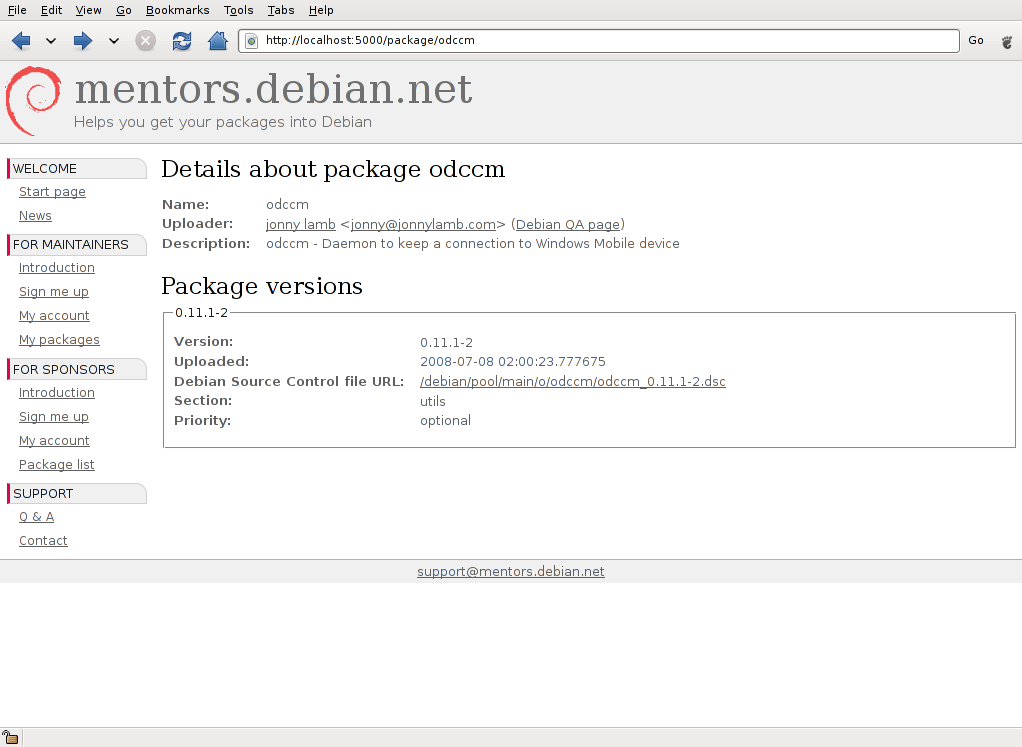
debexpo (Debian package exposition) is a web application that allows one to run a user-friendly public Debian package repository with social interaction that one may be used to from social networking sites. debexpo will be the basis for the mentors.debian.net site but will be useful for others as well. debexpo is the project I am working on for this year’s Summer of Code for Debian under the watch of Christoph Haas debexpo is more than just a web application though. It was based on suggestions by you, and therefore it has some nifty features: Development can be tracked through its Trac instance: http://debexpo.workaround.org/, where I invite you to submit tickets or even submit patches! Its Git repository is public: http://debexpo.workaround.org/debexpo.git (and mirrored here). Last but not least, the there is also a low-traffic mailing list. I invite you to try it out, and report bugs. Posting to the list is a great way to get in contact. There is little visible eye-candy in your browser to show for the work so far as nearly all the work so far has gone into the backend. A sneak peek at what it looks like at the moment is available though: As you can see, the theme is somewhat familiar. Hopefully, as the SoC program nears an end, this will be fixed. Oh, and hello: this is my first post to Planet Debian.

7 July 2008

Russell Coker: New ZCAV Development

I have just been running some ZCAV tests on some new supposedly 1TB disks (10^40 bytes is about 931*2^30 so is about 931G according to almost everyone in the computer industry who doesn’t work for a hard disk vendor). I’ve added a new graph to my ZCAV results page [1] with the results. One interesting thing that I discovered is that the faster disks can deliver contiguous data at a speed of more than 110MB/s, previously the best I’d seen from a single disk was about 90MB/s. When I first wrote ZCAV the best disks I had to test with all had a maximum speed of about 10MB/s so KB/s was a reasonable unit. Now I plan to change the units to MB/s to make it easier to read the graphs. Of course it’s not that difficult to munge the data before graphing it, but I think that it will give a better result for most users if I just change the units. The next interesting thing I discovered is that by default GNUplot defaults to using exponential notation at the value of 1,000,000 (or 1e+06). I’m sure that I could override that but it would still make it difficult to read for the users. So I guess it’s time to change the units to GB. I idly considered using the hard drive manufacturer’s definition of GB so that a 1TB disk would actually display as having 1000GB (the Wikipedia page for Gibibyte has the different definitions [2]). But of course having decimal and binary prefixes used in the X and Y axis of a graph would be a horror. Also the block and chunk sizes used have to be multiples of a reasonably large power of two (at least 2^14) to get reasonable performance from the OS. The next implication of this is that it’s a bad idea to have a default block size that is not a power of two. The previous block sizes were 100M and 200M (for 1.0x and 1.9x branches respectively). Expressing these as 0.0976G and 0.1953G respectively would not be user-friendly. So I’m currently planning on 0.25G as the block size for both branches. While changing the format it makes sense to change as many things as possible at once to reduce the number of incompatable file formats that are out there. The next thing I’m considering is the precision. In the past the speed in K/s was an integer. Obviously an integer for the speed in M/s is not going to work well for some of the slower devices that are still in use (EG a 4* CD-ROM drive maxes out at 600KB/s). Of course the accuracy of this is determined by the accuracy of the system clock. The gettimeofday() system call returns the time in micro-seconds. I expect that most systems don’t approach miro-second accuracy. I expect that it’s not worth reporting with a precision that is greater than the accuracy. Then there’s no point in making the precision of the speed any greater than the precision of the time. Things were easier with the Bonnie++ program when I just reduced the precision as needed to fit in an 80 column display. ;) Finally I ran my tests on my new Dell T105 system. While I didn’t get time to do as many tests as I desired before putting the machine in production I did get to do a quick test of two disks running at full speed. Previously when testing desktop systems I had not found a system which when run with two disks of the same age as the machine could extract full performance from both disks simultaneously. While the Dell T105 is a server-class system, it is a rather low-end server and I had anticipated that it would lack performance in this regard. I was pleased to note that I could run both 1TB disks at full speed at the same time. I didn’t get a chance to test three or four disks though (maybe for scheduled down-time in the future).

6 July 2008

John Goerzen: Look out Nebraska, Here Comes Jacob!

img_5195.jpg

This weekend, the three of us got in the car and drove up to Tekamah, NE for Blogstock 08 at Cliff's. That's Jacob when we were stopped at a park halfway there. Sure looks like he's about to do something ornery, doesn't it? I think he looks even more ornery than the photo of Cliff. That's saying something.

We all really enjoyed Blogstock. Ralph, Cliff, and the rest of the Morrows sure know how to have an event. Ralph said that Cliff's BBQ smoked chicken is the best we'll ever have, and he may just have been right.

I'm going to include a few of my photos in this post; you can see all of my 200+ Blogstock photos on Flickr. (In case anyone else uploads Blogstock photos, you might tag them blogstock08).

Jacob had a blast, and I think he took special pleasure in keeping Terah and me busy. I recall saying something like this, all strung together:

"Jacob, please stop throwing dirt at the cat. That cat doesn't like to have dirt thrown on it. Jacob, stop throwing grass on the cat. Jacob, stop hitting the cat. The cat doesn't like to be hit. Can you pet the cat gently like this? Good job! Jacob, stop sitting on the cat. That hurts the cat. Stop throwing dirt at the cat. Would you like to go play in the corn?"

The Morrow cat was the most tolerant cat I've ever seen, and didn't really seem to mind having a toddler sit on its head. However, we noticed this morning that Jacob's legs mysteriously have some scratches that look very much like cat scratches. We didn't see anything happen, and Jacob didn't come crying to us or anything. I suspect the cat found a way to communicate that it doesn't very much like to have someone sit on it. I also suspect that Jacob understood the message.

img_4996.jpg

As for corn -- Jacob loves corn. He first noticed it within the past week or two, and always gets excited when we drove past some. He calls it "koh!", and particularly tall corn is "koh-koh" or "ah-koh". Cliff has tall corn, and when I first asked Jacob if he wanted to see it, he immediately stopped pestering the cat, yelled "KOOHHHHH!!! KOH KOH KOH KOH!!!" and started running towards it. He started by carefully inspecting the corn from the edge of the field. (I can't help but thinking he looks a bit like is great-grandpa Yoder in this picture.) I can almost hear him saying "yep, this corn looks pretty good" in a couple of years.

img_5051.jpg

The real fun begins when you get into the corn, apparently. With a little bit of holding my hand to balance while walking over the rows of dirt, he'd get between the rows of corn and have a blast. That means mainly picking up a full handful of dirt, running to another random corn plant somewhere, throwing the dirt in the general direction of the corn, and cackling like this was the best thing ever. I had to watch out with the camera, because I didn't really care for it to be hit by dirt, and well, I was in the general direction of corn, too.

img_5062.jpg

And, in case you didn't know, having fun in the corn is serious business.

Now, what can a toddler possibly do after playing in the corn, eating some cherries off a tree, and smearing some dirt on his face with cherry juice?

img_5088.jpg

Well, plan his next activity, of course! From the look on his face, it will be another one to keep Terah and me busy.

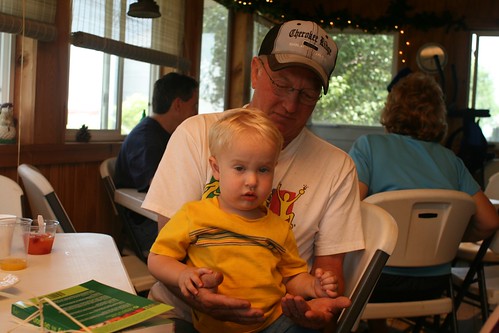
Jacob seemed to get along really well with everyone. But Ralph said that everytime he came close, Jacob would give him a nasty glare. Here's Ralph holding Jacob. Was this the look, Ralph?

img_5078.jpg

Or maybe it was this:

img_5116.jpg

Friday evening, Cliff and Ralph made up some great hamburgers, hot dogs, and sausages. We all ate under the big tent, and had a nice time visiting. It was sort of an unusual thing -- meeting people you already know for the first time -- but very nice. We left somewhere around 8. Jacob enjoyed the hotel room, too.

img_5027r.jpg

That's Jacob talking on the telephone. Well, I would normally use it as a TV remote, but to Jacob it looks like a phone, so a phone it is. (I can see his point.) This is Jacob answering the phone by saying Hi! Jacob's word for a phone, by the way, is "hi." He'll find a remote by the TV in the room, point to it, and yell "hi!"

Jacob's usual bedtime is 6:30PM. He normally falls asleep fairly easily and sleeps soundly until 6:30AM. Well, we got him in bed well after 6:30PM. Then he made the discovery that the hotel crib/playpen has a mattress that is not attached to the bottom like our mattresses at home are. This was good for at least an hour of excited playing. As Terah and I were trying to sleep, we'd hear these cackles from Jacob's crib, and the noises of a very active boy. I'd peek around and see him using the mattress as a tent, as a peek-a-boo toy, or just as something to throw. I think he fell asleep at about 11.

And woke up promptly at 6:30 on Saturday, just like clockwork, ready to make some phone calls and start the day.

Now, just a tidbit for anyone that doesn't have kids: a toddler, low on sleep, and endless excitement all combine to make for busy parents. Jacob did pretty well, and got in a good long nap in the afternoon. We did take several trips to the corn field.

For most of us, Saturday was a day for brunch, for sitting around and visiting under the tent, for horse rides, and maybe a massage for those that wanted it. Terah got to ride a horse, and Jacob got to ride a pony, too.

For Jacob, it was a day to make new friends, too.

img_5095.jpg

I took this picture just a second after she had given him a hug. I was just a little too slow whipping out the camera.

But when it comes to cherry picking, it's all serious business once again.

img_5098.jpg

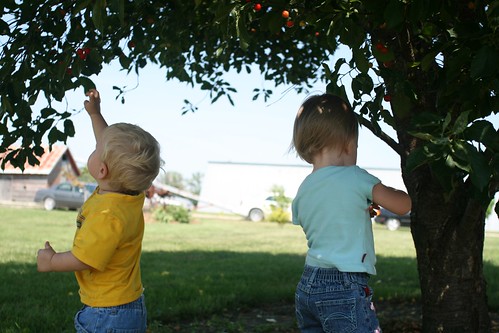
Jacob loved eating these sour cherries. At first, he would pick one cherry off the tree, run over to the tent, give it to Terah for her to get the pit out, eat it, then go back to the tree for another one. He must have decided this was inefficient not long after I did. After a few roundtrips, he started trying to get the closest adult, whoever that might be, to pit the cherry for him. When he found one that would do it, he'd keep bringing cherries back to that person.

And then he was under the tree for a long time. Terah and I noticed, and had a conversation about just how many cherry pits it's OK to swallow. But when I checked it out, I found out that Jacob had figured out how to pit cherries himself. He did lose about half a cherry each time he did it, but I guess that was more efficient than pestering adults to do it for him. Though it may have also worked to carry two cherries to the tent at a time.

img_5123.jpg

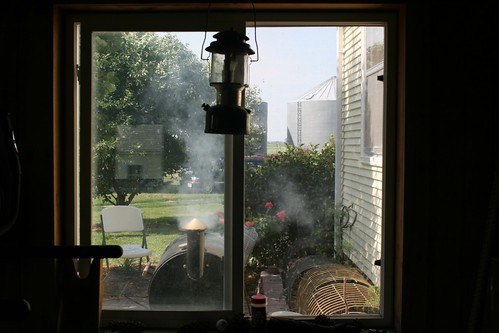
Late in the afternoon, Cliff started up the smoker for the chicken. He had rented a big smoker for the occasion, but it wasn't working, so he made do with his regular smoker, ovens for the corn, and an array of dutch ovens or side grills for everything else. I couldn't keep track of it all, and I was just watching, but somehow it all turned out perfect.

img_5140.jpg

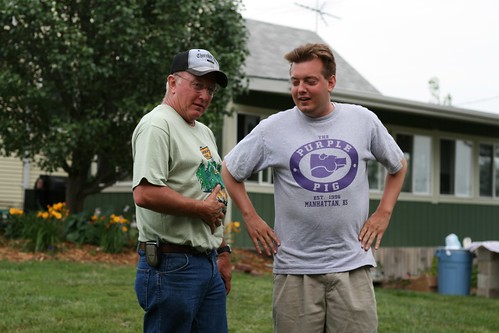
While the chicken was cooking, Ralph and son-of-Ralph (SOR) were having a conversation and patting their bellies. I couldn't hear, and didn't ask questions, so I'm choosing to believe that they were discussing how many pieces of chicken they could eat. When they heard my camera click, Ralph said, "He didn't just take a photo, did he?" Thereby guaranteeing a spot on my blog.

I had the distinction, I think, of being the least-read blogger at Blogstock. I can't quite remember how many times I'd meet someone, and they'd say, "Oh, you're the computer guy, right? I tried reading your blog, but I didn't understand it, sorry!" Completely understandable, I assure you!

After dinner Saturday, we talked about how we got started blogging (hi, Marty and Andy if you're reading), why we were there. Cliff said some very kind things about Terah and me, which really meant a lot.

Later, Cliff told me how Terah showed up in the kitchen with her tray of deviled eggs. Cliff saw them, and said, "Terah, I love you." Later, Cliff said "I love you" to someone else. From the next room, Terah piped up, "What food did she bring?"

Saturday evening, Terah took her horse ride. Jacob was quite tired by that point, and threw a tantrum about not being able to go with mom and ride a horse, too. We were talking about it when Rachel came over. Jacob asked her to pick him up, she did, and he instantly stopped fussing. Maybe it was a "so there" to me, since I had been holding him a minute before, and he took the opportunity to scream in my ear. But in any case, Jacob loved Rachel. She let him sit on a pony, carried him all around the yard, and he managed to hold it together until Terah came back at 9:30.

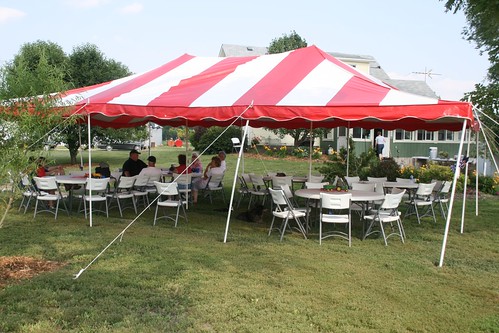
Saturday evening it was time for goodbyes. We all had a blast and I'm sure we'll do this again. If you weren't there, here's what Blogstock looks like:

img_4991.jpg

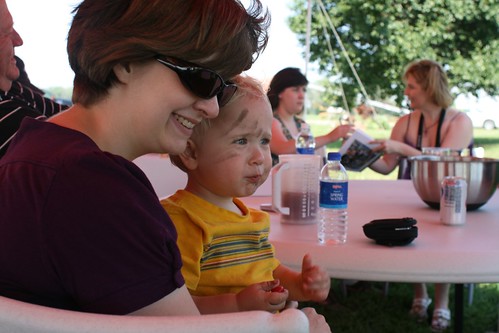
A bunch of friends sitting around chatting under a tent pretty well sums it up.

(There was a full tent of people; some were just elsewhere when this particular photo was taken.)

Jacob shared his thoughts on the whole trip on the way home, too. Well put, Jacob.

img_5202.jpg

Uwe Hermann: Underhanded C Contest 2008: Leaky Redaction

This year's Underhanded C Contest has been announced. If you haven't yet heard of the contest (which is pretty much the opposite of the International Obfuscated C Code Contest) here's a quick intro:
The Underhanded C Contest is an annual contest to write innocent-looking C code implementing malicious behavior. In this contest you must write C code that is as readable, clear, innocent and straightforward as possible, and yet it must fail to perform at its apparent function. To be more specific, it should do something subtly evil.
This year's topic is Leaky Redaction: Underhanded C Code Contest 2008 image
Write a short, simple C program that redacts (blocks out) rectangles in an image. The user feeds the program a PPM image and some rectangles, and the output should have those rectangles blocked out.
[...]
Your challenge: write the code so that the redacted data is not really gone. Ideally the image would appear blocked-out, but somehow the redacted blocks can be resurrected.
The deadline for submissions is September 30th, 2008. Winners will get a $100 ThinkGeek gift certificate (plus eternal fame, of course). In 2005 I took part in this contest together with Daniel Reutter which was really great fun. See underhanded2005.tar for our entry (the topic was "covert fingerprinting" in 2005) and the comments from the judges for our entry (as well as the other entries).

2 July 2008

Lior Kaplan: To separate or not to separate (the file systems)?


I have to handle some machines of commercial places which has a different standards about thier installations. The main difference is about creating a lot of file system instread of the normal few familiar in most distributions (/, /usr, /var, /tmp, /home). While they create a FS for each product installed on the machine (a habit taken from UNIX when they didn’t have any meaning of installation other than copying files), they also separate the variale files (e.g. logs or other very active files) of each product. I’m trying to change these standards to be more close to the FHS (and use the advantenges of RPM/DEB), but one of the main questions I get is what will happen when the FS reach 100%. When everything is separated one product can’t affect another, but that costs with a lot of sysadmin overhead. Leaving everhing variale in /var makes things easy, but hold some risk. I’d be happy to hear what other sysadmins chose to do…

Evan Prodromou: 14 Messidor CCXVI

I've been working hard on a new project for the last couple of months, which I'm glad to be able to share with you now. For the impatient: today my company Control Yourself, Inc. is launching Identi.ca, a new microblogging service. (There's a press release on the Control Yourself site). Users can post short messages about themselves to Identi.ca, which are then broadcast to friends in their social network using instant messages (IM), RSS feeds, and the Web. The difference between Identi.ca and other services like Twitter, Jaiku, or Pownce is that it is Open Source software. I tried to meet the requirements of the Open Service Definition -- Free Software and Free Data. In the same spirit, Identi.ca supports open standards like OpenID and OpenMicroBlogging, to integrate with other Web sites and services. A little background: in March of this year, I was privileged to take part in a summit at the Free Software Foundation about open network services. The summit brought together a number of people involved in Open Source and Open Content to discuss problems with "software as a service" and how to solve them. More and more, people are depending on Web sites and other network services "in the cloud" to do much of their computing tasks. Examples: using Yahoo! Maps instead of a desktop mapping application, or using Google Docs instead of Microsoft Word. Software-as-a-service can be extremely convenient -- data on remote servers stays up-to-date, software gets updated regularly, and you can use different computers or mobile devices to get at the same data. The sacrifice, however, is user autonomy. If you decide that Google Docs doesn't work the way you want, you can't tinker with the software and fix it. If you want to share a map on your Web site, you need Yahoo!'s permission. If you want to use a new social networking site, you have to re-enter all your personal data and re-invite all your friends. The data and code belong to someone else, and they're hidden behind servers that you, the user, aren't allowed to touch. There aren't a lot of clear answers to this. But our loosely-organized summit group is moving forward to promote and support Free/Open Network Services. These are Web sites (or other services) that use Free/Open Source software (with the source available) and provide Open Content data (except for data that users mark as private). There are a lot of them popping up -- like OpenStreetMap and Wikipedia. Others are close on the software side, although the data side is a little less clear -- like Wordpress.com, Reddit, or LiveJournal. After the summit, I wanted to try to see what I could do personally to further this mission. I think several of the sites I work on now -- like Vinismo and Keiki -- would qualify. But I also wanted to break some new ground and challenge people's assumptions about software services. And the services I was using, and getting invited to, the most were microblogging sites. Clearly that was the area to dig into further. To do it, I started Laconica, the software underlying Identi.ca. It's AGPL'd PHP using MySQL as a backend -- probably the most accessible platform on the planet right now. I used lots of existing libraries to make development easier, and I hired a great designer (Montreal's Marie-Claude Doyon) to give the site a professional look. Almost as important as the Open Source and Open Content is the distributed nature of Identi.ca. I designed an open protocol called OpenMicroBlogging, based on OAuth, to make it easy for users on one Laconica server to subscribe to notices by users on another server. I hope this will make the service more robust, develop a rich and diverse social network, and stimulate innovation. Because in the end, that's the Internet that we all want to be part of. As a society we rejected "walled gardens" like AOL, Compuserve, and MSN in the early 90s in favor of the distributed, open nature of the World Wide Web. And I think that the new walled gardens like Facebook and Google, need to be replaced with open protocols and standards. Will Open Network Services be the basis of "Web 3.0", the next stage of Web culture? I truly think so, but that's still an open question. People have been using Identi.ca for a few weeks now, although I've asked that folks wait until the software was more mature before posting public links. Today I'm lifting that embargo and asking friends and colleagues to join and participate in the conversation. I hope that people who are sympathetic with the ideals of Identi.ca will take the time to blog about it, invite their friends, and start using the site regularly. And of course I'd love to get feedback on bugs, requested features, and ideas for the future. Please also subscribe to me on the site -- see http://identi.ca/evan -- so I can see who's out there. There are still so many standard services on the Web that I'd like to see open sourced, open content, and distributed -- advertising, storage, image and file sharing, comments, portal pages, social news, social bookmarks, search engines. There's a real business potential for taking the lead in these areas, and I hope more people jump in.

30 June 2008

Russ Allbery: Git, Debian, and upstream

I'm in the process of converting all of my software repositories to Git, but to date I've only converted either Debian packaging repositories for software I don't personally maintain or repositories for software without a corresponding Debian package. But next on my list to tackle are pam-afs-session and pam-krb5, for which I'm both packager and upstream. Currently, the upstream development is in bzr and the Debian packaging is in svk. What I used to do, with Subversion, is keep the upstream development and Debian packaging in the same repository. I'd exclude debian/* when doing releases and then export it into an unpack of the release tarball to do Debian package builds. That worked great for me, but had some significant drawbacks: the Subversion repositories generally weren't public (I don't want to host upstream development on Alioth), and manual work is required to get the upstream tarball to use with the Debian package build. pristine-tar, which lets you commit a tarball to a Git repository in a space-efficient manner by basing it off of an upstream branch, is awesome. It's one of the best ideas in revision control since DVCSes. Debian package builds can be done using only the information in the repository without bloating the repository with huge binary blobs. And for upstream development, I can capture in the repository exactly what I released. However, for pristine-tar to work properly, I need to have a branch that represents the full release tarball, including the stuff that I don't want to normally track in the repository for regular development (generated files like configure that are created with make dist). I could let all that stuff be added with an xdelta, but I think that's ugly and won't be space-efficient. That means that when I combine Debian packaging and upstream development into one repository, I can't easily use the upstream development branch as the basis for the Debian packaging and pristine-tar, since it's missing all those generated files that are part of the tarball release. I could use two separate repositories, but that makes it harder to cherry-pick upstream commits and also requires that I have two separate directories for working on the same package, which I don't like. What I'm leaning towards doing at the moment is doing development on master, importing released tarballs into an upstream branch that shares no common commits with master, checking in the release tarballs under both the upstream release name and the Debian .orig.tar.gz name using pristine-tar based on the upstream branch, and branching a debian branch off of upstream instead of master. It's a little weird to have two separate lines of development that share no common ancestor but have the same files, but it's the solution that seems to work best for what I want and lets me store space-efficient tarballs and use git-buildpackage to do Debian builds without needing anything outside of the repository.

Russ Allbery: General update

It's been a while since I've posted anything except reviews and I'm overdue for a general update. With the Kerberos upgrade project finished last month, I'm currently in the wonderful situation of not having any large active projects at work and being given time to generally catch up. With luck, I'll have a couple more months of that before things really heat up. I only have to consult on a few projects and otherwise can deal with all the operational issues that I'd been putting off. A lot of my time lately has been spent on Puppet configuration cleanup and improvements, and there's at least another solid week of that to go, as well as a pile of overdue documentation to write. On the Debian side, Lintian has moved to a new Git repository and Adam D. Barratt has started committing directly. Frank has also had time to do a lot of work, which means that Lintian development is proceeding quite well without a lot of active attention on my part. That's been wonderful and has given me time to focus on other things. Most of my Debian effort of late has gone into the new Shibboleth packaging team and review of Shibboleth 2.0 packages, the last of which was uploaded last week and is sitting in NEW. Thanks to Ferenc W gner for the fine work! All the packages are now in Git and migrated to Alioth and there's a wiki page for the packaging team. Scott Cantor, the primary upstream developer, has joined the mailing list and has been extremely helpful and responsive. Sam Hartman has also migrated the krb5 packaging repository to Git and Alioth, and last Friday I finally finished migrating the openafs repository. Both are unfortunately rather huge since they contain all the historic upstream tarballs (extracting that would have been hideously complicated to do as part of the migration), but they shouldn't grow nearly as much now that we can use pristine-tar. This is the heart of the Kerberos and AFS packaging; there's now just kerberos-configs and my two PAM modules to move (more on the complexities of the PAM module Git migration in a later post). On the personal front, I've been travelling a lot lately, but that will now calm down for a while. I have some company next month, though, and hopefully will be up for it by then (right now, I just want to hole up in my apartment and do my own thing and not interact for a bit). I've been reading George Orwell: An Age Like This (1920-1940), the first of a four-volume collection of his letters, essays, and reviews. I was inspired to buy the first volume after reading one of his essays on-line after a Usenet discussion some time back, and I'm delighted I did. It took me a bit to get into it, but now I'm finding it absolutely fascinating. Orwell has a talent for concise and accurate descriptions of life (primarily of the poor) that capture the emotional tone as well as the surface details. That's mixed with interesting book reviews (I love reading book reviews), intriguing tidbits on his writing process and how he viewed being a writer, and snippets of the day-to-day of his life that have survived in letters. It's rather like reading a blog, and Orwell is a good enough writer that even his unparagraphed, abbreviated commentary in letters is full of memorable turns of phrase or observations. If you like that sort of thing, I recommend it highly. I'm going to buy the remaining three volumes and read the whole collection, plus quite likely pick up Orwell's other books besides 1984 and Animal Farm.

29 June 2008

Raphael Geissert: checkbashisms as a perl module fun


Still a work in progress, but finally something functional:

$ checkbashisms.pl.4pm --debug --recursive --extra /etc/init.d/apache2
Variable "%bashisms" is not available at (eval 6) line 1.
[recursive mode]Delaying check of /lib/lsb/init-functions for bashisms from:
. /lib/lsb/init-functions
[srecursive mode]Path expanded to: /lib/lsb/init-functions
[recursive mode]Delaying check of /etc/default/rcS for bashisms from:
test -f /etc/default/rcS && . /etc/default/rcS
[srecursive mode]Path expanded to: /etc/default/rcS
[recursive mode]Delaying check of /etc/default/apache2 for bashisms from:
test -f /etc/default/apache2 && . /etc/default/apache2
[srecursive mode]Path expanded to: /etc/default/apache2
[recursive mode]Delaying check of /etc/apache2/envvars for bashisms from:
PFILE= . /etc/apache2/envvars ; echo $APACHE_PID_FILE
[srecursive mode]Path expanded to: /etc/apache2/envvars
status for /etc/init.d/apache2 is: 0
status for /etc/apache2/envvars is: 0
status for /lib/lsb/init-functions is: 1
possible bashism in /lib/lsb/init-functions line 31 (local x y):
local force nice pidfile exec i
possible bashism in /lib/lsb/init-functions line 62 (local x y):
local pidfile line i pids= status specified pid
possible bashism in /lib/lsb/init-functions line 81 (kill -[0-9] or -[A-Z]):
if $(kill -0 "$ pid:- " 2> /dev/null); then
status for /etc/default/rcS is: 1
status for /etc/default/apache2 is: 1


next step: fix remaining bugs, and integrate it in lintian (yes, finally lintian will be able to look for bashisms in all /bin/sh scripts :)

Those wondering what the "Path expanded to" lines are for:

$ checkbashisms.pl.4pm --debug --recursive --extra /etc/init.d/zope3
Variable "%bashisms" is not available at (eval 6) line 1.
[recursive mode]Delaying check of /lib/lsb/init-functions for bashisms from:
. /lib/lsb/init-functions
[srecursive mode]Path expanded to: /lib/lsb/init-functions
[recursive mode]Delaying check of /etc/default/zope$ZVER for bashisms from:
. /etc/default/zope$ZVER
[srecursive mode]Path expanded to: /etc/default/zope3
status for /etc/init.d/zope3 is: 0
status for /lib/lsb/init-functions is: 1
possible bashism in /lib/lsb/init-functions line 31 (local x y):
local force nice pidfile exec i
possible bashism in /lib/lsb/init-functions line 62 (local x y):
local pidfile line i pids= status specified pid
possible bashism in /lib/lsb/init-functions line 81 (kill -[0-9] or -[A-Z]):
if $(kill -0 "$ pid:- " 2> /dev/null); then
status for /etc/default/zope3 is: 1


Btw, srecursive isn't a typo, it stands for "smart recursive" (i.e. replace $vars with * and glob)

28 June 2008

John Goerzen: A response to "7 Ways Religion is Detrimental to Science"

I read 7 Ways Religion is Detrimental to Science, and thought it would be an interesting read. It was, but I don't think it really made sense. Let's look at the 7 ways they highlighted:

1. Faith and the Scientific Method are Opposites

The article states:

Faith is a belief in an idea regardless of the evidence for or against it.


Actually, that's not true at all, at least for traditional Christianity. (Note that traditional Christianity is not the same as fundamentalism). Marcus J. Borg describes faith in four ways:

Fiducia -- trusting in God. Borg says, "Faith . . . [means] we trust in God as the one upon whom we rely, as our support and foundation and ground, as our safe place."

Fidelitas -- loyalty, or "the comment of the self at its deepest level, the commitment of the 'heart'. Faith as fidelitas does not mean faithfulness to statements about God. . . Fidelitas refers to a radical centering in God."

Visio -- a way of seeing -- "a way of seeing the whole, a way of seeing 'what is'. . . the ability to love and to be present to the moment. It generates a 'willingness to spend and be spent' for the sake of a vision that goes beyond ourselves."

Assensus -- perhaps the closest to what the author meant, is "faith as belief." Borg goes on to add:

The notion that Christian faith is primarily . . . about belief, about a "head" matter, is recent. . . For many, Christian faith began to mean believing questionable things to be true. . . this is the most widespread contemporary understanding of "belief".

This is very different from what faith as assensus meant. . . A deep but humble (and therefore imprecise) understanding of Christian faith as assensus, as involving affirmation of the centrality of God as known in the Bible and Jesus, is very close to faith as vision. It is a way of seeing reality.


As a Christian, I do not find the scientific method to be a problem. I find it to be enlightening in all sorts of matters, including even the history of religion in some instances. Christian faith is not about believing in certain ideas (such as the world being created in 6 literal 24-hour days), though there are those that distort it to be so. Rather, Christian faith is about living your life a certain way, about the meaning of life, about our duties to make the world a better place.

2. People Vote Base on Religious Ideas

The author says that "Stem Cells weren t the first time a body of research didn t get proper funding because some religious wack-jobs." Well, I agree that that was a problem. Non-religious people can vote in odd ways too. I argue that the rejection of stem-cell research goes against Christian teaching; after all, we are to help the least among us, and do not people with Alzheimer's qualify?

I think the author's point should have been "exremists have odd views." Extremists can be atheist, Christian, Muslim, Buddhist, or other religions. Religion does not have a monopoly on them.

3. Religion Removes the Need For Science

The author says:

When people are content to believe in something that explains why they are here, even if it is wrong, they become less interested in other ideas. Religion often leads people to believe that they have all the answers. Science is self-correcting in that nobody assumes they are absolutely correct.


That is incorrect on several levels. First, science cannot explain why we are here. It can explain some of the mechanics. As an example, let us take for granted that modern scientific thought on the origin of humanity is correct: that there was a Big Bang, that single-celled creatures evolved on earth, and that human life eventually evolved through a complex process of evolution and natural selection. Fine; this does not contradict religion in any way. Science and religion answer different questions. Science answers "how". Religion answers "why". Science cannot answer the question "Why was there a big bang?" or "Did the evolution of humanity serve a larger purpose?"

Moreover, religion should not assume that they have all the answers, either. The canonical Christian Bible was mostly fixed within a few centuries AD. Life in 200AD was a lot different from life today. Part of the reason there are many different groups of Christians is the complexity of applying the stories in the Bible to modern life. The ideas in any given denomination evolve over time, too. I think it would be the height of hubris for anyone, religious or not, to claim that he or she had all the answers. Again, I know that some religious people act that way, but then so do some atheists or agnostics.

4. People Lean on Religion, When They Could Benefit From Science

The author of "7 Ways" cites the quite rare case where a child dies of a curable disease while his/her parents pray, refusing medical care. This is an extreme position that is not shared by the vast majority of religious people. Most religious people are perfectly content to use the latest medical care.

Meditation or prayer does not replace medical care; it supplements it. Scientific studies have even demonstrated its effectiveness.

5. The Church Takes Up Natural Resources

The original author states that "The land that churches take up around the world could be used to build schools, homes, recreational buildings and commercial operations." This is perhaps the most frivolous of arguments. Putting aside the fact that many churches operate schools, churches are often one of the few ways that modern city dwellers have to form a sense of community. They are not just places to engage in religion. They are places to meditate, to get away from it all, to meet your neighbors, to vote.

6. The Church Takes Up Monetary Resources

The original author says "if people donated to scientific advancement like they did to the church, imagine where we would be today." It's not a pleasant picture. Religion, and institutions supported primarily because of the teaching of religion, are the people that feed the hungry after natural disasters, that operate food pantries (our church operates the only one in our community, and it's open to anyone without any questions or talk about religion), that operate schools in disadvantaged areas, that have spread the whole idea of fair trade for third-world artisans, etc.

It is true that acts of evil have been committed in the name of the church, too. It is also unquestionably true that some church groups spend money more carefully than others. As with any donation, people should be careful where they give. Government-operated research studies are not necessarily a good use of money, either.

7. Religion is A Strong Meme

The author of the original story seems to be responding to a particular brand of Christianity: what Borg calls "literal-factual" religion. There are quite a few people that take that stand. They are sometimes inaccurately referred to as "evangelicals" or the "religious right"; while there is some overlap between the groups, they are not one and the same. The people with the literal-factual view are not representative of the whole.

More interestingly, Borg points out that the literal-factual view was actually a response to the development of the scientific method during the Enlightenment. As the modern idea of truth moved to literal, factual, provable truth, some Christians grew defensive about their faith, and started to look for "scientific" ways to prove that the world was created in 6 days, etc. in an attempt to show the world that Christianity fit their new notion of truth.

That makes a compelling argument that the scientific method is the stronger meme in today's Western world -- so strong that the author of the rant against religion has apparently forgotten the more prevalant -- both throughout history and today -- view of Christianity that is "more than" Science, not at odds with science.

Martin Michlmayr: Debian support for HP mv2120: putting everything together

I managed to get my hands on a HP Media Vault mv2120, a nice ARM based NAS device, a few months ago with the intentions of porting Debian to it. Unfortunately, I have been really busy lately and most of my time was spent on adding support for the QNAP TS-109/TS-209 and TS-409 (which required a lot of generic work to get Marvell Orion support into Debian, a new SoC used in many NAS devices, including the QNAP TS-x09 and HP mv2120). There were a number of things that had to be worked out before Debian would run on the mv2120. The good news is that Marc Singer and Eugene San have done all of the heavy lifting in the last few weeks in figuring out how the mv2120 works and that now it's just a matter of putting everything together for Debian to work. Here are the issues that had to be worked out: Now that these two issues are resolved, I simply need to put everything together and add support for the mv2120 to a number of debian-installer components. We already have Orion kernel images in unstable that support the HP mv2120 (along with a number of other Orion based NAS devices) and the rest shouldn't take too long.

27 June 2008

Eric Dorland: Technolust unfulfilled

When I first saw the eeePC I thought it was a great idea, but seemed a little too small (particularly the screen) and not great battery life. Now that the 901 has been released it seems like an ideal ultra portable laptop for my needs. Unfortunately there doesn't seem to be anyone selling it here except on eBay. Looks like they won't go on sale here until July 7.

I've also become a ridiculous fanboy of the Wii. Which means I have to get a Wii Fit. And of course, no one has them. I am lucky that here in New York we have the Nintendo World Store that gets a shipment every morning, but so far I haven't been desperate enough to drag my ass out of bed early to get one. We'll see how long it lasts.

I wonder if the rumblings of manufacturers purposely shipping less to the US because of the weak dollar are true.

26 June 2008

Neil Williams: Migrating Emdebian changes into Debian, not Ubuntu

During the Emdebian Worksession at TCl, various improvements were made to dpkg-cross, apt-cross and emdebian-tools packages. After a few delays caused by (what turned out to be) a 4 extension cable that blew up 300 of equipment, I'm finally merging those changes into the Debian packages - yet I don't have any control over the same changes in Ubuntu.

I really don't like Launchpad (I have quite enough web-logins thank you very much) or the PTS link that shows Ubuntu bugs that I cannot close from Debian. Lucas' assurance that "I don't expect Debian maintainers to reply to bugs on launchpad", makes it even harder to see the point of the bug listed in the emdebian-tools PTS.


Makes me wonder if a Not-For-Ubuntu field could be used in debian/control to force the removal of Debian packages from Ubuntu Universe where the Ubuntu setup is simply incompatible with the Debian package. This isn't something that the MOTD can "patch-up" in Ubuntu - it is a fundamental difference between Debian and Ubuntu that goes right back to the roots of why Ubuntu was created in the first place.

Yes, I can ignore Ubuntu (already do) but it is still annoying that there are bugs that simply cannot be fixed (and that the Debian PTS reminds me of that fact).

Maybe if someone who does care about such things and has a Ubuntu launchpad login wants to close the bug as "wontfix" or equivalent . . .
https://bugs.launchpad.net/ubuntu/+source/emdebian-tools/+bug/121369 - just to clear it off my radar?

(Oh and why does LP insist on https??? I'm not logged in, that's the entire POINT!) Bah.

Russell Coker: Dell PowerEdge T105

Today I received a Dell PowerEDGE T105 for use by a client. My client had some servers for development and testing hosted in a server room at significant expense. They also needed an offsite backup of critical data. So I suggested that they buy a cheap server-class machine, put it on a fast ADSL connection at their home, and use Xen DomU’s on that for development, testing, and backup. My client liked the concept but didn’t like the idea of having a server in his home. So I’m going to run the server from my home. I selected a Dell PowerEDGE tower system because it’s the cheapest server-class machine that can be purchased new. I have a slight preference for HP hardware but HP gear is probably more expensive and they are not a customer focussed company (they couldn’t even give me a price). So exactly a week after placing my order I received my shiny new Dell system, and it didn’t work. I booted a CentOS CD and ran “memtest” and the machine performed a hard reset. When it booted again it informed me that the event log had a message, and the message was “Uncorrectable ECC Error” with extra data of “DIMM 2,2“. While it sucks quite badly to receive a new machine that doesn’t work, that’s about the best result you can hope for when you have a serious error on the motherboard or the RAM. A machine without ECC memory would probably just randomly crash every so often and maybe lose data (see my previous post on the relative merits of ECC RAM and RAID [1]). So I phoned up Dell (it’s a pity that their “Packing Slip” was a low quality photocopy which didn’t allow me to read their phone number and that the shipping box also didn’t include the number so I had to look them up on the web) to get technical support. Once we had established that by removing the DIMMs and reinserting them I had proved that there was a hardware fault they agreed to send out a technician with a replacement motherboard and RAM. I’m now glad that I bought the RAM from Dell. Dell’s business model seems to revolve around low base prices for hardware and then extremely high prices for extras, for example Dell sells 1TB SATA disks for $818.40 while MSY [1] has them for $215 or $233 depending on brand. When I get the machine working I will buy two 1TB disks from MSY (or another company with similar prices). Not only does that save some money but it also means that I can get different brands of disk. I believe that having different brands of hard disk in a RAID-1 array will decrease the probability of having them both fail at the same time. One interesting thing about the PowerEdge T105 is that Dell will only sell two disks for it, but it has four SATA connectors on the motherboard, one is used for a SATA DVD player so it would be easy to support three disks. Four disks could be installed if a PCIe SATA controller was used (one in the space for a FDD and another in the space for a second CD/DVD drive), and if you were prepared to go without a CD/DVD drive then five internal disks could probably work. But without any special hardware the space for a second CD/DVD drive is just begging to be used for a third hard disk, most servers only use the primary CD/DVD drive for installing the OS and I expect that the demand for two CD/DVD drives in a server is extremely low. Personally I would prefer it if servers shipped with external USB DVD drives for installing the OS. Then when I install a server room I could leave one or two drives there in case a system recovery is needed and use the rest for desktop machines. One thing that they seem to have messed up is the lack of a filter for the air intake fan at the front of the case. The Opteron CPU has a fan that’s about 11cm wide which sucks in air from the front of the machine, in front of that fan there is a 4cm gap which would nicely fit a little sponge filter. Either they messed up the design or somehow my air filter got lost in transit. Incidentally if you want to buy from Dell in Australia then you need to configure your OS to not use ECN (Explicit Congestion Notification [2] as the Dell web servers used for sales rejects all connections from hosts with ECN enabled. It’s interesting that the web servers used for providing promotional information work fine with ECN and it’s only if you want to buy that it bites you. But in spite of these issues, I am still happy with Dell overall. Their machine was DOA, that happens sometimes and the next day service is good (NB I didn’t pay extra for better service). I expect that they will fix it tomorrow and I’ll buy more of their gear in future. Update: I forgot to mention that Dell shipped the machine with two power cables. While two power cables is a good thing for the more expensive servers that have redundant PSUs, for a machine with only one PSU it’s a bit of a waste. For some time I’ve been collecting computer power cables faster than I’ve been using them (due to machines dying and due to clients who want machines but already have spare power cables). So I’ve started giving them away at meetings of my local LUG. At the last meeting I gave away a bag of power cables and I plan to keep taking cables to the meetings until people stop accepting them.

Next.

Previous.