Search Results: "nic"

14 October 2013

Bits from Debian: Ada Lovelace Day: meet some of the "women behind Debian"!

Today is Ada Lovelace Day:
"Ada Lovelace Day is about sharing stories of women - whether engineers, scientist, technologists or mathematicians - who have inspired you to become who you are today. The aim is to create new role models for girls and women in these male-dominated fields by raising the profile of other women in STEM". source
To celebrate, we asked to some of the "women behind Debian" to share their stories with us. Enjoy! Alt Ada Lovelace portrait Ana Guerrero Lopez (ana) Who are you? I'm a 30-something years old geek. I'm from Andalusia, Spain but live in France. What do you do in Debian? I work mostly on my packages, in sponsoring new people's packages and in this very blog you're reading now. I also maintain an unofficial Google+ page about Debian. At $PAID job, I work in an internal Debian distribution so from time to time, I get the opportunity to contribute back some of the stuff we do there. How and why did you start contributing to Debian? I started using Debian around 2003 switching from Mandrake. I was a happy Debian user when the Debian Women project started in the summer 2004. When I saw the project announced, I asked myself why I wasn't contributing to Debian and the rest is history... in a couple of weeks it'll be my 7 years DD-versary! If for some reason you want a longer reply to this question, read here. Beatrice Who are you? I am a PhD student with a degree in Biology. I am a computer fan since my first C64 and I am a self-taught computer geek wanna-be. And I am a bug fan - not software bugs, real bugs :) What do you do in Debian? I work on translations - doing the translation work itself, but also reviewing other translators' work and helping in coordinating the translation effort. How and why did you start contributing to Debian? I started using Linux because I liked the idea of an open source operative system based on collaboration and I began reviewing open source software translations. Since my first Linux system was Debian Potato and I sticked to Debian ever since, it only seemed natural to focus my translation work on Debian. Christine Caulfield Who are you? My name is Christine Caulfield. My day job is principal software engineer at Red Hat working on the cluster infrastructure components corosync & pacemaker. Outside computing I'm a musician and sound engineer. I play violin with lots of technology attached, and love avant garde music. What do you do in Debian? I'm not that active on Debian any more due to pressure of time, and maturity of the packages I work on. I currently maintain the, little-used, DECnet userspace packages and the, even less used I suspect, mopd bootloader. I used to maintain lvm2 for a while but dropped that a few years ago. How and why did you start contributing to Debian? My initial reasons for joining Debian were slightly selfish, to find a home for the DECnet project that I was heavily involved in at the time. I was a keep Debian user and people wanted a distribution where the software was easy to set up. DECnet is quite complicated for users to configure, being a totally independant networking stack to IP and so OS support is needed. Debian seemed like the logical place to make this happen. As mentioned above I got quite involved for a time and maintained other packages too. I picked up lvm2 because I was on the lvm2 dev team at work in Red Hat and as it was a new package at that time I seemed a logical choice. Elena Grandi (valhalla) Who are you? I'm a 30-something years old geek and Free Software enthusiast from Italy. What do you do in Debian? I'm currently maintaining a few packages (2 python modules and a python program) as a sponsored uploader; I'm also slowly looking around for other things to do (by preference technical, but not limited to packaging), with the aim to spend more time contributing to Debian. How and why did you start contributing to Debian? For a while I had being distro-hopping between "fun" distributions (the ones that break now and then) on the desktop while using Debian stable on the home server and in chroots. I was already doing marginal contributions to those distributions, where finding stuff that was missing was easy, but my perception as a stable user was that Debian was already working fine and probably didn't really need any help. Then I started to socialize on IRC with some DDs and DMs, and realized that my perception was superficial and that in reality there were dark holes in the depths of the archive where Evil festered and prospered and... ok, sorry, I got carried away :) Anyway, since I was actually using Debian more and more I decided to start contributing: I read documentation, I attended the useful IRC sessions on #debian-women and decided that it was probably best not to add new stuff, but look for things that I used and that needed help. Then nothing happened for a while, because finding stuff that doesn't work is hard (at least on my mostly textual systems). Then one day I was trying to write a python script that needed to verify gpg signed messages; it had to run on my Debian server, so I was trying to use python-pyme and its documentation was painful to use, while I remembered an earlier attempt using python-gnupg that was much more pythonic, but not available in Debian. In a fit of anger I decided to forgo all of my good intentions and actually add a new package: I checked the sources for problems, packaged, sent it to mentors@d-o, got reviews, fixed problems, resent and finally got sponsored and well, everything started. Francesca Ciceri (madamezou) Who are you? I'm Francesca, a 30-something Italian graduated in Social Sciences. What do you do in Debian? I'm a (non uploading) Debian Developer since 2011 and have been DPN editor, press officer, webmaster for www.debian.org and translator for the Italian l10n team. Recently, due to time constraints, I had to reduce my involvement and now only work on two things: writing/editing articles for bits.debian.org together with Ana Guerrero, and creating subtitles for the DebConf talks, in the DebConf Subs team. How and why did you start contributing to Debian? Basically thanks to the sudden abundance of free time - due to an health problem - and the desire to give something back to this wonderful operating system. After that, I found out that Debian is not only a great OS but also a very special community. Today, some of my dearest friends are people I met through Debian. :) Laura Arjona Who are you? I live in Madrid (Spain), and work as IT Assistant in the Technical University of Madrid (UPM). I'm married and I have a 4-years-old son. What do you do in Debian? In 2012 I started to clean spam and to translate Debian web pages into Spanish. I also follow the work of the web and publicity team, I hope I'll get more involved there too. And of course, I'm in Debian Women :) How and why did you start contributing to Debian? I'm using Debian at work since 2007 (servers), and in my desktops since 2010. I like very much that it is a community distro and I wanted to participate. I was already doing translations in other (small) free software projects, so I began here too. The Debian-Women list, the planet, and people in identi.ca helped me to learn a lot and feel part of the community even when I was not contributing yet. M nica Ram rez Arceda (monica) Who are you? My name is M nica Ram rez Arceda and I am an enthusiast of free software and sharing knowledge cultures: for me it's a kind of philosophy of life. I studied Maths a long time ago but ended up working as a developer for some years. Now I'm working as an IT teacher. What do you do in Debian? Debian is a huge project, so you can help in various scopes. Mainly, I work on packaging, fixing wnpp bug inconsistencies in BTS and helping in spam cleaning of the mailing lists. But I also enjoy doing some non-technical work from time to time: the project I am just now involved is organizing, with the rest of Debian Catalan community, a local team to propose Barcelona as the venue for a minidebconf where all the speakers will be women. How and why did you start contributing to Debian? In 2000 I discovered Free Software world and I fell deeply in love with its philosophy. Since then, I've been trying to do my best in different activities, like spreading the word, giving free courses, helping collectives and friends in technical stuff (from installing Debian to developing some helping apps for them)... but two years ago I was looking forward to join a free software project and I decided to try Debian, since it has been my first and only distro in my day-to-day life for about ten years. So, I wanted to give back Debian all what it had offered to me, but.... I thought I couldn't (hey, Debian is for real hackers, not for you little ant!), but I started to adopt some orphaned packages, do some QA uploads, fix some RC bugs, talk with some Debian Developers that helped me and encouraged me more than I expected, I traveled to my first Debconf... And one thing takes you to the other, and on March 2012 I became a DD. Now, I'm glad to see that everything that frightened me is not so scary :-)

Brett Parker: Just in case you missed it...

So, I've changed jobs, I now work for the incredibly awesome Mythic Beasts, So far it's been great, we've hit a few problems, we've made sane plans, and we're moving forwards and making things easier to manage long term. I've mostly been involved with debugging mac-mini boot problems, and getting them working with (as far as possible) stock kernels, rather than our previous set of custom compiled kernels, so that it's easier to upgrade later, and so that we're not having to maintain a whole set of patches that we shouldn't need to! We're also starting to package our own software that we use internally so that actually deploying new servers is becoming a lot easier, and configuration of our previous packages is now (mostly) handled by debconf, meaning that actually setting up backups is becoming much easier. We've also changed out main backup strategy from using a (slightly flaky) openvpn connection with loopback mounted ext3 filesystems to using rsync with the --fake-super option - the only thing that we've found slightly wrong with this so far is that --fake-super can't reconcile symlinks (it uses user level xattr to store the origional permissions, and with symlinks this doesn't work, because, apparently, symlinks should store user xattr attrbutes!). We also offer ipv6 for all our dedicated and vps customers, as per the mythic blog - and our 2 authoritative name servers are both v6 enabled. We're working towards making all of our core services available over both ipv4 and ipv6, and we should be there soon. It's fantastic to work for a company that has the technical knowledge and no-shit stance that Mythic Beasts has, we will hold our hands up if we do something wrong, and we'll tell you exactly what happened, why, and what we're doing to stop it from happening again. So, 1 month in, and I'm absolutely loving working for them, and I've been a customer of theirs since black cat networks sold their domain name side to them, and shortly afterwards bluelinux sold their virtual servers service to them. Our new VDS lite service is reasonably priced, and well spec'd. I thoroughly recommend our services, and obviously, we actually use our own vds service to provide some of our services - so it's as important to us that it keeps working as it is for our customers. Wow, so that was a very salesy post. Erm, next time, back to whinging about authors not having written the books I'm waiting for yet! :)

13 October 2013

Dirk Eddelbuettel: Chicago Marathon 2013

A gorgeous day in Chicago for the 37th annual Chicago Marathon. Today was the seventh time I ran this race. I had sat out last fall, and ran a smaller local race (well enough for a BQ). But the last time I ran Chicago I mused that maybe next time I'd train more. I tried, but it didn't quite work with a minor injury dragging on a little. Just like in 2010. And so it continues: it is my home course, and the course I have run the most and know the best. Yet it is the one where I have the greatest difficulty coming in with a time that is good enough for Boston. I knew that today wasn't going to be that day, so I aimed lower to just run even splits (ie running about equal halfs). But even that failed: After 1:44 for the first half I lost a good ten minutes to finish at 3:40:42. Oh well. There is always next year... But it was a simply sunningly fabulous day, and the race was once again very, very well put together. We were worried about extra security: not a real issue. The streets were lined with people and even Lisa and Julia managed to cheer me on at mile 13 (still smiles), mile 19 (grimacing, about to fall apart) and 25 (hanging in). And Anna was working the mile 18 water stop. The worst where miles 20 to 22 when I walked a fair bit. The race results have details; maybe I'll update the chart I made in prior years. One minor FAIL was a wait at the end for gear check. That was pathetic. I guess the folks manning the stand didn't keep bags sorted well enough so lines were long, and slow. Oh well -- the rest was fine, and it remains one of the nicest marathon races. Oh, and the other FAIL was that my Nexus 4 phone couldn't hold a charge til I was done. What's up with that? The running tracker traced me til around mile 20, and then the phone shut down for lack of juice. Disappointing too. But hey, it spares you, dear reader, the look of some bad post-race selfies...

John Goerzen: Why are we still backing up to hardlink farms?

A person can find all sorts of implementations of backups using hardlink trees to save space for incrementals. Some of them are fairly rudimentary, using rsync --link-dest. Others, like BackupPC, are more sophisticated, doing file-level dedup to a storage pool indexed by a hash. While these are fairly space-efficient, they are really inefficient in other ways, because they create tons of directory entries. It would not be surprising to find millions of directory entries consumed very quickly. And while any given backup set can be deleted without impact on the others, the act of doing so can be very time-intensive, since often a full directory tree is populated with every day s backup. Much better is possible on modern filesystems. ZFS has been around for quite awhile now, and is stable on Solaris, FreeBSD and derivatives, and Linux. btrfs is also being used for real workloads and is considered stable on Linux. Both have cheap copy-on-write snapshot operations that would work well with a simple rsync --inplace to achieve the same effect ad hardlink farms, but without all the performance penalties. When creating and destroying snapshots is a virtually instantaneous operation, and the snapshots work at a file block level instead of an entire file level, and preserve changing permissions and such as well (which rsync --link-dest can have issues with), why are we not using it more? BackupPC has a very nice scheduler, a helpful web interface, and a backend that doesn t have a mode to take advantage of these more modern filesystems. The only tool I see like this is dirvish, which someone made patches for btrfs snapshots three years ago that never, as far as I can tell, got integrated. A lot of folks are rolling a homegrown solution involving rsync and snapshots. Some are using zfs send / btrfs send, but those mechanisms require the same kind of FS on the machine being backed up as on the destination, and do not permit excluding files from the backup set. Is this an area that needs work, or am I overlooking something? Incidentally, hats off to liw s obnam. It doesn t exactly do this, but sort of implements its own filesystem with CoW semantics.

12 October 2013

Vincent Fourmond: 8 months with a macbook pro retina 15''

Back in February, I wanted a new laptop for my work, so I bought a fancy Dell Latitude E6540 laptop. Bad luck, it was giving my sore eyes and horrible headaches, to the point I couldn't work more than a dozen minutes with it. As in my work, we were not allowed to buy PC laptops with any other vendor, my boss convinced me to get a 15'' macbook pro retina (yes that's about as expensive a laptop as you can get). Although quite reluctant at first, I did need a new laptop, so I gave in. Of course, I had to install debian on it. I booted once or twice on macos to leave enough space for Debian and install rEFIt so that I could boot into it. I had to use version 3.9 of linux else it wouldn't boot.After about 8 month, I must say I'm quite pleased with the beast. The retina display is very neat (a 2880x1800 resolution!), and it is pretty fast. There are two annoyances though:Another point is the update of GRUB: Debian's post-install scripts don't play nice with the EFI setup, so here is what I have to do to update to a newer version of grub, (and it's also what I had to do initially to install GRUB):
# mount /dev/sda1 /mnt
# grub-install --efi-directory=/mnt
The /dev/sda1 partition is the so-called EFI partition. I think it is created by rEFIt and it is essentially empty.

11 October 2013

Petter Reinholdtsen: Oslo community mesh network - with NUUG and Hackeriet at Hausmania

Wireless mesh networks are self organising and self healing networks that can be used to connect computers across small and large areas, depending on the radio technology used. Normal wifi equipment can be used to create home made radio networks, and there are several successful examples like Freifunk and Athens Wireless Metropolitan Network (see wikipedia for a large list) around the globe. To give you an idea how it work, check out the nice overview of the Kiel Freifunk community which can be seen from their dynamically updated node graph and map, where one can see how the mesh nodes automatically handle routing and recover from nodes disappearing. There is also a small community mesh network group in Oslo, Norway, and that is the main topic of this blog post. I've wanted to check out mesh networks for a while now, and hoped to do it as part of my involvement with the NUUG member organisation community, and my recent involvement in the Freedombox project finally lead me to give mesh networks some priority, as I suspect a Freedombox should use mesh networks to connect neighbours and family when possible, given that most communication between people are between those nearby (as shown for example by research on Facebook communication patterns). It also allow people to communicate without any central hub to tap into for those that want to listen in on the private communication of citizens, which have become more and more important over the years. So far I have only been able to find one group of people in Oslo working on community mesh networks, over at the hack space Hackeriet at Husmania. They seem to have started with some Freifunk based effort using OLSR, called the Oslo Freifunk project, but that effort is now dead and the people behind it have moved on to a batman-adv based system called meshfx. Unfortunately the wiki site for the Oslo Freifunk project is no longer possible to update to reflect this fact, so the old project page can't be updated to point to the new project. A while back, the people at Hackeriet invited people from the Freifunk community to Oslo to talk about mesh networks. I came across this video where Hans J rgen Lysglimt interview the speakers about this talk (from youtube): I mentioned OLSR and batman-adv, which are mesh routing protocols. There are heaps of different protocols, and I am still struggling to figure out which one would be "best" for some definitions of best, but given that the community mesh group in Oslo is so small, I believe it is best to hook up with the existing one instead of trying to create a completely different setup, and thus I have decided to focus on batman-adv for now. It sure help me to know that the very cool Serval project in Australia is using batman-adv as their meshing technology when it create a self organizing and self healing telephony system for disaster areas and less industrialized communities. Check out this cool video presenting that project (from youtube): According to the wikipedia page on Wireless mesh network there are around 70 competing schemes for routing packets across mesh networks, and OLSR, B.A.T.M.A.N. and B.A.T.M.A.N. advanced are protocols used by several free software based community mesh networks. The batman-adv protocol is a bit special, as it provide layer 2 (as in ethernet ) routing, allowing ipv4 and ipv6 to work on the same network. One way to think about it is that it provide a mesh based vlan you can bridge to or handle like any other vlan connected to your computer. The required drivers are already in the Linux kernel at least since Debian Wheezy, and it is fairly easy to set up. A good introduction is available from the Open Mesh project. These are the key settings needed to join the Oslo meshfx network:
SettingValue
Protocol / kernel modulebatman-adv
ESSIDmeshfx@hackeriet
Channel / Frequency11 / 2462
Cell ID02:BA:00:00:00:01
The reason for setting ad-hoc wifi Cell ID is to work around bugs in firmware used in wifi card and wifi drivers. (See a nice post from VillageTelco about "Information about cell-id splitting, stuck beacons, and failed IBSS merges! for details.) When these settings are activated and you have some other mesh node nearby, your computer will be connected to the mesh network and can communicate with any mesh node that is connected to any of the nodes in your network of nodes. :) My initial plan was to reuse my old Linksys WRT54GL as a mesh node, but that seem to be very hard, as I have not been able to locate a firmware supporting batman-adv. If anyone know how to use that old wifi access point with batman-adv these days, please let me know. If you find this project interesting and want to join, please join us on IRC, either channel #oslohackerspace or #nuug on irc.freenode.net. While investigating mesh networks in Oslo, I came across an old research paper from the university of Stavanger and Telenor Research and Innovation called The reliability of wireless backhaul mesh networks and elsewhere learned that Telenor have been experimenting with mesh networks at Gr nerl kka in Oslo. So mesh networks are also interesting for commercial companies, even though Telenor discovered that it was hard to figure out a good business plan for mesh networking and as far as I know have closed down the experiment. Perhaps Telenor or others would be interested in a cooperation? Update 2013-10-12: I was just told by the Serval project developers that they no longer use batman-adv (but are compatible with it), but their own crypto based mesh system.

Russ Allbery: krb5-strength 2.1

This is a quick bug-fix release, since of course there was a significant bug in the recent 2.0 release. In this case, it was a problem with the build: if you configured the package without CDB support, it didn't build. Apparently I didn't retest that after doing some refactoring. I have good test suite techniques for reasonable code coverage, but not for testing various variant configurations at the Autoconf level. This is what a continuous build infrastructure would be good for, I know. We even have one sitting around; someday, I should invest in hooking my projects up to it. Anyway, also in this release is the start of an Autoconf fix so that --with-tinycdb without an argument works correctly, but I have more Autoconf work to do (also affecting rra-c-util). I also tweaked the error messages returned by the non-CrackLib portions of krb5-strength so that they would hopefully be more comprehensible to users while still being technically accurate. You can get the latest release from the krb5-strength distribution page.

8 October 2013

Daniel Kahn Gillmor: Unaccountable surveillance is wrong

As I mentioned earlier, the information in the documents released by Edward Snowden show a clear pattern of corporate and government abuse of the information networks that are now deeply intertwined with the lives of many people all over the world. Surveillance is a power dynamic where the party doing the spying has power over the party being surveilled. The surveillance state that results when one party has "Global Cryptologic Dominance" is a seriously bad outcome. The old saw goes "power corrupts, and absolute power corrupts absolutely". In this case, the stated goal of my government appears to be absolute power in this domain, with no constraint on the inevitable corruption. If you are a supporter of any sort of a just social contract (e.g. International Principles on the Application of Human Rights to Communications Surveillance), the situation should be deeply disturbing. One of the major sub-threads in this discussion is how the NSA and their allies have actively tampered with and weakened the cryptographic infrastructure that everyone relies on for authenticated and confidential communications on the 'net. This kind of malicious work puts everyone's communication at risk, not only those people who the NSA counts among their "targets" (and the NSA's "target" selection methods are themselves fraught with serious problems). The US government is supposed to take pride in the checks and balances that keep absolute power out of any one particular branch. One of the latest attempts to simulate "checks and balances" was the President's creation of a "Review Group" to oversee the current malefactors. The review group then asked for public comment. A group of technologists (including myself) submitted a comment demanding that the review group provide concrete technical details to independent technologists. Without knowing the specifics of how the various surveillance mechanisms operate, the public in general can't make informed assessments about what they should consider to be personally safe. And lack of detailed technical knowledge also makes it much harder to mount an effective political or legal opposition to the global surveillance state (e.g. consider the terrible Clapper v. Amnesty International decision, where plaintiffs were denied standing to sue the Director of National Intelligence because they could not demonstrate that they were being surveilled). It's also worth noting that the advocates for global surveillance do not themselves want to be surveilled, and that (for example) the NSA has tried to obscure as much of their operations as possible, by over-classifying documents, and making spurious claims of "national security". This is where the surveillance power dynamic is most baldly in play, and many parts of the US government intelligence and military apparatus has a long history of acting in bad faith to obscure its activities. The people who have been operating these surveillance systems should be ashamed of their work, and those who have been overseeing the operation of these systems should be ashamed of themselves. We need to better understand the scope of the damage done to our global infrastructure so we can repair it if we have any hope of avoiding a complete surveillance state in the future. Getting the technical details of these compromises in the hands of the public is one step on the path toward a healthier society. PostscriptLest I be accused of optimism, let me make clear that fixing the technical harms is necessary, but not sufficient; even if our technical infrastructure had not been deliberately damaged, or if we manage to repair it and stop people from damaging it again, far too many people still regularly accept ubiquitous private (corporate) surveillance. Private surveillance organizations (like Facebook and Google) are too often in a position where their business interests are at odds with their users' interests, and powerful adversaries can use a surveillance organization as a lever against weaker parties. But helping people to improve their own data sovereignty and to avoid subjecting their friends and allies to private surveillance is a discussion for a separate post, i think.Tags: cryptography, nsa

Thomas Goirand: OpenStack 2013.2~rc1, aka Havana, fully available in Debian Experimental

Announcement After a very long work, over the course of 4 months, I have finished packaging the first RC1 of OpenStack. This comes on time, just 9 days before the official Havana release. Please do try this RC1 before the official 2013.2, code name Havana, is released, and hopefully uploaded to Debian. All of the packages are available from Debian Experimental, keeping Grizzly in Sid. However, there is also some private repositories that I maintain, holding Wheezy backports: deb http://havana.pkgs.enovance.com/debian havana main deb http://archive.gplhost.com/debian havana-backports main The first repository holds the packages maintained within the Alioth group. These are built directly from my Jenkins machine, on each git push. The 2nd repository is holding backports from Sid to Wheezy for the packages that I don t actively maintain (though a lot of them are in the Python module team, in which I do a lot of packaging and updates as well). A few numbers A few numbers about this now. I had to work on 145 source packages: at least backport them to Wheezy, and push them in the GPLHost archive repository above. This generates 360 binary packages. Out of these, I maintain 77 source packages within the Alioth OpenStack group, generating 209 .deb files. That s a lot of stuff to deal with (and I feel sometimes a bit dizzy about it). While OpenStack is a big jigsaw puzzle to solve for the users, it is even more for someone who has to deal with all the (sometimes buried in the the code) Python dependencies. I hope others will come and join me in this packaging effort, since over the time, there s more and more work to be done, as the project grows. Note that most of the work is unfortunately done on packaging (and updating) the Python dependencies, working on the packages themselves is done last, at the end of the cycle. Other things not packaged (yet) Before the release (and the forthcoming Hongkong summit on the 5th of November), I hope to be able to finish packaging TripleO. TripleO is in fact OpenStack on OpenStack, which works with nova-baremetal. I have no idea how to test or install this, though it sounds like a lot of fun. There are 6 source packages that need to be done. Also, pending on the FTP masters NEW queue, is Trove: Database as a Service. I hope this one can get through soon. There is, also, Marconi, which is an incubated project for a new message queuing service, which probably will replace RabbitMQ (I m not sure yet what it does, and I will be happy to hear about it at the summit). Lastly, there s Ironic, which will at some point, replace nova-baremetal. That is, it does cloud computing over bare metal, without virtualization. All of these new projects are still in an incubation stage, and are not part of the official release yet. Though, I have learned over the course of this past year, that with OpenStack, it s never early enough to start the packaging work. Thanks to my sponsor! Please note that all of this wouldn t be possible without eNovance sponsoring my packaging work. A big up to all of them for supporting and loving Debian! You guys rox. Also a special thanks to Mehdi / Sileth, for his work testing everything with the Tempest functional tests and the CI platform.

Petter Reinholdtsen: Skolelinux / Debian Edu 7.1 install and overview video from Marcelo Salvador

The other day I was pleased and surprised to discover that Marcelo Salvador had published a video on Youtube showing how to install the standalone Debian Edu / Skolelinux profile. This is the profile intended for use at home or on laptops that should not be integrated into the provided network services (no central home directory, no Kerberos / LDAP directory etc, in other word a single user machine). The result is 11 minutes long, and show some user applications (seem to be rather randomly picked). Missed a few of my favorites like celestia, planets and chromium showing the Zygote Body 3D model of the human body, but I guess he did not know about those or find other programs more interesting. :) And the video do not show the advantages I believe is one of the most valuable featuers in Debian Edu, its central school server making it possible to run hundreds of computers without hard drives by installing one central LTSP server. Anyway, check out the video, embedded below and linked to above: Are there other nice videos demonstrating Skolelinux? Please let me know. :)

7 October 2013

Gregor Herrmann: using lintian profiles for fun & profit

since lintian gained support for vendor profiles, or at least since it has a nice documentation about writing checks & even a tutorial (the latter only local/in the package), I thought about writing some checks in a specific 'pkg-perl' profile. after talking to niels at debconf13, I tried in late august, & realized that at least simple checks are fun to write & really not difficult; luckily niels also reviewed my first attempts. & axel soon joined the fun & added some more checks. so here we are: the new pkg-perl-tools package also ships a lintian vendor profile 'pkg-perl' with a couple of simple but still useful checks that help to enforce our group policy. if you want to use them, install the package and check /usr/share/doc/pkg-perl-tools/README.lintian, if you want to look at the checks, you can also clone the git repo or inspect it in gitweb (directory lintian).

6 October 2013

Russ Allbery: Review: Captain Vorpatril's Alliance

Review: Captain Vorpatril's Alliance, by Lois McMaster Bujold
Series: Vorkosigan #14
Publisher: Baen
Copyright: November 2012
ISBN: 1-4516-3845-0
Format: Kindle
Pages: 432
This is the fourteenth book in the long-running Vorkosigan series (not counting a few side works). It shifts viewpoint characters, following Ivan Vorpatril instead of either Miles or Cordelia, and could be read on its own since the necessary background is at least briefly explained. But it's probably best read in its proper context in the larger series, since otherwise many of the prior events mentioned here won't have much resonance. Ivan Vorpatril, Miles's cousin, has appeared in multiple previous books along with the rest of Miles's extended family, but he's stayed out of the center of the plot. And he clearly likes it that way. Ivan is not at all ambitious, tries to avoid politics, and just wants to live a quiet life (insofar as that's possible in the Barrayan military), sleep with a few women, and stay out of trouble. But given his relations and his job as aide-de-camp to an admiral this doesn't always work. In this book, the not working comes in the form of Byerly, ImpSec (Imperial Security, the Barrayan equivalent of the CIA), and a request to find out more about a woman who seems to be the target of a bounty. Fairly quickly, Ivan finds himself hopelessly entangled in both politics and in someone else's complex life, and is not entirely sure what to do about either. It's been months since I read this book and I'm only now writing a review, in part because I find it hard to know what to say about it. While Ivan doesn't have Miles's manic energy, the tone of this book is very similar to the rest of the Vorkosigan series, as is the plot and most of the characters. Ivan tries a more laid-back approach and doesn't actively seek danger the way that Miles does, but his persistent efforts to do the right thing in the face of unexpected events lead mostly to the same places. There's a bit of humor, a bit of danger, some galactic politics, some scheming, and a slow process of understanding other people better in short, Captain Vorpatril's Alliance is very similar to the thirteen books that proceeded it. This is obviously not a bad thing. If you've read this far in the series, more of the same is probably just fine. I enjoyed the book. Bujold is great at telling stories, the plot mostly moved right along, and I quite liked the two women Ivan meets over the course of the story. But there wasn't much about the story that grabbed me or, I suspect, that I will find particularly memorable. One reason for my somewhat "meh" reaction is that the core of this story is a romance, and while much of that romance is well-done, there is a large segment in the middle of the book where the suspense of the plot derives mostly from one of the two characters refusing to confide in the other. This is Bujold, so this isn't as much of a train wreck as it might be in the hands of another author, and it is for valid plot reasons. But even with those justifications, I never like that plot element. There were about a hundred pages where I wanted to grab Tej and shake some sense into her, which doesn't endear a character to me. And the leads in a romance, at least this sort of romance, should be endearing. I think one reason why Bujold went for that approach to building tension is that there weren't a lot of options available. The basic outlines of what's going to happen are obvious from early in the book and essentially forced by the structure of the series. We know from past books that Ivan is both trustworthy and related to a staggering variety of powerful people, almost all of whom are highly competent and honorable. It's fairly obvious that, as soon as the necessary people trust Ivan and let him and his family solve their problems, all the problems will be solved. It's also fairly obvious how the romances will play out, and that all the new characters will end up a little in awe of how competent and trustworthy all the Barrayans are (a few misdirections aside). Therefore, much of the book, for a long-time reader of the series, involves waiting until those things happen, and meanwhile getting increasingly annoyed at characters who refuse to trust obviously trustworthy people. All that said, I still quite liked the beginning of the book, because Tej and Rish are a wonderful pair and have a great interpersonal dynamic, and the very end of the book once everyone gets past the communication problems and the plot can deliver on its promises. Both together make up for some noticeable sagging in the middle section of the book. Captain Vorpatril's Alliance is not up to the standards of the most memorable books of the series, but it's a solid dose of "more of the same" and provides its money's worth of entertainment. I'm still hoping for more Ekaterin and more fireworks in the next book, though. Rating: 7 out of 10

5 October 2013

Vincent Sanders: If I have a style, I am not aware of it.

I wish I had known about that quote from Michael Graves before now. I would have perhaps had an answer to some recent visitors to makespace.

There are regular scheduled visits to makespace where people can come and view our facilities, and perhaps start the process of becoming a member if they decide they like what they see.

Varnishing a folding chair using a stool as a stand
However, we sometimes get people who just turn up at the door. If a member feels charitable they may choose to give a short tour rather than just turn the person away. I happened to be in one Friday afternoon recently varnishing a folding chair when two such people rang the doorbell. There were few other members about and because watching varnish dry was dull I decided to be helpful and do a quick tour.

I explained that they really ought to return for a scheduled event for a proper tour, gave the obligatory minimal safety briefing, and showed them the workshops and tools. During the tour it was mentioned they were attending a certain local higher education establishment and were interested in makespace as an inexpensive studio.

Before they left I was asked what I was working on. I explained that I had been creating stools and chairs from plywood. At this point the conversation took a somewhat surreal turn, one of them asked, well more demanded, who my principle influence had been in designing with plywood.

When I said that I had mainly worked from a couple of Google image searches they were aghast and became quite belligerent. They both insisted I must have done proper research and my work was obviously influenced by Charles and Ray Eames and Arne Jacobsen and surely I intended to cite my influences in my design documents.

My admission that I had never even heard the names before and had no design documents seemed to lead to a distinctly condescending tone as they explained that all modern plywood design stemmed from a small number of early 20th century designers and any competent designers research would have revealed that.

At this point in proceedings I was becoming a bit put out that my good deed of showing off the workshop had not gone unpunished. I politely explained that I designed simply by generating a requirement in my head, maybe an internet search to see what others had done, measuring real things to get dimensions and then a great deal of trial and error.

I was then abruptly informed that my "design process was completely invalid and there were well established ways to design furniture correctly and therefore my entire design was invalid" and that I was wasting time and material. I thanked them for their opinion and showed them out, safe and well before anyone gets any ideas.

I put the whole incident out of my mind until I finished writing up the final folding chair post the other day. It struck me that perhaps I had been unknowingly influenced by these designers. It was certainly true I had generated ideas from the hundreds of images my searches had revealed.

I did some research and it turns out that from the 1930s to the 1950s there were a string of designers using plywood in novel ways from the butterfly stool by Sori Yanagi through formed curvy chairs by Alvar Aalto and eero saarinen.

While these designers produced some wonderfully iconic and contemporary furniture I think that after reviewing my initial notes that two more modern designers Christian Desile and Leo Salom probably influenced me more directly. Though I did not reference their designs beyond seeing the images along with hundreds of others, certainly nothing was directly copied.

And there in lies an often repeated observation: no one creates anything without being influenced by their environment. The entire creative process of several billion ape descendants (or Golgafrincham telephone sanitisers if you prefer) is based on the simple process of copying, combining and transforming what is around us.

Isaac Newton by Sir Godfrey Kneller [Public domain], via Wikimedia Commons
I must accept that certain individuals at points in history have introduced radical improvements in their field, people like Socrates Galileo Leonardo Newton Einstein. However, even these outstanding examples were enlightened enough to acknowledge those that came before. Newtons quotation "If I have seen further it is by standing on the shoulders of giants" pretty much sums it up.

In my case I am privileged enough to live in a time where my environment has grown to the size of the world thanks to the internet. My influences, and therefore what I create, is that much richer but at the same time it means that my influence on others is similarly diminished.

I have joined the maker community because I want to create. The act of creation teaches me new skills in a physical, practical way and additionally I get to exercise my mind using new techniques or sometimes things I had forgotten I already knew. I view this as an extension of my previous Open Source software work, adding a physical component to a previously purely mental pursuit.

But importantly I like that my creations might provide inspiration for someone else. To improve those chances in the wider world I force myself to follow a few basic rules:
Release
Possibly one of the hardest things for any project. I carefully avoided the word finish here because my experience leads me to the conclusion that I always want to improve my designs.

But it is important to get to a point in a project where you can say "that is good enough to share", this is more common in software but it really applies to any project.

Share
If your aim here is to improve your society with your contribution sharing your designs and information is important. I think there is nothing better than someone else taking one of your designs and using it and perhaps improving on it, remember that is what you probably did in one way or another better to make it less hard for that to happen.

Ensure your design files are appropriately licensed and they are readily accessible. I personally lean towards the more generally accessible open source licences like MIT but the decision is ultimately yours.

Licencing is important, especially in the current copyright happy society. I know it sounds dull and no one takes that seriously, right? Sorry, but yes they do and it is better for you to be clear from the start, especially if there is a software component to your project. Oh one personal plea, use an existing well known licence, the world simply does not need another one!

Write about it
The blog posts about the things I have made sometimes take almost as much time as the creation. The clear recording on my thoughts in written and photographic form often gives me more inspiration for improvements or other projects.

If someone else gets pleasure from the telling then that can only be good. If you do not do this then your voice cannot be heard and you wasted an opportunity to motivate others.

Feedback
If you do manage to get feedback on your creation, read it. You may disagree or not be interested for the current project but the feedback process is important. In software this often manifests as bug reports, in more physical projects this often becomes forum or blog comments.

Just remember that you need a thick skin for this, the most vocal members of any society are the minority with inflammatory opinion, the silent majority are by definition absent but there is still useful feedback out there.

Create again
By this I simply mean that once you are satisfied yourself on a project move on to the next. This may sound a little obvious but once you have some creative momentum it is much easier to keep going project to project than in you leave time between.

Also do not have too many projects ongoing, by all means have a couple so you do not get stuck waiting for materials or workshop time but more than three and four and you will never be able to release any of them.
Those students were perhaps somewhat misguided in how they stated their opinions, but they are correct that in the world in which we find ourselves we are all influenced. Though contrary to received wisdom those influences are more likely to be from the internet and our peers in the global maker society than historical artists.

Rémi Vanicat: Key-transition

A recent discussion on debian-project remind me I have to do this:
-----BEGIN PGP SIGNED MESSAGE-----
Hash: SHA1,SHA256
Hello,
I am transitioning GPG keys from an old 1024-bit DSA key to a new
4096-bit RSA key.  The old key will continue to be valid for some
time, but I prefer all new correspondance to be encrypted in the new
key, and will be making all signatures going forward with the new key.
This transition document is signed with both keys to validate the
transition.
If you have signed my old key, I would appreciate signatures on my new
key as well, provided that your signing policy permits that without
reauthenticating me.
The old key, which I am transitional away from, is:
   pub   1024D/9057B5D3 2002-02-07
         Key fingerprint = 7AA1 9755 336C 6D0B 8757  E393 B0E1 98D7 9057 B5D3
The new key, to which I am transitioning, is:
   pub   4096R/31ED8AEF 2009-05-08
         Key fingerprint = DE8F 92CD 16FA 1E5B A16E  E95E D265 C085 31ED 8AEF
To fetch the full new key from a public key server using GnuPG, run:
  gpg --keyserver keys.gnupg.net --recv-key D265C08531ED8AEF
If you have already validated my old key, you can then validate that
the new key is signed by my old key:
  gpg --check-sigs D265C08531ED8AEF
If you then want to sign my new key, a simple and safe way to do that
is by using caff (shipped in Debian as part of the "signing-party"
package) as follows:
  caff D265C08531ED8AEF
Please contact me via e-mail at <vanicat@debian.org> if you have any
questions about this document or this transition.
  Remi vanicat
  vanicat@debian.org
  remi.vanicat@gmail.com
  remi.vanicat@ens-lyon.org
-----BEGIN PGP SIGNATURE-----
Version: GnuPG v1.4.14 (GNU/Linux)
iD8DBQFST8iPsOGY15BXtdMRAggfAJ4z5wEpUy8Bcicv9KTGOjsUAZF2xACfYKv9
GWXh8iT1N2Qqjhwtpvx9B3aJAhUDBQFST8iP0mXAhTHtiu8BCPldEADYM9e/22yu
En8lcZ5UUI/eQ5jFgZaxTZ90ShS0vPD/Mgn6xyKoeigA0Bk4ltTjDXA7vEWXLjOK
gbGv3SvffPJIsR1WJmhYtVyNquJXXjyElEBsbxvCJ/awYdU9BFXPqtLlLVCObvSc
bE9xlJhoLdk3bDqSSTO3nqoDa0qgPnJvwKNYIMBrNavGyIW3QT0BRUCKyBssqh+u
P4x8VhpHiR2Ee4LHfRVeJk+5ncvSXYluAohOXka5AnV2GgFQoVYfFqxn2Gh3BMWC
sqf/NUPnFOCSRw++oNP3mBv3jn/jZuo8BcVOECKL+/dO6/3otgO6a/5tUspfnAJA
m/UxBdc2vs7LkZ0wUipIHg10x4154f+hZfx4WuCJ05X0dqcKeh4eJ0zFBvxMyh+A
o2TfifT9WJlyb+Hah/w1MFAXI8cAj5RvwdVgTzcodXpggtpBpdLDvv3G1KYFm/TG
Zev480N6bGrBb3JKgUtAMuTls8+FngYtYg9YKBiajEDM3MVC+H4MiOzVNKV++y/n
YW3z59Oc04ZMi9hV+uR3kwq8D7aUJmc0QFeOGmq7W9LOjvVO+lTf87l3jh2ahxx/
FgiinSZr1YzE+9OtNj8CTsmAmApIxsTJUCR6h554z+lyrTwc0pdeUwzSWqV84k7G
V6HBmTiw9IGs22+W15pRzq/mCVYdrYT7zQ==
=c5fJ
-----END PGP SIGNATURE-----
Here is the link to the .txt version for easier checking of signature.

4 October 2013

Tanguy Ortolo: Using a Plantronics USB headset under X.Org/Linux

I just received an USB headset from Plantronics. Since it has a keypad on it, with buttons to mute the microphone and to adjust the volume, it appears as both a sound card and a keyboard. Problem: that keyboard sends a mouse ButtonPress 1 (yes, a mouse button event, do not ask me how that is materially and logically possible) when the microphone is muted, and only sends the corresponding ButtonRelease 1 when it is unmuted. As a result, the pointer behaves as if the mouse button was pressed continuously, rendering the desktop quite unusable.This situation has been the object of many discussions and bug reports. All of them always suggest the same solution: making X.Org ignore the keyboard associated to the headset, with an important side effect: volume adjustment will no longer be possible using the headset buttons. Microphone muting will still be available though, since it is implemented directly in the headset. There is a better solution however: remap the mouse button 1 of that keyboard (yes, the idea that a keyboard has mouse buttons is quite funny) to disable it. To do that temporarily:
 $ # Get the identifier of the Plantronics keyboard
$ xinput --list
  Virtual core pointer            id=2  [master pointer  (3)]
      Logitech USB Optical Mouse  id=10 [slave  pointer  (2)]
  Virtual core keyboard           id=3  [master keyboard (2)]
      Power Button                id=6  [slave  keyboard (3)]
      Logitech USB Keyboard       id=8  [slave  keyboard (3)]
      Plantronics .Audio 400 DSP  id=11 [slave  keyboard (3)]
$ # Remap its mouse button 1 to 0 (disable)
$ xinput --set-button-map 11 0
And to do it permanently, create a file /etc/X11/xorg.conf.d/plantronics.conf and restart X.Org:
 Section "InputClass"
    Identifier "Plantronics"
    MatchVendor "Plantronics"
    Option "ButtonMapping" "0"
EndSection
This way, the mouse button 1 events from the headset keyboard are ignored, while all the other events it generates, that is KeyPress/KeyRelease XF86AudioLowerVolume and XF86AudioRaiseVolume, are not.

3 October 2013

Joachim Breitner: Experimenting with the TI eZ430 Chronos

For a while I have been eyeing with the TI eZ430 Chronos watch, a slightly bulky sports watch that not only comes with a built-in thermometer, barometer and accelerometer, but also a freely programmable micro controller (from the TI MSP430 family hence the name). In addition it has a small radio chip included and can communicate wirelessly with the computer, or possibly other devices. All in all, a very geeky toy. A week ago I managed to buy one quite cheaply via eBay (30 including shipping). It took me a while to get an overview of the various resources about the device. Here is what I have learned. After I found that out, I tried to hack a bit on the various software. The first issue I had (and still have) is that I cannot use the buttons of the device while it is attached to the debug board. They do work if forget to take out the battery, but supposedly that is bad for the battery. So my compile-upload-test-cycle becomes a compile-upload-detach-insert-battery-test-remove-battery-attach-cycle. I could not find out how to emulate button presses using mspdebug. Any suggestions are welcome. The other problem was the new altimeter hardware: Neither OpenChronos nor openchronos-ng support that yet. I originally planned to port the driver from the official software to a random OpenChronos fork when I read that Richard Rondu did that to openchronos-ng yet. I found the code in a month-old merge-request. I tried it, it worked, and I started to clean up the code a bit and add a variometer mode to it, e.g. displaying the current rate of climb my ultimate goal is to use this as a surprisingly cheap variometer for paragliding. After a day of hacking and quickly lifting the watch from the room floor to the room ceiling and back I believe that it works okish, although quite a few parameter can benefit from more tweaking: sample rate (currently 20Hz), length of history (currently 2s) and the linear regression method (currently simply the difference between the average of the samples of the current second with the samples of the last second). As always, patches welcome, the code is in my fork on sf.net.
Next to do would be to enable some buzzing noise depending on the rate of change; during flight I don t want to decipher a low-contract LCD screen. But it is questionable whether the buzzer is loud enough we ll see. I was also happy to hear that there are other zE430-hackers in Karlsruhe, one of them for example tries to make the alarm clock sleep-cycle-aware.

Michal &#268;iha&#345;: Hiking in Slovenia

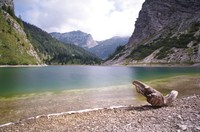
Continuing in photo blog posts, here is our last vacation - in the beginning of September we've traveled around Slovenia, mostly for hiking, but we've enjoyed other things as well. Our first short hike was around lake Bled, which is nice lake placed in between mountains: Afternoon we had some time left, so we've walked around Peri nik waterfall, which was close to Mojstrana where we were accommodated (if you will be looking for accommodation there, check River Cottage): Then it came time for some serious hiking and we went up to the mountains, in the end we did not make it to Triglav because of weather, but we've gone on Cmir: After that we had to relax a bit and visited Ljubljana and ended up near kocjan Caves which we've visited on next day: After relaxing evening in Saksida winery, it was time to go back to mountains. We've started visiting Tolmin gorges, which is nice natural area worth short detour: Last days we've spent near Bovec and hiked around a bit, one of the things we've enjoyed most is trip to Krnsko lake: This was definitely not our last trip to Slovenia as there are still some places we want to visit :-).

Filed under: English Photography Travelling 2 comments Flattr this!

2 October 2013

Joey Hess: insured

Here in the US, the Affordable Care Act is finally going into effect, with accompanying drama. I managed to get signed up today at healthcare.gov. After not having health insurance since 2000, I will finally be covered starting January 1 2014. Since my income is mosty publically known anyway, I thought it might be helpful to blog about some details. I was uninsured for 14 years due to a combination of three factors:

  1. Initially, youthful stupidity and/or a perfectly resonable cost/benefit analysis. (Take your pick.)
  2. Due to the US health insurance system being obviously broken, and my preference to avoid things that are broken. Especially when the breakage involved insurers refusing to cover me at any sane level due to a minor and easily controlled pre-existing condition.
  3. Since I'm not much motivated by income levels, and am very motivated to have time to work on things that are important to me, my income has been on average pretty low, and perhaps more importantly, I have intentionally avoided being a full-time employee of anyone at any point in the past 14 years (have rejected job offers), and so was not eligible for any employee plans which were the only reasonable way to be covered in the US. (See point #2.)
So, if you're stuck waiting in line on healthcare.gov (is this an entirely new online experience brought to us by the US government?), or have seen any of the dozen or so failure modes that I saw just trying to register for a login to the site, yeah, it's massively overloaded right now, and it's also quite broken on a number of technical levels. But you can eventually get though it. Based on some of the bugs I saw, it may help to have an large number of email addresses and use a different one for each application attempt. It also wouldn't hurt to write some programs to automate the attempts, because otherwise you may have to fill out the same form dozens of times. And no, you can't use "you+foo@bar.com" for your email; despite funding the development of RFC-822 in the 80's, the US government is clueless about what consititutes a valid email address. But my "favorite" misfeature of the site is that it refuses to let you enter any accented characters, or characters not in the latin alphabet when signing up. Even if they're, you know, part of your name. (Welcome back to Ellis Island..) I want to check the git repository to see if I can find the backstory for these and other interesting technical decisions, but they have forgotten to push anything to it for over 3 months. The good news is that once you get past the initial signup process, and assuming you get the confirmation mail before the really short expiration period of apparently less than 1 hour (another interesting technical choice, given things like greylisting), the actual exchange is not badly overloaded, and nor is it very buggy (comparatively). I was able to complete an application in about an hour. The irony is that after all that, I was only able to choose from one health insurer covering my area on the so-called "exchange". (Blue Cross/Blue Shield) I also signed up for dental insurance (it was a welcome surprise that the site offers this at all) and had a choice of two insurers for that. The application process was made more uncertian for me since I have no idea what I'll end up doing for money once my current crowdsourced year of work is done. The site wants you to know how much income you'll have in 2014, and my guess is anywhere between $6000 (from a rental property) and about what I made this year (approx $25000 before taxes). Or up, if I say, answered the Google pings. The best choice seemed to be to answer what I made this year, which is also close to what I made last year. So, I'll be paying around $200/month for a combination of not very good health insurance, and not very good dental insurance. There is around $750/year of financial aid to people at my guesstimated 2014 income level, which would drop that to $140/month, but I will let them refund me whatever that turns out to be in a lump sum later instead. For comparison, I am lucky to spend rather less renting a three bedroom house situated in 25 acres of woods.. It's strange to think that all of this is an improvement to the system here in the US, especially given all the better options that could have been passed instead, but it seems that it probably is. Especially when I consider the many people around me who are less fortunate than myself. If you'd like a broader perspective on this, see Tobias Buckell's "American healthcare was already socialized by Reagan, we re just fighting about how to pay for it".

Matthew Garrett: The state of XMir

XMir's been delayed from Ubuntu 13.10. The stated reason is that multi-monitor support isn't sufficiently reliable. That's true, but it's far from the only problem that XMir still has:

It's clear that XMir has turned into a larger project than Canonical had originally anticipated, but that's hardly surprising. There's only one developer with previous X experience working on it full-time, and the announced schedule provided no opportunity to deal with unexpected problems. As if that weren't enough, there's obvious conflict between Ubuntu Desktop and Ubuntu Phone when it comes to developer time and required functionality. The one hardware vendor who's willing to take a public stand has demonstrated that they have no interest in supporting XMir, despite Canonical assuring people that they were already engaging in productive negotiations with GPU manufacturers.

Multiple monitor support may be the single most obvious feature where XMir is lacking, but it's not the only one. Technically and politically, this code is a long way from being ready for prime time. Without significant community contribution, Canonical need to focus on prioritising it appropriately rather than expecting a tiny number of developers to perform miracles. Or, alternatively, they could just drop XMir entirely and focus on Unity 8.

comment count unavailable comments

1 October 2013

Michal &#268;iha&#345;: Trip to Switzerland

After I was at DebConf 13, we took opportunity and made short trip through Switzerland. Even the DebConf itself brought some nice opportunities to take pictures, especially in the morning: Then there was a day trip to Creux du Van, which is a wonderful location: After DebConf, we've traveled to visit our friend and made some trips. The one I really enjoyed was around Luzerne and to mount Pilatus: An while being in north of Switzerland, we simply had to see Rheinfall:

Filed under: English Photography Travelling 0 comments Flattr this!

Next.

Previous.