Search Results: "ean"

28 April 2013

Vasudev Kamath: Tribute to Beloved Teacher

Today I'm writing this blog with saddened heart. My mentor and a best friend Dr.Ashokkumar is no more. He died yesterday after fighing with Lymph Node cancer. Ashokkumar or Ashok sir that is how we all students used to address him, was a Professor in Information Science Engineering in NMAM Institue of Technology and recently transferred to Computer Science Engineering Departement. My last meeting him with him was last year December during which he was looking every bit okay other than he had knee pain because of which he couldn't walk freely. But I never imagined that it will be my last meeting with him. Ashok sir was also behind the FLOSS event that took place in NMAM Institute of Technology including MiniDebconf 2011 which saw 2 of the foreign DD's Christian Perrier and Jonas Smedegaard. It was because of his first organized FLOSS event which I volunteered called Linux Habba I entered into the FLOSS world. This means its because of him that I started my FLOSS world journey and reached to my current level. Also it was because of his motivation I started writing this blog which I continue till this day.
I whole heartedly thank Ashok sir for teaching me guiding me and motivating me during my difficult times. You will always be remembered through out my life. May your soul Rest In Peace.
Here are the 2 pics of Ashok sir taken during Minidebconf (Credits: Christian Perrier and Kartik Mistry) Ashokkumar with Jonas and Me Ashokkumar during inaugaration of MiniDebconf with Christian and Kartik on stage Good bye Sir :-(

Vagrant Cascadian: intro

For many years, I've been meaning to write about various things in some sort of online journal. I'd like to tie together various parts of my life, such as my technical work in Debian, LTSP and other Free Software, Software Libre, and Open Source Software projects, but also my passion for Aikido, and other ideas that inspire me, such as pleaching. As with many new things, I struggled to name this journal. I even struggled with calling it a journal as opposed to a Blog, though blog always sounded a bit... brief and kind of blunt for my liking. So journal it is. But I still didn't even really have a name for it. Recently introduced to the concept of pleaching, essentially weaving living, growing branches togther, I was drawn to the concept, but admittedly, the sound of "pleach" or "pleaching" also carried some hint of harshness in it. Looking into synonyms, weaving, plait, braid... braid, yes, I typically wear my hair in a pair of braids... It has enough meaning to get by on... But that's too plain... so I borrowed from Spanish to come up with "trenza". So, thankfully to all involved, most of these posts will probably not be about picking names for things. I have a bit of backlog about some technical projects I've worked on that I'd like to write about, so I'll start with a few of those...

26 April 2013

Russ Allbery: WebAuth 4.5.0

Time to finally release three months of work! This is a very large feature release for the multifactor support in WebAuth and for the integration with the user information service, which is the way that WebAuth interacts with local site policy. (Currently, you still have to write your own to a well-defined protocol, although we do hope to provide Perl modules to help with this in the future.) The major driving motivation for this release is to add the infrastructure required to set long-lived persistent cookies in a browser that contribute factors to authentications, which allows WebAuth to support "remember this device" functionality and to only require multifactor from devices from which a user has not previously authenticated. This includes a new token type, new attributes the user information service can send (including a way to invalidate such tokens), and new data that's sent back to the user information service. The user information service also now has the ability to add arbitrary additional factors to the current authentication, something that is intended to provide a hook for a local help desk to bypass multifactor for a user for some time if required. This release also contains substantial contributions by Benjamin Coddington at UVM to improve multifactor interactions, including sending the OTP type back to the user information service if WebLogin knows it, a mechanism for the user information service to communicate a message to the user that's displayed on the multifactor login page, opaque state that can be sent back and forth between WebLogin and the user information service, and the ability for the user information service to add specific authentication factors to the required set for a particular authentication. Other improvements in multifactor handling include the ability to set a lifetime on factors obtained via OTP login, a fix for a long-standing bug where an initial multifactor factor would satisfy a session requirement for random multifactor, and logging of even ignored errors when contacting the user information service. There are other changes too. This release touches almost every part of WebAuth. The change to WebAuthForceLogin in 4.4.0 was reverted since, on further consideration, the original semantics seemed more useful. Password change handling in WebLogin was fixed (it's been broken for some time). Apache 2.4 error logging for all modules is much improved, and mod_webauth and mod_webkdc now produce better error logs for all versions of Apache. And WebLogin now communicates password expiration times to its templates in seconds since epoch in addition to a pre-formatted English time for better localization support. William Orr contributed a new WebAuthLdapOperationalAttribute directive for mod_webauthldap that allows it to query operational attributes and include them in the environemnt. There are two backward-incompatible changes for WebLogin. First, WebAuth now supports a user checkbox indicating either to remember their login on that device or to not remember their login (local site templates can present it either way). However, proper implementation of this matching the normal expected wording of "remember me on this device" required changing the default, so a straight upgrade from an earlier version will result in no single sign-on. To preserve behavior, either a template change to add the checkbox (checked by default) or a configuration change are required. Second, support for getting password expiration times directly with remctl to a kadmin-remctl backend has been removed in favor of using data from the user information service by way of the WebKDC. Finally, I got to do a lot of cleanup of the API, fix diagosis of undef passed to Perl XS functions, and fixed a compilation error with Heimdal. You can get the latest release from the official WebAuth distribution site or from my WebAuth distribution pages.

Vincent Sanders: When you make something, cleaning it out of structural debris is one of the most vital things you do.

Collabora recently had a problem with a project's ARM build farm. In a nice change of pace it was not that the kernel was crashing, nor indeed any of the software or hardware.
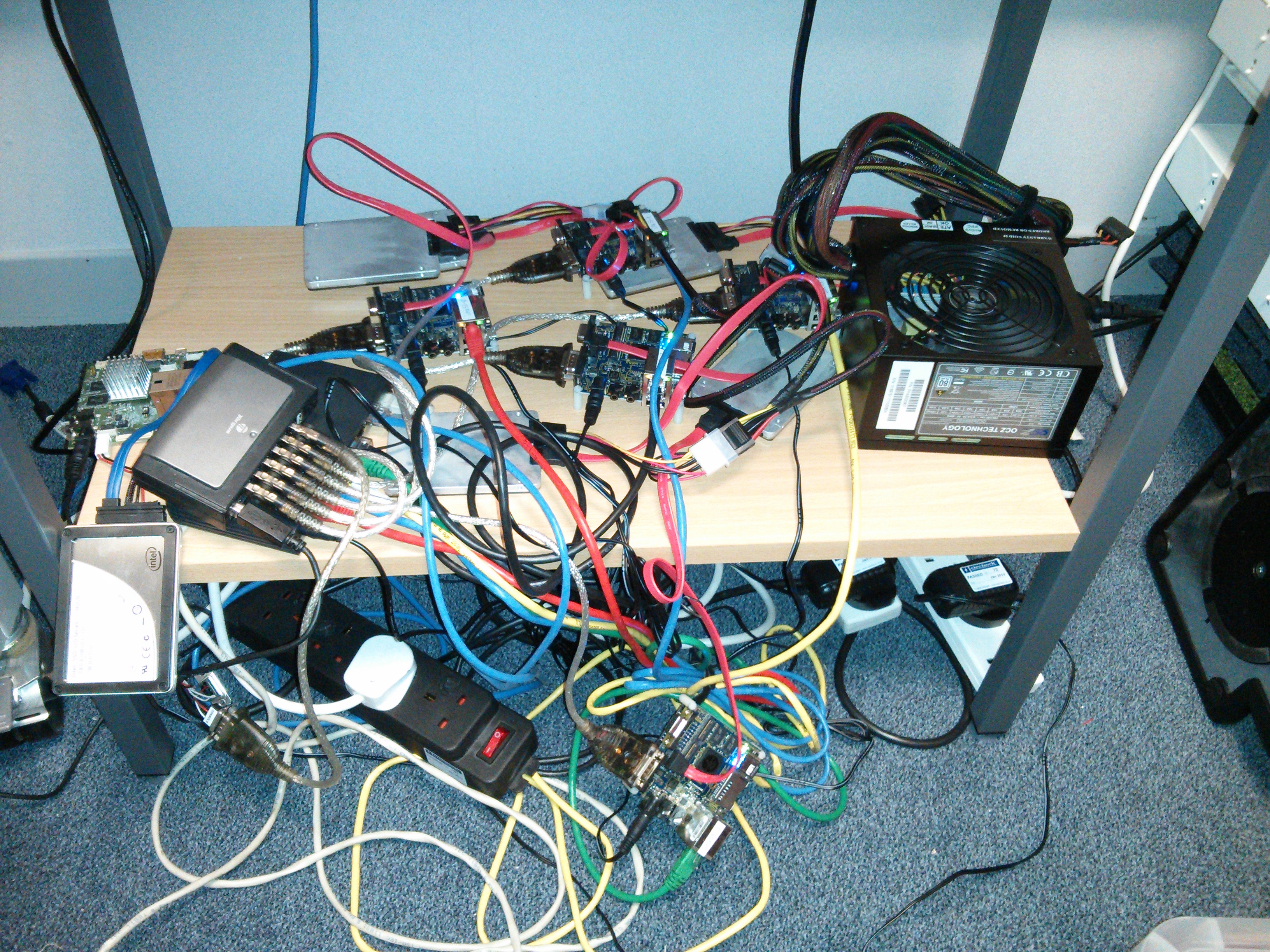
The ProblemInstead our problem was our build farm could best be described as "a pile of stuff" and we wanted to add more systems to it and have switched power control for automated testing.

Which is kinda where the Christopher Alexander quote comes into this. I suggested that I might be able to come up with a better, or at least cleaner, solution.
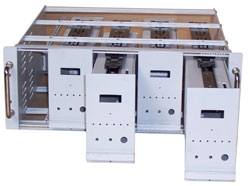
The IdeaA subrack with sub modulesPrevious experience had exposed me to the idea of using 19 inch subracks for mounting circuits inside submodules.

I originally envisaged the dev boards individually mounted inside these boxes. However preliminary investigation revealed that the enclosures were both expensive and used a lot of space which would greatly increase the rack space required to house these systems.

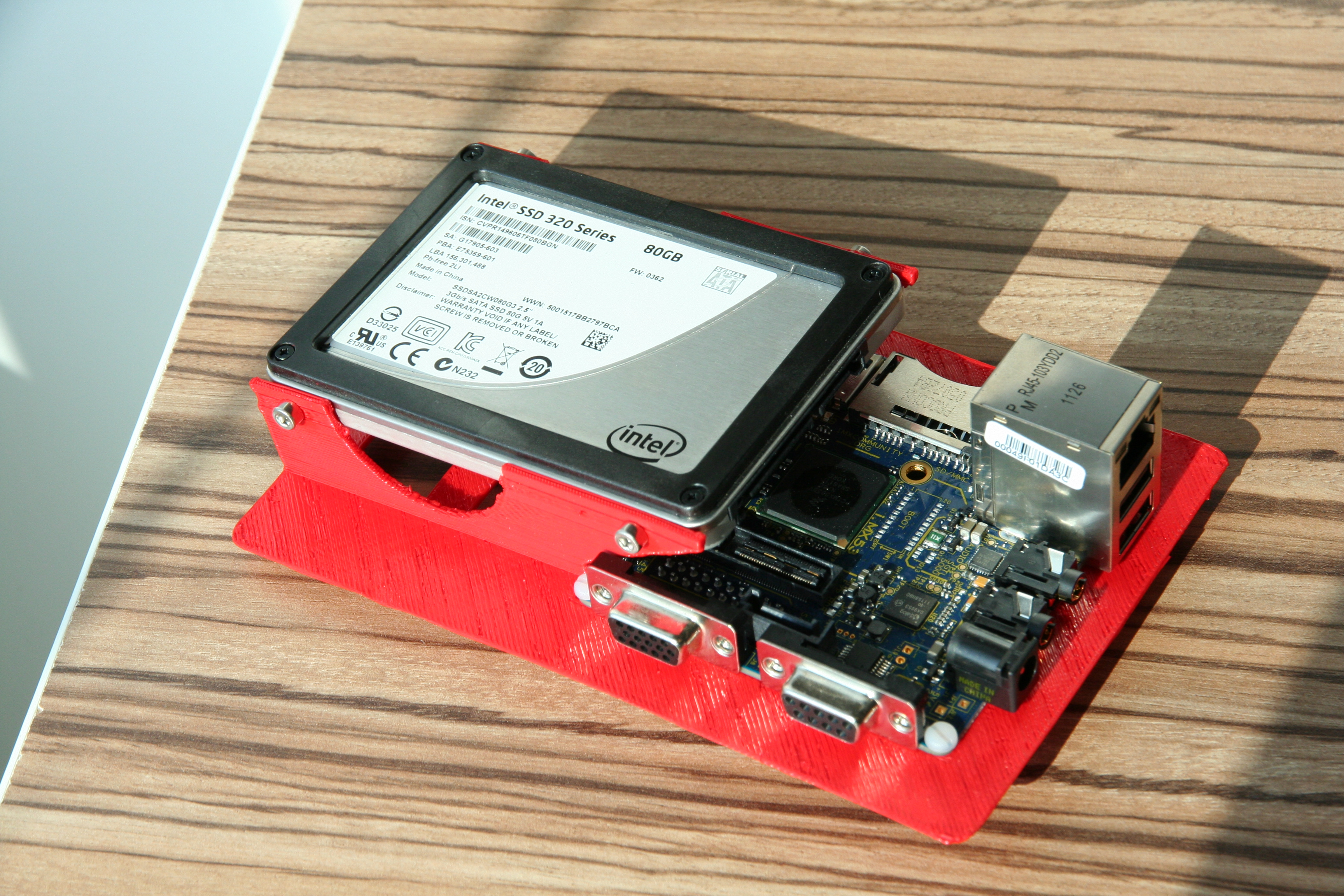
imx53 QSB eurocard carrier
I decided to instead look at eurocard type subracks with carriers for the systems. Using my 3D printer I came up with a carrier design for the imx53 QSB and printed it. I used the basic eurocard size of 100mm x 160mm which would allow the cards to be used within a 3U subrack.

Once assembled it became apparent that each carrier would be able to share resources like power supply, ethernet port and serial console via USB just as the existing setup did and that these would need to be housed within the subrack.
The Prototype
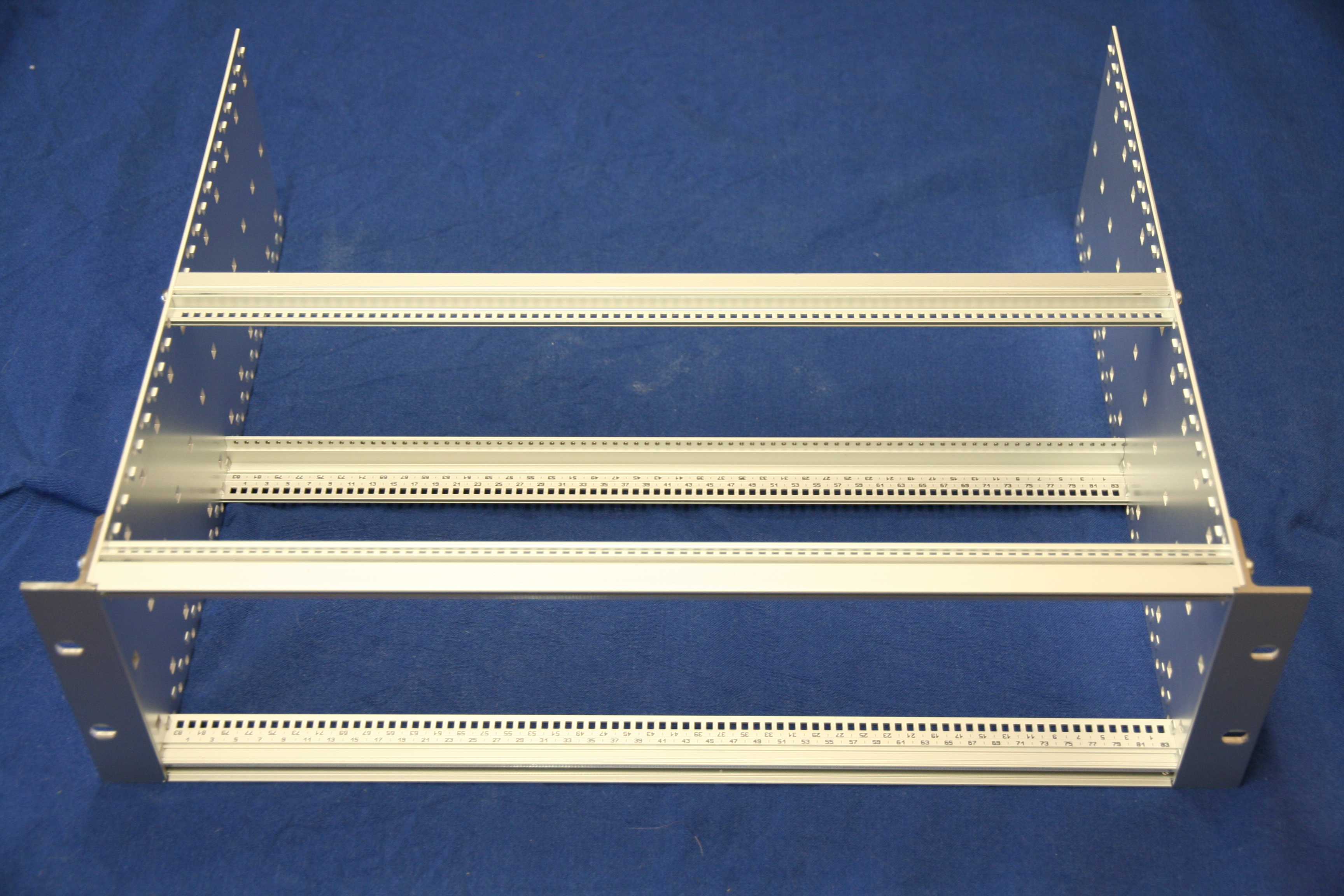
The carrier prototype was enough to get enough interest to allow me to move on to the next phase of the project. I purchased a Schroff 24563-194 subrack kit and three packs of guide rails from Farnell and assembled it.

Initially I had envisaged acquiring additional horizontal rails from Schroff which would enable constructing an area suitable for mounting the shared components behind the card area.

Rear profile for Schroff subrackUnfortunately Schroff have no suitable horizontal profiles in their catalog and are another of those companies who seem to not want to actually sell products to end users but rather deal with wholesalers who do not have their entire product range!

Printed rear profile for Schroff subrack
Undaunted by this I created my own horizontal rail profile and 3D printed some lengths. The profile is designed to allow a 3mm thick rear cover sheet attached with M2.5 mounting bolts and fit rack sides in the same way the other profiles do.

At this point I should introduce some information on how these subracks are dimensioned. A standard 19 inch rack (as defined in IEC 60297) has a width of 17.75 inches(450.85mm) between the vertical posts. The height is measured in U (1.75 inches)

A subrack must obviously fit in the horizontal gap while providing as much internal space as possible. A subrack is generally either 3 or 6 U high. The width within a subrack is defined in units called HP (Horizontal Pitch) which are 0.2 inches(5.08 mm) and subracks like the Schroff generally list 84 usable HP.

However we must be careful (or actually just learn from me stuffing this up ;-) as the usable HP is not the same thing as the actual length of the horizontal rails! The enclosures actually leave and additional 0.1 inch at either end giving a total internal width of 85HP (17 inches, 431.8 mm) which leaves 0.75 inches for the subrack sides and some clearance.

The Schroff subrack allows eurocards to be slotted into rails where the card centre line is on HP boundaries, hence we describe the width of a card in the slot in terms of HP
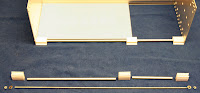
I cannot manufacture aluminium extrusions (I know it is a personal failing) nor produce more than 100 mm long length of the plastic profile on my printer.

Even if full lengths are purchased from a commercial service (120 euros for a pair including tax and shipping) the plastic does not have sufficient mechanical strength.

The solution I came up with was somewhat innovative, as an alternative a M5 bolt into a thread in the aluminium extrusion I used a 444mm long length of 4mm threaded rod with nuts at either end. This arrangement puts the extrusion under compression and gives it a great deal of additional mechanical strength as the steel threaded rod is very strong.

Additionally to avoid having to print enough extrusion for the entire length I used some 6mm aluminium tube as a spacer between 6HP(30.48mm) wide sections of the printed extrusion.

It was intended to use a standard modular PC power supply which is 150mm wide which is pretty close to 30HP (6 inches) so it was decided to have a 6HP section of rail at that point to allow a rear mounting plate for the PSU to be attached.

This gives 6HP of profile, 21HP(106.68mm) of tube spacer, 6HP of profile, 46HP(233.68 mm) of tube spacer and a final 6HP profile summing to our total of 85HP. Of course this would be unnecessary if a full continuous 85HP rail had been purchased, but 6 of 6 HP long profile is only 51 euro a saving of 70 euro.

To provide a flat area on which to mount the power switching, Ethernet switch and USB hubs I ordered a 170 x 431 mm sheet of 3mm thick aluminium from inspiredsteel who, while being an ebay company, were fast, cheap and the cutting was accurate.

Do be sure to mention you would prefer it if any error made the sheet smaller rather than larger or it might not fit, for me though they were accurate to the tenth of a mm! If you would prefer the rear section of the rack to be enclosed when you are finished, buy a second sheet for the top. For my prototype I only purchased a 170 x 280mm sheet as I was unsure if I wanted a surface under the PSU (you do, buy the longer sheet)
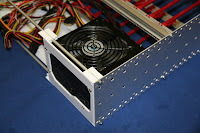
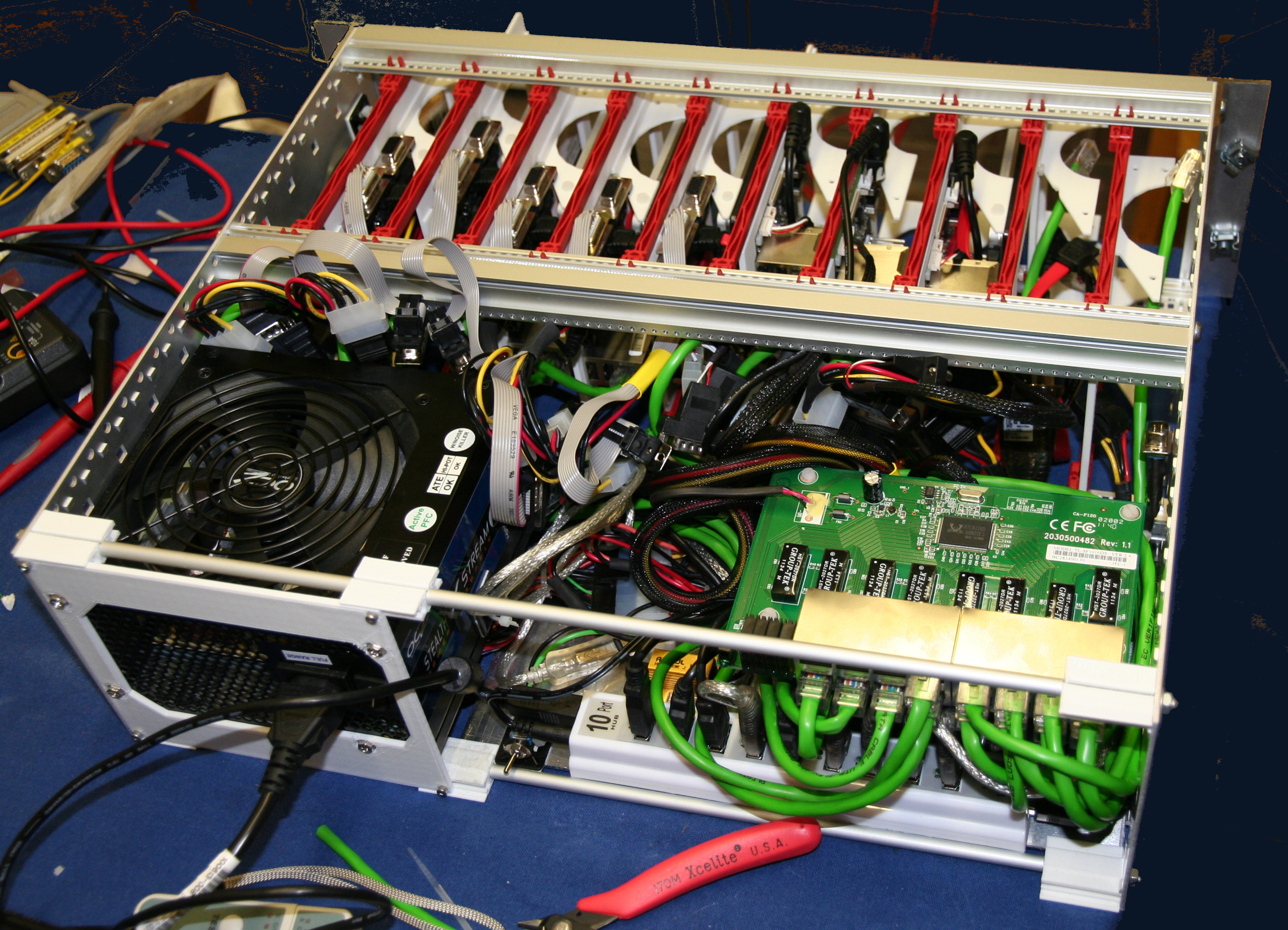
PC power supply mounted to back plateMounting the PSU was a simple case of constructing a 3 mm thick plate with the correct cutouts and mounting holes for an ATX supply. Although the images show the PSU mounted on the left hand side of the rack this was later reversed to improve cable management.

The subrack needed to provide Ethernet switch ports to all the systems. A TP-Link TL-SF1016DS 16-Port 10/100Mbps Switch was acquired and the switch board removed from its enclosure. The switch selected has an easily removed board and is powered by a single 3.3V input which is readily available from the ATX PSU.

Attention now returned to the eurocard carriers for the systems, the boards to be housed were iMX53 QSB and iMX6 SABRE Lite and a Raspberry Pi control system to act as USB serial console etc.

The carriers for both main boards needed to be 8HP wide, comprised of:
Although only 38 mm this is 7.5HP and fractions of an HP are not possible with the selected subrack.

With 8HP wide modules this would allow for ten slots, within the 84 usable HP, and an eleventh 4HP wide in which the Raspberry Pi system fits.

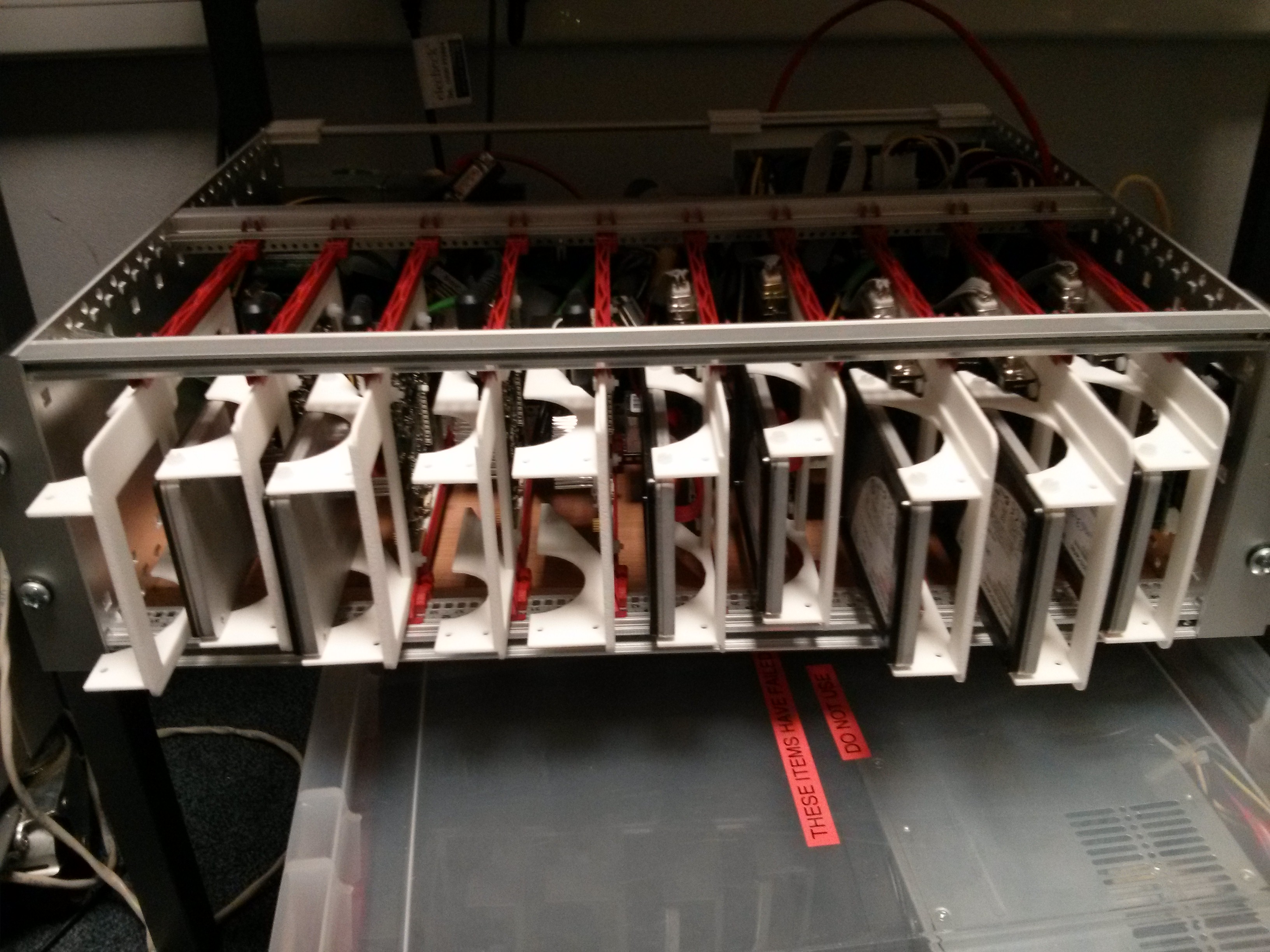
iMX6 SABRE Lite eurocard carrierCarrier designs for both the i.MX53 QSB and the i.MX6 SABRE Lite boards were created and fabricated at a professional 3D print shop which gave a high quality finish product and removed the perceived risk of relying on a personal 3D printer for a quantity of parts.

This resulted in changes in the design to remove as much material as possible as commercial 3D services charge by the cubic cm. This Design For Manufacture (DFM) step removed almost 50% from the price of the initial design.

i.MX53 QSB carriers with wiring loom
The i.MX6 design underwent a second iteration to allow for the heatsink to be mounted and not mechanically interfere with the hard drive (although the prototype carrier has been used successfully for a system that does not require a hard drive). The lesson learned here is to be aware that an design iteration or two is likely and that it is not without cost.

The initial installation was to have six i.MX53 and two i.MX6 this later changed to a five/four split, however the carrier solution allows for almost any combination, the only caveat (discovered later) is the imx53 carriers should be to the right hand side with the small 4HP gap at that end as they have a JTAG connector underneath the board which otherwise foul the hard drive of the next carrier.

Racked cards showing unwanted cable tails
A wiring loom was constructed for each board giving them a connector tail long enough to allow them to be removed. This was the wrong approach! if you implement this design (or when I do it again) the connector tails on the wiring loom should present all the connections to the rear at the same depth as the Ethernet connection.

The rack cables themselves should be long enough to allow the slides to be removed but importantly it is not desirable to have the trailing cable on the cards. I guess the original eurocard designers figured this out as they designed the cards around the standard fixed DIN connectors at the back of the card slots.

USB relay board with wiring loom attached
We will now briefly examine a misjudgement that caused the initially deployed solution to be reimplemented. As the design was going to use USB serial converters to access the serial console a USB connected relay board was selected to switch the power to each slot. I had previously used serial controlled relay boards with a USB serial convertor however these were no longer available.

Initial deployment with USB controlled relay board
All the available USB relay boards were HID controlled, this did not initially seem to be an issue and Linux software was written to provide a reasonable interface. However it soon became apparent that the firmware on the purchased board was very buggy and crashed the host computer's USB stack multiple times.

Deployed solutionOnce it became apparent that the USB controlled power board was not viable a new design was conceived. As the Ethernet switch had ports available Ethernet controlled relay boards were acquired.

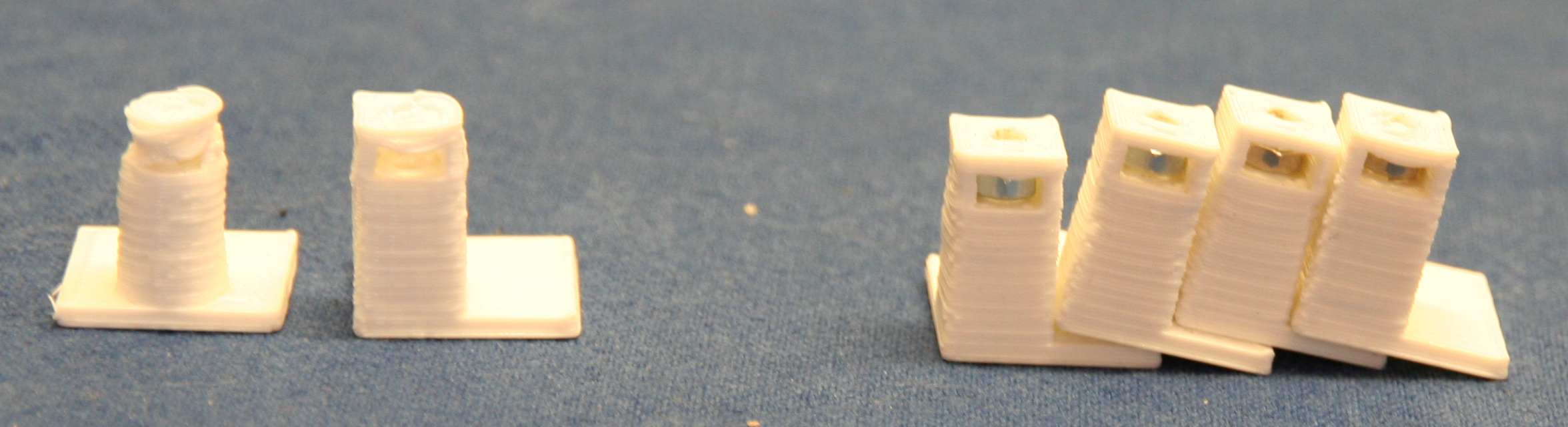
Evolution of 3mm PCB pillars
It did prove necessary to design and print some PCB support posts with M3 nut traps to allow the relay boards to be easily mounted using double sided adhesive pads.

By stacking the relay boards face to face and the Ethernet switch on top separated using nylon spacers it was possible to reduce the cable clutter and provide adequate cable routing space.

A busbar for Ground (black) and unswitched 12V (yellow) was constructed from two lengths of 5A chock block.

An issue with power supply stability was noted so a load resistor was added to the 12V supply and an adhesive thermal pad used to attach it to the aluminium base plate.

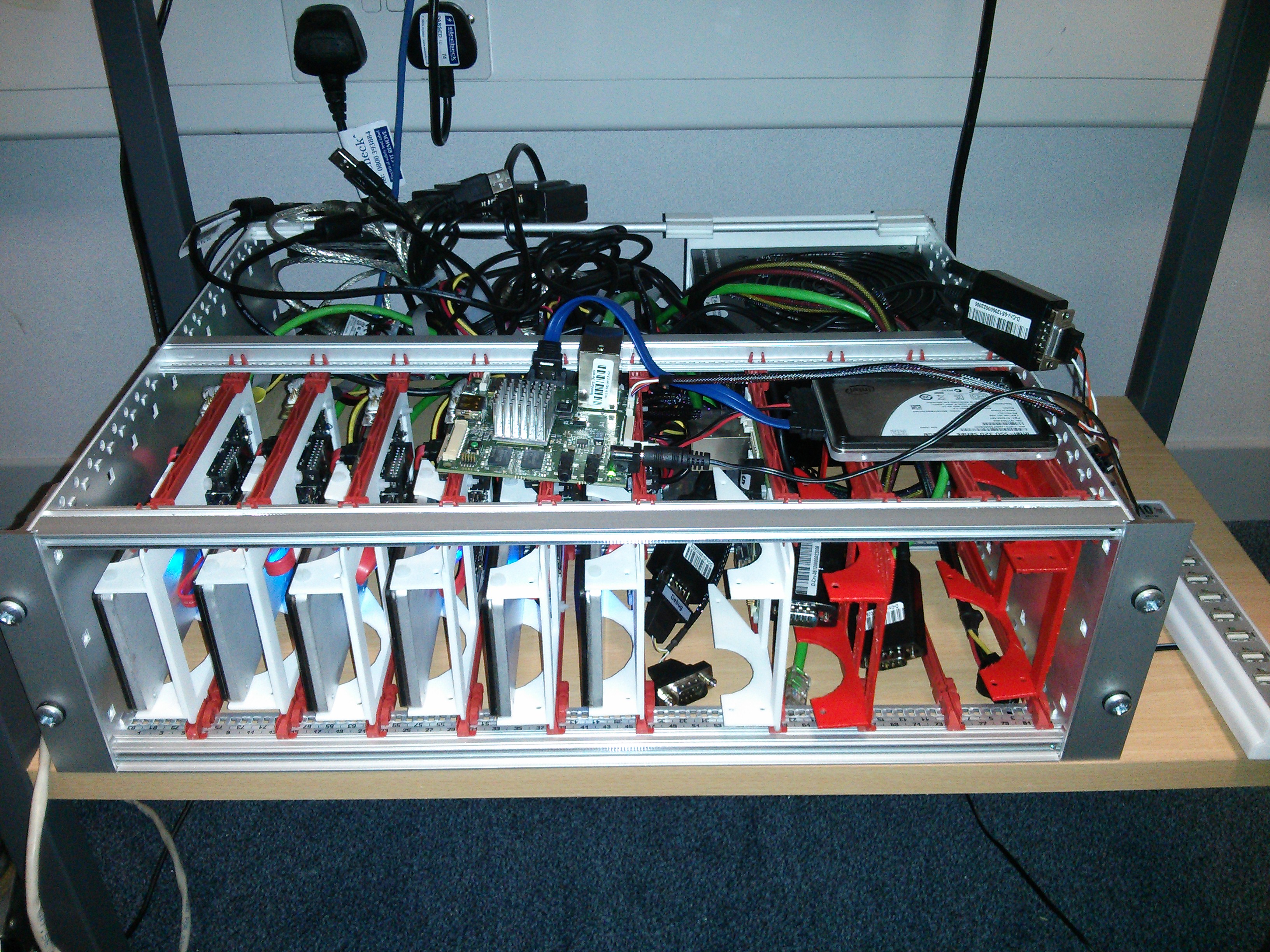
Completed redesign
It was most fortunate that the ethernet switch mounting holes lined up very well with the relay board mounting holes allowing for a neat stack.

This second edition is the one currently in use, it has proved reliable in operation and has been successfully updated with additional carriers.

The outstanding issues are mainly centered around the Raspberry Pi control board:
  • Needs its carrier fitting. It is currently just stuck to the subrack end plate.
  • Needs its Ethernet cable replacing. The existing one has developed a fault post installation.
  • Needs the USB hub supply separating from the device cable. The current arrangement lets the hub power the Pi which means you cannot power cycle it.
  • Connect its switched supply separately to the USB hub/devices.
Shopping listThe final bill of materials (excluding labour and workshop costs) which might be useful to anyone hoping to build their own version.

Prices are in GBP currency converted where appropriate and include tax at 20% and delivery to Cambridge UK and were correct as of April 2013.

The purchasing was not optimised and for example around 20GBP could be saved just by ordering all the shapeways parts in one order.
Base subrack
ItemSupplierQuantityLine Price
Schroff 24563-194 subrack kitFarnell141.28
Schroff 24560-351 guide railsFarnell313.65
Schroff rack rear horizontal railShapeways2100.00
1000mm length of 4mm threaded rodB and Q11.48
170mm x 431mm x 3mm Aluminium sheetinspired steel240.00
PSU mounting plateShapeways135.42
PCB standoffShapeways422.30
160mm Deep Modular PC supplyCCL155.76
TP-Link TL-SF1016DS 16-Port 10/100Mbps-SwitchCCL123.77
8 Channel 16A Relay Board Controlled Via EthernetRapid2126.00
Raspberry PiFarnell126.48
USB Serial convertersCCL1037.40
10 port strip style USB HUBEbay17.00
Parts for custom Ethernet cablesRS1326.00
Parts for custom molex power cables (salvaged from scrap ATX PSU)Workshop1111.00
33R 10W wirewound resistor for dummy loadRS11.26
24pin ATX female connector pre-wiredMaplin12.99
Akasa double sided thermal padMaplin15.00
Small cable tie basesMaplin16.49
Miscellaneous cable, connectors, nylon standoffs, solder, heatshrink, zip ties, nuts, washers etc. Workshop120.00
Total for subrack603.28

The carriers are similarly not optimally priced as over five GBP each can be saved by combining shipping on orders alone. Also the SSD drive selection was made some time ago and a newer model may be more suitable.
i.MX53 QSB carrier
ItemSupplierQuantityLine Price
i.MX53 QSBFarnell1105.52
Intel 320 SSD 80GCCL1111.83
Carrier boardShapeways130.00
combined sata data and power (15 to 20cm version)EBay15.00
Low profile right angle 5.5mm x 2.1mm barrel jackEBay10.25
Parts for 9pin serial cable extensionRS15.00
Miscellaneous solder, heatshrink, nylon nuts, bolts and washersWorkshop15.00
Total for carrier262.60

i.MX6 SABRE Lite carrier
ItemSupplierQuantityLine Price
i.MX6 SABRE LiteFarnell1128.06
Intel 320 SSD 80GCCL1111.83
Carrier boardShapeways135.00
combined sata data and power (15 to 20cm version)EBay15.00
Low profile right angle 5.5mm x 2.1mm barrel jackEBay10.25
Parts for 9pin serial cable modificationRS12.00
Miscellaneous solder, heatshrink, nylon nuts, bolts and washersWorkshop15.00
Total for carrier287.14
ConclusionThe solution works and in a 3U high 355mm deep subrack ten ARM development boards can be racked complete with local ethernet switching, power control and serial consoles.

Deployed system in situ configured as a build and test farm
The solution is neat and provides flexibility, density and reproducibility the "pile of stuff" solution failed to do.

For current prototype with nine filled slots the total cost was around 3000GBP or around 330GBP per slot which indicates a 100GBP per slot overhead over the "pile of stuff" solution. These figures omit the costs of the engineer and workshop time, which are estimated at an additional 1500GBP. Therefore a completed rack, fully filled with i.MX6 carriers costs around 5000GBP

Density could be increased if boards with lower height requirements were used however above twelve units there issues with Ethernet switch, power switch and USB port availability become a factor. For Example the 16 port Ethernet switch requires a port for uplink, one for each relay board and one for the console server which leaves only 12 ports for systems.

Addressing the outstanding issues would result in a much more user friendly solution. As the existing unit is in full time use and downtime is not easily scheduled for all ten systems, the issues are not likely to be fixed on the prototype and would have to be solved on a new build.

The solution is probably not suitable for turning into a product but that was not really the original aim. A commercial ARM blade server using this format would almost certainly use standard DIN connectors and a custom PCB design rather than adapting existing boards.

Ian Campbell: Generating Random MAC Addresses

Working with virtualisation I find myself occasionally needing to generate a random MAC address for use with a virtual machine. I have a stupid little local script which spits one out, which is all fine and dandy for my purposes. However this week one of my colleagues was writing a wiki page and needed to include instructions on how to set the MAC address on the Arndale board. He wanted to include a shell snippet to generate one and I suggested that there must be websites which will generate you a suitable address. But when I came to look we found that not a single one of the half a dozen site which I looked at handled the locally administered or multicast bits correctly, meaning that they would randomly generate either multicast addresses or addresses using assigned OUI (or both). Using a random OUI may not cause too much trouble in practice but using a multicast address is sure to lead to strange behaviour, and in any case it's kind of lame. So last night I sat down and wrote a quick hack cgi script to generate random addresses and tonight I deployed it at: http://www.hellion.org.uk/cgi-bin/randmac.pl. This is where the world and his dog leaves a comment pointing me to the existing service my searches missed...

Steve Kemp: Modern console mail clients?

I've recently started staging upgrades from Squeeze to Wheezy. One unpleasant surprise was that the mutt-patched package available to Debian doesn't contain the "sidebar-new-only" patch. This means I need to maintain it myself again, which I'd rather avoid. Over time I've been slowly moving to standard Debian systems, trying to not carry too many local perversions around. Unfortunately if you've kept all your mail since 1994 you have many mailboxes. having mutt-patched available at all, with the sidebar patch, is a great timesaver. But I don't want to see mailboxes I'm never going to touch; just mailboxes with new mail in them. Also I find the idea of having to explicitly define mailboxes a pain. Just run inotify on ~/Maildir and discover the damn things yourself. Please computer, compute! If you divide up "mail client" into distinct steps it doesn't seem so hard: Obviously there is more to it than that. Sending mail? exec( sendmail ). Filtering mail? procmail/sieve/etc. Editing mail? exec(vim). I'm sure if I were to start a core of a program, suitable for myself, would be simple enough. Maybe with lua, maybe with javascript, but with a real language at the core. Anyway I've thought this before, and working with quilt and some ropy patches has always seemed like the way to go. Maybe it still is, but I can dream. (PS. Sup + Notmuch both crash on my archives. I do not wish to examine them further. Still some interesting ideas. It should be possible to say "maildirs are tags; view "~/Maildir/.livejournal.2003" and ~/Maildir/.livejournal.2007 at the same time. Why just a single directory in the "index-view? So 1994.) Disjointed posts R Us. Obquote: "How hard could it be?" -- Patrick.

Lior Kaplan: The commit police: learning for recent reference mistakes

Continuing the previous post about commits and bugs, I d like to review some mistakes I saw recently. Mistakes do happen, but mentioning them here is meant to teach others and hopefully to reduce similar ones in the future. This post isn t about shaming the authors/commiters. Also, the points I highlight are what I consider as a mistakes or problems, other people might think differently.
  1. Mentioning two bugs in one commit message, which our system doesn t support right now. So the second bug doesn t get the commit notification, and that should be done manually (example: commit 2933935 and fdo#53278).
  2. Referencing gerrit changes as part of the commit message (example: commit 87f185d). Giving references as part of the commit is great and helpful, but I would prefer to see the reference to the actual commit and not to its review process. This is meaningful when you search the log. If the followup change is suggested when the first change is still in review it should be combined, otherwise it already have a commit to reference.
  3. Following up a commit, and not mentioning the bug it references (example: commit 87f185d). In this specific case, the we re talking about a meta bug for translating comments from German to English (fdo#39468), so no harm done. But this important when you want to cherry pick a fix for a bug to other branches and might forget the follow up commits. It s also relevant to more technical meta bugs (example: fdo#62096).
  4. Referencing a mailing list which reference a commit and a bug instead of referencing them directly (commit 21fea27, fdo#60534). This bug shows very well why correct referencing is important, a commit was made to fix the bug, a follow up commit was done without proper reference, and than the first commit was reverted. No one involved in trying to fix that specific bug knew about the follow up commit as it wasn t documented anywhere.
  5. Referencing bugs though full bug URL instead of the right format (example: commit e1f6dac). Also the bug is referenced in the commit in the body of the message instead of the first line (header) which is more visible.
  6. Referencing non existing bugs (example: commit 3a4534b). Which got a manual notification in the bug by the comitter (fdo#33091).
  7. Using shortening services URL as part of commit messages (example: commit 86f8fba). There s no way to know to what the reference is without using the service, which in this case was leading to a post on one of the projects mailing list. There isn t any problem giving the direct URL to the list s archive. It s interesting whether we should link to our URL and is it OK to use other external services who also archive our mailing lists (example: commit e83990a).
To conclude, having references in commit message is really helpful, but please reference the right resource to help people find it easily and to let our automated services parse it.
Filed under: LibreOffice

25 April 2013

David Bremner: Exporting Debian packaging patches from git, (redux)*

(Debian) packaging and Git. The big picture is as follows. In my view, the most natural way to work on a packaging project in version control [1] is to have an upstream branch which either tracks upstream Git/Hg/Svn, or imports of tarballs (or some combination thereof, and a Debian branch where both modifications to upstream source and commits to stuff in ./debian are added [2]. Deviations from this are mainly motivated by a desire to export source packages, a version control neutral interchange format that still preserves the distinction between upstream source and distro modifications. Of course, if you're happy with the distro modifications as one big diff, then you can stop reading now gitpkg $debian_branch $upstream_branch and you're done. The other easy case is if your changes don't touch upstream; then 3.0 (quilt) packages work nicely with ./debian in a separate tarball. So the tension is between my preferred integration style, and making source packages with changes to upstream source organized in some nice way, preferably in logical patches like, uh, commits in a version control system. At some point we may be able use some form of version control repo as a source package, but the issues with that are for another blog post. At the moment then we are stuck with trying bridge the gap between a git repository and a 3.0 (quilt) source package. If you don't know the details of Debian packaging, just imagine a patch series like you would generate with git format-patch or apply with (surprise) quilt. From Git to Quilt. The most obvious (and the most common) way to bridge the gap between git and quilt is to export patches manually (or using a helper like gbp-pq) and commit them to the packaging repository. This has the advantage of not forcing anyone to use git or specialized helpers to collaborate on the package. On the other hand it's quite far from the vision of using git (or your favourite VCS) to do the integration that I started with. The next level of sophistication is to maintain a branch of upstream-modifying commits. Roughly speaking, this is the approach taken by git-dpm, by gitpkg, and with some additional friction from manually importing and exporting the patches, by gbp-pq. There are some issues with rebasing a branch of patches, mainly it seems to rely on one person at a time working on the patch branch, and it forces the use of specialized tools or workflows. Nonetheless, both git-dpm and gitpkg support this mode of working reasonably well [3]. Lately I've been working on exporting patches from (an immutable) git history. My initial experiments with marking commits with git notes more or less worked [4]. I put this on the back-burner for two reasons, first sharing git notes is still not very well supported by git itself [5], and second Gitpkg maintainer Ron Lee convinced me to automagically pick out what patches to export. Ron's motivation (as I understand it) is to have tools which work on any git repository without extra metadata in the form of notes. Linearizing History on the fly. After a few iterations, I arrived at the following specification. Condition (4) suggests we want something roughly like git format-patch upstream..head, removing those patches which are only about Debian packaging. Because of (3), we have to be a bit careful about commits that touch upstream and ./debian. We also want to avoid outputting patches that have been applied (or worse partially applied) upstream. git patch-id can help identify cherry-picked patches, but not partial application. Eventually I arrived at the following strategy.
  1. Use git-filter-branch to construct a copy of the history upstream..head with ./debian (and for technical reasons .pc) excised.
  2. Filter these commits to remove e.g. those that are present exactly upstream, or those that introduces no changes, or changes unrepresentable in a patch.
  3. Try to revert the remaining commits, in reverse order. The idea here is twofold. First, a patch that occurs twice in history because of merging will only revert the most recent one, allowing earlier copies to be skipped. Second, the state of the temporary branch after all successful reverts represents the difference from upstream not accounted for by any patch.
  4. Generate a "fixup patch" accounting for any remaining differences, to be applied before any if the "nice" patches.
  5. Cherry-pick each "nice" patch on top of the fixup patch, to ensure we have a linear history that can be exported to quilt. If any of these cherry-picks fail, abort the export.
Yep, it seems over-complicated to me too. TL;DR: Show me the code. You can clone my current version from
git://pivot.cs.unb.ca/gitpkg.git
This provides a script "git-debcherry" which does the history linearization discussed above. In order to test out how/if this works in your repository, you could run
git-debcherry --stat $UPSTREAM
For actual use, you probably want to use something like
git-debcherry -o debian/patches
There is a hook in hooks/debcherry-deb-export-hook that does this at source package export time. I'm aware this is not that fast; it does several expensive operations. On the other hand, you know what Don Knuth says about premature optimization, so I'm more interested in reports of when it does and doesn't work. In addition to crashing, generating multi-megabyte "fixup patch" probably counts as failure. Notes
  1. This first part doesn't seem too Debian or git specific to me, but I don't know much concrete about other packaging workflows or other version control systems.
  2. Another variation is to have a patched upstream branch and merge that into the Debian packaging branch. The trade-off here that you can simplify the patch export process a bit, but the repo needs to have taken this disciplined approach from the beginning.
  3. git-dpm merges the patched upstream into the Debian branch. This makes the history a bit messier, but seems to be more robust. I've been thinking about trying this out (semi-manually) for gitpkg.
  4. See e.g. exporting. Although I did not then know the many surprising and horrible things people do in packaging histories, so it probably didn't work as well as I thought it did.
  5. It's doable, but one ends up spending about a bunch lines of code on duplicating basic git functionality; e.g. there is no real support for tags of notes.
  6. Since as far as I know quilt has no way of deleting files except to list the content, this means in particular exporting upstream should yield a DFSG Free source tree.

Wouter Verhelst: Dear supplier,

I don't usually blog about work, but this time around, you maxed it. When I specifically ask you to not ship goods, I have good reasons for that. Specifically: Not Happy(tm)

Jeff Licquia: Linux Is Hard, Except When It Isn t

Online tech news site Ars Technica (which I recommend, by the way) recently reviewed the Dell XPS 13 Developer Edition. Its unique feature: it ships with Ubuntu Linux as the default operating system. This preload deal had a few unique properties: That last point deserves some explanation. A few vendors have grabbed a Windows computer they sell and allowed the option to preload Linux on it, but without support; you re on your own if it doesn t work in some way, which is likely. Essentially, they save you the time of wiping Windows off the box and doing a fresh install, but not much more. But this laptop comes out of Dell s Project Sputnik, a project to put out Linux machines for developers with a DevOps flavor, and they felt the machine had to work as well as their regular products. So they actually put effort and testing into getting the laptop to run Ubuntu well, with all the drivers configured properly and tweaked to support the machine s quirks, just like they do for Windows. And so, the review is surprised to learn that Ubuntu on the XPS 13, well, just works! It s even in the title of the review. Here s reviewer Lee Hutchinson s observations:
I ve struggled before with using Linux as my full-time operating environment both at work and at home. I did it for years at work, but it was never quite as easy as I wanted it to be on an older Dell laptop, keeping dual monitor support working correctly across updates required endless fiddling with xorg.conf, and whether or not it was Nvidia s fault was totally irrelevant to swearing, cursing Past Lee, trying desperately to get his monitors to display images so he could make his 10am conference call without having to resort to running the meeting on the small laptop screen.
And thence comes the astonishment: on this Linux laptop, everything just works. Most of the review is spent on the kinds of hardware features that distinguish this from other laptops: the keyboard is like this, the screen is that resolution, it has this CPU and this much RAM and so on. Some space is devoted to impressions of the default Ubuntu 12.04 install, and some space is given to the special DevOps software, which helps the developer reproduce the software environment on the laptop when deploying apps. But before all that, Hutchinson has to put in a dig:
It s an impressive achievement, and it s also a sad comment on the overall viability of Linux as a consumer-facing operating system for normal people. I don t think anyone is arguing that Linux hasn t earned its place in the data center it most certainly has but there s no way I d feel comfy installing even newbie-friendly Ubuntu or Mint on my parents computers. The XPS 13 DE shows the level of functionality and polish possible with extra effort, and that effort and polish together means this kind of Linux integration is something we won t see very often outside of boutique OEMs.
Of course, Windows is actually worse than Linux on the hardware front when you don t get it pre-installed. Imagine if more vendors put as much effort into preinstalled Linux as they did into preinstalled Windows. In that alternate reality, I imagine people would react more like this:
Isn t that what you re looking for in a mainstream product? Rick chided. In 1996 it was: Wow look at this, I got Linux running on xxxxxxxx. Even in 2006 that was at times an accomplishment When was the last time you turned on an Apple or Windows machine and marveled that it just worked? It should be boring.
Which was, of course, the reaction Hutchinson got when discussing the review with a Linux-using friend. With Microsoft being less of a friend to the hardware vendors every day, here s a case study more of them should be paying attention to.

21 April 2013

Lisandro Damián Nicanor Pérez Meyer: On the road to Qt 5: Qt 5 base, tools, jsbackend and xmlpatterns in experimental

The first Qt 5 packages have been accepted in Debian experimental.

What's there
To start building Qt 5 apps you will need to export QT_SELECT=qt5, install the package qt5-defaults or read qtchooser's man page. Note that exporting QT_SELECT has precedence over installing qt5-defaults.

What's not there
ArchitecturesAMD64 is already there because it's the arch used by maintainers to build the packages. i386 should be following as soon as buildds catch up. Most surely ARM-based archs will be there at some point too.

Other archs will need some love. Not strange, the Qt project supports amd64, i386 and ARM, but we Debian have normally prepared patches to make it build in other archs. And yes, we try to push them upstream for everyone's benefit. So, if you are missing it in your arch, take a look. You may be the one who enables Qt 5 in it :-)

GLES2 and WaylandWe don't have GLES2 or Wayland support yet. Building it will most probably break the desktop for people using proprietary video drivers (or at least I was told so). I'll surely provide non-official packages with GLES2/Wayland enabled to allow people testing it, but not soon.

This also means that we are not currently able to split X11 and framebuffer support. But we have time to work on it :-)

Non DFSGs compliant files
If you get the original source code tarball from Debian you will notice that it has dfsg in it's name. That means that we had to remove some non DFSG compliant stuff from the original tarball, namely:

  • Every RFC.
  • Three files used for testing the build, which are made of RFCs.
  • Some fonts.

What's following
Other parts of Qt 5 are on the way. And remember, this packages would not have been possible if it weren't for the great Debian's pkg-kde team. My kudos to them.

20 April 2013

Ulrich Dangel: Analyzing rc bug messages

Michael Stapelberg recently posted a blog post about looking into the number of Debian Developers actively working on RC bugs for the upcoming wheezy release. In this blog post I analyze the data shared by Michael and provide the R commands used to generate the plots & findings. If you are interested into looking into the data yourself, but don t like R, I suggest using ipython notebook + numpy instead.

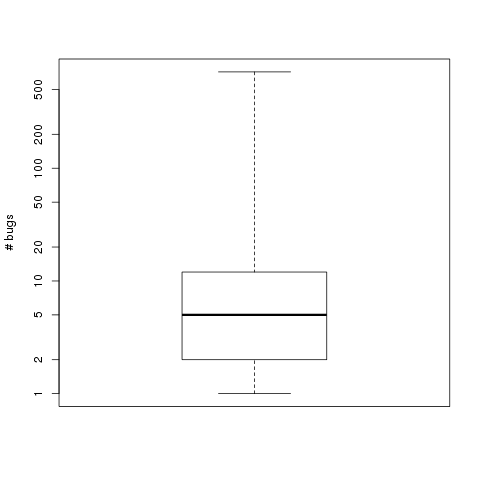
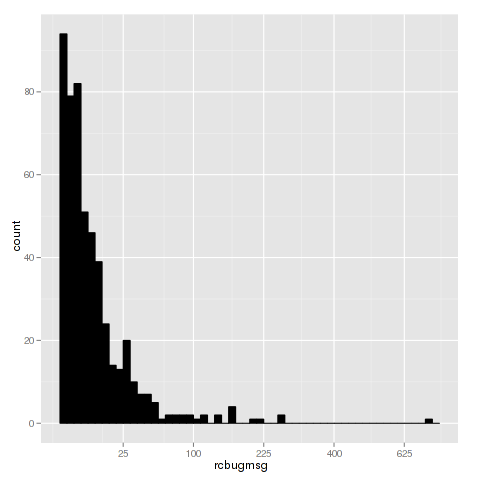
Analysis After parsing the data file we typically want to get an understanding of the data, by using summary(bugs) we get the minimum(1), median(5), mean(15.4), max(716) and quantiles of the data. This shows that the number of messages is wide-spread and a few people contribute a lot. To visualize the dispersion of the data we can create a box plot showing the range of messages: boxplot As the first and third quantile are close together we can assume that the majority of the work is done by a few, especially since the second quantile is 5. This is supported by the histogram below, where the x axis is the number of recorded messages and y is the number of developers. histogram
Top 10 contributors The TOP 10 contributors, according to the dataset, are:
  1. Lucas Nussbaum - 716 messages
  2. Gregor Herrmann - 270 messages
  3. Jakub Wilk - 270 messages
  4. Andreas Beckmann - 225 messages
  5. Julien Cristau - 205 messages
  6. Cyril Brulebois - 169 messages
  7. Moritz Muehlenhoff - 162 messages
  8. Michael Biebl - 159 messages
  9. Salvatore Bonaccorso - 158 messages
  10. Christoph Egger - 142 messages

r commands These are the commands used to generate the plots and information in this plot:
bugs <- read.csv("by-msg.csv")
summary(bugs)
boxplot(bugs$rcbugmsg, log='y', range=0, ylab="# bugs")
quantile(bugs$rcbugmsg)
0%  25%  50%  75% 100%
1    2    5   12  716
# create histogram
llibrary('ggplot2')
ggplot(bugs, aes(x=rcbugmsg)) + geom_histogram(binwidth=.5, colour="black", fill="black") + scale_x_sqrt()
top10 <- tail(bugs[order(bugs$rcbugmsg),], 10)
top10

Ulrich Dangel: Analyzing rc bug messages

Michael Stapelberg recently posted a blog post about looking into the number of Debian Developers actively working on RC bugs for the upcoming wheezy release. In this blog post I analyze the data shared by Michael and provide the R commands used to generate the plots & findings. If you are interested into looking into the data yourself, but don t like R, I suggest using ipython notebook + numpy instead.

Analysis After parsing the data file we typically want to get an understanding of the data, by using summary(bugs) we get the minimum(1), median(5), mean(15.4), max(716) and quantiles of the data. This shows that the number of messages is wide-spread and a few people contribute a lot. To visualize the dispersion of the data we can create a box plot showing the range of messages: boxplot As the first and third quantile are close together we can assume that the majority of the work is done by a few, especially since the second quantile is 5. This is supported by the histogram below, where the x axis is the number of recorded messages and y is the number of developers. histogram

Top 10 contributors The TOP 10 contributors, according to the dataset, are:
  1. Lucas Nussbaum - 716 messages
  2. Gregor Herrmann - 270 messages
  3. Jakub Wilk - 270 messages
  4. Andreas Beckmann - 225 messages
  5. Julien Cristau - 205 messages
  6. Cyril Brulebois - 169 messages
  7. Moritz Muehlenhoff - 162 messages
  8. Michael Biebl - 159 messages
  9. Salvatore Bonaccorso - 158 messages
  10. Christoph Egger - 142 messages

r commands These are the commands used to generate the plots and information in this plot:
bugs <- read.csv("by-msg.csv")
summary(bugs)
boxplot(bugs$rcbugmsg, log='y', range=0, ylab="# bugs")
quantile(bugs$rcbugmsg)
0%  25%  50%  75% 100%
1    2    5   12  716
# create histogram
llibrary('ggplot2')
ggplot(bugs, aes(x=rcbugmsg)) + geom_histogram(binwidth=.5, colour="black", fill="black") + scale_x_sqrt()
top10 <- tail(bugs[order(bugs$rcbugmsg),], 10)
top10

Dmitrijs Ledkovs: FTBFS fixes and other patches available for your package!

Wheeze is planned to release very soon! There is still a fair amount of work to push the release out, but it does mean that a lot of fun can begin for jessie.

Over the past cycle in Ubuntu, many packages where synced from experimental, many fixes were applied and many packages were upgraded ahead of debian version strings.

If one goes to your package PTS page at:

packages.qa.debian.org/$SCRPACKAGENAME

One can find the following box titled "ubuntu" in it:


Please click on "patches for VERSION STRING" to find:
  • Useless irrelevant changes =) oh well, it happens
  • FTBFS fixes due to GCC 4.8 (*)
  • FTBFS fixes due to new GlibC
  • FTBFS fixes due to multiarched Python2.7 and Python3.3
  • FTBFS fixes due to multiarched Tcl/Tk
  • FTBFS fixes due to Python hash randomisation enabled
  • FTBFS fixes due to Boost 1.53 (*)
  • Fixes to minimise dependencies when bootstrapping packages
  • Fixes to multiarch more and more libraries
  • Fixes to enable package cross-building
  • Updates to new upstream releases
  • Usage of pybuild
  • Completed migration away from guile1.6
(*) more of those will be available after S-series opens in ubuntu, from April the 29th onwards

Some of the above patches were submitted to debian, with majority of submitted patches have not been applied, simply because none of them were appropriate during freeze and could have been disruptive to Wheezy release.

Please check useful patches available on your PTS!

Please take those patches!

Not taking Ubuntu patches results in more duplicate work in Ubuntu (i.e. rebasing those patches), thus reducing total dev-time available to work to fix other issues.

I myself uploaded a few of those patches into Ubuntu. And in the beginning I was filing BTS bugs with a patch against relevant packages in Debian. Very quickly I realised that since Debian is frozen a lot of those patches would just bitrot in BTS. I of course wished that they would all be instantly applied and uploaded into Experimental, but that did not happen. At the moment there are still 8 bugs open with patches I submitted, with oldest one opened on 6th of July 2012. So that's the reason why I stopped pushing patches to BTS, because well they are not reviewed nor applied in a timely manner =) where my expectation of timely manner is less than 6 months to be uploaded into Experimental or reviewed/rejected/commented on. Not uploading patches because they don't apply to Debian yet, is silly as they will apply to Debian eventually. Unapplied patches continue to generate more work on a more universal scope (e.g. requiring those patches to be rebased in ubuntu, thus many developers spending their time doing that, instead of writting fixes for new issues).

Paul Tagliamonte: Fixing the theme situation in Jessie

Hello, World, As many of you know, I fell into helping get the artwork for Wheezy into place. While I don t want to do this (in the long run), I feel the urge to get it into shape for Jessie. I d like to do a small request for methods to improve the theme packaging. I ve posted a suggestion, but I never really got happy with it. The problem is basically the deb makes no sense because making thee deb make sense would result in insanity ;) stuff like proper dependencies to allow the Plymouth theme to work can t be done, since it d require a dep on Plymouth, which means it requires all installs with desktop-base to have it installed. Thanks, lazyblog!

19 April 2013

Rog rio Brito: Some recent Debian activities

I have been occasionally working on some Debian-related tasks. Chrony One of those was to get chrony is a slightly better shape, by using, at least, a patch system (indeed, I "modernized" its packaging with the format "3.0 (quilt)"), put it in a git repository and would like to receive some comments on what I have so far. The bug Debian bug #694690 contains a very brief description of my intentions and of the problems that I see in the current package. IMVHO, it is a very nice NTP client and server and it could even be used as the default for Debian, once it gets in shape. There is at least another high-profile distribution, namely Fedora, that switched to chrony as its default NTP software. We can certainly take a look at what they are doing and join forces here. MongoDB Another package where I spent some time was with mongodb: MongoDB is a tricky package that is only built for 2 arches: amd64 and i386. The version in unstable for i386 was 2.0.x (roughly the same as for wheezy), which the version in unstable for amd64 was 2.4.1, which has many features that 2.0 lacks. The packaging of it is a bit tricky, since the source tree has bazillion embedded/convenience libraries (e.g., Google's v8, Mozilla's spidermonkey, BOOST, Google's Snappy, PCRE 3 etc.). Up to version 2.4.1-2, it used all these convenience copies, which is of course, a problem for a distribution like Debian. I changed part of the build process to use the libraries that we already have in Debian and, as Antonin Kral uploaded this newer version, unsurprisingly the binary packages are smaller (especially if you take into account that a handful of the libraries may already be installed on the system). A few hours later, Antonin uploaded a new upstream version, which means that we now have better MongoDB packages to play with. I am, in fact, really playing with MongoDB as my first NoSQL database, since 10gen is giving an introductory course on how it works and my motivation was to get what we have in Debian in shape for the course. You can say that I am a firm believer of the "eat your own dogfood" principle. Regarding MongoDB only being built for i386 and amd64, the BTS has a patch to enable building for kFreeBSD, but the patch is for the 2.0 series and the code has changed so drastically in relation to the 2.4 series that there is no hope of it applying. It would be super nice to have MongoDB working on kFreeBSD and on HURD also, though. nocache There is a very nice command line program called nocache that was packaged by Dmitry Smirnov (and just approved by the FTP masters!) whose packaging I briefly reviewed per Dmitry's request and this is an amazing utility whose purpose is to bypass/minimize file system caching for a program. This is especially useful when you are making backups (reading lots of files that would, otherwise, fill the filesystem cache, even if they are not used frequently) or if you are just streaming one file (possibly larger than the system's RAM) to another computer and you have no need to use the file immediately after that. It performs its job by using the LD_PRELOAD mechanism and using posix_fadvise's flag POSIX_FADV_DONTNEED for the files that will be touched. Post note Oh, just one aside: for the readers of Debian Planet and other aggregation services which are not Debian Developers/Maintainers, I contributed to these packages without being the maintainer of them, just scratching some itches and contributing back what I produced.

Gunnar Wolf: Of European descent

A colleague of mine at Facultad de Ingenier a pointed me to a note published in the Faculty's gazette about a short cycle of talks we had on April 4th, trying to get life and interest back in the once-active LIDSOL (Laboratorio de Investigaci n y Desarrollo en Software Libre, Free Software Research and Development Laboratory), which nowadays lies mostly dormant. Good thing the official communication channels got notice of this! Only I am not sure if they can properly produce Spanish (as this feels more like an English redaction). Quoting only the first lines of the paragraph that referes to me:
La ltima conferencia fue presentada por Gunnar Wolf, que aunque su nombre nos hiciera pensar en una nacionalidad europea, l es nacido en tierras mexicanas pero con descendencias h ngaras, austriacas y polacas.
Which translates to:
The last talk was presented by Gunnar Wolf, that although he has a name that makes us think about an European nationality, he was born in Mexican soil, but with Hungarian, Austriac and Polish descent.
As far as I can tell (and I am almost sure I know all of the story At least on that regard), I have no descent yet. Not Hungarian, Austriac, Polish, nor of any nationality. (nitpickers: Yes, similar words are often used. In Spanish, it would be correct to say de ascendencia h ngara, austriaca y polaca, and in my attempt towards English translation, it would be of Hungarian, Austriac and Polish descent).

17 April 2013

Gerfried Fuchs: Pentatonix

I know it's been ages since I last blogged anything at all. To some degree I had a down phase, but I hope to get out of it. It's nice to see that there are people out there who give me a prod every now and then, and don't let me drown. Thanks, most of you probably know that I mean exactly you, and in case you are uncertain, you probably are meant if you contact me every now and then. Anyway, if you remember that I blogged about Lindsey Stirling last year and you started to follow her you might have already stumbled upon the next band I'd like to present. I'm speaking of Pentatonix. These five humans have terrific voices that they use in a very special way that is quite unique. I don't want to delay the songs I want to present to you any longer, so here they are: Like always, enjoy! And hopefully read me again more regularly again.

/music permanent link Comments: 1 Flattr this

Joey Hess: Template Haskell on impossible architectures

Imagine you had an excellent successful Kickstarter campaign, and during it a lot of people asked for an Android port to be made of the software. Which is written in Haskell. No problem, you'd think -- the user interface can be written as a local webapp, which will be nicely platform agnostic and so make it easy to port. Also, it's easy to promise a lot of stuff during a Kickstarter campaign. Keeps the graph going up. What could go wrong? So, rather later you realize there is no Haskell compiler for Android. At all. But surely there will be eventually. And so you go off and build the webapp. Since Yesod seems to be the pinnacle of type-safe Haskell web frameworks, you use it. Hmm, there's this Template Haskell stuff that it uses a lot, but it only makes compiles a little slow, and the result is cool, so why not. Then, about half-way through the project, it seems time to get around to this Android port. And, amazingly, a Haskell compiler for Android has appeared in the meantime. Like the Haskell community has your back. (Which they generally seem to.) It's early days and rough, lots of libraries need to be hacked to work, but it only takes around 2 weeks to get a port of your program that basically works. But, no webapp. Cause nobody seems to know how to make a cross-compiling Haskell compiler do Template Haskell. (Even building a fully native compiler on Android doesn't do the trick. Perhaps you missed something though.) At this point you can give up and write a separate Android UI (perhaps using these new Android JNI bindings for Haskell that have also appeared in the meantime). Or you can procrastinate for a while, and mull it over; consider rewriting the webapp to not use Yesod but some other framework that doesn't need Template Haskell. Eventually you might think this: If I run ghc -ddump-splices when I'm building my Yesod code, I can see all the thousands of lines of delicious machine generated Haskell code. I just have to paste that in, in place of the Template Haskell that generated it, and I'll get a program I can build on Android! What could go wrong? And you even try it, and yeah, it seems to work. For small amounts of code that you paste in and carefully modify and get working. Not a whole big, constantly improving webapp where every single line of html gets converted to types and lambdas that are somehow screamingly fast. So then, let's automate this pasting. And so the EvilSplicer is born! That's a fairly general-purpose Template Haskell splicer. First do a native build with -ddump-splices output redirected to a log file. Run the EvilSplicer to fix up the code. Then run an Android cross-compile. But oh, the caveats. There are so many ways this can go wrong.. Anyway, if you struggle with it, or pay me vast quantities of money, your program will, eventually, link. And that's all I can promise for now.
PS, I hope nobody will ever find this blog post useful in their work. PPS, Also, if you let this put you off Haskell in any way .. well, don't. You just might want to wait a year or so before doing Haskell on Android.

16 April 2013

Wouter Verhelst: The devops "installer"

puppet and similar things are very nice tools for managing your systems. Rather than doing the same thing 100 times, it's much more interesting to spend some time describing how to do something, and then have it done hundreds of times automatically. However, I'm starting to see a distressing trend lately. I'd like to say that puppet is not an installer, nor is it a replacement for one. Here's why: Please, pretty please, with sugar on top: just provide packages. If that can't be done, just provide clear installation instructions and/or a puppet module that I can include or something. Don't assume I'm a system administrator not worth his paycheck. Thanks. note: the gitorious example above is just that, an example. I've seen more cases of people doing similar things, not just gitorious. Surprisingly, it's mostly from people who're on the ruby kool-aid. I hope that's not related... Update: (2013-04-18) despite my usage of buzzwords in the title of this post, I did not mean to imply that any of the above has anything to do with devops. Instead, what the post is supposed to say is that you should not fall into the trap of believing that devops methods, which may work wonderfully internal to your organization, will therefore also work wonderfully for processes outside your organization.

Next.

Previous.