Search Results: "ads"

22 January 2017

Shirish Agarwal: Debian contributions and World History

Beware, this would be slightly longish. Debian Contributions In the last couple of weeks, was lucky to put up a patch against debian-policy which had been bothering me for a long-long time. The problem statement is simple, man-pages historically were made by software engineers for software-engineers. The idea, probably then was you give the user some idea of what the software does and the rest the software engineer would garner from reading the source-code. But over period of time, the audience has changed. While there are still software engineers who use GNU/Linux for the technical excellence, the man-pages have not kept up with this new audience who perhaps are either not technically so sound that or they do not want to take the trouble to reading the source-code to understand how things flow. An example or examples in a man-page gives us (the lesser mortals) some insight as how the command works, how the logic flows. A good example of a man-page is the ufw man-page
EXAMPLES
Deny all access to port 53: ufw deny 53 Allow all access to tcp port 80: ufw allow 80/tcp Allow all access from RFC1918 networks to this host: ufw allow from 10.0.0.0/8
ufw allow from 172.16.0.0/12
ufw allow from 192.168.0.0/16 Deny access to udp port 514 from host 1.2.3.4: ufw deny proto udp from 1.2.3.4 to any port 514 Allow access to udp 1.2.3.4 port 5469 from 1.2.3.5 port 5469: ufw allow proto udp from 1.2.3.5 port 5469 to 1.2.3.4 port 5469
Now if we had man-pages like the above which give examples, then the user at least can try to accomplish whatever s/he is trying to do. I truly believe not having examples in a man-page kills 50% of your audience and people who could potentially use your tool. Personal wishlist The only thing (and this might be my failure) is we need a good way to search through a man-page. The only way I know is using / and try to give a pattern. Lots of times it fails because I, the user doesn t know the exact keyword which the documenter was using. What would be nice, great if we do have some sort of parser where I tell it, $this is what I m looking for and the parser tries the pattern + all its synonyms and whatever seems to be most relevant passage from the content, in this case a manpage it tells me. It would make my life a lot easier while at the same time force people to document more and more. I dunno if there has been any research or study of the relationship between good documentation and popularity of a program. I know there are lots of different tiny bits which make or break a program, one of which would definitely be documentation and in that a man-page IF it s a command-line tool. A query on Quora gives some indication https://www.quora.com/How-comprehensible-do-you-find-Unix-Linux-Man-pages although the low response rate tells its own story. there have been projects like man2html and man2pdf and others which try to make the content more accessible to people who are not used to the man-page interface but till you don t have Examples the other things can work only so far. Also if anybody talks about X project which claims to solve this problem they will have to fight manpages who have been around like forever. As can be seen in the patch, did some rookie mistakes as can be seen. I also filed a lintian bug at the same time. Hope the patch does get merged at some point in debian-policy and then a check introduced in lintian in some future release. I do agree with anarcat s assertion that it should be at the level of the manpage missing level. I am no coder but finding 14,000 binary packages without a manpage left me both shocked and surprised. I came to know about manpage-alert from the devscripts package to know which all binary packages that have been installed but not have man-pages. I hope to contribute a manpage or two if I across a package I m somewhat comfortable with. I have made a beginning of sorts by running manpage alert and putting the output in a .txt file which I would grep through manually and see if something interesting jumps at me. The learning garnered from putting the patch to the debian package resulted in another patch but this time for an upstream project altogether. As can be seen all are just baby-steps that even a non-coder can take. Another couple of bugs I filed which were fixed were of a sim called unknown-horizons . A 2D realtime strategy simulation. I had filed three bugs, two of which were fixed in 2 days, the 3rd I hope is also fixed soonish. Lastly, I spent most of the week-end poring over packages who have left files in /etc/bash_completion.d/ . I spent almost 4-5 odd hours as each package in question as well as entries found in /etc/bash-completion.d/$filename I had to find which package it belonged to first

[$] dpkg -S /etc/bash_completion.d/git-prompt
git: /etc/bash_completion.d/git-prompt
I know that dpkg-query also does the same
[$] dpkg-query -S /etc/bash_completion.d/git-prompt
git: /etc/bash_completion.d/git-prompt
But I am used to plain dpkg although do know that dpkg-query can do lot more intimate searching in various ways than dpkg can. Once the package name was established, first simulate the purge [$] sudo aptitude -s purge git

[sudo] password for shirish:
The following packages will be REMOVED:
git p
0 packages upgraded, 0 newly installed, 1 to remove and 14 not upgraded.
Need to get 0 B of archives. After unpacking 29.5 MB will be freed.
The following packages have unmet dependencies:
libgit-wrapper-perl : Depends: git but it is not going to be installed
git-extras : Depends: git (>= 1.7.0) but it is not going to be installed
bup : Depends: git but it is not going to be installed
git-remote-gcrypt : Depends: git but it is not going to be installed
git-svn : Depends: git (> 1:2.11.0) but it is not going to be installed
Depends: git ( 1:2.11.0) but it is not going to be installed
Depends: git (= 1:1.8.1) but it is not going to be installed
git-core : Depends: git (> 1:1.7.0.2) but it is not going to be installed
The following actions will resolve these dependencies:
Remove the following packages:
1) bup [0.29-2 (now, testing, unstable)]
2) fdroidserver [0.7.0-1 (now, testing, unstable)]
3) git-annex [6.20161012-1 (now, testing)]
4) git-core [1:2.11.0-2 (now, testing, unstable)]
5) git-extras [4.2.0-1 (now, testing, unstable)]
6) git-remote-gcrypt [1.0.1-1 (now, testing, unstable)]
7) git-repair [1.20151215-1 (now, unstable)]
8) git-svn [1:2.11.0-2 (now, testing, unstable)]
9) gitk [1:2.11.0-2 (now, testing, unstable)]
10) libgit-wrapper-perl [0.047-1 (now, testing, unstable)]
11) python3-git [2.1.0-1 (now, testing, unstable)]
12) svn2git [2.4.0-1 (now, testing, unstable)] Leave the following dependencies unresolved:
13) devscripts recommends libgit-wrapper-perl
14) dh-make-perl recommends git
15) fdroidserver recommends git
16) git-annex recommends git-remote-gcrypt (>= 0.20130908-6)
17) gplaycli recommends fdroidserver
18) python-rope recommends git-core
Accept this solution? [Y/n/q/?] q
Abandoning all efforts to resolve these dependencies.
Abort.
Then I made a note of all the packages being affected, saw purging all of them wouldn t call others (the Package dependency Hell), made the purge and then reinstalled anew. The reason I did this is that many a times during upgrade, either during update/upgrade sometimes the correct action doesn t happen. To take the git s example itself, there were two files git-extras and git-prompt which were in /etc/bash_completion.d/ both of which were showing their source as git. Purging git and installing git afresh removed git-extras file and git-prompt is the only one remaining. While blogging about the package, did try to grep through changelog.Debian.gz and changelog.gz in git

[shirish@debian] - [/usr/share/doc/git] - [10046]
[$] zless changelog.gz
and similarly

[shirish@debian] - [/usr/share/doc/git] - [10046]
[$] zless changelog.Debian.gz
But failed to find any mention of the now gone git-extras. Doing this with all the packages took considerable time as didn t want to deal with any potential fallout later on. For instance, ufw (uncomplicated firewall) also had an entry in /etc/bash_completion.d/, hence before purging ufw, took backup of all the rules I have made, did a successful simulation

[$] sudo aptitude -s purge ufw gufw


The following packages will be REMOVED:
gufw p ufw p
0 packages upgraded, 0 newly installed, 2 to remove and 14 not upgraded.
Need to get 0 B of archives. After unpacking 4,224 kB will be freed.
Note: Using 'Simulate' mode.
Do you want to continue? [Y/n/?] y
Would download/install/remove packages.
purged the packages, reinstalled it and then re-added all the rules. Doing it all for various sundry packages, had to do it manually as there is no one size fits all solution. A sensitive one was grub which still has an entry in /etc/bash_completion.d/grub. Doing it wrong could have resulted in a non-bootable situation. There are workarounds for that, but it would have taken quite a bit of time, energy, notes and bit of recall factor what I did the last time something like that happened. Doing it manually, being present meant I could do it rightly the first time. So, was it worth it It would be if the package maintainers do the needful and the remaining entries are moved out of /etc/bash_completion.d/ to /usr/share/bash-completions and some to my favourite /usr/share/zsh/vendor-completions/ for instance

[shirish@debian] - [/usr/share/zsh/vendor-completions] - [10064]
[$] ll -h _youtube-dl
-rw-r--r-- 1 root root 3.2K 2016-12-01 08:48 _youtube-dl But trying to get all or even major packages to use zsh-completions would be hard work and would take oodles of time and this concerns upstream stuff, also very much outside what I was sharing. World History Before, during and even after South-African experience, I was left wondering why India and South Africa, two countries who had similar histories at least the last couple of hundred years or more, the final result of Independence was so different for both the countries. It took me quite sometime to articulate that in a form of question , while the answers were interesting, from what little I know of India itself, if I were an Englishman I would never leave Hindustan . What the people answering failed to take into account was that in that era it was Hindustan or un-divided India.
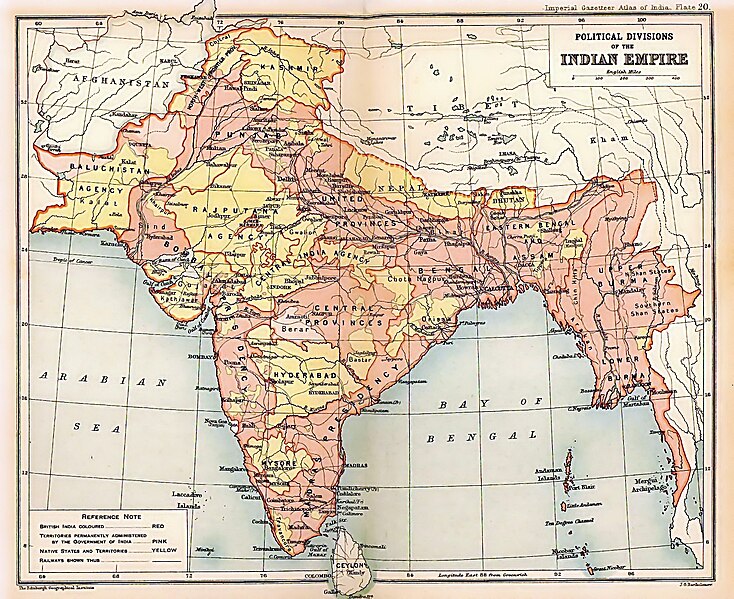
Pre-partition map of India

Pre-partition map of India

This map can be found at https://commons.wikimedia.org/wiki/File:British_Indian_Empire_1909_Imperial_Gazetteer_of_India.jpg and is part of quite a few Indian articles. I would urge people to look at the map in-depth. Except for the Central India Agency and Central India Provinces, most of the other regions were quite comfortable weather-wise. Hence I can t help but feel the assertion that Britishers didn t like India (as to live here) slightly revolting. See the excerpt/take on Dale Kennedy s The Magic Mountains: Hill Stations and the British Raj. Berkeley: University of California Press, 1996. xv + 264 pp. . A look at the list of hill stations of divided India is enough to tell that there were lot of places which either were founded by the Britishers or they chose to live there. And this is not all, there are supposed to lot of beautiful places even in Pakistan, especially in North East Frontier, Swat for instance. While today it s infamous for Taliban and Islamic Terrorism, there was a time it was known for its beauty.
The second most difficult mountain in the world - K2, Pakistan

The second most difficult mountain in the world K2, Pakistan

Trivia After Everest, K2 is the smaller one although whatever I have read of people s accounts, most people who ascended all 14 8,000 metre peaks say K2 is technically more tougher than Everest and after Everest has the highest casualty rate. Also places like the disputed North half of Pakistan Occupied Kashmir, Gilgit Baltistan, Extreme northern Punjab of Pakistan , Northern half of Khyber-Pakhtunkhawa province and Northern Balochistan all of these places would have been more than conducive to the Britishers as it is near to the British climate (snow and pleasant weather all year round). It really is a pity that Pakistan chose to become a terrorist state where it could have become one of the more toured places of Asia. I really feel nauseous and sad at the multiple chances that Pakistan frittered away, it could have been something else.
Filed under: Miscellenous Tagged: #bash-completion, #British Raj, #contributions, #debian, #debian-policy, #Debian-QA, #Hill Stations, #India Independance Movement, #lintian, #obsolete-conffiles, #unknown-horizons, #weather, #World History, adequate, Pakistan, tourism

Steinar H. Gunderson: Nageru loopback test

Nageru, my live video mixer, is in the process of gaining HDMI/SDI output for bigscreen use, and in that process, I ran some loopback tests (connecting the output of one card into the input of another) to verify that I had all the colorspace parameters right. (This is of course trivial if you are only sending one input on bit-by-bit, but Nageru is much more flexible, so it really needs to understand what each pixel means.) It turns out that if you mess up any of these parameters ever so slightly, you end up with something like this, this or this. But thankfully, I got this instead on the very first try, so it really seems it's been right all along. :-) (There's a minor first-generation loss in that the SDI chain is 8-bit Y'CbCr instead of 10-bit, but I really can't spot it with the naked eye, and it doesn't compound through generations. I plan to fix that for those with spare GPU power at some point, possibly before 1.5.0 release.)

Lars Wirzenius: Improving debugging via email, followup

Half a year ago I wrote a blog post about debugging over email. This is a follow-up. The blog post summarised: Based on further thinking and feedback, I add: I've not written any code to help with this remote debugging, but it's something I will start experimenting with in the near future. Further ideas welcome.

21 January 2017

Dirk Eddelbuettel: Updated Example Repo for RMarkdown and Metropolis/Mtheme

During useR! 2016, Nick Tierney had asked on Twitter about rmarkdown and metropolis and whether folks had used RMarkdown-driven LaTeX Beamer presentations. My firm hell yeah answer, based on having used mtheme outright or in local mods for quite some time (see my talks page), lead to this blog post of mine describing this GitHub repo I had quickly set up during breaks at useR! 2016. The corresponding blog post and the repo have some more details on how I do this, in particular about local packages (also with sources on GitHub) for the non-standard fonts I use. This week I got around to updating the repo / example a little by making the default colours (in my example) a little less awful, and a page on blocks and, most importantly, turning the example into the animated gif below:
And thanks to the beautiful tint package -- see its repo and CRAN package --- I now know how to create a template package. So if there is interest (and spare time), we could build a template package for RStudio too. With that, may I ask a personal favour of anybody still reading the post? Please do not hit my twitter handle with questions for support. All my code is an GitHub, and issue tickets there are much preferred. Larger projects like Rcpp also have their own mailing lists, and it is much better to use those. And if you like neither, maybe ask on StackOverflow. But please don't spam my Twitter handle. Thank you.

Clint Adams: Strangers with candy

This.
Posted on 2017-01-21
Tags: barks

20 January 2017

Joachim Breitner: Global almost-constants for Haskell

More than five years ago I blogged about the configuration problem and a proposed solution for Haskell, which turned into some Template Haskell hacks in the seal-module package. With the new GHC proposal process in plase, I am suddenly much more inclined to write up my weird wishes for the Haskell language in proposal form, to make them more coherent, get feedback, and maybe (maybe) actually get them implemented. But even if the proposal is rejected it is still a nice forum to discuss these ideas. So I turned my Template Haskell hack into a proposed new syntactic feature. The idea is shamelessly stolen from Isabelle, including some of the keywords, and would allow you to write
context fixes progName in
  foo :: Maybe Int -> Either String Int
  foo Nothing  = Left $ progName ++ ": no number given"
  foo (Just i) = bar i
  bar :: Int -> Either String Int
  bar 0 = Left $ progName ++ ": zero no good"
  bar n = Right $ n + 1
instead of
foo :: String -> Maybe Int -> Either String Int
foo progName Nothing  = Left $ progName ++ ": no number given"
foo progName (Just i) = bar progName  i
bar :: String -> Int -> Either String Int
bar progName 0 = Left $ progName ++ ": zero no good"
bar progName n = Right $ n + 1
when you want to have an almost constant parameter. I am happy to get feedback at the GitHub pull request.

Michal Čihař: Weblate 2.10.1

This is first security bugfix release for Weblate. This has to come at some point, fortunately the issue is not really severe. But Weblate got it's first CVE ID today, so it's time to address it in a bugfix release. Full list of changes: If you are upgrading from older version, please follow our upgrading instructions. You can find more information about Weblate on https://weblate.org, the code is hosted on Github. If you are curious how it looks, you can try it out on demo server. You can login there with demo account using demo password or register your own user. Weblate is also being used on https://hosted.weblate.org/ as official translating service for phpMyAdmin, OsmAnd, Aptoide, FreedomBox, Weblate itself and many other projects. Should you be looking for hosting of translations for your project, I'm happy to host them for you or help with setting it up on your infrastructure. Further development of Weblate would not be possible without people providing donations, thanks to everybody who have helped so far!

Filed under: Debian English SUSE Weblate 0 comments

19 January 2017

Matthew Garrett: Android apps, IMEIs and privacy

There's been a sudden wave of people concerned about the Meitu selfie app's use of unique phone IDs. Here's what we know: the app will transmit your phone's IMEI (a unique per-phone identifier that can't be altered under normal circumstances) to servers in China. It's able to obtain this value because it asks for a permission called READ_PHONE_STATE, which (if granted) means that the app can obtain various bits of information about your phone including those unique IDs and whether you're currently on a call.

Why would anybody want these IDs? The simple answer is that app authors mostly make money by selling advertising, and advertisers like to know who's seeing their advertisements. The more app views they can tie to a single individual, the more they can track that user's response to different kinds of adverts and the more targeted (and, they hope, more profitable) the advertising towards that user. Using the same ID between multiple apps makes this easier, and so using a device-level ID rather than an app-level one is preferred. The IMEI is the most stable ID on Android devices, persisting even across factory resets.

The downside of using a device-level ID is, well, whoever has that data knows a lot about what you're running. That lets them tailor adverts to your tastes, but there are certainly circumstances where that could be embarrassing or even compromising. Using the IMEI for this is even worse, since it's also used for fundamental telephony functions - for instance, when a phone is reported stolen, its IMEI is added to a blacklist and networks will refuse to allow it to join. A sufficiently malicious person could potentially report your phone stolen and get it blocked by providing your IMEI. And phone networks are obviously able to track devices using them, so someone with enough access could figure out who you are from your app usage and then track you via your IMEI. But realistically, anyone with that level of access to the phone network could just identify you via other means. There's no reason to believe that this is part of a nefarious Chinese plot.

Is there anything you can do about this? On Android 6 and later, yes. Go to settings, hit apps, hit the gear menu in the top right, choose "App permissions" and scroll down to phone. Under there you'll see all apps that have permission to obtain this information, and you can turn them off. Doing so may cause some apps to crash or otherwise misbehave, whereas newer apps may simply ask for you to grant the permission again and refuse to do so if you don't.

Meitu isn't especially rare in this respect. Over 50% of the Android apps I have handy request your IMEI, although I haven't tracked what they all do with it. It's certainly something to be concerned about, but Meitu isn't especially rare here - there are big-name apps that do exactly the same thing. There's a legitimate question over whether Android should be making it so easy for apps to obtain this level of identifying information without more explicit informed consent from the user, but until Google do anything to make it more difficult, apps will continue making use of this information. Let's turn this into a conversation about user privacy online rather than blaming one specific example.

comment count unavailable comments

Daniel Pocock: Which movie most accurately forecasts the Trump presidency?

Many people have been scratching their heads wondering what the new US president will really do and what he really stands for. His alternating positions on abortion, for example, suggest he may simply be telling people what he thinks is most likely to win public support from one day to the next. Will he really waste billions of dollars building a wall? Will Muslims really be banned from the US? As it turns out, several movies provide a thought-provoking insight into what could eventuate. What's more, these two have a creepy resemblance to the Trump phenomenon and many of the problems in the world today. Countdown to Looking Glass On the classic cold war theme of nuclear annihilation, Countdown to Looking Glass is probably far more scary to watch on Trump eve than in the era when it was made. Released in 1984, the movie follows a series of international crises that have all come to pass: the assassination of a US ambassador in the middle east, a banking crisis and two superpowers in an escalating conflict over territory. The movie even picked a young Republican congressman for a cameo role: he subsequently went on to become speaker of the house. To relate it to modern times, you may need to imagine it is China, not Russia, who is the adversary but then you probably won't be able to sleep after watching it. cleaning out the swamp? The Omen Another classic is The Omen. The star of this series of four horror movies, Damien Thorn, appears to have a history that is eerily reminiscent of Trump: born into a wealthy family, a series of disasters befall every honest person he comes into contact with, he comes to control a vast business empire acquired by inheritance and as he enters the world of politics in the third movie of the series, there is a scene in the Oval Office where he is flippantly advised that he shouldn't lose any sleep over any conflict of interest arising from his business holdings. Did you notice Damien Thorn and Donald Trump even share the same initials, DT?

18 January 2017

Jan Wagner: Migrating Gitlab non-packaged PostgreSQL into omnibus-packaged

With the release of Gitlab 8.15 it was announced that PostgreSQL needs to be upgraded. As I migrated from a source installation I used to have an external PostgreSQL database instead of using the one shiped with the omnibus package.
So I decided to do the data migration into the omnibus PostgreSQL database now which I skipped before. Let's have a look into the databases:
$ sudo -u postgres psql -d template1
psql (9.2.18)  
Type "help" for help.
gitlabhq_production=# \l  
                                             List of databases
         Name                  Owner         Encoding   Collate    Ctype           Access privileges
-----------------------+-------------------+----------+---------+---------+---------------------------------
 gitlabhq_production     git                 UTF8       C.UTF-8   C.UTF-8  
 gitlab_mattermost       git                 UTF8       C.UTF-8   C.UTF-8  
gitlabhq_production=# \q  
Dumping the databases and stop PostgreSQL. Maybe you need to adjust database names and users for your needs.
$ su postgres -c "pg_dump gitlabhq_production -f /tmp/gitlabhq_production.sql" && \
su postgres -c "pg_dump gitlab_mattermost -f /tmp/gitlab_mattermost.sql" && \  
/etc/init.d/postgresql stop
Activate PostgreSQL shipped with Gitlab Omnibus
$ sed -i "s/^postgresql\['enable'\] = false/#postgresql\['enable'\] = false/g" /etc/gitlab/gitlab.rb && \
sed -i "s/^#mattermost\['enable'\] = true/mattermost\['enable'\] = true/" /etc/gitlab/gitlab.rb && \  
gitlab-ctl reconfigure  
Testing if the connection to the databases works
$ su - git -c "psql --username=gitlab  --dbname=gitlabhq_production --host=/var/opt/gitlab/postgresql/"
psql (9.2.18)  
Type "help" for help.
gitlabhq_production=# \q  
$ su - git -c "psql --username=gitlab  --dbname=mattermost_production --host=/var/opt/gitlab/postgresql/"
psql (9.2.18)  
Type "help" for help.
mattermost_production=# \q  
Ensure pg_trgm extension is enabled
$ sudo gitlab-psql -d gitlabhq_production -c 'CREATE EXTENSION IF NOT EXISTS "pg_trgm";'
$ sudo gitlab-psql -d mattermost_production -c 'CREATE EXTENSION IF NOT EXISTS "pg_trgm";'
Adjust permissions in the database dumps. Indeed please verify that users and databases might need to be adjusted too.
$ sed -i "s/OWNER TO git;/OWNER TO gitlab;/" /tmp/gitlabhq_production.sql && \
sed -i "s/postgres;$/gitlab-psql;/" /tmp/gitlabhq_production.sql  
$ sed -i "s/OWNER TO git;/OWNER TO gitlab_mattermost;/" /tmp/gitlab_mattermost.sql && \
sed -i "s/postgres;$/gitlab-psql;/" /tmp/gitlab_mattermost.sql  
(Re)import the data
$ sudo gitlab-psql -d gitlabhq_production -f /tmp/gitlabhq_production.sql
$ sudo gitlab-psql -d gitlabhq_production -c 'REVOKE ALL ON SCHEMA public FROM "gitlab-psql";' && \
sudo gitlab-psql -d gitlabhq_production -c 'GRANT ALL ON SCHEMA public TO "gitlab-psql";'  
$ sudo gitlab-psql -d mattermost_production -f /tmp/gitlab_mattermost.sql
$ sudo gitlab-psql -d mattermost_production -c 'REVOKE ALL ON SCHEMA public FROM "gitlab-psql";' && \
sudo gitlab-psql -d mattermost_production -c 'GRANT ALL ON SCHEMA public TO "gitlab-psql";'  
Make use of the shipped PostgreSQL
$ sed -i "s/^gitlab_rails\['db_/#gitlab_rails\['db_/" /etc/gitlab/gitlab.rb && \
sed -i "s/^mattermost\['sql_/#mattermost\['sql_/" /etc/gitlab/gitlab.rb && \  
gitlab-ctl reconfigure  
Now you should be able to connect to all the Gitlab services again. Optionally remove the external database
apt-get remove postgresql postgresql-client postgresql-9.4 postgresql-client-9.4 postgresql-client-common postgresql-common  
Maybe you also want to purge the old database content
apt-get purge postgresql-9.4  

Jonathan Dowland: RetroPie, NES Classic and Bluetooth peripherals

I wanted to write a more in-depth post about RetroPie the Retro Gaming Appliance OS for Raspberry Pis, either technically or more positively, but unfortunately I don't have much positive to write. What I hoped for was a nice appliance that I could use to play old games from the comfort of my sofa. Unfortunately, nine times out of ten, I had a malfunctioning Linux machine and the time I'd set aside for jumping on goombas was being spent trying to figure out why bluetooth wasn't working. I have enough opportunities for that already, both at work and at home. I feel a little bad complaining about an open source, volunteer project: in its defence I can say that it is iterating fast and the two versions I tried in a relatively short time span were rapidly different. So hopefully a lot of my woes will eventually be fixed. I've also read a lot of other people get on with it just fine. Instead, I decided the Nintendo Classic NES Mini was the plug-and-play appliance for me. Alas, it became the "must have" Christmas toy for 2016 and impossible to obtain for the recommended retail price. I did succeed in finding one in stock at Toys R Us online at one point, only to have the checkout process break and my order not go through. Checking Stock Informer afterwards, that particular window of opportunity was only 5 minutes wide. So no NES classic for me! My adventures in RetroPie weren't entirely fruitless, thankfully: I discovered two really nice pieces of hardware.
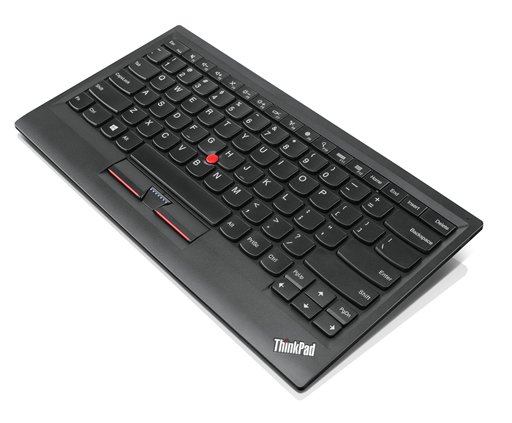
ThinkPad Keyboard ThinkPad Keyboard
The first is Lenovo's ThinkPad Compact Bluetooth Keyboard with TrackPoint, a very compact but pleasant to use Bluetooth keyboard including a trackpoint. I miss the trackpoint from my days as a Thinkpad laptop user. Having a keyboard and mouse combo in such a small package is excellent. My only two complaints would be the price (I was lucky to get one cheaper on eBay) and the fact it's bluetooth only: there's a micro-USB port for charging, but it would be nice if it could be used as a USB keyboard too. There's a separate, cheaper USB model.
8bitdo SFC30 8bitdo SFC30
The second neat device is a clone of the SNES gamepad by HK company 8bitdo called the SFC30. This looks and feels very much like the classic Nintendo SNES controller, albeit slightly thicker from front to back. It can be used in a whole range of different modes, including attached USB; Bluetooth pretending to be a keyboard; Bluetooth pretending to be a controller; and a bunch of other special modes designed to work with iOS or Android devices in various configurations. The manufacturer seem to be actively working on firmware updates to further enhance the controller. The firmware is presently closed source, but it would not be impossible to write an open source firmware for it (some people have figured out the basis for the official firmware). I like the SFC30 enough that I spent some time trying to get it working for various versions of Doom. There are just enough buttons to control a 2.5D game like Doom, whereas something like Quake or a more modern shooter would not work so well. I added support for several 8bitdo controllers directly into Chocolate Doom (available from 2.3.0 onwards) and into SDL2, a popular library for game development, which I think is used by Steam, so Steam games may all gain SFC30 support in the future too.

B lint R czey: My debian-devel pledge

I pledge that before sending each email to the debian-devel mailing list I move forward at least one actionable bug in my packages.

Norbert Preining: Debian/TeX Live January 2017

As the freeze of the next release is closing in, I have updated a bunch of packages around TeX: All of the TeX Live packages (binaries and arch independent ones) and tex-common. I might see whether I get some updates of ConTeXt out, too.

texlive2016-debian The changes in the binaries are mostly cosmetic: one removal of a non-free (unclear-free) file, and several upstream patches got cherrypicked (dvips, tltexjp contact email, upmendex, dvipdfmx). I played around with including LuaTeX v1.0, but that breaks horribly with the current packages in TeX Live, so I refrained from it. The infrastructure package tex-common got a bugfix for updates from previous releases, and for the other packages there is the usual bunch of updates and new packages. Enjoy! New packages arimo, arphic-ttf, babel-japanese, conv-xkv, css-colors, dtxdescribe, fgruler, footmisx, halloweenmath, keyfloat, luahyphenrules, math-into-latex-4, mendex-doc, missaali, mpostinl, padauk, platexcheat, pstring, pst-shell, ptex-fontmaps, scsnowman, stanli, tinos, undergradmath, yaletter. Updated packages acmart, animate, apxproof, arabluatex, arsclassica, babel-french, babel-russian, baskervillef, beamer, beebe, biber, biber.x86_64-linux, biblatex, biblatex-apa, biblatex-chem, biblatex-dw, biblatex-gb7714-2015, biblatex-ieee, biblatex-philosophy, biblatex-sbl, bidi, calxxxx-yyyy, chemgreek, churchslavonic, cochineal, comicneue, cquthesis, csquotes, ctanify, ctex, cweb, dataref, denisbdoc, diagbox, dozenal, dtk, dvipdfmx, dvipng, elocalloc, epstopdf, erewhon, etoolbox, exam-n, fbb, fei, fithesis, forest, glossaries, glossaries-extra, glossaries-french, gost, gzt, historische-zeitschrift, inconsolata, japanese-otf, japanese-otf-uptex, jsclasses, latex-bin, latex-make, latexmk, lt3graph, luatexja, markdown, mathspec, mcf2graph, media9, mendex-doc, metafont, mhchem, mweights, nameauth, noto, nwejm, old-arrows, omegaware, onlyamsmath, optidef, pdfpages, pdftools, perception, phonrule, platex-tools, polynom, preview, prooftrees, pst-geo, pstricks, pst-solides3d, ptex, ptex2pdf, ptex-fonts, qcircuit, quran, raleway, reledmac, resphilosophica, sanskrit, scalerel, scanpages, showexpl, siunitx, skdoc, skmath, skrapport, smartdiagram, sourcesanspro, sparklines, tabstackengine, tetex, tex, tex4ht, texlive-scripts, tikzsymbols, tocdata, uantwerpendocs, updmap-map, uplatex, uptex, uptex-fonts, withargs, wtref, xcharter, xcntperchap, xecjk, xellipsis, xepersian, xint, xlop, yathesis.

Dirk Eddelbuettel: RProtoBuf 0.4.8: Windows support for proto3

Issue ticket #20 demonstrated that we had not yet set up Windows for version 3 of Google Protocol Buffers ("Protobuf") -- while the other platforms support it. So I made the change, and there is release 0.4.8. RProtoBuf provides R bindings for the Google Protocol Buffers ("Protobuf") data encoding and serialization library used and released by Google, and deployed as a language and operating-system agnostic protocol by numerous projects. The NEWS file summarises the release as follows:

Changes in RProtoBuf version 0.4.8 (2017-01-17)
  • Windows builds now use the proto3 library as well (PR #21 fixing #20)

CRANberries also provides a diff to the previous release. The RProtoBuf page has an older package vignette, a 'quick' overview vignette, a unit test summary vignette, and the pre-print for the JSS paper. Questions, comments etc should go to the GitHub issue tracker off the GitHub repo.

This post by Dirk Eddelbuettel originated on his Thinking inside the box blog. Please report excessive re-aggregation in third-party for-profit settings.

17 January 2017

Ritesh Raj Sarraf: Linux Tablet-Mode Usability

In my ongoing quest to get Tablet-Mode working on my Hybrid machine, here's how I've been living with it so far. My intent is to continue using Free Software for both use cases. My wishful thought is to use the same software under both use cases.
  • Browser: On the browser front, things are pretty decent. Chromium has good support for Touchscreen input. Most of the Touchscreen use cases work well with Chromium. On the Firefox side, after a huge delay, finally, Firefox seems to be catching up. Hopefully, with Firefox 51/52, we'll have a much more usable Touchscreen browser.
  • Desktop Shell: One of the reason of migrating to GNOME was its touch support. From what I've explored so far, GNOME is the only desktop shell that has touch support natively done. The feature isn't complete yet, but is fairly well usable.
    • Given that GNOME has touchscreen support native, it is obvious to be using GNOME equivalent of tools for common use cases. Most of these tools inherit the touchscreen capabilities from the underneath GNOME libraries.
    • File Manager: Nautilus has decent support for touch, as a file manager. The only annoying bit is a right-click equivalent. Or in touch input sense, a long-press.
    • Movie Player: There's a decent movie player, based on GNOME libs; GNOME MPV. In my limited use so far, this interface seems to have good support. Other contenders are:
      • SMPlayer is based on Qt libs. So initial expectation would be that Qt based apps would have better Touch support. But I'm yet to see any serious Qt application with Touch input support. Back to SMPlayer, the dev is pragmatic enough to recognize tablet-mode users and as such has provided a so called "Tablet Mode" view for SMPlayer (The tooltip did not get captured in the screenshot).
      • MPV doesn't come with a UI but has basic management with OSD. And in my limited usage, the OSD implementation does seem capable to take touch input.
  • Books / Documents: GNOME Documents/Books is very basic in what it has to offer, to the point that it is not much useful. But since it is based on the same GNOME libraries, it enjoys native touch input support. Calibre, on the other hand, is feature rich. But it is based on (Py)Qt. Touch input is told to work for Windows. For Linux, there's no support yet. The good thing about Calibre is that it has its own UI, which is pretty decent in a Tablet-Mode Touch workflow.
  • Photo Management: With compact digital devices commonly available, digital content (Both Photos and Videos) is on the rise. The most obvious names that come to mind are Digikam and Shotwell.
    • Shotwell saw its reincarnation in the recent past. From what I recollect, it does have touch support but was lacking quite a bit in terms of features, as compared to Digikam.
    • Digikam is an impressive tool for digital content management. While Digikam is a KDE project, thankfully it does a great job in keeping its KDE dependencies to a bare minimum. But given that Digikam builds on KDE/Qt libs, I haven't had any much success in getting a good touch input solution for Tablet Mode. To make it barely usable in Table-Mode, one could choose a theme preference with bigger toolbars, labels and scrollbars. This helps in making a touch input workaround use case. As you can see, I've configured the Digikam UI with Text alongside Icons for easy touch input.
  • Email: The most common use case. With Gmail and friends, many believe standalone email clients are no more a need. But there always are users like us who prefer emails offline, encrypted emails and prefer theis own email domains. Many of these are still doable with free services like Gmail, but still.
    • Thunderbird shows its age at times. And given the state of Firefox in getting touch support (and GTK3 port), I see nothing happening with TB.
    • KMail was something I discontinued while still being on KDE. The debacle that KDEPIM was, is something I'd always avoid, in the future. Complete waste of time/resource in building, testing, reporting and follow-ups.
    • Geary is another email client that recently saw its reincarnation. I recently had explored Geary. It enjoys similar benefits like the rest applications using GNOME libraries. There was one touch input bug I found, but otherwise Geary's featureset was limited in comparison to Evolution.
    • Migration to Evolution, when migrating to GNOME, was not easy. GNOME's philosophy is to keep things simple and limited. In doing that, they restrict possible flexibilities that users may find obvious. This design philosophy is easily visible across all applications of the GNOME family. Evolution is no different. Hence, coming from TB to E was a small unlearning + newLearning curve. And since Evolution is using the same GNOME libraries, it enjoys similar benefits. Touch input support in Evolution is fairly good. The missing bit is the new Toolbar and Menu structure that many have noticed in the newer GNOME applications (Photos, Documents, Nautilus etc). If only Evolution (and the GNOME family) had the option of customization beyond the developer/project's view, there wouldn't be any wishful thoughts.
      • Above is a screenshot of 2 windows of Evoluiton. In its current form too, Evolution is a gem at times. For my RSS feeds, they are stored in a VFolder in Evolution, so that I can read them when offline. RSS feeds are something I read up in Tablet-mode. On the right is an Evolution window with larger fonts, while on the left, Evoltuion still retains its default font size. This current behavior helps me get Table-Mode Touch working to an extent. In my wishful thoughts, I wish if Evolution provided flexibility to change Toolbar icon sizes. That'd really help easily touch the delete button when in Tablet Mode. A simple button, Tablet Mode, like what SMPlayer has done, would keep users sticky with Evolution.
My wishful thought is that people write (free) software, thinking more about usability across toolkits and desktop environments. Otherwise, the year of the Linux desktop, laptop, tablet; in my opinion, is yet to come. And please don't rip apart tools, in porting them to newer versions of the toolkits. When you rip a tool, you also rip all its QA, Bug Reporting and Testing, that was done over the years. Here's an example of a tool (Goldendict), so well written. Written in Qt, Running under GNOME, and serving over the Chromium interface. In this whole exercise of getting a hybrid working setup, I also came to realize that there does not seem to be a standardized interface, yet, to determine the current operating mode of a running hybrid machine. From what we explored so far, every product has its own way to doing it. Most hybrids come pre-installed and supported with Windows only. So, their mode detection logic seems to be proprietary too. In case anyone is awaer of a standard interface, please drop a note in the comments.

Categories:

Keywords:

Like:

16 January 2017

Raphaël Hertzog: Freexian s report about Debian Long Term Support, December 2016

A Debian LTS logoLike each month, here comes a report about the work of paid contributors to Debian LTS. Individual reports In December, about 175 work hours have been dispatched among 14 paid contributors. Their reports are available: Evolution of the situation The number of sponsored hours did not increase but a new silver sponsor is in the process of joining. We are only missing another silver sponsor (or two to four bronze sponsors) to reach our objective of funding the equivalent of a full time position. The security tracker currently lists 31 packages with a known CVE and the dla-needed.txt file 27. The situation improved a little bit compared to last month. Thanks to our sponsors New sponsors are in bold.

No comment Liked this article? Click here. My blog is Flattr-enabled.

Maria Glukhova: APK, images and other stuff.

2 more weeks of my awesome Outreachy journey have passed, so it is time to make an update on my progress. I continued my work on improving diffoscope by fixing bugs and completing wishlist items. These include:

Improving APK support I worked on #850501 and #850502 to improve the way diffoscope handles APK files. Thanks to Emanuel Bronshtein for providing clear description on how to reproduce these bugs and ideas on how to fix them. And special thanks to Chris Lamb for insisting on providing tests for these changes! That part actually proved to be little more tricky, and I managed to mess up with these tests (extra thanks to Chris for cleaning up the mess I created). Hope that also means I learned something from my mistakes. Also, I was pleased to see F-droid Verification Server as a sign of F-droid progress on reproducible builds effort - I hope these changes to diffoscope will help them!

Adding support for image metadata That came from #849395 - a request was made to compare image metadata along with image content. Diffoscope has support for three types of images: JPEG, MS Windows Icon (*.ico) and PNG. Among these, PNG already had good image metadata support thanks to sng tool, so I worked on .jpeg and .ico files support. I initially tried to use exiftool for extracting metadata, but then I discovered it does not handle .ico files, so I decided to use a bigger force - ImageMagick s identify - for this task. I was glad to see it had that handy -format option I could use to select only the necessary fields (I found their -verbose, well, too verbose for the task) and presenting them in the defined form, negating the need of filtering its output. What was particulary interesting and important for me in terms of learning: while working on this feature, I discovered that, at the moment, diffoscope could not handle .ico files at all - img2txt tool, that was used for retrieving image content, did not support that type of images. But instead of recognizing this as a bug and resolving it, I started to think of possible workaround, allowing for retrieving image metadata even after retrieving image content failed. Definetely not very good thinking. Thanks Mattia Rizzolo for actually recognizing this as a bug and filing it, and Chris Lamb for fixing it!

Other work

Order-like differences, part 2 In the previous post, I mentioned Lunar s suggestion to use hashing for finding order-like difference in wide variety of input data. I implemented that idea, but after discussion with my mentor, we decided it is probably not worth it - this change would alter quite a lot of things in core modules of diffoscope, and the gain would be not really significant. Still, implementing that was an important experience for me, as I had to hack on deepest and, arguably, most difficult modules of diffoscope and gained some insight on how they work.

Comparing with several tools (work in progress) Although my initial motivation for this idea was flawed (the workaround I mentioned earlier for .ico files), it still might be useful to have a mechanism that would allow to run several commands for finding difference, and then give the output of those that succeed, failing if and only if they all have failed. One possible case when it might happen is when we use commands coming from different tools, and one of them is not installed. It would be nice if we still used the other and not the uninformative binary diff (that is a default fallback option for when something goes wrong with more clever comparison). I am still in process of polishing this change, though, and still in doubt if it is needed at all.

Side note - Outreachy and my university progress In my Outreachy application, I promised that if I am selected into this round, I will do everything I can to unload the required time period from my university time commitements. I did that by moving most of my courses to the first half of the academic year. Now, the main thing that is left for me to do is my Master s thesis. I consulted my scientific advisors from both universities that I am formally attending (SFEDU and LUT - I am in double degree program), and as a result, they agreed to change my Master s thesis topic to match my Outreachy work. Now, that should have sounded like an excellent news - merging these activities together actually mean I can allocate much more time to my work on reproducible builds, even beyond the actual internship time period. That was intended to remove a burden from my shoulders. Still, I feel a bit uneasy. The drawback of this decision lies in fact I have no idea on how to write scientific report based on pure practical work. I know other students from my universities have done such things before, but choosing my own topic means my scientific advisors can t help me much - this is just out of their area of expertise. Well, wish me luck - I m up to the challenge!

15 January 2017

Dirk Eddelbuettel: Rcpp 0.12.9: Next round

Yesterday afternoon, the nineth update in the 0.12.* series of Rcpp made it to the CRAN network for GNU R. Windows binaries have by now been generated; and the package was updated in Debian too. This 0.12.9 release follows the 0.12.0 release from late July, the 0.12.1 release in September, the 0.12.2 release in November, the 0.12.3 release in January, the 0.12.4 release in March, the 0.12.5 release in May, the 0.12.6 release in July, the 0.12.7 release in September, and the 0.12.8 release in November --- making it the thirteenth release at the steady bi-montly release frequency. Rcpp has become the most popular way of enhancing GNU R with C or C++ code. As of today, 906 packages on CRAN depend on Rcpp for making analytical code go faster and further. That is up by sixthythree packages over the two months since the last release -- or about a package a day! Some of the changes in this release are smaller and detail-oriented. We did squash one annoying bug (stemming from the improved exception handling) in Rcpp::stop() that hit a few people. Nathan Russell added a sample() function (similar to the optional one in RcppArmadillo; this required a minor cleanup by for small number of other packages which used both namespaces 'opened'. Date and Datetime objects now have format() methods and << output support. We now have coverage reports via covr as well. Last but not least James "coatless" Balamuta was once more tireless on documentation and API consistency --- see below for more details.

Changes in Rcpp version 0.12.9 (2017-01-14)
  • Changes in Rcpp API:
    • The exception stack message is now correctly demangled on all compiler versions (Jim Hester in #598)
    • Date and Datetime object and vector now have format methods and operator<< support (#599).
    • The size operator in Matrix is explicitly referenced avoiding a g++-6 issues (#607 fixing #605).
    • The underlying date calculation code was updated (#621, #623).
    • Addressed improper diagonal fill for non-symmetric matrices (James Balamuta in #622 addressing #619)
  • Changes in Rcpp Sugar:
    • Added new Sugar function sample() (Nathan Russell in #610 and #616).
    • Added new Sugar function Arg() (James Balamuta in #626 addressing #625).
  • Changes in Rcpp unit tests
    • Added Environment::find unit tests and an Environment::get(Symbol) test (James Balamuta in #595 addressing issue #594).
    • Added diagonal matrix fill tests (James Balamuta in #622 addressing #619)
  • Changes in Rcpp Documentation:
    • Exposed pointers macros were included in the Rcpp Extending vignette (MathurinD; James Balamuta in #592 addressing #418).
    • The file Rcpp.bib move to directory bib which is guaranteed to be present (#631).
  • Changes in Rcpp build system
    • Travis CI now also calls covr for coverage analysis (Jim Hester in PR #591)

Thanks to CRANberries, you can also look at a diff to the previous release. As always, even fuller details are on the Rcpp Changelog page and the Rcpp page which also leads to the downloads page, the browseable doxygen docs and zip files of doxygen output for the standard formats. A local directory has source and documentation too. Questions, comments etc should go to the rcpp-devel mailing list off the R-Forge page.

This post by Dirk Eddelbuettel originated on his Thinking inside the box blog. Please report excessive re-aggregation in third-party for-profit settings.

Mehdi Dogguy: Debian from 10,000 feet

Many of you are big fans of S.W.O.T analysis, I am sure of that! :-) Technical competence is our strongest suit, but we have reached a size and sphere of influence which requires an increase in organisation.

We all love our project and want to make sure Debian still shines in the next decades (and centuries!). One way to secure that goal is to identify elements/events/things which could put that goal at risk. To this end, we've organized a short S.W.O.T analysis session at DebConf16. Minutes of the meeting can be found here. I believe it is an interesting read and is useful for Debian old-timers as well as newcomers. It helps to convey a better understanding of the project's status. For each item, we've tried to identify an action.

Here are a few things we've worked on:
During next DebConf, we can review the progress that has been made on each item and discuss new ones. In addition to this session acting as a health check, I see it as a way for the DPL to discuss, openly and publicly, about the important changes that should be implemented in the project and imagine together a better future.

In the meantime, everyone should feel free to pick one item from the list and work on it. :-)

Next.

Previous.