Search Results: "xam"

1 March 2010

Erich Schubert: Geo-Temporal visualization

I've been playing around a bit with Geo-Temporal visualization. Here's a screenshot of an experimental visualization on Google Maps:Geo-Temporal visualizationThe icons are placed on approximate coordinates; multiple events in a small area are aggregated into a single marker. The red sectors correspond to temporal information: to the right is the current day, a full turn corresponds to a duration of 7 days. Typical events listed on this map cover 1 to 4 hours in the evening of a day, resulting in a rather small sectors in typical angles corresponding to the seven days of a week. There are three larger events, one being a weekend workshop in Hamburg (covering the saturday and sunday sectors), a Friday to Saturday in Leipzig and an event incorrectly set for all tuesday in Dresden. M nchen on the other hand seems to take a day off on Saturday (in fact they have a full-week workshop on Lanzarote, on a part of the map not shown ...).While this visualization is quite fancy and can scale to arbitrary time window, I will not be able to add it to the public version of this map (which can be tried out on http://swing.vitavonni.de/).The rendering of so many polygons with Google Maps is just way to slow for all the browsers I tried. Maybe I could use cached png images instead and traditional overlays to improve performance.For some visualizations, it would also make sense to turn the sectors into a spiral, for example where the angle corresponds to the day of the month and the distance from the center corresponds to the month.

Erich Schubert: Database streaming API

For my research at the university, I've become a lead developer for ELKI, a framework for developing data mining algorithms along with index structures, to be able to one one hand quickly implement new algorithms (by being able to reuse a lot of code, in particular index structures, parsers, ...), but also on the other hand to evaluate the interaction of index structures with different algorithms, distance functions, and so on. The new version 0.3 which adds a lot of new outlier detection methods will be published beginning of April at DASFAA 2010. (Note that this is designed for research and teaching use; code extensibility, readability etc. instead of maximized performance. You might want to do a rewrite in C for maximum performance, since Java does give you quite a memory and performance overhead in these setups.)After this release, we will be doing a major redesign of the database and index layer, to allow better comparison of different index structures in parallel; right now it's hard to use more than one at a time, and building e.g. a combined index structure is a larger effort than we'd like it to be. During the process of redesigning the database layer, I'll also be improving the database update or "streaming" API.If you know of a nice API for streaming databases, please send me an Email to erich -at- debian -dot- org.Note that I'm looking for a programming API, i.e. "interfaces". Not for random data sources such as Twitter. Also I really need an API able to model data changes, not just "events" aka "instances". So please don't point me to what Twitter calls a "streaming API". What I'm looking for is a nicely-designed API to allow programmers to react to Database changes, such as insertions, deletions, updates, bulk operations etc. and update their index structures and algorithm results accordingly. An example would be the "oracle streams" API I believe; MySQL probably has a logging (used in their replication hacks) which can also be seen as a database stream. But these are designed around a RDBMS view, and not so much for data mining. Weka/MOA Streams seems to be just event/instance streams, where there is no such thing as a bulk insert or even a deletion. Of course there are many use cases where you will be happy with working on just the previous n instances. The more general case however handles arbitrary inserts and deletes, instead of having just inserts (and implicit delitions by an expiry strategy). And yes, of course you can in turn wrap database events as instances into an event stream (with "insert", "update", "delete" events) ...Yes, I'm aware that this kind of setup was abandoned for what is called a "stream processing engine" (SPE) in many use cases, that do not care about "old" data or deletions in general. We'd like to be able to support both approaches, also to be able to do fair comparisons.Of course you can also point me to badly done APIs, and explain me where they fall short for you. We're not so much interested in copying some API, but we'd just like to design a good API for people to do research on stream processing in a database context (e.g. index support for streaming data, online algorithms, ...) Or you can write me a mock-up API that you would deem useful.

Gregor Herrmann: RC bugs 2010/07, 2010/08

not many closed RC bugs in the last two weeks. it seems we're running out of easy-enough-for-me bugs does this mean the freeze is near? :)

28 February 2010

Steve Kemp: Fire and wind come from the sky, from the gods of the sky.

Recently I was flirting with the idea of creating an online game, but I got distracted by wondering how to make the back-end more flexible. To communicate the state of the game to N connected clients I figured I needed some kind of server which would accept "join"/"quit" requests and then make changes available. To that end I came up with the idea that a client would make requests via HTTP such as:
http://example.com/server/game/chess/join
This would regard the originating client as part of a new chess game, for example, and return a UID identifying the "game channel".
http://example.com/server/changes/1-2-3-4
This will retrieve a list of all events which had occurred in the game which had not already been sent. (Here 1-2-3-4 is obviously the UID previously allocated.)
http://example.com/server/submit/1-2-3-4/move
This would submit the move "move" to the server.
After mulling this over for a while it seemed like a great reusable solution, I'd make an initial "join" request, then repeated polling with the allocated UID would allow game moves to be observed. All using JSON over HTTP as the transport. It was only this morning that I realised I'd have saved a lot of time if I'd just proxied requests to a private IRC server, as the functionality is essentially the same. Still I'm sure this pattern of "join"/"poll"/"quit" could be useful for a lot of dynamic websites, even in the non-gaming world. So although the idea was mostly shelved it was an interesting thing to have experimented with. D'oh. ObFilm: Conan The Barbarian

Siegfried Gevatter: Zeitgeist Data-Source Registry

This post is about an upcoming feature in Zeitgeist 0.3.3 and is so far only available in checkouts from trunk or our PPA. It is expected to be released within the next weeks. Some weeks ago I implemented a new feature in Zeitgeist and I figured I d drop some lines about it. I m talking about a data-source registry. You may be wondering, what the hell is that even, a data-source? . So Zeitgeist is a database, a global event log, but it doesn t do any magic indexing or monitoring by itself; the information it logs needs to come from somewhere be it applications sending it to Zeitgeist themselves, daemons, plugins for applications, etc. Any such entity is called a data-source . Having a register of all data-sources interacting with Zeitgeist provides some benefits, like for example:
Screenshot of tools/gtk/zeitgeist-data-sources-gtk.py

Prototype of a data-source management user-interface

More details When they register, data-sources will need to provide the following information: an unique ID, a name (may be localized), a description (may be localized) and optionally a template specifying what sort of events it logs. Additionally, the last timestamp the data-source was seen by Zeitgeist, whether it is running right now and whether it is enabled will also be available. It is important to note that registration is not compulsory; while it is highly encouraged for data-sources to use it, is it still possible to anonymously insert information into Zeitgeist (for example from a shell script). The event template is also only informational, and will not be enforced by Zeitgeist at this time. Avoiding duplicates from GTK Recently Used You may know that zeitgeist-datahub provides basic support for applications which have no direct Zeitgeist support but do use GTK s RecentManager, which is not as detailed as we would like, but it is better than nothing. However, until now we had a problem: when applications had support for both, GTK s Recently Used and Zeitgeist (be it native or as an extension), it was possible for duplicate events to be inserted or other sorts of conflicts between both data-sources. Now that we have the information from the registry available, we ve been able to solve this modifying our Recently Used data-source to ignore any events concerning applications which already have another data-source logging the same types of events.

In case you don t care at all about what I m talking here and you just want to see fancy interfaces, go check this out. Related posts:
  1. Zeitgeist is out!
  2. Introduction to Zeitgeist 0.2 s API
  3. Zeitgeist Hackfest (II)

No comments
Siegfried-Angel Gevatter Pujals, 2010. Permalink License Post tags: , ,

Russ Allbery: Review: Coders at Work

Review: Coders at Work, by Peter Seibel
Publisher: Apress
Copyright: 2009
ISBN: 1-4302-1948-3
Format: Trade paperback
Pages: 601
Coders at Work is a collection of edited interviews by Peter Seibel (probably best known previously for his book Practical Common Lisp) of an eclectic and excellent collection of fifteen programmers. It opens with an interview with Jamie Zawinski (one of the original Netscape developers) and closes with Donald Knuth. In between, the interview subjects range in programmer generations from Fran Allen (who started at IBM in 1957) and Bernie Cosell (one of the original ARPANET developers) to Brad Fitzpatrick (LiveJournal founder and original developer). Techniques and preferences also range widely, including two people involved in JavaScript development and standardization (Brendan Eich and Douglas Crockford), a functional programming language designer and developer (Simon Peyton Jones), language designers and standardizers such as Guy Steele, and people like Dan Ingalls who have a different experimental approach to programming than the normal application development focus. All of the interviewees are asked roughly the same basic questions, but each discussion goes in different directions. Seibel does an excellent job letting the interview subjects shape the discussion. Two things immediately stood out for me about this book. First, it's huge, and that's not padding. There are just over 600 pages of content here, much of it fascinating. The discussions Seibel has are broad-ranging, covering topics from the best way to learn programming to history and anecdotes of the field. There's some discussion of technique, but primarily at the level of basic approaches and mindset. One typical question is how each programmer organizes their approach to reading code that isn't familiar with them. Each interviewee is also asked for book recommendations, for their debugging techniques, for their opinions on proving code correct, and how they design code. The participants are so different in their backgrounds and approaches that these conversations go in fifteen different directions. This is one of the most compelling and engrossing non-fiction books I've read. Second, the selection of interview subjects, while full of well-known names in the field, is not the usual suspects. While I'm interested in the opinions of people like Larry Wall and Guido van Rossum, I've already heard quite a lot about how they think about programming. That's material that Coders at Work doesn't need to cover, and it doesn't. Many of the interview subjects here are people I'd heard of only vaguely or not at all prior to this book, often because they work in an area of programming that I'm not yet personally familiar with. Those who I had heard of, such as L. Peter Deutsch, I often knew in only one context (Ghostscript in that case) and was unfamiliar with the rest of their work. This gives the book a great exploratory feel and a lot of originality. There is so much good material here that it's hard to give a capsule review. This is a book I'm highly likely to re-read, taking more detailed notes. There's entertaining snarking from Jamie Zawinski and Brendan Eich, fascinating history of the field (including in gender balance) from Fran Allen, and an intriguing interview with Joe Armstrong (creator of Erlang), who seems to have a far different attitude towards languages and libraries than the other interviewees. Every interview is full of gems, bits of insight that I now want to research or play with. A couple of examples come to mind, just to provide a feel of the sort of insights I took out of the book. In the interview with Joshua Bloch, who does a lot of work on library APIs, he mentions that empathy is one of the most important skills for designing an API. You have to be able to put yourself in the shoes of the programmer who's going to use the API and understand how it will feel to them. This came up in the context of a discussion about different types of programmers, and how programmers can be good at different things; the one who can do low-level deep optimization may not have that sense of empathy. Another example: Bernie Cosell talked about how he did debugging, and how he got a reputation for being a fantastic debugger who was able to fix just about anything. He confessed that he often reached a portion of the code that he didn't understand, that seemed too complex and tricky for what it was attempting to accomplish, and rather than trace through it and try to understand it, he just rewrote it. And after rewriting, the bug was often gone. It wasn't really debugging, but at the same time it's close to the more recent concept of refactoring. Several of the interview subjects commented on a subjective feeling of complexity and how when it gets too high that's a warning sign that code may need to be rethought and rewritten. A third example: I was fascinated by the number of interviewees who said that they used printf, assert, and eyeballs to debug rather than using any more advanced debugging tools. The former Lisp developers would often bemoan the primitiveness of tools like gdb, but many of them found that print statements and thinking hard about the code were usually all that's needed. (There was also a lot of discussion about test suites and test-driven development.) The general consensus was that concurrency problems were the hardest to debug; they made up a disproportional number of the responses to Seibel's question about the hardest bug the programmer ever had to track down. I could go on giving similar examples at great length, but apart from the specific bits of wisdom, the strongest impact this book made on me was emotional. Coders at Work is full of people who love programming and love software, and that enthusiasm, both in general and for specific tools and ideas, comes through very clearly. I found it inspiring. I realized while reading this book, and I suspect I'm not alone among programmers in this, that I largely stopped learning how to program a few years back and have been reusing skills that I already have. Reading Coders at Work gave me a strong push towards finding ways to start learning, experimenting, and trying new techniques again. It also filled me with enthusiasm for the process of programming, which immediately helped my productivity on my own coding projects. This is obviously a book whose primary target audience is practicing programmers, and while it doesn't go too far into language theory, I was relying on remembered terms and structure from my master's degree for a few of the interviews. I think it's approachable for anyone who has a working background in programming and a few languages or a CS degree, but it might be a stretch for someone new to the field. But even someone without any programming knowledge at all would get a lot out of the anecdotes and snapshots of the history of software development. Coders at Work is also full of jumping-off points for some additional research on Google or additional reading in other recommended books. I only have one complaint, which I have to mention in passing: for such a large book full of interesting ideas and book recommendations, the index is wholly inadequate. I tried looking up five or six things in it, including the source of some of the book recommendations that are collected in an appendix, and I struck out every time. It's very hard to find something again in 600 pages, and more attention paid to the index would have been greatly appreciated. But, despite that, for people within the target audience, I cannot recommend this book too highly. Not only was it full of useful information, at the level of programming above the code details that's often the hardest to talk about, but it's consistently entertaining and emotionally invigorating and inspiring. It made the rounds of tech blogs when it was first released, to nearly universal approval, and I can only echo that. If you're a practicing programmer, I don't think you'll regret spending a few weeks reading and thinking about this book. Rating: 10 out of 10

26 February 2010

C.J. Adams-Collier: Connecting to MySQL with ODBC on Mono

We had a visitor on #mono today who needed help with his homework. It seems that Reggie is happy to have forgotten everything about using ODBC to connect to MySQL. I was curious and feeling helpful, so I figured it out. Install the MySQL ODBC driver $ sudo apt-get install libmyodbc You can also grab the package directly from MySQL Configure the MySQL ODBC driver ODBC looks in /etc/odbcinst.ini for driver configuration. In order to let it know about the MySQL ODBC libraries, append the following to your /etc/odbcinst.ini file:
[MySQL]
Description	= MySQL driver
Driver	= /usr/lib/odbc/libmyodbc.so
Setup		= /usr/lib/odbc/libodbcmyS.so
CPTimeout	=
CPReuse	=
Configure your DSN If you expect that you will be using this database connection often, you may want to create a short name for it, so you don t have to enter all of the parameters every time you want to connect. ODBC uses something called DSNs (Data Source Names, if I recall correctly) to make it easier on the user. If you want to create a DSN, append something like the following to your /etc/odbc.ini file:
[myodbc3]
Driver       = MySQL
Description  = MySQL ODBC 3.51 Driver DSN
Server       = mysql
Port         =
User         = testuser
Password     = password
Database     = test
Option       = 3
Socket       =
You will also need to update the ODBC Data Sources list near the top of the file to mention the new DSN:
[ODBC Data Sources]
myodbc3     = MySQL ODBC 3.51 Driver DSN
C ODBC connection example Here is some example code to get you connected:
using System;
using System.Data;
using System.Data.Odbc;
class ODBCTest  
  public static void Main(String[] args)  
    // Connection string using explicit parameters
    string ConStr = String.Format(
      "DRIVER= 0 ;SERVER= 1 ;DATABASE= 2 ;UID= 3 ;PWD= 4 ",
      " MySQL ","mysql","test","testuser","password" );
    // Connection string using DSN
//  string ConStr = String.Format("DRIVER= 0 ;DSN= 1 ",
//                                " MySQL ","myodbc3");                       
    //Create the connection object
    var OdbcCon = new OdbcConnection( ConStr );
    try  
      Console.Write("Opening connection... ");
      //open the database connection
      if (OdbcCon.State == ConnectionState.Closed)
        OdbcCon.Open();
      Console.WriteLine("connection opened!");
      catch (OdbcException Ex)  
      Console.WriteLine(Ex.Message);
      finally  
      //close the database connection
      OdbcCon.Close();


Frans Pop: Fun with VMware

Until two years or so ago I used VMware Workstation intensively for development and testing of Debian Installer, using one of the licenses generously made available to the D-I team by VMware. It was much faster than Qemu and thus very welcome. But due to increasing problems keeping it working with new kernels on a desktop system running unstable, I switched to VirtualBox (the OSE version), which has the huge advantage of being packaged for Debian and thus automatically follows the Debian kernel packages. That advantage has disappeared somewhat as I'm currently compiling my own kernels I'm currently running 2.6.33 on a Lenny desktop. So far I've been able without too much trouble to find patches for the VirtualBox modules to keep them compatible with new upstream kernels. This week I had reason to try VMware again. The Server edition this time as that has free licenses. The Server concept, where you connect to the management system and virtual machines via a web browser, is quite nice. It means I could install it on a server and keep my laptop nice and responsive. To keep VMware separate from the rest of the system and not mix it with software installed cleanly from Debian packages, I decided to install it in /opt. And that works beautifully. There are only a few bits installed in /etc, but that's OK. I have /etc managed by etckeeper anyway [1]. More challenging was building WMware modules to match my kernel. VMware wants you to run their vmware-config.pl script every time you switch kernels and build the kernel modules on the system where it runs (which requires the kernel headers). I wanted to build the modules as part of my kernel build process, on a totally different machine. The same as I already do for VirtualBox. I save the custom modules in a tarball that has the same uname and package version as the kernel package I build and have a simple script that installs them correctly. I succeeded by hacking the Makefiles (deleting most of their content) and then integrating them in my kernel build wrapper script. The module source provided by VMware built fine with a Debian 2.6.26 kernel, but not with the 2.6.32.9 kernel on my server (of course). But luckily others had already run into the same problems and solved them, so with some searching I found the required patches (first a full updated source for 2.6.29, then patches needed for .31 and for .32). Isn't open source just wonderful? So with that the VMware server started beautifully (well, the init script needed to be told that module names have changed from *.o to *.ko), but I could not connect to it from my laptop using SSL. Connecting without SSL (using an instance of iceweasel running on the server but started remotely from my laptop using X forwarding SSH) worked fine. That turned out to be a known issue too. After applying all the suggested workarounds in my iceweasel configuration (disable TLS 1.0; set cache size to zero; explicitly disable use of proxy for the server) I can now connect reliably to the VMware Server management system. Phew. [1] I had to exclude a fair number of VMware files for etckeeper as they are updated by VMware itself and thus really belong in /var. Example are DCHP status files...

MJ Ray: Disaster Recovery, Local Strategic Partnerships

I am MJ Ray and I have not blogged for a week</bloggers-anonymous> Sorry about that. Basically, it s been hectic and I don t want to write about some of the things that have been going on between the co-op and its clients (nothing bad for our co-op, don t worry!), but I ve one tip and one request which I d like to write about now. The tip: make disaster recovery plans! Have both a general set of principles and specific plans for any mission-critical services. Think about reasonably common sources of problems and try to set policies to minimise the risk. For example, would unauthorised access to your social media accounts be a problem? If so, teach your workers not to enter their usernames and passwords into sites linked from direct messages, like in the latest example. For another example, do your workers have authentication details for your key servers? Plan what you will do about those passwords if a worker vanishes for a few days without warning after an argument at work. The request: I m meeting North Somerset Enterprise Agency about cooperatives and local strategic partnership representation does anyone have tips or advice about this, please? If so, please leave me comments.

25 February 2010

Russell Coker: Terms of Abuse for Minority Groups

Due to the comments on my blog post about Divisive Behavior [1] I ve been considering the issue of terms of abuse of minority groups a topic of which racial abuse is only one aspect. It seems that there are many discussions about which terms are offensive and when they are offensive, most of which are very misguided. Solving this problem would be an almost impossible task, but I have some ideas which may help to improve the situation. I would appreciate any pointers to better ideas in comments or in blog posts that are inspired by this one. One common mistake seems to be the idea that there are global objective criteria by which a statement can be proven to not be offensive. In any language that is constantly evolving (IE any language that s not dead) this seems impossible. It is particularly difficult with a language like English which is widely used in different countries and cultures. If a member of a minority group claims that you have just offended them then it seems most reasonable to have the default assumption be that you have said or done something which is actually offensive. In such a situation an immediate apology for the misunderstanding should be well accepted, but a debate about who s cultural standards should be used for determining what is offensive probably won t get a positive reception. It seems extremely difficult (if not impossible) for a member of the majority group to properly understand what members of a minority group experience. So therefore attempts to understand why certain terms are offensive are likely to be doomed to failure. Sometimes if a certain word is used and then a group of people immediately get really angry you just have to accept the fact that it s not a good word to use. One common example of this is words that are associated with violence if someone associates a particular term with a threat of serious injury or death then you won t be able to convince them that it s not a big deal, but there are more subtle things of a similar nature. It s worth trying to understand people and these things can be productively discussed between friends. But a discussion of such things is not viable during the course of a debate. If involved in a debate with someone you really dislike it doesn t seem like a good strategy to start a meta-discussion about whether they should regard one of your statements as being unreasonably offensive (regarding minority group status) as opposed to the level of offense that is acceptable in debate (something like that s the most ridiculous argument I ve ever heard may offend the recipient but is not inherently unreasonable). Words tend to have multiple meanings. Claiming that your intent was significantly different from the way your message was interpreted probably isn t going to work well unless accompanied by an apology. Even I m sorry you were offended (which is not the best apology) will probably do. Finally I m sure that anyone who does Google searches dating back to 2005 (as an arbitrary year that references my previous post) can find examples of me doing things that go against some of these suggestions. I ve learned things since then, it s an ongoing process.

Jon Dowland: The Wire

A good friend of mine convinced me to give "The Wire" a try. I've just finished season four of five. This is the best TV programme I have ever seen. I'd have a renewed faith in the TV industry's quality standards were it not for the fact it stands alone, quality-wise. Guardian columnist Charlie brooker says it best:
The Wire's so good, I've lost count of the number of people who've approached or emailed me just to thank ME for convincing THEM to watch it. The Wire's so good, I'm jealous of anyone who hasn't seen it yet, because they get to discover it anew. The Wire's so good, it's come to an end.
That last point is an important one. I'm only ten episodes away from it ending. As much as I'm going to hate reaching the end, I'm glad it will. I'm reasonably confident it will end with the same quality as it began: something which I can't say about Battlestar Galactica, for example. I wish I'd discovered "The Wire" sooner: I think you can learn a lot about relationship politics which can be applied to aspects of your own life. A word of advice to the folks who produce the boxed-set: a second set of Season One episodes would be very useful, as things stand I can only loan it out to one person at a time.

David Pashley: Reducing Coupling between modules

In the past, several of my Puppet modules have been tightly coupled. A perfect example is Apache and Munin. When I install Apache, I want munin graphs set up. As a result my apache class has the following snippet in it:
munin::plugin   "apache_accesses":  
munin::plugin   "apache_processes":  
munin::plugin   "apache_volume":  
This should make sure that these three plugins are installed and that munin-node is restarted to pick them up. The define was implemented like this:
define munin::plugin (
      $enable = true,
      $plugin_name = false,
      )  
   include munin::node
   file   "/etc/munin/plugins/$name":
      ensure => $enable ?  
         true => $plugin_name ?  
            false => "/usr/share/munin/plugins/$name",
            default => "/usr/share/munin/plugins/$plugin_name"
          ,
         default => absent
       ,
      links => manage,
      require => Package["munin-node"],
      notify => Service["munin-node"],
    
 
(Note: this is a slight simplification of the define). As you can see, the define includes munin::node, as it needs the definition of the munin-node service and package. As a result of this, installing Apache drags in munin-node on your server too. It would be much nicer if the apache class only installed the munin plugins if you also install munin on the server. It turns out that is is possible, using virtual resources. Virtual resources allow you to define resources in one place, but not make them happen unless you realise them. Using this, we can make the file resource in the munin::plugin virtual and realise it in our munin::node class. Our new munin::plugin looks like:
define munin::plugin (
      $enable = true,
      $plugin_name = false,
      )  
   # removed "include munin::node"
   # Added @ in front of the resource to declare it as virtual
   @file   "/etc/munin/plugins/$name":
      ensure => $enable ?  
         true => $plugin_name ?  
            false => "/usr/share/munin/plugins/$name",
            default => "/usr/share/munin/plugins/$plugin_name"
          ,
         default => absent
       ,
      links => manage,
      require => Package["munin-node"],
      notify => Service["munin-node"],
      tag => munin-plugin,
    
 
We add the following line to our munin::node class:
File<  tag == munin-plugin  >
The odd syntax in the munin::node class realises all the virtual resources that match the filter, in this case, any that is tagged munin-plugin. We've had to define this tag ourself, as the auto-generated tags don't seem to work. You'll also notice that we've removed the munin::node include from the munin::plugin define, which means that we no longer install munin-node just by using the plugin define. I've used a similar technique for logcheck, so additional rules are not installed unless I've installed logcheck. I'm sure there are several other places where I can use it to reduce such tight coupling between classes.
Read Comments (2)

Ian Wienand: Building a quiet, cool media/house server

After getting sick of having to underclock my existing home server to get it to remain up for any period of time, along with the horrendous noise, I finally found the time and budget to rebuild. My goals were: In the end I went with The case is really awesome. Very easy to access, and the fan is extremley quiet. It very cleverly holds 3 full-size hard-disks; two mounted vertically on either side, and one horizontally in the middle. The final space is for a DVD -- after that it's pretty cramped inside! It makes claims it is a very efficient power supply. It has a very bright blue LED on the front, and the face-plate over the DVD looks nice but the button doesn't quite reach the eject button on my drive, so it's software eject only. All over, definitely recommend. The motherboard is fairly good. One annoying thing is that it only has 3 SATA ports -- I think it's reasonable to want to have a primary drive, two mirrored large disks plus a DVD for a nice little media server. It also has no parallel-IDE, which is reasonable these days. However, if you wanted to install a wireless card you'd be out of luck if you also wanted to put in another SATA card, as it only has one PCI slot. There are plenty of USB ports for a USB wireless card, however. It also comes with two SATA cables, which isn't mentioned anywhere I could see (hopefully this saves you a trip back to Fry's to return your extra cables :). The CPU fan is a little on the loud side, as mentioned in some other forums. It is also located right where the power supply cables come down in this case, making for a fairly tight fit. Here's a lspci for those interested in such things
00:00.0 Host bridge: nVidia Corporation MCP79 Host Bridge (rev b1)
00:00.1 RAM memory: nVidia Corporation MCP79 Memory Controller (rev b1)
00:03.0 ISA bridge: nVidia Corporation MCP79 LPC Bridge (rev b2)
00:03.1 RAM memory: nVidia Corporation MCP79 Memory Controller (rev b1)
00:03.2 SMBus: nVidia Corporation MCP79 SMBus (rev b1)
00:03.3 RAM memory: nVidia Corporation MCP79 Memory Controller (rev b1)
00:03.5 Co-processor: nVidia Corporation MCP79 Co-processor (rev b1)
00:04.0 USB Controller: nVidia Corporation MCP79 OHCI USB 1.1 Controller (rev b1)
00:04.1 USB Controller: nVidia Corporation MCP79 EHCI USB 2.0 Controller (rev b1)
00:06.0 USB Controller: nVidia Corporation MCP79 OHCI USB 1.1 Controller (rev b1)
00:06.1 USB Controller: nVidia Corporation MCP79 EHCI USB 2.0 Controller (rev b1)
00:08.0 Audio device: nVidia Corporation MCP79 High Definition Audio (rev b1)
00:09.0 PCI bridge: nVidia Corporation MCP79 PCI Bridge (rev b1)
00:0b.0 IDE interface: nVidia Corporation MCP79 SATA Controller (rev b1)
00:10.0 PCI bridge: nVidia Corporation MCP79 PCI Express Bridge (rev b1)
00:15.0 PCI bridge: nVidia Corporation MCP79 PCI Express Bridge (rev b1)
01:05.0 RAID bus controller: Silicon Image, Inc. PCI0680 Ultra ATA-133 Host Controller (rev 02)
02:00.0 VGA compatible controller: nVidia Corporation ION VGA (rev b1)
03:00.0 Ethernet controller: Realtek Semiconductor Co., Ltd. RTL8111/8168B PCI Express Gigabit Ethernet controller (rev 03)
I know there are issues with the controller of the Patriot SSD, which would probably worry me for a general purpose machine. However for the primary disk of a server machine I'm not too fussed. The silence is golden and cool-running and low power consumption really helps too. I wouldn't really say it seems that blazing fast. It comes with a handy mount so it fits in a full-size hard-disk slot. Hard to beat for the price. One concession I made to avoid excessive writes was mounting /tmp on tmpfs; this is where it's nice to have 4GB of RAM. Handbrake seems to do a lot of work in /tmp for example. The two green hard-disks (software mirrored) are also inaudible. I'm hoping different brands should at least not fail at the same time. I'm not sure if they're auto-spinning down, but you can't really tell if they're on or not, even under load. Even when running flat-out re-encoding a DVD in the enclosed cabinet with minimal airflow the CPU temperature hasn't gone above 60C; normal CPU temp is around 40C. Performance is adequate -- running PlayOn in a VMware workstation XP VM almost works. It's kind of hard to take photos inside a case, but here's an attempt: <object height="300" width="400"> <param name="flashvars" value="offsite=true&amp;lang=en-us&amp;page_show_url=%2Fphotos%2Fiwienand%2Fsets%2F72157623509152266%2Fshow%2F&amp;page_show_back_url=%2Fphotos%2Fiwienand%2Fsets%2F72157623509152266%2F&amp;set_id=72157623509152266&amp;jump_to="> <param name="movie" value="http://www.flickr.com/apps/slideshow/show.swf?v=71649"> <param name="allowFullScreen" value="true"><embed allowfullscreen="true" flashvars="offsite=true&amp;lang=en-us&amp;page_show_url=%2Fphotos%2Fiwienand%2Fsets%2F72157623509152266%2Fshow%2F&amp;page_show_back_url=%2Fphotos%2Fiwienand%2Fsets%2F72157623509152266%2F&amp;set_id=72157623509152266&amp;jump_to=" height="300" src="http://www.flickr.com/apps/slideshow/show.swf?v=71649" type="application/x-shockwave-flash" width="400"></embed></object> Debian unstable installed without issues (except for some weird bug with the boot hanging for 60 seconds due to the RTL driver). It is also very strange installing from USB to an SSD no noise!

23 February 2010

Russell Coker: Divisive Behavior

Past Sins Sam Varghese wrote an article about Matthew Garrett s LCA talk The Linux community: what is it and how to be a part of it [1]. In page 2 Sam quotes Martin Krafft as asking about how Matthew s behavior had changed between 2004 and the present, Sam cites some references for Matthew s actions in 2005 to demonstrate. I think that this raises the issue of how far back it is reasonable to go in search of evidence of past behavior, something that I think is far more important than the specific details of what Matthew said on mailing lists many years ago and whether he now regrets such email. If someone did something that you consider to be wrong yesterday and did the same thing five years ago you might consider it to be evidence of a pattern of behavior. If someone s statements today don t match their actions yesterday then you should consider it to be evidence of hypocrisy. But if someone did something five years ago which doesn t match their current statements then in many situations it seems more reasonable to consider it as evidence that they have changed their mind. Then of course there is the significance of what was done. Flaming some people excessively on some mailing lists is something that can be easily forgiven and forgotten if Google doesn t keep bringing it up. But as a counter-example I don t think that Hans Reiser will be welcome in any part of the Linux community when he gets out of jail. For the development of the Linux community (and society in general) I think it s best to not tie people to their past minor mistakes. While it is nice when someone apologises for their past actions, the practical benefits of someone just quietly improving their behavior are almost identical. A particular corner case in this regard is the actions of young people, anyone who was born after about 1980 will have had great access to electronic media for their entire life and will have left a trail. Most people do a variety of silly things when they were young, the older members of the Linux community were fortunate enough not to have electronic records remaining where Google could find them. Back to Matthew, I think that if he is to be criticised about such things then evidence that is much more recent than 2005 needs to be used. Cultural Differences Sam quotes Matthew as claiming that the Linux community was largely a Western, English-speaking one, those who participated in it necessarily had to adapt to the norms of this group . I don t believe that there is a single Linux community. There are a number of different communities that are formed around free software, which have significant amounts of overlap. I don t believe that there s any reason why a Chinese or Indian Linux mailing list should conform to the same standards as those of an American list. But there will be a trend towards meme propagation through people who are associated with the Linux communities in multiple countries every time you meet Linux people in another country you are helping to reduce the cultural differences in the Linux community. Someone from China or India who joins a LUG in Australia will have to adapt to some of the norms of Australian behavior in the same way as an Australian who migrates to China or India would have to adapt to some local norms. On page 4 of the discussion Matthew disagrees with Sam s interpretation [2], maybe Matthew s opinions on this matter are closer to mine than the way Sam describes them. Is Division Inherently Bad? I believe that the word divisive is overused. The only way to avoid division is to have everyone agree with the majority, but sometimes the minority will be right. Note that I am using the word minority to refer to any group of people who happen to disagree with the majority, among other things that includes people who vote for a political party that isn t one of the two biggest ones. An entirely separate issue is that of the treatment of minority groups , one of the most divisive events in history was the US civil war it s good that slavery is outlawed but unfortunate that a war was required to gain that result. On page 4 of the discussion Matthew says to Sam Your writing is influenced by members of the Linux community, and in turn it influences the Linux community. The tone of it is entirely relevant to the behavioural standards of the community [2]. If a community can be easily divided then the real problem probably isn t the person who triggered a particular division. Also there is the issue that even if you could get a general agreement that certain issues shouldn t be discussed in certain ways then with the wide range of cultural attitudes and ages of participants you have to expect someone to raise the issue you don t want raised. Of course it s impossible to objectively determine whether a division is productive or not, so it doesn t seem at all viable to have any expectations regarding outsiders not being divisive. Sometimes you just have to deal with the fact that the Internet contains people who disagree with you. It seems to me that the most divisive issues we face involve people who mostly agree on contentious issues. If someone entirely disagrees with you then it s easy to ignore them (if you even have a conversation with them), but if they are someone that you communicate with and they are almost right in your opinion then there s the potential for a big argument. Probably the best way to minimise division in the community is to have the first people who get involved in a dispute take a Rogerian approach [3]. Failing that a good approach is to respond by writing an essay. When an issue is made popular by services such as Twitter that give little explanation then everyone rushes to the barricades. It seems to me that the unreliability of some blogging platforms is part of the cause of the problem in this regard. I ve just given up on writing comments on Blogger, I m not going to write a good comment only to have it eaten by blogger. There are lots of blogs that have problems which discourage the population from writing anything other than a one-sentence response. The Good that can come from Disputes On page 5 of the discussion there is a comment from Anirudh the Indian student who was criticised by Sam (which ended up inspiring part of Matthew s talk and leading to more disputes) [4]. Here is the start: I am the person who wrote the ill thought-out post that drew criticism eight months ago. There has been some discussion about that, so I wish to say something.

I am very grateful to Sam Varghese. I say this with utmost sincerity. Read the rest, it s educational. I m sure that there are others who have had similar learning experiences but who don t want to write about them. I m sure that there have been many disputes which would appear to the casual observer to have resulted in no good at all, but which would actually have resulted in people learning things and amending their behavior. The issue of Age Car rental companies generally don t do business with men who are less than 25 years old. Life insurance policies don t offer reasonable rates to males between the ages of about 16 and 25. This is because the insurance companies have good statistical data on the results of the typical actions of people at various ages and know that young men tend to be at a high risk of earning a Darwin Award. The same combination of hormones and life experience that makes a young man a danger on the road will also tend to make him get involved in flame-wars on the net. If we could figure out how to influence teenagers into being less anti-social then it would be a great achievement. The current young people will become older and more sensible soon enough but will be replaced by a larger number of young people who will do the same things. As things stand I don t expect the next cohort of young people to learn from Anirudh.

21 February 2010

Michael Banck: 21 Feb 2010

Application Indicators: A Case of Canonical Upstream Involvement and its Problems I always thought Canonical could do a bit more to contribute to the GNOME project, so I was happy to see the work on application indicators proposed to GNOME. Application indicators are based on the (originally KDE-driven, I believe) proposed cross-desktop status notifier spec. The idea (as I understand it) is to have a consistent way of interacting with status notifiers and stop the confusing mix of panel applets and systray indicators. This is a very laudable goal as mentioned by Colin Walters:
"First, +5000 that this change is being driven by designers, and +1000 that new useful code is being written. There are definite problems being solved here."
The discussion that followed was very useful, including the comments by Canonical's usability expert Matthew Paul Thomas. Most of the discussion was about the question how this proposal and spec could be best integrated into GTK, the place where most people seemed to agree this belongs (rather than changing all apps to provide this, this should be a service provided by the platform) However, on the same day, Canonical employee Ted Gould proposed libappindicator as an external dependency. The following thread showed a couple of problems, both technical and otherwise: What I personally disliked is the way the Cody Russel and Ted Gould are papering over the above issues in the thread that followed. For examples, about point one, Ted Gould writes in the proposal:
Q: Shouldn't this be in GTK+?
A: Apparently not.
while he himself said on the same day, on the same mailing list: "Yes, I think GTK/glib is a good place" and nobody was against it (and in fact most people seemed to favor including this in GTK). To the question about why libappindicator is not licensed as usual under the LGPL, version 2.1 or later, Canonical employee Cody Russell even replied:
"Because seriously, everything should be this way. None of us should be saying "LGPL 2.1 or later". Ask a lawyer, even one from the FSF, how much sense it makes to license your software that way."
Not everybody has to love the FSF, but proposing code under mandated copyright assignments which a lot of people have opposed and at the same time insinuating that the FSF was not to be trusted on their next revision of the LGPL license seems rather bold to me. Finally, on the topic of copyright assignments, Ted said:
"Like Clutter for example ;) Seriously though, GNOME already is dependent on projects that require contributor agreements."
It is true that there are (or at least were) GNOME applications which require copyright assignments for contributions (evolution used to be an example, but the requirement was lifted), however, none of the platform modules require this to my knowledge (clutter is an external dependency as well). It seems most people in the GNOME community have the opinion that application indicators should be in GTK at least eventually, so having libappindicator as an external dependency with copyright assignments might work for now but will not be future proof. In summary, Most of the issues could be dealt with by reimplementing it for GTK when the time comes for this spec to be included, but this would mean (i) duplication of effort, (ii) possibly porting all applications twice and (iii) probably no upstream contribution by Canonical. Furthermore, I am amazed at how the Canonical people approach the community for something this delicate (their first major code drop, as far as I am aware). To be fair, neither Ted nor Cody posted the above using their company email addresses, but nevertheless the work is sponsored by Canonical, so their posts to desktop-devel-list could be seen as writing with their Canonical hat on. Canonical does not have an outstanding track record on contributing code to GNOME, and at least to me it seems this case is not doing much to improve things, either.

19 February 2010

Matthew Garrett: Pittsburgh

As I mentioned, I headed to Pittsburgh last week to give some talks at CMU and find out something about what they're doing there. Despite the dire weather that had closed the airport the day before, I had no trouble getting into town and was soon safely in a hotel room with a heater that seemed oddly enthusiastic about blasting cold air at me for ten seconds every fifteen minutes. Unfortunately, it seems that life wasn't as easy for everyone - ten minutes after I arrived, I got a phone call telling me that the city had asked CMU to cancel classes the next day.

This turned out to be much less of a problem than I'd expected - whether because of their enthusiasm to learn about ACPI or because they simply hadn't noticed the alert telling them about the cancellation, a decent body of students turned up the next morning. After a brief chat with Mark Stehlik, the assistant dean for undergraduate education, I headed off to the lecture hall. The fact that I can now just plug my laptop into a VGA cable and have my desktop automatically extend itself continues to amaze me, as does OpenOffice's seemingly unerring ability to get confused about which screen should have my content and which should be showing me the next slide. Nevertheless, facts were imparted and knowledge dropped on those assembled. I'm even reasonably sure that the contents were factually accurate, which is a shame because the most attractive part of teaching always struck me as being able to lie to students who will then happily regurgitate whatever you tell them because in case it turns up on the exam. Perhaps this is why I'm safer out of academia.

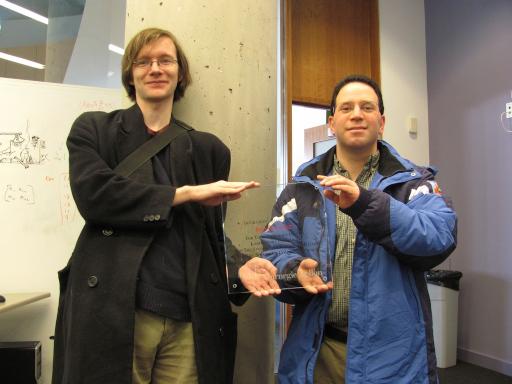
Lunch offered an opportunity to visit the Red Hat sponsored lab, which was pleasingly located somewhere other than a basement. The guy on the right of the picture is Greg Kesden, the director of undergraduate laboratories in CS there - it was wonderful to get an opportunity to see the machines getting used, and students seemed genuinely appreciative of the facility.

After lunch I spent a while talking to Satya about the Internet Suspend and Resume project. This is an impressive combination of virtualisation and migration, using a Fedora-based live image to bring up an OS on arbitrary hardware before downloading a machine image and launching it. The majority of the data is pulled in on demand, meaning that initial performance can be slow but ensuring that data is only downloaded if it's needed. When the user is finished, the delta between the original image and the new one can be pushed back to the server while remaining cached on the local machine in case the image is used again.

It's an interesting approach, combining the flexibility of thin clients with the advantages of having actually useful computing power at the local end. There's a few functional awkwardnesses, such as some VMs being unhappy if images are migrated between machines with different CPU features, and it obviously benefits from having significant bandwidth. But the idea of being able to combine the convenience of a floating session with the knowledge that you can still keep copies of your data on you is an attractive one, and I'd love a future where I can move my session between my laptop and a desktop.

After that there was some time to talk to Bill Scherlis and Philip Lehman about the software engineering courses that CMU run. Part of the minor in software engineering includes a course requirement to make a meaningful contribution to an existing software project, from design through to submission and upstream acceptance. I had the opportunity to talk to a couple of the students about this and the differences they found between working with the Mozilla and Chrome communities, which I'll try to write up at some point.

Finally I gave a presentation on Fedora and some of the issues that we face in providing a useful OS when patents and recalcitrant hardware vendors do their best to thwart us. Despite the ice outside and the significantly-below-freezing temperatures, enough people turned up that sorties had to be sent out to find extra chairs. It was great to see how interested people were in learning about what we do, although it's probably the case that the free pizza did help encourage people.

After that it was an early trip back to the airport, where I found that my plane was delayed and the only "restaurant" still open was McDonalds. Even so, I left with the feeling that it had been an interesting and educational visit. Many thanks to David Eckhardt, who runs the OS course I presented to and who looked after me all day - thanks too to Joshua Wise who picked me up when David was running late due to the ground being covered with blocks of ice.

Steve Kemp: If you were a comic book character, what character would you be?

I've been overhauling the way that I am host a number of virtual websites upon my main box. Partly to increase security, and partly for a cleaner separation or roles, ownership, and control. (In general everything on my box is "mine", but some things are "ours"...) After a fair amount of experimentation I decided that I wasn't willing or able to rewrite all my Apache mod_rewrite rules just yet. So my interim plan was to update each existing virtual host: To make it clear what the users were for I decided that every hosting-user would have an "s-" prefix. So the virtual host "static.steve.org.uk" was initially going to be served by the s-static user. The thttpd configuration file would look like this, and would be located in /etc/thttpd/sites/static.steve.org.uk:
host=127.0.0.1
port=1008
dir=/home/www/static.steve.org.uk/htdocs/
chroot
user=s-static
throttles=/etc/thttpd/throttle.conf
logfile=/home/www/static.steve.org.uk/logs/thttpd.log
pidfile=/home/www/static.steve.org.uk/pid/file
(I wrote a trivial script to stop/start all the sites en mass, and removed the default thttpd init script, logrotation job, and similar things.) How did I decide which port to run this instance under? By taking the UID of the user:
steve@skx:~$ id s-static
uid=1008(s-static) gid=1009(s-static) groups=1009(s-static)
With this in place I could then update the Apache configuration file from serving the site directly to merely proxying to the back-end server:
<VirtualHost *>
    ServerName  static.steve.org.uk
    # Proxy ACL
    <Proxy *>
        Order allow,deny
        Allow from all
    </Proxy>
    # Proxy directives
    ProxyPass          /   http://localhost:1008/
    ProxyPassReverse   /   http://localhost:1008/
    ProxyPreserveHost on
</VirtualHost>
So was that all there is to it? Sadly not. There were a couple of minor issues, some of which were:
cronjobs
I have various cron-jobs in my main steve account which previously updated blog indexes, etc. (I use namazu2 to make my blog searchable.) I had to change the ownership of the existing indexes, the scripts themselves, and move the cronjob to the new s-blog user.
cross-user dependencies
I run a couple of sites which pull in content from other locations. For example a couple of list summaries, and archives. These are generally fed from a ~/.procmail snippet under my primary login. Since my primary login no longer owns the web-tree it is no longer able to update things directly. Instead I had to duplicate a couple of subscriptions and move this work under the UID of the site-owner.
I'm no longer running apache
For a day or two I'd forgotten I was using the apache facility to include snippets in my site; such as links to my wishlist. Since I'm not using Apache in the back-end server-parsed files no longer work. Happily I'm using a simple template-based setup for my main sites, so I updated the template-parser to understand "##include ./path/to/file". For example this source file produces my donation page. The upshot is my "static" site is even more static, which is a good thing.
uploads are harder
Several of my domains host entirely static content which is generated on my main desktop machine, and then uploaded via rsync post-build. I had to add some more accounts and configure SSH keys, then update the uploading routines/Makefiles appropriately. Not a major annoyance, but suddenly my sshd_config file has gone from "PermitUser steve,backup" to including many additional accounts.
The single biggest pain was handling my my mercurial repositories - overhauling that took a bit of creativity to ensure that nothing was broken for existing or new checkouts. I wish that a backport of mercurial-server was trivial because I'd love to be using that. In general though watching the thttpd logs has been sufficient to spot problems. I had to tweak things a little to generate statistics properly, but otherwise all is good. Why thttpd? Well small, lightweight, and the ability to run CGI scripts. Something missing from nginx for example. I'm still aiming to remove apache2 from the front-end - it is mostly just a dumb proxy, but it does perform some ACL operations and expand mod_rewrite rules. I could port those to another engine .. but not today. The most likely candidates are nginx, perlbal, or lighttpd - each of these should be capable of doing simple ACL checks, and performing mod_rewrite-like rules. ObFilm: Mallrats

17 February 2010

Masayuki Hatta: Freenet for Debian

The recent development of the situation in China or Iran reminds me of the importance AND fragility of the freedom of speech on the Net. As the influence by the Net on the general public grows, attempts by governments to control and tame the Net will be aggravated, in a more sophisticated, crowd-pleasing way (for example, by claiming a need for Internet Driver's Licenses). How can we deal with this? Freenet can be a key to solve this problem. After almost 10 years of continuous development, it seems that it finally became an usable product(I don't say it's perfect -- there are still a lot of things to be done, especially around its UI). Freenet has its own dark side and I don't expect that it will become the standard way of the communication over the Net, but we always need the last resort to enjoy our everyday life. Unfortunately, most of Freenet-related information on the Net, especially about the installation method on GNU/Linux, are severely outdated. Freenet is a Free Software(GPL'd), and Debian did have a .deb package for Freenet long long ago, but it's basically gone and defunct. Since the pace of current development is quite fast and sometimes the backward compatibility is broken, it's not really a good idea to ITP and upload Freenet to the main Debian archive for now. Thus, I cooked up up-to-date .deb packages of the modern Freenet and publish them by myself on people.debian.org. I tried to follow the Debian packaging convention as much as possible, so at least they can be installed & uninstalled cleanly ;-) Also, Build-Deps are carefully set, so you may rebuild it without much hassle if you need. Add the following to your /etc/apt/sources.list:
deb http://people.debian.org/~mhatta/debian/freenet ./
deb-src http://people.debian.org/~mhatta/debian/freenet ./
Then run "apt-get update" and install "fred" package. This is basically all you need(you might also want jSite or FMS). Then take a look at /usr/share/doc/fred/README.Debian. You might need to copy seednodes.fref into /var/lib/fred if you want to use Freenet's Opennet mode for the first time. After that, access http://localhost:8888 and follow the instructions. Recommended readings on the modern Freenet: Enjoy.

Tag this post with del.icio.us!

16 February 2010

Steve Kemp: I am lightened, can we drop this?

As part of some house-keeping I've been checking over my systems and ensuring they're all tickity-boo for the past couple of days. One thing that I'm getting increasingly tempted by is converting my kvm guest to a 64-bit system. I've not quite sold myself on the prospect of what will be a fair amount of downtime, but I'm 90% there. I do think that a lot of my setup needs an overhaul, for example: One possible plan is to wipe my system, and then restore data from backups. A perhaps saner approach is divide my guest into two smaller ones, and migrate services over one by one (e.g. website1, website2, .. websiteN, email, etc). For the moment I've taken a complete dump of my existing guest, and I'm running it with an IP in the 10.0.0.0/24 range on my desktop. That's at least given me a clear idea of the amount of work involved. I'm still a little unclear on how best to manage running N websites with the intention they'll each run under their own UID. I guess it comes down to having a few instances of nginx/lighttpd/apache and then proxy from *:80 to the actual back-end. Precisely which mixture of services to use is a little overwhelming. Though at some point soon I need to start enabling IPv6 support, and that changes things a little. (Not least because nginx has no IPv6 support present in the Lenny release - I've got a backported package which I run on the Debian Administration website.) It's possible I could hack mod_vhost_alias to redirect/proxy to a local port based upon the virtual hostname present in the request - that's pretty trivial and I've already done something similar for work purposes. Though something like that should presumably already exist? I would expect a map of some form:
example.org: 127.0.0.1:8080
example.net: 127.0.0.1:9090
That has to be about the minimum necessary information to make the decision; a pair of vhost name & local destination. /me googles some.. Update
OK quick update I've added local users for some of my sites, and now have them running under thttpd.
skx:/etc/thttpd# ls -ltr /home/www/   tail -n 4
drwxr-sr-x  4 s-static   s-static   4096 Jan 15 01:41 static.steve.org.uk
drwxr-sr-x  5 s-openid   s-openid   4096 Feb 16 21:31 openid.steve.org.uk
drwxr-sr-x  6 s-images   s-images   4096 Feb 16 21:52 images.steve.org.uk
drwxr-sr-x  5 s-packages s-packages 4096 Feb 16 22:03 packages.steve.org.uk
That seems to work well, with a small wrapper script to start N instances of thttpd instead of a single one. Minor issues are that I'm using mod_proxy to forward requests to the thtpd instances running upon the loopback - and it was initially logging 127.0.0.1 as the source IP. A quick patch later all is well. I'll leave it running a couple of the simple sites for the next few days and see if it kills children. If it does I'll convert the rest. Probably will aim to have nginx in front of thttpd, instead of Apache, but this way I don't have to worry about mod_rewrite rules just yet.
ObFilm: Cruel Intentions

15 February 2010

William Pitcock: 5 Healthy Eating Oout Diet Tips

bbsteakbsr
It s hard to do a healthy diet outside the home? Whereas many of the activities carried out. Try some tips refer to following a healthy diet that you can do outside. re Dieting to reduce consumption of fats, carbohydrates or sugar? That does not mean you can not eat well. With a few tricks and cunning look of food, you can even a good meal in a restaurant also order food from fast-food restaurant. Try it voyeur tips from DASH, Dietary Approaches to Stop Hypertension. With these healthy tips you can still eat well and avoid high blood pressure or high cholesterol levels. Well, try telling refer to the following tips: 1. Avoid foods with saturated fats and cholesterol High
But avoid foods that contain saturated fatty acids and also high yan foods contain cholesterol. You can avoid these foods but still give priority to taste, a variety of menus to choose from, even a favorite. If you re eating out make sure the following things:
- Make sure your food is cooked using olive oil instead of butter or
fat if the dish was a stir-fried or something.
- Ask for salad dressing or salad dressings are low in fat.
- If mkan meat or chicken, remove the parts that contain fat such as chicken skin.
- Choose foods with dimaska burned, boiled, or baked. In addition to not using oil, usually healthier. 2. Watchful Against Salt
Another thing to note that this works DASH diet is salt. Because salt can raise your blood pressure, while salt is often used in a variety of restaurants to make food more delicious. You still can control the salt in your food when eating out by doing:
- Ask the waiter to not put salt or MSG in your food.
- Beware of any food that a high salt content such as pickles, soy sauce, broth, bacon, and others.
- Keep the salt from your desk, because usually you will reflexively add salt to the food.
- Reduce the use of mustard, ketchup, pickles, and other Condiment a high salt content.
- Choose fruits or vegetables as the opening menu. 3. Avoid foods with a portion of
But avoid foods with large portions. In addition you will feel
unfortunately if the foods are not consumed, you will feel sick if you eat too much excess. We recommend that you order enough food. Or if that portion is too big, shared with friends is much better. 4. Always Instill Healthy Living Patterns in the Mind
More and more people realize how important a healthy life, making a lot of restaurants started to state that low-fat or rich in antioxidants to the food they sell. Actually do not stop until the food alone, you
also have to think about drinks or dessert healthy what happens to the balance. For example:
- Choose a drink that does not cause side effects, such as mineral water, fruit juice, or herbal tea.
- Expand vegetables and fruits as well as the opening menu to avoid overeating at the main menu.
- If you decide to eat a salad, choose low-fat sauce or put the sauce on the plate edge so that its use is not excessive.
- Avoid mouthwashes that contain high fat like cheese cake. We recommend that you choose desserts such as fruit, sorbet, or fruit jelly. 5. Order careful in Resto Fast Food
Fast-food restaurant is the most dangerous enemy to your diet. But if you are careful, you can still enjoy fast food without the fear of cholesterol or high blood pressure soared and certainly does not ruin your diet program. Here are some tips if your food in the restaurant inginmemesan fast food:
- Take your time choosing foods, read the content carefully to what
contained in one serving. And do not be shy to ask the waiter about
Andapesan food.
- Combine your foods such as grilled chicken with whole wheat and yogurt drinks or low-fat milk.
- Do not order more servings.
- Be aware of and avoid salad dressings containing Condiment bleak high salt soy sauce, ketchup, and pickles.
- To drink mineral water should choose, even if others want to order to avoid fizzy drinks.

Next.

Previous.