Search Results: "sto"

20 February 2015

Rhonda D'Vine: Queer-Positive Songs

Just recently I stumbled upon one of these songs again and thought to myself: Are there more out there? With these songs I mean songs that could from its lyrics be considered queer-positive. Lyrics that cointain parts that speak about queer topics. To get you an idea of what I mean here are three songs as examples: Do you have further examples for me? I know that I already mentioned another one in my blog entry about Garbage for a start. I am aware that there probably are dedicated bands that out of their own history do a lot songs in that direction, but I also want to hear about songs in which it is only mentioned in a side note and not made the central topic of the whole song, making it an absolutely normal random by-note. Like always, enjoy and I'm looking forward to your suggestions!

/music permanent link Comments: 17 Flattr this

19 February 2015

Niels Thykier: Partial rewrite of lintian s reporting setup

I had the mixed pleasure of doing a partial rewrite of lintian s reporting framework. It started as a problem with generating the graphs, which turned out to be not enough memory . On the plus side, I am actually quite pleased with the end result. I managed to scope-creep myself quite a bit and I ended up getting rid of a lot of old issues. The major changes in summary: There are also some nice minor features : As you can probably tell, I am quite pleased with the end result. The reporting framework lacks behind in development, since it just sits there and takes care of itself . Also with the complete lack of testing, it also suffers from the if it is not broken, then do not fix it paradigm (because we will not notice if we broke until it is too late). Of course, I managed to break the setup a couple of times in the process. However, a bonus feature of the reporting setup is that if you break it, it simply leaves an outdated report on the website. Anyway, enjoy. :)
Filed under: Debian, Lintian

Michal Čihař: Weblate 2.2

Weblate 2.2 has been released today. It comes with improved search, user interface cleanup and various other fixes. Full list of changes for 2.2: You can find more information about Weblate on http://weblate.org, the code is hosted on Github. If you are curious how it looks, you can try it out on demo server. You can login there with demo account using demo password or register your own user. Weblate is also being used https://hosted.weblate.org/ as official translating service for phpMyAdmin, Gammu, Weblate itself and other projects. If you are free software project which would like to use Weblate, I'm happy to help you with set up or even host Weblate for you. Further development of Weblate would not be possible without people providing donations, thanks to everybody who have helped so far! PS: The roadmap for next release is just being prepared, you can influence this by expressing support for individual issues either by comments or by providing bounty for them.

Filed under: English phpMyAdmin SUSE Weblate 0 comments Flattr this!

18 February 2015

Philipp Kern: Caveats of the HP MicroServer Gen8

If you intend to buy the HP MicroServer Gen8 as a home server there are a few caveats that I didn't find on the interwebs before I bought the device:
If you try to boot FreeBSD with its zfsloader you will likely need to apply a workaround patch, because the BIOS seems to do something odd. Linux works as expected.

17 February 2015

Lucas Nussbaum: Some email organization tips and tricks

I d like to share a few tips that were useful to strengthen my personal email organization. Most of what follows is probably not very new nor special, but hey, let s document it anyway. Many people have an inbox folder that just grow over time. It s actually similar to a twitter or RSS feed (except they probably agree that they are supposed to read more of their email feed ). When I send an email to them, it sometimes happen that they don t notice it, if the email arrives at a bad time. Of course, as long as they don t receive too many emails, and there aren t too many people relying on them, it might just work. But from time to time, it s super-painful for those interacting with them, when they miss an email and they need to be pinged again. So let s try not to be like them. :-) Tip #1: do Inbox Zero (or your own variant of it) Inbox Zero is an email management methodology inspired from David Allen s Getting Things Done book. It s best described in this video. The idea is to turn one s Inbox into an area that is only temporary storage, where every email will get processed at some point. Processing can mean deleting an email, archiving it, doing the action described in the email (and replying to it), etc. Put differently, it basically means implementing the Getting Things Done workflow on one s email. Tip #1.1: archive everything One of the time-consuming decisions in the original GTD workflow is to decide whether something should be eliminated (deleted) or stored for reference. Given that disk space is quite cheap, it s much easier to never decide about that, and just archive everything (by duplicating the email to an archive folder when it is received). To retrieve archived emails when needed, I then use notmuch within mutt to easily search through recent (< 2 year) archives. I use archivemail to archive older email in compressed mboxes from time to time, and grepmail to search through those mboxes when needed. I don t archive most Debian mailing lists though, as they are easy to fetch from master.d.o with the following script:
#!/bin/sh
rsync -vP master.debian.org:~debian/*/*$1/*$1.$ 2:-$(date +%Y%m) * .
Then I can fetch a specific list archive with getlist devel 201502, or a set of archives with e.g. getlist devel 2014, or the current month with e.g. getlist devel. Note that to use grepmail on XZ-compressed archives, you need libmail-mbox-messageparser-perl version 1.5002-3 (only in unstable I was using a locally-patched version for ages, but finally made a patch last week, which Gregor kindly uploaded). Tip #1.2: split your inbox (Yes, this one looks obvious but I m always surprised at how many people don t do that.) Like me, you probably receive various kinds of emails: Splitting those into separate folders has several advantages: I ve seen some people splitting their inbox into too many folders. There s not much point in having a per-sender folder organization (unless there s really a recurring flow of emails from a specific person), as it increases the risk of missing an email. I use procmail to organize my email into folders. I know that there are several more modern alternatives, but I haven t looked at them since procmail does the job for me. Resulting organization I use one folder for my day-job email, one for my DPL email, one for all other email directed or Cced to me. Then, I have a few folders for automated notifications of stuff. My Debian mailing list folders are auto-managed by procmail s $MATCH:
:0:
 * ^X-Mailing-List: <.*@lists\.debian\.org>
 * ^X-Mailing-List: <debian-\/[^@]*
 .ml.debian.$MATCH/
Some other mailing lists are in they separate folders, and there s a catch-all folder for the remaining ones. Ah, and since I use feed2imap, I have folders for the RSS/Atom feeds I follow. I have two different commands to start mutt. One only shows a restricted number of (important) folders. The other one shows the full list of (non-empty) folders. This is a good trick to avoid spending time reading email when I am supposed to do something more important. :) As for many people probably, my own organization is loosely based on GTD and Inbox Zero. It sometimes happen that some emails stay in my Inbox for several days or weeks, but I very rarely have more than 20 or 30 emails in one of my main inbox folders. I also do reviews of the whole content of my main inbox folders once or twice a week, to ensure that I did not miss an email that could be acted on quickly. A last trick is that I have a special folder replies, where procmail copies emails that are replies to a mail I sent, but which do not Cc me. That s useful to work-around Debian s no Cc on reply to mailing list posts policy. I receive email using offlineimap (over SSH to my mail server), and send it using nullmailer (through a SSH tunnel). The main advantage of offlineimap over using IMAP directly in mutt is that using IMAP to a remote server feels much more sluggish. Another advantage is that I only need SSH access to get my full email setup to work. Tip #2: tracking sent emails Two recurring needs I had was: I developed a short script to address that. It scans the content of my Sent maildir and my archive maildirs, and, for each email address I use, displays (see example output in README) the list of emails sent with this address (one email per line). It also detects if an email was replied to ( R column after the date), and abbreviates common parts in email addresses (debian-project@lists.debian.org becomes d-project@l.d.o). It also generates a temporary maildir with symlinks to all emails, so that I can just open the maildir if needed.

Clint Adams: Copyleft licenses are oppressing someone

I go to a party, carrying two expensive bottles of liquor that I have acquired from faraway lands. The hosts of the party provide a variety of liquors, snacks, and mixers. Some neuro guy shows up, looks around, feels guilty, says that he should have brought something. His friend shows up, bearing hot food. The neuro guy decides to contribute $7 to the purchase of food since he didn't bring anything. The friend then proceeds to charge us each $7. No one else demands money for any of the other things being share and consumed by everyone. The hosts do not retroactively charge a cover fee for entrance to the house. No one else offers to pay anyone for anything. The neuro guy attempts to wash some dishes before leaving, but is stopped by the hosts, because he is a guest.

John Goerzen: Has Linux lost its way? comments prompt a Debian developer to revisit FreeBSD after 20 years

I ll admit it. I have a soft spot for FreeBSD. FreeBSD was the first Unix I ran, and it was somewhere around 20 years ago that I did so, before I switched to Debian. Even then, I still used some of the FreeBSD Handbook to learn Linux, because Debian didn t have the great Reference that it does now. Anyhow, some comments in my recent posts ( Has modern Linux lost its way? and Reactions to that, and the value of simplicity), plus a latent desire to see how ZFS fares in FreeBSD, caused me to try it out. I installed it both in VirtualBox under Debian, and in an old 64-bit Thinkpad sitting in my basement that previously ran Debian. The results? A mixture of amazing and disappointing. I will say that I am quite glad that both exist; there is plenty of innovation happening everywhere and neat features exist everywhere, too. But I can also come right out and say that the statement that FreeBSD doesn t have issues like Linux does is false and misleading. In many cases, it s running the exact same stack. In others, it s better, but there are also others where it s worse. Perhaps this article might dispell a bit of the FUD surrounding jessie, while also showing off some of the nice things FreeBSD does. My conclusion: Both jessie and FreeBSD 10.1 are awesome Free operating systems, but both have their warts. This article is more about FreeBSD than Debian, but it will discuss a few of Debian s warts as well. The experience My initial reaction to FreeBSD was: wow, this feels so familiar. It reminds me of a commercial Unix, or maybe of Linux from a few years ago. A minimal, well-documented base system, everything pretty much in logical places in the filesystem, and solid memory management. I felt right at home. It was almost reassuring, even. Putting together a FreeBSD box is a lot of package installing and config file editing. The FreeBSD Handbook, describing how to install X, talks about editing this or that file for this or that feature. I like being able to learn directly how things fit together by doing this. But then you start remembering the reasons you didn t like Linux a few years ago, or the commercial Unixes: maybe it s that programs like apache are still not as well supported, or maybe it s that the default vi has this tendency to corrupt the terminal periodically, or perhaps it s that root s default shell is csh. Or perhaps it s that I have to do a lot of package installing and config file editing. It is not quite the learning experience it once was, either; now there are things like paste this XML file into some obscure polkit location to make your mouse work or something. Overall, there are some areas where FreeBSD kills it in a way no other OS does. It is unquestionably awesome in several areas. But there are a whole bunch of areas where it s about 80% as good as Linux, a number of areas (even polkit, dbus, and hal) where it s using the exact same stack Linux is (so all these comments about FreeBSD being so differently put together strike me as hollow), and frankly some areas that need a lot of work and make it hard to manage systems in a secure and stable way. The amazing Let s get this out there: I ve used ZFS too much to use any OS that doesn t support it or something like it. Right now, I m not aware of anything like ZFS that is generally stable and doesn t cost a fortune, so pretty much: if your Unix doesn t do ZFS, I m not interested. (btrfs isn t there yet, but will be awesome when it is.) That s why I picked FreeBSD for this, rather than NetBSD or OpenBSD. ZFS on FreeBSD is simply awesome. They have integreated it extremely well. The installer supports root on zfs, even encrypted root on zfs (though neither is a default). top on a FreeBSD system shows a line of ZFS ARC (cache) stats right alongside everything else. The ZFS defaults for maximum cache size, readahead, etc. auto-tune themselves at boot (unless overridden) based on the amount of RAM in a system and the system type. Seriously, these folks have thought of everything and it just reeks of solid. I haven t seen ZFS this well integrated outside the Solaris-type OSs. I have been using ZFSOnLinux for some time now, but it is just not as mature as ZFS on FreeBSD. ZoL, for instance, still has some memory tuning issues, and is not really suggested for 32-bit machines. FreeBSD just nails it. ZFS on FreeBSD even supports TRIM, which is not available in ZoL and I think fairly unique even among OpenZFS platforms. It also supports delegated administration of the filesystem, both to users and to jails on the system, seemingly very similar to Solaris zones. FreeBSD also supports beadm, which is like a similar tool on Solaris. This lets you basically use ZFS snapshots to make lightweight boot environments , so you can select which to boot into. This is useful, say, before doing upgrades. Then there are jails. Linux has tried so hard to get this right, and fallen on its face so many times, a person just wants to take pity sometimes. We ve had linux-vserver, openvz, lxc, and still none of them match what FreeBSD jails have done for a long time. Linux s current jail-du-jour is LXC, though it is extremely difficult to configure in a secure way. Even its author comments that you won t hear any of the LXC maintainers tell you that LXC is secure and that it pretty much requires AppArmor profiles to achieve reasonable security. These are still rather in flux, as I found out last time I tried LXC a few months ago. My confidence in LXC being as secure as, say, KVM or FreeBSD is simply very low. FreeBSD s jails are simple and well-documented where LXC is complex and hard to figure out. Its security is fairly transparent and easy to control and they just work well. I do think LXC is moving in the right direction and might even get there in a couple years, but I am quite skeptical that even Docker is getting the security completely right. The simply different People have been throwing around the word distribution with respect to FreeBSD, PC-BSD, etc. in recent years. There is an analogy there, but it s not perfect. In the Linux ecosystem, there is a kernel project, a libc project, a coreutils project, a udev project, a systemd/sysvinit/whatever project, etc. You get the idea. In FreeBSD, there is a base system project. This one project covers the kernel and the base userland. Some of what they use in the base system is code pulled in from elsewhere but maintained in their tree (ssh), some is completely homegrown (kernel), etc. But in the end, they have a nicely-integrated base system that always gets upgraded in sync. In the Linux world, the distribution makers are responsible for integrating the bits from everywhere into a coherent whole. FreeBSD is something of a toolkit to build up your system. Gentoo might be an analogy in the Linux side. On the other end of the spectrum, Ubuntu is a just install it and it works, tweak later sort of setup. Debian straddles the middle ground, offering both approaches in many cases. There are pros and cons to each approach. Generally, I don t think either one is better. They are just different. The not-quite-there I said that there are a lot of things in FreeBSD that are about 80% of where Linux is. Let me touch on them here. Its laptop support leaves something to be desired. I installed it on a few-years-old Thinkpad basically the best possible platform for working suspend in a Free OS. It has worked perfectly out of the box in Debian for years. In FreeBSD, suspend only works if it s in text mode. If X is running, the video gets corrupted and the system hangs. I have not tried to debug it further, but would also note that suspend on closed lid is not automatic in FreeBSD; the somewhat obscure instuctions tell you what policykit pkla file to edit to make suspend work in XFCE. (Incidentally, it also says what policykit file to edit to make the shutdown/restart options work). Its storage subsystem also has some surprising misses. Its rough version of LVM, LUKS, and md-raid is called GEOM. GEOM, however, supports only RAID0, RAID1, and RAID3. It does not support RAID5 or RAID6 in software RAID configurations! Linux s md-raid, by comparison, supports RAID0, RAID1, RAID4, RAID5, RAID6, etc. There seems to be a highly experimental RAID5 patchset floating around for many years, but it is certainly not integrated into the latest release kernel. The current documentation makes no mention of RAID5, although it seems that a dated logical volume manager supported it. In any case, RAID5 does not seem to be well-supported in software like it is in Linux. ZFS does have its raidz1 level, which is roughly the same as RAID5. However, that requires full use of ZFS. ZFS also does not support some common operations, like adding a single disk to an existing RAID5 group (which is possible with md-raid and many other implementations.) This is a ZFS limitation on all platforms. FreeBSD s filesystem support is rather a miss. They once had support for Linux ext* filesystems using the actual Linux code, but ripped it out because it was in GPL and rewrote it so it had a BSD license. The resulting driver really only works with ext2 filesystems, as it doesn t work with ext3/ext4 in many situations. Frankly I don t see why they bothered; they now have something that is BSD-licensed but only works with a filesystem so old nobody uses it anymore. There are only two FreeBSD filesystems that are really useable: UFS2 and ZFS. Virtualization under FreeBSD is also not all that present. Although it does support the VirtualBox Open Source Edition, this is not really a full-featured or fast enough virtualization environment for a server. Its other option is bhyve, which looks to be something of a Xen clone. bhyve, however, does not support Windows guests, and requires some hoops to even boot Linux guest installers. It will be several years at least before it reaches feature-parity with where KVM is today, I suspect. One can run FreeBSD as a guest under a number of different virtualization systems, but their instructions for making the mouse work best under VirtualBox did not work. There may have been some X.Org reshuffle in FreeBSD that wasn t taken into account. The installer can be nice and fast in some situations, but one wonders a little bit about QA. I had it lock up on my twice. Turns out this is a known bug reported 2 months ago with no activity, in which the installer attempts to use a package manger that it hasn t set up yet to install optional docs. I guess the devs aren t installing the docs in testing. There is nothing like Dropbox for FreeBSD. Apparently this is because FreeBSD has nothing like Linux s inotify. The Linux Dropbox does not work in FreeBSD s Linux mode. There are sketchy reports of people getting an OwnCloud client to work, but in something more akin to rsync rather than instant-sync mode, if they get it working at all. Some run Dropbox under wine, apparently. The desktop environments tend to need a lot more configuration work to get them going than on Linux. There s a lot of editing of polkit, hal, dbus, etc. config files mentioned in various places. So, not only does FreeBSD use a lot of the same components that cause confusion in Linux, it doesn t really configure them for you as much out of the box. FreeBSD doesn t support as many platforms as Linux. FreeBSD has only two platforms that are fully supported: i386 and amd64. But you ll see people refer to a list of other platforms that are supported , but they don t have security support, official releases, or even built packages. They includ arm, ia64, powerpc, and sparc64. The bad: package management Roughly 20 years ago, this was one of the things that pulled me to Debian. Perhaps I am spolied from running the distribution that has been the gold standard for package management for so long, but I find FreeBSD s package management even pkg-ng in 10.1-RELEASE to be lacking in a number of important ways. To start with, FreeBSD actually has two different package management systems: one for the base system, and one for what they call the ports/packages collection ( ports being the way to install from source, and packages being the way to install from binaries, but both related to the same tree.) For the base system, there is freebsd-update which can install patches and major upgrades. It also has a cron option to automate this. Sadly, it has no way of automatically indicating to a calling script whether a reboot is necessary. freebsd-update really manages less than a dozen packages though. The rest are managed by pkg. And pkg, it turns out, has a number of issues. The biggest: it can take a week to get security updates. The FreeBSD handbook explains pkg audit -F which will look at your installed packages (but NOT the ones in the base system) and alert you to packages that need to be updates, similar to a stripped-down version of Debian s debsecan. I discovered this myself, when pkg audit -F showed a vulnerability in xorg, but pkg upgrade showed my system was up-to-date. It is not documented in the Handbook, but people on the mailing list explained it to me. There are workarounds, but they can be laborious. If that s not bad enough, FreeBSD has no way to automatically install security patches for things in the packages collection. Debian has several (unattended-upgrades, cron-apt, etc.) There is pkg upgrade , but it upgrades everything on the system, which may be quite a bit more than you want to be upgraded. So: if you want to run Apache with PHP, and want it to just always apply security patches, FreeBSD packages are not up to the job like Debian s are. The pkg tool doesn t have very good error-handling. In fact, its error handling seems to be nonexistent at times. I noticed that some packages had failures during install time, but pkg ignored them and marked the package as correctly installed. I only noticed there was a problem because I happened to glance at the screen at the right moment during messages about hundreds of packages. In Debian, by contrast, if there are any failures, at the end of the run, you get a nice report of which packages failed, and an exit status to use in scripts. It also has another issue that Debian resolved about a decade ago: package scripts displaying messages that are important for the administrator, but showing so many of them that they scroll off the screen and are never seen. I submitted a bug report for this one also. Some of these things just make me question the design of pkg. If I can t trust it to accurately report if the installation succeeded, or show me the important info I need to see, then to what extent can I trust it? Then there is the question of testing of the ports/packages. It seems that, automated tests aside, basically everyone is running off the master branch of the ports/packages. That s like running Debian unstable on your servers. I am distinctly uncomfortable with this notion, though it seems FreeBSD people report it mostly works well. There are some other issues, too: FreeBSD ports make no distinction between development and runtime files like Debian s packages do. So, just by virtue of wanting to run a graphical desktop, you get all of the static libraries, include files, build scripts, etc for XOrg installed. For a package as concerned about licensing as FreeBSD, the packages collection does not have separate sections like Debian s main, contrib, and non-free. It s all in one big pot: BSD-license, GPL-license, proprietary without source license. There is /usr/local/share/licenses where you can look up a license for each package, but there is no way with FreeBSD, like there is with Debian, to say never even show me packages that aren t DFSG-free. This is useful, for instance, when running in a company to make sure you never install packages that are for personal use only or something. The bad: ABI stability I m used to being able to run binaries I compiled years ago on a modern system. This is generally possible in Linux, assuming you have the correct shared libraries available. In FreeBSD, this is explicitly NOT possible. After every major version upgrade, you must reinstall or recompile every binary on your system. This is not necessarily a showstopper for me, but it is a hassle for a lot of people. Update 2015-02-17: Some people in the comments are pointing out compat packages in the ports that may help with this situation. My comment was based on advice in the FreeBSD Handbook stating After a major version upgrade, all installed packages and ports need to be upgraded . I have not directly tried this, so if the Handbook is overstating the need, then this point may be in error. Conclusions As I said above, I found little validation to the comments that the Debian ecosystem is noticeably worse than the FreeBSD one. Debian has its warts too particularly with keeping software up-to-date. You can see that the two projects are designed around a different passion: FreeBSD s around the base system, and Debian s around an integrated whole system. It would be wrong to say that either of those is always better. FreeBSD s approach clearly produces some leading features, especially jails and ZFS integration. Yet Debian s approach also produces some leading features in the way of package management and security maintainability beyond the small base. My criticism of excessive complexity in the polkit/cgmanager/dbus area still stands. But to those people commenting that FreeBSD hasn t lost its way like Linux has, I would point out that FreeBSD mostly uses these same components also, and FreeBSD has excessive complexity in its ports/package system and system management tools. I think it s a draw. You pick the best for your use case. If you re looking for a platform to run a single custom app then perhaps all of the Debian package management benefits don t apply to you (you may not even need FreeBSD s packages, or just a few). The FreeBSD ZFS support or jails may well appeal. If you re looking to run a desktop environment, or a server with some application that needs a ton of PHP, Python, Perl, or C libraries, then Debian s package management and security handling may well be attractive. I am disappointed that Debian GNU/kFreeBSD will not be a release architecture in jessie. That project had the promise to provide a best of both worlds for those that want jails or tight ZFS integration.

16 February 2015

Matthew Garrett: Intel Boot Guard, Coreboot and user freedom

PC World wrote an article on how the use of Intel Boot Guard by PC manufacturers is making it impossible for end-users to install replacement firmware such as Coreboot on their hardware. It's easy to interpret this as Intel acting to restrict competition in the firmware market, but the reality is actually a little more subtle than that.

UEFI Secure Boot as a specification is still unbroken, which makes attacking the underlying firmware much more attractive. We've seen several presentations at security conferences lately that have demonstrated vulnerabilities that permit modification of the firmware itself. Once you can insert arbitrary code in the firmware, Secure Boot doesn't do a great deal to protect you - the firmware could be modified to boot unsigned code, or even to modify your signed bootloader such that it backdoors the kernel on the fly.

But that's not all. Someone with physical access to your system could reflash your system. Even if you're paranoid enough that you X-ray your machine after every border crossing and verify that no additional components have been inserted, modified firmware could still be grabbing your disk encryption passphrase and stashing it somewhere for later examination.

Intel Boot Guard is intended to protect against this scenario. When your CPU starts up, it reads some code out of flash and executes it. With Intel Boot Guard, the CPU verifies a signature on that code before executing it[1]. The hash of the public half of the signing key is flashed into fuses on the CPU. It is the system vendor that owns this key and chooses to flash it into the CPU, not Intel.

This has genuine security benefits. It's no longer possible for an attacker to simply modify or replace the firmware - they have to find some other way to trick it into executing arbitrary code, and over time these will be closed off. But in the process, the system vendor has prevented the user from being able to make an informed choice to replace their system firmware.

The usual argument here is that in an increasingly hostile environment, opt-in security isn't sufficient - it's the role of the vendor to ensure that users are as protected as possible by default, and in this case all that's sacrificed is the ability for a few hobbyists to replace their system firmware. But this is a false dichotomy - UEFI Secure Boot demonstrated that it was entirely possible to produce a security solution that provided security benefits and still gave the user ultimate control over the code that their machine would execute.

To an extent the market will provide solutions to this. Vendors such as Purism will sell modern hardware without enabling Boot Guard. However, many people will buy hardware without consideration of this feature and only later become aware of what they've given up. It should never be necessary for someone to spend more money to purchase new hardware in order to obtain the freedom to run their choice of software. A future where users are obliged to run proprietary code because they can't afford another laptop is a dystopian one.

Intel should be congratulated for taking steps to make it more difficult for attackers to compromise system firmware, but criticised for doing so in such a way that vendors are forced to choose between security and freedom. The ability to control the software that your system runs is fundamental to Free Software, and we must reject solutions that provide security at the expense of that ability. As an industry we should endeavour to identify solutions that provide both freedom and security and work with vendors to make those solutions available, and as a movement we should be doing a better job of articulating why this freedom is a fundamental part of users being able to place trust in their property.

[1] It's slightly more complicated than that in reality, but the specifics really aren't that interesting.

comment count unavailable comments

Julien Danjou: Hacking Python AST: checking methods declaration

A few months ago, I wrote the definitive guide about Python method declaration, which had quite a good success. I still fight every day in OpenStack to have the developers declare their methods correctly in the patches they submit. Automation plan The thing is, I really dislike doing the same things over and over again. Furthermore, I'm not perfect either, and I miss a lot of these kind of problems in the reviews I made. So I decided to replace me by a program a more scalable and less error-prone version of my brain. In OpenStack, we rely on flake8 to do static analysis of our Python code in order to spot common programming mistakes. But we are really pedantic, so we wrote some extra hacking rules that we enforce on our code. To that end, we wrote a flake8 extension called hacking. I really like these rules, I even recommend to apply them in your own project. Though I might be biased or victim of Stockholm syndrome. Your call. Anyway, it's pretty clear that I need to add a check for method declaration in hacking. Let's write a flake8 extension! Typical error The typical error I spot is the following:
class Foo(object):
# self is not used, the method does not need
# to be bound, it should be declared static
def bar(self, a, b, c):
return a + b - c

That would be the correct version:
class Foo(object):
@staticmethod
def bar(a, b, c):
return a + b - c

This kind of mistake is not a show-stopper. It's just not optimized. Why you have to manually declare static or class methods might be a language issue, but I don't want to debate about Python misfeatures or design flaws. Strategy We could probably use some big magical regular expression to catch this problem. flake8 is based on the pep8 tool, which can do a line by line analysis of the code. But this method would make it very hard and error prone to detect this pattern. Though it's also possible to do an AST based analysis on on a per-file basis with pep8. So that's the method I pick as it's the most solid. AST analysis I won't dive deeply into Python AST and how it works. You can find plenty of sources on the Internet, and I even talk about it a bit in my book The Hacker's Guide to Python. To check correctly if all the methods in a Python file are correctly declared, we need to do the following: Flake8 plugin In order to register a new plugin in flake8 via hacking, we just need to add an entry in setup.cfg:
[entry_points]
flake8.extension =
[ ]
H904 = hacking.checks.other:StaticmethodChecker
H905 = hacking.checks.other:StaticmethodChecker

We register 2 hacking codes here. As you will notice later, we are actually going to add an extra check in our code for the same price. Stay tuned. The next step is to write the actual plugin. Since we are using an AST based check, the plugin needs to be a class following a certain signature:
@core.flake8ext
class StaticmethodChecker(object):
def __init__(self, tree, filename):
self.tree = tree

def run(self):
pass

So far, so good and pretty easy. We store the tree locally, then we just need to use it in run() and yield the problem we discover following pep8 expected signature, which is a tuple of (lineno, col_offset, error_string, code). This AST is made for walking The ast module provides the walk function, that allow to iterate easily on a tree. We'll use that to run through the AST. First, let's write a loop that ignores the statement that are not class definition.
@core.flake8ext
class StaticmethodChecker(object):
def __init__(self, tree, filename):
self.tree = tree

def run(self):
for stmt in ast.walk(self.tree):
# Ignore non-class
if not isinstance(stmt, ast.ClassDef):
continue

We still don't check for anything, but we know how to ignore statement that are not class definitions. The next step need to be to ignore what is not function definition. We just iterate over the attributes of the class definition.
for stmt in ast.walk(self.tree):
# Ignore non-class
if not isinstance(stmt, ast.ClassDef):
continue
# If it's a class, iterate over its body member to find methods
for body_item in stmt.body:
# Not a method, skip
if not isinstance(body_item, ast.FunctionDef):
continue

We're all set for checking the method, which is body_item. First, we need to check if it's already declared as static. If so, we don't have to do any further check and we can bail out.
for stmt in ast.walk(self.tree):
# Ignore non-class
if not isinstance(stmt, ast.ClassDef):
continue
# If it's a class, iterate over its body member to find methods
for body_item in stmt.body:
# Not a method, skip
if not isinstance(body_item, ast.FunctionDef):
continue
# Check that it has a decorator
for decorator in body_item.decorator_list:
if (isinstance(decorator, ast.Name)
and decorator.id == 'staticmethod'):
# It's a static function, it's OK
break
else:
# Function is not static, we do nothing for now
pass

Note that we use the special for/else form of Python, where the else is evaluated unless we used break to exit the for loop.
for stmt in ast.walk(self.tree):
# Ignore non-class
if not isinstance(stmt, ast.ClassDef):
continue
# If it's a class, iterate over its body member to find methods
for body_item in stmt.body:
# Not a method, skip
if not isinstance(body_item, ast.FunctionDef):
continue
# Check that it has a decorator
for decorator in body_item.decorator_list:
if (isinstance(decorator, ast.Name)
and decorator.id == 'staticmethod'):
# It's a static function, it's OK
break
else:
try:
first_arg = body_item.args.args[0]
except IndexError:
yield (
body_item.lineno,
body_item.col_offset,
"H905: method misses first argument",
"H905",
)
# Check next method
continue

We finally added some check! We grab the first argument from the method signature. Unless it fails, and in that case, we know there's a problem: you can't have a bound method without the self argument, therefore we raise the H905 code to signal a method that misses its first argument. Now you know why we registered this second pep8 code along with H904 in setup.cfg. We have here a good opportunity to kill two birds with one stone. The next step is to check if that first argument is used in the code of the method.
for stmt in ast.walk(self.tree):
# Ignore non-class
if not isinstance(stmt, ast.ClassDef):
continue
# If it's a class, iterate over its body member to find methods
for body_item in stmt.body:
# Not a method, skip
if not isinstance(body_item, ast.FunctionDef):
continue
# Check that it has a decorator
for decorator in body_item.decorator_list:
if (isinstance(decorator, ast.Name)
and decorator.id == 'staticmethod'):
# It's a static function, it's OK
break
else:
try:
first_arg = body_item.args.args[0]
except IndexError:
yield (
body_item.lineno,
body_item.col_offset,
"H905: method misses first argument",
"H905",
)
# Check next method
continue
for func_stmt in ast.walk(body_item):
if six.PY3:
if (isinstance(func_stmt, ast.Name)
and first_arg.arg == func_stmt.id):
# The first argument is used, it's OK
break
else:
if (func_stmt != first_arg
and isinstance(func_stmt, ast.Name)
and func_stmt.id == first_arg.id):
# The first argument is used, it's OK
break
else:
yield (
body_item.lineno,
body_item.col_offset,
"H904: method should be declared static",
"H904",
)

To that end, we iterate using ast.walk again and we look for the use of the same variable named (usually self, but if could be anything, like cls for @classmethod) in the body of the function. If not found, we finally yield the H904 error code. Otherwise, we're good. Conclusion I've submitted this patch to hacking, and, finger crossed, it might be merged one day. If it's not I'll create a new Python package with that check for flake8. The actual submitted code is a bit more complex to take into account the use of abc module and include some tests. As you may have notice, the code walks over the module AST definition several times. There might be a couple of optimization to browse the AST in only one pass, but I'm not sure it's worth it considering the actual usage of the tool. I'll let that as an exercise for the reader interested in contributing to OpenStack. Happy hacking!
The Hacker's Guide to Python
A book I wrote talking about designing Python applications, state of the art, advice to apply when building your application, various Python tips, etc. Interested? Check it out.

Vincent Sanders: To a child, often the box a toy came in is more appealing than the toy itself.

I think Allen Klein might not have been referring to me when he said that but I do seem to like creating boxes for my toys.

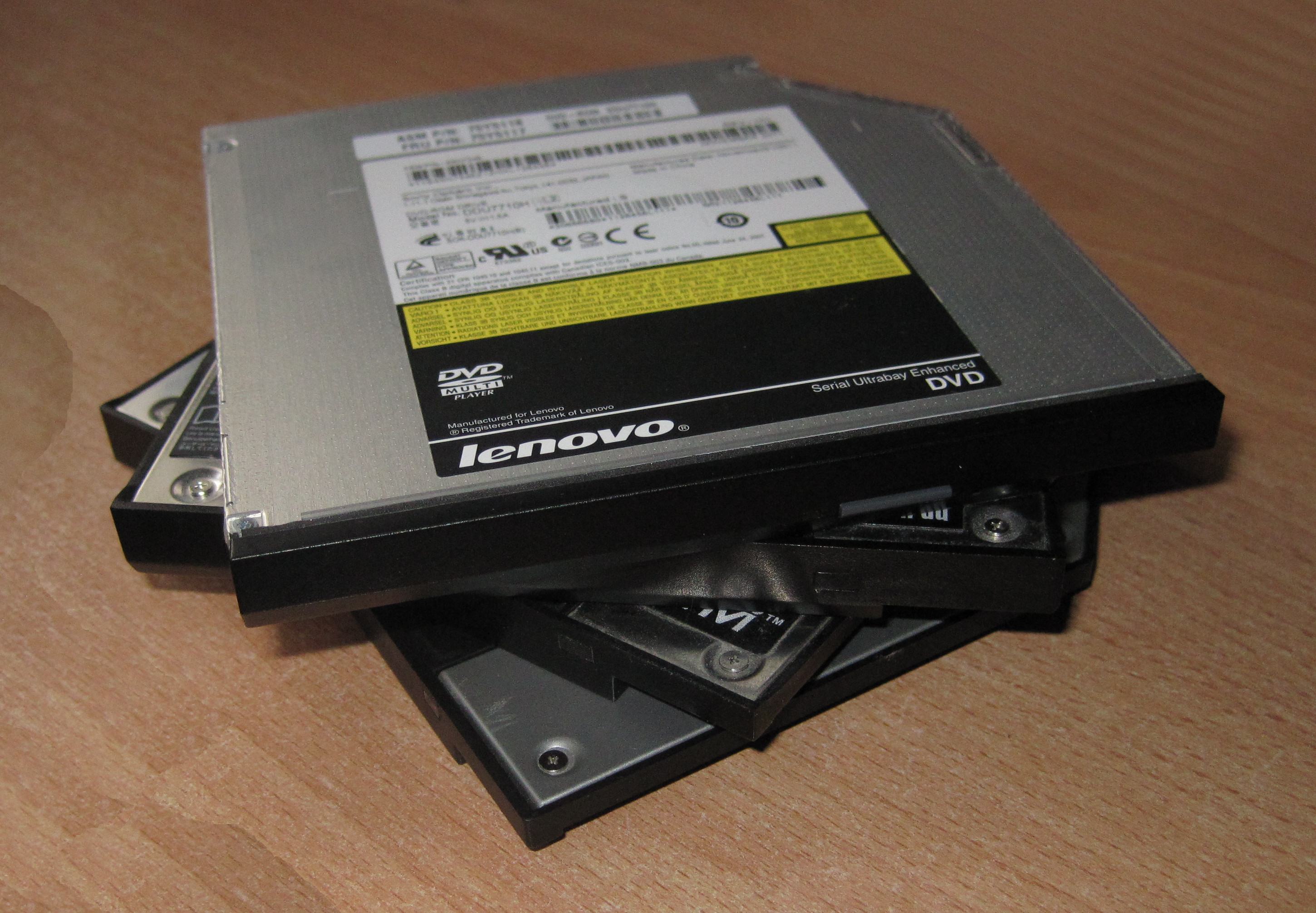
Lenovo laptop with ultrabay ejected
My Lenovo laptop has an Ultrabay, these are a way to easily swap optical and hard drives drives. They allow me to carry around additional storage and, providing I remembered to pack the drive, access optical media.
Over time I have acquired several additional hard drives housed in Ultrabay caddies. Generally I only need to access one at a time but increasingly I want to have more than one available.

Lenovo used to sell docking stations with multiple Ultrabays but since Series 3 was introduced this is no longer the case as the docks have been reduced to port replicators.

One solution is to buy a SATA to USB convertor which lets you use the drive externally. However once you have more than one drive this becomes somewhat untidy, not to mention all those unhoused drives on your desk become something of a hazard.

Recently after another close call I decided what I needed was a proper external enclosure to house all my drives. After some extensive googling I found nothing suitable ready to buy. Most normal people would give up at this point, I appear to be an abnormal person so I got the CAD package out.

A few hours of design and a load of laser cutting later I came up with a four bay enclosure that now houses all my Ultrabay caddies.

The design was slightly evolved to accommodate the features of some older caddies and allow a pencil to be used to eject the drives (I put a square hole in the back)

The completed unit uses about 10 of plastic and takes 30 minutes to lasercut.

The only issue with the enclosure as manufactured is that Makespace ran out of black plastic stock and I had to use transparent to finish so it is not in classic black as lenovo intended.

As usual all the design files are publicly available from my design repo.

15 February 2015

Sergio Talens-Oliag: Retooling

I haven't blogged for a long time, but I've decided that I'm going to try to write again, at least about technical stuff. My plan was to blog about the projects I've been working on lately, the main one being the setup of the latest version of Kolab with the systems we already have at work, but I'll do that on the next days. Today I'm just going to make a list of the tools I use on a daily basis and my plans to start using additional ones in the near future. Shells, Terminals and Text Editors I do almost all my work on Z Shell sessions running inside tmux; for terminal emulation I use gnome-terminal on X, VX ConnectBot on Android systems and iTerm2 on Mac OS X. For text editing I've been using Vim for a long time (even on Mobile devices) and while I'm aware I don't know half of the things it can do, what I know is good enough for my day to day needs. In the past I also used Emacs as a programming editor and my main tool to write HTML, SGML and XML, but since I haven't really needed an IDE for a long time and I mainly use Lightweight Markup Languages I haven't used it for a long time (I briefly tried to use Org mode, but for some reason I ended up leaving it). Documentation formats and tools Since a long time ago I've been an advocate of Lightweight Markup Languages; I started to use LaTeX and Lout, then moved to SGML/XML formats (LinuxDoc and DocBook) and finally moved to plain text based formats. I started using Wiki formats (parsewiki) and soon moved to reStructuredText; I also use other markup languages like Markdown (for this blog, aka ikiwiki) and tried MultiMarkdown to replace reStructuredText for general use, but as I never liked Markdown syntax I didn't liked an extended version of it. While I've been using ReStructuredText for a long time, I recently found Asciidoctor and the Asciidoc format and I guess I'll be using it instead of rst whenever I can (I still need to try the slide backends and conversions to ODT, but if that works I guess I'll write all my new documents using Asciidoc). Programming languages I'm not a developer, but I read and patch a lot of free software code written on a lot of different programming languages (I wouldn't be able to write whole programs on most of them, but thanks to Stack Overflow I'm usually able to fix what I need). Anyway, I'm able to program in some languages; I write a lot of shell scripts and I go for Python and C when I need something more complicated. On the near future I plan to read about javascript programming and nodejs (I'll probably need it at work) and I already started looking at Haskell (I guess it was time to learn about functional programming and after reading about it, it looks like haskell is the way to go for me). Version Control For a long time I've been a Subversion user, at least for my own projects, but seems that everything has moved to git now and I finally started to use it (I even opened a github account) and plan to move all my personal subversion repositories at home and at work to git, including the move of all my debian packages from svn-buildpackage to git-buildpackage. Further Reading With the previous plans in mind, I've started reading a couple of interesting books: Now I just need to get enough time to finish reading them ... ;)

Matthew Palmer: The Vicious Circle of Documentation

Ever worked at a company (or on a codebase, or whatever) where it seemed like, no matter what the question was, the answer was written down somewhere you could easily find it? Most people haven t, sadly, but they do exist, and I can assure you that it is an absolute pleasure. On the other hand, practically everyone has experienced completely undocumented systems and processes, where knowledge is shared by word-of-mouth, or lost every time someone quits. Why are there so many more undocumented systems than documented ones out there, and how can we cause more well-documented systems to exist? The answer isn t people are lazy , and the solution is simple though not easy.

Why Johnny Doesn t Read When someone needs to know something, they might go look for some documentation, or they might ask someone else or just guess wildly. The behaviour look for documentation is often reinforced negatively, by the result documentation doesn t exist . At the same time, the behaviours ask someone and guess wildly are positively reinforced, by the results I get my question answered and/or at least I can get on with my work . Over time, people optimise their behaviour by skipping the look for documentation step, and just go straight to asking other people (or guessing wildly).

Why Johnny Doesn t Write When someone writes documentation, they re hoping that people will read it and not have to ask them questions in order to be productive and do the right thing. Hence, the behaviour write documentation is negatively reinforced by the results I still get asked questions , and nobody does things the right way around here, dammit! Worse, though, is that there is very little positive reinforcement for the author: when someone does read the docs, and thus doesn t ask a question, the author almost certainly doesn t know they dodged a bullet. Similarly, when someone does things the right way, it s unlikely that anyone will notice. It s only the mistakes that catch the attention. Given that the experience of writing documentation tends to skew towards the negative, it s not surprising that eventually, the time spent writing documentation is reallocated to other, more utility-producing activities.

Death Spiral The combination of these two situations is self-reinforcing. While a suitably motivated reader might start by strictly looking for documentation, or an author initially be enthused to always fully documenting their work, over time the reflex will be for readers to just go ask someone, because there s never any documentation! , and for authors to not write documentation because nobody bothers to read what I write anyway! . It is important to recognise that this iterative feedback loop is the natural state of the reader/author ecosystem, resulting in something akin to thermodynamic entropy. To avoid the system descending into chaos, energy needs to be constantly applied to keep the system in order.

The Solution Effective methods for avoiding the vicious circle can be derived from the things that cause it. Change the forces that apply themselves to readers and authors, and they will behave differently. On the reader s side, the most effective way to encourage people to read documentation is for it to consistently exist. This means that those in control of a project or system mustn t consider something done until the documentation is in a good state. Patches shouldn t be landed, and releases shouldn t be made, unless the documentation is altered to match the functional changes being made. Yes, this requires discipline, which is just a form of energy application to prevent entropic decay. Writing documentation should be an explicit and well-understood part of somebody s job description. Whoever is responsible for documentation needs to be given the time to do it properly. Writing well takes time and mental energy, and that time needs to be factored into the plans. Never forget that skimping on documentation, like short-changing QA or customer support, is a false economy that will cost more in the long term than it saves in the short term. Even if the documentation exists, though, some people are going to tend towards asking people rather than consulting the documentation. This isn t a moral failing on their part, but only happens when they believe that asking someone is more beneficial to them than going to the documentation. To change the behaviour, you need to change the belief. You could change the belief by increasing the cost of asking. You could fire (or hellban) anyone who ever asks a question that is answered in the documentation. But you shouldn t. You could yell RTFM! at everyone who asks a question. Thankfully that s one acronym that s falling out of favour. Alternately, you can reduce the cost of getting the answer from the documentation. Possibly the largest single productivity boost for programmers, for example, has been the existence of Google. Whatever your problem, there s a pretty good chance that a search or two will find a solution. For your private documentation, you probably don t have the power of Google available, but decent full-text search systems are available. Use them. Finally, authors would benefit from more positive reinforcement. If you find good documentation, let the author know! It requires a lot of effort (comparatively) to look up an author s contact details and send them a nice e-mail. The like button is a more low-energy way of achieving a similar outcome you click the button, and the author gets a warm, fuzzy feeling. If your internal documentation system doesn t have some way to close the loop and let readers easily give authors a bit of kudos, fix it so it does. Heck, even if authors just know that a page they wrote was loaded N times in the past week, that s better than the current situation, in which deafening silence persists, punctuated by the occasional plaintive cry of Hey, do you know how to ? . Do you have any other ideas for how to encourage readers to read, and for authors to write?

14 February 2015

John Goerzen: Willis Goerzen a good reason to live in Kansas

From time to time, people ask me, with a bit of a disbelieving look on their face, Tell me again why you chose to move to Kansas? I can explain something about how people really care about their neighbors out here, how connections through time to a place are strong, how the people are hard-working, achieve great things, and would rather not talk about their achievements too much. But none of this really conveys it. This week, as I got word that my great uncle Willis Goerzen passed away, it occured to me that the reason I live in Kansas is simple: people like Willis. Willis was a man that, through and through, simply cared. For everyone. He had hugs ready anytime. When I used to see him in church every Sunday, I d usually hear his loud voice saying, Well John! Then a hug, then, How are you doing? When I was going through a tough time in life, hugs from Willis and Thelma were deeply meaningful. I could see how deeply he cared in his moist eyes, the way he sought me out to offer words of comfort, reassurance, compassion, and strength. Willis didn t just defy the stereotypes on men having to hide their emotions; he also did so by being just gut-honest. Americans often ask, in sort of a greeting, How are you? and usually get an answer like fine . If I asked Willis How are you? , I might hear great! or it s hard or pretty terrible. In a place where old-fashioned stoicism is still so common, this was so refreshing. Willis and I could have deep, heart-to-heart conversations or friendly ones. Willis also loved to work. He worked on a farm, in construction, and then for many years doing plumbing and heating work. When he retired, he just kept on doing it. Not for the money, but because he wanted to. I remember calling him up one time about 10 years ago, asking if he was interested in helping me with a heating project. His response: I ll hitch up the horses and be right there! (Of course, he had no horses anymore.) When I had a project to renovate what had been my grandpa s farmhouse (that was Willis s brother), he did all the plumbing work. He told me, John, it s great to be retired. I can still do what I love to do, but since I m so cheap, I don t have to be fast. My old knees can move at their own speed. He did everything so precisely, built it so sturdy, that I used to joke that if a tornado struck the house, the house would be a pile of rubble but the ductwork would still be fine. One of his biggest frustrations about ill health was being unable to work, and in fact he had a project going before cancer started to get the best of him. He was quite distraught that, for the first time in his life, he didn t properly finish a job. Willis installed a three-zone system (using automated dampers to send heat or cool from a single furnace/AC into only the parts of the house where it was needed) for me. He had never done that before. The night Willis and his friend Bob came over to finish the setup was one to remember. The two guys, both in their 70s, were figuring it all out, and their excitement was catching. By the time the evening was over, I certainly was more excited about thermostats than I ever had been in my life. I heard a story about him once he was removing some sort of noxious substance from someone s house. I forget what it was whatever it was, it had pretty bad long-term health effects. His comment: Look, I m old. It s not going to be this that does me in. And he was right. In his last few years, Willis started up a project that only Willis would dream up. He invited people to bring him all their old and broken down appliances and metal junk air conditioners, dehumidifiers, you name it. He carefully took them apart, stripped them down, and took the metals into a metal salvage yard. He then donated all the money he got to a charity that helped the poor, and it was nearly $5000. Willis had a sense of humor about him that he somehow deployed at those perfect moments when you least expected it. Back in 2006, before I had moved into the house that had been grandpa s, there was a fire there. I lost two barns (one was the big old red one with lots of character) and a chicken house. When I got out there to see what had happened, Willis was already there. It was quite the disappointment for me. Willis asked me if grandpa s old manure spreader was still in the chicken house. (Cattle manure is sometimes used as a fertilizer.) This old manure spreader was horse-drawn. I told him it was, and so it had burned up. So Willis put his arm around me, and said, John, do you know what we always used to call a manure spreader? Nope. Shit-slinger! That was so surprising I couldn t help but break out laughing. Willis was the only person that got me to laugh that day. In his last few years, Willis battled several health ailments. When he was in a nursing home for a while due to complications from knee surgery, I d drop by to visit. And lately as he was declining, I tried to drop in at his house to visit with Willis and Thelma as much as possible. Willis was always so appreciative of those visits. He always tried to get in a hug if he could, even if Thelma and I had to hold on to him when he stood up. He would say sometimes, John, you are so good to come here and visit with me. And he d add, I love you. As did I. Sometimes when Willis was felling down about not being able to work more, or not finish a project, I told him how he was an inspiration to me, and to many others. And I reminded him that I visited with him because I wanted do, and being able to do that meant as much to me as it did to him. I m not sure if he ever could quite believe how deeply true that was, because his humble nature was a part of who he was. My last visit earlier this week was mostly with Thelma. Willis was not able to be very alert, but I held his hand and made sure to tell him that I love and care for him that time. I m not sure if he was able to hear, but I am sure that he didn t need to. Willis left behind a community of hundreds of people that love him and had their lives touched by his kind and inspirational presence.

13 February 2015

Jonathan Carter: Debconf 2016 to be hosted in Cape Town

Table Mountain, an icon of Cape Town Long story short, we put in a bid to host Debconf 16 in Cape Town, and we got it! Back at Debconf 12 (Nicaragua), many people asked me when we re hosting a Debconf in South Africa. I just laughed and said Who knows, maybe some day . During the conference I talked to Stefano Rivera (tumbleweed) who said that many people asked him too. We came to the conclusion that we d both really really want to do it but just didn t have enough time at that stage. I wanted to get to a point where I could take 6 months off for it and suggested that we prepare a bid for 2019. Stefano thought that this was quite funny, I think at some point we managed to get that estimate down to 2017-2018. That date crept back even more with great people like Allison Randal and Bernelle Verster joining our team, along with other locals Graham Inggs, Raoul Snyman, Adrianna Pi ska, Nigel Kukard, Simon Cross, Marc Welz, Neill Muller, Jan Groenewald, and our international mentors such as Nattie Mayer-Hutchings, Martin Krafft and Hannes von Haugwitz. Now, we re having that Debconf next year. It s almost hard to believe, not sure how I ll sleep tonight, we ve waited so long for this and we ve got a mountain of work ahead of us, but we ve got a strong team and I think Debconf 2016 attendees are in for a treat! Since I happened to live close to Montr al back in 2012, I supported the idea of a Debconf bid for Montr al first, and then for Cape Town afterwards. Little did I know then that the two cities would be the only two cities bidding against each other 3 years later. I think both cities are superb locations to host a Debconf, and I m supporting Montr al s bid for 2017. Want to get involved? We have a mailing list and IRC channel: #debconf16-capetown on oftc. Thanks again for all the great support from everyone involved so far!

Olivier Berger: Testing the RuneStone interactive Python courses server in docker

I ve been working on setting up a Docker container environment allowing to test the RuneStone Interactive server. RuneStone Interactive allows the publication of courses containing interactive Python examples, and while most of the content is static (the Python examples are run innside a Python interpreter implemented in JavaScript, hence locally in the JS VM of the Web browser), the tool also offers an environment allowing to monitor the progress of learners in a course, which is dynamic and is queried by the browser over AJAX APIs. That s the part which I wanted to be able to operate for test purposes. As it is a web2py application, it s not exactly obvious to gather all dependencies and run locally. Well, in fact it is, but I want to understand the architecture of the tool to be able to understand the deployment constraints, so making a docker image will help in this purpose. The result is the following : Now, it s easier to test the writing of a new course (yet another container above the latter one), and directly test for real.

Neil Williams: OpenTAC mailing list

After the OpenTAC session at Linaro Connect, we do now have a mailing list to support any and all discussions related to OpenTAC. Thanks to Daniel Silverstone for the list. List archive: http://listmaster.pepperfish.net/pipermail/opentac-vero-apparatus.com More information on OpenTAC: http://wiki.vero-apparatus.com/OpenTAC

12 February 2015

Sven Hoexter: Out of the comfort zone: What I learned from my net-snmp backport on CentOS 5 and 6

This is a short roundup of things I learned after I've rolled out the stuff I wrote about here. Bugs and fighting with multiarch rpm/yum One oversight led me to not special case the perl-devel dependency on the net-snmp-devel package for CentOS 5, to depend on perl instead. That was easily fixed but afterwards a yum install net-snmp-devel still failed because it tried to install the stock CentOS 5 net-snmp-devel package and its dependencies. Closer investigation showed that it did so because I only provided x86_64 packages in our internal repository but it wanted to install i386 and x86_64 packages. Looking around this issue is documented in the Fedora Wiki. So the modern way to deal with it is to make the dependency architecture dependend with the
% ?_isa 
macro. That is evaluated at build time of the src.rpm and then the depedency is hardcoded together with the architecture. Compare
$ rpm -qRp net-snmp-devel-5.7.2-18.el6.x86_64.rpm grep perl
perl-devel(x86-64)
to
$ rpm -qRp net-snmp-devel-5.7.2-19.el5.centos.x86_64.rpm  grep perl
perl
As you can see it's missing for the el5 package and that's because it's too old, or more specific, rpm is too old to know about it. The workaround we use for now is to explicitly install only the x86_64 version of net-snmp-devel on CentOS 5 when required. That's a
yum install net-snmp-devel.x86_64
Another possible workaround is to remove i386 from your repository or just blacklist it in your yum configuration. I've read that's possible but did not try it. steal time still missing on CentOS 6 One of the motivations for this backport is support for steal time reporting via SNMP. For CentOS 5 that's solved with our net-snmp backport but for CentOS 6 we still do not see steal time. A short look around showed that it's also missing in top, vmstat and friends. Could it be a kernel issue? Since we're already running on the CentOS Xen hypervisor we gave the Linux 3.10.x packages a spin in a domU and now we also have steal time reporting. Yes, a kernel issue with the stock CentOS 6/RHEL 6 kernel. I'm not sure where and how to fill it since RedHat moved to KVM.

Sven Hoexter: Comparing apples and oranges: IPv6 adoption vs HTTP/2 adoption

I did not yet read the HTTP/2 draft but I've read the SPDY draft about 2.5 years ago. So I might be wrong here with my assumptions. We're now about 17 years into the IPv6 migration and still we do not have widespread IPv6 adoption on the client side. That's mostly an issue of CPE device rotation at the customer side and updating provisioning solutions. For the server side we're more or less done. Operating system support is there, commercial firewall and router vendors picked it up in the last ten years, datacenter providers are ready, so we're waiting for the users to put some pressure on providing a service via IPv6. Looking at HTTP/2 it's also a different protocol. The gap might be somewhat closer than the one between IPv4 and IPv6, but it's still huge. Now I'd bet that in the case of HTTP/2 we'll also see a really slow adoption, but this time it's not the client side that's holding back the adoption. For HTTP/2 I've no doubts about a fast adoption on the client side. Google and Mozilla are nowadays providing some kind of continues delivery of new features to the end user on a monthly basis (surprisingly that also works for mobile devices!). So the web browser near you will soon have a HTTP/2 implementation. Even Microsoft is switching to a new development model of rolling updates with Windows 10 and the Internet Explorer successor. But looking at the server side I doubt we'll have widespread HTTP/2 support within the next 5 years. Maybe in 10. But I doubt even that. With all those reverse proxies, interception devices for header enrichment at mobile carriers, application servers, self written HTTP implementations, load balancers and so on I doubt we'll have a fast and smooth migration ahead. But maybe we're all lucky and I'm wrong. I'd really love to be wrong here. Maybe we can provide working IPv4-IPv6 dual-stack setups for everyone in the meantime.

Daniel Leidert: Setting up a network buildd with pbuilder ... continued

Last year I'd described my setup of a local network-buildd using pbuilder, ccache, inoticoming and NFS. One then-still-open goal was to support different Debian releases. This is especially necessary for backports of e.g. bluefish. The rules to contribute backports require to include all changelog entries since the last version on debian-backports or since stable if it's the first version in an uploaded package. Therefor one needs to know the last version in e.g. wheezy-backports. Because I'm not typing the command (the source package only gets uploaded and inoticoming starts the build process) I was looking for a way to automatically retrieve that version and add the relevant -vX.Y-Z switch to dpkg-buildpackage.The solution I found requires aptitude and a sources.list entry for the relevant release. If you are only interested in the solution, just jump to the end :)I'm going to add the version switch to the DEBBUILDOPTS variable of pbuilder. In my setup I have a common (shared) snippet called /etc/pbuilderrc.inc and one configuration file per release and architecture, say /etc/pbuilderrc.amd64.stable. Now the first already contains ...
DEBBUILDOPTS="-us -uc -j2"
... and DEBBUILDOPTS can be extended in the latter:
DEBBUILDOPTS+="..."
Because the config file is parsed pretty early in the process the package name has not yet been assigned to any variable. The last argument to pbuilder is the .dsc file. So I use the last argument and parse the file to retrieve the source package name.
cat $ @: -1    grep -e ^Source   awk -F\  '  print $2  '
The solution above works, because pbuilder is a BASH script. Otherwise it maybe needs some tweaking. I use the source package name, because it is unique and there is just one :) Now with this name I check for all versions in wheezy* and stable* and sort them. The sort order of aptitude is from low to high, so the last line shopuld contain the highest version. This covers the possibility that there has not yet been a backport or that there is one:
aptitude versions -F '%p' --show-package-names=never --group-by=none --sort=version \
"?narrow(?source-package(^PACKAGE\$), ?or(?archive(^wheezy.*), ?archive(^stable.*)))" \
tail -n 1 sed -e 's#~bpo.*$##g'
The sed-part is necessary because otherwise dh_genchanges will add a superfluous changelog entry (the last one of the last upload). To make things easier, I assign the name and version to variables. So this is the complete solution:

[..]
MYPACKAGE=" cat $ @: -1 grep -e ^Source awk -F\ ' print $2 ' "
MYBPOVERS=" aptitude versions -F '%p' --show-package-names=never --group-by=none --sort=version "?narrow(?source-package(^$MYPACKAGE\$), ?or(?archive(^wheezy.*), ?archive(^stable.*)))" tail -n 1 sed -e 's#~bpo.*$##g' "

log "I: Package is $MYPACKAGE and last stable/bpo version is $MYBPOVERS"

DEBBUILDOPTS+=" -v$MYBPOVERS"
[..]
ExamplesI've recently built a new bluefish backport. The last backport version is 2.2.6-1~bpo70+1. There is also the stable version 2.2.3-4. So the version I need is 2.2.6-1 (2.2.6-1~bpo70+1 < 2.2.6-1!!). Checking the log it works:
I: Package is bluefish and last stable/bpo version is 2.2.6-1
A different example is rsync. I've recently locally rebuilt it for a stable system (wanted to make use of the --chown switch). There is not yet a backport. So the version I (would) need is 3.0.9-4. Checking the logs again and works too:
I: Package is rsync and last stable/bpo version is 3.0.9-4
Feedback appreciated ... Links

11 February 2015

John Goerzen: Reactions to Has modern Linux lost its way? and the value of simplicity

Apparently I touched a nerve with my recent post about the growing complexity of issues. There were quite a few good comments, which I ll mention here. It s provided me some clarity on the problem, in fact. I ll try to distill a few more thoughts here. The value of simplicity and predictability The best software, whether it s operating systems or anything else, is predictable. You read the documentation, or explore the interface, and you can make a logical prediction that when I do action X, the result will be Y. grep and cat are perfect examples of this. The more complex the rules in the software, the more hard it is for us to predict. It leads to bugs, and it leads to inadvertant security holes. Worse, it leads to people being unable to fix things themselves one of the key freedoms that Free Software is supposed to provide. The more complex software is, the fewer people will be able to fix it by themselves. Now, I want to clarify: I hear a lot of talk about ease of use. Gnome removes options in my print dialog box to make it easier to use. (This is why I do not use Gnome. It actually makes it harder to use, because now I have to go find some obscure way to just make the darn thing print.) A lot of people conflate ease of use with ease of learning, but in reality, I am talking about neither. I am talking about ease of analysis. The Linux command line may not have pointy-clicky icons, but at least at one time once you understood ls -l and how groups, users, and permission bits interacted, you could fairly easily conclude who had access to what on a system. Now we have a situation where the answer to this is quite unclear in terms of desktop environments (apparently some distros ship network-manager so that all users on the system share the wifi passwords they enter. A surprise, eh?) I don t mind reading a manpage to learn about something, so long as the manpage was written to inform. With this situation of dbus/cgmanager/polkit/etc, here s what it feels like. This, to me, is the crux of the problem: It feels like we are in a twisty maze, every passage looks alike, and our flashlight ran out of battieries in 2013. The manpages, to the extent they exist for things like cgmanager and polkit, describe the texture of the walls in our cavern, but don t give us a map to the cave. Therefore, we are each left to piece it together little bits at a time, but there are traps that keep moving around, so it s slow going. And it s a really big cave. Other user perceptions There are a lot of comments on the blog about this. It is clear that the problem is not specific to Debian. For instance: This stuff is really important, folks. People being able to maintain their own software, work with it themselves, etc. is one of the core reasons that Free Software exists in the first place. It is a fundamental value of our community. For decades, we have been struggling for survival, for relevance. When I started using Linux, it was both a question and an accomplishment to have a useable web browser on many platforms. (Netscape Navigator was closed source back then.) Now we have succeeded. We have GPL-licensed and BSD-licensed software running on everything from our smartphones to cars. But we are snatching defeat from the jaws of victory, because just as we are managing to remove the legal roadblocks that kept people from true mastery of their software, we are erecting technological ones that make the step into the Free Software world so much more difficult than it needs to be. We no longer have to craft Modelines for X, or compile a kernel with just the right drivers. This is progress. Our hardware is mostly auto-detected and our USB serial dongles work properly more often on Linux than on Windows. This is progress. Even our printers and scanners work pretty darn well. This is progress, too. But in the place of all these things, now we have userspace mucking it up. We have people with mysterious errors that can t be easily assisted by the elders in the community, because the elders are just as mystified. We have bugs crop up that would once have been shallow, but are now non-obvious. We are going to leave a sour taste in people s mouth, and stir repulsion instead of interest among those just checking it out. The ways out It s a nasty predicament, isn t it? What are your ways out of that cave without being eaten by a grue? Obviously the best bet is to get rid of the traps and the grues. Somehow the people that are working on this need to understand that elegance is a feature a darn important feature. Sadly I think this ship may have already sailed. Software diagnosis tools like Enrico Zini s seat-inspect idea can also help. If we have something like an ls for polkit that can reduce all the complexity to something more manageable, that s great. The next best thing is a good map good manpages, detailed logs, good error messages. If software would be more verbose about the permission errors, people could get a good clue about where to look. If manpages for software didn t just explain the cavern wall texture, but explain how this room relates to all the other nearby rooms, it would be tremendously helpful. At present, I am unsure if our problem is one of very poor documentation, or is so bad that good documentation like this is impossible because the underlying design is so complex it defies being documented in something smaller than a book (in which case, our ship has not just sailed but is taking on water). Counter-argument: progress One theme that came up often in the comments is that this is necessary for progress. To a certain extent, I buy that. I get why udev is important. I get why we want the DE software to interact well. But here s my thing: this already worked well in wheezy. Gnome, XFCE, and KDE software all could mount/unmount my drives. I am truly still unsure what problem all this solved. Yes, cloud companies have demanding requirements about security. I work for one. Making security more difficult to audit doesn t do me any favors, I can assure you. The systemd angle To my surprise, systemd came up quite often in the discussion, despite the fact that I mentioned I wasn t running systemd-sysv. It seems like the new desktop environemt ecosystem is the systemd ecosystem in a lot of people s minds. I m not certain this is justified; systemd was not my first choice, but as I said in an earlier blog post, jessie will still boot . A final note I still run Debian on all my personal boxes and I m not going to change. It does awesome things. For under $100, I built a music-playing system, with Raspberry Pis, fully synced throughout my house, using a little scripting and software. The same thing from Sonos would have cost thousands. I am passionate about this community and its values. Even when jessie releases with polkit and all the rest, I m still going to use it, because it is still a good distro from good people.

Next.

Previous.