Search Results: "sf"

9 August 2007

Evan Prodromou: 20 Thermidor CCXV

Great day today. It's been beautiful here in the South Bay, and I'm glad to get some regeneration. I miss Amita June and Maj pretty badly, but they're coming to California on Saturday, so the end is near. Tonight I'm heading up to San Francisco for the Creative Commons Salon. Should be really fun. tags:

Planet Nowhere So, I've had some complaints from people that my blog posts on Planet Debian weren't about Debian enough. Although that's not the mission of PD -- it's stuff by Debian developers, not stuff about Debian -- I decided to remove my feed from the list there. Life's too short. So, if you're used to reading my blog there, you'll need to add my feed to your reader directly. tags:

Meanwhile... I just got back from the CC Salon. Excellent time! I hadn't been to one in SF, although I helped to organize the first one in Toronto. The presentations were all by the summer interns from CC. I was shocked and astounded that all the interns were doing cool, important things, like desktop integration, enhancing the CC Wiki, and developing best practices for marking CC-licensed content. These are all things that CC users have actually been asking for and need a lot. I'm concerned that this is breaking with the tradition of summer interns everywhere doing meaningless tasks that help no-one. Is the future of summer internships in jeopardy? One of my favourite pieces of info, of course, was that you can now log into CC Wiki with OpenID. Coolio! tags:

8 August 2007

Thijs Kinkhorst: Naar de Apen

Michal iha asks about a mobile phone usable in Japan. When I went to Japan this spring, I've researched some options. Renting such a phone in The Netherlands was about 50/day (!). However, when you rent it upon arrival in Japan, it was only 500/day, ~ 3. It worked perfectly and is very affordable for shorter trips. See NTT DoCoMo for details. Apropos phones, I've got a new mobile phone: the Nokia 6300 to replace my previous 6310i. Transferring the data on it worked great with the help of gnokii. The only question was how to get rid of my old phone responsibly. Stiching AAP, a sanctuary for monkeys, offers the possibility to send the phone to them for free. It will be recycled and AAP gets a bit of money for it. A real "win-win" situation.

7 August 2007

Evan Prodromou: 19 Thermidor CCXV

I'm on the plane down from Vancouver to San Francisco this morning. My flight from Taipei hit Vancouver around 8PM last night, so I stayed at the Fairmont Hotel at the airport. It was definitely a special treat -- the Fairmont's pretty pricey -- but this trip has been really low-budget and I needed a lot of rest and recharge. I had a good room with a view of the airport and the city beyond. My flight over was uneventful -- sleep, eat, Spiderman 3 -- which was good since I'd had such a big last day in Taipei. In the morning, I'd gone out to see Taipei 101, which claims to be the tallest building in the world by some standards. I think there are lots of ways to slice the "tallest building" category -- the CN Tower has a strong claim, but that's only counting the huge antenna on top. And there's an unfinished tower in Dubai that's already close to, or taller than, Taipei 101. Regardless, Taipei 101 is a real interesting site. The elevators are the fastest in the world -- 38 seconds to go from floor 5 to floor 87. The windowed observation deck is interesting, and there's an outdoor deck two flights above it. The outdoor deck is racked by Taipei's scorching heat -- when I was there, it was 31C, up above the city's protective smog belt. The sun and empty sky make for an otherworldly experience. After 101, I took Taipei's local subway, the MRT, to the National Palace Museum. I've found the MRT easy to get around on -- most of the information was available in English as well as Chinese -- but I got a little lost looking for the museum. I was disappointed that the information booth in the Taiwan Main Station had so little tourism information, and all of it in Chinese. (Yeah, I forgot to print out the Wikitravel Taipei guide before leaving the hotel. My bad.) But I managed to wend my way out to Shilin Station and took a cab to the museum. It was worth the search. When the Chinese Nationalists left the mainland for Taiwan, they took with them many of the treasures of the Imperial Palace (much to the chagrin of the victorious Communists). These form the core of the museum's collection, and they're really quite amazing -- articles in bronze, ivory and gold from the Neolithic era to the modern day. While Western culture has gone through so many distinct and discontinuous phases -- Egypt and Mesopotamia, Greco-Roman, Medieval and Modern -- China's has varied much more smoothly and continuously. It's a little disconcerting to see artistic themes from 4000BC that are echoed in items for sale in the stores today. I had to get back to the Wikimania site -- by then almost empty -- to do a GChat conference with Niko. There were a passel of Wikimaniacs still around after the conference looking around Taiwan like I was, and after consulting Wikitravel we decided to go to Taipei's most famous restaurant, Din Something Something. It's got a short menu of delicious steamed dumplings -- pork, veggie, crab and shrimp. The shop's claim to fame is the elastic skin that keeps a pocket of hot broth inside the dumplings. Hey: if you do something well, why vary the menu? It was the best meal I've had in a long time. The dumplings themselves were incredibly good -- moist and rich with complex flavors. But the company was even better -- about 14 Wikimedians from all continents and walks of life, some of the most fascinating and important people on the planet. We were a big enough group to be stowed in our own party room, and with basket after basket of steamed dumplings piled onto the table, washed down with shared bottles of the ubiquitous Taiwan Beer, we had a crazy chaotic and fun time. I'm so glad I took an extra day after the conference to see a bit of the city. I think there's a lot more that I missed, but I'm glad that I got a taste. tags:

Wikimania 2008 Inevitably the conversation at Din Something Something turned to Wikimania 2008 and possible venues for it. Right now, the only serious bid is from Alexandria, Egypt, home of the Biblioteca Alexandrina. This is a modern reconstruction of the famous Library of Alexandria, centre of learning for the ancient world and repository of all of its knowledge. The bid is to use the sleek, glamourous conference centre attached to the Biblioteca -- offered to us free of charge. You couldn't put together a more powerful metaphor -- Wikimedia being itself a project to capture the world's knowledge and share it with all humanity. Having our event on the African continent would also send a great message about the Foundation's commitment to making free information accessible to the developing world. North Africa is definitely the most accessible part of the continent for Europeans and North Americans -- many of whom balked at the price and distance of travel to Taipei. The big problem with planning Wikimanias (Wikimaniae?) in the past has been the short time-frame. Typically bids for the event don't start until after the previous one, and the bidding process takes several months. By the time a venue is selected, there may be only 6-8 months of planning time available. For an international conference of several hundred people, this is a stressful, breakneck schedule. The idea was floated to do a little stutter-step and put Wikimania on a more long-term planning schedule. The event committee would short-circuit the bidding process this year, and declare Alexandria the site for Wikimania 2008 unless other groups insisted on bids for other cities. Then, bidding for Wikimania 2009 would start in September or October, with a decision made by the end of 2007. This would give 20 months for the Wikimania 2009 organizing team to prepare. Most importantly, they'd be able to shadow the 2008 team, learn how the job is done, attend the 2008 conference, and present about their venue for the next year. I think this is a really good idea. The Biblioteca conference centre staff will be able to provide us some professional services, making the shorter schedule (still about 11 months) a lot easier. There are some concerns about fairness of the process, or appearance of same, but my guess is that if the 2009 bid process starts soon after, people won't have a big beef. There are two major concerns with going to Alexandria, though. First is Egypt's worrying problem with human rights -- specifically gay rights. Homosexual Egyptian men are subject to arrest, and the laws are occasionally enforced. One foreigner was arrested in 2002. That's enough to put Egypt on a no-visit list with some gay-rights groups. Depressing as it is, I think it might be too much to hope for a venue in a country with an absolutely spotless human rights record. Maybe parts of Scandinavia...? There's a cruel calculus needed to evaluate which national human rights abuses can be reluctantly overlooked, and which are unacceptable. It's also clear that my personal judgment might be clouded, since this particular human rights issue is not one I would be directly targeted by. My hope is that an official statement by the Foundation would make it clear to the Egyptian government that this kind of policy is not conducive to attracting overseas business and tourism. The second concern is that Egypt and the Arab world in general have only embryonic local Wikimedian communities. While there are many people who contribute to Arabic Wikipedia, there is not a Wikimedia chapter in Egypt, nor are there regular meetups in the country or region. This might be a chicken-and-egg problem: choosing Alexandria would probably kick-start local groups. I hope that ar: Wikimedians pick up the mantle of leadership that the world Wikimedia community is offering them. tags:

Adrian von Bidder: Fun with virtualisation

Since I seem to be the last person these days who doesn't run his servers inside Xen, Vserver, kvm, lguest or whatever, I decided to finally evaluate Xen. Not having spare hardware and not wanting to really touch my main workhorse, I started with Qemu. Installing etch inside a Qemu (why can't qemu have working tun/tap setup scripts by default?), then xenifying this according to Ganneff's excellent slides, I was stopped while booting into the Xen kernel with a hard freeze in the boot process (Inside Qemu, so no harm done.) Talking to some people in #xen resulted in me disabling kqemu, and a few minutes later I had a working dom0. Debootstrap is slooooooowwww (well, inside a non-accelerated Qemu machine...)! So I decided to use cdebootstrap instead. Sadly, xen-create-image has debootstrap hardcoded, so I had to "ln -sf /usr/bin/cdebootstrap debootstrap". (I decided to do this when debootstrap was still calculating dependencies after several minutes.) After that, creating and booting a domU Just Worked(tm). Having a running Xen environment, I finally wanted to play around with live migration (mostly I was just curious how robust this Qemu + Xen setup is...) So, just clone the qemu disk and boot them both. Whereupon the two qemu machines have the same MAC address, hence networking is not reliable. Change the MAC of the second Xen dom0, curse udev for thinking that now the network interface should be eth1 (persistent device naming is a good thing, generally. I'm not sure there is a sane solution possible that can cover all/most cases. Computers with only one network interface might warrant some special logic ... Oh well.) Having restored the networking setup, enabling the relocation service in the Xen configuration is trivial. After thinking about using plain files on NFS and seeing a Novell tutorial which uses iSCSI, I decided that I should try AoE because it should be much simpler to set up. And by installing the 'vblade' package, it is indeed possible to have an AoE server running within a few minutes (the vbladed command doesn't take the -m option, though.) And the client side is just as simple, just install the aoetools package, and /dev/etherd is automagically created and lists all available devices. That's how SANs should work! (Note: I had the AoE devices in the dom0 and passed them to the domU. A next experiment would obviously be to pass AoE directly to the domU as root devices. Not sure what the implications would be, though.) Ok, after all this, I have two dom0 machines and a domU. Just for fun, I've installed xdaliclock inside the domU and started a live migration. Result: it works stable (modulo some scary kernel messages popping up when booting the domU. I didn't experience any crashes in this light test), xdaliclock stops for a mere 20s (yes, seconds, not milliseconds. Remember, this is two layers of virtualisation without hardware support.) Normal migration (pausing the domU), the migration takes roughly 2 min (both dom0 have 384M RAM assigned in Qemu, the domU has 128M in Xen, the host is a 3GHz P4 with 1G physical ram. There is some swapping going on (I use KDE, so some of the RAM is lost there. I also didn't stop beagle for this experiment.) The full live migration takes about twice as much time. But this said, if you're using Xen inside qemu, timing values are not what you're after... I was, frankly, astonished at how well this worked. Hmmm. I wonder, if I can stack some other virtualisation layer somewhere in there? Just to see how silly it might get.

Cameron Dale: DebTorrent Release 0.1.3 (in package form!)

Today I have released the next version of DebTorrent. This is the first release to be available in a binary package (.deb) form, and most of the changes are related to the packaging I still consider the program to be alpha quality, though all the functionality for a beta release is there, it just needs to be tested (so tell your friends). I run the program daily and use it for my apt-based updating, so I'm pretty sure it works, but there are definitely bugs. If you do find one please submit it to the DebTorrent mailing list. The installable binary can be found on the Alioth project, or in my personal repository which can be added to your sources.list like so:
deb http://debian.camrdale.org/ unstable main contrib non-free
Once installed, it will start running automatically, and will restart on bootup, so all that is needed is to modify your sources.list files to point them at DebTorrent by prepending localhost:9988 to the mirror name. For example, the entry above for my personal repository would become:
deb http://localhost:9988/debian.camrdale.org/ unstable main contrib non-free
Here's the changelog:

6 August 2007

Julien Danjou: Implementing Debian policy check with rebuildd

After reading Mike Hommey's idea about buildd network for QA testing, I decided to try to implement the 10.1 policy recommendations check using rebuildd. Here is how I proceeded. Install and configure rebuildd This is done by apt-get install rebuildd. Then, init database (I use sqlite) with rebuildd init. Then I initialized build system with rebuildd-init-build-system. I had to add nostrip to DEB_BUILD_OPTIONS, so I decided to do quick and dirty and I edited /usr/bin/dpkg-build-package adding the good export info in the first lines. Configuration file and post build cmd My configuration file is simple and the one by default: I only changed email addresses and add a post_build_cmd script. Here's the code for the script:
#!/bin/sh
dist=$1
pkg=$2
version=$3
arch= dpkg --print-architecture 
RET=0
cd /var/cache/pbuilder/result   exit 1
for file in $(grep '.deb$' $ pkg _$ version _$ arch .changes  cut -d\  -f6)
do
	echo Checking $file for stripped binaries...
	echo ---------------------------------------
	mkdir /tmp/$file
	dpkg -x $file /tmp/$file
	find /tmp/$file -type f   (while read line
	do 
		L=$(file $line   egrep 'ELF.*, stripped')
		if test ! -z "$L"
		then
			echo $L
			RET=1
		fi
	done; exit $RET)
	RET=$?
	rm -rf /tmp/$file
done
echo
echo ...done
echo Removing result files...
for file in $(grep-dctrl -sFiles . $ pkg _$ version _$ arch .changes   sed '1d'   cut -d\  -f6)
do
	rm -f $file
	rm -f /var/cache/rebuildd/build/$file
done
rm -f $ pkg _$ version _$ arch .changes
echo ...done
exit $RET
Fille the db Then I fill the database with:
grep-dctrl -sPackage,Version .  /var/lib/apt/lists/ftp.fr.debian.org_debian_dists_sid_main_source_Sources   cut -d: -f2-   tr '\n' ' '   sed 's/   /\n/g'  sed 's/  / /'   xargs -L1 -ixxxxxx echo xxxxxx sid   rebuildd-job add
And finally I just have to start rebuildd and let it do the job. Argh, already 3 build logs received with stripped binaries Update: Bug list can be found here

Julien Blache: Good bye Linbox

As some of you may know, I’ve been working with Linbox for the past 3 years, on and off, part time and full time, depending on the time of the year. I won’t be working with Linbox anymore after Mandriva, which has bought Linbox back in June, decided Linbox wouldn’t go ahead in the Enterprise VoIP business. I have been, for the past 2 years, the architect of Linbox’ VoIP solution. This unfortunate and ill-advised decision of stopping the development of a successful product at its beginning will effectively leave the current customers out in the cold, as technical support will probably be erratic at best. Looking back in the mirror, I’ve done a lot of things, small and big, during these 3 years: And, more importantly: I’m especially proud of that; the solution was ready for that moment, and my deployment plan proved to be the right one and flexible enough to account for everything that wasn’t ready in time (missing network infrastructure, things that had been forgotten on the client side, things that didn’t go as planned and last minute changes to accommodate users’ needs). The customers were very happy and enthusiastic with regard to their new VoIP infrastructure - so much that there was more to come. And more to come means more business for a company that definitely needs it, and is now turning that business down. So it’s all over now, and overall I’ve had a good time working there with the technical team. They’re all very talented, and we were 3 DDs working there - that figure is now down to 1 (yes, one, as in 3 - 2 = 1). I’ve been able to produce a really great free (as in speech) Enterprise VoIP solution that I liked quite a lot. I had great plans for the LIPS, but couldn’t carry out much of that until it was integrated into the Linbox Management Console. In the last weeks, I’ve had confirmation that my plans were right and I was going the right way. That’s history now, and I’m looking at what I’ll be doing next. It’s good because I can look for a job that either involves VoIP or not; it’s good to change after a while. It sucks because looking for a job sucks.

Russell Coker: Housing Prices

The Sydney Morning Herald has an article about pre-fabricated houses from Ikea and suggests that they could solve the housing price problems. The article states that in the UK the pre-fab houses would be more than 25% cheaper than regular houses in the UK. Let’s assume for the sake of discussion that the introduction of Ikea pre-fabricated houses in the Australian market (which they currently don’t plan to do) will reduce house prices by 25%. This won’t solve the problem. According to the Australian Bureau of Statistics in 2006 the median income for males was $600-799 and for females was $250-399. A couple who are both at the high-end of that scale would gross $1200 per week, this would possibly allow them to pay $1600 per month towards a mortgage, if they were in the middle of that scale then they would gross $1000 per week which might allow paying $1000 per month towards a mortgage. With current interest rates that would make any mortgage greater than $200K unreasonably difficult for a couple at the high end of the median income range to repay and a mortgage greater than $120K would be unreasonably difficult for a couple in the middle of the range. The ABS median house prices show that the cheapest places to buy houses in 2005 were Adelaide, Hobart, and Darwin with median prices of $208K, $209K, and $216K respectively. So a couple who are both at the high end of the median income range can only afford to buy a house in the three cheapest cities in Australia (which are also not densly populated). The two largest cities are Sydney and Melbourne which had median house prices of $363K and $300K respectively, they would not be affordable to a couple who are anywhere near the median income - not even with a 25% reduction in price! I believe that people on a median income should be able to afford a median prices house - the majority of Australian families should be able to afford the majority of houses! The above analysis only covers families wanting to purchase a house with two incomes. The “traditional” Australian idea of having the man earn the majority of all the money that is required while his wife looks after the children (which is a bad thing for other reasons) is obviously dead. A man who earns 50% more than the median income will have trouble paying for a house while supporting children if his wife doesn’t also work. It is generally accepted that anyone who doesn’t purchase a house before having children will never own a house. It seems strange that the major political parties talk about wanting to support families and to support “the Aussie battler”, but won’t do anything serious about house prices (which is the most significant issue for such people). Giving a first home owners grant of $7000 (which is less than 3% of the required money). One possible way of alleviating this problem would be to remove Negative Gearing (or at least modifying it to encourage construction rather than buying existing properties). Then the price of properties that are rented out would reflect the rent value instead of being significantly over-priced. Another possibility would be to make public transport more efficient and with a wider scope. The desirability of a location is to a large extent determined by how much time/money/effort is required to get to the centre of the nearest city for work. Making the mass public transport support larger numbers of people (by larger and more frequent trains, trams, and buses), have shorter journeys (by a more frequent service to reduce waiting and express and connecting services where possible), and more routes (by building new train or tram lines every time a new major road is built) would significantly increase the desirability of properties that are further from the centre of cities. That would decrease the market pressure on prices of properties that are a currently 30 minutes or one hour travel from the centre. It would also be a significant benefit if people who currently spend 30 minutes commuting could spend only 20. If public transport was improved and negative gearing was abolished then I expect that there would be increased demand for new houses that are further away from city centres, and that pre-fabricated houses would make a significant difference in the price. But while the majority of the value of a house is contained in the land that it rests on I can’t see that making a difference.

5 August 2007

Christian Perrier: Set brightness from a script: result

The winner is Pierre "Madcoder" Habouzit who first mentioned (Enrico Zini came a little bit later) xbacklight which works perfectly with the i915 card in my Dell X1 and can even fade the screen brightness to values I couldn't reach with the Dell's buttons. Once, again, Keith Packard save my life (my Watts in that case). He already did so with xrandr, allowing to easily play with screen output on the very same Dell and have nice ways to do my talks. That X.org and XSF team really rock!

4 August 2007

Marc 'Zugschlus' Haber: Mobile Internet is affordable in Germany

Last thursday and friday, I spent around eleven hours in the InterCity Express (ICE) of Deutsche Bahn. I was online, using Simyo GPRS, during this entire time. Thanks to the cellular network repeaters in ICE’s coach 3 and 23, this has worked reasonably well and has cost me EUR 5,27 - in a tariff with no basic charge and no commitment. I really like that, because this usage of the mobile cellular network would have cost about fifty times more just a year ago. Thanks, Simyo, E Plus and the other E Plus resellers who have made the first step to reducing the cost of mobile Internet in Germany. A few technical notes:

Riku Voipio: Debian armel status

The debian armel port reached one milestone yesterday: Being able to run debootstrap from DD-signed, upto-date unmodified debian/unstable packages.

Looking backward:

* When watching the buildd's, the worst of Debian is visible. You don't spend much time wondering on successful builds. The time goes into wondering about the crappy code that fails to compile, the maintainers who ignore RC bugs for months, code with dead upstream..
* bootstrapping a Debian port is still painful. Fortunately Lennert did that for us this time.
* Most maintainers are very responsive, and are happy enough apply patches that help even unofficial ports. The few who ignore patches or are else effectively MIA can cause long delays...
* C++ code is evil. or at least the g++ implementation of it. A random game written in C++ can take 5h to build, when even the most complex C apps compile in 2-3 hours (with a few exceptions like glibc and linux-2.6). Worse, g++-4.2 seems to be another 10-20% slower than g++-4.1... Remember God kills a kitten every time you upload a c++ package unnecessarily!.
* Esoteric language bindings suck too.

Looking forward:

There is some 500 (out of 7100) packages that in Dep-Wait state due some missing packages on armel port:
* ~290 packages that would need FORTRAN (!). specifically the old g77 version...
* ~80 packages waiting for objective C / gnustep
* ~70 packages waiting for ghc6 or related Haskell code
* ~40 packages waiting for Java (being worked on)
* ~15 packages waiting for mono (patch in BTS)
* Then there usual crop of esoteric languages, packages failing to build with current unstable on any port, and packages build-depending on stuff removed or to-be-removed packages.

Effectively this means getting armel over 90% built of Debian needs either g77 to armel or getting Debian to migrate from g77 to gfortran (which is available but not throughly tested on armel). I'm working on the second route..

* Start building d-i images. So that Eddyp can have blazingly fast softfloat rrdtool on his nslu-2 without bugs and trouble.

* Request inclusion into Debian ftp archives. I think with the latest milestones, armel should be ready for archive as a "second class citizen". Inclusion for lenny needs still some work.

* Finally: there's tablets and phones waiting to for Debian armel mobile ;)

Matthew Garrett

Anyway, back to pure Linux stuff. A while ago, the Ubuntu Technical Board were asked to take a look at Automatix. I've finally got around to doing so, and here are my initial conclusions. I'd appreciate any factual corrections, and note that at this point this is my individual opinion rather than any sort of official statement.

Automatix is a combination system configuration/package installation
tool, aimed at making it easy for users to install features like
graphics drivers, media codecs and software not distributed as part of
the Ubuntu distribution. It is provided as a .deb file containing a
python GUI frontend that calls out to a shell backend. The frontend
parses an XML file which contains module descriptions and function
names for installing and uninstalling modules, with these functions
being part of the shell backend. An install module will typically
check whether another package manager is running, and if not either
install a set of debs or download and manually install a
tarball. Uninstall modules generally remove the same software or clean
up the manually installed files.

The following is a list of identified issues with the current version
of Automatix - it is the result of a few hours of investigation, so
may not be complete.
Conclusion:

Automatix exists to satisfy a genuine need, and further work should be
carried out to determine whether these user requirements can be
satisfied within the distribution as a whole. However, in its current
form Automatix is actively dangerous to systems - ranging from damage
to small items of user configuration, through removing user-installed
packages without adequate prompting or warning and up to the (small
but existing) potential to leave a system in an unbootable state.

The current design of Automatix precludes any reasonable way to fix
some of these problems. It is attempting to fulfil the role of a
high-level package manager without actually handling any sort of
dependency resolution itself.

A more reasonable method of integrating Automatix's functionality into
Ubuntu would be for the Automatix team to provide deb files to act as
installers for the software currently provided. These could then be
installed through the existing package manager interfaces. This would
solve many of the above problems while still providing the same level
of functionality.

In its current form Automatix is unsupportable, and a mechanism for
flagging bugs from machines with Automatix installed may provide a
valuable aid for determining whether issues are due to supported
distribution packages or third party software installers.
3 August 2007

Russell Coker: Getting Work in Another Country

Often there are possibilities to earn more money or gain valuable experience by working in another country. I learned (and earned) a lot while working in London and Amsterdam and recommend travelling if you get the opportunity. There are two ways of getting work in another country. One way is to work for a multi-national company and get transferred, this gives benefits of having the company sort everything out for you (creating a bank account etc). But it isn’t an option that is open to many people. Getting a job directly in another country is in some ways more difficult than expected and in some ways easier. Here are some of the factors that make it easier:
Here are some of the problems that you will face:

Ross Burton: Poky Autobuilder

God bless buildbot. Once Poky was released Richard, Marcin and myself started pushing upgrades into Poky trunk, resulting in 96 commits during the day. These generally worked on our personal machines, but thanks to the incremental autobuilder (which compiles all of the packages for five different targets) all of the problems were caught rapidly and fixed by the end of the day. As a well-done present the nightly autobuilder (which does a clean build) managed to build everything successfully for almost all of the targets. Impressive stuff really, without buildbot I doubt we'd have been able to upgrade autotools, Linux, X, and GNOME in one day and still produce working images the next. NP: Butterfly Wings Make, Orla Wren

Russell Coker: Popular Posts

I’ve just reviewed my web stats from last month. Here are what appear to be the most popular posts:
  1. Committing Data to Disk - about how RPM and DPKG don’t use fsync() the way I believe that they should. Surprisingly popular (more than twice as popular as #2), maybe the developers of both RPM forks and dpkg were repeatedly checking for comments.

  2. Terrorism Foolishness - found by StumbleUpon.com and got lots of traffic from there. More than twice as popular as #3.

  3. Prius vs Small Non-Hybrid Car - a little contentious as some Prius owners think I should compare the Prius to a Camry. I will visit a Toyota dealer soon to investigate this matter in more depth. Note that this is a post from June that was one of the most popular reads for July!

  4. Tevion MP4 Player Model M6 - a Review - review of an MP4 player that didn’t satisfy me.

  5. Installing Xen DomU on Debian Etch - from January but still getting read!

  6. A Support Guide to Xen

  7. Buying a Laptop From Another Country

  8. Xen and Heartbeat - another from June.

It seems that most readers of my blog come from Planet Debian. So the above seems like an indication of what people on that planet want to read.

2 August 2007

David Welton: Windows for Linux Users

After many months of few contributions, and lots of spam, I decided to shut down the Windows for Linux Users wiki, and transfer its contents to an article on my new personal web site: http://www.welton.it/articles/windows_for_linux_users.html I will still accept contributions, of course, but it's more efficient to simply apply them myself rather than sort through a lot of spam on a relatively static wiki. The content is based on my experiences with windows several years ago - I realized that I knew very little about using it productively, and so I attempted to share what I learned about turninig it into an environment I could be productive in. Since most people go from Windows to Linux, they're not likely to face those problems, but for those who do, some of the listed tips and tricks are useful. These days, I can happily report that I'm happily back to a windows-free life.

1 August 2007

Lars Wirzenius: Obnam: Generating backup data sets

Sometimes in programming one gets to concentrate for a bit on a single, simple, pure program. A command line utility which is completely in batch mode, does not handle any kind of complicated data, does not need to deal with other programs, or the network, or anything nasty like that. Something where one can just look at the one or two interesting parts and not have to worry about anything else. This is the story of one such program. I need a program to generate test data sets for backup performance testing. The program needs to be reasonably efficient, since the simulated backups may be rather large. My first attempt was not fast enough. There were two reasons for this: the way I was generating random binary data, and the way I was generating filenames. The program generates random binary data to simulate large files, such as image, audio, or video files, and thus it needs to be uncompressible with the usual compression algorithms. My first attempt was to generate each output byte with the Python pseudo-random number generator (random.randint). This only results in about 0.1 megabyte/s (on my laptop), so I needed to improve it. After some iteration and advice, I landed on the following: I generate random bytes with the Python PRNG (random.getrandbits), and feed these to an MD5 checksum. After each byte, I get the current digest and append it to the output. This way, for each random byte, I get 16 bytes of output. It isn't completely random, but it satisfies the uncompressibility requirement. This resulted in about 2.5 MB/s. I then tweaked the code a bit, doing things like avoiding unnecessary arithmetic. I further decided to only feed the first few dozen bytes from the PRNG, and the rest as the same constant byte. The initial run of randomness is enough to make sure the output is unique for different files, so that compression doesn't find lots of duplicates of the big files. This resulted in a speed of about 6.6 MB/s on my laptop and about 13 MB/s on my server. This still didn't make the program fast enough, but the remaining problem was not that writing the contents of one file was too slow, but operations on directories were very, very slow. After benchmarking with zero-byte files, turns out that at the slowest, with file counts in the millions, it would create only a few tens of files per second. That's empty files, so only requiring an update of indoes and the creation of a new directory entry. Obviously, the problem was that I was putting too many files in directories, causing the filesystem to spend a lot time scanning them. I was creating up to 250 files per sub-directory, and then creating a new sub-directory. All of these sub-directories were going directly under the user's chosen output directory. To measure what the optimal size of a directory was, and whether to create two levels of sub-directories, I wrote a little benchmark program.
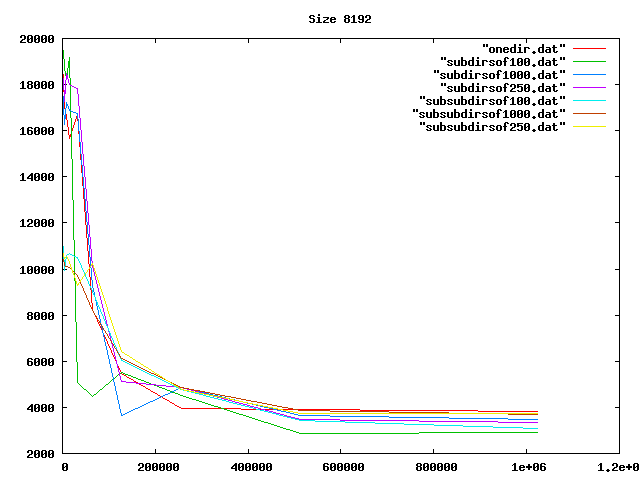
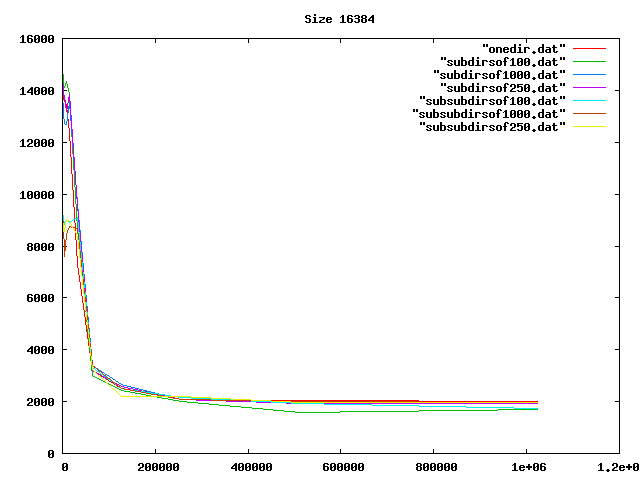
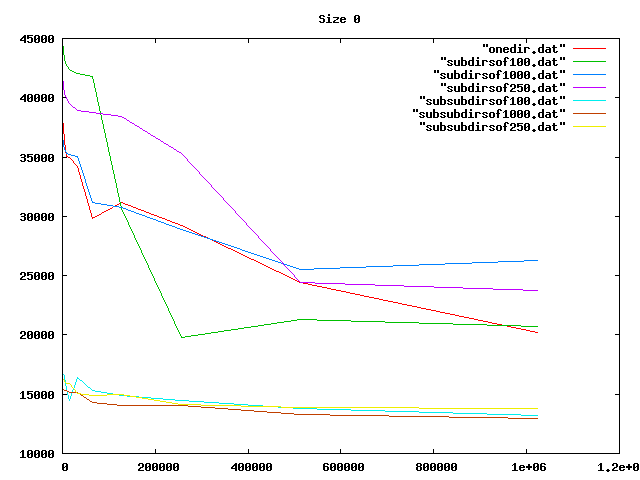
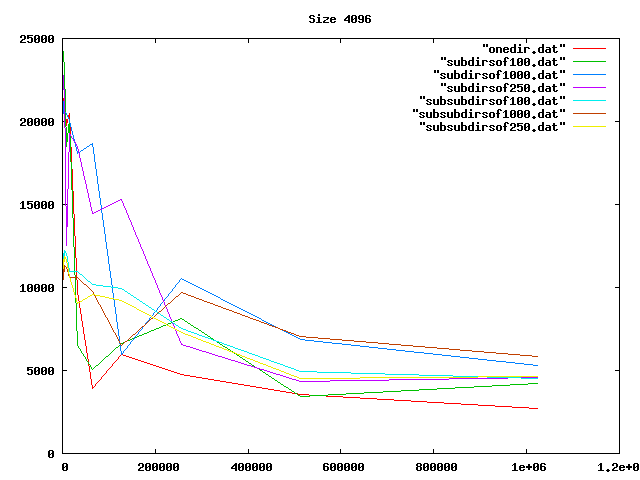
Graph, 0-byte files Graph, 4096-byte files Graph, 8196-byte files Graph, 16384-byte files Some graphs from the benchamrks: for 0, 4, 8, and 16 KiB files, for up to one million files of each size. onedir puts all files in the same directory, subdirsofN puts N files per directory, and subsubdirsofN has two levels of directories, the leaf directories getting N files each.
From the graphs I deduced that overall, having two levels of directories and up to 1000 files per sub-directory was the best option of those tested. On the other hand, the bigger the files, the less it mattered what the directory structure was. Perhaps the obvious reason for the slowness wasn't that, after all. Then I realized my code was slow because I was doing an os.listdir (listing all files in a directory) for every directory every time I creted a file. Fixing that idiocy made the code so fast that any overhead from the directory operations was no longer relevant. But at least I had some nice graphs. On the server I will be generating my test data the program is now happily generating just over 11 MB/s of test data. I wouldn't mind having it be a lot faster, but it's fast enough. It will take hours to generate hundreds of gigabytes, but I hopefully won't need to do that very often. Thus, further optimization isn't worth my time, right now. The program is genbackupdata, in case anyone else cares about it.

31 July 2007

Simon Richter: Night hacking

Another night of evil code. The mighty gdb now talks to me. Have successfully resisted the urge to reimplement everything, so far.

30 July 2007

Miriam Ruiz: Lets try Epiphany

Is it just my perception, or Firefox/Iceweasel crashes too much lately? At some point in the future I might consider switching to Konqueror, but for now I’d prefer making a smaller change and stick to Gecko. After having a look at the available options, and asking some people (thanks dudes, thanks Sam, thanks Tolimar), I’ve decided to give a chance to Epiphany. Lets see how it goes! :)

29 July 2007

Steve McIntyre: Life...

I've been busy doing various things, so I've not had a chance to blog much lately. Time for a quick catch-up... We've had a bit of a development panic at work, so I've been working longer hours than normal. The scary thing is (and I've noticed this in the past too), I seem to enjoy the job more when there's real pressure involved. That's not to say I want it to always be stressful, but we've had more fun with a small group of us really concentrating on a single project, working well together. Outside of work, I've been really quite relieved to take a bit of a break from Debian stuff since Debconf has finished. Debconf (as always) was a really good way to be re-enthused about working on Debian, but it has taken me several weeks to get over it physically. I've finally finished upgrading all of my machines at home to Etch. In most cases it was easy, but the final one left was lump, the firewall/mail/web/foo server. I'd chickened out of upgrading it for quite a while due to the sheer number of services it hosts, and also the substantial amount of local config it therefore holds. In the end, things were thankfully mostly painless. The nice thing about doing the upgrade was that finally lots of new software has suddenly become readily available. Amongst other things, I've added iodine and openvpn, and now I'm looking into playing with voice over IP (probably Asterisk). My Nokia E70 has a VOIP client and wifi, so in theory I should be able to use my regular mobile phone as a voip handset on my wireless network at home and just get cheaper outbound calls. Yay! I visited my friend Matthew a couple of weeks ago, and also helped him upgrade/install his network of Debian machines. Unfortunately, his main workstation (dual AMD64 goodness) is still left just running Windows. BIOS/SATA RAID - just say NO! No matter what we did on that machine, we could not make it dual-boot XP and Debian without forcing him to reinstall it all from scratch. :-( The SPI board elections have just finished. Congratulations to the new mugs^H^H^H^Hmembers of the board, and best of luck in doing a good job. And comiserations to the people who lost - I'm sure most of you would have been good, useful board members too. We're having a final Debconf 7 wrapup meeting next weekend in York, where we're hoping to get the final conference report finished. There are a few more T-shirts to get finished and delivered to people and the sponsorship bags to go out, then it's all done for this year. It'll be good to meet up with people again anyway. Oh, and not long now until the big BBQ at my place. I've started getting some supplies in already, and I'm looking forwards to a bunch of geeks coming round to wreck my house again. Or something... *grin* Last but not least - I'm changing ISPs shortly. Noodles and Huggie have provided excellent service for nearly 3 years, but are exiting the business and moving on to other things. So I'll be moving my home ADSL back to UKFSN shortly. Hopefully the disruption will be minimal.

Next.

Previous.