Search Results: "ron"

30 October 2013

Matthew Palmer: How to deal with the "package gcc: " problem in Puppet

In a comment to yesterday s post on why your Puppet module sucks, Warren asks what can be done about the problem of multiple modules needing to include the same package (gcc being the most common example I m yet to come across). As I stated previously, there is no sane, standardised way for multiple independent modules to cooperate to ensure that certain packages are installed for their cooperative use. If it wasn t already obvious, I consider this to be a significant failing in Puppet, and one which essentially renders any attempt at public, wide-scale reuse of Puppet modules impossible. Software packages are such a fundamental part of system management today that it is rare for a module not to want to interact with them in some way. Without strong leadership from Puppet Labs, or someone core to the project who s willing to be very noisy and obnoxious on the subject, the issue is fundamentally unsolveable, because it requires either deep (and non-backwards-compatible) changes to how Puppet works at a core level, or it needs cooperation from everyone who writes Puppet modules for public consumption (to use a single, coordinated approach to common packages). The approaches that I ve seen people advocate using, or that I ve considered myself, roughly fall into the following camps.

Put your package into a class in your module Absofrickinglutely useless, because the elementary package resources you end up creating will still conflict with other modules package resources. Anyone who suggests this can be permanently ignored, as they don t understand the problem being solved.

Use a globally common module of classes representing common packages This could work, if you could get everyone who writes modules to use it (see someone willing to be very noisy and obnoxious ). Practically speaking, anyone who suggests this doesn t understand human nature. I don t see this actually happening any time soon.

Use the defined() function everywhere By wrapping all your package resources in if !defined(Package["foo"]) blocks, you can at least stop your module from causing explosions. What it doesn t do is make sure that the various definitions of the package resource are congruent (imagine if one was package "gcc": ensure => absent ). In order to safely avoid explosion, everyone would have to follow this approach, which (in the worst case) reduces the problem to the globally common module of classes. However, it s the least-worst approach I can practically consider. At least your module won t be the cause of explosions, and realistically no module s going to ask for gcc to be removed (or, if they are, you ll quickly find them and kill them). I ve seen calls from Puppet core dev team members to deprecate and remove the defined() function entirely. Given the complete lack of alternatives, this is a disturbing illustration of just how out of touch they are from the unfortunate realities of practical Puppetry.

Use virtual resources This is yet another variant of the common class technique that would require everyone, everywhere, to dance to the same tune. It has all the same problems, and hence gets a big thumbs-down from me.

Use singleton_packages This module is a valiant attempt to work around the problem, but practically speaking is no better than using defined() because again, if a module that isn t using singleton_packages specifies package "gcc": ensure => absent , you re going to end up with assplosion. The mandatory dependency on hiera doesn t win me over, either (I m a hiera-skeptic, for reasons which I might go into some other time).

Use only modules from a single source This is the solution that I use myself, if that s any recommendation As a result of pretty much every publically-available Puppet module sucking for one reason or another, I do not, currently, have any externally-written Puppet modules in the trees that I use. Every module (158, at current count) has been written by someone in the sysadmin team at $DAYJOB, to our common standards. This means that I can coordinate use of package resources, using our module of common classes where appropriate, or refactor modules to separate concerns appropriately. If you re wondering why we don t have all of these 158 modules available publically, well, we have a few of them up, but yes, the vast majority of them aren t publically available. Some of them suck mightily, while many others are just too intertwined with other modules to be able to use on their own, and we don t want to release crap code there s far too much of that out there already.

29 October 2013

Pau Garcia i Quiles: FOSDEM 2014 Desktops DevRoom Call for Talks

FOSDEM is one of the largest gatherings of Free Software contributors in the world and happens each February in Brussels (Belgium). One of the tracks will be the Desktops DevRoom (formerly known as CrossDesktop DevRoom ), which will host Desktop-related talks. We are now inviting proposals for talks about Free/Libre/Open-source Software on the topics of Desktop development, Desktop applications and interoperability amongst Desktop Environments. This is a unique opportunity to show novel ideas and developments to a wide technical audience. Topics accepted include, but are not limited to: Enlightenment, Gnome, KDE, Unity, XFCE/Razor, Windows, Mac OS X, general desktop matters, applications that enhance desktops and web (when related to desktop). Talks can be very specific, such as developing mobile applications with Qt Quick; or as general as predictions for the fusion of Desktop and web in 5 years time. Topics that are of interest to the users and developers of all desktop environments are especially welcome. The FOSDEM 2013 schedule might give you some inspiration. Please include the following information when submitting a proposal: The deadline for submissions is December 14th 2013. FOSDEM will be held on the weekend of 1-2 February 2014. Please use the following website to submit your proposals: https://penta.fosdem.org/submission/FOSDEM14 You can also join the devroom s mailing list, which is the official communication channel for the DevRoom: desktops-devroom@lists.fosdem.org (subscription page for the mailing list) The Desktops DevRoom 2014 Organization Team

Soeren Sonnenburg: Shogun Toolbox Version 3.0 released!

Dear all, we are proud to announce the 3.0 release of the Shogun Machine-Learning Toolbox. This release features the incredible projects of our 8 hard-working Google Summer of Code students. In addition, you get other cool new features as well as lots of internal improvements, bugfixes, and documentation improvements. To speak in numbers, we got more than 2000 commits changing almost 400000 lines in more than 7000 files and increased the number of unit tests from 50 to 600. This is the largest release that Shogun ever had! Please visit http://shogun-toolbox.org/ to obtain Shogun. News Here is a brief description of what is new, starting with the GSoC projects, which deserve most fame: Screenshots Everyone likes screenshots. Well, we have got something better! All of the above projects (and more) are now documented in the form of IPython notebooks, combining machine learning fundamentals, code, and plots. Those are a great looking way that we chose to document our framework from now on. Have a look at them and feel free to submit your use case as a notebook! FGM.html GMM.html HashedDocDotFeatures.html LMNN.html SupportVectorMachines.html Tapkee.html bss_audio.html bss_image.html ecg_sep.html gaussian_processes.html logdet.html mmd_two_sample_testing.html The web-demo framework has been integrated into our website, go check them out. Other changes We finally moved to the Shogun build process to CMake. Through GSoC, added a general clone and equals methods to all Shogun objects, and added automagic unit-testing for serialisation and clone/equals for all classes. Other new features include multiclass LDA, and probability outputs for multiclass SVMs. For the full list, see the NEWS. Workshop Videos and slides In case you missed the first Shogun workshop that we organised in Berlin last July, all of the talks have been put online. Shogun in the Cloud As setting up the right environment for shogun and installing it was always one of the biggest problems for the users (hence the switching to CMake), we have created a sandbox where you can try out shogun on your own without installing shogun on your system! Basically it's a web-service which give you access to your own ipython notebook server with all the shogun notebooks. Of course you are more than welcome to create and share your own notebooks using this service! *NOTE*: This is a courtesy service created by Shogun Toolbox developers, hence if you like it please consider some form of donation to the project so that we can keep up this service running for you. Try shogun in the cloud. Thanks The release has been made possible by the hard work of all of our GSoC students, see list above. Thanks also to Thoralf Klein and Bj rn Esser for the load of great contributions. Last but not least, thanks to all the people who use Shogun and provide feedback. S ren Sonnenburg on behalf of the Shogun team (+ Viktor Gal, Sergey Lisitsyn, Heiko Strathmann and Fernando Iglesias)

Eddy Petrișor: The stupidest trend in laptop design is...

... numpads on laptop keyboards.

Just because a very, very, very restricted segment of the population is into accounting or other jobs needing frequent numeric input, almost all laptop manufacturers feel the stupid urge to place a numpad on laptops with screens over 14''.

Reasons why a numpad on a laptop is a bad idea:
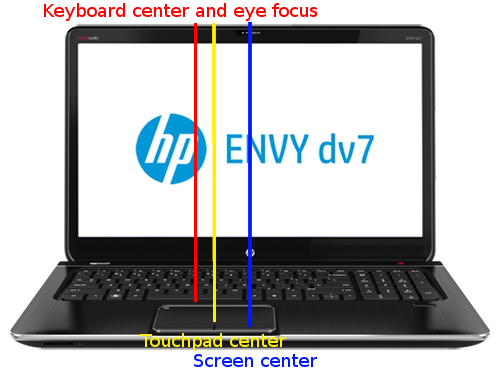
The numpad forces eye focus and users' hands to be way off center.
The touchpad looks as if it was thrown to the side by accident
Note how the designer tried to offset the misalignment forced
by the numpad by "positioning" the touchpad closer to center,
but not in line with the space bar (and the keyboard)

Without numpad the position is almost perfect!
The symmetry of the laptop improves on the design.
Notice how the touchpad is also centered.


What's worse is that most resellers do not have filters for this particular mis-feature, so you can't easily exclude laptops corrupted by this horrendous idea.

So, if you're a laptop designer, please stop putting numpads on laptops.

It will make for better looking laptops and you'll have the opportunity to be the one stating the obvious: numpads are generally useless! Even on desktop keyboards!

Matthew Palmer: Why Your Puppet Module Sucks

I use Puppet a lot at work, and I use a lot of modules written by other people, as well as writing quite a number of my own. Here s a brief list of reasons why I might say that your module sucks.

1. You use global variables This would have to be both the most common idiom that just makes my teeth grind. Defined types exist for a bloody reason. Global variables make it incredibly difficult to reason about what is going to happen when I use a particular global variable (see also You don t write documentation ), and I get no feedback if I typo a global variable name. Add in a healthy heaping of lack of namespacing , and you ve basically guaranteed that your module will be loudly cursed.

2. You use parameterised classes I ve never managed to work out why parameterised classes even exist. They ve got all the problems of regular classes, as well as all the problems of types. There was a fantastic opportunity with parameterised classes to fix some of the really annoying things about regular resources, such as doing conflict checking on parameters and only barfing if there was a conflict but no, if you define the same class twice, even with identical parameters, Puppet will smack you on the hand and take away your biscuit. FFFFFFUUUUUUUUUUUU-

3. You fail at using fail() Modules are supposed to be reusable. That s their whole reason for existence. One of the benefits of Puppet is that you can provide an OS-independent interface for configuring something. However, unless you re some absolute God of cross-platform compatibility, you will only be writing your module to support those OSes or distros that you, personally, care about. That s cool if you don t know anything about OS X, you probably shouldn t be guessing at how to support something on that platform anyway. However, when you do have some sort of platform-specific code, for the love of pete, have a default or else clause that calls fail() with a useful and descriptive error message, to indicate clearly that you haven t included support for whatever environment the module s being used in. Failing to do this can cause some really spectacular explosions, because the rest of your module assumes that certain things have been done in the platform-specific code, and when it hasn t hoo boy.

4. You don t write documentation Yes, it isn t easy to write good documentation. I know that. But without documentation, your module is going to be practically unuseable. So if you don t have docs, your module is basically useless. Well done, you.

5. You have undeclared dependencies This also includes declaring your dependencies in a non-machine-parseable manner; I m not going to grovel through your README for the list of other modules I might need; I have machines to do that kind of thing for me. If I try to use your module, and it craps out on trying to reference some sort of type or class that doesn t appear at all related to your module, I will call into question your ancestry, and die a little more inside.

6. You use common packages without even trying to avoid the pitfalls OK, to be fair this is, ultimately, Puppet s grand fuckup, not yours, but you at least need to pretend to care There is no sane, standardised way in Puppet for multiple modules to install the same package. Let s say that a module I write needs to have a compiler. So I package "gcc": . Then someone else s module also wants a compiler, so it also package "gcc": . FWAKOOM! says Puppet. What the fuck? says the poor sysadmin, who just wanted both a virtualenv and an RVM environment on the one machine. Basically, using packages is going to make your module suck. Does that mean that this makes wide distribution of a large repository of modules written by different people nigh-on impossible? Yes. Fantastic.

28 October 2013

Dirk Eddelbuettel: Kurt Elling at Dominican University

Some catchup blogging: Kurt Elling was back in town on October 19, and not just in Chicago but quite literally in our little 'burb as the headliner for this season's concerts at Domiminican University. They had done us the favour of inviting Dianne Reeves back in March 2009, but this was clearly going to be a real treat. And I managed to snatch four front row (!!) tickets as soon as I heard about it, and the show once again didn't disappoint. Elling was as usual accompanied by his long-time collaborator Laurence Hobgood on piano, as well as local heros Clark Sommers on bass and John McLean on guitar. This time, Quincy Davies was on drums. And this band is realiably excellent, as is Elling in any live setting. The set was dominated by pieces from his most recent record and augmented by a few other standout pieces. There is a pretty rich set of live music by Elling on YouTube, see for example On Broadway (which was part of the set in a wonderfully fast and funked-up variant), Golden Lady (from the previous album, and also played live this time) or for example this wonderful version of You Send Me (also part of the concert). I snatched a photo or two (while at least turning my flash off, unlike the weird gal to my left, but I digress) and posted one on Google+. Kurt Elling will be back in Chicago at the Green Mill in early January. Expect to me there, and I hope to see you too!

This post by Dirk Eddelbuettel originated on his Thinking inside the box blog. Please report excessive re-aggregation in third-party for-profit settings.

25 October 2013

Enrico Zini: A vision wanted

A vision wanted Today Richard Stallman mailed all Italian LUGs asking that tomorrow's LinuxDay be called "GNU/Linux Day" instead. I wonder how that is ever going to help a community so balkanised, that the only way Italian LUGs manage to do something together, is to say "let's not care what we all do, let's just do it on the same day and call it a national event". Of course a few LUGs still make a point of not doing anything on that day, because you know, Judean People's Front. Cawk. Today a friend asked me if I could help her support people in installing Citrix Whatsit to set up a video conference to network meetings that will take place in a month in different cities. Those meetings are something I look forwad to. It wasn't much of a problem to say "no, I can't do that"; it was a problem to be unable to come up with some viable, Free alternatives. I sometimes have to use Skype to talk with friends who also are Debian Developers, because I still haven't managed to make VoIP work unless I go through a commercial proxy. There was the happy news that our regional administration is switching from MS Word to OpenOffice. It soon became a flamewar, because some people loudly complained that they should have used LibreOffice instead. At DebConf, after spending an hour getting frustrated with the default formatting of bullet points in WhateverOffice Impress, I did my Debian Contributors talk using a text file in vim. And it was a success! Thanks Francois Marier for maintaining cowsay. I can't sync contact lists and appointments between my N900, which runs a Debian derivative, and my laptop, because I don't want to have a Google account, and nothing else would work out of the box. I don't even know how to keep a shared calendar with other DDs, without using a 3rd party cloud service that I don't want to trust with my life's personal schedule. I need to do a code review of every vim plugin I need to use, because you can only get them by cloning GitHub repositories over plain http, and they don't even provide signed tags. That code is run with my own privileges every time I start a text editor, which is, like, all the time. I'm frightened at the idea of how many people blissfully don't think about what that means. Vim users. Programmers. Cool chaps. Yet the most important thing in Debian today seems to be yet another crusade between upstart and systemd. But we haven't had a lengthy discussion on why, although the excellent OpenStreetMap exists and many of us contribute to it, it seems to still be more immediate to hit Google Maps to get a route computed. How can we change that? We haven't had a lengthy discussion on what can we offer to allow anyone to set up some social platform that won't get swamped with spam the first day and cracked open the second; that would allow people to share some photos with their friends only, and some with the rest of the world; that won't required a full-time paid person to maintain. That won't be obsolete and require a migration to a new platform in a year. That isn't Facebook or Google Plus. I stopped taking photos because it's too much work to show them to people. Other people use Instagram. Whatever the hipster trend is for photo sharing today, October 25, 2013, I'm pretty sure it's not a Free platform. But we can do something. We technology leaders. We are those who drive technological change! For example, today I invested two hours of hard effort trying to figure out why libbuffy's test suite fails on kfreebsd. All while wondering why I was doing that, since I know all buffy's users personally, and none of them uses kfreebsd. And I will take a day off work to study the library symbols file specification, so that next time I'll know right away if the new version of a C++ compiler decides that a template-generated symbol isn't worth adding to a library anymore. What is this effort really about? It sometimes feel like micromanaging to me. It's good to have excellent quality standards. But not without a vision. Not until "reliable network printing with all PDF viewers and print servers we ship" is among our release goals. Not until we commit to making sure that "sharing files between Debian users" will work out of the box, without the need of going through a 3rd party website, or email. I'm not interested in spending energy discussing init systems. I'm interested in spending energy sharing stories of what cool stuff we can do in Debian today, out of the box. And what cool stuff we'll be able to do tomorrow. Let's spend time on IRC, on mailing lists, and at the next Debian events, talking about why we are really into this. Talking about a vision! Note: Please don't spend time telling me how to fix the problems I mentioned above. I'm not interested in help fixing some problems for me today. I'm interested in asking help fixing problems for everybody, right in the next stable release. Remember, remember, the 5th of November, 2014.

Jorge Salamero Sanz: Zentyal is hiring (C/C++ developers for Samba4/OpenChange)

Zentyal is seeking to hire a results driven and autonomous software C/C++ developers, motivated to work in a start-up environment and to become part of an open source company. You will be actively involved into Zentyal products -OpenChange and Samba projects-, digging into the internals, answering escalated customers requests and participating in pushing the full solution to enterprise level. Also, you will take part in discussions and proof of concept developments related to scalability, high availability and best efficiency scenarios. Check Zentyal careers website for more information, or ping us in IRC!

Jan Wagner: PHP.net infected with Malware and Linux Malware Detect

As some of you might have noticed, the Site PHP.net was infected yesterday with Malware.
If you are running a shared hosting environment, you are also be faced with similar Malware problems. Beside XSS attacks and compromised server systems on OS-level, very widely used attack szenarios are stolen user credentials. A usefull mitigation strategy might be a web application firewall (WAF) like ModSecurity. Another way might be the Malware scanner Linux Malware Detect. The project describes itself:
**Description**
Linux Malware Detect (LMD) is a malware scanner for Linux released under the
GNU GPLv2 license, that is designed around the threats faced in shared hosted
environments. It uses threat data from network edge intrusion detection systems
to extract malware that is actively being used in attacks and generates
signatures for detection. In addition, threat data is also derived from user
submissions with the LMD checkout feature and from malware community resources.
The signatures that LMD uses are MD5 file hashes and HEX pattern matches, they
are also easily exported to any number of detection tools such as ClamAV.
**Features**
- MD5 file hash detection for quick threat identification
- HEX based pattern matching for identifying threat variants
- statistical analysis component for detection of obfuscated threats (e.g: base64)
- integrated detection of ClamAV to use as scanner engine for improved performance
- integrated signature update feature with -u update
- integrated version update feature with -d update-ver
- scan-recent option to scan only files that have been added/changed in X days
- scan-all option for full path based scanning
- checkout option to upload suspected malware to rfxn.com for review / hashing
- full reporting system to view current and previous scan results
- quarantine queue that stores threats in a safe fashion with no permissions
- quarantine batching option to quarantine the results of a current or past scans
- quarantine restore option to restore files to original path, owner and perms
- quarantine suspend account option to Cpanel suspend or shell revoke users
- cleaner rules to attempt removal of malware injected strings
- cleaner batching option to attempt cleaning of previous scan reports
- cleaner rules to remove base64 and gzinflate(base64 injected malware
- daily cron based scanning of all changes in last 24h in user homedirs
- daily cron script compatible with stock RH style systems, Cpanel & Ensim
- kernel based inotify real time file scanning of created/modified/moved files
- kernel inotify monitor that can take path data from STDIN or FILE
- kernel inotify monitor convenience feature to monitor system users
- kernel inotify monitor can be restricted to a configurable user html root
- kernel inotify monitor with dynamic sysctl limits for optimal performance
- kernel inotify alerting through daily and/or optional weekly reports
- e-mail alert reporting after every scan execution (manual & daily)
- path, extension and signature based ignore options
- background scanner option for unattended scan operations
- verbose logging & output of all actions
The recent development can be found at Github and in the last days I worked on packaging this into a Debian package 'maldetect'. If you want to give it a try on Debian, you could install the packages from our restricted repository:
    # wget "http://ftp.cyconet.org/debian/sources.list.d/restricted-cyconet.list" \
        -O /etc/apt/sources.list.d/restricted-cyconet.list
    # aptitude update
    # aptitude -t restricted install maldetect
For adding our archive key, you can just install the package "debian-cyconet-archive-keyring"

24 October 2013

Daniel Pocock: Final report on GSoC 2013 projects

Google Summer of Code finished recently. This is the first year that I have participated as a mentor for the Debian Project. Its a big responsibility to be part of the Debian team and to be one of the Debian team members representing Debian at the GSoC Mentor Summit. Birthdays all round This has been a particularly important year for the Debian Project, as the project celebrated our 20th birthday recently, on 16 August 2013, one of the final days of DebConf13 in Switzerland. GSoC celebrates its 10th year in 2014, with a generous 10% boost in the student stipend to mark the occasion. Google: don't be evil Google's "Don't be evil" approach to business has always been an interesting point for discussion. In my view, there are few cases of absolute good or absolute evil that we can universally classify and agree on. At a more pragmatic level, various people have commented that GSoC is a recruiting program for Google: some have even cited this as a reason not to participate. This is a more interesting point for discussion. The results of the program are not exclusive to the headhunters at Google. Anybody can browse through the Debian GSoC weekly student reports from each student to find out exactly what the students were up to and try to recruit them. Mentors and the projects they belong to have not been forced to sign any wide-ranging non-disclosure agreements or non-compete agreements with Google. In one recent example, the xWiki open source project even went as far as setting up a new office in Romania and employing some former GSoC students on a permanent basis.
Assorted images from Iasi, Romania, where xWiki set up an office employing former GSoC students How does Google benefit then? Well, there appear to be several possibilities:
  • Generating a huge amount of goodwill and recognition for the value that they place on the development of the next generation of software engineers
  • Stimulating the expansion of high quality free software projects, many of which they use directly or indirectly for their internal projects
  • Access to private evaluations prepared by the mentors. These evaluations don't take more than an hour for the mentors to complete but they do serve to give Google's headhunters a slight headstart over anybody else who is scouring the web for the names of graduates who completed GSoC
Overall, it appears to fit the definition of a "win-win" scenario: yes, Google gets stuff out of it, but the benefit is not exclusive to Google and projects like Debian are winners too. My initial approach I started by reviewing some of these materials: One particular concept that I took note of was the need to give students some opportunity to be innovative and original in their project proposals. In other words, it has been suggested that students should not be given a precise specification: rather, they should be given some very general concepts or goals and asked to suggest some funky, innovative new idea. The wisdom of this approach varies. If your free software project has some very specific gap that you need to fill, you may only be interested in taking a student who can fill that gap and you may not want to waste the time of other applicants. On the other hand, if you do precisely document this gap you want filled, you may get a bunch of very similar proposals from students and it may be more difficult to distinguish which of them is the most desirable candidate. Furthermore, if your expectations are too rigid, you may not benefit from a top-gun coming in and contributing some really exciting piece of work that you hadn't even thought of. In the end, I opted for providing more generic project briefs and looking at how students responded. The briefs that I published are available here. Coding tasks during the selection process There is no doubt about it, coding tasks are an important part of ensuring students are capable of development work before they are selected. They are also very important for us as mentors. It is not uncommon for some of us to be completely out of touch with the capabilities of other developers. The coding tasks completed by the students during the selection phase allow us to get a feel for their capabilities and set reasonable expectations for how much they can achieve during the course of the project. To simplify the management of coding tasks and engage the students in the Debian community at large, I decided to create tasks as wishlist items in the Debian bug tracking system, such as this dynalogin bug report. The prospective GSoC students were asked to put their name in the bug tracker to take ownership of the task they would complete. Student project proposals For the real-time communications project, I felt all the students slightly underestimated the complexity of this field and would have to be extremely lucky to complete everything they hoped to. After all, this is a field that the free software movement has been wrestling with for years without gaining the upper hand. For somebody with good knowledge of the projects in this space, it is possible to guide the students towards meaningful and achievable subprojects. Nonetheless, the proposals were useful for me in understanding which part of the topics were most attractive to the students. For the other project areas, the student proposals were slightly more specific. Fabian's appeared to be the most specific and well considered proposal for the one-time-password project, in fact, it appeared very much like a project that he could work through from start to finish. Debian teamwork Anybody looking at the GSoC web site will notice that there is a certain amount of overhead in joining the program, promotion, payment administration and optional participation in the GSoC Mentor Summit. As a large organisation, Debian established a dedicated SoC administration team who looked after the GSoC and Outreach Program for Women administrivia. As a developer and mentor, I found this arrangement was highly effective and allowed me to focus over 99% of my efforts on the front-line work, selecting students and supporting them through their projects. Project results One of the more controversial issues during the Debian 7 (wheezy) release cycle was the inclusion of the Mumble voice conferencing software. Although the software has some serious issues, it was eventually escalated to the technical committee and allowed to remain in Debian, partly due to lack of any alternative. One of the first results from Catalin's project was the creation of an alternative, the new reConServer project, based on the librecon conversation manager API from the reSIProcate SIP stack. reConServer is a significantly more generic solution than Mumble, as it allows any SIP peer to participate in an audio conference. It supports TURN for NAT traversal too. Catalin then went on to make the first working implementation of a scheme for passing context information from a web site to SIP WebRTC call as described in the IETF draft. All work has been integrated into release tarballs and packaging. Fabian worked through the latest standards for one-time passwords, extending the oath-toolkit and dynalogin projects to implement mutual two-factor authentication with just about any arbitrary crypto suite using one-time passwords. This work is yet to be merged into an official release of dynalogin as it requires co-ordination with the oath-toolkit release and package updates. However, there is a compelling demonstration in his video from DebConf13 and the source is available under Fabian's github account. In the post-Snowden world, the work from both of these student projects will be hugely valuable to people wanting to tighten up their computer security and communication security practices. The development process Deciding to mentor more than one project turned out to be a worthwhile decision. At first, this might seem like a big risk but it is manageable with support from co-mentors. The upside is that different students work at different speeds, they have different code styles, they even work at different times of the day or week and mentoring more than one student/project allows the mentor to gain a better appreciation of how the students differ than if mentoring only a single project. For Catalin's project, it became obvious at an early stage that he would benefit from having a dedicated server to run the VoIP applications on public IP addresses and low-latency networks while testing them. I spun up a virtual machine with IPv4 and IPv6 in my Xen Cloud Platform and this was extremely helpful for both of us. Throughout the project, I took a hands-off approach and often left the students to their own devices. I gave some suggestions to Catalin about the object-oriented design and this was enough for him to fill in the gaps and write all the code by himself. Fabian's project had fewer ambiguities and he was able to use existing code as a model more frequently than Catalin. It is possible that the students may have produced more code if I had thought through the designs myself and given them definite blue-prints. However, I feel that this would have made it harder for me to appreciate their own abilities and test the limits of their design skills. DebConf13 participation One of the highlights for the students was their participation in DebConf13. Both students presented a session at the conference showcasing some of their work. The DebConf video team produces high quality videos of all sessions at the conference and this in turn provides some great evidence of the students' capabilities and what GSoC adds to Debian and the wider free software universe. I would encourage other mentors to actively contemplate ways to involve their students in conferences during or shortly after the completion of their project work. Looking ahead Google has recently confirmed that Google Summer of Code will be repeated in 2014. It is the 10th anniversary of the program and to celebrate, students will get 10% extra pay. Thank you There are many people to thank for the success of these projects and the wider success of the Debian GSoC team:
  • The Debian GSoC and OPW organisation admin team
  • Google and the Google Open Source Programs Office
  • All the co-mentors who assisted on these projects with me: Simon Josefsson, Luke Faraone, Sylvain Berfini, Eloy Coto and Jes s P rez Rubio
  • The students themselves, C t lin Constantin U urelu and Fabian Gr nbichler
  • All the other very capable and motivated students who applied, submitted code samples but were not selected to participate: many of these students could have also completed a successful project and turning them away is one of the most difficult tasks for mentors in a volunteer organisation like Debian

Steve Kemp: Some things change, some things do not.

After seven years working from home I've resigned from my position at Bytemark. Why? A combination of wanting to do something different coupled with the desire to reclaim my second bedroom, which is currently tied up as an office. Working in an office in the future will be weird ("You mean I have to get dressed every day?!") but hopefully not unduly burdonsome. My two-year plan still remains in effect: Pay off this flat as soon as possible, then purchase another and rent this one out. Giving me some income of my own, which I will need. The "five" year plan involves me quitting work, so that I can stay home and raise children. That makes sense because sometime next year I'll become the partner who earns the least amount of monies, and I'll also be the partner with the lowest upper-bound on salary potential (short of moving to London/similar which I've always ruled out). Having rental income for myself means I'm not utterly dependant on other money, and all being well this place will be 100% paid off within 18 months. (After that lots of saving will take place for a deposit for the second place. We did bid on a couple of places locally, which were outstanding, but it is perhaps for the best we didn't win them. No more looking at ESPC!) Bytemark now becomes a company I recommend 100% for hosting in the UK. In the past I've always said nice things, but I've not strongly recommended them/us, because I'm too biased. All my personal hosting, except for one virtual machine, will remain at Bytemark indefinitely. Lovely, flexible, and great. (I have one outside guest for the purposes of diversification. That currently lives at Mythic Beasts.)

Ingo Juergensmann: Sharing GnuPG between Linux and OSX

I've been using GnuPG since years. Well, using is too strong. I have a GPG key that I've created somewhen and use it once in a while when sending login credentials to other Linux people. But since Edward Snowdens NSA leaks I now get encrypted mails by non-Linux people. It is great that people are making use of strong encryption to protect their communication, but it is frightening that people have to do so because of NSA mass surveillance the complete world and violating our civil and human rights. Anyway, one problem with GnuPG and other PKI tools is, that you should keep your private key secret. When you use more than one device to write your mails, you will run into usuability problems like I did. My main computer is my Debian box, but I use a MacBook Pro laptop with OSX very often as well. There is GPGSuite (formerly GPGMail) for OSX to pimp your Mail.app with GPG. It uses, of course, a local .gnupg/ directory and thus it would create a separate GnuPG pair of keys. But apparently I want to use my existing pair of keys - without the need to copy them over from my Linux box to my laptop. The solution would be a simple setup of netatalk to mount your home directory from the Linux box under OSX and a matching symlink to your Linux .gnupg/ directory (or even better: symlink the contents where necessary and not the whole directory). But that would've been too easy, I guess, because I got this error message on OSX:

So, basically this didn't work right out of the box. Fortunately the GPGSuite support guys replied quick and solved this problem. The version they released yesterday did fix that problem, but I needed to add the following line to my ~/,gnupg/gpg-agent.conf, which didn't exist before too:

no-use-standard-socket

With that line everything works like a charme under OSX with Mail.app using my GPG keys on my Debian box.

Kategorie:

Russ Allbery: Review: Applied Cryptography

Review: Applied Cryptography, by Bruce Schneier
Publisher: John Wiley & Sons
Copyright: 1996
ISBN: 0-471-11709-9
Format: Trade paperback
Pages: 621
This is the next entry in the series of Russ reading books that he bought years ago and never got around to reading. Thankfully, this time, the book has aged somewhat better. This review is for the second edition of Applied Cryptography, published in 1996. Given how important computer security has become, and how central cryptography is to computer security, one might think that the passage of 17 years would make a book effectively obsolete. This turns out not to be the case. Yes, Rijndael (the current AES standard and the most widely-used block cipher), Camellia (the up-and-comer in the block cipher world), and the SHA-2 hash postdate this book and aren't discussed. Yes, there have been some further developments in elliptic-curve public-key cryptography. And yes, much of the political information in this book, as well as the patent situation for public-key cryptosystems, is now mostly of historical interest. But a surprising amount of this book still applies directly. Partly that's because much of Applied Cryptography is focused on general principles, classes of algorithms, and cryptographic protocols, and those do not change quickly. A rather amazing number of techniques and protocols still in widespread use today originated in the 1970s. Block ciphers, stream ciphers, cipher modes, public-key systems, signature systems, hash functions, key exchange, secret splitting, key management, and other, similar topics have not changed substantially. And even in the area of specific algorithms, DES is still in use (unfortunately) and its analysis is valuable for understanding any block cipher. RC4, Triple DES, CAST, RSA, MD4, MD5, and SHA-1 are still part of the cryptography landscape, and Schneier was already warning against using MD5 in 1996. The source code included in this book has, thankfully, been made obsolete by widely-available, high-quality free implementations of all common ciphers, available for any modern operating system. But the math, the explanations, and much of the cryptanalysis is still quite relevant. While it contains a comprehensive introduction to cryptographic concepts, Applied Cryptography is structured more like a reference manual than a tutorial. The first two chapters provide some foundations. Then, a wide variety of protocols, from the common to the completely esoteric, are discussed across the subsequent four chapters. There are four chapters on the basics of ciphers, another chapter on the mathematics, and then the longest part of the book: twelve chapters that provide a tour of all major and several interesting minor protocols that existed in 1996. These are organized into block ciphers, stream ciphers (and pseudo-random number generators), hash functions, and public-key systems. An entire chapter is devoted to the history and analysis of DES, and I think that was my favorite chapter of the book. Not only is it worth understanding how DES works, but it also provides a comprehensive introduction to the complexities of block cipher design, the politics of interactions with the NSA, and a fascinating history of early computer cryptosystems. Finally, Applied Cryptography closes with chapters on real-world systems and on politics. The politics section is mostly a historical curiosity, as is much of the chapter on real-world systems. Schneier discusses some of the PKCS and X.509 protocols here but doesn't use SSL as one of his examples despite its specification predating this book (perhaps the most glaring omission of the book). But he does discuss Kerberos (which is of personal interest to me), and it was useful to see it analyzed in the broader context of this sort of book. Those who read Schneier's blog regularly, or who have read any of his other books, will know that he's concise, incisive, and very readable, even with difficult material. I think he does err on the side of compactness this is not a book that handholds the reader or explains something more than once but there's a lot of ground to cover, so I can't really blame him. Expect to have to read the more difficult parts several times, and (at least on a first read) expect to just skip past some of the most complex sections as probably not worth the effort. But I think Schneier does a great job structuring the book so that one comes away with a high-level impression and overview sufficient to make informed guesses about capabilities and relative difficulty even if one doesn't have the patience to work through the details. I suspect most readers will want to skim at least part of this book. Unless you're willing to do a lot of background reading to understand the math, or a lot of careful study to follow the detailed descriptions and flaws in often-obscure algorithms, the algorithm discussions start to blend together. I found myself skipping a lot of the math and focusing on the basic descriptions and the cryptanalysis, particularly for the obscure ciphers. Many of the algorithms are also highly opaque and of obscure benefit; I doubt I will ever care about blind signatures or oblivious transfer, and I struggled to wrap my mind around the details of bit commitment (although it's apparently important in zero knowledge proofs, which in turn are relevant to authentication). But this is not the sort of book where you have to read every word. It's very well-structured, provides clear resynchronization points for readers who have had enough of a particular topic, and marks the topics that are more obscure or of dubious general usefulness. The most useful parts of this book, in my opinion, are the basic conceptual introductions to each class of cryptographic algorithm or protocol, and those chapters are excellent. I've been working in applied computer security, at the application and deployment level, for years, and this is the first time that I've felt like I really understood the difference between a block cipher and a stream cipher, or the implications of block cipher mode selection. Applied Cryptography is also a fascinating exercise in adjusting one's intuition for where the complexity lies. It's a memorable experience to move from the chapters on block ciphers, full of S-boxes and complex mixing and magic numbers, into the far more straightforward mathematical analysis of stream ciphers. Or the mathematical simplicity of RSA (although quite a bit of complexity is lurking on the cryptanalysis side, much of which is only touched on here). Of more historical interest, but still quite impressive, is that Applied Cryptography doubles as a comprehensive literature review. Not only does it cover nearly every algorithm in use at the time, it discusses the cryptography literature on nearly every topic with brief summaries of results and lines of investigation. The references section is a stunning 66 pages of small print featuring 1,653 references, and those are mentioned and put in context throughout the book. I'm not personally interested in chasing those lines of research further, and of course 17 years means there are many new papers that are as important to read today, but it's obvious that this book would have been an amazing and invaluable map to the research territory when it was first published. There are now newer books on this topic that you should consider if you're purchasing a book today. Cryptography Engineering in particular is in my to-read pile, and I'm interested to see how much of this book it could replace, although I believe it's lighter on the mathematical analysis and details. But I think Applied Cryptography still has a place on the bookshelf of any computer security professional. Schneier is succinct, detailed, straightforward, and comprehensive, at least for 1996, and I know I'll be reaching for this book the next time I forget the details of CFB mode and then get hopelessly confused by the Wikipedia article on the topic. Rating: 8 out of 10

Dirk Eddelbuettel: Introducing the CRAN Repository Policy Watch

CRAN is the repository network for R. It is a resounding success with (as of right now) almost 5000 packages, and growth rate which has been estimated (cf John Fox's keynote at useR! a few years ago) to be near 40% per year. We as R community members owe a great deal of thanks to the CRAN maintainers, and the R Core team. The tight integration between the language and the contributed code repository is unique among programming languages, and one of the many reasons why CRAN has been such a success and driver of growth and adoption for R. And the amount of work the CRAN maintainers put into this is substantial, and we owe them. Yet there is some friction between the repo maintainers, and the community of developers. There have numerous discussions on the main developer list about various aspect of how CRAN maintains the impeccable quality of the code in the archive. One particular aspect which has bugging (at least me) is the lack of communication when policy changes are made. It would be trivial to posts a set of changes to the developer list, and I suggested as much. Only to be soundly ignored. But changes to text (or html) files can monitored rather easily, and when such changes occur an alert can be sent. So I cooked up rather simple system for this which I called the CRAN Policy Watch. In essence, a simple cronjob monitors changes, and records new versions in a Github repo (which you can follow or star). Alternatively, the cronjob now also tweets from the @CRANPolicyWatch account which I invite everyone to subscribe to as well. If someone knows of a simple tool to summarize diffs of html or text files in static html pages, I'd be interested to expand the service to some github.io pages. Alernatively I could also just commit to a single file too and let Github summarize the changes. This was an itch I needed to scratch, and I hope some other people will fine this useful too.

23 October 2013

Rog rio Brito: Assorted random notes

This post is just a bunch of random notes, but I think that things are going well, this time.

Btrfs Just started playing with btrfs after converting a 2TB disk with about 1.3TB of data from ext4 to btrfs. This particular filesystem contains my backup data and I hope that btrfs is able to live up to high standards. I will probably write a detailed review with my impressions, but suffice to say that it is working fine and I hope that I will be happy for a long time to come. My other filesystems, for the moment, will be ext4.

Coursera Downloader Thanks to John Lehmann's generosity, now coursera-dl has a new home: a github organization of its own!

youtube-dl Some people may have noticed, others may not, but when downloading videos from Youtube, they apparently are getting more aggressive with the use of Dynamic Adaptive Streaming over HTTP (also called DASH) and, as a result, some (perhaps going to be all in the near future?) of the videos may not be available in the resolution/formats that you used to like (like me, with format number 35). By the way, one thing that is interesting with youtube videos provided via DASH is that they are available in different streams: one for the video and another for the audio. What does this mean in practical terms for users of youtube-dl? Well, if you wanted to download videos in resolutions like the 480p (format 35) that I mentioned, then you will probably have to change your way of doing things, until a more automated solution is in place. You will have to download both the audio and the video and, then, "combine" them (that is, multiplex them) to create one "normal" video file with both the audio and the video. I usually do this via: ffmpeg -i audio.m4a -i video.mp4 -vcodec copy -acodec copy combined.mp4 If you prefer having a Matroska container instead of an mp4 container (which, BTW, results in smaller muxing overhead), then you can use the command line: mkvmerge -o combined.mkv audio.m4a video.mp4 Oh, those m4a and mp4 extensions are a new addition that I just sent upstream (in the past, both would have been named with an extension of mp4). As, an aside, I like formats 135 for video and 140 for audio, for the reasons that I mentioned in a comments to issue 1612:
Otherwise, to download 480p videos (which I do for lectures and so on with other projects of mine, like edx-dl) I have to call youtube-dl twice: once for format 135 and another for format 140, since the old (?) format 35 files are much smaller than the lower resolution 360p files (due to the former being encoded in High profile vs. the latter being encoded in Constrained Baseline profile).
While this is unfortunate for some, this is a good thing for others: I once had a blind user of youtube-dl asking me if he could avoid downloading the whole video just to extract the audio, so that he save on bandwidth. Well, now this is possible. Expect a new version of youtube-dl to be uploaded soon to Debian unstable.

Music It is so nice to see the music that I like getting better. It was particularly pleasant to see Tarja Turunen being joined on stage by Floor Jansen. In fact, it is my impression that the once female-fronted bands are getting more and more into collaborations and side-projects and they are, in many ways, getting more refined. Examples of this includes Floor, Tarja, Anneke van Giersbergen, Sharon den Adel, Kari Ruesl tten and many others that I can't remember right now. Of course, some thanks to people that take the time to film, and upload/share the videos so that other people not at these events can watch them is highly appreciated and they usually are treated as anonymous, but, of course, this should be fixed.

Russell Coker: LUV Hardware Library after 20 Months

20 months ago I started the LUV Hardware Library [1]. The aim of the project is to provide a repository of free spare parts for computers for the use of club members. People who have parts that are good but which they can t use can donate them and others who need such parts can take them. Some people have criticised my choice of the name Hardware Library because the word is associated with borrowing while with my Hardware Library it is expected that noone will return the item that they take. The Wikipedia page about libraries is worth reading, my interpretation of that is that the essential aspect of a library is that it is a public collection of items that are useful for study and that borrowing is just one thing that can be done. A book library could consist of a service of printing free books on demand (anyone could do this with access to The Gutenberg Project [2] and a printer) or of just making them available to download. Many libraries don t allow books to be borrowed, they just allow them to be studied and copied in the library. Also every general public library has reference items that can t be borrowed, it s typical for a library to have a full encyclopedia which is not available to be borrowed. Also with the Hardware Library people feel obliged to give something if they take something (as happens with a geocache), so there is an issue of returning something. My main aims with the Hardware Library were to save people money on parts and to help the environment by reducing the need to buy new computers when old ones can be upgraded and remain in service. My next aim was to help people learn about hardware by providing free parts, when a mistake has no financial cost people are more willing to experiment and will learn more. I believe that those aims have been achieved. More Successful Than Expected One thing that surprised me is the social aspect that developed. I had expected that most people would just find some parts that they need and not look at it again for some months. I had also anticipated that some people would poll the Hardware Library every month in the hope that a part they needed might appear. I didn t expect that people would look through it every month because they just like looking at old hardware. I also didn t expect groups of people to hang out by the Hardware Library to discuss various issues related to PC hardware and Linux. During the breaks in the main meeting the location of the Hardware Library often becomes a focus for discussions of various issues related to Linux and hardware. I think that this is really advancing the aims of LUV [3] and I think that members of other LUGs should experiment with similar projects. Starting this didn t require any special skill or authority. I just started bringing a briefcase full of parts to meetings and offering them to whoever was interested. Any member of any LUG can do the same. To start something like this you wouldn t even need a collection of parts, you could just bring a box and ask for donations.

Russ Allbery: Review: Lean In

Review: Lean In, by Sheryl Sandberg & Nell Scovell
Publisher: Alfred A. Knopf
Copyright: March 2013
ISBN: 0-385-34994-7
Format: Hardcover
Pages: 217
Lean In is normally listed as written only by Sheryl Sandberg, which is also what's on the dust jacket, but the inside cover says "with Nell Scovell." Given what that normally means for celebrity books, supported by comments in the acknowledgments, I'm listing it as co-written by Scovell. However, much of the book is written in the first person and is clearly meant to be Sandberg's voice, so I will mostly refer to Sandberg as the author for the rest of the review. I was unfair to this book. Lean In made quite a splash when it first came out, since the named author is the Chief Operating Officer of Facebook, a former vice president of Google, and one of the most prominent female executives in the business world. The subtitle is Women, Work, and the Will to Lead, and the normal Internet summary was that it focused on how women could change their behavior to be more effective and successful in the business world. Throw in some ridiculous review hyperbole (one New York Times writer compared it to The Feminine Mystique, which is a bit like the comparison of every extruded fantasy product with The Lord of the Rings) and I was ready to hate this book. It's work advice from someone in a very privileged position, and it seemed to have a distinct whiff of victim-blaming. It's obvious, however, from the first few pages that Sandberg was very aware of this trap and had no intent of falling into it. This is hard: giving practical advice to women on how to navigate a sexist culture runs a severe risk of victim-blaming even with the best of intentions, particularly since part of the sexism of the culture is a pervasive impression that women aren't doing enough. But I think Lean In handles that about as well as one could while still writing a book focused on practical advice rather than revolutionary change. Sandberg is clear that many things women can do to help their careers shouldn't be necessary, and she takes some time, in each section, to talk about the shape of any structural unfairness that she's seen. What advice she offers here is clearly in the spirit of how to navigate a system that is unfair and unequal, but which can be navigated and can be made more fair by more women participating. This is a very practical book, with more in common with business self-help books than with feminist critiques. It's also a narrowly targeted book, not that you'd guess this from the number of copies it's sold and the sort of publicity it got. Lean In is advice to female executives about how to navigate the top levels of US business culture, with a strong eye for issues of feminism, gender-based double standards, and potential traps of self-sabotage. It offers a blend of encouragement, practical tips, and some forthright analysis that tries to bring to the surface internalized sexism and perceived barriers and limitations for female executives so that they can be addressed and hopefully overcome. It's not in any way a revolutionary book, either with respect to business culture or with respect to gender roles; rather, it's an open acknowledgment of a whole bunch of problems combined with practical advice for how to work around those problems until they can be solved. For the most part, it doesn't attempt to address how to solve the problems. There is nothing wrong with that as a focus for a book. Lean In has attracted a fair bit of criticism in some circles, but, after reading the book, I think a lot of that criticism is predicated on assuming different goals than this book actually has. Contrary to various glowing reviews, Lean In is not a book that's going to change the world; rather, it's a book that might help a narrow band of the population in a specific job and career path navigate problems of sexism and gender expectations and be more effective. Read in that light, it struck me as honest, open, considered, and well aware of its own limitations. Sandberg says repeatedly that many of the options she discusses simply aren't available to most women, and that women may not be in a position to be able to make the decisions she made. She's quite forthright about the limitations of her own experience and the limitations of the advice that she offers, and I think deserves full points for honesty. Similarly, when it comes to business culture, Lean In is not about changing that culture for the better. It's about navigating that culture as it exists. Here, I think Sandberg is less aware of the limitations of this perspective; there is far less acknowledgment in Lean In that executive culture may be inherently toxic as there is of the limitations that women face in business. But while Sandberg has an obvious blind spot, this is not a paean to overwork. It has some excellent advice about work-life balance, including the need to put strict limits on the amount of time one spends in the office and the necessity for someone to pick up substantial burdens in the home if one of the members of a household is going to pursue a business executive job. I was worried, going in, that Lean In would excuse, justify, or idealize the culture of exploitation so common with salaried jobs in the United States, but it really doesn't. As with feminism, it doesn't pick any deep fights, and those with a "kill it with fire" gut reaction towards US executive culture (such as myself) will find the bland acceptance of it irritating, but this is more of an issue with reader expectations than with the book. One should not expect a highway map to point out that trains are more efficient. So, I'm willing to stand up for Lean In to a degree. This is not a bad book. It's very readable, parts are quite interesting, and some of Sandberg's observations about the intersection of gender expectations and executive culture were worth hearing. I learned some things from it. But I think one should read it in full awareness of its limitations. This is a book of practical advice that will only be of direct use to 10% of the population, and which could be generalized with some effort to maybe 25%. It has little to say to women who are not in white-collar, professional jobs, and its applicability to women who aren't aiming for executive careers is a bit hazy. It's the kind of book that's full of anecdotes about how Sandberg got parking spots reserved for pregnant women at Google by talking to the founders about it, or about how to negotiate salary when offered an executive position, which are vaguely interesting but of dubious practical benefit to people who aren't offered jobs where salary and benefit negotiation is available. This isn't the fault of the book, but at times it is rather stunning how different (and how much more tractable) the world looks to someone with the wealth and personal connections that Sandberg has. (To her credit, Sandberg does seem to be aware of this and does acknowledge it.) If you are a female executive, or a male executive interested in developing your empathy and understanding of how institutional sexism affects your colleagues, I suspect Lean In would be quite helpful. If you're not, I think it's mostly a curiosity. But it's also well-written, well-organized, probably available in most libraries in the United States, and provides anecdotal data to help build a more complete picture of the concerns and experiences of female executives. Unless you're in the specific target audience, I'm not sure I'd recommend going out of your way to find it, but it's probably worth reading if it falls into your lap. Rating: 7 out of 10

17 October 2013

Thomas Goirand: OpenStack Havana 2013.2 Debian packages available

OpenStack upstream was released today. Thanks to the release team and a big up to TTX for his work. By the time you read this, probably all of my uploads have reached your local Debian mirror. Please try Havana using either Sid from any Debian mirror, or using the Wheezy backports available here: deb http://havana.pkgs.enovance.com/debian havana main
deb http://archive.gplhost.com/debian havana-backports main Yes, you will need *both* repositories. This is unofficial, though these are the exact same packages as in Sid, just rebuilt for Wheezy. On the package side, here s what is new: - All packages who needs it can now be configured through debconf for the RabbitMQ settings. This is on top of what was already available for Grizzly, which is automated configuration for: keystone auth token, the database, the API endpoints and much more. (remember: this is fully optional, you can always use the non-interactive mode ) - All Quantum pluggin packages have been removed, and now everything is self-contained in the neutron-common package. The selection of which plugin to use is done directly using the core_plugin= directive in /etc/neutron/neutron.conf. This will also control the init.d script of neutron-server, so that it loads the corresponding ini file in /etc/neutron/plugins. The plugin selection is done through Debconf, so that users don t have to write the full path of the plugin class, which is (for most) very cryptic (am I the only one who thinks that writing neutron.plugins.openvswitch.ovs_neutron_plugin.OVSNeutronPluginV2 in a configuration file is user friendly?). - All of the package descriptions and Debconf templates have been reviewed by the Debian internationalization team, and most strings are translated in Czech, Danish, French, Italian, Japanese and Russian (sometimes even more) for almost all packages (thanks everyone!). I d like to publicly thanks eNovance for sponsoring my packaging work, and Mehdi Abaakouk for his work on our CI with the tempest tests. Happy Havana release testing,
Please report bugs through the Debian BTS.

Next.

Previous.