Search Results: "nic"

30 October 2013

Joey Hess: license monads

This could have been a blog post about toothbrushes for monkeys, which I seem to have dreamed about this morning. But then I was vaguely listening to the FAIFCast in the car, and I came up with something even more esoteric to write about! License monads would allow separating parts of code that are under different licenses, in a rigorous fashion. For example, we might have two functions in different license monads:
foo :: String -> GPL String
bar :: Char -> BSD Char
Perhaps foo needs to use bar to calculate its value. It can only do so if there's a way to lift code in the BSD monad into the GPL monad. Which we can legally write, since the BSD license is upwards-compatable with the GPL:
liftGPL :: BSD a -> GPL a
On the other hand, there should be no way provided to lift the GPL monad into the BSD monad. So bar cannot be written using code from foo, which would violate foo's GPL license. Perhaps the reason I am thinking about this is that the other day I found myself refactoring some code out of the git-annex webapp (which is AGPL licensed) and into the git-annex assistant (which is GPL licensed). Which meant I had to relicense that code. Luckily that was easy to do legally speaking, since I am the only author of the git-annex webapp so far, and own the whole license of it. (Actually, it's only around 3 thousand lines of code, and another thousand of html.) It also turned out to be easy to do the refactoring, technically speaking because looking at the code, I realized I had accidentially written it in the wrong monad; all the functions were in the webapp's Handler monad, but all of them used liftAnnex to actually do their work in the Annex monad. If that had not been the case, I would not have been able to refactor the code, at least not without entirely rewriting it. It's as if I had accidentially written:
foo :: String -> GPL String
foo = mapM (liftGPL . bar)
Which can be generalized to:
foo :: String -> BSD String
foo = mapM bar
I don't think that license monads can be realistically used in the current world, because lawyers and math often don't mix well. Lawyers have, after all, in the past written laws re-defining pi to be 3. Still, license monads are an interesting way to think about things for myself. They capture how my code and licenses are structured and allow me to reason about it on a more granular level than the licences of individual files. (I have a vague feeling someone else may have written about this idea before? Perhaps I should have been blogging about monkey toothbrushes after all...)

29 October 2013

Pau Garcia i Quiles: FOSDEM 2014 Desktops DevRoom Call for Talks

FOSDEM is one of the largest gatherings of Free Software contributors in the world and happens each February in Brussels (Belgium). One of the tracks will be the Desktops DevRoom (formerly known as CrossDesktop DevRoom ), which will host Desktop-related talks. We are now inviting proposals for talks about Free/Libre/Open-source Software on the topics of Desktop development, Desktop applications and interoperability amongst Desktop Environments. This is a unique opportunity to show novel ideas and developments to a wide technical audience. Topics accepted include, but are not limited to: Enlightenment, Gnome, KDE, Unity, XFCE/Razor, Windows, Mac OS X, general desktop matters, applications that enhance desktops and web (when related to desktop). Talks can be very specific, such as developing mobile applications with Qt Quick; or as general as predictions for the fusion of Desktop and web in 5 years time. Topics that are of interest to the users and developers of all desktop environments are especially welcome. The FOSDEM 2013 schedule might give you some inspiration. Please include the following information when submitting a proposal: The deadline for submissions is December 14th 2013. FOSDEM will be held on the weekend of 1-2 February 2014. Please use the following website to submit your proposals: https://penta.fosdem.org/submission/FOSDEM14 You can also join the devroom s mailing list, which is the official communication channel for the DevRoom: desktops-devroom@lists.fosdem.org (subscription page for the mailing list) The Desktops DevRoom 2014 Organization Team

Eddy Petrișor: The stupidest trend in laptop design is...

... numpads on laptop keyboards.

Just because a very, very, very restricted segment of the population is into accounting or other jobs needing frequent numeric input, almost all laptop manufacturers feel the stupid urge to place a numpad on laptops with screens over 14''.

Reasons why a numpad on a laptop is a bad idea:
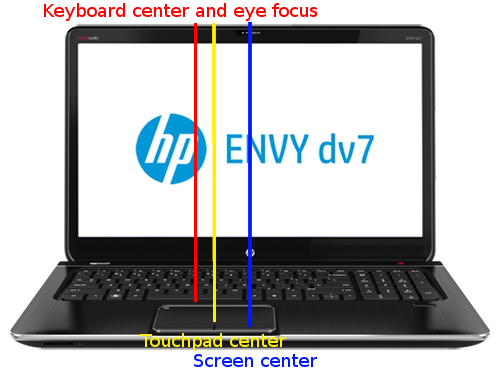
The numpad forces eye focus and users' hands to be way off center.
The touchpad looks as if it was thrown to the side by accident
Note how the designer tried to offset the misalignment forced
by the numpad by "positioning" the touchpad closer to center,
but not in line with the space bar (and the keyboard)

Without numpad the position is almost perfect!
The symmetry of the laptop improves on the design.
Notice how the touchpad is also centered.


What's worse is that most resellers do not have filters for this particular mis-feature, so you can't easily exclude laptops corrupted by this horrendous idea.

So, if you're a laptop designer, please stop putting numpads on laptops.

It will make for better looking laptops and you'll have the opportunity to be the one stating the obvious: numpads are generally useless! Even on desktop keyboards!

28 October 2013

Matthias Klumpp: Tanglu update & release plans

Long time with no article about Tanglu! This was mainly because we were busy with the project itself, improving various aspects of the distribution. So, here is a new summary on what has been done and what you can expect from the first release ;-) Tanglu QA We further improved the automatic archive QA. There is now qa.tanglu.org, which constantly monitors the number of uninstallable or unbuildable packages in the Tanglu suites. It also provides tanglu-platform-smallstatus information on the metapackage generator, which helps us in finding out which packages are available on the live-cds. Furthermore, information about the staging->devel migration process is provided, to answer the question why a package does not migrate (this still needs some improvements, but it is being worked on). We also use some code from Ubuntu to monitor package versions in Debian and upstream, which helps to see if others have released newer versions of software shipped with Tanglu. This already resulted in many improvements: The Tanglu Aequorea suite does not contain unbuildable packages (at least not due to build-dependency changed), and all live-cds are working well. We will soon migrate the archive to a new server, which frees some server capacities we can use for automated QA and things like automatic live-CD building. Live-CDs, Installer, Alpha-Releases We currently don t do Alpha-Releases of Tanglu, but we create Live-CD snapshots of Tanglu, which are available at releases.tanglu.org (or mirror1, mirror2). These snapshots still have issues and are just early previews. They also ship without and installer, we are still working on that part. Please note that CD more or less means DVD or USB-Stick right now (and this won t change the expected image size will be around 800MB). Release Planning I am happy to announce that we will do a release this year, most likely in December. But what can you expect from the release? KDE 4.11kde-konqui We will ship with KDE 4.11, which will be the only desktop we officially support so far. The reason is simply lack of manpower we could promise to support more, but that would just be not realistic for the small team. So we focus on KDE (Plasma Shells) right now, and try to make it awesome. Also, the team consists mostly of KDE people right now, which contributed to that decision ;-) . If you want to try Tanglu, right now the KDE live-images are the best to try it out. GNOME 3.8 gnome-logoWe will also provide images with GNOME. The problem with GNOME is, that the GNOME team does not have enough manpower to maintain the whole desktop or to upgrade it to the latest version (it is essentially just me looking at it from time to time). So GNOME will be available in a preview state. We invite everyone with GNOME knowledge to join the project and help improving Tanglu-GNOME GNOMErs, we want you! systemd >= 204 We ship with systemd by default, which works nicely so far, although more testing needs to be done. The logind service will be used to replace ConsoleKit, if we manage to get everything in place and working in time (if there are issues, we might switch back to CK for one release). There are some plans to use a higher systemd version, due to some improvements made there, but if this will be done is still unclear (Debian will most likely stick to 204 for some time, because with systemd > 205, running it as pid 1 will be mandatory to use logind (and Debian is just in the process to decide which init-system we will use there)). Systemd will run in SysVInit compatibility mode for most of the available services. This will improve in later Tanglu releases. Of course, systemd is usable, even if not every init-script has been converted to a service file. It just has an impact on startup times, so Tanglu will not be the distributions with the fastest startup times (yet ;-) ). Debian Package Mixdebian_logo1 Tanglu consists mostly of packages from Debian Testing (Jessie), but we take full advantage of the Debian archive, so you will also find package versions from Unstable or even Experimental (where it made sense). A very small portion of packages has also been merged with Ubuntu. Although stuff has been changed, the incompatibilities with Debian are almost zero, so if you are installing Tanglu, it will currently feel like an more up-to-date Debian Testing with some extras. Still, the differences are large enough that upgrading a Debian system to Tanglu might result in some issues. Installer Right now, the installer is a major field of work. Tanglu will most likely ship with the Debian-Installer, because it is the easiest thing to do right now. For later releases, it is planned to also offer the Ubiquity installer (the thing Ubuntu uses), or a new installer with a similar UI and concept. Other Cool Things266px-Wayland_Logo Tanglu will ship with a fully working Qt5 (which is currently being tested and updated) and the latest version of Wayland/Weston as a preview for developers to play around with. We also ship with Perl 5.18 and Haskell GHC 7.6, as well as with GCC 4.8 as default compiler (although the whole distribution does not yet compile with GCC 4.8). We might ship with Linux 3.12, but this also depends on other things. The Linux kernel build will be the same as in Debian. There might be more things to come :-) Please do always keep in mind that Tanglu is a new project, so the first release might still have some teething problems but we re working on it. The Aequorea release will be supported one to two more months after the next release is out. Tanglu Policy I started to draft a Tanglu policy, which defines stuff like the procedures to become a Tanglu project member and/or developer, some basic values of the distribution, decision making processes etc. This work is at a very early stage right now, and will need lots of feedback later. But as soon as it is done, joining the project will be easier and what Tanglu is will be well-defined. The policy will also include a Code-of-Conduct as an additional document from the start. We need help! ;-) First of all, thanks to everyone working on Tanglu! You are amazing! Also, many thanks to every Debian developer or contributor who helped a lot in setting the project up and contributed knowledge. And of course, thanks to everyone else who contributed by creating awesome artwork, helped with code, TangluTanglu Logo (big) archive mirrors, buildd-servers or by testing the distribution and providing feedback! (given the state the aequorea suite was in at the beginning, testing was a really frustrating activity but people still did it!) So, if you would like to help, just find us on #tanglu-devel on Freenode or join the tg-devel mailinglist. We also really need some people taking care of the Tanglu website and updating it with some recent information from time to time, so people can see what is going on. Before we have the Tanglu policy finished and the Tanglu members and developers directory in place (a software which allows us to track all registered developers and gives them an @tanglu.org mailalias), the start might be a bit confusing, but we do our best to make it easy for new people to join. The best way is asking people. Tanglu is still created by an incredibly small team, which has a large task to accomplish. Help is welcome :-)


Dirk Eddelbuettel: Kurt Elling at Dominican University

Some catchup blogging: Kurt Elling was back in town on October 19, and not just in Chicago but quite literally in our little 'burb as the headliner for this season's concerts at Domiminican University. They had done us the favour of inviting Dianne Reeves back in March 2009, but this was clearly going to be a real treat. And I managed to snatch four front row (!!) tickets as soon as I heard about it, and the show once again didn't disappoint. Elling was as usual accompanied by his long-time collaborator Laurence Hobgood on piano, as well as local heros Clark Sommers on bass and John McLean on guitar. This time, Quincy Davies was on drums. And this band is realiably excellent, as is Elling in any live setting. The set was dominated by pieces from his most recent record and augmented by a few other standout pieces. There is a pretty rich set of live music by Elling on YouTube, see for example On Broadway (which was part of the set in a wonderfully fast and funked-up variant), Golden Lady (from the previous album, and also played live this time) or for example this wonderful version of You Send Me (also part of the concert). I snatched a photo or two (while at least turning my flash off, unlike the weird gal to my left, but I digress) and posted one on Google+. Kurt Elling will be back in Chicago at the Green Mill in early January. Expect to me there, and I hope to see you too!

This post by Dirk Eddelbuettel originated on his Thinking inside the box blog. Please report excessive re-aggregation in third-party for-profit settings.

27 October 2013

Petter Reinholdtsen: Teaching vmdebootstrap to create Raspberry Pi SD card images

The vmdebootstrap program is a a very nice system to create virtual machine images. It create a image file, add a partition table, mount it and run debootstrap in the mounted directory to create a Debian system on a stick. Yesterday, I decided to try to teach it how to make images for Raspberry Pi, as part of a plan to simplify the build system for the FreedomBox project. The FreedomBox project already uses vmdebootstrap for the virtualbox images, but its current build system made multistrap based system for Dreamplug images, and it is lacking support for Raspberry Pi. Armed with the knowledge on how to build "foreign" (aka non-native architecture) chroots for Raspberry Pi, I dived into the vmdebootstrap code and adjusted it to be able to build armel images on my amd64 Debian laptop. I ended up giving vmdebootstrap five new options, allowing me to replicate the image creation process I use to make Debian Jessie based mesh node images for the Raspberry Pi. First, the --foreign /path/to/binfm_handler option tell vmdebootstrap to call debootstrap with --foreign and to copy the handler into the generated chroot before running the second stage. This allow vmdebootstrap to create armel images on an amd64 host. Next I added two new options --bootsize size and --boottype fstype to teach it to create a separate /boot/ partition with the given file system type, allowing me to create an image with a vfat partition for the /boot/ stuff. I also added a --variant variant option to allow me to create smaller images without the Debian base system packages installed. Finally, I added an option --no-extlinux to tell vmdebootstrap to not install extlinux as a boot loader. It is not needed on the Raspberry Pi and probably most other non-x86 architectures. The changes were accepted by the upstream author of vmdebootstrap yesterday and today, and is now available from the upstream project page. To use it to build a Raspberry Pi image using Debian Jessie, first create a small script (the customize script) to add the non-free binary blob needed to boot the Raspberry Pi and the APT source list:
#!/bin/sh
set -e # Exit on first error
rootdir="$1"
cd "$rootdir"
cat <<EOF > etc/apt/sources.list
deb http://http.debian.net/debian/ jessie main contrib non-free
EOF
# Install non-free binary blob needed to boot Raspberry Pi.  This
# install a kernel somewhere too.
wget https://raw.github.com/Hexxeh/rpi-update/master/rpi-update \
    -O $rootdir/usr/bin/rpi-update
chmod a+x $rootdir/usr/bin/rpi-update
mkdir -p $rootdir/lib/modules
touch $rootdir/boot/start.elf
chroot $rootdir rpi-update
Next, fetch the latest vmdebootstrap script and call it like this to build the image:
sudo ./vmdebootstrap \
    --variant minbase \
    --arch armel \
    --distribution jessie \
    --mirror http://http.debian.net/debian \
    --image test.img \
    --size 600M \
    --bootsize 64M \
    --boottype vfat \
    --log-level debug \
    --verbose \
    --no-kernel \
    --no-extlinux \
    --root-password raspberry \
    --hostname raspberrypi \
    --foreign /usr/bin/qemu-arm-static \
    --customize  pwd /customize \
    --package netbase \
    --package git-core \
    --package binutils \
    --package ca-certificates \
    --package wget \
    --package kmod
The list of packages being installed are the ones needed by rpi-update to make the image bootable on the Raspberry Pi, with the exception of netbase, which is needed by debootstrap to find /etc/hosts with the minbase variant. I really wish there was a way to set up an Raspberry Pi using only packages in the Debian archive, but that is not possible as far as I know, because it boots from the GPU using a non-free binary blob. The build host need debootstrap, kpartx and qemu-user-static and probably a few others installed. I have not checked the complete build dependency list. The resulting image will not use the hardware floating point unit on the Raspberry PI, because the armel architecture in Debian is not optimized for that use. So the images created will be a bit slower than Raspbian based images.

26 October 2013

Russ Allbery: Review: Why We Fail

Review: Why We Fail, by Victor Lombardi
Publisher: Rosenfeld Media
Copyright: 2013
ISBN: 1-933820-17-9
Format: Kindle
Pages: 248
Subtitled Learning from Experience Design Failures, Why We Fail is a case study book. It defines experience design, discusses the usefulness of analyzing failure, and then walks through ten marketplace failures attributed to failures of user experience (as opposed to engineering or user interface) and tries to draw some conclusions about those failures and how they could have been prevented. Lombardi then presents a more general (if fairly simple) framework for iterative experience design, along with some discussion of how that approach could have helped in these cases. Hardware and software designs can work properly but still fail with users and customers because the overall experience isn't right. Sometimes this is because something else got there first with more market share and people got used to it, sometimes it's because a system is too complicated, sometimes it's too simple, sometimes it's just uninspiring. Most of the news media coverage and many of the blog posts on this topic look to inspirational examples of successes. Lombardi points out here that successes can be accidental and failures are often more informative, a concept already common in many more mature areas of engineering. His hope, with Why We Fail, is to push a broader industry practice of taking apart and analyzing the failures. User experience design is still in its infancy, since many of the complex interactions now possible in modern hardware and software have just recently crossed into levels of complexity that qualify as experiences rather than interactions, and could benefit from more rigor. The concept sounds great. The approach in Why We Fail is at least interesting; Lombardi tells good stories, and I think they do tell some useful lessons. Drawing general principles is harder, which is always the weakness of case-study books. Lombardi's own attempt doesn't go far beyond a familiar mantra of the scientific method, small and responsive teams, cross-functional teams with flexibility to address a whole range of technical and business issues, and honest and forthright analysis of and iteration after failure. All of this is doubtless good advice; none of it should surprise anyone with even a smattering of engineering background or familiarity with current software design philosophy. The heart of the book is in the stories, and I did like that Lombardi captured a wide range of different designs. Included are embedded systems (BMW's iDrive), traditional software packages, web services of various types, and even a protocol (OAuth). Some were vaguely familiar and some were not familiar at all, although I don't follow UI and UX discussions to any large extent. In each case, Lombardi gives a short but effective introduction to the problem space and the product, walks through the design choices, and then talks about the failure. Usefully, he doesn't stop with the failure but continues the story through the reaction of the company to the failure and any subsequent actions they took, which in some cases contain their own useful lessons. All of this, I should note, is a bit far afield of my own area of expertise (architectural building blocks and sub-surface components without as much direct interaction with the user), so I'm not the best person to judge the quality and originality of the analysis. But I liked Lombardi's approach and his analysis of multiple possible failure causes, and all of his conclusions seemed quite plausible and sensible given the case studies as described. I'm best-qualified to judge the chapter on OAuth, since I've worked extensively on web authentication systems, and his analysis of the challenges and user experiences in that case closely match my own. I didn't notice any significant errors, which is hopefully a good sign for the rest of the book. As one might expect from a short book about a complex field aimed mostly at starting a conversation, there isn't much here that's earth-shattering, nor are there simple extractable principles that will make your experience designs better. As always, the takeaway boils down to "invest time and resources into this and try to think about it systematically," which of course is true of every possible axis of improvement for any product. (The challenge is usually where to spend those limited resources.) I will also note in passing that Lombardi assumes an entirely market-driven metric for success, and all of the case studies are exclusively commercial not unexpected, since that's where most of the money and a lot of the resources are, but not that helpful for bespoke work where the nature of the problem is subtlely different. But, despite the expected shortcomings and the inherent weakness of the case study approach to analysis, which tries to pluralize anecdote to get data I enjoyed this book. I also got at least one useful trick out of it: the premortem, to look for potential failure points in the experience before rolling out, or even designing, the product. It's a fairly light-weight book, but I think it's moderately inspirational, and I wholeheartedly concur with Lombardi on the merits of failure analysis as an engineering approach. Rating: 7 out of 10

25 October 2013

David Welton: MicroConf Europe

I don't envy conference organizers these days - most of what's being said can be read the next day, for free, on line, at your own pace, from the comfort of your own home, and without spending a bundle of time and money to sleep in a far away hotel. Competing with that is not easy, but the guys at MicroConf managed to. I would sum up the weekend by saying that it was a "very high bandwidth experience". Every day, from breakfast until I turned in, I was chatting with people or listening to speakers during the conference itself. That's aproximately 16 hours of being "on", and by the time I got home to Padova, I was exhausted! But at the end of the day, I felt like it was worth it being there in person, because of all the interaction with other people. The speakers' talks all ended up on line, more or less, but all the chatting and discussion and getting to know everyone is the human element that is tough to replicate on line, and one of the most important reasons to attend a conference in person. Prague is also a beautiful city - I wish I had had more time there to check it out. Here are some highlights and notes, in no particular order: However, since it was a business conference, I also have to put on my cold, hard accountant hat. Will the conference pay for itself? Only time will tell. I learned a variety of interesting and useful things, many of which I think I can put into practice. The problem is finding the time between consulting work and family, but that was a bottleneck before, too - I had, and have, more things to do than time. Also, to be very direct about it, how much of what I learned could not have been learned by carefully reading accounts of the conference, slides, and other material published on the internet? A lot of it. I'm not sure I would have paid attention to all of it though, so the conference was definitely nice in that it exposed me to some talks and ideas that otherwise I might have brushed off before giving them a chance. In terms of dollars and cents, I won't be able to say for a while whether it was a sensible investment or not. Would I go again? I'd like to - it was a lot of fun and the people were great. Like I said, it's tough doing conferences because your competition is the internet!

24 October 2013

Daniel Pocock: Final report on GSoC 2013 projects

Google Summer of Code finished recently. This is the first year that I have participated as a mentor for the Debian Project. Its a big responsibility to be part of the Debian team and to be one of the Debian team members representing Debian at the GSoC Mentor Summit. Birthdays all round This has been a particularly important year for the Debian Project, as the project celebrated our 20th birthday recently, on 16 August 2013, one of the final days of DebConf13 in Switzerland. GSoC celebrates its 10th year in 2014, with a generous 10% boost in the student stipend to mark the occasion. Google: don't be evil Google's "Don't be evil" approach to business has always been an interesting point for discussion. In my view, there are few cases of absolute good or absolute evil that we can universally classify and agree on. At a more pragmatic level, various people have commented that GSoC is a recruiting program for Google: some have even cited this as a reason not to participate. This is a more interesting point for discussion. The results of the program are not exclusive to the headhunters at Google. Anybody can browse through the Debian GSoC weekly student reports from each student to find out exactly what the students were up to and try to recruit them. Mentors and the projects they belong to have not been forced to sign any wide-ranging non-disclosure agreements or non-compete agreements with Google. In one recent example, the xWiki open source project even went as far as setting up a new office in Romania and employing some former GSoC students on a permanent basis.
Assorted images from Iasi, Romania, where xWiki set up an office employing former GSoC students How does Google benefit then? Well, there appear to be several possibilities:
  • Generating a huge amount of goodwill and recognition for the value that they place on the development of the next generation of software engineers
  • Stimulating the expansion of high quality free software projects, many of which they use directly or indirectly for their internal projects
  • Access to private evaluations prepared by the mentors. These evaluations don't take more than an hour for the mentors to complete but they do serve to give Google's headhunters a slight headstart over anybody else who is scouring the web for the names of graduates who completed GSoC
Overall, it appears to fit the definition of a "win-win" scenario: yes, Google gets stuff out of it, but the benefit is not exclusive to Google and projects like Debian are winners too. My initial approach I started by reviewing some of these materials: One particular concept that I took note of was the need to give students some opportunity to be innovative and original in their project proposals. In other words, it has been suggested that students should not be given a precise specification: rather, they should be given some very general concepts or goals and asked to suggest some funky, innovative new idea. The wisdom of this approach varies. If your free software project has some very specific gap that you need to fill, you may only be interested in taking a student who can fill that gap and you may not want to waste the time of other applicants. On the other hand, if you do precisely document this gap you want filled, you may get a bunch of very similar proposals from students and it may be more difficult to distinguish which of them is the most desirable candidate. Furthermore, if your expectations are too rigid, you may not benefit from a top-gun coming in and contributing some really exciting piece of work that you hadn't even thought of. In the end, I opted for providing more generic project briefs and looking at how students responded. The briefs that I published are available here. Coding tasks during the selection process There is no doubt about it, coding tasks are an important part of ensuring students are capable of development work before they are selected. They are also very important for us as mentors. It is not uncommon for some of us to be completely out of touch with the capabilities of other developers. The coding tasks completed by the students during the selection phase allow us to get a feel for their capabilities and set reasonable expectations for how much they can achieve during the course of the project. To simplify the management of coding tasks and engage the students in the Debian community at large, I decided to create tasks as wishlist items in the Debian bug tracking system, such as this dynalogin bug report. The prospective GSoC students were asked to put their name in the bug tracker to take ownership of the task they would complete. Student project proposals For the real-time communications project, I felt all the students slightly underestimated the complexity of this field and would have to be extremely lucky to complete everything they hoped to. After all, this is a field that the free software movement has been wrestling with for years without gaining the upper hand. For somebody with good knowledge of the projects in this space, it is possible to guide the students towards meaningful and achievable subprojects. Nonetheless, the proposals were useful for me in understanding which part of the topics were most attractive to the students. For the other project areas, the student proposals were slightly more specific. Fabian's appeared to be the most specific and well considered proposal for the one-time-password project, in fact, it appeared very much like a project that he could work through from start to finish. Debian teamwork Anybody looking at the GSoC web site will notice that there is a certain amount of overhead in joining the program, promotion, payment administration and optional participation in the GSoC Mentor Summit. As a large organisation, Debian established a dedicated SoC administration team who looked after the GSoC and Outreach Program for Women administrivia. As a developer and mentor, I found this arrangement was highly effective and allowed me to focus over 99% of my efforts on the front-line work, selecting students and supporting them through their projects. Project results One of the more controversial issues during the Debian 7 (wheezy) release cycle was the inclusion of the Mumble voice conferencing software. Although the software has some serious issues, it was eventually escalated to the technical committee and allowed to remain in Debian, partly due to lack of any alternative. One of the first results from Catalin's project was the creation of an alternative, the new reConServer project, based on the librecon conversation manager API from the reSIProcate SIP stack. reConServer is a significantly more generic solution than Mumble, as it allows any SIP peer to participate in an audio conference. It supports TURN for NAT traversal too. Catalin then went on to make the first working implementation of a scheme for passing context information from a web site to SIP WebRTC call as described in the IETF draft. All work has been integrated into release tarballs and packaging. Fabian worked through the latest standards for one-time passwords, extending the oath-toolkit and dynalogin projects to implement mutual two-factor authentication with just about any arbitrary crypto suite using one-time passwords. This work is yet to be merged into an official release of dynalogin as it requires co-ordination with the oath-toolkit release and package updates. However, there is a compelling demonstration in his video from DebConf13 and the source is available under Fabian's github account. In the post-Snowden world, the work from both of these student projects will be hugely valuable to people wanting to tighten up their computer security and communication security practices. The development process Deciding to mentor more than one project turned out to be a worthwhile decision. At first, this might seem like a big risk but it is manageable with support from co-mentors. The upside is that different students work at different speeds, they have different code styles, they even work at different times of the day or week and mentoring more than one student/project allows the mentor to gain a better appreciation of how the students differ than if mentoring only a single project. For Catalin's project, it became obvious at an early stage that he would benefit from having a dedicated server to run the VoIP applications on public IP addresses and low-latency networks while testing them. I spun up a virtual machine with IPv4 and IPv6 in my Xen Cloud Platform and this was extremely helpful for both of us. Throughout the project, I took a hands-off approach and often left the students to their own devices. I gave some suggestions to Catalin about the object-oriented design and this was enough for him to fill in the gaps and write all the code by himself. Fabian's project had fewer ambiguities and he was able to use existing code as a model more frequently than Catalin. It is possible that the students may have produced more code if I had thought through the designs myself and given them definite blue-prints. However, I feel that this would have made it harder for me to appreciate their own abilities and test the limits of their design skills. DebConf13 participation One of the highlights for the students was their participation in DebConf13. Both students presented a session at the conference showcasing some of their work. The DebConf video team produces high quality videos of all sessions at the conference and this in turn provides some great evidence of the students' capabilities and what GSoC adds to Debian and the wider free software universe. I would encourage other mentors to actively contemplate ways to involve their students in conferences during or shortly after the completion of their project work. Looking ahead Google has recently confirmed that Google Summer of Code will be repeated in 2014. It is the 10th anniversary of the program and to celebrate, students will get 10% extra pay. Thank you There are many people to thank for the success of these projects and the wider success of the Debian GSoC team:

  • The Debian GSoC and OPW organisation admin team
  • Google and the Google Open Source Programs Office
  • All the co-mentors who assisted on these projects with me: Simon Josefsson, Luke Faraone, Sylvain Berfini, Eloy Coto and Jes s P rez Rubio
  • The students themselves, C t lin Constantin U urelu and Fabian Gr nbichler
  • All the other very capable and motivated students who applied, submitted code samples but were not selected to participate: many of these students could have also completed a successful project and turning them away is one of the most difficult tasks for mentors in a volunteer organisation like Debian

Steve Kemp: Some things change, some things do not.

After seven years working from home I've resigned from my position at Bytemark. Why? A combination of wanting to do something different coupled with the desire to reclaim my second bedroom, which is currently tied up as an office. Working in an office in the future will be weird ("You mean I have to get dressed every day?!") but hopefully not unduly burdonsome. My two-year plan still remains in effect: Pay off this flat as soon as possible, then purchase another and rent this one out. Giving me some income of my own, which I will need. The "five" year plan involves me quitting work, so that I can stay home and raise children. That makes sense because sometime next year I'll become the partner who earns the least amount of monies, and I'll also be the partner with the lowest upper-bound on salary potential (short of moving to London/similar which I've always ruled out). Having rental income for myself means I'm not utterly dependant on other money, and all being well this place will be 100% paid off within 18 months. (After that lots of saving will take place for a deposit for the second place. We did bid on a couple of places locally, which were outstanding, but it is perhaps for the best we didn't win them. No more looking at ESPC!) Bytemark now becomes a company I recommend 100% for hosting in the UK. In the past I've always said nice things, but I've not strongly recommended them/us, because I'm too biased. All my personal hosting, except for one virtual machine, will remain at Bytemark indefinitely. Lovely, flexible, and great. (I have one outside guest for the purposes of diversification. That currently lives at Mythic Beasts.)

Ingo Juergensmann: Sharing GnuPG between Linux and OSX

I've been using GnuPG since years. Well, using is too strong. I have a GPG key that I've created somewhen and use it once in a while when sending login credentials to other Linux people. But since Edward Snowdens NSA leaks I now get encrypted mails by non-Linux people. It is great that people are making use of strong encryption to protect their communication, but it is frightening that people have to do so because of NSA mass surveillance the complete world and violating our civil and human rights. Anyway, one problem with GnuPG and other PKI tools is, that you should keep your private key secret. When you use more than one device to write your mails, you will run into usuability problems like I did. My main computer is my Debian box, but I use a MacBook Pro laptop with OSX very often as well. There is GPGSuite (formerly GPGMail) for OSX to pimp your Mail.app with GPG. It uses, of course, a local .gnupg/ directory and thus it would create a separate GnuPG pair of keys. But apparently I want to use my existing pair of keys - without the need to copy them over from my Linux box to my laptop. The solution would be a simple setup of netatalk to mount your home directory from the Linux box under OSX and a matching symlink to your Linux .gnupg/ directory (or even better: symlink the contents where necessary and not the whole directory). But that would've been too easy, I guess, because I got this error message on OSX:

So, basically this didn't work right out of the box. Fortunately the GPGSuite support guys replied quick and solved this problem. The version they released yesterday did fix that problem, but I needed to add the following line to my ~/,gnupg/gpg-agent.conf, which didn't exist before too:

no-use-standard-socket

With that line everything works like a charme under OSX with Mail.app using my GPG keys on my Debian box.

Kategorie:

Dirk Eddelbuettel: Introducing the CRAN Repository Policy Watch

CRAN is the repository network for R. It is a resounding success with (as of right now) almost 5000 packages, and growth rate which has been estimated (cf John Fox's keynote at useR! a few years ago) to be near 40% per year. We as R community members owe a great deal of thanks to the CRAN maintainers, and the R Core team. The tight integration between the language and the contributed code repository is unique among programming languages, and one of the many reasons why CRAN has been such a success and driver of growth and adoption for R. And the amount of work the CRAN maintainers put into this is substantial, and we owe them. Yet there is some friction between the repo maintainers, and the community of developers. There have numerous discussions on the main developer list about various aspect of how CRAN maintains the impeccable quality of the code in the archive. One particular aspect which has bugging (at least me) is the lack of communication when policy changes are made. It would be trivial to posts a set of changes to the developer list, and I suggested as much. Only to be soundly ignored. But changes to text (or html) files can monitored rather easily, and when such changes occur an alert can be sent. So I cooked up rather simple system for this which I called the CRAN Policy Watch. In essence, a simple cronjob monitors changes, and records new versions in a Github repo (which you can follow or star). Alternatively, the cronjob now also tweets from the @CRANPolicyWatch account which I invite everyone to subscribe to as well. If someone knows of a simple tool to summarize diffs of html or text files in static html pages, I'd be interested to expand the service to some github.io pages. Alernatively I could also just commit to a single file too and let Github summarize the changes. This was an itch I needed to scratch, and I hope some other people will fine this useful too.

23 October 2013

Rog rio Brito: Assorted random notes

This post is just a bunch of random notes, but I think that things are going well, this time.

Btrfs Just started playing with btrfs after converting a 2TB disk with about 1.3TB of data from ext4 to btrfs. This particular filesystem contains my backup data and I hope that btrfs is able to live up to high standards. I will probably write a detailed review with my impressions, but suffice to say that it is working fine and I hope that I will be happy for a long time to come. My other filesystems, for the moment, will be ext4.

Coursera Downloader Thanks to John Lehmann's generosity, now coursera-dl has a new home: a github organization of its own!

youtube-dl Some people may have noticed, others may not, but when downloading videos from Youtube, they apparently are getting more aggressive with the use of Dynamic Adaptive Streaming over HTTP (also called DASH) and, as a result, some (perhaps going to be all in the near future?) of the videos may not be available in the resolution/formats that you used to like (like me, with format number 35). By the way, one thing that is interesting with youtube videos provided via DASH is that they are available in different streams: one for the video and another for the audio. What does this mean in practical terms for users of youtube-dl? Well, if you wanted to download videos in resolutions like the 480p (format 35) that I mentioned, then you will probably have to change your way of doing things, until a more automated solution is in place. You will have to download both the audio and the video and, then, "combine" them (that is, multiplex them) to create one "normal" video file with both the audio and the video. I usually do this via: ffmpeg -i audio.m4a -i video.mp4 -vcodec copy -acodec copy combined.mp4 If you prefer having a Matroska container instead of an mp4 container (which, BTW, results in smaller muxing overhead), then you can use the command line: mkvmerge -o combined.mkv audio.m4a video.mp4 Oh, those m4a and mp4 extensions are a new addition that I just sent upstream (in the past, both would have been named with an extension of mp4). As, an aside, I like formats 135 for video and 140 for audio, for the reasons that I mentioned in a comments to issue 1612:
Otherwise, to download 480p videos (which I do for lectures and so on with other projects of mine, like edx-dl) I have to call youtube-dl twice: once for format 135 and another for format 140, since the old (?) format 35 files are much smaller than the lower resolution 360p files (due to the former being encoded in High profile vs. the latter being encoded in Constrained Baseline profile).

While this is unfortunate for some, this is a good thing for others: I once had a blind user of youtube-dl asking me if he could avoid downloading the whole video just to extract the audio, so that he save on bandwidth. Well, now this is possible. Expect a new version of youtube-dl to be uploaded soon to Debian unstable.

Music It is so nice to see the music that I like getting better. It was particularly pleasant to see Tarja Turunen being joined on stage by Floor Jansen. In fact, it is my impression that the once female-fronted bands are getting more and more into collaborations and side-projects and they are, in many ways, getting more refined. Examples of this includes Floor, Tarja, Anneke van Giersbergen, Sharon den Adel, Kari Ruesl tten and many others that I can't remember right now. Of course, some thanks to people that take the time to film, and upload/share the videos so that other people not at these events can watch them is highly appreciated and they usually are treated as anonymous, but, of course, this should be fixed.

18 October 2013

Rog rio Brito: Quick tip #1

I wrote the following as part of a post to an discussion forum (I can't remember which one), and people told me that they liked this information and said that others would profit from it if I posted it on my blog, which I now decided to post. The context: for homework of one MOOC, people were trying to download a large virtual machine image that was offered both via an official HTTP source, which was slow. A person volunteered that already had downloaded the image volunteered to create a bittorrent to help fellow students. Other students started saying that the bittorrent download was faster up to a certain point and, then, things slowed down a lot. Of course, they got faster to the point where lots of pieces were already well distributed and, then, only the everybody had already downloaded things and, then, only the seeder had the missing segments of the torrent. Then I commented with:
Depending on your bittorrent client, you can add the original HTTP download as a "Web seed" and, this way, your client will download both from the peers and also from the web to fill in parts that are not yet available. One such client is the Free (as in Freedom) qbittorrent, but I guess that others also have this option.
Soon after that, people started downloading things much faster.

17 October 2013

Stefano Zacchiroli: org-mutt ported to org-capture

org-mutt with org-mode >= 8 Thanks to Don I just remembered that I haven't yet announced org-mutt support for org-mode >= 8. Let's catch up! Since a few weeks I've been aware of the fact that my mutt/org-mode glue, AKA org-mutt, was no longer working with org-mode >= 8, due to the ditching of org-remember in favor of org-capture. Allegedly, org-capture should have been backward compatible, but it clearly is not. Before I had time to fix it myself, Mako came to my rescue and submitted a patch (now accepted) that does the needed porting. Free Software is truly amazing, isn't it? I've just updated the canonical org-mutt blog post, so that the documentation in there is up to date again. If you're using org-mutt, I suggest to refer to the Git repository as the canonical location for future updates, if any. Thanks Don, thanks Mako!

16 October 2013

Matthew Garrett: Standing for the Linux Foundation Technical Advisory Board

According to its charter, the Linux Foundation Technical Advisory Board exists "to advise The Linux Foundation Board of Directors (Board) and the management of The Linux Foundation (Management) on matters related to supporting the technical agenda of The Linux Foundation". It consists of 10 members, with 5 seats up for election each year. Elections take place at an event at Kernel Summit, but are also open to attendees of whichever conference is colocated with the Kernel Summit that year. The election announcement is emailed to the Linux kernel list and tech-board-discuss, a mostly moribund list that springs into life once a year for election announcements.

This arrangement seemed odd to me even back in 2007. Back then the Linux Foundation was already sponsoring development of certain non-kernel components, and now that list is even larger. While nominally open to all, nominations for the TAB tend to end up being people actively involved in the kernel community. That's probably better than people limited to any other single technical community (kernel developers tend to end up dealing with bugs from a fairly wide range of projects, so they're not entirely unaware of what other people have to deal with), but it still seems suboptimal. The current membership is mostly limited to people who spend little to no time working with userspace developers, let alone anyone active in other Linux Foundation projects. I don't think this is a good thing

So, after several years of considering it, I'm finally standing for the TAB. I've been an active developer at most levels of the Linux stack, from the kernel through to desktop environments. I've worked closely with distributions. I've even worked closely with firmware developers. I'm not intimately involved in any of the other Linux Foundation projects, but I have experience that allows me to better understand their needs and motivations than I'd have from having spent my entire life living in the kernel. Being on the TAB would make it easier to ensure that these projects are represented in a meaningful way.

Of the other people who I know are standing (and this list may well grow longer), I'm inclined to vote for:
The election is currently scheduled to be National Museum in Edinburgh on the evening of the 23rd of October. If you're attending Linuxcon or one of the colocated events, please do come along and vote.

(Updated to correct a typo)

comment count unavailable comments

Brett Parker: Hepworth Spam

There's been a recent spate of spam from domains held by Communicado Ltd, to counter this Martin A Brooks has created a lovely list of domains to easily filter, see his blog post for information on the distribution and usage of this list.

15 October 2013

Craig Small: Damn you, unworking r8168

I really don t know why ethernet device makers insist on making it hard for to use their products. Ethernet has been around for many, many years; surely its not too much to ask for drivers that just work . And so that s the problem I currently have with my new computer. It has an onboard Ethernet interface which uses a Realtek chip and that s where the problems have been (with the exception of a power button that wriggled free, but that is also easy to fix). The device comes up as:
03:00.0 Ethernet controller: Realtek Semiconductor Co., Ltd. RTL8111/8168B PCI Express Gigabit Ethernet controller (rev 06)

I ve used:

and all of them don t work.  It seems that the receive side works fine (I sometimes get a valid IPv6 address) but no packets are sent, even ifconfig eth0 shows zero transmitted packets.
ethtool shows some of the setup, this is with the r8168 driver:
driver: r8168
version: 8.037.00-NAPI
firmware-version: 
bus-info: 0000:03:00.0
supports-statistics: yes
supports-test: no
supports-eeprom-access: no
supports-register-dump: yes
supports-priv-flags: no
Interestingly, if I use the r8169 driver in the kernel and try ifup etho then I do get an entry in the firmware-version spot. dmesg also shows that it finds the device.
[  0.916487] r8168 Gigabit Ethernet driver 8.037.00-NAPI loaded
[  0.916667] r8168 0000:03:00.0: irq 72 for MSI/MSI-X
[  0.939129] r8168: This product is covered by one or more of the following patents: US6,570,884, US6,115,776, and US6,327,625.
[  0.939136] r8168  Copyright (C) 2013  Realtek NIC software team <nicfae@realtek.com>
[  10.807066] r8168: eth0: link up
So it all looks good, except it won t send any packets. Anyone got one of these devices and if so (and more importantly) how did you get it to work?

Petter Reinholdtsen: Good causes: Debian Outreach Program for Women, EFF documenting the spying and Open access in Norway

The last few days I came across a few good causes that should get wider attention. I recommend signing and donating to each one of these. :) Via Debian Project News for 2013-10-14 I came across the Outreach Program for Women program which is a Google Summer of Code like initiative to get more women involved in free software. One debian sponsor has offered to match any donation done to Debian earmarked for this initiative. I donated a few minutes ago, and hope you will to. :) And the Electronic Frontier Foundation just announced plans to create video documentaries about the excessive spying on every Internet user that take place these days, and their need to fund the work. I've already donated. Are you next? For my Norwegian audience, the organisation Studentenes og Akademikernes Internasjonale Hjelpefond is collecting signatures for a statement under the heading Bloggers United for Open Access for those of us asking for more focus on open access in the Norwegian government. So far 499 signatures. I hope you will sign it too.

Matthew Garrett: Hacker News is a social echo chamber

Hacker News is a fairly influential link aggregation site, with stories submitted and voted on by users. As explained in the FAQ, the ranking of stories is roughly determined by the number of votes divided by a function of the time since submission. It's not a huge traffic driver (my personal experience of stories on the front page is on the order of 30,000 hits), but it's notable because the demographic tends to include a more technically literate and influential set of readers than most other sites. The discussion that ensues from technical posts often includes meaningful feedback from domain experts. Stories that appear there are likely to be noted by technology workers, especially in the Silicon Valley startup field[1].

That rather specific demographic appears to correlate with other traits. There's a rather more techno-libertarian bias on Hacker News than on most general discussion forums, which is consistent with the startup-oriented culture that it springs from - the desire to provide disruptive solutions to real world problems tends to collide with existing regulatory frameworks, so it's unsurprising that a belief in individual rights and small government would overlap with US startup culture. There's a leaning towards the use of web technologies rather than traditional client applications, which matches what people are doing in the rest of the world. And there's more enthusiasm for liberal open-source licenses over Copyleft licenses, which makes sense in a web-focused environment (as I wrote about here).

Now, personally I'm a big-government, client-app, Copyleft kind of person, but for the most part I don't think the above is actively dangerous. It's inevitable that political views will vary, we'll probably continue to cycle between thick and thin clients for generations and nobody's ever going to demonstrably prove that one licensing model deserves to win over another. But what is important is that the ongoing debates between these opinions be driven by facts, and that it remain obvious that these disagreements exist. As far as technical (and even political) discussion goes, Hacker News doesn't seem to
have a problem with that. Disagreeing with the orthodoxy is tolerated.


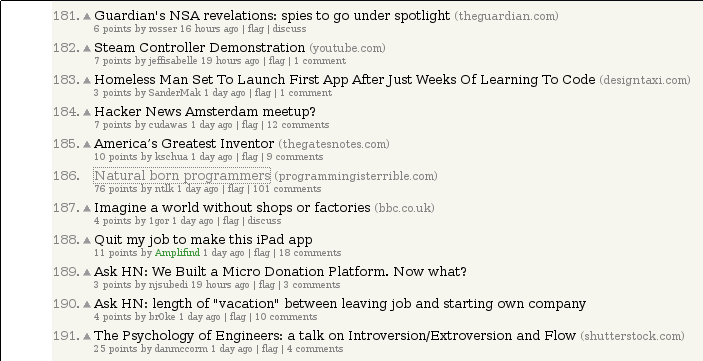
This seems less true when it comes to social issues. When a posting discussing the myth of the natural born programmer[2] hit the front page, the top rated comment is Paul Graham[3] off-handedly discounting the conclusions drawn. The original story linked to a review of peer-reviewed scientific research. Graham simply discounts it on the basis of his preconceptions. Shortly afterwards, the story plummeted off the front page, now surrounded by stories posted around the same time but with much lower scores.

How does this happen? There's two publicised methods which can result in stories dropping down the order. Users with high karma scores (either via submitting popular stories or writing popular comments) are able to flag submissions, and if enough do so then a negative weighting is applied to the story. There's also a flamewar detector, a heuristic that attempts to detect contentious subjects and pushes them off the front page.

The effect of both is to enforce the status quo of social beliefs. Stories that appear to challenge the narrative that good programmers are just naturally talented tend to vanish. Stories that discuss the difficulties faced by minorities in our field are summarily disappeared. There are no social problems in the technology industry. We have always been at war with Eastasia.

This isn't healthy. We don't improve the state of the software industry by hiding stories that expose conflicts. Flamewars don't solve problems, but without them we'd be entirely unaware of how much of a victim blaming mentality exists amongst our peers. It's true that conflict may reinforce preconceptions, causing people to dig in as they defend their beliefs. However, the absence of conflict does nothing to counteract that. If you're never exposed to opinions you disagree with, you'll never question your existing beliefs.

Hacker News is a privately run site and nobody's under any obligation to change how they choose to run it. But the focus on avoiding conflict to such an extent that controversial stories receive less exposure than ones that fit people's existing beliefs doesn't enhance our community. If we want to be able to use technology as an instrument of beneficial change to society as a whole, we benefit from building a diverse and welcoming community and questioning our preconceptions. Building a social echo chamber risks marginalising us from the rest of society, gradually becoming ignored and irrelevant as our self-reinforcing opinions drift ever further away from the mainstream. It doesn't help anybody.

[1] During the batch of interviews I did last year, two separate interviewers both mentioned a story they'd read on Hacker News that turned out to have been written by me. I'm not saying that that's what determined a hire/don't hire decision, but it seems likely that it helped.
[2] The article in question discusses the pervasive idea that some people are inherently good programmers. It turns out that perpetuating the idea that some people are just born good at a particular skill actually discourages others from even trying to learn it, even those who are just as capable.
[3] One of the co-founders of Y-Combinator and creator of Hacker News.

(Edited to fix a footnote reference)

comment count unavailable comments

Next.

Previous.