Search Results: "ed"

24 March 2021

Sam Hartman: Making our Community Safe: the FSF and rms

I felt disgust and horror when I learned yesterday that rms had returned to the FSF board. When rms resigned back in September of 2019, I was Debian Project Leader. At that time, I felt two things. First, I was happy that the community was finally taking a stand in favor of inclusion, respect, and creating a safe, welcoming place to do our work. It was long past time for rms to move on. But I also felt thankful that rms was not my problem to solve. In significant part because of rms, I had never personally been that involved in the FSF. I considered drafting a statement as Debian Project Leader. I could have talked about how through our Diversity Statement and Code of Conduct we had taken a stand in favor of inclusion and respect. I could have talked about how rms's actions displayed a lack of understanding and empathy and how this created a community that was neither welcoming nor respectful. I didn't. I guess I didn't want to deal with confirming I had sufficient support in the project. I wanted to focus on internal goals, and I was healing and learning from some mistakes I made earlier in the year. It looked like other people were saying what needed to be said and my voice was not required. Silence was a mistake.

It's a mistake I've been making all throughout my interactions with rms. Enough is enough. It's long past time I added my voice to those who cry for accountability and who will not sit aside while rms's disrespect and harm is tolerated.

The first time I was silent about rms was around 15 years ago. I was at a science fiction convention in a crowded party. I didn't know anyone, other than the host of the party. I was out of my depth. I heard his voice---I recognized it from the Share the Software Song. He was hitting on some girl, talking about how he invented Emacs. As best I could tell, she didn't even know what Emacs was. Back then, I wondered what she saw in the interaction; why she stuck around even though she didn't know what he was talking about. I sure didn't want to be around; the interaction between the two of them was making me uncomfortable. Besides, the wings on her costume kept hitting me in the face. So I left as fast as I could.

I've learned a lot about creating safe spaces and avoiding sexual harassment since then. Thinking back, she was probably hitting me because she was trying to back away and getting crowded. If this happened today, I think I would do a better job of owning my responsibility for helping keep the space around me safe. I've learned better techniques for checking in to make sure people around me are comfortable.

I didn't come to silence alone: I had been educated into the culture of avoiding rms and not calling him out. There was a running game in the group of computer security professionals I learned from. The goal was to see how much you could contribute to free software and computer security without being recognized by or interacting with rms. And so, indoctrinated into a culture of silence about the harm that rms caused, I took my first step.

Things weren't much better when I attended Libreplanet 2019 just before taking office as Debian Project Leader. I had stayed away from the conference in large part because of rms. But there were Debian people there, and I was missing community interaction. Unfortunately, I saw that even after the problems of 2018, rms was still treating himself as above community standards. He interrupted speakers, objecting to how they phrased the problem they were considering. After a speech on codes of conduct in the free software community, he cornered the talk organizer to "ask her opinion" about the GNU project's lack of code on conduct. He wasn't asking for an opinion. He was justifying himself; there wasn't much listening in the conversation I heard. Aspects of that conversation crossed professional boundaries for what should be said. The talk organizer was okay--we talked about it after--but if we did a better job of policing our community, that wouldn't even be a question. I think the most telling sign was a discussion with an FSF board member. We were having a great conversation, but he had to interrupt it. He was on rms duty (my words) at the next session. The board had decided it was necessary to have members there so that the staff would not be put in awkward positions by their president. If someone needed to call rms out, it could be a board member rather than the staff members of the conduct team.

And yet again, I held my silence. It's so easy to keep silent. It's not that I never speak up. There are communities where I have called people out. But it's hard to paint that target on yourself. It's hard to engage and to stand strong for a community's standards when you aren't the target. It's hard to approach these problems while maintaining empathy for everyone involved. Some people give into the rage; I don't have that option if I want to be the person I've chosen to be. And so, when I do speak up, the emotional cost is high.

Yet, it's long past time I raised my voice on this issue. Rms has demonstrated that he cannot hold to standards of respect for others, respect for their boundaries, or standards of community safety. We need those standards to be a welcoming community.

If the people who came before me--those who taught me the game of avoiding rms--had spoken up, the community could have healed before I even came on the scene. If I and others had stood up fifteen years ago, we'd have another couple generations who were more used to respect, inclusion, welcoming and safety. The FSF board could have done their job back in 2018. And perhaps if more of us had spoken out in 2019, the FSF board would have found the strength to stand strong and not accept rms's return.

And so, finally, I raise my voice. I signed the open letter calling for the resignation of rms and the entire FSF board. Perhaps if we all get used to raising our voice, it will be easier. Perhaps if we stand together, taking the path of community rather than the path of silence, we'll have the support we need to create communities inclusive enough to welcome everyone who can contribute. For me, I'm done being silent.

There's one criticism of the open letter I'd like to respond to. I've heard concerns about asking for the resignation of the entire FSF board under the understanding that some board members voted against rms's return. It should be obvious why those who voted for rms's return need to resign. But resignation does not always mean you did something wrong. If you find yourself in a leadership role in an organization that takes decisions in significant conflict with your standards of ethics, resignation is also the right path. Staying on the board even if you voted against rms's return means that you consider voting for rms to be a reasonable thing to do. It means that even if you disagreed with it, you can still be part of an organization that takes the path of welcoming rms. At this point, I cannot do that, nor can I support leaders in the FSF who do.

23 March 2021

Gunnar Wolf: Regarding the Stallman comeback

Context:
  1. Richard Stallman is the founder of the Free Software movement, and commited his life to making what seemed like a ludicrous idea into a tangible reality. We owe him big time for that, and nothing somebody says or does will ever eclipse the fact.
  2. But Richard Stallman has a very toxic personality. There is a long, well-known published list of abuse cases; if you must read more into it, some regarding his views on sex, consent, gender, and some other issues are published as a part of the open letter I am about to reference. I have witnessed quite a few; I won t disclose here the details, as many other incidents are already known. And I don t mean by this sexual abuse, although that s the twig that eventually broke the camel s back, but ranging from general rudeness to absolute lack of consideration for people around him.
  3. In September 2019, Stallman was Forced to resign, first from his position at MIT, then as the president of the FSF. The direct cause was a comment where he defended the accusations on Minsky (a personal friend of his, and deceased three years prior to the fact) of sexual abuse.
  4. Last week, 18 months after he was driven out of the FSF, and at LibrePlanet (FSF s signature conference, usually held at the MIT, this time naturally online only) Stallman announced his comeback to the Board of Directors of the FSF.
Many people (me included, naturally) in the Free Software world are very angry about this announcement. There is a call for signatures for a position statement presented by several free software leaders that has gathered, as I write this message, over 400 signatures. The Open Source Initiative has presented its institutional position statement. And I can only forecast this rejection will continue to grow. Free software was once the arena of young, raging alpha machos where a thick skin was an entry requirement. A good thing about growing up is that our community is now wiser, and although it still attracts younger people, there is a clear trend not to repeat our past ways. Free software has grown, and there is no place for a leader so disrespectful and hurting as many of us have witnessed Stallman to be. Again, the free software movement and the world as a whole owes a great deal to Stallman. He changed history. I admire his work, his persistence and his stubbornness. But I won t have him represent me.

Sean Whitton: rmsopenletter

I was shocked to learn today that Richard Stallman has been reinstated as a member of the board of the Free Software Foundation. I think this is plain inappropriate, but I cannot see how anyone who doesn t think that could fail to see the reinstatement as counterproductive. As Bradley M. Kuhn put it,
The question is whether an organization should have a designated leader who is on a sustained, public campaign advocating about an unrelated issue that many consider controversial. It really doesn t matter what your view about the controversial issue is; a leader who refuses to stop talking loudly about unrelated issues eventually creates an untenable distraction from the radical activism you re actively trying to advance. The message of universal software freedom is a radical cause; it s basically impossible for one individual to effectively push forward two unrelated controversial agendas at once. In short, the radical message of software freedom became overshadowed by RMS radical views about sexual morality.
There is an open letter calling for the removal of the entire Board of the Free Software Foundation in response. I haven t signed the letter because the Free Software Foundation Board s vote to reinstate Stallman was not unanimous, so the call to remove all of them does not make sense to me. I agree with the open letter s call to remove Stallman from other positions of leadership. I hope that this whole situation can be resolved quickly.

Ian Jackson: Signing the open letter about RMS

I have signed the open letter calling for RMS to be removed from all leadership positions, including the GNU Project, and for the whole FSF board to step down. Here is what I wrote in my commit message:
    I published my first Free Software in 1989, under the GNU General
    Public Licence.  I remain committed to the ideal of software freedom,
    for everyone.
    
    When the CSAIL list incident blew up I was horrified to read the
    stories of RMS's victims.  We have collectively failed those people
    and I am glad to see that many of us are working to make a better
    community.
    
    I have watched with horror as RMS has presided over, and condoned,
    astonishingly horrible behaviour in many GNU Project discussion
    venues.
    
    The Free Software Foundation Board are doing real harm by reinstating
    an abuser.  I had hoped for and expected better from them.
    
    RMS's vision and ideals of software freedom have been inspiring to me.
    But his past behaviour and current attitudes mean he must not and can
    not be in a leadership position in the Free Software community.
Comments are disabled. Edited 2021-03-23T21:44Z to fix a typo in the commit message.


comment count unavailable comments

Jonathan Dowland: The Cure: 40 Live

Back in 2019, The Cure released a double-video-album featuring two live shows from 2018, their 40th anniversary concert at Hyde Park (which I attended) and their experimental "Curaetion" show from the Meltdown festival a few weeks earier. Rumours that there would be a release had been circulating since the gig itself, where video director Tim Pope was spotted filming the gig (sporting a tee shirt reading "Yes I'm Filming. No I don't know when you'll see it."). Earlier in 2019 the "Anniversary" half had a limited run in cinemas, but the home video release was not officially revealed until much later, and the inclusion of Curaetion an unexpected bonus. 'deluxe' releases The release is available in several configurations. The "standard" issue is a two-DVD (or Blu Ray) set in a hard-book case, with some liner notes in the middle. A "deluxe" issue is a roughly twice-as-large boxed set containing the two video discs and two CD-audio discs of the shows. When it comes to deluxe editions, I would historically have been the perfect "mark", but I've had some bad experiences with other releases (this is a story for another blog post), so for this release I pre-ordered the standard BR edition. Right up until release, I wondered whether I should have made the other choice. Eventually, pictures of other people's Deluxe Editions started to circulate, and I was re-assured that I made the right call. The larger box is just something harder to store, the larger booklet is an exact reproduction of the smaller, standard edition liner notes, which are not really notable. The shows I think the shows are great. The Hyde Park show is a fairly standard "best of" setlist, and my enjoyment of it might be coloured by having been at the show and having fond memories of it. But it's a great performance and very well captured, so I think there's something for people who like the Cure but weren't there to enjoy too. I wasn't at the Meltdown show. The setlist for that one is much more esoteric, and it's lovely to have renditions of songs that are rarely performed live (And: across the two sets you get If Only Tonight We Could Sleep twice). Getting the audio I knew in advance that I would likely listen to the shows more often than watch them, so the CDs in the Deluxe set would have been useful for that, but I was fairly sure the audio mix would be the same as on the video discs, so I could just extract that. I was half-right: the BR set (at least) has 5.1 surround and separate lossless stereo mixes, but they have been mastered quite differently to the CD audio, which appears to be brick-wall mastered, to such an extent that the audio distorts quite noticeably in a few places. The BR audio does not seem to suffer from the same problems. Getting the audio off the discs was interesting. On Linux, the tool of choice for decoding encrypted Blu Rays is libaacs, which requires a list of Blu Ray keys which you must source separately. With my BR drive I was not able to decode the discs using the keys I could find online. However, the separate tool MakeMKV was able to decode them. I don't know exactly how but I speculate that MakeMKV contains some leaked hardware player keys that are not in more general circulation. Once I had decoded copies of the two videos, the trusty tool ffmpeg is able to easily extract the PCM stereo audio track. Unfortunately it cannot, in one go, split the audio track at the chapter boundary points. This is easy to script around: one ffmpeg invocation to get the chapter offsets, then some scripting to turn that into seek and duration command-line arguments for further ffmpeg invocations. For space reasons, I opted to transcode to FLAC at the same time as extracting each track. I hit an interesting (although not fatal) problem: the time taken to extract each track got progressively slower, almost as if ffmpeg was transcoding the entire audio track up to the point specified as the offset to start extracting from. If I wanted to answer categorically whether the BR audio was preferable, I would need to perform a double-blind listening test, using a tool such as squishyball. I certainly can't be bothered: the BR audio is fine for me.

Bits from Debian: New Debian Developers and Maintainers (January and February 2021)

The following contributors got their Debian Developer accounts in the last two months: The following contributors were added as Debian Maintainers in the last two months: Congratulations!

Thomas Lange: More than 10.000 customized ISO image created by FAIme

The FAIme service was started in November 2017. After 3,5 years it created more than 10.000 customized installation and cloud images. And we still have enough CPU power and disk space for more users. FAIme

Antoine Beaupr : Major email crash with syncmaildir

TL:DR; lost half my mail (150,000 messages, ~6GB) last night. Cause uncertain, but possibly a combination of a dead CMOS battery, systemd OnCalendar=daily, a (locking?) bug in syncmaildir, and generally, a system too exotic and complicated.

The crash So I somehow lost half my mail:
anarcat@angela:~(main)$ du -sh Maildir/
7,9G    Maildir/
anarcat@curie:~(main)$ du -sh Maildir
14G     Maildir
anarcat@marcos:~$ du -sh Maildir
8,0G    Maildir
Those are three different machines:
  • angela: my laptop, not always on
  • curie: my workstation, mostly always on
  • marcos: my mail server, always on
Those mails are synchronized using a rather exotic system based on SSH, syncmaildir and rsendmail. The anomaly started on curie:
-- Reboot --
mar 22 16:13:00 curie systemd[3199]: Starting pull emails with syncmaildir...
mar 22 16:13:00 curie smd-pull[4801]: rm: impossible de supprimer '/home/anarcat/.smd/workarea/Maildir': Le dossier n'est pas vide
mar 22 16:13:00 curie systemd[3199]: smd-pull.service: Main process exited, code=exited, status=1/FAILURE
mar 22 16:13:00 curie systemd[3199]: smd-pull.service: Failed with result 'exit-code'.
mar 22 16:13:00 curie systemd[3199]: Failed to start pull emails with syncmaildir.
mar 22 16:14:00 curie systemd[3199]: Starting pull emails with syncmaildir...
mar 22 16:14:00 curie smd-pull[7025]:  4091 ?        00:00:00 smd-push
mar 22 16:14:00 curie smd-pull[7025]: Already running.
mar 22 16:14:00 curie smd-pull[7025]: If this is not the case, remove /home/anarcat/.smd/lock by hand.
mar 22 16:14:00 curie smd-pull[7025]: any: smd-pushpull@localhost: TAGS: error::context(locking) probable-cause(another-instance-is-running) human-intervention(necessary) suggested-actions(run(kill 4091) run(rm /home/anarcat/.smd/lock))
mar 22 16:14:00 curie systemd[3199]: smd-pull.service: Main process exited, code=exited, status=1/FAILURE
mar 22 16:14:00 curie systemd[3199]: smd-pull.service: Failed with result 'exit-code'.
mar 22 16:14:00 curie systemd[3199]: Failed to start pull emails with syncmaildir.
Then it seems like smd-push (from curie) started destroying the universe for some reason:
mar 22 16:20:00 curie systemd[3199]: Starting pull emails with syncmaildir...
mar 22 16:20:00 curie smd-pull[9319]:  4091 ?        00:00:00 smd-push
mar 22 16:20:00 curie smd-pull[9319]: Already running.
mar 22 16:20:00 curie smd-pull[9319]: If this is not the case, remove /home/anarcat/.smd/lock by hand.
mar 22 16:20:00 curie smd-pull[9319]: any: smd-pushpull@localhost: TAGS: error::context(locking) probable-cause(another-instance-is-running) human-intervention(necessary) suggested-actions(ru
mar 22 16:20:00 curie systemd[3199]: smd-pull.service: Main process exited, code=exited, status=1/FAILURE
mar 22 16:20:00 curie systemd[3199]: smd-pull.service: Failed with result 'exit-code'.
mar 22 16:20:00 curie systemd[3199]: Failed to start pull emails with syncmaildir.
mar 22 16:21:34 curie smd-push[4091]: default: smd-client@smd-server-anarcat: TAGS: stats::new-mails(0), del-mails(293920), bytes-received(0), xdelta-received(26995)
mar 22 16:21:35 curie smd-push[9374]: register: smd-client@smd-server-register: TAGS: stats::new-mails(0), del-mails(0), bytes-received(0), xdelta-received(215)
mar 22 16:21:35 curie systemd[3199]: smd-push.service: Succeeded.
Notice the del-mails(293920) there: it is actively trying to destroy basically every email in my mail spool. Then somehow push and pull started both at once:
mar 22 16:21:35 curie systemd[3199]: Started push emails with syncmaildir.
mar 22 16:21:35 curie systemd[3199]: Starting push emails with syncmaildir...
mar 22 16:22:00 curie systemd[3199]: Starting pull emails with syncmaildir...
mar 22 16:22:00 curie smd-pull[10333]:  9455 ?        00:00:00 smd-push
mar 22 16:22:00 curie smd-pull[10333]: Already running.
mar 22 16:22:00 curie smd-pull[10333]: If this is not the case, remove /home/anarcat/.smd/lock by hand.
mar 22 16:22:00 curie smd-pull[10333]: any: smd-pushpull@localhost: TAGS: error::context(locking) probable-cause(another-instance-is-running) human-intervention(necessary) suggested-actions(r
mar 22 16:22:00 curie systemd[3199]: smd-pull.service: Main process exited, code=exited, status=1/FAILURE
mar 22 16:22:00 curie systemd[3199]: smd-pull.service: Failed with result 'exit-code'.
mar 22 16:22:00 curie systemd[3199]: Failed to start pull emails with syncmaildir.
mar 22 16:22:00 curie smd-push[9455]: smd-client: ERROR: Data transmission failed.
mar 22 16:22:00 curie smd-push[9455]: smd-client: ERROR: This problem is transient, please retry.
mar 22 16:22:00 curie smd-push[9455]: smd-client: ERROR: server sent ABORT or connection died
mar 22 16:22:00 curie smd-push[9455]: smd-server: ERROR: Unable to open Maildir/.kobo/cur/1498563708.M122624P22121.marcos,S=32234,W=32792:2,S: Maildir/.kobo/cur/1498563708.M122624P22121.marco
mar 22 16:22:00 curie smd-push[9455]: smd-server: ERROR: The problem should be transient, please retry.
mar 22 16:22:00 curie smd-push[9455]: smd-server: ERROR: Unable to open requested file.
mar 22 16:22:00 curie smd-push[9455]: default: smd-client@smd-server-anarcat: TAGS: stats::new-mails(0), del-mails(293920), bytes-received(0), xdelta-received(26995)
mar 22 16:22:00 curie smd-push[9455]: default: smd-client@smd-server-anarcat: TAGS: error::context(receive) probable-cause(network) human-intervention(avoidable) suggested-actions(retry)
mar 22 16:22:00 curie smd-push[9455]: default: smd-server@localhost: TAGS: error::context(transmit) probable-cause(simultaneous-mailbox-edit) human-intervention(avoidable) suggested-actions(r
mar 22 16:22:00 curie systemd[3199]: smd-push.service: Main process exited, code=exited, status=1/FAILURE
mar 22 16:22:00 curie systemd[3199]: smd-push.service: Failed with result 'exit-code'.
mar 22 16:22:00 curie systemd[3199]: Failed to start push emails with syncmaildir.
There it seems push tried to destroy the universe again: del-mails(293920). Interestingly, the push started again in parallel with the pull, right that minute:
mar 22 16:22:00 curie systemd[3199]: Starting push emails with syncmaildir...
... but didn't complete for a while, here's pull trying to start again:
mar 22 16:24:00 curie systemd[3199]: Starting pull emails with syncmaildir...
mar 22 16:24:00 curie smd-pull[12051]: 10466 ?        00:00:00 smd-push
mar 22 16:24:00 curie smd-pull[12051]: Already running.
mar 22 16:24:00 curie smd-pull[12051]: If this is not the case, remove /home/anarcat/.smd/lock by hand.
mar 22 16:24:00 curie smd-pull[12051]: any: smd-pushpull@localhost: TAGS: error::context(locking) probable-cause(another-instance-is-running) human-intervention(necessary) suggested-actions(run(kill 10466) run(rm /home/anarcat/.smd/lock))
mar 22 16:24:00 curie systemd[3199]: smd-pull.service: Main process exited, code=exited, status=1/FAILURE
mar 22 16:24:00 curie systemd[3199]: smd-pull.service: Failed with result 'exit-code'.
mar 22 16:24:00 curie systemd[3199]: Failed to start pull emails with syncmaildir.
... and the long push finally resolving:
mar 22 16:24:00 curie smd-push[10466]: smd-client: ERROR: Data transmission failed.
mar 22 16:24:00 curie smd-push[10466]: smd-client: ERROR: This problem is transient, please retry.
mar 22 16:24:00 curie smd-push[10466]: smd-client: ERROR: server sent ABORT or connection died
mar 22 16:24:00 curie smd-push[10466]: smd-client: ERROR: Data transmission failed.
mar 22 16:24:00 curie smd-push[10466]: smd-client: ERROR: This problem is transient, please retry.
mar 22 16:24:00 curie smd-push[10466]: smd-client: ERROR: server sent ABORT or connection died
mar 22 16:24:00 curie smd-push[10466]: smd-server: ERROR: Unable to open Maildir/.kobo/cur/1498563708.M122624P22121.marcos,S=32234,W=32792:2,S: Maildir/.kobo/cur/1498563708.M122624P22121.marcos,S=32234,W=32792:2,S: No such file or directory
mar 22 16:24:00 curie smd-push[10466]: smd-server: ERROR: The problem should be transient, please retry.
mar 22 16:24:00 curie smd-push[10466]: smd-server: ERROR: Unable to open requested file.
mar 22 16:24:00 curie smd-push[10466]: default: smd-client@smd-server-anarcat: TAGS: stats::new-mails(0), del-mails(293920), bytes-received(0), xdelta-received(26995)
mar 22 16:24:00 curie smd-push[10466]: default: smd-client@smd-server-anarcat: TAGS: error::context(receive) probable-cause(network) human-intervention(avoidable) suggested-actions(retry)
mar 22 16:24:00 curie smd-push[10466]: default: smd-server@localhost: TAGS: error::context(transmit) probable-cause(simultaneous-mailbox-edit) human-intervention(avoidable) suggested-actions(retry)
mar 22 16:24:00 curie systemd[3199]: smd-push.service: Main process exited, code=exited, status=1/FAILURE
mar 22 16:24:00 curie systemd[3199]: smd-push.service: Failed with result 'exit-code'.
mar 22 16:24:00 curie systemd[3199]: Failed to start push emails with syncmaildir.
mar 22 16:24:00 curie systemd[3199]: Starting push emails with syncmaildir...
This pattern repeats until 16:35, when that locking issue silently recovered somehow:
mar 22 16:35:03 curie systemd[3199]: Starting pull emails with syncmaildir...
mar 22 16:35:41 curie smd-pull[20788]: default: smd-client@localhost: TAGS: stats::new-mails(5), del-mails(1), bytes-received(21885), xdelta-received(6863398)
mar 22 16:35:42 curie smd-pull[21373]: register: smd-client@localhost: TAGS: stats::new-mails(0), del-mails(0), bytes-received(0), xdelta-received(215)
mar 22 16:35:42 curie systemd[3199]: smd-pull.service: Succeeded.
mar 22 16:35:42 curie systemd[3199]: Started pull emails with syncmaildir.
mar 22 16:36:35 curie systemd[3199]: Starting pull emails with syncmaildir...
mar 22 16:36:36 curie smd-pull[21738]: default: smd-client@localhost: TAGS: stats::new-mails(0), del-mails(0), bytes-received(0), xdelta-received(214)
mar 22 16:36:37 curie smd-pull[21816]: register: smd-client@localhost: TAGS: stats::new-mails(0), del-mails(0), bytes-received(0), xdelta-received(215)
mar 22 16:36:37 curie systemd[3199]: smd-pull.service: Succeeded.
mar 22 16:36:37 curie systemd[3199]: Started pull emails with syncmaildir.
... notice that huge xdelta-received there, that's 7GB right there. Mysteriously, the curie mail spool survived this, possibly because smd-pull started failing again:
mar 22 16:38:00 curie systemd[3199]: Starting pull emails with syncmaildir...
mar 22 16:38:00 curie smd-pull[23556]: 21887 ?        00:00:00 smd-push
mar 22 16:38:00 curie smd-pull[23556]: Already running.
mar 22 16:38:00 curie smd-pull[23556]: If this is not the case, remove /home/anarcat/.smd/lock by hand.
mar 22 16:38:00 curie smd-pull[23556]: any: smd-pushpull@localhost: TAGS: error::context(locking) probable-cause(another-instance-is-running) human-intervention(necessary) suggested-actions(run(kill 21887) run(rm /home/anarcat/.smd/lock))
mar 22 16:38:00 curie systemd[3199]: smd-pull.service: Main process exited, code=exited, status=1/FAILURE
mar 22 16:38:00 curie systemd[3199]: smd-pull.service: Failed with result 'exit-code'.
mar 22 16:38:00 curie systemd[3199]: Failed to start pull emails with syncmaildir.
That could have been when i got on angela to check my mail, and it was busy doing the nasty removal stuff... although the times don't match. Here is when angela came back online:
anarcat@angela:~(main)$ last
anarcat  :0           :0               Mon Mar 22 19:57   still logged in
reboot   system boot  5.10.0-0.bpo.3-a Mon Mar 22 19:57   still running
anarcat  :0           :0               Mon Mar 22 17:43 - 18:47  (01:03)
reboot   system boot  5.10.0-0.bpo.3-a Mon Mar 22 17:39   still running
Then finally the sync on curie started failing with:
mar 22 16:46:35 curie systemd[3199]: Starting pull emails with syncmaildir...
mar 22 16:46:42 curie smd-pull[27455]: smd-server: ERROR: Client aborted, removing /home/anarcat/.smd/curie-anarcat__Maildir.db.txt.new and /home/anarcat/.smd/curie-anarcat__Maildir.db.txt.mtime.new
mar 22 16:46:42 curie smd-pull[27455]: smd-client: ERROR: Failed to copy Maildir/.debian/cur/1613401668.M901837P27073.marcos,S=3740,W=3815:2,S to Maildir/.koumbit/cur/1613401640.M415457P27063.marcos,S=3790,W=3865:2,S
mar 22 16:46:42 curie smd-pull[27455]: smd-client: ERROR: The destination already exists but its content differs.
mar 22 16:46:42 curie smd-pull[27455]: smd-client: ERROR: To fix this problem you have two options:
mar 22 16:46:42 curie smd-pull[27455]: smd-client: ERROR: - rename Maildir/.koumbit/cur/1613401640.M415457P27063.marcos,S=3790,W=3865:2,S by hand so that Maildir/.debian/cur/1613401668.M901837P27073.marcos,S=3740,W=3815:2,S
mar 22 16:46:42 curie smd-pull[27455]: smd-client: ERROR:   can be copied without replacing it.
mar 22 16:46:42 curie smd-pull[27455]: smd-client: ERROR:   Executing  cd; mv -n "Maildir/.koumbit/cur/1613401640.M415457P27063.marcos,S=3790,W=3865:2,S" "Maildir/.koumbit/cur/1616446002.1.localhost"  should work.
mar 22 16:46:42 curie smd-pull[27455]: smd-client: ERROR: - run smd-push so that your changes to Maildir/.koumbit/cur/1613401640.M415457P27063.marcos,S=3790,W=3865:2,S
mar 22 16:46:42 curie smd-pull[27455]: smd-client: ERROR:   are propagated to the other mailbox
mar 22 16:46:42 curie smd-pull[27455]: default: smd-client@localhost: TAGS: error::context(copy-message) probable-cause(concurrent-mailbox-edit) human-intervention(necessary) suggested-actions(run(mv -n "/home/anarcat/.smd/workarea/Maildir/.koumbit/cur/1613401640.M415457P27063.marcos,S=3790,W=3865:2,S" "/home/anarcat/.smd/workarea/Maildir/.koumbit/tmp/1613401640.M415457P27063.marcos,S=3790,W=3865:2,S") run(smd-push default))
mar 22 16:46:42 curie systemd[3199]: smd-pull.service: Main process exited, code=exited, status=1/FAILURE
mar 22 16:46:42 curie systemd[3199]: smd-pull.service: Failed with result 'exit-code'.
mar 22 16:46:42 curie systemd[3199]: Failed to start pull emails with syncmaildir.
It went on like this until I found the problem. This is, presumably, a good thing because those emails were not being destroyed. On angela, things looked like this:
-- Reboot --
mar 22 17:39:29 angela systemd[1677]: Started run notmuch new at least once a day.
mar 22 17:39:29 angela systemd[1677]: Started run smd-pull regularly.
mar 22 17:40:46 angela systemd[1677]: Starting pull emails with syncmaildir...
mar 22 17:43:18 angela smd-pull[3916]: smd-server: ERROR: Unable to open Maildir/.tor/new/1616446842.M285912P26118.marcos,S=8860,W=8996: Maildir/.tor/new/1616446842.M285912P26118.marcos,S=886
0,W=8996: No such file or directory
mar 22 17:43:18 angela smd-pull[3916]: smd-server: ERROR: The problem should be transient, please retry.
mar 22 17:43:18 angela smd-pull[3916]: smd-server: ERROR: Unable to open requested file.
mar 22 17:43:18 angela smd-pull[3916]: smd-client: ERROR: Data transmission failed.
mar 22 17:43:18 angela smd-pull[3916]: smd-client: ERROR: This problem is transient, please retry.
mar 22 17:43:18 angela smd-pull[3916]: smd-client: ERROR: server sent ABORT or connection died
mar 22 17:43:18 angela smd-pull[3916]: default: smd-server@smd-server-anarcat: TAGS: error::context(transmit) probable-cause(simultaneous-mailbox-edit) human-intervention(avoidable) suggested
-actions(retry)
mar 22 17:43:18 angela smd-pull[3916]: default: smd-client@localhost: TAGS: error::context(receive) probable-cause(network) human-intervention(avoidable) suggested-actions(retry)
mar 22 17:43:18 angela systemd[1677]: smd-pull.service: Main process exited, code=exited, status=1/FAILURE
mar 22 17:43:18 angela systemd[1677]: smd-pull.service: Failed with result 'exit-code'.
mar 22 17:43:18 angela systemd[1677]: Failed to start pull emails with syncmaildir.
mar 22 17:43:18 angela systemd[1677]: Starting pull emails with syncmaildir...
mar 22 17:43:29 angela smd-pull[4847]: default: smd-client@localhost: TAGS: stats::new-mails(29), del-mails(0), bytes-received(401519), xdelta-received(38914)
mar 22 17:43:29 angela smd-pull[5600]: register: smd-client@localhost: TAGS: stats::new-mails(2), del-mails(0), bytes-received(92150), xdelta-received(471)
mar 22 17:43:29 angela systemd[1677]: smd-pull.service: Succeeded.
mar 22 17:43:29 angela systemd[1677]: Started pull emails with syncmaildir.
mar 22 17:43:29 angela systemd[1677]: Starting push emails with syncmaildir...
mar 22 17:43:32 angela smd-push[5693]: default: smd-client@smd-server-anarcat: TAGS: stats::new-mails(0), del-mails(0), bytes-received(0), xdelta-received(217)
mar 22 17:43:33 angela smd-push[6575]: register: smd-client@smd-server-register: TAGS: stats::new-mails(0), del-mails(0), bytes-received(0), xdelta-received(219)
mar 22 17:43:33 angela systemd[1677]: smd-push.service: Succeeded.
mar 22 17:43:33 angela systemd[1677]: Started push emails with syncmaildir.
Notice how long it took to get the first error, in that first failure: it failed after 3 minutes! Presumably that's when it started deleting all that mail. And this is during pull, not push, so the error didn't come from angela.

Affected data It seems 2GB of mail from my main INBOX was destroyed. Another 2.4GB of spam (kept for training purposes) was also destroyed, along with 700MB of Sent mail. The rest is hard to figure out, because the folders are actually still there, just smaller. So I relied on ncdu to figure out the size changes. (Note that I don't really archive (or delete much of) my mail since I use notmuch, which is why the INBOX is so large...) Concretely, according to the notmuch-new.service which still runs periodically on marcos, here are the changes that happened on the server:
mar 22 16:17:12 marcos notmuch[10729]: Added 7 new messages to the database. Removed 57985 messages. Detected 1372 file renames.
mar 22 16:22:43 marcos notmuch[12826]: No new mail. Removed 143842 messages. Detected 6072 file renames.
mar 22 16:27:02 marcos notmuch[13969]: No new mail. Removed 82071 messages. Detected 1783 file renames.
mar 22 16:29:45 marcos notmuch[15079]: Added 22743 new messages to the database. Detected 1 file rename.
mar 22 16:31:48 marcos notmuch[16196]: Added 22779 new messages to the database. Removed 5 messages.
mar 22 16:33:11 marcos notmuch[17192]: Added 3711 new messages to the database.
mar 22 16:40:41 marcos notmuch[19122]: Added 74558 new messages to the database. Detected 1 file rename.
mar 22 16:43:21 marcos notmuch[20325]: Added 9061 new messages to the database. Detected 4 file renames.
mar 22 17:43:08 marcos notmuch[7420]: Added 1793 new messages to the database. Detected 6 file renames.
That is basically the entire mail spool destroyed at first (283 898 messages), and then bits and pieces of it progressively re-added (134 645 messages), somehow, so 149 253 mails were lost, presumably.

Recovery I disabled the services all over the place:
systemctl --user --now disable smd-pull.service smd-pull.timer smd-push.service smd-push.timer notmuch-new.service notmuch-new.timer
(Well, technically, I did that only on angela, as I thought the problem was there. Luckily, curie kept going but it seems like it was harmless.) I made a backup of the mail spool on curie:
tar cf - Maildir/   pv -s 14G   gzip -c > Maildir.tgz
Then I crossed my fingers and ran smd-push -v -s, as that was suggested by smd error codes themselves. That thankfully started restoring mail. It failed a few times on weird cases of files being duplicates, but I resolved this by following the instructions. Or mostly: I actually deleted the files instead of moving them, which made smd even unhappier (if there ever was such a thing). I had to recreate some of those files, so, lesson learned: do follow the advice smd gives you, even if it seems useless or strange. But then smd-push was humming along, uploading tens of thousands of messages, saturating the upload in the office, refilling the mail spool on the server... yaay!... ? Except... well, of course that didn't quite work: the mail spool in the office eventually started to grow beyond the size of the mail spool on the workstation. That is what smd-push eventually settled on:
default: smd-client@smd-server-anarcat: TAGS: error::context(receive) probable-cause(network) human-intervention(avoidable) suggested-actions(retry)
default: smd-client@smd-server-anarcat: TAGS: stats::new-mails(151697), del-mails(0), bytes-received(7539147811), xdelta-received(10881198)
It recreated 151 697 emails, adding about 2000 emails to the pool, kind of from nowhere at all. On marcos, before:
ncdu 1.13 ~ Use the arrow keys to navigate, press ? for help
--- /home/anarcat/Maildir ------------------------------------
    4,0 GiB [##########] /.notmuch
  717,3 MiB [#         ] /.Archives.2014
  498,2 MiB [#         ] /.feeds.debian-planet
  453,1 MiB [#         ] /.Archives.2012
  414,5 MiB [#         ] /.debian
  408,2 MiB [#         ] /.quoifaire
  389,8 MiB [          ] /.rapports
  356,6 MiB [          ] /.tor
  182,6 MiB [          ] /.koumbit
  179,8 MiB [          ] /tmp
   56,8 MiB [          ] /.nn
   43,0 MiB [          ] /.act-mtl
   32,6 MiB [          ] /.feeds.sysadvent
   31,7 MiB [          ] /.feeds.releases
   31,4 MiB [          ] /.Sent.2005
   26,3 MiB [          ] /.sage
   25,5 MiB [          ] /.freedombox
   24,0 MiB [          ] /.feeds.git-annex
   21,1 MiB [          ] /.Archives.2011
   19,1 MiB [          ] /.Sent.2003
   16,7 MiB [          ] /.bugtraq
   16,2 MiB [          ] /.mlug
 Total disk usage:   8,0 GiB  Apparent size:   7,6 GiB  Items: 184426
After:
ncdu 1.13 ~ Use the arrow keys to navigate, press ? for help
--- /home/anarcat/Maildir ------------------------------------
    4,7 GiB [##########] /.notmuch
    2,7 GiB [#####     ] /.junk
    1,9 GiB [###       ] /cur
  717,3 MiB [#         ] /.Archives.2014
  659,3 MiB [#         ] /.Sent
  513,9 MiB [#         ] /.Archives.2012
  498,2 MiB [#         ] /.feeds.debian-planet
  449,6 MiB [          ] /.Archives.2015
  414,5 MiB [          ] /.debian
  408,2 MiB [          ] /.quoifaire
  389,8 MiB [          ] /.rapports
  380,8 MiB [          ] /.Archives.2013
  356,6 MiB [          ] /.tor
  261,1 MiB [          ] /.Archives.2011
  240,9 MiB [          ] /.koumbit
  183,6 MiB [          ] /.Archives.2010
  179,8 MiB [          ] /tmp
  128,4 MiB [          ] /.lists
  106,1 MiB [          ] /.inso-interne
  103,0 MiB [          ] /.github
   75,0 MiB [          ] /.nanog
   69,8 MiB [          ] /.full-disclosure
 Total disk usage:  16,2 GiB  Apparent size:  15,5 GiB  Items: 341143
That is 156 717 files more. On curie:
ncdu 1.13 ~ Use the arrow keys to navigate, press ? for help
--- /home/anarcat/Maildir ------------------------------------------------------------------
    2,7 GiB [##########] /.junk
    2,3 GiB [########  ] /.notmuch
    1,9 GiB [######    ] /cur
  661,2 MiB [##        ] /.Archives.2014
  655,3 MiB [##        ] /.Sent
  512,0 MiB [#         ] /.Archives.2012
  447,3 MiB [#         ] /.Archives.2015
  438,5 MiB [#         ] /.feeds.debian-planet
  406,5 MiB [#         ] /.quoifaire
  383,6 MiB [#         ] /.debian
  378,6 MiB [#         ] /.Archives.2013
  303,3 MiB [#         ] /.tor
  296,0 MiB [#         ] /.rapports
  237,6 MiB [          ] /.koumbit
  233,2 MiB [          ] /.Archives.2011
  182,1 MiB [          ] /.Archives.2010
  127,0 MiB [          ] /.lists
  104,8 MiB [          ] /.inso-interne
  102,7 MiB [          ] /.register
   89,6 MiB [          ] /.github
   67,1 MiB [          ] /.full-disclosure
   66,5 MiB [          ] /.nanog
 Total disk usage:  13,3 GiB  Apparent size:  12,6 GiB  Items: 342465
Interestingly, there are more files, but less disk usage. It's possible the notmuch database there is more efficient. So maybe there's nothing to worry about. Last night's marcos backup has:
root@marcos:/home/anarcat# find /mnt/home/anarcat/Maildir   pv -l   wc -l
 341k 0:00:16 [20,4k/s] [                             <=>                                                                                                                                     ]
341040
... 341040 files, which seems about right, considering some mail was delivered during the day. An audit can be performed with hashdeep:
borg mount /media/sdb2/borg/::marcos-auto-2021-03-22 /mnt
hashdeep -c sha256 -r /mnt/home/anarcat/Maildir   pv -l -s 341k > Maildir-backup-manifest.txt
And then compared with:
hashdeep -c sha256 -k Maildir-backup-manifest.txt Maildir/
Some extra files should show up in the Maildir, and very few should actually be missing, because I shouldn't have deleted mail from the previous day the next day, or at least very few. The actual summary hashdeep gave me was:
hashdeep: Audit failed
   Input files examined: 0
  Known files expecting: 0
          Files matched: 339080
Files partially matched: 0
            Files moved: 782
        New files found: 107
  Known files not found: 106
So 106 files added, 107 deleted. Seems good enough for me... Postfix was stopped at Mar 22 21:12:59 to try and stop external events from confusing things even further. I reviewed the delivery log to see if mail that came in during the problem window disappeared:
grep 'dovecot:.*stored mail into mailbox' /var/log/mail.log  
  tail -20  
  sed 's/.*msgid=<//;s/>.*//'   
  while read msgid; do 
    notmuch count --exclude=false id:$msgid  
      grep 0 && echo $msgid missing;
  done
And things looked okay. Now of course if we go further back, we find mail I actually deleted (because I do do that sometimes), so it's hard to use this log as an audit trail. We can only hope that the curie spool is sufficiently coherent to be relied on. Worst case, we'll have to restore from last night's backup, but that's getting far away now: I get hundreds of mails a day in that mail spool, and reseting back to last night does not seem like a good idea. A dry run of smd-pull on angela seems to agree that it's missing some files:
default: smd-client@localhost: TAGS: stats::new-mails(154914), del-mails(0), bytes-received(0), xdelta-received(0)
... a number of mails somewhere in between the other two, go figure. A "wet" run of this was started, without deletion (-n), which gave us:
default: smd-client@localhost: TAGS: stats::new-mails(154911), del-mails(0), bytes-received(7658160107), xdelta-received(10837609)
Strange that it sync'd three less emails, but that's still better than nothing, and we have a mail spool on angela again:
anarcat@angela:~(main)$ notmuch new
purging with prefix '.': spam moved (0), ham moved (0), deleted (0), done
Note: Ignoring non-mail file: /home/anarcat/Maildir//.uidvalidity
Processed 1779 total files in 26s (66 files/sec.).
Added 1190 new messages to the database. Removed 3 messages. Detected 593 file renames.
tagging with prefix '.': spam, sent, feeds, koumbit, tor, lists, rapports, folders, done.
Notice how only 1190 messages were re-added, that is because I killed notmuch before it had time to remove all those mails from its database.

Possible causes I am totally at a loss as to why smd started destroying everything like it did. But a few things come to mind:
  1. I rewired my office on that day.
  2. This meant unplugging curie, the workstation.
  3. It has a bad CMOS battery (known problem), so it jumped around the time continuum a few times, sometimes by years.
  4. The smd services are ran from a systemd unit with OnCalendar=*:0/2. I have heard that it's possible that major time jumps "pile up" execution of jobs, and it seems this happened in this case.
  5. It's possible that locking in smd is not as great as it could be, and that it corrupted its internal data structures on curie, which led it to command a destruction of the remote mail spool.
It's also possible that there was a disk failure on the server, marcos. But since it's running on a (software) RAID-1 array, and no errors have been found (according to dmesg), I don't think that's a plausible hypothesis.

Lessons learned
  1. follow what smd says, even if it seems useless or strange.
  2. trust but verify: just backup everything before you do anything, especially the largest data set.
  3. daily backups are not great for email, unless you're ready to lose a day of email (which I'm not).
  4. hashdeep is great. I keep finding new use cases for it. Last time it was to audit my camera SD card to make sure I didn't forget anything, and now this. it's fast and powerful.
  5. borg is great too. the FUSE mount was especially useful, and it was pretty fast to explore the backup, even through that overhead: checksumming 15GB of mail took about 35 minutes, which gives a respectable 8MB/s, probably bottlenecked by the crap external USB drive I use for backups (!).
  6. I really need to finish my backup system so that I have automated offsite backups, although in this case that would actually have been much slower (certainly not 8MB/s!).

Workarounds and solutions I setup fake-hwclock on curie, so that the next power failure will not upset my clock that badly. I am thinking of switching to ZFS or BTRFS for most of my filesystems, so that I can use filesystem snapshots (including remotely!) as a backup strategy. This seems so much more powerful than crawling the filesystem for changes, and allows for truly offsite backups protected from an attacker (hopefully). But it's a long way there. I'm also thinking of rebuilding my mail setup without smd. It's not the first time something like this happens with smd. It's the first time I am more confident it's the root cause of the problem, however, and it makes me really nervous for the future. I have used offlineimap in the past and it seems it was finally ported to Python 3 so that could be an option again. isync/mbsync is another option, which I tried before but do not remember why I didn't switch. A complete redesign with something like getmail and/or nncp could also be an option. But alas, I lack the time to go crazy with those experiments. Somehow, doing like everyone else and just going with Google still doesn't seem to be an option for me. Screw big tech. But I am afraid they will win, eventually. In any case, I'm just happy I got mail again, strangely.

22 March 2021

Rapha&#235;l Hertzog: Freexian s report about Debian Long Term Support, February 2020

A Debian LTS logo
Like each month, have a look at the work funded by Freexian s Debian LTS offering. Debian project funding In February, we put aside 5475 EUR to fund Debian projects. The first project from this initiative was finished and thus Carles Pina was able to issue the first invoice! We are looking forward to receive more projects from various Debian teams and contributors. Learn more about the rationale behind this initiative in this article. Debian LTS contributors In February, 12 contributors have been paid to work on Debian LTS, their reports are available: Evolution of the situation In February we released 28 DLAs (including one regression update) and we held an internal team meeting using video chat.
Finally, as every month we would like to remark once again that we are constantly looking for new contributors. Please contact Holger if you are interested! The security tracker currently lists 46 packages with a known CVE and the dla-needed.txt file has 34 packages needing an update. Thanks to our sponsors Sponsors that joined recently are in bold.

Wouter Verhelst: Twenty years of Debian

Ten years ago, I reflected on the fact that -- by that time -- I had been in Debian for just over ten years. This year, in early February, I've passed the twenty year milestone. As I'm turning 43 this year, I will have been in Debian for half my life in about three years. Scary thought, that. In the past ten years, not much has changed, and yet at the same time, much has. I became involved in the Debian video team; I stepped down from the m68k port; and my organizing of the Debian devroom at FOSDEM resulted in me eventually joining the FOSDEM orga team, where I eventually ended up also doing video. As part of my video work, I wrote SReview, for which in these COVID-19 times in much of my spare time I have had to write new code and/or fix bugs. I was a candidate for the position of DPL one more time, without being elected. I was also a candidate for the technical committee a few times, also without success. I also added a few packages to the list of packages that I maintain for Debian; most obviously this includes SReview, but there's also things like extrepo and policy-rcd-declarative, both fairly recent packages that I hope will improve Debian as a whole in the longer term. On a more personal level, at one debconf I met a wonderful girl that I now have just celebrated my first wedding anniversary with. Before that could happen, I have had to move to South Africa two years ago. Moving is an involved process at any one time; moving to a different continent altogether is even more so. As it would have been complicated and involved to remain a business owner of a Belgian business while living 9500km away from the country, I sold my shares to my (now ex) business partner; it turned the page of a 15-year chapter of my life, something I could not do without feelings one way or the other. The things I do in Debian has changed over the past twenty years. I've been the maintainer of the second-highest number of packages in the project when I maintained the Linux Gazette packages; I've been an m68k porter; I've been an AM, and briefly even an NM frontdesk member; I've been a DPL candidate three times, and a TC candidate twice. At the turn of my first decade of being a Debian Developer, I noted that people started to recognize my name, and that I started to be one of the Debian Developers who had been with the project longer than most. This has, obviously, not changed. New in the "I'm getting old" department is the fact that during the last Debconf, I noticed for the first time that there was a speaker who had been alive for less long than I had been a Debian Developer. I'm assuming these types of things will continue happening in the next decade, and that the future will bring more of these kinds of changes that will make me feel older as I and the project mature more. I'm looking forward to it. Here's to you, Debian; may you continue to influence my life, in good ways and in bad (but hopefully mostly good), as well as continue to inspire me to improve the world, as you have over the past twenty years!

20 March 2021

Dirk Eddelbuettel: An Ode to Stable Interfaces: R and R Core Deserve So Much Praise

A few days ago, a friend and I were riffing about the wonderful stability of R and (subsets of) R packages. The rigorous ASAN/UBSAN/Valgrind/ checks, while at times frustrating for us package maintainers when we do not have easily replicable setups [1], really help in ensuring code quality. As do of course all other layers of quality control at CRAN, and for R. In passing, I mentioned there was an older blog post demonstrating a little power-law-alike behaviour between the most frequent R Core committer and everybody else. So I was intrigued. Could we just pick up a blog post I had written in August of 2007, or almost fourteen years ago, and run it as is? [2] Yes, we can. Which is truly, truly awesome. Back then I must have taken a minor shortcut and analysed just one calendar year of SVN that was pre-extracted (and a few more still exists here if one scrolls down). Maybe then I might not have had the r-devel SVN repo checkout. But these days (and for probably a decade now) I do, and just a few lines of bash get us a full log:
#!/bin/bash

## adjust as needed
svn=$ HOME /svn/r-devel

rev=$(cd $ svn  && svn info --show-item revision)
today=$(date +%Y-%m-%d)

echo -n "Extracting $ rev  revisions at $ today  ... "
(cd $ svn  && svn log --limit $ rev  )   gzip -9 > svn-log-$ today .txt.gz
echo "done"
So that leads to one code adjustments given the different input source. But otherwise the first paragraph runs as is (and now gives us 49.2% for the amazing Prof Ripley):
logfile <- "svn-log-2021-03-20.txt.gz"

## cf http://dirk.eddelbuettel.com/blog/2007/08/11/
x <- readLines(logfile)
rx <- x[grep("^r",x)]
who <- gsub(" ","",sapply(strsplit(rx,"\\ "),"[",2))
twho <- table(who)
twho["ripley"]/sum(twho)
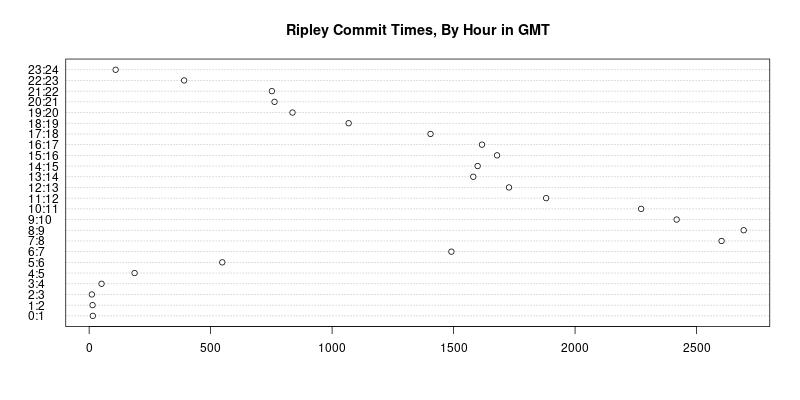
That is what one gets by trusting stable interfaces: code untouched for fourteen years runs unchanged. R itself has had well over sixty releases since then, including two major and eighteen minor releases. Yet the code just runs, including the code for two graphs one can reproduce with the exact same code as we show next.
tod <- unlist(sapply(rx,function(x)strsplit(x,split=" ")[[1]][6]))
tod <- tod[who=="ripley"]

tz <- sub(pattern=".*(-[0-9] 4 ).*",replacement="\\1",x=rx)
tz <- tz[who=="ripley"]
tz <- as.numeric(tz)/100
offset <- 3600*tz

z <- strptime(tod,format="%H:%M:%S")
hist(z,"hours",main="Ripley Commit Times in SVN TZ")

h <- z - offset
h <- format(h,format="%H")
h <- factor(as.numeric(h), levels=0:23)
## added as.vector() here to suppress a warning
dotchart(as.vector(table(h)), main="Ripley Commit Times, By Hour in GMT",
         labels=paste(0:23,1:24,sep=":"))
The code reproduces the chart from 2008, but this time uses the full twenty plus years of SVN history. I added just one as.vector() to suppress one new warning which appears under current R and which was presumably added in the fourteen years since (at the chart is produces without it too). The remainder of the code also runs. I just added one library(zoo) my blog post had omitted. No other changes.
## rather extract both  date and time
dat <- unlist(sapply(rx, function(x)  
  txt <- strsplit(x,split=" ")[[1]]
  paste(txt[5], txt[6])
 ))
## subset on Prof Ripley
dat <- dat[who == "ripley"]
## and convert to POSIXct, correcting by tz as well
datpt <- as.POSIXct(strptime(dat,format="%Y-%m-%d %H:%M:%S")) - offset

## turn into zoo -- we use a constant series of ones as each
## committ is taken as a timestamped event
library(zoo)
datzoo <- zoo(1, order.by=datpt)
## and use zoo to aggregate into commits per date
daily <- aggregate(datzoo, as.Date(index(datzoo)), sum)

## now plot as grey bars
plot(daily, col='darkgrey', type='h', lwd=2,
     ylab="Nb of SVN commits, three-week median",
     xlab="R release dates 2.5.0 and 2.5.1 shown in orange",
     main="The amazing Prof. Ripley")
## mark the two R releases of 2007
abline(v=c(as.Date("2007-04-24"),as.Date("2007-06-28")),col='orange',lwd=1.5)
## and do a quick centered rolling median
lines(rollmedian(daily, 21, align="center"), lwd=3)
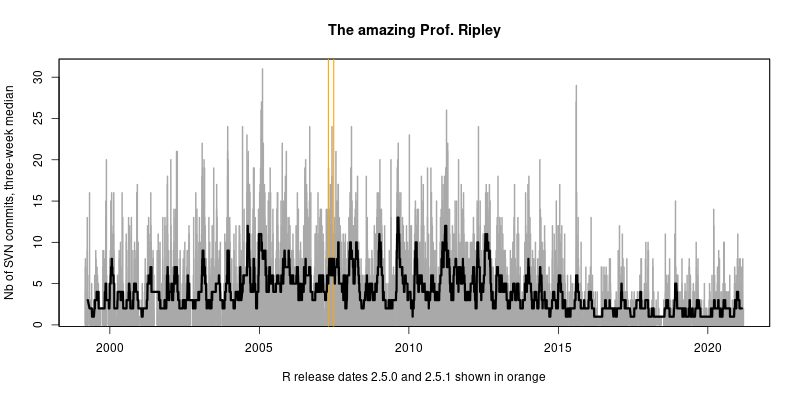
It produces this chart spanning two decades of commits. [3] The subtitle highlighting the then-most-recent releases is a little quaint now given that R has had eighten major.minor releases, and over sixty total releases, since then. Stable and rigourously maintained interfaces are a fantastic resource that is dramatically under-appreciated. Efforts such as the ten-year reproduction challenge demonstrate that this really is not a given. Maybe instead of celebrating band aides ( look, I reproduce via code I have frozen in a virtual environment / container / machine / ) we should celebrate languages, ecosystems, packages, that allow us to rely on just the code itself. Because we can. And we should strengthen and reinforce that ability. And discourage rapid changes just for changes sake. Code running for a decade, or even longer, is a huge boon to everybody relying on it. Three cheers to R Core. [1] Docker containers would be really good, and a step above the specs in the README. Winston s nice r-debug sumo container comes closest and helps a lot, and is updated regularly (which my earlier r-devel-san container is not). [2] The post owes some of its code ideas to Ben Bolker and Simon Jackman, but links to now-stale prior affiliations of theirs. [3] And the singularly impressive contributions charted remain unparalled, but were already the focus of the previous post. Yet over three times as a long period, they remain even more stunning. Edit 2021-03-21: Two minor fixes for grammar and typing.

Russ Allbery: pam-krb5 4.10

pam-krb5 is a relatively simple Kerberos PAM module with no dependencies on larger infrastructure such as sssd. This is a small bug-fix release that fixes a possible double-free if krb5_cc_get_principal fails on the newly-acquired ticket cache during authentication. I am dubious this is exploitable because this temporary ticket cache should not be under the control of an attacker, but I'm putting out a release just in case. Thanks to Michael Muehle for the report. You can get the latest release from the pam-krb5 distribution page.

Russ Allbery: rra-c-util 9.0

rra-c-util is my collection of support functions, Autoconf macros, test programs, and other infrastructure that I use to build other packages. This release includes lots of portability work to support the INN 2.6.4 release, much of it by Julien LIE. There are some incompatibilities in the Autoconf macros compared to previous versions, hence the version bump. There are also some fixes for portability of the test suite and other minor portability improvements. You can get the latest release from the rra-c-util distribution page.

Kentaro Hayashi: fabre.debian.net is now IPv6 ready

Today, we are pleased to announce that fabre.debian.net is now IPv6 ready. FOSSHOST provides us already a VPS instance which is located at OSU Open Source Lab and then also IPv6 capability to us! About fabre.debian.net fabre.debian.net is a experimental service to demonstrate how to improve user experience with finding and fixing Debian unstable related bugs for making "unstable life" comfortable. Thank FOSSHOST for kindly support.
19 March 2021

Antoine Beaupr : Securing my IRC (irssi, screen) session with dtach and systemd

A recent vulnerability in GNU screen caused some people to reconsider their commitment to the venerable terminal multiplexing program. GNU screen is probably used by thousands of old sysadmins around the world to run long-standing processes and, particularly, IRC sessions, which are especially vulnerable to arbitrary garbage coming on ... screen, so to speak. So this vulnerability matters, and you should definitely pay attention to it. If you haven't switched to tmux yet, now might be a good time to get your fingers trained. But don't switch to it just yet for your IRC session, and read on for a better, more secure solution. After all, it's not because we found this flaw in screen that it doesn't exist in tmux (or your favorite terminal emulator, for that matter, a much scarier thought).

Hardening my bouncer Back in March 2019, I had already switched away from screen for IRC, but not to tmux like many did, but to dtach. I figured that I didn't actually need multiplexing to run my long-running IRC session: I just needed to be able to reattach to the terminal. That's what dtach does. No windows, no panes, and, especially, no way to start a new shell, which is exactly the kind of hardening I need. So I came up with this, to start irssi:
dtach -N /run/$USER/dtach-irssi.socket irssi
To attach:
dtach -a /run/$USER/dtach-irssi.socket
Fairly simple no? Already one attack vector gone: evil attacker can't get a new shell through my terminal multiplexer, yay.

Splitting into another user But why stop there! Why am I running irssi as my main user anyways! Let's take the lessons from good UNIX security, and run this as a separate user altogether. This requires me to create another user, say foo-irc:
adduser foo-irc
... and run it as a systemd service, because how else are you going to start this thing anyways, cron? I came up with something like this unit file:
[Unit]
Description=IRC screen session
After=network.target
[Service]
Type=simple
Environment="TERM=screen.xterm-256color"
User=%i
RuntimeDirectory=%i
ExecStart=-/usr/bin/dtach -N /run/%i/dtach-irssi.socket irssi
ExecStop=-/bin/sh -c 'echo /quit stopping service...   exec /usr/bin/dtach -p /run/%i/dtach-irssi.socket'
ExecReload=-/bin/sh -c 'echo /restart   exec /usr/bin/dtach -p /run/%i/dtach-irssi.socket'
Notice this is a service template, because of the %i stuff. I don't actually remember how to enable this thing, but let's say you drop this in /etc/systemd/system/irssi@.service, then you run:
systemctl daemon-reload
And then, not sure about this bit, instantiate that template:
systemctl enable irssi@foo-irc.service
And then this should start the irssi session:
systemctl start irssi@foo-irc.service
To access the session:
sudo -u foo-irc dtach -a /run/foo-irc/dtach-irssi.socket
Obviously, you will probably need to migrate your irssi configuration over, otherwise you'll end up with a blank, old-school irssi. Take a moment to savor the view though. Nostalgia. Ah.

Hardening irssi But this is still not enough. That pesky foo-irc user can still launch arbitrary commands, thanks to irssi /exec (and a generous Perl scripting environment). Let's throw the entire kitchen sink at it and see what sticks. At this point, the unit file becomes too long to just maintain in a blog post (which would be silly, but not unheard of), so just look at this git repository instead.

Password-less remote irssi The neat thing with this hardening is that I now feel comfortable enough with the setup to just add a password-less SSH key to that (basically throwaway) account: worst that can happen if someone gets a hold of that SSH key is they land in a heavily sandboxed irssi session. So yay, no password to jump on chat. Like a real client or something. Just make sure to secure the SSH key you'll deploy in authorized_keys with:
restrict,pty,command="dtach -a /run/foo-irc/dtach-irssi.socket" [...]
Obviously, make sure the keys are not writable by the user, by placing it somewhere outside their home, which might require hacking at your server's SSH configuration. Because otherwise a compromised user will be able to change his own authorized_keys, which could be bad.

Configuration management And at this point, you may have noticed that you shouldn't actually followed my instructions to the letter. Instead, just use this neat little Puppet module which does all of the above, but also include some little wrapper so that mosh still works. It also includes instructions on how to setup your SSH keys. Enjoy, and let me know if (or rather, how) I messed up.

Updates
  1. it seems that dtach is not very active upstream: the last release (0.9) is from 2016, and the last commit (at the time of writing) is from 2017
  2. dtach is not necessarily safer than screen or tmux from arbitrary input from the outside, in fact there was a vulnerability on dtach CVE-2012-3368 that led to an attacker accessing stack memory (but maybe not code execution)
  3. after writing the Puppet module and publishing this article, I started to get weird behavior from dtach: i would leave the office at night and then return the next morning to find that I was timed out on servers. from my perspective, irssi noticed only when I re-attached the session:
    09:39:51 -!- Irssi: warning Broken pipe
    09:39:51 -!- Irssi: warning SSL write error: Broken pipe
    09:39:51 -!- Irssi: warning SSL write error: Broken pipe
    09:39:51 -!- Irssi: warning SSL write error: Broken pipe
    09:39:51 -!- Irssi: warning SSL write error: Broken pipe
    09:39:51 [bitlbee] -!- Irssi: Connection lost to localhost
    09:39:51 -!- Irssi: warning SSL write error: Broken pipe
    09:39:51 [gitter] -!- Irssi: Connection lost to irc.gitter.im
    09:39:51 [OFTC] -!- Irssi: Connection lost to irc.oftc.net
    09:42:34 [IMC] -!- Irssi: Connection lost to irc.indymedia.org
    09:42:34 -!- Irssi: Connection lost to irc.hackint.org
    09:42:34 -!- Irssi: Connection lost to chat.freenode.net
    09:42:34 -!- dtach_away: Set away
    
    from the outside I actually timed out a few minutes after I detached, which also makes for a weird asymmetry:
    22:31:00 -!- anarcat [~anarcat@ocean] has quit [Ping timeout: 250 seconds]
    
    that is eleven hours before the error I get.
  4. the mosh wrapper script seems to not work as well as it did before. somehow just running mosh $server hangs with a blank screen instead of instantly rejoining the session. I'm not sure it is related to the timeout problem but I did rewrite the wrapper before publication. this is the old version:
    #!/bin/sh
    # inspired by https://serverfault.com/questions/749474/ssh-authorized-keys-command-option-multiple-commands
    command="dtach -a /run/anarcat-irc/dtach-irssi.socket"
    case "$SSH_ORIGINAL_COMMAND" in
        mosh-server*)
        exec mosh-server -- $command
        ;;
        *)
        exec $command
        ;;
    esac
    
    I'm thinking of trying that one out for a while to see if it's related. The weirdest thing is that mosh "un-hangs" if i reattach with plain ssh, so there's definitely something fishy going on here.

Reproducible Builds (diffoscope): diffoscope 170 released

The diffoscope maintainers are pleased to announce the release of diffoscope version 170. This version includes the following changes:
[ Chris Lamb ]
* Avoid frequent long lines in RPM header outputs that cause very very slow
  HTML outputs. (Closes: reproducible-builds/diffoscope#245)
* Fix test_libmix_differences on openSUSE Tumbleweed.
  (Closes: reproducible-builds/diffoscope#244)
* Move test_rpm to use the assert_diff utility helper.
[ Hans-Christoph Steiner ]
* Add a diffoscope.tools.get_tools() method to support programmatically
  fetching Diffoscope's config.
[ Roland Clobus ]
* Become tolerant of malformed Debian .changes files.
You find out more by visiting the project homepage.

18 March 2021

Arturo Borrero Gonz lez: Debugging ip token set RTNETLINK error

Networking At the Wikimedia Foundation they configure basically all servers with IPv4/IPv6 dual stack, at least in the control plane interface (those used for SSH management, etc). IPv6 is not supported yet on the Cloud Services dataplane (openstack), but it will in the near future. An elegant solution for this IPv4/IPv6 dual stack configuration in the control plane is to embed the IPv4 address into the IPv6 address, something like this:

IPv4: 208.80.154.23
IPv6: 2620:0:861:1:208:80:154:23
                   ^^^^^^^^^^^^^
The gateways send prefix advertisements and by default IPv6 autoconfiguration uses such routers prefixes plus the interface MAC address to build the final address. This behavior can be somewhat changed, you can explicitly set some data instead of the MAC address for the kernel to use when building the final IPv6 address. The trick is to use the ip token command, and further context and reasoning for this can be seen in the puppet manifest that the SRE team uses to configure this:
The token command explicitly configures the lower 64 bits that will be used with any autoconf
address, as opposed to one derived from the macaddr. This aligns the autoconf-assigned address with
the fixed one set above, and can do so as a pre-up command to avoid ever having another address
even temporarily, when this is all set up before boot.
For example:
user@debian:~$ sudo ip token list
token ::208:80:154:23 dev eno1
token :: dev eno2
token :: dev eno3
token :: dev eno4
user@debian:~$ sudo ip token set dev eno2 ::beef
user@debian:~$ ip token get dev eno2
token ::beef dev eno2
user@debian:~$ ip token list
token ::208:80:154:23 dev eno1
token ::beef dev eno2
token :: dev eno3
token :: dev eno4
I was installing a new server the other day and the networking service (ifupdown) was failing to bring the interface up. The issue was the ip token command failing:
root@cloudgw2002-dev:~# ip token set ::10:192:20:18 dev eno1
RTNETLINK answers: Invalid argument
RTNETLINK error reporting is awful. What could be wrong about that command? Well, I had to dig into the kernel source code to try figuring out where was that EINVAL being generated. The routine can be seen in the function inet6_set_iftoken() (source):
static int inet6_set_iftoken(struct inet6_dev *idev, struct in6_addr *token)
 
	struct inet6_ifaddr *ifp;
	struct net_device *dev = idev->dev;
	bool clear_token, update_rs = false;
	struct in6_addr ll_addr;
	ASSERT_RTNL();
	if (!token)
		return -EINVAL;
	if (dev->flags & (IFF_LOOPBACK   IFF_NOARP))
		return -EINVAL;
	if (!ipv6_accept_ra(idev))
		return -EINVAL;
	if (idev->cnf.rtr_solicits == 0)
		return -EINVAL;
[..]
I couldn t identify the reason at first glance, apparently I pass every check in there: Something was wrong here. Upon deeper checks, I finally read the ipv6_accept_ra() function (source):
static inline bool ipv6_accept_ra(struct inet6_dev *idev)
 
	/* If forwarding is enabled, RA are not accepted unless the special
	 * hybrid mode (accept_ra=2) is enabled.
	 */
	return idev->cnf.forwarding ? idev->cnf.accept_ra == 2 :
	    idev->cnf.accept_ra;
 
That was it! Forwarding was enabled on the interface, and it shouldn t. I fixed my configuration with a simple patch for the sysctl configuration. Original issue on the Wikimedia Foundation ticketing system: Phabricator T277287

16 March 2021

Tianon Gravi: My Docker Install Process (re-redux)

See My Docker Install Process and My Docker Install Process (redux) . This one s going to be even more to-the-point.

grab Docker s APT repo GPG key
GNUPGHOME="$(mktemp -d)"; export GNUPGHOME
gpg --keyserver ha.pool.sks-keyservers.net --recv-keys 9DC858229FC7DD38854AE2D88D81803C0EBFCD88
sudo mkdir -p /etc/apt/tianon.gpg.d
gpg --export --armor 9DC858229FC7DD38854AE2D88D81803C0EBFCD88   sudo tee /etc/apt/tianon.gpg.d/docker.gpg.asc
rm -rf "$GNUPGHOME"

add Docker s APT source
source /etc/os-release
echo "deb [ arch=amd64 signed-by=/etc/apt/tianon.gpg.d/docker.gpg.asc ] https://download.docker.com/linux/debian $VERSION_CODENAME stable"   sudo tee /etc/apt/sources.list.d/docker.list
$ sudo apt update
...
Get:6 https://download.docker.com/linux/debian buster/stable amd64 Packages [17.8 kB]
...
Reading package lists... Done

exclude (unwated) CLI plugins
echo 'path-exclude /usr/libexec/docker/cli-plugins/*'   sudo tee /etc/dpkg/dpkg.cfg.d/unwanted-docker-cli-plugins

pin Docker versions
sudo vim /etc/apt/preferences.d/docker.pref
Package: *aufs* *rootless* cgroupfs-mount
Pin: version *
Pin-Priority: -10
Package: docker*
Pin: version 5:20.10*
Pin-Priority: 999
Package: containerd*
Pin: version 1.4*
Pin-Priority: 999

pre-configure Docker
sudo mkdir -p /etc/docker
sudo vim /etc/docker/daemon.json
 
	"storage-driver": "overlay2"
 

configure boot parameters
I usually set a few boot parameters as well (in /etc/default/grub s GRUB_CMDLINE_LINUX_DEFAULT option run sudo update-grub after adding these, space-separated).
  • cgroup_enable=memory enable memory accounting for containers (allows docker run --memory for setting hard memory limits on containers)
  • swapaccount=1 enable swap accounting for containers (allows docker run --memory-swap for setting hard swap memory limits on containers)
  • vsyscall=emulate allow older binaries to run (debian:wheezy, etc.; see docker/docker#28705)
  • systemd.legacy_systemd_cgroup_controller=yes newer versions of systemd may disable the legacy cgroup interfaces Docker currently uses; this instructs systemd to keep those enabled (for more details, see systemd/systemd#4628, opencontainers/runc#1175, docker/docker#28109)
    • NOTE: this one gets more complicated in Debian 11+ ( Bullseye ); possibly worth switching to cgroupv2 and systemd.unified_cgroup_hierarchy=1
All together:
...
GRUB_CMDLINE_LINUX_DEFAULT="cgroup_enable=memory swapaccount=1 vsyscall=emulate systemd.legacy_systemd_cgroup_controller=yes"
...
(Don t forget to sudo update-grub and potentially reboot check /proc/cmdline to verify.)

install Docker!
$ sudo apt-get install -V docker-ce
...
Unpacking containerd.io (1.4.4-1) ...
...
Unpacking docker-ce-cli (5:20.10.5~3-0~debian-buster) ...
...
Unpacking docker-ce (5:20.10.5~3-0~debian-buster) ...
...

$ sudo usermod -aG docker "$(id -un)"

15 March 2021

Matthew Garrett: Exploring my doorbell

I've talked about my doorbell before, but started looking at it again this week because sometimes it simply doesn't send notifications to my Home Assistant setup - the push notifications appear on my phone, but the doorbell simply doesn't trigger the HTTP callback it's meant to[1]. This is obviously suboptimal, but it's also tricky to debug a device when you have no access to it.

Normally I'd just head straight in with a screwdriver, but the doorbell is shared with the other units in this building and it seemed a little anti-social to interfere with a shared resource. So I bought some broken units from ebay and pulled one of them apart. There's several boards inside, but one of them had a conveniently empty connector at the top with "TX", "RX" and "GND" labelled. Sticking a USB-serial converter on this gave me output from U-Boot, and then kernel output. Confirmation that my doorbell runs Linux, but unfortunately it didn't give me a shell prompt. My next approach would often me to just dump the flash and look for vulnerabilities that way, but this device uses TSOP-48 packaged NAND flash rather than the more convenient SPI NOR flash that I already have adapters to access. Dumping this sort of NAND isn't terribly hard, but the easiest way to do it involves desoldering it from the board and plugging it into something like a Flashcat USB adapter, and my soldering's not good enough to put it back on the board afterwards. So I wanted another approach.

U-Boot gave a short countdown to hit a key before continuing with boot, and for once hitting a key actually did something. Unfortunately it then prompted for a password, and giving the wrong one resulted in boot continuing[2]. In the past I've had good luck forcing U-Boot to drop to a prompt by simply connecting one of the data lines on SPI flash to ground while it's trying to read the kernel - the failed read causes U-Boot to error out. It turns out the same works fine on raw NAND, so I just edited the kernel boot arguments to append "init=/bin/sh" and soon I had a shell.

From here on, things were made easier by virtue of the device using the YAFFS filesystem. Unlike many flash filesystems, it's read/write, so I could make changes that would persist through to the running system. There was a convenient copy of telnetd included, but it segfaulted on startup, which reduced its usefulness. Fortunately there was also a copy of Netcat[3]. If you make a fifo somewhere on the filesystem, you can cat the fifo to a shell, pipe the shell to a netcat listener, and then pipe netcat's output back to the fifo. The shell's output all gets passed to whatever connects to netcat, and whatever's sent to netcat gets passed through the fifo back to the shell. This is, obviously, horribly insecure, but it was enough to get a root shell over the network on the running device.

The doorbell runs various bits of software, one of which is Lighttpd to provide a local API and access to the device. Another component ("nxp-client") connects to the vendor's cloud infrastructure and passes cloud commands back to the local webserver. This is where I found something strange. Lighttpd was refusing to start because its modules wanted library symbols that simply weren't present on the device. My best guess is that a firmware update went wrong and left the device in a partially upgraded state - and without a working local webserver, there was no way to perform any further updates. This may explain why this doorbell was sitting on ebay.

Anyway. Now that I had shell, I could simply dump the flash by copying it directly off the /dev/mtdblock devices - since I had netcat, I could just pipe stuff through that back to my actual computer. Now I had access to the filesystem I could extract that locally and start digging into it more deeply. One incredibly useful tool for this is qemu-user. qemu is a general purpose hardware emulation platform, usually used to emulate entire systems. But in qemu-user mode, it instead only emulates the CPU. When a piece of code tries to make a system call to access the kernel, qemu-user translates that to the appropriate calling convention for the host kernel and makes that call instead. Combined with binfmt_misc, you can configure a Linux system to be able to run Linux binaries from other architectures. One of the best things about this is that, because they're still using the host convention for making syscalls, you can run the host strace on them and see what they're doing.

What I found was that nxp-client was calling back to the cloud platform, setting up an encrypted communication channel (using ChaCha20 and a bunch of key setup stuff I couldn't be bothered picking apart) and then waiting for commands from the cloud. It would then proxy those through to the local webserver. Since I couldn't run the local lighttpd, I just wrote a trivial Python app using http.server and waited to see what requests I got. The first was a GET to a CGI script called editcgi.cgi, along with a path name. I mocked up the GET request to respond with what was on the actual filesystem. The cloud then proceeded to POST to editcgi.cgi, with the same pathname and with new file contents. editcgi.cgi is apparently able to read and write to files on the filesystem.

But this is on the interface that's exposed to the cloud client, so this didn't appear immediately useful - and, indeed, trying to hit the same CGI binary over the local network gave me a 401 unauthorized error. There's a local API spec for these doorbells, but they all refer to scripts in the bha-api namespace, and this script was in the plain cgi-bin namespace. But then I noticed that the bha-api namespace didn't actually exist in the filesystem - instead, lighttpd's mod_alias was configured to rewrite requests to bha-api through to files in cgi-bin. And by using the documented API to get a session token, I could call editcgi.cgi to read and write arbitrary files on the doorbell. Which means I can drop an extra script in /etc/rc.d/rc3.d and get a shell on my doorbell.

This all requires the ability to have local authentication credentials, so it's not a big security deal other than it allowing you to retain access to a monitoring device even after you've moved out and had your credentials revoked. I'm sure it's all fine.

[1] I can ping the doorbell from the Home Assistant machine, so it's not that the network is flaky
[2] The password appears to be hy9$gnhw0z6@ if anyone else ends up in this situation
[3] https://twitter.com/mjg59/status/654578208545751040

comment count unavailable comments

14 March 2021

Russ Allbery: New experimental Big Eight Usenet signing key

I have finally done the work to create a new modern GnuPG signing key for control messages for the Big Eight hierarchies and wired it into the machinery that sends those control messages. I have sent one experimental checkgroups message signed with that key:
    <cmsg-20210314174844$1888@isc.org>
To test the automation, tomorrow the normal monthly checkgroups will be issued, which should result in two control messages, one signed with the new key and one with the old key. I've used the same key ID for the new key as the old key so that updating will be as simple as importing the new key. This key is currently EXPERIMENTAL and I reserve the right to reissue the key if anyone uncovers any problems. If you are in a position to do so, please try verifying the control messages with the new key and verify that the work properly. I plan on making this new key official some time next month and will post a more general announcement to news.announce.newgroups and news.admin.announce at that time. The new key, signed with my personal key and the old hierarchy control signing key, is available on my web site. (The Big Eight hierarchies need a more official information page for news administrators, I know, but one thing at a time.)

Next.

Previous.
