Search Results: "bod"

31 August 2006

Ross Burton: qmail Author Considered Dangerous

Thanks to LWN I was reminded of the, erm, interesting license and security guarantee of qmail. Specifically:
In March 1997, I offered $500 to the first person to publish a verifiable security hole in the latest version of qmail: for example, a way for a user to exploit qmail to take over another account. My offer still stands. Nobody has found any security holes in qmail. [...] In May 2005, Georgi Guninski claimed that some potential 64-bit portability problems allowed a remote exploit in qmail-smtpd.'' This claim is denied. Nobody gives gigabytes of memory to each qmail-smtpd process, so there is no problem with qmail's assumption that allocated array lengths fit comfortably into 32 bits.
Erm. Well. I'm not sure what to say. Assuming that array lengths (size_t, IIRC) is a 32-bit type even on 64-bit architectures is wrong. Defending it is insanity. NP: Layered, Antibreak

30 August 2006

Uwe Hermann: LinuxBIOS Symposium 2006 Europe

For everybody who might be interested in this kind of stuff: the LinuxBIOS project's annual LinuxBIOS Symposium will take place October 1st-3rd, 2006 in the nice German city Hamburg. In the light of the recent discussions about "sourceless firmware" and similar issues in Debian, some people might be interesting in helping with (or at least getting informed about) a practical project related to this - a free (GPL'd) BIOS replacement. It's quite likely that some OLPC people will be there, too, as the OLPC (One Laptop Per Child) project employs LinuxBIOS on their hardware... Deadline for workshop and talk proposals is September 10th (if you should plan to give a talk), and a preliminary agenda is already available online. The registration process has also recently started (deadline is September 11th). See this post for the full announcement. Now, if I manage to somehow gather a reasonably large amount of Euros, I'll probably be there.

29 August 2006

Wouter Verhelst: Divisivity meter

How to verify whether a discussion is about a divisive subject. This post brought to you by the International Foundation for the Betterment of Flame Wars

Steve McIntyre: What day is it again?

Another year, another party bigger than last year's. By my count, we had 56 people (and a dog) in my house and garden at the peak on Saturday evening. It was excellent to see people from all over: .fi, .nl, .no, .be, .it, .ch. And .uk, of course. Even the gods of weather were kind to us and held off on the rain that was forecast for Saturday. As far as I could tell, everybody enjoyed themselves; I know I definitely did! Same time, same place next year I guess... :-)

26 August 2006

Jesus Climent: What are the odds?

Flying from Helsinki to Cambridge. Wearing a Debian tee. A guy approaches me and asks if I am a Debian developer. He turns out to be one too (he works for Redhat, but hey, nobody’s perfect). We move our asses to the plane. We ask each other where we sit. Turns out we are sitting in the same row, consecutive sits. What are the odds of that happening to you?

Evan Prodromou: 9 Fructidor CCXIV

We're still in wt:Copenhagen today, but we head out this afternoon for our tour of the Baltic Sea. We've had a great time in the city so far, mostly due to staying with longtime Wikitraveller wt:User:Elgaard, who generously offered us the extra room in his apartment for the time we're here. There's something about staying in an actual human being's home while you're travelling to really recharge the batteries. After a week in hotels and restaurants, a little time in a real house can make you feel a lot more human. We took our time getting to Copenhagen from wt:Odense at the end of the Wikisym conference, mostly because I was really hung over. I'd spent the last night of the event drinking at the Irish pub in the pedestrian area, and I probably had 1-5 pints too many. Paul Yount calls Irish pubs "the first Open Source franchise", and it's true: you can expect certain things at a pub no matter where it is in the world. Although we started out with about 30 people, the crowd thinned through the night. I had a good time talking with Brion Vibber and Chuck Smith about the state of Esperanto-language wikis on the Web -- in a mish-mash of English and Esperanto, of course. (In case you were wondering: the state is "fine".) I also chatted Wikimedia Foundation politics with Angela Beesley; we both think Erik Moeller is going to make a good addition to the WMF board. After the pub shut down, I headed to the deathly silent casino in the sub-basement of the Radisson of Odense. The bar was eerily silent, and the gaming tables were intense and serious; I don't think people could have been more somber if they were organ harvesters gambling for body parts. The last hangers-on were Andrea Forte of Georgia Tech, Alex Schroeder of CommunityWiki, Sunir Shah of MeatballWiki, and Eugene Eric Kim, of Blue Oxen and HyperCore. In other words, some of the smartest people in the wiki world today -- we talked wiki politics and theory until the wee hours of the morning. They all switched to mineral water while I was still slugging down pints of Carlsberg Special, which is probably where I went wrong. Wikisym, for me, was one of the best conferences I've been to this year, and I've been to a lot. It capped off a long summer of conference-going, and this fall should be relatively tranquil. Which is great: I have a lot of work to do, based on the ideas I've picked up this season. tags:

sterbro All of which is to say that I was feeling pretty crufty the next morning as we got on the train. Kindly Maj got us a late checkout and let me sleep in late, which helped a lot; a falafel sandwich around 11AM also cleared my head a bit. The train ride from Odense to Copenhagen was great, and by the time we got to Niels Elgaard Larsen's house in sterbro (a neighborhood of Copenhagen) I was pretty refreshed. Niels took us out to an early dinner at a restaurant called Pixie in a square by his house. Copenhagen has some pretty strict traffic laws, and the number of cars on the street is possibly the least I've ever seen for a major metropolis, leaving a lot of room for sidewalks, bike paths, and open parks and plazas. We got to chat with Niels over a fresh pasta dinner, and thence home to his house for beers and more talk. One great thing about visiting Wikitravellers is that they tend to be a) very smart, b) well-travelled, and c) interested in Free Software and Free Culture. Niels is no exception; he's active in the Danish and European Free Software and information freedom communities, and he's extremely interesting to talk to on the subject. We shared travel stories and talked about Open Source and Open Content later than I would have thought, based on my earlier-morning hangover. Probably the high point of the evening, for me, was when Niels shared a brilliant idea for a way to distribute Wikitravel guides in digital form for a very wide array of users. We've had a hard time settling on a mobile document format for Wikitravel guides, since mobile devices like PDAs and cell phones support standards so poorly. It's one of the most requested features for Wikitravel, but it's going to take a huge amount of work to cover even a fraction of the mobile device owner community. Except Niels had a genius idea for how to distribute guides in a simple, standard format that works on a mobile digital device many if not most travellers carry with them every time they travel. The idea: make guides that are downloadable JPEG images which can be copied to a SD card or Compact Flash or Memory stick or whatever, then stuck into a digital camera. If the camera supports zooming on images, and has a decent screen for review, the guides might be useful and readable. I'm going to try to do some experiments with the idea -- I think it could be a real winner. Adding 30-40 images to a camera today is pretty cheap, and if they're just text I think some aggressive compression can work well. tag:

Copenhagen on foot Yesterday we did a big tour of the city on our own. In the morning, we had some breakfast at the Laundromat Cafe right next door to Niels's house, and I took the opportunity to clean a week's worth of dirty laundry. Nothing like a stack of clean clothes to make you feel more like a decent citizen. I was down to a bathing suit and the ICANNWiki t-shirt Ray King gave me at Wikisym. Then we headed out on the town to do some sight-seeing. First we hit the Kastellet, a fortress in northeast Copenhagen that's the oldest operational military base in Europe. It's got the distinctive star-shaped outline typical of old fortifications, and is surrounded by a lovely park with ducks and swans. We had lunch at a nearby caf , with large beers. (Gee, I'm getting worried about the pattern here.) After lunch we made an unscheduled stop at den lille havfrue -- the famous Litle Mermaid statue in the harbour. It was miniscule and surrounded by perhaps 100 onlookers, crammed into a tiny swatch of sidewalk. We stopped about half a mile away, took some pictures of the crowd, and moved on. We then hoofed it down through the harbour and across Nyhavn and a bridge to Christianhavn and Christiania. We'd both heard about the city-within-a-city run on anarchist principles -- kind of like a giant squat -- but neither of us had been there before. It was an interesting place -- packed with people, lots of food cooking a beer-drinking, caf s and restaurants all over the place, interspersed with art installations and little gardens. But it had the unkempt scumminess of a big squat, too -- especially on the main drag -- and there were a few too many pitbulls and gutterpunks for my tastes. Overall a good experience but I don't know if I'll go back. After our long walk we took the metro back to Niels's, where we napped until he and wife Chiquita got home. Chiquita is an investment banker from wt:Toronto who does a lot of business in Europe, where she met Niels a few years ago. They were married last year and have had a long-distance relationship -- visiting each other a week or so out of each month -- for the whole time. She's moving here this year, which I think will be nice for both of them. We had a good dinner at a place called Thomas's -- a buffet, which seems to be very popular here -- and then back home for a nightcap and bed. Amita June was overtired by the time we got her to bed, and she let us know that we'd pushed her too hard with a quarter-hour of heavy crying. But we all got to sleep pretty well afterwards, and at least the parents know that we should take it easy in the future. tags:

25 August 2006

Tollef Fog Heen: X broken in Dapper

(and what we want to do to avoid similar problems in the future) A few days ago, a broken xserver-xorg-core was uploaded to dapper-updates. This caused, unsurprisingly, a large amount of bug reports. A fixed package was uploaded about 12 hours after the first bug report came in. We also pointed all the $countrycode.archive.ubuntu.com (se.archive.ubuntu.com, au.archive.ubuntu.com, etc) to archive.ubuntu.com to speed up the propagation of the fix. Even so, it hit far, far too many users. Incidentially, the distro team is currently in a sprint in Wiesbaden, Germany and we had a large discussion this morning about both how to handle such situations when they happen (and recover from them, mostly in the technical sense) and how to prevent them from happening in the first place. The latter is obviously more important as we won't have to recover if there is not a problem in the first place. Note that those ideas listed below were ideas and not finished procedures and we are going to write up a proper policy document. Ideas for prevention ranged form using $distro-proposed and explicit call for testers of that to getting more code review for updates. The current review process for updates to $distro-updates is a review by the release manager who accepts it into $distro-updates. This update passed that review even though the update was faulty, so even if we had another reviewer, it might have passed that review too. Using $distro-proposed does not prevent the problem from affecting anybody, it just changes the group affected with the goal that the group choosing to enable $distro-proposed will hopefully be able to recover more easily. Recovery ideas ranged from being able to put an update onto a user's machine whether he wanted it or not to snapshot/rollback support and having some kind of a "safe mode" where it would give you a kdrive-based VESA X server and tools to fix your system. I'm not sure what we would do if we managed to break one of those tools (or the "safe-mode" X server), though. We all agreed that being open about the problem, the cause of the problem and how we are working to solve it is important. Downplaying the severity or making jokes or sarcastic comments about the fix ("Ooops, we did it again") is bad and something we shouldn't do. (And I don't think we did it this time either.) No response is equally bad and something we should work hard to avoid. Hopefully, we will have a procedure in place in a little while which tells us how to handle such an emergency when it happens and we will be deploying safeguards to prevent it from happening again while not ending up paralysing us and making us unable to deploy updates to $distro-updates as this is something we need to be able to. While this post is fairly critical of the current set of policies and procedures, I have tried hard to avoid pointing fingers at anybody in particular. I would much rather have us have a positive and constructive discussion about how to avoid similar problems in the future than a discussion on who is to blame. The points and views in this post is also those of my own and not any kind of official communication from Canonical or Ubuntu.

22 August 2006

Steve Kemp: Y know it ain t right when its all wrong

Peter Nuttall is my personal hero for running with my idea to limit N consecutive posts on a planetplanet installation - if you’d like test it and apply it to planet.debian.org, or elsewhere, find it here. (Note: Patch is reversed). Bad day at work today. I spent half the morning wrestling with xen on my laptop - it seems that linux-image-2.6.16-2-xen-686 or linux-modules-2.6.16-2-xen-686 panics on boot in some weird Xen way. (ie. before initrd.) I upgraded to these packages yesterday afternoon, and the problem only showed itself by a failure to boot this morning. Since the laptop is fairly new none of my install CDs were capable of booting it with networking. In the end I downloaded knoppix, broke a window whilst waiting for it to download, and finally installed a non-Xen kernel so I could work. I’ve reported a bug against the kernel package (with a bogus email address which I’ll need to fixup afterwards) but it hasn’t shown up in the bts yet. There isn’t anything obvious in the bootup message just a panic after “disabling trace buffers” so I’m not sure the report will be terribly useful. In other “worky” news four months after making the request I got a second phone line installed in my flat today, so I can get another network connection. Neat. Now I need to track down somebody to replace / fix my window. Thats going to be pricy, but it will have to be done before the weather turns or I’ll freeze in my house. The problem is frustratingly mechanical - the window “handle” is jammed in such a way that I can’t turn the handle and close the window - so it is permananetly open about four inches. The frustration comes primarily because if the window would open more, (it won’t), I could use a screwdrive to unscrew the locking site - and that would allow me to close it. (Albeit leaving it unlocked). Its half-open/half-closed state is just the worse way for it to be stuck.

21 August 2006

Steve Kemp: I am the lie that you believe

If I wrote a new feed for this blog which returned two-hundred entries, of gibberish, would this: Tempting .. tempting … As a serious reponse to planet-flooding I’d like to suggest that planetplanet be updated such that only N consecutive posts by the same individual would be shown. That way a person could still make 10 entries a day if they wished, but they would only be shown if somebody else got a word in edgeways - otherwise only the latest N would be displayed. This could be tunable, and would ideally default to something small like 3. /me goes to look at the code. It seems that planet/__init__.py: items() is the place to make the change, but dear God I hate python…

Gustavo Franco: All i need is python-cairochart

Well, i've just started in the world of charts using the Python language. There's gdchart, gdchart2 and a few more, but all i can see using them are ugly images. The interface could be better too, but it's two or three year old.<br /><br />The fact is that i don't care too much about eye-candy, i feel comfortable with the numbers that my classes are generating in the reports (sqlobject is really cool), but i need to prepare a small website containing daily updates with images.<br /><br />If somebody already wrote a gdchart-like using cairo vectorial graphics library, that's exactly what i want. Drop me a comment if you have that or any suggestion better than 'start coding from scratch'.

Gustavo Franco: new debian packages feed

I see the <a href="http://kitenet.net/%7Ejoey/blog/entry/package_news_feeds.html">Joeyh's post</a> about package news feeds and i thought 'why not follow new packages entering the Debian archive using a rss feed' ? <a href="http://polydistortion.net/monkey/archives/2002/07/04/000835.html">I've found</a> it! Yes somebody did it first, but i'm not sure if it's cool enough. For some reason there's no full description (just the short) in the entries and it lacks package version too. The blog post is old, but the feed seems to be updated. There's some weird entries with Debian' web site URLs but i'm ignoring that.

Gustavo Franco: Tectonic verdict: It sucks

Well, two days ago Jason Norwood-Young published in Tectonic the worst article about Ubuntu, Debian and the Ubuntu latest release Dapper Drake until now. I would like to point out where he's wrong here, just to clarify for Debian users my view on the subject.<br /><br />Source: http://www.tectonic.co.za/view.php?id=1026<br /><br /><span style="font-style: italic;" class="viewbody">"I can only guess where Ubuntu went wrong. The first mistake, I think, was its desire to be a bleeding edge distribution, rather than a leading edge distro. Basing itself on Etch, Debian's unstable release, could be a problem. When the early versions of Ubuntu used the then-unstable Sarge as their foundations, it wasn't a risk -- Sarge was on the cusp of being released. Etch, on the other hand, is brand-new, and far from getting a thumbs-up as a stable distribution."</span><br /><br />The truth is that Ubuntu Dapper Drake was never based on Debian testing that we will be our next release, that we already call Etch. Ubuntu spend some time importing packages from Debian Unstable (that we always call sid too) and merging them with the changes they had and applying new changes, adding more packages software and all that. For more information about Debian release cycle, check our <a href="http://www.us.debian.org/releases/">Debian release page</a>.<br /><br /><span style="font-style: italic;" class="viewbody">"I also wonder who is doing the up-stream support. Shuttleworth poached the best-of-the-best Debian developers for Ubuntu. So who's working on Debian? The hald bug has been identified as an up-stream problem -- a Debian problem in other words. Perhaps Debian doesn't have the man-power to run around fixing Ubuntu bugs. "<br /><br /></span>Mr. Jason failed miserably here. Considering that he's right and Mark hired the best-of-the-best Debian developers for Ubuntu, the hald bug that is a software <a href="http://www.freedesktop.org/wiki/Software_2fhal">from freedesktop</a> and not Debian, should be solved by the best-of-the-best, no? Perhaps Ubuntu doesn't have the man-power to run around fixing every freedesktop bug.<br /><br /><span style="font-style: italic;" class="viewbody">"Finally, there's the problem of prioritising. Ubuntu, at its heart, is a community project. Many of the developers are not Canonical employees and don't get paid to work on Ubuntu -- they do it because the want to."<br /><br /><span style="font-style: italic;"></span></span><span class="viewbody">Great, Ubuntu at its heart, is a community project and what Debian is?<br /><br />I think the guy isn't a troll, but he should be more polite with both projects, after all he likes the previous Ubuntu release without considering that we (Debian) had some input there. In other words if it works it's Ubuntu, if it breaks is it upstream's fault? He can't recognize that Ubuntu upstream isn't always Debian.<br /><br />Meanwhile:<br /></span> <span class="body"><b>"Comment added</b></span><br /><span class="body">Thank you for your contribution <b>Gustavo Franco</b>. <br />Your comments will be posted on the site as soon as they have been moderated by the editors."<br /><br />We will see which kind of moderation i'll receive there.<br /></span>

Gustavo Franco: Not so happy vacation

Let me start with what makes me happy. I'm almost done "porting" gnome-tasksel from gtk+1 to gtk+2 (that libglade-convert thing is nice, thanks Guilherme). I need to upload the bzr repository, open bugs and contact the current upstream again. If they're not interested in the tool anymore i'm. I've some task related ideas that hopefully will be ready in time for Etch. Meanwhile, i do some python transition related uploads too.<br /><br />I am on vacation, and since i'm not miles away from my home travelling i've the motivation and enough free time to do everything Debian i ever dreamed, right? Sure, but not after somebody else inform you that this is almost game over from where you were. Bad news, no?

Gustavo Franco: Thank you ftp team

Sometimes you look at the NEW queue and feel bad, because in a way some old and new volunteers' work is there waiting somebody else (that is a volunteer too). If it happens for one time or two you don't consider this a real problem, but after some months the person will notice that it isn't uncommon and will feel frustrated. It's really hard to explain in words, so i see a lot of flamewars about the subject after so many years contributing to the project, and the result is questionable to say the least. Sometimes you need to say thank you.<br /><br />I'm on vacation and feeling motivated to contribute with uploads, so i haven't sent a VAC notice to any mail list. I'm on vacation from paid work, but doing my best for Debian. After some sponsored uploads and stuff that i uploaded by myself, i uploaded notify-python, a NEW package. I thought "ok, if i'm lucky in 15 days it will hit the archive and i can prepare the -2 upload from there". What? Thinking in a second upload before upload the first one? Yes. The fact is that we've a new Python infrastructure and i prepared the package to work over that, but just for our current default Python version (2.3). Technically it can work well with Python 2.4, but it wasn't strict needed for the first upload and after all "i've at least 15 days to do it better". No, i don't...<br /><br />notify-python was accepted today and the package count in NEW is 19. I don't need to, but i want to add the Python 2.4 support there right now. Why? It's hard to explain in words, as i said. I think others share the same feel and maybe it's time to keep the package count in NEW really low until Etch and maybe the fun will be back. It won't solve all our problems, but is really helpful. Those who feel the same after reading ACCEPTED will agree. Thanks ftp team: masters and assistants. Keep it going this way, if possible.

Gunnar Wolf: Caps Lock becomes useful again! / Is this a farewell, my dear Window Maker?

I have always hated and despised the Caps Lock key. Not only it is useless to anybody who works writing code, sysadmining, or plainly writing real text, but its mere existence has degraded the work quality of millions of people's work. Suddenly, IT GETS NORMAL TO WRITE LIKE THIS - It's just a magic spell that allows you to get rid of those old-fashioned rules about the language, about where to write in which case. Even worse, in Spanish some people tend to think that uppercase letters do not carry accents, so they produce text that is, um... Lets say it is readable, but that's often an overstatement.
[switch context]
I have been a happy and loyal user of Window Maker since 1997, when Juan Pablo Romero pointed me to it (BTW, I found Juan Pablo's homepage after searching for some links to post here and finding his, very old and probably unmaintained, WindowMaker page), back in the time where one of my favorite webpages was Window managers for X - clear sign that I didn't really like anything I had been using. And with WMaker, I was happy for (WOW) almost ten years. I still am. But after last week's ugly XFS corruption episode, I decided to follow the trend among some Debian people, and installed ion3.
My impression so far, with two and a half days of usage? I LOVE IT. It is the only WM I've met that really comes from a different point of view, stating that what most so-called modern WMs offer is just counter-productive. It just stays out of your way, not providing any visual distractions, and limiting to providing screens and frames to organize your windows. It acknowledges that its target audience (in my life I'd never set up ion3 for my mother ;-) ) usually hates using the mouse if unneeded, and that there is little point in wasting screen real estate with docks and desktops with functionality. It just sits there waiting for you to command its working via the keyboard - of course, the mouse is also an option, but not the natural one.
Anyway, I won't discuss the beauty of ion3 here - mostly because I have only scratched the surface so far. I have loved it, let me tell you. A little more on this in a couple of lines... Just for my Spanish-prefering friends, I found this piece of text explaining what ion3 is about: Ion3: Rompiendo con los entornos gr ficos convencionales
[merge contexts]
My only grudge is that in its default configuration, ion3 becomes the 0wn3r of Meta. What is Meta? What some people call "the Alt key". That key that is not Ctrl, but has become a controlling key. And I'm a heavy Meta user - Remember that my favorite way of interacting with the computer is Emacs. Yup, the nice OS without a decent editor, nicknamed after "Escape-Meta-Alt-Ctrl-Shift". Rob me of my Meta, and the gained productivity might as well go down the drain.
Here comes the link to my first paragraph: Ion3 is very configurable. No, it's not configurable - it's programmable. The configuration files are pieces of Lua, a full programming language. Of course, this means you can do mostly anything with it... But you have to do it in the end. Editing ion3's behaviour is not just clicking on selectors - You can take a dive to get the feeling. It looks quite easy, but I yet have to get around it and start poking the configuration.
After mourning my lack of Meta, I came across a very useful post in Gregor Hermann's blog. Gregor, I owe you a beer or three - You not only gave me back my productivity, you also gave use to the most despised key in my keyboard. Two lines into XModmap, one line into a couple of Ion3 files (I have yet to be sure it is needed in all of them), and I now have a perfectly useful CapsLock key, which is the key I will manage my WM with. It just rocks! It stands in nobody's way, and I am sure I'll very soon grow used to it.
19 August 2006

Erich Schubert: Giving up on SELinux for sarge, maybe even Debian altogether.

I'm giving up on backporting SELinux to sarge. Too many changes are needed in too many apps to make them really compatible with SELinux. Nothing serious, but just lots and lots of small things. For example, the amavisd-new package will need a cronjob modification. This has already been resolved (somewhat) for unstable, but it means I would need to provide a modified amavisd-new package or a backport. I hope that when etch gets released end of the year (and I actually believe this will happen), many issues will already be resolved. But it depends of course on many people using SELinux in different settings. My most-annoying-issue with SELinux on Debian: cron bug #333837, open for some 300 days now. The debian cron package will backup e.g. /etc/shadow, which actually sounds like a quite inappropriate place for this task. And of course it's all in one file named /etc/cron.d/standard, instead of e.g. /etc/cron.d/backup-key-system-files or so, which I could then label backup_exec_t or something else to assign the special privilege of reading shadow files... It's bugs like these, unhandled for 300 days, together with having the impression of being the only one trying to get SELinux running and receiving basically no support by the SELinux upstream "community" (which is almost exclusively "enterprise", it seems). It's pretty much like everybody wants you to not use SELinux. Or in my case, not enable people to use SELinux on Debian, since I'm not just "joe average user", but actually trying to add SELinux support to the Debian distribution (which would help Ubuntu to get SELinux, too. The Ubuntu people seem to have given up on SELinux already).

Evan Prodromou: 1 Fructidor CCXIV

We had an active day around here getting ready to fly off to wt:Odense in wt:Denmark for Wikisym. I finally debugged the last testing error with the MediaWiki 1.7.1 upgrade for Wikitravel, so I did a rollout this morning, and things seem to be working great. The Wikimedia team's rollout schedule -- they run the Subversion trunk version on e.g. Wikipedia and make quarterly stable drops -- has worked out pretty well. It's interesting to see the Free Software world moving away from "It'll be done when it's done" to "Here's what we have since the last 6 months, and it more or less works". It doesn't seem to be damaging the quality of the software released or the willingness to innovate -- more the opposite. And users seem to really appreciate not having to decide between "stable" and "up-to-date". Having a bleeding edge that everyone can afford to be on makes things a little less bloody. tags:

Burn I also started the insurance process for our Montreal local Burning Man event in September. All Burning Man regional events have to be fully insured, which is pretty annoying when you are paying for it and pretty calming when you've got a big bonfire going. Next up: toilets. This is the glamour of Burning Man, folks. tags:

Baby carriers Maj, Amita June and I took a trip to nearby B b Dep t on Christophe Colombe and St. Zotique -- yes, non-wt:Montreal-residents, those are real street names -- to get some baby carrying units. Baby carrying is serious technology. A week before Amita June was born, we got this 12-foot-long elastic cloth that you're supposed to wrap around your body 4 times and the baby ends up in one or more of the various folds. It seemed like a good idea at the time, but trying to get a newborn into it turned out to be a real hassle. So, a few days after we came home from the hospital, I ran out to Bummie's on Mont Royal and got a black Heart-to-Heart shoulder sling. It's been absolutely fantastic -- the real workhorse of our baby-carrying needs. But as Amita got bigger, it got harder to go for long walks with her in the sling. So when we were at 2006 SxSW Interactive I ran out early one morning to the Walmart near our hotel and got a $12.99 umbrella stroller. Amita loves it -- go figure -- but the thing is about 6 inches too short for me, so I've developed a real hunch pushing it around. For our trip to Europe, we decided to shell out some serious dough -- far into the double digits -- to get major technology for our baby-carrying needs. We got a really nice stroller from Chicco with a canopy and comfy handles that reach up just about to where I need them, which is very nice. And we got a baby backpack -- porte-b b sac- -dos -- that Amita can sit in while I carry her on my back. That's by far the most fun for me so far. She cried like the dickens when we put her in, but pretty soon she was cooing like a dove. It was really comfortable for me, too. We're taking the backpack and not the stroller to Europe... we're both trepidatious about the choice and I hope it turns out well. tags:

18 August 2006

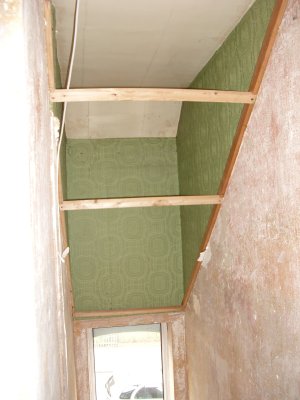
Jonathan McDowell: Bodies in the Attic

Kathy and I have finally started stripping the wallpaper from our hall/stairs/landing (it's only been on our todo list since we moved in over 3 years ago). This includes removing it from the ceiling. Now, the ceiling above our stairs was parallel to the stairs (ie not horizontal, diagonal). Which left us wondering what was in the gap, which we had no access to. As we started to remove the wallpaper on it some hardboard was revealed. Which I eventually decided should come down, if only because it would be easier to cleanup and repaint that way. The result? The Hidden Space Obviously the last time someone wanted to repaint/paper they decided to cut down on the amount of work they had to do...

Martin F. Krafft: Talk on Debian "etch"

Tomorrow I will deliver a talk on Debian "etch" at the University of Limerick Computer Society. Staying true to my principles, I held back the preparation of slides until the last minute, but now I actually ended up having them done well in advance, with enough time to invite you to take a look [*] and provide feedback. In this talk, I introduce Debian, give a status update on the "etch" release, talk a little bit about the future and how I see Debian's strategies evolving/developing/changing, and finally relate a bit to Ubuntu. That latter point was added on request, and I will remain objective and talk about the status quo, problems, and benefits (so it won't be a subjective take like this, although I certainly will address some of the issues). Comments welcome!
[*]the slides were prepared for S5 and can be viewed directly in modern browsers. The best experience is with a 1024x768 or higher resolution. Here are instructions on how to browse them (though you probably don't need them).
Update: the talk went well. I planned it to be 40 minutes (which is ambitious for 25 slides, but I can zip through them at high speed if I need to), and I learnt that the room was scheduled for two hours, so I added about 5 slides and went into it without a clock... and totally enjoyed delivering a talk with almost no time restrictions, which turned out to last just under 2 hours in the end. I talked a bit too much about what Debian is, then delivered the status report on the "etch" release, and in the end also had quite some time to spare on talking about our current and future challenges, as well as discussing some of the problems with the distribution and the project, as I see them. I would like to thank the attendants for making their way to the campus on a Saturday, and for their attention throughout the two hours of presentation without a single one of them giving me the impression of disinterest! We ended in a bar with beer in the afternoon, of which I probably had a little more than I should have had, given that I needed to be a little more productive that day. But even that worked out well. Laura, the society's president, offered me an honorary membership with skynet.ie, which I gladly accepted [ ], and I enjoyed hearing some of their stories about the past and the present. Given that university computer societies may be somewhat in decline, I think they still have their rightful purpose, and they are definitely a great place to gain experience and have a lot of fun. Thanks, skynet.ie for a good time! And now on to meet them at a pub...
[ ]If nothing else, then an account on skynet.ie should allow me to port-forward or even use VPN from Zurich, to access some of the electronic library resources available here, to which the University of Zurich has not subscribed.

17 August 2006

Aigars Mahinovs: Secure flying

If one really wants to make international flying perfectly safe (at least safe from terrorists masquerading as passengers), it is in fact very simple and quite cheap: * No carry-on or check-in luggage at all (all kinds of chemical, bacteriological or radioactive materials could be hidden there, for example it can be trivial to make a laptop burn up in flames mid-flight and make in in non-detectable way). * No personal items of clothes (clothes can be soaked in certain chemicals to make them explosive). * Secure passengers during the flight ( so that they can not actually do any terrorist activity). So, the optimal way of securing air transportation would be to have people come in without any luggage at all, remove all items and clothing at check-in, dress in uniform one-time paper clothing where one can not hide anything, sedate them, feed them trough introspective inspection to detect in-body foreign objects and check the chemistry of skin and hair, pack them into the airplane on secured padded shelves, fly them to the destination, reverse the sedative and give them a standard set of clothes and essential personal items. In addition to perfect security, this plan will also reduce the overall cost of air travel by allowing to pack more people into an airplane of the same size - the padded shelves can go from the bottom of the airplane to the very top with minimal spacing (all passengers are sedated - they will not walk around), no separate cargo hold will be needed (no luggage) and no in-flight entertainment or food will be required. If the current security craze continues, we might reach this perfection by 2020. Congratulations! Note: All software by that time will be Web-based, so there will be no sense in taking your “personal” laptop with you.

Next.

Previous.