Search Results: "ads"

30 January 2017

Marc 'Zugschlus' Haber: openssh authorized_keys "restrict" option lessens worries

Starting with OpenSSH 7.2, a new restrict option for authorized_keys lines has become available. It sets all available restrictions that the current OpenSSH version can do (like no-agent-forwarding, no-x11-forwarding etc). One can individually turn on those features again by corresponding new options. This saves one from sorrows when a new capability of OpenSSH is introduced through an update which is enabled by default, since one has to remember that restricted authorized_keys lines are in unse and then to manually add the restrictions. On the downside, Debian jessie and CentOS 7 don t have a recent enough OpenSSH. So we ll have to continue worrying about new features being inadvertendly enabled for a while. P.S.: Yes, I haven t blogged about Linux and Debian in English in a while.

Michal Čihař: See you at FOSDEM

This has become sort of tradition for me, but still worth mentioning - I'm going to to FOSDEM this weekend. This time I have no talk (I somehow failed to submit anything in time), but still I'm there to meet people and listen to some talks. As I've agreed to help Software Freedom Conservancy on stand (in the H building), it's quite likely that you will find me there. You will also have unique chance to grab phpMyAdmin stickers at this stand. Also if you spot somebody wearing Weblate t-shirt, then it's most likely me ;-).

Filed under: Debian English phpMyAdmin SUSE Weblate 1 comments

Shirish Agarwal: Different strokes

Delhi Metro - courtesy wikipedia.org Statutory warning It s a long read. I start by sharing I regret, I did not hold onto the Budget and Economics 101 blog post for one more day. I had been holding/thinking on to it for almost couple of weeks before posting, if I had just waited a day more, I would have been able to share an Indian Express story . While I thought that the work for the budget starts around 3 months before the budget, I came to learn from that article that it takes 6 months. As can be seen in the article, it is somewhat of a wasted opportunity, part of it probably due to the Government (irrespective of any political party, dynasty etc.) mismanagement. What has not been stated in the article is what I had shared earlier, reading between the lines, it seems that the Government isn t able to trust what it hears from its advisers and man on the street. Unlike Chanakya and many wise people before him who are credited with advising about good governance, that a good king is one who goes out in disguise, learns how his/er subjects are surviving, seeing what ills them and taking or even not taking corrective steps after seeing the problem from various angles. Of course it s easier said then done, though lot of Indian kings did try and ran successful provinces. There were also some who were more interested in gambling, women and threw/frittered away their kingdoms. The 6-month things while not being said in the Express article is probably more about checking and re-checking figures and sources to make sure they are able to read whatever pattern the various Big Businesses, Industry, Social Welfare schemes and people are saying I guess. And unless mass digitalization as well as overhaul of procedures, Right to Information (RTI) happens, don t see any improvement in the way the information is collected, interpreted and shared with the public at large. It would also require people who are able to figure out how things work sharing the inferences (right or wrong) through various media so there is discussion about figures and policy-making. Such researchers and their findings are sadly missing in Indian public discourses and only found in glossy coffee table books :(. One of the most basic question for instance is, How much of any policy should be based on facts and figures and how much giving fillip to products and services needed in short to medium term ? Also how much morality should play a part in Public Policy ? Surprisingly, or probably not, most Indian budgets are populist by nature with some scientific basis but most of the times there is no dialog about how the FM came to some conclusion or Policy-making. I am guessing a huge part of that has also to do with basic illiteracy as well as Economic and Financial Illiteracy. Just to share a well-known world-over example, one of the policies where the Government of India has been somewhat lethargic is wired broadband penetration. As have shared umpteen times, while superficially broadband penetration is happening, most of the penetration is the unreliable and more expensive mobile broadband penetration. While this may come as a shock to many of the users of technology, BSNL, a Government company who provides broadband for almost 70-80% of the ADSL wired broadband subscribers gives 50:1 contention ratio to its customers. One can now understand the pathetic speeds along with very old copper wiring (20 odd years) on which the network is running. The idea/idiom of running network using duct-tape seems pretty apt in here  Now, the Government couple of years ago introduced FFTH Fiber-to-the-home but because the charges are so high, it s not going anywhere. The Government could say 10% discount in your Income Tax rates if you get FFTH. This would force people to get FFTH and would also force BSNL to clean up its act. It has been documented that a percentage increase in broadband equals a similar percentage rise in GDP. Having higher speeds of broadband would mean better quality of streaming video as well as all sorts of remote teaching and sharing of ideas which will give a lot of fillip to all sorts of IT peripherals in short, medium and long-term as well. Not to mention, all the software that will be invented/coded to take benefit of all that speed. Although, realistically speaking I am cynical that the Government would bring something like this  Moving on Behind a truck - Courtesy TheEconomist.com Another interesting story which I had shared was a bit about World History Now the Economist sort of confirmed how things are in Pakistan. What is and was interesting that the article is made by a politically left-leaning magazine which is for globalization, business among other things . So, there seem to be only three options, either I and the magazine are correct or we both are reading it wrong. The third and last option is that the United States realize that Pakistan can no longer be trusted as Pakistan is siding more and more with Chinese and Russians, hence the article. Atlhough it seems a somewhat far-fetched idea as I don t see the magazine getting any brownie points with President Trump. Unless, The Economist becomes more hawkish, more right-wingish due to the new establishment. I can t claim to have any major political understanding or expertise but it does seem that Pakistan is losing friends. Even UAE have been cautiously building bridges with us. Now how this will play out in the medium to long-term depends much on the personal equations of the two heads of state, happenings in geopolitics around the world and the two countries, decisions they take, it is a welcome opportunity as far they (the Saudis) have funds they want to invest and India can use those investments to make new infrastructure. Now, I need a bit of help of Java and VCS (Version control system) experts . There is a small game project called Mars-Sim. I asked probably a few more questions than I should have and the result was that I was made a member of the game team even though I had shared with them that I m a non-coder. I think such a game is important as it s foss. Both the game itself is foss as well as its build-tools with a basic wiki. Such a game would be useful not only to Debian but all free software distributions. Journeying into the game Unfortunately, the game as it is currently, doesn t work with openjdk8 but private conversations with the devs. have shared they will work on getting it to work on OpenJDK 9 which though is sometime away. Now as it is a game, I knew it would have multiple multimedia assets. It took me quite sometime to figure out where most of the multimedia assets are. I was shocked to find that there aren t any tool/s in Debian as well a GNU/Linux to know about types of content is there inside a directory and its sub-directories. I framed it in a query and found a script as an answer . I renamed the script to file-extension-information.sh (for lack of imagination of better name). After that, I downloaded a snapshot of the head of the project from https://sourceforge.net/p/mars-sim/code/HEAD/tree/ where it shows a link to download the snapshot. https://sourceforge.net/code-snapshots/svn/m/ma/mars-sim/code/mars-sim-code-3847-trunk.zip unzipped it and then ran the script on it [$] bash file-extension-information.sh mars-sim-code-3846-trunk
theme: 1770
dtd: 31915
py: 10815
project: 5627
JPG: 762476
fxml: 59490
vm: 876
dat: 15841044
java: 13052271
store: 1343
gitignore: 8
jpg: 3473416
md: 5156
lua: 57
gz: 1447
desktop: 281
wav: 83278
1: 2340
css: 323739
frag: 471
svg: 8948591
launch: 9404
index: 11520
iml: 27186
png: 3268773
json: 1217
ttf: 2861016
vert: 712
ogg: 12394801
prefs: 11541
properties: 186731
gradle: 611
classpath: 8538
pro: 687
groovy: 2711
form: 5780
txt: 50274
xml: 794365
js: 1465072
dll: 2268672
html: 1676452
gif: 38399
sum: 23040
(none): 1124
jsx: 32070
It gave me some idea of what sort of file were under the repository. I do wish the script defaulted to showing file-sizes in KB if not MB to better assess how the directory is made up but not a big loss . The above listing told me that at the very least theme, JPG, dat, wav, png, ogg and lastly gif files. For lack of better tools and to get an overview of where those multimedia assets used ncdu [shirish@debian] - [~/games/mars-sim-code-3846-trunk] - [10210]
[$] ncdu mars-sim/
--- /home/shirish/games/mars-sim-code-3846-trunk/mars-sim --------------------------------------------------------------------------------------
46.2 MiB [##########] /mars-sim-ui
15.2 MiB [### ] /mars-sim-mapdata
8.3 MiB [# ] /mars-sim-core
2.1 MiB [ ] /mars-sim-service
500.0 KiB [ ] /mars-sim-main
188.0 KiB [ ] /mars-sim-android
72.0 KiB [ ] /mars-sim-network
16.0 KiB [ ] pom.xml
12.0 KiB [ ] /.settings
4.0 KiB [ ] mars-sim.store
4.0 KiB [ ] mars-sim.iml
4.0 KiB [ ] .project
I found that all the media is distributed randomly and posted a ticket about it. As I m not even a java newbie, could somebody look at mokun s comment and help out please ? On the same project, there has been talk of migrating to github.com Now whatever little I know of git, it makes a copy of the whole repository under .git/ folder/directory so having multimedia assets under git is a bad, bad idea, as each multimedia binary format file would be unique and no possibility of diff. between two binary files even though they may be the same file with some addition or subtraction from earlier version. I did file a question but am unhappy with the answers given. Can anybody give some definitive answers if they have been able to do how I am proposing , if yes, how did they go about it ? And lastly Immigrants of the United States in 2000 by country of birth America was founded by immigrants. Everybody knows the story about American Indians, the originals of the land were over-powered by the European settlers. So any claim, then and now that immigration did not help United States is just a lie. This came due to a conversation on #debconf by andrewsh
[18:37:06] I d be more than happy myself to apply for an US tourist not transit visa when I really need it, as a transit visa isn t really useful, is just as costly as a tourist visa, and nearly as difficult to get as a tourist visa
[18:37:40] I m not entirely sure I wish to transit through the US in its Trumplandia incarnation either
[18:38:07] likely to be more difficult and unfun
FWIW I am in complete agreement with Andrew s assessment of how it might be with foreigners. It has been on my mind and thoughts for quite some time although andrewsh put it eloquently. But as always I m getting ahead of myself. The conversation is because debconf this year would be in Canada. For many a cheap flight, one of the likely layovers/stopover can be the United States. I actually would have gone one step further, even if it was cheap transit visa, it would equally be unfun as it would discriminate. About couple of years back, a friend of mine while explaining what visa is, put it rather succinctly the visa officer looks at only 3 things a. Your financial position something which tells that you can take care of your financial needs if things go south b. You are not looking to settle there unlawfully c. You are not a criminal. While costs do matter, what is disturbing more is the form of extremism being displayed therein. While Indians from the South Asian continent in US have been largely successful, love to be in peace (one-off incidents do and will happen anywhere) if I had to take a transit or tourist visa in this atmosphere, it would leave a bad taste in the mouth. When one of my best friends is a Muslim, 20% of the population in India is made of Muslims and 99% of the time both of us co-exist in peace I simply can t take any alternative ideology. Even in Freakonomics 2.0 the authors when they shared that it s less than 0.1 percent of Muslims who are engaged in terrorist activities, if they were even 1 percent than all the world s armed forces couldn t fight them and couldn t keep anyone safe. Which simply means that 99.99% of even all Muslims are good. This resonates strongly with me for number of reasons. One of my uncles in early to late 80 s had an opportunity for work to visit Russia for official work. He went there and there were Secret Police after him all the time. While he didn t know it, I later read it, that it was SOP (Standard Operating Procedure) when all and any foreigners came visiting the country, and not just foreigners, they had spies for their own citizens. Russka a book I read several years ago explained the paranoia beautifully. While U.S. in those days was a more welcoming place for him. I am thankful as well as find it strange that Canada and States have such different visa procedures. While Canada would simply look at the above things, probably discreetly inquire about you if you have been a bad boy/girl in any way and then make a decision which is fine. For United States, even for a transit visa I probably would have to go to Interview where my world view would probably be in conflict with the current American world view. Interestingly, while I was looking at conversations on the web and one thing that is missing there is that nobody has talked about intelligence community. What Mr. Trump is saying in not so many words is that our intelligence even with all the e-mails we monitor and everything we do, we still can t catch you. It almost seems like giving a back-handed compliment to the extremists saying you do a better job than our intelligence community. This doesn t mean that States doesn t have interesting things to give to the world, Star Trek conventions, Grand Canyon (which probably would require me more than a month or more to explore even a little part), NASA, Intel, AMD, SpaceX, CES (when it s held) and LPC (Linux Plumber s conference where whose who come to think of roadmap for GNU/Linux). What I wouldn t give to be a fly in the wall when LPC, CES happens in the States. What I actually found very interesting is that in the current Canadian Government, if what I read and heard is true, then Justin Trudeau, the Prime Minister of Canada made 50 of his cabinet female. Just like in the article, studies even in Indian parliament have shown that when women are in power, questions about social justice, equality, common good get asked and policies made. If I do get the opportunity to be part of debconf, I would like to see, hear, watch, learn how the women cabinet is doing things. I am assuming that reporting and analysis standards of whatever decisions are more transparent and more people are engaged in the political process to know what their elected representatives are doing. Mountain biking in British Columbia, Canada - source wikipedia.org One another interesting point I came to know is that Canada is home to bicycling paths. While I stopped bicycling years ago  as it has been becoming more and more dangerous to bicycle here in Pune as there is no demarcation for cyclists, I am sure lot of Canadians must be using this opportunity fully. Lastly, on the debconf preparation stage, things have started becoming a bit more urgent and hectic. From a monthly IRC meet, it has now become a weekly meet. Both the wiki and the website are slowly taking up shape. http://deb.li/dc17kbp is a nice way to know/see progress of the activities happening . One important decision that would be taken today is where people would stay during debconf. There are options between on-site and two places around the venue, one 1.9 km around, the other 5 km. mark. Each has its own good and bad points. It would be interesting to see which place gets selected and why.
Filed under: Miscellenous Tagged: #budget, #Canada, #debconf organization, #discrimination, #Equal Opportunity, #Fiber, #svn, #United States, #Version Control, Broadband, Git, Pakistan, Subversion

Francois Marier: Creating a home music server using mpd

I recently setup a music server on my home server using the Music Player Daemon, a cross-platform free software project which has been around for a long time.

Basic setup Start by installing the server and the client package:
apt install mpd mpc
then open /etc/mpd.conf and set these:
music_directory    "/path/to/music/"
bind_to_address    "192.168.1.2"
bind_to_address    "/run/mpd/socket"
zeroconf_enabled   "yes"
password           "Password1"
before replacing the alsa output:
audio_output  
   type    "alsa"
   name    "My ALSA Device"
 
with a pulseaudio one:
audio_output  
   type    "pulse"
   name    "Pulseaudio Output"
 
In order for the automatic detection (zeroconf) of your music server to work, you need to prevent systemd from creating the network socket:
systemctl stop mpd.service
systemctl stop mpd.socket
systemctl disable mpd.socket
otherwise you'll see this in /var/log/mpd/mpd.log:
zeroconf: No global port, disabling zeroconf
Once all of that is in place, start the mpd daemon:
systemctl start mpd.service
and create an index of your music files:
MPD_HOST=Password1@/run/mpd/socket mpc update
while watching the logs to notice any files that the mpd user doesn't have access to:
tail -f /var/log/mpd/mpd.log

Enhancements I also added the following in /etc/logcheck/ignore.server.d/local-mpd to silence unnecessary log messages in logcheck emails:
^\w 3  [ :0-9] 11  [._[:alnum:]-]+ systemd\[1\]: Started Music Player Daemon.$
^\w 3  [ :0-9] 11  [._[:alnum:]-]+ systemd\[1\]: Stopped Music Player Daemon.$
^\w 3  [ :0-9] 11  [._[:alnum:]-]+ systemd\[1\]: Stopping Music Player Daemon...$
and created a cronjob in /etc/cron.d/mpd-francois to update the database daily and stop the music automatically in the evening:
# Refresh DB once a day
5 1 * * *  mpd  MPD_HOST=Password1@/run/mpd/socket /usr/bin/mpc --quiet update
# Think of the neighbours
0 22 * * 0-4  mpd  MPD_HOST=Password1@/run/mpd/socket /usr/bin/mpc --quiet stop
0 23 * * 5-6  mpd  MPD_HOST=Password1@/run/mpd/socket /usr/bin/mpc --quiet stop

Clients To let anybody on the local network connect, I opened port 6600 on the firewall (/etc/network/iptables.up.rules since I'm using Debian's iptables-apply):
-A INPUT -s 192.168.1.0/24 -p tcp --dport 6600 -j ACCEPT
Then I looked at the long list of clients on the mpd wiki.

Desktop The official website suggests two clients which are available in Debian and Ubuntu: Both of them work well, but haven't had a release since 2011, even though there is some activity in 2013 and 2015 in their respective source control repositories. Ario has a simpler user interface but gmpc has cover art download working out of the box, which is why I might stick with it. In both cases, it is possible to configure a polipo proxy so that any external resources are fetched via Tor.

Android On Android, I got these two to work: I picked M.A.L.P. since it includes a nice widget for the homescreen.

iOS On iOS, these are the most promising clients I found: since MPoD and MPaD don't appear to be available on the AppStore anymore.

29 January 2017

Dimitri John Ledkov: 2017 is the new 1984

1984: Library EditionNovel by George Orwell, cover picture by Google Search result
I am scared.
I am petrified.
I am confused.
I am sad.
I am furious.
I am angry.

28 days later I shall return from NYC.

I hope.

Jonathan McDowell: BelFOSS 2017

On Friday I attended the second BelFOSS conference. I d spoken about my involvement with Debian at the conference last year, which seemed to be well received. This year I d planned to just be a normal attendee, but ended up roped in at a late stage to be part of a panel discussing various licensing issues. I had a thoroughly enjoyable day - there were many great speakers, and plenty of opportunity for interesting chats with other attendees. The conference largely happens through the tireless efforts of Jonny McCullagh, though of course many people are involved in bringing it together. It s a low budget single day conference which has still managed to fill its single track attendee capacity both years, and attract more than enough speakers. Last year Red Hat and LPI turned up, this year Matt Curry from Allstate s Arizona office appeared, but in general it s local speakers talking to a local audience. This is really good to see - I don t think Jonny would object at all if he managed to score a big name speaker, but one of his aims is to get students interested and aware of Free Software, and I think it helps a lot that the conference allows them to see that it s actively in use in lots of aspects of the industry here in Northern Ireland. Here s hoping that BelFOSS becomes an annual fixture in the NI tech calendar!

Margarita Manterola: Decopy - Yet another debian/copyright helper

As every responsible maintainer should know, having an updated debian/copyright file is very important but can also take a significant amount of work. A lot of copy & pasting, a lot of manual corrections, and a lot of opportunity for human errors. There are several tools that help with this, but they all have their limitations. decopy is a newly uploaded tool (unfortunately too new for stretch) that aims to: How to use it In order to run it, after apt-get installing it, just go to a source package directory and run decopy in it. Depending on the size of the package, it might take a while (the thorough processing means that a lot of checking is going on). This will show you the generated debian/copyright file in stdout. If you want to store it and diff it against your current copyright file, use decopy --output /tmp/copyright. There's more documentation in the README file. Future changes More licenses are coming, the intention is to support all licenses listed in the SPDX License List. Additionally, the analysis will be improved to prioritize looking for the most common licenses first, avoiding unnecessary delays. More modes of operation are also coming. We are planning for a diff mode that shows you only the changes between the current copyright file and what the tool thinks should be there as well as an explain mode that will let the user know what the differences are in a more verbose manner. Credits and source Decopy was mainly written by Maximiliano Curia. I've added testing, documentation and packaging. It's hosted in collab-maint, licensed under the ISC license. We would love to get more contributors for it :)

28 January 2017

Steve Kemp: So I've been playing with hardware

At the end of December I decided I was going to do hardware "things", and so far that has worked out pretty well. One of the reasons I decided to play with Arduinos is that I assumed I could avoid all forms of soldering. I've done soldering often enough to know I can manage it, but not quite often enough that I feel comfortable doing so. Unfortunately soldering has become a part of my life once again, as too many of the things I've been playing with have required pins soldering to them before I can connect them. Soldering aside I've been having fun, and I have deployed several "real" projects in and around my flat. Perhaps the most interesting project shows the arrival time of the next tram to arrive at the end of my street: That's simple, reliable, and useful. I have another project which needs to be documented which combineds a WeMos D1 and a vibration sensor - no sniggers - to generate an alert when the washing machine is done. Having a newborn baby around the place means that we have a lot of laundry to manage, and we keep forgetting that we've turned the washing machine on. Oops. Anyway. Hardware. More fun than I expected. I've even started ordering more components for bigger projects. I'll continue to document the various projects online, mostly to make sure I remember the basics:

27 January 2017

Rhonda D'Vine: Icona Pop

Last fall I went to a Silent Disco event. You get wireless headphones, a DJane and a DJ were playing music on different channels, and you enjoy the time with people around who can't hear what you hear. It's a pretty funny experience, and it was one of the last warm sunny days. There I heard a song that was just in the mood for the moment, and made me looking up the band to listen more closely to them. The band was Icona Pop, they have a mood enlighening pop sound that cheers you up. Here are the songs I want to present you today: Like always, enjoy!

/music permanent link Comments: 4 Flattr this

Dirk Eddelbuettel: digest 0.6.12

A new release, now at version 0.6.12, of the digest package is now on CRAN and in Debian. The digest creates hash digests of arbitrary R objects (using the 'md5', 'sha-1', 'sha-256', 'crc32', 'xxhash' and 'murmurhash' algorithms) permitting easy comparison of R language objects. This release extends sha1 digest methods to even more types, thanks to another contribution by Thierry Onkelinx. CRANberries provides the usual summary of changes to the previous version. For questions or comments use the issue tracker off the GitHub repo.

This post by Dirk Eddelbuettel originated on his Thinking inside the box blog. Please report excessive re-aggregation in third-party for-profit settings.

Michal Čihař: stardicter 0.11

Stardicter 0.11, the set of scripts to convert some freely available dictionaries to StarDict format, has been released today. There are mostly minor changes and it's time to push them out in official release. The most important being fixed sorting of ascii dictionaries, what did break searching in some programs. Full list of changes: As usual, you can install from pip, download source or download generated dictionaries from my website.

Filed under: Debian English StarDict SUSE 0 comments

Iustin Pop: Languages, part 1

Human languages, part 1 I do enjoy writing blog posts, but sometimes time is lacking, other times inspiration. As I was eating dinner today, I was lost in thoughts and my eyes stopped on the documentation from a certain medication for coughing (the thing almost noone reads, like EULAs). I was surprised quite surprised with te text that I said well, some blog posts on languages might be interesting . Background: My mother tongue is Romanian. While growing up and learning foreign languages, I considered only the utilitarian aspect of languages, but as I get older (not old, older! ), I find human languages more and more interesting. Back to the subject: this being Switzerland, most everything is written in German, French and Italian (in this order of frequency). German is still a foreign language to me (let's say I get by, but not nicely), French is the fancy high class cousin, and Italian Well Italian is a special case. When I first saw Italian on TV (a newscast while travelling in Italy) I was shocked at how much one can understand without learning Italian in any way (much, much more than German after years of trying). So Italian language is quite close, and usually one understands a third to half; this is both spoken (less in common language, more in official language) and in writing. In this particular case, the instructions of use say (sorry for typos, manually copying):
In casi rarissimi possono manifestarsi reazioni di ipersensibilit grave con tumefazione del viso, difficolt respiratoria (dispnea) e diminuzione della pressione arteriosa.
What was surprising here was not the list of side effects (hah), but that this short phrase is 98% identical to the translation in Romanian; not only words, but also phrase structure. I don't think I've ever seen this before:
n cazuri rare se pot manifesta reac ii de hipersensibilitate grav cu tumefac ie a fe ei, dificultate respiratorie (dispnee) i diminuare a presiunii arteriale.
Not all the words are identical, but even the one that is obviously different (it. 'del viso', ro. 'a fe ei') is easily translatable as 'visiune' in Romanian means 'to see', so the link is clear. This phrase structure is also quite a natural way to say the things in Romanian. I was then curious to see the French version, which is:
Dans de tr s rares cas, [the medicine] peut d clencher de violentes r actions d'hypersensibilit s'accompagnant d'un gonflement du visage, de d tresse respiratorie e d'une chute de tension.
French is usually quite different from Romanian that one has to learn it (for quite a while, especially for grammar) in order to be proficient in it, but here you can make also word-by-word translation (transposition?) that doesn't lose the meaning:
n cazuri tare rari, [the medicime] poate declan a violente reac ii de hypersensibilitate acompaniate de o umflare a fe ei, de ???? respiratorie i de ???? a tensiunii.
Basically here we have two non-equivalent words, and a bit more wierd phrase structure it sounds more like coloquial speech than written language but for French is also surprisingly close. You'd invert some of the adjective-noun pairs (fr. 'violentes r actions' is understandable in Romanian as 'violente reac ii', but it sounds very poetical and you'd usually write it as 'reac ii violente'). The next phrase is no longer that similar, but the one after is again obviously identical:
Se osserva effetti collaterali qui non descritti, dovrebbe informare il suo medico, il suo farmacista o il suo drogerie.
which is:
[Dac /If] se observ effecte colaterale care nu sunt descrise, trebuie informat medicul vostru, farmacistul vostru sau [xxxx - no real equivalent].
And the French is also identical, modulo again 'droguiste':
Si vouz remarquez de effets secondaires qui ne sont pas mentionn s dans cette notice, veuillez en informer votre m decin, votre pharmacien ou votre droguiste.
which is:
Dac remarca i efecte secundare care nu sunt men ionate n aceast not , informa i medicul vostru, farmacistul vostru sau al vostru [xxxx].
This is even closer; 'votre' is more similar to '[al] vostru' than 'suo', and the phrase structure is much more natural - this is exactly how you'd write it in 'native' Romanian, whereas the Italian is not (I had to add the 'if' to make it parseable). The 'vous' in 'vouz remarquez' is 'voi' in Romanian, but doesn't need to be added as it would be redundant; but it doesn't confuse the phrase. The 'veuillez en informer' doesn't have a 1:1 translation (it would be written as 'v rug m s informa i'), but is still understandable; a false friend translation would be 'vede i s informa i'/see to inform/voir informer. Why is this all surprising? Because Romanian has a significant amount of words of Slavic origin (~11% in overall vocabulary, 15% in most commonly used 2500 words) and some from other nearby countries (Turkey, Greek, some Hungarian and German). At a stretch, it's even possible to write simple but complete sentences entirely with words from Slavic origin, as I learned from this interesting youtube video. Also, our accent is almost always confused with Russian, not with Italian or French. So to get to a summary: normally you see sentence elements that are similar or identical, but not entire sentences, and definitely not phrases. What made the three languages here keep, in this particular case, not only similar but almost identical words and also almost identical phrase structure? Is it the subject (medicine)? Maybe. Is it a random fluke? If so, I don't remember seeing it before. Do I just see similarities where there are none? Possibly , but at least I thought it worth mentioning; it was quite surprising to me. Did my brain get confused by too many languages and I misinterpreted words that don't really exist (e.g. I was sure that 'vizajul' is a Romanian word, but upon checking, it isn't )? Also possible. In any case, for me it was a good subject for a blog post. Now let's not go near Spanish and definitely not near Portuguese

26 January 2017

Martin Michlmayr: Debian on Jetson TX1

Debian is now working on the NVIDIA Jetson TX1 developer kit, a development board based on the Tegra X1 chip (Tegra 210), a 64-bit ARM chip. We have a pre-built u-boot image in Debian as well as kernel and installer support. There are some minor kernel glitches but NVIDIA is very active upstream and I hope they'll get resolved soon. The Jetson TX1 developer kit makes a pretty good 64-bit ARM development platform. The board is supported in mainline u-boot and the mainline kernel and NVIDIA are pretty responsive to bug reports. Unfortunately, a proprietary blob is required for USB (and Ethernet is connected via USB). If you're interested in a good 64-bit ARM development platform, give Debian on the Jetson TX1 development kit a try.

Joey Hess: badUSB

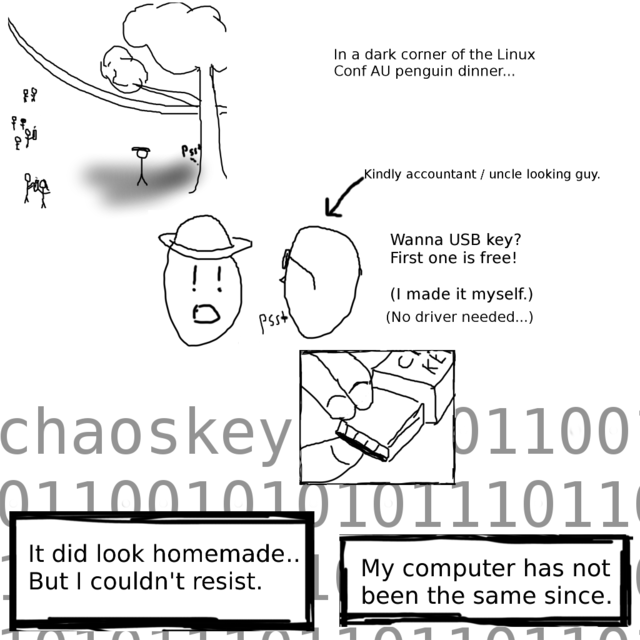
3 panel comic: 1. In a dark corner of the Linux Conf AU penguin dinner. 2. (Kindly accountant / uncle looking guy) Wanna USB key? First one is free! (I made it myself.) (No driver needed..) 3. It did look homemade, but I couldn't resist... My computer has not been the same since This actually happened.
Jan 19 00:05:10 darkstar kernel: usb 2-2: Product: ChaosKey-hw-1.0-sw-1.6.
In real life, my hat is uglier, and Keithp is more kindly looking. gimp source

25 January 2017

Martin-Éric Racine: OpenWRT Backfire on WRT54GL signal strenght

Because I wanted my home router to use at least decently supported software that provides complete out-of-the-box support for native IPv6, I recently got around upgrading my WRT54GL's firmware from White Russian to Backfire, which is the most recent OpenWRT release that fits the hardware's limited amount of flash memory.


One issue remains unanswered:

In GNOME shell's top panel and WiFi menu, the signal strength remains at 2 out of 4 bars. Given how the router sits only a few meters behind me, I would have expected much better signal strength than that.

Would anyone happen to know how to improve on these results? Thanks!

B lint R czey: Stretch preparations before the freeze

These are the last hours when we can update packages and they migrate to testing after 10 days right before the full freeze on 5 February. The latest Wireshark upstream version, 2.2.4 has been released on Monday and it is waiting patiently to be part of next Debian stable. I have just tested the fix for Kodi s bug preventing playing DVD-s and today it will be fixed in unstable as well. If you have packages which could be updated to make Stretch even better you can still do it today, but don t wait too long! Thanks to everyone working on Debian! Stretch will be awesome!

Urvika Gola: Outreachy- Week 4 & 5 Progress

Working with Preferences, AudioManager, RingtoneManager in Android. Sometimes the noise can get too much. Imagine all the people around you at work or in a classroom. All of them have at least one cell phones. Even if they were all to make a tiny blip, the noise would be irritating and disruptive. To avoid devices from interrupting the non-digital life, applications often provide settings that allow users to modify app volumes. My task this week was to enable/disable silent mode in Lumicall. To provide settings for your application, instead of using multiple Views, Preference APIs should be used. Each preference appears as an item in a list and provides the appropriate UI for users to modify the setting. In Lumicall, when settings menu from the menubar is selected, a preference screen is displayed showing various setting options, where I appended a Configure Silent Mode option. The UI for the preference screen is expected to be in Src->xml folder under the name preferences.xml

silentSnippet from Lumicall s preference.xml for Configure Silent Mode preference screen.
In Lumicall, whenever a SIP message comes in, RingtoneManager Class is used to generate a notification sound & AudioManager Class is used to generate sound for incoming encrypted calls. The difference between the two is that, AudioManager provides access to volume and ringer mode control. Ringer modes like, Normal, silent and vibration. Whereas RingtoneManager provides access to ringtones, notification. So to add a simple -disable/enable silent mode- functionality, I decided to use a CheckboxPreference. For the same goal, a better looking widget would be a SwitchPreference, but It does not work properly with DarkThemes which Lumicall uses. So I decided to use a simple Checkbox instead. The result of all the settings are saved as key value pairs in the default SharedPreferences file which can be retrieved to make changes in the app based on the settings modified by the user.
Every preference has a key and the result associated with it.
To fetch the result from the SharedPreferences file-
boolean silentflag=PreferenceManager.getDefaultSharedPreferences(ctx).getBoolean(org.sipdroid.sipua.ui.Settings.PREF_SILENT_MODE, org.sipdroid.sipua.ui.Settings.DEFAULT_SILENT_MODE); Note, the arguments in getBoolean function is (Key, DefaultValue). Don t forget to pass the Context object, ctx in the statement. I wasted a lot of time figuring that one out and created a non-optimal-working way which I eventually had to remove cos I figured out how to retrieve the result value. frustrated
To add a second method of setting silent mode, i.e where the user can enter his work days/time, I wanted to display an activity with required widgets .
To display an activity on a when a preference is selected, intent tags are used. (See the above snippet)
Note that the target package in the intent tags is not the package name of where the java file of the activity is to be found.It s the package name which is your applicationID. Now this activity, like any other activity in android is a combination of an xml and java file.
1. My xml file contains the widgets for user to enter two set of time value in HH:MM format. i.e.the start and end time during which user requires application notifications to be silent it also contains checkboxes for user to select multiple days of the week. 2. The java file associated with this does the following:
2.1 Comparing the Real Time with User s Specified Start and End time
2.2 Checking the current day of the week with the days marked by the user in the checkboxes I have used inbuilt Calendar class and Date class to accomplish this. All done I felt quite proud but this.. this was something that tested my patience and endurance!
As I continue my work, I will keep sharing! Please keep reading!
U


24 January 2017

Jonathan McDowell: Experiments with 1-Wire

As previously mentioned, at the end of last year I got involved with a project involving the use of 1-Wire. In particular a DS28E15 device, intended to be used as a royalty tracker for a licensed piece of hardware IP. I d no previous experience with 1-Wire (other than knowing it s commonly used for driving temperature sensors), so I took it as an opportunity to learn a bit more about it. The primary goal was to program a suitable shared key into the DS28E15 device that would also be present in the corresponding hardware device. A Maxim programmer had been ordered, but wasn t available in stock so had to be back ordered. Of course I turned to my trusty Bus Pirate, which claimed 1-Wire support. However it failed to recognise the presence of the device at all. After much head scratching I finally listened to a co-worker who had suggested it was a clock speed issue - the absence of any option to select the 1-Wire speed in the Bus Pirate or any mention of different speeds in the documentation I had read had made me doubt it was an issue. Turns out that the Bus Pirate was talking standard 1-Wire and the DS28E15 only talks overdrive 1-Wire, to the extent that it won t even announce its presence if the reset pulse conforms to the standard, rather than overdrive, reset time period. Lesson learned: listen to your co-workers sooner. A brief period of yak shaving led to adding support to the Bus Pirate for the overdrive mode (since landed in upstream), and resulted in a search request via the BP interface correctly finding the device and displaying its ROM ID. This allowed exploration of the various commands the authenticator supports, to verify that the programming sequence operated as expected. These allow for setting the shared secret, performing a SHA256 MAC against this secret and a suitable nonce, and retrieving the result. Next problem: the retrieved SHA256 MAC did not match the locally computed value. Initially endianness issues were suspected, but trying the relevant permutations did not help. Some searching found an implementation of SHA256 for the DS28E15 that showed differences between a standard SHA256 computation and what the authenticator performs. In particular SHA256 normally adds the current working state (a-g) to the current hash value (h0-h7) at the end of every block. The authenticator does this for all but the final block, where instead the hash value is set to the working state. I haven t been able to find any documentation from Maxim that this is how things are calculated, nor have I seen any generic implementation of SHA256 which supports this mode. However rolling my own C implementation based on the code I found and using it to compare the results retrieved from the device confirms that this is what s happening. So at this point we re done, right? Wait for the proper programming hardware to turn up, write the key to the devices, profit? Well, no. There was a bit of a saga involving the programmer (actually programmers, one with at least some documentation that allowed the creation of a Python tool to allow setting the key and reading + recording the ROM ID for tracking, and one with no programming documentation that came with a fancy GUI for manually doing the programming), but more importantly it was necessary to confirm that the programmed device interacted with the hardware correctly. Initial testing with the hardware was unsuccessful. Again endianness issues were considered and permutations tried, but without success. A simple key constructed to avoid such issues was tried, and things worked fine. There was a hardware simulation of both components available, so it was decided to run that and obtain a capture of the traffic between them. As the secret key was known this would then allow the random nonce to be captured, and the corresponding (correct) hash value. Tests could then be performed in software to determine what the issue was & how to generate the same hash for verification. Two sets of analyzer software were tried, OpenBench LogicSniffer (OLS) and sigrok. As it happened both failed to correctly decode the bitstream detected as 1-Wire, but were able to show the captured data graphically, allowing for decoding by eye. A slight patch to OLS to relax the timing constraints allowed it to successfully decode the full capture and provided the appropriate data for software reproduction. The end issue? A 256 bit number (as defined in VHDL) is not the same as 32 element byte array Obvious when you know what the issue is! So? What did I learn, other than a lot about 1-Wire? Firstly, don t offhandedly discount suggestions that you don t think make sense. Secondly, having a tool (in this case the Bus Pirate) that lets you easily play with a protocol via a simple interface is invaluable in understanding it. Thirdly, don t trust manufacturers to be doing something in a normal fashion when they claim to be using a well defined technology. Fourthly, be conscious about all of the different ways bitstreams can be actually processed in memory. It s not just endianness. Finally, spending the time to actually understand what s going on up front can really help when things don t work as you d expect later on - without the yak shaving to support Overdrive on the BP I wouldn t have been able to so quickly use the simulation capture to help diagnose the issue.

Shirish Agarwal: Budget and Economics 101

The Budget The story which I wanted to share is there are few friends (from Debian as well as elsewhere) who shared that they didn t get the whole demonetisation play or what the Government is/was trying to do. As budget is just round the corner (India will be presenting its yearly budget on 1st of February), thought it is prudent to share at least some basics, ideas and theories of what goals the Finance Minister would be looking at when presenting his budget. I would NOT talk of Inflation targeting or some such exotica as those topics would require their own blog-posts altogether. I would mainly be talking a bit about Taxation and in that Personal Income Tax. I would also not use words like Receivables and like which thought bit more accurate are not used in everyday language. Just like Private Companies and increasingly public utilities, The Government of the day has two-three different aims when it is presenting a budget a. The first is to give an update about how things went last year. Did all the incomes that were projected, did it happen or was there a short-fall ? If there was a short-fall what were the reasons for the shortfall. Similarly, did all the budgeted expenditure earmarked for the year was spent and were it spent under the heads they were supposed to ? If not what went wrong there ? There is usually a tussle between Planned and Unplanned expenditure and one of the hallmarks of good governance is that unplanned expenditure is kept at minimum, while planned expenditure and projects completion or/and assets coming on-line were within the estimated time-frames. So these updates are given to the Parliament and hence public at large. The second and the more interesting part are the plans for the immediate future, 1 year down-the-line. Based on the performance last year, a bit of crystal-ball gazing of external and internal conditions of the country, the Finance Minister along with her/his colleagues of Finance Ministry. Trivia There hasn t been a female finance minister till date in India. The Finance Ministry as a whole also holds consultations with most sections of the society before sharing/putting his Fiscal Policy (Planned Expenditure) for debate and passage in form of the Budget. While the budget itself is a technical exercise, it is also a Political exercise as both the budget and the finance bill (which contains the taxation proposals) need to be passed in Lok Sabha (Lower house). After passing scrutiny of Lok Sabha (Lower House having people s representatives directly elected) and Rajya Sabha (Upper House, indirectly elected), the taxation proposals becomes the law. It isn t that simple but for our understanding, keeping it simple. This Political model of governance with two houses is modeled under the British (Westminister) model since 1947. The Government, just like any other Organization gives a similar Profit and Loss Account and a Balance Sheet.
How A country's budget is made.

How A country s budget is made. A representational and simplified version of how things flow was made using Graphviz. Click on it to see image in detail.

I am a newbie to graphviz. The graph was made like this
graph Budget
subgraph tier1
node [color="limegreen",style="filled",group="tier1"]
Country_Budget

......
Country_Budget -- Profit_and_Loss_Account [type=s];
It might be possible to make the graph much better than it is currently . The Profit and Loss Account of the Government tells what Incomes it is projected to earn in the upcoming year and whatever Expenditures it hopes to do this year. The Income and Expenditure independently can be bifurcated into two, Revenue Income and Capital Income and Revenue Expenditure and Capital Expenditure.
Indian Railways EMU local train

Indian Railways EMU local train

The simplest example of such planned expenditure which comes to my mind is the Indian Railways Budget which is all planned expenditure. As can be seen even with ample funds Railways were able to spent only 50% of the total amount disbursed last year. Similarly income generation for Railways was far below the target. Examples of Revenue Income include taxes of all sorts, while Capital Income are rare, like divestment/stake sale of a company owned by the Government. These are usually one-off events. Examples of Capital Expenditure is when the Government makes a road, makes a bridge etc. Usually large expenditures come under Capital Expenditure while salaries to Government employees and routine expenditures are known as Revenue Expenditure. There was a statement by the present Government that the last 6-7 years the budgets has been more or less static as far as numbers are concerned. This hampers Government s ability to take up any new work. The Revenue income earned by the Government can again be bifurcated primarily into two Direct Taxes and Indirect Taxes.
INR 2000 Rupees

INR 2000 Rupees

Direct Taxes are those which the Government earns through Personal Income Tax and Corporate Tax. As only 1 percent of Indians pay Personal income tax, the rest Government tries to raise by Hence the Government of the day is in fix. It needs to have more money if it wants to invest into infrastructure, defence spending, social spending such as health and education and so on and so forth. It cannot Another point is that unlike China which is a Large State-backed Enterprises Export-led Economy which has its own problems, India s economy is much more consumption-based, hence any large tinkering upwards may possibly stall whatever little spending the middle-class does, similar to the stall in consumer durables which has been happening over the last few years. There are a couple of short-term solutions that the Government may do While both seem to be attractive ways, but both have their disadvantages also, both have costs associated for them. In the first one, like any other scheme, when any scheme is launched, it needs to be underwritten by GOI which means even if it s not a success they would have to service all and any obligations towards investors. Also they have to be careful how much they are borrowing as excessive borrowing for today could lead to a Greece-like meltdown situation, whether internal or external borrowers. With external borrowers they also usually like to have a guarantee that the Rupee will not slide beyond a point otherwise the Government will have to pay all and any losses but this is going beyond what I wanted to share. Printing excess money in the system could lead to loss in the value of the money itself as well as leading to inflationary pressures which leads to more problems for the poor and greater inequality between the classes among other things. So while the Government may use all of the above ways in varying degrees, the present Government had the idea that if we were to reduce black money or hidden economy (AFAIK no country can claim to completely eliminate it) we would be able to raise the finance we need without a major cost associated to it. For instance, I was reading that even in Canada, it is expected that 20% of black money/shadow economy works and that assessment is by their own taxation authorities. So While doing demonetization, it came out with an equivalent Black Money Declaration Scheme (IDS). The idea is simple, even if 1 percent of the population comes in the traditional tax net the Government of the day would be able to enhance budgets to various expenditure. Now while the idea is good in theory, implementation has been the Achilees heel. While the Government s expected something like 15% of the whole economy was black money or shadow money, almost 95% of the money in circulation came back in Banks during demonetization ( These are unofficial figures, Finance Ministry/RBI would be disclosing the real figures on 1st of February 2017 so we will know). It is suspected that 10% of money in Banks is black money. There are considerable costs to search analyze, prove in the court of law that it is so. There are and would be considerable costs to train new officers as existing Income Tax Officers are already burdened with Advance Tax being paid by Corporates and small business-man paying round the year (every 3 months), The existing Income Tax Officers already have their hands full. Also till Governments don t fix up realty sector/real-estate sector and other places where the black money/shadow economy may prevail. Hence all the training, salary, buildings where new Income Tax Officers could work, infrastructure, new buildings where suspect cases have to be tried and lawyers for those. As have shared a few times on this blog, India has almost 29 million court cases pending in the lower judiciary alone. Unless any such cases are not successfully tried within time by the Government, it would be a waste. Now whether the Government knew of these issues or not would probably be never known. Lastly, there is a voluntary part that the Government hopes, that they will by themselves join the mainstream tax-paying public. This might happen but any such happening will happen over years. People make their own choices. And unless there are not any stick and carrot approach to the Government s Policies people will tend to go back to their old ways. I would share an example from the demonetisation process which would help prove my point During demonetization, there was a great push towards doing digital transaction either via smartphones or greater usage of debit and credit cards etc. For the first 60 days till 31st December 2016, you could do digital transactions without paying any transaction fee. During that period, I used my Debit card to shop, to eat at restaurants or/and even small shops. But come 1st January 2017, the charges for digital transactions are anything between 1.5% to 3% of transactions. Naturally, I stopped using them and use them very sparingly where cash won t work. So at the end, while the Government made the whole demonetization drive to drive out shadow economy, terror financing etc. While terror financing has been hurt quite a bit, the same cannot be said of the shadow/black economy. It seems that the Government would need to close many more doors and windows before people join the mainstream. While Politically it was risky, socially it was also a bit risky move as it was uncertain how and where things will move. Venezuela tried the same thing and fell flat on its face. All said and done, if and when people become part of the tax-paying class/people, The most optimistic idea that the Government has that everybody will go cashless and it would be far easier to find out who s not paying taxes. As shared before, I don t think this will happen unless the charges for cashless is at 0.05% or something similar. Even IF people do join the mainstream, it is very much possible that the present Govt. will not enjoy fruits of this labour as fruits might come in 2018/19 or even later even if they do come. So whether the decision had the right affect or not, we may never come to know. Governments tend to tinker around with the figures as well. But I hope some idea of how things happen is known now.
Filed under: Miscellenous Tagged: #demonetization, #Government Budget, #graphviz, #Limitations, #Profit and Loss Account, #Taxation

23 January 2017

Matthew Garrett: Android permissions and hypocrisy

I wrote a piece a few days ago about how the Meitu app asked for a bunch of permissions in ways that might concern people, but which were not actually any worse than many other apps. The fact that Android makes it so easy for apps to obtain data that's personally identifiable is of concern, but in the absence of another stable device identifier this is the sort of thing that capitalism is inherently going to end up making use of. Fundamentally, this is Google's problem to fix.

Around the same time, Kaspersky, the Russian anti-virus company, wrote a blog post that warned people about this specific app. It was framed somewhat misleadingly - "reading, deleting and modifying the data in your phone's memory" would probably be interpreted by most people as something other than "the ability to modify data on your phone's external storage", although it ends with some reasonable advice that users should ask why an app requires some permissions.

So, to that end, here are the permissions that Kaspersky request on Android:
Every single permission that Kaspersky mention Meitu having? They require it as well. And a lot more. Why does Kaspersky want the ability to record audio? Why does it want to be able to send SMSes? Why does it want to read my contacts? Why does it need my fine-grained location? Why is it able to modify my settings?

There's no reason to assume that they're being malicious here. The reasons that these permissions exist at all is that there are legitimate reasons to use them, and Kaspersky may well have good reason to request them. But they don't explain that, and they do literally everything that their blog post criticises (including explicitly requesting the phone's IMEI). Why should we trust a Russian company more than a Chinese one?

The moral here isn't that Kaspersky are evil or that Meitu are virtuous. It's that talking about application permissions is difficult and we don't have the language to explain to users what our apps are doing and why they're doing it, and Google are still falling far short of where they should be in terms of making this transparent to users. But the other moral is that you shouldn't complain about the permissions an app requires when you're asking for even more of them because it just makes you look stupid and bad at your job.

comment count unavailable comments

Next.

Previous.