VLANd is a python program intended to make it easy to manage
port-based VLAN setups across multiple switches in a network. It is
designed to be vendor-agnostic, with a clean pluggable driver API to
allow for a wide range of different switches to be controlled
together.
There's more information in
the README
file. I've just released v0.3, with a lot of changes included since
the last release:
My monthly report covers a large part of what I have been doing in the free software world. I write it for my donators (thanks to them!) but also for the wider Debian community because it can give ideas to newcomers and it s one of the best ways to find volunteers to work with me on projects that matter to me.
Debian LTS
This month I have been paid to work 15 hours on Debian LTS. In that time I did the following:
Kali Linux wants to experiment something close to Debian Constantly Usable Testing: we have a kali-rolling release that is based on Debian Testing and we want to take a new snapshot every 4 months (in order to have 3 releases per year).
More specifically we have a kali-dev repository which is exactly Debian Stretch + our own Kali packages (the kali package take precedence) updated 4 times a day, just like testing is. And we have a britney2 setup that generates kali-rolling out of kali-dev (without any requirement in terms of delay/RC bugs, it just ensures that dependencies are not broken), also 4 times a day.
We have jenkins job that ensures that our metapackages are installable in kali-dev (and kali-rolling) and that we can build our ISO images. When things break, I have to fix them and I try to fix them on the Debian side first. So here are some examples of stuff I did in response to various failures:
how-can-i-help -s testing-autorm --old I just submitted #794238 as a wishlist against how-can-i-help.
At the same time, there are bugs that make it into testing and that I fix / work around on the Kali side. But those fixes / work around might be more useful if they were pushed to testing via testing-proposed-updates. I tried to see whether other derivatives had similar needs to see if derivatives could join their efforts at this level but it does not look like so for now.
Last but not least, bugs reported on the Kali side also resulted in Debian improvements:
2 comments Liked this article? Click here. My blog is Flattr-enabled.
The DUCK challenge is making a quite stable progress: in the last 4 weeks there were approximately 12.25 packages fixed and uploaded per week.
In the current week the following packages were fixed and uploaded into unstable:
| Week 1 | Week 2 | Week 3 | Week 4 | Week 5 | Week 6 | Week 7 | |
|---|---|---|---|---|---|---|---|
| # Packages | 10 | 15 | 10 | 14 | - | - | - |
| Total | 10 | 25 | 35 | 49 | - | - | - |
So we're in Finland, and the differences start out immediately.
We're renting a flat, in building ten, on a street. You'd think "10
Streetname" was a single building, but no. It is a pair of buildings: 10A, and 10B.
Both of the buildings have 12 flats in them, with 10A having 1-12, and 10B having 13-24.
There's a keypad at the main entrance, which I assumed was to let you press a button and talk to the people inside "Hello I'm the postmaster", but no. There is no intercom system, instead you type in a magic number and the door opens.
The magic number? Sounds like you want to keep that secret, since it lets people into the common-area? No. Everybody has it. The postman, the cleaners, the DHL delivery man, and all the ex-tenants. We invited somebody over recently and gave it out in advance so that they could knock on our flat-door.
Talking of cleaners: In the UK I lived in a flat and once a fortnight somebody would come and sweep the stair-well, since we didn't ever agree to do it ourselves. Here somebody turns up every day, be it to cut the grass, polish the hand-rail, clean the glass on the front-door, or mop the floors of the common area. Sounds awesome. But they cut the grass, right outside our window, at 7:30AM. On the dot. (Or use a leaf-blower, or something equally noisy.)
All this communal-care is paid for by the building-association, of which all flat-owners own shares. Sounds like something we see in England, or even like Americas idea of a Home-Owners-Association. (In Scotland you own your own flat, you don't own shares of an entity which owns the complete building. I guess there are pros and cons to both approaches.)
Moving onwards other things are often the same, but the differences when you spot them are odd. I'm struggling to think of them right now, somebody woke me up by cutting our grass for the second time this week (!)
Anyway I'm registered now with the Finnish government, and have a citizen-number, which will be useful, I've got an appointment booked to register with the police - which is something I had to do as a foreigner within the first three months - and today I've got an appointment with a local bank so that I can have a euro-bank-account.
Happily I did find a gym to join, the owner came over one Sunday to
give me a tiny-tour, and then gave me a list of other gyms to try if
his wasn't good enough - which was a nice touch - I joined a couple of
days later, his gym is awesome.
(I'm getting paid in UK-pounds, to a UK-bank, so right now I'm getting local money by transferring to my wifes account here, but I want to do that to my own, and open a shared account for paying for rent, electricity, internet, water, & etc).
My flat back home is still not rented, because the nice property management company lost my keys. Yeah you can't make that up can you? With a bit of luck the second set of keys I mailed them will arrive soon and the damn thing can be occupied, while I'm not relying on that income I do wish to have it.
Dear Debian/KDE users,
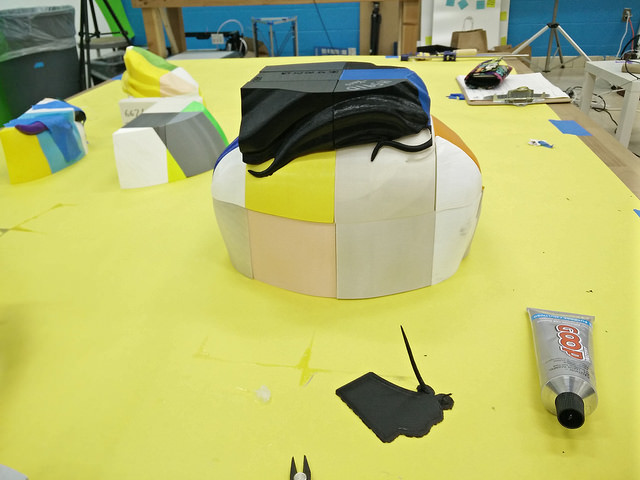
I helped print this statue of Edgar Allan Poe, through We the Builders , who coordinate large-scale crowd-sourced 3D print jobs:
You can see one of my parts here on top, with -Kees on the piece with the funky hair strand:
The MakerWare I run on Ubuntu works well. I wish they were correctly signing their repositories. Even if I use non-SSL to fetch their key, as their Ubuntu/Debian instructions recommend, it still doesn t match the packages:
W: GPG error: http://downloads.makerbot.com trusty Release: The following signatures were invalid: BADSIG 3D019B838FB1487F MakerBot Industries dev team <dev@makerbot.com>And it s not just my APT configuration:
$ wget http://downloads.makerbot.com/makerware/ubuntu/dists/trusty/Release.gpg $ wget http://downloads.makerbot.com/makerware/ubuntu/dists/trusty/Release $ gpg --verify Release.gpg Release gpg: Signature made Wed 11 Mar 2015 12:43:07 PM PDT using RSA key ID 8FB1487F gpg: requesting key 8FB1487F from hkp server pgp.mit.edu gpg: key 8FB1487F: public key "MakerBot Industries LLC (Software development team) <dev@makerbot.com>" imported gpg: Total number processed: 1 gpg: imported: 1 (RSA: 1) gpg: BAD signature from "MakerBot Industries LLC (Software development team) <dev@makerbot.com>" $ grep ^Date Release Date: Tue, 09 Jun 2015 19:41:02 UTCLooks like they re updating their Release file without updating the signature file. (The signature is from March, but the Release file is from June. Oops!)
2015, Kees Cook. This work is licensed under a Creative Commons Attribution-ShareAlike 3.0 License.
midna /tmp $ dh-make-golang github.com/jacobsa/ratelimit 2015/07/25 18:25:39 Downloading "github.com/jacobsa/ratelimit/..." 2015/07/25 18:25:53 Determining upstream version number 2015/07/25 18:25:53 Package version is "0.0~git20150723.0.2ca5e0c" 2015/07/25 18:25:53 Determining dependencies 2015/07/25 18:25:55 2015/07/25 18:25:55 Packaging successfully created in /tmp/golang-github-jacobsa-ratelimit 2015/07/25 18:25:55 2015/07/25 18:25:55 Resolve all TODOs in itp-golang-github-jacobsa-ratelimit.txt, then email it out: 2015/07/25 18:25:55 sendmail -t -f < itp-golang-github-jacobsa-ratelimit.txt 2015/07/25 18:25:55 2015/07/25 18:25:55 Resolve all the TODOs in debian/, find them using: 2015/07/25 18:25:55 grep -r TODO debian 2015/07/25 18:25:55 2015/07/25 18:25:55 To build the package, commit the packaging and use gbp buildpackage: 2015/07/25 18:25:55 git add debian && git commit -a -m 'Initial packaging' 2015/07/25 18:25:55 gbp buildpackage --git-pbuilder 2015/07/25 18:25:55 2015/07/25 18:25:55 To create the packaging git repository on alioth, use: 2015/07/25 18:25:55 ssh git.debian.org "/git/pkg-go/setup-repository golang-github-jacobsa-ratelimit 'Packaging for golang-github-jacobsa-ratelimit'" 2015/07/25 18:25:55 2015/07/25 18:25:55 Once you are happy with your packaging, push it to alioth using: 2015/07/25 18:25:55 git push git+ssh://git.debian.org/git/pkg-go/packages/golang-github-jacobsa-ratelimit.git --tags master pristine-tar upstreamThe ITP is often the most labor-intensive part of the packaging process, because any number of auto-detected values might be wrong: the repository owner might not be the Upstream Author , the repository might not have a short description, the long description might need some adjustments or the license might not be auto-detected.
midna /tmp $ cat itp-golang-github-jacobsa-ratelimit.txt From: "Michael Stapelberg" <stapelberg AT debian.org> To: submit@bugs.debian.org Subject: ITP: golang-github-jacobsa-ratelimit -- Go package for rate limiting Content-Type: text/plain; charset=utf-8 Content-Transfer-Encoding: 8bit Package: wnpp Severity: wishlist Owner: Michael Stapelberg <stapelberg AT debian.org> * Package name : golang-github-jacobsa-ratelimit Version : 0.0~git20150723.0.2ca5e0c-1 Upstream Author : Aaron Jacobs * URL : https://github.com/jacobsa/ratelimit * License : Apache-2.0 Programming Lang: Go Description : Go package for rate limiting GoDoc (https://godoc.org/github.com/jacobsa/ratelimit) . This package contains code for dealing with rate limiting. See the reference (http://godoc.org/github.com/jacobsa/ratelimit) for more info. TODO: perhaps reasoning midna /tmp $After filling in all the TODOs in the file, let s mail it out and get a sense of what else still needs to be done:
midna /tmp $ sendmail -t -f < itp-golang-github-jacobsa-ratelimit.txt midna /tmp $ cd golang-github-jacobsa-ratelimit midna /tmp/golang-github-jacobsa-ratelimit master $ grep -r TODO debian debian/changelog: * Initial release (Closes: TODO) midna /tmp/golang-github-jacobsa-ratelimit master $After filling in these TODOs as well, let s have a final look at what we re about to build:
midna /tmp/golang-github-jacobsa-ratelimit master $ head -100 debian/**/* ==> debian/changelog <== golang-github-jacobsa-ratelimit (0.0~git20150723.0.2ca5e0c-1) unstable; urgency=medium * Initial release (Closes: #793646) -- Michael Stapelberg <stapelberg@debian.org> Sat, 25 Jul 2015 23:26:34 +0200 ==> debian/compat <== 9 ==> debian/control <== Source: golang-github-jacobsa-ratelimit Section: devel Priority: extra Maintainer: pkg-go <pkg-go-maintainers@lists.alioth.debian.org> Uploaders: Michael Stapelberg <stapelberg@debian.org> Build-Depends: debhelper (>= 9), dh-golang, golang-go, golang-github-jacobsa-gcloud-dev, golang-github-jacobsa-oglematchers-dev, golang-github-jacobsa-ogletest-dev, golang-github-jacobsa-syncutil-dev, golang-golang-x-net-dev Standards-Version: 3.9.6 Homepage: https://github.com/jacobsa/ratelimit Vcs-Browser: http://anonscm.debian.org/gitweb/?p=pkg-go/packages/golang-github-jacobsa-ratelimit.git;a=summary Vcs-Git: git://anonscm.debian.org/pkg-go/packages/golang-github-jacobsa-ratelimit.git Package: golang-github-jacobsa-ratelimit-dev Architecture: all Depends: $ shlibs:Depends , $ misc:Depends , golang-go, golang-github-jacobsa-gcloud-dev, golang-github-jacobsa-oglematchers-dev, golang-github-jacobsa-ogletest-dev, golang-github-jacobsa-syncutil-dev, golang-golang-x-net-dev Built-Using: $ misc:Built-Using Description: Go package for rate limiting This package contains code for dealing with rate limiting. See the reference (http://godoc.org/github.com/jacobsa/ratelimit) for more info. ==> debian/copyright <== Format: http://www.debian.org/doc/packaging-manuals/copyright-format/1.0/ Upstream-Name: ratelimit Source: https://github.com/jacobsa/ratelimit Files: * Copyright: 2015 Aaron Jacobs License: Apache-2.0 Files: debian/* Copyright: 2015 Michael Stapelberg <stapelberg@debian.org> License: Apache-2.0 Comment: Debian packaging is licensed under the same terms as upstream License: Apache-2.0 Licensed under the Apache License, Version 2.0 (the "License"); you may not use this file except in compliance with the License. You may obtain a copy of the License at . http://www.apache.org/licenses/LICENSE-2.0 . Unless required by applicable law or agreed to in writing, software distributed under the License is distributed on an "AS IS" BASIS, WITHOUT WARRANTIES OR CONDITIONS OF ANY KIND, either express or implied. See the License for the specific language governing permissions and limitations under the License. . On Debian systems, the complete text of the Apache version 2.0 license can be found in "/usr/share/common-licenses/Apache-2.0". ==> debian/gbp.conf <== [DEFAULT] pristine-tar = True ==> debian/rules <== #!/usr/bin/make -f export DH_GOPKG := github.com/jacobsa/ratelimit %: dh $@ --buildsystem=golang --with=golang ==> debian/source <== head: error reading debian/source : Is a directory ==> debian/source/format <== 3.0 (quilt) midna /tmp/golang-github-jacobsa-ratelimit master $Okay, then. Let s give it a shot and see if it builds:
midna /tmp/golang-github-jacobsa-ratelimit master $ git add debian && git commit -a -m 'Initial packaging' [master 48f4c25] Initial packaging 7 files changed, 75 insertions(+) create mode 100644 debian/changelog create mode 100644 debian/compat create mode 100644 debian/control create mode 100644 debian/copyright create mode 100644 debian/gbp.conf create mode 100755 debian/rules create mode 100644 debian/source/format midna /tmp/golang-github-jacobsa-ratelimit master $ gbp buildpackage --git-pbuilder [ ] midna /tmp/golang-github-jacobsa-ratelimit master $ lintian ../golang-github-jacobsa-ratelimit_0.0\~git20150723.0.2ca5e0c-1_amd64.changes I: golang-github-jacobsa-ratelimit source: debian-watch-file-is-missing P: golang-github-jacobsa-ratelimit-dev: no-upstream-changelog I: golang-github-jacobsa-ratelimit-dev: extended-description-is-probably-too-short midna /tmp/golang-github-jacobsa-ratelimit master $This package just built (as it should!), but occasionally one might need to disable a test and file an upstream bug about it. So, let s push this package to pkg-go and upload it:
midna /tmp/golang-github-jacobsa-ratelimit master $ ssh git.debian.org "/git/pkg-go/setup-repository golang-github-jacobsa-ratelimit 'Packaging for golang-github-jacobsa-ratelimit'" Initialized empty shared Git repository in /srv/git.debian.org/git/pkg-go/packages/golang-github-jacobsa-ratelimit.git/ HEAD is now at ea6b1c5 add mrconfig for dh-make-golang [master c5be5a1] add mrconfig for golang-github-jacobsa-ratelimit 1 file changed, 3 insertions(+) To /git/pkg-go/meta.git ea6b1c5..c5be5a1 master -> master midna /tmp/golang-github-jacobsa-ratelimit master $ git push git+ssh://git.debian.org/git/pkg-go/packages/golang-github-jacobsa-ratelimit.git --tags master pristine-tar upstream Counting objects: 31, done. Delta compression using up to 8 threads. Compressing objects: 100% (25/25), done. Writing objects: 100% (31/31), 18.38 KiB 0 bytes/s, done. Total 31 (delta 2), reused 0 (delta 0) To git+ssh://git.debian.org/git/pkg-go/packages/golang-github-jacobsa-ratelimit.git * [new branch] master -> master * [new branch] pristine-tar -> pristine-tar * [new branch] upstream -> upstream * [new tag] upstream/0.0_git20150723.0.2ca5e0c -> upstream/0.0_git20150723.0.2ca5e0c midna /tmp/golang-github-jacobsa-ratelimit master $ cd .. midna /tmp $ debsign golang-github-jacobsa-ratelimit_0.0\~git20150723.0.2ca5e0c-1_amd64.changes [ ] midna /tmp $ dput golang-github-jacobsa-ratelimit_0.0\~git20150723.0.2ca5e0c-1_amd64.changes Uploading golang-github-jacobsa-ratelimit using ftp to ftp-master (host: ftp.upload.debian.org; directory: /pub/UploadQueue/) [ ] Uploading golang-github-jacobsa-ratelimit_0.0~git20150723.0.2ca5e0c-1.dsc Uploading golang-github-jacobsa-ratelimit_0.0~git20150723.0.2ca5e0c.orig.tar.bz2 Uploading golang-github-jacobsa-ratelimit_0.0~git20150723.0.2ca5e0c-1.debian.tar.xz Uploading golang-github-jacobsa-ratelimit-dev_0.0~git20150723.0.2ca5e0c-1_all.deb Uploading golang-github-jacobsa-ratelimit_0.0~git20150723.0.2ca5e0c-1_amd64.changes midna /tmp $ cd golang-github-jacobsa-ratelimit midna /tmp/golang-github-jacobsa-ratelimit master $ git tag debian/0.0_git20150723.0.2ca5e0c-1 midna /tmp/golang-github-jacobsa-ratelimit master $ git push git+ssh://git.debian.org/git/pkg-go/packages/golang-github-jacobsa-ratelimit.git --tags master pristine-tar upstream Total 0 (delta 0), reused 0 (delta 0) To git+ssh://git.debian.org/git/pkg-go/packages/golang-github-jacobsa-ratelimit.git * [new tag] debian/0.0_git20150723.0.2ca5e0c-1 -> debian/0.0_git20150723.0.2ca5e0c-1 midna /tmp/golang-github-jacobsa-ratelimit master $Thanks for reading this far, and I hope dh-make-golang makes your life a tiny bit easier. As dh-make-golang just entered Debian unstable, you can install it using
apt-get install
dh-make-golang. If you have any feedback, I m eager to hear it.
Hadley is a popular figure, and rightly so as he successfully introduced many newcomers to the wonders offered by R. His approach strikes some of us old greybeards as wrong---I particularly take exception with some of his writing which frequently portrays a particular approach as both the best and only one. Real programming, I think, is often a little more nuanced and aware of tradeoffs which need to be balanced. As a book on another language once popularized: "There is more than one way to do things." But let us leave this discussion for another time.
As the reach of the Hadleyverse keeps spreading, we sometimes find ourselves at the receiving end of a cost/benefit tradeoff. That is what this post is about, and it uses a very concrete case I encountered yesterday.
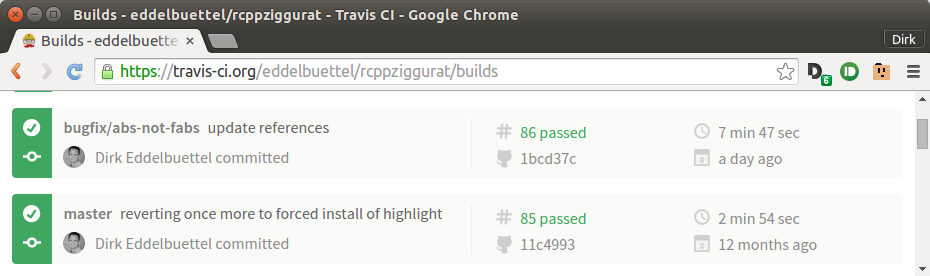
As blogged earlier, the RcppZiggurat package was updated. I had not touched it in a year, but Brian Ripley had sent a brief and detailed note concerning something flagged by the Solaris compiler (correctly suggesting I replace fabs() with abs() on integer types). (Allow me to stray from the main story line here for a second to stress just how insane a work load he is carrying, essentially for all of us. R and the R community are so just so indebted to him for all his work---which makes the usual social media banter about him so unfortunate. But that too shall be left for another time.) Upon making the simple fix, and submitting to GitHub the usual Travis CI was triggered. And here is what I saw:
- ./travis-tool.sh install_r RcppGSL rbenchmark microbenchmark highlight
which implies source builds of the four listed packages and all their dependencies with the following line implying binary installations of already built packages:
- ./travis-tool.sh install_aptget libgsl0-dev r-cran-rcppgsl r-cran-rbenchmark r-cran-microbenchmark r-cran-highlight
In this particular case I also needed to build a binary package of my RcppGSL package as this one is not (yet) handled by Michael. I happen to have (re-)discovered the beauty of PPAs for Travis earlier this year and revitalized an older and largely dormant launchpad account I had for this PPA of mine. How to build a simple .deb package will also have to left for a future post to keep this more concise.
This can be used with the existing r-travis setup---but one needs to use the older, initial variant in order to have the ability to install .deb packages. So in the .travis.yml of RcppZiggurat I just use
before_install:
## PPA for Rcpp and some other packages
- sudo add-apt-repository -y ppa:edd/misc
## r-travis by Craig Citro et al
- curl -OL http://raw.github.com/craigcitro/r-travis/master/scripts/travis-tool.sh
- chmod 755 ./travis-tool.sh
- ./travis-tool.sh bootstrap
to add my own PPA and all is good. If you do not have a PPA, or do not want to create your own packages you can still benefit from the PPAs by Michael and "mix and match" by installing from binary what is available, and from source what is not.
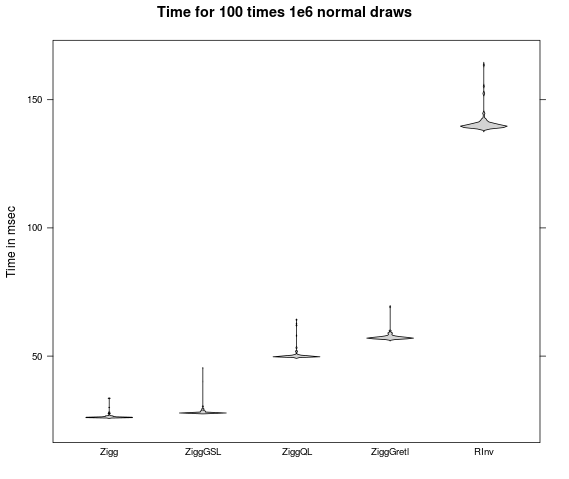
Here we were able to use an all-binary approach, so let's see the resulting performance:
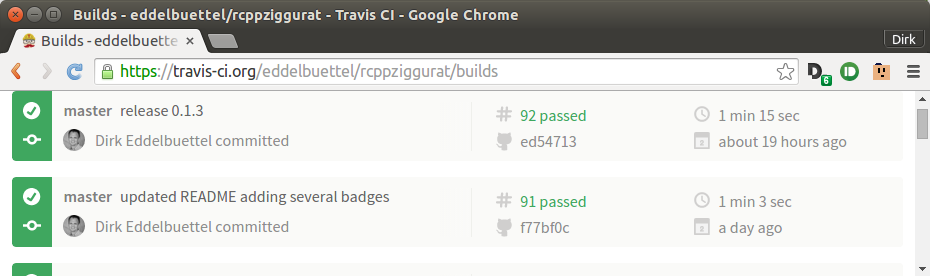
Follow-up: The post got some pretty immediate feedback shortly after I posted it. Craig Citro pointed out (quite correctly) that I could use r_binary_install which would also install the Ubuntu binaries based on their R packages names. Having built R/CRAN packages for Debian for so long, I am simply more used to the r-cran-* notations, and I think I was also the one contributing install_aptget to r-travis ... Yihui Xie spoke up for the "new" Travis approach deploying containers, caching of packages and explicit whitelists. It was in that very (GH-based) discussion that I started to really lose faith in the new Travis approach as they want use to whitelist each and every package. With 6900 and counting at CRAN I fear this simply does not scale. But different approaches are certainly welcome. I posted my 1:03 to 1:15 minutes result. If the "New School" can do it faster, I'd be all ears.
This post by Dirk Eddelbuettel originated on his Thinking inside the box blog. Please report excessive re-aggregation in third-party for-profit settings.
this week, besides other activities, I again managed to NMU a few packages
as part of the GCC

5 transition. & again I could build on patches submitted by various
HP engineers & other helpful souls.
What happened in the reproducible
builds effort this week:
Toolchain fixes
DEB_CHANGELOG_DATETIME with non English locales.SOURCE_DATE_EPOCH and use UTC as a timezone. A modified package is now being experimented.
Packages fixed
The following 14 packages became reproducible due to changes in their
build dependencies:
bino,
cfengine2,
fwknop,
gnome-software,
jnr-constants,
libextractor,
libgtop2,
maven-compiler-plugin,
mk-configure,
nanoc,
octave-splines,
octave-symbolic,
riece,
vdr-plugin-infosatepg.
The following packages became reproducible after getting fixed:
debian/changelog entry.debian/changelog entry.debian/changelog entry.debian/changelog entry.debian/changelog entry.debian/changelog entry.debian/changelog entry.debian/changelog entry.debian/changelog entry.debian/changelog entry.debian/changelog entry.debian/changelog entry.debian/changelog entry.debian/changelog entry.debian/changelog entry.debian/changelog entry.debian/changelog entry.debian/changelog entry.debian/changelog entry.debian/changelog entry.debian/changelog entry.debian/changelog entry.debian/changelog entry.debian/changelog entry.debian/changelog entry.debian/changelog entry.debian/changelog entry.debian/changelog entry.debian/changelog entry.debian/changelog entry.debian/changelog entry.debian/changelog entry.debian/changelog entry.debian/changelog entry.debian/changelog entry.debian/changelog entry.debian/changelog entry.debian/changelog entry.debian/changelog entry.debian/changelog entry.debian/changelog entry.debian/changelog entry.debian/changelog entry.debian/changelog entry.debian/changelog entry.debian/changelog entry.debian/changelog entry.debian/changelog entry.debian/changelog entry.debian/changelog entry.TZ=UTC when calling zip.TZ=UTC when calling zip.TZ=UTC when calling zip.
What happened in the reproducible
builds effort this week:
Toolchain fixes
Eric Dorlan uploaded automake-1.15/1:1.15-2 which makes the output of mdate-sh deterministic. Original patch by Reiner Herrmann.
Kenneth J. Pronovici uploaded epydoc/3.0.1+dfsg-8 which now honors SOURCE_DATE_EPOCH. Original patch by Reiner Herrmann.
Chris Lamb submitted a patch to dh-python to make the order of the generated maintainer scripts deterministic. Chris also offered a fix for a source of non-determinism in dpkg-shlibdeps when packages have alternative dependencies.
Dhole provided a patch to add support for SOURCE_DATE_EPOCH to gettext.
Packages fixed
The following 78 packages became reproducible in our setup due to changes in their
build dependencies:
chemical-mime-data,
clojure-contrib,
cobertura-maven-plugin,
cpm,
davical,
debian-security-support,
dfc,
diction,
dvdwizard,
galternatives,
gentlyweb-utils,
gifticlib,
gmtkbabel,
gnuplot-mode,
gplanarity,
gpodder,
gtg-trace,
gyoto,
highlight.js,
htp,
ibus-table,
impressive,
jags,
jansi-native,
jnr-constants,
jthread,
jwm,
khronos-api,
latex-coffee-stains,
latex-make,
latex2rtf,
latexdiff,
libcrcutil,
libdc0,
libdc1394-22,
libidn2-0,
libint,
libjava-jdbc-clojure,
libkryo-java,
libphone-ui-shr,
libpicocontainer-java,
libraw1394,
librostlab-blast,
librostlab,
libshevek,
libstxxl,
libtools-logging-clojure,
libtools-macro-clojure,
litl,
londonlaw,
ltsp,
macsyfinder,
mapnik,
maven-compiler-plugin,
mc,
microdc2,
miniupnpd,
monajat,
navit,
pdmenu,
pirl,
plm,
scikit-learn,
snp-sites,
sra-sdk,
sunpinyin,
tilda,
vdr-plugin-dvd,
vdr-plugin-epgsearch,
vdr-plugin-remote,
vdr-plugin-spider,
vdr-plugin-streamdev,
vdr-plugin-sudoku,
vdr-plugin-xineliboutput,
veromix,
voxbo,
xaos,
xbae.
The following packages became reproducible after getting fixed:
LC_ALL=C when running sort.TZ=UTC when calling unzip.Makefile.debian/changelog in version string.TZ=UTC when calling unzip.TZ=UTC when calling unzip.TZ=UTC when calling unzip.TZ=UTC when calling unzip.TZ=UTC when calling unzip.debian/changelog in manpages.*.pyo and *.pyc from binary package.debian/changelog when generating version strings.debian/changelog.freebsd-hackers mailing list. The build is run on a new virtual machine running FreeBSD 10.1 with 3 cores and 6 GB of RAM, also sponsored by Profitbricks.
strip-nondeterminism development
Andrew Ayer released version 0.009 of strip-nondeterminism. The new version will strip locales from Javadoc, include the name of files causing errors, and ignore unhandled (but rare) zip64 archives.
debbindiff development
Lunar continued its major refactoring to enhance code reuse and pave the way to fuzzy-matching and parallel processing. Most file comparators have now been converted to the new class hierarchy.
In order to support for archive formats, work has started on packaging Python bindings for libarchive. While getting support for more archive formats with a common interface is very nice, libarchive is a stream oriented library and might have bad performance with how debbindiff currently works. Time will tell if better solutions need to be found.
Documentation update
Lunar started a Reproducible builds HOWTO intended to explain the different aspects of making software build reproducibly to the different audiences that might have to get involved like software authors, producers of binary packages, and distributors.
Package reviews
17 obsolete
reviews have
been removed, 212 added and 46 updated this week.
15 new bugs for packages failing to build from sources have been reported by Chris West (Faux), and Mattia Rizzolo.
Presentations
Lunar presented Debian efforts and some recipes on making software build reproducibly at Libre Software Meeting 2015. Slides and a video recording are available.
Misc.
h01ger, dkg, and Lunar attended a Core Infrastructure Initiative meeting. The progress and tools mode for the Debian efforts were shown. Several discussions also helped getting a better understanding of the needs of other free software projects regarding reproducible builds. The idea of a global append only log, similar to the logs used for Certificate Transparency, came up on multiple occasions. Using such append only logs for keeping records of sources and build results has gotten the name Binary Transparency Logs . They would at least help identifying a compromised software signing key. Whether the benefits in using such logs justify the costs need more research.
After a slight hiatus since the last release in early 2014, we are delighted to announce a new release of RcppZiggurat which is now on the CRAN network for R.
The RcppZiggurat package updates the code for the Ziggurat generator which provides very fast draws from a Normal distribution.
The package provides a simple C++ wrapper class for the generator improving on the very basic macros, and permits comparison among several existing Ziggurat implementations. This can be seen in the figure where Ziggurat from this package dominates accessing the implementations from the GSL, QuantLib and Gretl---all of which are still way faster than the default Normal generator in R (which is of course of higher code complexity).
This release contains a few internal cleanups relative to the last release. It was triggered by a very helpful email from Brian Ripley who notices compiler warnings on the Solaris platform due to my incorrect use of on integer variables.
The NEWS file entry below lists all changes.
Changes in version 0.1.3 (2015-07-25)Courtesy of CRANberries, there is also a diffstat report for the most recent release. More information is on the RcppZiggurat page.
- Use the
SHR3generator for the default implementation just like Leong et al do, making our default implementation identical to theirs (but 32- and 64-bit compatible)- Switched generators from
floattodoubleensuring that results are identical on 32- and 64-bit platforms- Simplified builds with respect to GSL use via the RcppGSL package; added a seed setter for the GSL variant
- Corrected use of
fabs()toabs()on integer variables, with a grateful nod to Brian Ripley for the hint (based on CRAN checks on the beloved Slowlaris machines)- Accelerated Travis CI tests by relying exclusively on
r-cran-*packages from the PPAs by Michael Rutter and myself- Updated
DESCRIPTIONandNAMESPACEaccording to current best practices, andR-devel CMD check --as-cranchecks
This post by Dirk Eddelbuettel originated on his Thinking inside the box blog. Please report excessive re-aggregation in third-party for-profit settings.
A new release 0.12.0 of Rcpp arrived on the CRAN network for GNU R this morning, and I also pushed a Debian package upload.
Rcpp has become the most popular way of enhancing GNU R with C++ code. As of today, 423 packages on CRAN depend on Rcpp for making analyses go faster and further. Note that this is 60 more packages since the last release in May! Also, BioConductor adds another 57 packages, and casual searches on GitHub suggests many more.
And according to Andrie De Vries, Rcpp has now page rank of one on CRAN as well!
And with this release, Rcpp also becomes ready for Big Data, or, as they call it in Texas, Data.
Thanks to a lot of work and several pull requests by Qiang Kou, support for R_xlen_t has been added.
That means we can now do stunts like
R> library(Rcpp)
R> big <- 2^31-1
R> bigM <- rep(NA, big)
R> bigM2 <- c(bigM, bigM)
R> cppFunction("double getSz(LogicalVector x) return x.length(); ")
R> getSz(bigM)
[1] 2147483647
R> getSz(bigM2)
[1] 4294967294
R>
where prior versions of Rcpp would just have said
> getSz(bigM2)
Error in getSz(bigM2) :
long vectors not supported yet: ../../src/include/Rinlinedfuns.h:137
>
which is clearly not Texas-style. Another wellcome change, also thanks to Qiang Kou, adds encoding support for strings.
A lot of other things got polished. We are still improving exception handling as we still get the odd curveballs in a corner cases. Matt Dziubinski corrected the var() computation to use the proper two-pass method and added better support for lambda functions in Sugar expression using sapply(), Qiang Kou added more pull requests mostly for string initialization, and Romain added a pull request which made data frame creation a little more robust, and JJ was his usual self in tirelessly looking after all aspects of Rcpp Attributes.
As always, you can follow the development via the GitHub repo and particularly the Issue tickets and Pull Requests. And any discussions, questions, ... regarding Rcpp are always welcome at the rcpp-devel mailing list.
Last but not least, we are also extremely pleased to annouce that Qiang Kou has joined us in the Rcpp-Core team. We are looking forward to a lot more awesome!
See below for a detailed list of changes extracted from the NEWS file.
Changes in Rcpp version 0.12.0 (2015-07-24)Thanks to CRANberries, you can also look at a diff to the previous release As always, even fuller details are on the Rcpp Changelog page and the Rcpp page which also leads to the downloads page, the browseable doxygen docs and zip files of doxygen output for the standard formats. A local directory has source and documentation too. Questions, comments etc should go to the rcpp-devel mailing list off the R-Forge page.
- Changes in Rcpp API:
Rcpp_eval()no longer usesR_ToplevelExecwhen evaluating R expressions; this should resolve errors where calling handlers (e.g. throughsuppressMessages()) were not properly respected.- All internal length variables have been changed from
R_len_ttoR_xlen_tto support vectors longer than 2^31-1 elements (via pull request 303 by Qiang Kou).- The sugar function
sapplynow supports lambda functions (addressing issue 213 thanks to Matt Dziubinski)- The
varsugar function now uses a more robust two-pass method, supports complex numbers, with new unit tests added (via pull request 320 by Matt Dziubinski)Stringconstructors now allow encodings (via pull request 310 by Qiang Kou)Stringobjects are preserving the underlyingSEXPobjects better, and are more careful about initializations (via pull requests 322 and 329 by Qiang Kou)- DataFrame constructors are now a little more careful (via pull request 301 by Romain Francois)
- For R 3.2.0 or newer,
Rf_installChar()is used instead ofRf_install(CHAR())(via pull request 332).- Changes in Rcpp Attributes:
- Use more robust method of ensuring unique paths for generated shared libraries.
- The
evalCppfunction now also supports thepluginsargument.- Correctly handle signature termination characters (' ' or ';') contained in quotes.
- Changes in Rcpp Documentation:
- The
Rcpp-FAQvignette was once again updated with respect to OS X issues and Fortran libraries needed for e.g. RcppArmadillo.- The included
Rcpp.bibbibtex file (which is also used by other Rcpp* packages) was updated with respect to its CRAN references.
This post by Dirk Eddelbuettel originated on his Thinking inside the box blog. Please report excessive re-aggregation in third-party for-profit settings.
Some time ago we've decided to move phpMyAdmin out of SourceForge.net services. This was mostly motivated by issues with sf.net bundling crapware with installers (though we were not affected), but also we've missed some features that we would like to have and were not possible there.
The project relied on SourceForge.net with several services. The biggest ones being website and downloads hosting, issue tracking and mailing lists. We've chosen different approach for each of these.
As first, we've moved away website and downloads. Thanks to generous offer of CDN77.com, everything went quite smoothly and we now have HTTPS secured website and downloads, see our announcement. Oh and on the way we've started to PGP sign the releases as well, so you can verify the download.
Shortly after this SourceForge.net was hit by major problems with infrastructure. Unfortunately we were not yet completely ready with rest of the migration, but this has definitely pushed us to make progress faster.
During the outage, we've opened up issue tracker on GitHub, to be able to receive bug reports from our users. On the background I've worked on the issue migration. The good news is that as of now almost all issues are migrated. There are few missing ones, but these will be hopefully handled in upcoming days as well.
Last but not least, we had mailing lists on SourceForge.net. We've shortly discussed available options and decided to run own mail server with these. It will allow us greater flexibility while still using well know software in background. Initial attempts with Mailman 3 failed, so we got back to Mailman 2, which is stable and easy to configure. See also our news posts for official announcement.
Thanks to SourceForge.net, it has been great home for us, but now we have better places to live.
Filed under: English phpMyAdmin 0 comments
So we've recently spent our first week together in Helsinki, Finland.
Mostly this has been stress-free, but there are always oddities about living in new places, and moving to Europe didn't minimize them.
For the moment I'll gloss over the differences and instead document the computer problem I had. Our previous shared-desktop system had a pair of drives configured using software RAID. I pulled one of the drives to use in a smaller-cased system (smaller so it was easier to ship).
Only one drive of a pair being present make mdadm scream, via email, once per day, with reports of failure.
The output of cat /proc/mdstat looked like this:
md2 : active raid1 sdb6[0] [LVM-storage-area]
1903576896 blocks super 1.2 2 near-copies [2/1] [_U]
md1 : active raid10 sdb5[1] [/root]
48794112 blocks super 1.2 2 near-copies [2/1] [_U]
md0 : active raid1 sdb1[0] [/boot]
975296 blocks super 1.2 2 near-copies [2/1] [_U]
See the "_" there? That's the missing drive. I couldn't remove the drive as it wasn't present on-disk, so this failed:
mdadm --fail /dev/md0 /dev/sda1 mdadm --remove /dev/md0 /dev/sda1 # repeat for md1, md2.Similarly removing all "detached" drives failed, so the only thing to do was to mess around re-creating the arrays with a single drive:
lvchange -a n shelob-vol mdadm --stop /dev/md2 mdadm --create /dev/md2 --level=1 --raid-devices=1 /dev/sdb6 --force ..I did that on the LVM-storage area, and the /boot partition, but "/" is still to be updated. I'll use knoppix/similar to do it next week. That'll give me a "RAID" system which won't alert every day. Thanks to the joys of re-creation the UUIDs of the devices changed, so /etc/mdadm/mdadm.conf needed updating. I realized that too late, when grub failed to show the menu, because it didn't find it's own UUID. Handy recipe for the future:
set prefix=(md/0)/grub/ insmod linux linux (md/0)/vmlinuz-3.16.0-0.bpo.4-amd64 root=/dev/md1 initrd (md/0)//boot/initrd.img-3.16.0-0.bpo.4-amd64 boot
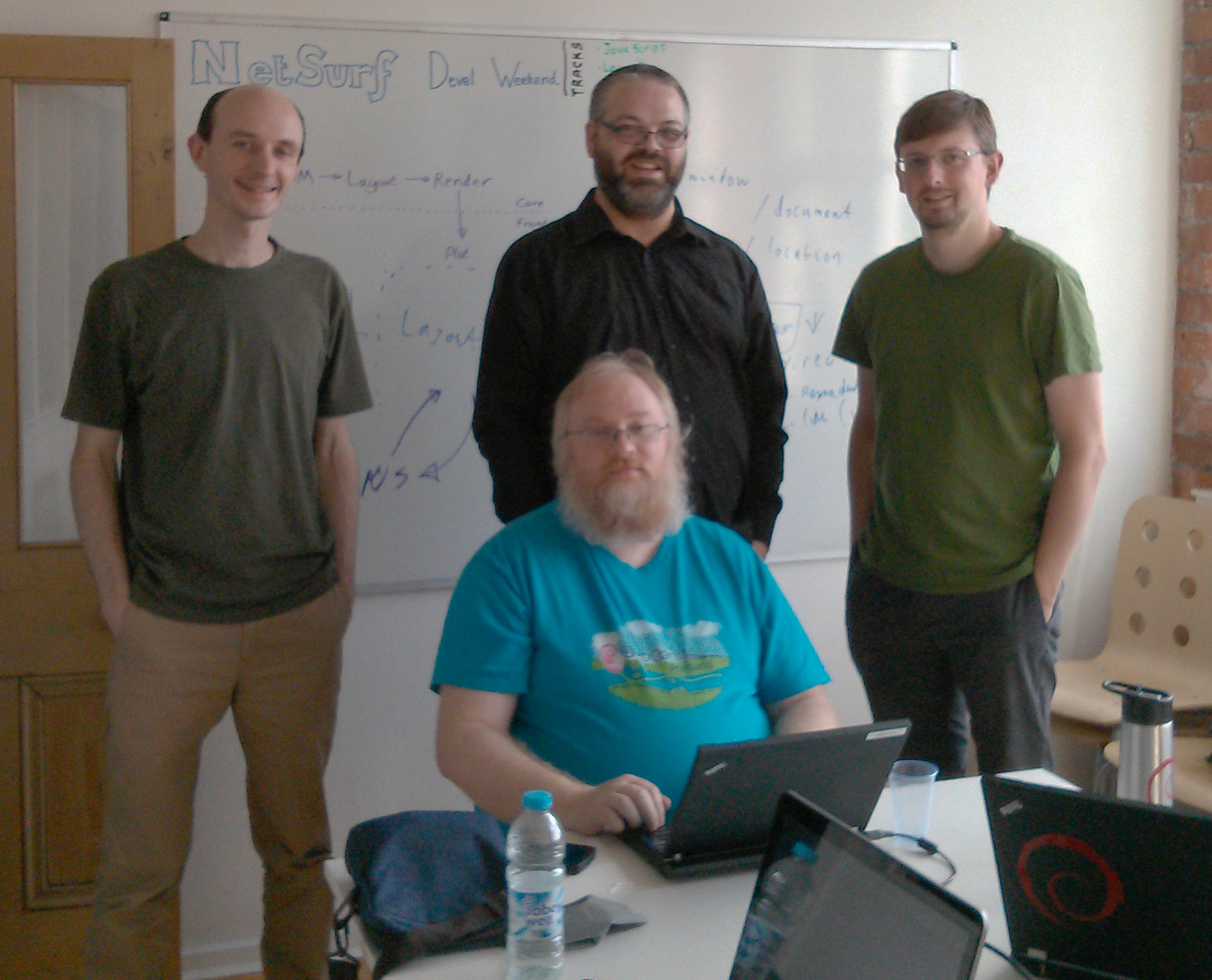
The fifth developer weekend was an opportunity for us to gather in a pleasant setting and work together in person. We were graciously hosted, once again, by Codethink in their Manchester offices.My credit card info was stolen when I used a wifi hotspot in an airport... Should I use open wifi networks? Is it safe to use my credit card for shopping online?Here is a modified version of an answer I sent to a friend recently which I thought could be useful to the larger internet community. The short answer is "sorry about that", "it depends, you generally can, but be careful" and "your credit card company is supposed to protect you".
https://accesd.desjardins.com/
in my case)
directly myself instead of clicking on links, bookmarks or using a
search engine to find my bank site.
In the case of credit cards, it is much trickier because when you buy
stuff online, you end up putting that credit card number on different
sites which you do not necessarily trust. There's no good solution
but complaining to your credit card company if you believe a
website you used has stolen your credit card details. You can also use
services like Paypal,
Dwolla or Bitcoin that hide your credit card details from the
seller, if they support the service.
I usually try to avoid putting my credit card details on sites I do
not trust, and limit myself to known parties
(e.g. Via Rail,
Air Canada, etc). Also, in general, I try to
assume the network connection between me and the website I visit is
compromised. This forced me to get familiar with online
security and use of encryption. It is more accessible to me than
trying to secure the infrastructure i am using, because i often do not
control it at all (e.g. internet cafes...).
Internet security is unfortunately a hard problem, and things are not
getting easier as more things move online. The burden is on us
programmers and system administrators to create systems that are more
secure and intuitive for our users so, as I said earlier, sorry the
internet sucks so much, we didn't think so many people would join the
acid trip of the 70s.
Next.