Search Results: "agi"

21 January 2009

David Welton: More Github

Before I get started, I want to make it quite clear that I have no problems with Github - au contraire, they provide a very nice service. What my speculation centers around is the social dynamics of Github. One of the Github guys writes a nice response to my original post, here: http://ozmm.org/posts/linux_vs_classic_dev_style.html First of all, apologies for the comment bug. In theory, it has been fixed by the Typo guys, I just need to find the time to upgrade. Chris mentions that it's possible to create a "SourceForge style" project on Github. I see that it's possible to add collaborators, so I guess that's what he means. I still find it a bit ugly to have things at .../davidw/... but that's not very important if the URL is at least stable, rather than hopping around to whoever has the latest fork and updates of the code in question. In my other post, I talked about people being less interested in doing what it takes to contribute to existing projects, rather than forking them, unless it's really called for. Here's a concrete example of how things might go wrong. At my current consulting gig, we were looking at utilizing actionwebservice to do some SOAP stuff. That code is not part of Rails anymore, but that's not the problem - surely someone has decided to take up maintenance of the gem, right? Well, yes... but let's look:
root@fortrock:~# gem1.8 search -r actionwebservice
*** REMOTE GEMS ***
actionwebservice (1.2.6)
datanoise-actionwebservice (2.2.2)
dougbarth-actionwebservice (2.1.1)
nmeans-actionwebservice (2.1.1)
So we have the original, clearly out of date, and three others. Yuck... I guess we'll use the 2.2.2 one, but who knows if perhaps the others contain some good stuff too? Let's Google it. http://www.google.com/search?hl=en&q=actionwebservice The first link is to a RubyForge project, which is basically dead. A few links down, there is a link talking about a more recent version, at the Datanoise site. However, it's one of many. Confusing. If you go to the github page for the datanoise version of actionwebservice, the README has this:
The latest Action Web Service version can be downloaded from http://rubyforge.org/projects/actionservice
Hrm. We were just there and that doesn't seem quite right... Sure, it's an easy enough oversight to ignore, but it adds to the confusion. Now, this is not really a serious problem, but do you see how it could get worse over time, as various people fork the code, write blog entries, and so on? It would get harder for someone interested in utilizing the code in question to ascertain which is "the" version. It's not hard to imagine situations where two forks add different bits of useful code. Typically, in situations like this, new users, those who don't know the code at all, are also the people least able to look through all the diffs and changes and log entries and what not in an attempt to merge any changes that might be useful. This leads to a "paradox of choice" type of problem. Another consideration, this one more positive, is that perhaps people are putting code in Github that, in the past, might have simply remained on their own computers, with no effort whatsoever to share it, so in that sense, Github might be doing people a service by at least making the code public. However, even in that case, if the service fills up with code that people have simply "thrown over the wall", rather than creating a genuine open source project, with a community, communication channels, and so on, it could get a reputation for having code that you have to handle with care, as a lot of is just stuff slapped up there without much thought to quality or continuity. Anyway, the Github guys have done a nice job with the service, and I'm sure they'll continue to improve it. Who knows, perhaps they have some good ideas about mitigating some of these potential problems that they'll be rolling out soon.

Robert McQueen: My new font rendering technique is unstoppable

You know it s time to call it a day and write your talk tomorrow when I just upgraded Gtk+, Cairo and Pango to the versions in Debian experimental while I was upgrading some Telepathy packages, and got this the next time I loaded OO.o. Magic. But seriously, anyone got any ideas what s going on? Update: I switched my Debian mirror to .au and downloaded OpenOffice.org 3.0.1~rc2, and installed the Gtk+ and GNOME stuff too, and not only did the fonts came back, but it no longer looks like the 80s. Score! Thanks for the tips. Back to my talk

Kartik Mistry: Sorry!


* Magically, my old post appeared on various Planets after I added one more relevant tag in it. I am really Sorry for that!

20 January 2009

Theodore Ts'o: Israel and Palestine: A Viewpoint from a Former Zionist

Gunnar Wolf is Debian Developer, a Mexican, and is a former member of a Hashomer Kibbutz. He has written an essay on his blog entitled About the recent events and possible outcomes in Israel and Palestine . I strongly encourage people to read it, since he talks about the historical roots of the conflict (going back all the way to the roots of Zionism) in a way that while it is definitely not pro-Zionism, neither is it as unfair as some of the pro-Palestinian accounts of the period 1947-1949. It s about as balanced an account of the roots of the whole mess in the Palestinian areas and Israel that I think you can find, although he definitely has a point of view:
All in all, even if I won t live there again, [Israel] is a country I learnt to love, a society I have long studied And yes, I keep the political stand I had 12 years ago: The only solution is to dialogue, to treat the current enemies -and not only their governments- with respect, recognizing their dignity and right to life, to self-determination. Only then we will change the status quo.
On this day when we will finally see the back side of George W. Bush s presidency, I can only hope and pray that more people will be as thoughtful as Gunnar Wolf was in his blog posting. Even if we disagree (and there will be disagreement), it s only by encouraging more people to learn about all sides of such tragedies such as the Israeli-Palestinian conflict that we can help make decisions that might bring peace to this shattered world. May that day arrive soon!

19 January 2009

Gunnar Wolf: About the recent events and possible outcomes in Israel and Palestine

Several friends, from different groups and backgrounds and with different points of view regarding the current war in Israel (and regarding the Arab-Israeli conflict in general) have asked me for an explanation on what is happening there, what is (my view of) the real conflict, its causes... and any possible answers. And yet I am quite far from being an authority, I do want to write something about it. Be prepared, as this post is quite long.
And yet, after writing frankly a lot more than what I expected... It is by far not enough. I have still much more to add, but I have to say "stop" at some point. So, here you have it: My points of view, as well as some explanation on why are we standing where we currently are.
I am writing this based just on my personal experiencie and, of course, my personal point of view. Furthermore, I wrote a good part of this text while riding a bus, with no network access, so I am offering very few references - In any case, it will allow me to make much more progress. References always take as much time as the text itself! About me Why am I writing this? Why do people ask for my opinion? I must start by explaining who I am, so the rest of this makes sense. I am a Mexican Jew. That means, I was born in a Jewish (albeit secular) family, and grew up in an environment with general Jewish culture. My direct family (say, my parents and brother, and to a lesser degree my closest cousins) are not at all religious, I'd even venture to say most of us are complete atheists. Yet, besides the cultural belonging (which is a mixture of a Eastern European culture with lots of Idish words and dishes and general humor), my family has a strong national identification - In other words, I grew up in a fully Zionist environment, which traces back to Poland.
My grandmother was member of Hashomer Hatzair in Poland, since the early years of its existence, late 1910s and early 1920s. What is it? To make it short, a Zionist Socialist, Kibbutzian youth movement. It has many similarities (and somewhat stems indirectly from) the Scouts many of you will be familiar with, but -obviously- has a way lengthier agenda. And, yes, nowadays I feel it is somewhat out of reach with the current state of the world - It was founded in 1913, and only slightly adjusted its principles since then.
I will talk more about Hashomer later on.
My grandmother arrived in the late 1920s to Mexico, for familiar and economic reasons, but still dreamt about living in Israel for a long time. As they grew up, first my uncle joined Hashomer in Mexico in the late 1940s, when it still pursued a very much Soviet-style ideals for Israel (one of the core points that changed during the 1950s); both my father and my mother joined in the late 1950s (in fact, that's where they met). My cousins and myself were very active in the 1980s and 1990s.
The Iszaevich family has something very unusual, I'd say, engraved in our genes. We live very deeply our ideologies. That's the only explanation I can find to the way we all have led our lives. I won't go into the other family members' details, but just into mine: I was fully convinced of all we taught to our younger members and what we discussed among ourselves. I am among the very few people who really learnt Hebrew at my school, and that was only because I really cared - I know some people that just after 12 years of pseudo-learning could maybe utter a few phrases.
After finishing high school I went with my Hashomer group, together with people my age from other similar-minded Mexican Zionist youth groups, to live and learn for a year in Israel, on what is usually known as shnat hajshar - A year to get ready. To get ready to what? But of course, to come and give back go the younger groups of the movement, and finally go back to Israel and settle there definitively. I came back to Mexico, and after one year I did the only thing that was logical: I became an Israeli and went to live to a kibutz - Zikim, a beautiful place just between Ashkelon and Gaza, very near the sea shore. It was a beautiful period in my life, and I really enjoyed it - But it didn't last for very long - I quickly grew to hate the Israeli society at large. A society full of rage, of hatred. Not just between Arabs and Israelis, as many would think from the outside, but between religious and seculars. And between immigrants and locals. And between leftists and rightists (in several dimensions, as it is one of the countries where you can most easily be a economic leftist while being a political rightist - a complex society it is). A society full of disrespect and intolerance. A very hypocritical society. And one of the things that most shocked me: I wanted to live in a society of proud of its existence, that's what I had learnt Israel was - But Israelis aspire and dream of being anything else (and mostly US-Americans) in a way that made me sick, more than anything I had previously seen in Mexico.
I loved the life at the Kibutz, and I loved being an agricultor, doing hard work every day and literally getting the fruit of it. However, I cannot live isolated to a 300-people universe - At least once a week you have to go to the city if you don't want to become insane. And I could not stand the sick Israeli society.
Anyway, to make things short: After six months as an Israeli, I came back to Mexico. I went through a long period of finding myself, as I could not uphold anymore my Hashomer ideology (if I am not going to live by it, how can I continue teaching it?). Many people do anyway, but for the first months, where my Hashomer work was basically all of my life, I felt really uncomfortable. So, in short, I severed all of my relations to the Jewish community, and even denied for a long time my Jewishness until I found a (I think) better balance.
Today I am at peace. But anyway, I wanted to talk about myself in the critical period that marked me in this regard: The 1990s. Enough, lets get down to business. Zionism 1870-1920 Many people argue that the Jews invaded the Palestinians homeland - And yes, nowadays I cannot counter this. But we cannot judge what happened then based on what we see now.
Modern Zionism started around the 1870s. The Jewish history is full of pogroms and persecution, in different countries all over Europe - And a group of young people decided the only solution was to build a place to call their own. And yes, this was full of idealism and in no small part the foolishness of youth. For several centuries and up to 1920, all of current Middle East were provinces of the Ottoman Empire. Before Zionism began, the population of today-Israel was very sparse, not more than 400,000 people - up to 5% of them Jewish, around 10% Christian Arabs, and the remainder, Muslim Arabs. Of course, the low population was mostly because the country was mostly hostile - A desert in the South, mostly swamps in the North, and some minor towns mostly in the hills. It was a mostly forgotten province, away from the central Turkish rule, and there had been no frictions with the local population. It was a nice place to go, thinking -again- as a fool youngster, or as an idealist. They said, lets take a folk without a land to a land without a folk.
The number of accomplishing Zionists (this is, people who actually went to Israel instead of just talking about doing so) was not high during the first decades. But towards the 1890s, it gained critical mass. The political Zionist movement was born, with Theodor Herzl as a leader, and they started pushing -politically- for different governments to concede a territory to Jews. They went to the Turks, and didn't really get much echo. Went to other colonial powers of the time, and got unfeasible promises with no real backing (i.e. Birobidjan in Eastern Russia, Uganda in Africa)... And, as it happens in strongly ideologized movements, the movement started splitting into different groups with slightly different positions.
And no, I am not talking about the People Front for the Liberation of Judea and the People Judean Liberation Front, but I very well could. Sometimes the differences are as ridiculous as that. But hey, I take that most of my readers are acquinted with the Free Software issues, right? Think BSD vs. GPL vs. OpenSource. To give a broad idea - Only in Mexico City, with a very small Jewish community (~30,000 people), in the mid-1990s we had over 10 such movements, with 50-150 youngsters attending each. And even though some were local, and even though some very important ideologies are not represented in this country, they are all different enough to exist as separate entities. British Mandate The Ottoman empire was divided after the first World War. Its possesions in Europe became independent states, while in Asia (and Africa, if you take the semi-independent Egypt and part of Sudan into account) they were taken over as colonies or protectorates by France and the UK - Evidently, attempting to secure a long-term dominion over the area. In some aspects, they failed. In some aspects, they were (and still are) tremendously successful. The division of people by setting arbitrary boundaries has led to countries sustainable only by force and a harsh rule (such as Iraq, Lebanon and Syria), or doomed to poverty (and thus submission) due to lack of natural resources (as Jordan). Focusing on Israel/Palestine, the UK entered the area by making mutually incompatible promises to arabs and Jews - i.e. the Hussein-McMahon letters and the Balfour declaration, both ambiguous enough to lead to... Well, today. The UK rule was disastrous to the region, both in giving (and taking away) power from all sorts of puppet regimes, and swiftly going away as soon as things started looking too complicated. Yes, typical colonialism.
So, while up to the 1920s there was no real animosity between Arabs and Jews (as i.e. the Faisal-Weizmann agreement shows), during the next decades the seeds of hatred started growing, from both sides.
Many people still quote the 1947 partition plan as the direct antecedent towards Israel's real existence - That was not the first partition plan that existed. Ten years earlier, the Peel commision suggested a similar partition involving forceful population transfer. And many people see the separation of Transjordan (now Jordan) from Palestine in 1922 as a first partition. It is understandable that both partition plans (much more the 1947 than the 1937 one) were accepted by Zionists: Going from having nothing to having something (and against all odds in the environment they lived) is acceptable.
From the Zionist side, two main groups rejected the partitions: The right-wing and religious groups, insisting that the whole of the Mandate should become Israel, and the left-wing groups, which advocated for a single, bi-national state, with equal rights for all of its population. Go over and read this last link, as it was quite interesting (to me at least) to see how this solution has kept existing and regarded by (relatively) many people, and has many interesting links. 1948 onwards: Where did the refugees come from? The November 1947 partition didn't exactly translate to a planned, smooth Israeli independence - It led to six months of revolts (basically, a civil war). By mid May, the UK government and troops abandoned the territory, and one day later, Israel declared its independence. And, of course, all neighbouring countries (and Iraq) sent their troops to invade Israel. The war lasted for over six months (cease-fire was signed in January 1949). There was an intense Arab campaign indicating the armies would enter Israel and devastate it, leaving no stone in place, indicating Arab population to temporarily leave the Jewish-destined areas. The war, they said, would not take more than a couple of months, and they would be able to go back home.
Only that... When the war ended, the results were far from what the Arab governments expected. Not only Israel continued to exist, but it conquered important territories.
Of course, the Israelis were not innocent from said exodus: During the 1947-1948 civil war, and the independence war, some of the existing so-called self-defense forces (some of them were really defensive, while some were quite aggressive, even terrorist) attacked Arab villages in strategic or predominantly Jewish areas to prompt them to leave - yes, what we today call ethnic cleansing.
I had (in my head) the number of 650,000 Arabs (from a total of slightly over a million) fleeing to neighbouring countries. Wikipedia states that it is somewhere between 367,000 and 950,000. A similar number of Jews were expelled from Arab countries, many of which arrived to settle at Israel (and many others went elsewhere - For instance, a good part of the Mexican Jewish community is from Syrian origins - Many of them fleed in those years). Israel didn't accept back the (relatively few) Arabs that requested to resettle, as they were seen as hostile population - but neither did the countries that "temporarily" accepted the Palestinians accepted them as citizens. The Palestinian refugee camps today, mainly in in Lebanon, Syria, and the occupied territories held by Israel have terrible living conditions, and its population -despite living there for over 60 years- have no civil rights at all. Note that I'm omitting Jordan here, although it has several camps as well, as their situation is way better.
The Arab population that didn't leave did receive full Israeli citizenship. No, their living standards are not up to level with the average Israeli. The country and the society do have a sensible degree of racism and segregation. But the situation is nowhere as terrible as it is in the camps.
The areas which were originally to become Palestinian and were not conquered by Israel -this is, current-day West Bank and Gaza- bacame respectively Jordan and Egyptian territory. While Jordan did fully extend its soverignty covering the West Bank, Egypt didn't - Gaza is, since 1949, occupied military territory. Gaza, among the most densely populated areas in the world, has had their inhabitants under military rule ever since. When Israel returned the Sinai after signing the peace treaty with President Sadat, Egypt didn't accept Gaza back - And that's where today's greatest problem is born.
Now, Israel conquered those territories in 1967, along with the very sparsely populated Sinai and Golan. For the first ten years, the territories were basically only administered (yes, under a military rule). In 1977, with the first right-wing Israeli government, an extensive settlement policy began (and led partly to today's seemingly unsolvable situation). In 1980-1982, Israel withdrew from the Sinai. In 1981, Israel claimed full soverignty over the whole of Jerusalem and the Golan. In 1993, the "Oslo Agreement" was signed between Israel and the PLO, and it seemed we were heading towards a bright future. I lived in Israel between 1994 and 1996 - Yes, the most hope-filled period in the country's life.
Since 1996, I have tried to keep up to date with the country's evolution. All in all, even if I won't live there again, it is a country I learnt to love, a society I have long studied (even if in the end I did include many references, I wrote most of this text just off the top of my head, with the data I remember - so it might have several big errata). And yes, I keep the political stand I had 12 years ago: The only solution is to dialogue, to treat the current enemies -and not only their governments- with respect, recognizing their dignity and right to life, to self-determination. Only then we will change the status quo. How not to fight hatred Since 1993, the dream of peaceful coexistence seems to have faded. What we saw during the past three weeks, along to what we saw in Lebanon in 2006, is plainly a gross mistake if the goal is to achieve good, lasting peace.
Try to imagine how could life in Gaza be, even in the total absence of Israeli attacks. Just to set some numbers first: The Gaza strip hosts almost 1.5 million people on 360 km . When I lived in Israel, I was constantly surprised at how small a country it is - Israel tops at 550Km North to South, 150Km east to West (it is amazing, almost wherever you stand, except in the middle of the Negev, you can see the country's borders. Yes, I recognize as the border the so-called Green Line); over half of the territory is a desert, and it hosts seven million inhabitants. And it is hard to imagine how that country can be economically viable.
I do not find it feasible to imagine Gaza and the West Bank integrating a single country, and not only because they are separated by ~40Km, but because they are so sociologically different. People in the West Bank, yes, live opressed under military rule and subject to a much more constant, more visible apartheid-like state (as the territory is truly sprinkled with Jewish outposts which many Israelis refuse to recognize as their own, but still, which have incredibly higher living standards). The best land has been taken away from them, yes, but they have some space between cities to have some farming, to communicate, to... Breathe. Besides, West Bank inhabitants -even those in refugee camps- have much better living standards than anybody in Gaza. It is still an overpopulated area, but not nearly as much as Gaza.
Gazan population have been driven towards extremism. And yes, there was a civil war between Palestinian factions, as the world views between both populations are completely different - However hostile a Jenin inhabitant can be towards Israel, he does not lead the life -if it can so be called- you see at Khan Yunis.
But back to Gaza... What Israel is doing (and not only during this military operation terror campaign is wrong, from any rational point of view. Israel wants Hamas to become weaker? Then don't drive the population into supporting them!
Palestinians started giving over 50% of their support to Fatah (ex-PLO), and under 20% to Hamas. That was less than 15 years ago. However, Fatah has shown to be corrupt and inefficient at building infrastructure and improving life conditions, ineffective at negotiating a permanent agreement which secures dignity and sustainability to their people. Hamas stands as a religious, righteous organization. There are no serious corruption charges against any Hamas leaders. Hamas is clearly still at war - They didn't subscribe any peace agreement so far, and their stated #1 goal is to build a Muslim State in the whole of Israel. And the Hamas movement -like Hizbollah in Lebanon- has built quite a bit of infrastructure in the areas they control - Mainly housing. Yes, housing where they mix their own offices, many will accuse, getting human shields for free. But still, they are benefactors to a dehumanized, pauperized population.
I find it obvious that, if living conditions were at a basic level in the region, support of Hamas would decrease. Even more, of course, if they improved due to Israeli support. Israel controls this territory, so it is responsible for the well-being of its population, like it or not. And Gaza is simply too small and low on resources to survive by itself.
I was a bit surprised to find mention -although very brief- of a three state solution - And yes, this is close to what I would expect as a viable outcome. It is clear that Israel will not ever grant full citizenship to the Palestinians, as they would -euphemistically speaking- challenge the Jewish character of the State. Dropping the euphemism, Israel relies on apartheid in order not to become an Arab majority country. I might have some numbers wrong, but AFAIK, there are ~7 million Israelis, 20% of which are Arab citizens (which means, 1.4 million Arabs and probably 5 million Jews, with many other minor denominations for the difference), and ~4 million Palestinians live in the territories. Today, the country is already predominantly Arab, or at least is close to being so. So, Israel should permanently, formally disengage from all of the occupied territories. And in order to ensure violence stops, start a comprehensive, unconditional, long-term aid program. Start with giving them autonomy to regain their sea, as the Gaza port has long been closed. Allow the airport to operate again. Instead of bombing tunnels in the Egypt-Gaza borders, allow Gaza to trade with Egypt - Perhaps even to integrate territorialy, if the conditions are met. Treat their people with respect, and help them ease the terrible situation they have lived for so many decades - and then, undoubtely, terror will stop.
The West Bank? Possibly it could become a Palestinian state by itself. Possibly, it could integrate back to Jordan. That would be up to Jordans and Palestinians to decide. Of course, Jordan has already a large segment of its population defining itself as Palestinians, which counts both for and against. So, I won't venture into this supposition.
But anyway - Back to what prompted me to write this text -yes, a very or maybe even too long text - I hope somebody even takes the time to read it!- is to explain what is my point of view on the current situation, and why.
Today, a cease-fire was announced, after 23 days of murder and destruction. I sadly do not hold very high hopes for it to be lasting, much the less to be enough, to lead to what they call a de-escalation of the conflict. The most I can currently do is to voice my opinion, and hope that mine is just one more voice pointing to a sane solution, to a permanent, dignifying way out, for all people involved. Every people has the right for survival and for safety. We cannot deny this to any others. And certainly, we cannot expect anybody not to fight for their right to live.

18 January 2009

Steve Kemp: You didn't faint. That's always a good sign

Joey has implemented blogspam support for ikiwiki, which you can find here. He was also good enough to provide valuable & useful feedback so I can present a moderately updated API - most notably with the ability to train comments when/if they are incorrectly marked. I can imagine several other useful additions, but mostly I think the code should be cleaned up (written in an evening, posted to keep myself honest, didn't really expect anybody to be terribly interested) and then it should just tick over until comment submitters adapt and improve to the extent that my sites suffer again .. ObFilm: Kissed

Wouter Verhelst: FOSDEM Debian Devroom: annotated schedule

FOSDEM is a 2-day weekend of insanity. 218 talks this year; if you want to understand exactly how insane that is, have a look at the schedule grid. There are 19 rooms where events are held; possibly more, since I understand not every devroom has sent in its schedule yet. Might be hard for people to make a choice that way, I guess. Now there're supposed to be abstracts of each talk on the FOSDEM website, but reading them all can be quite tedius. In an effort to help, at least for the Debian devroom, here's the schedule for our devroom with a bit of explanation of what it's about. Note that this is mainly aimed at people not familiar with Debian; those who are should probably understand it enough by looking at the titles. Saturday: 13:00 - 14:00: 'Outside broadcast on a budget - the DebConf video team and DVswitch'. DVswitch is the software used to create those excellent Debian videos. The best ones yet, IMO, are the ones of Debconf8. Check them out. There's nothing Debian-specific about DVswitch, except that it was written by Debian people. It's a great way to do live Internet .ogg streaming by using nothing more than DV cams, Firewire, and plain old Ethernet. 14:00 - 15:00: 'Ultimate Debian Database: datamining Debian made easy!'. UDD is a SQL database containing a shitload of data related to Debian, and which should allow easy datamining. Hence the title. This probably won't be of any interest to people who are not either a Debian Developer or a statistician, but I might be mistaken. 15:00 - 16:00: 'Introducing DDE, Debian Data Export'. This is a new project Enrico came up with, and which is related to the same subject as the previous talk. I don't know much more beyond what's in the abstract. However, given the fact that Enrico is going to be doing this talk, it can't be bad. Seriously. 16:00 - 17:00: 'The Debian status quo on the Openmoko Neo Freerunner'. Yup, Debian runs on the OpenMoko, and has done so since Debconf8, last august. This talk should give some more insight; if you have an OpenMoko, this definately is for you. 17:00 - 17:30: 'Running Debian on Inexpensive Network Storage Devices'. I've been running Debian on a Thecus N2100 for a few years now, and it's great. There are more options, however, and Martin does most of the hard work related to these devices. He's done a similar talk on the two previous FOSDEMs (go check out the videos), and this one will mainly be an update on what's going to be new in Lenny. 17:30 - 18:15: 'Grid Computing with Debian, Globus and ARC'. These guys are a group of academics from three different universities who've been doing grid computing (i.e., something like 'SETI@Home', but then somewhat different) with Debian and some other technologies. They'll be explaining how, exactly. I don't know much about this talk; it could be great, or it could fail miserably. I guess we'll see. 18:15 - 19:00: 'What does the DPL do?'. This is really firmly targetted at Debian people. If you're not in the least interested in how Debian does things, you'll be bored. Sunday 09:15 - 10:00: 'The state of Virtualization in Debian'. If you're a Debian user interested in virtualization, this talk is for you. Henning will explain what virtualization options exist in the upcoming 'Lenny' release, and how to use them. 10:00 - 11:00: 'TDebs'. This might not be too interesting to you unless you happen to be involved in Debian infrastructure. TDebs don't exist yet, but will sometime soon; Neil will be explaining how, why, and what. 11:00 - 12:00: 'Internationalization in Debian: How to improve further?' If you're interested in i18n, this is probably for you. 12:00 - 13:00: 'The Common Debian Build System (CDBS)'. CDBS is one way to build a Debian package. This is probably only of interest to Debian people. 13:00 - 14:00: 'Release management in Debian - can we do better?'. Frans isn't a member of the release team, but has some criticism on how they function. He intends to present his arguments in order to start a discussion. This is Debian internal kitchery, really. 14:00 - 15:00: 'Lenny - the road to release'. Neil is a member of the release team, and is going to explain how we got to the current state. I hope he'll also explain why we still haven't released. I guess we'll see :-) 15:00 - 16:00: 'The long road to KDE4 in Debian'. Um, yeah. I'm not a KDE guy, but I understand some other people are. In any case, might be an interesting talk even if you don't use Debian, since I understand it will look at some of the new features in KDE (and how they relate to packaging). 16:00 - 17:00: 'Debian and Google Summer of Code 2008: wrap-up and insights'. I guess Leslie will be there. The speaker was a student working on Debian during this year's SoC, and he will present what's been accomplished. There, that's it. Now my only hope is that there'll be many people attending. If previous editions are any indication, however, that won't be a problem.

Russ Allbery: Lintian 2.1.6

I'm managing to do enough work on Lintian each week that it's still making sense to stick with a weekly release cycle. So a new Saturday, a new Lintian release. This one was mostly a set of random bug fixes and a few new, easy tests, cleaning up some false positives and lowering the bug count. We're now firmly under 100 bugs, which always makes me happy. The new test suite is also taking further shape, although I didn't do quite as much work on it this week. I expect the next release to be 2.2.0 and incorporate support for a --pedantic option, contributed by Raphael Geissert. This will be a new tag severity less even than wishlist. It's for style checks, checks that are highly likely to have false positives, things that might be cleaner but are unimportant, etc. People should only use --pendantic if they're willing to see tags that are inaccurate or don't fit their personal style and take them with a grain of salt. There are a bunch of long-standing bugs requesting checks of that sort that are often easy to implement, just not things we've implemented in the past because even at the info level they'd annoy too many people. I'm hoping to do a few more infrastructure changes and library changes for the next release as well, but I'll see how much time I have.

16 January 2009

Christoph Berg: RFH: mutt

From: Christoph Berg <myon@debian.org>
To: Debian Bugs Submit <submit@bugs.debian.org>
Subject: Bug#512072: RFH: mutt -- text-based mailreader supporting MIME, GPG, PGP and threading
Package: wnpp
Hi, the Debian Mutt package needs more maintainers. There are almost 200 open bugs. Some of these are already forwarded upstream and might just need some triaging/poking. Some need forwarding. Some might be fixed with a trivial patch. Others are Debian specific, mostly for the extra patches we include. There's duplicates and sub-wishlist items. We are using bts-link to link to dev.mutt.org's trac, but that also needs more tweaking. There's a new upstream version 1.5.19 pending, we need people to check which bugs still apply. The (in?)famous mutt-patched package needs love to get the sidebar patch updated to the new version, and to get some of mutt-ng's extra gimmicks and add-ons integrated. I've moved packaging to git since that seems to be the least scary choice nowadays: http://git.debian.org/?p=pkg-mutt/mutt.git The repository has been updated to 1.5.19. The mutt-patched build is disabled for now, as the patch doesn't apply. Testers welcome :) If you are interested in helping out, please get in contact with me. To get started, subscribe to mutt's PTS feed. There's no extra maintainer mailinglist, mailing mutt@packages.debian.org will work for PTS subscribers. If you prefer IRC, join #mutt on irc.freenode.net. Thanks,
Christoph

Petr Rockai: darcs 2.2.0

I am happy to announce general availability of darcs 2.2.0. Getting the release For this release, we have decided to provide two flavours, depending on the build system used:
  1. The source tarball, http://www.darcs.net/darcs-2.2.0.tar.gz, which can be built using the traditional autoconf-based system. This is the fully supported version. After downloading and unpacking, you can issue:
    $ ./configure
    $ make
    
    and possibly
    # make install
    
    More detailed instructions inside the tarball (file README). Please note that we had at least one report of build failure, with quickcheck-related message. The currently best workaround, if this happens to you, is to use the cabal version of the package instead, see below.
  2. Cabalised source. You can either download a tarball from http://hackage.haskell.org/packages/archive/darcs/2.2.0/darcs-2.2.0.tar.gz and build manually (see the build instructions in README inside the tarball), or, alternatively, you can use cabal-install to obtain a copy:
    $ cabal update
    $ cabal install darcs
    
    This will give you a darcs binary in ~/.cabal/bin you should probably add that to your PATH.
In addition to source tarballs, we expect binary packages for various UNIX platforms will be available in due time. For Windows users, Salvatore Insalaco has prepared a binary build, available from http://homepage.mac.com/kirby81_it/darcs/darcs-2.2.0-win1.zip. You just need to unpack the directory somewhere and add it to your path (if you like). Moreover, an experimental TortoiseDarcs release for darcs 2 has been made available by Kari Hoijarvi and is looking for home. It can be found at http://datafed.net/darcs (unfortunately, at the time of this writing, the site seemed unreachable If you can help with hosting, please mail Kari.) What s New The summary of changes since version 2.1.2 (released last November) follows: And a summary of issues that have been fixed in darcs since version 2.1.2 (compiled by Thorkil Naur): 525 amend-record => darcs patches show duplicate additions
971 darcs check fails (case sensitivity on filenames)
1006 darcs check and repair do not look for adds
1043 pull => mergeAfterConflicting failed in geteff (2.0.2+)
1101 darcs send cc recipient not included in success message
1117 Whatsnew should warn on non-recorded files
1144 Add darcs send in-reply-to or header In-Reply-To: x@y.z
1165 get should print last gotten tag
1196 Asking for changes in /. of directory that doesn t exist gives changes in entire repo
1198 Reproducible mergeConflictingNons failed in geteff with ix
1199 Backup files darcs added after external merge
1223 sporadic init.sh test failure (2.1.1rc2+472)
1238 wish: darcs help setpref should list all prefs
1247 make TAGS is broken
1249 2.1.2 (+ 342 patches) local drive detection on Windows error
1272 amend-record not the same as unrecord + record
1273 renameFile: does not exist (No such file or directory)
1223 sporadic init.sh test failure (2.1.1rc2+472) I would like to thank all contributors for making this release possible. Future The next release will be 2.2.1, fixing low-risk issues found in 2.2.0, or those that have been excluded for 2.2.0 due to freeze. This release will appear in two or three weeks time, depending on circumstances. The next major release will be 2.3, due in June or July this year. The focus of this release will be new features and further work on performance. Moreover, we expect that it will use Cabal as its default build system and will make first steps towards sustainable libdarcs API.

15 January 2009

Miriam Ruiz: Chatting in Facebook via Pidgin

Instant messaging through web interfaces is not really the most comfortable thing to use. While their ubiquity is nice, and they can be used from whatever computer you want without having to install anything, for my own computer I prefer a real desktop application. Pidgin (formerly called gaim) is a multi-platform instant messaging client that supports many commonly used instant messaging protocols, so different services can be used from the same application. Being a user of many different messaging systems, I kinda use Pidgin as an abstraction layer from the services I use. Yesterday I discovered pidgin-facebookchat, a Facebook chat plugin for Pidgin and libpurple messengers, that is able to connects to the new Facebook Chat IM service without the need for an API key. It works quite well, all things considered.

Ross Burton: 3G Woes

Has anyone out there used a recent Nokia phone (E65 to be precise) as a modem with Network Manager 0.7? I can't seem to get the magic right, and get one of two failures:
NetworkManager: <info>  (ttyACM0): powering up... 
NetworkManager: <info>  Registered on Home network 
an 15 10:50:04 blackadder NetworkManager: <info>  Associated with network: +COPS: 0,2,"23415" 
  NetworkManager: <WARN>  dial_done(): Dialing timed out </WARN>
Or:
NetworkManager: <info>  Activation (ttyACM0) Stage 1 of 5 (Device Prepare) complete. 
NetworkManager: <info>  (ttyACM0): powering up... 
NetworkManager: <info>  Registered on Home network 
NetworkManager: <info>  Associated with network: +COPS: 0,2,"23415" 
NetworkManager: <info>  Connected, Woo! 
NetworkManager: <info>  Activation (ttyACM0) Stage 2 of 5 (Device Configure) scheduled..
. 
NetworkManager: <info>  Activation (ttyACM0) Stage 2 of 5 (Device Configure) starting...
 
NetworkManager: <info>  (ttyACM0): device state change: 4 -> 5 
NetworkManager: <info>  Starting pppd connection 
NetworkManager: <debug> [1232015456.962700] nm_ppp_manager_start(): Command line: /usr/s
bin/pppd nodetach lock nodefaultroute user web ttyACM0 noipdefault usepeerdns lcp-echo-failure 0 lcp-echo-interval 
0 ipparam /org/freedesktop/NetworkManager/PPP/4 plugin /usr/lib/pppd/2.4.4/nm-pppd-plugin.so 
NetworkManager: <debug> [1232015456.964964] nm_ppp_manager_start(): ppp started with pid
 29590 
NetworkManager: <info>  Activation (ttyACM0) Stage 2 of 5 (Device Configure) complete. 
pppd[29590]: Plugin /usr/lib/pppd/2.4.4/nm-pppd-plugin.so loaded.
pppd[29590]: pppd 2.4.4 started by root, uid 0
NetworkManager: <WARN>  pppd_timed_out(): Looks like pppd didn't initialize our dbus mod
ule
Anyone know what the problem could be?

Adeodato Sim : Quality of commit messages

I ve been subscribed to the Git mailinglist for three weeks now, and I ve finally seen in action what was already imaginable by looking at their git log history: they not only review the code for the patches that go in (as in many other projects, that is), but also review the accompanying commit messages, in order to ensure they meet certain quality standards. More than once already I ve seen an otherwise-fine patch get resubmitted in order to gain a more meaningful or thorough commit message. I m sure there are more projects that do this, but alas, I haven t been in any of them (nor in that many projects in general, for that matter). It s very exciting for me to see it in action, because quality commit messages are high in my Grokking VCS list. Ideally, a commit message conveys all the necessary information the maintainer of a project needs to understand your patch and its benefits, in particular those bits that don t fit as comments in the code. If you have to accompany your patch with rationales, wouldn t it make sense to include a condensed version of them in your commit message? If you re writing messages for a project of your own, please think of future people dealing with your code, particularly if it s a public project. (It takes discipline in addition to being convinced of it, though.) Commit messages are also great because they allow you to be verbose, without cluttering the code with information that s only relevant in the context of the change, and not to the final code. There is however an (actually-not-so-fine) line between what should be in the commit message, and what should be as comments in the code, and I think we commit message enthusiasts should watch out for that. Take, for example, 39c19ce. I think a short comment saying Don t call rev-parse for each blamed line would have been a perfect companion. There must be somewhere a document explaining with more detail what makes a good commit message. If you would recommend any, please let me know (but I m not interested in documents that explain how to format your commit messages).

Russell Coker: Old PDA vs New Mobile Phone for PDA use

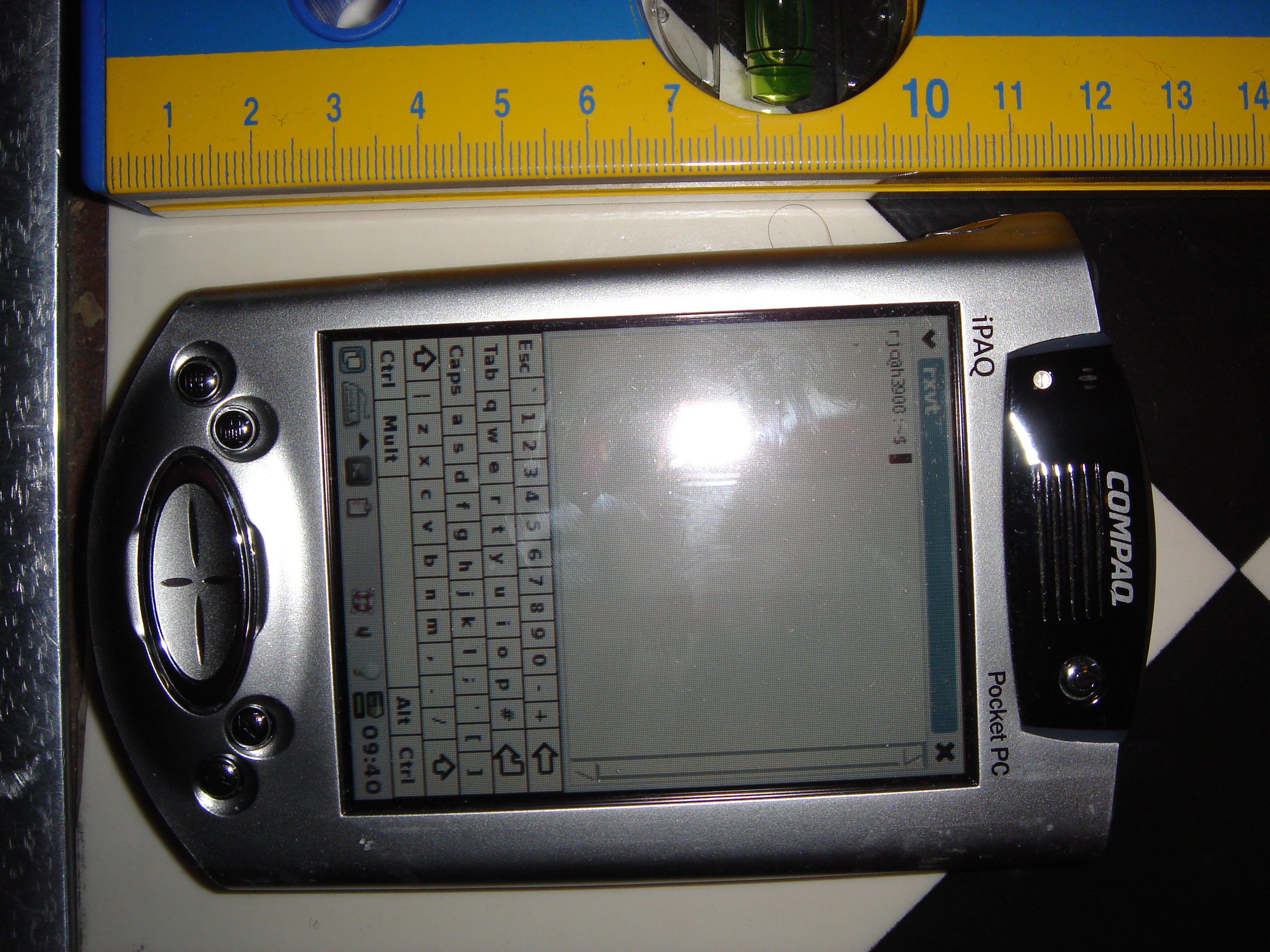
Since about 2002 I have been using a iPaQ [1] for taking notes while on the move. I have a pair of H3950 iPaQs that were given to me for the purpose of some software development work. As modern mobile phones have telephony as a small part of their feature set I think it s worth comparing a 2002 iPaQ with a 2009 mobile phone in terms of the note taking functionality. I have just got myself an LG U990 Viewty mobile phone [2]. It has a screen resolution of 240*320 which is the highest resolution that is remotely common for a mobile phone - and the same resolution as my 2002 model iPaQ. The LG KC910 Renoir has a resolution of 240*400 and seems to be the only phone that my carrier provides which has a higher resolution. The iPhone [3] has a resolution of 480*320. So it seems that the most expensive modern mobile phone that is available in Australia has a screen resolution that is only twice that of a 2002 PDA. I believe that in Japan you could buy a PDA with a higher resolution than 240*320 in 2002. My iPaQ is running Linux, so I can do whatever I want with it. I have a bar at the bottom of the screen with icons to launch, I configure it with the programs that I need most often and they are always one click away. While with my mobile phone I always have two large icons for paid services from my telco and I can t add icons for the things that I want. My iPaQ has a virtual keyboard that can be displayed in portrait or landscape mode. The above pictures show it in the portrait mode which allows the greatest area of screen space for text. The landscape mode is good for entering long lines of text even though the total number of words that can be displayed on screen is smaller. The size of my iPaQ is 134mm in height, between 77 and 84mm in width (it tapers) and 15.9mm thick without it s protective sleeve. The protective sleeve (shown in the second picture) adds about another 5mm to the width and thickness. My iPaQ is 1.76* the volume of my Viewty phone and at 184g vs 112g is 1.64* the mass. With it s sleeve on it is about 2.4* the volume. It s larger but with the sleeve it s a lot more solid, a touch-screen is very fragile so putting a touch-screen device in your back pocket without a sleeve is not a viable option. So I now own a mobile phone that has more storage, RAM, and CPU power than my iPaQ, but is less useful for the basic task of writing small documents and seems to have no facility for drawing diagrams. Most recent mobile phones have the ability to record voice (my Viewty can store 34 hours on it s internal storage and supports mini-SD cards for extra storage). But my Viewty lacks the ability to pause voice recording so if I wanted a series of notes during a meeting I would get a series of short voice recordings rather than a single file with many items. The todo list is also fairly poor in the Viewty, so even disregarding the poor keyboard on the touch-screen it would compare badly to the iPaQ. So it seems that an iPaQ that is almost seven years old when running Linux and the GPE Palmtop Environment [4] with with default configuration handily beats one of the latest and greatest mobile phones for all areas of common functionality. If the Viewty had it s source code available I would be tempted to contribute some patches (even if it was not free software). Finally, before someone suggests an Android [5], Greenphone [6] or other phone that s relatively open and programmable, I wanted a phone that had a good camera (by phone standards) and came essentially for free on an affordable contract. Maybe in two years time (when my current contract ends) there will be such a phone on offer. Mobile phones aren t THAT important to me, so while I would like to encourage the development of open telephony platforms it s a much lower priority than about a dozen free software projects. I expect that in the future something like an Android will become a great mobile phone with great PDA functionality. But for the moment I ll use an iPaQ and a Viewty.

Kapil Paranjape: Securing Synchronisation with unison (Mostly Wrong)

There are a number of documents about how to permit ssh access to run rsync or unison for remote synchronisation by an appropriate configuration of the authorized_keys file. Of these the best two are probably those by St phane Kattoor and Christian 'Greek0' Aichinger. Joey Hess also explains some of the pitfalls. The problem is the familiar one: to limit the file-system hierarchy accessible. The humble chroot is a natural way to implement such restrictions which is probably what led "Greek0" to suggest the use of dchroot. This is indeed a fine solution ... except, how does one implement it if one is not root on the server machine? WARNING: The rest of this entry is wrong as was pointed out by Joey Hess. See the update at the bottom. The package fakechroot by Piotr Roszatycki provides a way out. The problem I had was as follows: A recent enough version of fakechroot (version 2.8 worked) allows one to do make use of environment variables as follows:
LD_PRELOAD=libfakechroot.so
LD_LIBRARY_PATH=/usr/lib/fakechroot:/usr/lib64/fakechroot:/usr/lib32/fakechroot:/usr/lib:/lib
FAKECHROOT=true
FAKECHROOT_VERSION=2.8
FAKECHROOT_EXCLUDE_PATH=/bin:/lib:/usr
export LD_LIBRARY_PATH LD_PRELOAD
export FAKECHROOT_EXCLUDE_PATH FAKECHROOT FAKECHROOT_VERSION

After this setup one can run
HOME=/ chroot $HOME/some/dir /usr/bin/unison -server

and the unison server1 will only be able to view /bin, /lib, /usr and $HOME/some/dir; the latter will be mapped to /. (One needs to set the $HOME variable to something sensible for unison to function.) One should not be tempted to create subdirectories of $HOME/some/dir containing only the "relevant" portions of the system directories for unison. The reason is that those files will be created as me and so could be overwritten by unison. The creation of a suitable entry in authorized_keys to use this is an easy exercise! UPDATE: As Joey Hess has noted:
Taking a program, be it fakechroot or unison, that was never designed with security in mind, and trying to use it as a security barrier, is an open invitation to pain.
I had thought about the problem of uploading static-linked binaries and had imagined that it had been overcome. However, the basic facts in this case are:

  1. For those trying this out at $HOME with some terminal command like /bin/sh instead of /usr/bin/unison a suggestion is to add /dev to the FAKEROOT_EXCLUDE_PATH variable so that you have access to your terminal. Be aware that giving remote access to /dev may have unintended consequences!

14 January 2009

Axel Beckert: Sedating irssi's nick highlight for microblogging messages

My favourite IRC client is irssi. I like it so much that I even use it for all my instant messaging needs. The gateway of choice between irssi and mostly Jabber is Bitlbee. I also microblog on identi.ca, a free (free as in AGPL) microblogging service based on laconi.ca. In comparsion to the non-free and proprietary Twitter microblogging, identi.ca has all the features which Twitter turned off already again. For me the most important feature of Twitter was tweeting via XMPP (aka Jabber). Since Twitter turned off that feature, Twitter increasingly fast became unimportant for me. Identi.ca still has this feature and cultivates it further. So usually don t visit the identi.ca website that often anymore but get the microblogging stream of my friends via XMPP and Bitlbee directly into my irssi. Although this is very convenient, it has one big disadvantage: In comparison to an IRC channel, not only notices directed to me personally but every incoming notice beeps, because Bitlbee sends them either as /MSG or prepends my nick name. For normal IRC communication /MSG should beep, and you can t make exceptions for that so easily in irssi. I asked on #bitlbee (OFTC) and on #irssi (IRCNet). On #irssi funnily the first answer was I tried that yesterday, no success from Shrike. So I m not alone, although Shrike uses Jaiku and not identi.ca. Then I had the idea to get Bitlbee to not prepend my nick name for all those identi.ca notices which go into the &bitlbee channel but I didn t find a way to configure this in Bitlbee. But Shrike found a way to do this with already existing irssi plugins: The trigger.pl plugin (available e.g. in Debian s irssi-scripts package or on scripts.irssi.org) can add triggers which replace parts of the message. So the following three lines helped me to reduce the noise microblogging causes in my irssi:
/script load trigger
/trigger add -publics -masks 'identica!update@identi.ca' -channels '&bitlbee' -regexp "^XTaran: " -replace ''
/trigger save
And on the command line I just needed a symlink to automatically start the trigger plugin on irssi startup:
ln -vis /usr/share/irssi/scripts/trigger.pl ~/.irssi/scripts/autorun/
So now again only the important messages beep. :-)

13 January 2009

Petr Rockai: darcs 2.2.0rc1

(This post is somewhat late, the final release is in two days. However, we still need testing and reports of possible issues.) I am pleased to announce that darcs 2.2 is coming along nicely. I would like to ask everyone to give a ride to darcs 2.2, release candidate 1. This release again comes in two flavours:
  1. The source tarball, http://repos.mornfall.net/darcs/darcs-2.2.0rc1.tar.gz, which can be built using the traditional autoconf-based buildsystem. This is the fully supported version. After downloading and unpacking, you can issue:
    $ ./configure
    $ make
    $ ./darcs --version
    
    or
    # make install
    
    More detailed instructions inside the tarball (file README).
  2. Cabalised source. You can either download a tarball from http://repos.mornfall.net/darcs/darcs-2.1.99.0.tar.gz and build manually (see the build instructions in README inside the tarball), or, alternatively, you can use cabal-install to obtain a copy (the release candidate is now available on hackage):
    $ cabal update  
    $ cabal install darcs
    
    This should give you a darcs binary in ~/.cabal/bin you should probably add that to your PATH.
This is a preliminary changelog since version 2.1.2 (released last November): Preliminary list of issues that have been fixed in darcs since version 2.1.2: 1223 sporadic init.sh test failure (2.1.1rc2+472)
525 amend-record => darcs patches show duplicate additions
1247 make TAGS is broken
1273 renameFile: does not exist (No such file or directory)
1165 get should print last gotten tag
1249 2.1.2 (+ 342 patches) local drive detection on Windows error
1238 wish: darcs help setpref should list all prefs
1199 Backup files darcs added after external merge
1043 pull => mergeAfterConflicting failed in geteff (2.0.2+)
1117 Whatsnew should warn on non-recorded files
1101 darcs send cc recipient not included in success message Thanks to Thorkil Naur for compiling this list. I would like to thank all contributors developers, testers, bystanders for helping darcs get along further. It s been hard times recently for darcs, as many of you probably know. Nevertheless, we are regaining confidence in future darcs development. No way are we going to leave darcs fall by the road. I am sure that this one time, I speak for everyone in our developer and user community.

12 January 2009

Steve Kemp: Death is... whimsical... today.

I'm not sure how you can pre-announce something in a way that cannot be later faked. The best I can imagine is you write it in a text file and post the size / hash of the file.
steve@skx:~$ ls -l 10-march-2009
-rw-r--r-- 1 steve users 234 Jan 12 21:40 10-march-2009
steve@skx:~$ sha1sum 10-march-2009
99d1b6d625ed4c15a3be2be5fec63c17941c370d  10-march-2009
steve@skx:~$ md5sum 10-march-2009
1a0e68b8fbb3b0fe30e5b4a9413ceeec  10-march-2009
I don't need anybody to keep me honest, but I welcome interesting suggestions on more neat ways to pre-confirm you have content that hasn't been changed between being written and being released...? I guess you could use GPG and a disposible key-pair, and then post the secret key afterward, but that feels kinda wrong too. Update of course you could post the detached signature. D'oh. Shamir's Secret Sharing could be another option - posting just enough pieces of the secret to make recovery possible with the addition of one piece that was witheld until the later date. Jake wrote a nice introduction to secret sharing a couple of years ago. ObFilm: L on

11 January 2009

Steve Kemp: There's something out there waiting for us, and it ain't no man.

Things have turned a little morbid here. I imagine that if I were to cease to be alive things would mostly keep ticking over for a while. But for how long exactly? Assuming that you've got your hosting paid for, supported, or otherwise managed that would continue to exist. But after a while domain names would start to expire, and manual intervention would be required (that is assuming that manual intervention were not required in advance.) So when I die, I'd have to assume everything I maintained myself would disappear within two years. Is that depressing, or realistic? I'm not sure. But definitely morbid. ObFilm: Predator

Next.

Previous.