Search Results: "ag"

11 December 2020

Reproducible Builds (diffoscope): diffoscope 163 released

The diffoscope maintainers are pleased to announce the release of diffoscope version 163. This version includes the following changes:
[ Chris Lamb ]
* Bug fixes & new features:
  - Normalise "ret" to "retq" in objdump output to support multiple versions
    of obdump(1). (Closes: #976760, reproducible-builds/diffoscope#227)
  - Don't show progress indicators when running zstd(1).
    (Closes: reproducible-builds/diffoscope#226)
  - Move the slightly-confusing behaviour of loading an "existing diff" if a
    single file is passed to diffoscope to the new --load-existing-diff
    command.
* Output improvements:
  - Use pprint.pformat in the JSON comparator to serialise the differences
    from jsondiff to make the output render better.
  - Correct tense in --debug log output.
* Code quality:
  * Don't use an old-style "super" call.
  - Rewrite the filter routine for post-processing output from readelf(1).
  - Update my copyright years.
  - Remove unncessary PEP 263 encoding lines (replaced via PEP 3120).
  - Use "minimal" instead of "basic" as a variable name to match the
    underlying package name.
  - Add comment regarding Java tests for diffoscope contributors who are not
    using Debian. (Re: reproducible-builds/diffoscope!58)
* Debian packaging:
  - Update debian/copyright to match copyright notices in source-tree.
    (Closes: reproducible-builds/diffoscope#224)
  - Ensure the new "diffoscope-minimal" package has a different short
    description from the main "diffoscope" one.
[ Jean-Romain Garnier ]
* Add tests for OpenJDK 14.
[ Conrad Ratschan ]
* Add comparator for "legacy" uboot uImage files.
  (MR: reproducible-builds/diffoscope!69)

You find out more by visiting the project homepage.

10 December 2020

John Goerzen: How the Attention Economy Hurts You via Social Media Sites like Facebook

There is a whole science to manipulating our attention. And because there is a lot of money to be made by doing this well, it means we all encounter attempts to manipulate what we pay attention to each day. What is this, and how is it harmful? This post will be the first on a series on the topic. Why is attention so important? When people use Facebook, they use it for free. Facebook generally doesn t even try to sell them anything, yet has billions in revenues. What, then, is Facebook s product? Well, really, it s you. Or, more specifically, your attention. Facebook sells your attention to advertisers. Everything they do is in service to that. They want you to spend more time on the site so they can show you more ads. (I should say here that I m using Facebook as an example, but this applies to other social media companies too.) Seeking to maximize attention So if your attention is so important to their profit, it follows naturally that they would seek ways to get people to spend more time on their site. And they do. They track all sorts of metrics, including engagement (if you click like , comment, share, or otherwise interact with content). They know which sorts of things are likely to capture your (and I mean you in specific!) attention and show you that. Your neighbor may have different interests and Facebook judges different things are likely to capture their attention. Manipulating your attention Attention turning into money isn t unique for social media. In fact, in the article If It Bleeds, It Leads: Understanding Fear-Based Media, Psychology Today writes:
In previous decades, the journalistic mission was to report the news as it actually happened, with fairness, balance, and integrity. However, capitalistic motives associated with journalism have forced much of today s television news to look to the spectacular, the stirring, and the controversial as news stories. It s no longer a race to break the story first or get the facts right. Instead, it s to acquire good ratings in order to get advertisers, so that profits soar. News programming uses a hierarchy of if it bleeds, it leads. Fear-based news programming has two aims. The first is to grab the viewer s attention. In the news media, this is called the teaser. The second aim is to persuade the viewer that the solution for reducing the identified fear will be in the news story. If a teaser asks, What s in your tap water that YOU need to know about? a viewer will likely tune in to get the up-to-date information to ensure safety.
You ve probably seen fear-based messages a lot on Facebook. They will highlight messages to liberals about being afraid of what Trump is doing, and to conservatives about being afraid of what Biden is doing. They may or may not even intentionally be doing this; it is their algorithm predicts that those would maximize time and engagement for certain people, so that s what they see. Fear leads to controversy It s not just fear, though. Social media also loves controversy. There s nothing that makes people really want to stay on Facebook like anger. See something controversial and you ll see hundreds or thousands of people are there arguing about it and in the process, giving Facebook their attention. A quick Internet search will show you numerous articles on how marketing companes can leverage controvery to get attention and engagement with their campaigns. Consequences of maximizing fear and controversy What does it mean to society at large and to you personally that large companies make a lot of money by maximizing fear and controversy? The most obvious way is it leads to less common ground. If the posts and reactions that show common ground are never seen because they don t drive engagement, it poisons the well; left and right hate each other with ever more vigor a profitable outcome to Facebook, but a poisonous one to all of us. I have had several friendships lost because I a liberal in agreement with these friends on political matters still talk to Trump voters. On the other side, we ve seen people storm the Michigan statehouse with weapons. How did that level of disagreement and even fear behind it get so firmly embedded in our society? Surely the fact that social media shows us things designed to stimulate fear and anger must play a role. What does it do to our ability to have empathy for, and understand, others? The Facebook groups I ve been in for like-minded people have largely been flooded with memes calling the President rump and other things clearly designed to make people angry or fearful. It s a worthless experience, and not just that, but it s a harmful experience. When our major media TV and social networks all are optimizing for fear, anger, and controvesry, we have a society beholden to fear, anger, and controvesy. In my next installment, I m going to talk about what to do about this, including the decentralized social networks of the Fediverse that are specifically designed to put you back in charge of your attention. Update 2020-12-16: There are two followup articles for this: how to join the Fediverse and non-creepy technology purchasing and gifting guides. The latter references the FSF s page on software manipulation towards addiction, which is particularly relevant to this topic.

Jonathan Carter: CentOS Stream, or Debian?

It s the end of CentOS as we know it Earlier this week, the CentOS project announced the shift to CentOS stream. In a nutshell, this means that they will discontinue being a close clone of RHEL along with security updates, and instead it will serve as a development branch of RHEL. As you can probably imagine (or gleam from the comments in that post I referenced), a lot of people are unhappy about this. One particular quote got my attention this morning while catching up on this week s edition of Linux Weekly News, under the distributions quotes section:

I have been doing this for 17 years and CentOS is basically my life s work. This was (for me personally) a heart wrenching decision. However, i see no other decision as a possibility. If there was, it would have been made.Johnny Hughes
I feel really sorry for this person and can empathize, I ve been in similar situations in my life before where I ve poured all my love and energy into something and then due to some corporate or organisational decisions (and usually poor ones), the project got discontinued and all that work that went into it vanishes into the ether. Also, 17 years is really long to be contributing to any one project so I can imagine that this must have been especially gutting.

Throw me a freakin bone here I m also somewhat skeptical of how successful CentOS Stream will really be in any form of a community project. It seems that Red Hat is expecting that volunteers should contribute to their product development for free, and then when these contributors actually want to use that resulting product, they re expected to pay a corporate subscription fee to do so. This seems like a very lop-sided relationship to me, and I m not sure it will be sustainable in the long term. In Red Hat s announcement of CentOS Stream, they kind of throw the community a bone by saying In the first half of 2021, we plan to introduce low- or no-cost programs for a variety of use cases - it seems likely that this will just be for experimental purposes similar to the Windows Insider program and won t be of much use for production users at all. Red Hat does point out that their Universal Base Image (UBI) is free to use and that users could just use that on any system in a container, but this doesn t add much comfort to the individuals and organisations who have contributed huge amounts of time and effort to CentOS over the years who rely on a stable, general-purpose Linux system that can be installed on bare metal.

Way forward for CentOS users Where to from here? I suppose CentOS users could start coughing up for RHEL subscriptions. For many CentOS use cases that won t make much sense. They could move to another distribution, or fork/restart CentOS. The latter is already happening. One of the original founders of the CentOS project, Gregory Kurtzer, is now working on Rocky Linux, which aims to be a new free system built from the RHEL sources. Some people from Red Hat and Canonical are often a bit surprised or skeptical when I point out to them that binary licenses are also important. This whole saga is yet another data point, but it proves that yet again. If Red Hat had from the beginning released RHEL with free sources and unobfuscated patches, then none of this would ve been necessary in the first place. And while I wish Rocky Linux all the success it aims to achieve, I do not think that working for free on a system that ultimately supports Red Hat s selfish eco-system is really productive or helpful. The fact is, Debian is already a free enterprise-scale system already used by huge organisations like Google and many others, which has stable releases, LTS support and ELTS offerings from external organisations if someone really needs it. And while RHEL clones have come and gone through the years, Debian s mission and contract to its users is something that stays consistent and I believe Debian and its ideals will be around for as long as people need Unixy operating systems to run anywhere (i.e. a very long time). While we sometimes fall short of some of our technical goals in Debian, and while we don t always agree on everything, we do tend to make great long-term progress, and usually in the right direction. We ve proved that our method of building a system together is sustainable, that we can do so reliably and timely and that we can collectively support it. From there on it can only get even better when we join forces and work together, because when either individuals or organisations contribute to Debian, they can use the end result for both private or commercial purposes without having to pay any fee or be encumbered by legal gotchas. Don t get caught by greedy corporate motivations that will result in you losing years of your life s work for absolutely no good reason. Make your time and effort count and either contribute to Debian or give your employees time to do so on company time. Many already do and reap the rewards of this, and don t look back. While Debian is a very container and virtualization friendly system, we ve managed to remain a good general-purpose operating system that manages to span use cases so vast that I d have to use a blog post longer than this one just to cover them. And while learning a whole new set of package build chain, package manager and new organisational culture and so on can be uhm, really rocky at the start, I d say that it s a good investment with Debian and unlikely to be time that you ll ever felt was wasted. As Debian project leader, I m personally available to help answer any questions that someone might have if they are interested in coming over to Debian. Feel free to mail leader_AT_debian.org (replace _AT_ with @) or find me on the oftc IRC network with the nick highvoltage. I believe that together, we can make Debian the de facto free enterprise system, and that it would be to the benefit of all its corporate users, instead of tilting all the benefit to just one or two corporations who certainly don t have your best interests in mind.

Norbert Preining: KDE/Plasma and Cinnamon updates in Debian

It is the time of the year when we all are searching for some peaceful time, but the pre-release freeze of Bullseye is putting a higher burden than usual on us  So here we go, two desktop environments got updates in Debian/experimental. A few days ago I have updated all the Cinnamon related packages to the latest release 4.8, and yesterday I have uploaded KDE/Plasma packages of 5.20.4. This brings my two favorite desktop environments up to upstream release in Debian. My plans for both are uploads as soon as possible to unstable, so that they can transition to Debian/testing and will be included in the next release of Bullseye. You can help now by installing your preferred desktop environment (Cinnamon or KDE/Plasma) from experimental and report bugs to the BTS, so that we can iron out some more bugs before pushing it out. If you are not sure, feel free to contact the respective maintainer email lists (debian-cinnamon and debian-kde) with questions/reports/suggestions. Thanks everyone, and let us hope for a great Bullseye release!

9 December 2020

Shirish Agarwal: Farm Laws and Too much Democracy

Issues with Farm Laws While I have written about the farm laws a bit sometime back. The issue is still in the nation s eye and that is due to the policies which have been done. I have been reading up on it quite a bit and also have been seeing what has been happening in here and now. The problems are with the three bills themselves which I have shared as below Click to access farmers-produce-trade-and-commerce-promotion-and-facilation-bill.pdf Click to access farmers-empowerment-and-protection-bill.pdf Click to access essential-commodities-bill-2020.pdf Biggest issue with the laws While there are many issues with the laws themselves but for me the biggest issue is that the fundamental right of the farmer to get justice via civil courts has been railroaded. From the laws itself. Standard disclaimer not a lawyer, please consult one for any issues per-se.

Farmers-produce-trade-and-commerce (promotion and facilitation-bill) 2020 Page 4 Chapter 3 Section 8 (1)8. (1) In case of any dispute arising out of a transaction between the farmer and a trader under section 4, the parties may seek a mutually acceptable solution through conciliation by filing an application to the Sub-Divisional Magistrate who shall refer such dispute to a Conciliation Board to be appointed by him for facilitating the binding settlement of the dispute. (2) Every Board of Conciliation appointed by the Sub-Divisional Magistrate under sub-section (1), shall consist of a chairperson and such members not less than two and not more than four, as the Sub-Divisional Magistrate may deem fit.10 (5) If the parties to the transaction under sub-section (1) are unable to resolve the dispute within thirty days in the manner set out under this section, they may approach the Sub-Divisional Magistrate concerned who shall be the Sub-Divisional Authority for settlement of such dispute. (8) Any party aggrieved by the order of the Sub-Divisional Authority may prefer an appeal before the Appellate Authority (Collector or Additional Collector nominated by the Collector) within thirty days of such order who shall dispose of the appeal within thirty days from the date of filing of such appeal. 10. (1) Any person aggrieved by an order under section 9 may, prefer an appeal within sixty days from the date of such order, to an officer not below the rank of Joint Secretary to the Government of India to be nominated by the Central Government for this purpose: Page 6 of the bill. 13. No suit, prosecution or other legal proceedings shall lie against the Central Government or the State Government, or any officer of the Central Government or the State Government or any other person in respect of anything which is in good faith done or intended to be done under this Act or of any rules or orders made thereunder. Page 7 of the bill, 15. No civil court shall have jurisdiction to entertain any suit or proceedings in respect of any matter, the cognizance of which can be taken and disposed of by any authority empowered by or under this Act or the rules made thereunder. Now the same laws have been reiterated for the farmers (Empowerment and Protection) Agreement on Price Assurance and Farm Services Bill, 2020. The problem is that too much power is being put into the hands of the executive. All the three, whether it is SDM (Sub-Divisional Magistrate) , the Appellate Authority or the Government Secretary directly are subservient to the whims and fancies of the Central Govt. They after all get their salaries from the Govt. itself. So there will be no independent oversight to any injustices done to the farmer. The third bill i.e. the Essential Commodities Bill, 2020 does away with stock limits on traders and big players like Adani and Ambani. This means that both these players can take and keep produce at their end thereby forcing consumers like you and me who at the retail end would have to pay higher prices for fruits and vegetables while from the producer they will take at the lowest price possible. While I have shared is just one of the points. That is the reason why even the Supreme Court bar association which almost never takes part in politics has been forced to take sides with the farmers. In many ways, one is forced to remember the Emergency  Update 11/12/20 Came across this article on the wire which tells how everybody s rights, not just the farmer s rights are being shod over. I think it depicts correctly the signs of time to come. While arguing on SM, also came to know about Article 300 (1), thanks to Sachin Kumar which shows multiple instances where Government was sued because somebody was working in official capacity and did mistakes, malafide or otherwise and it was the state who was made to pay. FWIW, today farmers from Maharashtra, my state arrived at Delhi border where they were also kept at bay. I did come across an infographic which shows how the various states have fared. Most tellingly, is the state of Bihar. It was in 2006 (one of the most backward states) where APMC was taken off. While others have tried to paint a flattering picture of Bihar, they have failed to share that in the interim 15 odd years, there hasn t been any sort of infrastructure created for farmers which is the reason it is still the lowest earner. These are the last available figures we have about the farmer s income. From 2014 to 2020 there hasn t been any update.
Situation Assessment Survey of Agricultural Household 2013 Copyright GOI,
This concludes just one portion of the bill. I will take other parts of the bill. I may dwell on some other parts as and when I have the time. A cartoon which depicts the current issue
I stand with farmers Copyright Sanitary Panels
Too much democracy Amitabh Kant Yesterday, the Niti Aayog chief Amitabh Kant remarked that we are too much of a democracy at an event called for Atmanirbhar Bharat which is basically a coinage for import substitution. Whether this is desirable or not I have argued and if needed will re-argue the same later as well. What is and was interesting were the gentleman s context, the media reactions and our overall Democracy Index which has been going downhill for quite some years. Now the gentleman who is the Niti Aayog chief and who is supposed to have the ear of the Prime Minister had opined it in an event organized by Swarajya Magazine (a far-right magazine) known to be Islamophobic and all things undemocratic. It has been a target of defundthehate campaign and with good reason. But that s a different story altogether. His full statement was as below

Tough reforms are very difficult in the Indian context, as we are too much of a democracy but the government has shown courage and determination in pushing such reforms across sectors, including mining, coal, labour and agriculture. Niti Aayog chief. The upper quotation remarks and the statement has been from the article in Indian Express which I have linked to. I have archived it as a pdf just in case the link goes dead. Yesterday, after the statement became viraled, tweets of media houses which shared the tweet suddenly become unavailable. Seems too much democracy, became too little democracy all of a sudden. I think Mr. Amitabh Kant didn t visualize as the opposition as well as most people who are on Twitter to share their opinion on the same. Few examples
Too much Democracy copyright Satish Acharya
Too much democracy Illustration and Copyright Alok
Sterlite protest 13 dead, 100 injured Copyright Business Standard too much democracy
Erosion of Democracy V-dem institute Copyright The Hindu Web Team
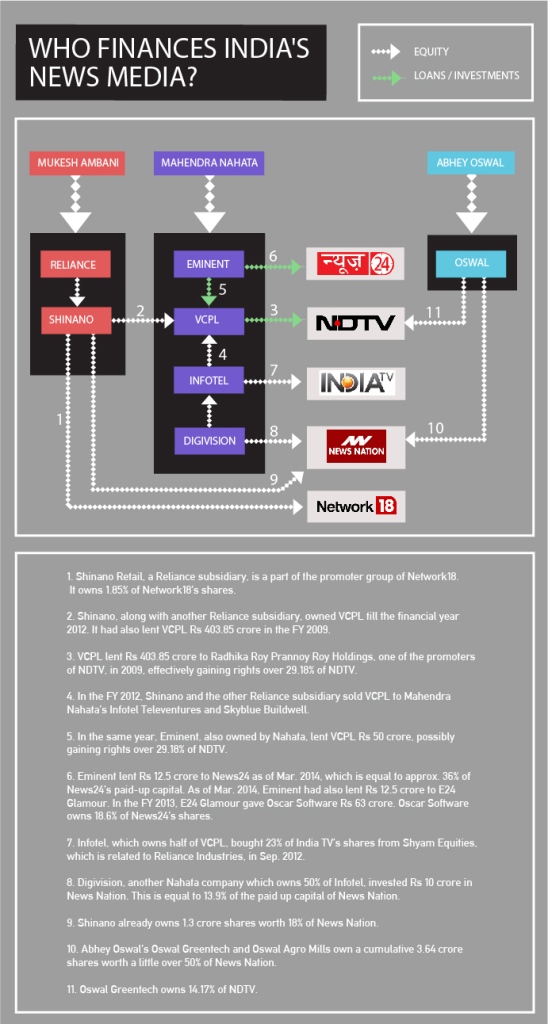
The last one requires a bit more information. This comes from V-Dem Institute which is an independent research institute based out of Department of Political Science, University of Gothenburg, Sweden. I am gonna leave the methods they use for another day as the blog post itself has become rather big/large. Apart from that is the Economists own Democracy Index -2019 Click to access democracy-index-2019.pdf Now for many people, both the V-Dem report and the Economist Index are some sort of attack against India. Doesn t matter that in V-Dem 200+ countries have been taken a variety of indicators and data or the Economist which has data from 150+- countries. Somehow India is supposed to be bigger than all these countries, they do think that other countries data specifically our neighbor China or any other neighbor, those are all accurate. How the dissonance is, has to be gauged from statements of various people. Update 11/12/20 Sadly, the newest V-Dem report marks India as getting into authoritarianism. Gag on Press and Media owners I had shared about the gag on the press especially with respect to western media or reports or anything. This news made its way to straitstimes which normally covers a wide-range of stories covering East Asia vis-a-vis India/South-East Asia. What has also been a big worry that most of the media has been in the hands of a few people. Caravan ran a story on the same in 2016, it has been four years, god only knows what the current situation might be. Any wonder that there is dearth of investigative journalism in India.
India media ownership 2016 Copyright Caravan
Incidentally, a reporter called Akarshan Uppal, who is a reporter on a channel called IBN24 had showecased just few days back how Adani has got land which was shot down for land change use in 2017 to 2020 around 100 acres. There seem to be very less details as to how the land was acquired, whose land it was etc. etc. The reporter was supposedly following a story on drugs on which he was attacked and is now lying in hospital.
Akarshan Uppal Reporter, IBN24 Copyright IBN24
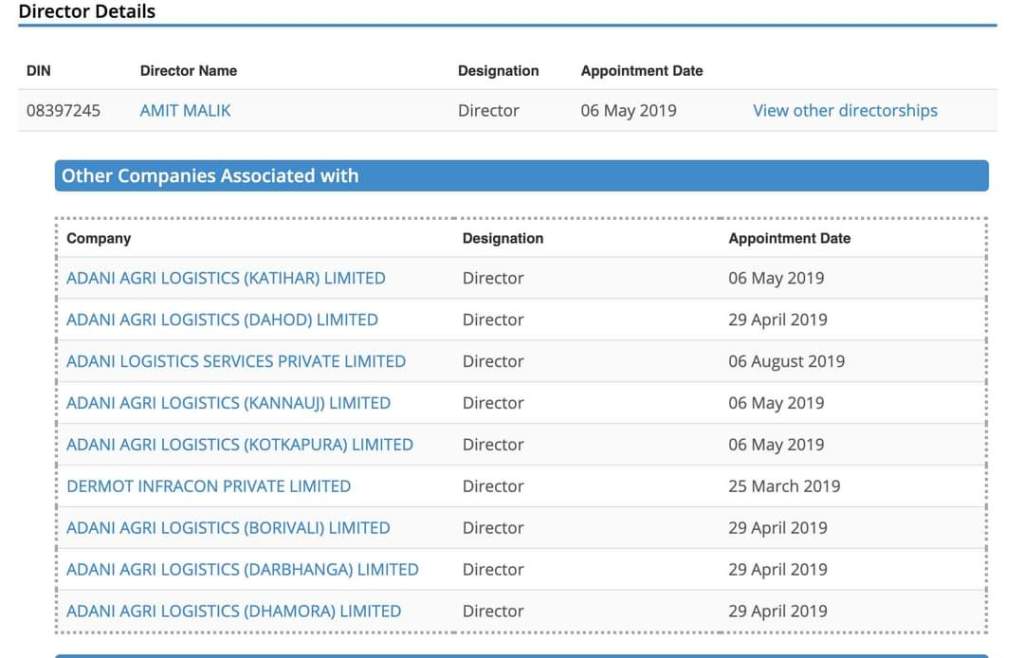
While it would take a whole article/blog post to talk about either Adani or Ambani, in the recent case, the land that has been taken over by Adani is 100 acres and there are private rail lines. And all of this was secret till few days back. The place where these massive godowns/silos have been made are Panipat s Jondhan Kalan and Naultha villages in Haryana. This is Adani AgiLogistics. Almost 7 odd companies have registered and come up in the last couple of years. As can be seen, almost all have come up within the last 2-3 years. Seems to be a lot of coincidence, isn t it?
Personal Anecdote on Data Collection and child marriages in India.

Around 1995 -96 when Internet had started to become a thing in India, there had been quite a few non-profits which were working on various issues. One of those which I initially came in contact with and which I found to be a bit absurd was non-profit which was working in the field of women against Violence. Now it is and was not the concept or the idea which was absurd to me, it was what these women were doing. Instead of the traditional ways in which you counsel women and try and figure out issues, these women were collecting data points from newspapers and magazines. This was way way before data science became a thing in India. They had their own structure where a story about violence against women which would be above the fold would be 5 points, the one below 2.5 points, in inner pages, it would be less and less. Patriarchy at that time was so strong, even today is but at that time it was such, that it felt a waste of time. I did consult them but never said that but did privately feel the above. In hindsight, they were doing the right thing and yet even today crimes against women goes unreported and is suppressed by both State and Central Governments as well as NCRB (National Crime Records Bureau). Interestingly, just few days back, the case against M.J. Akbar by Priya Ramani had taken a back seat and the defamation case by M.J. Akbar was taken forward. Even then, Priya Ramani s counsel s arguments were such that the court wound up in half an hour when they were expecting to do a whole day hearing. The next hearing would be happening today which I will look at in few hours from now. Why Priya Ramani was singled out rather than other tweets may probably be because she is an NRI and most NRI s usually do not want to be part of the bureaucratic Indian court system. This is also the reason that most companies from outside India especially those who are into startups prefer to change ownership, IPR etc. to their own or any country outside India which does make a loss to the exchequer. But this again is a story for another day. At the end, while I did not want to end on a negative note, it seems in many ways status-quo remains. For e.g. 2 years back, a BJP candidate (part of the ruling dispensation) had made a controversy saying that if they win the police won t interfere in child marriages. This is and was in Rajasthan where they have been trying to eradicate it forever. Till date, neither the NHRC (National Human Rights Commission) nor NCW (National Commission for Women) has taken cognizance of the statement. This is our state of democracy.

8 December 2020

Fran ois Marier: Opting your domain out of programmatic advertising

A few years ago, the advertising industry introduced the ads.txt project in order to defend against widespread domain spoofing vulnerabilities in programmatic advertising. I decided to use this technology to opt out of having ads sold for my domains, at least through ad exchanges which perform this check, by hosting a text file containing this:
contact=ads@fmarier.org
at the following locations: (In order to get this to work on my blog, running Ikiwiki on Branchable, I had to disable the txt plugin in order to get ads.txt to be served as a plain text file instead of being automatically rendered as HTML.)

Specification The key parts of the specification for our purposes are:
[3.1] If the server response indicates the resource does not exist (HTTP Status Code 404), the advertising system can assume no declarations exist and that no advertising system is unauthorized to buy and sell ads on the website. [3.2.1] Some publishers may choose to not authorize any advertising system by publishing an empty ads.txt file, indicating that no advertising system is authorized to buy and sell ads on the website. So that consuming systems properly read and interpret the empty file (differentiating between web servers returning error pages for the /ads.txt URL), at least one properly formatted line must be included which adheres to the format specification described above.
As you can see, the specification sadly ignores RFC8615 and requires that the ads.txt file be present directly in the root of your web server, like the venerable robots.txt file, but unlike the newer security.txt standard. If you don't want to provide an email address in your ads.txt file, the specification recommends using the following line verbatim:
placeholder.example.com, placeholder, DIRECT, placeholder

Validation A number of online validators exist, but I used the following to double-check my setup:

Russell Coker: Links December 2020

Business Insider has an informative article about the way that Google users can get locked out with no apparent reason and no recourse [1]. Something to share with clients when they consider putting everything in the cloud . Vice has an interestoing article about people jailbreaking used Teslas after Tesla has stolen software licenses that were bought with the car [2]. The Atlantic has an interesting article titled This Article Won t Change Your Mind [3]. It s one of many on the topic of echo chambers but has some interesting points that others don t seem to cover, such as regarding the benefits of groups when not everyone agrees. Inequality.org has lots of useful information about global inequality [4]. Jeffrey Goldberg has an insightful interview with Barack Obama for the Atlantic about the future course of American politics and a retrospective on his term in office [5]. A Game Designer s Analysis Of QAnon is an insightful Medium article comparing QAnon to an augmented reality game [6]. This is one of the best analysis of QAnon operations that I ve seen. Decrypting Rita is one of the most interesting web comics I ve read [7]. It makes good use of side scrolling and different layers to tell multiple stories at once. PC Mag has an article about the new features in Chrome 87 to reduce CPU use [8]. On my laptop I have 1/3 of all CPU time being used when it is idle, the majority of which is from Chrome. As the CPU has 2 cores this means the equivalent of 1 core running about 66% of the time just for background tabs. I have over 100 tabs open which I admit is a lot. But it means that the active tabs (as opposed to the plain HTML or PDF ones) are averaging more than 1% CPU time on an i7 which seems obviously unreasonable. So Chrome 87 doesn t seem to live up to Google s claims. The movie Bad President starring Stormy Daniels as herself is out [9]. Poe s Law is passe. Interesting summary of Parler, seems that it was designed by the Russians [10]. Wired has an interesting article about Indistinguishability Obfuscation, how to encrypt the operation of a program [11]. Joerg Jaspert wrote an interesting blog post about the difficulties packagine Rust and Go for Debian [12]. I think that the problem is many modern languages aren t designed well for library updates. This isn t just a problem for Debian, it s a problem for any long term support of software that doesn t involve transferring a complete archive of everything and it s a problem for any disconnected development (remote sites and sites dealing with serious security. Having an automatic system for downloading libraries is fine. But there should be an easy way of getting the same source via an archive format (zip will do as any archive can be converted to any other easily enough) and with version numbers.

6 December 2020

Olivier Berger: Offsite backups to rsync.net from an Asustor NAS

I have an Asustor (Nimbuster 4 / AS5304T) NAS at home, which allows me to perform regular backups. Unfortunately, I couldn't manage to find a way to configure remote backups from the NAS to rsync.net using the "Remote Sync" option of the "Backup & Restore" app provided in the ADM OS of the Asustor NAS. I'm used to using rsync -e ssh commands and would have expected some such configuration to be possible... it may just be some UI issue, but I couldn't find how to add one for rsync.net. I've then used the following workaround : the NAS can run a "Linux VM" (LXC ?) with the provided "Linux Center" app. It allows me to run a regular Debian installation inside this Linux guest. On which I installed backupninja, which performs backups over rsync, from the NAS filesystem, to the rsync.net remote. Along the way I had to overcome a few issues, whose documentation may be useful to others :

5 December 2020

Andrew Cater: And the last few architectures are getting done - Debian 10.7 edging ever closer

And we're through the live images as far as we can reasonably go. There remain a couple of MIPS architectures to build and IBM s390x - we have no hardware to test these.It's now 23:30 UTC - so that's 12 1/2 hours since we started and Sledge has another couple of hours to wait before the last images can be signed and the image release can be pushed.Thanks so much to Sledge, RattusRattus, Isy, Schweer and jlsantos - who came back to us after a significant internet outage local to them in California - to those who popped by - hi Kibi and Manty - and to all who labour behind the scenes to make each release "just work"Here's to the next one - in another couple of months, I'm guessing.

Thorsten Alteholz: My Debian Activities in November 2020

FTP master Unfortunately a day only has 24h. As the freeze is approaching, I had to concentrate a bit more on keeping my packages in shape. So this month I only accepted nine packages. The good news, I rejected no package. The overall number of packages that got accepted was 328. Debian LTS This was my seventy-seventh month that I did some work for the Debian LTS initiative, started by Raphael Hertzog at Freexian. This month my all in all workload has been 22.75h. During that time I did LTS uploads of: I also started to work on x11vnc and slirp. Last but not least I did some days of frontdesk duties. Debian ELTS This month was the twenty ninth ELTS month. During my allocated time I uploaded: Unfortunately I also had to give back some hours. Last but not least I did some days of frontdesk duties. Other stuff This month I uploaded new upstream versions of: I fixed one or two bugs in: I improved packaging of: and there have been even some new packages: As it is again this time of the year, I would also like to draw some attention to the Debian Med Advent Calendar. Like the past years, the Debian Med team starts a bug squashing event from the December 1st to 24th. Every bug that is closed will be registered in the calendar. So instead of taking something from the calendar, this special one will be filled and at Christmas hopefully every Debian Med related bug is closed. Don t hesitate, start to squash :-). The announcement on the mailing list can be found here.

Andrew Cater: Lots further forwards - but moving slowly through live CD testing

All of the testing of the normal Debian images has gone through the steps we lay out. We're now working on the Debian live CDs which take significantly longer per image.Looks like a long night until Steve is ready to sign the release and begin the final transfer - however much we try to minimise it, it's a 12-15 hour process and my thanks go to RattusRattus and Steve for the final stages of a very long day.

Joachim Breitner: Named goals in Coq

TL;DR: Some mildly tricky tricks allow you to select subgoals by name, like in Isabelle. This leads to more readable proofs, and proofs that are more robust against changes.

The need for case names Consider the following Coq proof, right out of the respected Software Foundations book, Chapter Inductively Defined Propositions (and slightly simplified):
Lemma star_app: forall T (s1 s2 : list T) (re : reg_exp T),
  s1 =~ Star re ->
  s2 =~ Star re ->
  s1 ++ s2 =~ Star re.
Proof.
  intros T s1 s2 re H1.
  remember (Star re) as re'.
   generalize dependent s2.
  induction H1.
  - (* MEmpty *) discriminate.
  - (* MChar *) discriminate.
  - (* MApp *) discriminate.
  - (* MUnionL *) discriminate.
  - (* MUnionR *) discriminate.
  - (* MStar0 *)
    injection Heqre' as Heqre''. intros s H. apply H.
  - (* MStarApp *)
    injection Heqre' as Heqre''.
    intros s3 H1. rewrite <- app_assoc.
    apply MStarApp.
    + apply H1_.
    + apply IHexp_match2.
      * rewrite Heqre''. reflexivity.
      * apply H1.
Qed.
This is a very typical example for a proof by induction over an inductively defined relation (in this case, the relations s =~ re which indicates that the string s matches the regular expression re): After some preparation, the invocation of a tactic like induction (could also be inversion or others) creates a number of new goals, one of for each rule of the relation. Then the modern(!) Coq user uses proof bullets to focus the goals, one after another, in order, to solve them. We can see from this example that proof bullets (which were a big improvement) are not quite satisfactory, and the author of this proof felt the need to annotate each subproof with the case it corresponds to. But these are mere comments! This is unsatisfactory, as there is nothing keeping them correct as my proof changes. And anyone who came to Coq from Isabelle is just flabbergasted that the state of art in Coq is still at that level So, wouldn t it be great if
  • I could focus goals by their name (e.g. MEmpty)
  • Focus them in any order (so that refactoring of my data types do not break my proofs)
  • This even worked when simultaneously inducting over or inverting multiple relations?

Simulating named goals in Coq Well, with a few tricks we can! It just takes three simple steps:
  1. I load a small file full of hacks (explained below):
    Require Import NamedCases.
  2. This allows me to prefix the type of the constructors of the inductive relations (i.e. the rules of the relation) with case <name>, , as follows:
    Reserved Notation "s =~ re" (at level 80).
    Inductive exp_match  T  : list T -> reg_exp T -> Prop :=
        MEmpty:
        case empty,
        [] =~ EmptyStr
        MChar:
        case char,
        forall x,
        [x] =~ (Char x)
        MApp:
        case app,
        forall s1 re1 s2 re2
        (H1 : s1 =~ re1)
        (H2 : s2 =~ re2),
        (s1 ++ s2) =~ (App re1 re2)
        MUnionL:
        case union_l,
        forall s1 re1 re2
        (H1 : s1 =~ re1),
        s1 =~ (Union re1 re2)
        MUnionR:
        case union_r,
        forall re1 s2 re2
        (H2 : s2 =~ re2),
        s2 =~ (Union re1 re2)
        MStar0:
        case star0,
        forall re,
        [] =~ (Star re)
        MStarApp:
        case star_app,
        forall s1 s2 re
        (H1 : s1 =~ re)
        (H2 : s2 =~ (Star re)),
        (s1 ++ s2) =~ (Star re)
      where "s =~ re" := (exp_match s re).
    This is the definition from the Software Foundations book; only the case <name>, lines are added.
  3. Now I can change the proof: After the induction tactic I use ; name_cases to name the cases, and then I can use the relatively new named goal focusing feature ([name]: , which I suggested two years ago, and was implemented by Th o Zimmermann) to focus a specific case:
    Lemma star_app2: forall T (s1 s2 : list T) (re : reg_exp T),
      s1 =~ Star re ->
      s2 =~ Star re ->
      s1 ++ s2 =~ Star re.
    Proof.
      intros T s1 s2 re H1.
      remember (Star re) as re'.
       generalize dependent s2.
      induction H1; name_cases.
      [empty]:  
         discriminate.
       
      [char]:  
         discriminate.
       
      [app]:  
         discriminate.
       
      [unionL]:  
         discriminate.
       
      [unionR]:  
        discriminate.
       
      [star0]:  
        injection Heqre' as Heqre''. intros s H. apply H.
       
      [starApp]:  
        injection Heqre' as Heqre''.
        intros s3 H1. rewrite <- app_assoc.
        apply MStarApp; clear_names.
        + apply H1_.
        + apply IHexp_match2.
          * rewrite Heqre''. reflexivity.
          * apply H1.
        
    Qed.
    The comments have turned into actual names!
Goal focusing is now just much more reliable. For example, let me try to discharge the boring cases by using ; try discriminate after the induction. This means there are suddenly only two goals left. With bullets, the first bullet would now suddenly focus a different goal, and my proof script would likely fail somewhere. With named goals, I get a helpful error message No such goal: empty and I can t even enter the first subproof. So let me delete these goals and, just to show off, focus the remaining goals in the wrong order:
Lemma star_app: forall T (s1 s2 : list T) (re : reg_exp T),
  s1 =~ Star re ->
  s2 =~ Star re ->
  s1 ++ s2 =~ Star re.
Proof.
  intros T s1 s2 re H1.
  remember (Star re) as re'.
   generalize dependent s2.
  induction H1; name_cases; try discriminate.
  [starApp]:  
    injection Heqre' as Heqre''.
    intros s3 H1. rewrite <- app_assoc.
    apply MStarApp; clear_names.
    + apply H1_.
    + apply IHexp_match2.
      * rewrite Heqre''. reflexivity.
      * apply H1.
    
  [star0]:  
    injection Heqre' as Heqre''. intros s H. apply H.
   
Qed.
I did not explain the clear_names tactic yet that I had to use after apply MStarApp. What I am showing here is a hack, and it shows these case names are extra hypothesis (of a trivially true type CaseName), and this tactic gets rid of it.

Even better than Isabelle The above even works when there are multiple inductions/inversions involved. To give an example, let s introduce another inductive predicate, and begin proving a lemma that one can do by induction on one and inversion on the other predicate.
Inductive Palindrome  T  : list T -> Prop :=
  EmptyPalin:
  case emptyP,
  Palindrome []
  SingletonPalin:
  case singletonP,
  forall x,
  Palindrome [x]
  GrowPalin:
  case growP,
  forall l x,
  Palindrome l -> Palindrome ([x] ++ l ++ [x])
.
Lemma palindrome_star_of_two:
  forall T (s : list T) x y,
  Palindrome s -> s =~ Star (App (Char x) (Char y)) ->
  s = [] \/ x = y.
Proof.
  intros T s x y HPalin HRe.
  induction HPalin; inversion HRe; name_cases.
At this point we have four open goals. Can you tell why there are four, and which ones they are? Luckily, Show Existentials will tell us their names (and Coq 8.13 will just show them in the proof state window). These names not only help us focus the goal in a reliable way; they even assist us in understanding what goal we have to deal with. For example, the last goal arose from the GrowP rule and the StarApp rule. Neat!
  [emptyP_star0]:  
    left. reflexivity.
   
  [emptyP_starApp]:  
     left. reflexivity.
   
  [singletonP_starApp]:  
    inversion HRe; clear HRe.
    inversion H5; clear H5.
    inversion H10; clear H10.
    inversion H11; clear H11.
    subst.
    inversion H3.
   
 [growP_starApp]:  
    admit. (* I did not complete the proof *)
  

Under the hood (the hack) The above actually works, but it works with a hack, and I wish that Coq s induction tactic would just do the right thing here. I hope eventually this will be the case, and this section will just be curiosity but until, it may actually be helpful.
  1. The trick1 is to leave markers in the proof state. We use a dedicate type CaseName, and a hypothesis name : CaseName indicates that this goal arose from the that case.
    Inductive CaseName := CaseNameI.
    With this, we can write StarApp: forall (starApp : CaseName), to name this case.
  2. For a little bit of polish, we can introduce notation for that:
    Notation "'case' x , t" := (forall  x : CaseName , t) (at level 200).
    This allows us to use the syntax you saw above.
  3. To easily discharge these CaseName assumptions when using the introduction forms, I wrote these tactics:
    Ltac clear_names := try exact CaseNameI.
    Ltac named_constructor  := constructor; [ exact CaseNameI   idtac .. ].
    Ltac named_econstructor := econstructor; [ exact CaseNameI   idtac .. ].
  4. Finally I wrote the tactic name_cases. What it does is relatively simple:
    For each subgoal: Take all hypotheses of type CaseName, concatenate their names, change the name of the current goal to that, and clear these hypotheses
    Unfortunately, my grasp of Coq tactic programming is rather rudimentary, and the only way I manged to solve this is a horrible monster of Ltac2, including hand-rolled imperative implementations of string concatenation and a little nested Ltac1 tactic within. You have been warned:
    From Ltac2 Require Import Ltac2.
    From Ltac2 Require Option.
    Set Default Proof Mode "Classic".
    Ltac name_cases := ltac2:(
      (* Horribly manual string manipulations. Does this mean I should
         go to the Ocaml level?
      *)
      let strcpy s1 s2 o :=
        let rec go := fun n =>
          match Int.lt n (String.length s2) with
            true => String.set s1 (Int.add o n) (String.get s2 n); go (Int.add n 1)
            false => ()
          end
        in go 0
      in
      let concat := fun s1 s2 =>
        let l := Int.add (Int.add (String.length s1) (String.length s2)) 1 in
        let s := String.make l (Char.of_int 95) in
        strcpy s s1 0;
        strcpy s s2 (Int.add (String.length s1) 1);
        s
      in
      Control.enter (let rec go () :=
        lazy_match! goal with
          [ h1 : CaseName, h2 : CaseName  - _ ] =>
          (* Multiple case names? Combine them (and recurse) *)
          let h := concat (Ident.to_string h1) (Ident.to_string h2) in
          Std.clear [h1; h2];
          let h := Option.get (Ident.of_string h) in
          assert ($h := CaseNameI);
          go ()
          [ _ : CaseName  - _ ] =>
          (* A single case name? Set current goal name accordingly. *)
          ltac1:(
            (* How to do this in ltac2? *)
            lazymatch goal with
              [ H : CaseName  - _ ] => refine ?[H]; clear H
            end
          )
          [  - _ ] =>
          Control.backtrack_tactic_failure "Did not find any CaseName hypotheses"
        end
      in go)
    ).
    If someone feels like re-implementing this in a way that is more presentable, I ll be happy to update this code (and learn something along the way
That s all it takes!

Conclusion With some mild hackery, we can get named cases in Coq, which I find indispensable in managing larger, evolving proofs. I wonder why this style is not more common, and available out of the box, but maybe it is just not known well enough? Maybe this blog post can help a bit here.

  1. I have vague recollections of seeing at least parts of this trick on some blog some years ago, and I do not claim originality here.

4 December 2020

Jonathan Dowland: Toronto

selfie skating at night
Nathan Phillips Square rink at night
view over Nathan Phillips Square rink
skaters by day
This time a year ago, I visited Toronto, Canada for my first (and hopefully not last) time, for the Red Hat Java team's face-to-face meetings. The hotel we were staying in was right next to Nathan Phillip's Square, which is an open-air Ice Rink for the winter months. I love Ice Skating and rarely took opportunities to do it (even before Covid-19) so I decided to take full advantage of the locality. Skating was free, but boot rental was not, so I bought some new skates. That meant an interesting problem getting them home on the plane. I think I got out there about 5 times over 5 days. It was busy during the day and very quiet at other times. 8am worked pretty well. My local Ice Rink has been intermittently open over the year as and when the Lockdown rules have allowed it, but the combination of cold air, indoor circulation and strenuous activity seem to me to be very unsafe, so I won't risk it. In Newcastle, the Centre for Life usually puts an outdoor rink on around Christmas, which is very expensive to skate on. Unfortunately they've decided against it this year. Toronto was great for more than just Ice Skating! I had a fantastic time meeting my team members; good food, good drink (especially Ice Wine); The CN Tower; a funky music instrument shop, and the first Teenage Engineering OP-1 I've ever seen in the flesh; not much Maple syrup, which surprised me. Good coffee. A comfortable-feeling city. It'll probably be a long while before I travel for work (or anything else) quite like this again. I'm glad to have made the most of it, whilst I could!
me, covered in snow

Russell Coker: ZFS 2.0.0 Released

Version 2.0 of ZFS has been released, it s now known as OpenZFS and has a unified release for Linux and BSD which is nice. One new feature is persistent L2ARC (which means that when you use SSD or NVMe to cache hard drives that cache will remain after a reboot) is an obvious feature that was needed for a long time. The Zstd compression invented by Facebook is the best way of compressing things nowadays, it s generally faster while giving better compression than all other compression algorithms and it s nice to have that in the filesystem. The PAM module for encrypted home directories is interesting, I haven t had a need for directory level encryption as block device encryption has worked well for my needs. But there are good use cases for directory encryption. I just did a quick test of OpenZFS on a VM, the one thing it doesn t do is let me remove a block device accidentally added to a zpool. If you have a zpool with a RAID-Z array and mistakenly add a new disk as a separate device instead of replacing a part of the RAID-Z then you can t remove it. There are patches to allow such removal but they didn t appear to get in to the OpenZFS 2.0.0 release. For my use ZFS on Linux 0.8.5 has been working fairly well and apart from the inability to remove a mistakenly added device I haven t had any problems with it. So I have no immediate plans to upgrade existing servers. But if I was about to install a new ZFS server I d definitely use the latest version. People keep asking about license issues. I m pretty sure that Oracle lawyers have known about sites like zfsonlinux.org for years, the fact that they have decided not to do anything about it seems like clear evidence that it s OK for me to keep using that code.

Russell Coker: KDE Icons Disappearing in Debian/Unstable

One of my workstations is running Debian/Unstable with KDE and SDDM on an AMD Radeon R7 260X video card. Recently it stopped displaying things correctly after a reboot, all the icons failed to display as well as many of the Qt controls. When I ran a KDE application from the command line I got the error QSGTextureAtlas: texture atlas allocation failed, code=501 . Googling that error gave a blog post about a very similar issue in 2017 [1]. From that blog post I learned that I could stop the problem by setting MESA_EXTENSION_OVERRIDE= -GL_EXT_bgra -GL_EXT_texture_format_BGRA8888 in the environment. In a quick test I found that the environment variable setting worked, making the KDE apps display correctly and not report an error about a texture atlas. I created a file ~/.config/plasma-workspace/env/bgra.sh with the following contents:
export MESA_EXTENSION_OVERRIDE="-GL_EXT_bgra -GL_EXT_texture_format_BGRA8888"
Then after the next login things worked as desired! Now the issue is, where is the bug? GL, X, and the internals of KDE are things I don t track much. I welcome suggestions from readers of my blog as to what the culprit might be and where to file a Debian bug or a URL to a Debian bug report if someone has already filed one. Update When I run the game warzone2100 with this setting it crashes with the below output. So this Mesa extension override isn t always a good thing, just solves one corner case of a bug.
$ warzone2100 
/usr/bin/gdb: warning: Couldn't determine a path for the index cache directory.
27      ../sysdeps/unix/sysv/linux/wait4.c: No such file or directory.
No frame at level 0x7ffc3392ab50.
Saved dump file to '/home/etbe/.local/share/warzone2100-3.3.0//logs/warzone2100.gdmp-VuGo2s'
If you create a bugreport regarding this crash, please include this file.
Segmentation fault (core dumped)
Update 2 Carsten provided the REAL solution to this, run apt remove libqt5quick5-gles which will automatically install libqt5quick5 which makes things work. Another workstation I run that tracks Testing had libqt5quick5 installed which was why it didn t have the problem. The system in question had most of KDE removed due to package dependency issues when tracking Unstable and when I reinstalled it I guess the wrong one was installed.

Dirk Eddelbuettel: #31: Test your R package against bleeding-edge gcc

Welcome to the 31th post in the rapturously rampant R recommendations series, or R4 for short. This post will once again feature Docker for use with R. Earlier this week, I received a note from CRAN about how my RcppTOML package was no longer building with the (as of right now of course unreleased) version 11 of the GNU C++ compiler, i.e. g++-11. And very kindly even included a hint about the likely fix (which was of course correct). CRAN, and one of its maintainers in particular, is extremely forward-looking in terms of toolchain changes. A year ago we were asked to updated possible use of global variables in C code as gcc-10 tightened the rules. This changes is a C++ one, and a fairly simple one of simply being more explicit with include headers. Previous g++ release had done the same. The question now was about the least painful way to get g++-11 onto my machine, with the least amount of side-effects. Regular readers of this blog will know where this is headed, but even use of Docker requires binaries. A look at g++-11 within packages.debian.org comes up empty. No Debian means no Ubuntu. But there is a PPA for Ubuntu with toolchain builds we have used before. And voil there we have it: within the PPA for Ubuntu Toolchain repository is the volatile packages PPA with both g++-10 and g++-11. Here Ubuntu 20.10 works with g++-10, but g++-11 requires Ubuntu 21.04. Docker containers are there for either. So with the preliminaries sorted out, the key steps are fairly straightforward: And that is it! RcppTOML is fairly minimal and could be a member of the tinyverse so no other dependencies are needed if your package has any you could just use the standard steps to install from source, or binary (including using RSPM or bspm). You can see the resulting Dockerfile which contains a minimal amount of extra stuff to deal with some environment variables and related settings. Nothing critical, but it smoothes the experience somewhat. This container is now built (under label rocker/r-edge with tags latest and gcc-11), and you can download it from Docker Hub. With that the proof of the (now fixed and uploaded) package building becomes as easy as
edd@rob:~/git/rcpptoml(master)$ docker run --rm -ti -v $PWD:/mnt -w /mnt rocker/r-edge:gcc-11 g++ --version
g++ (Ubuntu 11-20201128-0ubuntu2) 11.0.0 20201128 (experimental) [master revision fb6b29c85c4:a331ca6194a:e87559d202d90e614315203f38f9aa2f5881d36e]
Copyright (C) 2020 Free Software Foundation, Inc.
This is free software; see the source for copying conditions.  There is NO
warranty; not even for MERCHANTABILITY or FITNESS FOR A PARTICULAR PURPOSE.

edd@rob:~/git/rcpptoml(master)$ 
edd@rob:~/git/rcpptoml(master)$ docker run --rm -ti -v $PWD:/mnt -w /mnt rocker/r-edge:gcc-11 R CMD INSTALL RcppTOML_0.1.7.tar.gz
* installing to library  /usr/local/lib/R/site-library 
* installing *source* package  RcppTOML  ...
** using staged installation
** libs
g++ -std=gnu++11 -I"/usr/share/R/include" -DNDEBUG -I../inst/include/ -DCPPTOML_USE_MAP -I'/usr/lib/R/site-library/Rcpp/include'    -fpic  -g -O2 -fdebug-prefix-map=/build/r-base-Fuvi9C/r-base-4.0.3=. -fstack-protector-strong -Wformat -Werror=format-security -Wdate-time -D_FORTIFY_SOURCE=2 -g  -c RcppExports.cpp -o RcppExports.o
g++ -std=gnu++11 -I"/usr/share/R/include" -DNDEBUG -I../inst/include/ -DCPPTOML_USE_MAP -I'/usr/lib/R/site-library/Rcpp/include'    -fpic  -g -O2 -fdebug-prefix-map=/build/r-base-Fuvi9C/r-base-4.0.3=. -fstack-protector-strong -Wformat -Werror=format-security -Wdate-time -D_FORTIFY_SOURCE=2 -g  -c parse.cpp -o parse.o
g++ -std=gnu++11 -shared -L/usr/lib/R/lib -Wl,-Bsymbolic-functions -Wl,-z,relro -o RcppTOML.so RcppExports.o parse.o -L/usr/lib/R/lib -lR
installing to /usr/local/lib/R/site-library/00LOCK-RcppTOML/00new/RcppTOML/libs
** R
** inst
** byte-compile and prepare package for lazy loading
** help
*** installing help indices
** building package indices
** testing if installed package can be loaded from temporary location
** checking absolute paths in shared objects and dynamic libraries
** testing if installed package can be loaded from final location
** testing if installed package keeps a record of temporary installation path
* DONE (RcppTOML)
edd@rob:~/git/rcpptoml(master)$ 
I hope both the availability of such a base container with gcc-11 (and g++-11 and gfortran-11) as well as a recipe for building similar containers with newer clang version will help other developers. If you like this or other open-source work I do, you can sponsor me at GitHub.

This post by Dirk Eddelbuettel originated on his Thinking inside the box blog. Please report excessive re-aggregation in third-party for-profit settings.

3 December 2020

Daniel Lange: No dog food today - the Linux Foundation annual report

The Linux Foundation has published its annual report today. LWN calls it glossy and yeah, boy, it is shiny. So shiny that people that work in the publishing industry immediately see this has been produced with the Adobe toolchain which - unfortunately - is one of the big suites of software not yet available for Linux. Checking the PDF file metadata reveals the keywords "open source, open standards, open hardware, open data". That is what the Linux Foundation is about. Good stuff. Linux Foundation annual report 2020 cover The PDF producer meta data for the annual report PDF has been set to "Linux kernel 0.12.1 for Workgroups" and the PDF creator meta data element to "Sharp Zaurus XR-5000 (Maemo5) Edition". Somebody thought to better hide the real data and had some tongue-in-cheek ideas. Kudos. But nicer would have been to use Open Source software to produce the report, not? Running strings 2020-Linux-Foundation-Annual-Report_113020.pdf grep Adobe wc -l gives us 1229 lines and confirms the suspicion of the toolchain. A stale /Title (Annual Report 2020) /Producer (macOS Version 10.15.7 \(Build 19H15\) Quartz PDFContext) has been forgotten in the document to tell us about the platform. So, ladies and gentlemen, the Linux Foundation 2020 annual report has been produced on a Mac. Running Adobe Creative Cloud on MacOS Catalina 10.15.7. Which is proprietary software. Its kernel (and some userland pieces) are based on BSD. Not Linux.


The image on the front page also struck me as a bit odd ... using a ballpoint pen on the laptop screen? Unbranded laptop. Unbranded cup in the foreground. Kid in the background not paying attention to his tablet. All of that cries stock image so loud it hurts. Google currently finds ~560 uses of the picture and any editorial use nicely tells us that it is Dragana Gordic / Shutterstock. The image is "Smiling mom working at home with her child on the sofa while writing an email. Young woman working from home, while in quarantine isolation during the Covid-19 health crisis". See the Daily Mail for a wonderful example of the working mum in context. I hope, if her laptop had been powered on, it would have run Linux. I mean, what else would still run on an old white MacBook with an Intel "Core 2 Duo" processor from 2008? Daily Mail screenshot of the same stock image used Continue reading "No dog food today - the Linux Foundation annual report"

Andrew Cater: Preparing for release of Debian 10.7 over the weekend and CentOS / Scientific Linux 6.x and EPEL for 6 now EOL

For those keeping score:This weekend - 5th December 2020 - should see us release Debian 10.7 - an update to Debian stable (Buster) so I should be spending a day or so in the company of my friends and colleagues.Red Hat 6.10 is now out of support unless you pay Extended Update subscriptions for individual Red Hat machines. This means that CentOS 6.* has now been removed from CentOS mirrors since these were dependent on Red Hat 6 sources.. Similarly, Scientific Linux have also removed their fork of 6.*. They are continuing to support a Scientific Linux 7 but suggest a move to CentOS 8 thereafter.
Separately, Fedora Linux have removed EPEL 6.* - definitely time to update to Red Hat/CentOS/Scientific Linux 7.* or greater for those affected.
All the very best to all:

Alberto Garc a: Subcluster allocation for qcow2 images

In previous blog posts I talked about QEMU s qcow2 file format and how to make it faster. This post gives an overview of how the data is structured inside the image and how that affects performance, and this presentation at KVM Forum 2017 goes further into the topic. This time I will talk about a new extension to the qcow2 format that seeks to improve its performance and reduce its memory requirements. Let s start by describing the problem. Limitations of qcow2 One of the most important parameters when creating a new qcow2 image is the cluster size. Much like a filesystem s block size, the qcow2 cluster size indicates the minimum unit of allocation. One difference however is that while filesystems tend to use small blocks (4 KB is a common size in ext4, ntfs or hfs+) the standard qcow2 cluster size is 64 KB. This adds some overhead because QEMU always needs to write complete clusters so it often ends up doing copy-on-write and writing to the qcow2 image more data than what the virtual machine requested. This gets worse if the image has a backing file because then QEMU needs to copy data from there, so a write request not only becomes larger but it also involves additional read requests from the backing file(s). Because of that qcow2 images with larger cluster sizes tend to: Unfortunately, reducing the cluster size is in general not an option because it also has an impact on the amount of metadata used internally by qcow2 (reference counts, guest-to-host cluster mapping). Decreasing the cluster size increases the number of clusters and the amount of necessary metadata. This has direct negative impact on I/O performance, which can be mitigated by caching it in RAM, therefore increasing the memory requirements (the aforementioned post covers this in more detail). Subcluster allocation The problems described in the previous section are well-known consequences of the design of the qcow2 format and they have been discussed over the years. I have been working on a way to improve the situation and the work is now finished and available in QEMU 5.2 as a new extension to the qcow2 format called extended L2 entries. The so-called L2 tables are used to map guest addresses to data clusters. With extended L2 entries we can store more information about the status of each data cluster, and this allows us to have allocation at the subcluster level. The basic idea is that data clusters are now divided into 32 subclusters of the same size, and each one of them can be allocated separately. This allows combining the benefits of larger cluster sizes (less metadata and RAM requirements) with the benefits of smaller units of allocation (less copy-on-write, smaller images). If the subcluster size matches the block size of the filesystem used inside the virtual machine then we can eliminate the need for copy-on-write entirely. So with subcluster allocation we get: This figure shows the average number of I/O operations per second that I get with 4KB random write requests to an empty 40GB image with a fully populated backing file.
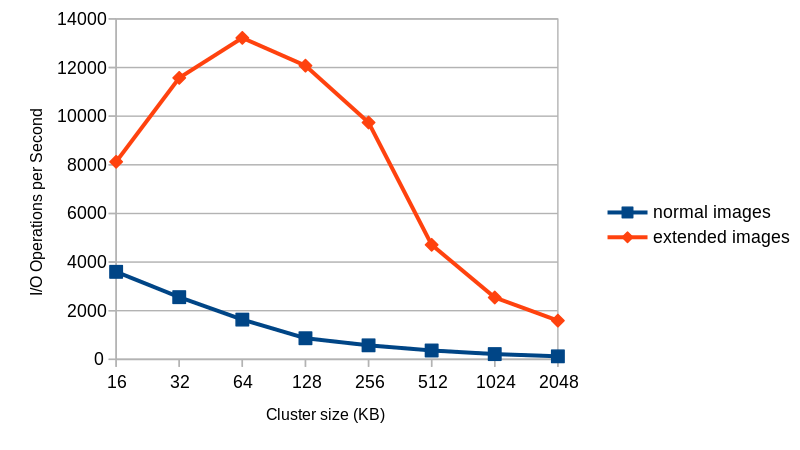
I/O performance comparison between traditional and extended qcow2 images
Things to take into account: How to use this? Extended L2 entries are available starting from QEMU 5.2. Due to the nature of the changes it is unlikely that this feature will be backported to an earlier version of QEMU. In order to test this you simply need to create an image with extended_l2=on, and you also probably want to use a larger cluster size (the default is 64 KB, remember that every cluster has 32 subclusters). Here is an example:
$ qemu-img create -f qcow2 -o extended_l2=on,cluster_size=128k img.qcow2 1T
And that s all you need to do. Once the image is created all allocations will happen at the subcluster level. More information This work was presented at the 2020 edition of the KVM Forum. Here is the video recording of the presentation, where I cover all this in more detail: You can also find the slides here. Acknowledgments This work has been possible thanks to Outscale, who have been sponsoring Igalia and my work in QEMU.
Igalia and Outscale
And thanks of course to the rest of the QEMU development team for their feedback and help with this!

Bdale Garbee: Shifting Emphasis

I joined the Debian project in late 1994, well before the first stable release was issued, and have been involved in various ways continuously ever since. Over the years, I adopted a number of packages that are, or at least were at one time, fundamental to the distribution. But, not surprisingly, my interests have shifted over time. In the more than quarter century I've contributed to Debian, I've adopted existing packages that needed attention, packaged new software I wanted to use that wasn't yet in Debian, offered packages up for others to adopt, and even sometimes requested the removal of packages that became obsolete or replaced by something better. That all felt completely healthy. But over the last couple weeks, I realized I'm still "responsible" for some packages I'd had for a very long time, that generally work well but over time have accumulated bugs in functionality I just don't use, and frankly haven't been able to find the motivation to chase down. As one example, I just noticed that I first uploaded the gzip package 25 years ago today, on 2 December 1995. And while the package works fine for me and most other folks, there are 30 outstanding bugs and 3 forwarded bugs that I just can't muster up any energy to address. So, I just added gzip to a short list of packages I've offered up for adoption recently. I'm pleased that tar already has a new maintainer, and hope that both sudo and gzip will get more attention soon. It's not that I'm less interested in Debian. I've just been busy recently packaging up more software I use or want to use in designing high power model rockets and the solid propellant motors I fly in them, and would rather spend the time I have available for Debian maintaining those packages and all their various build dependencies than continuing to be responsible for core packages in the distribution that "work fine for me" but could use attention. I'm writing about this partly to mark the passing of more than a quarter century as a package maintainer for Debian, partly to encourage other Debian package maintainers with the right skills and motivation to consider adopting some of the packages I'm giving up, and finally to encourage other long-time participants in Debian to spend a little time evaluating their own package lists in a similar way.

Next.

Previous.