Search Results: "nic"

21 November 2013

Russ Allbery: Small but lovely haul

A few things for which I'd been waiting for quite some time were released, so there was another book order. Allie Brosh Hyperbole and a Half (graphic novel)
Jacqueline Carey Dark Currents (sff)
Debra Dunbar A Demon Bound (sff)
Nicola Griffith Hild (historical)
Ursula K. Le Guin The Unreal and the Real, Volume 1 (sff)
Ursula K. Le Guin The Unreal and the Real, Volume 2 (sff)
Ken Stern With Charity for All (non-fiction) I'm trying to buy fewer books given how many I have and haven't read, and also because I've been on a gaming tear recently and there are only so many hours in the day. Unfortunately, playing a lot of video games means reading fewer books. So I'm trying for quality rather than quantity, and this particular order has one of the best densities of hopefully good books as anything I've ordered in a while. For those who aren't familiar with Allie Brosh, Hyperbole and a Half is one of the most brilliant blogs that I've ever read, and this is a collection plus new stories and new illustrations. I specifically got the hardcover, which is beautiful and very high-quality. I've been waiting for Hild for years since Griffith started talking about writing it on her blog, and now I have the lovely hardcover in my hands. That's probably going to be Christmas reading. The Le Guin is a two-volume hardcover collection of Le Guin's personal favorites from her large lifetime oeuvre of short fiction.

Gunnar Wolf: Back aches...

This year, I had slowly taken again running. It's an activity I enjoy, even though I'm far from the condition I had when I did it every day My maximum was running about 8Km four days a week (ocassionally up to 15Km, say, on weekends)... But I slowly drifted out of it over the last three years. Yes, I have taken it up now and then, but dropped out again after a few weeks. Well, this year it felt I was getting back in the routine. Not without some gaps, but I had ran most weeks since July at least once, but usually two times. I started slowly, doing about 3Km close to home, but didn't take much to go back to my usual routes inside UNAM, doing a modest average of 4.5-5Km per run, and averaging somewhat over 8Km/h (6.5 min/Km). But... Well, I cannot relate precisely what happened on this Exactly a month ago, after a very average run (even a short one, 3.6Km), I had a lower back ache. Didn't pay too much attention to it, but it was strange since the first day, as I often have upper back aches Never lower. The pain came and went slowly several times. I kept cycling to work, although not every day. On October 27th, I even took the time to do the Ciclot n, a nice 38Km (including the ~5Km distance from home) around central Mexico City. I enjoyed the ride, even though every stop and re-start of the bike was a bit painful what hurts is to get off and on the bike: The posture change. But the pain has been almost constantly there. When I stand up, or when I sit down, it's about five minutes until the body gets used to the new position and stops hurting. Another strange data point: This last weekend (together with a national holiday) we went to a small conference in Guadalajara, and then to visit our friends in Guanajuato. So, we spent 12 hours on the bus there (12 Yes, there was an accident on the road, and we could not pass... So many hours were wasted there, and going back to a junction to take an alternative, longer road), then one night in a hotel bed, and two nights in our friends' guest mattresses which are not precisely luxury-grade. And Sunday night... I had no pain at all! Came back home, and after only one night back in our bed... I just could not move. I had the strongest pain so far. Could not even walk without some help. We went to the orthopedist a friend recommended, and I was seriously bending my posture: While that part of my posture is usually stable, my right hip was about 2cm higher than the left one, and my shoulders were almost 7cm displaced from my hips! So... Well, I'm having a cocktail of painkillers and antiinflamatories. The doctor says next week he wants me to have a tomography taken to better understand the causes for this. And, of course, tomorrow I'm leaving for Festival de Software Libre in Puerto Vallarta. I'm going there by plane, so no big hassle. But the way back, it will be 12 more hours on a bus. I'm... not precisely looking forward to this bus ride :( Anyway... I sorely miss my bike+running :(

Steve McIntyre: Mini-Debconf in Cambridge, November 14-17 2013

Phew, we did it! We successfuly ran our mini-conf last weekend. We welcomed roughly 60 people to the ARM offices in Cambridge over the 4 days. We started off with two days of sprint time, set aside for focussed hacking. We had a selection of ARM development boards on hand that people were playing with, plus a number of other people working on various other projects. The sprint sessions also saw some lively discussions on a couple of topics: the status of the ARM ports in Debian and automated system testing. Saturday and Sunday saw us move over to the more traditional style of conference session. Two full days of talks covered a wide range of topics: system testing to git tools, Debian ftp team work to bootstrapping the new arm64 port, improving ways of tracking and crediting Debian contributions to dealing with the new world of UEFI. Several volunteers from the DebConf video team were on hand too, so our talks were streamed live and recorded too - look out for them online soon! The mini-conf went well and feedback from attendees was universally positive, so we're already planning to run another similar event next year and maybe even apply to host a full DebConf in Cambridge soon too. :-) Many more details about the conference are in the debconf wiki at https://wiki.debconf.org/wiki/Miniconf-UK/2013 . Thanks to the sponsors who helped to make it all happen: ARM, Boston, Open@Citrix/Xen and Codethink/Baserock.

Michael Banck: 21 Nov 2013

PostgreSQL talk at Linux-Stammtisch

Next Wednesday (November 27th), the Munich Linux-Stammtisch is happening again. This time the topic will be Open-Source databases. Mathias Brandstetter will present MySQL and I will give a talk about PostgreSQL.

So if you are from or around Munich and using/interested in PostgreSQL in particular or databases in general, come around! The Stammtisch is in the Maximiliansst berl at Hofbr ukeller, starting from 19:00. As a Brotzeit is sponsored for attendees, you need to sign up either at the Xing page or here.

Jon Dowland: Winter has arrived

Winter has come A nice view at work this morning.

20 November 2013

Matt Zimmerman: Scaling Human Systems: Management

This is part 6 in a series on organizational design and growth.
The change from a business that the owner-entrepreneur can run with helpers to a business that requires management is a sweeping change. [...] One can compare the two kinds of business to two different kinds of organism: the insect, which is held together by a tough, hard skin, and the vertebrate animal, which has a skeleton. Land animals that are supported by a hard skin cannot grow beyond a few inches in size. To be larger, animals must have a skeleton. Yet the skeleton has not evolved out of the hard skin of the insect; for it is a different organ with different antecedents. Similarly, management becomes necessary when an organization reaches a certain size and complexity. But management, while it replaces the hard-skin structure of the owner-entrepreneur, is not its successor. It is, rather, its replacement. Peter Drucker
What it means Management is the art of enabling people to cooperate in achieving shared goals. I ve written elsewhere about what management is not. Management is a multifaceted discipline which is centered on people and the environment in which they work. Why it s important In very small organizations, management can be comparatively easy, and happen somewhat automatically, especially between people who have worked together before. But as organizations grow, management becomes a first-class concern, requiring dedicated practice and a higher degree of skill. Without due attention to management, coordination becomes excessively difficult, working systems are outgrown and become strained, and much of the important work described in this series just won t happen. Management is part of the infrastructure of the organization, and specifically the part which enables it to adapt and change as it grows. Old Status Quo People generally just do stuff , meaning there is little conscious understanding of the system in which people are working. If explicit managers exist, their jobs are poorly understood. Managers themselves may be confused or uncertain about what their purpose is, particularly if they are in such a role for the first time. The organization itself has probably developed more through accretion than deliberate design. New Status Quo People work within systems which help coordinate their work. These systems are consciously designed, explicitly communicated, and changed as often as necessary. Managers guide and coordinate the development and continuous improvement of these systems. The role of managers in the organization is broadly understood, and managers receive the training, support and coaching they need to be successful. Behaviors that help Obstacles that stand in our way

19 November 2013

Carl Chenet: Yarn: a scenario testing tool

Follow me also on Twitter Those who follow me on Twitter may have read my recent tweet about Yarn, a really nice software by Lars Wirzenius I discovered the last week-end while attending the Mini-Debconf UK in Cambridge. To make a long story short, Yarn allows the user to write scenarios of the executions of softwares. This scenario will be automatically played by Yarn which also returns the overview of the execution, with the goal to test the behaviour of these softwares. 1. Small example of how to use Yarn Let s have a look of how to use Yarn with a real example. The scenario will test if the software Brebis, a fully automatized backup checker, executes in an expected way. We can proceed as follow :
  1. set up the test environment
  2. launch a command with the software under test in the test environment
  3. verify the execution of the test
This is an example of a Yarn scenario file, the file is formatted using the Markdown syntax:
    SCENARIO basic brebis execution
    GIVEN setting up brebis
    AND generating backup configuration with brebis
    WHEN brebis verifies a backup
    THEN verify brebis output
    IMPLEMENTS GIVEN setting up brebis
    hg clone http://hg.brebisproject.org $DATADIR/brebis
    mkdir -p $DATADIR/brebis/yarn-test
    cp $DATADIR/brebis/functional-tests/expected-generated-list-for-tar-archive/expected-generated-list-for-tar-archive.tar.gz $DATADIR/brebis/yarn-test
    IMPLEMENTS GIVEN generating backup configuration with brebis
    $DATADIR/brebis/brebis.py -G $DATADIR/brebis/yarn-test/expected-generated-list-for-tar-archive.tar.gz
    IMPLEMENTS WHEN brebis verifies a backup
    $DATADIR/brebis/brebis.py -c $DATADIR/brebis/yarn-test -l $DATADIR/brebis/yarn-test/brebis.log
    IMPLEMENTS THEN verify brebis output
    if [ -s $DATADIR/brebis/yarn-test/brebis.log ]; then return 1; else return 0; fi
2. Result of the execution of the Yarn scenario Yarn provides at the end of the scenario an overview of the execution, as show below: $ yarn brebis-scenario
Scenario test suite PASS, with 1 scenarios (4 total steps), in 16.4 seconds 3. Details of the Yarn scenarios The five first lines are basically your scenario. Each step takes a keyword and a sentence to identify a step. You define a name with the SCENARIO keyword. The next step, GIVEN, allows generally the setup of the test environment. It is possible of course to define different steps with the keywork AND. Once the environment setup has been completed, we launch the test with the keyword WHEN. At last we check the result of the execution with THEN. It is worth noting that if you need further steps after checking the result of the execution, you can use FINALLY. Very helpful while setting up the test environment is the variable $DATADIR, automatically initialized by Yarn. It provides the path to a temporary directory where you can store files during the execution of your scenario. This directory is by default removed at the end of the scenario. Now the real trick: at each step I described above is associated shell commands to execute thanks to the IMPLEMENTS keyword.It s in my opinion a great way to increase the understanding of what the scenario really does. In a short glance of the first lines, if the names of the steps are carefully chosen, you will understand what the scenario does without needing to read the actual shell code. Simple and efficient. 4. More about Yarn Yarn is written in Python and now available in Debian in the package cmdtest. The sources are available here. In my opinion, if you were looking for this kind of tool, Yarn is in a really good direction. This project is still young but the core features do the job and the upstream is eager to receive feedbacks (and patches) :) Some links: Interested in Yarn? What do you think about it? Let us know in the comments of this post.

Raphaël Hertzog: Will Debian s technical committee coopt Keith Packard or Philipp Kern?

The process has been ongoing for more than a year but the Debian technical committee is about to select a candidate to recommend for its vacant seat. The Debian Project Leader will then (likely) appoint him (looks like it won t be a women). According to recent discussions on debian-ctte@lists.debian.org, it seems that either Keith Packard or Philipp Kern will join the committee. If you look at the current membership of the committee, you will see:
  • Bdale Garbee: USA
  • Russ Allbery: USA
  • Don Armstrong: USA
  • Andreas Barth: Germany
  • Ian Jackson: United Kingdom
  • Steve Langasek: USA
  • Colin Watson: United Kingdom
That s very Anglo-Saxon centric (6 out of 7 members). While I trust the current members and while I know that they are open-minded people, it still bothers me to see this important body with so few diversity. Coming back to the choice at hand, Keith Packard is American and Philipp Kern is German. No new country in the mix. I can only hope that Philipp will be picked to bring some more balance in the body.

9 comments Liked this article? Click here. My blog is Flattr-enabled.

Francois Marier: Things that work well with Tor

Tor is a proxy server which allows its users to hide their IP address from the websites they connect to. In order to provide this level of anonymity however, it introduces latency into these connections, an unfortunate performance-privacy trade-off which means that few users choose to do all of their browsing through Tor. Here are a few things that I have found work quite well through Tor. If there are any other interesting use cases I've missed, please leave a comment!

Tor setup There are already great docs on how to install and configure the Tor server and the only thing I would add is that I've found that having a Polipo proxy around is quite useful for those applications that support HTTP proxies but not SOCKS proxies. On Debian, it's just a matter of installing the polipo package and then configuring it as it used to be recommended by the Tor project.

RSS feeds The whole idea behind RSS feeds is that articles are downloaded in batch ahead of time. In other words, latency doesn't matter. I use akregator to read blogs and the way to make it fetch articles over Tor is to change the KDE-wide proxy server using systemsettings and setting a manual proxy of localhost on port 8008 (i.e. the local instance of Polipo). Similarly, I use podget to automatically fetch podcasts through this cron job in /etc/cron.d/podget-francois:
0 12 * * 1-5 francois   http_proxy=http://localhost:8008/ https_proxy=http://localhost:8008/ nocache nice ionice -n7 /usr/bin/podget -s
Prior to that, I was using hpodder and had the following in ~/.hpodder/curlrc:
proxy=socks4a://localhost:9050

GnuPG For those of us using the GNU Privacy Guard to exchange encrypted emails, keeping our public keyring up to date is important since it's the only way to ensure that revoked keys are taken into account. The script I use for this runs once a day and has the unfortunate side effect of revealing the contents of my address book to the keyserver I use. Therefore, I figured that I should at least hide my IP address by putting the following in ~/.gnupg/gpg.conf:
keyserver-options http-proxy=http://127.0.0.1:8008
However, that tends to makes key submission fail and so I created a key submission alias in my ~/.bashrc which avoids sending keys through Tor:
alias gpgsendkeys='gpg --send-keys --keyserver-options http-proxy=""'

Instant messaging Communication via XMPP is another use case that's not affected much by a bit of extra latency. To get Pidgin to talk to an XMPP server over Tor, simply open "Tools Preferences" and set a SOCKS5 (not Tor/Privacy) proxy of localhost on port 9050.

GMail Finally, I found that since I am running GMail in a separate browser profile, I can take advantage of GMail's excellent caching and preloading and run the whole thing over Tor by setting that entire browser profile to run its traffic through the Tor SOCKS proxy on port 9050.

18 November 2013

Joey Hess: new and old laptops

I've had a new laptop for a couple months. It's a lot larger and faster than my old Dell Mini 9 netbook, which I somewhat famously used exclusively for 5 years. The new laptop is a Lenovo Yoga 11, and its screen can bend all the way back and around to under the keyboard, converting it to a tablet. (Held together with some quite powerful magnets, it turns out.. when did those become ok to have around computer equiment?) This is a feature I've always felt laptops should have, especially after the Mini 9, which couldn't even open out to flat. Although since the accelerometer is not yet working under Linux, and Linux GUIs are not very well suited for tablets, I have so far mostly used the feature for a) reading and b) cleaning that usually hard to reach area around the hinge. Anyway, this is a laptop that wants to be a tablet, including all the bad parts, like a hard to remove battery. (20-some torx screws, according to the service manual.) Yesterday I made the mistake of running down the battery all day, and when I plugged it in, after a gloomy grey day, there was not enough oomph in the house's battery bank to recharge a hungry L-ion battery. So I was stuck using my old laptop for several hours, with its battery removed, and its lack of fan making it a nice warm lump. It felt kind of like driving around in an old VW bus, everything is awkward and slow, and yet somehow also charming, and at the end you wonder how you put up with it for so long. These machines and the ways they influence us..

Russ Allbery: Review: Anathem

Review: Anathem, by Neal Stephenson
Publisher: William Morrow
Copyright: 2008
ISBN: 0-06-147409-6
Format: Hardcover
Pages: 935
Fraa Erasmas is a little less than twenty years old and is an avout of the decade math of the Concent of Saunt Edhar. As Anathem opens, he's approaching his first apert. All of those words are left for the reader to puzzle out for themselves, unless you cheat and read the glossary (which I would recommend doing only with caution, but more on that in a moment), since Erasmas, the first-person narrator of this story, writes (mostly) as if the reader is familiar with the mathic world and its concepts. Translated into English, it means that Erasmas was brought into something akin to a scientific monastery (the "math") at around the age of nine and has been there for ten years, since his math is a decade math and therefore remains closed to all outside (s cular) ideas and contact for periods of ten years at a time. He is still a student there, not yet declaring allegiance to one of the chapters. That's something that he will be expected to do after the first apert. Every ten years, the decade math opens its doors to the outside world for a period of ten days (apert), and the fraas and suurs can leave the math and travel through the outside world as they wish. The start of Anathem is an exercise in alienation and reorientation. Stephenson has constructed a complex society with a long history and its own specific technical jargon and throws the reader into it with a minimum of orientation. Despite being familiar with SF novels that use this technique, I did read the preface and recommend that other readers do as well unless they particularly love piecing together a world from hints and clues. The timeline, in particular, was invaluable and something I referred to throughout the story. But even with the preface, you should expect to read the first part of Anathem interpolating meanings from context or just letting things slip past until you later come to understand them. A lot of people bounce off of Anathem here, and it's one of the reasons why I'd been postponing reading it (the other being that it's a substantial doorstop and I wanted to give it my undivided attention). But it's really not as bad as I feared. One gets a feel for the terms fairly quickly, and the more difficult ones Stephenson defines as he goes with excerpts from a dictionary of the mathic world. I found it slightly disorienting for a chapter or two, and then it started growing on me. The terminology is sometimes different just for the sake of being different (jeejahs are indistinguishable from smartphones for all practical purposes), but usually the invented words provide either important links to the past of the constructed world of Arbre or are technical terms that add precision and clarity once you know their meanings. It can be a little bit frustrating to remember the mapping of famous theories and theorems to the Orth names, but only mildly. (And Diax's Rake is so useful of a name for something that English doesn't name that I may start using it myself.) This is also why I recommend against reading the glossary. The definitions of terms are linked to important parts of history, which are, in turn, linked to important parts of the plot, and the glossary therefore risks spoilers. I liked having the term introduced by the frequent dictionary excerpts scattered through the chapters, and enjoyed the feeling of the terminology unfolding with the plot. The glossary is there if you really get lost, but I think the experienced SF reader (particularly if you have enough history background to pick up on the obvious parallels and start mapping bits to Greece, Rome, the Catholic Church, etc.) will be able to navigate the language without that much difficulty. I also stopped caring about the terminology because the story is so engrossing that it pulled me right into the book, closed over me, and made Erasmas's world feel real, precious, and fascinating. Whether that's going to be true of other people is a surprisingly difficult question, and one that I'll try to tackle as part of this review. But I will say up-front that I think this is the best book that Stephenson has ever written, even better than Snow Crash, despite some undeniable flab and one extremely irritating choice. Anathem is, at its heart, a novel about the scientific method. I think it's the first book by Stephenson that elegantly mingles his tendencies (and obsessions) as a writer with the interests (and obsessions) of the characters and makes the whole novel feel coherent. All of Stephenson's books are prone to discursive infodumps, but they've usually had to be shoehorned in around the characters. Even with the Baroque Cycle, a series full of natural philosophers, the digressions are jammed in around the plot like the filling of an over-packed box and frequently stick out at odd angles or dribble out on the floor. With Anathem, Stephenson has populated a book full of characters who have completely believable and engrossing reasons to digress into scientific debate and analysis, can put them into dialogue and thereby avoid some of the strain of the infodump, and (most importantly) largely restrains himself from narrative digressions via first-person narration and careful attention to when the characters themselves would follow the same digression. In short, this is a book full of very smart and very well-educated people who figure things out from first principles using agreed-upon theory, thrown into an unknown and dangerous situation that requires a great deal of deep thinking, science, engineering, and philosophy. All of Stephenson's quirks are still here, on prominent display, but rarely have I ever seen a better match of writer, characters, plot, and world background than this book. I would go so far as to say that, if you don't like this book, you're unlikely to like any long Stephenson. I haven't said a lot about the plot. Erasmas's apert is only the first part, and barely touches on any significant plot elements. It's mostly there to set some groundwork, introduce characters, and get the reader oriented. I'm not going to say much more, since the way the novel transitions from routine to unusual to emergency, and the resulting scramble to understand the emergency, is the heart and soul of this book and should not be spoiled. (I spoiled myself slightly by reading some analysis that I shouldn't have and regretted it, although it wasn't too much of a problem.) This is one of Stephenson's best-plotted novels. It develops slowly enough for the reader (and the characters) to think hard about it and make some good and bad guesses, but fast enough to stay engrossing. Most of it is very well-paced provided that you find the background of science and philosophy of science interesting. (If you don't, this is probably not a book you're going to enjoy.) I say "most of it" because, as mentioned earlier, this book is a bit flabby. There are a couple of sections where the theory and analysis are pushed aside by exigent circumstances and more action-oriented plot elements, both of which reminded me that Stephenson is very bad at writing action sequences and both of which I wished were shorter. And there are a couple of sections where Erasmas is getting oriented to a new situation or working up the courage to do something where I wished he'd get on with it already. But for a novel of nearly 1,000 pages, the amount of tension and reader interest Stephenson maintained for me was quite impressive. But as good as the plot is, the best part of this book is its full-bore, no-apologies embrace of understanding things. This is a book about making sense of the world, and about what it means to make sense of the world, and how you go about it, and what preconditions are required to do so. It is not, contrary to so much science fiction, a book about knowing things. The people who are already experts appear in this book, but generally only in the context of figuring out new things they've not previously been exposed to. Rather, it's a book about learning things, the thrill that comes from applying theory to understand something new, and the satisfaction of working through something from first principles or previously-established theory, arriving at testable predictions, and then testing them. It's the first novel I've read that captures some of the joy and delight that I got from reading George Gamow's One Two Three... Infinity as a child. Stephenson novels have always been about showing the reader neat things he learned, but I think previous books relied on the reader to bring their own enthusiasm. Anathem, at least for me, goes a step farther and uses the passion and approach of its characters to create that enthusiasm. It's one of those books that I not only enjoyed but went away from feeling like it made me a better person in some subtle but detectable way. Sadly, this is also where the irritating part comes in. I'm going to be very careful and indirect here, since the details are all extremely significant spoilers. You may want to skip to the last paragraph of this review if you want to avoid any knowledge about the end of Anathem. Stephenson pulls several rabbits out of the hat in this book, but most of them are well-defended and nicely handled bits of misdirection. There are a few where I thought the science or engineering was dubious, but even those are usually backed with enough hand-waving about Arbre technology that I could swallow it enough for the purposes of this book. (The timeline here is very helpful in allowing one to write off a few things as unknown technology.) But he puts, at the core of the plot, one of the most scientifically dubious bits of the whole book, and there's simply no avoiding that by the end of the story. Now, this doesn't mean that he just expects the reader to swallow it. Much of Anathem is a carefully-constructed defense of the bits he uses for the plot, and the defense is not half-bad within his fictional world. There are substantial in-book justifications for believing these techniques will work on Arbre even if they wouldn't in our scientific domain. So it's not so much the plausibility that bothered me; the idea is at least as plausible as some of the FTL drive concepts that I've swallowed without complaint. I do hold Anathem to a higher standard because the book is about science in a way that most science fiction isn't, but even with that, I think Stephenson mostly managed to dance across the thin ice he built. The problem is more subtle but more serious: if taken seriously on its own terms, the approach Stephenson takes to the plot destroys science in his universe. I can't really say more than that, since all of the details are huge spoilers, but the more I thought about it, the more irritated and annoyed I got. Anathem is otherwise a brilliant defense of the scientific method, and it felt like Stephenson injected a poison pill in the center of it, leading necessarily to a world where the scientific method no longer works. This does not happen on camera, or even between the pages of the book; you have to think about the implications for a while before you realize that's what happened. But once you do, it's a bitter pill to swallow, and it's hard to escape the feeling that it fundamentally undermines Stephenson's whole project here. And, to make it worse (although also oddly better in a way), I think it was unnecessary. He would have had to reconstruct the ending, but I can't shake the feeling that there were ways to write the ending, even maintaining the same character strengths, without having to pull that particular rabbit out of the hat. Because I think it's, in the end, unnecessary, I was still able to enjoy the whole book, including the ending, despite this, but while the rest of Anathem is a wholehearted 10, that choice knocked a full point off my impression of the book. It's profoundly irritating precisely because Stephenson did such an excellent job with the rest of it. But, that said, this book is still exceptional. I think it's the book that Stephenson was meant to write. Not only did he get the overall construction nearly perfect, he gets so many of the details right, from the history (which for a while I thought was merely clever, once I started seeing the correspondences that moved it out of the realm of pure invention, but which transitioned back to profound with later revelations in the book) to the language to the way that he excerpted some theoretic digressions into very well-done appendices. If you've ever thought of a theory as beautiful, or like reading about smart people debating the nature of understanding and knowledge, I cannot recommend this book too highly. Despite the highly irritating flaw at its center, and despite a few sections that show Stephenson is not a well-rounded writer, I think it's brilliant. Rating: 9 out of 10

17 November 2013

Joachim Breitner: Breaking News: Debian TC leaked decision on init system

According to the German news page heisse news , the Debian Technical Committee has made a decision on the question about the default init system in Debian: There will be none! Instead, according to Ian Vorlon Bart, Debian will start to distribute a suspend-to-disk image to their users, with all daemons already started, completely eradicating the need for an init system. If you are able to read German, read all about it at Debian Technical Committee entscheidet sich gegen ein Init-System

16 November 2013

Lars Wirzenius: Debian: developing it wrong

This is an essay form of a talk I have given today at the Cambridge Mini-debconf. The talk was videoed, so will presumably show up in the Debconf video archive eventually. Abstract Debian has a long and illustrious history. However, some of the things we do perhaps no longer make as much sense as they used to do. It's a new millennium, and we might find better ways of doing things. Things that used to be difficult might now be easy, if we dare look at things from a fresh perspective. I have been doing that at work, for the Baserock project, and this talk is a compilation of observations based on what I've learnt, concentrating on things that affect the development workflow of package maintainers. Introduction and background I have been a Debian developer since August, 1996 (modulo a couple of retirements), and have used it a little bit longer. I have done a variety of things for Debian, from maintaining PGP 2 packages to writing piuparts to blathering excessively on the mailing lists. My day job is to develop the Baserock system at Codethink. Baserock is a set of tools and workflows for developing embedded and appliance Linux systems. If you squint, it looks a bit like a source-based Linux distribution. I have worked on Baserock since September, 2011. Some of Baserock's design has been influenced by my experience with Debian. With Baserock I have the chance to fix all the things that are wrong in Debian, and this talk is me giving back to Debian by pointing out some the things I feel should be fixed. I don't have solutions for these problems: this is a bug report, not a patch. It's also perhaps a bit of a rant. I am specifically concentrating here on technical and tooling issues that affect the development process of Debian. I excluding social issues. I am also not trying to get Debian to switch to Baserock. Baserock is targeting embedded and appliance systems, and makes simplifying assumptions based on those targets, which Debian does not get to do. I am pointing out problems, and I am outlining solutions as implemented in Baserock, when I think the concept carries over well to Debian. Build tools should be intelligent, packaging should be dumb In Debian, the fundamental tool for compiling the upstream code and assembling a binary package is dpkg-buildpackage. It uses debian/rules, which is a Makefile with targets with specific names and semantics. By executing the right targets in the right order, dpkg-buildpackage tells the source package to build the binary package. On the one hand, this is a nice design, because it abstracts away the large variety of upstream build systems into one API for dpkg-buildpackage to use. On the other hand, it puts all the intelligence for how packages are built into the packages. Making packaging intelligent, rather than the build tool, means packagers need to do more work, and there's more work to do when, say, the Debian policy changes, or when there are other changes that affect a large number of packages. If packaging is intelligent, then every package needs changes. If the build tool is intelligent, then you change the build tool and re-build everything. In Baserock we put as much intelligence as we can into the Morph tool, which drives the build process. It turns out that today, unlike in 1995, most upstream projects use one of a handful well-known build systems: autotools, cpan, cmake, Python distutils, etc. With just a little extra logic in Morph we avoid having any delta against upstream in Baserock. This doesn't work for quite all upstream projects, of course, but we've spent the 2% (two, not twenty) of effort that solves 80% of the problem. In recent years, the dh approach to packaging has made a lot of packages be able to have only a minimal, 3-line debian/rules file. This is excellent. Wouldn't it be nice if even that wasn't needed? It'd save thousands of files in source packages across the archive, at least. It would be easy to: if the file is missing, have dpkg-buildpackage assume the 3-line version by default. Getting rid of a single file is, of course, not a particularly big win. The big win is the change in mindset: rather than dealing with all new issues in development by adding yet more fields to debian/control and more optional, competing tooling outside the core toolset, if you improve the tools everyone uses, then everyone's packages gets better. The goal should, in my opinion, be that for the large number of packages where upstream uses a well-known, well-behaved build system, and uses it in a reasonably sensible way, the Debian source package should not require anything added to make the package build. There will still be a need to add some stuff, such as the debian/copyright file, to make a good Debian package, but just getting the package to build should require nothing extra. (Side note: wouldn't it be nice if there was a well-known, widely used way to mark up copyright information so that debian/copyright could be constructed and updated automatically?) Configuration file handling on upgrades: add ucf to dpkg already In the 1990s, dpkg had excellent handling of configuration files and merging local changes with changes from the new package version, but it was excellent only because it tried to do that at all, and mostly nothing else did. It hasn't changed much, since, and it's not excellent on any absolute scale. We have the ucf tool, which can do a better job, but requires to be added to each package wanting to use it. Why don't we make dpkg smarter, instead? If ucf is not not good enough to be merged wholesale into dpkg, let's write something better. Making every package maintainer use ucf manually is just wasteful. This is not the kind of thing that should be done for each package separately: the package manager should be smart so that packaging can be stupid. The goal should be that dpkg is smart enough in its configuration file handling that having the package do it is a very rare special case. Clean building shouldn't be hard The basic tool for building a package is dpkg-buildpackage. It is ever so slightly cumbersome to use, so there are some wrappers, most importantly debuild. However, if you're making a build intended to be uploaded to the Debian archive, you should be doing a clean build. This means having to learn, configure, and use yet more tools. A clean build is important: security updates, development, debugging, quality control, porting, and user support become more difficult if we don't know how a package was built, and can't reproduce the build. It gets harder to keep build dependencies correct, making it harder for everyone to build things. Luckily, Debian has solved the clean build problem. Unluckily, it has solved it multiple times, creating the problem of having to choose the clean building approach you want to use. The default way of building is not clean, so then you have to remember to use the non-standard way. You also get to spend time maintaining the clean build environments yourself, since that doesn't seem to be fully automated. None of this is hard, as such, but it's extra friction in the development workflow. The primary approaches for clean building in Debian seem to be pbuilder, cowbuilder, and sbuild. I happen to use pbuilder myself, because it's what's been around the longest, but I make no claim of having made an informed choice. That is part of the problem here: why should I have to spend the effort to become informed to make a choice well? Why is the default way of building not clean? Don't say performance: Morph sets up a clean staging area in seconds, and does not offer you a choice of not doing so. It's a chroot, with everything but the build tree hardlinked from cached, unpacked build dependencies, and protected using read-only bind mounts. What's more, this approach avoids having to maintain the pbuilder base tarballs or sbuild chroots manually. It's all automatic, and up to date, for every build. Furthermore, the staging area contains only the specified build dependencies, and not anything else, meaning a build fails if a build dependency is missing, rather than succeeding because it happens to be in the default set of packages the build tool installs. Mass building shouldn't be hard Suppose you want to try out a large-scale change in Debian. It might be trying out a new version of GCC, or using llvm's clang as the default C compiler, or updating glibc, or doing a large library transition such as a new version of GTK+, or trying a new dpkg version, or even something more exploratory such as changing the default optimisation flags for all packages to see what breaks. All of these will require you to at least rebuild all affected packages. Ideally you'd test the built packages as well, but let's concentrate on the building for now. Here's what you do. You make the changes you want to try out, and build those packages. You create a dedicated APT repository, and upload your packages there. You configure your build environment to favour that APT repository. You make a list of all reverse build dependencies of the packages you changed. You write a script to build all of those, preferably so that if you change A, and rebuild B, then you also rebuild C which build depends on B. Each rebuilt package you also upload to your APT repository. You keep track of the build log, and success or failure, of each build. The people in Debian who do this kind of stuff regularly presumably have tools for doing it. It shouldn't be a rare, special thing, though. If my package has reverse build dependencies, I should at least consider testing building when I'm making changes. Otherwise, it might take years until the reverse build dependencies are rebuilt, and the problem is only found then, making it harder to fix. To be fair, building a lot of packages takes a lot of resources. It's not feasible to rebuild everything in Debian every time there's any change to, say, eglibc. However, it's feasible to do it, for large subsets of the archive, without huge hardware investments. One VCS to rule them all In 1995 there was really only one relevant version control system: CVS. It was not a great tool. In 2000, another contender existed: Subversion. It fixed some problems in CVS, but still wasn't a great tool. In 2005, there was a great upheaval and distributed version control systems started to become mainstream. There were a large handful of them. In 2010, it was becoming pretty clear that git had won. It's ugly, but it's powerful. I'm not going to debate the relative merits of different version control systems. Until recently, I was a Bazaar boy, and all of my personal projects were kept in Bazaar. (I have recently switched everything to git.) There are, however, strong benefits from everyone using the same system. Developers don't need to learn a dozen version control systems. Tools that operate on many repositories are easier to write and maintain. Workflows become simpler if one system can be assumed. Debian has a strong historical tendency to choose every option. This is sometimes a good thing, and sometimes a bad thing. For keeping source packages in version control I believe it is to be a bad thing. The status quo is that a Debian source package may not be in version control at all, or it might be in any version control system. This is acceptable when everyone only ever needs to maintain their own packages. However, in a distribution the size of Debian, that is not the case. NMUs, security support, archive wide transitions, and other situations arise when I might need to change yours, or you might need to change mine. We try to work around this by having a complicated source package format, using quilt to maintain patches to upstream semi-manually in a debian/patches directory. This is an awkward workflow. It's a workflow that trips up those that are not used to it. (I know quilt is a patch management system, not a version control system. I think git does it much better anyway.) It would be oh so much easier if everyone kept their source packages in the same, real version control system. I don't even care what it is, as long as it is powerful enough to handle the use cases we have. Imagine a world where every Debian source package is kept, for argument's sake, git, and everyone also uses the same layout and roughly the same workflow to maintain it. What would this mean? It would mean that if you want to inspect the history of your package, you know how to do that. If you want to merge in some bugfix from upstream code, you know how to do that, without having to figure out which of the several source package formats are in use. It would make feasible the development of more powerful, more higher level tooling. For example, it would allow Debian to have what we call system branches in Baserock. In Debian we have stable, testing, unstable, and experimental. We may get something like Ubuntu's PPAs, or perhaps an improved version of those. These are very poor versions of system branches, just like quilt is a poor way to manage patches and deltas against upstream. For example, you can upload an experimental version of gccto experimental, but then nobody else can upload another experimental version. You can set up your own PPA for this, but you'll still be affected by all the uploads to unstable while you're working. A Baserock system branch is a branch of the entire system, or the entire distribution in the case of Debian. It is isolated from other system branches. In branch in an individual repository is a well-known concept. A system branch is conceptually like branching every repository in the distribution at once. The actual implementation is more efficient, of course. This would be possible to implement without standardising on one version control system, but it would be much harder to implement, and would have to live with the lowest common denominator for features. CVS and Subversion, for example, don't really to merges, where Bazaar, Mercurial, and git do. Possible does not mean feasible. Any work you do in a system branch is isolated. Your work doesn't affect others, and theirs doesn't affect yours, until a merge happens. This is a simple, but very powerful tool. Cheap system branches, and powerful merging, makes it possible to do experiments safely, with little fuss. Combine that with being able to build everything cleanly and quickly, and get into a situation where there's no need to have make technical decisions based on arguments on mailing lists, and instead they can be done by choosing by looking at working code. I don't know how this could be implemented in Debian, but think about it. If Debian could have this, it might many archive-scale changes easier. debian/rules clean: really? One of the silliest things we require of packages is that they have a debian/rules clean rule that cleans up after a build perfectly so that we can do repeated builds in the same source tree. Let's just use git clean -fdx instead. This is a problem that is superbly well suited for automation. There is no point whatsover making packagers do any manual work for this. Large scale semi-mechanical changes require too much effort About a decade ago, we decided to follow a new version of the Filesystem Hierarchy Standard and transition from /usr/doc to /usr/share/doc. This was an almost entirely mechanical change: in many cases, a mere rebuild would fix it, and in almost every other case it was just a minor tweak to the packaging. A one-line change. It took us seven years to do this. Seven years. Think about it. In a recent discussion about building R binary data files from source at package build time it was suggested that we take 2-3 release cycles to get this done. That's four to six years. Think about it. These are not isolated cases. Every time we need to make a change that affects more than a small handful of packages, it becomes a major undertaking. Most of the time all the people involved in this are agreeable to the change, and welcome it. The change takes long because it requires co-ordinating a large number of people. Sometimes people are just busy. Sometimes they've left the project, but haven't properly orphaned their packages. Waiting for a timeout for answers about packages drags the process longer. Mechanical changes, or semi-mechanical ones, which are very easy and very quick to do should not take years. They should take an evening, no more. There's no end of changes we might want to do like this. In 2005 and 2006 I filed a few hundred bugs from failed piuparts runs. They're still being fixed, even when the fix is simple, such as adding a postrm script to remove, when the package is purged, a configuration file created by postinst, or starting the service with invoke-rc.d rather than running an init.d script directly. Mostly one-line changes. There's more mechanical changes that might happen. For example, changing the value of the VCS-Browser field when the Debian version control server changes domain names. It's not just about simple, mechanical changes, either. Transitions of important library packages, for example, which require changes to reverse dependencies due to a changed API are another source of pain. What should be a few evenings of build fixes can drag out to months of co-ordination. This is caused partly by technical issues, and partly due to social issues. The main social issue is that we have quite a strong ownership of packages, and NMUs are to be done carefully, and only in some cases. This is both good and bad, and I won't discuss that aspect now. The technical issues are that our tools are primarily intended for maintaining individual packages, rather than all of them together, making it harder to make even simple changes in large number of packages. In addition to easy mass building and system branches, as outlined above, large-scale changes would require testing tools so that you don't build the new package versions, but also test things automatically. Essentially, CI at the distribution level. Conclusion I've listed above a small variety of problems I see in the Debian development processes and tools. They're not the important part of this talk. The important part is that it we, the Debian developers, should look at our tools, and workflows, critically, and improve them when we can. Even small improvements are very useful, when they affect each of our twenty thousand source packages. The important change I argue for here is one in mindset, rather than any specific problem in any tool. We need a mindset of constant, incremental improvement for our tools.

Russ Allbery: Review: Blue Remembered Earth

Review: Blue Remembered Earth, by Alastair Reynolds
Series: Poseidon's Children #1
Publisher: Ace
Copyright: January 2012
Printing: June 2012
ISBN: 0-441-02071-2
Format: Hardcover
Pages: 505
Geoffrey Akinya is one heir to the vast Akinya business empire, which straddles the solar system and has created vast riches from exploration and mining. He wants nothing to do with it. His passion is elephants: long and methodical study of wild herds in Africa, including a slow and careful investigation into their thought processes. His obnoxious and superior cousins have a passion for business and finance and can have the running of the company for all he cares. But Geoffrey's grandmother Eunice, the family matriarch and driving force behind much of their business expansion, has died. Her ashes are brought back to Africa from the Winter Palace in orbit around the Moon where she lived out her final days and scattered in a family ceremony. And, shortly thereafter, Geoffrey's cousins convince him to investigate a safe-deposit box left on the Moon by Eunice to ensure that it doesn't contain anything damaging to the family. What it contains is the first step in a puzzle. Despite himself, Geoffrey and his sister Sunday an artist and family black sheep who lives in a region of the Moon that is one of the sole holdouts against the ubiquitous monitoring common in the rest of the inhabited solar system are slowly pulled into unraveling that puzzle. This leads them into an uneasy alliance with one of the major political forces in the solar system and some startling revelations about their grandmother's actual plans. Blue Remembered Earth is another entry in the currently-popular sub-genre of solar system SF. Interstellar travel is still a dream, but a combination of improved technology, suspended animation, and heavy use of robots and robotic factories has let humans slowly expand into more of the solar system. On Earth, powers have risen and fallen, and the leap into the solar system coincided with a surging and powerful Africa. Extensive undersea colonization has established a new international consortium of sea-floor countries, and Earth politics have realigned into a diplomatic and business struggle between surface and oceanic nations. Unusually for this sort of fiction, most characters of significance in this story are African. The United States and Europe have quietly disappeared in the way that all non-US countries tend to in most other SF. Reynolds doesn't do very much with this setup (and the characters don't seem distinctly African to me). It's just there as the unremarked normal. I liked that. I kind of wish more of African culture had come through in the story, but there are enough SF novels with an assumed and unremarked white (and usually US) future that an assumed and unremarked black African culture is a nice change of pace. I picked up this book in part because it was described as a better 2312. That's a fairly accurate summary (although only helpful to those who have read Kim Stanley Robinson's novel). The scope and setting are similar, although Reynolds's future cuts back on the scope of off-world human colonization, relies more heavily on robotics, and keeps the power base on Earth. Both books are structured as a mystery, although in Blue Remembered Earth that mystery is deliberately planted for the characters. Reynolds is nowhere near as good at set pieces as Robinson, sadly. There's nothing here at the level of some of the scenes on Mercury in 2312. But he is much better at plotting and characterization, and Blue Remembered Earth tells a coherent story with increasing tension and a satisfying ending. Reynolds here uses an interesting strategy for spinning a mystery out of pieces of knowledge and discovery: set the discovery process prior to the novel, use protagonists who were unaware of it, and turn the details into a mystery that they have to investigate. This is an interesting way to address the problem that most discovery processes are slow and not particularly dramatic. It is artificial Eunice creates the plot for the novel but that worked for me. By the end of the book, I think I understand her reasons for doing so, and both Geoffrey and Sunday have good reasons to not be aware of any of the details before they start following the clues that Eunice leaves behind. The mystery of course sends Geoffrey and Sunday on a bit of a tour of the solar system as well as a tour of the past of their family business and the politics of the present. Here, Reynolds draws on an old SF idea: a conflict between groups that want to mechanize space exploration and groups that want to adapt humans for space. Long-time SF readers will be familiar with this approach, and I don't think Reynolds does anything startlingly new with it, but I thought it was a well-executed side plot. And, for once, an SF author realizes that Earth's oceans are as compelling of a place for that conflict to play out as outer space. There are, of course, significant mysteries to be uncovered, but it takes much of the book before those revelations start (even if one of them is almost spoiled in the dust jacket summary). The story up until that point is driven by character, particularly Geoffrey's stubborn annoyance at the rest of his family and his complete lack of interest in being the protagonist of a novel. I should probably warn here that many of the Amazon reviews disliked this book because of the characters, particularly Geoffrey. Apparently he comes across to some as whiny, resentful, and annoying. I, however, didn't have this reaction at all, possibly in part because I wholeheartedly share his opinion of both big business and his cousins. I thoroughly enjoyed reading an SF novel whose main characters are not driven either typical capitalist motives or a desire for personal exploration, but instead are pulled into the plot through a sense of loyalty and an inability to get out of the way of the problem. I also liked the way Reynolds manages to broaden and deepen the reader's appreciation for the characters as the story unfolds, and even salvages some characters I thought were unsalvageable. The last third of the book features some excellent plot twists and some very nicely-handled revelations. This is apparently the first book of a trilogy, and I had a suspicion at the end of the book that sequels were coming, but I think it stands on its own quite well. Most of the questions raised by the plot are resolved by the end of the book, and those that remain are of a size that other books have left unanswered intentionally. Despite not reaching the same moments of awe-inspiring beauty, and despite more workman-like descriptions, the stronger plot and more interesting characters do make Blue Remembered Earth a better 2312 for me. Given that 2312 won a Nebula, that's saying something (although I don't agree with that award). It's a bit deliberate in its pacing, and the plot built around a constructed puzzle can feel a bit artificial, but I think it's a solid and satisfying near-space SF novel. Followed by On the Steel Breeze. Rating: 7 out of 10

15 November 2013

Michal Čihař: Autumn in Dolomites

It has become a tradition, that I'm going into Dolomites each October with friends using Pentax. This year the weather looked more like a winter than autumn, but still it was nice opportunity to take some mountain pictures. We've started near Passo Rolle: However our first night and morning was at Passo Valles: Inevitably we had to visit some places where we've been in past as well, so we went again to Passo Falzarego: Last morning was at Passo Gardena, though it should be last time we did this (we've said this last year as well):

Filed under: English Photography Travelling 3 comments Flattr this!

Jo Shields: The directhex! In an Adventure with MIPS

We ve been trying to build Mono on MIPS in Debian for a long time. Just under a decade, in fact. Mono 0.29.99.20040114-3 was the first attempt, back when the Mono source was 10 meg, not today s ~80. It never worked though. Not once. At the end of 2004, 10 upstream versions later, we gave up, and turned off mipsel as a target architecture in the package. When I became a Debian Developer in 2009, one of the first things I did was try again with Mono on various previously unsupported architectures, by running a build on the Debian porterboxes. Supposedly MIPS support was there, as evidenced by all the MIPS-related files in the source tree. But I d try it, and it d fail, and upstream would say works for me . I repeat the process every major release or so, to see what s changed. The breakthrough Spurred by the removal of two bitrotted architectures (IA64 and SPARC), I decided to try again, this time investigating more deeply into the reason for the failures, with the help of upstream developer Alex R nne Petersen. A couple of hours of IRC-driven gdb and test program disassembly later, a seemingly innocent comment flagged something in my brain: 09-07-2013 15:10:11 < alexrp!~zor@baldr.rfw.name: TIL that mul and mult are not the same thing on mips Why is this notable? Well, MIPS processors lack a whole bunch of instructions which are commonly used in assembler. MUL is one of them it s valid MIPS assembler, which is expanded to MULT/MFLO when compiling. Call it a macro, or a mnemonic, or shorthand the preferred term is pseudoinstructions . So what s the issue? 09-07-2013 15:18:27 > directhex: mono isn't trying to use a mul instruction, right? i mean, that instruction doesn't exist as far as the cpu is concerned, it's a macro the compiler does things with See where this is headed? 09-07-2013 15:23:59 > directhex: mini/mini-mips.c:#define USE_MUL 1 /* use mul instead of mult/mflo for multiply */ Argh. See, the thing about MIPS pseudoinstructions is they may be real instructions on a given CPU implementation. Strictly speaking MUL isn t a standard instruction, but a given CPU might have it anyway, to make multiplication a little faster (by using only one instruction, not two, for multiplication). In this case, the Debian MIPS infrastructure is based around ICT Loongson-2E processors which don t have that extension but the upstream Mono developers were building and testing on an extended CPU, never seeing the issue themselves. Flipping that define to 0 (and amending the instruction length setting in another file) fixed the build. Mono was running on MIPS for me for the first time ever. Digging through the history in git showed just how annoying this implementation quirk was. USE_MUL was added in late 2008 replacing a previously used #if 1 . The mult/mflo version of the code existed in the Mono source since the first time the full MIPS port was committed in 2006, but we never saw it. The breakage So, with that patched to work, I added mipsel to the Experimental build of Mono which still failed. The runtime would build fine, but the class library build would fail at random times, with random meaningless stack traces. Unrepeatable. Some kind of race condition. The build would eventually succeed if I hammered make a few times, but that s no good for the Debian build daemons. Back to square one except I had an epiphany yesterday. I have heard more than once that Loongson processors are missing a few instructions. What if one of those was being hit, intermittently? I started doing a search in places that might need to work around that kind of issue, and found this. A patch to binutils in 2009, replacing one no-op instruction with another, when /usr/bin/as is fed the -mfix-loongson2f-nop flag. Turns out NOP is another pseudoinstruction on MIPS. Well, more of an alias. The opcode 0 000000 is Shift Left Logical with 0 registers and 0 data, which is a no-op. But on all but the latest generation of Loongson-2F chips, that opcode can, under heavy load, fail causing inconsistent state in the CPU registers. The flag to as replaces sll 0,0,0 with or $at,$at,0 , which is also a no-op instruction, but doesn t trigger the failure on Loongson-2F chips (and 2E chips, although that s not stated in the documentation). As long as ALL your programs get fed through as , you don t have a problem, since it uses the replacement opcode but what if you use a JITter to generate your own opcodes? Oh fuck, it couldn t be diff --git a/mono/arch/mips/mips-codegen.h b/mono/arch/mips/mips-codegen.h

index dc4df7d..1dbd1c6 100644
--- a/mono/arch/mips/mips-codegen.h
+++ b/mono/arch/mips/mips-codegen.h
@@ -334,7 +334,7 @@ enum
/* misc and coprocessor ops */
#define mips_move(c,dest,src) mips_addu(c,dest,src,mips_zero)
#define mips_dmove(c,dest,src) mips_daddu(c,dest,src,mips_zero)
-#define mips_nop(c) mips_sll(c,0,0,0)
+#define mips_nop(c) mips_or(c,mips_at,mips_at,0)
#define mips_break(c,code) mips_emit32(c, ((code)<<6) 13)
#define mips_mfhi(c,dest) mips_format_r(c,0,0,0,dest,0,16)
#define mips_mflo(c,dest) mips_format_r(c,0,0,0,dest,0,18)
Oh yes it could! Mono was using sll 0,0,0 (the recommended no-op instruction from the MIPS instruction reference manual), causing failures in my tests, because Debian s build and test infrastructure just happens to use defective silicon. And, again, upstream were unable to reproduce a problem because they use better silicon than we do. So what now? Well, last night I uploaded mono_3.2.3+dfsg-3, which includes the above patch to force the replacement no-op instruction. It test built fine on the porterbox, and it should (when the damn experimental buildd gets around to it), just work. Finally. After just under a decade, Mono packages will be available on MIPS in Debian. And after all this time, all we had to change was 4 lines to work around 7 year old Chinese knock-off processors. The edit So, things are finally built. It turns out that despite everything, the replacement NOP opcode is not enough. If you re-read the post to the binutils list, pay close attention to: In theory this is still not enough to fully eliminate possible hangs, but the possiblity is extremely low now and hard to be hit in real code. It s a filthy lie. It s easy to hit the issue in real code: just do a from-source build of the whole Mono class library. With the replacement instruction it builds .NET 2.0, 3.0, 3.5, 4.0, and most of 4.5, before dying in the same way as before an improvement on failing early in the 2.0 build, but not enough. Thankfully, 2 out of the 5 Debian mipsel build servers are not Loongson 2 they re 11 year old Broadcom SWARM developer boards. Not fast but also not broken. Luck smiled on me, and caused my build to go to one of these Broadcom machines. As a result (experimental_mipsel-dchroot)directhex@eder:~$ mono --version head -1
Mono JIT compiler version 3.2.3 (Debian 3.2.3+dfsg-3)
It s been a long time coming.

14 November 2013

Jan Wagner: Upgrade RAM of your QNAP TS-459 Pro+ to 2GB

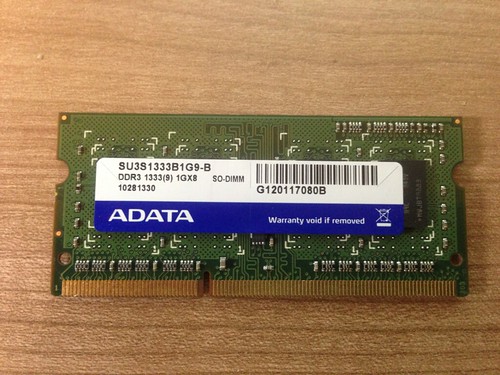
After running a QNAP TS-459 Pro+ for the last 3 or 4 years at home, my monitoring was alerting me about memory warnings cause I upgraded my SqueezeBox Server to the latest nightly version. So I looked into how to upgrade the shipped Adata SU3S1333B1G9-B.
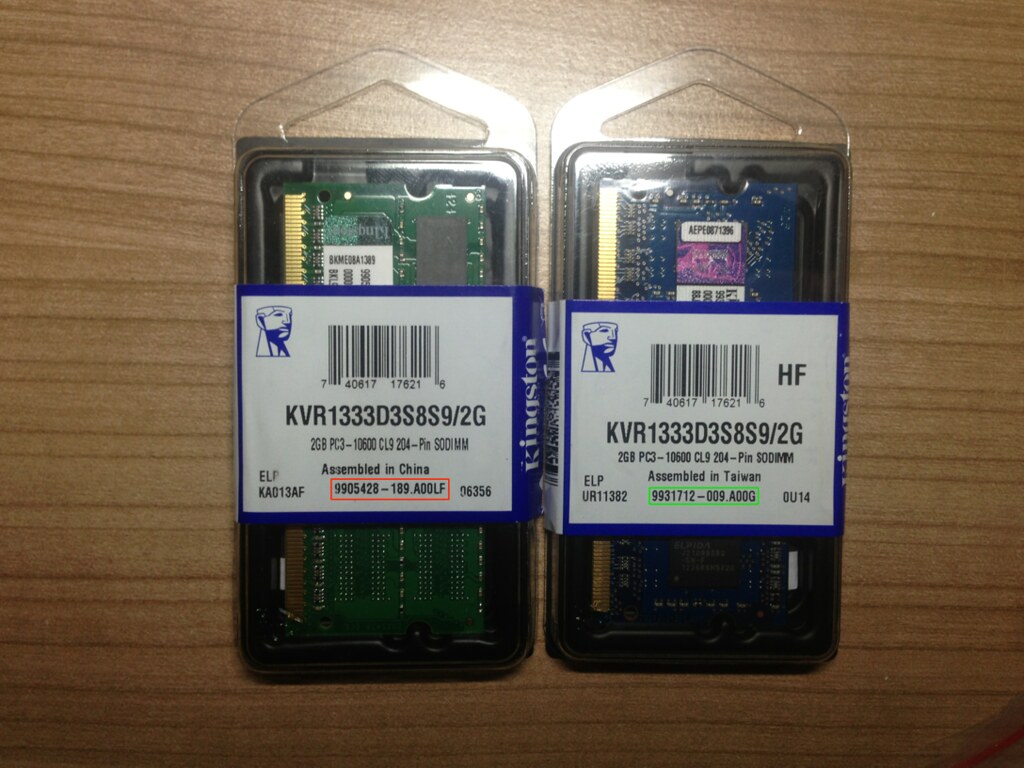
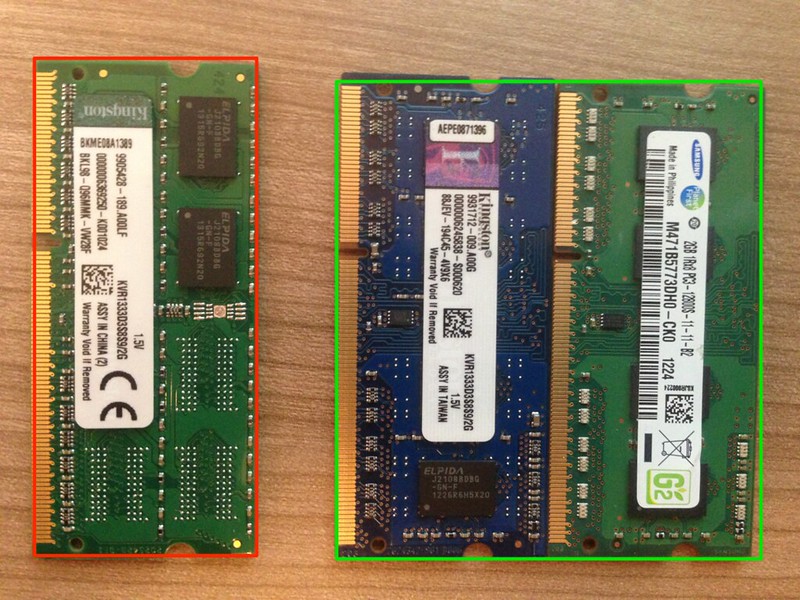
It seems that the KVR1333D3S8S9/2G should work, so I ordered one. After plugin it in, it revealed that the module wasn't working while it worked for others. After digging around, it seems essentially that the modul has a 8-chip design. Indeed, my modul just has only 8 memory chips, but the design is a 16 chip. So I thought it would be a nice try to order the one from amazon that worked for others. And like expected it's not the same module but has the same Kingston Part Number.

As you can see, the 16 chip design module has printed '9905428-189.A00lf' on and the 8 chip design '9931712-009.A00G'. It's something like in the Wireless LAN USB dongle business where they sell totally different hardware with the same Part Number but different Revisions.
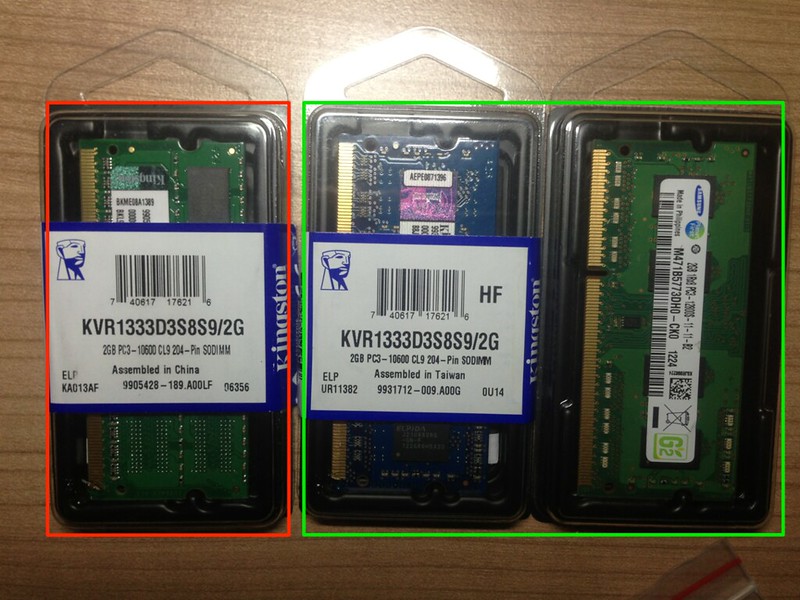
I also ordered a Samsung M471B5773DH0-CH9 cause that's also a 8 chip design.

To make it short, both 8 chips design modules worked like a charm, the M471B5773DH0-CH9 and the KVR1333D3S8S9/2G (9931712-009.A00G). - Please avoid the Adolf one from Kingston! ;)
Russ Allbery: Small random haul

Paul Lockhart A Mathematician's Lament (non-fiction)
Alastair Reynolds Blue Remembered Earth (sff)
Donna Tartt The Goldfinch (mainstream)
Tor.com (ed.) Some of the Best from Tor.com 2013 (sff) Not very much in this set, but I wanted to post it before I forgot about it. The Reynolds was the only book I picked up on vacation this year, since I'm being good about not buying too many new books until I get back on the reading bandwagon. That said, I did just place another order since several new books came out that I want to have right now, most notably Nicola Griffith's Hild.

Benjamin Drung: Wanted: Most secure unencrypted email solution

Dear lazy web, Thanks to the global surveillance disclosures, I am searching for a secure email solution. Using end-to-end encryption seems to be the only secure solution to keep the email content private, but it does not protect your email header. End-to-end encryption has the big drawback that the communication partner has to use it, which is rarely the case. I want to communicate as secure as possible even with people that do not use end-to-end encryption. What is the most secure unencrypted email solution? Should I rent a (virtual) server in my country (Germany) and run my own email server on it? Do you know any reliable, inexpensive server host for such use case?

13 November 2013

Julien Danjou: OpenStack Design Summit Icehouse, from a Ceilometer point of view

Last week was the OpenStack Design Summit Icehouse in Hong-Kong where we, OpenStack developers, discussed and designed the new OpenStack release (Icehouse) that is coming up. The week has been wonderful. It was my second OpenStack design summit, and I loved it. Bumping into various people I've never met so far and worked with online was a real pleasure. As it was to meet again with fellow OpenStack developers! The event organisation was great, as were the parties. :-) On the last day, I had the chance to present a talk with Eoghan Glynn and Nick Barcet how we built the auto-scaling feature in Heat, implementing the "alarming" feature needed in Ceilometer.
The slides and video of the talk is online on my talks page. Design sessions This time, Ceilometer design sessions were spread on 3 days. Everything we talked about has its Etherpad instance. The discussions were interesting, and the amount of feedback gathered is big and is going to be very useful. There's a lot of people and companies using Ceilometer now, and the project is getting more and more traction in general. There's a lot of different way to use it and to bend it to one's needs. Considering the amount of features and options that is provided, building functionality with a genericized approach it making Ceilometer useful for a lot of different and interesting use-cases. Icehouse roadmap The list of blueprints targeting Icehouse is available, but not yet complete. I expect people to start filling this list in the next days.If you want to propose blueprints, you're free to do so and inform us about it so we can validate it. The same applies if you wish to implement one of them! Thereafter, I try to guess what the roadmap will look like in the upcoming weeks for Ceilometer based on the discussion we had last week during the summit. Events management A lot of work is going to be put into event management. Ceilometer plans to store notifications sent using oslo.messaging by OpenStack projects. Some work already got merge for Havana, but the API part and future improvements and ideas will continue to flow into the Icehouse release. Agents and group management A lot has been discussed around the polling agents and around the alarm evaluator agent. The current state of the ceilometer-central-agent disallows any kind of high-availability and load-balancing, as the polling task are kept and scheduled on only one node. The high-availability part is already covered by a custom mechanism built into ceilometer-alarm-evaluator, but it came clear to us that a more generic approach is needed. A lot of other projects needs this kind of functionality, and a pattern have been pointed out. A blueprint about group membership has been discussed in an Oslo session, and will end into a new Python library written to solve this in Ceilometer and in other projects. TaskFlow will also probably be leveraged to solve the task distribution issue. Documentation Since a few weeks, Ceilometer auto-generates its API reference documentation using sphinxcontrib-docbookrestapi that parses our API code that uses WSME. We also want to start writing a user guide, and we'll do that inside our own repository. That way, I hope that we will be the first project in OpenStack to require documentation to be incorporated into every patch that's being sent to Ceilometer. This is the best way to assure that nothing can be changed nor added without being accompanied with a documentation update. Tempest testing Testing of Ceilometer already has been a subject during the previous design summit about testing. We already put a large effort on Tempest testing in this last cycle, but we encountered a lot of small issues that we had to tackle to achieve something. Some Ceilometer basic tests are already on their way into Tempest, so this is something that is going to be achieved very soon. Ultimately, I would also want Ceilometer moving towards providing its own set of Tempest tests as part of the code base. That way, it'd be as easy for core reviewers to refuse a patch if it doesn't provide functional tests as it is to refuse it if it doesn't provide unit tests. As we'll do for the documentation. API improvements Once again, a few API improvements will probably be implemented, like aggregation or the ability to specify multiple queries with OR and AND operators. Roll-up, archiving of data There seems to be interest in archiving and rolling-up the data stored by Ceilometer, so work in this area is to be expected. Supporting multiple data storage driver in parallel seems to be something that needs to be done for this and other aspects of Ceilometer feature set. Alarming The alarming feature set is already big, and the work that has been accomplished pretty amazing. A few improvements will be made, as retrieving better metrics and building better statistics (exclusion of low quality data points).

Next.

Previous.