Search Results: "az"

14 August 2007

Antti-Juhani Kaijanaho: Local is global

The world has many wonders. Therefore, to read a newspiece of a man who had his thumbs surgically altered to suit the iPhone better is to think, this guy is crazy. But the story in itself is plausible. Generally, stories published in a straight news category are intended to be taken seriously. There is one exception: any story published on the 1st of April may be a jest, and everybody knows it. But it is not enough, generally, that people know that the day is a jest day: a serious paper litters the April’s Fool story with blatant clues. For example, a Finnish story last April said that the principals of the story enjoyed their traditional herring in muddy water – referring to the traditional Finnish April’s Fool refrain: “April’s Fool, April’s Fool, eat herring and wash it down with muddy water!” (”Aprillia aprillia, sy silli , juo kuravett p lle!”) Perhaps the original story, published by a community newspaper, contains clues that are visible to the local readers. Perhaps there is something about the locale of the story that tells the locals that this is a false story. Or perhaps the names are ridiculous to native speakers of the American language. Certainly, the paper seems to think that the story contains sufficient clues: Careful reading of the piece makes it clear to any critical consumer of information that the piece is pure humor and not news or reported as fact, the editor claims. The original story is in the “news” category. It is written in a flip style, but then again, many “the world is crazy” style stories are. I have now read the story twice, and I find in it no clue that the story is a hoax (or satire, as the newspaper in question likes to style it). The paper made an error in judgment, that the story would only be read in the community where the story is published. They forgot that we all like to read stories of crazy people who live far away. The editor ridicules us for not noticing the satire, but the real joke is on them: they did not have the balls to acknowledge their mistake. I acknowledge mine. I was fooled. Anybody got some muddy water to spice up the herring I’m having for dinner this evening?
12 August 2007

Russell Coker: Porn For Children

James Purser writes about the current plans for Internet filtering in Australia and concentrates on the technical issues (whether it will degrade the ISP service) and the issue of who’s moral standards should be enforced for the entire country. But the fact is that children have never had any problem accessing porn. When I was in grade 4 at primary school (~9yo) a group of boys decided to walk to the local shopping centre at lunch-time and I joined them. At the shopping centre the other boys read Playboy (that was before such magazines were required to be displayed in sealed plastic bays). I didn’t read Playboy because there were some electronics magazines that were more interesting. When in grade 6 (~11yo) a friend told me about his parents video collection which featured fellatio and sodomy. I don’t recall whether he offered to show me the videos but being a good friend I’m sure he would have done so if I had asked. In the early years of high school some boys ran a black-market for second-hand porn magazines (ick), they also sold new magazines that were significantly more expensive. When in year 12 digital porn was just becoming popular and the exchange of porn on floppy disk began. I’m sure that now children use USB sticks to exchange porn that they get from the Internet or other sources. When I was in year 10 a female dancing instructor ceased working for the school after an up-skirt picture of her was stuck on a notice-board (I guess that her resignation was related to the picture but can’t be sure). The evidence that I witnessed while at school is that 15yo boys are prepared to photograph unwilling women and exchange the pictures, and that the exchange and sale of all manner of porn is not uncommon at school (including primary school). I don’t think that the schools I attended were in any way unusual in this regard. When I was at school cameras were large. Unless you had a polaroid camera (which was even larger) the film had to be developed - and the staff at the photo company were potential witnesses. I expect that these factors significantly decreased the amount of such activity. Now a significant portion of children have a mobile phone and it seems that a built-in camera is a standard feature in all new phones now. Digital cameras (which have much better quality than phone-cameras) are becoming quite cheap. It’s widely regarded that giving a teenager a mobile phone is good for their safety (and it certainly makes it easier to discover where children claim to be) and it’s also widely regarded that a digital camera is a good toy (babies as young as 2 are often given the old camera when their parents get a new one). We should expect that the number of children who have digital cameras to rapidly approach 100% of children who desire them. Given these factors it seems to me that it would be a good idea to allow teenage boys access to better quality porn than they are unable to produce (with either willing or unwilling subjects). It has already been shown that increased access to porn reduces the incidence of rape. I expect that the same also applies to the issue of making porn, people who have good access to porn will be less inclined to make their own. There is some nasty porn out there. If they were to try and prevent access to porn that is illegal under Australian law (IE pictures of children, animals, rape, etc) then I don’t think that anyone would object. But preventing access to soft porn such as Playboy (which is so tame that it’s hardly porn by modern standards) is a really bad idea if it will increase the risk of up-skirt photos and the production of child rape movies. Let’s be sensible and accept the fact that children who want to see porn will see it and focus our attention on what type of porn will be seen by children and whether the “actors” are consenting adults. PS I spent several years living in Amsterdam and working as a sys-admin for ISPs there.

Dirk Eddelbuettel: The amazing Prof. Ripley (cont'ed)

A little mini-meme got started on August 1 when Ben Bolker posted the following code to the r-devel list (and here I substituted the more standard '-' assignment operator for the less standard though-now permitted '='):
x <- readLines("http://developer.r-project.org/R.svnlog.2007")
rx <- x[grep("^r",x)]
who <- gsub(" ","",sapply(strsplit(rx,"\\ "),"[",2))
twho <- table(who)
twho["ripley"]/sum(twho)
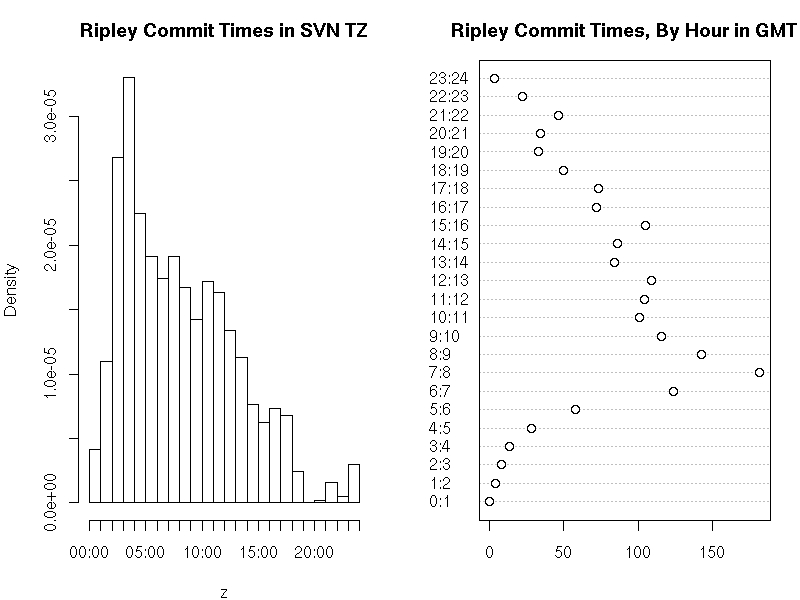
In five lines (that could be shortened to three at the expense of some readibility), the SVN log for R is downloaded directly from the website, the revision authors are extraced and then tabulated by submitter. The relative percentage of Brian Ripley is found to be a staggering 74.8% -- or about three times as much as the other fifteen committers combined. Smokes. [ Oh, and for those who don't know him, he's also got a day job which presumably entails looking after his graduate students at Oxford. Who knows, he may even teach. Kidding aside, he's actually one of the nicest persons you'll ever meet in real life. ] Now yesterday, Simon Jackman who had at first simply repeated Ben's analysis on his own blog followed up with a nice analysis (albeit typeset in a way that rendered the code inoperational, which has now been fixes) that creates both a histogram and a dotplot of commits per hour of the day. Omitting Ben's code which Simon reuses, we have the following for histogram and dotchart:
tod <- unlist(sapply(rx,function(x)strsplit(x,split=" ")[[1]][6]))
tod <- tod[who=="ripley"]
tz <- sub(pattern=".*(-[0-9] 4 ).*",replacement="\\1",x=rx)
tz <- tz[who=="ripley"]
tz <- as.numeric(tz)/100
offset <- 3600*tz
z <- strptime(tod,format="%H:%M:%S")
hist(z,"hours",main="Ripley Commit Times in SVN TZ")
h <- z - offset
h <- format(h,format="%H")
h <- factor(as.numeric(h), levels=0:23)
dotchart(table(h), main="Ripley Commit Times, By Hour in GMT",
         labels=paste(0:23,1:24,sep=":"))
This extracts the commit times, subsets to the ones by Prof. Ripley, extracts the timezones component (as strptime seemingly doesn't do that which is a pain), extracts the tz-less time via strptime into a variable 'z' for which the histogram is drawn. He then corrects the times by the tz offset expressed in seconds, formats is as hour of the day and turns it into a 'factor' (an R data type for qualitative variables which may be ordered as is the case here) and draws a dotplot. This results in the following chart: Simon Jackman's per-hour charts of Brian Ripley's commit patterns Now, nobody has looked at the time series. So we correct this and add the following:
## rather extract both  date and time
dat <- unlist(sapply(rx, function(x)  
  txt <- strsplit(x,split=" ")[[1]]
  paste(txt[5], txt[6])
 ))
## subset on Prof Ripley
dat <- dat[who == "ripley"]
## and convert to POSIXct, correcting by tz as well
datpt <- as.POSIXct(strptime(dat,format="%Y-%m-%d %H:%M:%S")) - offset
## turn into zoo -- we use a constant series of ones as each
## committ is taken as a timestamped event
datzoo <- zoo(1, order.by=datpt)
## and use zoo to aggregate into commits per date
daily <- aggregate(datzoo, as.Date(index(datzoo)), sum)
## now plot as grey bars
plot(daily, col='darkgrey', type='h', lwd=2,
     ylab="Nb of SVN commits, three-week median",
     xlab="R release dates 2.5.0 and 2.5.1 shown in orange",
     main="The amazing Prof. Ripley")
## mark the two R releases of 2007
abline(v=c(as.Date("2007-04-24"),as.Date("2007-06-28")),col='orange',lwd=1.5)
## and do a quick centered rolling median
lines(rollmedian(daily, 21, align="center"), lwd=3)
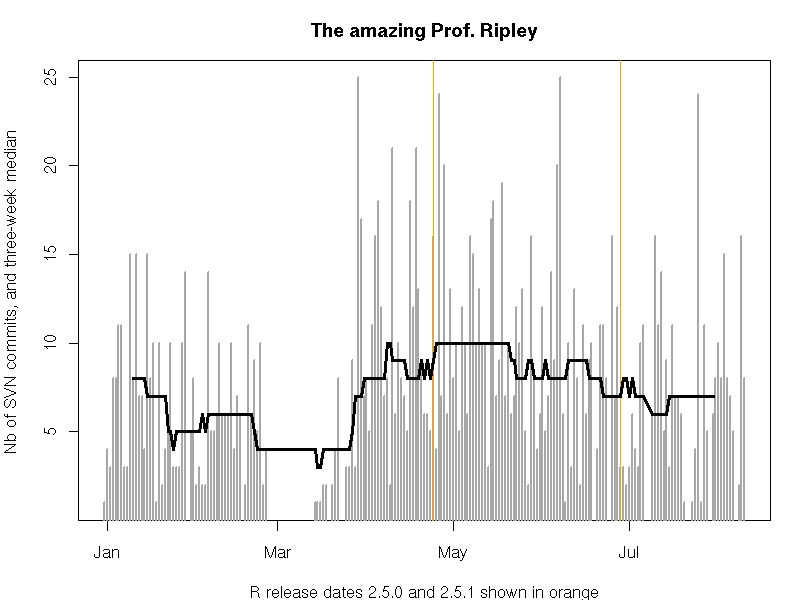
This extracts both date and time, creates a proper R time object (a so-called POSIXct type) from it, fills a zoo ('the' magic class for time series) object with it, uses zoo to aggregate commits per day and plots those in a barchart-alike (I know, I know, ...) plot to which we add the two releases as well as a rolling and centered three-week median (as a real quick hack rather than a proper smooth). Timeseries of Brian Ripley's commit patterns This shows that Prof Ripley averaged about ten commits a day before and after the release of R 2.5.0, and that he has slowed down ever so slightly since then to end up at around a mere seven commits a day. Every day. For the seven-plus months we looked at. So, anyone for analysing his r-help posting frequencies ?

11 August 2007

Dirk Eddelbuettel: UseR! 2007: Two talks and a new R package 'RDieHarder'

The first UseR! conference in North America ended yesterday. I gave two talks and updated my presentations page accordingly. One talk was joint work with Steffen Moeller (who had also presented our work in Italy in June, and I added that presentation too), David Vernazobres and Albrecht Gebhard and concerns automated building of around two thousand (!!) new Debian source packages for all CRAN and BioConductor packages for GNU R. I plan to send something to debian-devel on that in a day or two as well because the time is right for some feedback on this. The other talk was on about RDieHarder. This is joint work with Robert G. Brown and uses his DieHarder library for random number testing (that I've added to Debian a few months back). It allows R to both runs these tests, and to further analyse and visualize the test results. I finally uploaded RDieHarder to CRAN a few days ago -- in fact, my CRANberries rss feed of new CRAN packages had it show up the morning of the presentation. And now that I've added a webpage about RDieHarder I can finally say it's been released.

10 August 2007

Holger Levsen: First three days of CCCamp

It's shortly after midnight and day one of the cccamp is "over". Which doesn't mean the "first" day is over at all, lots of intergalactic hackerparties are going on and besides, most people didn't arrive today but earlier.

I guess the most amazing thing I've seen where two people forging two different kinds of steel, something I haven't expected to see here at all :) The atmosphere, the people and their projects, the light effects and the venue are simply wow. The venue is an ex military airport turned into an open air museum and now hosting the Chaos Communication Camp 2007 with 2000 participants coming from ma ny countries and backgrounds and involved in a diversity of stuff.

The Debian gathering currently is more private camping than a open booth, though we have a huge tent to use, we have not really done so so far: today it was more important to get a decent sun shade for where our private tents are and relaxing and socialising...

The above I wrote at the end of the first night and then yesterday I was busy setting up the Debian village or corner in one of the huge Freifunk tents and getting some backlog done. Now we are having some table space (and some unused sofa space) next to the openWRT and the GnuRadio project, which gives lots of opportunities for interesting discussions, plus there are some workshops (mostly soldering) taking place in this tent as well.

And now I'll go out to go to buy some tickets for a round flight above the camp :-)

Andrew Pollock: [opinion] Amazon Marketplace is less crap

After my venting yesterday I received an email from an Amazon employee who reads Planet Debian, and he pointed me at http://www.amazon.com/gp/help/customer/display.html?nodeId=537868, which covers how to make a claim. I've no idea how one is supposed to directly find that page, as it didn't jump out at me when I went looking. I've filed a claim, we'll see what happens...

9 August 2007

Evan Prodromou: 21 Thermidor CCXV

So, a few weeks ago (Journal/22 Prairial CCXV) I expressed some discomfort about the Mister Wong logo. I'm very happy to see that the company has taken my and other people's uneasiness into consideration and removed the logo from their site. They've started a new Mister Wong logo contest with a grand prize of $6000 (American, assumably) and two second prizes of $3000. That's a pretty good cash-out for a logo contest; Mister Wong is also a high-profile and growing site. I hope some of my designer friends and colleagues decide to jump in. (Yeah, Brigitte, Marie-Claude, Patrick, and Mark, I mean you!) I think it's definitely an interesting challenge for someone doing identity work. I'm not going to join the contest, though. My only idea right now is to do a copy of the current Mister Wong logo (same gray suit and tie) but with a Caucasian man's face instead. The sub-title? It can't be Wong when it feels so white. Yeah, that's why I don't get the big bucks in the corporate identity biz. tags:

Back on Planet So, I got a lot of feedback about removing my blog from Planet Debian -- all of it bad. People really felt that it was important for all Debian developers to be able to say their piece on PD. So, I re-instated it this morning. I'm going to try to make some changes to fix the main thing that seems to bother people: that my post titles are the current date in the French Revolutionary Calendar. For some reason, that really gets under people's skins. Unfortunately, a few things on my (hand-coded) wiki-blog site expect that format, so it's going to be a little tricky. One thing I might do is create and distribute a Greasemonkey script for planet.debian.org (and p.d.net) that seeks out titles that look like French revolutionary calendar dates and replaces them with a random selection from an array of more typical blog post titles:
  • "Some thoughts"
  • "A funny thing happened today"
  • "What I've been doing lately"
  • "Depressing thought"
  • "Haven't blogged in a while"
  • "WTF!?!?!"
  • "My opinion"
  • "Random notes"
  • "IMHO"
  • "Snapshots from my life"
  • "Further proof that we live in a crazy world"
  • "Memo to myself"
Any other suggestions for all-purpose blog-post titles to add to the array are welcome. tags:

Andrew Pollock: [opinion] Amazon Marketplace is crap

I ordered a book on June 26. It never arrived. It appears that Amazon doesn't want to get involved with such disputes at all, and tells you contact the seller. It doesn't tell you what to do if the seller never gets back to you...

8 August 2007

Eric Warmenhoven: Self portraits are hard.

A few weeks ago, Lisa and I were in Barnes&Noble, and I decided to buy a few photography books: The Digital Photography Book by Scott Kelby: This book is, as advertised, not a book about concepts and theories but rather about practical advice and tips. If you already know some of the theory, it’s pretty easy to see how it plays out in practice in this book. Composition Photo Workshop by Blue Fier: I love the name “Blue Fier”, even though I’m probably pronouncing “Fier” wrong (”Fire”). Anyway, this book started off a little slow for me because he covers things like aperture and depth of field and focus, and shutter speed and ISO and other things I’m already fairly familiar with. When he started getting into framing and rule-of-thirds type stuff it got more interesting. He also covered several different styles of photography (landscape, macro, portrait, etc.) and so it was a pretty good introductory book. Digital Portrait Photography and Lighting by Catherine Jamieson and Sean McCormick: I’m only half way through this book so far, and already it’s prompted me to spend hundreds of dollars on a new flash, and gotten me thinking about getting lights and umbrellas and reflectors and setting up my own miniature studio. I’ve spent the past few days trying to take portraits of Pixel and Lisa and myself, and haven’t had much success, mainly due to poor lighting (hence the flash and the dreams of better lighting equipment). When taking self portraits I’ve had such trouble getting the camera placement and focus and lighting right that I haven’t even gotten to really working on posing much. Which is fine, since I haven’t gotten to that chapter yet anyway. There’s a portrait workshop being held in Los Gatos at the end of September that I think I’m going to enroll in, but I’m worried based on the description that I’ll have already heard most of it from the portrait book I bought. In the spring I may enroll for a photography class at the local community college as well.

David Moreno Garza: Sapo verde soy yo

I’m 23 years old since 2 am on this August, 8th. Thanks for the congratulations messages I’ve received so far :-), resiak even sang happy birthday to me on IRC! Next year (August, 8th, 2008), 08-08-08, I will turn 24! 08+08+08! Something really bad is going to happen because of that :-) Probably that’s gonna be my really lucky year. But how en Earth can I be more lucky than what I am today? :-P In the meantime, I’ve invited my closest local friends to a bar this Friday to celebrate my birthday. Let the rum and tequila flow, baby! Yeah!

Eddy Petri&#537;or: Bash says: I am different from myself!

Dear lazyweb, is this a bug? Should I fill this?

$ sh -x rpm/build_latest_srpm foo 2>&1 grep -E '\'
+ alias 'rpmbuilder=rpmbuild --define "_topdir /tmp/rpmbuildarea/foo/redhat"'
+ rpmbuild --define '_topdir /tmp/rpmbuildarea/foo/redhat' -bs foo.spec
$ sh rpm/build_latest_srpm foo 2>&1 grep -E '\'

$ bash -x rpm/build_latest_srpm foo 2>&1 grep -E '\'
+ alias 'rpmbuilder=rpmbuild --define "_topdir /tmp/rpmbuildarea/foo/redhat"'
+ rpmbuilder -bs foo.spec
rpm/build_latest_srpm: line 46: rpmbuilder: command not found
$ bash rpm/build_latest_srpm foo 2>&1 grep -E '\'
rpm/build_latest_srpm: line 46: rpmbuilder: command not found

$ rpm/build_latest_srpm foo 2>&1 grep -E '\'
rpm/build_latest_srpm: line 46: rpmbuilder: command not found

$ type sh
sh is hashed (/bin/sh)
$ type bash
bash is hashed (/bin/bash)
$ ll /bin/*sh
-rwxr-xr-x 1 root root 677184 2006-12-11 23:20 /bin/bash
lrwxrwxrwx 1 root root 21 2006-08-17 21:05 /bin/csh -> /etc/alternatives/csh
-rwxr-xr-x 1 root root 80200 2007-02-02 09:34 /bin/dash
lrwxrwxrwx 1 root root 4 2006-12-19 15:02 /bin/rbash -> bash
lrwxrwxrwx 1 root root 4 2006-12-19 15:02 /bin/sh -> bash
lrwxrwxrwx 1 root root 13 2006-08-17 20:58 /bin/tcsh -> /usr/bin/tcsh


The script has /bin/bash in the shabang.

I tried to reproduce with another simpler script, and I observed that the issue happens when the script is processed by bash. With a /bin/sh shabang, it didn't since the command processing the script was sh, also all sh commands were ok.

I also suspect that it has to do with this paragraph from the bash manual:


Aliases are not expanded when the shell is not interactive, unless the expand_aliases shell option is set using
shopt (see the description of shopt under SHELL BUILTIN COMMANDS below).


... but different and (I would say) worse behaviour than the sh invocation should not happen.

The test script follows:

#!/bin/bash

alias rpm-build="echo \"I:\""
alias dpkg-select="dpkg --get-selections \"ls\*\""

echo "alias1:" && rpm-build test
echo "alias2:" && dpkg-select

Test and enjoy. Before you ask, yes, I use bash functionality.

Update: Also using set -i just before the alias definition and keeping it during the expansion does not help.

Peter Makholm: Re: Two Question for All Serious Free Software Contributors

Russel Cooker asks two questions to free software Contributors. Here is my answers: The most important advice I can give to someone who wants to contribute to the free software community is “Take it easy, it’s only software”. If you’re not able to take criticism or to be drawn into tough discussions without taking it personal, you should consider if it it worth it to contribute. Most free software project have their part of to big egos, regular kooks and people with less than good communication skills. And worst of all, nor really good way of coercing people to behave or work together. My own advantage of participationg in open source projects is the famous itch. For me the most convincing argument for working with open source is “Scratching you own itch while being lazy and not reinvent everything else.” If you dn’t have that itch, then you shouldn’t care about joining a project.

Lars Wirzenius: Random thought: bzr uncommit

One of the things that occasionally happens to me is that I mistakenly commit too much. I use Bazaar (bzr) as my version control tool of choice, and tend to do "microcommits": every time I make a change that is a useful, if very small, step in its own right, and "make check" still passes, I commit, even if it is only a one line change. This means that usually all the changed files need to be committed. Sometimes, but rarely, I make unrelated changes in several files at the same time, and then I need to commit each change separately. But then I forget to specify the files on the command line. With CVS, I would just shrug and continue. With Bazaar, I do "bzr uncommit", which removes the latest commit from the branch, and then re-commit with the proper files. This is a small, but important, change from CVS, for me. It makes me happy. "Ha! Foiled you again, you stupid over-eager Enter key." I have no idea whether other modern version control tools have the same thing; this entry is not to advertize Bazaar, but share my joy in victory over Enter.

7 August 2007

Evan Prodromou: 19 Thermidor CCXV

I'm on the plane down from Vancouver to San Francisco this morning. My flight from Taipei hit Vancouver around 8PM last night, so I stayed at the Fairmont Hotel at the airport. It was definitely a special treat -- the Fairmont's pretty pricey -- but this trip has been really low-budget and I needed a lot of rest and recharge. I had a good room with a view of the airport and the city beyond. My flight over was uneventful -- sleep, eat, Spiderman 3 -- which was good since I'd had such a big last day in Taipei. In the morning, I'd gone out to see Taipei 101, which claims to be the tallest building in the world by some standards. I think there are lots of ways to slice the "tallest building" category -- the CN Tower has a strong claim, but that's only counting the huge antenna on top. And there's an unfinished tower in Dubai that's already close to, or taller than, Taipei 101. Regardless, Taipei 101 is a real interesting site. The elevators are the fastest in the world -- 38 seconds to go from floor 5 to floor 87. The windowed observation deck is interesting, and there's an outdoor deck two flights above it. The outdoor deck is racked by Taipei's scorching heat -- when I was there, it was 31C, up above the city's protective smog belt. The sun and empty sky make for an otherworldly experience. After 101, I took Taipei's local subway, the MRT, to the National Palace Museum. I've found the MRT easy to get around on -- most of the information was available in English as well as Chinese -- but I got a little lost looking for the museum. I was disappointed that the information booth in the Taiwan Main Station had so little tourism information, and all of it in Chinese. (Yeah, I forgot to print out the Wikitravel Taipei guide before leaving the hotel. My bad.) But I managed to wend my way out to Shilin Station and took a cab to the museum. It was worth the search. When the Chinese Nationalists left the mainland for Taiwan, they took with them many of the treasures of the Imperial Palace (much to the chagrin of the victorious Communists). These form the core of the museum's collection, and they're really quite amazing -- articles in bronze, ivory and gold from the Neolithic era to the modern day. While Western culture has gone through so many distinct and discontinuous phases -- Egypt and Mesopotamia, Greco-Roman, Medieval and Modern -- China's has varied much more smoothly and continuously. It's a little disconcerting to see artistic themes from 4000BC that are echoed in items for sale in the stores today. I had to get back to the Wikimania site -- by then almost empty -- to do a GChat conference with Niko. There were a passel of Wikimaniacs still around after the conference looking around Taiwan like I was, and after consulting Wikitravel we decided to go to Taipei's most famous restaurant, Din Something Something. It's got a short menu of delicious steamed dumplings -- pork, veggie, crab and shrimp. The shop's claim to fame is the elastic skin that keeps a pocket of hot broth inside the dumplings. Hey: if you do something well, why vary the menu? It was the best meal I've had in a long time. The dumplings themselves were incredibly good -- moist and rich with complex flavors. But the company was even better -- about 14 Wikimedians from all continents and walks of life, some of the most fascinating and important people on the planet. We were a big enough group to be stowed in our own party room, and with basket after basket of steamed dumplings piled onto the table, washed down with shared bottles of the ubiquitous Taiwan Beer, we had a crazy chaotic and fun time. I'm so glad I took an extra day after the conference to see a bit of the city. I think there's a lot more that I missed, but I'm glad that I got a taste. tags:

Wikimania 2008 Inevitably the conversation at Din Something Something turned to Wikimania 2008 and possible venues for it. Right now, the only serious bid is from Alexandria, Egypt, home of the Biblioteca Alexandrina. This is a modern reconstruction of the famous Library of Alexandria, centre of learning for the ancient world and repository of all of its knowledge. The bid is to use the sleek, glamourous conference centre attached to the Biblioteca -- offered to us free of charge. You couldn't put together a more powerful metaphor -- Wikimedia being itself a project to capture the world's knowledge and share it with all humanity. Having our event on the African continent would also send a great message about the Foundation's commitment to making free information accessible to the developing world. North Africa is definitely the most accessible part of the continent for Europeans and North Americans -- many of whom balked at the price and distance of travel to Taipei. The big problem with planning Wikimanias (Wikimaniae?) in the past has been the short time-frame. Typically bids for the event don't start until after the previous one, and the bidding process takes several months. By the time a venue is selected, there may be only 6-8 months of planning time available. For an international conference of several hundred people, this is a stressful, breakneck schedule. The idea was floated to do a little stutter-step and put Wikimania on a more long-term planning schedule. The event committee would short-circuit the bidding process this year, and declare Alexandria the site for Wikimania 2008 unless other groups insisted on bids for other cities. Then, bidding for Wikimania 2009 would start in September or October, with a decision made by the end of 2007. This would give 20 months for the Wikimania 2009 organizing team to prepare. Most importantly, they'd be able to shadow the 2008 team, learn how the job is done, attend the 2008 conference, and present about their venue for the next year. I think this is a really good idea. The Biblioteca conference centre staff will be able to provide us some professional services, making the shorter schedule (still about 11 months) a lot easier. There are some concerns about fairness of the process, or appearance of same, but my guess is that if the 2009 bid process starts soon after, people won't have a big beef. There are two major concerns with going to Alexandria, though. First is Egypt's worrying problem with human rights -- specifically gay rights. Homosexual Egyptian men are subject to arrest, and the laws are occasionally enforced. One foreigner was arrested in 2002. That's enough to put Egypt on a no-visit list with some gay-rights groups. Depressing as it is, I think it might be too much to hope for a venue in a country with an absolutely spotless human rights record. Maybe parts of Scandinavia...? There's a cruel calculus needed to evaluate which national human rights abuses can be reluctantly overlooked, and which are unacceptable. It's also clear that my personal judgment might be clouded, since this particular human rights issue is not one I would be directly targeted by. My hope is that an official statement by the Foundation would make it clear to the Egyptian government that this kind of policy is not conducive to attracting overseas business and tourism. The second concern is that Egypt and the Arab world in general have only embryonic local Wikimedian communities. While there are many people who contribute to Arabic Wikipedia, there is not a Wikimedia chapter in Egypt, nor are there regular meetups in the country or region. This might be a chicken-and-egg problem: choosing Alexandria would probably kick-start local groups. I hope that ar: Wikimedians pick up the mantle of leadership that the world Wikimedia community is offering them. tags:

Sergio Talens-Oliag: Lifestyle, Resignations and the Peter Principle

I'll be 0x24 (hex) or pow(6,2) (dec) years old next Sunday and it is becoming obvious that I need to change my lifestyle. On the physical side I'm sure that I have to loose between 20 and 30 Kg. if I don't want to have health problems in the future. The plan is to change my eating habits and do sport regularly. The basic idea is to do a diet seriously and keep part of the rules more or less forever (that's the habits change); the other important thing is to do some exercise, I've never liked sports too much, but I'm sure I can try to walk some days and swim others (I've been going once a week to the swimming pool during the last months and I'll be doing it twice a week starting this September). On the mental side, I need to reduce my obligations and care less about the work problems in and out of the office. To reduce my obligations and have more free time I decided a couple of months ago that I was going to leave the Uni, as it was taking away a lot of time that I can use for more important things; I notified it and after this September I won't be working for the Universitat de Val ncia anymore. Initially my idea was to keep my main work and use some hours each week to work on my PhD Thesis, but the truth is that I'm not interested anymore; I don't have anything specially interesting to say and my main motivation for getting a PhD has also disappeared (at some point I thought about becoming a full time University professor, but after three and a half years I've had enough, at least for a looong while). This leaves me with my work at the ITI as my main and only work, but after some months I'm seriously considering leaving it also. My main problem there is that I believe that I'm starting to suffer the Peter Principle or something similar; almost all my professional career I've been working as a technician, first as a programmer and sysadmin and lately as analyst and team leader or technical manager, but now, as it seems to happen always in the Spanish IT companies, I'm being forced to move to a pure project management work and, to be fair, I don't like it. I don't know if that means that I'll get to my level of incompetence, but if that is the case I think I'll have to try the Peter's Parry, that basically means to refuse a promotion (I've already done it asking to get a place under my theoretical level, although not on a convincing manner, it seems) or use the Creative Incompetence technique, that is, give the impression that you have already arrived to your incompetence level (probably it is too late to do that at my current place, but maybe on the next one I'll be able to do it). Maybe this is not the last level of the Peter Principle, as I'm sure that I can and will do this work (I'm thinking about moving, but I will not do it until I have a plan for the future, and that will probably mean a new job), but I'm also sure that I will never do it as well as I can do technical tasks because I don't have any real motivation to do it and while I plan to get the skills needed, they are not attractive to me. I understand that on the current IT world we need to have project managers, and I really hate bad managers, but that does not mean I like to become one, I prefer to be a team leader and work only on one or two projects at a time, instead of having more than five and not do real work in any of them; my main problem is that the challenges and tasks a manager has to do have nothing in common with the things I like from computer science and I'm too perfectionist to handle people that does not care about how things are done in a lazy way (a team leader with a couple of projects can handle technical people, when you are a manager with multiple projects you miss the day to day perspective and problematic people is more difficult to handle). Oh well, we will see how things evolve. The good thing is that I believe that one way or another I'll end up having a better life and, if I'm able to care less about my own work (and the one done by others) maybe I'll be able to stay at an acceptable level on the hierarchy without getting burn out and maybe some day I'll be able to work again on the things I like and keep my promises.

Andrew Pollock: [debian] Doing random repository things with Python APT?

Dearest Lazyweb, I want to write a program that I can point at a standard repository, and an in-house one, so I can track version differences between common packages. I wanted to write this in Python, so python-apt sprang to mind, however the documentation is somewhat lacking, and none of the examples include retrieving a package list from anything other than the local APT cache. The documentation in libapt-pkg-doc is also rather lacking. So before I go giving up on using a "proper" library for the task, I thought I'd reach out. Love, and sloppy kisses, Andrew

Lars Wirzenius: Random thought: Productivity fear

Every time I do a "Getting Things Done" weekly review, I am amazed at how easy it is, and also how much it energizes me. Yet every time it is time to start one, I fear it, and procrastinate, sometimes for several weeks. Obviously I have a deep-set fear of being productive.

Jeff Bailey: ... and the packers descended

Our place this morning was so calm and peaceful. Angie was cooking muffins. Then the packers showed up at 8am. It's 2.5 hours later, and we're now surrounded by boxes. In another 24 hours, the computers will be shut down, the cable modem returned, and the moving trucks will show up.

Two weeks ago when we left Montr al for visiting family and going to UbuntuLive, we knew that we only had a couple days left back here, but the reality is now setting in. From here we'll go to Opus, the Unitarian Universalist young adult conference at which we're two of the four cooks. From there, we head south, fetch a rental car, and start our one-way drive out to California.

Crazyness!

Russell Coker: Blog Memes

A common pattern in blog communication is referred to as a Meme. Here is one example of the commonly used definition of the term as applied to blogs. One common factor that doesn’t seem to get directly mentioned much when people define the term (but which always seems to be mentioned in passing) is the idea of tagging people. So the definition of a meme as applied to blogs seems to be a silly question that you answer in a blog post and then request that some other bloggers (usually 5) answer as well. At the end of this post I have included the dictionary definition of the term (here is the Wikipedia definition). I believe that it is incorrect to call a question such as “which superhero do you most identify with” a meme. Instead I think that there is a Memeplex associated with such posts. One meme is that when someone “tags” you (requests that you answer a question) it should be considered an honour (someone in the blog-sphere likes you enough to ask you random questions in a public forum). Another meme is that such discussion is a good thing (although an increasing number of people in the more serious part of the blog-sphere oppose this). A final one that is apparent to me (I’m sure that there are others) is that so-called memes and lazyweb posts are the same thing (I believe this to be wrong). I believe that lazyweb posts if written about interesting topics can contribute significantly to the community knowledge base. I also believe that chain lazyweb posts (here is a link to the only such post I’ve made so far) can also contribute if created in a sensible manner. Chain posts that don’t require any thought or input from the person re-posting them (EG “please post this message to all your friends so that they can know of the terrible war/famine/earthquake/whatever in some foreign part of the world”) are of course quite useless (you can make a post of links once a month if you want to spread the news about such things). Now I agree that some amount of conversation among bloggers in a community that is personal and not directly related to the main topics of discussion is good for building the community. From Jargon File (4.4.4, 14 Aug 2003) [jargon]: meme
/meem/, n. [coined by analogy with gene’, by Richard Dawkins] An idea considered as a replicator , esp. with the connotation that memes parasitize people into propagating them much as viruses do. Used esp. in the phrase meme complex denoting a group of mutually supporting memes that form an organized belief system, such as a religion. This lexicon is an (epidemiological) vector of the hacker subculture’ meme complex; each entry might be considered a meme. However, meme is often misused to mean meme complex. Use of the term connotes acceptance of the idea that in humans (and presumably other tool- and language-using sophonts) cultural evolution by selection of adaptive ideas has superseded biological evolution by selection of hereditary traits. Hackers find this idea congenial for tolerably obvious reasons. PS This evening I had planned to go to a LUV meeting and see my friend Andy Fitzsimon (blog) give a talk about Inkscape (for which he is famous). I also had a day off work, so it was going to be a day of non-stop fun. But instead I got some sort of cold/flu, stayed in bed for much of the day, missed the meeting, and was late in my blog post. This sucks.

6 August 2007

Martin F. Krafft: Sending email via IMAP (or not?)

I am playing with the thought of using IMAP to send email from my mobile clients. The way this works is that mail is actually placed into a Maildir locally and synchronised with the IMAP server using a tool such as offlineimap. The Courier IMAP server supports such an outbox feature, for other servers you can use inotify or a cron job (I am planning to publish a writeup about my new mail setup sometime soon, so no scripts linked here yet). Anyway, it's trivial to get it working, and Dann Frazier has written it all up. The question is more whether I want to, or not. I am soliciting feedback. The advantages of using an IMAP-synchronised outbox are: Any solution with advantages comes with disadvantages, and these are: Can you think of any other advantages or disadvantages? Do you use an IMAP-synchronised outbox and would like to share your experiences with me? Or do you have yet another solution? Write to me! NP: OSI: Free

Next.

Previous.