Search Results: "agi"

3 February 2009

Peter Eisentraut: Debian PostgreSQL Packaging Project

We have launched the Debian PostgreSQL Packaging Project at http://pkg-postgresql.alioth.debian.org/. We are a group of people interested in maintaining Debian packages related to PostgreSQL.

Obviously, Debian already contains a large number of packages related to PostgreSQL. The idea behind this project is to get the involved maintainers together, concentrate resources, exchange ideas, and allow more people to get involved in small ways. See our web site about participating.

2 February 2009

Romain Francoise: First Emacs 23 pretest released

Emacs 23.0.90 was released yesterday, it's the first pretest for the upcoming 23.1 version. Debian packages for etch and lenny/sid are here; Ubuntu packages for hardy, intrepid and jaunty are here. If you find any bugs please use M-x report-emacs-bug (unless it's a packaging issue, in which case feel free to email me directly).

Axel Beckert: Daily Snapshot .debs of Conkeror

Keeping track with packaging software which is under heavy development can be time-consuming. I noticed this while packaging Conkeror, because there was quite a demand for up-to-date packages, especially from upstream themself. So recently on the IRC channel #conkeror the idea of automatically built Debian packages came up. After a few hours of experimenting and a few days of steadily optimizing, I can proudly present daily built snapshot packages of Conkeror for currently Lenny and Sid, ready to be included in your sources.list:
deb     http://noone.org/conkeror-nightly-debs lenny main
deb-src http://noone.org/conkeror-nightly-debs lenny main
deb     http://noone.org/conkeror-nightly-debs sid main
deb-src http://noone.org/conkeror-nightly-debs sid main
The binary package conkeror-spawn-process-helper is currently only built for the i386 architecture, but other architectures may follow. The packages probably work also on any other Debian based distribution (e.g. Ubuntu) which includes XULRunner version 1.9. Surely they are not of the usual Debian quality, but they should do it for staying up-to-date with the Conkeror development just by using your favourite APT frontend. The script which generates those packages is also available in the Conkeror git repository at repo.or.cz. The APTable archive is generated with reprepro. Packages and the repository are signed with the passphrase-less GnuPG key 373B76B4 which is used only for the Conkeror nightly builds. (If anyone knows a better solution for automatic builds than a passphrase-less key, please tell me. :-) P.S.: I really like the new keybindings << , >> and G . :-)

1 February 2009

Obey Arthur Liu: Debian Summer of Code 08 : Where are they now (part 2.5/3)

I ve so far been going through the list of projects that were done last year (part 1, part 2) in a somewhat dry fashion so I m going to make a little pause here and tell where I m going from with these posts. As I went through the 2008 Summer of Code at Debian, I moved from being a nearly total outsider student to something more of a developer. I ve been contributing to Aptitude since the end of the Summer of Code (well, trying to find time to contribute more, as with many people..) and will be going to FOSDEM. I can t say I m an insider yet: I haven t met a lot of people, most people have no idea who I am, I ve been active here for, like 9 months and I m not even in new-maintainer yet (though I plan to apply when I feel I ll have contributed significantly to Debian). The Student point of view See, I m a student in Computer Science. I use free software, I d like to participate but it s intimidating and you never know where to start. You know the drill. Then comes the Google Summer of Code. Let s review its stated goals, as per its FAQ:
Google Summer of Code has several goals:
  • Get more open source code created and released for the benefit of all;
  • Inspire young developers to begin participating in open source development;
  • Help open source projects identify and bring in new developers and committers;
  • Provide students in Computer Science and related fields the opportunity to do work related to their academic pursuits (think flip bits, not burgers );
  • Give students more exposure to real-world software development scenarios (e.g., distributed development, software licensing questions, mailing-list etiquette).
I m going to start with these goals and provide some of my opinions in something of a candid way. Inspire young developers to begin participating in open source development I have been playing with the idea of making a GUI for Aptitude ever since I dropped Synaptic, about 2 months into its use. It felt like when I bought a high-school required Texas Instruments TI-83+, that I dropped for a TI-89 within a month. Since back in 2005, every time I would see someone using Synaptic, I would pitch Aptitude as a better tool. The main reason for not doing so was that Aptitude was scary-looking. See, it s a lot of blocky text and wacky colors. With life and cool stuff like CPGE, I never had time to really code so I left it at that. In 2008, for the first time I was free the whole summer and so, I tried to get into the Summer of Code program and into Debian. Actually, it wasn t the first try. One popular way to get acquainted with Debian is to go to wnpp, adopt a package (new or orphaned) and find a mentor to upload it. In January 2008, I did try to package a set of geocaching tools I used at that time. But I didn t find a mentor to upload it. I didn t try very hard though and the package had some minor issues anyway. I reckon that Debian-mentor is a good idea to bring in new Debian Maintainers but the whole process is still quite technical. It is true that the minimal technical level for good packaging is not trivial in itself and the process should filter out unserious people, but the technicality curve could be adjusted to be more welcoming. I think the Debian website could be improved in this area (ok, it s a quite long-standing bug). Holger Levsen mentioned the way Fedora and Sugar presented avenues of collaboration to prospective developers. The crux here is that it should feel much easier to identify areas to get involved into and who to contact if needed. Help open source projects identify and bring in new developers and committers Actually, it would rather be the other way around: help students identify and integrate into open source projects. For the Summer of Code, I only postulated at two organizations, Debian and Freenet (the ones working on an anonymous darknet, remember ?). I got accepted at both and ultimately chose Debian (was my first choice from the beginning). The Debian developers community is quite unique in the way it is very decentralized, independent and fluid. There are teams in some areas (Kernel, KDE, Translation, Edu, Publicity, whatever) but much of what makes up Debian is done by individual developers working on their own. The downside of this is that for a newcomer, it s a little off-putting. Organized teams are not the way all things are done within Debian so there are often no smaller circle of people one gets to know. Going to Debian meetings and not knowing most of the people is a little intimidating. Keeping up with all the faces is a little hard too :). Many other organizations participated into the Summer of Code and many would feel arguably different. Many may be more corporate-like, more hierarchical, more centralized. I preferred Debian because it was less formal in its structure. I felt that I didn t want to get into something that looked too much like work with supervisors and the like. It is indeed how it felt, there were no one up there to decide what we had to do. We were quite independent. I can say that the Summer of Code is quite a good way to get a feeling of how a particular organization works in the inside. Give students more exposure to real-world software development scenarios As said earlier, many parts of Debian are independent, which is a result of the work separation through packages. In my work on Aptitude, it is a pity that I didn t have to interact a lot with other members of the Debian community. Aptitude talks with the rest of the Debian packaging ecosystem through mature library interfaces so there s not much need to ask questions beyond them, and even more so because my Daniel Burrows, my mentor and developer of Aptitude participated in their development. Also, I was working on bringing a graphical interface to it, so I didn t have to modify a lot of core code that interacted with the outside world. Despite this, I still met a few people interested with future developments in the area of package managers. One example is Enrico Zini who pushed his work with Xapian APT Index. Over the summer, my mentor integrated packages search through Xapian which was interesting with the expanded possibilities of a graphical interface such as search as you type, drop down suggestions and so on. Because of the short duration of the Summer of Code, most projects can t complete a full development cycle. The proposed work in my proposal was quite imposing. In the end, I managed to produce an (probably not even) alpha quality version of a graphical interface. My branch (if I remember correctly) was merged into the main trunk at the end of the summer and a version landed in Experimental at the end of the year. One aspect that I missed was beta-testing feedback. During summer, only a handful people popped up on the mailing-list giving feedback on the GUI I was writing, although I knew through stats on my mercurial repository that dozens of people cloned it and followed it. Debian has no testing team , or any kind of semi-organized group of people who try stuff, which would be very useful to have an idea of how well I was doing. So, did the Summer of Code at Debian give me real-world software development scenarios ? Not really in my case but by staying longer into Debian, I think caught up a little with that. Here is some advice for the future Summer of Code student at Debian: To conclude, despite all the difficulties, I would say that the Summer of Code at Debian was awesome. Although Debian is quite different from many other organizations, it was a very fruitful experience. And that s why I m still here. Coming next is the rest of the projects reviews and a more concise and substantive list of recommendations for the handling of the next Summer of Code at Debian. And of course, see you at FOSDEM.

30 January 2009

Wichert Akkerman: An update from the Plone UI sprint

I have been told that not enough information about the Plone user interface sprint at Informaat is getting out. That is not due to a non-disclosure agreement for attendees; all of us have just been too busy working and enjoying ourselves to get to such mundane things as writing reports or blog posts. This sprint is somewhat different than normal sprints: the goal is not to produce as much code as possible, but to lay a foundation for the user interface for future versions of Plone. This requires a lot of thought and prototyping to figure out the right concepts, both in the user interface itself and the backend code on top of which it is built. A lot of this work is done on top of the work done by the little known deco group. There are a few guiding ideas behind the work done at this sprint: We divided the activities in five areas: content editing, control panels, page assembly, backend and tests. The first day was almost entirely spent on brainstorming, which is very rare for a Plone sprint. This was extremely useful, and provides us with a solid foundation for the rest of the sprint, and ongoing improvement of the Plone user interface.

29 January 2009

Bdale Garbee: Facial Dignity

People keep asking me about the beard thing... Here's my take on what happened and why. Just before I left for LCA 2009, my wife offered to send along one of the limited edition prints of her award-winning waterfall photograph. She knew from prior years that the LCA organizers often host an auction or raffle to raise money for some worthy charity at the conference banquet. Since the photo was taken at Milford Sound on the way to last year's LCA in Melbourne, there was a connection between the photo and LCA. We had no idea what this year's charity might be, nor did we anticipate that her photo would become the centerpiece of the evening's fund-raising activities. The charity selected this year was an organization that is trying to save the Tasmanian Devil from extinction. Professor Hamish McCallum, the chief scientist with the program, gave a talk after dinner and before the auction began. The native population is suffering from a fatal facial tumor disease that results in horrible lesions, and is likely to kill off all the Devils within a decade or three. My family and I all have a strong love of nature, and Karen and I had the pleasure of touring Tasmania after LCA 2003 in Perth, so this seemed like a great charity to raise money for with her photo. As often happens at LCA, the auction and related fund-raising activities got complicated. This year, the photo alone was bid up to $2500 (which was very cool!), before people started offering things for higher bids. For years, going maybe as far back as Perth, I've been cajoled about shaving my beard if the bidding hit some level, and have always said no. This year, someone offered $5000 if I would shave my beard, and again I said no. Much later, after more cajoling and many counter offers, when the bids and various matching offers had us approaching $20,000 in total donation to the charity, I relented and announced that if we hit a total of $25,000 going to the charity I would consent to a shave. The resulting frenzy, including the suggestion that if it went high enough Linus should do the shaving, and the formation of a bidding consortium that kept raising more money and bidding against itself, was completely unexpected! Others have tried to capture details of the insanity, but the bottom line is that by the end of the evening, the total had blown way past anything we could have imagined, and by the end of the conference the total going to the charity was on the order of $40,000! Why did I agree to let Linus shave my beard? To be honest, I'm not entirely certain. I only had one beer that evening, so I can't blame intoxication. The fact that it would yield a worthy charity something over 10 times what my wife's photo alone had drawn as a maximum bid seemed significant to me. In hindsight, I also think I was at least a little bit curious to see what my face looked like after having a beard since sometime around September of 1982! In any case, I made the offer, insane amounts of money were raised, and on the last day of the conference, over the lunch hour, Linus took trimmers in hand and removed my beard in front of an audience. The reactions have been completely overwhelming. A local TV station and a local newspaper in Hobart were both there and ran stories. The ripple of mentions in the blogosphere was and is just astounding. There's even a silly Shaving Bdale game created overnight by the "Mad Scientists" at Secret Lab! And from all over the globe, people I do and don't know have been sending emails and finding me on IRC to plead with me to grow my beard again! Right after the shave, my good friend Keith Packard said "Bdale, grow it back!". Before I left Hobart, my wife emailed saying she and the kids hoped I wasn't waiting until I got home to start. Joey Hess blogged a hairy tale about how I'd scarred the minds of young Debian developers. The leader of Debian-RS sent word by email that the group all hoped I would re-grow my beard. And on and on and on... I'm really not used to being the center of so much attention! Being suddenly without beard felt weird in lots of silly little ways. I was hyper-sensitive to drafts. The feel of cold beverages hitting my upper lip was downright strange. And I kept wanting to scratch what wasn't there! After making faces at myself in the mirror for a while, I decided I really wasn't happy, and do prefer being bearded. So I haven't shaved since Saturday morning in Hobart, and am pretty scruffy looking. My wife said today that I'm "already starting to look like Bdale again". At the current growth rate, I have high hopes of having at least some facial dignity back by the time I speak at FOSDEM. And no, I won't be shaving my beard off again any time soon...

28 January 2009

Joey Hess: GSoC followups

Arthur Liu is doing a great series of posts following up on the results of Google Summer of Code '08 projects in Debian. (post 1 post 2) Most of them failed to produce code that's actually used in Debian, though there were some very successful projects, too. My experience with ikiwiki in '07 parallels that: latex Patrick Winnertz produced a working teximg (latex -> image) plugin that's in ikiwiki. The initial proposal also included doing latex -> html and wiki page -> latex conversions; that work never happened. file upload and image gallery Ben Coffey had an ambitious proposal to add file upload support to ikiwiki and also write an image gallery plugin using that. Ben did produce a working file upload interface, but that code never got into ikiwiki. This was due to a combination of at least three things:
  1. The only outside communication with the ikiwiki community was doing a design proposal at the beginning, and a code dump toward the end of the project.
  2. There was an existing complex spec for how to limit who could upload what files, but Ben didn't choose to implement those access controls.
  3. The code dump was not even noticed until much later, when I was putting the finishing touches on my own implementation of an attachments plugin.
By the way, since I happened to do that attachments plugin as a paid consultant, I have an interesting data point: It took me 19 hours total to implement it, vs roughly a summer of work for the GSoC project. I don't mean this to reflect poorly on Ben, it just shows that someone who is familar with a code base and has thought a lot about a problem can work on it much more efficiently than a newcomer. AFAICS, Ben never did get to the gallery part. His involvement in SoC was cut short for personal reasons. Wiki WYSIWYG Editor Taylor Killian produced a working interface to Wikiwyg, but it tragically never made it into ikiwiki. This seemed to be going swimmingly -- Taylor set up a subversion repository for his work and produced several revisions of the wikiwyg plugin in response to feedback. At the end of the summer, it was close to ready to be included in ikiwiki. Then we lost contact with Taylor, and his site fell off the net. Subversion repo: Gone. Tarballs: Gone. The final tragic part of this story is that I had a local copy of all of Taylor's work. And when I moved ikiwiki over from subversion to git, I set up a wikiwyg branch, and put his work into it, and happily deleted my other copies of his work. But I made some kind of newbie mistake pushing that branch, and so his work never made it onto my git server, and at this point seems completly lost. (I still hope to hear from Taylor..) gallery Arpit Jain produced a working gallery plugin for ikiwiki. But that code never made it into ikiwiki. The main stumbling block seems to be that it used the lightbox javascript library, which, at least at the time was licensed under a non-free CC license. The code is present in a branch in ikiwiki's git repo, but at this point there is still no image gallery plugin in ikiwiki, though others are now working on other implementations. Conclusions I learned some important things from participating in the '07 SoC:

Obey Arthur Liu: Debian Summer of Code 08 : Where are they now (part 2/3)

Here s for the second installment of my review of this past year s Summer of Code at Debian. See the previous part here: Debian Summer of Code 08 : Where are they now (part 1/3). I apologize for being so late at getting this second part out but I have been very busy. Still, I ll get the last part out before FOSDEM. Those of you who ever had to write a Java compiler (ok, Java subset, but the OOP part was here ) in brainfucking Ada will understand what I went through working on two of my most loathed languages. Debian NAS, improve support of Debian on NAS devices Presentation There is a large range of inexpensive Network storage devices available on the market. For some of them, such as Linksys NSLU-2 and Thecus N2100, we have added support, but there is many many more devices we could support. For this summer we look forward at supporting multiple Marvell Orion based devices (as outlined in Martin Michlmayr s talk Running Debian on Inexpensive Network Storage Devices), such as Revogear Kuro Box Pro, Buffalo Linkstation, QNAP TS-109+, If you don t have old computers lying around to turn into NAS servers, you need to sleep at night without the soothing sound of computer fans or if you actually pay your own electricity bill, you might want to have a look at standalone NAS devices. They re cheap and can be made vastly more capable by slapping a Debian on it. If you ever heard of DD-WRT, you know the spirit. The project was mentored by Riku Voipio, with help from Martin Michlmayr. The project proposal (sorry, Google cache) was introduced by Martin, who did a presentation about it the previous year at FOSDEM. Student Per Andersson was a 24 year old student working towards a MSc in computer science at Chalmers University of Technology in Sweden. He had been looking for ways to join Debian but with school still being priority one, he didn t find time to dive in. Result This project was successful. The Kurobox Pro is now supported and several useful tools were packaged to make life easier with these NAS devices. Martin Michlmayer is still working on Debian NAS related stuff. Per was happy to be invited to the Emdebian work session in Extremadura and has been active within debian, maintaining the packages he created during the Summer of Code. Cran2deb, generate Debian packages from R packages Presentation GNU R has become the preeminent platform for computing with data . The CRAN archives contain over 1300 source packages of very high-quality, and BioConductor has again almost as many focuses on bioinformatics. We want more of these in Debian, and going beyond the 50+ packages we currently have suggests more scripting and automation. R is a pretty big among statisticians and all of them they wasted no time writing their own package to work on particular research subject. It s a lot like Perl with CPAN or LaTeX with CTAN. It s always a pain to discovery that a particular R package is not wihtin Debian and having to resort to unmanaged installation of said packages. The project was mentored by Dirk Eddelbuetel. The project proposal (which is nowhere to be found but seemed to be good) was introduced by Dirk, along with another proposal he did for R. Student Charles Blundell is a research student at.. hum.. didn t do my homework about that. Anyway, you can find him around R related projects. Result This project was successful. Cran2deb is happilly turning more than 1400 of the ~1500 CRAN R packages, all with correct dependencies. The work has since been moved to R-Forge. It s working, we re almost there. We just need it to be polished and we ll get a whole bunch of new packages into Debian. Charles pinged me about the status of Cran2Deb after the previous post. He admits that he hasn t done much about cran2deb recently because of his new position as a research student but hopes to commit again to it soon. I do encourage him to get these R packages into Debian. I had to manually install some packages myself when I had to use R for school because they weren t into Debian and it s not pretty. Mergemaster, interactively merge changes in configuration files Presentation FreeBSD has a shellscript called mergemaster which is used to interactively merge changes in configuration files, based on 3-way diffs. Debian s approach to configuration file differences is much more primitive: either keep the original file, or blow it away (including all local changes) and use the Debian-provided file. It would be nice to get a system such as mergemaster into Debian. Important is to remember that Debian contains two often-used configuration file management systems: ucf, and conffiles; porting mergemaster in such a way that it will be used in both cases would be great. The handling of configuration files during upgrades has always been a little.. brutal, with the user being asked at gunpoint to make a good decision, lest the upgrade won t continue or configuration files get borked (ever tried automerging nagios configuration files?). Having a less stressful upgrade experience is a good thing since the point of Debian is to make package management a stressless thing. The project was mentored by, hum, Manoj Srivastava. I have no idea who came up at first with the proposal. UPDATE: Wouter Verhelst mailed to say that he made the original proposal. Student Max Wiehle was a physics student at the University of Heidelberg. He did a Summer of Code stint (Archive.org copy..) as a student for Beagle Project in 2006 which, I suppose, was successful. He s been active in the past with Gnome and desktop related projects. Result This project was somewhat successful. He posted an update one month into the program with repositories with code to test. Last commit to the mergecf branch of project was September 19th but it was never merged in. According to Steve McIntyre, it s dead, Jim. I couldn t find any further public involvement of Max within Debian. PAS NSS Debian Installer, improve support of PAM and NSS at install-time Presentation It would be very important for the Debian allowing the user to configure additional PAM and NSS modules (eg. LDAP, NIS) during the installation process inside the Debian Installer. To do this, we have to provide tools and helpers to modify /etc/nsswitch.conf and /etc/pam.d/common-*, as well as changing the maintainer scripts for the packages libpam-* and libnss-* to apply the required changes at install time using debconf and these helpers. To be honest, I will probably never use this. I don t do that many coordinated installs in the same place to warrant doing funny authentication with PAM and NSS, and if I did, I would probably use a more elaborate tool to personalize the install, like FAI. On the other hand, I can see the appeal of being done with authentication mechanisms before the first boot. The project was mentored by Fabio Tranchitella. The proposal came from the student. Student Juan Luis Belmonte was a computer science student. He worked in a couple of companies in the area of Sarragossa. He is now founding debug_mode=ON. Result This was quite a disappointement after seemingly good work. Although Juan was satisfied with the project, the PAM package maintainer (Steve Vorlon Langasek) was not. He was never asked about this project (but didn t intervene timely either when the accepted projects were announced though). In his words, it was the wrong solution to the problem . You can find his lenghty rationale on the wontfix bug report that resulted from the project. It really was a problem of communication with the Debian developpers since Juan could certainly have done the right work if pointed to it. Juan didn t ask thoroughly for existing work and Steve didn t publicize his (enough). That s all for now. The information is quite fragmented I admit. Most of it was pulled from Google, mailing lists, commit logs, blogs, whatever. If some projects are lacking in information here, it s because I couldn t find it readily (which is an issue in itself!). In my next post, I ll try to give a student point of view of the Summer of Code in general, and more specifically, at Debian. It will be post 2.5/3 since it s getting a little longer than I planned. Release early, release often, as the say.
If you re a student or a mentor mentioned above, feel free to fill any of the blanks in my report. It s much appreciated. You re not a student or mentor mentioned above and have an opinion on how to improve the next Debian Summer of Code ? Feel free to comment.

27 January 2009

Alexander Reichle-Schmehl: localhost nagios checks via nrpe

I'll write it down, so maybe I won't forget it: If you want to check localhost via Nagios nrpe (e.g. because you are lazy and want to reuse all the nrpe configuration you already have for other hosts), but it fails with CHECK_NRPE: Error - Could not complete SSL handshake., then make sure, that you allowed 127.0.1.1 in your allowed_hosts.

26 January 2009

Michal &#268;iha&#345;: Gammu test version 1.22.92

It took more than a week this time, because I was ill, but new testing Gammu version is here. This time there are finally no really major changes, only fixes of regressions (PostgreSQL SMSD brokeness) and bugs found by testing and reported by users. Full list of changes: You can download sources and Windows binaries (now for first time you can select which parts you want to install) from usual place: http://cihar.com/gammu/, Debian users will find packages in experimental soon and RPM users can use my repository at OpenSUSE Build Service. PS: I'd like to thank to "j t" who kindly donated me Nokia 6822 for testing.

Matthew Garrett: Nnngh.

Intel have a magic communciation channel between the system firmware and the graphics hardware. It's based on a region of shared memory and judicious use of interrupts, and it's documented here.

Nvidia have a magic communication channel between the system firmware and the graphcis hardware. It's based on WMI and bonghits, and it's not documented.

Why, yes, I have spent half the day trying to work out how the NVIF method works.

25 January 2009

Roland Mas: GForge is now FusionForge

Executive summary To avoid confusion with the proprietary versions of GForge (known as GForge Advanced Server, GForge Express Edition and GForge Community Edition), the free/libre/opensource codebase will from now on be separately maintained under the name FusionForge by the main developers of the free GForge 4.x codebase. Since this is mostly a renaming, the migration path for existing users will be smooth. Longer version, with details After the initial forking from the Sourceforge codebase, the development of GForge has long been hosted, and many enhancements directly developed, by the GForge Group (GForge, LLC), with regular contributions from outsiders. The results of these evolutions were public and free, subject to the GNU GPL. In parallel, the GForge Group wrote a proprietary re-implementation of GForge, which it sold under the name "GForge Advanced Server", or "GForge AS" for short. This re-implementation added some features for "the enterprise", but was not contributed wholesale to the GForge codebase under a free license. Although some of the features were contributed to the public, the GForge Group concentrated its efforts on its (proprietary software) business model, with more versions appearing, such as "GForge Express Edition" and more recently "GForge Community Edition". As a result, it became increasingly harder for the public to know which version was which without doing extensive research (indeed, some users mistakenly installed one version instead of the other). A consequence was that the free software codebase suffered from a loss in visibility, which lowered its momentum to the point that there haven't been any moderately important releases since the (currently stable) 4.5.x series was announced in late 2005. So, in order to clarify things, avoid further confusion, and regain some of the lost momentum, it was decided by a group of leading contributors that the free software version of the GForge codebase would from now on be developed under the FusionForge name, and its development would be hosted on FusionForge.org. So is this a fork? Well, we don't know yet. It could arguably be called one, since we're taking the code and running away with it under a new name. However, we believe it's not a fork unless both roads continue their own way (more of a oddly-shaped bend). What happens to the GForge codebase developed by the GForge Group at gforge.org remains to be seen, although for the sake of our users we will backport security fixes to the gforge.org Subversion repository (at least for the 4.5.x series and the unreleased 4.6 and 4.7 pre-series) for some time. The bulk of the development will move on to FusionForge and the repositories at FusionForge.org, though, and users are encouraged to migrate at their own pace. Since we're basically continuing the evolution rather than starting from scratch, the migration path should be rather smooth. So why the FusionForge name? Because there were actually lots of locally-patched versions of GForge (and Sourceforge), and we felt it was a waste of resources that should be fixed. It seems many people and organisations took these codebases at some point in time and evolved them for their own needs. Sadly, many of the changes were not contributed back or even published, so lots of efforts were duplicated. Fortunately, many of the people managing these locally-patched forges are now realising that "out-of-tree" patches and features require quite some manpower to maintain. Some formal inter-project discussion is already taking place, and we hope to achieve actual merging of most of the interesting features that have been developed here and there into a common base that can be reused locally with minimal changes. We'd like to "un-fork" as much as possible. We also expect that, by using standard components and tools, we'll facilitate the work of potential contributors, thereby reducing the risk of a new era of fragmentation. And who are we anyway? We're Christian Bayle, Roland Mas and Alain Peyrat, long-time contributors to GForge and responsible for over 95% of the commits over the past two years, as well as a few relative newcomers. Christian and Roland have been maintaining the Debian packaging since the "Debian-SF" era, and Alain has been focusing on code quality. The three of us have, for various reasons, a vested interest in maintaining a lively codebase in a healthy ecosystem. What are our plans? Our short-term goals, as currently planned, include: Longer term goals are less well defined, but we're thinking about the following: Some of these items should be facilitated by our switch to a distributed version control system and a new coordinated workflow. Also, the Debian i18n team has been kind enough to offer to host our translation effort on their Pootle server, which means translators will have a much easier time doing their job. We hope to hear from users and contributors alike in the near future. For more information, we can be reached via our fusionforge-general mailing-list (see our lists), which is also suitable for general discussions. We can also be found on IRC (#fusionforge on the Freenode network).

Ben Armstrong: Involve kids in free software development through play

Giving up on a position within a free software project when you know you re no longer managing to do an effective job is a wonderfully liberating experience. Now that I have started to talk with Miriam Ruiz about handing over the Debian Jr. project, I can stop worrying about the leadership task and just have fun with it. I can always count on Miriam for recommendations for games in Debian my kids may enjoy, as she has a passion for finding good games to package for Debian, and in particular, games for children. Over the past few weeks we ve had some fun with her picks. At the same time, I always have Debian Jr. in mind. How can we ensure kids can have the most fun with this? How do we equip their guides to help them? What we ve done with each new piece of software is to find a quiet time when one or more of the children can start playing with it on their own while we watch, offering such guidance as they need, but for the most part just letting them loose with it. Each wrinkle of the brow, each impetuous thump of the mouse, every illuminated grin and exclamation of delight is noted. We try to see what frustrates or pleases our kids and discuss it both with them and the Debian maintainers and upstream developers. This is an excercise we ve managed to pull off without being overly intrusive and the results have been well worth the effort. Using a few of Miriam s picks we tried this week, we were able to draw their play into the free software development process. Here s a brief summary of those sessions: Platinum Arts Sandbox puts into children s hands the ability to role play in a 3D world and edit that world using simplified controls. The expressions on the faces of our kids as they played were priceless: both the ups and the downs. I wanted to capture this on video and share it. After having established a rapport with upstream, we took a 20 minute clip of one of our play sessions and gave a copy to them to use to help further their work. Here is the edited result. They were very pleased to have that kind of feedback and found the video valuable for determining where the software still needed improvement and to notice which aspects particularly pleased the children. I happen to know that Hex-a-hop is one of Miriam s personal favourites. We have a household full of puzzle-lovers so this puzzle game was an instant hit. While on irc on #debian-jr with Miriam we relayed in real-time some of the reactions as they played this and a handful of her other picks. This gave her some confirmation of areas she knew needed work as well as inspiration for upcoming releases of these packages. During this play session, which also included StegaVorto, kartofel, Anagramarama, Funny Boat and Vodovod, my youngest girl, age 7, plunked down on the couch next to me as her 10-year-old sister played. Then she started to notice I was typing what people in the livingroom were saying and doing on irc. She took a mild affront to me copying her own words and actions, so I decided it would be better to let her participate so she would feel included. At this point, I started playing secretary for her, typing what she dictated to me while she read the responses from the display. Later, I just handed her the keyboard so she could type and read the responses on her own. She was still at it long past bedtime and it was with some reluctance that she finally gave up the keyboard. We all had a lot of fun and look forward to doing this again. We are particularly careful with privacy, taking care to share pictures, videos, and other personal details only so far as we believe it does not put our children at risk. Also, we need to ensure we observe in a way that is welcome and doesn t interfere with their enjoyment. But with a little bit of prudence and a practiced eye and ear for what increases or diminishes enjoyment of the software, we can involve our children directly in the free software development process. I commend to anyone who has the privilege to share free software with children to use this method to communicate with maintainers and developers, increasing your own enjoyment of the software in the process and that of children and their guides everywhere.

Russ Allbery: Lintian 2.2.0

We're still managing to keep to the weekly release cycle and put substantial changes into each version. This makes me happy. I'm hoping that we'll be able to keep slowly working the bug count down. This release merges quite a bit of work done by Raphael Geissert, most notably the addition of pedantic tags. Lintian has quite a few open bugs for checks that are useful in only some contexts or that check coding style issues that not everyone agrees with or wants to be bothered with, and we've been holding off on implementing those since I'd like to encourage everyone to enable info-level tags and I didn't want to just put them all in there. Now we have a new level, --pedantic, which includes all the picky stuff and the stuff that may be completely wrong. It's up to each maintainer whether to use --pedantic at all. The tags won't be in the default lintian.debian.org view (right now, they're not there at all). If you do use --pedantic, please don't worry too much about making your package pedantic-clean unless the tags really seem like a good idea. Also, as noted in the man page, adding overrides for pedantic tags is probably not worth the effort. You should look over the report and apply human judgement. I expect this mode to be useful for sponsors, who want to be alerted to possible issues but can decide for themselves which ones to mention. This release will also add a new page on lintian.debian.org that shows tags sorted by severity and certainty. Not only will this be useful for people looking for problems in the archive, it will also help the Lintian maintainers with updating severities and certainties. (For example, looking at the test page, I think a lot of the important tags should probably be serious instead.) I'm currently doing a full archive run from scratch with the new version to make sure that I plugged the memory leak problems that Lintian had before and to finish fixing #507849. Once that run finishes, I'll send a "bits from the Lintian maintainers" post to debian-devel-announce with information about the pedantic mode and the new tag page.

24 January 2009

Brice Goglin: Debian/X.org notes - Howto Input-hotplug?

I have been wondering for a while how to get X.org "input-hotplug" to work, but I never actually tried before today. It is actually fairly easy, once you know what to do. Requirements First, make sure you have the evdev X driver installed (xserver-xorg-input-evdev). You might want to use X packages from experimental since things are much more recent than in Lenny or Sid these days, and upstream improved input management in the meantime. Then, if you are not running a pre-packaged kernel, check the the evdev driver is enabled and loaded in your kernel (CONFIG_INPUT_EVDEV). Telling hal what to do with input devices Now, you need to tell hal how to configure your input devices. Actually, you do not have much to do since latest xserver-xorg-input-evdev packages bring what you need. hal reads all fdi files under /usr/share/hal/fdi/policy to find out how devices should be configured. If you run lshal and look for input, you should see that the evdev is planned to drive your input devices. However, if you look at keyboard devices in lshal (look for input.keys), you will see that the US layout is used. To switch to another layout, you can add some overriding rules as a new *.fdi file in /etc/hal/fdi/policy/. For instance, to get French layout:
<?xml version="1.0" encoding="UTF-8"?>
<deviceinfo version="0.2">
  <device>
    <match key="info.capabilities" contains="input.keys">
      <-- Enforce XkbLayout=fr and XkbVariant empty -->
      <merge key="input.xkb.layout" type="string">fr</merge>
      <merge key="input.xkb.variant" type="string" />
    </match>
  </device>
</deviceinfo>
Thanks to this, you can enforce XkbLayout, XkbVariant and friends as usual in /etc/X11/xorg.conf. Don't forget to restart hal after modifying some fdi files. Then run lshal, and look for Xkb, you should find your setup there. Note that you can add some matching rules to configure some devices with different setups if needed. Just need to read the output of lshal and find something like a hardware identifier to match on. You can find some documentation about these rules by looking at the existing fdi files in /usr/share/hal/fdi/policy/20thirdparty/, and in the upstream x11-input.fdi (note that input.xkb.foo is the actual recommended syntax instead of input.x11_options.XkbFoo). Touchpads If you have a touchpad and want to use the synaptics driver, installing the xserver-xorg-input-synaptics will bring another fdi file. /usr/share/hal/fdi/policy/20thirdparty/11-x11-synaptics.fdi matches input.touchpad in the device capabilities in hal. Now the synaptics driver will be automagically loaded for your touchpad (instead of evdev for regular mice). Again, you can override this rule in /etc/hal/fdi/policy/ and you can add many configuration options for synaptics as well. See /usr/share/hal/fdi/policy/20thirdparty/11-x11-synaptics.fdi to get an example. Fortunately, you will not have to manually take care of the above /etc/hal/fdi/policy/ file for ever. The plan is to have hal look at the Debian console configuration and get at least the keyboard layout from there automatically. Telling the Xserver to talk to hal Now, you need to tell the Xserver to use what hal wants. Basically, you want to remove everything about keyboard, mouse and other input devices from your xorg.conf. Just drop all InputDevice sections and all references to them within other sections. With recent Xserver versions, options AllowEmptyInput and AutoAddDevices are enabled by default (otherwise, you might have to add them in the ServerFlags section). For more documentation, you want to read Peter Hutterer's blog, especially this post and this one. By the way, if you don't want this input-hotplug thing and you want to run a recent Xserver anyway, you should set AllowEmptyInput and AutoAddDevices to off in the ServerFlags section. Update: Fixed the way to manage fdi files, fixed the syntax of input.xkb.foo rules, added a paragraph about synaptics, and organized things in sections. Thanks to everybody's comment.
(Permanent link)

Steve Kemp: Just some kind of fairytale.

Once upon a time I ran a Valentine-Matching site for Livejournal users. (Actually I did it for about three years in a row, but then got bored.) The basic idea was simple, you'd visit a magical site and it would present you with the usernames of all your friends. You'd tick a few boxes, and that would nominate those users as your potential valentines. Then you'd do nothing until February 14th, at which point you'd discover if you matched. A match being made if you chose bob, and bob chose you in return. (Essentially the site is a big double-blind matching system, albeit with constrained membership, via lj.) The major technical difficulty in early days was preventing spoofed accounts. I didn't want Evil Alice to be able to visit the site and pretend to be Bob. In the couple of years I did this I came up with a couple of fun schemes to minimize the chances of this occuring - anything from using email validation, to requiring that users taking part updated their profiles to include a magic cookie-string, or posting to a specific community which I could later screen-scrape. These days the use of openid allows me to prevent spoofing in a trivial manner - and once I realised that I figured why the hell not?! In short here I am and here we go again: The motivation? Playing with openID and because I still like to "match people up". I am aware of one marriage that resulted from a match on my system back in 2003. There could be more. If you're a long-time reader you might remember ctrl-alt-date - how time flies - I just let the domain name(s) expire this week. The timing is a little bit of a coincidence, but not entirely. The only thing that I'm doing this time is not sending emails on matches, because I just can't. Unless I asked people to volunteer their mail addresses I don't have the data. Still I expect remembering to return for the results won't be a challenge. Now, lets get viral. But not in an icky fashion .. ObFilm: Daywatch

23 January 2009

Kartik Mistry: Breaker


* I have started breaking commitments so often. It really hurts when you do it often and I am very depressed by myself at moment. But, good things in life so far: + My new digital photoframe has arrived. Thanks to Chintan for it. + We have started to make some furniture for home (ie my longterm pending thing: Computer Table!) + Kavin is becoming so smart, he has started speaking some random words and identify and duplicate things I do (no, not Debian packaging yet!) + My macbook has 4 GB RAM now. The incident is here (Sorry, its in Gujarati only!).

22 January 2009

John Goerzen: Hope

Our power alone cannot protect us, nor does it entitle us to do as we please. . . Our security emanates from the justness of our cause; the force of our example; the tempering qualities of humility and restraint. - Barack Obama, inaugural speech, Jan. 20, 2009
This, right here, is why, for the first time in my life, I actually feel good about an American president. Why I have hope about our government for the first time in years. Why I m glad I used a vacation day to sit on the couch and watch TV yesterday. On the occasion, once every 4 or 8 years, that is a celebration of American strength, power, and pride, we see our new president speaking of humility, of peace, of moral leadership, this is something remarkable. Past presidents have used occasions such as these to speak of crushing our enemies, of wanting people dead or alive, of grand government promises that turned out to triple the national debt. Obama spoke of extending the hand of friendship to anyone that would unclench their fist. He spoke that we had kicked the can down the road too far, and now we ve reached the end of the road. We have to stop thinking that we can have everything: low taxes, expensive programs, and a large military, simply by mortgaging our future. And he leveled with us: we all are in this together, and all have to work to make it better. Conventional politicians assumed it would be political suicide to say even half of what Obama has said. Yet he went out there and did it. He was blasted during the campaign by people on both sides of the political spectrum for being just words . He s the first presidential candidate that meant what he said about bringing Americans, and their representatives, together. The shock in Washington has he invited gasp! both an openly gay bishop and an anti-gay evangelical minister to give prayers was telling. It s as if people were saying, Wait, he really MEANT that? Yes, he did. Let s hope he can pull it off. And as Rev. Lowry concluded with his benediction:
With your hands of power and your heart of love, help us then, now, Lord, to work for that day when nations shall not lift up sword against nation, when tanks will be beaten into tractors, when every man and every woman shall sit under his or her own vine and fig tree and none shall be afraid, when justice will roll down like waters and righteousness as a mighty stream. . . Let all those who do justice and love mercy say Amen. (amen) Say Amen! (Amen!) Say Amen! (AMEN!)

21 January 2009

Axel Beckert: Tablet Amora runs on the OpenMoko FreeRunner (updated)

Amora ( A MObile Remote Assistant ) is a client/server suite which allows you to remote control an X desktop using a bluetooth enabled mobile phone. Initially there was only a Symbian client (running e.g. on nearly all Nokia E and N series phones), but J2ME clients are under developement, too. Then there is Tablet Amora (aka Tamora), an Amora proof of concept client for the Maemo platform which runs on internet tablets like e.g. the linux based Nokia N770, N800, and N810. Since Maemo isn t that far away from what runs on the OpenMoko, getting Tamora working on the OpenMoko, too, suggested itself. Maemo seems to use the deb package format, too, just slightly extended (e.g. by package icons), so it wasn t even that hard work to adapt the existing Maemo packaging to build, install and run on Debian, too. So that s how Tamora looks on the OpenMoko:
The packaging is still far away from Debian standards (throws tons of lintian warnings and the source package generation is b0rked), so yet there are no prebuilt debs available, but you can checkout amora-client from the Subversion repository and build the package from there:
 $ svn checkout http://amora.googlecode.com/svn/trunk/amora-client/maemo/ amora-client
 $ cd amora-client
 $ debuild -uc -us
 $ cd ..
 # dpkg -i amora-client_0.1-2maemo+openmoko_all.deb
For running and installing tamora you need packages from the pkg-fso APT repository on alioth. And to build it, you need the libedje-bin which is available from the pkg-fso repository for at least the armel architecture, or else from Debian experimental. You can add these repositories to your sources.list as follows:
 # PKG FSO repository
 deb     http://pkg-fso.alioth.debian.org/debian unstable main
 deb-src http://pkg-fso.alioth.debian.org/debian unstable main
 # Debian Experimental
 deb     http://ftp.ch.debian.org/debian experimental main
 deb-src http://ftp.ch.debian.org/debian experimental main
Since Tamora is yet only a proof of concept client, currently only the following remote functions are available: This should though at least suffice for a presentation with the OpenOffice.org Presenter. To use Tamora to remote control your Debian laptop, you need a bluetooth dongle (or builtin bluetooth support) and amora-server installed as with the Symbian S60 (3rd Edition) Amora client, too. Update, 23:51 libedje-bin seem not available in the pkg-fso repository for every architecture. You ll also find it in Debian experimental. Updated the sources.list section above appropriately. Thanks to Sebastian Montini for pointing out this problem.

Kyle McMartin: fudcon f11

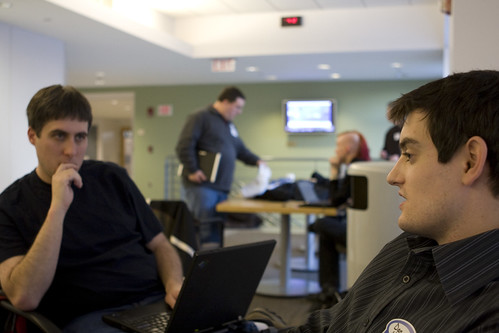
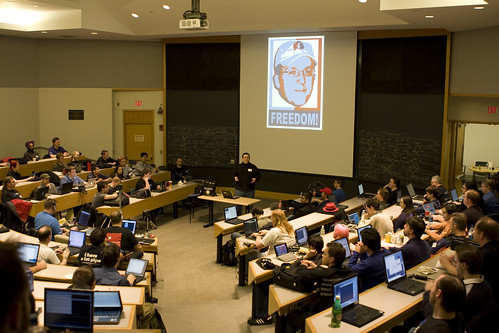
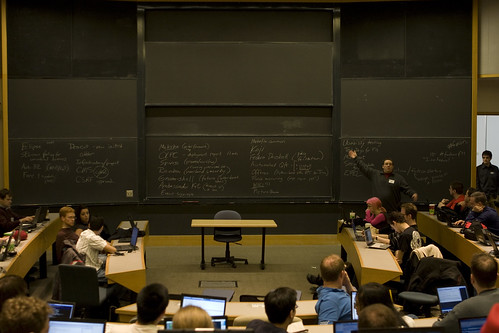
I was in Boston last week for FUDcon F11. As usual, despite bringing several tonnes of camera gear, I couldn t be bothered to pull it out aside from a few (terrible) casual shots. But hey, I m not big on being spontaneous. Anyway, the two hackfest days were really productive (as were the days I managed to make it out to the Red Hat office.) Although sadly we didn t make it into MIT for the Sunday hackfest day, due to the weather and the Sunday bus schedule in Arlington. paul's intro session Instead of DaveJ doing his usual what s going on in the kernel for F$next I pitched that session and Dave held a session on dracut, he and Jeremy s new framework for building initramfs. My session was well attended and got a lot of questions about various things like the new drivers/staging policy (though, that s a post for another time.) dcbw and notting The rest of the time was productively spent poking at updates for the kernel for F9 and F10, rebasing them to 2.6.28, and poking at 2.6.29-rc1 for rawhide. This meant btrfs, while not ready for your critical data, was in mainline! After pushing out the new build, I spent most of the weekend doing some btrfs testing, and pushing out a new btrfsprogs build. Once they were composed into rawhide, I believe Fedora became the first to ship the mainline working btrfs in a distro. paul's closing session All said, it was a fairly productive weekend, and FUDPub on Saturday night was a great chance to catch up with a bunch of my coworkers who I rarely get to see. I kind of wish I had bothered to set up an umbrella and get some decent shots of my friends, colleagues and coworkers having a raucous good time, but oh well, there s always next release. off-topic
I absolutely hate being politic, and desperately hate posting about life or whatever, since I don t care about yours and don t see why you should care about mine, but the callous arrogance of these striking transit workers here in Ottawa is beginning to irritate me. These are people who ve threatened to picket students attempting to get to school if the universities accepted funding from the municipal government to continue to run replacement shuttles, and (though they ve reached a side agreement now) had threatened to picket for attempting to hire more drivers to increase their ParaTranspo service which provides shuttle services for the elderly and less-able-bodied residents of Ottawa. My point is, one of the shops I walked past on the high street yesterday said it best: Caution, possibly NSFW depending on your point of view. Given that I live in a (fairly) suburban part of Ottawa, this means I get to enjoy a forty minute walk to the nearest (competent) grocery store or coffee shop, and haven t bothered much. But hey, wonderful North American urban planning strikes again. Huzzah.

Next.

Previous.