Search Results: "ron"

11 December 2013

Gustavo Noronha Silva: WebKitGTK+ hackfest 5.0 (2013)!

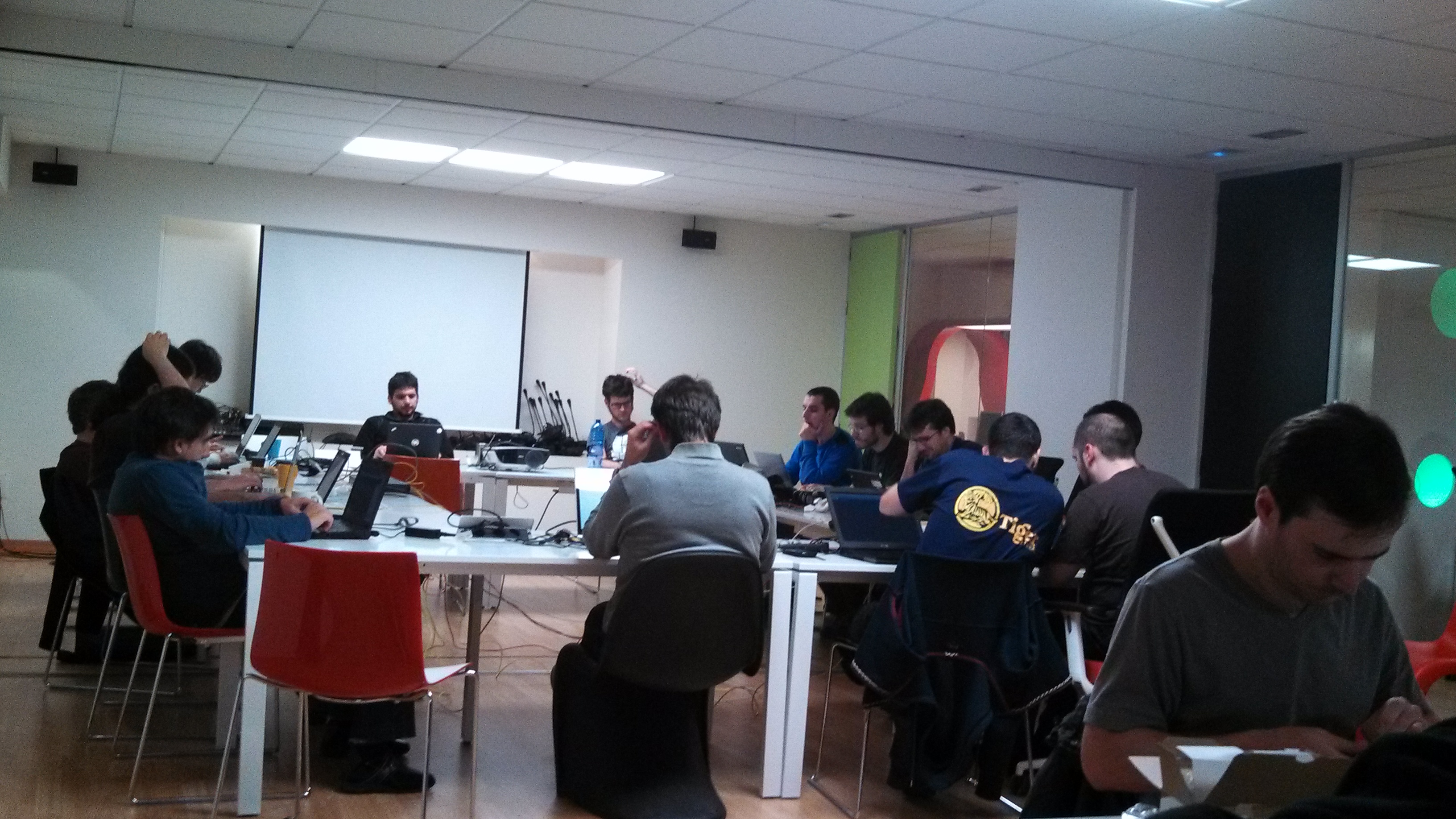
For the fifth year in a row the fearless WebKitGTK+ hackers have gathered in A Coru a to bring GNOME and the web closer. Igalia has organized and hosted it as usual, welcoming a record 30 people to its office. The GNOME foundation has sponsored my trip allowing me to fly the cool 18 seats propeller airplane from Lisbon to A Coru a, which is a nice adventure, and have pulpo a feira for dinner, which I simply love! That in addition to enjoying the company of so many great hackers.
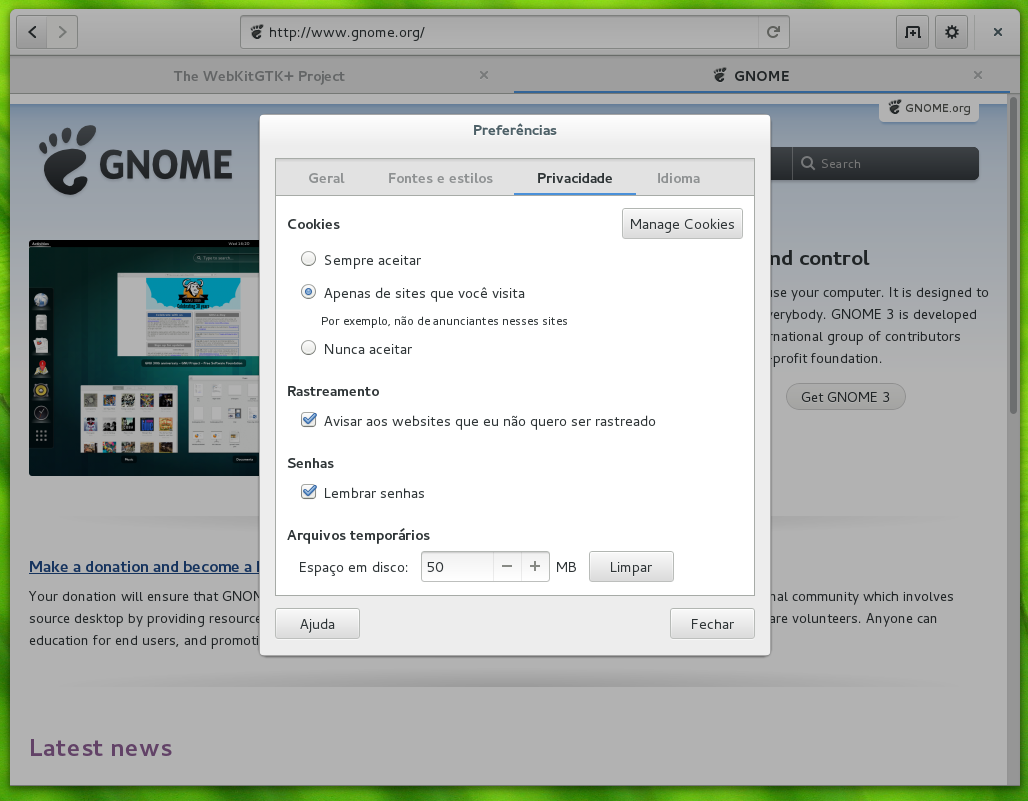
Web with wider tabs and the new prefs dialog

Web with wider tabs and the new prefs dialog

The goals for the hackfest have been ambitious, as usual, but we made good headway on them. Web the browser (AKA Epiphany) has seen a ton of little improvements, with Carlos splitting the shell search provider to a separate binary, which allowed us to remove some hacks from the session management code from the browser. It also makes testing changes to Web more convenient again. Jon McCan has been pounding at Web s UI making it more sleek, with tabs that expand to make better use of available horizontal space in the tab bar, new dialogs for preferences, cookies and password handling. I have made my tiny contribution by making it not keep tabs that were created just for what turned out to be a download around. For this last day of hackfest I plan to also fix an issue with text encoding detection and help track down a hang that happens upon page load.
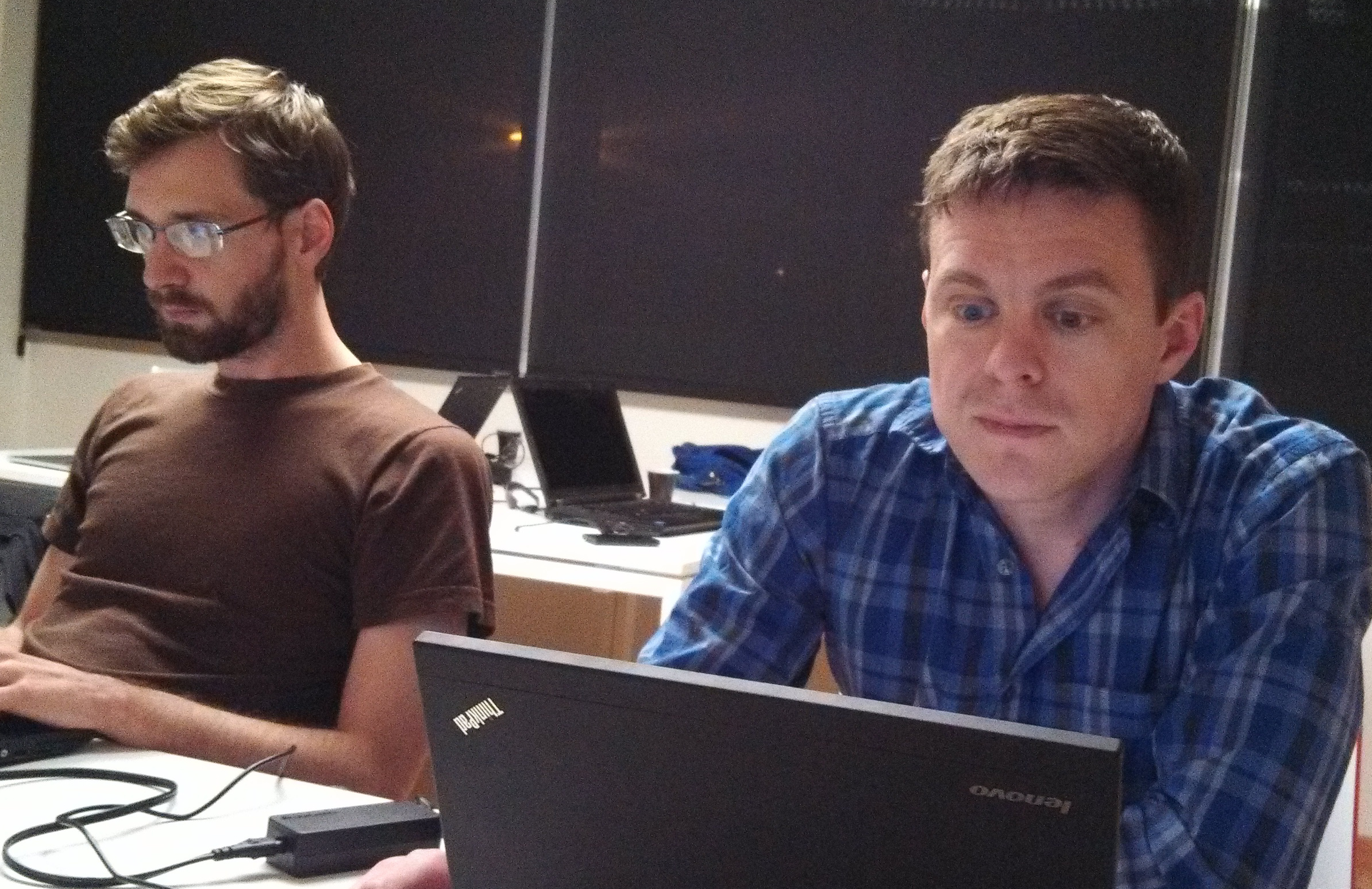
Martin Robinson and Dan Winship hack

Martin Robinson and Dan Winship hack

Martin Robinson and myself have as usual dived into the more disgusting and wide-reaching maintainership tasks that we have lots of trouble pushing forward on our day-to-day lives. Porting our build system to CMake has been one of these long-term goals, not because we love CMake (we don t) or because we hate autotools (we do), but because it should make people s lives easier when adding new files to the build, and should also make our build less hacky and quicker it is sad to see how slow our build can be when compared to something like Chromium, and we think a big part of the problem lies on how complex and dumb autotools and make can be. We have picked up a few of our old branches, brought them up-to-date and landed, which now lets us build the main WebKit2GTK+ library through cmake in trunk. This is an important first step, but there s plenty to do.
Hackers take advantage of the icecream network for faster builds

Hackers take advantage of the icecream network for faster builds

Under the hood, Dan Winship has been pushing HTTP2 support for libsoup forward, with a dead-tree version of the spec by his side. He is refactoring libsoup internals to accomodate the new code paths. Still on the HTTP front, I have been updating soup s MIME type sniffing support to match the newest living specification, which includes specification for several new types and a new security feature introduced by Internet Explorer and later adopted by other browsers. The huge task of preparing the ground for a one process per tab (or other kinds of process separation, this will still be topic for discussion for a while) has been pushed forward by several hackers, with Carlos Garcia and Andy Wingo leading the charge.
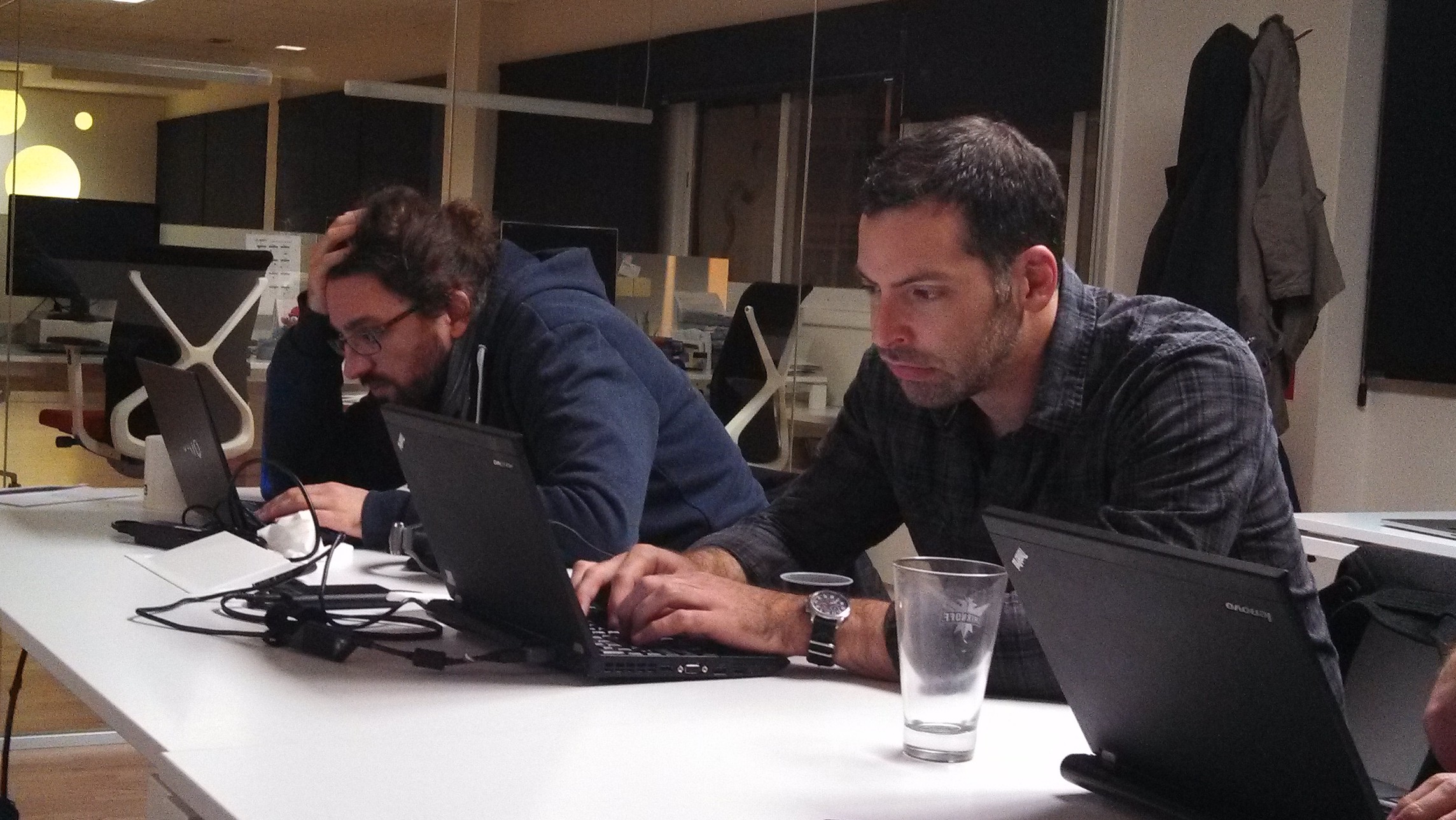
Jon and Guillaume battling code

Jon and Guillaume battling code

Other than that I have been putting in some more work on improving the integration of the new Web Inspector with WebKitGTK+. Carlos has reviewed the patch to allow attaching the inspector to the right side of the window, but we have decided to split it in two, one providing the functionality and one the API that will allow browsers to customize how that is done. There s a lot of work to be done here, I plan to land at least this first patch durign the hackfest. I have also fought one more battle in the never-ending User-Agent sniffing war, in which we cannot win, it looks like.
Hackers chillin' at A Coru a

Hackers chillin at A Coru a

I am very happy to be here for the fifth year in a row, and I hope we will be meeting here for many more years to come! Thanks a lot to Igalia for sponsoring and hosting the hackfest, and to the GNOME foundation for making it possible for me to attend! See you in 2014!

Rog rio Brito: Trivial fact: convexity of polyhedra

Just a trivial fact: every polyhedron that is used in linear programming is convex, that is !!mathjaxbegin-i!! QXggXGxlcSBi !!mathjaxend-i!! is convex, for a matrix !!mathjaxbegin-i!! QQ== !!mathjaxend-i!! and a (column) vector !!mathjaxbegin-i!! Yg== !!mathjaxend-i!!. Proof: Take any !!mathjaxbegin-i!! eCcsIHgnJw== !!mathjaxend-i!! that satisfy the system of inequalities !!mathjaxbegin-i!! QXggXGxlcSBi !!mathjaxend-i!!. Then, for !!mathjaxbegin-i!! MCBcbGVxIFxsYW1iZGEgXGxlcSAx !!mathjaxend-i!!, we have that !!mathjaxbegin-i!! XGxhbWJkYSBBeCcgXGxlcSBcbGFtYmRhIGI= !!mathjaxend-i!!, that is !!mathjaxbegin-i!! QSBcbGFtYmRhIHgnIFxsZXEgXGxhbWJkYSBi !!mathjaxend-i!!. Similarly, for !!mathjaxbegin-i!! eCcn !!mathjaxend-i!!, we have that !!mathjaxbegin-i!! QSAoMS1cbGFtYmRhKSB4JyBcbGVxICgxLVxsYW1iZGEpIGI= !!mathjaxend-i!!. Summing the inequalities, we get: !!mathjaxbegin-d!! CiBBW1xsYW1iZGEgeCcgKyAoMS1cbGFtYmRhKSB4JyddIFxsZXEgW1xsYW1iZGEgKyAoMS1cbGFt YmRhKV0gYiA9IGIsCg== !!mathjaxend-d!! which means that !!mathjaxbegin-i!! XGhhdHt4fSA9IFxsYW1iZGEgeCcgKyAoMS1cbGFtYmRhKSB4Jyc= !!mathjaxend-i!! is again a solution of the original set of inequalities, thus concluding the argument.

10 December 2013

Russ Allbery: krb5-sync 3.0

krb5-sync is the software we run at Stanford to synchronize principal information from a central Heimdal realm to Active Directory, allowing users to use either a Linux-based Kerberos environment or Active Directory with the same account and password. The original intent of this release was to add a new feature to allow a subsidiary instance of an account in the MIT or Heimdal realm to be synchronized with the instance-less account in Active Directory. This allows, for example, an rra/windows instance to be used to set and maintain the password for an rra principal in Active Directory. In the process of implementing that, though, I ended up doing a significant overall of the code, since the plugin architecture was quite awkward and dated. The code now uses the MIT Kerberos data structures in a more natural and native way, since MIT Kerberos has now added direct support for plugins of this sort. Kerberos contexts and Kerberos error codes are used uniformly throughout the plugin, which provides consistent and more robust error handling and reporting. I also significantly enhanced the test suite, although it still needs more work to test the core functionality that has complex external dependencies. This release also drops support for all versions of MIT Kerberos prior to 1.9, which required an external patch; to run krb5-sync 3.0, you should upgrade to a recent version of MIT Kerberos. This allowed me to drop support for the legacy API. There are a couple of major backward-incompatible changes in this release (and both unfortunately are not handled automatically by the Debian package upgrade, since it's hard to find and safely modify KDC configuration). First, the ad_ldap_base configuration option is now mandatory when synchronizing account status and its meaning has changed. Previously, dc elements for the realm were appended to a provided partial base. Now, the complete DN of the root of the Active Directory tree should be provided. This is more flexible and more useful with a wider variety of Active Directory setups. Second, I took advantage of the backward-incompatibilities to change the module name to sync.so from krb5_sync.so, since the latter sounded weirdly redundant and verbose when installed in the Kerberos plugin directory. This will require a configuration change to the plugin configuration for the KDC or kadmin server. Also in this release are a couple of new options: ad_queue_only, which forces all changes to be queued for later processing instead of processed in real time, and syslog, which can be used to turn off the internal syslog logging of non-errors from the module. (This is mostly useful for test suites.) Now, password changes are queued on any Active Directory failure, not just a few oddly-distinguished ones. The previous behavior was rather specific to Stanford's needs, and queuing all password changes shouldn't pose any problems. Finally, the krb5-sync-backend utility program for manipulating the queued changes has been completely rewritten and is much cleaner. It now uses the Net::Remctl::Backend Perl module for command and option handling, so that module (provided with remctl 3.4 or later) must be installed. It also requires IPC::Run, which is available from CPAN. It uniformly supports a -d option to specify the queue location, and skips event files during processing that no longer exist. You can get the latest release from krb5-sync distribution page.

9 December 2013

John Goerzen: Delicious Holiday Recipes

I ve come up with some new favorites this season. The boys and Laura were around for all three, and I am happy to report there were many kitchen smiles over these! From-Scratch Hot Chocolate There s something about hot chocolate made from scratch, with chocolate melted into milk, instead of a powder stirred in. It takes quite a bit more time, and probably has more calories, but it is quite delicious. The key to a delicious result where milk is concerned is to take things slow and keep stirring. You don t want the chocolate to scorch at the bottom of the pan. Heating up the milk before the chocolate should help things mix in more easily as well. The basis for this recipe was here, and it called for 2 cups milk and 2 cups half-and-half. I trust my heavy whipping cream was fine! <grin> There are also some other variations on that site. This nearly made my little cast iron kettle overflow, so next time I made a 3/4 recipe. Hot Spiced Cider We put up a Christmas tree yesterday, so I thought hot spiced cider would be perfect for the occasion. I went searching for recipes, and many of them called for cloves (which have to be sifted out later or put in a spice bag). I wasn t going to have time to delay two boys from setting up a Christmas tree long enough for that, so I found this basic recipe to work well. However, I, as usual, made some modifications ;-) Mmmmm . yum . Turkey or Chicken Noodle Soup The annual what to do with all that leftover turkey quest strikes again. I like chicken noodle soup, so why not a turkey noodle soup done the same way? Here s what I used, roughly, in my large 6-quart cast iron cooking pot (aka Dutch oven ): Start with the broth, onion, basil, oregano, pepper, and bay leaf. Heat up the mixture and add the vegetables. Bring it to boiling, then add the uncooked noodles. Return to boiling, then reduce heat, cover, and simmer for 8 minutes. Add the turkey or chicken and diced tomatoes, and simmer until hot enough to serve. The nice thing about soups is that they freeze well and make great winter leftovers. This recipe makes quite a lot of soup; you may wish to halve it. This recipe was adapted from one in a Better Homes & Gardens cookbook.

8 December 2013

Russell Coker: A Basic Income for Australia

There has been a lot of discussion recently about the concept of a Basic Income (Wikipedia), largely due to the efforts to change the Swiss constitution to provide a Basic Income [1]. The concept of a Basic Income is that residents get a fixed payment without having to be sick, disabled, looking for work, or eligible for other forms of social security. A Basic Income wouldn t replace all other forms of social security, one of the most obvious examples is that sick people will often need money for medical care in additional to living expenses. Also I believe that it shouldn t be means tested in any way. I think that one of the problems with current payment schemes is that there are complex eligibility criteria which require effort for the applicant and for government agencies to prevent accidental or fraudulent over-payment. The tax rates could be raised slightly to make it revenue neutral. Newstart In Australia the main form of social security for unemployed people at the moment is called Newstart [2]. Currently Newstart payments range from a maximum of $501 per fortnight for a single person ($13,026 per annum), to a maximum of $699.90 per fortnight for someone who is a carer. The Newstart payments start to decrease if the recipient earns more than $62 per fortnight. The minimum wage in Australia is $16.37 per hour for permanent work or $20.30 for casual work [3]. So if someone works for more than 3 hours at a casual rate (and I can t imagine 4 hours a fortnight being anything other than casual) then their Newstart payments will decrease. The payment decreases are fairly significant, for every dollar that is earned about 50 cents will be deducted from the payments. That s a great incentive to either avoid opportunities to do part-time work or to do cash-only work that s outside the tax system. The most obvious way of implementing a Basic Income would be to replace Newstart. Then anyone who is in that situation would be free to just not get a job which would be OK IMHO as people who don t want to work probably wouldn t do a good job if the government forced them to get a job. People who are unemployed who want to work could work as much as they want and scale up according to what their employer asks and how much money they need. Currently the full-time minimum wage is $622.20 per week (I m not sure exactly how they get that from $16.37). That s almost 2.5* the Newstart allowance for a single person (but less than twice the Newstart allowance for a carer). While Newstart (and the other forms of social security) don t provide a great income, it seems that the difference between Newstart and the minimum wage isn t that great particularly when you consider that working involves some expenses for travel etc. There doesn t seem to be a great financial incentive for someone to leave Newstart and get a minimum wage job. People Who Want Social Security Some people think it s great to get government payments while others find it embarrassing to need such payments and won t necessarily apply if they are eligible. I think that the current system of forcing people to apply for social security is a way of discouraging people who find themselves unexpectedly in a difficult situation but doesn t discourage people who are happy not to work. This seems to effectively reduce the incidence of payments to the people who most tax-payers would regard as the most worthy recipients. Economics Charles Stross wrote about some ideas related to this [4]. He suggests that as the workforce participation has been steadily reducing due to technology we should move to a social model that isn t based around working to live but working to buy luxuries that aren t covered by the Basic Income. One of the many economic changes related to a Basic Income is that the minimum wage could be smaller than it might otherwise be. For example if the minimum wage was decreased by the same amount that the Basic Income provided then the minimum income would remain the same while employers would pay less, this would affect the viability of certain types of contract work web sites if they were subject to minimum wage laws (currently they just ignore the minimum wage laws by paying based on job completion instead of hours worked). I don t think that the minimum wage should decrease that much though, currently employers are able to run viable businesses with the minimum wage laws and I don t think that a Basic Income should be used as a way of helping corporations avoid paying their employees. If we had a Basic Income then there s many ways that it could be used to stabilise the economy. If people could pay their rent even if they lost their job then a down-turn in one area of the economy wouldn t immediately affect other areas. Also if rent payments were deducted automatically from an account used to receive the Basic Income then landlords would be more likely to rent to poor people as they could be guaranteed to receive rent payments (it would be easy to have a contractual agreement for rent to take priority and have bank computers enforce that). The Implementation Problem I don t think that my idea would have any significant negative effects. It wouldn t decrease government revenues if tax was adjusted accordingly. It wouldn t make people stop working as people who don t want to work already avoid it. It would help people who are out of work to get work by reducing the barriers to entry in terms of paperwork and of unreasonable cuts to Newstart making it bad value to take part time work. I think that the big problem with implementing it is people who want to prevent poor people from having opportunities. They want to reduce social security and minimum wages even though such changes will in the long run only give less tax revenue and greater expense in law enforcement. It seems rather ironic that such hostility often comes from people at the low end of the middle class whos jobs are most likely to be at risk from new technology. As on-going technological development reduces the number of workers that are required to keep things running we need to have some form of payment to the people who aren t doing enough work to survive. A decent Basic Income is a much better option than giving Newstart payments and forcing a significant portion of the population into a degrading search for jobs that don t exist. As that s the inevitable future I think we should make political changes to deal with it sooner rather than later. However a Basic Income might be implemented now it s surely going to be a lot better than what might happen if we wait until the majority of the population are unemployed before doing something about it.

John Goerzen: Results with btrfs and zfs

The recent news that openSUSE considers btrfs safe for users prompted me to consider using it. And indeed I did. I was already familiar with zfs, so considered this a good opportunity to experiment with btrfs. btrfs makes an intriguing filesystem for all sorts of workloads. The benefits of btrfs and zfs are well-documented elsewhere. There are a number of features btrfs has that zfs lacks. For instance: The feature set of ZFS that btrfs lacks is well-documented elsewhere, but there are a few odd btrfs missteps: btrfs would be fine if it worked reliably. I should say at the outset that I have never lost any data due to it, but it has caused enough kernel panics that I ve lost count. I several times had a file that produced a panic when I tried to delete it, several times when it took more than 12 hours to unmount a btrfs filesystem, behaviors where hardlink-heavy workloads take days longer to complete than on zfs or ext4, and that s just the ones I wrote about. I tried to use btrfs balance to change the metadata allocation on the filesystem, and never did get it to complete; it seemed to go into an endless I/O pattern after the first 1GB of metadata and never got past that. I didn t bother trying the live migration of data from one disk to another on this filesystem. I wanted btrfs to work. I really, really did. But I just can t see it working. I tried it on my laptop, but had to turn of CoW on my virtual machine s disk because of the rm bug. I tried it on my backup devices, but it was unusable there due to being so slow. (Also, the hardlink behavior is broken by default and requires btrfstune -r. Yipe.) At this point, I don t think it is really all that worth bothering with. I think the SuSE decision is misguided and ill-informed. btrfs will be an awesome filesystem. I am quite sure it will, and will in time probably displace zfs as the most advanced filesystem out there. But that time is not yet here. In the meantime, I m going to build a Debian Live Rescue CD with zfsonlinux on it. Because I don t ever set up a system I can t repair.

6 December 2013

Petter Reinholdtsen: Debian Edu interview: Klaus Knopper

It has been a while since I managed to publish the last interview, but the Debian Edu / Skolelinux community is still going strong, and yesterday we even had a new school administrator show up on #debian-edu to share his success story with installing Debian Edu at their school. This time I have been able to get some helpful comments from the creator of Knoppix, Klaus Knopper, who was involved in a Skolelinux project in Germany a few years ago. Who are you, and how do you spend your days? I am Klaus Knopper. I have a master degree in electrical engineering, and is currently professor in information management at the university of applied sciences Kaiserslautern / Germany and freelance Open Source software developer and consultant. All of this is pretty much of the work I spend my days with. Apart from teaching, I'm also conducting some more or less experimental projects like the Knoppix GNU/Linux live system (Debian-based like Skolelinux), ADRIANE (a blind-friendly talking desktop system) and LINBO (Linux-based network boot console, a fast remote install and repair system supporting various operating systems). How did you get in contact with the Skolelinux / Debian Edu project? The credit for this have to go to Kurt Gramlich, who is the German coordinator for Skolelinux. We were looking for an all-in-one open source community-supported distribution for schools, and Kurt introduced us to Skolelinux for this purpose. What do you see as the advantages of Skolelinux / Debian Edu? What do you see as the disadvantages of Skolelinux / Debian Edu? For these reasons and experience from our project, I would now rather consider using plain Debian for schools next time, until Skolelinux is more closely integrated into Debian and becomes upgradeable without reinstallation. Which free software do you use daily? GNU/Linux with LXDE desktop, bash for interactive dialog and programming, texlive for documentation and correspondence, occasionally LibreOffice for document format conversion. Various programming languages for teaching. Which strategy do you believe is the right one to use to get schools to use free software? Strong arguments are

5 December 2013

Daniel Kahn Gillmor: The legal utility of deniability in secure chat

This Monday, I attended a workshop on Multi-party Off the Record Messaging and Deniability hosted by the Calyx Institute. The discussion was a combination of legal and technical people, looking at how the characteristics of this particular technology affect (or do not affect) the law. This is a report-back, since I know other people wanted to attend. I'm not a lawyer, but I develop software to improve communications security, I care about these questions, and I want other people to be aware of the discussion. I hope I did not misrepresent anything below. I'd be happy if anyone wants to offer corrections. BackgroundOff the Record Messaging (OTR) is a way to secure instant messaging (e.g. jabber/XMPP, gChat, AIM). The two most common characteristics people want from a secure instant messaging program are:
Authentication
Each participant should be able to know specifically who the other parties are on the chat.
Confidentiality
The content of the messages should only be intelligible to the parties involved with the chat; it should appear opaque or encrypted to anyone else listening in. Note that confidentiality effectively depends on authentication -- if you don't know who you're talking to, you can't make sensible assertions about confidentiality.
As with many other modern networked encryption schemes, OTR relies on each user maintaining a long-lived "secret key", and publishing a corresponding "public key" for their peers to examine. These keys are critical for providing authentication (and by extension, for confidentiality). But OTR offers several interesting characteristics beyond the common two. Its most commonly cited characteristics are "forward secrecy" and "deniability".
Forward secrecy
Assuming the parties communicating are operating in good faith, forward secrecy offers protection against a special kind of adversary: one who logs the encrypted chat, and subsequently steals either party's long-term secret key. Without forward secrecy, such an adversary would be able to discover the content of the messages, violating the confidentiality characteristic. With forward secrecy, this adversary is be stymied and the messages remain confidential.
Deniability
Deniability only comes into play when one of the parties is no longer operating in good faith (e.g. their computer is compromised, or they are collaborating with an adversary). In this context, if Alice is chatting with Bob, she does not want Bob to be able to cryptographically prove to anyone else that she made any of the specific statements in the conversation. This is the focus of Monday's discussion. To be clear, this kind of deniability means Alice can correctly say "you have no cryptographic proof I said X", but it does not let her assert "here is cryptographic proof that I did not say X" (I can't think of any protocol that offers the latter assertion). The opposite of deniability is a cryptographic proof of origin, which usually runs something like "only someone with access to Alice's secret key could have said X."
The traditional two-party OTR protocol has offered both forward secrecy and deniability for years. But deniability in particular is a challenging characteristic to provide for group chat which is the domain of Multi-Party OTR (mpOTR). You can read some past discussion about the challenges of deniability in mpOTR (and why it's harder when there are more than two people chatting) from the otr-users mailing list. If you're not doing anything wrong... The discussion was well-anchored by a comment from another participant who cheekily asked "If you're not doing anything wrong, why do you need to hide your chat at all, let alone be able to deny it?" The general sense of the room was that we'd all heard this question many times, from many people. There are lots of problems with the ideas behind the question from many perspectives. But just from a legal perspective, there are at least two problems with the way this question is posed: In these situations, people confront real risk from the law. If we care about these people, we need to figure out if we can build systems to help them reduce that legal risk (of course we also need to fix broken laws, and the legal environment in general, but those approaches were out of scope for this discussion). The Legal Utility of Deniability Monday's meeting was called specifically because it wasn't clear how much real-world usefulness there is in the "deniability" characteristic, and whether this feature is worth the development effort and implementation tradeoffs required. In particular, the group was interested in deniability's utility in legal contexts; many (most?) people in the room were lawyers, and it's also not clear that deniability has much utility outside of a formal legal setting. If your adversary isn't constrained by some rule of law, they probably won't care at all whether there is a cryptographic proof or not that you wrote a particular message (In retrospect, one possible exception is exposure in the media, but we did not discuss that scenario). Places of possible usefulness So where might deniability come in handy during civil litigation or a criminal trial? Presumably the circumstance is that a piece of a chat log is offered as incriminating evidence, and the defendant is trying to deny something that they appear to have said in the log. This denial could take place in two rather different contexts: during rules over admissibility of evidence, or (once admitted) in front of a jury. In legal wrangling over admissibility, apparently a lot of horse-trading can go on -- each side concedes some things in exchange for the other side conceding other things. It appears that cryptographic proof of origin (that is, a lack of deniability) on the chat logs themselves might reduce the amount of leverage a defense lawyer can get from conceding or arguing strongly over that piece of evidence. For example, if the chain of custody of a chat transcript is fuzzy (i.e. the transcript could have been mishandled or modified somehow before reaching trial), then a cryptographic proof of origin would make it much harder for the defense to contest the chat transcript on the grounds of tampering. Deniability would give the defense more bargaining power. In arguing about already-admitted evidence before a jury, deniability in this sense seems like a job for expert witnesses, who would need to convince the jury of their interpretation of the data. There was a lot of skepticism in the room over this, both around the possibility of most jurors really understanding what OTR's claim of deniability actually means, and on jurors' ability to distinguish this argument from a bogus argument presented by an opposing expert witness who is willing to lie about the nature of the protocol (or who misunderstands it and passes on their misunderstanding to the jury). The complexity of the tech systems involved in a data-heavy prosecution or civil litigation are themselves opportunities for lawyers to argue (and experts to weigh in) on the general reliability of these systems. Sifting through the quantities of data available and ensuring that the appropriate evidence is actually findable, relevant, and suitably preserved for the jury's inspection is a hard and complicated job, with room for error. OTR's deniability might be one more element in a multi-pronged attack on these data systems. These are the most compelling arguments for the legal utility of deniability that I took away from the discussion. I confess that they don't seem particularly strong to me, though some level of "avoiding a weaker position when horse-trading" resonates with me. What about the arguments against its utility? Limitations The most basic argument against OTR's deniability is that courts don't care about cryptographic proof for digital evidence. People are convicted or lose civil cases based on unsigned electronic communications (e.g. normal e-mail, plain chat logs) all the time. OTR's deniability doesn't provide any legal cover stronger than trying to claim you didn't write a given e-mail that appears to have originated from your account. As someone who understands the forgeability of e-mail, i find this overall situation troubling, but it seems to be where we are. Worse, OTR's deniability doesn't cover whether you had a conversation, just what you said in that conversation. That is, Bob can still cryptographically prove to an adversary (or before a judge or jury) that he had a communication with someone controlling Alice's secret key (which is probably Alice); he just can't prove that Alice herself said any particular part of the conversation he produces. Additionally, there are runtime tradeoffs depending on how the protocol manages to achieve these features. For example, forward secrecy itself requires an additional round trip or two when compared to authenticated, encrypted communications without forward secrecy (a "round trip" is a message from Alice to Bob followed by a message back from Bob to Alice). Getting proper deniability into the mpOTR spec might incur extra latency (imagine having to wait 60 seconds after everyone joins before starting a group chat, or a pause in the chat of 15 seconds when a new member joins) or extra computational power (meaning that they might not work well on slower/older devices) or an order of magnitude more bandwidth (meaning that chat might not work at all on a weak connection). There could also simply be complexity that makes it harder to correctly implement a protocol with deniability than an alternate protocol without deniability. Incorrectly-implemented software can put its users at risk. I don't know enough about the current state of mpOTR to know what the specific tradeoffs are for the deniability feature, but it's clear there will be some. Who decides whether the tradeoffs are worth the feature? Other kinds of deniability Further weakening the case for the legal utility of OTR's deniability, there seem to be other ways to get deniability in a legal context over a chat transcript. There are deniability arguments that can be made from outside the protocol. For example, you can always claim someone else took control of your computer while you were asleep or using the bathroom or eating dinner, or you can claim that your computer had a virus that exported your secret key and it must have been used by someone else. If you're desperate enough to sacrifice your digital identity, you could arrange to have your secret key published, at which point anyone can make signed statements with it. Having forward secrecy makes it possible to expose your secret key without exposing the content of your past communications to any listener who happened to log them. Conclusion My takeaway from the discussion is that the legal utility of OTR's deniability is non-zero, but quite low; and that development energy focused on deniability is probably only justified if there are very few costs associated with it. Several folks pointed out that most communications-security tools are too complicated or inconvenient to use for normal people. If we have limited development energy to spend on securing instant messaging, usability and ubiquity would be a better focus than this form of deniability. Secure chat systems that take too long to make, that are too complex, or that are too cumbersome are not going to be adopted. But this doesn't mean people won't chat at all -- they'll just use cleartext chat, or maybe they'll use supposedly "secure" protocols with even worse properties: for example, without proper end-to-end authentication (permitting spoofing or impersonation by the server operator or potentially by anyone else); with encryption that is reversible by the chatroom operator or flawed enough to be reversed by any listener with a powerful computer; without forward secrecy; or so on. As a demonstration of this, we heard some lawyers in the room admit to using Skype to talk with their clients even though they know it's not a safe communications channel because their clients' adversaries might have access to the skype messaging system itself. My conclusion from the meeting is that there are a few particular situations where deniability could be useful legally, but that overall, it is not where we as a community should be spending our development energy. Perhaps in some future world where all communications are already authenticated, encrypted, and forward-secret by default, we can look into improving our protocols to provide this characteristic, but for now, we really need to work on usability, popularization, and wide deployment. Thanks Many thanks to Nick Merrill for organizing the discussion, to Shayana Kadidal and Stanley Cohen for providing a wealth of legal insight and legal experience, to Tom Ritter for an excellent presentation of the technical details, and to everyone in the group who participated in the interesting and lively discussion. Tags: chat, deniability, otr, security

4 December 2013

Aigars Mahinovs: Translation management workflows

Whatever you do with translations, consider translation management issues. For example, you are developing a multilingual web site. All kinds of labels and buttons and form fields are nicely translatable with trans template tag and ugettext. You have po files that follow your code from dev to stage to production environment.

Now you add a CMS into the mix. And suddenly - you translations are in more than one place, in more than one format and follow different routes to production.
Now imagine that you need to add Chinese language to your entire site. The translator is an off-site contractor. What files would you send to him to translate? How would you generate them? How will you integrate them?
If someone adds or changes a page on production in English: how will your developers see that change? how will you know that an updated translation for Chinese is needed? how will you manage the update of the translation?
If you make a CMS and don't have at least the export_po_file and import_po_file management commands, then you are not really multilingual. It is either that or figuring out your own answer for the above questions.
I have finally found a Django-based CMS that has those - http://pythonhosted.org/django-page-cms/ . Have not really tried it yet, but I am hopeful.

3 December 2013

Matthew Garrett: Subverting security with kexec

(Discussion of a presentation I gave at Kiwicon last month)

Kexec is a Linux kernel feature intended to allow the booting of a replacement kernel at runtime. There's a few reasons you might want to do that, such as using Linux as a bootloader[1], rebooting without having to wait for the firmware to reinitialise or booting into a minimal kernel and userspace that can be booted on crash in order to save system state for later analysis.

But kexec's significantly more flexible than this. The kexec system call interface takes a list of segments (ie, pointers to a userspace buffer and the desired target destination) and an entry point. The kernel relocates those segments and jumps to the entry point. That entry point is typically code referred to as purgatory, due to the fact that it lives between the world of the first kernel and the world of the second kernel. The purgatory code sets up the environment for the second kernel and then jumps to it. The first kernel doesn't need to know anything about what the second kernel is or does. While it's conventional to load Linux, you can load just about anything.

The most important thing to note here is that none of this is signed. In other words, despite us having a robust in-kernel mechanism for ensuring that only signed modules can be inserted into the kernel, root can still load arbitrary code via kexec and execute it. This seems like a somewhat irritating way to patch the running kernel, so thankfully there's a much more straightforward approach.

I modified kexec to add an additional loader and uploaded the code here. Build and install it. Make sure that /sys/module/module/parameters/sig_enforce on your system is "Y". Then, as root, do something like:
kexec --type="dummy" --address= printf "0x%x" $(( $(grep "B sig_enforce" /proc/kallsyms awk ' print "0x"$1 ') & 0x7fffffff)) --value=0 --load-preserve-context --mem-max=0x10000 /bin/true
to load it[2]. Now do kexec -e and watch colours flash and check /sys/module/module/parameters/sig_enforce again.

The beauty of this approach is that it doesn't rely on any kernel bugs - it's using kernel functionality that was explicitly designed to let you do this kind of thing (ie, run arbitrary code in ring 0). There's not really any way to fix it beyond adding a new system call that has rather tighter restrictions on the binaries that can be loaded. If you're using signed modules but still permit kexec, you're not really adding any additional security.

But that's not the most interesting way to use kexec. If you can load arbitrary code into the kernel, you can load anything. Including, say, the Windows kernel. ReactOS provides a bootloader that's able to boot the Windows 2003 kernel, and it shouldn't be too difficult for a sufficiently enterprising individual to work out how to get Windows 8 booting. Things are a little trickier on UEFI - you need to tell the firmware which virtual physical map to use, and you can only do it once. If Linux has already done that, it's going to be difficult to set up a different map for Windows. Thankfully, there's an easy workaround. Just boot with the "noefi" kernel argument and the kernel will skip UEFI setup, letting you set up your own map.

Why would you want to do this? The most obvious reason is avoiding Secure Boot restrictions. Secure Boot, if enabled, is explicitly designed to stop you booting modified kernels unless you've added your own keys. But if you boot a signed Linux distribution with kexec enabled (like, say, Ubuntu) then you're able to boot a modified Windows kernel that will still believe it was booted securely. That means you can disable stuff like the Early Launch Anti-Malware feature or driver signing, or just stick whatever code you want directly into the kernel. In most cases all you'd need for this would be a bootloader, kernel and an initrd containing support for the main storage, an ntfs driver and a copy of kexec-tools. That should be well under 10MB, so it'll easily fit on the EFI system partition. Copy it over the Windows bootloader and you should be able to boot a modified Windows kernel without any terribly obvious graphical glitches in the process.

And that's the story of why kexec is disabled on Fedora when Secure Boot is enabled.

[1] That way you only have to write most drivers once
[2] The address section finds the address of the sig_enforce symbol in the kernel, and the value argument tells the dummy code what value to set that address to. --load-preserve-context informs the kernel that it should save hardware state in order to permit returning to the original kernel. --mem-max indicates the highest address that the kernel needs to back up. /bin/true is just there to satisfy the argument parser.

comment count unavailable comments

Russell Coker: Preferring Not To

I ve just read Bartleby the Scrivener which is a short story about a scrivener who refused to work saying I d prefer not to . It reminded me of some situations in the computer industry. I ve never seen a single case where someone preferred not to work when everyone around them (colleagues and management) wanted them to work. But then the incidence of having an entire team and management wanting to work efficiently isn t nearly as common as one might imagine. In some cases it s desired that someone not work, such as a former colleague who was hired as a sysadmin but did nothing but change backup tapes (a few hours work per week). Not having him login as root improved the general reliability of the servers but it was fortunate that we never needed to restore from backups One time I had a colleague who preferred to spend most of his time in the office searching the Internet for videos of street fights. I have often told colleagues that I would prefer them to work, but in the case of a guy who s only hobby is street-fighting I decided to let it go. Managing people can be difficult, particularly for someone who doesn t like disagreements. Some managers that I ve reported to seemed to prefer not to manage in an apparent attempt to avoid disputes. One time when I complained about a colleague not even having a suitable computer to permit doing any work a manager responded with the rhetorical question what do you expect me to do? . That manager didn t do any annual reviews of staff for over a year, he only eventually did some reviews because he was told that his scheduled promotion was on hold until he got them done. I got the impression that at least two levels of management preferred not to work at that company. Sometimes it just gets weird though, such as the occasion when I was the only member of a team and the manager who was supposedly managing no-one but me never seemed to have time to have a meeting with me. But he didn t want me to bypass him and talk directly to other people in the company, so he preferred not to work and not to have anyone else do his job. Most of the companies that I ve worked for in a full-time capacity didn t seem to have any effective technical interviews (note that I ve mostly worked for financial companies and ISPs not free software companies). So it seems that anyone with minimal computer skills who wants a well paying job could just send out a CV to a bunch of recruiting agencies, get interviewed by enough companies to eventually hit one without a technical interview process and then find a job that doesn t require work. Depression The Wikipedia page about Bartleby the Scrivener [2] suggests that Bartleby was depressed. I wonder how much of the lack of performance I ve witnessed has been due to depression. There appears to be a strong correlation between work environments that cause depression and people preferring not to work. Maybe managers should be considering how to make work less depressing to try and get more effective employees (in terms of quality and quantity of work). One example of this is the sysadmin team death spiral I ve witnessed where no-one can automate solving problems (EG by cron jobs to manage resource usage and analysis tools to find minor problems before they become major problems) because everyone is dedicated to fixing things that break needlessly (EG systems crashing due to lack of disk space). When people start getting control over recurring problems and automating things then the work becomes increasingly about solving problems and less about implementing the same manual processes every day/week and it s more fun and effective for everyone. At the BoF on depression at LCA 2013 one delegate stated that many companies have people in HR who can arrange support for depressed employees. Apparently if you are depressed and you work for a company that s large enough to have a HR department then it can be beneficial to talk to HR about it. That probably works well in the case where an employee is depressed but the company is working well. But in the case where the company isn t working well it seems unlikely to help. David Graeber wrote an interesting article about Bullshit Jobs [3]. He goes a bit far, I don t think that late night pizza delivery is a bullshit job and actuaries are useful to society. But his points about the existence of useless jobs are reasonable. Management Levels I sometimes wonder whether there is some benefit in establishing social norms about working and then having management take little interest in how it happens. If a team works well together then management could just set deadlines (which would be negotiated with employees who know what s possible) and let the team work out how to do it. Then instead of having one manager for each team of ~10 people who theoretically tracks what everyone is doing you could have one manager for a dozen teams who just tracks overall team performance essentially remove a layer of management. Valve is famous for having no formal management structure and for getting things done, unfortunately that apparently allows school-style cliques to block actions [4]. But I think that the Valve experiment is useful and provides some ideas that can be used by other companies. Maybe if instead of requiring consensus of the entire company for hiring decisions they only required consensus of the team things would have worked better. Of course another down-side to such things is that hierarchical management can be good for avoiding discrimination and bullying. The article I cited about Valve compares it to high-school. It could be that Valve employees were all nice people who only hired other nice people. But if similar systems were implemented in many companies then some would surely end up being like a typical high school with all the bullying and mistreatment of minority groups that entails. Michael O. Church wrote an interesting article in which he divides employees into four categories, loser , clueless , psychopaths , and technocrats (note that he didn t invent the first three names) [5]. In his model the clueless category includes most middle-management. I think that there are some problems with Michael s model and I m not arguing for a technocracy (which is how this post might be interpreted in terms of his ideas). But I think he demonstrates some of the real problems in the way companies are managed and in his model the losers prefer not to work as long as they can get paid. Conclusion I don t have any good solutions to these problems to offer. It seems that the best we can hope for is incremental change to make work less depressing, to have the minimal amount of management, and to avoid bullshit jobs .

2 December 2013

Tim Retout: How not to parse search queries

While I remember, I have uploaded the slides from my talk about Solr and Perl at the London Perl Workshop. This talk was inspired by having seen and contributed to at least five different sets of Solr search code at my current job, all of which (I now believe) were doing it wrong. I distilled this hard-won knowledge into a 20 minute talk, which - funny story - I actually delivered twice to work around a cock-up in the printed schedule. I don't believe any video was successfully taken, but I may be proved wrong later. I have also uploaded the Parse::Yapp grammar mentioned in the talk. In case you don't have time to read the slides, the right way to present Solr via Perl is to use the 'edismax' parser, and write your code a bit like this:
my $solr = WebService::Solr->new($url);
my $s = $query->param('q');
# WebService::Solr::Query objects are useful for
# 'fq' params, but avoid them for main 'q' param.
my $options =  
 fq => [WebService::Solr::Query->new(...)];
 ;
$solr->search($s, \%options);
The key thing here is not to put any complicated parsing code in between the user and Solr. Avoid Search::QueryParser at all costs.

Ben Hutchings: Upgrading from Android 2.3 'Gingerbread' to 4.3 'Jelly Bean'

Replacing my phone My first Android phone was a ZTE Blade (sold as Orange San Francisco here in the UK). It originally shipped with Android 2.1 but was upgradable to 2.3 thanks to CyanogenMod (or other unofficial mods). However there's little sign of an upgrade to 4.x; the apps I want to use are pushing the limits of its CPU, RAM and internal storage; and I've never got very good at typing on a soft keyboard. So it seemed like time to get a newer phone with a hard keyboard (and still with a SD slot). After a little research with the CyanogenMod compatibility list and some time looking at reviews, I settled on the Samsung Galaxy S Relay 4G, which was exclusive to T-Mobile USA but is being resold through eBay. It shipped with Android 4.0 but I immediately installed CyanogenMod 10.2 (Android 4.3). This was a bit of an adventure as I bought the Blade with CM already installed and wasn't familiar with the multiple steps that were necessary. Copying my data The last step, and the real subject of this entry, was to move my data across. Much of this was on a SD card which I could simply plug into the Relay. The internal files had to be backed up onto this card and then restored, using the recovery environment (ClockworkMod) on each phone. After rebooting the Relay into the full Android system, my apps and settings were mostly present but I was immediately confronted with a series of error dialogs reporting that 'Unfortunately, Dialler has stopped' - and the same for 'Clock' and 'the process android.process.acore' (whatever that is). What went wrong There are thankfully more detailed error logs in the filesystem, under /data/system/dropbox (this is for logging at the Java level; if a process is terminated by a fatal signal it's logged to /data/tombstones). There are several ways to get at them, but I used recovery mode and adb to get a root shell where I could easily read and write files as necessary. The Contacts (aka People) database upgrade fails with an SQLiteException, apparently because it doesn't account for upgrading from the schema used in 2.3:
Process: android.process.acore
Flags: 0x883e45
Package: com.android.providers.applications v18 (4.3.1-f963020e38)
Package: com.android.providers.contacts v18 (4.3.1-f963020e38)
Package: com.android.providers.userdictionary v18 (4.3.1-f963020e38)
Build: samsung/apexqtmo/apexqtmo:4.1.2/JZO54K/T699UVBMC5:user/release-keys
android.database.sqlite.SQLiteException: no such column: phonebook_label (code 1): , while compiling: UPDATE raw_contacts SET display_name_source=?,display_name=?,display_name_alt=?,phonetic_name=?,phonetic_name_style=?,sort_key=?,phonebook_label=?,phonebook_bucket=?,sort_key_alt=?,phonebook_label_alt=?,phonebook_bucket_alt=? WHERE _id=?
...
        at com.android.providers.contacts.ContactsDatabaseHelper.updateRawContactDisplayName(ContactsDatabaseHelper.java:5344)
        at com.android.providers.contacts.ContactsDatabaseHelper.upgradeToVersion504(ContactsDatabaseHelper.java:3580)
        at com.android.providers.contacts.ContactsDatabaseHelper.onUpgrade(ContactsDatabaseHelper.java:2261)
...
Clock fails somewhat similarly though it apparently didn't try to upgrade:
Process: com.android.deskclock
Flags: 0xc8be45
Package: com.android.deskclock v203 (2.0.3)
Build: samsung/apexqtmo/apexqtmo:4.1.2/JZO54K/T699UVBMC5:user/release-keys
android.database.sqlite.SQLiteException: no such column: incvol (code 1): , while compiling: SELECT _id, hour, minutes, daysofweek, alarmtime, enabled, vibrate, message, alert, incvol, profile FROM alarms WHERE (enabled=1)
...
        at com.android.deskclock.AlarmProvider.query(AlarmProvider.java:73)
        at android.content.ContentProvider.query(ContentProvider.java:744)
        at android.content.ContentProvider$Transport.query(ContentProvider.java:199)
        at android.content.ContentResolver.query(ContentResolver.java:414)
        at android.content.ContentResolver.query(ContentResolver.java:357)
        at com.android.deskclock.Alarms.getFilteredAlarmsCursor(Alarms.java:165)
        at com.android.deskclock.Alarms.calculateNextAlert(Alarms.java:344)
        at com.android.deskclock.Alarms.setNextAlert(Alarms.java:417)
        at com.android.deskclock.Alarms.saveSnoozeAlert(Alarms.java:510)
        at com.android.deskclock.AlarmInitReceiver$1.run(AlarmInitReceiver.java:49)
...
The media player fails with a NullPointerException:
Process: com.andrew.apollo:main
Flags: 0x98be65
Package: com.andrew.apollo v2 (1.1)
Build: samsung/apexqtmo/apexqtmo:4.1.2/JZO54K/T699UVBMC5:user/release-keys
java.lang.NullPointerException
        at com.andrew.apollo.MusicPlaybackService.stop(MusicPlaybackService.java:878)
        at com.andrew.apollo.MusicPlaybackService.openCurrentAndMaybeNext(MusicPlaybackService.java:1048)
        at com.andrew.apollo.MusicPlaybackService.openCurrentAndNext(MusicPlaybackService.java:1031)
        at com.andrew.apollo.MusicPlaybackService.access$1500(MusicPlaybackService.java:74)
        at com.andrew.apollo.MusicPlaybackService$MusicPlayerHandler.handleMessage(MusicPlaybackService.java:2337)
        at android.os.Handler.dispatchMessage(Handler.java:99)
        at android.os.Looper.loop(Looper.java:137)
        at android.os.HandlerThread.run(HandlerThread.java:61)
Fixing the problem Maybe I could have worked out how to upgrade the relevant databases myself, but I went for simpler solutions. The clock settings are easy to re-enter and most of the media player state is regenerated by scanning files on the SD card. So I just deleted those on the Relay:
  rm -rf /data/data/com.android.deskclock
  rm -rf /data/data/com.android.providers.media
The contacts were what I really cared about, and there are actually specific menu items in Contacts to export and import those (using VCF format), side-stepping the database upgrade. So I did:
  1. Insert SD card in Blade
  2. Open Contacts and export to VCF (I forget where this is in the menus but it was easy to find)
  3. Remove broken Contacts database on Relay:
    rm -rf /data/data/com.android.providers.contacts
  4. Insert SD card in Relay
  5. Move exported contacts to internal storage:
    mv /storage/sdcard1/*.vcf /storage/emulated/legacy
  6. Open People and tap the menu key, 'Import/export', 'Import from storage', then the filename
This may not include all data, and in particular it doesn't seem to include attached photos. But that was good enough for me.

30 November 2013

Gunnar Wolf: On errors in exams - Short rant

Blogging from a phone... first time ever. I don't want to forget some specifics for this :) I have just completed an exam to try to enter a postgraduate program (I'll talk more about it once it becomes real ). The exam is administered by CENEVAL, the same evaluation agency Where I presented my graduation equivalency exam some years ago - Only this exam is for all of the postgraduate studies on many national universities and is thus basically just a psychometric test. The exam had 162 questions, all to be filled in a optical reader sheet, on five subjects: mathematical reasoning, Spanish grammar and comprehension, Project management, Computers and technology, And English reading and understanding. It was all in all a fun exam to take, mostly due to the math reasoning part. But... on the Subject I Know I am an expert, I have to complain (and intend to find a easy to do so formally). First, I spotted two absolute mistakes (and answered based on What I knew others would, but knowing the answer is wrong technically). One was a subtlety, on how and why have hard drives should be defragmented (and part of my quip is that it's an obsolete habit, but besides, the answers were all erroneous), but a second one was... just wrong. It asked on what should not be part of an "Internet link" (can only guess they meant An URL). The 4 options were valid parts of a URL - including one very seldom used by most people, but very often by many of us: the @ sign. Anyway, answered it, but my other main gripe is that most of the section was in specific use of Office software. Not only In Office-like, which would be bad enough to begin with, but on specific ways of using Mainly Excel And PowerPoint. Syntax issues, or the name of the menu under which to look for specific functions.

Anyway, I will wait the stipulated 10 days for the exam to be rated, but will anyway look die a way to contact the very opaque and secretive CENEVAL. Not to demand to be better treated, but to try to correct those known mistakes and errors.

Petter Reinholdtsen: Dugnadsnett for alle, a wireless community network in Oslo, take shape

If you want the ability to electronically communicate directly with your neighbors and friends using a network controlled by your peers in stead of centrally controlled by a few corporations, or would like to experiment with interesting network technology, the Dugnasnett for alle i Oslo might be project for you. 39 mesh nodes are currently being planned, in the freshly started initiative from NUUG and Hackeriet to create a wireless community network. The work is inspired by Freifunk, Athens Wireless Metropolitan Network, Roofnet and other successful mesh networks around the globe. Two days ago we held a workshop to try to get people started on setting up their own mesh node, and there we decided to create a new mailing list dugnadsnett (at) nuug.no and IRC channel #dugnadsnett.no to coordinate the work. See also the NUUG blog post announcing the mailing list and IRC channel.

29 November 2013

Steve Kemp: A difficult day

Today was my last day working at Bytemark, and I found it a lot harder than expected. For better or worse I finished earlier than expected; having been gradually removing my accounts and privileges over the past few weeks I'd revoked my OpenVPN key this morning. Mid-afternoon my openvpn connection tried to renegotiate session keys, or similar, and failed. So I stopped work a few hours early. That meant I managed to avoid sending my "goodbye world" email, which is probably for the best - after all a lovely company, lovely people, and a good environment, what can you say besides things that are lovely? I think I largely wrapped things up neatly, and I'm pleased that one of my photos is hanging on the office wall. (I look forward to seeing that actually, I've only rarely made canvas prints.) The only other thing of note this week has been the sharp rise in blogspam I've detected. Black Friday alive and well, on the internets ..

Keith Packard: Black Friday 2013

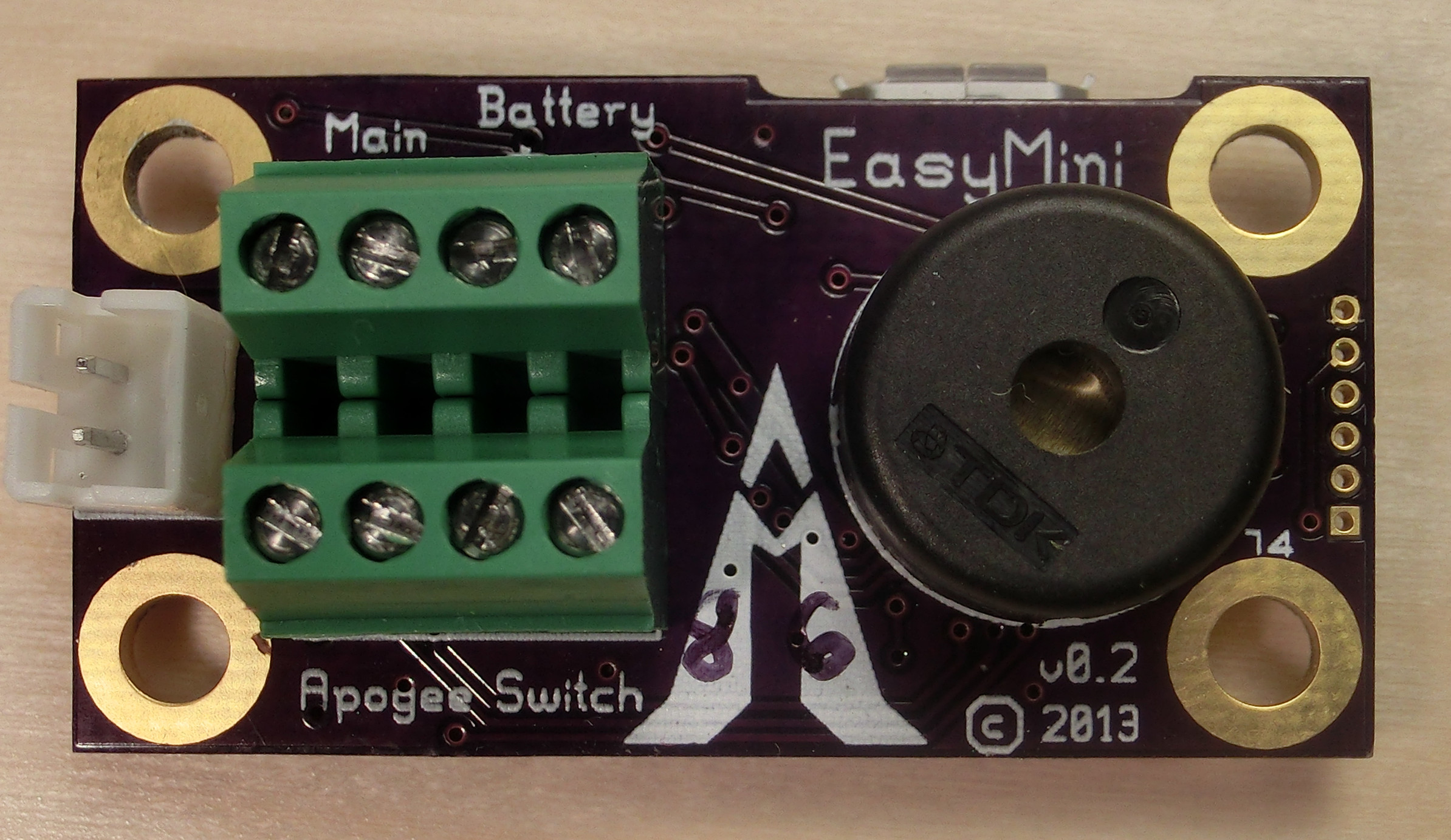
Back on Black (Friday) Event Altus Metrum is pleased to announce our Back on Black (Friday) event! For the first time since the Black Forest fire in June, we re re-opening our web store this weekend with a host of new and classic Altus Metrum products, including a special pre-order discount on our latest-and-greatest flight computer design, TeleMega. This weekend only, Friday, 29 November 2013 through Monday, 2 December, 2013, the first 40 TeleMega direct orders placed through our web store will receive a special $50 pre-order discount (regular $400, now only $350!). TeleMega is an advanced flight computer with 9-axis IMU, 6 pyro channels, uBlox Max 7Q GPS and 40mW telemetry system. We designed TeleMega to be the ideal flight computer for sustainers and other complex projects. TeleMega production is currently in process, and we expect to be ready to ship in mid-December. Pre-order now and we won t charge you until we ship. Learn more about TeleMega at: http://altusmetrum.org/TeleMega/ We are also pleased to announce that TeleBT is back in stock. Priced at $150, TeleBT is our latest ground station that connects to your laptop over USB or your Android device over BlueTooth. Learn more about TeleBT at http://altusmetrum.org/TeleBT/ Another new product we re thrilled to announce is EasyMini! Priced at only $80, EasyMini is a two-channel flight computer with built-in data logging and USB data download. Like our more advanced flight computers, EasyMini is loaded with sophisticated electronics and firmware, designed to be very simple to use yet capable enough for high performance airframes. Perfect as a first flight computer, EasyMini is also great as a backup deployment controller in complext projects. Learn more about EasyMini at: http://altusmetrum.org/EasyMini/ Also in stock for immediate shipment is MicroPeak, our 1.9 gram recording altimeter available for $50. The MicroPeak USB adapter, also $50, has been improved to make data downloading a snap. Read more about these at: http://altusmetrum.org/MicroPeak http://altusmetrum.org/MicroPeakUSB You can learn more about these and all our other Altus Metrum products at http://altusmetrum.org. The special discount on TeleMega pre-orders is available only on orders placed directly through Bdale s web store at http://shop.gag.com Thank you all for your support of Altus Metrum during 2013. It s been a rough year, but we re having a great time updating our existing products and designing new stuff! We look forward to returning products like TeleMetrum and TeleMini to the market soon, and plan to introduce even more new products soon.
Axel Beckert: PDiffs are still useful

probably just not as default. I do agree with Richi and with Michael that disabling PDiffs by default gives the big majority of Debian Testing or Unstable users a speedier package list update. I m though not sure, if disabling PDiffs by default would Additionally I want to remind you that PDiffs per se are nothing bad and should be continued to be supported: So yes, disabling PDiffs by default is probably ok, but the feature must be kept available for those who haven t 100 MBit/s fibre connection into their homes or are sitting just one hop away from the next Debian mirror (like me at work :-). Oh, and btw., for the very same reasons I m also a big fan of debdelta which is approximately the same as PDiffs, just not for package lists but for binary packages. Using debdelta I was able to speed up my download rates over EDGE to up to virtual 100 kB/s, i.e. by factor four (depending on the packages). Just imagine a LibreOffice minor update at 15 kB/s average download rate. ;-) And all these experiences were not made with a high-performance CPU but with the approximately 5 year old Intel Atom processor of my ASUS EeePC 900A. So I used PDiffs and debdelta even despite having a slight performance penalty on applying the diffs and deltas.

28 November 2013

Dirk Eddelbuettel: RcppCNPy 0.2.1

Version 0.2.1 of RcppCNPy is now on CRAN earlier. This version is a minor upgrade with a few small changes as detailed in the NEWS file:
Changes in version 0.2.1 (2013-11-28)
  • Synchronized code with the cnpy repository
  • Added new function to test from R whether integers supported
  • Updated tests for integer support, if available
  • Updated vignette and discussion about need for rebuilding only RcppCNPy with the -std=c++11 flag if integer support is desired
  • Updated tests for integer support, if available
  • Updated THANKS file
  • Ensure that inclusion of Rinternal.h does not affect other headers by adding RF_NO_REMAP
CRANberries also provides a diffstat report for 0.2.1 relative to 0.2.0. As always, feedback is welcome and the rcpp-devel mailing list off the R-Forge page for Rcpp is the best place to start a discussion.

This post by Dirk Eddelbuettel originated on his Thinking inside the box blog. Please report excessive re-aggregation in third-party for-profit settings.

Craig Small: XBMC with MythTv

I have had MythTV running on my server for quite some time. Once I got past the weird problems you often have with the local ABC channel, it has worked very well. One tip, put the recordings into their own partition. MythTV will happily fill it and deleting files only marks them for deletion. This makes perfect sense when it has its own partition but is annoying otherwise. Until recently, the frontend on the television in the living room was a DVD player that spoke DLNA. This worked ok, but was very basic. The recordings were just a list with no graphics or details. Something better had to go here and it has; XBMC. A small (size of a paperback) PC later and we have XBMC running and doesn t it look pretty! The cute thing was it merged my DVD images and my recordings into one, so it didn t matter where the movie came from, it looks the same. It even understands MythTV advertising marks and skips them, all is good. Except, no sound. This is where a combination of my Google skills and XBMC s documentation failed. The documentation either says switch to HDMI output or go through a very long and involved process to get the sound card working. The tests on the command line failed and I thought I was going to be in for that long and involved process fixing alsa. Then in another part of the menus I saw you had Basic, Advanced, Expert levels and wondered what that did? It gave me more things to tweak in the menus. Perhaps that might fix my HDMI sound problem? Going into the System setup and then audio and then switching to a higher level of menu (it s on the left) suddenly I have a screen and a half of options and a few seconds later, sound! So if you are searching for NVIDIA and HDMI and sound, first turn on the advanced menu items and try setting that, it might be all you need (despite what Google and documentation says). One other thing, the C or I button on a remote could be called Guide . It is on mine. Also, SMB shares give a much better result than DLNA ones because SMB all the images and info are done on XBMC and it doesn t do the same for DLNA.

Next.

Previous.