Raphaël Hertzog: People Behind Debian: Steve McIntyre, debian-cd maintainer, former Debian Project Leader

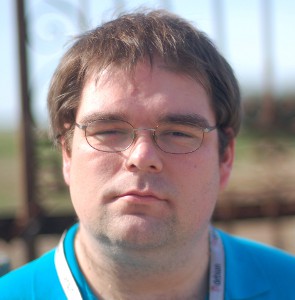 Steve McIntyre has been contributing to Debian since 1996, 2 years before I joined! But I quickly stumbled upon Steve: in 1999, he was struggling with getting his debian-cd script to produce 2 ISO images (it was the first time that Debian did no longer fit on a single CD), I helped him by rewriting debian-cd with a robust system to split packages on as many ISO images as required.
I remember those times very well because Steve was very supportive of my efforts and it was a real pleasure to get this done. His friendly nature probably also explains why he got elected Debian Project Leader twice!
Anyway, enough history, check out his interview to learn more about the great work he s doing nowadays. My questions are in bold, the rest is by Steve.
Raphael: Who are you?
Steve: I m a professional software engineer, 37, living in Cambridge
(England) with my new wife Jo. I studied for the EIST degree at the
University of Cambridge, then (like many people here, it seems) I just
forgot to go home again afterwards and settled here. I spent more of
my study time playing with Linux than working on my degree, so I
guess I m lucky that it worked and I found a career in that area!
Raphael: How did you start contributing to Debian?
Steve: During my time in college, I started hacking on software in my free
time, using Slackware as my first Linux distribution from the middle
of 1994. After encountering more and more problems with Slackware, I
was encouraged by a number of friends to make the jump over to Debian
and in October 1996 I did. The installation process back then was
much harder than anything people see today, but after
a long weekend I finally had my Debian system up and running.
I was already one of the main upstream developers for the Mikmod music
player at that time, so that very same weekend I applied to be a DD so
I could maintain it in Debian too. Back then, the NM process was much
simpler: I just mailed a key to Bruce and he set me up with an account
almost immediately!
I then found that Joey Hess had beaten me to it and already packaged Mikmod. Grrr!
 Raphael: What s your biggest achievement within Debian?
Steve: Without a doubt, my proudest achievement within Debian is being
elected Project Leader for 2 years by the other developers. It s a
great feeling to have earned the trust of your friends and peers, and
also a great responsibility to go and help Debian where needed:
talking to the press about Debian, assisting wherever problems crop
up, etc. The DPL job is certainly a lot of hard work, and I have
nothing but respect for anybody who volunteers for it.
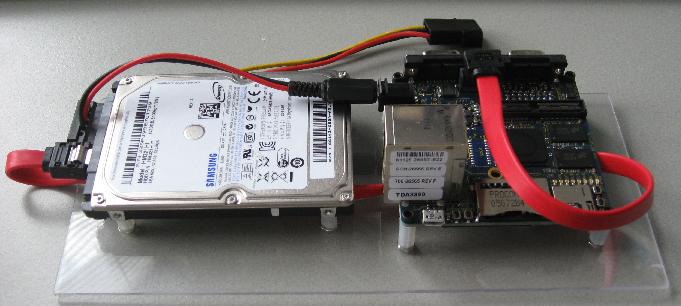
It s a great feeling to have earned the trust of your friends and peers.Elsewhere, I ve been leading the Debian CD team for years too, both doing most of the maintenance of the debian-cd package and producing and testing the regular installation CDs and DVDs that we ship to the world. Again, this is a time-consuming job but it needs doing and it s worthwhile. Raphael: You re currently employed by ARM. What are you working on and are they supportive of your Debian involvement? Steve: The situation within ARM is very interesting; I m employed in PDSW (Processor Division, SoftWare), a new group founded just a couple of years back to help improve the state of software on ARM. Most of the people in the group are working on Free Software at this stage (e.g. toolchains, browsers, Linux kernel), which is lovely. Some of the engineers have also been seconded into a new non-profit company Linaro, which is a collaboration between ARM and a number of other companies investing in core Linux software and tools for ARM-based CPUs. I m one of the ARM engineers in Linaro, and I m a Technical Architect in the Office of the CTO. My role includes looking at future projects for Linaro to help with (e.g. ARM servers), but for the last few months I ve been concentrating on the new armhf architecture in Debian, Ubuntu and elsewhere. armhf is a new architecture in Debian and Ubuntu terms, but it s not strictly a new type of hardware. Instead, it s a new ABI. We have two reasons for doing this work:
- It targets the latest version of 32-bit ARM CPUs (v7) and makes better use of the hardware, for better performance. Compare targetting i686 instead of i386, for example. We ll still support the older armel port for the foreseeable future for users with older hardware that can t run armhf.
- More importantly: we are standardising on the ABI / compiler options / hardware support for future users.
Raphael: What are your plans for Debian Wheezy?
Steve: There are three main tracks here.
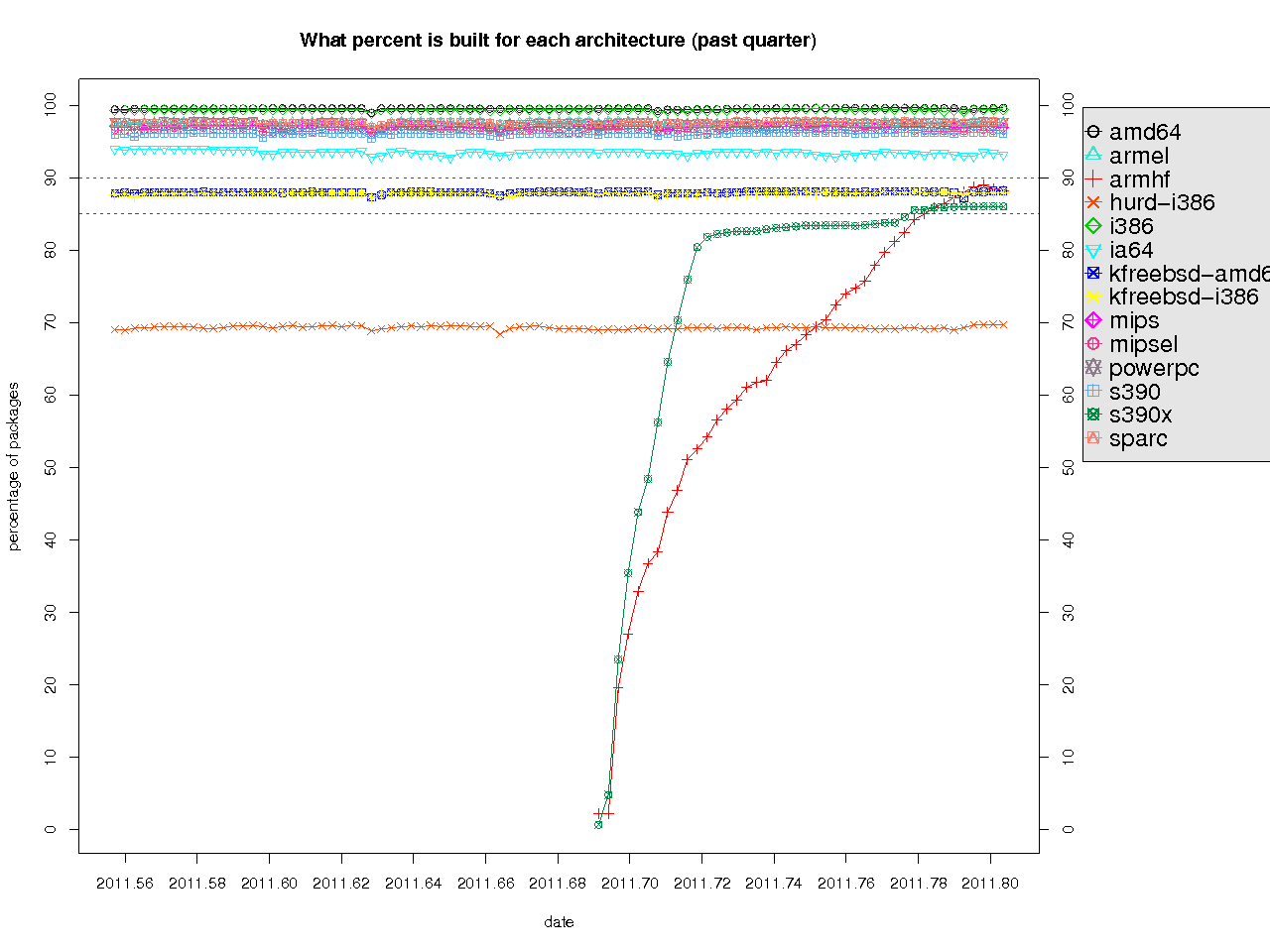
Obviously, I m interested in seeing armhf release with Wheezy. We ve
just been added to Testing last weekend, so that s going well. We ve
got over 90% of the archive built now, and we re mopping up the
remaining issues.
I m the primary maintainer of cdrkit at this point, but I d prefer to
have it go away. Xorriso and the associated software in libisoburn is
almost capable of replacing all the aging cdrtools-derived software
that we have in Debian, The only missing feature that I m aware of is
creating the HFS hybrid filesystems that we use for installations on
Mac systems. I ve been talking with the upstream folks about this for
some time already, and I m hoping we can finish this soon enough that
we can get it into Wheezy.
Finally, I ve got the ever-growing wishlist of things for debian-cd.
We ve got the beginnings of an automated test suite that Mart n
Ferrari has written, but it needs integrating and improving. I want to
help get regular weekly/daily/release debian-live builds running on
the main CD build machine. There s work needed if we want to make good
installation media for the new multi-arch world, too. The Emdebian
people are asking for help making CD images The list goes on
Raphael: The ARM community seems to be very interested in multi-arch. Can you explain why?
Steve: There are a number of reasons for ARM people to be interested in multi-arch; two really stand out for me:
- With the historical issues around the plethora of ARM ABIs in the wild, multi-arch will allow us to potentially support multiple ABIs cleanly on one system. That allows users to have (for example) an up-to-date system that makes the most of their current hardware, yet also run legacy programs that might use an older ABI. There s also a new 64-bit architecture coming (ARMv8) which will run older 32-bit software; again, multi-arch makes mixed installation of old and new software reasonable.
- ARM has traditionally been a common target for cross-compilation, and I d expect that to remain the case for a long time to come yet. For a lot of embedded developers, using a big fast i386/amd64 machine to compile is much faster than using a limited-power small ARM CPU. However, setting up sane cross-compilation environments has long been a bugbear for developers. Getting the toolchain and all the cross-architecture libraries to work together correctly can be like black magic. This is potentially the killer app for multi-arch: simply install the libraries for the target architecture directly on your development machine. Install a simple cross-gcc package and (maybe) qemu, and you re all set.
This is potentially the killer app for multi-arch: simply install the libraries for the target architecture [ ], install a simple cross-gcc package [ ] and you re all set.Raphael: What s the biggest problem of Debian? Steve: For me, Debian s biggest problem has been the same for a long time: we are forever short of enough people to do the work that we re trying to do. That might sound like a weird thing to claim when Debian is one of the largest Free Software projects on the planet, but it s more a statement of just how huge our goals are. Many of the largest things in Debian are developed or controlled by very small teams working very hard, and there s always a risk of losing people due to burnout in those situations.
We are forever short of enough people to do the work that we re trying to do.Some of the tasks that should be easy given our large membership (e.g. large-scale packaging transitions) can often instead take a very long time. We are fortunate to have more people wanting to join in Debian s work all the time, but we also need to be careful to keep on promoting what we re doing and recruiting new contributors, encouraging them to get more and more involved in core work. Debian gets ever bigger in terms of the size and the number of packages we distribute; we re not currently matching that growth rate elsewhere. Raphael: What motivates you to continue to contribute year after year? Steve: This one is much easier to answer! The thing that first attracted me to Debian was the fact that I could help to develop it, help to decide how things could and should be done within it. Instead of being forced to accept what some corporation decided I could do with my computer, I could change the software to suit my needs and preferences. Alongside that, I could get involved with a strong community of similar people all over the world, all with their own strong opinions about how software should work. I joined in and found it was great fun and very rewarding. That hasn t changed for me in the intervening years, and that s why I m still around. I work on Debian because it helps me to get the OS that I want to use. It seems that lots of people around the world find it useful too, and that s awesome.
Raphael: Do you believe that Stefano Zacchiroli will be the first DPL who managed to stay 3 consecutive years on the seat? Would you like him to candidate again?
Steve: To be honest, I would be very surprised if Zack stood again for DPL
this year. He told me himself that he wasn t planning on it, and I can
understand that decision. He s been an awesome DPL in my opinion, and
I m glad that he took the job. But: it is also a very difficult and
time-consuming task that would be enough to wear down anybody. If Zack
does decide to stand again, I would support him 100%. But I know that
we also have lots of other good people in Debian who would be ready to
take up the challenge next.
Raphael: Is there someone in Debian that you admire for their contributions?
Steve: There are lots of people I admire in Debian, so many so that I almost don t want to list individuals here for fear of missing people out. But
Bdale Garbee has been an inspiration to many of us, for many
years. He s technically excellent, a great friend to many of us, an
endless source of sage advice and (last but not least) he has some
wonderful stories to tell about his experiences over the years. On top
of that, he s just cool.
Christian Perrier is another exceptional developer, in my eyes he s
great at co-ordinating people in translations, working tirelessly to
make this very important part of Debian work better and better with
every release. He s also a really nice guy and we all love him.
I also have to mention Joey Hess here, whether he likes it or
not. *grin* He s been responsible for so many good things in Debian
over the years, even if he did steal my first package
Finally, the teams of people who make sure that Debian is
always working: the security team and DSA. The rest
of us can choose to take time off from Debian to go and do other
things, but these people need to cover things every day. That s a
major responsibility, and I salute them for taking on that challenge.
Thank you to Steve for the time spent answering my questions. I hope you enjoyed reading his answers as I did. Note that you can find older interviews on http://wiki.debian.org/PeopleBehindDebian.
Subscribe to my newsletter to get my monthly summary of the Debian/Ubuntu news and to not miss further interviews. You can also follow along on Identi.ca, Google+, Twitter and Facebook.
One comment Liked this article? Click here. My blog is Flattr-enabled.
 The
 So, in 2002 I attended my first

 I've just finished reading Graham Joyce's haunting

 Current status
Back in September,
I
 [0] There is perfectly valid reason for doing that.
I might get back to that in a later post.
[1] One in unstable, testing, testing-proposed-updates and proposed-updates. The latter may seem a bit weird, but [0]
[2] This is the rule that prune relations like the one in the dpkg Breaks-field.
Edit: 2011-01/09, clarified that we have at most 4 versions per architecture.



 It took me much more uploads than I expected, but
 By now hopefully you got a chance to see my Jeopardy! episode so it won't be much of a spoiler to mention that I didn't win.
It went like this. I flew into LA on the night of October 31st. The taping was to take place on the next two days. Jeopardy! tapes two weeks of shows, two days a week for a total of 10 episodes. Contestants are randomly chosen for one of those 10 episodes but you don't find out which one you will be on until the last minute. Randomness and secrecy have become become a big part of the production process in games since the
 A bit over a year ago, I
 I use


 I started this blog over a decade ago. Over time, my priorities have changed family, work, home, etc. Many other avenues for online self-expression have also developed in the interim. I m done for now. Old entries remain online, but do not necessarily reflect any of my current views, and certainly do not reflect any views of any of my employers.