Search Results: "ads"

12 February 2017

Dirk Eddelbuettel: Letting Travis keep a secret

More and more packages, be it for R or another language, are now interfacing different application programming interfaces (API) which are exposed to the web. And many of these may require an API key, or token, or account and password. Which traditionally poses a problem in automated tests such as those running on the popular Travis CI service which integrates so well with GitHub. A case in point is the RPushbullet package where Seth Wenchel and I have been making a few recent changes and additions. And yesterday morning, I finally looked more closely into providing Travis CI with the required API key so that we could in fact run continuous integration with unit tests following each commit. And it turns that it is both easy and quick to do, and yet another great showcase for ad-hoc Docker use. The rest of this post will give a quick minimal run-down, this time using the gtrendsR package by Philippe Massicotte and myself. Start by glancing at the 'encrypting files' HOWTO from Travis itself. We assume you have Docker installed, and a suitable base package. We will need Ruby, so any base Linux image will do. In what follows, I use Ubuntu 14.04 but many other Debian, Ubunti, Fedora, ... flavours could be used provided you know how to pick the relevant packages. What is shown here should work on any recent Debian or Ubuntu flavour 'as is'. We start by firing off the Docker engine in the repo directory for which we want to create an encrypted file. The -v $(pwd):/mnt switch mounts the current directory as /mnt in the Docker instance:
edd@max:~/git/gtrendsr(master)$ docker run --rm -ti -v $(pwd):/mnt ubuntu:trusty
root@38b478356439:/# apt-get update    ## this takes a minute or two
Ign http://archive.ubuntu.com trusty InRelease
Get:1 http://archive.ubuntu.com trusty-updates InRelease [65.9 kB]
Get:2 http://archive.ubuntu.com trusty-security InRelease [65.9 kB]
# ... a dozen+ lines omitted ...
Get:21 http://archive.ubuntu.com trusty/restricted amd64 Packages [16.0 kB]    
Get:22 http://archive.ubuntu.com trusty/universe amd64 Packages [7589 kB]      
Fetched 22.4 MB in 6min 40s (55.8 kB/s)                                        
Reading package lists... Done
root@38b478356439:/# 
We then install what is needed to actually install the travis (Ruby) gem, as well as git which is used by it:
root@38b478356439:/# apt-get install -y ruby ruby-dev gem build-essential git
Reading package lists... Done
Building dependency tree       
Reading state information... Done
The following extra packages will be installed:
# ... lot of output ommitted ...
Processing triggers for ureadahead (0.100.0-16) ...
Processing triggers for sgml-base (1.26+nmu4ubuntu1) ...
root@38b478356439:/# 
This too may take a few minutes, depending on the networking bandwidth and other factors, and should in general succeed without the need for any intervention. Once it has concluded, we can use the now-complete infrastructure to install the travis command-line client:
root@38b478356439:/# gem install travis
Fetching: multipart-post-2.0.0.gem (100%)
Fetching: faraday-0.11.0.gem (100%)
Fetching: faraday_middleware-0.11.0.1.gem (100%)
Fetching: highline-1.7.8.gem (100%)
Fetching: backports-3.6.8.gem (100%)
Fetching: multi_json-1.12.1.gem (100%
# ... many lines omitted ...
Installing RDoc documentation for websocket-1.2.4...
Installing RDoc documentation for json-2.0.3...
Installing RDoc documentation for pusher-client-0.6.2...
Installing RDoc documentation for travis-1.8.6...
root@38b478356439:/#                        
This in turn will take a moment. Once done, we can use the travis client to login into GitHub. In my base this requires a password and a two-factor authentication code. Also note that we switch directories first to be in the actual repo we had mounted when launching docker.
root@38b478356439:/# cd /mnt/    ## change to repo directory
root@38b478356439:/mnt# travis --login
Shell completion not installed. Would you like to install it now?  y  y
We need your GitHub login to identify you.
This information will not be sent to Travis CI, only to api.github.com.
The password will not be displayed.
Try running with --github-token or --auto if you don't want to enter your password anyway.
Username: eddelbuettel
Password for eddelbuettel: ****************
Two-factor authentication code for eddelbuettel: xxxxxx
Successfully logged in as eddelbuettel!
root@38b478356439:/mnt# 
Now the actual work of encrypting. For this particular package, we need a file .Rprofile containing a short option() segment setting a user-id and password:
root@38b478356439:/mnt# travis encrypt-file .Rprofile
Detected repository as PMassicotte/gtrendsR, is this correct?  yes  
encrypting .Rprofile for PMassicotte/gtrendsR
storing result as .Rprofile.enc
storing secure env variables for decryption
Please add the following to your build script (before_install stage in your .travis.yml, for instance):
    openssl aes-256-cbc -K $encrypted_988d19a907a0_key -iv $encrypted_988d19a907a0_iv -in .Rprofile.enc -out .Rprofile -d
Pro Tip: You can add it automatically by running with --add.
Make sure to add .Rprofile.enc to the git repository.
Make sure not to add .Rprofile to the git repository.
Commit all changes to your .travis.yml.
root@38b478356439:/mnt#
That's it. Now we just need to follow-through as indicated, committing the .Rprofile.enc file, making sure to not commit its input file .Rprofile, and adding the proper openssl invocation with the keys known only to Travis to the file .travis.yml.

Iustin Pop: Fine art printing at home

Fine art printing at home It is very interesting how people change over time. Way back in the analog film era, I was using a very cheap camera, and getting the film developed and pictures printed at random places in town. As the movement towards digital began, I started dreaming of a full digital workflow take picture, download from camera, enjoy on your monitor. No more pesky physical stuff. And when I finally got a digital camera, I was oh-so-happy to finally get rid of films and prints. But time passes, and a few years back though, at the end of 2013, I had the misfortune to learn on various photography forums that, within certain limits, one can do high quality printing at home quality high enough for serious prints. I always imagined that "serious" prints can only happen on big, professional stuff, but to my surprise, what I was reading was that many professional photographers can do their prints themselves (for certain paper sizes). I tried before printing photos on my laser printer that I wrote about, but that is a hilarious exercise, nothing more. Thinking process was pretty simple: So I decided to get a photo printer. Because hey, one more printer was the thing I was missing the most. Ink The think with inkjet photo printers is that the bigger they are, the more cheaper the ink is, and the more optimised they are for large volume printing. The more optimisation for large volume, the worse the printers do if you don't print often enough, in the sense of dried ink. This means clogged heads, and each of the serious printer manufacturers (Canon, Epson, HP) deal in different ways with it; some by having extra, spare lines in the print head that replace the clogged ones, others have replaceable printer heads, others rely on wasting ink by trying to flush the ink lines, etc. Also within each manufacturer's lines, different printers behave differently. So one must take this into account how often will you print? Of course I thought very often, but the truth is, this is just another hobby, so time is lacking, and I have weeks going by without turning the printer on. And so, I did have some problems with dried ink, but minor I'd say; I only had once to run a "power cleaning", when due to real world I didn't have time to turn the printer on for months; I managed to choose a good printer in this regard. I never though computed how much ink I wasted with cleaning the heads Paper Another issue with printing is the fact that the result is a physical object, outside of the digital realm. And the transition from digital to physical is tricky. First, the printer itself and the ink are one relatively straightforward choice: decide (by whatever criteria you want) on the printer, and most printers at this level have one set of inks only. But the problem is: which paper? And as I learned, since how the paper looks is a subjective thing, this is an endless topic As you can see, this is really a bottomless pit. I made the mistake of buying lots of sample packs, thinking that settling on a specific paper will be an objective process, but no. Three years later, I have a few favourite papers, but I'm sure I could have almost randomly chosen them (read 3 reviews, choose) and not gotten objectively different results. ICC profiles and processing Another thing is that simply having the printer and the paper doesn't mean everything is fixed. Since printers are analog devices, there needs to be a printer and paper specific colour profile, so that you get (on paper) what you see on the screen (which also needs to be calibrated). So when choosing the printer you should be careful to choose one which is common enough that it has profiles, ideally profiles done by the paper manufacturer themselves. Or, you can go the more basic route, and calibrate the printer/paper combination yourself! I skipped that part though. However you get a profile, if you tell your photo processing application what is your display profile and your printer+paper profile, ideally you what you see is what you get, this time for real. Except that sometimes the gamut of colours in the picture can't be represented entirely in either the display nor the printer profile, so the display is an approximation, but a different one than your printer will do on paper. So you learn about relative and perceptual colorimetric conversions, and you read many blog posts about which one to use for what type of pictures (portraits have different needs than landscapes), and you wonder why did you chose this hobby? Of course, you can somewhat avoid the previous two issues by going more old-school to black and white printing. This should be simple, right? Black and white, nothing more. Hah, you wish. Do you do the B&W conversion in your photo processing application, or in your printer? Some printers are renowned by their good B&W conversions, some not. If you print B&W, then the choice of papers also change, because some papers are just awesome at B&W, but only so-so for colours. So says the internet, at least. But even if you solve all of the above, don't give up just yet, because there is still a little problem. Even if you send the right colours to the printer, the way a certain picture looks on paper is different than on screen. This circles somewhat back to paper choice (glossy type ink having deeper blacks than matte, for example) and colour-vs-b&w, but is a general issue: displays have better contrasts than paper (this doesn't mean the pictures are better looking on screen though). So you use the soft-proofing function, but it looks completely weird, and you learn that you need to learn how specific papers will differ from screen, and that sometimes you don't need any adjustment, sometimes you need a +15, which might mean another run of the same print. You print, then what? So you print. Nice, high quality print. All colours perfect! And then what? First, you wait. Because ink, as opposed to laser toner, is not "done" once the paper is out of the printer. It has to dry, which is a process taking about 24 hours in its initial phase, and which you help along by doing some stuff. The ink settles during this time in the paper, and only after that you know what the final look of the print will be. Depending on what you plan to do with the print, you might want to lay a layer of protective stuff on top of it; a kind of protective film that will keep it in better shape over time, but which has the downside that a) it must definitely be applied after the ink has dried and the the paper has for sure finished outgassing and b) it's a semi-hard layer, so you can roll the paper anymore (if you were planning to do that for transport). Or you say damn it, this is anyway a poor picture So with the print all good and really in its final state, you go on and research what solutions are there for hanging prints at home. And look at frames, and think about behind-glass framing or no glass-framing, and and and and you realise that if you just printed your photos at a lab, they'd come directly framed! I still have the really minimalist hanging solution that I bought a year ago unpacked Getting there, sometime! Costs/economic sense If you think all this effort is done in order to save money on prints, the answer is "Ha ha ha" While professional prints at a lab are expensive, how much do you think all the above (printer, inks, paper, framing, TIME) costs? A lot. It's definitely not worth unless your day job is photography. No, for me it was more the desire to own the photographic process from start to end: learn enough to be able to choose everything (camera which implies sensor which implies a lot of things, lens, post-processing, printer/ink, paper), and see (and have) the end result of your work in your hands. Is it worth all the trouble? Fast forward three years later, I still have the printer, although many times I was thinking of getting rid of it. It takes space, it costs some money (although you don't realise this as you print, since you already sunk the money in consumables), it takes time. Being able to print small photos for family (e.g. 10 15) is neat, but a small printer can do this as well, or you can order prints online, or print them from a memory card at many places. Being able to print A4-size (for which framing for e.g. desk-use is a pain) is also neat, but here there are still simpler solutions than your own big printer. The difference is when you print large. You look at the picture on your big screen, you think/imagine how it will look printer, and then you fire an A2 print. The printer starts, makes noises for about 10 minutes, and then you have the picture in your hands. The ink is still fresh (you know it takes 24 hours to settle), and has that nice ink smell that you don't get anymore in day to day life. With a good paper and a good printer, the way the picture looks is so special, that all the effort seems trivial now. I don't know how looking at pictures on an 8K 30+ inch monitor will be; but there's an indescribable difference between back-lighted LCD and paper for the same picture. Even at the same relative size, the paper is real, while the picture is virtual. You look at the people in the picture on your display, whereas the people in the print look at you. Maybe this is just size. A2 is bigger than my monitor wait, no. A2 has a diagonal of ~29 inches (vs. the display at 30"). Maybe it's resolution? An A2 print out of D810 is small enough to still have good resolution (it's about 320dpi after the small cropping needed for correcting the aspect ratio, which matches the printer's native 360dpi resolution). Coupled with a good printer, it's more than high enough resolution that even with a loupe, there's enough detail in the picture to not see its "digital" history (i.e. no rasterization, no gradients, etc.) Note that 360dpi for photo inkjet printers is much different from 600-1200dpi for laser printers (which are raster-based, not ink droplet based, so it's really not comparable). In any case, the print, even at this (relatively large) size, feels like a reflection of reality. On the monitor, it still feels like a digital picture. I could take a picture of the print to show you, but that would defeat the point, wouldn't it And this is what prompted this blog post. I had a pretty intense week at work, so when the weekend came, I was thinking what to do to disconnect and relax. I had a certain picture (people, group photo) that I wanted to print for a while, and it was OK on the screen, but not special. I said, somewhat not very enthusiastic, let's print it. And as the printer was slowly churning along, and the paper was coming out, I remembered why I don't get rid of the printer. Because every time I think about doing that, I say to myself "let's do one more print", which quickly turns into "wow, not, I'm keeping it". Because, even as our life migrates into the digital/virtual realm or maybe more so we're still living in the real world, and our eyes like to look at real objects. And hey, on top of that, it was and still is a pretty intense learning experience!

11 February 2017

Reproducible builds folks: Reproducible Builds: week 93 in Stretch cycle

Here's what happened in the Reproducible Builds effort between Sunday January 29 and Saturday February 4 2017: Media coverage Dennis Gilmore and Holger Levsen presented "Reproducible Builds and Fedora" (Video, Slides) at Devconf.cz on February 27th 2017. On February 1st, stretch/armhf reached 90% reproducible packages in our test framework, so that now all four tested architectures are 90% reproducible in stretch. Yay! For armhf this means 22472 reproducible source packages (in main); for amd64, arm64 and i386 these figures are 23363, 23062 and 22607 respectively. Chris Lamb appeared on the Changelog podcast to talk about reproducible builds: Holger Levsen pitched Reproducible Builds and our need for a logo in the "Open Source Design" room at FOSDEM 2017 (Video, 09:36 - 12:00). Upcoming Events Reproducible work in other projects We learned that the "slightly more secure" Heads firmware (a Coreboot payload) is now reproducibly built regardless of host system or build directory. A picture says more than a thousand words: reproducible heads build on two machines Docker started preliminary work on making image builds reproducible. Toolchain development and fixes Ximin Luo continued to write code and test cases for the BUILD_PATH_PREFIX_MAP environment variable. He also did extensive research on cross-platform and cross-language issues with enviroment variables, filesystem paths, and character encodings, and started preparing a draft specification document to describe all of this. Chris Lamb asked CPython to implement an environment variable PYTHONREVERSEDICTKEYORDER to add an an option to reverse iteration order of items in a dict. However this was rejected because they are planning to formally fix this order in the next language version. Bernhard Wiedemann and Florian Festi added support for our SOURCE_DATE_EPOCH environment variable, to the RPM Package Manager. James McCoy uploaded devscripts 2.17.1 with a change from Guillem Jover for dscverify(1), adding support for .buildinfo files. (Closes: #852801) Piotr O arowski uploaded dh-python 2.20170125 with a change from Chris Lamb for a patch to fix #835805. Chris Lamb added documentation to diffoscope, strip-nondeterminism, disorderfs, reprotest and trydiffoscope about uploading signed tarballs when releasing. He also added a link to these on our website's tools page. Packages reviewed and bugs filed Bugs filed: Reviews of unreproducible packages 83 package reviews have been added, 86 have been updated and 276 have been removed in this week, adding to our knowledge about identified issues. 2 issue types have been updated: Weekly QA work During our reproducibility testing, the following FTBFS bugs have been detected and reported by: diffoscope development Work on the next version (71) continued in git this week: reproducible-website development Daniel Shahaf added more notes on our "How to chair a meeting" document. tests.reproducible-builds.org Holger unblacklisted pspp and tiledarray. If you think further packages should also be unblacklisted (possibly only on some architectures), please tell us. Misc. This week's edition was written by Ximin Luo, Holger Levsen and Chris Lamb & reviewed by a bunch of Reproducible Builds folks on IRC & the mailing lists.

10 February 2017

Rhonda D'Vine: Anouk

I need music to be more productive. Sitting in an open workspace it helps to shut off outside noice too. And often enough I just turn cmus into shuffle mode and let it play what comes along. Yesterday I just stumbled upon a singer again that I fell in love with her voice a long time ago. This is about Anouk. The song was on a compilation series that I followed because it so easily brought great groups to my attention in a genre that I simply love. It was called "Crossing All Over!" and featured several groups that I digged further into and still love to listen to. Anyway, don't want to delay the songs for you any longer, so here they are: Like always, enjoy!

/music permanent link Comments: 0 Flattr this

Dirk Eddelbuettel: anytime 0.2.1

An updated anytime package arrived at CRAN yesterday. This is release number nine, and the first with a little gap to the prior release on Christmas Eve as the features are stabilizing, as is the implementation. anytime is a very focused package aiming to do just one thing really well: to convert anything in integer, numeric, character, factor, ordered, ... format to either POSIXct or Date objects -- and to do so without requiring a format string. See the anytime page, or the GitHub README.md for a few examples. This releases addresses two small things related to the anydate() and utcdate() conversion (see below) and adds one nice new format, besides some internal changes detailed below:
R> library(anytime)
R> anytime("Thu Sep 01 10:11:12 CDT 2016")
[1] "2016-09-01 10:11:12 CDT"
R> anytime("Thu Sep 01 10:11:12.123456 CDT 2016") # with frac. seconds
[1] "2016-09-01 10:11:12.123456 CDT"
R> 
Of course, all commands are also fully vectorised. See the anytime page, or the GitHub README.md for more examples.

Changes in anytime version 0.2.1 (2017-02-09)
  • The new DatetimeVector class from Rcpp is now used, and proper versioned Depends: have been added (#43)
  • The anydate and utcdate functions convert again from factor and ordered (#46 closing #44)
  • A format similar to RFC 28122 but with additonal timezone text can now be parsed (#48 closing #47)
  • Conversion from POSIXt to Date now also respect the timezone (#50 closing #49)
  • The internal .onLoad functions was updated
  • The Travis setup uses https to fetch the run script

Courtesy of CRANberries, there is a comparison to the previous release. More information is on the anytime page. For questions or comments use the issue tracker off the GitHub repo.

This post by Dirk Eddelbuettel originated on his Thinking inside the box blog. Please report excessive re-aggregation in third-party for-profit settings.

9 February 2017

Charles Plessy: Beware of libinput 1.6.0-1

Since I updated this evening, touch to click with my touchpad is almost totally broken. Fortunately, a correction is pending. update: To reinstall packages version 1.5.5-4 solves the problem in the meantime.

Vincent Bernat: Integration of a Go service with systemd

Unlike other programming languages, Go s runtime doesn t provide a way to reliably daemonize a service. A system daemon has to supply this functionality. Most distributions ship systemd which would fit the bill. A correct integration with systemd is quite straightforward. There are two interesting aspects: readiness & liveness. As an example, we will daemonize this service whose goal is to answer requests with nifty 404 errors:
package main
import (
    "log"
    "net"
    "net/http"
)
func main()  
    l, err := net.Listen("tcp", ":8081")
    if err != nil  
        log.Panicf("cannot listen: %s", err)
     
    http.Serve(l, nil)
 
You can build it with go build 404.go. Here is the service file, 404.service1:
[Unit]
Description=404 micro-service
[Service]
Type=notify
ExecStart=/usr/bin/404
WatchdogSec=30s
Restart=on-failure
[Install]
WantedBy=multi-user.target

Readiness The classic way for an Unix daemon to signal its readiness is to daemonize. Technically, this is done by calling fork(2) twice (which also serves other intents). This is a very common task and the BSD systems, as well as some other C libraries, supply a daemon(3) function for this purpose. Services are expected to daemonize only when they are ready (after reading configuration files and setting up a listening socket, for example). Then, a system can reliably initialize its services with a simple linear script:
syslogd
unbound
ntpd -s
Each daemon can rely on the previous one being ready to do its work. The sequence of actions is the following:
  1. syslogd reads its configuration, activates /dev/log, daemonizes.
  2. unbound reads its configuration, listens on 127.0.0.1:53, daemonizes.
  3. ntpd reads its configuration, connects to NTP peers, waits for clock to be synchronized2, daemonizes.
With systemd, we would use Type=fork in the service file. However, Go s runtime does not support that. Instead, we use Type=notify. In this case, systemd expects the daemon to signal its readiness with a message to an Unix socket. go-systemd package handles the details for us:
package main
import (
    "log"
    "net"
    "net/http"
    "github.com/coreos/go-systemd/daemon"
)
func main()  
    l, err := net.Listen("tcp", ":8081")
    if err != nil  
        log.Panicf("cannot listen: %s", err)
     
    daemon.SdNotify(false, "READY=1") //  
    http.Serve(l, nil)                //  
 
It s important to place the notification after net.Listen() (in ): if the notification was sent earlier, a client would get connection refused when trying to use the service. When a daemon listens to a socket, connections are queued by the kernel until the daemon is able to accept them (in ). If the service is not run through systemd, the added line is a no-op.

Liveness Another interesting feature of systemd is to watch the service and restart it if it happens to crash (thanks to the Restart=on-failure directive). It s also possible to use a watchdog: the service sends watchdog keep-alives at regular interval. If it fails to do so, systemd will restart it. We could insert the following code just before http.Serve() call:
go func()  
    interval, err := daemon.SdWatchdogEnabled(false)
    if err != nil   interval == 0  
        return
     
    for  
        daemon.SdNotify(false, "WATCHDOG=1")
        time.Sleep(interval / 3)
     
 ()
However, this doesn t add much value: the goroutine is unrelated to the core business of the service. If for some reason, the HTTP part gets stuck, the goroutine will happily continue to send keep-alives to systemd. In our example, we can just do a HTTP query before sending the keep-alive. The internal loop can be replaced with this code:
for  
    _, err := http.Get("http://127.0.0.1:8081") //  
    if err == nil  
        daemon.SdNotify(false, "WATCHDOG=1")
     
    time.Sleep(interval / 3)
 
In , we connect to the service to check if it s still working. If we get some kind of answer, we send a watchdog keep-alive. If the service is unavailable or if http.Get() gets stuck, systemd will trigger a restart. There is no universal recipe. However, checks can be split into two groups:
  • Before sending a keep-alive, you execute an active check on the components of your service. The keep-alive is sent only if all checks are successful. The checks can be internal (like in the above example) or external (for example, check with a query to the database).
  • Each component reports its status, telling if it s alive or not. Before sending a keep-alive, you check the reported status of all components (passive check). If some components are late or reported fatal errors, don t send the keep-alive.
If possible, recovery from errors (for example, with a backoff retry) and self-healing (for example, by reestablishing a network connection) is always better, but the watchdog is a good tool to handle the worst cases and avoid too complex recovery logic. For example, if a component doesn t know how to recover from an exceptional condition3, instead of using panic(), it could signal its situation before dying. Another dedicated component could try to resolve the situation by restarting the faulty component. If it fails to reach an healthy state in time, the watchdog timer will trigger and the whole service will be restarted.

  1. Depending on the distribution, this should be installed in /lib/systemd/system or /usr/lib/systemd/system. Check with the output of the command pkg-config systemd --variable=systemdsystemunitdir.
  2. This highly depends on the NTP daemon used. OpenNTPD doesn t wait unless you use the -s option. ISC NTP doesn t either unless you use the --wait-sync option.
  3. An example of an exceptional condition is to reach the limit on the number of file descriptors. Self-healing from this situation is difficult and it s easy to get stuck in a loop.

Dirk Eddelbuettel: RcppArmadillo 0.7.700.0.0

armadillo image Time for another update of RcppArmadillo with a new release 0.7.700.0.0 based on a fresh Armadillo 7.700.0. Following my full reverse-dependency check of 318 package (commit of log here), CRAN took another day to check again. Armadillo is a powerful and expressive C++ template library for linear algebra aiming towards a good balance between speed and ease of use with a syntax deliberately close to a Matlab. RcppArmadillo integrates this library with the R environment and language--and is widely used by (currently) 318 other packages on CRAN -- an increase of 20 just since the last CRAN release of 0.7.600.1.0 in December! Changes in this release relative to the previous CRAN release are as follows:

Changes in RcppArmadillo version 0.7.700.0.0 (2017-02-07)
  • Upgraded to Armadillo release 7.700.0 ("Rogue State")
    • added polyfit() and polyval()
    • added second form of log_det() to directly return the result as a complex number
    • added range() to statistics functions
    • expanded trimatu()/trimatl() and symmatu()/symmatl() to handle sparse matrice

Changes in RcppArmadillo version 0.7.600.2.0 (2017-01-05)
  • Upgraded to Armadillo release 7.600.2 (Coup d'Etat Deluxe)
    • Bug fix to memory allocation for fields

Courtesy of CRANberries, there is a diffstat report. More detailed information is on the RcppArmadillo page. Questions, comments etc should go to the rcpp-devel mailing list off the R-Forge page.

This post by Dirk Eddelbuettel originated on his Thinking inside the box blog. Please report excessive re-aggregation in third-party for-profit settings.

Steve Kemp: Old packages are interesting.

Recently Vincent Bernat wrote about writing his own simple terminal, using vte. That was a fun read, as the sample code built really easily and was functional. At the end of his post he said :
evilvte is quite customizable and can be lightweight. Consider it as a first alternative. Honestly, I don t remember why I didn t pick it.
That set me off looking at evilvte, and it was one of those rare projects which seems to be pretty stable, and also hasn't changed in any recent release of Debian GNU/Linux: I wonder if it would be possible to easily generate a list of packages which have the same revision in multiple distributions? Anyway I had a look at the source, and unfortunately spotted that it didn't entirely handle clicking on hyperlinks terribly well. Clicking on a link would pretty much run:
 firefox '%s'
That meant there was an obvious security problem. It is a great terminal though, and it just goes to show how short, simple, and readable such things can be. I enjoyed looking at the source, and furthermore enjoyed using it. Unfortunately due to a dependency issue it looks like this package will be removed from stretch.

8 February 2017

Steve Kemp: Old packages are interesting.

Recently Vincent Bernat wrote about writing his own simple terminal, using vte. That was a fun read, as the sample code built really easily and was functional. At the end of his post he said :
evilvte is quite customizable and can be lightweight. Consider it as a first alternative. Honestly, I don t remember why I didn t pick it.
That set me off looking at evilvte, and it was one of those rare projects which seems to be pretty stable, and also hasn't changed in any recent release of Debian GNU/Linux: I wonder if it would be possible to easily generate a list of packages which have the same revision in multiple distributions? Anyway I had a look at the source, and unfortunately spotted that it didn't entirely handle clicking on hyperlinks terribly well. Clicking on a link would pretty much run:
 firefox '%s'
That meant there was an obvious security problem. It is a great terminal though, and it just goes to show how short, simple, and readable such things can be. I enjoyed looking at the source, and furthermore enjoyed using it. Unfortunately due to a dependency issue it looks like this package will be removed from stretch.

Antoine Beaupr : Reliably generating good passwords

Passwords are used everywhere in our modern life. Between your email account and your bank card, a lot of critical security infrastructure relies on "something you know", a password. Yet there is little standard documentation on how to generate good passwords. There are some interesting possibilities for doing so; this article will look at what makes a good password and some tools that can be used to generate them. There is growing concern that our dependence on passwords poses a fundamental security flaw. For example, passwords rely on humans, who can be coerced to reveal secret information. Furthermore, passwords are "replayable": if your password is revealed or stolen, anyone can impersonate you to get access to your most critical assets. Therefore, major organizations are trying to move away from single password authentication. Google, for example, is enforcing two factor authentication for its employees and is considering abandoning passwords on phones as well, although we have yet to see that controversial change implemented. Yet passwords are still here and are likely to stick around for a long time until we figure out a better alternative. Note that in this article I use the word "password" instead of "PIN" or "passphrase", which all roughly mean the same thing: a small piece of text that users provide to prove their identity.

What makes a good password? A "good password" may mean different things to different people. I will assert that a good password has the following properties:
  • high entropy: hard to guess for machines
  • transferable: easy to communicate for humans or transfer across various protocols for computers
  • memorable: easy to remember for humans
High entropy means that the password should be unpredictable to an attacker, for all practical purposes. It is tempting (and not uncommon) to choose a password based on something else that you know, but unfortunately those choices are likely to be guessable, no matter how "secret" you believe it is. Yes, with enough effort, an attacker can figure out your birthday, the name of your first lover, your mother's maiden name, where you were last summer, or other secrets people think they have. The only solution here is to use a password randomly generated with enough randomness or "entropy" that brute-forcing the password will be practically infeasible. Considering that a modern off-the-shelf graphics card can guess millions of passwords per second using freely available software like hashcat, the typical requirement of "8 characters" is not considered enough anymore. With proper hardware, a powerful rig can crack such passwords offline within about a day. Even though a recent US National Institute of Standards and Technology (NIST) draft still recommends a minimum of eight characters, we now more often hear recommendations of twelve characters or fourteen characters. A password should also be easily "transferable". Some characters, like & or !, have special meaning on the web or the shell and can wreak havoc when transferred. Certain software also has policies of refusing (or requiring!) some special characters exactly for that reason. Weird characters also make it harder for humans to communicate passwords across voice channels or different cultural backgrounds. In a more extreme example, the popular Signal software even resorted to using only digits to transfer key fingerprints. They outlined that numbers are "easy to localize" (as opposed to words, which are language-specific) and "visually distinct". But the critical piece is the "memorable" part: it is trivial to generate a random string of characters, but those passwords are hard for humans to remember. As xkcd noted, "through 20 years of effort, we've successfully trained everyone to use passwords that are hard for human to remember but easy for computers to guess". It explains how a series of words is a better password than a single word with some characters replaced. Obviously, you should not need to remember all passwords. Indeed, you may store some in password managers (which we'll look at in another article) or write them down in your wallet. In those cases, what you need is not a password, but something I would rather call a "token", or, as Debian Developer Daniel Kahn Gillmor (dkg) said in a private email, a "high entropy, compact, and transferable string". Certain APIs are specifically crafted to use tokens. OAuth, for example, generates "access tokens" that are random strings that give access to services. But in our discussion, we'll use the term "token" in a broader sense. Notice how we removed the "memorable" property and added the "compact" one: we want to efficiently convert the most entropy into the shortest password possible, to work around possibly limiting password policies. For example, some bank cards only allow 5-digit security PINs and most web sites have an upper limit in the password length. The "compact" property applies less to "passwords" than tokens, because I assume that you will only use a password in select places: your password manager, SSH and OpenPGP keys, your computer login, and encryption keys. Everything else should be in a password manager. Those tools are generally under your control and should allow large enough passwords that the compact property is not particularly important.

Generating secure passwords We'll look now at how to generate a strong, transferable, and memorable password. These are most likely the passwords you will deal with most of the time, as security tokens used in other settings should actually never show up on screen: they should be copy-pasted or automatically typed in forms. The password generators described here are all operated from the command line. Password managers often have embedded password generators, but usually don't provide an easy way to generate a password for the vault itself. The previously mentioned xkcd cartoon is probably a common cultural reference in the security crowd and I often use it to explain how to choose a good passphrase. It turns out that someone actually implemented xkcd author Randall Munroe's suggestion into a program called xkcdpass:
    $ xkcdpass
    estop mixing edelweiss conduct rejoin flexitime
In verbose mode, it will show the actual entropy of the generated passphrase:
    $ xkcdpass -V
    The supplied word list is located at /usr/lib/python3/dist-packages/xkcdpass/static/default.txt.
    Your word list contains 38271 words, or 2^15.22 words.
    A 6 word password from this list will have roughly 91 (15.22 * 6) bits of entropy,
    assuming truly random word selection.
    estop mixing edelweiss conduct rejoin flexitime
Note that the above password has 91 bits of entropy, which is about what a fifteen-character password would have, if chosen at random from uppercase, lowercase, digits, and ten symbols:
    log2((26 + 26 + 10 + 10)^15) = approx. 92.548875
It's also interesting to note that this is closer to the entropy of a fifteen-letter base64 encoded password: since each character is six bits, you end up with 90 bits of entropy. xkcdpass is scriptable and easy to use. You can also customize the word list, separators, and so on with different command-line options. By default, xkcdpass uses the 2 of 12 word list from 12 dicts, which is not specifically geared toward password generation but has been curated for "common words" and words of different sizes. Another option is the diceware system. Diceware works by having a word list in which you look up words based on dice rolls. For example, rolling the five dice "1 4 2 1 4" would give the word "bilge". By rolling those dice five times, you generate a five word password that is both memorable and random. Since paper and dice do not seem to be popular anymore, someone wrote that as an actual program, aptly called diceware. It works in a similar fashion, except that passwords are not space separated by default:
    $ diceware
    AbateStripDummy16thThanBrock
Diceware can obviously change the output to look similar to xkcdpass, but can also accept actual dice rolls for those who do not trust their computer's entropy source:
    $ diceware -d ' ' -r realdice -w en_orig
    Please roll 5 dice (or a single dice 5 times).
    What number shows dice number 1? 4
    What number shows dice number 2? 2
    What number shows dice number 3? 6
    [...]
    Aspire O's Ester Court Born Pk
The diceware software ships with a few word lists, and the default list has been deliberately created for generating passwords. It is derived from the standard diceware list with additions from the SecureDrop project. Diceware ships with the EFF word list that has words chosen for better recognition, but it is not enabled by default, even though diceware recommends using it when generating passwords with dice. That is because the EFF list was added later on. The project is currently considering making the EFF list be the default. One disadvantage of diceware is that it doesn't actually show how much entropy the generated password has those interested need to compute it for themselves. The actual number depends on the word list: the default word list has 13 bits of entropy per word (since it is exactly 8192 words long), which means the default 6 word passwords have 78 bits of entropy:
    log2(8192) * 6 = 78
Both of these programs are rather new, having, for example, entered Debian only after the last stable release, so they may not be directly available for your distribution. The manual diceware method, of course, only needs a set of dice and a word list, so that is much more portable, and both the diceware and xkcdpass programs can be installed through pip. However, if this is all too complicated, you can take a look at Openwall's passwdqc, which is older and more widely available. It generates more memorable passphrases while at the same time allowing for better control over the level of entropy:
    $ pwqgen
    vest5Lyric8wake
    $ pwqgen random=78
    Theme9accord=milan8ninety9few
For some reason, passwdqc restricts the entropy of passwords between the bounds of 24 and 85 bits. That tool is also much less customizable than the other two: what you see here is pretty much what you get. The 4096-word list is also hardcoded in the C source code; it comes from a Usenet sci.crypt posting from 1997. A key feature of xkcdpass and diceware is that you can craft your own word list, which can make dictionary-based attacks harder. Indeed, with such word-based password generators, the only viable way to crack those passwords is to use dictionary attacks, because the password is so long that character-based exhaustive searches are not workable, since they would take centuries to complete. Changing from the default dictionary therefore brings some advantage against attackers. This may be yet another "security through obscurity" procedure, however: a naive approach may be to use a dictionary localized to your native language (for example, in my case, French), but that would deter only an attacker that doesn't do basic research about you, so that advantage is quickly lost to determined attackers. One should also note that the entropy of the password doesn't depend on which word list is chosen, only its length. Furthermore, a larger dictionary only expands the search space logarithmically; in other words, doubling the word-list length only adds a single bit of entropy. It is actually much better to add a word to your password than words to the word list that generates it.

Generating security tokens As mentioned before, most password managers feature a way to generate strong security tokens, with different policies (symbols or not, length, etc). In general, you should use your password manager's password-generation functionality to generate tokens for sites you visit. But how are those functionalities implemented and what can you do if your password manager (for example, Firefox's master password feature) does not actually generate passwords for you? pass, the standard UNIX password manager, delegates this task to the widely known pwgen program. It turns out that pwgen has a pretty bad track record for security issues, especially in the default "phoneme" mode, which generates non-uniformly distributed passwords. While pass uses the more "secure" -s mode, I figured it was worth removing that option to discourage the use of pwgen in the default mode. I made a trivial patch to pass so that it generates passwords correctly on its own. The gory details are in this email. It turns out that there are lots of ways to skin this particular cat. I was suggesting the following pipeline to generate the password:
    head -c $entropy /dev/random   base64   tr -d '\n='
The above command reads a certain number of bytes from the kernel (head -c $entropy /dev/random) encodes that using the base64 algorithm and strips out the trailing equal sign and newlines (for large passwords). This is what Gillmor described as a "high-entropy compact printable/transferable string". The priority, in this case, is to have a token that is as compact as possible with the given entropy, while at the same time using a character set that should cause as little trouble as possible on sites that restrict the characters you can use. Gillmor is a co-maintainer of the Assword password manager, which chose base64 because it is widely available and understood and only takes up 33% more space than the original 8-bit binary encoding. After a lengthy discussion, the pass maintainer, Jason A. Donenfeld, chose the following pipeline:
    read -r -n $length pass < <(LC_ALL=C tr -dc "$characters" < /dev/urandom)
The above is similar, except it uses tr to directly to read characters from the kernel, and selects a certain set of characters ($characters) that is defined earlier as consisting of [:alnum:] for letters and digits and [:graph:] for symbols, depending on the user's configuration. Then the read command extracts the chosen number of characters from the output and stores the result in the pass variable. A participant on the mailing list, Brian Candler, has argued that this wastes entropy as the use of tr discards bits from /dev/urandom with little gain in entropy when compared to base64. But in the end, the maintainer argued that reading "reading from /dev/urandom has no [effect] on /proc/sys/kernel/random/entropy_avail on Linux" and dismissed the objection. Another password manager, KeePass uses its own routines to generate tokens, but the procedure is the same: read from the kernel's entropy source (and user-generated sources in case of KeePass) and transform that data into a transferable string.

Conclusion While there are many aspects to password management, we have focused on different techniques for users and developers to generate secure but also usable passwords. Generating a strong yet memorable password is not a trivial problem as the security vulnerabilities of the pwgen software showed. Furthermore, left to their own devices, users will generate passwords that can be easily guessed by a skilled attacker, especially if they can profile the user. It is therefore essential we provide easy tools for users to generate strong passwords and encourage them to store secure tokens in password managers.
Note: this article first appeared in the Linux Weekly News.

Alberto Garc a: QEMU and the qcow2 metadata checks

When choosing a disk image format for your virtual machine one of the factors to take into considerations is its I/O performance. In this post I ll talk a bit about the internals of qcow2 and about one of the aspects that can affect its performance under QEMU: its consistency checks. As you probably know, qcow2 is QEMU s native file format. The first thing that I d like to highlight is that this format is perfectly fine in most cases and its I/O performance is comparable to that of a raw file. When it isn t, chances are that this is due to an insufficiently large L2 cache. In one of my previous blog posts I wrote about the qcow2 L2 cache and how to tune it, so if your virtual disk is too slow, you should go there first. I also recommend Max Reitz and Kevin Wolf s qcow2: why (not)? talk from KVM Forum 2015, where they talk about a lot of internal details and show some performance tests. qcow2 clusters: data and metadata A qcow2 file is organized into units of constant size called clusters. The cluster size defaults to 64KB, but a different value can be set when creating a new image: qemu-img create -f qcow2 -o cluster_size=128K hd.qcow2 4G Clusters can contain either data or metadata. A qcow2 file grows dynamically and only allocates space when it is actually needed, so apart from the header there s no fixed location for any of the data and metadata clusters: they can appear mixed anywhere in the file. Here s an example of what it looks like internally:
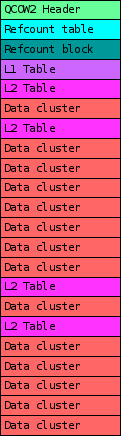
In this example we can see the most important types of clusters that a qcow2 file can have: Metadata overlap checks In order to detect corruption when writing to qcow2 images QEMU (since v1.7) performs several sanity checks. They verify that QEMU does not try to overwrite sections of the file that are already being used for metadata. If this happens, the image is marked as corrupted and further access is prevented. Although in most cases these checks are innocuous, under certain scenarios they can have a negative impact on disk write performance. This depends a lot on the case, and I want to insist that in most scenarios it doesn t have any effect. When it does, the general rule is that you ll have more chances of noticing it if the storage backend is very fast or if the qcow2 image is very large. In these cases, and if I/O performance is critical for you, you might want to consider tweaking the images a bit or disabling some of these checks, so let s take a look at them. There are currently eight different checks. They re named after the metadata sections that they check, and can be divided into the following categories:
  1. Checks that run in constant time. These are equally fast for all kinds of images and I don t think they re worth disabling.
    • main-header
    • active-l1
    • refcount-table
    • snapshot-table
  2. Checks that run in variable time but don t need to read anything from disk.
    • refcount-block
    • active-l2
    • inactive-l1
  3. Checks that need to read data from disk. There is just one check here and it s only needed if there are internal snapshots.
    • inactive-l2
By default all tests are enabled except for the last one (inactive-l2), because it needs to read data from disk. Disabling the overlap checks Tests can be disabled or enabled from the command line using the following syntax: -drive file=hd.qcow2,overlap-check.inactive-l2=on
-drive file=hd.qcow2,overlap-check.snapshot-table=off It s also possible to select the group of checks that you want to enable using the following syntax: -drive file=hd.qcow2,overlap-check.template=none
-drive file=hd.qcow2,overlap-check.template=constant
-drive file=hd.qcow2,overlap-check.template=cached
-drive file=hd.qcow2,overlap-check.template=all Here, none means that no tests are enabled, constant enables all tests from group 1, cached enables all tests from groups 1 and 2, and all enables all of them. As I explained in the previous section, if you re worried about I/O performance then the checks that are probably worth evaluating are refcount-block, active-l2 and inactive-l1. I m not counting inactive-l2 because it s off by default. Let s look at the other three: Conclusion The qcow2 consistency checks are useful to detect data corruption, but they can affect write performance. If you re unsure and you want to check it quickly, open an image with overlap-check.template=none and see for yourself, but remember again that this will only affect write operations. To obtain more reliable results you should also open the image with cache=none in order to perform direct I/O and bypass the page cache. I ve seen performance increases of 50% and more, but whether you ll see them depends a lot on your setup. In many cases you won t notice any difference. I hope this post was useful to learn a bit more about the qcow2 format. There are other things that can help QEMU perform better, and I ll probably come back to them in future posts, so stay tuned! Acknowledgments My work in QEMU is sponsored by Outscale and has been made possible by Igalia and the help of the rest of the QEMU development team.

Shirish Agarwal: Sex, death and nature

Yin-Yang-Balance

Yin-Yang-Balance

There is/was a somewhat controversial book by Osho which I read long back Sambhog se Samadhi Ki Aur or the English version From Sex to Superconsciousness While I can t say I understand or understood it all, read it about a decade back, the main point shared in the book was that if you are able to achieve bliss/orgasm during sex, you might be able to have a glimpse of super-consciousness. I had to share the above context as I had gone to a meetup couple of weeks back had gone to a meetup where a friend, Dr. Swati Shome is attempting to write an educational book for teenagers to talk about sex. I did help her a bit in the past I tried to share some of the concerns I had as my generation didn t have any guidance from parents or teachers. Most of us were left to our own devices which is similar to today s children as well with the exception that they have the web. You look at both the books, both written in Pune (my home-town) and both talking about the same subject but from so different a view-point. If you see the comments on the meetup page, it really pains to see people s concerns. I don t know if there is any solution to the widespread ignorance, myth-making etc. and hence felt a bit sad  . Sharing a small clip I had seen few months back. Just to give a bit of context, the law as has been shared as passed in 2015 has happened after the 2012 Delhi Gang Rape. A part of it is also that the Indian society still frowns upon live-in relationships so in part it may also be a push-back from the conservatives. After all the BJP, a right of the center party has been in power for 2.5 years now so it s possible that they were part of it. As I don t have enough knowledge of what the actual case was, who were the litigants and the defendants, the lawyers and the judge involved, I cannot further speculate. If somebody has more info. or link please pass it on. It would be interesting to know if it was a single bench ruling or 3-5 judge bench. The yin-yan symbol I had shared becomes a bit more apt as in quite a few cultures, including Indian and Japanese, the two are seen as parts of the same coin. One life-giving, the other life-taking or not even taking but converting into something else.
Death

Death

That came few days later when I was reading an article about sleep. The purpose of sleep, is to forget . It was slightly strange and yet interesting article. What disturbed me though, was the bit about the mouse being killed and his brain being sliced. I tried to find many a justification for it, but none I could have peace with. And the crux of that is because the being, the creature s wilful consent hasn t been taken. In nature s eyes humans and mice are one and the same. We don t get any special passes due to the fact that we are human. A natural disaster doesn t care whether you are small or big, fat or strong, mouse or wo/man, coward or brave. It s sheer luck and after disaster preparedness that people and animals get saved or not. I thought quite a bit that instead of animals being used for scientific experiments, why don t we use actual humans. While I m sure PETA supporters probably may have spear-headed this idea for a long time, but it doesn t mean I can t come to this realization by myself. After all, it s not about pandering to a group but rather what I think is right. Passing the baton to humans does have its own knotty problems though. For any such kind of endeavour, people s participation and wilful consent would be needed. While humans can and do give wilful consent, it is difficult problem as you don t know the situation in which that consent has been taken. We all know about Organ trafficking . Many people especially from lower economic background may be enticed and cheated with the whole economics for science. In most Indian middle and higher-middle classes religion plays a part even though with death the body is cremated and is supposed to scatter among the Pancha Mahaboota, the five elements. I, for one have no hang-ups if some scientist were to slice my brain to find something, provided I m dead  or for that matter any part of the body. If more people thought like that, probably we wouldn t have to specially grow and then kill lab mice and guinea-pigs to test out theories. Possibly medical innovations would probably be a lot faster than now. Ironically, most medical innovations have happened during wars and continues to do so till date. Comments, ideas, suggestions and criticisms all are welcome.
Filed under: Miscellenous Tagged: #Death, #Innocence, #Medical Innovatiion, #Medicine, #Murder, #PETA, #Sex, #sleep, #war, education, exploitation, nature

7 February 2017

Vincent Bernat: Write your own terminal emulator

I was an happy user of rxvt-unicode until I got a laptop with an HiDPI display. Switching from a LoDPI to a HiDPI screen and back was a pain: I had to manually adjust the font size on all terminals or restart them. VTE is a library to build a terminal emulator using the GTK+ toolkit, which handles DPI changes. It is used by many terminal emulators, like GNOME Terminal, evilvte, sakura, termit and ROXTerm. The library is quite straightforward and writing a terminal doesn t take much time if you don t need many features. Let s see how to write a simple one.

A simple terminal Let s start small with a terminal with the default settings. We ll write that in C. Another supported option is Vala.
#include <vte/vte.h>
int
main(int argc, char *argv[])
 
    GtkWidget *window, *terminal;
    /* Initialise GTK, the window and the terminal */
    gtk_init(&argc, &argv);
    terminal = vte_terminal_new();
    window = gtk_window_new(GTK_WINDOW_TOPLEVEL);
    gtk_window_set_title(GTK_WINDOW(window), "myterm");
    /* Start a new shell */
    gchar **envp = g_get_environ();
    gchar **command = (gchar *[]) g_strdup(g_environ_getenv(envp, "SHELL")), NULL  ;
    g_strfreev(envp);
    vte_terminal_spawn_sync(VTE_TERMINAL(terminal),
        VTE_PTY_DEFAULT,
        NULL,       /* working directory  */
        command,    /* command */
        NULL,       /* environment */
        0,          /* spawn flags */
        NULL, NULL, /* child setup */
        NULL,       /* child pid */
        NULL, NULL);
    /* Connect some signals */
    g_signal_connect(window, "delete-event", gtk_main_quit, NULL);
    g_signal_connect(terminal, "child-exited", gtk_main_quit, NULL);
    /* Put widgets together and run the main loop */
    gtk_container_add(GTK_CONTAINER(window), terminal);
    gtk_widget_show_all(window);
    gtk_main();
 
You can compile it with the following command:
gcc -O2 -Wall $(pkg-config --cflags --libs vte-2.91) term.c -o term
And run it with ./term: Simple VTE-based terminal

More features From here, you can have a look at the documentation to alter behavior or add more features. Here are three examples.

Colors You can define the 16 basic colors with the following code:
#define CLR_R(x)   (((x) & 0xff0000) >> 16)
#define CLR_G(x)   (((x) & 0x00ff00) >>  8)
#define CLR_B(x)   (((x) & 0x0000ff) >>  0)
#define CLR_16(x)  ((double)(x) / 0xff)
#define CLR_GDK(x) (const GdkRGBA)  .red = CLR_16(CLR_R(x)), \
                                    .green = CLR_16(CLR_G(x)), \
                                    .blue = CLR_16(CLR_B(x)), \
                                    .alpha = 0  
vte_terminal_set_colors(VTE_TERMINAL(terminal),
    &CLR_GDK(0xffffff),
    &(GdkRGBA)  .alpha = 0.85  ,
    (const GdkRGBA[]) 
        CLR_GDK(0x111111),
        CLR_GDK(0xd36265),
        CLR_GDK(0xaece91),
        CLR_GDK(0xe7e18c),
        CLR_GDK(0x5297cf),
        CLR_GDK(0x963c59),
        CLR_GDK(0x5E7175),
        CLR_GDK(0xbebebe),
        CLR_GDK(0x666666),
        CLR_GDK(0xef8171),
        CLR_GDK(0xcfefb3),
        CLR_GDK(0xfff796),
        CLR_GDK(0x74b8ef),
        CLR_GDK(0xb85e7b),
        CLR_GDK(0xA3BABF),
        CLR_GDK(0xffffff)
 , 16);
While you can t see it on the screenshot1, this also enables background transparency. Color rendering

Miscellaneous settings VTE comes with many settings to change the behavior of the terminal. Consider the following code:
vte_terminal_set_scrollback_lines(VTE_TERMINAL(terminal), 0);
vte_terminal_set_scroll_on_output(VTE_TERMINAL(terminal), FALSE);
vte_terminal_set_scroll_on_keystroke(VTE_TERMINAL(terminal), TRUE);
vte_terminal_set_rewrap_on_resize(VTE_TERMINAL(terminal), TRUE);
vte_terminal_set_mouse_autohide(VTE_TERMINAL(terminal), TRUE);
This will:
  • disable the scrollback buffer,
  • not scroll to the bottom on new output,
  • scroll to the bottom on keystroke,
  • rewrap content when terminal size change, and
  • hide the mouse cursor when typing.

Update the window title An application can change the window title using XTerm control sequences (for example, with printf "\e]2;$ title \a"). If you want the actual window title to reflect this, you need to define this function:
static gboolean
on_title_changed(GtkWidget *terminal, gpointer user_data)
 
    GtkWindow *window = user_data;
    gtk_window_set_title(window,
        vte_terminal_get_window_title(VTE_TERMINAL(terminal))?:"Terminal");
    return TRUE;
 
Then, connect it to the appropriate signal, in main():
g_signal_connect(terminal, "window-title-changed", 
    G_CALLBACK(on_title_changed), GTK_WINDOW(window));

Final words I don t need much more as I am using tmux inside each terminal. In my own copy, I have also added the ability to complete a word using ones from the current window or other windows (also known as dynamic abbrev expansion). This requires to implement a terminal daemon to handle all terminal windows with one process, similar to urxvtcd. While writing a terminal from scratch 2 suits my need, it may not be worth it. evilvte is quite customizable and can be lightweight. Consider it as a first alternative. Honestly, I don t remember why I didn t pick it. UPDATED: evilvte has not seen an update since 2014. Its GTK+3 support is buggy. It doesn t support the latest versions of the VTE library. Therefore, it s not a good idea to use it. You should also note that the primary goal of VTE is to be a library to support GNOME Terminal. Notably, if a feature is not needed for GNOME Terminal, it won t be added to VTE. If it already exists, it will likely to be deprecated and removed.

  1. Transparency is handled by the composite manager (Compton, in my case).
  2. For some definition of scratch since the hard work is handled by VTE.

Jonathan McDowell: GnuK on the Maple Mini

Last weekend, as a result of my addiction to buying random microcontrollers to play with, I received some Maple Minis. I bought the Baite clone direct from AliExpress - so just under 3 each including delivery. Not bad for something that s USB capable, is based on an ARM and has plenty of IO pins. I m not entirely sure what my plan is for the devices, but as a first step I thought I d look at getting GnuK up and running on it. Only to discover that chopstx already has support for the Maple Mini and it was just a matter of doing a ./configure --vidpid=234b:0000 --target=MAPLE_MINI --enable-factory-reset ; make. I d hoped to install via the DFU bootloader already on the Mini but ended up making it unhappy so used SWD by following the same steps with OpenOCD as for the FST-01/BusPirate. (SWCLK is D21 and SWDIO is D22 on the Mini). Reset after flashing and the device is detected just fine:
usb 1-1.1: new full-speed USB device number 73 using xhci_hcd
usb 1-1.1: New USB device found, idVendor=234b, idProduct=0000
usb 1-1.1: New USB device strings: Mfr=1, Product=2, SerialNumber=3
usb 1-1.1: Product: Gnuk Token
usb 1-1.1: Manufacturer: Free Software Initiative of Japan
usb 1-1.1: SerialNumber: FSIJ-1.2.3-87155426
And GPG is happy:
$ gpg --card-status
Reader ...........: 234B:0000:FSIJ-1.2.3-87155426:0
Application ID ...: D276000124010200FFFE871554260000
Version ..........: 2.0
Manufacturer .....: unmanaged S/N range
Serial number ....: 87155426
Name of cardholder: [not set]
Language prefs ...: [not set]
Sex ..............: unspecified
URL of public key : [not set]
Login data .......: [not set]
Signature PIN ....: forced
Key attributes ...: rsa2048 rsa2048 rsa2048
Max. PIN lengths .: 127 127 127
PIN retry counter : 3 3 3
Signature counter : 0
Signature key ....: [none]
Encryption key....: [none]
Authentication key: [none]
General key info..: [none]
While GnuK isn t the fastest OpenPGP smart card implementation this certainly seems to be one of the cheapest ways to get it up and running. (Plus the fact that chopstx already runs on the Mini provides me with a useful basis for other experimentation.)

Olivier Berger: Making Debian stable/jessie images for OpenStack with bootstrap-vz and cloud-init

I m investigating the creation of VM images for different virtualisation solutions. Among the target platforms is a destop as a service platform based on an OpenStack public cloud. We ve been working with bootstrap-vz for creating VMs for Vagrant+VirtualBox so I wanted to test its use for OpenStack. There are already pre-made images available, including official Debian ones, but I like to be able to re-create things instead of depending on some external magic (which also means to be able to optimize, customize and avoid potential MitM, of course). It appears that bootstrap-vz can be used with cloud-init provided that some bits of config are specified. In particular the cloud_init plugin of bootstrap-vz requires a metadata_source set to NoCloud, ConfigDrive, OpenStack, Ec2 . Note we explicitely spell it OpenStack and not Openstack as was mistakenly done in the default Debian cloud images (see https://bugs.debian.org/854482). The following snippet of manifest provides the necessary bits :
---
name: debian- system.release - system.architecture - %Y %m %d 
provider:
  name: kvm
  virtio_modules:
  - virtio_pci
  - virtio_blk
bootstrapper:
  workspace: /target
  # create or reuse a tarball of packages
  tarball: true
system:
  release: jessie
  architecture: amd64
  bootloader: grub
  charmap: UTF-8
  locale: en_US
  timezone: UTC
volume:
  backing: raw
  partitions:
    #type: gpt
    type: msdos
    root:
      filesystem: ext4
      size: 4GiB
    swap:
      size: 512MiB
packages:
  # change if another mirror is closer
  mirror: http://ftp.fr.debian.org/debian/
plugins:
  root_password:
    password: whatever
  cloud_init:
    username: debian
    # Note we explicitely spell it 'OpenStack' and not 'Openstack' as done in the default Debian cloud images (see https://bugs.debian.org/854482)
    metadata_sources: NoCloud, ConfigDrive, OpenStack, Ec2
  # admin_user:
  #   username: Administrator
  #   password: Whatever
  minimize_size:
    # reduce the size by around 250 Mb
    zerofree: true
I ve tested this with the bootstrap-vz version in stretch/testing (0.9.10+20170110git-1) for creating jessie/stable image, which were booted on the OVH OpenStack public cloud. YMMV. Hope this helps

Junichi Uekawa: According to annual health check my weight has not increased the last year.

According to annual health check my weight has not increased the last year. Hopefully that's because of going to the gym.

Sean Whitton: reclaiming conversation

On Friday night I attended a talk by Sherry Turkle called Reclaiming Conversation: The Power of Talk in a Digital Age . Here are my notes.
Turkle is an anthropologist who interviews people from different generations about their communication habits. She has observed cross-generational changes thanks to (a) the proliferation of instant messaging apps such as WhatsApp and Facebook Messenger; and (b) fast web searching from smartphones. Her main concern is that conversation is being trivialised. Consider six or seven college students eating a meal together. Turkle s research has shown that the etiquette among such a group has shifted such that so long as at least three people are engaged in conversation, others at the table feel comfortable turning their attention to their smartphones. But then the topics of verbal conversation will tend away from serious issues you wouldn t talk about your mother s recent death if anyone at the table was texting. There are also studies that purport to show that the visibility of someone s smartphone causes them to take a conversation less seriously. The hypothesis is that the smartphone is a reminder of all the other places they could be, instead of with the person they are with. A related cause of the trivialisation of conversation is that people are far less willing to make themselves emotionally vulnerable by talking about serious matters. People have a high degree of control over the interactions that take place electronically (they can think about their reply for much longer, for example). Texting is not open-ended in the way a face-to-face conversation is. People are unwilling to give up this control, so they choose texting over talking. What is the upshot of these two respects in which conversation is being trivialised? Firstly, there are psycho-social effects on individuals, because people are missing out on opportunities to build relationships. But secondly, there are political effects. Disagreeing about politics immediately makes a conversation quite serious, and people just aren t having those conversations. This contributes to polarisation. Note that this is quite distinct from the problems of fake news and the bubbling effects of search engine algorithms, including Facebook s news feed. It would be much easier to tackle fake news if people talked about it with people around them who would be likely to disagree with them. Turkle understands connection as a capacity for solitude and also for conversation. The drip feed of information from the Internet prevents us from using our capacity for solitude. But then we fail to develop a sense of self. Then when we finally do meet other people in real life, we can t hear them because we just use them to try to establish a sense of self. Turkle wants us to be more aware of the effects that our smartphones can have on conversations. People very rarely take their phone out during a conversation because they want to escape from that conversation. Instead, they think that the phone will contribute to that conversation, by sharing some photos, or looking up some information online. But once the phone has come out, the conversation almost always takes a turn for the worse. If we were more aware of this, we would have access to deeper interactions. A further respect in which the importance of conversation is being downplayed is in the relationships between teachers and students. Students would prefer to get answers by e-mail than build a relationship with their professors, but of course they are expecting far too much of e-mail, which can t teach them in the way interpersonal contact can. All the above is, as I said, cross-generational. Something that is unique to millenials and below is that we seek validation for the way that we feel using social media. A millenial is not sure how they feel until they send a text or make a broadcast (this makes them awfully dependent on others). Older generations feel something, and then seek out social interaction (presumably to share, but not in the social media sense of share ). What does Turkle think we can do about all this? She had one positive suggestion and one negative suggestion. In response to student or colleague e-mails asking for something that ought to be discussed face-to-face, reply I m thinking. And you ll find they come to you. She doesn t want anyone to write empathy apps in response to her findings. For once, more tech is definitely not the answer. Turkle also made reference to the study reported here and here and here.

Joachim Breitner: Why prove programs equivalent when your compiler can do that for you?

Last week, while working on CodeWorld, via a sequence of yak shavings, I ended up creating a nicely small library that provides Control.Applicative.Succs, a new applicative functor. And because I am trying to keep my Haskell karma good1, I wanted to actually prove that my code fulfills the Applicative and Monad laws. This led me to inserted writing long comments into my code, filled with lines like this:
The second Applicative law:
  pure (.) <*> Succs u us <*> Succs v vs <*> Succs w ws
= Succs (.) [] <*> Succs u us <*> Succs v vs <*> Succs w ws
= Succs (u .) (map (.) us) <*> Succs v vs <*> Succs w ws
= Succs (u . v) (map ($v) (map (.) us) ++ map (u .) vs) <*> Succs w ws
= Succs (u . v) (map (($v).(.)) us ++ map (u .) vs) <*> Succs w ws
= Succs ((u . v) w) (map ($w) (map (($v).(.)) us ++ map (u .) vs) ++ map (u.v) ws)
= Succs ((u . v) w) (map (($w).($v).(.)) us ++ map (($w).(u.)) vs ++ map (u.v) ws)
= Succs (u (v w)) (map (\u -> u (v w)) us ++ map (\v -> u (v w)) vs ++ map (\w -> u (v w)) ws)
= Succs (u (v w)) (map ($(v w)) us ++ map u (map ($w) vs ++ map v ws))
= Succs u us <*> Succs (v w) (map ($w) vs ++ map v ws)
= Succs u us <*> (Succs v vs <*> Succs w ws)
Honk if you have done something like this before! I proved all the laws, but I was very unhappy. I have a PhD on something about Haskell and theorem proving. I have worked with Isabelle, Agda and Coq. Both Haskell and theorem proving is decades old. And yet, I sit here, and tediously write manual proofs by hand. Is this really the best we can do? Of course I could have taken my code, rewritten it in, say, Agda, and proved it correct there. But (right now) I don t care about Agda code. I care about my Haskell code! I don t want to write it twice, worry about copying mistakes and mismatchs in semantics, and have external proofs to maintain. Instead, I want to prove where I code, and have the proofs checked together with my code! Then it dawned to me that this is, to some extent, possible. The Haskell compiler comes with a sophisticated program transformation machinery, which is meant to simplify and optimize code. But it can also be used to prove Haskell expressions to be equivalent! The idea is simple: Take two expressions, run both through the compiler s simplifier, and check if the results are the same. If they are, then the expressions are, as far as the compiler is concerned, equivalent. A handful of hours later, I was able to write proof tasks like
app_law_2 = (\ a b (c::Succs a) -> pure (.) <*> a <*> b <*> c)
        === (\ a b c -> a <*> (b <*> c))
and others into my source file, and the compiler would tell me happily:
[1 of 1] Compiling Successors       ( Successors.hs, Successors.o )
GHC.Proof: Proving getCurrent_proof1  
GHC.Proof: Proving getCurrent_proof2  
GHC.Proof: Proving getCurrent_proof3  
GHC.Proof: Proving ap_star  
GHC.Proof: Proving getSuccs_proof1  
GHC.Proof: Proving getSuccs_proof2  
GHC.Proof: Proving getSuccs_proof3  
GHC.Proof: Proving app_law_1  
GHC.Proof: Proving app_law_2  
GHC.Proof: Proving app_law_3  
GHC.Proof: Proving app_law_4  
GHC.Proof: Proving monad_law_1  
GHC.Proof: Proving monad_law_2  
GHC.Proof: Proving monad_law_3  
GHC.Proof: Proving return_pure  
GHC.Proof proved 15 equalities
This is how I want to prove stuff about my code! Do you also want to prove stuff about your code? I packaged this up as a GHC plugin in the Haskell library ghc-proofs (not yet on Hackage). The README of the repository has a bit more detail on how to use this plugin, how it works, what its limitations are and where this is heading. This is still only a small step, but finally there is a step towards low threshold program equivalence proofs in Haskell.

  1. Or rather recover my karma after such abominations such as ghc-dup, seal-module or ghc-heap-view.

6 February 2017

Martin Pitt: Migrated blog from WordPress to Hugo

My WordPress blog got hacked two days ago and now twice today. This morning I purged MySQL and restored a good backup from three days ago, changed all DB and WordPress passwords (both the old and new ones were long and autogenerated ones), but not even an hour after the redeploy the hack was back. (It can still be seen on Planet Debian and Planet Ubuntu. Neither the Apache logs nor the Journal had anything obvious, nor were there any new files in global or user www directories, so I m a bit stumped how this happened. Certainly not due to bruteforcing a password, that would both have shown in the logs and also have triggered ban2fail, so this looks like an actual vulnerability. I upgraded to WordPress 4.7.1 a few days ago, and apparently 4.7.2 fixes a few vulnerabilities, although all of them don t sound like they would match my situation. jessie-backports is still at 4.7.1, so I missed that update. But either way, all WordPress blogs hosted on my server are down for the time being. I took this as motivation to finally migrate to something more robust. WordPress has tons of features that I never need, and also a lot of overhead (dynamic generation, MySQL, its own user/passwords, etc.). I had a look around, and it seems Hugo and Blogofile are nice contenders no privileges, no database, outputting static files, input is Markdown (so much nicer to type than HTML!), and maintaining your blog in git and previewing the changes on my local laptop are straightforward. I happened to try Hugo first, and like it enough to give it an extended try you have plenty of themes to choose from and they are straightforward to customize, so I don t need to spend a lot of time learning and crafting CSS. I ran the WordPress to Hugo Exporter, and it produced remarkable results fairly usable HTML Markdown and metadata conversion, it keeps all the original URLs, and it s painless to use. Nicely done! So here it is, on to a much more secure server now! \o/

Next.

Previous.