Search Results: "will"

27 December 2015

Gregor Herrmann: RC bugs 2015/51-52

the upload of perl 5.22 to unstable some days ago provided ample opportunity to fix some new RC bugs. here's the list of my work:

Gregor Herrmann: RC bugs 2015/51-52

the upload of perl 5.22 to unstable some days ago provided ample opportunity to fix some new RC bugs. here's the list of my work:

Vincent Sanders: The only pleasure I get from moving house is stumbling across books I had forgotton I owned

I have to agree with John Burnside on that statement, after having recently moved house again rediscovering our book collection has been a salve for an otherwise exhausting undertaking. I returned to Cambridge four years ago, initially on my own and then subsequently the family moved down to be with me.

We rented a house but, with two growing teenagers, the accommodation was becoming a little crowded. Melodie and I decided the relocation was permanent and started looking for our own property, eventually finding something to our liking in Cottenham village.

Melodie took the opportunity to have the house cleaned and decorated while empty because of overlapping time with our rental property. This meant we had to be a little careful while moving in as there was still wet paint in places.

Some of our books
Moving weekend was made bearable by Steve, Jonathan and Jo lending a hand especially on the trips to Yorkshire to retrieve, amongst other things, the aforementioned book collection. We were also fortunate to have Andy and Jane doing many other important jobs around the place while the rest of us were messing about in vans.

The desk in the study
The seemingly obligatory trip to IKEA to acquire furniture was made much more fun by trying to park a luton van which was only possible because Steve and Jonathan helped me. Though it turns out IKEA ship mattresses rolled up so tight they can be moved in an estate car so taking the van was unnecessary.

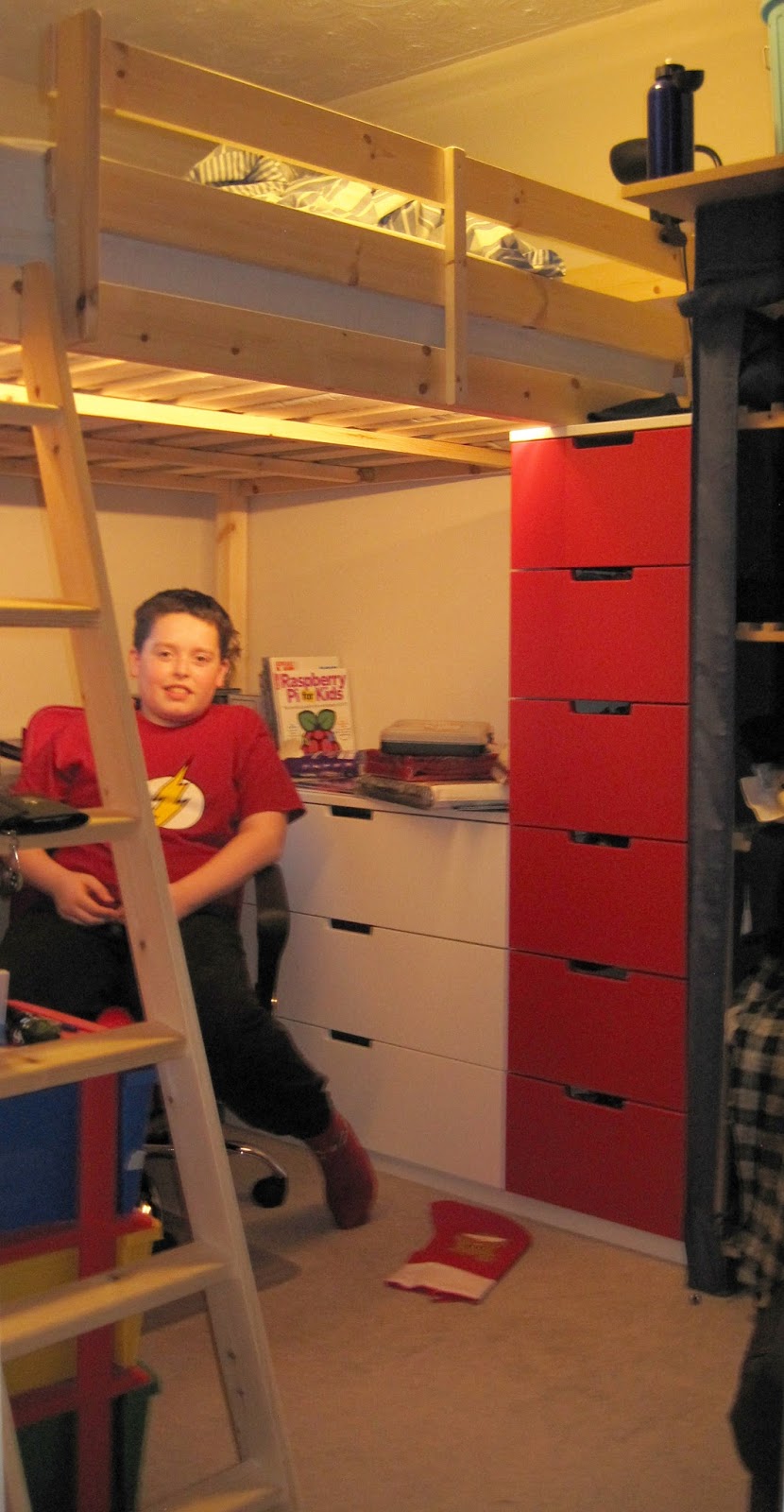
Alex under his loft bed
Having moved in it seems like every weekend is filled with a never ending "todo" list of jobs. From clearing gutters to building a desk in the study. Eight weeks on and the list seems to be slowly shrinking meaning I can even do some lower priority things like the server rack which was actually a fun project.


Joshua in his completed roomThe holidays this year afforded me some time to finish the boys bedrooms. They both got loft beds with a substantial area underneath. This allows them both to have double beds along with a desk and plenty of storage. Completing the rooms required the construction of some flat pack furniture which rather than simply do myself I supervised the boys doing it themselves.

Alexander building flat pack furniture
Teaching them by letting them get on with it was a surprisingly effective and both of them got the hang of the construction method pretty quickly. There was only a couple of errors from which they learned immediately and did not repeat (draw bottoms having a finished side and front becomes back when you are constructing upside down)

Joshua assembling flat pack furniture
The house is starting to feel like home and soon all the problems will fade from memory while the good will remain. Certainly our first holiday season has been comfortable here and I look forward to many more re-reading our books.

Steve Kemp: Some things are universal?

I don't often do retrospectives, but this year has been an unusual one for me, as I moved to Finland almost six months ago. The topic has come up in conversation a lot over the past few months, so when people ask me what I think I can give some simple answers without too much thought. Here's a brief summary. There are some obvious changes:
The Traffic
The traffic drives on the right-hand side of the roads, which took a bit of getting used to, but isn't a huge surprise as I've travelled in Europe in the past. There aren't so many countries that drive on the left after all so most people probably wouldn't even notice this as odd. When it comes to traffic one thing nice about Helsinki is that most junctions are "zebra crossings". Sure they don't have flashing lights, but they have shaded areas, and pedestrians have right of way. As for transport the city of Helsinki has local trains, trams, buses and taxis. The trams and buses all use the same card for payment so transport is integrated very well. I buy a time-based card, spending about 50 for a month of unlimited travel. If you prefer you may add euros to your card and pay for distinct journeys - but that works out more expensive if you travel twice, or more, a day.
The Money
Finland uses the Euro these days, having switched from the Finnish markka in 2002. Enough said. Costs are largely in line with what I'd expect: Cigarettes are cheap, beer is expensive. Some things are very expensive, some things are very cheap. Largely the expensive things are those that are imported. It is a very small country after all.
The Language
Finnish is .. complex. But I've not struggled too much. Mostly I can buy what I want without difficulty. There are weird exceptions though for example I went out to buy soup one day and had to return carrying only shame and disappointment: I can't read the language on the tins and what I thought was soup turned out to be a can of chopped tomatoes. Food is good though, and available easily (!!). The only significant surprise when it comes to shopping is that loose goods must be weighed yourself. You pick up a bunch of bananas, take it to the scales, press the button that has a picture of a banana on it, and it prints out a label you attach to them - at the till the cashier will scan the label and charge you. If you forget, or don't know how to do it they'll tut and complain. In daily life I use two phrases frequently and they are sufficient for communcation:
  • "minua haluan ... kahvi kakku olut"
    • "I want ... coffee cake beer".
  • "kiitos"
    • "Thanks"
Usually people speak to me in English, which is a little annoying as it means I'm not learning as much as I could. But that said over the past few months I've had proper conversations entirely in Finnish with shop-keepers, and similar. So I'm getting better.
The Culture
Finnish people are friendly, but terse. That's the reputation. The Finnish people are alcoholics, and have high rates of suicide. Also the reputation. Finally we know that the Finnish people consume more coffee than the rest of the world. All those things are true, but they're not enough by far to describe the people. Obviously they're all different, and we have a lot of people from other parts of the world here too - Russians, Asians, Somalians. So culture is complex .. but markedly different than in the UK. I could write more about this, but I think for the moment I'll just draw a line under culture and say that I'm enjoying the interactions with people here, and while many things are slightly "off", it's not bad. Just different. Also saunas are fun. I've never had any qualms about being naked with strangers, so I don't really understand why Americans, and others, find this so difficult/surprising. But yeah, saunas are great. Things that Finland is known for internationally: The invention of the molotov cocktail, rally-driving, hockey, world's strongest man, Moomins, Tom of Finland, Salmiakki.
The Weather
Not too hot. Not too cold. But that's largely because I'm one of those "hot" people who doesn't really get cold even at the best of times. My ideal temperatures are about 13 C. My wife prefers 15 C, or more. We don't fight any more. Mostly. Winter is apparently full of snow, but this year has been poor. We had the first snowfall yesterday, here in Helsinki, and we woke this morning a blanket of snow about two inches high. It looks pretty. The biggest thing about weather in Finland is the constant darkness in winter, and the constant sun in Summer. In Summer there were like 22 hours of sunlight a day which made sleeping hard when we moved into our flat - with no curtains. In winter it feels like there is 20 minutes of sunlight a day. It's not that bad here in the south, although I think it is something like five hours and less in the north. I've never had any real issues with depression, or similar: People have good days and bad days, I'd generally be "OK" or "great". In the darkness? I've been grumpy at colleagues, I've made bad choices, I've lapsed attention. I'm not sure I can blame it on the weather, or my reaction to the weather, but I know I've not been as "happy" as I "should". It requires effort to be enthusiastic in a way I've never experienced before. Thankfully once I (slowly) realized this I took action and I think I'm good now. Unlike the UK the buildings here are relatively modern. I think that's the biggest contributing factor to how houses are "warm". Houses have all been built in the last 50-100 years, so you have proper insulation. Even though it might be very very cold outdoors indoors you can be naked without heating. Try that in the UK and you might freeze in some of the older leakier houses! You do have to laugh, though, when people point out "the oldest pub" in the city though. Where I come from if I pub isn't 500+ years old you wouldn't give it a seconds thought - places like The Golden Fleece, etc.
I could write more. I probably should. But it has been an interesting year, and although there are things I miss about the UK, and Edinburgh specifically, I have no regrets. I'm glad I came. What triggered this post? I said "Some things are universal" to my wife, when I saw a child riding a bicycle they'd obviously just received for Christmas. Her reaction "No Finnish person would buy a bicycle at Christmas - they'd expect too much snow!". So perhaps it was another immigrant family. Christmas bicycles universal, or not, it doesn't really matter.

26 December 2015

Norbert Preining: Debian/TeX Live 2015.20151226-1

Before I disappear into the Japanese winter holidays, here the Christmas update of all TeX Live packages. Nothing spectacular here, just the usual bunch of updates of loads of packages. There is a bug with respect to a file move from one package to another, will be fixed in an upload soon. Debian - TeX Live 2015 Updated packages apnum, appendix, archaeologie, babel, babel-french, babel-greek, babel-hungarian, bangorcsthesis, beamer-verona, bhcexam, bibarts, bidi, bxjscls, chemfig, commado, comprehensive, context, cslatex, csplain, ctanify, doclicense, dvips, ejpecp, exsheets, fbb, fibeamer, fithesis, fontools, francais-bst, gitinfo2, glossaries, gnuplottex, greek-fontenc, hyph-utf8, indextools, ksp-thesis, l3build, l3experimental, l3kernel, l3packages, latexcourse-rug, lollipop, lstbayes, lualibs, luaotfload, luatexja, luatexko, luatodonotes, make4ht, mcf2graph, media9, mex, mfirstuc, mhchem, mptopdf, nameauth, nevelok, newtx, nicetext, nucleardata, ocgx2, pageslts, petri-nets, phonrule, pkuthss, powerdot, proofread, proposal, pst-labo, pst-solides3d, reledmac, sapthesis, serbian-lig, showlabels, t2, tcolorbox, tempora, testhyphens, tetex, tex4ebook, tex4ht, texlive-scripts, texsis, thuthesis, toptesi, tudscr, ucharcat, versonotes, xcharter, xepersian, xifthen, xindy, xint. New packages beamertheme-detlevcm, beamertheme-metropolis, beamertheme-phnompenh, beamer-verona, bitpattern, carbohydrates, delimseasy, drawmatrix, einfuehrung2, ellipse, ffslides, gitlog, greektonoi, ksp-thesis, longfbox, options, simpler-wick, unicode-data. Enjoy.

Julian Andres Klode: Much faster incremental apt updates

APT s performance in applying the Pdiffs files, which are the diff format used for Packages, Sources, and other files in the archive has been slow. Improving performance for uncompressed files The reason for this is that our I/O is unbuffered, and we were reading one byte at a time in order to read lines. This changed on December 24, by adding read buffering for reading lines, vastly improving the performance of rred. But it was still slow, so today I profiled using gperftools the rred method running on a 430MB uncompressed Contents file with a 75 KB large patch. I noticed that our ReadLine() method was calling some method which took a long time (google-pprof told me it was some _nss method, but that was wrong [thank you, addr2line]). After some further look into the code, I noticed that we set the length of the buffer using the length of the line. And whenever we moved some data out of the buffer, we called memmove() to move the remaining data to the front of the buffer. So, I tried to use a fixed buffer size of 4096 (commit). Now memmove() would spend less time moving memory around inside the buffer. This helped a lot, bringing the run time on my example file down from 46 seconds to about 2 seconds. Later on, I rewrote the code to not use memmove() at all opting for start and end variables instead; and increasing the start variable when reading from the buffer (commit). This in turn further improved things, bringing it down to about 1.6 seconds. We could now increase the buffer size again, without any negative effect. Effects on apt-get update I measured the run-time of apt-get update, excluding appstream and apt-file files, for the update from todays 07:52 to the 13:52 dinstall run. Configured sources are unstable and experimental with amd64 and i386 architectures. appstream and apt-file indexes are disabled for testing, so only Packages and Sources indexes are fetched. The results are impressive: That s a tenfold increase in performance. By the way, running without PDiffs took 20 seconds, so there s no reason not to use them. Future work Writes are still unbuffered, and account for about 75% to 80% of our runtime. That s an obvious area for improvements. rred-profile Performance for patching compressed files Contents files are usually compressed with gzip, and kept compressed locally because they are about 500 MB uncompressed and only 30MB compressed. I profiled this, and it turns out there is not much we can do about it: The majority of the time is spent inside zlib, mostly combining CRC checksums: rred-gz-profile Going forward, I think a reasonable option might be to recompress Contents files using lzo they will be a bit bigger (50MB instead of 30MB), but lzo is about 6 times as fast (compressing a 430MB Contents file took 1 second instead of 6).
Filed under: Debian, Uncategorized

Russ Allbery: Review: The Steerswoman

Review: The Steerswoman, by Rosemary Kirstein
Series: Steerswomen #1
Publisher: Del Rey
Copyright: 1989, 2003
Printing: 2003
ISBN: 0-345-46105-3
Format: Trade paperback
Pages: 264
I read this novel as part of The Steerswoman's Road omnibus, which is the edition reflected in the metadata (except for the page count, which is just this novel). Rowan is a steerswoman, a member of an order of traveling scholars in a world of generally medieval customs. This is a world of small villages and town blacksmiths, of swords, sailing ships, and lots of walking. Steerswomen (the order does include some men, but only rarely; the gender balance is left delightfully unexplained and unremarked) mostly travel routes through the Inner Lands until they decide to retire and do research and study. Sometimes, though, they get on the trail of something unexplained, and are driven to explain it. That's the case for Rowan at the start of this book: she's run across several peculiar flat jewels. No one seems to know what they are, their pattern of distribution is odd, and they're discovered in some decidedly strange places, such as embedded deep in a tree. It's a puzzle, and Rowan is determined to understand it. The Steerswoman opens with Rowan investigating a jewel owned by an innkeeper, and a chance meeting in his inn with an Outskirter who wears a whole belt of the same jewels. The Outskirters are nomadic tribes from the far west known for their prickly attitude, their ability in warfare, and their occasional raids. Those who live in the Inner Lands consider them barbarians. But Bel is curious, thoughtful, and happy to tell Rowan of the origin of her belt: her father found a huge number of the jewels embedded in the side of a cliff, far into the Outskirts. Rowan is immediately tempted to go there, but she has to report to the Archives first. Much to her surprise, Bel asks to accompany her. And then wizards start trying to kill them. The steerswomen are Kirstein's best bit of world-building and the anchor around which the rest of the story is told. Steerswomen have to answer all questions they're asked, truthfully. In return, they can ask a question of anyone and have to be answered truthfully. If anyone refuses to answer, or tells a deliberate lie, they're placed under the steerswomen's ban, and no steerswoman will answer their questions. This is woven deep into the culture of the Inner Lands... except for the wizards, who refuse to explain what they're doing or how to anyone, are under the ban, and don't care. They protect cities from dragons, build magical lighting, and occasionally start wars with other wizards in which numerous people die. They're effectively the rulers of this world insofar as it has rulers, and they're apparently quite interested in Rowan's search for these unexplained jewels. Rowan is a wonderful character. At the start of the book, she's the only steerswoman that the reader knows, so much of her early behavior is also world-building, showing us steerswomen. But as the story develops, we meet other steerswomen and Rowan develops into her own character: innocent in a way, but determined, ethical, and with a very deep store of self-knowledge and inner contemplation. I found the middle part of the book somewhat frustrating for the same reasons Rowan did. The ending lets her shine, in her own way, and it's deeply satisfying. The Steerswoman does pick up a third character along the way, a young boy named Will who hopes to become a wizard's apprentice, and to whom I never warmed. Part of the problem was structural: he's very suspicious of characters that the reader knows are entirely honorable. This is a difficult tone to pull off without irritating me, and Kirstein doesn't quite manage. She also shifts the story to the Will's perspective from time to time, and I never found his viewpoint very interesting. I warmed to him a bit by the climax, but I still don't think he added much to the story. Bel, though... Bel competes with Rowan as best character of this book. The other characters all have roles to play: Rowan is the steerswoman, integral to the world-building, and Will exemplifies another corner of the analytical process so central to this book and represents the appeal of the wizards. But Bel is just herself: irreverent, curious, loyal, dangerous, decisive, and adventurous. Rowan is the heart of the book and the primary protagonist, but I think Bel is its soul. I haven't said too much about the themes of this book, intentionally. Kirstein is doing something very interesting and subtle with the reader's expectations of a medieval world with wizards, and I think it's better experienced without spoilers. But it's also a character-driven story, a story of unlikely friendship between two very different women, and a story about the value of being true to yourself even when it's exceptionally dangerous. Rowan delighted me immediately, Bel grew on me over the course of the story, and the rough patches in the middle of the book faded in comparison to an excellent ending. Unfortunately, this is only part of a story. There is a climax, and we do know what the jewels are by the end of the book. But the journey has raised many more questions, most of which are not solved. The world has become far more complicated. Rowan has a lot left to learn and investigate. I recommend the omnibus, or getting the ebooks from Amazon where you can quickly get more, because you'll probably want to immediately start the second book. Followed by The Outskirter's Secret. Rating: 8 out of 10

25 December 2015

Norbert Preining: Plex Home Theater becomes OpenPHT release 1.5.0 for Debian sid and jessie

The nice guys from RasPlex have forked the abandoned Plex Home Theater into OpenPHT (github, Plex forum) and updated it with several improvements. Plex itself is now developing a new player called Plex Media Player, which unfortunately uses closed source components. I tried to build also the Plex Media Player for Debian, but a hitherto unreleased Qt versions is necessary, so I gave up for now. So here is a new built of OpenPHT for Debian/sid and jessie, amd64 and i386. This new package conflicts with the old plexhometheater. plex-debian-new Note also that the lines for sources.list have changed again. I will also remove the builds of plexhometheater from my server soon. sid and testing For sid use the following lines:
deb http://www.preining.info/debian/ openpht-sid main
deb-src http://www.preining.info/debian/ openpht-sid main
You can also grab the binary for amd64 directly here for amd64 and i386, you can get the source package with
dget http://www.preining.info/debian/pool/main/o/openpht/openpht_1.5.0.502-1.dsc
jessie For the stable release jessie, use the following lines:
deb http://www.preining.info/debian/ openpht-jessie main
deb-src http://www.preining.info/debian/ openpht-jessie main
You can also grab the binary for amd64 directly here for amd64 and i386, you can get the source package with
dget http://www.preining.info/debian/pool/main/o/openpht/openpht_1.5.0.502-1~bpo8+1.dsc
The release file and changes file are signed with my official Debian key 0x860CDC13. Now be ready for enjoying the next movie!

24 December 2015

Zlatan Todori : Deepin switches to Debian Sid

Distribution that I feel fond of their work on UX for Linux ecosystem has switched from Ubuntu to Debian. So now pabs will probably invite them to our Derivate Census and they start packaging their stack into Debian directly. More about their latest RC release and the mention of switch is on their blog

Michal Čihař: Going to FOSDEM

It has become almost tradition for me, so yes, I'm attending FOSDEM 2016. It's probably the best conference in Europe to meet other free software guys and that was always motivation for me to come - to see people I meet on mailing lists for rest of the year. This time it will be slightly different for me - I will be giving talk there for first time. Originally I wanted to do lightning talk only, but in the end I got persuaded and it's full length talk now. It will be in the Coding for Language Communities devroom and you might guess from the devroom topic that it will be about Weblate.

Filed under: English phpMyAdmin SUSE Weblate 0 comments

22 December 2015

Ian Wienand: Platform bootstrap for OpenStack Infrastructure

This is a terse guide on bootstrapping virtual-machine images for OpenStack infrastructure, with the goal of adding continuous-integration support for new platforms. It might also be handy if you are trying to replicate the upstream CI environment. It covers deployment to Rackspace for testing; Rackspace is one of the major providers of capacity for the OpenStack Infrastructure project, so it makes a good place to start when building up your support story. Firstly, get an Ubuntu Trusty environment to build the image in (other environments, like CentOS or Fedora, probably work -- but take this step to minimise differences to what the automated machinery of what upstream does). You want a fair bit of memory, and plenty of disk-space. The tool used for building virtual-machine images is diskimage-builder. In short, it takes a series of elements, which are really just scripts run in different phases of the build process. I'll describe building a Fedora image, since that's been my focus lately. We will use a fedora-minimal element -- this means the system is bootstrapped from nothing inside a chroot environment, before eventually being turned into a virtual-machine image (contrast this to the fedora element, which bases itself off the qcow2 images provided by the official Fedora cloud project). Thus you'll need a few things installed on the Ubuntu host to deal with bootstrapping a Fedora chroot
apt-get install yum yum-utils python-lzma
You will hit stuff like that python-lzma dependency on this road-less-travelled -- technically it is a bug that yum packages on Ubuntu don't depend on it; without it you will get strange yum errors about unsupported compression. At this point, you can bootstrap your diskimage-builder environment. You probably want diskimage-builder from git, and then build up a virtualenv for your support bits and pieces.
git clone git://git.openstack.org/openstack/diskimage-builder
virtualenv dib_env
. dib_env/bin/activate
pip install dib-utils
dib-utils is a small part of diskimage-builder that is split-out; don't think too much about it. While diskimage-builder is responsible for the creation of the basic image, there are a number of elements provided by the OpenStack project-config repository that bootstrap the OpenStack environment. This does a lot of stuff, including caching all git trees (so CI jobs aren't cloning everything constantly) and running puppet setup.
git clone git://git.openstack.org/openstack-infra/project-config
There's one more trick required for building the VHD images that Rackspace requires; make sure you install the patched vhd-util as described in the script help. At this point, you can probably build an image. Here's something approximating what you will want to do
break=after-error \
TMP_DIR=~/tmp \
ELEMENTS_PATH=~/project-config/nodepool/elements \
DIB_DEV_USER_PASSWORD="password"  DIB_DEV_USER_PWDLESS_SUDO=1 \
DISTRO=23 \
./bin/disk-image-create -x --no-tmpfs -t vhd \
   fedora-minimal vm devuser simple-init \
   openstack-repos puppet nodepool-base node-devstack
To break some of this down This goes and does its thing; it will take about 20 minutes. Depending on how far your platform diverges from the existing support, it will require a lot of work to get everything working so you can get an image out the other side. To see a rough example of what should be happening, see the logs of the official image builds that happen for a variety of platforms. At some point, you should get a file image.vhd which is now ready to be deployed. The only reasonable way to do this is with shade. You can quickly grab this into the virtualenv we created before
pip install shade
Now you'll need to setup a clouds.yaml file to give yourself the permissions to upload the image. It should look something like
clouds:
  rax:
    profile: rackspace
    auth:
       username: your_rax_username
       password: your_rax_password
       project_id: your_rax_accountnum
    regions:
    - IAD
You should know your user-name and password (whatever you log into the website with), and when you login to Rackspace your project_id value is listed in the drop-down box labeled with your username as Account #. shade has no UI as such, so a simple script will do the upload.
import shade
shade.simple_logging(debug=True)
cloud = shade.openstack_cloud(cloud='rax')
image = cloud.create_image('image-name', filename='image.vhd', wait=True)
Now wait -- this will also take a while. Even after upload it takes a fair while to process (you will see the shade debug output looping around some glance calls seeing if it is ready). If everything works, the script should return and you should be able to see the new image in the output of nova list-images. At this point, you're ready to try booting! One caveat is that the Rackspace web interface does not seem to give you the option to boot with a configuration drive available to the host, essential for simple-init to bring up the network. So boot via the API with something like
nova boot --flavor=2 --image=image-uuid --config-drive 1 test-image
This should build and boot your image! This will allow you to open a whole new door of debugging to get your image booting correctly. You can now iterate by rebuilding/uploading/booting as required. Note these are pretty big images, and uploaded in broken-up swift files, so I find swift delete --all helpful to reset between builds (obviously, I have nothing else in swift that I want to keep). The Rackspace java-based console UI is rather annoying; it cuts itself off every time the host reboots. This makes it quite difficult to catch the early bootup, or modify grub options via the boot-loader, etc. You might need to fiddle timeout options, etc in the image build. If you've managed to get your image booting and listening on the network, you're a good-deal of the way towards having your platform supported in upstream OpenStack CI. At this point, you likely want to peruse the nodepool configuration and get an official build happening here. Once that is up, you can start the process of adding jobs that use your platform to test! Don't worry, there's plenty more that can go wrong from here -- but you're on the way! OpenStack infra is a very dynamic environment, which many changes in progress; so in general, #openstack-infra on freenode is going to be a great place to start looking for help.

Jonas Smedegaard: Hamara Linux

Siri and I are on a journey through India and Nepal, with the aim of learning about needs of Debian derivatives, to improve Debian and encourage closer integration.

Distribution Hamara Linux is a distribution based on Trisquel, hence descending from Debian via Ubuntu. Next release will be a direct derivative of Debian. We recommended to package missing parts for Debian itself, even if Hamara needs them faster than deemed "stable" in Debian. ITP bugreports is since filed for theme and install routine.

Visual design Hamara Linux ships with a coherent visual style, covering widget theme, install routine, boot and login, and a range of wallpapers. Siri has begun comparing widget theme against Debian. We might try distill diffs for each Debian Ubuntu Trisquel Hamara derivation.

System contents and setup Hamara Linux comes in two flavors: Hamara Namaste with a GNOME desktop, and Hamara Sugam with an Lxde desktop. I have begun decomposing the package sets into classes for Boxer, at the same time extending Boxer.

Michal Čihař: Weekly phpMyAdmin contributions

Again one week has passed and there has been some progress on phpMyAdmin. This week the focus was on code cleanup and issue fixing. I've identified several pieces of dead code and removed that from our code base (the biggest removal being no longer used PMA_String class). The codebase is quite old and sometimes it's not easy to identify code which is not really being used, as it still might be referenced from some locations, but without actually invoking it. On the issue fixing side, I'm really happy from improving user experience with fields marked as binary - so far phpMyAdmin has displayed them as hexadecimal dump in all cases. Now it will display them as text as long as the content is valid utf-8. Bugs fixed: PS: I will most likely skip report next week due to Christmas.

Filed under: English phpMyAdmin 0 comments

21 December 2015

Matthew Garrett: GPL enforcement is a social good

The Software Freedom Conservancy is currently running a fundraising program in an attempt to raise enough money to continue funding GPL compliance work. If they don't gain enough supporters, the majority of their compliance work will cease. And, since SFC are one of the only groups currently actively involved in performing GPL compliance work, that basically means that there will be nobody working to ensure that users have the rights that copyright holders chose to give them.

Why does this matter? More people are using GPLed software than at any point in history. Hundreds of millions of Android devices were sold this year, all including GPLed code. An unknowably vast number of IoT devices run Linux. Cameras, Blu Ray players, TVs, light switches, coffee machines. Software running in places that we would never have previously imagined. And much of it abandoned immediately after shipping, gently rotting, exposing an increasingly large number of widely known security vulnerabilities to an increasingly hostile internet. Devices that become useless because of protocol updates. Toys that have a "Guaranteed to work until" date, and then suddenly Barbie goes dead and you're forced to have an unexpected conversation about API mortality with your 5-year old child.

We can't fix all of these things. Many of these devices have important functionality locked inside proprietary components, released under licenses that grant no permission for people to examine or improve them. But there are many that we can. Millions of devices are running modern and secure versions of Android despite being abandoned by their manufacturers, purely because the vendor released appropriate source code and a community grew up to maintain it. But this can only happen when the vendor plays by the rules.

Vendors who don't release their code remove that freedom from their users, and the weapons users have to fight against that are limited. Most users hold no copyright over the software in the device and are unable to take direct action themselves. A vendor's failure to comply dooms them to having to choose between buying a new device in 12 months or no longer receiving security updates. When yet more examples of vendor-supplied malware are discovered, it's more difficult to produce new builds without them. The utility of the devices that the user purchased is curtailed significantly.

The Software Freedom Conservancy is one of the only organisations actively fighting against this, and if they're forced to give up their enforcement work the pressure on vendors to comply with the GPL will be reduced even further. If we want users to control their devices, to be able to obtain security updates even after the vendor has given up, we need to keep that pressure up. Supporting the SFC's work has a real impact on the security of the internet and people's lives. Please consider giving them money.

comment count unavailable comments

Keith Packard: TeleLaunchTwo

TeleLaunchTwo A Smaller Wireless Launch Controller I've built a wireless launch control system for NAR and OROC. Those are both complex systems with a single controller capable of running hundreds of pads. And, it's also complicated to build, with each board hand-made by elves in our Portland facility (aka, my office). A bunch of people have asked for something simpler, but using the same AES-secured two-way wireless communications link, so I decided to just build something and see if we couldn't eventually come up with something useful. I think if there's enough interest, I can get some boards built for reasonable money. Here's a picture of the system; you can see the LCO end in a box behind the pad end sitting on the bench. Radio Link Each end has a 35mW 70cm digital transceiver (so, they run in the 440MHz amateur band). These run at 19200 baud with fancy forward error correction and AES security to keep the link from accidentally (or maliciously) firing a rocket at the wrong time. Using a bi-directional link, we also get igniter continuity and remote arming information at the LCO end. The LCO Box In the LCO box, there's a lipo battery to run the device, so it can be completely stand-alone. It has three switches and a button -- an arming switch for each of two channels, a power switch and a firing button. The lipo can be charged by opening up the box and plugging it into a USB port. The Pad Box The pad box will have some cable glands for the battery and each firing circuit. On top, it will have two switches, a power switch and an arming switch. The board has two high-power FETs to drive the igniters. That should be more reliable than using a relay, while also allowing the board to tolerate a wider range of voltages -- the pad box can run on anything from 12V to 24V. The Box Unlike the OROC and NAR systems, these boards are both designed to fit inside a specific box, the Hammond 1554E, and use the mounting standoffs provided. This box is rated at NEMA 4X, which means it's fairly weather proof. Of course, I have to cut holes in the box, but I found some NEMA 4X switches, will use cable glands for the pad box wiring and can use silicone around the BNC connector. The result should be pretty robust. I also found a pretty solid-seeming BNC connector, which hooks around the edge of the board and also clips on to the board. Safety Features. There's an arming switch on both ends of the link, and you can't fire a rocket without having both ends armed. That provides an extra measure of safety while working near the pad. The pad switch is a physical interlock between the power supply and the igniters, so even if the software is hacked or broken, disarming the box means the igniters won't fire. The LCO box beeps constantly when either arming switch is selected, giving you feedback that the system is ready to fire. And you can see on any LED whether the pad box is also armed.

20 December 2015

Lunar: Reproducible builds: week 34 in Stretch cycle

What happened in the reproducible builds effort between December 13th to December 19th: Infrastructure Niels Thykier started implementing support for .buildinfo files in dak. A very preliminary commit was made by Ansgar Burchardt to prevent .buildinfo files from being removed from the upload queue. Toolchain fixes Mattia Rizzolo rebased our experimental debhelper with the changes from the latest upload. New fixes have been merged by OCaml upstream. Packages fixed The following 39 packages have become reproducible due to changes in their build dependencies: apache-mime4j, avahi-sharp, blam, bless, cecil-flowanalysis, cecil, coco-cs, cowbell, cppformat, dbus-sharp-glib, dbus-sharp, gdcm, gnome-keyring-sharp, gudev-sharp-1.0, jackson-annotations, jackson-core, jboss-classfilewriter, jboss-jdeparser2, jetty8, json-spirit, lat, leveldb-sharp, libdecentxml-java, libjavaewah-java, libkarma, mono.reflection, monobristol, nuget, pinta, snakeyaml, taglib-sharp, tangerine, themonospot, tomboy-latex, widemargin, wordpress, xsddiagram, xsp, zeitgeist-sharp. The following packages became reproducible after getting fixed: Some uploads fixed some reproducibility issues, but not all of them: Patches submitted which have not made their way to the archive yet: reproducible.debian.net Packages in experimental are now tested on armhf. (h01ger) Arch Linux packages in the multilib and community repositories (4,000 more source packages) are also being tested. All of these test results are better analyzed and nicely displayed together with each package. (h01ger) For Fedora, build jobs can now run in parallel. Two are currently running, now testing reproducibility of 785 source packages from Fedora 23. mock/1.2.3-1.1 has been uploaded to experimental to better build RPMs. (h01ger) Work has started on having automatic build node pools to maximize use of armhf build nodes. (Vagrant Cascadian) diffoscope development Version 43 has been released on December 15th. It has been dubbed as epic! as it contains many contributions that were written around the summit in Athens. Baptiste Daroussin found that running diffoscope on some Tar archives could overwrite arbitrary files. This has been fixed by using libarchive instead of Python internal Tar library and adding a sanity check for destination paths. In any cases, until proper sandboxing is implemented, don't run diffosope on unstrusted inputs outside an isolated, throw-away system. Mike Hommey identified that the CBFS comparator would needlessly waste time scanning big files. It will now not consider any files bigger than 24 MiB 8 MiB more than the largest ROM created by coreboot at this time. An encoding issue related to Zip files has also been fixed. (Lunar) New comparators have been added: Android dex files (Reiner Herrmann), filesystem images using libguestfs (Reiner Herrmann), icons and JPEG images using libcaca (Chris Lamb), and OS X binaries (Clemens Lang). The comparator for Free Pascal Compilation Unit will now only be used when the unit version matches the compiler one. (Levente Polyak) A new multi-file HTML output with on-demand loading of long diffs is available through the --html-dir option. On-demand loading requires jQuery which path can be specified through the --jquery option. The diffs can also be simply browsed for non-JavaScript users or when jQuery is not available. (Joachim Breitner) Example of on-demand loading in diffosope Portability toward other systems has been improved: old versions of GNU diff are now supported (Mike McQuaid), suggestion of the appropriate locale is now the more generic en_US.UTF-8 (Ed Maste), the --list-tools option can now support multiple systems (Mattia Rizzolo, Levente Polyak, Lunar). Many internal changes and code clean-ups have been made, paving the way for parallel processing. (Lunar) Version 44 was released on December 18th fixing an issue affecting .deb lacking a md5sums file introduced in a previous refactoring (Lunar). Support has been added for Mozilla optimized Zip files. (Mike Hommey). The HTML output has been optimized in size (Mike Hommey, Esa Peuha, Lunar), speed (Lunar), and will now properly number lines (Mike Hommey). A message will always be displayed when lines are ignored at the end of a diff (Lunar). For portability and consistency, Python os.walk() function is now used instead of find to perform directory listing. (Lunar) Documentation update Package reviews 143 reviews have been removed, 69 added and 22 updated in the previous week. Chris Lamb reported 12 new FTBFS issues. News issues identified this week: random_order_in_init_py_generated_by_python-genpy, timestamps_in_copyright_added_by_perl_dist_zilla, random_contents_in_dat_files_generated_by_chasen-dictutils_makemat, timestamps_in_documentation_generated_by_pandoc. Chris West did some improvements on the scripts used to manage notes in the misc repository. Misc. Accounts of the reproducible builds summit in Athens were written by Thomas Klausner from NetBSD and Hans-Christoph Steiner from The Guardian Project. Some openSUSE developers are working on a hackweek on reproducible builds which was discussed on the opensuse-packaging mailing-list.

Iain R. Learmonth: A Week of Debian

For the last week I have been stuck in England. For the vast majority of that time, I've had nothing to do except work on Debian and this blog post documents some of the things I worked on. Obviously spending a whole week on Debian, there's going to be some packaging involved. The following packages got new versions in unstable this last week: Packaging updates were one of the simpler tasks tackled this week though. I spent a lot of time this week on Debian Live along with others in the #debian-live IRC channel. Over the last week we achieved a number of things, possibly the most important being that all the generic live support packages (i.e. live-boot, live-config and live-tools) have now been converted into native packages, have their VCS repositories hosted on Alioth and have seen a good number of patches merged from the BTS and from the old patch system. All future patches will be managed via the BTS for Debian Live, as with other Debian projects. We've also put effort into getting documentation online again now that the live.debian.net server has been turned off and we now have the live-build documentation and the live-wrapper documentation hosted on the project's Alioth webspace. The live-wrapper user documentation was mostly written this week so may not be amazing. On the smaller task list for Debian Live, the KGB bots are now present in the channel and reporting on git commits, a number of the more popular URLs from live.debian.net are now being redirected to their new locations (although we've had to recover these URLs from web.archive.org, the list of redirections is certainly not complete) and we've made updates to the wiki pages about how to contribute to the project. Unfortunately, no one has stepped forwards as a new lead for live-build and so this package has been orphaned. This does not necessarily mean that the package will be removed from Debian any time soon, just that it does not currently have a maintainer. If you're interested in taking over maintainence of live-build, see #808048. For testing the core live support packages, new live images for stretch have been built using live-wrapper and are available here. There are known issues with the syslinux configuration and these are not isohybrid images. My other major project this week has been my efforts to form a Debian Metadata team. The Debian Metadata team would produce the frameworks and run the services that make data about Debian available in a number of formats to make the data as accessible as possible and to encourage its use both within Debian and in external projects. Currently this includes two experimental services: rdf.debian.net and map.debian.net. We're don't plan to duplicate any of the work done by UDD, but make the data aggregated in UDD more accessible to users and developers. This means publishing that data in JSON/JSONP, KML, RDF, iCalendar and any other format that makes sense. There may be instances where it makes sense to augment the published data with live data, for example mirror availability should probably be live and not just a recent snapshot. If you're interested in participating in the Debian Metadata team, you can register your interested on bug #808049. This is not a complete summary of all my activities over the last week, but for those interested, it should give you an idea of what I've been up to. Finally, for those of you that have been waiting for my write-up on the airgapped GnuPG master key, I decided in the end that my blog was not the right place for this. You can find the guide in two parts: key generation and key export to the YubiKey. I've tried to keep these guides as generic as possible while still being as useful as possible. While writing these up on the wiki, I've also created pages for OpenPGP and GnuPG and I've almost entirely rewritten the DebianKeyring wiki page. I discovered this awesome guide to OpenPGP concepts which I would recommend to anyone that is new to OpenPGP.

Iustin Pop: Nikkor 200-500mm f5.6E ED VR tests

So, lately I've been on a telephoto lens learning curve; after the 300mm prime, I said to test a zoom lens. As I found the prime reasonably easy to adapt to (compared to shorter focal length lenses), I thought that a zoom (heavier, bigger) will be the same. Oh, I was wrong. My keeper rate for the first outdoors test was quite bad around 50% only, which (when talking only about focus/sharpness) is much below my standards. I started easy; some close or medium range shots, nothing special: Usual flower picture Lonely snag But then, moving to further distances, things became less straightforward. Shooting two pictures each time meant that usually one of them was sharp, but the other not. I got really confused at this step; the shutter speed was 1/2000s and I also had VR on; either VR was unneeded (i.e. contributing blur instead of helping) or something else was going on. After much head scratching, I think it's a combination of the following factors: So, for such style of shooting, I need to train more both photographic technique and arm strength at the gym In the meantime, it is possible to get such shots reasonably sharp, for example this picture of the (start of the) Alps taken from what is technically still Z rich city: The Alps  viewed from Z rich! I'm happy with the detail (at this distance), however I was not able to correct the colour due to the haze between me and the mountains; note that the trees on the bottom of the distance were not near me, but on the next or after-next hill. This picture confirms that with more practice things will get better. Coming back to shorter distances, and shorter focal lengths, things are looking better. We were passing somewhat near some people playing with RC-controlled planes not near enough to hear them, but near enough to see the plane quickly flying. Switched camera quickly to AF-C and Dynamic-21 focus, and - to my surprise - I was able to capture four good pictures, two so-so and four more clearly out of focus. But, for such a heavy length, hand-held and on the short notice, I was happy; the first picture is one of the so-so ones, but I kept it as I like the way the propeller is seen. All pictures at 290mm plus some cropping, 1/1250s, ISO between 900 and 1800, f/5.6 (i.e wide open): RC plane: continous focus tests RC plane #2 RC plane #3: good results! RC plane #4 RC plane #5: landing? From this exercise, the conclusion is that the lens is OK-ish for tracking, although the not-so good keeper rate tells me that I need to be careful; I'll have to see how a subject moving not left-right, but instead approaching or moving away from the camera would be tracked. But enough pictures of small planes. At 500mm, but still somewhat close, trees: Trees @ 500mm At this step I'm starting to wonder if stopping down a bit would help with the sharpness; I'll have to test that in the future. Walking some more, finally a bird in flight; one of the hopes when I took the camera/lens out was that I'll see some birds, but this was the first. 500mm, heavily cropped, but quite good result for myself (same autofocus settings as before): Bird in flight @ 500mm Bird in flight: difficult light The only problem here is, as always with crows (I think these are crows), is the black bird against the light-blue sky (not even strong blue), which means the picture has a high dynamic range; recovering the shadows on the bird is difficult. But in any case, it's clear the lens can deliver, if the photographer is good. Next, a helicopter was gracious enough to pass by (pretty close): Helicopter: close shot Two minutes later, it was quite far, but since it was going in the direction of the Alps, it gave the opportunity for a nice shot: Helicopter: flying towards the Alps This picture is less sharp, but still I like it due to composition; not successful on small screens though, only if you see it full screen. Light is very difficult though and about 10 seconds earlier would have been even better (more separation between the helicopter and the mountain). And since we're talking about planes, let's see a plane at 500m, directly overhead, and quite high: High-flying plane This picture (@500mm, cropped, 1/2000s) has the most detail of a plane flying high enough to have trails (not sure how to estimate, but at least 5km, maybe more around 7-8 I'd say) that I ever took. So yes, the lens can deliver, but it's not easy. This shot, being shot more or less straight up, had the least distance through low-altitude atmosphere, so it has less problems compared to the mountains pictures. It's still not really sharp (lens wide open), but the amount of detail I'm sold :) And to finish on a more close note: Hunting!! A long focal length lens allows one to get "close" without getting close, which means animals are not disturbed. The first picture with the cat (not shown) had the cat less alert; ears not fully up, although eyes were still seeking; this picture shows it fully alert and concentrated, like it was a wild cat hunting for its survival, and not a city cat, out just for fun. So, summary: All the best to everybody for the coming holidays, and thanks for reading.

Iain R. Learmonth: YubiKey + udev follow-ups

In my previous post, I talked about the udev hack I had used with the YubiKey and how it was not the correct way to do things. I recieved a lot of feedback on this post, and here I'm hoping to summarise what the correct way to do it is. The rule I was originally using was:
SUBSYSTEMS=="usb", ATTRS idVendor =="1050",ATTRS idProduct =="0111", OWNER="irl"  
The problem with this rule was that it always made my own username the owner of the YubiKey. For my use on my laptop, this was fine, as I'm the only user ever logged into my laptop, but this is not the right way to do this. On a multi-user system you would want the user logged into the console, and so the one that has plugged in the USB device by implication, to be the owner of the device. Sam Morris followed up to my last post by e-mail to suggest the following rule:
SUBSYSTEMS=="usb", ATTRS idVendor =="1050", ATTRS idProduct =="0111", TAG+="uaccess"  
The difference here is that instead of explicitly setting an owner, the uaccess tag is added to the device. This tag has meaning to systemd-logind and will add the necessary ACLs to the device to allow the console user to access it. The ACL should also be removed by systemd-logind when you log out. He also suggested using getfacl (from the acl package) to check the ACLs that have been assigned to devices.
irl@orbiter$ getfacl /dev/hidraw0  
# file: hidraw0
# owner: irl
# group: root
user::rw-  
user:irl:rw-  
group::---  
mask::rw-  
other::---  
Here we can see that the device has been set to being owned by my username. (Note that on your system, the YubiKey may have a different path, check your dmesg output to see what device name it is assigned.) If you don't have systemd-logind available, fear not as there is an alternative approach you can take that was suggested by Simon Josefsson, who actually wrote a blog post in 2014 about using an offline GnuPG master key with subkeys on a YubiKey. If you install the pcscd package this will provide you with a daemon that runs as root and provides access to the smartcard for ordinary users. I haven't looked at how pcscd handles limiting access to the device for other users as this isn't an approach I've taken. Thanks to everyone who gave feedback, I feel like I've learnt something and taken another step closer to doing things The Right Way .

Petter Reinholdtsen: Using appstream with isenkram to install hardware related packages in Debian

Around three years ago, I created the isenkram system to get a more practical solution in Debian for handing hardware related packages. A GUI system in the isenkram package will present a pop-up dialog when some hardware dongle supported by relevant packages in Debian is inserted into the machine. The same lookup mechanism to detect packages is available as command line tools in the isenkram-cli package. In addition to mapping hardware, it will also map kernel firmware files to packages and make it easy to install needed firmware packages automatically. The key for this system to work is a good way to map hardware to packages, in other words, allow packages to announce what hardware they will work with. I started by providing data files in the isenkram source, and adding code to download the latest version of these data files at run time, to ensure every user had the most up to date mapping available. I also added support for storing the mapping in the Packages file in the apt repositories, but did not push this approach because while I was trying to figure out how to best store hardware/package mappings, the appstream system was announced. I got in touch and suggested to add the hardware mapping into that data set to be able to use appstream as a data source, and this was accepted at least for the Debian version of appstream. A few days ago using appstream in Debian for this became possible, and today I uploaded a new version 0.20 of isenkram adding support for appstream as a data source for mapping hardware to packages. The only package so far using appstream to announce its hardware support is my pymissile package. I got help from Matthias Klumpp with figuring out how do add the required metadata in pymissile. I added a file debian/pymissile.metainfo.xml with this content:
<?xml version="1.0" encoding="UTF-8"?>
<component>
  <id>pymissile</id>
  <metadata_license>MIT</metadata_license>
  <name>pymissile</name>
  <summary>Control original Striker USB Missile Launcher</summary>
  <description>
    <p>
      Pymissile provides a curses interface to control an original
      Marks and Spencer / Striker USB Missile Launcher, as well as a
      motion control script to allow a webcamera to control the
      launcher.
    </p>
  </description>
  <provides>
    <modalias>usb:v1130p0202d*</modalias>
  </provides>
</component>
The key for isenkram is the component/provides/modalias value, which is a glob style match rule for hardware specific strings (modalias strings) provided by the Linux kernel. In this case, it will map to all USB devices with vendor code 1130 and product code 0202. Note, it is important that the license of all the metadata files are compatible to have permissions to aggregate them into archive wide appstream files. Matthias suggested to use MIT or BSD licenses for these files. A challenge is figuring out a good id for the data, as it is supposed to be globally unique and shared across distributions (in other words, best to coordinate with upstream what to use). But it can be changed later or, so we went with the package name as upstream for this project is dormant. To get the metadata file installed in the correct location for the mirror update scripts to pick it up and include its content the appstream data source, the file must be installed in the binary package under /usr/share/appdata/. I did this by adding the following line to debian/pymissile.install:
debian/pymissile.metainfo.xml usr/share/appdata
With that in place, the command line tool isenkram-lookup will list all packages useful on the current computer automatically, and the GUI pop-up handler will propose to install the package not already installed if a hardware dongle is inserted into the machine in question. Details of the modalias field in appstream is available from the DEP-11 proposal. To locate the modalias values of all hardware present in a machine, try running this command on the command line:
cat $(find /sys/devices/ grep modalias)
To learn more about the isenkram system, please check out my blog posts tagged isenkram.

Next.

Previous.