Search Results: "ina"

30 April 2016

Daniel Stender: My work for Debian in April

This month I've worked on the these things for Debian: To begin with that, I've set up a Debhelper sequencer script for dh-buildinfo1, this add-on now can be used with dh $@ --with buildinfo in deb/rules instead of having to explicitly call it somewhere in an override. Debops I've set up initial Debian packages of Debops2, a collection of fine crafted Ansible roles and playbooks especially for Debian servers (servers which run on Debian), which are shipped with a couple of helper and wrapper scripts in Python3. There are two binary packages, one for the toolset (debops), and the other for the playbooks and roles of the project (debops-playbooks). The application is easy to use, just initialize a new project with debops-init foo and add your server(s) to foo/ansible/inventory/hosts belonging to groups representing services and things you want to employ on them. For example, the group [debops_gitlab] automatically installs a complete running Gitlab setup on one or a multitude of servers in the same run with the debops command4. Other groups like [debops_mariadb_server] could be used accordingly in the same host inventory. Ansible works without agent, so you don't have to prepare freshly setup servers with nothing special to use that tool randomly (like on localhost). The list of things you could deploy with Debops is quite amazing and dozens of services are at hand. The new Debian packages are currently in experimental because they need some more fine tuning, e.g. there are a couple of minor error messages which recently occur using it, but it works well. The (early staged) documentation unfortunately couldn't be packaged because of the scattered resp. collective nature of the project (all parts have their own Github repositories)5, and also how to generate the upstream tarball remains a bit of a challenge (currently, it's the outcome of debops-init)6. I'll have this package in unstable soon. More info on Debops is coming up, then. HashiCorp's Packer I'm very glad to announce that Packer7 is ready being available in unstable, and the RFP bug could be finally closed after I've taken it over8. It's another great and much convenient devops tool which does a lot of different things in an automated fashion using only a single "one-argument" CLI tool in combination with a couple of lines in a configuration script (thanks to Yaroslav Halchenko for the tip). Packer helps creating machine images for different platforms. This is like when you use e.g. Debian installations in a Qemu box for testing or development purposes. Instead of setting up a new virtual machine manually the same way as installing Debian on another computer this process can be completely automated with Packer, like I've written about in this blog entry here9. You just need a template which contains instructions for the included Qemu builder and a preseeding script for the Debian installer, and there you go drinking your coffee while Packer does all the work: download the ISO image for installation, create the new virtual harddrive, boot the emulator, run the whole installation process automatically like with answering questions, selecting things, reboot without ISO image to complete the installation etc. A couple of minutes and you have a new pre-baked virtual machine image like from a vendoring machine, another fresh one could be created anytime. Packer10 supports a number of builders for different target platforms (desktop virtualization solutions as much as public cloud providers and private cloud software), can build in parallel, and also the full range of common provisioners can be employed in the process to equip the newly installed OSs with services and programs. Vagrant boxes could be generated by one of the included postprocessors. I'll write more on Packer here on this blog, soon. There were more then two dozens of packages missing to complete Packer11, which is the achievement of combined forces within the pkg-go group. Much thanks esp. to Alexandre Viau who have worked on the most of the needed new packages. Thanks also to the FTP masters which were always very quick in reviewing the Go packages, so that it could be proceeded to build and package the sub dependent new ones always consecutively. Squirrel3 I've didn't had the major work of that and just sponsored this for Fabian Wolff, but want to highlight here that there's a new package of Squirrel12 now available in Debian13. Squirrel is a lightweight scripting language, somewhat comparable to Lua. It's fully object-oriented and highly embeddable, it's used in a lot of commerical computer games under the hood for implementing intelligence for bots next to other things14, but also for the Internet of Things (it's embedded in hardware from Electric Imp). Squirrel functions could be called from C++15. I've filed an ITP bug for Squirrel already in 2011 (#651195), but always something else had a higher priority, and it ended up being an RFP. I'm really glad that it got picked up and completed quickly afterwards. misc There were a couple of uploads on updated upstream tarballs and for fixing bugs, namely afl/2.10b-1 and 2.11b-1, python-afl/0.5.3-1, pyutilib/5.3.2-1, pyomo/4.3.11327-1, libvigraimpex/1.10.0+git20160211.167be93dfsg-2 (fix of #820429, thanks to Tobias Frost), and gamera/3.4.2+svn1454-1. For the pkg-go group, I've set up a new package of github-mitchellh-ioprogress (which is needed by the official DigitalOcean CLI tool doctl, now RFP #807956 instead of ITP due to the lack of time, again a lot of missing packages are missing for that), and provided a little patch for dh-make-golang updating some standards16. For Packer I've also updated azure-go-autorest and azure-sdk as team upload (#821938, #821832), but it came out that the project which is currently under heavy development towards a new official release broke a lot in the past weeks (no Git branching have been used), so that Packer as a matter of fact needed a vendored snapshot, although there have been only a couple of commits in between. Docker-registry has the same problem with the new package of azure-sdk/2.1.1~beta1, so that it needed to be fixed, too (#822146). By the way, the tool ratt17 comes very handy for automatically test building down all reverse dependencies, not only for Go packages (thanks to Tianon Gravi for the tip). Finally, I've posted the needed reverse depencies as RFP bugs for Terraform18 (again quite a lot), Vuls19, and cve-dictionary20, which is needed for Vuls. I'll let them rest a while waiting to get picked up before working anything down.

29 April 2016

Iain R. Learmonth: MiniDebCamp Vienna 2016

I'm currently in Vienna for MiniDebCamp and MiniDebConf at FH Technikum Wien, hosted as a part of Linuxwochen Wien. Today and yesterday have been spent hacking on Debian, and I've produced a few package updates and closed a few bugs.

Scapy The last update to Scapy in Debian was in August 2011. Bug #773554 was filed in 2014 to request a new upstream version be packaged and in a few days this bug should be closed. As this package is maintained by someone else and I'm performing a non-maintainer upload, the upload will sit in the delayed queue for 3 days. There has also been a Python 3 port of Scapy developed, and I've also packaged this (bug #822096). You will be able to install this version as python3-scapy and run it as /usr/bin/scapy3, which means it can fully co-exist with an installation of the original Python 2 version on the same system.

Hamradio Blend
  • Carles Fernandez had produced an updated package for gnss-sdr and this has now been uploaded to unstable.
  • Ana Custura produced an updated package for chirp and this has now been uploaded to unstable.
  • I've made a couple of updates to the hamradio-maintguide and released version 0.2 of that documentation. This was simple changes for secure URIs for the Vcs-* fields and options for updating existing packages to new upstream versions using uscan, by tarball URL or by local tarball.

qtile qtile is a "full-featured, hackable tiling window manager written and configured in Python". I've been a big fan of tiling window managers for a few years now, starting with XMonad in 2013, moving to i3 and now I plan to move to qtile as I think its customisability and complete removal of window decorations will work well for me. I have now packaged qtile (bug #762637), and updated one of its dependencies (xcffib), and it will appear in unstable after passing ftp-master scrutiny.

28 April 2016

Holger Levsen: Voctomix available in Debian sid

Yesterday evening CarlFK prodded me to package Voctomix, which is a live video mixer written by the Chaos Communication Congress' Video Operation Crew. It's written in Python using GStreamer and was started when they realised dvswitch was not suitable anymore for them. The DebConf16 video team plans to test it in Cape Town (for covering the BoF room), so I figured I'd help now with packaging the software. Less than 24h after I started, voctomix made it through NEW and is now available in sid and hopefully will be available in stretch soon too! And by DebConf16 it should also finally be available in jessie-backports. Wheeehooo! Thanks to Stefano Rivera who helped me with some dh_python3 detail and the Debian ftpmasters for letting it though NEW so quickly (and btw, for their general awesome work on NEW processing in the last years too!) - may the winkekatze be with you! ;-)

Dirk Eddelbuettel: RcppRedis 0.1.7

A new release of RcppRedis arrived on CRAN today. And just like for the previous release, Russell Pierce contributed a lot of changes via several pull requests which make for more robust operations. In addition, we have started to add support for MessagePack by relying on our recently-announced RcppMsgPack package.
Changes in version 0.1.7 (2016-04-27)
  • Added support for timeout constructor argument (PR #14 by Russell Pierce)
  • Added new commands exists, ltrim, expire and pexpire along with unit tests (PR #16 by Russell Pierce)
  • Return NULL for empty keys in serialized get for consistency with lpop and rpop (also PR #16 by Russell Pierce)
  • Minor corrections to get code and hget and hset documentation (also PR #16 by Russell Pierce)
  • Error conditions are now properly forwarded as R errors (PR #22 by Russell Pierce)
  • Results from Redis commands are now checked for NULL (PR #23 by Russell Pierce)
  • MessagePack encoding can now be used which requires MessagePackage headers of version 1.0 or later; the (optional) RcppMsgPack package can be used.
Courtesy of CRANberries, there is also a diffstat report for the most recent release. More information is on the RcppRedis page.

This post by Dirk Eddelbuettel originated on his Thinking inside the box blog. Please report excessive re-aggregation in third-party for-profit settings.

26 April 2016

Niels Thykier: Putting Debian packages in labelled boxes

Lintian 2.5.44 was released the other day and (to most) the most significant bug fix was probably that Lintian learned about Policy 3.9.8. I would like to thank Axel Beckert for doing that. Notably it also made me update the test suite so to make future policy releases less painful. For others, it might be the fact that Lintian now accepts (valid) versioned provides (which seemed prudent now that Britney accepts them as well). Newcomers might appreciate that we are giving a much more sensible warning when they have extra spaces in their changelog sign off line (rather than pretending it is an improper NMU). But I digress What I am here to talk about is that Lintian 2.5.44 started classifying packages based on various facts or properties , we can determine. Therefore: Here are some of the labelled boxes your packages will be put into[0]: The tags themselves are (as mentioned) mere classifications and their primary purpose is to classify or measure certain properties. With them any body can download the data set and come with some bold statement about Debian packages (hopefully without relying too much on lies, damned lies and statistics ). Lets try that immediately! In the next release, we will also add tracking of auto-generated snippets from dh_*-tools. Currently unversioned, but I hope to add versioning to that so we can find and rebuild packages that have been built with buggy autoscripts (like #788098) If you want to see the classification tags for your package, please run lintian with like this:
# Add classification tags
$ lintian -L +classification <pkg-or-changes>
# Or if you want only classification tags$ lintian -L =classification <pkg-or-changes>
Please keep in mind that classification tags ( C ) are not issues in themselves. Lintian is simply attempting to add a visible indicator about a given fact or property in the package nothing more, nothing less. Future work help (read: patches) welcome: [0] Mind you, the reporting framework s handling of these tags could certainly be improved. [1] Please note how it distinguishes 1.0 into native and non-native based on whether the package has a diff.gz. Presumably that can be exploited somehow [2] Disclaimer: At the time of writing, only ~80% of the archive have been processed. This is computed as: NS / (NS + WS), where NS and WS are the number of unique packages with the tags no-ctrl-scripts and ctrl-script respectively. [3] or maybe not, but we got two packages classified as using both CDBS and the dh-sequencer. I have not looked at it in detail. For the curious: libmecab-java and ctioga2.
Filed under: Debian, Lintian

Matthias Klumpp: Why are AppStream metainfo files XML data?

This is a question raised quite quite often, the last time in a blogpost by Thomas, so I thought it is a good idea to give a slightly longer explanation (and also create an article to link to ). There are basically three reasons for using XML as the default format for metainfo files: 1. XML is easily forward/backward compatible, while YAML is not This is a matter of extending the AppStream metainfo files with new entries, or adapt existing entries to new needs. Take this example XML line for defining an icon for an application:
<icon type="cached">foobar.png</icon>
and now the equivalent YAML:
Icons:
  cached: foobar.png
Now consider we want to add a width and height property to the icons, because we started to allow more than one icon size. Easy for the XML:
<icon type="cached" width="128" height="128">foobar.png</icon>
This line of XML can be read correctly by both old parsers, which will just see the icon as before without reading the size information, and new parsers, which can make use of the additional information if they want. The change is both forward and backward compatible. This looks differently with the YAML file. The foobar.png is a string-type, and parsers will expect a string as value for the cached key, while we would need a dictionary there to include the additional width/height information:
Icons:
  cached: name: foobar.png
          width: 128
          height: 128
The change shown above will break existing parsers though. Of course, we could add a cached2 key, but that would require people to write two entries, to keep compatibility with older parsers:
Icons:
  cached: foobar.png
  cached2: name: foobar.png
          width: 128
          height: 128
Less than ideal. While there are ways to break compatibility in XML documents too, as well as ways to design YAML documents in a way which minimizes the risk of breaking compatibility later, keeping the format future-proof is far easier with XML compared to YAML (and sometimes simply not possible with YAML documents). This makes XML a good choice for this usecase, since we can not do transitions with thousands of independent upstream projects easily, and need to care about backwards compatibility. 2. Translating YAML is not much fun A property of AppStream metainfo files is that they can be easily translated into multiple languages. For that, tools like intltool and itstool exist to aid with translating XML using Gettext files. This can be done at project build-time, keeping a clean, minimal XML file, or before, storing the translated strings directly in the XML document. Generally, YAML files can be translated too. Take the following example (shamelessly copied from Dolphin):
<summary>File Manager</summary>
<summary xml:lang="bs">Upravitelj datoteka</summary>
<summary xml:lang="cs">Spr vce soubor </summary>
<summary xml:lang="da">Filh ndtering</summary>
This would become something like this in YAML:
Summary:
  C: File Manager
  bs: Upravitelj datoteka
  cs: Spr vce soubor 
  da: Filh ndtering
Looks manageable, right? Now, AppStream also covers long descriptions, where individual paragraphs can be translated by the translators. This looks like this in XML:
<description>
  <p>Dolphin is a lightweight file manager. It has been designed with ease of use and simplicity in mind, while still allowing flexibility and customisation. This means that you can do your file management exactly the way you want to do it.</p>
  <p xml:lang="de">Dolphin ist ein schlankes Programm zur Dateiverwaltung. Es wurde mit dem Ziel entwickelt, einfach in der Anwendung, dabei aber auch flexibel und anpassungsf hig zu sein. Sie k nnen daher Ihre Dateiverwaltungsaufgaben genau nach Ihren Bed rfnissen ausf hren.</p>
  <p>Features:</p>
  <p xml:lang="de">Funktionen:</p>
  <p xml:lang="es">Caracter sticas:</p>
  <ul>
  <li>Navigation (or breadcrumb) bar for URLs, allowing you to quickly navigate through the hierarchy of files and folders.</li>
  <li xml:lang="de">Navigationsleiste f r Adressen (auch editierbar), mit der Sie schnell durch die Hierarchie der Dateien und Ordner navigieren k nnen.</li>
  <li xml:lang="es">barra de navegaci n (o de ruta completa) para URL que permite navegar r pidamente a trav s de la jerarqu a de archivos y carpetas.</li>
  <li>Supports several different kinds of view styles and properties and allows you to configure the view exactly how you want it.</li>
  ....
  </ul>
</description>
Now, how would you represent this in YAML? Since we need to preserve the paragraph and enumeration markup somehow, and creating a large chain of YAML dictionaries is not really a sane option, the only choices would be: In both cases, we would loose the ability to translate individual paragraphs, which also means that as soon as the developer changes the original text in YAML, translators would need to translate the whole bunch again, which is inconvenient. On top of that, there are no tools to translate YAML properly that I am aware of, so we would need to write those too. 3. Allowing XML and YAML makes a confusing story and adds complexity While adding YAML as a format would not be too hard, given that we already support it for DEP-11 distro metadata (Debian uses this), it would make the business of creating metainfo files more confusing. At time, we have a clear story: Write the XML, store it in /usr/share/metainfo, use standard tools to translate the translatable entries. Adding YAML to the mix adds an additional choice that needs to be supported for eternity and also has the problems mentioned above. I wanted to add YAML as format for AppStream, and we discussed this at the hackfest as well, but in the end I think it isn t worth the pain of supporting it for upstream projects (remember, someone needs to maintain the parsers and specification too and keep XML and YAML in sync and updated). Don t get me wrong, I love YAML, but for translated metadata which needs a guarantee on format stability it is not the ideal choice. So yeah, XML isn t fun to write by hand. But for this case, XML is a good choice.

Reproducible builds folks: Reproducible builds: week 52 in Stretch cycle

What happened in the Reproducible Builds effort between April 17th and April 23rd 2016: Toolchain fixes Thomas Weber uploaded lcms2/2.7-1 which will not write uninitialized memory when writing color names. Original patch by Lunar. The GCC 7 development phase has just begun, so Dhole reworked his patch to make gcc use SOURCE_DATE_EPOCH if set which prompted interesting feedback, but it has not been merged yet. Alexis Bienven e submitted a patch for sphinx to strip Python object memory addresses from the generated documentation. Packages fixed The following packages have become reproducible due to changes in their build dependencies: cobertura, commons-pool, easymock, eclipselink, excalibur-logkit, gap-radiroot, gluegen2, jabref, java3d, jcifs, jline, jmock2, josql, jtharness, libfann, libgroboutils-java, libjemmy2-java, libjgoodies-binding-java, libjgrapht0.8-java, libjtds-java, liboptions-java, libpal-java, libzeus-jscl-java, node-transformers, octave-msh, octave-secs2d, openmama, rkward. The following packages have become reproducible after being fixed: Patches submitted that have not made their way to the archive yet: tests.reproducible-builds.org diffoscope development diffoscope 52 was released with changes from Mattia Rizzolo, h01ger, Satyam Zode and Reiner Herrmann, who also did the release. Notable changes included: As usual, diffoscope 52 is available on Debian, Archlinux and PyPI, other distributions will hopefully soon update. Package reviews 28 reviews have been added, 11 have been updated and 94 have been removed in this week. 14 FTBFS bugs were reported by Chris Lamb (one being was a duplicate of a bug filed by Sebastian Ramacher an hour earlier). Misc. This week's edition was written by Lunar, Holger 'h01ger' Levsen and Chris Lamb and reviewed by a bunch of Reproducible builds folks on IRC.

Steinar H. Gunderson: Full stack

As I'm nearing the point where Nageru, my live video mixer, can produce a stream directly that is actually suitable to streaming directly to clients (without a transcoding layer in the chain), it struck me the other day how much of the chain I've actually had to touch: In my test setup, the signal comes into a Blackmagic Intensity Shuttle. At some point, I found what I believe is a bug in the card's firmware; I couldn't fix it, but a workaround was applied in the Linux kernel. (I also have some of their PCI cards, in which I haven't found any bugs, but I have found bugs in their drivers.) From there, it goes into bmusb, a driver I wrote myself. bmusb uses libusb-1.0 to drive the USB card from userspace but for performance and stability reasons, I patched libusb to use the new usbfs zerocopy support in the Linux kernel. (The patch is still pending review.) Said zerocopy support wasn't written by me, but I did the work to clean up the support and push it upstream (it's in the 4.6-rc* series). Once safely through bmusb, it goes of course into Nageru, which I wrote myself. Nageru uses Movit for pixel processing, which I also wrote myself. Movit in turn uses OpenGL; I've found bugs in all three major driver implementations, and fixed a Nageru-related one in Mesa (and in the process of debugging that, found bugs in apitrace, a most useful OpenGL debugger). Sound goes through zita-resampler to stretch it ever so gently (in case audio and video clocks are out of sync), which I didn't wrote, but patched to get SSE support (patch pending upstream). So now Nageru chews a bit on it, and then encodes the video using x264 (that's the new part in 1.3.0 of course, you need a fast CPU to do that as opposed to using Quick Sync). I didn't write x264, but I had to redo parts of the speedcontrol patch (not part of upstream; awaiting review semi-upstream) because of bugs and outdated timings, but I also found a bug in x264 proper (fixed by upstream, pending inclusion). Muxing is done through ffmpeg, where I actually found multiple bugs in the muxer (some of which are still pending fixes). Once the stream is safely encoded and hopefully reasonably standards-conforming (that took me quite a while), it goes to Cubemap, which I wrote, for reflection to clients. For low-bitrate clients, it takes a detour through VLC to get a re-encode on a faster machine to lower bitrate I've found multiple bugs in VLC's streaming support in the past (and also fixed some of them, plus written the code that interacts with Cubemap). From there it goes to any of several clients, usually a browser. I didn't write any browsers (thank goodness!), but I wrote the client-side JavaScript that picks the closest relay, and the code for sending it to a Chromecast. I also found a bug in Chrome for Android (will be fixed in version 50 or 51, although the fix was just about turning on something that was already in the works), and one in Firefox for Linux (fixed by patching GStreamer's MP4 demuxer, although they've since switched away from that to something less crappy). IE/Edge also broke at some point, but unfortunately I don't have a way to report bugs to Microsoft. There's also at least one VLC bug involved on the client side (it starts decoding frames too late if they come with certain irregular timestamps, which causes them to drop), but I want to verify that they still persist even after the muxer is fixed before I go deep on that. Moral of the story: If anyone wants to write a multimedia application and says I'll just use <framework, language or library XYZ>, and I'll get everything for free; I just need to click things together! , they simply don't know what they're talking about and are in for a rude awakening. Multimedia is hard, an amazing amount of things can go wrong, complex systems have subtle bugs, and there is no silver bullet.

Matthias Klumpp: A GNOME Software Hackfest report

Two weeks ago was the GNOME Software hackfest in London, and I ve been there! And I just now found the time to blog about it, but better do it late than never  . Arriving in London and finding the Red Hat offices After being stuck in trains for the weekend, but fortunately arriving at the airport in time, I finally made it to London with quite some delay due to the slow bus transfer from Stansted Airport. After finding the hotel, the next issue was to get food and a place which accepted my credit card, which was surprisingly hard in defence of London I must say though, that it was a Sunday, 7 p.m. and my card is somewhat special (in Canada, it managed to crash some card readers, so they needed a hard-reset). While searching for food, I also found the Red Hat offices where the hackfest was starting the next day by accident. My hotel, the office and the tower bridge were really close, which was awesome! I have been to London in 2008 the last time, and only for a day, so being that close to the city center was great. The hackfest didn t leave any time to visit the city much, but by being close to the center, one could hardly avoid the London experience  . Cool people working on great stuff towerbridge2016That s basically the summary for the hackfest  . It was awesome to meet with Richard Hughes again, since we haven t seen each other in person since 2011, but work on lots of stuff together. This was especially important, since we managed to solve quite some disagreements we had over stuff Richard even almost managed to make me give in to adding <kudos/> to the AppStream spec, something which I was pretty against supporting (it didn t make it yet, but I am no longer against the idea of having that the remaining issues are solvable). Meeting Iain Lane again (after FOSDEM) was also very nice, and also seeing other people I ve only worked with over IRC or bug reports (e.g. William, Kalev, ) was great. Also lots of new people were there, like guys from Endless, who build their low-budget computer for developing/emerging countries on top of GNOME and Linux technologies. It s pretty cool stuff they do, you should check out their website! (they also build their distribution on top of Debian, which is even more awesome, and something I didn t know before (because many Endless people I met before were associated with GNOME or Fedora, I kind of implicitly assumed the system was based on Fedora  )). The incarnation of GNOME Software used by endless looks pretty different from what the normal GNOME user sees, since it s adjusted for a different audience and input method. But it looks great, and is a good example for how versatile GS already is! And for upstream GNOME, we ve seen some pretty great mockups done by Endless too I hope those will make it into production somehow.

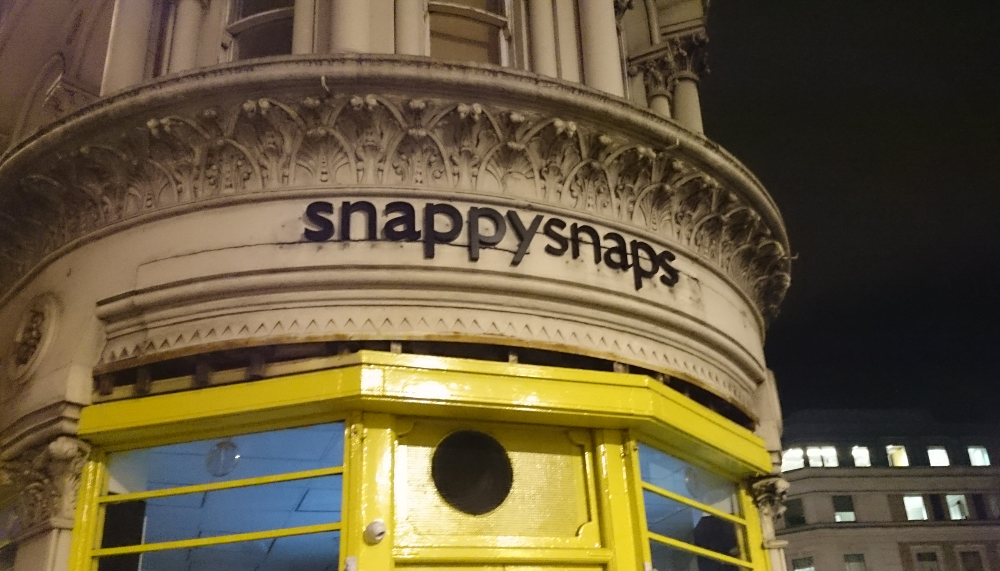
Ironically, a "snapstore" was close to the office ;-)

Ironically, a snapstore was close to the office ;-)

XdgApp and sandboxing of apps was also a big topic, aside from Ubuntu and Endless integration. Fortunately, Alexander Larsson was also there to answer all the sandboxing and XdgApp-questions. I used the time to follow up on a conversation with Alexander we started at FOSDEM this year, about the Limba vs. XdgApp bundling issue. While we are in-line on the sandboxing approach, the way how software is distributed is implemented differently in Limba and XdgApp, and it is bad to have too many bundling systems around (doesn t make for a good story where we can just tell developers ship as this bundling format, and it will be supported everywhere ). Talking with Alex about this was very nice, and I think there is a way out of the too-many-solutions dilemma, at least for Limba and XdgApp I will blog about that separately soon. On the Ubuntu side, a lot of bugs and issues were squashed and changes upstreamed to GNOME, and people were generally doing their best to reduce Richard s bus-factor on the project a little  . I mainly worked on AppStream issues, finishing up the last pieces of appstream-generator and running it against some sample package sets (and later that week against the whole Debian archive). I also started to implement support for showing AppStream issues in the Debian PTS (this work is not finished yet). I also managed to solve a few bugs in the old DEP-11 generator and prepare another release for Ubuntu. We also enjoyed some good Japanese food, and some incredibly great, but also suddenly very expensive Indian food (but that s a different story  ). The most important thing for me though was to get together with people actually using AppStream metadata in software centers and also more specialized places. This yielded some useful findings, e.g. that localized screenshots are not something weird, but actually a wanted feature of Endless for their curated AppStore. So localized screenshots will be part of the next AppStream spec. Also, there seems to be a general need to ship curation information for software centers somehow (which apps are featured? how are they styled? added special banners for some featured apps, app of the day features, etc.). This problem hasn t been solved, since it s highly implementation-specific, and AppStream should be distro-agnostic. But it is something we might be able to address in a generic way sooner or later (I need to talk to people at KDE and Elementary about it). In summary It was a great event! Going to conferences and hackfests always makes me feel like it moves projects leaps ahead, even if you do little coding. Sorting out issues together with people you see in person (rather than communicating with them via text messages or video chat), is IMHO always the most productive way to move forward (yeah, unless you do this every week, but I think you get my point  ). For me, being the only (and youngest ^^) developer at the hackfest who was not employed by any company in the FLOSS business, the hackfest was also motivating to continue to invest spare time into working on these projects. So, the only thing left to do is a huge shout out of THANK YOU to the Ubuntu Community Fund and therefore the Ubuntu community for sponsoring me! You rock! Also huge thanks to Canonical for organizing the sponsoring really quickly, so I didn t get into trouble with paying my flights.

Laney and attente walking on the Millennium Bridge after we walked the distance between Red Hat and Canonical's offices.

Laney and attente on the Millennium Bridge after we walked the distance between Red Hat and Canonical s offices.

To worried KDE people: No, I didn t leave the blue side I just generally work on cross-desktop stuff, and would like all desktops to work as well as possible

Francois Marier: Using DNSSEC and DNSCrypt in Debian

While there is real progress being made towards eliminating insecure HTTP traffic, DNS is a fundamental Internet service that still usually relies on unauthenticated cleartext. There are however a few efforts to try and fix this problem. Here is the setup I use on my Debian laptop to make use of both DNSSEC and DNSCrypt.

DNSCrypt DNSCrypt was created to enable end-users to encrypt the traffic between themselves and their chosen DNS resolver. To switch away from your ISP's default DNS resolver to a DNSCrypt resolver, simply install the dnscrypt-proxy package and then set it as the default resolver either in /etc/resolv.conf:
nameserver 127.0.2.1
if you are using a static network configuration or in /etc/dhcp/dhclient.conf:
supersede domain-name-servers 127.0.2.1;
if you rely on dynamic network configuration via DHCP. There are two things you might want to keep in mind when choosing your DNSCrypt resolver:
  • whether or not they keep any logs of the DNS traffic
  • whether or not they support DNSSEC
I have personally selected a resolver located in Iceland by setting the following in /etc/default/dnscrypt-proxy:
DNSCRYPT_PROXY_RESOLVER_NAME=ns0.dnscrypt.is

DNSSEC While DNSCrypt protects the confidentiality of our DNS queries, it doesn't give us any assurance that the results of such queries are the right ones. In order to authenticate results in that way and prevent DNS poisoning, a hierarchical cryptographic system was created: DNSSEC. In order to enable it, I have setup a local unbound DNSSEC resolver on my machine and pointed /etc/resolv.conf (or /etc/dhcp/dhclient.conf) to my unbound installation at 127.0.0.1. Then I put the following in /etc/unbound/unbound.conf.d/dnscrypt.conf:
server:
    # Remove localhost from the donotquery list
    do-not-query-localhost: no
forward-zone:
    name: "."
    forward-addr: 127.0.2.1@53
to stop unbound from resolving DNS directly and to instead go through the encrypted DNSCrypt proxy.

Reliability In my experience, unbound and dnscrypt-proxy are fairly reliable but they eventually get confused (presumably) by network changes and start returning errors. The ugly but dependable work-around I have found is to create a cronjob at /etc/cron.d/restart-dns.conf that restarts both services once a day:
0 3 * * *    root    /usr/sbin/service dnscrypt-proxy restart
1 3 * * *    root    /usr/sbin/service unbound restart

Captive portals The one remaining problem I need to solve has to do with captive portals. This can be quite annoying when travelling because it requires me to use the portal's DNS resolver in order to connect to the splash screen that unlocks the wifi connection. The dnssec-trigger package looked promising but when I tried it on my jessie laptop, it wasn't particularly reliable. My temporary work-around is to comment out this line in /etc/dhcp/dhclient.conf whenever I need to connect to such annoying wifi networks:
#supersede domain-name-servers 127.0.0.1;
If you've found a better solution to this problem, please leave a comment!

Dirk Eddelbuettel: RcppMgsPack 0.1.0

Over the last few months, I have been working casually on a new package to integrate MessagePack with R. What is MessagePack, you ask? To quote its website, "It's like JSON, but fast and small." Or in more extended terms:
MessagePack is an efficient binary serialization format. It lets you exchange data among multiple languages like JSON. But it's faster and smaller. Small integers are encoded into a single byte, and typical short strings require only one extra byte in addition to the strings themselves.
Now, serialization formats are a dime a dozen: JSON, BSON, Protocol Buffers, CaptnProto, Flatbuffer. The list goes on and on. So why another? In a nutshell: "software ecosystems". I happen to like working with Redis, and within the world of Redis, MessagePack is a first-class citizen supported by things close to the core like the embedded Lua interpreter, as well as fancy external add-ons such as the Redis Desktop Manager GUI. So nothing overly fundamentalist here, but a fairly pragmatic choice based on what happens to fit my needs. Plus, having worked on and off with Protocol Buffers for close to a decade, the chance of working with something not requiring a friggin' schema compiler seemed appealing for a chance. So far, we have been encoding a bunch of data streams at work via MessagePack into Redis (and of course back). It works really well---header-only C++11 libraries for the win. I'll provide an updated RcppRedis which uses this (if present) in due course. For now and the foreseeable future, this RcppMsgPack package will live only on the ghrr drat repository. To make RcppMsgPack work, I currently have to include the MessagePack 1.4.0 headers. A matching package for this version of the headers is in Debian but so far only in experimental. Once this hits the mainline repository I can depend on it, and upload a (lighter, smaller) RcppMsgPack to CRAN. Until then, please just do
## install drat if not present
if (!require(drat)) install.packages("drat")
## use drat to select ghrr repo
drat::addRepo("ghrr")
## install RcppMsgPack
install.packages("RcppMsgPack")
More details, issue tickets etc are at the GitHub repository.

This post by Dirk Eddelbuettel originated on his Thinking inside the box blog. Please report excessive re-aggregation in third-party for-profit settings.

25 April 2016

Antoine Beaupr : My free software activities, April 2016

Debian Long Term Support (LTS) This is my 5th month working on Debian LTS, started by Raphael Hertzog at Freexian. This is my largest month so far, in which I worked on completing the Xen and NSS packages updates from last month, but also spent a significant amount of time working on phpMyAdmin and libidn.

Updates to NSS and Xen completed This basically consisted on following up on the reviews from other security people. I basically continued building up on Brian's work and tested the package on a test server at Koumbit, which seems to have survived well the upgrade. The details are in this post to the debian-lts mailing list. As for NSS, the package was mostly complete, but I forgot to ship the tests for some reason, so I added them back. I also wrote the release team to see if it was possible to update NSS to the same version in all suites. Unfortunately, this issue is still pending, but I still hope we can find better ways of managing that package in the long term.

IDN and phpMyAdmin Most of my time this month was spent working on IDN and phpMyAdmin. Unfortunately, it turns out that someone else had worked on the libidn package. This is partly my fault: I forgot to check in the dsa-needed.txt file for assignment before working on the package. But considering how in flux the workflow currently is with the switch between the main security team and the LTS team for the wheezy maintenance, I don't feel too bad. Still, I prepared a package which was a bit more painful than it should have been because of GNUlib. I didn't even know about GNUlib before, oddly enough, and after that experience, I feel that it should just not exist at all anymore. I have filed a bug to remove that dependency at the very least, but I do not clearly see how such a tool is necessary on Debian at this point in time. But phpMyAdmin, no one had worked on that. And I understand why: even though it's a very popular package, there were quite a few outstanding issues (8!) in Wheezy, with 10-15 patches to be ported. Plus, it's ... well, PHP. And old PHP at that, with parts of it with modern autoloader classes, and other with mixed HTML and PHP content, require (and not require_once) and all sorts of nasty things you still find in the PHP universe. I nevertheless managed to produce a new Debian package for wheezy and test it on Koumbit's test servers. Hopefully, that can land into Wheezy soon.

Long term software support I am a little worried that we are, both in Jessie and Wheezy sitting in between stable releases for phpMyAdmin, something that is a recurring issue for a lot of packages in Debian stable or LTS. Sometimes, it just happens that the version that happens to be in Debian testing when it is released as stable is just not a supported release upstream. It's the case for phpMyAdmin in Jessie (4.3, whereas 4.0 and 4.4 are supported) and Wheezy (3.4, although it's unclear how long that was supported upstream). But even if the next Debian stable (Stretch), would pick a stable release upstream, there is actually no phpMyAdmin release that has a support window as long as Debian stable (roughly 3 years), let alone as long as Debian LTS (5 years). This is a similar problem with NSS: upstream is simply not supporting their product in the long term, or at least not in the terms we are used to in the Debian community (ie. only security fixes or regressions). This is, in my opinion, a real concern for the reliability and sustainability of the computing infrastructure we are creating. While some developers are of the opinion that software older than 18 months is too old, here we are shipping hardware and software in space or we have Solaris, which is supported for 16 years! Now that is a serious commitment and something we can rely on. 18 months is really, really, a tiny short time in the history of our civilization. I know computer programmers and engineers like to think of themselves in elitist terms, that they are changing the world every other year. But the truth is that things have not changed much in the last 4 decades where computing has existed, both in terms of security or functionality. Two quotes from my little quotes collection come to mind here:
Software gets slower faster than hardware gets faster. - Wirth's law The future is already here it's just not very evenly distributed. - William Gibson
Because of course, the response to my claims that computing is not really advancing is "but look! we have supercomputers in our pockets now!" Yes, of course, we do have those fancy phones and they are super-connected, but they are a threat to our fundamental rights and freedom. And those glittering advances always pale in comparison to what could be done if we wouldn't be wasting our time rewriting the same software over and over again on different, often proprietary, platforms, simply because of the megalomaniac fantasies of egoistic programmers. It would be great to build something that lasts, for a while. Software that does not need to be updated every 16 months. You'd think that something as basic as a screensaver release could survive what is basically the range of human infancy. Yet it seems we like to run mindlessly in the minefield of software development, one generation following the other without questioning the underlying assumption of infinite growth that permeates our dying civilization. I have talked about this before of course, but working with the LTS project just unnerves me so bad that I just needed to let out another rant. (For the record, I really have a lot of respect for JWZ and all the work he has done in the free software world. I frequently refer to his "no-bullshit" backup guide and use Xscreensaver daily. But I do think he was wrong in this case: asking Debian to remove Xscreensaver is just too much. The response from the maintainer was exemplary of how to handle such issues in the future. I restarted Xscreensaver after the stable update, and the message is gone, and things are still all fine. Thanks JWZ and Tormod for keeping things rolling.)

Other free software work With that in mind, I obviously didn't stop doing other computing work this month. In fact, I did a lot of work to try to generally fix the internet, that endless and not-quite-gratifying hobby so many of us are destroying our bodies to accomplish.

Build tools I have experimented a bit more with different build tools. I got worried because at some point cowbuilder got orphaned and I figured I could refresh the way I build packages for LTS. I looked into sbuild, but that ended up not bringing much improvements over my current cowbuilder setup (which I really need to document better). I was asked by the new maintainer to open a bug report to make such setups easier by guessing the basepath better, so we'll see how that goes. I did enjoy the simplicity of gitpkg and discovered cowpoke which made it about 2 times faster to build packages because I could use another server to build larger packages. I also found that gitpkg doesn't use -n by default when calling gzip, which makes it harder to reproduce tarballs when they are themselves built reproducibly, which is the case for Github tarballs (really nice of them). So I filed bug #820842 about that. It would be pretty awesome if such buildds would be available for Debian Developers to do their daily tasks. It could simply be a machine that would spin up a chroot with cowbuilder or it could even be a full, temporary VM although that would take way more resources than a simple VM with a cowbuilder setup. In the meantime, I should probably look at whalebuilder as an alternative to cowbuilder. It is a tool that supports building packages within a Docker chroot, which means that packages are built from a clean environment like pbuilder, and using COW optimisations but also without privileges or network access, which is a huge plus especially when you build untrusted packages.

Ikiwiki admonitions I have done some work to implement Moinmoin-like admonitions in Ikiwiki, something I am quite happy about since it's something I was really missing about Moinmoin. Admonitions bring a really nice way to outline certain blocks with varying severity levels and distinct styles. For example:
Admonitions are great!
This was done with a macro, but basically, since Markdown allows more or less arbitrary HTML, this can also be done with the <div> tag. I like that we don't have a new weird markup here. Yet, I still liked the sub-parser feature of MoinMoin, something that can be implemented in Ikiwiki, but it's a little more clunky. Normally, you'd probably do this with the inline macro and subpages, but it's certainly less intuitive that directly inlined content.

Ereader I got a new e-reader! I was hesitant between the Kobo Aura H20 and the Kobo Glo HD, which were the ones available at Bestbuy. So I bought both and figured I would return the other. That was a painful decision! In the end, both machines are pretty nice:
  • Aura H2O
    • Pros:
      • waterproof
      • larger screen (makes it easier to see web pages and better for the eyes)
      • naturally drawn to it
    • Cons:
      • heavier
      • larger (fits in outside pocket though)
      • port cover finicky
      • more expensive (180$) - prices may go down in future
  • Aura Glo HD
    • Pros
      • smaller (fits in inside pocket of both coats)
      • better resolution in theory (can't notice in practice)
      • cheaper (100$)
      • may be less common on the future (larger models more common? just a guess)
    • Cons
      • no SD card
      • smaller screen
      • power button in the middle
... but in the end, I ended up settling down on the Glo, mostly for the price. Heck, I saved around 100$, so for that amount, I could have gotten two machines so that if one breaks I would still have the other. I have ordered a cover for it on Deal Extreme about two weeks ago, and it still hasn't arrived. I suspect it's going to take a few more months to get there, by which point I may have changed e-reader again. Note that both e-readers needed an update to calibre, so I started working on a calibre backport (#818309) which I will complete soon. So anyways, I looked into better ways of transferring articles from the web to the e-reader, something which I do quite a bit to avoid spending too much time on the computer. Since the bookmark manager I use (Bookie) is pretty much dead, I started looking at other alternatives. And partly inspired by Framasoft's choice of Wallabag for their bookmarking service (Framabag), I started to look into that software, especially since my friend who currently runs the Bookie instance is thinking of switching to Wallabag as well. It seems the simplest way to browse articles remotely through a standard protocol is by implementing OPDS support in Wallabag. OPDS is a standard developed in part by the Internet Archive and it allows for browsing book collections and downloading them. Articles and bookmarks would then be presented as individual books that would be accessible from any OPDS-compatible device. Unfortunately, the Kobo e-readers don't support OPDS out of the box: you need to setup some OPDS-compatible reader like Koreader. And that I found nearly impossible to do: I was able to setup KSM (the "start menu", not to be confused with that KSM), but not Koreader in KSM. Besides, I do not want a separate OS running here on the tablet: I just want to start Koreader every once in a while. KSM just starts another system when you reboot the e-reader, something which is not really convenient on the Kobo. Basically, I just want to add Koreader as a tile in the home screen on the e-reader. I found the documentation on that topic to be sparse and hard to follow. It is often dispersed across multiple forum threads and involves uploading random binaries, often proprietary, to the e-reader. It had been a long time since I was asked to "register my software" frenetically, and I hadn't missed that one bit. So I decided to stay away from this until that solution and its documentation matures a bit.

Streaming re-established I have worked a bit on my home radio stream. I simply turned the Liquidsoap stream back online, and did a few tweaks to the documentation that I had built back then. All that experimenting led me to do two NMUs. One was for gmpc-plugins to fix a FTBFS (bug #807735) and to properly kill the shout streamer when completing the playback (bug #820908). The other was to fix the ezstream manpage (bug #573928), a patch that had been sitting there for 5 years! This was to try to find an easy way to stream random audio (say from a microphone) to the Icecast server, something which is surprisingly difficult, consider how basic that functionality is. I was surprised to see that Darkice just completely fails to start (bug #821040) and I had to fallback to the simplest ices2 software to stream the audio. I am still having issues with Liquidsoap: it's really unstable! As a server, I would expect it to keep running for days if not years. Unfortunately, there's always something that makes it crash. I had assertion failed (bug #821112) and I keep seeing it crash after 2-3 days fairly reliably, a bug I reported 3 years ago and that is still not fixed (bug #727307). Switching back the stream to Vorbis (because I was having problems with the commandline mp3 players and ogg123 is much more lightweight) created another set of problems too, this time with the phone. It seems that Android cannot stream Vorbis at all, something that is even worse in Cyanogenmod... I also had to tweak my MPD config to make the Android client be able to load the larger playlists (see dmix buffer is full).

Android apps So I have also done quite a bit of work again on my phone. I finally was told how to access from Termux from adb shell which is pretty cool because now I can start a screen on my phone and then, when I'm tired of tapping to type, I can just reconnect to it when I plug in a USB cable on my laptop. I sent a pull request to fix the documentation regarding that. I also tried to see how my SMS and Signal situation could be improved. Right now, I have two different apps to do SMS on my phone: I use both Signal and the VoIP.ms SMS client, because I do not have a contract or SIM card in my phone. Both work well independently, but it's somewhat annoying to have to switch between the two. (In fact, I feel that Signal itself has an issue with how it depends on the network to send encrypted messages: I often have to "ping" people in clear text (and therefore in the other app) so that they connect to their data plan to fetch my "secure" signal messages...) Anyways, I figured it would be nice if at least there would be a SMS fallback in Signal that would allow me to send regular text messages from signal through Voip.MS. That was dismissed really fast. Moxie even closed the conversation completely, something I had never experienced before, and doesn't feel exactly pleasant. The Voip.MS side was of course not impressed and basically shrugged it off because Signal was not receptive. I also tried to clear up the Libresignal confusion: there are 3 different projects named "Libresignal", and I am not sure I figured out the right thing, even though the issue is now closed and there's a FAQ that is supposed to make all that clear. Nevertheless, I opened two distinct feature requests to try to steer the conversation into a more productive direction: GCM-less calls and GCM support. But I'm not sure neither will go anywhere. In the meantime, I am using the official signal client, which I downloaded using gplaycli and which I keep up to date with Aptoide. Even though the reliability of that site is definitely questionable, it seems that once you have a trusted version, it is safe to upgrade, regardless of the source because there is a trust path between you and the developer. I also filed a few issues with varying levels of success/response from the community:

Random background radiation And then there's of course the monthly background noise of all the projects I happened to not only stumble on, but also file bugs or patches against:

Ricardo Mones: Maximum number of clients reached Error: Can't open display: :0

Today it happened again: you try to open some program and nothing happens. Go to an open terminal, try again and it answers with the above message. Other days I used to reboot the session, but that's something I don't really think should be necessary.

First thought about X gone mad, but this one seems pretty well behaved:

$ lsof -p  pidof Xorg    wc -l
5

Then noticed I had a long running chromium process (a jQuery page monitoring a remote service) so tried this one as well:

$ for a in  pidof chromium ; do echo "$a " lsof -p $a   wc -l ; done
27914 5
26462 5
25350 5
24693 5
23378 5
22723 5
22165 5
21476 222
21474 1176
21443 5
21441 204
21435 546
11644 5
11626 5
11587 5
11461 5
11361 5
9833 5
9726 5

Wow, I'd bet you can guess next command ;-)

$ kill -9 21435 21441 21474 21476

This of course wiped out all chromium processes, but also fixed the problem. Suggestions for selective chromium killing welcome! But I'd better like to know why those files are not properly closed. Just relaunching chromium to write this post yields:

$ for a in  pidof chromium ; do echo "$a " lsof -p $a   wc -l ; done
11919 5
11848 222
11841 432
11815 5
11813 204
11807 398

Which looks a bit exaggerated to me :-(

Norbert Preining: G del and Daemons an excursion into literature

Explaining G del s theorems to students is a pain. Period. How can those poor creatures crank their mind around a Completeness and an Incompleteness Proof I understand that. But then, there are brave souls using G del s theorems to explain the world of demons to writers, in particular to answer the question:

You can control a Demon by knowing its True Name, but why?
goedel-glabrezu Very impressive. Found at worldbuilding.stackexchange.com, pointed to me by a good friend. I dare to full quote author Cort Ammon (nothing more is known), to preserve this masterpiece. Thanks!!!!
Use of their name forces them to be aware of the one truth they can never know. Tl/Dr: If demons seek permanent power but trust no one, they put themselves in a strange position where mathematical truisms paint them into a corner which leaves their soul small and frail holding all the strings. Use of their name suggests you might know how to tug at those strings and unravel them wholesale, from the inside out! Being a demon is tough work. If you think facing down a 4000lb Glabrezu without their name is difficult, try keeping that much muscle in shape in the gym! Never mind how many manicurists you go through keeping the claws in shape! I don t know how creative such demons truly are, but the easy route towards the perfect French tip that can withstand the rigors of going to the gym and benching ten thousand pounds is magic. Such a demon might learn a manicure spell from the nearby resident succubi. However, such spells are often temporary. No demon worth their salt is going to admit in front of a hero that they need a moment to refresh their mani before they can fight. The hero would just laugh at them. No, if a demon is going to do something, they re going to do it right, and permanently. Not just nice french tips with a clear lacquer over the top, but razor sharp claws that resharpen themselves if they are blunted and can extend or retract at will! In fact, come to think of it, why even go to the gym to maintain one s physique? Why not just cast a magic spell which permanently makes you into the glorious Hanz (or Franz) that the trainer keeps telling you is inside you, just waiting to break free. Just get the spell right once, and think of the savings you could have on gym memberships. Demons that wish to become more powerful, permanently, must be careful. If fairy tales have anything to teach is, it s that one of the most dangerous things you can do is wish for something forever, and have it granted. Forever is a very long time, and every spell has its price. The demon is going to have to make sure the price is not greater than the perks. It would be a real waste to have a manicure spell create the perfect claws, only to find that they come with a peculiar perchance to curve towards one s own heart in an attempt to free themselves from the demon that cast them. So we need proofs. We need proofs that each spell is a good idea, before we cast it. Then, once we cast it, we need proof that the spell actually worked intended. Otherwise, who knows if the next spell will layer on top perfectly or not. Mathematics to the rescue! The world of First Order Logic (FOL, or herefter simply logic ) is designed to offer these guarantees. With a few strokes of a pen, pencil, or even brush, it can write down a set of symbols which prove, without a shadow of a doubt, that not only will the spell work as intended, but that the side effects are manageable. How? So long as the demon can prove that they can cast a negation spell to undo their previous spell, the permanency can be reverted by the demon. With a few more fancy symbols, the demon can also prove that nobody else outside of the demon can undo their permanency. It s a simple thing for mathematics really. Mathematics has an amazing spell called reductio ad infinitum which does unbelievable things. However, there is a catch. There is always a catch with magic, even when that magic is being done through mathematics. In 1931, Kurt G del published his Incompleteness Theorems. These are 3 fascinating works of mathematical art which invoke the true names of First Order Logic and Set Theory. G del was able to prove that any system which is powerful enough to prove out all of algebra (1 + 1 = 2, 2 + 1 = 3, 3 * 5 = 15, etc.), could not prove its own validity. The self referential nature of proving itself crossed a line that First Order Logic simply could not return from. He proved that any system which tries must pick up one of these five traits: If the demon wants itself to be able to cancel the spell, his proof is going to have to include his own abilities, creating just the kind of self referential effects needed to invoke G del s incompleteness theorems. After a few thousand years, the demon may realize that this is folly. A fascinating solution the demon might choose is to explore the incomplete solution to G del s challenge. What if the demon permits the spell to change itself slightly, but in an unpredictable way. If the demon was a harddrive, perhaps he lets a single byte get changed by the spell in a way he cannot expect. This is actually enough to sidestep G del s work, by introducing incompleteness. However, now we have to deal with pesky laws of physic and magics. We can t just create something out of nothing, so if we re going to let the spell change a single byte of us, there must be a single byte of information, its dual, that is unleashed into the world. Trying to break such conservation laws opens up a whole can of worms. Better to let that little bit go free into the world. Well, almost. If you repeat this process a whole bunch of times, layering spells like a Matryoska doll, you re eventually left with a soul that is nothing but the leftover bits of your spells that you simply don t know enough about to use. If someone were collecting those bits and pieces, they might have the undoing of your entire self. You can t prove it, of course, but its possible that those pieces that you sent out into the world have the keys to undo your many layers of armor, and then you know they are the bits that can nullify your soul if they get there. So what do you do? You hide them. You cast your spells only on the darkest of nights, deep in a cave where no one can see you. If you need assistants, you make sure to ritualistically slaughter them all, lest one of them know your secret and whisper it to a bundle of reeds, The king has horns, if you are familiar with the old fairy tale. Make it as hard as possible for the secret to escape, and hope that it withers away to nothingness before someone discovers it, leaving you invincible. Now we come back to the name. The demon is going to have a name it uses to describe its whole self, including all of the layers of spellcraft it has acquired. This will be a great name like Abraxis, the Unbegotten Father or Satan, lord of the underworld. However, they also need to keep track of their smaller self, their soul. Failure to keep track of this might leave them open to an attack if they had missed a detail when casting their spells, and someone uncovered something to destroy them. This would be their true name, potentially something less pompous, like Gaylord Focker or Slartybartfarst. They would never use this name in company. Why draw attention to the only part of them that has the potential to be weak. So when the hero calls out for Slartybartfarst, the demon truly must pay attention. If they know the name the demon has given over the remains of their tattered soul, might they know how to undo the demon entirely? Fear would grip their inner self, like a child, having to once again consider that they might be mortal. Surely they would wish to destroy the hero that spoke the name, but any attempt runs the risk of falling into a trap and exposing a weakness (surely their mind is racing, trying to enumerate all possible weaknesses they have). It is surely better for them to play along with you, once you use their true name, until they understand you well enough to confidently destroy you without destroying themselves. So you ask for answers which are plausible. This one needs no magic at all. None of the rules are invalid in our world today. Granted finding a spell of perfect manicures might be difficult (believe me, some women have spent their whole life searching), but the rules are simply those of math. We can see this math in non-demonic parts of society as well. Consider encryption. An AES-256 key is so hard to brute force that it is currently believed it is impossible to break it without consuming 3/4 of the energy in the Milky Way Galaxy (no joke!). However, know the key, and decryption is easy. Worse, early implementations of AES took shortcuts. They actually left the signature of the path they took through the encryption in their accesses to memory. The caches on the CPU were like the reeds from the old fable. Merely observing how long it took to read data was sufficient to gather those reeds, make a flute, and play a song that unveils the encryption key (which is clearly either The king has horns or 1-2-3-4-5 depending on how secure you think your luggage combination is). Observing the true inner self of the AES encryption implementations was enough to completely dismantle them. Of course, not every implementation fell victim to this. You had to know the name of the implementation to determine which vulnerabilities it had, and how to strike at them. Or, more literally, consider the work of Alfred Whitehead, Principia Mathematica. Principia Mathematica was to be a proof that you could prove all of the truths in arithmetic using purely procedural means. In Principia Mathematica, there was no manipulation based on semantics, everything he did was based on syntax manipulating the actual symbols on the paper. G del s Incompleteness Theorem caught Principia Mathematica by the tail, proving that its own rules were sufficient to demonstrate that it could never accomplish its goals. Principia Mathematica went down as the greatest Tower of Babel of modern mathematical history. Whitehead is no longer remembered for his mathematical work. He actually left the field of mathematics shortly afterwards, and became a philosopher and peace advocate, making a new name for himself there. (by Cort Ammon)

24 April 2016

Bits from Debian: Debian welcomes its 2016 summer interns

GSoC 2016 logo Outreachy logo We're excited to announce that Debian has selected 29 interns to work with us this summer: 4 in Outreachy, and 25 in the Google Summer of Code. Here is the list of projects and the interns who will work on them: Android SDK tools in Debian: APT - dpkg communications rework: Continuous Integration for Debian-Med packages: Extending the Debian Developer Horizon: Improving and extending AppRecommender: Improving the debsources frontend: Improving voice, video and chat communication with Free Software: MIPS and MIPSEL ports improvements: Reproducible Builds for Debian and Free Software: Support for KLEE in Debile: The Google Summer of Code and Outreachy programs are possible in Debian thanks to the effort of Debian developers and contributors that dedicate part of their free time to mentor students and outreach tasks. Join us and help extend Debian! You can follow the students weekly reports on the debian-outreach mailing-list, chat with us on our IRC channel or on each project's team mailing lists. Congratulations to all of them!

Dirk Eddelbuettel: Brad Mehldau at the CSO, again

Almost seven years since the last time we saw him here, Brad Mehldau returned to the CSO for a concert on Friday eve in his standard trio setup with Larry Grenadier on bass and Jeff Ballard on drums. The material mostly (all?) new and drawn from the upcoming album Blues and Ballads. The morning of the concert---which happened to be the final one in their tour---he retweeted a bit from this review in the Boston Globe
[Brad Mehldau] flashed facets of his renowned pianism: crystalline touch, deep lyricism, harmonic sophistication, adroit use of space, and the otherworldly independence of his right and left hands.
I cannot really describe his style any better than this. If you get a chance to see him, go!

Daniel Pocock: LinuxWochen, MiniDebConf Vienna and Linux Presentation Day

Over the coming week, there are a vast number of free software events taking place around the world. I'll be at the LinuxWochen Vienna and MiniDebConf Vienna, the events run over four days from Thursday, 28 April to Sunday, 1 May. At MiniDebConf Vienna, I'll be giving a talk on Saturday (schedule not finalized yet) about our progress with free Real-Time Communications (RTC) and welcoming 13 new GSoC students (and their mentors) working on this topic under the Debian umbrella. On Sunday, Iain Learmonth and I will be collaborating on a workshop/demonstration on Software Defined Radio from the perspective of ham radio and the Debian Ham Radio Pure Blend. If you want to be an active participant, an easy way to get involved is to bring an RTL-SDR dongle. It is highly recommended that instead of buying any cheap generic dongle, you buy one with a high quality temperature compensated crystal oscillator (TXCO), such as those promoted by RTL-SDR.com. Saturday, 30 April is also Linux Presentation Day in many places. There is an event in Switzerland organized by the local local FSFE group in Basel. DebConf16 is only a couple of months away now, Registration is still open and the team are keenly looking for additional sponsors. Sponsors are a vital part of such a large event, if your employer or any other organization you know benefits from Debian, please encourage them to contribute.

22 April 2016

Matthew Garrett: Circumventing Ubuntu Snap confinement

Ubuntu 16.04 was released today, with one of the highlights being the new Snap package format. Snaps are intended to make it easier to distribute applications for Ubuntu - they include their dependencies rather than relying on the archive, they can be updated on a schedule that's separate from the distribution itself and they're confined by a strong security policy that makes it impossible for an app to steal your data.

At least, that's what Canonical assert. It's true in a sense - if you're using Snap packages on Mir (ie, Ubuntu mobile) then there's a genuine improvement in security. But if you're using X11 (ie, Ubuntu desktop) it's horribly, awfully misleading. Any Snap package you install is completely capable of copying all your private data to wherever it wants with very little difficulty.

The problem here is the X11 windowing system. X has no real concept of different levels of application trust. Any application can register to receive keystrokes from any other application. Any application can inject fake key events into the input stream. An application that is otherwise confined by strong security policies can simply type into another window. An application that has no access to any of your private data can wait until your session is idle, open an unconfined terminal and then use curl to send your data to a remote site. As long as Ubuntu desktop still uses X11, the Snap format provides you with very little meaningful security. Mir and Wayland both fix this, which is why Wayland is a prerequisite for the sandboxed xdg-app design.

I've produced a quick proof of concept of this. Grab XEvilTeddy from git, install Snapcraft (it's in 16.04), snapcraft snap, sudo snap install xevilteddy*.snap, /snap/bin/xevilteddy.xteddy . An adorable teddy bear! How cute. Now open Firefox and start typing, then check back in your terminal window. Oh no! All my secrets. Open another terminal window and give it focus. Oh no! An injected command that could instead have been a curl session that uploaded your private SSH keys to somewhere that's not going to respect your privacy.

The Snap format provides a lot of underlying technology that is a great step towards being able to protect systems against untrustworthy third-party applications, and once Ubuntu shifts to using Mir by default it'll be much better than the status quo. But right now the protections it provides are easily circumvented, and it's disingenuous to claim that it currently gives desktop users any real security.

comment count unavailable comments

21 April 2016

Alessio Treglia: Corporate Culture in the Transformative Enterprise

alberoVitaThe accelerated world of the Western or Westernized countries seems to be fed by an insidious food, which generates a kind of psychological dependence: anxiety. The economy of global markets cannot help it, it has a structural need of it to feed their iron logic of survival. The anxiety generated in the masses of consumers and in market competitors is crucial for Companies fighting each other and now they can only live if men are projected to objective targets continuously moving forward, without ever allowing them to achieve a stable destination.

The consumer is thus constantly maintained in a state of perpetual breathlessness, always looking for the fresh air of liberation that could eventually reduce his tension. It is a state of anxiety caused by false needs generated by advertising campaigns whose primary purpose is to create a need, to interpret to their advantage a still confused psychological demand leading to the destination decided by the market <Read More [by Fabio Marzocca]>

20 April 2016

Ben Hutchings: Experiments with signed kernels and modules in Debian

I've lately been working on support for Secure Boot in Debian, mostly in the packages maintained by the kernel team. My instructions for setting up UEFI Secure Boot are based on OVMF running on KVM/QEMU. All 'Designed for Windows' PCs should allow reconfiguration of SB, but it may not be easy to do so. They also assume that the firmware includes an EFI shell. Updated: Robert Edmonds pointed out that the 'Designed for Windows' requirements changed with Windows 10: The ability to reconfigure SB is indeed now optional for devices which are designed to always boot with a specific Secure Boot configuration. I also noticed that the requirements say that OEMs should not sign an EFI shell binary. Therefore I've revised the instructions to use efibootmgr instead. Background UEFI Secure Boot, when configured and enabled (which it is on most new PCs) requires that whatever it loads is signed with a trusted key. The one common trusted key for PCs is held by Microsoft, and while they will sign other people's code for a nominal fee, they require that it also validates the code it loads, i.e. the kernel or next stage boot loader. The kernel in turn is responsible for validating any code that could compromise its integrity (kernel modules, kexec images). Currently there are no such signed boot loaders in Debian, though the shim and grub-signed packages included in many other distributions should be usable. However it's possible to load an appropriately configured Linux kernel directly from the UEFI firmware (typically through the shell) which is what I'm doing at the moment. Packaging signed kernels Signing keys obviously need to be protected against disclosure; the private keys can't be included in a source package. We also won't install them on buildds separately, and generating signatures at build time would of course be unreproducible. So I've created a new source package, linux-signed, which contains detached signatures prepared offline. Currently the binary packages built from linux-signed also contain only detached signatures, which are applied as necessary at installation time. The signed kernel image (only on x86 for now) is named /boot/vmlinuz-kversion.efi.signed. However, since packages must not modify files owned by another package and I didn't want to dpkg-divert thousands of modules, the module signatures remain detached. Detached module signatures are a new invention of mine, and require changes in kmod and various other packages to support them. (An alternate might be to put signed modules under a different directory and drop a configuration file in /lib/depmod.d to make them higher priority. But then we end up with two copies of every module installed, which can be a substantial waste of space.) Preparation The packages you need to repeat the experiment: For Secure Boot, you'll then need to copy the signed kernel and the initrd onto the EFI system partition, normally mounted at /boot/efi. SB requires a Platform Key (PK) which will already be installed on a real PC. You can replace it but you don't need to. If you're using OVMF, there are no persistent keys so you do need to generate your own:
openssl req -new -x509 -newkey rsa:2048 -keyout pk.key -out pk.crt \
    -outform der -nodes
You'll also need to install the certificate for my kernel image signing key, which is under debian/certs in the linux-signed package. OVMF requires this in DER format:
openssl x509 -in linux-signed-1~exp3/debian/certs/linux-image-benh@debian.org.cert.pem \
    -out linux.crt -outform der 
You'll need to copy the certificate(s) to a FAT-formatted partition such as the EFI system partition, so that the firmware can read it. Use efibootmgr to add a boot entry for the kernel, for example:
efibootmgr -c -d /dev/sda -L linux-signed -l '\vmlinuz.efi' -u 'initrd=initrd.img root=/dev/sda2 ro quiet'
You should use the same kernel parameters as usual, except that you also need to specify the initrd filename using the initrd= parameter. The EFI stub code at the beginning of the kernel will load the initrd using EFI boot services. Enabling Secure Boot
  1. Reboot the system and enter UEFI setup
  2. Find the menu entry for Secure Boot customisation (in OVMF, it's under 'Device Manager' for some reason)
  3. In OVMF, enrol the PK from pk.crt
  4. Add linux.crt to the DB (whitelist database)
  5. Ensure that Secure Boot is enabled and in 'User Mode'
Booting the kernel in Secure Boot If all went well, Linux will boot as normal. You can confirm that Secure Boot was enabled by reading /sys/kernel/security/securelevel, which will contain 1 if it was. Module signature validation Module signatures are now always checked and unsigned modules will be given the 'E' taint flag. If Secure Boot is used or you add the kernel parameter module.sig_enforce=1, unsigned modules will be rejected. You can also turn on signature enforcement and turn off various other methods of modifying kernel code (such as kexec) by writing 1 to /sys/kernel/security/securelevel.

Next.

Previous.