Search Results: "az"

5 September 2007

Adam Rosi-Kessel: The biggest thing in their life is word of mouth

Spot-on profile of Rick Rubin and the future of music in this Sunday’s New York Times Magazine (probably already much blogged about):
The kids all said that a) no one listens to the radio anymore, b) they mostly steal music, but they don’t consider it stealing, and c) they get most of their music from iTunes on their iPod. They told us that MySpace is over, it’s just not cool anymore; Facebook is still cool, but that might not last much longer; and the biggest thing in their life is word of mouth. That’s how they hear about music, bands, everything.
That last point is key. If any new business model will thrive, it will be one that is built around the social graph. Technorati Tags: , , , , , ,

3 September 2007

Felipe Augusto van de Wiel: 3 Sep 2007

To Blog, or Not To Blog...

Amazon: in the hands of a few
Thinking about writing something for a while, about my Debian work or about my daily stuff, sometimes you lack the time or the motivation to do so, I should kept this more up-to-date so people can follow a little bit what's going on with me... specially considering that I try to keep this diary neutral about non-technical subjects, but hey! it is somewhat hard to be neutral in every single situation. Anyway, I found that I should help to spread the word from a Brazilian colleague, Sulamita, she posted about democracy (or the lack of it) today. Two videos, about the Amazon Forest area and some of the crazy things we find in Brazil. You can watch the Brazilian Portuguese version or the English one.

A lot of people are not aware of some of the political problems that Brazil faces in the last 10 years, it is not like it doesn't exist before, but it is getting worst and worst and, for a while, I've been wondering...
    A lot of friends want to leave Brazil as soon as they can, I love Brazil but I can understand their motivation.

  • Where do you find the desire to stay when you look around and you can't find fairness and equality? And if you look to the houses or places that should protect people, you realize that there is no protection?
  • How do you keep the passion for a country with huge levels of corruption in public government, in police forces, in your law makers? And day after day, corruption schemas, robbery and law abuse are noticed on the television?
  • What to do when you realize that the perception of the disloyal advantage is shared among your colleagues and that the feeling of failure dominates a great part of the population that could actually do something to change?
  • Can anybody, or group of individuals, feeling alone, work to change that? How? Specially when you look around and although you know there are people willing to help they need to take care of their lives (money, food, family)?
Or should I ask: Where's the love? (Black Eyed Peas Lyrics).

And before somebody thinks that the entire Brazil is lost, that we are under a Civil War and that monkeys and other animals are walking on our Jungle streets in the middle of the cities, no it is not... yes, we need help; yes people need to join forces; yes, we need to find ourselves and fix it; but it is still a great country to live, and yes, I love it!
Thanks: beraldo and sysdebug. And I'm happy to discover that advogato upgraded my status, I'm now a Journeyer.

Andrew Pollock: [life] Fwor

Sarah and finally got around to seeing the latest Harry Potter movie tonight. One of the trailers before it was for The Seeker: The Dark Is Rising. It was spine-tingling to think that my favourite series from Year Eight is going to be a movie. I'm curious as to whether they're going to make individual movies for each book of The Dark Is Rising Sequence, or try and cram it all into the one movie, and how true to the book (or books) it'll end up being. The trailer already raises doubts it's going to be that true to the books, but it'll still be cool to see how it turns out.

Dirk Eddelbuettel: Another Herbie Hancock concert

Herbie Hancock was in town to open this year's Chicago Jazz Festival with a concert at the CSO last Thursday. This time he came with a mostly-electric setup featuring Nathan East on bass, Vinnie Colaiuta on drums and Lionel Loueke on guitar. I found it at times a little heavy on the synthesizers, but it was evident that Hancock and the band enjoyed themselves during the two hour set. A nice concert, all in all, and again very different from his last two concerts.

2 September 2007

MJ Ray: Current Issues / Re: Recycling

How are you lot getting on with North Somerset Recycling?

Badly.  I thought West Norfolk recycling was pretty awful (glass not collected at doorstep) but North Somerset is worse. Do this with one thing, that with another.  Why the blue blazes can't we have national consistency like Spain and Germany seem to?

Let me see if I've got this right:-

Paper, tins and glass can just go in the green boxes. Cloth has to be bagged and put in the green boxes.

Garden waste and corrugated cardboard can go in the green bags, but you have to remove all tape (even bio-degradable) from cardboard, put your address in the little pouch and put out a stone to weigh the bag down, else they'll not empty it.

Non-corrugated cardboard, plastics types 1 and 2 and electrical equipment have to be taken to the tip (which is awkward without using a car - try it some time).

Drinks cartons have to be put into a special wheeliebin next to Tesco's car park.

Finally, batteries have to posted to Norfolk in an envelope you can get from Sainsburys.

Figuring that out has only taken me a year... Did I miss anything? :-/

31 August 2007

Russell Coker: Carbon Geo-Sequestration

My post about Why Hydrogen Powered Cars Will Never Work has received a record number of comments. Some of them suggested that carbon geo-sequestration (storing carbon-dioxide at high pressure under-ground) is the solution to the climate change problem. The idea is that you can mix natural gas or coal gas with steam at high temperature to give carbon-dioxide and hydrogen. Then the carbon dioxide gets stored under-ground while the hydrogen is used for relatively clean fuel. Beyond Zero Emissions has produced a media release about the fallacies expressed in the FutureGen document promoting so-called “clean-coal”, the best content is in their PDF document titled FutureGen Conceptual Design Retort. Note that I did some research to support the preparation of the retort, I am not referencing them to support my arguments but as background information. One overwhealming problem with geo-sequestration for coal based power plants is that it is significantly more expensive than the current coal-fired power plant design. Currently the price difference between coal power and wind power is quite small and there are several technologies that are almost ready for production which will decrease the cost of wind power, it is expected that before so-called “clean coal” becomes viable (they are planning for the first production plants to go live in 2022) the cost of renewable energy will be lower than the current cost of coal power. There is no reasonable possibility of “clean coal” being cheaper than renewable energy. The underground reservoirs that could be used for storing CO2 currently contain brine, which can contain toxic metals and radioactive substances (according to the Bureau of Land and Water Quality in the US). If toxic and radioactive substances need to be pumped out to make room for CO2 then it’s hardly a clean process! The US Geological Survey has an interesting page about volcanic gas. Apparently it’s not uncommon for small animals to be killed when CO2 forms pools in low lying areas. If (when?) CO2 escapes from geo-sequestration the same might happen with humans. They also have a page about CO2 killing trees at Mammoth Mountain! Before I read this I never realised that plants could be killed by excessive CO2. Apparently tree roots need oxygen and CO2 in the ground will kill them. The release of 300 tons of CO2 per day killed 100 acres of trees. The FutureGen trial power plant is designed to support sequestration of over 1,000,000 tons of CO2 per year (that is over 2,700 tons per day). If it leaked at 1/9 that rate then damage comparable to Mammoth Mountain would be the result. Note that the FutureGen trial plant will be a fraction of the size of a real coal power station so an escape of significantly less than 1/9 of the CO2 from a real sequestration plant would have such a bad result. It’s interesting to note that tents and basements are documented as CO2 risks, so I guess we have to avoid camping in areas near power plants! What would happen if a large geo-sequestration project had a sudden failure? IE if the reservoir broke and all the CO2 erupted suddenly? We already have an answer to this question because such things have happened in the past. In 1986 in Cameroon 1.2 cubic kilometers of CO2 gas was released from a volcanic lake, that is 2,400,000 tons (or just over two years of output from the proposed FutureGen plant). It killed over 2000 people. What might happen if 10 years of output from a commercial scale coal power plant was suddenly released into the atmosphere? As far as I know there has been no research on de-sequestration of CO2. If a reservoir is discovered to be unstable after 20,000,000 tons of CO2 have been stored in it, what will we do? Geo-sequestration of CO2 makes nuclear power plants seem safe by comparison.

Pierre Machard: Install Debian on Dell Vostro200

Recently, at work we changed our desktop computers. I’ve been faced to difficulties with a Dell Vostro200. Vostro had no OS. The hardware is still very recent. After 2 days I finally succeed in it. : The content of my box : (lspci and lspci -v).

migus@dazibao:~$ lspci
00:00.0 Host bridge: Intel Corporation 82G33/G31/P35/P31 Express DRAM Controller (rev 02)
00:01.0 PCI bridge: Intel Corporation 82G33/G31/P35/P31 Express PCI Express Root Port (rev 02)
00:19.0 Ethernet controller: Intel Corporation 82562V-2 10/100 Network Connection (rev 02)
00:1a.0 USB Controller: Intel Corporation 82801I (ICH9 Family) USB UHCI Controller #4 (rev 02)
00:1a.1 USB Controller: Intel Corporation 82801I (ICH9 Family) USB UHCI Controller #5 (rev 02)
00:1a.2 USB Controller: Intel Corporation 82801I (ICH9 Family) USB UHCI Controller #6 (rev 02)
00:1a.7 USB Controller: Intel Corporation 82801I (ICH9 Family) USB2 EHCI Controller #2 (rev 02)
00:1b.0 Audio device: Intel Corporation 82801I (ICH9 Family) HD Audio Controller (rev 02)
00:1d.0 USB Controller: Intel Corporation 82801I (ICH9 Family) USB UHCI Controller #1 (rev 02)
00:1d.1 USB Controller: Intel Corporation 82801I (ICH9 Family) USB UHCI Controller #2 (rev 02)
00:1d.2 USB Controller: Intel Corporation 82801I (ICH9 Family) USB UHCI Controller #3 (rev 02)
00:1d.7 USB Controller: Intel Corporation 82801I (ICH9 Family) USB2 EHCI Controller #1 (rev 02)
00:1e.0 PCI bridge: Intel Corporation 82801 PCI Bridge (rev 92)
00:1f.0 ISA bridge: Intel Corporation 82801IR (ICH9R) LPC Interface Controller (rev 02)
00:1f.2 IDE interface: Intel Corporation 82801IR/IO/IH (ICH9R/DO/DH) 4 port SATA IDE Controller (rev 02)
00:1f.3 SMBus: Intel Corporation 82801I (ICH9 Family) SMBus Controller (rev 02)
00:1f.5 IDE interface: Intel Corporation 82801I (ICH9 Family) 2 port SATA IDE Controller (rev 02)
01:00.0 VGA compatible controller: ATI Technologies Inc RV516 [Radeon X1300/X1550 Series]
01:00.1 Display controller: ATI Technologies Inc RV516 [Radeon X1300 Pro] (Secondary)
02:01.0 FireWire (IEEE 1394): Agere Systems FW323 (rev 61)
So let me explain how I did.
  1. First, I used a netboot. I downloaded a recent netboot.tar.gz (from Debian website). I downloaded a daily image and use a Netboot PXE.. Not all the netboot.tar.gz are working… (That is to say, that I am not sure that all daily snapshot are working). I used this tarball:
    http://migus.nerim.net/vostro200/netboot.tar.gz
    I tried to build my own netboot.tar.gz without success. IRQ conflicts always vanished the debian-installer. I wish I had included the lastest e1000 drivers in my netboot…
  2. I had a problem of network hardware (Intel e1000 included in vostro 200 is too recent). So
  3. I decided to plug the time of my install an old 10OMb/s Ethernet card (e100 with PXE).
  4. Very quickly I had IRQ conflicts that blocked the disk detection. (SATA Controller had timeout).
  5. I passed the following arguments to the install command line acpi=off  irqpoll  vga=791
  6. Everything went well. The installer finished its work. The box rebooted.
  7. I downloaded module assistant, kernel-headers, gcc : aptitude install module-assistant gcc linux-headers-2.6.21-2
    and the e1000 driver from http://sourceforge.net/projects/e1000/. I just run make install
  8. (for lspci I ran a update-pciids (8)).
Everyting work well since :-) Conclusion :
1) Install an old PCI Ethernet card with PXE
2) Install DHCP + PXE
2a) Find a netboot.tar.gz that work without freeze. (the tarball on my website works)
2b)Do not forget to plug your USB keyboard in the usb connector just bellow your ethernet connector. (If you don’t for an unknown reason, when you type on a key, Your box get it twice….)
3) Tune the installer command line : acpi=off  irqpoll
[let’s the installer worked]
4) Download e1000 driver
5) Remove your old PCI Ethernet Card.
6) Be happy
6a)If you want to enable acpi into your desktop, once you installed your system you can try acpi=noirq irqpoll.

Russell Coker: Interesting Ideas from George Monbiot

Here is a transcript of a lecture by George Monbiot about climate change and what we need to do. The latest scientific evidence suggests that we need to cut emissions to zero by 2030 to avoid significant increases in the sea level over the next century, George describes some options that will form part of a solution to this problem. Below are my comments on what I consider the most interesting (the ideas that I hadn’t heard of before), I recommend reading the full article for the rest.
  1. Have a carbon ration for each citizen. Wealthy people who want to use more resources could buy carbon rations from poorer people on an open market. That way people who use less than their ration still have an incentive to save more because the extra savings are worth money! As everyone would then have a financial incentive to reduce emissions there would be a lot of new development of methods and technologies for eliminating or compensating for carbon emissions, capitalism works!

  2. Build battery powered cars with interchangeable batteries. The idea is that you rent a battery from a fuel company, and whenever it runs low you go to a service station and swap it for a fully charged battery (for a small fee). If doing this the service station could use cheap night-time electricity to charge the batteries, and the batteries that are charged could be used to put electricity back into the grid at times of peak demand. A common idea is to have Prius+ type vehicles charge from the grid when not being used and then sell electricity back to the grid at peak times. Implementing such a system for millions of homes is technically challenging and expensive. But having a much smaller number of service stations sell larger quantities of electricity back to the grid is easier to manage.

  3. Reduce air travel by 90%. I wonder how much of this can be achieved by using high-speed trains for all national travel systems and for most travel within the EU. I have often travelled between Amsterdam and London by train, it’s much more civilised than flying.

  4. Classic quote from George on John Howard: “if Howard believes a slight reduction in consumption is a recessionary measure he ought to see what a total reduction of land area would be as a result of the melting of the west Antarctic ice sheet. The two things are just completely out of proportion..”

George Monbiot also has recently released a new book Heat: How to Stop the Planet from Burning.

John Goerzen: The Story of One Barn

img_2575

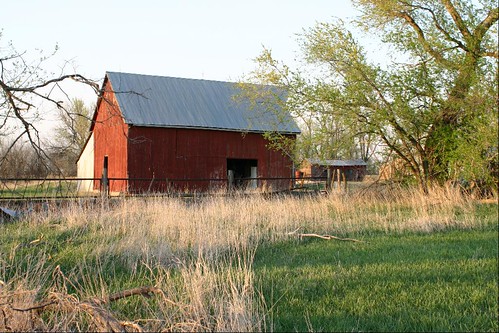
About 80 years ago, a Kansas family -- the Janzens -- built this barn.

About 60 years ago, my grandparents moved onto the farm. Their cattle were kept right here. I remember Grandpa's red tractor being parked in the barn.

So many memories have this barn in the background. We had a visit from one of the Janzens that lived here as a child. He had fond memories of this building. My dad and his siblings once played in the deep snow in front of this barn.

Here's one memory from those times:
078.jpg

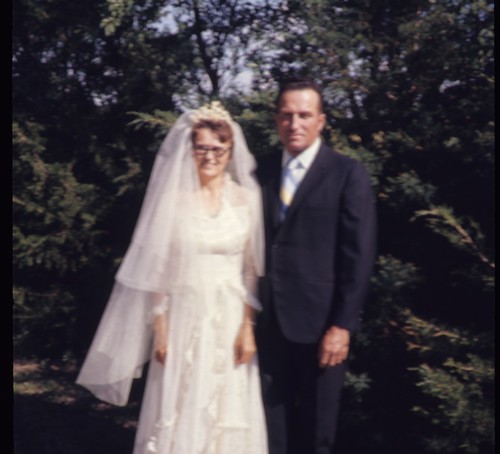
That's my grandma and grandpa on their 25th anniversary in 1970. It was a working barn back then, so they probably weren't standing right next to it for this picture, if you get my drift. But they were on the yard.

About 25 years ago, Grandma lost her battle with cancer. At some point or another, Grandpa had eased out of farming, so the barn had a lot less activity. I remember exploring his outbuildings when I got bored at family gatherings. And I used to mow the lawn next to it every summer when Grandpa went off to be a cook at a camp. I didn't mind mowing next to the barn. But I always tried to go past one corner of the house as fast as I could, because there were wasp and hornet nests right there.

About 7 years ago, it was time for Grandpa to move off the farm. It was getting to be too much to keep up the old house, the barn, the yard, and deal with things like freezing water pipes and water getting in through the windows. He moved to an independent-living duplex in town. He was always worried about what would happen to the farm. Over the next few years, the farm would sometimes be vacant, sometimes have renters. Some renters did some work on the house, but the barn sat. Grandpa would eventually move into the nursing home because of his Parkinson's.

Two and a half years ago, Grandpa passed away. I shared some memories from Grandpa's place at the funeral.

But what of the house, the farm now? Renters went, and it sat empty. Nothing was in great shape, and the house needed a lot of work. Perhaps the whole place would be leveled and turned back into the prairie that it once was, or used as farmland. Perhaps someone would have an interest someday.

A year and a half ago, Jacob was on the way. Terah and I had occasionally thought of buying Grandpa's place, but we never talked about it seriously. We figured that we better finally decide what we're doing, before we have a baby around, or a child in school. So in April 2006, we went out to the farm and checked it out. The picture at the top of this post is from that visit. Terah and I checked out the house, the barns, the granary, the pasture, and the creek. As we walked past one of the barns, a pigeon flew out. Terah jumped with a shout. I grew up around barns and didn't really notice it. In the big red barn, besides Grandpa's tractor, we found some remnants from years ago: some old bales, corn cobs that raccoons had found long ago, several generations of electric fencers, old appliances.

And we decided to go for it and buy the farm. This was right at a year after Grandpa died.

The family always liked to get together for Easter. What would happen for 2006? Well, they decided to have a picnic out at the farm. It was vacant, and a bit eerie. Yet they knew that we were working on buying the place and moving in. All but one took a last look through the house before our renovations began. The one person who didn't was my great aunt, Grandma's sister. She said, "I haven't been in this house for years. I remember how it looked back then. I don't want to remember how it looks now, run down like this. So I'm not going in. But once you have it all fixed up, THEN I'll go in!"

In June of 2006, we bought the farm.

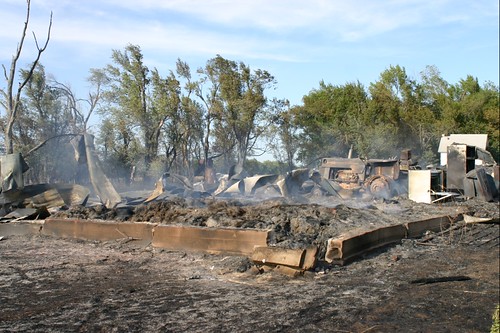
One month later, we lost this barn, and two other buildings, to a fire at our yard. This is what the beautiful red barn looked like that sad afternoon last year:
IMG_3630.JPG

As I wrote back then, nobody got hurt, the barn was insured, but "somehow, despite all these things, it still feels like we lost a little bit of Grandpa today."

2006 was a hot, dry summer. We had a patch of debris, then a patch of dirt, where the barn once stood.

7 months ago, Terah, Jacob, and I moved out to the farm. For the first time in 80 years, someone could stand in the farmhouse in the evening, look to the west, and see the colorful Kansas sunset over the pasture; the trees down by the creek; and even the neighbor's barn off in the distance. It was a beautiful sight, but it was also sad; that's not the view we had expected.

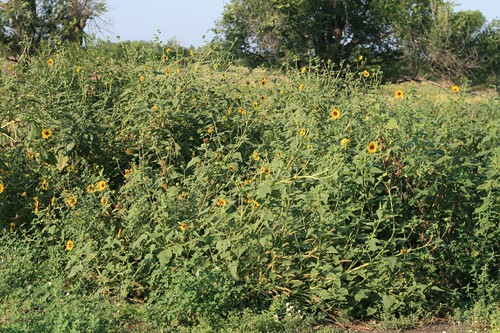
But then a surprise. This spring and summer, plants started coming up where none had grown for 80 years. But only where this barn stood -- not where the other two buildings were.

We watched as they grew tall. I'm sure decades of animals hanging out there were well appreciated by the plants.

As they grew, it looked like we might be seeing Terah's favorite flower: wild Kansas sunflowers.

And sure enough, they were.

Last weekend, Terah, Jacob, and I went out to the old barn. I took some pictures of its new appearance.

img_3429.jpg

This one stands where Grandpa's tractor used to be parked.

img_3401.jpg

And here we see a lifetime of flowers, from the old and withering, to the young just about ready to bloom.
img_3462.jpg

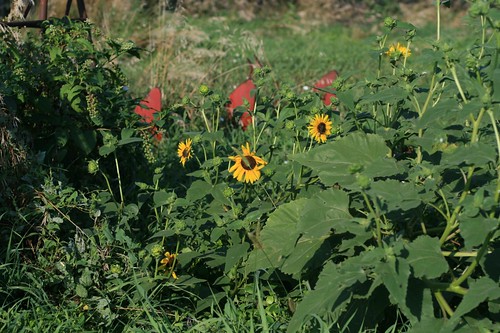
At the edge of the sunflowers, there's an old plow next to them. Though you might think it's barn-colored.

img_3411.jpg

Animals continue to be attracted to the area. Here's one of the smaller visitors.
img_3447.jpg

And here's a picture of almost the whole patch, right where the barn used to stand. I still mow right up to it.

I still miss the old barn. But somehow it still seems to be full of surprises and worth exploring. I wonder what next year will bring.

And I wonder if, a few years from now, Jacob will tell his friends about mowing right up to the sunflower patch, going fast to try to avoid any trouble with the bees.

30 August 2007

John Goerzen: Technology

Two days ago, I was out by the road digging a hole for our mailbox.

Along comes a guy on a tractor. The tractor was built in maybe the 1960s. It had no cab, and was loud, as tractors are. Attached to the back was a mower. It had long since lost any part of paint that was on it, and appeared to be made of rust.

The farmer driving this tractor was wearing a bluetooth earpiece for his cellphone.

(I don't think there would be any way to use a phone while driving that tractor due to the noise, but hey.)

Now, the rest of the story...

This being rural Kansas, the farmer saw me and stopped to chat, turning off the tractor first, of course. He introduced himself as "that crazy guy from south of town", and of course had a pretty good idea of who I was. After all, he's lived around here for decades and knew my grandpa.

I told him why I was digging the hole for the mailbox. There's going to be a second house down our mile, so now the post office will actually deliver to a mailbox at our driveway, rather than one almost a mile away. I thought he looked confused, so I pointed down the road and said that's our mailbox on the corner.

"Oh, I know. I probably shouldn't say this, but I knew when you moved in because I checked your mailbox one day and it didn't have 40-year-old ads piling up anymore."

We chatted a few more minutes, about the neighbor's goats, how annoying it is that he can't get DSL, why he wishes he could still use DOS instead of Windows. Then he went off towards home.

He had stopped his tractor in the middle of the road. But it wasn't a problem. Nobody drove by that whole time anyway.

29 August 2007

Russell Coker: The Silly BMW 745h

BMW has released a new prototype hydrogen powered car. The bmwworld.com web page about it claims the cruising range is 190 miles. Added to the 400-mile range of the normal fuel tank, the 745h can go 600 miles between fill-ups. The first issue is that 10 miles are not accounted for (maybe it finishes the 190 miles of hydrogen power at the top of a hill). But more seriously the hydrogen needed to drive for 190 miles would take as much space as petrol needed to drive for 646 miles (hydrogen needs 3.4* the volume to store an equivalent amount of energy). I wonder if that BMW has any space left in the boot/trunk? Now we have some green bloggers praising BMW. An internal combustion engine that burns hydrogen will not give no emissions other than water vapour, it will produce some nitrogen oxides. The processes to produce hydrogen for fuel all consume unreasonable amounts of energy (more than is required to charge a plug-in hybrid). BMW demonstrates their level of interest by giving the cars to some celebrities. This gets some PR but no analysis of the performance. They also introduce the prototype based on one of the most expensive models (the 745) which you almost never see on the roads. If they produced a 318 or 520 that ran on hydrogen it would demonstrate some level of interest in getting this working for the mass market. If BMW wanted to make their cars more environmentally friendly they would start by adopting some of the technology from the Prius. Rumour has it that part of Toyota’s plan to make money from Prius development is in licensing the technology that they patent. A couple of years ago I test drove a BMW 316 and a Prius. The Prius was very quiet and gave a smooth ride (you might call these luxury features), and also gave decent performance (it’s widely regarded that luxury cars should perform well - pity the BMW 316 is a slug). In Australia the concept of “badge engineering” of cars is well established. When government subsidies favoured large manufacturing runs the Ford Laser and Mazda 323 were essentially the same car. Maybe BMW could adopt this concept and sell a re-badged Prius i-tech with a few extra luxury features as a BMW 4 series (it’s a much better car than the 3 series BMW). Finally bmwworld.com has an amusing FAQ about hydrogen power, here are some of the mistakes that they make:
  1. They say “About 45 billion kilograms (50 million tons) [of hydrogen] is produced every year enough hydrogen to fuel 250 million fuel cell cars“, but only if the average fuel-cell car uses 180Kg of fuel per year. According to Wikipedia hydrogen has slightly more than 3* the energy density per mass than petrol, so 180Kg of fuel would be equivalent to 540L of petrol per year. The Australian Bureau of Statistics states that in 1996 the average annual distance travelled by car (it’s not clear whether this is per car or per person) was 14,600Km while among the countries listed the lowest was Japan with 10,130. When efficiently using hydrogen in a Prius (that is quoted as using 5.4L of petrol per 100Km) you might expect that 540/5.4*100=10,000Km could be travelled on the 180Kg of hydrogen. So the FAQ claim that 250M cars could be powered by the current hydrogen production would only apply if the cars are of Prius efficiency and driven the typical distances of Japanese drivers, or the cars were 46% more efficient than the Prius and driven in the Australian manner. Of course in the US things are even worse with 17,862Km being the average distance driven which means that their hypothetical fuel-cell car would need to be 78% more efficient than a Prius.

  2. They state that “the majority of merchant hydrogen is produced by a process called steam methane reforming“. Why not just run cars on methane then? Anything that burns can be used to fuel cars, and methane has a much higher boiling point than hydrogen so it would be easier to store and transport (see the Wikipedia page on methane).

  3. In regard to hydrogen production they say “about 95% of the total global hydrogen production is captive meaning it is used at the site where it is produced“, that is of course because it’s difficult and expensive to transport hydrogen.

  4. The final amusing fact is that it is noted that most hydrogen comes from fossil-fuels. What problem are they trying to solve here? Hydrogen isn’t going to help the environment if it comes from fossil fuels, it will be more expensive than other fuels. Apart from getting government grant money for BMW it doesn’t seem to do any good.

Jeff Bailey: Ready to ride again!

We're in Albuquerque, NM now and have been for a couple of days. We made such excellent time across Oklahoma and Texas that we were able to stop and take a break for three nights.

Texas: Holy *crap* is Amarillo a dirty place. We spent three times what we've spend on any hotel this trip in order to get a place that we were sure was insect-free. And what we wound up with was a place over top of a bar. Luckily it wasn't all country, so we didn't mind too much. It was also (surprisingly) the best breakfast I'd had on the trip. They did hash-browns on a griddle, and had lots of ketchup (do I have to spell it catsup now?), tabasco, and pepper to go on it. Weirdly, they also had pre-mixed peanut butter and honey. Otherwise, the truck stop we stopped at had cockroaches on the floor, the bottled-water bottles were dirty on the outside, and the place smelled like an airport tarmac.

We left early and headed out to Albuquerque. Aside from the fact that whoever laid out the roads was certainly drunk at the time (We drove around in circles three times trying to get to a hotel we could see, but not find a way to legally drive to before giving up and going to a different hotel) this place is really pretty. I came here for my last meeting as a Regional Organising Consultant for Young Adult and Campus Ministry and got a chance to see a bit of the place and really wanted to show it to Angie. Instead we decided we'd had enough of driving and traveling. This hotel has laundry facilities and the town has a Whole Foods Market, so we stocked up on microwaveable foods, washed our clothes, watched TV and I finally finished Harry Potter during a nice long bath.

The next day (Yesterday), we headed out to the Puebo Cultural Centre to see the art pieces and learn a little about their successful resistance against the spanish resulting in actual land grants to the 19 local groups. We also got to see how different groups have influenced them over the years, with ancestry tracing something like 12,000 years back. From there we managed to find the old town and got to see the type of architecture that I wanted to show Angie. The little pink houses don't *just* exist in DisneyLand. ;) We went to a restaurant that looked really familiar - I think we ate there when I was here last. We had some wonderful New Mexico food and I introduced Angie to what the local sopapillas are like. Here's they're large puffy things, whereas the sopapillas in Texas and back home look like soft tortilla chips.

I've started uploading some pictures to Flickr, but it turns out that I hadn't done so since before Juniper's wedding and have over 400 pictures to send. Between hotel wireless being slow and f-spot being a fragile piece of crap I managed to upload something over 100 pictures of Leif to the family-only archives before giving up. I'll probably post the Opus pictures up on Facebook rather than flickr so that it's easier for other Opusers to find them

The next target is Flagstaff, AZ for Thursday night. We're meeting Karina and her husband for a day of wandering around the Grand Canyon, so we'll see if there's some interesting things between here and there. I suspect there will be. =)

*hugs*, all! Less than a week until I start my new job! I'm excited!

28 August 2007

Russell Coker: The Silly BMW 745h

BMW has released a new prototype hydrogen powered car. The bmwworld.com web page about it claims the cruising range is 190 miles. Added to the 400-mile range of the normal fuel tank, the 745h can go 600 miles between fill-ups. The first issue is that 10 miles are not accounted for (maybe it finishes the 190 miles of hydrogen power at the top of a hill). But more seriously the hydrogen needed to drive for 190 miles would take as much space as petrol needed to drive for 646 miles (hydrogen needs 3.4* the volume to store an equivalent amount of energy). I wonder if that BMW has any space left in the boot/trunk? Now we have some green bloggers praising BMW. An internal combustion engine that burns hydrogen will not give no emissions other than water vapour, it will produce some nitrogen oxides. The processes to produce hydrogen for fuel all consume unreasonable amounts of energy (more than is required to charge a plug-in hybrid). BMW demonstrates their level of interest by giving the cars to some celebrities. This gets some PR but no analysis of the performance. They also introduce the prototype based on one of the most expensive models (the 745) which you almost never see on the roads. If they produced a 318 or 520 that ran on hydrogen it would demonstrate some level of interest in getting this working for the mass market. If BMW wanted to make their cars more environmentally friendly they would start by adopting some of the technology from the Prius. Rumour has it that part of Toyota’s plan to make money from Prius development is in licensing the technology that they patent. A couple of years ago I test drove a BMW 316 and a Prius. The Prius was very quiet and gave a smooth ride (you might call these luxury features), and also gave decent performance (it’s widely regarded that luxury cars should perform well - pity the BMW 316 is a slug). In Australia the concept of “badge engineering” of cars is well established. When government subsidies favoured large manufacturing runs the Ford Laser and Mazda 323 were essentially the same car. Maybe BMW could adopt this concept and sell a re-badged Prius i-tech with a few extra luxury features as a BMW 4 series (it’s a much better car than the 3 series BMW).

Eric Warmenhoven: Eclipse.

I stayed up late last night to watch the lunar eclipse, and took pictures. In related news, I need a lens that has a much longer zoom. The pictures I posted aren’t scaled (just cropped). I wish I’d thought of this a couple weeks ago so I could have finally ordered the Canon 100-400mm f/4.5-5.6L that I’ve been looking at for months now. I’ll probably get it soon though, so that I’ll have it for the Salinas Air Show at the end of September.

Zak B. Elep: Weekend Hacks: growl-notify and weeter for WeeChat

This weekend, a rather long one due to the observance of the National Heroes’ day, got me started into doing some little hacks for WeeChat, an IRC client that I have been using in place of Colloquy on the Macbook which I use at work. I have been using WeeChat originally because I’ve been using TOR to connect to the ‘Net, but later on I found out about WeeChat’s extensibility via script plugins that can be written in either Ruby, Lua, or Perl. And, being the Perl monger that I am, and having lots of idle time (hey, this was a weekend ;) I looked for some way to better integrate my WeeChat to my Mac setup. The first thing I came up with was a way to get the app to send event notifications via the Growl framework (which I got from Adium,) since the WeeChat I have here is a console-only app (there is an ongoing GTK/wxWidgets UI port, but not available yet in MacPorts, where I got WeeChat.) A quick look at the Growl developer documentation, however, got me looking into Mac::Growl, which provides a very simple Perl interface to Growl. And thus, I came up with growl-notify, which now keeps me up to date on what’s going on in IRC while I’m doing something else. The other thing that I got to work on with was a simple way to do Twitter status updates while on IRC. Of course, I do have the excellent Twitterific for Mac installed, but again I was raring for some quick hack to do at the weekend, so I decided to do this one too. In IRC, one can pretty much indicate his/her status by using the /me command (which is really a shortcut for doing a CTCP ACTION message, but I digress.) This particular command seemed to be a fairly natural command to tie a Twitter updater with, so it only took a while for me to look up Net::Twitter, write a modifier for the /me command, and come up with weeter. Now, the week’s back, and I look forward to my work and its pending tasks (currently something involving PostgreSQL, GlusterFS, and lots of Amazon EC2 nodes ;) with a renewed zest for tackling problems. And when weekend comes again, its yet another time to recharge, and perhaps hack some more on better integrating the apps that I use in my workflow (and thus helping my productivity.)

Michal Čihař: Photo album candidate - lazygal

I received number of reactions on my photoalbum post. Several were saying "I'm using some great Perl tool which is not actively maintained anymore.". Well I know such tools. I also used BINS some time ago, but it did break something (I don't recall what exactly right now, it's quite far far away in past) and I was unable to fix it. That was reason I switched to Matew. The other replies were much better. One of them recommended trying lazygal (well it was recommended by it's author). I gave it a try and it seemed to fit my basic needs quite well and extending it's EXIF support was a piece of cake. I will continue to tune it to my needs, but I'm pretty close right now. The hardest thing for me will be to come up with some good looking themes, but I will most likely steal my ones for Matew :-).

27 August 2007

Adam Rosi-Kessel: Terrorist Hashing?

The Hash House Harriers is “an international group of social, non-competitive running and drinking clubs.” I participated many years ago in college (e.g.), although the Princeton Group is probably more tame than most. Via Bruce Schneier, this crazy new items:
Two people who sprinkled flour in a parking lot to mark a trail for their offbeat running club inadvertently caused a bioterrorism scare and now face a felony charge.
Although I don’t hash anymore, I frequently see the characteristic flour marks while jogging in the woods. I can’t see how the perpetrators here could possibly meet the mens rea requirement for a felony bioterrorism charge.

Raphaël Hertzog: Planet debian CVS repo superseded by SVN repository

When I discussed the deprecation of cvs.debian.org, I forgot to mention that planet’s CVS repository was also part of the last users of this service. Thanks to mako, the move to Alioth is underway. The CVS repository has been disabled (crude hack, if you know a proper way to forbid commits to a CVS repository, please leave a comment) and its history has been imported in a new SVN repository As usual DD have write-access on this repository so that they can add/update their feeds and hackergotchis. Mako will change the live setup from CVS to SVN somewhat later today. Please start updating any documentation that refers to the CVS repository.

Adrian von Bidder: Favorite movies

Since I've never bloged about movies before, here's the “best of”, in more or less random order and from the top of my head. Not quite on the list, but still worth mentioning.

26 August 2007

Roland Mas: Gforge in Debian, August 2007

As I type this, debs for a current snapshot of upstream Subversion are on their way to Debian Sid. They are taken from the Subversion trunk and not from the yet-to-be-released 4.6 branch, because a few important changes have taken place on the trunk only, and the 4.6 branch is merged anyway. Hence the version number, 4.6.99+svn6078-1. These packages did spend some time in experimental, and I didn't get any bug reports, but that doesn't mean they're bug-free. Use with caution. One of the big changes is that Gforge now uses Gettext rather than its home-made internationalisation system. Which means probably fewer problems, and a more standard system allowing more people to get involved. Can you guess what I'm hinting at? Yes, it's a call for translations! Anyone interested in getting involved should bzr branch http://alioth.debian.org/~lolando/bzr/gforge/upstream-svn/trunk/, and start poking the existing *.po files (or creating new ones!). Why the private repo and not the upstream Subversion repository? Rationale follows. My job as a freelancer as well as my role as an Alioth admin involve maintaining separate branches of the Gforge code (different clients have different needs and patches). In order to facilitate patch migration, I therefore need a distributed VCS, and I've been using Bazaar for a few years, with a manual gatewaying between upstream CVS first, then Subversion, and a few private Bazaar branches. Now that Bazaar (as in Arch) is dead, I'm using Bazaar (as in Bazaar-NG, Bazaar-2, or bzr), which seems to be approaching a 1.0 release, and which provides a plugin to interoperate easily with Subversion repositories. And since the upstream Subversion repository is not accessible anonymously anyway, I decided to publish my gateway branch. I'll probably publish more branches as time passes (probably the Alioth branch, and quite possibly feature branches too). Note: if you want to share a bzr repository of a project containing PHP scripts with Apache, you may encounter a problem, because the bzr repository contains files named *.php.knit and *.php.kndx. And Apache will happily give these files to the PHP interpreter when serving them, and that's not what you want. My trick to fix that is to add a .htaccess file somewhere where the repository is stored, with the following contents:
AddHandler None .knit .kndx
This will ensure that these files will be sent straight to the HTTP client, and not through the PHP interpreter.

Next.

Previous.