Search Results: "ads"

20 February 2017

Holger Levsen: How to use .ics files like it's 1997

$ sudo apt install khal
 
Unpacking khal (0.8.4-3) ...
 
$ (echo 1;echo 0;echo y;echo 0; echo y; echo n; echo y; echo y)    khal configure
 
Do you want to write the config to /home/user/.config/khal/khal.conf? (Choosing  No  will abort) [y/N]: Successfully wrote configuration to /home/user/.config/khal/khal.conf
$ wget https://anonscm.debian.org/cgit/debconf-data/dc17.git/plain/misc/until-dc17.ics
 
HTTP request sent, awaiting response... 200 OK
Length: 6120 (6.0K) [text/plain]
Saving to:  until-dc17.ics 
 
$ khal import --batch -a private until-dc17.ics
$ khal agenda --days 14
Today:
16:30-17:30: DebConf Weekly Meeting  
27-02-2017
16:30-17:30: DebConf Weekly Meeting  
khal is available in stretch and newer and is probably best run from cron piping into '/usr/bin/mail' :-) Thanks to Gunnar Wolf for figuring it all out.

Jonathan Dowland: Blinkenlights!

blinkenlights! blinkenlights!
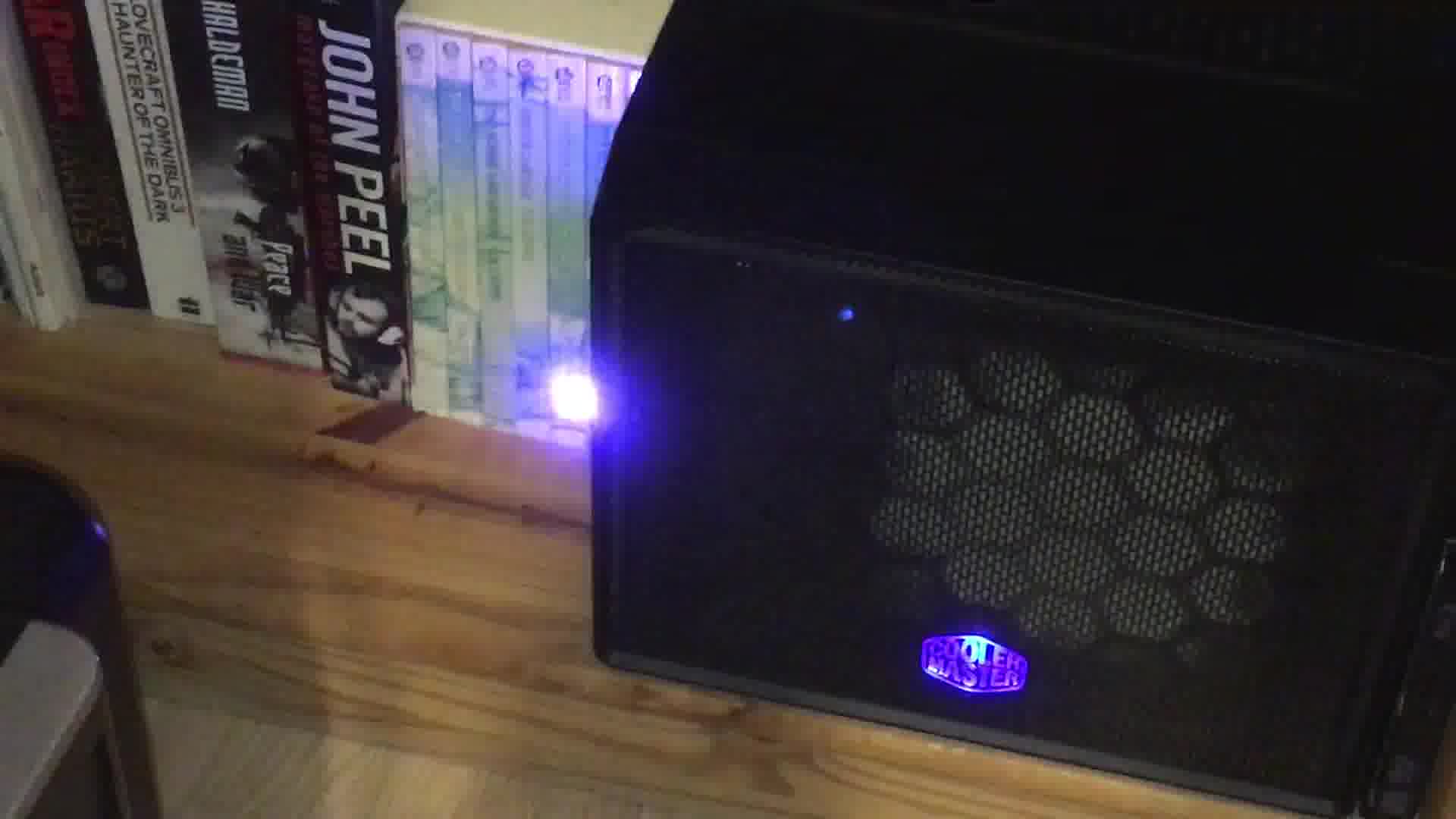
Part one of a series. part 2, part 3. Late last year, I was pondering how one might add a status indicator to a headless machine like my NAS to indicate things like failed jobs. After a brief run through of some options (a USB-based custom device; a device pretending to be a keyboard attached to a PS/2 port; commandeering the HD activity LED; commandeering the PC speaker wire) I decided that I didn't have the time to learn the kind of skills needed to build something at that level and opted to buy a pre-assembled programmable USB thing instead, called the BlinkStick. Little did I realise that my friend Jonathan McDowell thought that this was an interesting challenge and actually managed to design, code and build something! Here's his blog post outlining his solution and here's his code on github (or canonically) Even thought I've bought the blinkstick, given Jonathan's efforts (and the bill of materials) I'm going to have to try and assemble this for myself and give it a go. I've also managed to borrow an Arduino book from a colleague at work. Either way, I still have some work to do on the software/configuration side to light the LEDs up at the right time and colour based on the jobs running on the NAS and their state.

Jonathan Dowland: Blinkenlights, part 2

Part two of a series. part 1, part 3. To start with configuring my NAS to use the new blinkenlights, I thought I'd start with a really easy job: I plug in my iPod, a script runs to back it up, then the iPod gets unmounted. It's one of the simpler jobs to start with because the iPod is a simple block device and there's no encryption in play. For now, I'm also going to assume the LED Is going to be used exclusively for this job. In the future I will want many independent jobs to perhaps use the LED to signal things and figuring out how that will work is going to be much harder. I'll skip over the journey and go straight to the working solution. I have a systemd job that is used to invoke a sync from the iPod as follows:
[Service]
Type=oneshot
ExecStart=/bin/mount /media/ipod
ExecStart=/usr/local/bin/blinkstick --index 1 --limit 10 --set-color 33c280
ExecStart=/usr/bin/rsync ...
ExecStop=/bin/umount /media/ipod
ExecStop=/usr/local/bin/blinkstick --index 1 --limit 10 --set-color green
[Install]
WantedBy=dev-disk-by\x2duuid-A2EA\x2d96ED.device
[Unit]
OnFailure=blinkstick-fail.service
/media/ipod is a classic mount configured in /etc/fstab. I've done this rather than use the newer systemd .mount units which sadly don't give you enough hooks for running things after unmount or in the failure case. This feels quite unnatural, much more "systemdy" would be to Requires= the mount unit, but I couldn't figure out an easy way to set the LED to green after the unmount. I'm sure it's possible, but convoluted. The first blinkstick command sets the LED to a colour to indicate "in progress". I explored some of the blinkstick tool's options for a fading or throbbing colour but they didn't work very well. I'll take another look in the future. After the LED is set, the backup job itself runs. The last blinkstick command, which is only run if the previous umount has succeeded, sets the LED to indicate "safe to unplug". The WantedBy here instructs systemd that when the iPod device-unit is activated, it should activate my backup service. I can refer to the iPod device-unit using this name based on the partition's UUID; this is not the canonical device name that you see if you run systemctl but it's much shorter and crucially its stable, the canonical name depends on exactly where you plugged it in and what other devices might have been connected at the same time. If something fails, a second unit blinkstick-fail.service gets activated. This is very short:
[Service]
ExecStart=/usr/local/bin/blinkstick --index 1 --limit 50 --set-color red
This simply sets the LED to be red. Again it's a bit awkward that in 2 cases I'm setting the LED with a simple Exec but in the third I have to activate a separate systemd service: this seems to be the nature of the beast. At least when I come to look at concurrent jobs all interacting with the LED, the failure case should be simple: red trumps any other activity, user must go and check what's up.

Jonathan Dowland: Blinkenlights, part 3

red blinkenlights! red blinkenlights!
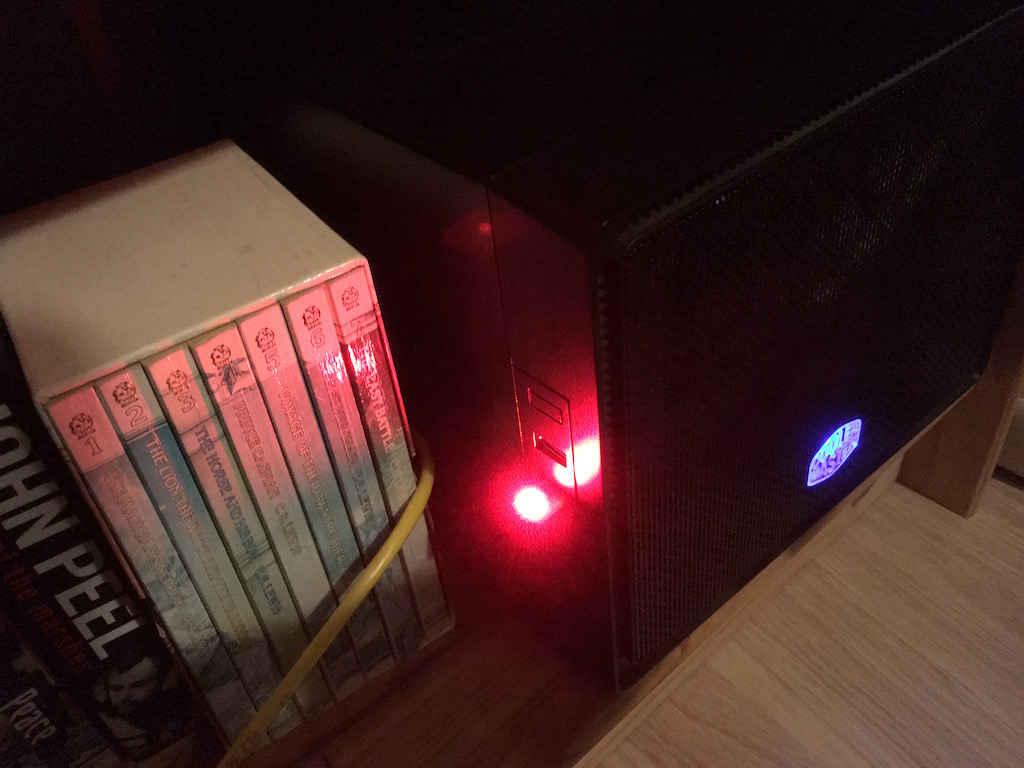
Part three of a series. part 1, part 2. One morning last week I woke up to find the LED on my NAS a solid red. I've never been happier to have something fail. I'd set up my backup jobs to fire off a systemd unit on failure
OnFailure=status-email-user@%n.service
This is a generator-service, which is used to fire off an email to me when something goes wrong. I followed these instructions on the Arch wiki to set it up). Once I got the blinkstick, I added an additional command to that service to light up the LED:
ExecStart=-/usr/local/bin/blinkstick --index 1 --limit 50 --set-color red
The actual failure was a simple thing to fix. But I never did get the email. On further investigation, there are problems with using exim and systemd in Debian at the moment: it's possible for the exim4 daemon to exit and for systemd not to know that this is a failure, thus, the mail spool never gets processed. This should probably be fixed by the exim4 package providing a proper systemd service unit.

Norbert Preining: Ryu Murakami Tokyo Decadence

The other Murakami, Ryu Murakami ( ), is hard to compare to the more famous Haruki. His collection of stories reflects the dark sides of Tokyo, far removed from the happy world of AKB48 and the like. Criminals, prostitutes, depression, loss. A bleak image onto a bleak society.
This collection of short stories is a consequent deconstruction of happiness, love, everything we believe to make our lives worthwhile. The protagonists are idealistic students loosing their faith, office ladies on aberrations, drunkards, movie directors, the usual mixture. But the topic remains constant the unfulfilled search for happiness and love.
I felt I was beginning to understand what happiness is about. It isn t about guzzling ten or twenty energy drinks a day, barreling down the highway for hours at a time, turning over your paycheck to your wife without even opening the envelope, and trying to force your family to respect you. Happiness is based on secrets and lies.Ryu Murakami, It all started just about a year and a half ago
A deep pessimistic undertone is echoing through these stories, and the atmosphere and writing reminds of Charles Bukowski. This pessimism resonates in the melancholy of the running themes in the stories, Cuban music. Murakami was active in disseminating Cuban music in Japan, which included founding his own label. Javier Olmo s pieces are often the connecting parts, as well as lending the short stories their title: Historia de un amor, Se fu .
The belief that what s missing now used to be available to us is just an illusion, if you ask me. But the social pressure of You ve got everything you need, what s your problem? is more powerful than you might ever think, and it s hard to defend yourself against it. In this country it s taboo even to think about looking for something more in life.Ryu Murakami, Historia de un amor
It is interesting to see that on the surface, the women in the stories are the broken characters, leading feminists to incredible rants about the book, see the rant^Wreview of Blake Fraina at Goodreads:
I ll start by saying that, as a feminist, I m deeply suspicious of male writers who obsess over the sex lives of women and, further, have the audacity to write from a female viewpoint
female characters are pretty much all pathetic victims of the male characters
I wish there was absolutely no market for stuff like this and I particularly discourage women readers from buying it Blake Fraina, Goodreads review
On first sight it might look like that the female characters are pretty much all pathetic victims of the male characters, but in fact it is the other way round, the desperate characters, the slaves of their own desperation, are the men, and not the women, in these stories. It is dual to the situation in Hitomi Kanehara s Snakes and Earrings, where on first sight the tattooist and the outlaw friends are the broken characters, but the really cracked one is the sweet Tokyo girly.
Male-female relationships are always in transition. If there s no forward progress, things tend to slip backwards.Ryu Murakami, Se fu
Final verdict: Great reading, hard to put down, very much readable and enjoyable, if one is in the mood of dark and depressing stories. And last but not least, don t trust feminist book reviews.

19 February 2017

Gregor Herrmann: RC bugs 2016/52-2017/07

debian is in deep freeze for the upcoming stretch release. still, I haven't dived into fixing "general" release-critical bugs yet; so far I mostly kept to working on bugs in the debian perl group: thanks to the release team for pro-actively unblocking the packages with fixes which were uploaded after the begin of the freeze!

18 February 2017

Steve Kemp: Apologies for the blog-churn.

I've been tweaking my blog a little over the past few days, getting ready for a new release of the chronicle blog compiler (github). During the course of that I rewrote all the posts to have 100% lower-case file-paths. Redirection-pages have been auto-generated for each page which was previously mixed-case, but unfortunately that will have meant that the RSS feed updated unnecessarily: That triggered a lot of spamming, as the URLs would have shown up as being new/unread/distinct.

Dirk Eddelbuettel: RPushbullet 0.3.1

RPpushbullet demo A new release 0.3.1 of the RPushbullet package, following the recent 0.3.0 release is now on CRAN. RPushbullet is interfacing the neat Pushbullet service for inter-device messaging, communication, and more. It lets you easily send alerts like the one to the to your browser, phone, tablet, ... -- or all at once. This release owes once again a lot to Seth Wenchel who helped to update and extend a number of features. We fixed one more small bug stemming from the RJSONIO to jsonlite transition, and added a few more helpers. We also enabled Travis testing and with it covr-based coverage analysis using pretty much the same setup I described in this recent blog post.

Changes in version 0.3.1 (2017-02-17)
  • The target device designation was corrected (#39).
  • Three new (unexported) helper functions test the validity of the api key, device and channel (Seth in #41).
  • The summary method for the pbDevices class was corrected (Seth in #43).
  • New helper functions pbValidateConf, pbGetUser, pbGetChannelInfo were added (Seth in #44 closing #40).
  • New classes pbUser and pbChannelInfo were added (Seth in #44).
  • Travis CI tests (and covr coverage analysis) are now enabled via an encrypted config file (#45).

Courtesy of CRANberries, there is also a diffstat report for this release. More details about the package are at the RPushbullet webpage and the RPushbullet GitHub repo.

This post by Dirk Eddelbuettel originated on his Thinking inside the box blog. Please report excessive re-aggregation in third-party for-profit settings.

17 February 2017

Michal Čihař: What's coming in Weblate 2.12

Weblate should be released by end of February, so it's now pretty much clear what will be there. So let's look at some of the upcoming features. There were many improvements in search related features. They got performance improvements (this is especially noticeable on site wide search). Additionally you can search for strings within translation project. On related topic, search and replace is now available for component or project wide operations, what can help you in case of massive renaming in your translations. We have worked on improving machine translations as well, this time we've added support for Yandex. In case you know some machine translation service which we do not yet support, please submit that to our issue tracker. Biggest improvement so far comes for visual context feature - it allows you to upload screenshots which are later shown to translators to give them better idea where and in which context the translation is used. So far you had to manually upload screenshot for every source string, what was far from being easy to use. With Weblate 2.12 (and this is already available on Hosted Weblate right now) the screenshots management got way better. There is now separate interface to manage screenshots (see screenshots for Weblate as an example), you can assign every screenshot to multiple source strings, however you can also let Weblate automatically recognize texts on the screenshots using OCR and suggest strings to assign. This can save you quite a lot of effort, especially with screenshots with lot of strings. This feature is still in early phase, so the suggestions are not always 100% matching, but we're working to improve it further. There will be some more features as well, you can look at our 2.12 milestone at GitHub to follow the process.

Filed under: Debian English SUSE Weblate 0 comments

Joey Hess: Presenting at LibrePlanet 2017

I've gotten in the habit of going to the FSF's LibrePlanet conference in Boston. It's a very special conference, much wider ranging than a typical technology conference, solidly grounded in software freedom, and full of extraordinary people. (And the only conference I've ever taken my Mom to!) After attending for four years, I finally thought it was time to perhaps speak at it.
Four keynote speakers will anchor the event. Kade Crockford, director of the Technology for Liberty program of the American Civil Liberties Union of Massachusetts, will kick things off on Saturday morning by sharing how technologists can enlist in the growing fight for civil liberties. On Saturday night, Free Software Foundation president Richard Stallman will present the Free Software Awards and discuss pressing threats and important opportunities for software freedom. Day two will begin with Cory Doctorow, science fiction author and special consultant to the Electronic Frontier Foundation, revealing how to eradicate all Digital Restrictions Management (DRM) in a decade. The conference will draw to a close with Sumana Harihareswara, leader, speaker, and advocate for free software and communities, giving a talk entitled "Lessons, Myths, and Lenses: What I Wish I'd Known in 1998." That's not all. We'll hear about the GNU philosophy from Marianne Corvellec of the French free software organization April, Joey Hess will touch on encryption with a talk about backing up your GPG keys, and Denver Gingerich will update us on a crucial free software need: the mobile phone. Others will look at ways to grow the free software movement: through cross-pollination with other activist movements, removal of barriers to free software use and contribution, and new ideas for free software as paid work.
-- Here's a sneak peek at LibrePlanet 2017: Register today! I'll be giving some varient of the keysafe talk from Linux.Conf.Au. By the way, videos of my keysafe and propellor talks at Linux.Conf.Au are now available, see the talks page.

Dirk Eddelbuettel: littler 0.3.2

max-heap image The third release of littler as a CRAN package is now available, following in the now more than ten-year history as a package started by Jeff in the summer of 2006, and joined by me a few weeks later. littler is the first command-line interface for R and predates Rscript. It is still faster, and in my very biased eyes better as it allows for piping as well shebang scripting via #!, uses command-line arguments more consistently and still starts faster. It prefers to live on Linux and Unix, has its difficulties on OS X due to yet-another-braindeadedness there (who ever thought case-insensitive filesystems where a good idea?) and simply does not exist on Windows (yet -- the build system could be extended -- see RInside for an existence proof, and volunteers welcome!). This release brings several new examples script to run package checks, use the extraordinary R Hub, download RStudio daily builds, and more -- see below for details. No internals were changed. The NEWS file entry is below.

Changes in littler version 0.3.2 (2017-02-14)
  • Changes in examples
    • New scripts getRStudioServer.r and getRStudioDesktop.r to download daily packages, currently defaults to Ubuntu amd64
    • New script c4c.r calling rhub::check_for_cran()
    • New script rd2md.r to convert Rd to markdown.
    • New script build.r to create a source tarball.
    • The installGitHub.r script now use package remotes (PR #44, #46)

Courtesy of CRANberries, there is a comparison to the previous release. Full details for the littler release are provided as usual at the ChangeLog page. The code is available via the GitHub repo, from tarballs off my littler page and the local directory here -- and now of course all from its CRAN page and via install.packages("littler"). Binary packages are available directly in Debian as well as soon via Ubuntu binaries at CRAN thanks to the tireless Michael Rutter. Comments and suggestions are welcome at the GitHub repo.

This post by Dirk Eddelbuettel originated on his Thinking inside the box blog. Please report excessive re-aggregation in third-party for-profit settings.

15 February 2017

Holger Levsen: Debian has installer images with non-free firmware included

Even though they are impossible to find without using a search engine or bookmarks, they exist. Bookmark them now. Or use a search engine later ;-)

Clint Adams: Tom's birthday happens every year

Sure, she said, while having a drink for breakfast at the post office.
Posted on 2017-02-15
Tags: mintings

14 February 2017

Steve McIntyre: Start the fans please!

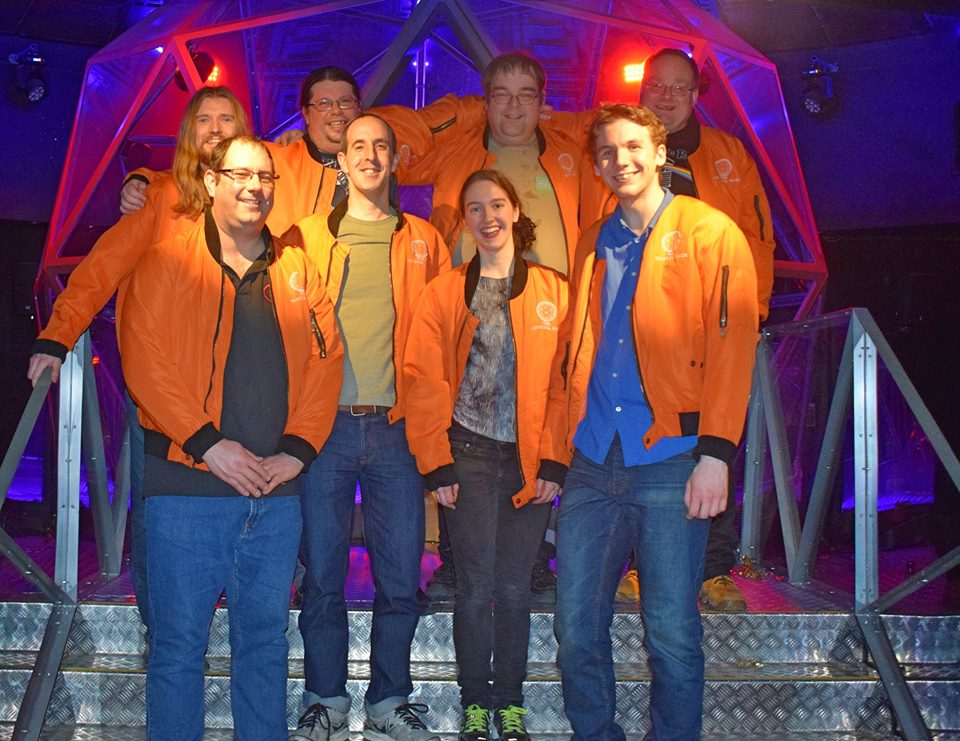
This probably won't mean much to people outside the UK, I'm guessing. Sorry! :-) The Crystal Maze was an awesome fun game show on TV in the UK in the 1990s. Teams would travel through differently-themed zones, taking on challenges to earn crystals for later rewards in the Crystal Dome. I really enojyed it, as did just about everybody my age that I know of... A group have started up a new Crystal Maze attraction in London and Manchester, giving some of us a chance of indulging our nostalgia directly in a replica of the show's setup! Neil NcGovern booked a load of tickets and arranged for a large group of people to go along this weekend. It was amazing! (Sorry!) I ended up captaining one of the 4 teams, and our team ("Failure is always an option!") scored highest in the final game - catching bits of gold foil flying around in the Dome. It was really, really fun and I'd heartily recommend it to other folks who like action games and puzzle solving. I just missed the biting scorn of the original show presenter, Richard O'Brien, but our "Maze Master" Boudica was great fun and got us all pumped up and working together.

13 February 2017

Vincent Sanders: The minority yields to the majority!

Deng Xiaoping (who succeeded Mao) expounded this view and obviously did not depend on a minority to succeed. In open source software projects we often find ourselves implementing features of interest to a minority of users to keep our software relevant to a larger audience.

As previously mentioned I contribute to the NetSurf project and the browser natively supports numerous toolkits for numerous platforms. This produces many challenges in development to obtain the benefits of a more diverse user base. As part of the recent NetSurf developer weekend we took the opportunity to review all the frontends to make a decision on their future sustainability.

Each of the nine frontend toolkits were reviewed in turn and the results of that discussion published. This task was greatly eased because we we able to hold the discussion face to face, over time I have come to the conclusion some tasks in open source projects greatly benefit from this form of interaction.

Netsurf running on windows showing this blog post
Coding and day to day discussions around it can be easily accommodated va IRC and email. Decisions affecting a large area of code are much easier with the subtleties of direct interpersonal communication. An example of this is our decision to abandon the cocoa frontend (toolkit used on Mac OS X) against that to keep the windows frontend.

The cocoa frontend was implemented by Sven Weidauer in 2011, unfortunately Sven did not continue contributing to this frontend afterwards and it has become the responsibility of the core team to maintain. Because NetSuf has a comprehensive CI system that compiles the master branch on every commit any changes that negatively affected the cocoa frontend were immediately obvious.

Thus issues with the compilation were fixed promptly but because these fixes were only ever compile tested and at some point the Mac OS X build environments changed resulting in an application that crashes when used. Despite repeatedly asking for assistance to fix the cocoa frontend over the last eighteen months no one had come forward.

And when the topic was discussed amongst the developers it quickly became apparent that no one had any objections to removing the cocoa support. In contrast the windows frontend, which despite having many similar issues to cocoa, we decided to keep. These were almost immediate consensus on the decision, despite each individual prior to the discussion not advocating any position.

This was a single example but it highlights the benefits of a disparate development team having a physical meeting from time to time. However this was not the main point I wanted to discuss, this incident highlights that supporting a feature only useful to a minority of users can have a disproportionate cost.

The cost of a feature for an open source project is usually a collection of several factors:
Developer time
Arguably the greatest resource of a project is the time its developers can devote to it. Unless it is a very large, well supported project like the Kernel or libreoffice almost all developer time is voluntary.
Developer focus
Any given developer is likely to work on an area of code that interests them in preference to one that does not. This means if a developer must do work which does not interest them they may loose focus and not work on the project at all.
Developer skillset
A given developer may not have the skillset necessary to work on a feature, this is especially acute when considering minority platforms which often have very, very few skilled developers available.
Developer access
It should be obvious that software that only requires commodity hardware and software to develop is much cheaper than that which requires special hardware and software. To use our earlier example the cocoa frontend required an apple computer running MAC OS X to compile and test, this resource was very limited and the project only had access to two such systems via remote desktop. These systems also had to serve as CI builders and required physical system administration as they could not be virtualized.
Support
Once a project releases useful software it generally gains users outside of the developers. Supporting users consumes developer time and generally causes them to focus on things other than code that interests them.

While most developers have enough pride in what they produce to fix bugs, users must always remember that the main freedom they get from OSS is they recived the code and can change it themselves, there is no requirement for a developer to do anything for them.
Resources
A project requires a website, code repository, wiki, CI systems etc. which must all be paid for. Netsurf for example is fortunate to have Pepperfish look after our website hosting at favorable rates, Mythic beasts provide exceptionally good rates for the CI system virtual machine along with hardware donations (our apple macs were donated by them) and Collabora for providing physical hosting for our virtual machine server.

Despite these incredibly good deals the project still spends around 200gbp (250usd) a year on overheads, these services obviously benefit the whole project including minority platforms but are generally donated by users of the more popular platforms.
The benefits of a feature are similarly varied:
Developer learning
A developer may implement a feature to allow them to learn a new technology or skill
Project diversity
A feature may mean the project gets built in a new environment which reveals issues or opportunities in unconnected code. For example the Debian OS is built on a variety of hardware platforms and sometimes reveals issues in software by compiling it on big endian systems. These issues are often underlying bugs that are causing errors which are simply not observed on a little endian platform.
More users
Gaining users of the software is often a benefit and although most OSS developers are contributing for personal reasons having their work appreciated by others is often a factor. This might be seen as the other side of the support cost.

In the end the maintainers of a project often have to consider all of these factors and more to arrive at a decision about a feature, especially those only useful to a minority of users. Such decisions are rarely taken lightly as they often remove another developers work and the question is often what would I think about my contributions being discarded?

As a postscript, if anyone is willing to pay the costs to maintain the NetSurf cocoa frontend I have not removed the code just yet.

Raphaël Hertzog: Freexian s report about Debian Long Term Support, January 2017

A Debian LTS logoLike each month, here comes a report about the work of paid contributors to Debian LTS. Individual reports In January, about 159 work hours have been dispatched among 13 paid contributors. Their reports are available: Evolution of the situation The number of sponsored hours increased slightly thanks to Exonet joining us. The security tracker currently lists 37 packages with a known CVE and the dla-needed.txt file 36. The situation is roughly similar to last month even though the number of open issues increased slightly. Thanks to our sponsors New sponsors are in bold.

No comment Liked this article? Click here. My blog is Flattr-enabled.

Ben Hutchings: Debian LTS work, January 2017

I was assigned 12.75 hours of work by Freexian's Debian LTS initiative and carried over 5.5 from December. I worked only 3 hours, so I carry over 15.25 hours - but I will probably give up some of those to the general pool. I spent some time finishing off the linux security update mentioned in my December entry. I also backported the current version of wireless-regdb - not a security update, but an important one anyway - and issued DLA 785-1.

Dirk Eddelbuettel: RcppTOML 0.1.1

Following up on the somewhat important RcppTOML 0.1.0 releaseas which brought RcppTOML to Windows, we have a first minor update 0.1.1. Two things changed: once again updated upstream code from Chase Geigle's cpptoml which now supports Date types too, and we added the ability to parse TOML from strings as opposed to only from files. TOML is a file format that is most suitable for configurations, as it is meant to be edited by humans but read by computers. It emphasizes strong readability for humans while at the same time supporting strong typing as well as immediate and clear error reports. On small typos you get parse errors, rather than silently corrupted garbage. Much preferable to any and all of XML, JSON or YAML -- though sadly these may be too ubiquitous now.
TOML is making good inroads with newer and more flexible projects such as the Hugo static blog compiler, or the Cargo system of Crates (aka "packages") for the Rust language.

Changes in version 0.1.1 (2017-xx-yy)
  • Synchronized multiple times with ccptoml upstream adding support for local datetime and local date and more (PR #9, #10, PR #11)
  • Dates are now first class types, some support for local versus UTC times was added (though it may be adviseable to stick with UTC)
  • Parsing from (R) character variables is now supported as well
  • Output from print.toml no longer prints extra newlines

Courtesy of CRANberries, there is a diffstat report for this release. More information and examples are on the RcppTOML page. Issues and bugreports should go to the GitHub issue tracker.

This post by Dirk Eddelbuettel originated on his Thinking inside the box blog. Please report excessive re-aggregation in third-party for-profit settings.

12 February 2017

Shirish Agarwal: Density and accessibility

Around 2 decades back and a bit more I was introduced to computers. The top-line was 386DX which was mainly used as fat servers and some lucky institutions had the 386SX where IF we were lucky we could be able to play some games on it. I was pretty bad at Prince of Persia or most of the games of the era as most of the games depended on lightning reflexes which I didn t possess. Then 1997 happened and I was introduced to GNU/Linux but my love of/for games still continued even though I was bad at most of them. The only saving grace was turn-based RPG s (role-playing games) which didn t have permadeath, so you could plan your next move. Sometimes a wrong decision would lead to getting a place from where it was impossible to move further. As the decision was taken far far break which lead to the tangent, the only recourse was to replay the game which eventually lead to giving most of those kind of games. Then in/around 2000 Maxis came out with Sims. This was the time where I bought my first Pentium. I had never played a game which had you building stuff, designing stuff, no violence and the whole idea used to be about balancing priorities of trying to get new stuff, go to work, maintain relationships and still make sure you are eating, sleeping, have a good time. While I might have spent probably something close to 500 odd hours in the game or even more so, I spent the least amount of time in building the house. It used to be 4 4 when starting (you don t have much of in-game money and other stuff you wanted to buy as well) to 8 8 or at the very grand 12 12. It was only the first time I spent time trying to figure out where the bathroom should be, where the kitchen should, where the bedroom should be and after that I could do that blind-folded. The idea behind my house-design used to be simplicity, efficient (for my character). I used to see other people s grand creations of their houses and couldn t understand why they made such big houses. Now few days back, I saw few episodes of a game called Stranded Deep . The story, plot is simple. You, the player are going in a chartered plane and suddenly lightning strikes ( game trope as today s aircrafts are much better able to deal with lightning strikes) and our hero or heroine washes up on a beach with raft with the barest of possessions. Now the whole game is based upon him/her trying to survive, once you get the hang of the basic mechanics and you know what is to be done, you can do it. The only thing the game doesn t have is farming but as the game has unlimited procedural world, you just paddle or with boat motor go island hopping and take all that what you need. What was interesting to me was seeing a gamer putting so much time and passion in making a house. When I was looking at that video, I realized that maybe because I live in a dense environment, even the designs we make either of houses or anything else is more to try to get more and more people rather than making sure that people are happy which leads to my next sharing. Couple of days back, I read Virali Modi s account of how she was molested three times when trying to use Indian Railways. She made a petition on change.org While I do condemn the molestation as it s an affront against individual rights, freedom, liberty, free movement, dignity. Few of the root causes as pointed out by her, for instance the inability or non-preference to give differently-abled people the right to board first as well as awaiting to see that everybody s boarded properly before starting the train are the most minimum steps that Indian Railways could take without spending even a paise. The same could be told/shared about sensitizing people, although I have an idea of why does Indian Railway not employ women porters or women attendants for precisely this job. I accompanied a blind gentleman friend few times on Indian Railways and let me tell you, it was one of the most unpleasant experiences. The bogies which is given to them is similar or even less than what you see in unreserved compartments. The toilets were/are smelly, the gap between the station and the train was/is considerable for everybody from blind people, differently-abled people, elderly people as well. This is one of the causes of accidents which happen almost every day on Indian Railways. I also learnt that especially for blind people they are looking for a sort of low-frequency whistle/noise which tells them the disabled coupe/bogie/coach will come at a specific spot in the Station. In a platform which could have anything between 1500-2000 people navigating it wouldn t be easy. I don t know about other places but Indian Railway Stations need to learn a lot to make it a space for differently abled to navigate by themselves. Pune Station operates (originating or passing through) around 200 odd trains, with exceptions of all the specials and weekly trains that ply through, adding those would probably another 5-10 trains to the mix. Each train carries anywhere between 750-1000 odd people so roughly anywhere between 15-20 million pass through Pune Railway Station daily. Even if we take conservative estimates of around 5% of the public commuting from Pune, it would mean around 750,000 people travelling daily. Pune Railway Station has 6 stations and if I spread them equally it would come to around 100,000 people on one platform in 24 hours. Divide that equally by 24 hours and it comes to 4,160 people per hour. Now you take those figures and you see the Pune platforms are under severe pressure. I have normalized many figures. For instance, just like airports, even in railways, there are specific timings where more trains come and go. From morning 0500 hrs to late night 2300 hrs. there would be lot many trains, whereas the graveyard shifts would have windows where maintenance of tracks and personnel takes place. I dunno if people can comprehend 4000 odd people on the platform. Add to that you usually arrive at least an hour or two before a train departs even if you are a healthy person as Indian Railways has a habit of changing platforms of trains at the last minute. So if you a differently abled person with some luggage for a long-distance train, the problems just multiply. See drag accidents because of gap between railway bogies and platforms. The width of the entrance to the bogie is probably between 30-40 inches but the design is such that 5-10 inches are taken on each side. I remembered the last year, our current Prime Minister, Mr. Narendra Modi had launched Accessible Campaign with great fanfare and we didn t hear anything much after that. Unfortunately, the site itself has latency and accessibility issues, besides not giving any real advice even if a person wants to know what building norms should one follow if one wants to make an area accessible. This was easily seen by last year s audit in Delhi as well as other places. A couple of web-searches later, I landed up at a Canadian site to have some idea about the width of the wheelchair itself as well as additional room to manoeuvre. Unfortunately, the best or the most modern coaches/bogies that Indian Railways has to offer are the LHB Bogies/Coaches. Now while the Coaches/Bogies by themselves are a big improvement from the ICF Coaches which we still have and use, if you read the advice and directions shared on the Canadian site, the coaches are far from satisfactory for people who are wheel-chair bound. According to Government s own census records, 0.6% of the population have movement issues. Getting all the differently-abled people together, it comes between 2, 2.5% of the population which is quite a bit. If 2-3 people out of every 100 people are differently-abled then we need to figure out something for them.While I don t have any ideas as to how we could improve the surroundings, it is clear that we need the change. While I was thinking,dreaming,understanding some of the nuances inadvertently, my attention/memories shifted to my toilet experiences at both Mumbai and the Doha Airport. As had shared then, had been pleasantly surprised to see that both in Mumbai Airport as well as the Doha Airport, the toilets were pretty wide, a part of me was happy and a part of me was seeing the added space as wastefulness. With the understanding of needs of differently-abled people it started to make whole lot of sense. I don t remember if I had shared then or not. Although am left wondering where they go for loo in the aircraft. The regular toilets are a tight fit for obese people, I am guessing aircrafts have toilets for differently-abled people as well. Looking back at last year s conference, we had 2-3 differently-abled people. I am just guessing that it wouldn t have been a pleasant experience for them. For instance, where we were staying, at UCT it had stairs, no lifts so by default they probably were on ground-floor. Then where we were staying and where most of the talks were about a few hundred metres away and the shortest distance were by stairs, the round-about way was by road but had vehicles around so probably not safe that way as well. I am guessing they had to be dependant on other people to figure out things. There were so many places where there were stairs and no ramps and even if there were ramps they were probably a bit more than the 1:12 which is the advice given. I have heard that this year s venue is also a bit challenging in terms of accessibility for differently-abled people. I am clueless as to did differently-able find debconf16 in terms of accessibility or not ? A related query to that one, if a Debconf s final report mentions issues with accessibility, do the venues make any changes so that at some future date, differently-abled people would have a better time. I know of Indian institutions reluctance to change, to do expenditure, dunno how western countries do it. Any ideas, comments are welcome.
Filed under: Miscellenous Tagged: #386, #accessibility, #air-travel, #Computers, #differently-abled, #Railways, gaming

Next.

Previous.