Search Results: "xam"

20 May 2010

Dirk Eddelbuettel: RcppArmadillo 0.2.0 (and 0.2.1)

With the Rcpp 0.8.0 release on Monday, Romain, Doug and I were able to follow-up with a new RcppArmadillo release. RcppArmadillo uses Rcpp (and a few dozen lines of 'glue') to provide a transparent interface from R to Conrad Sanderson's impressive Armadillo library for linear algebra. This new release offers a number of key improvements: While we had tested this quite rigourously, the combination of some last minute changes that were meant to be stylistic-only, some troubles with the tests and builds at CRAN that were not apparent in all our tests (hint: do not yet use dynamic help features referencing other packages even if you have a Depends: on them) and an upcoming travel deadline meant that we missed a gotcha on Windows---so release 0.2.1 had to follow a few hours after the short-lived 0.2.0. More information is on the RcppArmadillo page. Questions, comments etc should go to the rcpp-devel mailing list off the R-Forge page.

19 May 2010

Dominique Dumont: Improve config upgrade Ep 02 Minimal model for OpenSsh s sshd_config

Hello Currently Config::Model can upgrade /etc/ssh/sshd_config file because Sshd model is complete. All 80 parameters mentioned in sshd_config man pages are described there. The whole model (including doc is about 1000 lines long). If one just want configuration upgrade capability, requiring a complete model is too much work. The aim of this GSoC project is to find a way to provide upgrades at a reasonable cost. Ep 01 focused on what feature was missing from Config::Model to provide a model that could handle unknown parameters in most cases to enable upgrades without a complete model. This covered the use case of an unmaintained model facing software evolution. Now, let s go on with the OpenSsh example and let s see what would be the minimal model that would enable upgrades from older sshd_config version to a more recent one. (Note that this blog is based on upgrade requirements mentioned in sshd_config man page). This will cover the use case of a maintained model targeted for upgrades. From last blog, we know that this minimal model must feature: Let s tackle the structure of this minimal model by re-using the current model structure. We will need 2 classes:
  1. Sshd: to handle all leaf parameters a the the Match parameter
  2. Sshd::MatchElement: to handle parameters within a Match block
Sshd::MatchElement will need to handle unknown leaf parameters (exceptd Match parameters), so its declaration should be like: 'Sshd::MatchElement' =>
accept =>
match_not => '/Match/i'' ,
type => 'leaf',
value_type => 'string'


Note that there s no element declaration. The accept structure means that Config::Model will accept any parameter that does not contain match in its name and will handle it as a string parameter. (Note that this feature is not yet implemented in Config::Model) Now, we must declare the main class: Sshd. It will feature the a wider accept statement and element declarations for the following parameters: Here we go: Any unknown parameter will be accepted by Sshd configuration class: accept =>
type => 'leaf',
value_type => 'string'
,
Here are the element that require a special treatment: Match just refer to the class declared above
Match =>
type => 'hash',
index_type => 'uniline',
cargo =>
type => 'node',
config_class_name => 'Sshd::MatchElement'
,
KeepAlive is the obsolete parameter. Parameter with status 'deprecated' are handled by Config::Model but will not be written back in the configuration file. Hence re-using the deprecated information elsewhere is more than recommended.
KeepAlive =>
type => 'leaf',
value_type => 'enum',
status => 'deprecated',
choice => [ 'no', 'yes' ]
,
Here's the new parameter. It's value is computed from KeepAlive.
TCPKeepAlive =>
type => 'leaf',
value_type => 'enum',
choice => [ 'no', 'yes' ],
migrate_from =>
formula => '$keep_alive',
variables => keep_alive => '- KeepAlive'
,
,
Now that we have the model, we must figure out how to read and write value with minimal coding efforts. Due to the mismatch between the syntax of the file (flat structure) and the actual structure (special Match parameter), a dumb parser/writer cannot be used. A parser that takes into account Match is required. Either dedicated Perl code (like the parser/writer delivered with Config::Model::OpenSsh) or use Augeas and its sshd lenses. In summary, we ve seen that the model required to perform upgrades is about 30 lines instead of the 1000 lines required for a complete model. On the other hand, the syntax of sshd_config makes the parser and writer harder to write. But, normally, this parser/writer should not evolve during the life of OpenSsh project. Now the question that I cannot answer is: Can a packager handle the extra work to maintain this minimal model ? Feedback is welcome here ;-) Next episode will study how upgrades based on Config::Model can be applied on files with other syntaxes. All the best

18 May 2010

Bernd Zeimetz: deb.li - the Debian ShortURL Service - status update

Although my progress in adding new features is not too fast (hint: patches and help is welcome), I'm quite happy with the progress of deb.li. As mentioned on my last post on debian-devel@l.d.o, I've spent some time to migrate it to the new, but very well written microframework Flask, which is based on Werkzeug, the probably most advanced WSGI utility module. The migration also allowed me to clean up several pieces of messy code which were necessary to work around some issues in python-bottle. Also I've started to bring the layout and CSS into a nice shape. The templates are finished already, just a bit CSS is missing now. Last but not least - the ciabot git script in the example clients is finished and used in a few git based projects on alioth.debian.org now. Just link /var/lib/gforge/chroot/home/users/bzed/godebian-client/ciabot.py to hooks/update and set your CIA project name by running git config hooks.cia-project your-project-name. As usual - comments, bugreports and patches are welcome!

Sam Hartman: Moonshot: Federated Authentication Beyond the Web

Recently, I ve been working on an exciting project with JaNet(UK) on a project to bring federated authentication to non-web applications. I ve worked on authentication projects a lot, although this is the first federation project I ve worked on. The big difference appears to be an emphasis on credential independence: the subject (person trying to authenticate) and service will not share a common credential type. Within their organization, the subject and their identity provider share a credential. Then, the federation has some credential mechanism such that the user s organization and the service share some (probably completely different) type of credential. The other emphasis is on providing personalization. For web applications, there are a lot of options to achieve this: Information Card, Open ID, SAML, and OAuth all provide solutions in this space. However there are not good options for non-web applications. If you out-source your mail and chat infrastructure but want to use your own chat client or IMAP client, then you will not get the same federation benefits you can get with the web. If you re using usernames and passwords and don t mind the potential problems with your out-sourcing provider being able to impersonate all your users, you can simply synchronize usernames and passwords. Within an enterprise, you can do better using Kerberos. JaNet(UK) runs the UK Access Federation, which is a SAML-based web single-sign-on federation. In order to better meet the needs of their customers they d like to expand this offering to non-web applications. This demand is apparently shared across the European academic community. I suspect there is also some demand in the US academic community and in enterprise situations. With the web, it turns out that you have a convenient platform for interactions with the identity provider: you can simply direct a web browser to the identity provider and need not specify the user interaction with the web browser at all. This is seen as a significant branding and usability advantage. With other environments, it becomes necessary to specify the interaction with the identity provider. Consider an automated client that wishes to examine a mail box and provide advanced mail sorting or aggregation. That automated client cannot directly use a web browser. OAuth solves this issue with an enrollment step that does typically involve a web browser that produces a consumer key and an authentication step that does not. However for non-web clients it seems like avoiding reliance on the browser authentication will be important. It turns out we already have widely used technologies that do this: the Extensible Authentication Protocol (EAP) mediates the interaction between a subject and identity provider for obtaining network access. It also turns out that we have fairly good technologies for abstract security services within non-web applications: thanks to Kerberos and Active Director, many application protocols and a fair number of applications support GSS-API. JaNet(UK) proposes to combine these technologies with SAML in order to produce a solution for federation beyond the web. I prepared a feasibility analysis of this proposal. At a technical level, the proposal is sound. There s a lot of standardization and implementation work, but there appears to be sufficient motivation to form the seeds of a standards activity and put together a proof-of-concept implementation. However, the big question is Will anyone use it? In particular, to be useful beyond fairly small communities, support from client vendors and application framework vendors will be needed. It s taken massive money and around 20 years to get Kerberos support to a point where it is effective within an enterprise. Moonshot can leverage that work to a large extent, but moonshot may also have greater usability and penetration goals. It s interesting that I m advocating EAP for application layer authentication. When I was a Security AD, I made a strong statement that EAP must only be used for network access. I ve been fairly consistent about that since then. I think there are two huge problems with using EAP for application authentication. The first is that EAP only authenticates the home realm; it does not authenticate what service you re going to. So you might try to connect to your e-mail and end up giving something access to your stored files and pictures instead. That is, EAP has a phishing exposure in the federated context. If the only thing you can get by using EAP is network access, that exposure is only moderate. However in a fully federated environment that is a huge exposure. Moonshot will address this problem by using EAP channel binding and by doing the necessary work to make that a viable solution. The second concern is that interoperability is reduced when you have multiple authentication approaches for the same problem. If EAP is going to be used for application authentication, we need to understand how it relates to the rest of the application authentication metasystem. Moonshot proposes such a relationship, addressing my objection. Moonshot is designed to work well with the objectives of the Identity Metasystem and its laws of identity. It uses a different technology, but does have an approach for dealing with claims-based identity and hopefully will have a user experience very similar to the identity metasystem. It uses a different underlying technology. However one of the main beliefs behind the identity metasystem is that is the user experience and universal interoperability that is important, not any specific technology. In its domain, the technologies Moonshot selects will be a better fit than a web services stack. It s strange not to be working on Kerberos; Moonshot uses some Kerberos technology, but its core is definitely not today s Kerberos. In some ways it is fun to be working on something new. There s one aspect of Kerberos I really miss: Moonshot has nothing like tickets. There s no place to remember state or exchange to directly involve the client in what the server learns. My analysis talks about ways to make Moonshot more like Kerberos; there are some potential advantages, but so far, the tradeoffs do not justify changes. We re hoping to have a bar BOF at IETF 77 and a BOF in the summer at IETF 78.

17 May 2010

Dirk Eddelbuettel: Rcpp 0.8.0

Romain and I are happy to announce the release of Rcpp version 0.8.0. It has been uploaded to CRAN. A Debian upload is delayed until the now-required inline package is accepted into Debian. The source package is also available from here. This release brings a number of changes that are detailed below. Of particular interest may be the much more robust treatment of exceptions, the new classes for data frames and formulae, and the availability of the new helper function cppfunction for use with inline. Also of note is the new support for the 'LinkingTo' directive with which packages using Rcpp will get automatic access to the header files. An announcement email went to the r-packages list (ETH Zuerich, Gmane); Romain also blogged about the release. The full NEWS entry for this release follows below:
0.8.0   2010-05-17
    o   All Rcpp headers have been moved to the inst/include directory,
	allowing use of 'LinkingTo: Rcpp'. But the Makevars and Makevars.win
	are still needed to link against the user library.
    o   Automatic exception forwarding has been withdrawn because of
	portability issues (as it did not work on the Windows platform).
	Exception forwarding is still possible but is now based on explicit
	code of the form:
	
	  try  
	    // user code
	    catch( std::exception& __ex__)  
	    forward_exception_to_r( __ex___ ) ;
	   
	
	Alternatively, the macro BEGIN_RCPP and END_RCPP can use used to enclose
	code so that it captures exceptions and forward them to R. 
	
	  BEGIN_RCPP
	  // user code
	  END_RCPP
	
    o   new __experimental__ macros 
	
	The macros RCPP_FUNCTION_0, ..., RCPP_FUNCTION_65 to help creating C++
	functions hiding some code repetition: 
	
	  RCPP_FUNCTION_2( int, foobar, int x, int y) 
	    return x + y ;
	   
	The first argument is the output type, the second argument is the 
	name of the function, and the other arguments are arguments of the C++ 
	function. Behind the scenes, the RCPP_FUNCTION_2 macro creates 
	an intermediate function compatible with the .Call interface and handles 
	exceptions
	
	Similarly, the macros RCPP_FUNCTION_VOID_0, ..., RCPP_FUNCTION_VOID_65 
	can be used when the C++ function to create returns void. The generated
	R function will return R_NilValue in this case.
	
	  RCPP_FUNCTION_VOID_2( foobar, std::string foo ) 
	    // do something with foo
	   
	  
	The macro RCPP_XP_FIELD_GET generates a .Call compatible function that
	can be used to access the value of a field of a class handled by an 
	external pointer. For example with a class like this: 
	
	  class Foo 
		public:
			int bar ;
	   
	
	  RCPP_XP_FIELD_GET( Foo_bar_get, Foo, bar ) ;
	  
	RCPP_XP_FIELD_GET will generate the .Call compatible function called
	Foo_bar_get that can be used to retrieved the value of bar.
	
	
	The macro RCPP_FIELD_SET generates a .Call compatible function that 
	can be used to set the value of a field. For example:
	
	  RCPP_XP_FIELD_SET( Foo_bar_set, Foo, bar ) ;
	
	generates the .Call compatible function called "Foo_bar_set" that 
	can be used to set the value of bar
	
	
	The macro RCPP_XP_FIELD generates both getter and setter. For example
	
	  RCPP_XP_FIELD( Foo_bar, Foo, bar )
	  
	generates the .Call compatible Foo_bar_get and Foo_bar_set using the 
	macros RCPP_XP_FIELD_GET and RCPP_XP_FIELD_SET previously described
	
	  
	The macros RCPP_XP_METHOD_0, ..., RCPP_XP_METHOD_65 faciliate 
	calling a method of an object that is stored in an external pointer. For 
	example: 
	
	  RCPP_XP_METHOD_0( foobar, std::vector<int> , size )
	
	creates the .Call compatible function called foobar that calls the
	size method of the std::vector<int> class. This uses the Rcpp::XPtr<
	std::vector<int> > class.
	
	The macros RCPP_XP_METHOD_CAST_0, ... is similar but the result of
	the method called is first passed to another function before being
	wrapped to a SEXP.  For example, if one wanted the result as a double
	
	   RCPP_XP_METHOD_CAST_0( foobar, std::vector<int> , size, double )
	
	The macros RCPP_XP_METHOD_VOID_0, ... are used when calling the
	method is only used for its side effect.
	
	  RCPP_XP_METHOD_VOID_1( foobar, std::vector<int>, push_back ) 
	
	Assuming xp is an external pointer to a std::vector<int>, this could
	be called like this :
	
	  .Call( "foobar", xp, 2L )
	
    o	Rcpp now depends on inline (>= 0.3.4)
	
    o   A new R function "cppfunction" was added which invokes cfunction from
	inline with focus on Rcpp usage (enforcing .Call, adding the Rcpp
	namespace, set up exception forwarding). cppfunction uses BEGIN_RCPP
	and END_RCPP macros to enclose the user code
    o	new class Rcpp::Formula to help building formulae in C++
    
    o   new class Rcpp::DataFrame to help building data frames in C++
	
    o   Rcpp.package.skeleton gains an argument "example_code" and can now be
	used with an empty list, so that only the skeleton is generated. It
	has also been reworked to show how to use LinkingTo: Rcpp
	
    o   wrap now supports containers of the following types: long, long double,
	unsigned long, short and unsigned short which are silently converted
	to the most acceptable R type.
	
    o	Revert to not double-quote protecting the path on Windows as this
	breaks backticks expansion used n Makevars.win etc
        
    o   Exceptions classes have been moved out of Rcpp classes,
	e.g. Rcpp::RObject::not_a_matrix is now Rcpp::not_a_matrix
As always, even fuller details are in Rcpp Changelog page and the Rcpp page which also leads to the downloads, the browseable doxygen docs and zip files of doxygen output for the standard formats. A local directory has source and documentation too. Questions, comments etc should go to the rcpp-devel mailing list off the R-Forge page

Rapha&#235;l Hertzog: Open money and Debian

I recently read an introductory article in an IT magazine on the increased usage of new currencies. It briefly mentioned the work of a researcher called Arthur Brock in using those currencies within open source communities. While I did not find more details on the research, it led me to think again about Debian s relation with money. The reason why we have troubles using money to pay the time spent by our developers is that money is scarce and it s thus next to impossible to be fair in the way money is spent among us. So why not invent a new currency that is not scarce and that would encourage the kind of work that we really value? Apparently there is free software out there to build new currencies: see metacurrency.org or openmoney.org. Let s call the new currency swirly/swirlies for the sake of the examples below. There are then multiple ways to create a small economy within the community and/or even create bridges with the national currencies: I m sure we can come up with many similar ideas. Feel free to share yours in the comments. Partagez cet article / Share This

Enrico Zini: fuss-launcher: an application launcher built on apt-xapian-index

fuss-launcher: an application launcher built on apt-xapian-index Long ago I blogged about using apt-xapian-index to write an application launcher. Now I just added a couple of new apt-xapian-index plugins that look like they have been made just for that. In fact, they have indeed been made just for that. After my blog post in 2008, people from Truelite and the FUSS project took up the challenge and wrote a launcher applet around my example engine. The prototype has been quite successful in FUSS, and as a consequence I've been asked (and paid) to bring in some improvements. The result, that I have just uploaded to NEW, is a package called fuss-launcher:
* New upstream release
   - Use newer apt-xapian-index: removed need of local index
   - Dragging a file in the launcher shows the applications that can open it
   - Remembers the applications launched more frequently
   - Allow to set a list of favourite applications
To get it: It requires apt-xapian-index >= 0.35. To try it:
  1. Make sure your index is up to date, especially if you just installed app-install-data: just run update-apt-xapian-index as root.
  2. Run fuss-launcher.
  3. Click on the new tray icon to open the launcher dialog.
  4. Type some keywords and see the list of matching applications come to life as you type.
It's worth mentioning again that all this work was sponsored by Truelite and the Fuss project, which rocks. Some screenshots: When you open the launcher, by default it shows the most frequently started applicationss and the favourite applications: launcher just opened When you type some keywords, you get results as you type, and context-sensitive completion: keyword search When you drag a file on the launcher you only see the applications that can open that file: drag files to the launcher

16 May 2010

Enrico Zini: New apt-xapian-index plugins

New apt-xapian-index plugins Besides a fair bit of refactoring and cleanup, I've recently added two new plugins to apt-xapian-index: app-install If app-install-data is installed, information about .desktop files will now enter the index. This allows, for example, to limit query results to only those packages that contain .desktop files, which is quite useful, for example for building desktop-oriented package managers. aliases It reads term->aliases mapping from files in /etc/apt-xapian-index/aliases/ or /usr/share/apt-xapian-index/aliases/, and feeds them as synonyms in the index. apt-xapian-index ships an example alias file, to give people who know the wrong software names a chance to find the right ones:
# Aliases expanding names of popular applications
excel       XToffice::spreadsheet
powerpoint  XToffice::presentation
photoshop   XTworks-with::image:raster
coreldraw   XTworks-with::image:vector
autocad     XTworks-with::3dmodel
Notice how it is possible to use index terms that happen to be Debtags tags as synonyms, which yields better results, language independence and extra coolness.

Russell Coker: Noise Canceling Headphones and People Talking

The Problem I was asked for advice on buying headphones to protect students who have medical conditions that make them sensitive to noise, such headphones would have to allow them to hear human voices. Due to the significant differences in hearing issues (including physical damage and sensory issues) it seems unlikely that getting identical headphones for all students will give an ideal result. The person who asked me the question didn t explain what type of students are being taught. If it s an adult education class then getting everyone the ideal headset wouldn t be particularly difficult. If however it s the special needs class in a high school then students would probably want the most shiny headphones rather than the ones that are a best match to their hearing issues. Also some combinations of hearing problems and ambient noise can t be addressed by such headsets. A friend who developed Noise Induced Hearing Loss from shooting tells me that he really can t stand brass instruments. But the high frequencies from such instruments tend not to be filtered well by noise canceling headphones, so any student who has such a problem would probably need hearing aids that filter out high frequencies I believe that such hearing aids are available but don t have any particular knowledge about them. Test Results I did a quick test on my Bose QC-15 noise canceling headphones [1] which cost me $320US including tax and my cheap Bauhn headphones from Aldi [2] which cost me $69AU (and which apparently could later be purchased on special for $35AU to clear stock). I found that when not playing music they seemed to perform about equally well in terms of allowing me to hear people speaking, although I admit that just having a conversation with the nearest people wasn t the most scientific test. When I was playing music I found that the Bose headset made it significantly more difficult to hear people speak than the Bauhn headset. This is an advantage for the Bose for it s intended use, and I expect that students who need a headset for medical reasons won t want to listen to music while studying so it s never a disadvantage. In both cases, if the headphones are used for just canceling unwanted noise the speaker shouldn t need to raise their voice significantly to be heard. In some situations the noise canceling headphones make it easier for someone with good hearing to hear what people are saying, for example a conversation in a car or plane could probably be held at a lower volume if all people involved were wearing suitable noise canceling headphones. If however the students have damaged hearing then I can t make any prediction as to whether the teacher could speak at a lower volume or whether they would be required to use a higher volume if the students wore such headphones. The Brookstone on-ear headphones that I tested [3] seem particularly noteworthy in this regard due to the way they canceled the melody of the store background music and just left the singing. If someone wants to buy headphones for people with physical damage to their ears then the Brookstone product is really worth investigating. If however the target market happens to be people on the Autism Spectrum then they may hate anything that presses on their ears (as I do) in which case the Brookstone product can t be considered. The Brookstone price of $150US (presumably $160 including tax) was also the best price I saw when shopping in the US but I presume that I could have found something with a similar quality and price to Bauhn in the US if I looked hard enough. Conclusion The big advantage of the Bose for this use is that it blocks a wider range of frequencies than some other noise canceling headsets. They all work really well on regular low frequency noise such as car engine noise (whether a car passenger or a pedestrian) but to stop certain higher frequencies such as those from air conditioning systems the Bose wins hands down. I guess this may depend on what noise is to be blocked, if a class was held in the same room every time and noise canceling headsets were purchased specifically for that class then it would probably make sense to ensure that the acoustic capabilities of the headsets match the unwanted background noise and the hearing issue that each student has. Here s an Amazon link: Bose QuietComfort 15 Acoustic Noise Cancelling Headphones I ve been reading about Sensory Processing Disorder. I m sure that some children are doing poorly in the default school system because they either have an undiagnosed case of SPD or who don t have enough symptoms to get a diagnosis. I think it would make a good experiment to try noise canceling headphones on some of the difficult children, I wouldn t expect a high success rate but if it worked in as little as 5% of cases and did no harm to the children who didn t benefit then it would be worth doing.

13 May 2010

Aigars Mahinovs: Hacker Neo caught in Latvia

A scandal has been brewing in Latvia over the last half year and yesterday the activity spiked shocking the media and some IT people in the country. I ll go back and explain what happened first, what is happening now and why this could have a heavy impact on IT and journalists in Latvia. At the end of last year, there were rumours that the IT system of Latvia s Internal Revenue System was hacked and millions of documents had been downloaded by multiple organizations. Shortly thereafter more details on the glaring security hole became public (after it was closed). There is a full electronic interface to give all reports to the IRS electronically (at http://eds.vid.gov.lv) and as part of that system you could also view and export monthly report summaries about your organization into XML and PDF files. After the system checked that you are authorized to access the report, you were redirected to the URL to actually download the report by report ID (as a single param in a GET request). Unfortunately, report IDs were predicable and the script that gave the reports for download did not check if you were authorized to get that report. It did not even check if were logged into the system. There were suspicions that the authorization was disabled on purpose to allow to leak data on purpose, but apparently it was an error of forgetting to disable debug code in production environment. The error was discovered only because the firewall administrator noticed an unexplained stable increase of traffic, especially during night hours when typically the traffic fully stopped. Apparently a single hacker (who later identified himself as Neo to the press) discovered the flaw and wrote a script to just try all possible report ids and get as much data out as possible. This had been going on for months, before someone noticed. After the flaw was discovered and a bit of time passed, Neo made his first move he published the list of top salaries in a governmental company, that clearly showed that the top leadership of this company failed to cut their salary by 40%, like everyone elses during harsh budget cuts of 2009. He stripped the names and ids of the specific employees, but named the company which made it pretty easy to figure out who was who. The society was outraged that the top managers in a government owned company failed to comply with the strict pay cut that everyone else in government had to endure. But after a few weeks the outrage subsided and no action followed from the government or law enforcement. Neo continued to release documents detailing salaries of top managers in different Latvian government companies. And each time after short outrage, nothing happened. Neo gave an interview where he said that he was disappointed in the passivity of the Latvian people in face of such blatant injustices. After a few month Neo went silent, promising to return before parliamentary elections this fall. However, this week a new development shocked everyone in the middle of the night two police SWAT teams went into action: one detained Ilm rs Poik ns, a researcher in artificial intelligence at the University of Latvia s Computer Science department and another raided the home of a Latvian TV journalist Ilze Nagle who interviewed Neo. Poik ns confessed of being Neo the next day and was released (with travel restrictions, pending trial) today. Politicians reacted immediately opposition demanded the resignation of the Interior Minister over such blatant disregard of freedom of press and another politician (who is also a famous lawyer) Aleksejs Loskutovs volunteered to defend Neo pro-bono (on Twitter, no less). Almost all Latvian online media have the arrest of Neo and the raid on the home of a journalist as main stories of the day. As a legal titbit, we also know that Neo is being charged with breaking statutes 145 and and 244p2 of the criminal law. Statute 145 is hard to find applicable in this situation as talks about actions done by people authorized (..) to access [private] information . Statute 244p2 will also be hard to pin down as it mentions influencing system resources of (an IT system) and if such action caused severe harm . It looks like the first part talks about at least a DoS attack (which did not happen in this case) and also there was no measurable harm from these leaks. Also Neo was careful to strip all personally identifying information (such as names, social security numbers and addresses of the employees in question), so it will be hard to pin him on that. Also no actual breaking or other modification of an IT system occurred. And no specialized software was used beyond a trivial script such as :
for i in range(0,7000000):
    wget('https://eds.vid.gov.lv/getRep.aspx?id='+str(i))
A lot of commentators on the Internet likened the situation to walking trough an unlocked door and stealing something. I think that analogy is very incorrect there was no door, and nothing went missing after the action. I came up with a different analogy there was this corridor with a lot of doors in IRS, locked steel doors. You were instructed to go to a room with a specified number and given a key to that room to unlock it and see your secret info. However, that corridor opened out to the street on one end, oh and also the walls of the rooms with all the secrets were transparent. So Neo walked into the corridor, looked at some of the secrets, wrote them down (to remember them better) and then went out and discussed the worst examples abuses of power he saw. In the end IRS had to learn their lesson if you have to put naked photos of yourself on the Internet (or something equally embarrassing), then make damn sure you password protect that, but if you don t then don t cry that someone hacked you and stole you pictures. What other people think:
http://freespeechlatvia.blogspot.com/2010/05/neo-released-under-restrictions.html We ll see how the story develops soon.

11 May 2010

Biella Coleman: The end of a (V)era

The end of (V)era I did not think this day would come anytime soon. When the time came when the time came for my mom to pass on I thought I would be not only be accepting and ready but would welcome it with open arms. After a decade with Alzheimers, after two years bound in bed, and after months of barely able to sculpt even a word, I thought I was ready to see my mom breathe her last breath. But when the end came, the surprise, shock, and sadness were unmistakably there and I was silently urging my mother to keep fighting to breathe. In the end, it was her lungs that took her from this life as most everything else was still running smoothly and strong. She smoked like a chimney, so when she got pneumonia in late April, her diminished lung capacity made it hard for her to breathe, to get the oxygen needed to be present. But I expected a full recovery as she had reacted almost immediately and positively to the antibiotic treatment. She was still physically strong as a horse, for example, during this hospital stay, three of us had to hold her down when we did various tests. But one day to the next her blood pressure plummeted. Since I was unaware of this, I thought she was just (and finally) sleeping deeply after two days of barely doing so. After 8 hours of barely moving, the nurse let me know that in fact her vital signs were dim as were her chances of living. That evening, I crawled into bed with her for one last night together. Finally the next morning, as I was stroking her face, I witnessed her final breath. This is what I read at her service.

Biella Coleman: The end of a (V)era

The end of (V)era I did not think this day would come anytime soon. When the time came when the time came for my mom to pass on I thought I would be not only be accepting and ready but would welcome it with open arms. After a decade with Alzheimers, after two years bound in bed, and after months of barely able to sculpt even a word, I thought I was ready to see my mom breathe her last breath. But when the end came, the surprise, shock, and sadness were unmistakably there and I was silently urging my mother to keep fighting to breathe. In the end, it was her lungs that took her from this life as most everything else was still running smoothly and strong. She smoked like a chimney, so when she got pneumonia in late April, her diminished lung capacity made it hard for her to breathe, to get the oxygen needed to be present. But I expected a full recovery as she had reacted almost immediately and positively to the antibiotic treatment. She was still physically strong as a horse, for example, during this hospital stay, three of us had to hold her down when we did various tests. But one day to the next her blood pressure plummeted. Since I was unaware of this, I thought she was just (and finally) sleeping deeply after two days of barely doing so. After 8 hours of barely moving, the nurse let me know that in fact her vital signs were dim as were her chances of living. That evening, I crawled into bed with her for one last night together. Finally the next morning, as I was stroking her face, I witnessed her final breath. This is what I read at her service.

10 May 2010

Romain Beauxis: Ubuntu, the firm and its employees

This post is not meant to be offensive in any way. I would just like to write down things that came to my mind recently. It all started when I was considering applying for the right to upload the package I maintain into Ubuntu. Looking at the procedure, I realized that this needs to be present during an IRC meeting at a given date online. This stopped me immediately. I am working most of my day-time and, given the time zone I am living now, this was not an option. But, since I had registered to the corresponding mailing list, I started receiving mails of other applicants that where trying to arrange things with their work and private life to be able to participate. Now, today, I stumbled upon these notes of Mark's presentation in Bruxelles, relayed by a friend that is not either working for Ubuntu. Reading it gave me a strong taste of management-oriented presentation, with all this sort of "yeah we want our product in every box next year" propaganda. Not like Steve Ballmer, fortunately, but not far perhaps. So, yeah, there is something that makes me uncomfortable with Ubuntu. I am really happy by its success and I will continue to recommend it to friends around me. However, I wonder if, in a way, Ubuntu is not a model of commercial company where a minimal core of developers are actually payed, while a second layer of developers are fan-boys that are willing to participate as if there were employees but without being actually payed, and a third layer being the open-source developers whose work is actually what makes 90% of the core of the OS. A very good illustration is at the end of the note from Mark's presentation. It reads:
Somebody asks about advertising Ubuntu, looks like there are no plans for the moment to actually advertise Ubuntu across traditional media. Mark uses the Ubuntu Manual as an example of how Ubuntu gets advertised and will reach the mainstream, Mark points out myself and the room applauds the Ubuntu Manual Project! Woohoo!
Now, guess what:
About Us We are a group of individuals trying to promote the use of Ubuntu and its variants. This is a private web site that is not connected in any official or financial way with Ubuntu, Canonical PL or Ubuntu.com. Official Ubuntu guides and downloads are freely available at www.ubuntu.com. Ubuntu is a registered trademark of Canonical PL
Source: http://ubuntumanual.org/about-us

9 May 2010

Robert Collins: Maintainable pyunit test suites

There s a test code maintenance issue I ve been grappling with, and watching others grapple with for a while now. I ve blogged about some infrastructural things related to it before, but now I think its time to talk about the problem itself. The problem shows up as soon as you start writing setUp functions, or custom assertThing functions. And the problem is where do you put this code?
If you have a single TestCase, its easy. But as soon as you have two test classes it becomes more difficult. If you choose either class, the other class cannot use your setUp or assertion code. If you create a base class for your tests and put the code there you end up with a huge base class, and every test paying the total overhead of your test needs, rather than just the overhead needed to test the particular system you want to test. Or with a large and growing list of assertions most of which are irrelevant for most tests.
The reason the choices have to be made is because test code is just code; and all the normal issues there separation of concerns, composition often being better than inheritance, do-one-thing-well all apply to our test code. These issues are exacerbated by pyunit (that is the Python unittest module included with the standard library and extended by various projects)
Lets look some (some) of the concerns involved in a test environment: Test execution, fixture management, outcome decision making. I m using slightly abstract terms here because I don t want to bind the discussion down to an existing implementation. However the down side is that I need to define these terms a little.
Test execution by this I mean the basic machinery of running a single test: the test framework calling into user code and receiving back an outcome with details. E.g. in pyunit your test_method() code is called, success is determined by it returning successfully, and other outcomes by raising specific exceptions. Other languages without exceptions might do this returning an outcome object, or passing some object into the user code to be called by the test.
Fixture management the non trivial code that prepares a situation where you can make assertions. On the small side, creating a few object instances and glueing them together, on the large end, loading data into a database (and creating the database instance at the same time). Isolation issues such as masking out environment variables and creating temp directories are included in this category in my opinion.
Outcome decision making possibly the most obtuse label I ve ever given this, I m referring the process of deciding *what* outcome you wish to have happen. This takes different forms depending on your testing framework. For instance, in Python s doctest:
>>> x
45
provides a specification the test framework calls str(x) and then compares that to the string 45 . In pyunit assertions are typically used:
self.assertEqual(45, x)
Will call 45 == x and if the result is not True, raise an exception indicating a Failure has occured. Unexpected exceptions cause Errors, and in the most recent pyunit, and some extensions, other exceptions can signal that a test should not be run, or should have failed.
So, those are the three concerns that we have when testing; where should each be expressed (in pyunit)? Pragmatically the test execution code is the hardest to separate out: Its partly outside of user control , in that the contract is with the test framework. So lets start by saying that this core facility, which we should very rarely need to change, should be in TestCase.
That leaves fixture management and outcome decision making. Lets tackle decision making if you consider the earlier doctest and assertion examples, I think its fairly clear that there are multiple discrete components at play. Two in particular I d like to highlight are: matching and signalling. In the doctest example the matching is done by string matching the reference object(s) are stringified and compared to an example the test writer provides. In the pyunit example the matching is done by the __eq__ protocol. The signalling in the doctest example is done inside the test framework (so we don t see any evidence of it at all). In the pyunit example the signalling is done by the assertion method calling self.fail(), that being the defined contract for causing a failure. Now for a more complex example: testing a float. In doctest:
>>> %0.3f % x
0.123
In pyunit:
self.assertAlmostEqual(0.123, x, places=3)
This very simple check that a floating point number is effectively 0.123 exposes two problems immediately. The first, in doctest, is that literal string comparisons are extremely limited. A regex or other language would be much more powerful (and there are some extensions to doctest; the point remains though the operator is not enough). The second problem is in pyunit. It is that the contract of assertEqual and assertAlmostEqual are different: you cannot substitute one in where the other was expected without partial function application something that while powerful is not the most obvious thing to reach for, or to read in code. The JUnit folk came up with a nice way to address this: they decoupled /matching/ and /deciding/ with a new assertion called assertThat and a language for matching expressed as classes. The initial matcher library, hamcrest, is pretty ugly in Python; I don t use it because it tries too hard to be english like rather than being honest about being code. (Aside, what would is_() in a python library mean to you? Unless you ve read the hamcrest code, or are not a Python programmer, you ll probably get it wrong. However the concept is totally sound. So, outcome decision making should be done by using a matching language totally seperate from testing, and a small bit of glue for your test framework. In testtools that glue is assertThat , and the matching language is a narrow Matcher contract (in testtools.matchers) which I m going to describe here, in case you cannot or don t want to use the testtools one.
class Matcher:
    def __str__(self):
        "Describe this matcher."""
    def match(self, something):
        """Determine if something is matched.
        :param something: Something to match.
        :return: None if something matched, or a Mismatch object otherwise.
        """
class Mismatch:
    def describe(self):
        """Describe a mismatch that has occured."""
This permits composition and inheritance within your matching code in a pretty clean way. Using == only permits this if you can simultaneously define an __eq__ for your objects that matches with arbitrarily sensitivity (e.g. you might not want to be examining the process_id value for a process a test ran, but do want to check other fields).
Now for fixture management. This one is pretty simple really: stop using setUp (and other similar on-TestCase methods). If you use them, you will end up with a hierarchy like this:
BaseTestCase1
 +TestCase1
 +TestCase2
 +BaseTestCase2
   +TestCase3
   +TestCase4
   +BaseTestCase3
     +TestCase5
     ...
That is, you ll have a tree of base classes, and hanging off them actual test cases. Instead, write on your base TestCase a single glue method e.g.
def useFixture(self, fixture):
      fixture.setUp()
      self.addCleanup(fixture.tearDown)
      return fixture
And then rather than having a setUp function which performs complex operations, define a fixture an object with a setUp and a tearDown method. Use this in tests that need that code::
def test_foo(self):
      server = self.useFixture(NewServerWithUsers())
      self.assertThat(server, HasUser('fred'))
Note that there are some things around that offer this sort of convention already: thats all it is convention. Pick one, and run with it. But please don t use setUp; it was a conflated idea in the first place and is a concrete problem. Something like testresources or testscenarios may fit your needs if it does, great! However they are not the last word they aren t convenient enough to replace just calling a simple helper like I ve presented here.
To conclude, the short story is:
  • use assertThat and have a seperate hierarchy of composable matchers
  • use or create a fixture/resouce framework rather than setUp/tearDown
  • any old TestCase that has the outcomes you want should do at this point (but I love testtools).

4 May 2010

Erich Schubert: Facebook tracking users via "like" function.

Facebook recently launched the "Like" function, which basically can be embedded into arbitrary web sites. Naively, it does two things:
  1. Provide a "Like" button for sharing the web site
  2. Show you how many other users like the web site
Sounds good, doesn't it?But now reconsider: even when you don't use the "Like" function, facebook is in fact notified of which web sites you visit!.Encouraging you to "share" content with friends is the hanger for this function. This is what makes web masters install it on their sites: they expect to get some extra traffic from your friends, so they just add it.But whether you like it or not, it basically allows Facebook to track your complete web viewing habits. And it's the target web site that opts in, not the user! Combined with all the personal information Facebook already has on you, this is a major privacy concern. Combining this information might even be illegal in some countries (but probably not in the US where Facebook lives, privacy unfortunately has a low role here).The best workaround currently is to blacklist Facebooks "Like" function using some kind of AdBlock, for example using this element filter:
IFRAME[src^="http://www.facebook.com/plugins/like.php"]
But in general, we should try to make this kind of data aggregation illegal without explicit consent and force Facebook to make this an opt-in feature. Political work needed here ...P.S.: Make sure to check if your AdBlock actually blocks and not just hides. As far as I can tell, WebKit Adblock, including Chromes, only hide ads. Firefoxs AdblockPlus seems to be more powerful.P.P.S.: yes I've read the claim that Facebook doesn't track. No wait, all they basically said was that they are not going to announce at F8 they will be selling web surfing behaviour based ads to their customers. They actually did NOT state (or guarantee) they will NOT use data mining on this data. Just that you probably will not be able to buy eyeballs based on rules such as "has visited/liked disney.com" ...P.P.P.S.: I've been told that facebook.com/widgets/like.php also needs to be blocked, since some sites use this URI scheme. And of course, Privoxy and similar privacy-increasing proxies are a useful addition, too.

3 May 2010

Russell Coker: Flash, Apple, and Linux

Steve Jobs has published an interesting article about Flash [1]. He criticises Flash for being proprietary, this seems a little hypocritical coming from Apple (who s the only competitor for Microsoft in terms of being the most proprietary computer company) but is in fact correct. Steve advocates HTML5 which is a better technical solution to a lot of the things that Flash does. He claims that Apple users aren t missing out on much, but I think that sites such as Physics Games [2] demonstrate the benefits of Flash. I think that Apple s attack on Flash is generally a good thing. HTML5 web sites will work everywhere which will be a good incentive for web designers to fix their sites. I also think that we want to deprecate it, but as it s unfortunately popular it s useful to have tools such as GNASH to use Flash based web sites with free software. Microsoft has belatedly tried to compete with flash, but it s Silverlight system and the free but patent encumbered Linux equivalent Moonlight have very little content to play and will probably disappear soon. As an aside the relentless determination of GNOME people to force the MONO project (including Moonlight) on it s users convinced me to remove GNOME from all systems that I run. OS News has a good analysis of the MPEG-LA patents [3] which are designed to prevent anyone making any commercial use of H.264 which includes putting such videos on sites that contain Google advertising! These patent terms are so horrible that they want to control video streams that were ever encoded with them, so you can t even transcode a H.264 stream to an open format without potentially having the scum at MPEG-LA going after you. This is worth noting when examining Apple s actions, they support MPEG patents and therefore seem happy to do anything that reduces the freedom of their customers. Apple s 1984 commercial has been proven to be a lie, it s Apple that wants to control our freedom. Charles Stross makes some good points about the issues related to Apple and Flash [4]. He believes that it s all part of an Apple push to cloud computing and that Apple wants to own all our data at the back-end while providing a relatively reliable front-end (IE without all the anti-virus nonsense that is needed on the MS-Windows platform. Cloud computing is a good thing and I can t wait for the Linux support for it to improve, I support a number of relatives who run Linux and it would be a lot easier for me if they could have the primary storage for everything be on the cloud so that I can do central backups of user data and they can use their own data while visiting each other. I think that a network filesystem that is similar in concept to offline-IMAP would be a really good thing, I know that there are some filesystems such as AFS and CODA that are designed for wide area network use with client-side caching but as far as I am aware they aren t designed for the type of operation that offline/caching IMAP supports. Matt Brubeck has given a good status report of the work porting Firefox to Android [5]. He notes that the next version of Fennec (mobile Firefox) will have Electrolysis the Firefox one process per tab feature that was first implemented in Google Chrome [6]. I think that the development of Fennec and the one process per tab feature are both great developments. Matt also says One of my personal goals is to make Firefox compatible with more mobile sites, and to give web developers the tools and information they need to make their sites work great in mobile Firefox. I ll write much more about this in future articles , that sounds great, I look forward to the results of his coding and to reading his blog posts about it!

Guido G?nther: krb5-auth-dialog: DBUS signals and plugins

Krb5-auth-dialog now sends DBus signals when you acquire or renew your Kerberos ticket granting ticket and when the ticket expires. When using OpenAFS This can e.g. be used to trigger a call to aklog on ticket renewal. It's simple to catch the DBus signals from a Python script:
import dbus
bus = dbus.SessionBus()
bus.add_signal_receiver(tgt_renewed_handler, dbus_interface = "org.gnome.KrbAuthDialog", signal_name = "krb_tgt_renewed")
bus.add_signal_receiver(tgt_acquired_handler, dbus_interface = "org.gnome.KrbAuthDialog", signal_name = "krb_tgt_acquired")
bus.add_signal_receiver(tgt_expired_handler, dbus_interface = "org.gnome.KrbAuthDialog", signal_name = "krb_tgt_expired")
The tgt_*_handler will then be called when the signal is received. The shipped Python example allows to execute a script already:
tgt-signals.py -q --acquired-action=aklog --renewed-action=aklog
Krb5-auth-dialog also got a plugin system so you could use a loadable module for these kind of things instead. It already ships a PAM plugin that can be used to run some typical actions like calling pam-afs-session or getting kx509 set up. You need to tell krb5-auth-dialog which plugins to load via gconf. To load the dummy and PAM plugins use:
gconftool-2 --set --list-type=string --type=list /apps/krb5-auth-dialog/plugins/enabled [pam,dummy]
Since I'm not using AFS or kx509 myself I'd be interested to know if this works out as expected. If you want to write your one plugins you can use the dummy plugin as a basis. A package with the above enabled has been uploaded to Debian experimental.

Lucas Nussbaum: But why isn t Debian using Launchpad?

Due to my work on Ultimate Debian Database, I m sometimes asked why Debian isn t using Launchpad. First, using Launchpad can mean two different things. The first possibility is using Canonical s instance of Launchpad. That would mean creating a Debian project on launchpad.net, and using Canonical s infrastructure. Well, that s clearly not a good idea. We (Debian) do not want to depend on Canonical to fix bugs or make enhancements that we require to improve Debian. For example, Canonical imposes the use of the Bazaar Version Control System in Launchpad: you simply can t use Git instead (git-bzr hacks don t count). We want to stay in control of our infrastructure, for obvious reasons. So the other possibility would be to setup our own instance of Launchpad, given that Launchpad is now Free Software. However, it is not clear if it is actually possible: I was told by a Launchpad developer that they didn t know of any external (outside Canonical) installation of Launchpad. Even if this was possible, it is not clear at all that the Ubuntu infrastructure is superior to the Debian infrastructure. The Debian infrastructure has many nice features that are missing in Launchpad, for example version-tracking in the Bug Tracking System, which allows to track (by parsing the changelog) the versions of a package where a bug has been fixed or not (example with iceweasel). So, when switching to Launchpad, we would have to reimplement quite a lot of needed features in in, with no clear benefit: the Debian infrastructure works fine, and is actively maintained. It s also interesting to note that while the Ubuntu infrastructure is centered on Launchpad, there are quite a lot of external services that are not integrated in Launchpad: the Ubuntu popularity contest, merges.u.c, patches.u.c, the various services on qa.ubuntuwire.org and qa.u.c, etc. With the Debian model, it is very easy to add a new service and get it integrated with the various dashboard (Debian Developer s Packages Overview, Packages Tracking System). Within Ubuntu, those external services are really second-class citizens. All in all, the infrastructures of the two projects reflect their organizations: bazaar model for Debian, with an emphasis on collaboration between the services, controlled by Canonical for Ubuntu.

2 May 2010

Dominique Dumont: Improve config file upgrades Ep 01

Hello The GSoC project Krzysztof and I are working aims to facilitate configuration upgrade during package upgrades. Most of the cases, this upgrade should not require any input from the user, even if the user had previously customized his configuration file. Currently configuration upgrade may ask questions to the user which may be hard to answer for most non-technical users. For more details see PackageConfigUpgrade on Debian wiki. (If you are not familiar with upgrade issues, you might want to read this page.) At the 2 extremes of upgrade tools, we have: Each tool has its own advantages and drawbacks. On the plus side of diff3 tools : On the other hand, here are the issues with diff3 based tools: For more details on diff3 issues, see Benjamin Pierce s paper (thanks to David Lutterkort from Augeas for the info) On the other end of the spectrum, Config::Model pros are: But, Config::Model main problem is: diff3 tools is lackluster for users. While Config::Model puts too much strain on packagers because it requires configuration models where all parameters are defined and declared in the model. For fast evolving projects, this can be a huge recurrent task (been there, done that for Xorg) . (Well, this recurrent task is a problem until doc, implementation and config model can be extracted from a single meta-description But I digress, this may be a project for GSoC 2011 :-p ) So, this GSoC project (for 2010) aims to find a compromise between these 2 extreme cases. On Config::Model, I ve always had a drawer statement whenever I was asked why Config::Model does not handle unknown parameter:
a configuration file cannot be validated if an unknown parameter can t be distinguished from a user typo.
This stance is fine for casual user interaction on a stable system: an unknown parameter is most likely an error. And the user must be warned of his error as soon as possible. For a stable distro release, packagers should have the time to provide complete models, so basing upgrade on complete models should be possible (famous last words ?). On the other hand, a lot of configuration upgrades will be done on unstable systems where software evolve quite fast, where models will likely fall behind software evolutions. Another shorcoming of my drawer statement is that it assumes user interaction where erroneous input is more likely. In case of configuration upgrades, there should be no user interaction. And we can assume that the config file to be upgraded was used (and thus validated) by the old version of the software. So unknown parameters should be tolerated and managed as best as possible. Now, the big question is: how ? In all attempts I ve seen in managing upgrades that goes beyond diff3 tools, the configuration is stored as structured data. Sometimes this structure can be infered from the configuration file syntax (shell vars, INI files, YAML, XML), sometimes not (sshd config file). In the latter case, some structural knowledge must be built in the upgrade tool. Currently, Config::Model is designed to bring a complete description of the structure and semantics of a configuration file. This is perceived as bringing too much structural and semantic knowledge ( too semantic ). So the maintenance cost is perceived as too important. That may be right or wrong, but that does not matter. Perception is more important here. So, let s figure out a way to reduce the amount of work required to perform upgrades (you may want to read a little bit more on configuration model creation before going on ) One possibility would be to support configuration models that allow unknown leaves in nodes. Such a model would provide a kind of fallback leaf description. Something like: this parameter is unknown, let s assume it s a simple string value . Let s consider sshd_config example to see how such a behavior would pan out for some upgrade scenarios. sshd model is made of 2 main classes:
- Sshd
- SshdMatchElement The second one contains all parameters allowed in a Match class (in fact, Match parameter is the only one in sshd that defines a new hierarchical level. All other parameters are simple leaves). Now let s consider typical upgrade scenarios from old version (with old models) to a more modern version. Let s assume that the model is lagging behind and the model does not follow sshd evolutions. So Config::Model will face 3 upgrade cases (extracted from sshd config history):
  1. Unexpected parameter that are actually simple leaf parameters. E.g. introduction of ClientAliveInterval.
  2. Obsolete parameters that should be migrated. E.g KeepAlive is renamed into TCPKeepAlive
  3. New structural parameters (introduction of Match element)
So what would happen with a model allowing unknown parameters but lacking specific instructions for these upgrades:
  1. ClientAliveInterval value would be kept. :-)
  2. KeepAlive would be kept as is.TCPKeepAlive would also be kept. No migration is performed, but the configuration would be good. As long as sshd supports the old parameter, we re good. :-/
  3. Without knowledge of the structure brought by Match parameters, Config::Model would consider that parameter in Match block would duplicate parameters in the main block and remove the duplicate. User data may be lost. :-(
So, there s not silver bullet. Let s resume what we ve learnt: Next step is to figure out what would happen if the same strategy is applied to other types of configuration files. But that will be for another blog. All the best

Russell Coker: Lexmark Supposedly Supports Linux

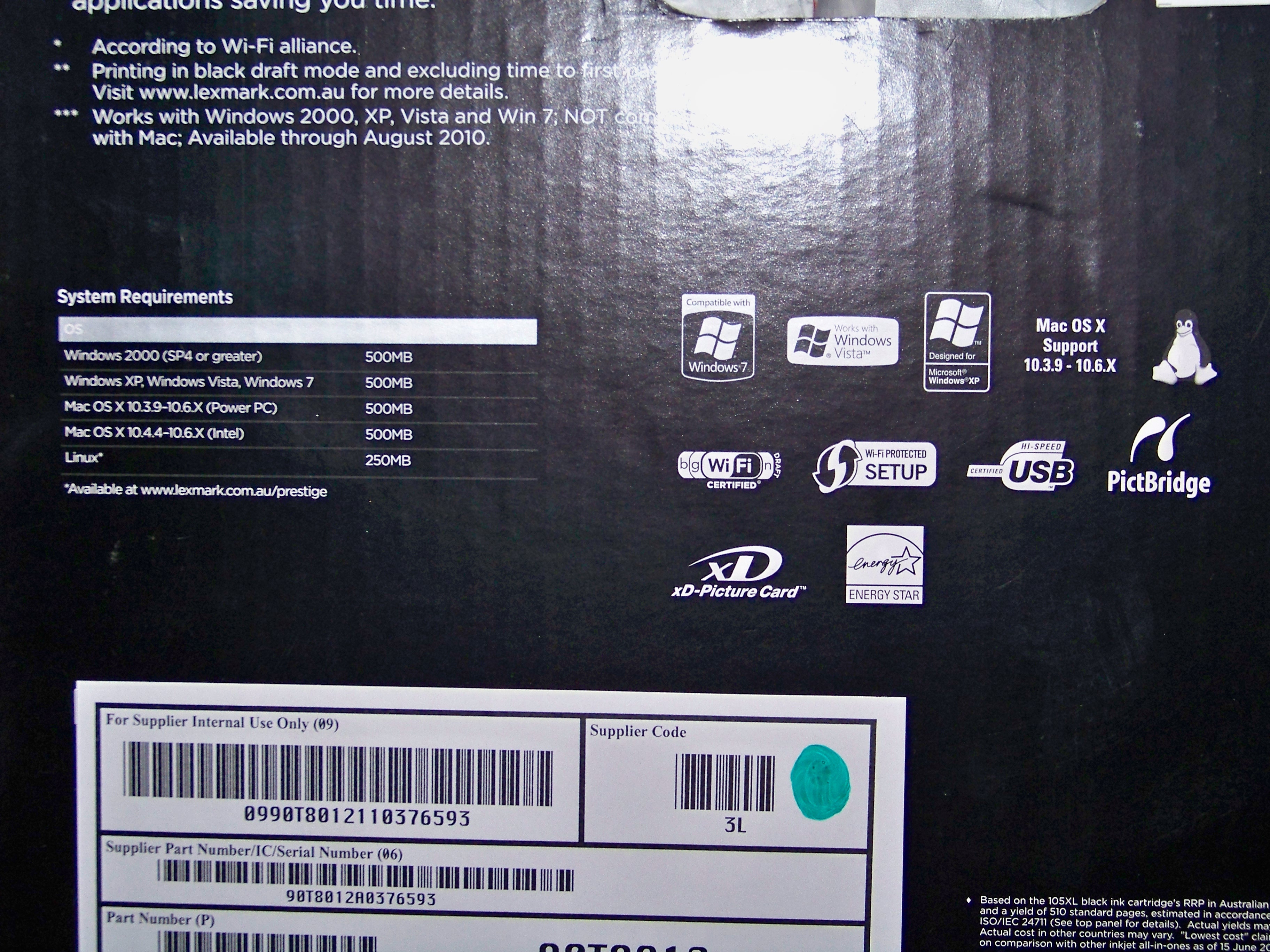
I wanted to get a Lexmark Prestige Pro805 printer to work under Linux, due to bad drivers from Lexmark and no driver support in Debian/Unstable I ve given up and advised the people who purchased it to return it for a refund. I recommend that Lexmark not be considered when purchasing a printer for use with Linux. The box advertises the URL http://www.lexmark.com.au/prestige for downloading Linux drivers. The driver file is named lexmark-inkjet-09-driver-1.5-1.i386_ts.deb.sh.tar.gz which makes anyone expect a tar.gz archive of a shell archive of a Debian package. But that s not what it is at all, in Lexmark-land deb is not the file name extension for a Debian package, but just a random bit of text to identify a file that is somewhat related to Debian, the fact that the Linux driver for Ubuntu/Debian Package Manager based distros doesn t use the string ubu in it s name is something that would lead a typical Linux user to believe that deb means a Debian package. Similarly the file named lexmark-inkjet-09-driver-1.5-1.i386_ts.rpm.sh.tar.gz and described as Linux driver for RedHat Package Manager based distros is not actually an RPM package or inherently for RPM based distros, it s just a shar archive that is built and tested for some unspecified version of some Red Hat distribution (RHEL? Fedora? SUSE?). Now when I execute lexmark-inkjet-09-driver-1.5-1.i386_ts.deb.sh on an AMD64 version of Linux it opens an X11 window, prompts for the root password, and then fails because an i386 Debian package that it somehow built couldn t be installed. When I ran the shar archive with the options --noexec --keep and examined the files it contained it has a few AMD64 executables so obviously the software they used to create the installer has some support for AMD64 but they just decided not to use it. It seems that the only way to buy an i386 system nowadays is to buy an embedded system or a NetBook, all Desktops, laptops, and servers run the AMD64 architecture, as most people do a Linux install that matches the full capabilities of their system (IE running AMD64 software on an AMD64 CPU) that means most systems sold in the last few years can t be used with a new Lexmark printer without an unreasonable amount of work. Sure it is possible to setup a chroot environment or KVM virtual machine for running printer drivers, but I don t really want to do that and a significant portion of the potential customers don t have the skill needed to do so. While technically their claims about having Linux driver support are correct (they support some distributions of Linux on i386), the majority of new systems won t work with it unless someone who has good skills spends some time and effort on it. Probably the majority of Linux Desktop and server systems that are in use today use AMD64 and are run by people who don t know how to setup a chroot so therefore for most real installations it s not supported. Even for i386 systems installation is unlikely to be trouble-free, when they support RPM based distributions (without identifying which of the many wildly different RPM systems they tested on) and Debian (without mentioning a version number) it seems that the incidence of people running a distribution that is supported is going to be quite low. Lexmark uses the Linux logo to claim compatibility Based on this experience I am not inclined to trust Lexmark in future, I will not trust any future claims of Linux support that they may make. The above picture of the Lexmark box shows Tux (the Linux logo), it doesn t mean support out of the box as you would hope, but instead means support for old systems with some effort.

Next.

Previous.