Search Results: "nic"

6 January 2014

Raphaël Hertzog: My Free Software Activities in December 2013


This is my monthly summary of my free software related activities. If you re among the people who made a donation to support my work (147.56 , thanks everybody!), then you can learn how I spent your money. Otherwise it s just an interesting status update on my various projects. The Debian Administrator s Handbook Cover of the Debian Administrator's Handbook (Wheezy edition)I spent a good chunk of December on the book. First finalizing the English version and getting it out (BTW, just for the launch, there s a 10% discount on the paperback that lasts only until January 9th!). Then working on updating the French translation. Eyrolles will publish a new edition of the French book based on this translation. Expect some further news about this during January! Debian France I contributed to many discussions within Debian France. Starting with a complaint that most events are organized in Paris, I proposed to map the location of Debian France members. We added new fields in the membership management page so that members can add their GPS coordinates and Fr d ric Decou made some experiments with Openstreetmap. Someone else (Kiriarat) volunteered to write the required glue code. A manual map is currently maintained on the website. Sample logo receivedIn the discussions about the setup of the Debian France shop, I suggested to update our logo with a nicer looking one. We got a few suggestions and after further discussions with Alexandre Delano and Sylvestre Ledru, we organized a small contest to entice designers to submit a logo proposal to us (the winner earns a set of Debian goodies). We got 46 proposals (see my favorite on the right)! The board is currently pre-selecting the logos and setting up the final vote for our members. The winner shall be announced at the end of the upcoming mini-debconf in Paris. I also continued the work to finalize new bylaws and new internal rules. They shall be adopted during the next general assembly which will happen during the mini-debconf. Misc Debian Work WordPress maintenance. I mentored Pablo Vasquez to do his first small contribution to the WordPress packaging. I really appreciate this but he s not yet ready to assume maintenance of a big package like WordPress on his own. I got multiple other offers of help and pinged them all while filing #733726 to coordinate the work on the new upstream version. But I got no reply :-( Handing over packages to new maintainers is hard Init system discussion. The technical committee has the hard task of picking the default init system that will replace the traditional System V init (see #727708). I followed this huge discussion closely and contributed a bit where I add something meaningful to say. Final decision is expected sometimes in January. FWIW, I share entirely Russ Allbery s point of view in those discussions. I have been running systemd on some of my computers for a few months already. Fixing lxc in stable. The lxc package in stable has a non-working debian template. I really dislike documenting that things are broken so instead of doing that in the Debian Administrator s Handbook, I opted to do something about it. I prepared a non maintainer upload for stable (see #680469 for the problem and #732358 for the stable update request). Misc stuff. I sponsored a tcpdf upload. I filed an enhancement request on Publican to have it keep processing instructions present in translations. I uploaded new versions of publican-librement and debian-handbook. I filed #732678 against git-buildpackage because it failed to properly call lintian when given the -A dpkg-buildpackage argument. Thanks See you next month for a new summary of my activities.


No comment Liked this article? Click here. My blog is Flattr-enabled.

Vincent Sanders: NetSurf Developer Workshop Redux

The NetSurf Developers bringing you alternative LOLcat viewing software since 2002Once again the NetSurf developers congregated in Cambridge at the Collabora offices where we were made welcome in a nice environment for the event.

Five developers managed to attend from around the UK Rob Kendrick, Vincent Sanders, Daniel Silverstone, John-Mark Bell and Michael Drake. We also had Chris Young and Fran ois Revol providing some bug fixes remotely.

This was the first time we had all met since the previous event towards the end of 2012 and we took full advantage of this to discuss a pretty extensive agenda in addition to the practical programming tasks.

From Friday lunchtime through to Sunday evening we managed 30 hours of work consisting of over 70 commits to over 100 files.

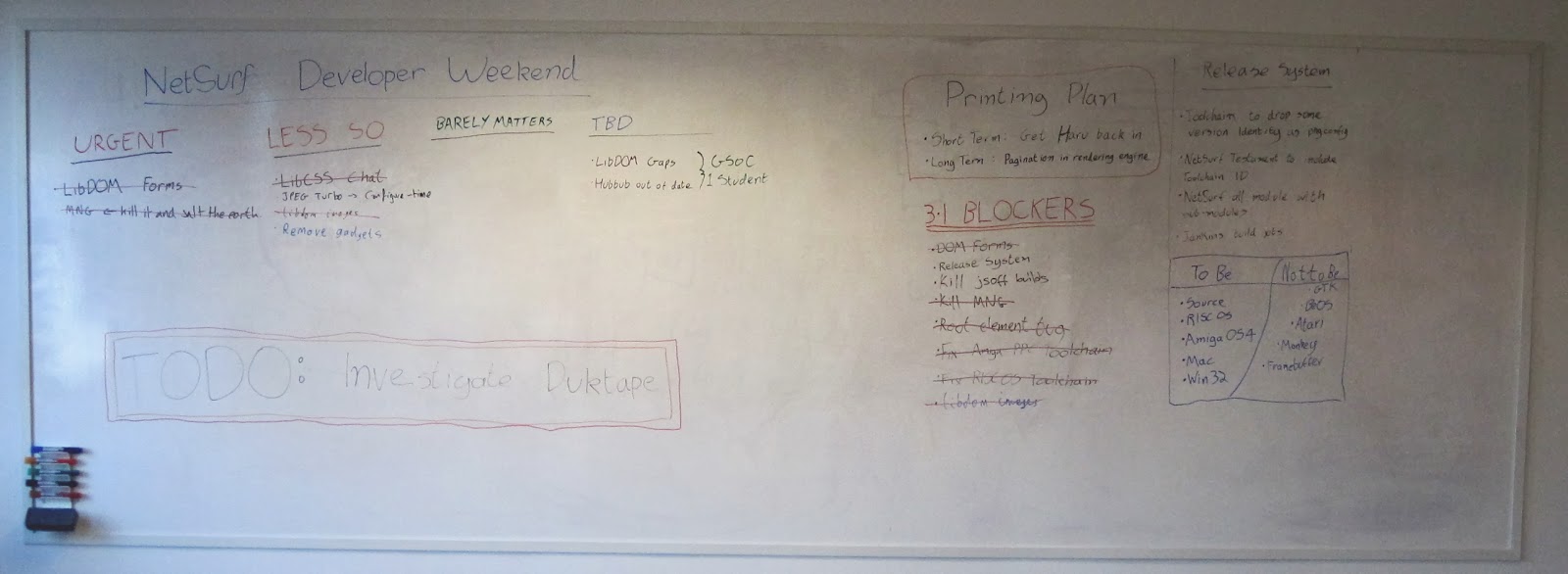
The whiteboard of our notes

Our main focus was working towards a 3.1 release which is scheduled for early April. Along with the source the release will have binary builds for RISC OS, AmigaOS, Windows and Mac OS X (x86 and ppc). Although the NetSurf project will not be directly releasing binaries for the GTK and Framebuffer frontends we will be ensuring the Debian packages are updated which is our prefered method of distribution for those targets.

We analysed the 3.0 release and formulated an improved process for the future. The 3.1 release will be generated automatically by the CI system ensuring constant results and removing the problems we encountered previously.

A set of release blocking issues was derived which we used as a task list during the workshop.The majority of these were completed including:
DOM based forms
Web forms are a feature Netsurf has supported for a long time and their implementation has not kept up with the rest of the browser. This is a long standing problem area which has resulted in numerous strange bugs with form submission. With this change the form system has been reworked to correctly operate directly from the DOM resulting in the squashing of a large number of bugs and a much improved user experience.

DOM based image loading
Up to now image fetching was performed only during the rendering of a page. With this change when the image link is placed into the DOM during the page parse it is scheduled to be fetched, this should give an improved user experience as images should be available earlier in a pages render.

Removal of MNG support
NetSurf has supported MNG since the 1.0 release, indeed the MNG library used to provide the PNG support too though we have long ago transitioned to libPNG. Alas the web has moved on and MNG has been largely forgotten, the libMNG library that performs the image decoding is old and generally unsupported specifically lacking security updates.

The build issues with libMNG (lack of pkg-config, reliance on libcms1 etc.) were causing maintenance issues in code nobody was actually using (there were crash bugs discovered during its removal!). Because of these issues it was decided to join the vast majority of browsers and remove support for this format.
The developers also addressed several issues with toolchain construction and a number of annoying usability bugs.

Plans for how to improve printing support we made. Initially we intend to fix the existing haru based pdf generation using this to print via pdf and in future have correct css styled page paginated printing render output.

The perennial issue of javascript was discussed however, while efforts to improve the existing support are ongoing, our usage of the spidermonkey library continues to raise various challenges including platform support and API changes between versions.

Due to these issues it has been suggested that we might add support for using the duktape JS engine instead, initial results are promising but given the size of the task of implementing an additional javascript engine binding further investigation is necessary before making a commitment.

Amongst the other discussions the group has also agreed that we will once again apply to be a GSoC organisation for a single student with some very focused projects:
  • Improving our HTML5 parser (hubbub)
  • Improving the DOM library implementing missing functionality.
While neither of these projects are as fashionable as some of our previous proposals they are well defined enough that as a group we believe we could offer enough support to the student to make their experience a pleasurable one and get the resulting code reviewed and merged promptly.

This event was very successful with a great deal achieved, the project is much more likely to be in a good shape to release 3.1 by April now and the meeting has given the developers a much welcomed boost.

I would like to extend the groups thanks to Robert McQueen for letting us use the Collabora offices, Dor e Carrier for organising all the administrative things and to Vivek Dasmohapatra for coming out on his Sunday afternoon to let us back in after locking ourselves out.


Julian Andres Klode: python-apt now native Python 3 code

Today I made an important change to the python-apt code: It is now native Python 3 code (but also works under Python 2). The previous versions all run 2to3 during the build process to create a Python 3 version. This is no longer needed, as the code is now identical. As part of that change, python-apt now only supports Python 2.7, Python 3.3, and newer. I m using some features only present in 3.3 like Python2 unicode literal syntax in order to keep the code simple. Here s how I did it: I took the Python 2 code and ran 2to3 -f print -x future on it. This turned every print statement in a call to the print function. I then went ahead and added a from __future__ import print_function to the top of each module. This was the first commit. For the second commit, I ran 2to3 -p -x future to convert the remaining stuff to Python 3, and then undid some changes (like unicode literals) and fixed the rest of the changes to work under both Python 2 and 3. Sometimes I added a top-level code like:
if sys.version_info_major >= 3:
    unicode = str
So I could use unicode in the code for the Python 2 cases. I used various backported modules like io and stuff only available in Python 2.7, so dropped support for Python 2.6.
Filed under: Debian, Python

Steve Kemp: A beginning is a very delicate time.

Recently I wrote about docker, after a brief diversion into using runit for service management, I then wrote about it some more. I'm currently setting up a new PXE-boot environment which uses docker for serving DHCP and TFTPD, which is my first "real" usage of any note. It is fun, although I now discover I'm not alone in using docker for this purpose. Otherwise life is good, and my blog-spam detection service recently broke through the 11 million-rejected-comment barrier. The Wordpress Plugin is seeing a fair amount of use, which is encouraging - but more reviews would be nice ;) I could write about work, I've not done that since changing job, but I'm waiting for something disruptive to happen first.. ObQuote: Dune. (film)

5 January 2014

Lisandro Damián Nicanor Pérez Meyer: Qt 5.2.0 in Debian experimental, now available for more archs

Qt 5.2.0 is already available in experimental until we get a transition slot, but don't be afraid to test it. With this release we had major improvements. With 5.1.1 currently in sid we have the following buildd chart:

Qt 5.1.1 in Debian Sid
Now with 5.2.0 in Debian experimental we have:

Qt 5.2.0 in Debian experimental

As you can see Qt has compiled in more archs, thanks to the effort of the Debian's porters and from the Qt/KDE team.

Note that Qt JS Backend has dissapeared: it's functionality (the javascript engine) is now in Qt Declarative itself. It has been ported away from Google's v8 to a Qt-based engine, allowing it to build in more archs among other features.

You can also note that we still have quite some FTBFS, mostly coming from Qt Webkit. Feel free to send patches ;-)

Thomas Goirand: OpenRC now in Experimental

I thought it would have been smooth, though it wasn t. OpenRC shipped /sbin/rc, which conflicted with the rc shell (an implementation of the AT&T Plan 9 shell), and /sbin/runscript was conflicting with minicom. With the help of upstream authors, /sbin/rc was renamed /sbin/openrc, and /sbin/runscript was renamed /sbin/openrc-run. However, the main goal is reached: after last summer Google Summer of Code project, and a bit of rework for the ruff edges, OpenRC made it to Debian. So, if you wish to try OpenRC, which is a direct replacement for sysv-rc, just add the Debian Experimental repository to your sources.list, and do apt-get install openrc . The only issue will be the first reboot, though that should be fine if one manually shuts down every running daemon, and then type what the postinst suggests as command echoed on the screen. Suggestions on how to improve this is welcome. I warmly also welcome more general feedback. I d like to publicly thank Patrick Lauer, Benda ( ), WIlliam Hubbs, Alexander Vershilov (who are all OpenRC upstreams), Bill Wang who was the GSoC studdent working on OpenRC, Roger Leigh who is the current sysv-init/sysv-rc maintainer, for their help and support when porting OpenRC to Debian. Without them, it wouldn t have been possible.

3 January 2014

Dirk Eddelbuettel: New BH release 1.51.1-4

A new release of the BH package is now on CRAN and its mirrors. BH provides (a sizeable subset of) the Boost library for C++, particularly the (large) parts delivered as pure template headers not requiring linking. See the BH page for more details. This release comes from a rewritten build script for the package. We no longer drive the initial set of Boost libraries by the requirements of the bigmemory (and synchronicity) packages, but rather explicitly enumerate an equivalent set of Boost libraries. This ensures that these libraries are included completely. We also move the project repository to this GitHub repo. The complete list changes follows below.
Changes in version 1.51.0-4 (2014-01-01)
  • Rewritten main package creation script to no longer scan for what bigmemory and synchronicity use, but rather explicitly copy over an (equivalent) list of explicitly-enumerated Boost libraries
  • Repository moved from R-Forge to GitHub, scripts and layout adjusted accordingly
  • Besides the implicitly expanded coverage by including the complete libraries, we also expanded from math/distributions to all of math.
Courtesy of CRANberries, there is also a diffstat report for the most recent release. Comments and suggestions are welcome via the mailing list or issue tracker still available via the package page at R-Forge.

This post by Dirk Eddelbuettel originated on his Thinking inside the box blog. Please report excessive re-aggregation in third-party for-profit settings.

2 January 2014

Keith Packard: Present-pixmap-lifetimes-part-deux

Pixmap ID Lifetimes under Present Redirection (Part Deux) I recently wrote about pixmap content and ID lifetimes. I think the pixmap content lifetime stuff was useful, but the pixmap ID stuff was not quite right. I ve just copied the section from the previous post and will update it. PresentRedirect pixmap ID lifetimes (reprise) A compositing manager will want to know the lifetime of the pixmaps delivered in PresentRedirectNotify events to clean up whatever local data it has associated with it. For instance, GL compositing managers will construct textures for each pixmap that need to be destroyed when the pixmap disappears. Present encourages pixmap destruction The PresentPixmap request says:
PresentRegion holds a reference to pixmap until the presentation occurs, so pixmap may be immediately freed after the request executes, even if that is before the presentation occurs.
Breaking this when doing Present redirection seems like a bad idea; it s a very common pattern for existing 2D applications. New pixmap IDs for everyone Because pixmap IDs for present contents are owned by the source application (and may be re-used immediately when freed), Present can t use that ID in the PresentRedirectNotify event. Instead, it must allocate a new ID and send that instead. The server has it s own XID space to use, and so it can allocate one of those and bind it to the same underlying pixmap; the pixmap will not actually be destroyed until both the application XID and the server XID are freed. The compositing manager will receive this new XID, and is responsible for freeing it when it doesn t need it any longer. Of course, if the compositing manager exits, all of the XIDs passed to it will automatically be freed. I considered allocating client-specific XIDs for this purpose; the X server already has a mechanism for allocating internal IDs for various things that are to be destroyed at client shut-down time. Those XIDs have bit 30 set, and are technically invalid XIDs as X specifies that the top three bits of every XID will be zero. However, the cost of using a server ID instead (which is a valid XID) is small, and it s always nice to not intentionally break the X protocol (even as we continue to take advantage of accidental breakages). (Reserving the top three bits of XIDs and insisting that they always be zero was a nod to the common practice of weakly typed languages like Lisp. In these languages, 32-bit object references were typed by using few tag bits (2-3) within the value. Most of these were just pointers to data, but small integers, that fit in the remaining bits (29-30), could be constructed without allocating any memory. By making XIDs only 29 bits, these languages could be assured that all XIDs would be small integers.) Pixmap Destroy Notify The Compositing manager needs to know when the application is done with the pixmap so that it can clean up when it is also done; destroying the extra pixmap ID it was given and freeing any other local resources. When the application sends a FreePixmap request, that XID will become invalid, but of course the pixmap itself won t be freed until the compositing manager sends a FreePixmap request with the extra XID it was given. Because the pixmap ID known by the compositing manager is going to be different from the original application XID, we need an event delivered to the compositing manager with the new XID, which makes this event rather Present specific. We don t need to select for this event; the compositing manager must handle it correctly, so we ll just send it whenever the composting manager has received that custom XID. PresentPixmapDestroyNotify
 
    PresentPixmapDestroyNotify
    type: CARD8         XGE event type (35)
    extension: CARD8        Present extension opcode
    sequence-number: CARD16
    length: CARD32          0
    evtype: CARD16          Present_PixmapDestroyNotify
    eventID: XFIXESEVENTID
    event-window: WINDOW
    pixmap: pixmap
 
This event is delivered to the clients selecting for SubredirectNotify for pixmaps which were delivered in a PresentRedirectNotify event and for which the originating application Pixmap has been destroyed. Note that the pixmap may still be referenced by other objects within the X server, by a pending PresentPixmap request, as a window background, GC tile or stipple or Picture drawable (among others), but this event serves to notify the selecting client that the application is no longer able to access the underlying pixmap with it s original Pixmap ID.

1 January 2014

Russ Allbery: 2013 Book Reading in Review

What a strange year. 2013 was marked by a whole sequence of entirely unexpected events, including multiple major work upheavals. For large chunks of the year, I had very little time or emotional energy for personal reading goals, and particularly for writing reviews. I declared personal amnesty on most of my intentions halfway through the year, and all the totals will reflect that. On the plus side (although not for reading and reviews), it was a great year for video games. Next year, there will be no specific goals. Between continuing work fallout, a very busy project schedule, my intent to keep playing a lot of video games, and various other personal goals I want to take on, I'm going to take the pressure off of reading. Things will be read and reviews will be written (and I'm going to make more of an effort to write reviews shortly after reading books), but I'm not going to worry about how many. The below statistics are confined to the books I reviewed in 2013. I read six more books that I've not yet reviewed, due to the chaos at the end of the year. Those will be counted in 2014. There were no 10 out of 10 books this year, partly due to the much lower reading totals and partly due to my tendency this year to turn to safe comfort reading, which is reliably good but unlikely to be exceptional. There were, however, several near-misses that were worth calling out. My favorite book of the year was Neal Stephenson's Anathem, which narrowly missed a 10 for me due to some fundamental problems with the plot premise. But this is still an excellent book: the best novel about the practice of science and philosophy that I've ever read. Also deserving mention are K.E. Lane's And Playing the Role of Herself, lovely and intelligent lesbian romance that's likely to appeal even to people who would not normally try that genre, and Guy Gavriel Kay's River of Stars. The latter isn't quite at the level of Kay's earlier Under Heaven, but it's still an excellent work of alternate historical fiction in a memorable setting. A special honorable mention goes to Lisa O'Donnell's The Death of Bees. It requires a lot of warnings for very dark subject matter and a rather abrupt ending, but it's been a long time since I've cared that much about the characters of a book. My favorite non-fiction book of the year was Gary J. Hudson's They Had to Go Out, a meticulously researched account of a tragic Coast Guard mission. The writing is choppy, the editing could have been better, and it's clear that the author is not a professional writer, but it's the sort of detailed non-fiction account that can only be written by someone who's been there and lived through similar experiences. Also worth mentioning is Mark Jason Dominus's Higher Order Perl, which was the best technical book I read all year and which I found quite inspiring for my own programming. The full analysis includes some additional personal reading statistics, probably only of interest to me.

Debian Sysadmin Team: Peter Palfrader: Securing the Debian zones

We are in the process of deploying DNSSEC, the DNS Security Extensions, on the Debian zones. This means properly configured resolvers will be able to verify the authenticity of information they receive from the domain name system. The plan is to introduce DNSSEC in several steps so that we can react to issues that arise without breaking everything at once. We will start with serving signed debian.net and debian.com zones. Assuming nobody complains loudly enough the various reverse zones and finally the debian.org zone will follow. Once all our zones are signed we will publish our trust anchors in ISC's DLV Registry, again in stages. The various child zones that are handled differently from our normal DNS infrastructure (mirror.debian.net, alioth, bugs, ftp, packages, security, volatile, www) will follow at a later date. We are using bind 9.6 for NSEC3 support and our fork of RIPE's DNSSEC Key Management Tools for managing our keys because we believe that it integrates nicely with our existing DNS helper scripts, at least until something better becomes available. We will use NSEC3RSASHA1 with key sizes of 1536 bits for the KSK and 1152 bits for the ZSK. Signature validity period will most likely be four weeks, with a one week signature publication period (cf. RFC4641: DNSSEC Operational Practices). Zone keys rollovers will happen regularly and will not be announced in any specific way. Key signing key rollovers will probably be announced on the debian-infrastructure-announce list until such time that our zones are reachable from a signed root. KSK rollovers for our own child zones (www.d.o et al.), once signed, will not be announced because we can just put proper DS records in the respective parent zone. Until we announce the first set of trust anchors on the mailinglist the keysets present in DNS should be considered experimental. They can be changed at any time, without observing standard rollover practices. Please direct questions or comments to either the debian-admin or, if you want a more public forum, the debian-project list at lists.debian.org. See also: -- Peter Palfrader

Vincent Fourmond: Rubyforge is dead, but ctioga2 goes on...

In the light of the frequent recent downtimes of rubyforge, and thanks to the information from @copiousfreetime, I finally decided to move the hosting of ctioga2 away from rubyforge, to sourceforge. Transition went smooth, git is now the only VCS. Code is hosted at sourceforge and mirrored at github.
Work goes on on ctioga2. I've recently implemented a decent support for histograms. It is already much more powerful than the one in the old ctioga, but it is far from being feature-full. Here's a preview.I'm slowly preparing a new release for ctioga2, that would incorporate quite some fixes since the last time, and quite a few nice features in addition to the histograms. Stay tuned !

Junichi Uekawa: A Happy New Year.

A Happy New Year.

31 December 2013

Paul Tagliamonte: Hy 0.9.12 released

Good morning all my hungover friends. New Hy release - sounds like the perfect thing to do while you re waiting for your headaches to go away. Here s a short-list of the changes (from NEWS) - enjoy!
Changes from Hy 0.9.11
   tl;dr:
    0.9.12 comes with some massive changes,
    We finally took the time to implement gensym, as well as a few
    other bits that help macro writing. Check the changelog for
    what exactly was added. 
    
    The biggest feature, Reader Macros, landed later
    in the cycle, but were big enough to warrent a release on it's
    own. A huge thanks goes to Foxboron for implementing them
    and a massive hug goes out to olasd for providing ongoing
    reviews during the development.
    
    Welcome to the new Hy contributors, Henrique Carvalho Alves,
    Kevin Zita and Kenan B l kba . Thanks for your work so far,
    folks!
    
    Hope y'all enjoy the finest that 2013 has to offer,
      - Hy Society
    * Special thanks goes to Willyfrog, Foxboron and theanalyst for writing
      0.9.12's NEWS. Thanks, y'all! (PT)
    [ Language Changes ]
    * Translate foo? -> is_foo, for better Python interop. (PT)
    * Reader Macros!
    * Operators + and * now can work without arguments
    * Define kwapply as a macro
    * Added apply as a function
    * Instant symbol generation with gensym
    * Allow macros to return None
    * Add a method for casting into byte string or unicode depending on python version
    * flatten function added to language
    * Add a method for casting into byte string or unicode depending on python version
    * Added type coercing to the right integer for the platform
    [ Misc. Fixes ]
    * Added information about core team members
    * Documentation fixed and extended
    * Add astor to install_requires to fix hy --spy failing on hy 0.9.11.
    * Convert stdout and stderr to UTF-8 properly in the run_cmd helper.
    * Update requirements.txt and setup.py to use rply upstream.
    * tryhy link added in documentation and README
    * Command line options documented
    * Adding support for coverage tests at coveralls.io
    * Added info about tox, so people can use it prior to a PR
    * Added the start of hacking rules
    * Halting Problem removed from example as it was nonfree
    * Fixed PyPI is now behind a CDN. The --use-mirrors option is deprecated.
    * Badges for pypi version and downloads.
    [ Syntax Fixes ]
    * get allows multiple arguments
    [ Bug Fixes ]
    *  OSX: Fixes for readline Repl problem which caused HyREPL not allowing 'b'
    * Fix REPL completions on OSX
    *  Make HyObject.replace more resilient to prevent compiler breakage.
    [ Contrib changes ]
    * Anaphoric macros added to contrib
    * Modified eg/twisted to follow the newer hy syntax
    * Added (experimental) profile module

30 December 2013

Russ Allbery: Init system evaluation thanks

Most people who follow Debian are probably aware that we're currently in the middle of a major debate over the future of Debian's init system. Over the past month, and particularly over the past week, I undertook an evaluation of two of the options in that debate, using one of my packages as a test bed. I also did a lot of reading, filed a few bugs, and asked a bunch of questions. That's an extension of the questions I've been asking and discussions I've been participating in around init systems for the past year plus. I have been keeping my opinions and writeups confined to the relevant Techncial Committee bug report so that they can be read in context with their rebuttals. There are a lot of thoughtful and well-informed opinions here, of which mine are only one, and several of my conclusions have been inaccurate or at least not complete, so the context is important. You can find the full traffic in the Technical Committee bug. Most of the discussion, in a threaded view, is in the Technical Committee archives for December. However, in one of the messages I sent today, I tried to show my appreciation for the people who have assisted with this evaluation over the past week, month, and years, and I think that section deserves broader distribution outside of the ongoing discussion. It is therefore included below. Throughout this evaluation process, my interactions with upstart and systemd upstream developers and Debian packagers have been uniformly excellent. Bug reports filed against both systemd and upstart have received excellent and timely response, and all involved have been quite willing to explain things I've misunderstood, correct my false starts, and discuss technical and practical aspects of their designs. I was particularly impressed by the clear effort that the systemd and upstart maintainers in Debian have put into fully integrating their init systems in such a way that makes them easy to test and use with existing Debian packages. This includes but is not limited to update-rc.d support, invoke-rc.d support, status synchronization with sysvinit, past Policy discussion, and attention to upgrade paths and init-switching use cases. I also want to particularly thank the OpenRC upstream development team for their involvement in this process and their contributions to the discussion. I personally don't think that package is a good match for Debian's needs on Linux, but that's through no fault of the people involved, and I think they would be an excellent upstream if that package looked like a good fit for the needs of any of Debian's non-Linux ports. I also want to thank Petter Reinholdtsen, Roger Leigh, and everyone else who has worked on the sysvinit package over the years, the insserv conversion to dependency-based boot, and the inclusion of LSB support. If it weren't for their hard work, we would be in a far worse position than we are today. It's often hard to see people discussing the inadequacies of something into which you put years of hard work. I want to call attention to their long-term contributions to the distribution, and to the number of Debian systems that have booted through their efforts over the years.

Carl Chenet: Virtual environments with Python 3.3

Follow me on Identi.ca or Twitter One of the major features of Python 3.3 is the new venv module, allowing the creation of Python virtual environments on your system. 1. What is a virtual environment? A virtual environment is a directory dedicated to the execution of your Python applications. Activating your virtual environment will force Python to execute in this directory as the top level of this directory was the root of your file system. The virtual environments are interesting because of the independence they have toward the host they run on, especially when you want to install several versions of Python or if you want to install lots of dependencies without being the system administrator of the host. python-logo-master-v3-TM If you are a Python developer, you must know virtualenv. This really nice application offers a nice way to create Python virtual environment. Moreover it comes with pip already installed in your virtual environment, in order to install other dependencies you need in a really convenience way. Starting from Python 3.3, the module venv of the Python standard library offers the users to create virtual environments. This new feature will encourage all users to create virtual environments to develop their own Python applications, which is a good practice. Thanks to the experiences of several applications being used in the Python community, the module venv was written to be really efficient and widely available. The Python Enhancement Proposal 405 (PEP405) offers a really interesting reading if you wish to find more information about this topic. 2. Creating a virtual environment with Python 3.3 With Python 3.3 comes pyvenv-3.3, allowing to create Python virtual environment:
$ pyvenv-3.3 myvirtualenv
$ cd myvirtualenv/
$ tree .
.
  bin
    activate
    pydoc
    python -> python3.3
    python3 -> python3.3
    python3.3 -> /usr/bin/python3.3
  include
  lib
    python3.3
        site-packages
  pyvenv.cfg
As we can see, three directories were created.
$ cat pyvenv.cfg 
home = /usr/bin
include-system-site-packages = false
version = 3.3.2
Just before moving on, if you want to use the existing modules in your global site-packages directory on your system, the option system-site-packages is available. 3. Activate the virtual environment Lets activate our virtual environment. We need to use the bin/activate file in this environment:
$ source bin/activate 
(myvirtualenv) $
A change in our prompt indicated the good activation of the virtual environment. 4. Installing applications in the virtual environment But playing around with only the default Python interpreter is not really funny. Lets download pip, the Python installer, but before that we need a dependency setuptools:
(myvirtualenv) $ curl https://bitbucket.org/pypa/setuptools/raw/bootstrap/ez_setup.py -o ez_setup.py
 % Total % Received % Xferd Average Speed Time Time Time Current
 Dload Upload Total Spent Left Speed
 100 11356 100 11356 0 0 18507 0 --:--:-- --:--:-- --:--:-- 18495
(myvirtualenv) $ curl https://raw.github.com/pypa/pip/master/contrib/get-pip.py -o get-pip.py
 % Total % Received % Xferd Average Speed Time Time Time Current
 Dload Upload Total Spent Left Speed
 100 543k 100 543k 0 0 685k 0 --:--:-- --:--:-- --:--:-- 685k
Now lets install Setuptools and Pip:
(myvirtualenv) $ python3.3 ez_setup.py
 Downloading https://pypi.python.org/packages/source/s/setuptools/setuptools-2.0.tar.gz
 Extracting in /tmp/tmpxlrv7q
 Now working in /tmp/tmpxlrv7q/setuptools-2.0
 Installing Setuptools
... (lots of lines)...
Installed /tmp/myvirtualenv/lib/python3.3/site-packages/setuptools-2.0-py3.3.egg
 Processing dependencies for setuptools==2.0
 Finished processing dependencies for setuptools==2.0
(myvirtualenv) $ python3.3 get-pip.py
 Downloading/unpacking pip
 Downloading pip-1.4.1.tar.gz (445kB): 445kB downloaded
 Running setup.py egg_info for package pip
 ... (lots of lines)...
 Successfully installed pip
 Cleaning up...
Ok now we re ready to use pip to install anything we need in our virtual environment. Lets think one more second about what we did: we install the Setuptools and the Pip application inside our virtual environment, with nothing written on our main system. Now lets try to install Brebis, the fully automated backup checker, and run it in this environment:
(myvirtualenv) $ pip-3.3 install brebis
 Downloading/unpacking brebis
 Downloading brebis-0.8.tar.gz
 Running setup.py egg_info for package brebis
Installing collected packages: brebis
 Running setup.py install for brebis
 changing mode of build/scripts-3.3/brebis from 644 to 755
changing mode of /tmp/myvirtualenv/bin/brebis to 755
 Successfully installed brebis
 Cleaning up...
We re now ready to launch Brebis, executing in our virtual environment:
(myvirtualenv) $ brebis -h
usage: brebis [-h] [-c DIR] [-C DIR] [-d DELIMITER] [-g] [-G] [-l FILE]
 [-L DIR] [-O DIR] [-v] 
Fully automated backup checker
positional arguments:
 archives archives to check
optional arguments:
 -h, --help show this help message and exit
 -c DIR, --configpath DIR
 the path to the configurations
 -C DIR, --output-conf-dir DIR
 the directory to store the configuration file
 -d DELIMITER, --delimiter DELIMITER
 delimiter of the fields for the list of files
 -g, --gen-list generate a list of files inside a backup
 -G, --gen-full generate the configuration file and the list of files
 for the backup
 -l FILE, --log FILE the log file
 -L DIR, --output-list-dir DIR
 the directory to store the list of files inside an
 archive or tree
 -O DIR, --output-list-and-conf-dir DIR
 the directory to store the configuration file and the
 list of files inside an archive or tree
 -v, --version print the version of this program and exit
For more information: http://www.brebisproject.org
So we get an execution of the Brebis application inside our virtual environment, installed from our virtual environment with tools installed only in the virtual environment. That s a big step that such a feature is now included in the standard library. In the future, you will enjoy the possibility to create new virtual environments for each Python version right out of the box. Moreover, using the upgrade option of the pyvenv command, you will upgrade, if needed, your virtual environment in a really easy and straightforward way, making environments adaptable in time. What about you? What do you think about the Python 3 virtual environments and their features, given your own needs? Feel free to use the comments section of this post.

Lars Wirzenius: Thoughtful, inspiring words from Russ

Russ Allbery has written up summaries of the research he's done in preparation of a Debian Technical Committee vote on default init system in Debian's next release. The mails are long, and well worth reading completely if the topic interests you at all, but I'd like to quote separately a few paragraphs that I found thoughtful, and inspiring, in the greater Debian context and not just for the init system discussion. From "init system other points, and conclusion":
Here again, I think we have an opportunity for Debian to be more innovative and forward-looking in what we attempt to accomplish in the archive by adopting frameworks that let us incorporate the principles of least privilege and defense in depth into our standard daemon configurations.
And later, from the same mail:
I think we should make wise decisions about which areas we want to invest project effort. I dislike investing significant project effort in catch-up efforts that, when complete, merely get us back to where we would have been if we'd chosen a different solution. I don't think that's wise stewardship of project resources. I want to see Debian focus its efforts on places where we can make a real difference, where we can be leaders. That means adopting the best-of-breed existing solutions and building on top of them, not reinventing wheels and thereby starting from a trailing position.
From "loose ends for init system decision":
It is not, in general, necessary to justify what you want to do in Debian. It doesn't matter if it's going to be used by thousands of people or two people. If you can do your work to the standards that we expect to be maintained across the archive, and without negative impact on Debian's other contributors, you can work on whatever you love. And, furthermore, we all support each other in our passions. Debian is built on a culture of deference to other people's work, and reasonable accomodation to the projects that other people want to work on. Now, there is a fine balance here. Deference to other people's work does not mean a requirement to join their work. Reasonable accomodation does not mean that every Debian developer is required to test their software on non-Linux ports. The goal is that all of us should be empowered to work on the things we are passionate about, which implicitly includes being empowered to not work on the things that are not of interest to us. Therefore, for some efforts, and specifically for the non-Linux port efforts, the work is mostly born by the porters. They're expected to test, diagnose problems, and submit patches. The deference and reasonable accomodation that we expect of Debian contributors is to merge those patches when they are reasonable, to not undermine the porting effort when there is a reasonable approach that preserves it, and to be aware of the implications of their packaging for those ports in the broad sense (such as qualifying build-dependencies with [linux-any] where appropriate). We do not expect Debian contributors to reject significant new upstream versions or significant new integrations because they will affect the non-Linux ports, or, for that matter, other projects in Debian. We do expect those changes to follow the standards that we expect of Debian as a whole, and that porting efforts will be treated with deference and reasonable accomodation.
I won't offer a comment on these quotes I prefer to let them speak for themselves but I will say I find these to be among the wisest things said within Debian all year.

Raphaël Hertzog: The Debian Wheezy Handbook is now available

After multiple months of hard work, I m pleased to announce that Roland and I finished updating the Debian Administrator s Handbook for Debian Wheezy. Grab it now! By the way, as part of the launch of this updated edition, you can benefit from a 10% discount on any paperback copy ordered before January 9th 2014. Just click here and place your order. Cover of the Debian Administrator's Handbook (Wheezy edition) We have put lots of hard work on this edition, doing quite some janitorial work. We didn t cover as many new topics as I would have liked, but I m still proud of the end result. The book has a nice preface co-signed by the current and former Debian Project Leaders. Let me quote a short extract:
The book you have in your hands is different. It s a free as in freedom book, a book which is up to Debian freedom standards for every aspects of your digital life. [ ] You can apt-get install this book, you can redistribute it, you can fork this book or, better, submit bug reports and patches for it, so that other in the future can benefit from your contributions. The maintainers of this book who are also its authors are longstanding members of the Debian Project, who grok the freedom ethos that permeates every aspect of Debian.
Enjoy it and share your comments! Even better if you write up a review that we can link from the website.

5 comments Liked this article? Click here. My blog is Flattr-enabled.
29 December 2013

Joachim Breitner: Sim Serim as a browser game

Recently, I gave the very elegant board game Sim Serim away as a present, without actually playing it, leaving me curious about the game. One can easily play it on paper (you just need a paper, and 4 tokens like coins for each player, BoardGameGeek has English rules the of game), but I took this as an opportunity to learn more about HTML5 canvas and nodejs, and so I created the browser game Sum Serum , implementing the game mechanics of Sim Serim . You can play it locally with two people, or over the network. Contributions are welcome! Especially slicker graphics...
In other news, given that in recent years I became one, I m on BoardGameGeek myself now, see my profile there.

Steve Kemp: A good week?

This week my small collection of sysadmin tools received a lot of attention; I've no idea what triggered it, but it ended up on the front-page of github as a "trending repository". Otherwise I've recently spent some time "playing about" with some security stuff. My first recent report wasn't deemed worthy of a security update, but it was still a fun one. From the package description rush is described as:
GNU Rush is a restricted shell designed for sites providing only limited access to resources for remote users. The main binary executable is configurable as a user login shell, intended for users that only are allowed remote login to the system at hand.
As the description says this is primarily intended for use by remote users, but if it is installed locally you can read "any file" on the local system. How? Well the program is setuid(root) and allows you to specify an arbitrary configuration file as input. The very very first thing I tried to do with this program was feed it an invalid and unreadable-to-me configuration file. Helpfully there is a debugging option you can add --lint to help you setup the software. Using it is as simple as:
shelob ~ $ rush --lint /etc/shadow
rush: Info: /etc/shadow:1: unknown statement: root:$6$zwJQWKVo$ofoV2xwfsff...Mxo/:15884:0:99999:7:::
rush: Info: /etc/shadow:2: unknown statement: daemon:*:15884:0:99999:7:::
rush: Info: /etc/shadow:3: unknown statement: bin:*:15884:0:99999:7:::
rush: Info: /etc/shadow:4: unknown statement: sys:*:15884:0:99999:7:::
..
How nice? The only mitigating factor here is that only the first token on the line is reported - In this case we've exposed /etc/shadow which doesn't contain whitespace for the interesting users, so it's enough to start cracking those password hashes. If you maintain a setuid binary you must be trying things like this. If you maintain a setuid binary you must be confident in the codebase. People will be happy to stress-test, audit, examine, and help you - just ask. Simple security issues like this are frankly embarassing. Anyway that's enough: #733505 / CVE-2013-6889.

Russ Allbery: Review: The Incrementalists

Review: The Incrementalists, by Steven Brust & Skyler White
Publisher: Tor
Copyright: September 2013
ISBN: 0-7653-3422-4
Format: Hardcover
Pages: 304
The Incrementalists are a secret society that has been in continuous existence for forty thousand years. The members are immortal... sort of (more on that in a moment). They are extremely good at determining what signals, triggers, and actions have the most impact on people, and adept at using those triggers to influence people's behavior. And they're making the world better. Not in any huge, noticeable way, just a little bit, here and there. Incrementally. Brust and White completely had me with this concept. There are several SF novels about immortals, but (apart from the vampire subgenre) they mostly stay underground and find ways to survive without trying to change the surrounding human society. I love the idea of small, incremental changes, and I was looking forward to reading a book about how that would work. How do they choose what to do? How do they find the right place to push? What long-term goals would such an organization pursue, and what governance structure would they use? I'm still wondering about most of those things, sadly, since that isn't what this novel is about at all. I should be fair: a few of those questions hover in the background. There are some political arguments (that parallel arguments on Brust's blog), and a tiny bit about governance. But mostly this is a sort of romance, a fight over identity, and an extensive exploration of the mental "garden" that the Incrementalists use and build to hold their memories and share information with each other. The story revolves around two Incrementalists: Phil, who is one of the leaders and has one of the longest continuous identities of any of the group, and Renee, a new recruit by Phil who picks up the memories and capabilities (sort of) of the recently-deceased Incrementalist Celeste. Phil is the long-term insider, although a fairly laid-back one. Renee is the outsider, the one to which the story is happening at the beginning, who is taught how the Incrementalists' system works. The Incrementalists is told in alternating first-person viewpoint sections by Phil and Renee (making me wonder if the characters were each written by one of the authors). Once I got past my disappointment over this book not being quite what I wanted, the identity puzzles that Brust and White play with here caught my attention. The underlying "magic" of the Incrementalists is based on the "memory palace" concept of storing memories via visualizations, but takes it into something akin to personal alternate worlds. Their immortality isn't through physical immortality, but rather the ability to store their memories and personality in their garden, which is their term for the memory palace, and then have it imposed on someone else: a combination of reincarnation, mental takeover, and mental merging. This makes for complex interpersonal relationships and complex interactions between memory, belief, and identity, not to mention some major ethical issues, which come to a head in Phil and Renee's relationship and Celeste's lingering meddling. I think Brust and White are digging into some interesting questions of character here. There's a lot of emphasis in The Incrementalists on the ease with which people can be manipulated, and the Incrementalists themselves are far from immune. Choice and personal definition are both questionable concepts given how much influence other people have, how many vulnerabilities everyone carries with them, and how much one's opinions are governed by one's life history. That makes identity complex, and raises the question of whether one can truly define oneself. But, while all these ideas are raised, I think The Incrementalists dances around them more than engages them directly. It's similar to the background hook: yes, these people are slowly improving the world, and we see a little bit of that (and a little bit of them manipulating people for their own convenience), but the story doesn't fully engage with the idea. There's a romance, a few arguments, some tension, some world-building, but I don't feel like this book ever fully committed to any of them. One of the occasional failure modes of Brust for me is insufficient explanation and insufficient clarity, and I hit that here. My final impression of The Incrementalists is interesting, enjoyable, but vaguely disappointing. It's still a good story with some interesting characters and nice use of the memory palace concept, and I liked Renee throughout (although I think the development of the love story is disturbingly easy and a little weird). But I can't strongly recommend it, and I'm not sure if it's worth seeking out. Rating: 7 out of 10

Next.

Previous.