Search Results: "tb"

12 August 2024

Freexian Collaborators: Monthly report about Debian Long Term Support, July 2024 (by Roberto C. S nchez)


Like each month, have a look at the work funded by Freexian s Debian LTS offering.

Debian LTS contributors In July, 13 contributors have been paid to work on Debian LTS, their reports are available:
  • Bastien Roucari s did 20.0h (out of 20.0h assigned).
  • Chris Lamb did 18.0h (out of 18.0h assigned).
  • Daniel Leidert did 5.0h (out of 4.0h assigned and 6.0h from previous period), thus carrying over 5.0h to the next month.
  • Guilhem Moulin did 8.75h (out of 4.5h assigned and 15.5h from previous period), thus carrying over 11.25h to the next month.
  • Lee Garrett did 51.5h (out of 10.5h assigned and 43.0h from previous period), thus carrying over 2.0h to the next month.
  • Lucas Kanashiro did 5.0h (out of 5.0h assigned and 15.0h from previous period), thus carrying over 15.0h to the next month.
  • Markus Koschany did 40.0h (out of 40.0h assigned).
  • Ola Lundqvist did 4.0h (out of 10.0h assigned and 14.0h from previous period), thus carrying over 20.0h to the next month.
  • Roberto C. S nchez did 5.0h (out of 5.25h assigned and 6.75h from previous period), thus carrying over 7.0h to the next month.
  • Santiago Ruano Rinc n did 6.0h (out of 16.0h assigned), thus carrying over 10.0h to the next month.
  • Sean Whitton did 2.25h (out of 6.0h assigned), thus carrying over 3.75h to the next month.
  • Sylvain Beucler did 39.5h (out of 2.5h assigned and 51.0h from previous period), thus carrying over 14.0h to the next month.
  • Thorsten Alteholz did 11.0h (out of 11.0h assigned).

Evolution of the situation In July, we have released 1 DLA. August will be the month that Debian 11 makes the transition to LTS. Our contributors have already been hard at work with preparatorty tasks and also with making contributions to packages in Debian 11 in close collaboration with the Debian security team and package maintainers. As a result, users and sponsors should not observe any especially notable differences as the transition occurs. While only one DLA was released in July (as a result of the transitional state of Debian 11 bullseye ), there were some notable highlights. LTS contributor Guilhem Moulin prepared an update of libvirt for Debian 11 (in collaboration with the Old-Stable Release Managers and the Debian Security Team) to fix a number of outstanding CVEs which did not rise to the level of a DSA by the Debian Security Team. The update prepared by Guilhem will be included in Debian 11 as part of the final point release at the end of August, one of the final transition steps by the Release Managers as Debian 11 moves entirely to the LTS Team s responsibility. Notable work was also undertaken by contributors Lee Garrett (fixes on the ansible test suite and a bullseye update), Lucas Kanashiro (Rust toolchain, utilized by the clamav, firefox-esr, and thunderbird packages), and Sylvain Beucler (fixes on the ruby2.5/2.7 test suites and CI infrastructure), which will help improve the quality of updates produced during the next LTS cycle. June was the final month of LTS for Debian 10 (as announced on the debian-lts-announce mailing list). No additional Debian 10 security updates will be made available on security.debian.org. However, Freexian and its team of paid Debian contributors will continue to maintain Debian 10 going forward for customers of the Extended LTS offer. Subscribe right away if you still have Debian 10 systems which must be kept secure (and which cannot yet be upgraded).

Thanks to our sponsors Sponsors that joined recently are in bold.

11 August 2024

Ravi Dwivedi: My Austrian Visa Refusal Story

Vienna - the capital of Austria - is one of the most visited cities in the world, popular for its rich history, gardens, and cafes, along with well-known artists like Beethoven, Mozart, G del, and Freud. It has also been consistently ranked as the most livable city in the world. For these reasons, I was elated when my friend Snehal invited me last year to visit Vienna for a few days. We included Christmas and New Year s Eve in my itinerary due to the city s popular Christmas markets and lively events. The festive season also ensured that Snehal had some days off for sightseeing. Indians require a visa to visit Austria. Since the travel dates were near, I rushed to book an appointment online with VFS Global in Delhi, and quickly arranged the required documents. However, at VFS, I found out that I had applied in the wrong appointment category (tourist), which depends on the purpose of the visit, and that my travel dates do not allow enough time for visa authorities to make a decision. Apparently, even if you plan to stay only for a part of the trip with the host, you need to apply under the category Visiting Friends and Family . Thus, I had to book another appointment under this category, and took the opportunity to shift my travel dates to allow at least 15 business days for the visa application to be processed, removing Christmas and New Year s Eve from my itinerary. The process went smoothly, and my visa application was submitted by VFS. For reference, here s a list of documents I submitted - The following charges were collected from me.
Service Description Amount (Indian Rupees)
Cash Handling Charge - SAC Code: (SAC:998599) 0
VFS Fee - India - SAC Code: (SAC:998599) 1,820
VISA Fee - India - SAC Code: 7,280
Convenience Fee - SAC Code: (SAC:998599) 182
Courier Service - SAC Code: (SAC:998599) 728
Courier Assurance - SAC Code: (SAC:998599) 182
Total 10,192
I later learned that the courier charges (728 INR) and the courier assurance charges (182 INR) mentioned above were optional. However, VFS didn t ask whether I wanted to include them. When the emabssy is done processing your application, it will send your passport back to VFS, from where you can either collect it yourself or get it couriered back home, which requires you to pay courier charges. However, courier assurance charges do not add any value as VFS cannot assure anything about courier and I suggest you get them removed. My visa application was submitted on the 21st of December 2023. A few days later, on the 29th of December 2023, I received an email from the Austrian embassy asking me to submit an additional document -
Subject: AUSTRIAN VISA APPLICATION - AMENDMENT REQUEST: Ravi Dwivedi VIS 4331 Dear Applicant, On 22.12.2023 your application for Visa C was registered at the Embassy. You are requested to kindly send the scanned copies of the following documents via email to the Embassy or submit the documents at the nearest VFS centre, for further processing of your application:
  • Kindly submit Electronic letter of guarantee EVE- Elektronische Verpflichtungserkl rung obtained from the Fremdenpolizeibeh rde of the sponsor s district in Austria. Once your host company/inviting company has obtained the EVE, please share the reference number (starting from DEL_____) received from the authorities, with the Embassy.
Kindly Note: It is in your own interest to fulfil the requirements as indicated above and submit the missing documents within 14 days of the receipt of this email. Otherwise a decision will be taken based on the documentation available. Sie werden in Ihrem Interesse ersucht, die gekennzeichneten M ngel so schnell wie m glich zu beheben bzw. fehlende Unterlagen umgehend nachzureichen, um die weitere Bearbeitung des Antrages zu erm glichen. Sollten Sie innerhalb 14 Tagen die gekennzeichneten M ngel nicht beheben bzw. die fehlenden Unterlagen nicht nachreichen, wird ber den vorliegenden Antrag ohne diese Unterlagen bzw. M ngelbehebung entschieden. Austrian Embassy New Delhi R.J/ Consular Section +91 11 2419 2700 EP-13, Chandragupta Marg, Chanakyapuri, New Delhi 110 021, India bmeia.gv.at/botschaft/new-delhi facebook.at/AustrianEmbassyNewDelhihttp://www.facebook.at/AustrianEmbassyNewDelhi twitter.com/MFA_Austriahttp://www.twitter.com/MFA_Austria [refocus1][Signatur_V+30]https://www.bmeia.gv.at/en/european-foreign-policy/foreign-trade/refocus-austria/[Logo_AT_IN_22px]
I misunderstood the required document (the EVE) to be a scanned copy of the letter of guarantee form signed by Snehal, and responded by attaching it. Upon researching, Snehal determined that the document is an electronic letter of guarantee, and is supposed to be obtained at a local police station in Vienna. He visited a police station the next day and had a hard time conversing due to the language barrier (German is the common language in Austria, whereas Snehal speaks English). That day was a weekend, so he took an appointment for Monday, but in the meantime the embassy had finished processing my visa. My visa was denied, and the refusal letter stated:
The Austrian embassy in Delhi examined your application; the visa has been refused. The decision is based on the following reason(s):
  • The information submitted regarding the justification for the purpose and conditions of the intended stay was not reliable.
  • There are reasonable doubts as to your intention to leave the territory of the Member States before the expiry of the visa.
Other remarks: You have been given an amendment request, which you have failed to fulfil, or have only fulfilled inadequately, within the deadline set. You are a first-time traveller. The social and economic roots with the home country are not evident. The return from Schengen territory does therefore not seem to be certain.
I could have reapplied after obtaining the EVE, but I didn t because I found the following line
The social and economic roots with the home country are not evident.
offensive for someone who was born and raised in India, got the impression that the absence of electronic guarantee letter was not the only reason behind the refusal, had already wasted 12,000 INR on this application, and my friend s stay in Austria was uncertain after January. In fact, my friend soon returned to India. To summarize -
  1. If you are visiting a host, then the category of appointment at VFS must be Visiting Friends and Family rather than Tourist .
  2. VFS charged me for courier assurance, which is an optional service. Make sure to get these removed from your bill.
  3. Neither my travel agent nor the VFS application center mentioned the EVE.
  4. While the required documents list from the VFS website does mention it in point 6, it leads to a dead link.
  5. Snehal informed me that a mere two months ago, his wife s visa was approved without an EVE. This hints at inconsistency in processing of applications, even those under identical categories.
Such incidents are a waste of time and money for applicants, and an embarrassment to VFS and the Austrian visa authorities. I suggest that the Austrian visa authorities fix that URL, and provide instructions for hosts to obtain the EVE. Credits to Snehal and Contrapunctus for editing, Badri for proofreading.

10 August 2024

Bits from Debian: DebConf24 closes in Busan and DebConf25 dates announced

DebConf24 group photo - click to enlarge On Saturday 3 August 2024, the annual Debian Developers and Contributors Conference came to a close. Over 339 attendees representing 48 countries from around the world came together for a combined 108 events made up of more than 50 Talks and Discussions, 37 Birds of a Feather (BoF informal meeting between developers and users) sessions, 12 workshops, and activities in support of furthering our distribution and free software (25 patches submitted to the Linux kernel), learning from our mentors and peers, building our community, and having a bit of fun. The conference was preceded by the annual DebCamp hacking session held July 21st through July 27th where Debian Developers and Contributors convened to focus on their Individual Debian-related projects or work in team sprints geared toward in-person collaboration in developing Debian. This year featured a BootCamp that was held for newcomers with a GPG Workshop and a focus on Introduction to creating .deb files (Debian packaging) staged by a team of dedicated mentors who shared hands-on experience in Debian and offered a deeper understanding of how to work in and contribute to the community. The actual Debian Developers Conference started on Sunday July 28 2024. In addition to the traditional 'Bits from the DPL' talk, the continuous key-signing party, lightning talks and the announcement of next year's DebConf25, there were several update sessions shared by internal projects and teams. Many of the hosted discussion sessions were presented by our technical core teams with the usual and useful meet the Technical Committee and the ftpteam and a set of BoFs about packaging policy and Debian infrastructure, including talk about APT and Debian Installer and an overview about the first eleven years of Reproducible Builds. Internationalization and localization have been subject of several talks. The Python, Perl, Ruby, and Go programming language teams, as well as Med team, also shared updates on their work and efforts. More than fifteen BoFs and talks about community, diversity and local outreach highlighted the work of various team involved in the social aspect of our community. This year again, Debian Brazil shared strategy and action to attract and retain new contributors and members and opportunities both in Debian and F/OSS. The schedule was updated each day with planned and ad-hoc activities introduced by attendees over the course of the conference. Several traditional activities took place: a job fair, a poetry performance, the traditional Cheese and Wine party, the group photos and the Day Trips. For those who were not able to attend, most of the talks and sessions were broadcast live and recorded and the videos made available through a link in their summary in the schedule. Almost all of the sessions facilitated remote participation via IRC messaging apps or online collaborative text documents which allowed remote attendees to 'be in the room' to ask questions or share comments with the speaker or assembled audience. DebConf24 saw over 6.8 TiB (4.3 TiB in 2023) of data streamed, 91.25 hours (55 in 2023) of scheduled talks, 20 network access points, 1.6 km fibers (1 broken fiber...) and 2.2 km UTP cable deployed, more than 20 country Geoip viewers, 354 T-shirts, 3 day trips, and up to 200 meals planned per day. All of these events, activities, conversations, and streams coupled with our love, interest, and participation in Debian and F/OSS certainly made this conference an overall success both here in Busan, South Korea and online around the world. The DebConf24 website will remain active for archival purposes and will continue to offer links to the presentations and videos of talks and events. Next year, DebConf25 will be held in Brest, France, from Monday, July 7 to Monday, July 21, 2025. As tradition follows before the next DebConf the local organizers in France will start the conference activities with DebCamp with particular focus on individual and team work towards improving the distribution. DebConf is committed to a safe and welcome environment for all participants. See the web page about the Code of Conduct in DebConf24 website for more details on this. Debian thanks the commitment of numerous sponsors to support DebConf24, particularly our Platinum Sponsors: Infomaniak, Proxmox, and Wind River. We also wish to thank our Video and Infrastructure teams, the DebConf24 and DebConf committees, our host nation of South Korea, and each and every person who helped contribute to this event and to Debian overall. Thank you all for your work in helping Debian continue to be "The Universal Operating System". See you next year! About Debian The Debian Project was founded in 1993 by Ian Murdock to be a truly free community project. Since then the project has grown to be one of the largest and most influential open source projects. Thousands of volunteers from all over the world work together to create and maintain Debian software. Available in 70 languages, and supporting a huge range of computer types, Debian calls itself the universal operating system. About DebConf DebConf is the Debian Project's developer conference. In addition to a full schedule of technical, social and policy talks, DebConf provides an opportunity for developers, contributors and other interested people to meet in person and work together more closely. It has taken place annually since 2000 in locations as varied as Scotland, Argentina, Bosnia and Herzegovina, and India. More information about DebConf is available from https://debconf.org/. About Infomaniak Infomaniak is an independent cloud service provider recognized throughout Europe for its commitment to privacy, the local economy and the environment. Recording growth of 18% in 2023, the company is developing a suite of online collaborative tools and cloud hosting, streaming, marketing and events solutions. Infomaniak uses exclusively renewable energy, builds its own data centers and develops its solutions in Switzerland, without relocating. The company powers the website of the Belgian radio and TV service (RTBF) and provides streaming for more than 3,000 TV and radio stations in Europe. About Proxmox Proxmox provides powerful and user-friendly Open Source server software. Enterprises of all sizes and industries use Proxmox solutions to deploy efficient and simplified IT infrastructures, minimize total cost of ownership, and avoid vendor lock-in. Proxmox also offers commercial support, training services, and an extensive partner ecosystem to ensure business continuity for its customers. Proxmox Server Solutions GmbH was established in 2005 and is headquartered in Vienna, Austria. Proxmox builds its product offerings on top of the Debian operating system. About Wind River Wind River For nearly 20 years, Wind River has led in commercial Open Source Linux solutions for mission-critical enterprise edge computing. With expertise across aerospace, automotive, industrial, telecom, and more, the company is committed to Open Source through initiatives like eLxr, Yocto, Zephyr, and StarlingX. Contact Information For further information, please visit the DebConf24 web page at https://debconf24.debconf.org/ or send mail to press@debian.org.

Russell Coker: PineTime Status

Since my last blog post about the PineTime [1] I haven t done anything exciting with it. I ve been wearing it every day and it s working reasonably well for me. It s been working better since I changed to a Samsung Galaxy Note 9 as my main phone [2], so it seems that the Huawei Mate 10 Pro has some issues with Bluetooth that were making it unreliable. A relative also has one which is working well for them but which had some problems, I only discovered that holding the button down for a long time (longer than usual for device reset) makes a PineTime reboot because of their issues. I also once had their device get into a bad state where the only thing I could do was flash a newer firmware which fortunately fixed the problem. My latest issue is the battery life. Recently it has been taking ages to get above about 90% charge when charging and the time taken to go down to ~70% when I charge it seems to be decreasing. Yesterday it suddenly went to 13% after being 73% the previous night. Then it stayed at 13% all day. It seems quite inaccurate. But also it doesn t seem to be lasting as long as before. Generally it seems to me that Pine64 products are almost great. I won t rule out the possibility of a newer firmware for the PineTime alleviating the battery issues (or at least reporting the status accurately) and making Bluetooth connectivity more reliable (even on older phones). For the PinePhonePro an update to Mobian could reduce power wasting from user space (there s an issue that I have reported in Plasma Mobile but no-one is interested on working on this before KDE 6), and a kernel update could improve things. But I don t think there s a possibility of it ever having the battery last a day while polling Matrix and Jabber servers which is something that every Android phone can do without problems.

31 July 2024

Russ Allbery: Review: The Book That Wouldn't Burn

Review: The Book That Wouldn't Burn, by Mark Lawrence
Series: Library Trilogy #1
Publisher: Ace
Copyright: 2023
ISBN: 0-593-43793-4
Format: Kindle
Pages: 561
The Book That Wouldn't Burn is apparently high fantasy, but of the crunchy sort that could easily instead be science fiction. It is the first of a trilogy. Livira is a young girl, named after a weed, who lives in a tiny settlement in the Dust. She is the sort of endlessly curious and irrepressible girl who can be more annoying than delightful to adults who are barely keeping everyone alive. Her settlement is not the sort of place that's large enough to have a name; only their well keeps them alive in the desert and the ever-present dust. There is a city somewhere relatively near, which Livira dreams of seeing, but people from the settlement don't go there. When someone is spotted on the horizon approaching the settlement, it's the first time Livira has ever seen a stranger. It's also not a good sign. There's only one reason for someone to seek them out in the Dust: to take. Livira and the other children are, in short order, prisoners of the humanoid dog-like sabbers, being dragged off to an unknown fate. Evar lives in the library and has for his entire life. Specifically, he lives in a square room two miles to a side, with a ceiling so high that it may as well be a stone sky. He lived there with his family before he was lost in the Mechanism. Years later, the Mechanism spit him out alongside four other similarly-lost kids, all from the same library in different times. None of them had apparently aged, but everyone else was dead. Now, years later, they live a strange and claustrophobic life with way too much social contact between way too few people. Evar's siblings, as he considers them, were each in the Mechanism with a book. During their years in the Mechanism they absorbed that book until it became their focus and to some extent their personality. His brothers are an assassin, a psychologist, and a historian. His sister, the last to enter the Mechanism and a refugee from the sabber attack that killed everyone else, is a warrior. Evar... well, presumably he had a book, since that's how the Mechanism works. But he can't remember anything about it except the feeling that there was a woman. Evar lives in a library in the sense that it's a room full of books, but those books are not on shelves. They're stacked in piles and massive columns, with no organizational system that any of them could discern. There are four doors, all of which are closed and apparently impenetrable. In front of one of them is a hundred yards of char and burned book remnants, but that door is just as impenetrable as the others. There is a pool in the center of the room, crops surrounding it, and two creatures they call the Soldier and the Assistant. That is the entirety of Evar's world. As you might guess from the title, this book is about a library. Evar's perspective of the library is quite odd and unexplained until well into the book, and Livira's discovery of the library and subsequent explorations are central to her story, so I'm going to avoid going into too many details about its exact nature. What I will say is that I have read a lot of fantasy novels that are based around a library, but I don't think I've ever read one that was this satisfying. I think the world of The Book That Wouldn't Burn is fantasy, in that there are fundamental aspects of this world that don't seem amenable to an explanation consistent with our laws of physics. It is, however, the type of fantasy with discoverable rules. Even better, it's the type of fantasy where discovering the rules is central to the story, for both the characters and the readers, and the rules are worth the effort. This is a world-building tour de force: one of the most engrossing and deeply satisfying slow revelations that I have read in a long time. This book is well over 500 pages, the plot never flags, new bits of understanding were still slotting into place in the last chapter, and there are lots of things I am desperately curious about that Lawrence left for the rest of the series. If you like puzzling out the history and rules of an invented world and you have anything close to my taste in characters and setting, you are going to love this book. (Also, there is at least one C.S. Lewis homage that I will not spoil but that I thought was beautifully done and delightfully elaborated, and I am fairly sure there is a conversation happening between this book and Philip Pullman's His Dark Materials series that I didn't quite untangle but that I am intrigued by.) I do need to offer a disclaimer: Livira is precisely the type of character I love reading about. She's stubborn, curious, courageous, persistent, egalitarian, insatiable, and extremely sharp. I have a particular soft spot for exactly this protagonist, so adjust the weight of my opinion accordingly. But Lawrence also makes excellent use of her as a spotlight to illuminate the world-building. More than anything else in the world, Livira wants to understand, and there is so much here to understand. There is an explanation for nearly everything in this book, and those explanations usually both make sense and prompt more questions. This is such a tricky balance for the writer to pull off! A lot of world-building of this sort fails either by having the explanations not live up to the mysteries or by tying everything together so neatly that the stakes of the world collapse into a puzzle box. Lawrence avoids both failures. This world made sense to me but remained sufficiently messy to feel like humans were living in it. I also thought the pacing and timing were impeccable: I figured things out at roughly the same pace as the characters, and several twists and turns caught me entirely by surprise. I do have one minor complaint and one caveat. The minor complaint is that I thought one critical aspect of the ending was a little bit too neat and closed. It was the one time in the book where I thought Lawrence simplified his plot structure rather than complicated it, and I didn't like the effect it had on the character dynamics. There is, thankfully, the promise of significant new complications in the next book. The caveat is a bit harder to put my finger on, but a comparison to Alaya Dawn Johnson's The Library of Broken Worlds might help. That book was also about a library, featured a protagonist thrown into the deep end of complex world-building, and put discovery of the history and rules at the center of the story. I found the rules structure of The Book That Wouldn't Burn more satisfyingly complicated and layered, in a way that made puzzle pieces fit together in my head in a thoroughly enjoyable way. But Johnson's book is about very large questions of identity, history, sacrifice, and pain, and it's full of murky ambiguity and emotions that are only approached via metaphor and symbolism. Lawrence's book is far more accessible, but the emotional themes are shallower and more straightforward. There is a satisfying emotional through-line, and there are some larger issues at stake, but it won't challenge your sense of morality and justice the way that The Library of Broken Worlds might. I think which of those books one finds better will depend on what mood you're in and what reading experience you're looking for. Personally, I was looking for a scrappy, indomitable character who would channel her anger into overcoming every obstacle in the way of thoroughly understanding her world, and that's exactly what I got. This was my most enjoyable reading experience of the year to date and the best book I've read since Some Desperate Glory. Fantastic stuff, highly recommended. Followed by The Book That Broke the World, and the ending is a bit of a cliffhanger so you may want to have that on hand. Be warned that the third book in the series won't be published until 2025. Rating: 9 out of 10

30 July 2024

Russell Coker: Links July 2024

Interesting Scientific American article about the way that language shapes thought processes and how it was demonstrated in eye tracking experiments with people who have Aboriginal languages as their first language [1]. David Brin wrote an interesting article Do We Really Want Immortality [2]. I disagree with his conclusions about the politics though. Better manufacturing technology should allow decreasing the retirement age while funding schools well. Scientific American has a surprising article about the differences between Chimp and Bonobo parenting [3]. I d never have expected Chimp moms to be protective. Sam Varghese wrote an insightful and informative article about the corruption in Indian politics and the attempts to silence Australian journalist Avani Dias [4]. WorksInProgress has an insightful article about the world s first around the world solo yacht race [5]. It has some interesting ideas about engineering. Htwo has an interesting video about adverts for fake games [6]. It s surprising how they apparently make money from advertising games that don t exist. Elena Hashman wrote an insightful blog post about Chronic Fatigue Syndrome [7]. I hope they make some progress on curing it soon. The fact that it seems similar to long Covid which is quite common suggests that a lot of research will be applied to that sort of thing. Bruce Schneier wrote an insightful blog post about the risks of MS Copilot [8]. Krebs has an interesting article about how Apple does Wifi AP based geo-location and how that can be abused for tracking APs in warzones etc. Bad Apple! [9]. Bruce Schneier wrote an insightful blog post on How AI Will Change Democracy [10]. Charles Stross wrote an amusing and insightful post about MS Recall titled Is Microsoft Trying to Commit Suicide [11]. Bruce Schneier wrote an insightful blog post about seeing the world as a data structure [12]. Luke Miani has an informative YouTube video about eBay scammers selling overprices MacBooks [13]. The Yorkshire Ranter has an insightful article about Ronald Coase and the problems with outsourcing big development contracts as an array of contracts without any overall control [14].

Lukas M rdian: Creating a Netplan enabled system through Debian-Installer

With the work that has been done in the debian-installer/netcfg merge-proposal !9 it is possible to install a standard Debian system, using the normal Debian-Installer (d-i) mini.iso images, that will come pre-installed with Netplan and all network configuration structured in /etc/netplan/. In this write-up, I d like to run you through a list of commands for experiencing the Netplan enabled installation process first-hand. Let s start with preparing a working directory and installing the software dependencies for our virtualized Debian system:
$ mkdir d-i_tmp && cd d-i_tmp
$ apt install ovmf qemu-utils qemu-system-x86
Now let s download the official (daily) mini.iso, linux kernel image and initrd.gz containing the Netplan enablement changes:
$ wget https://d-i.debian.org/daily-images/amd64/daily/netboot/gtk/mini.iso
$ wget https://d-i.debian.org/daily-images/amd64/daily/netboot/gtk/debian-installer/amd64/initrd.gz
$ wget https://d-i.debian.org/daily-images/amd64/daily/netboot/gtk/debian-installer/amd64/linux
Next we ll prepare a VM, by copying the EFI firmware files, preparing some persistent EFIVARs file, to boot from FS0:\EFI\debian\grubx64.efi, and create a virtual disk for our machine:
$ cp /usr/share/OVMF/OVMF_CODE_4M.fd .
$ cp /usr/share/OVMF/OVMF_VARS_4M.fd .
$ qemu-img create -f qcow2 ./data.qcow2 20G
Finally, let s launch the debian-installer using a preseed.cfg file, that will automatically install Netplan (netplan-generator) for us in the target system. A minimal preseed file could look like this:
# Install minimal Netplan generator binary
d-i preseed/late_command string in-target apt-get -y install netplan-generator
For this demo, we re installing the full netplan.io package (incl. the interactive Python CLI), as well as the netplan-generator package and systemd-resolved, to show the full Netplan experience. You can choose the preseed file from a set of different variants to test the different configurations: We re using the linux kernel and initrd.gz here to be able to pass the preseed URL as a parameter to the kernel s cmdline directly. Launching this VM should bring up the official debian-installer in its netboot/gtk form:
$ export U=https://people.ubuntu.com/~slyon/d-i/netplan-preseed+full.cfg
$ qemu-system-x86_64 \
	-M q35 -enable-kvm -cpu host -smp 4 -m 2G \
	-drive if=pflash,format=raw,unit=0,file=OVMF_CODE_4M.fd,readonly=on \
	-drive if=pflash,format=raw,unit=1,file=OVMF_VARS_4M.fd,readonly=off \
	-device qemu-xhci -device usb-kbd -device usb-mouse \
	-vga none -device virtio-gpu-pci \
	-net nic,model=virtio -net user \
	-kernel ./linux -initrd ./initrd.gz -append "url=$U" \
	-hda ./data.qcow2 -cdrom ./mini.iso;
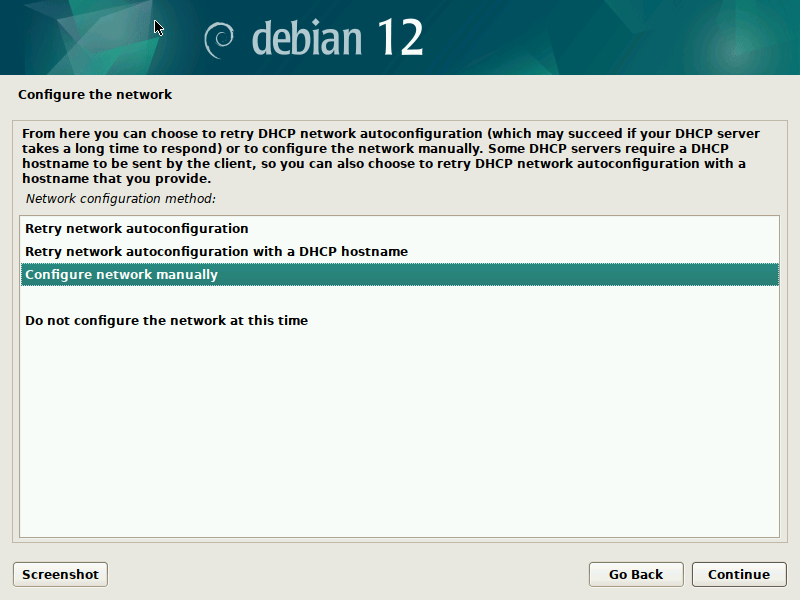
Now you can click through the normal Debian-Installer process, using mostly default settings. Optionally, you could play around with the networking settings, to see how those get translated to /etc/netplan/ in the target system.
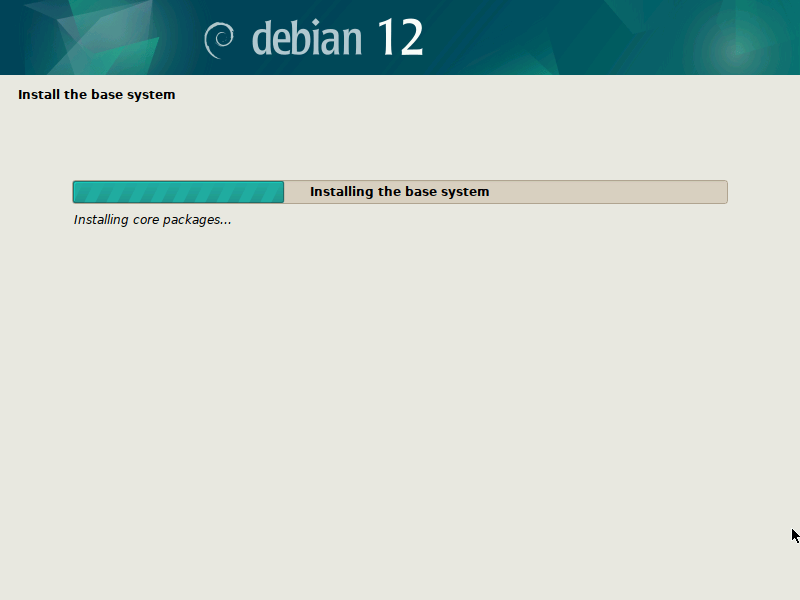
After you confirmed your partitioning changes, the base system gets installed. I suggest not to select any additional components, like desktop environments, to speed up the process.
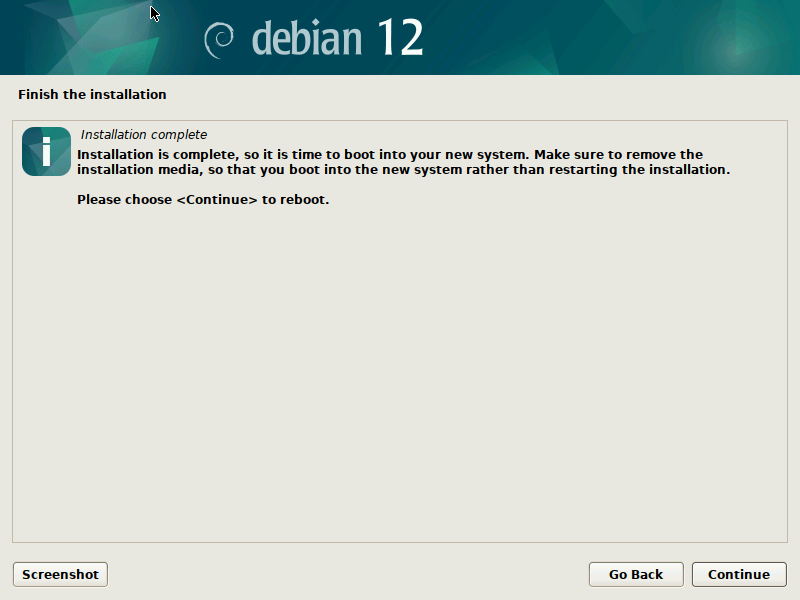
During the final step of the installation (finish-install.d/55netcfg-copy-config) d-i will detect that Netplan was installed in the target system (due to the preseed file provided) and opt to write its network configuration to /etc/netplan/ instead of /etc/network/interfaces or /etc/NetworkManager/system-connections/.
Done! After the installation finished, you can reboot into your virgin Debian Sid/Trixie system. To do that, quit the current Qemu process, by pressing Ctrl+C and make sure to copy over the EFIVARS.fd file that was modified by grub during the installation, so Qemu can find the new system. Then reboot into the new system, not using the mini.iso image any more:
$ cp ./OVMF_VARS_4M.fd ./EFIVARS.fd
$ qemu-system-x86_64 \
        -M q35 -enable-kvm -cpu host -smp 4 -m 2G \
        -drive if=pflash,format=raw,unit=0,file=OVMF_CODE_4M.fd,readonly=on \
        -drive if=pflash,format=raw,unit=1,file=EFIVARS.fd,readonly=off \
        -device qemu-xhci -device usb-kbd -device usb-mouse \
        -vga none -device virtio-gpu-pci \
        -net nic,model=virtio -net user \
        -drive file=./data.qcow2,if=none,format=qcow2,id=disk0 \
        -device virtio-blk-pci,drive=disk0,bootindex=1
        -serial mon:stdio
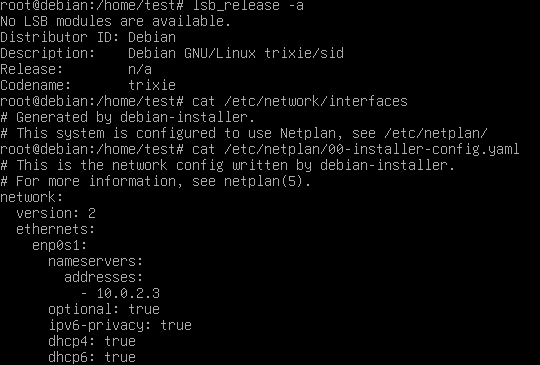
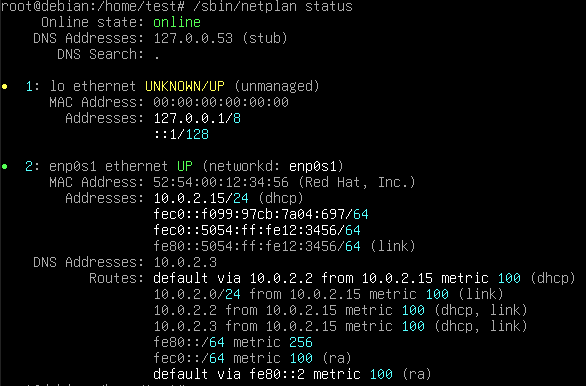
Finally, you can play around with your Netplan enabled Debian system! As you will find, /etc/network/interfaces exists but is empty, it could still be used (optionally/additionally). Netplan was configured in /etc/netplan/ according to the settings given during the d-i installation process.
In our case, we also installed the Netplan CLI, so we can play around with some of its features, like netplan status:
Thank you for following along the Netplan enabled Debian installation process and happy hacking! If you want to learn more, find us at GitHub:netplan.

28 July 2024

Vincent Bernat: Crafting endless AS paths in BGP

Combining BGP confederations and AS override can potentially create a BGP routing loop, resulting in an indefinitely expanding AS path. BGP confederation is a technique used to reduce the number of iBGP sessions and improve scalability in large autonomous systems (AS). It divides an AS into sub-ASes. Most eBGP rules apply between sub-ASes, except that next-hop, MED, and local preferences remain unchanged. The AS path length ignores contributions from confederation sub-ASes. BGP confederation is rarely used and BGP route reflection is typically preferred for scaling. AS override is a feature that allows a router to replace the ASN of a neighbor in the AS path of outgoing BGP routes with its own. It s useful when two distinct autonomous systems share the same ASN. However, it interferes with BGP s loop prevention mechanism and should be used cautiously. A safer alternative is the allowas-in directive.1 In the example below, we have four routers in a single confederation, each in its own sub-AS. R0 originates the 2001:db8::1/128 prefix. R1, R2, and R3 forward this prefix to the next router in the loop.
BGP routing loop involving 4 routers: R0 originates a prefix, R1, R2, R3 make it loop using next-hop-self and as-override
BGP routing loop using a confederation
The router configurations are available in a Git repository. They are running Cisco IOS XR. R2 uses the following configuration for BGP:
router bgp 64502
 bgp confederation peers
  64500
  64501
  64503
 !
 bgp confederation identifier 64496
 bgp router-id 1.0.0.2
 address-family ipv6 unicast
 !
 neighbor 2001:db8::2:0
  remote-as 64501
  description R1
  address-family ipv6 unicast
  !
 !
 neighbor 2001:db8::3:1
  remote-as 64503
  advertisement-interval 0
  description R3
  address-family ipv6 unicast
   next-hop-self
   as-override
  !
 !
!
The session with R3 uses both as-override and next-hop-self directives. The latter is only necessary to make the announced prefix valid, as there is no IGP in this example.2 Here s the sequence of events leading to an infinite AS path:
  1. R0 sends the prefix to R1 with AS path (64500).3
  2. R1 selects it as the best path, forwarding it to R2 with AS path (64501 64500).
  3. R2 selects it as the best path, forwarding it to R3 with AS path (64500 64501 64502).
  4. R3 selects it as the best path. It would forward it to R1 with AS path (64503 64502 64501 64500), but due to AS override, it substitutes R1 s ASN with its own, forwarding it with AS path (64503 64502 64503 64500).
  5. R1 accepts the prefix, as its own ASN is not in the AS path. It compares this new prefix with the one from R0. Both (64500) and (64503 64502 64503 64500) have the same length because confederation sub-ASes don t contribute to AS path length. The first tie-breaker is the router ID. R0 s router ID (1.0.0.4) is higher than R3 s (1.0.0.3). The new prefix becomes the best path and is forwarded to R2 with AS path (64501 64503 64501 64503 64500).
  6. R2 receives the new prefix, replacing the old one. It selects it as the best path and forwards it to R3 with AS path (64502 64501 64502 64501 64502 64500).
  7. R3 receives the new prefix, replacing the old one. It selects it as the best path and forwards it to R0 with AS path (64503 64502 64503 64502 64503 64502 64500).
  8. R1 receives the new prefix, replacing the old one. Again, it competes with the prefix from R0, and again the new prefix wins due to the lower router ID. The prefix is forwarded to R2 with AS path (64501 64503 64501 64503 64501 64503 64501 64500).
A few iterations later, R1 views the looping prefix as follows:4
RP/0/RP0/CPU0:R1#show bgp ipv6 u 2001:db8::1/128 bestpath-compare
BGP routing table entry for 2001:db8::1/128
Last Modified: Jul 28 10:23:05.560 for 00:00:00
Paths: (2 available, best #2)
  Path #1: Received by speaker 0
  Not advertised to any peer
  (64500)
    2001:db8::1:0 from 2001:db8::1:0 (1.0.0.4), if-handle 0x00000000
      Origin IGP, metric 0, localpref 100, valid, confed-external
      Received Path ID 0, Local Path ID 0, version 0
      Higher router ID than best path (path #2)
  Path #2: Received by speaker 0
  Advertised IPv6 Unicast paths to peers (in unique update groups):
    2001:db8::2:1
  (64503 64502 64503 64502 64503 64502 64503 64502 64503 64502 64503 64502 64503 64502 64503 64502 64503 64502 64503 64502 64503 64502 64503 64502 64503 64502 64503 64502 64503 64502 64503 64502 64503 64502 64503 64502 64503 64502 64503 64502 64503 64502 64503 64502 64503 64502 64503 64502 64503 64502 64503 64502 64503 64502 64503 64502 64503 64502 64503 64502 64503 64502 64503 64502 64503 64502 64503 64502 64503 64502 64503 64502 64503 64502 64503 64502 64503 64502 64503 64502 64503 64502 64503 64502 64503 64502 64503 64502 64503 64502 64503 64502 64503 64502 64503 64502 64503 64502 64503 64502 64503 64502 64500)
    2001:db8::4:0 from 2001:db8::4:0 (1.0.0.3), if-handle 0x00000000
      Origin IGP, metric 0, localpref 100, valid, confed-external, best, group-best
      Received Path ID 0, Local Path ID 1, version 37
      best of AS 64503, Overall best
There s no upper bound for an AS path, but BGP messages have size limits (4096 bytes per RFC 4271 or 65535 bytes per RFC 8654). At some point, BGP updates can t be generated. On Cisco IOS XR, the BGP process crashes well before reaching this limit.5
The main lessons from this tale are:

  1. When using BGP confederations with Cisco IOS XR, use allowconfedas-in instead. It s available since IOS XR 7.11.
  2. Using BGP confederations is already inadvisable. If you don t use the same IGP for all sub-ASes, you re inviting trouble! However, the scenario described here is also possible with an IGP.
  3. When an AS path segment is composed of ASNs from a confederation, it is displayed between parentheses.
  4. By default, IOS XR paces eBGP updates. This is controlled by the advertisement-interval directive. Its default value is 30 seconds for eBGP peers (even in the same confederation). R1 and R2 set this value to 0, while R3 sets it to 2 seconds. This gives some time to watch the AS path grow.
  5. This is CSCwk15887. It only happens when using as-override on an AS path with a too long AS_CONFED_SEQUENCE. This should be fixed around 24.3.1.

27 July 2024

Bits from Debian: DebConf24 welcomes its sponsors!

DebConf24 logo DebConf24, the 25th edition of the Debian conference is taking place in Pukyong National University at Busan, Republic of Korea. Thanks to the hard work of its organizers, it again will be an interesting and fruitful event for attendees. We would like to warmly welcome the sponsors of DebConf24, and introduce them to you. We have three Platinum sponsors. Our Gold sponsors are: Our Silver sponsors are: Bronze sponsors: And finally, our Supporter level sponsors: A special thanks to the Pukyong National University, our Venue Partner and our Network Partners KOREN and KREONET! Thanks to all our sponsors for their support! Their contributions make it possible for a large number of Debian contributors from all over the globe to work together, help and learn from each other in DebConf24.

24 July 2024

Kentaro Hayashi: apt-upgrade-canary - PoC apt JSON hook use case

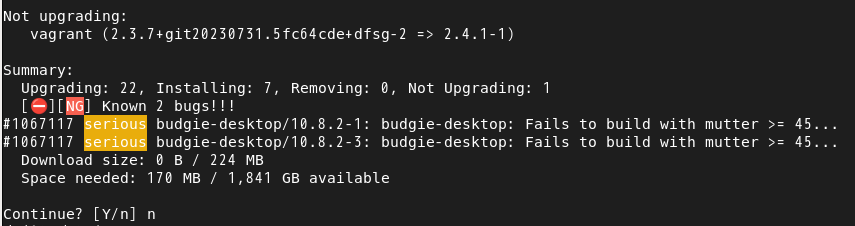
apt-upgrade-canary is a helper program to alert when upgrading packages via apt. If there are some packages which causes a critical or serious bug, it shows warnings for terminal. Then you can stay on current version of package by canceling upgrades. This program is aimed to help not to installing problematic packages via manual upgrades. Usually, you should delegate package upgrade to unattended-upgrades and apt-listbugs. apt-listbugs kindly warns if there are known bugs. In most cases it is enough safer. But there is one exception, it is not true that always apt-listbugs can follow very latest critical or serious bugs in timely manner. apt-upgrade-canary checks UDD mirror database (it take into account to cache query not to throw redundant one frequently)
Getting started
  1. Install required packages.
$ sudo apt install -y make ruby-pg ruby-json ruby-term-ansicolor
  1. Clone https://salsa.debian.org/kenhys/apt-upgrade-canary.
  2. Just sudo make install.

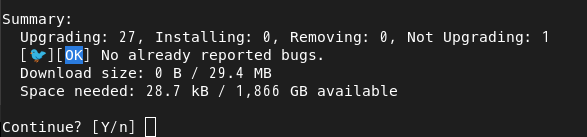
Use case in action If there is no serious bugs which is reported against target packages, apt-upgrade-canary reports no error.
apt-upgrade-canary: no problem
If there are something weird happen, it reports matched bugs.
apt-upgrade-canary: serious case
So you can stay on.

23 July 2024

Russell Coker: More About Kogan 5120*2160 Monitor

On the 18th of May I blogged about my new 5120*2160 monitor [1]. One thing I noted was that one Netflix movie had run in an aspect ratio that used all space on the monitor. I still don t know if the movie in question was cropped in a letterbox manner but other Netflix shows in full screen mode don t extend to both edges. Also one movie I downloaded as in 3840*1608 resolution which is almost exactly the same aspect ratio as my monitor. I wonder if some company is using 5120*2160 screens for TVs, 4K and FullHD are rumoured to be cheaper than most other resolutions partly due to TV technology being used for monitors. There is the Anamorphic Format of between 2.35:1 and 2.40:1 [2] which is a close match for the 2.37:1 of my new monitor. I tried out the HDMI audio on a Dell laptop and my Thinkpad Yoga Gen3 and found it to be of poor quality, it seemed limited to 2560*1440, at this time I m not sure how much of the fault is due to the laptops and how much is due to the monitor. The monitor docs state that it needs HDMI version 2.1 which was released in 2017 and my Thinkpad Yoga Gen3 was released in 2018 so probably doesn t have that. The HDMI cable in question did 4K resolution on my previous monitor so it should all work at a minimum of 4K resolution. The switching between inputs is a problem. If I switch between DisplayPort for my PC and HDMI for a laptop the monitor will usually timeout before the laptop establishes a connection and then switch back to the DisplayPort input. So far I have had to physically disconnect the input source I don t want to use. The DisplayPort switch that I ve used doesn t seem designed to work with resolutions higher than 4K. I ve bought a new USB-C dock which is described as doing 8K which means that as my Thinkpad is described as supporting 5120 2880@60Hz over USB-C I should be able to get 5120*2160 without any problems, however for unknown reasons I only get 4K. For work I m using a Dell Latitude 7400 2in1 that s apparently only capable of 4096*2304 @24 Hz which is less pixels than 5120*2160 and it will also only do 4K resolution. But for both those cases it s still a significant improvement over 2560*1440. I tested with a Dell Latitude 7440 which gave the full 5120*2160 resolution, I was unable to find specs on what the maximum resolution of the 7440 is. I also have bought DisplayPort switch rated at 8K resolution. I got a switch that doesn t also do USB because the ones that do 8K resolution and USB are about $70. The only KVM switch I saw for 8K resolution at a reasonable price was one designed for switching between two laptops and there doesn t seem to be any adaptors to convert from regular DisplayPort to USB-C alternative mode so that wasn t viable. Currently I have the old KVM switch used for USB only (for keyboard and mouse) and the new switch which only does DisplayPort. So I have two buttons to push when switching between input sources which isn t too bad. It seems that for PCs resolutions with more pixels than 4K are as difficult and inconvenient now as 4K was 6 years ago when I started doing it. If you want higher than 4K resolution to just work at this time then you need Apple hardware. The monitor has a series of modes for different types of output, I ve found standard to be good for text and movie to be good for watching movies/TV and for playing RTS games. I previously wrote about how to use ddcutil to use a monitor as a KVM switch [3], unfortunately I can t do this with the new monitor as the time that the monitor waits for a good signal on a new input after changing is shorter than the time taken for Linux on the laptops I m using to enable HDMI output. I ve found the following commands to do the basics.
# get display mode
ddcutil getvcp DC
# set standard mode
ddcutil setvcp DC 0
# set movie mode
ddcutil setvcp DC 03
Now that I have that going the next thing I want to do is to have it switch between standard and movie modes when I switch keyboard focus.

22 July 2024

Russell Coker: Blog Comments

The Akismet WordPress anti-spam plugin has changed it s policy to not run on sites that have adverts which includes mine. Without it I get an average of about 1 spam comment per hour and the interface for removing spam takes more mouse actions than desired. For email spam it s about the same volume half of which is messages with SpamAssassin scores high enough to go into the MaybeSpam folder (that I go through every few weeks) and half of which goes straight to my inbox. But fortunately moving spam to a folder where I can later use it to train Bayesian classification is a much faster option on PC and is also something I can do from my phone MUA. As an experiment I have configured my blog to only take comments from registered users. It will be interesting to see how many spammers make it through that and to also see feedback from genuine people. People who can t comment can tell me about it via the contact methods listed here [1]. I previously wrote about other ways of dealing with hostile comments [2]. Blogging seems to be less popular nowadays so a Planet specific forum doesn t seem a viable option. It s a pity, I think that YouTube and Facebook have taken over from blogs and that s not a good thing.

21 July 2024

Russell Coker: SE Linux Policy for Dell Management

The recent issue of Windows security software killing computers has reminded me about the issue of management software for Dell systems. I wrote policy for the Dell management programs that extract information from iDRAC and store it in Linux. After the break I ve pasted in the policy. It probably needs some changes for recent software, it was last tested on a PowerEdge T320 and prior to that was used on a PowerEdge R710 both of which are old hardware and use different management software to the recent hardware. One would hope that the recent software would be much better but usually such hope is in vain. I deliberately haven t submitted this for inclusion in the reference policy because it s for proprietary software and also it permits many operations that we would prefer not to permit. The policy is after the break because it s larger than you want on a Planet feed. But first I ll give a few selected lines that are bad in a noteworthy way:
  1. sys_admin means the ability to break everything
  2. dac_override means break Unix permissions
  3. mknod means a daemon creates devices due to a lack of udev configuration
  4. sys_rawio means someone didn t feel like writing a device driver, maintaining a device driver for DKMS is hard and getting a driver accepted upstream requires writing quality code, in any case this is a bad sign.
  5. self:lockdown is being phased out, but used to mean bypassing some integrity protections, that would usually be related to sys_rawio or similar.
  6. dev_rx_raw_memory is bad, reading raw memory allows access to pretty much everything and execute of raw memory is something I can t imagine a good use for, the Reference Policy doesn t use this anywhere!
  7. dev_rw_generic_chr_files usually means a lack of udev configuration as udev should do that.
  8. storage_raw_write_fixed_disk shouldn t be needed for this sort of thing, it doesn t do anything that involves managing partitions.
Now without network access or other obvious ways of remote control this level of access while excessive isn t necessarily going to allow bad things to happen due to outside attack. But if there are bugs in the software there s nothing to stop it from giving the worst results.
allow dell_datamgrd_t self:capability   dac_override dac_read_search mknod sys_rawio sys_admin  ;
allow dell_datamgrd_t self:lockdown integrity;
dev_rx_raw_memory(dell_datamgrd_t)
dev_rw_generic_chr_files(dell_datamgrd_t)
dev_rw_ipmi_dev(dell_datamgrd_t)
dev_rw_sysfs(dell_datamgrd_t)
storage_raw_read_fixed_disk(dell_datamgrd_t)
storage_raw_write_fixed_disk(dell_datamgrd_t)
allow dellsrvadmin_t self:lockdown integrity;
allow dellsrvadmin_t self:capability   sys_admin sys_rawio  ;
dev_read_raw_memory(dellsrvadmin_t)
dev_rw_sysfs(dellsrvadmin_t)
dev_rx_raw_memory(dellsrvadmin_t)
The best thing that Dell could do for their customers is to make this free software and allow the community to fix some of these issues.
Here is dellsrvadmin.te:
policy_module(dellsrvadmin,1.0.0)
require  
  type dmidecode_exec_t;
  type udev_t;
  type device_t;
  type event_device_t;
  type mon_local_test_t;
 
type dellsrvadmin_t;
type dellsrvadmin_exec_t;
init_daemon_domain(dellsrvadmin_t, dellsrvadmin_exec_t)
type dell_datamgrd_t;
type dell_datamgrd_exec_t;
init_daemon_domain(dell_datamgrd_t, dell_datamgrd_t)
type dellsrvadmin_var_t;
files_type(dellsrvadmin_var_t)
domain_transition_pattern(udev_t, dellsrvadmin_exec_t, dellsrvadmin_t)
modutils_domtrans(dellsrvadmin_t)
allow dell_datamgrd_t device_t:dir rw_dir_perms;
allow dell_datamgrd_t device_t:chr_file create;
allow dell_datamgrd_t event_device_t:chr_file   read write  ;
allow dell_datamgrd_t self:process signal;
allow dell_datamgrd_t self:fifo_file rw_file_perms;
allow dell_datamgrd_t self:sem create_sem_perms;
allow dell_datamgrd_t self:capability   dac_override dac_read_search mknod sys_rawio sys_admin  ;
allow dell_datamgrd_t self:lockdown integrity;
allow dell_datamgrd_t self:unix_dgram_socket create_socket_perms;
allow dell_datamgrd_t self:netlink_route_socket r_netlink_socket_perms;
modutils_domtrans(dell_datamgrd_t)
can_exec(dell_datamgrd_t, dmidecode_exec_t)
allow dell_datamgrd_t dellsrvadmin_var_t:dir rw_dir_perms;
allow dell_datamgrd_t dellsrvadmin_var_t:file manage_file_perms;
allow dell_datamgrd_t dellsrvadmin_var_t:lnk_file read;
allow dell_datamgrd_t dellsrvadmin_var_t:sock_file manage_file_perms;
kernel_read_network_state(dell_datamgrd_t)
kernel_read_system_state(dell_datamgrd_t)
kernel_search_fs_sysctls(dell_datamgrd_t)
kernel_read_vm_overcommit_sysctl(dell_datamgrd_t)
# for /proc/bus/pci/*
kernel_write_proc_files(dell_datamgrd_t)
corecmd_exec_bin(dell_datamgrd_t)
corecmd_exec_shell(dell_datamgrd_t)
corecmd_shell_entry_type(dell_datamgrd_t)
dev_rx_raw_memory(dell_datamgrd_t)
dev_rw_generic_chr_files(dell_datamgrd_t)
dev_rw_ipmi_dev(dell_datamgrd_t)
dev_rw_sysfs(dell_datamgrd_t)
files_search_tmp(dell_datamgrd_t)
files_read_etc_files(dell_datamgrd_t)
files_read_etc_symlinks(dell_datamgrd_t)
files_read_usr_files(dell_datamgrd_t)
logging_search_logs(dell_datamgrd_t)
miscfiles_read_localization(dell_datamgrd_t)
storage_raw_read_fixed_disk(dell_datamgrd_t)
storage_raw_write_fixed_disk(dell_datamgrd_t)
can_exec(mon_local_test_t, dellsrvadmin_exec_t)
allow mon_local_test_t dellsrvadmin_var_t:dir search;
allow mon_local_test_t dellsrvadmin_var_t:file read_file_perms;
allow mon_local_test_t dellsrvadmin_var_t:file setattr;
allow mon_local_test_t dellsrvadmin_var_t:sock_file write;
allow mon_local_test_t dell_datamgrd_t:unix_stream_socket connectto;
allow mon_local_test_t self:sem   create read write destroy unix_write  ;
allow dellsrvadmin_t self:process signal;
allow dellsrvadmin_t self:lockdown integrity;
allow dellsrvadmin_t self:sem create_sem_perms;
allow dellsrvadmin_t self:fifo_file rw_file_perms;
allow dellsrvadmin_t self:packet_socket create;
allow dellsrvadmin_t self:unix_stream_socket   connectto create_stream_socket_perms  ;
allow dellsrvadmin_t self:capability   sys_admin sys_rawio  ;
dev_read_raw_memory(dellsrvadmin_t)
dev_rw_sysfs(dellsrvadmin_t)
dev_rx_raw_memory(dellsrvadmin_t)
allow dellsrvadmin_t dellsrvadmin_var_t:dir rw_dir_perms;
allow dellsrvadmin_t dellsrvadmin_var_t:file manage_file_perms;
allow dellsrvadmin_t dellsrvadmin_var_t:lnk_file read;
allow dellsrvadmin_t dellsrvadmin_var_t:sock_file write;
allow dellsrvadmin_t dell_datamgrd_t:unix_stream_socket connectto;
kernel_read_network_state(dellsrvadmin_t)
kernel_read_system_state(dellsrvadmin_t)
kernel_search_fs_sysctls(dellsrvadmin_t)
kernel_read_vm_overcommit_sysctl(dellsrvadmin_t)
corecmd_exec_bin(dellsrvadmin_t)
corecmd_exec_shell(dellsrvadmin_t)
corecmd_shell_entry_type(dellsrvadmin_t)
files_read_etc_files(dellsrvadmin_t)
files_read_etc_symlinks(dellsrvadmin_t)
files_read_usr_files(dellsrvadmin_t)
logging_search_logs(dellsrvadmin_t)
miscfiles_read_localization(dellsrvadmin_t)
Here is dellsrvadmin.fc:
/opt/dell/srvadmin/sbin/.*        --        gen_context(system_u:object_r:dellsrvadmin_exec_t,s0)
/opt/dell/srvadmin/sbin/dsm_sa_datamgrd        --        gen_context(system_u:object_r:dell_datamgrd_t,s0)
/opt/dell/srvadmin/bin/.*        --        gen_context(system_u:object_r:dellsrvadmin_exec_t,s0)
/opt/dell/srvadmin/var(/.*)?                        gen_context(system_u:object_r:dellsrvadmin_var_t,s0)
/opt/dell/srvadmin/etc/srvadmin-isvc/ini(/.*)?        gen_context(system_u:object_r:dellsrvadmin_var_t,s0)

17 July 2024

Kalyani Kenekar: Securing Your Website: Installing and Configuring Nginx with SSL

Logo Nginx

The Initial Encounter: I recently started to work with Nginx to explore the requirements on how to configure a then so called server block. It s quite different than within Apache. But there are a tons of good websites out there which do explain the different steps and options quite well. I also realized quickly that I need to be able to configure my Nginx setups in a way so the content is delivered through https with some automatic redirection from http URLs.
  • Let s install Nginx

Installing Nginx
$ sudo apt update
$ sudo apt install nginx

Checking your Web Server
  • We can check now nginx service is active or inactive
Output
  nginx.service - A high performance web server and a reverse proxy server
     Loaded: loaded (/lib/systemd/system/nginx.service; enabled; vendor preset: enabled)
     Active: active (running) since Tue 2024-02-12 09:59:20 UTC; 3h ago
       Docs: man:nginx(8)
   Main PID: 2887 (nginx)
      Tasks: 2 (limit: 1132)
     Memory: 4.2M
        CPU: 81ms
     CGroup: /system.slice/nginx.service
              2887 nginx: master process /usr/sbin/nginx -g daemon on; master_process on;
              2890 nginx: worker process
  • Now we successfully installed nginx and it in running state.

How To Secure Nginx with Let s Encrypt on Debian 12
  • In this documentation, you will use Certbot to obtain a free SSL certificate for Nginx on Debian 12 and set up your certificate.

Step 1 Installing Certbot $ sudo apt install certbot python3-certbot-nginx
  • Certbot is now ready to use, but in order for it to automatically configure SSL for Nginx, we need to verify some of Nginx s configuration.

Step 2 Confirming Nginx s Configuration
  • Certbot needs to be able to find the correct server block in your Nginx configuration for it to be able to automatically configure SSL. Specifically, it does this by looking for a server_name directive that matches the domain you request a certificate for. To check, open the configuration file for your domain using nano or your favorite text editor.
$ sudo vi /etc/nginx/sites-available/example.com
 server  
    listen 80;
    root /var/www/html/;
    index index.html;
    server_name example.com
    location /  
        try_files $uri $uri/ =404;
     
    location /test.html  
        try_files $uri $uri/ =404;
        auth_basic "admin area";
        auth_basic_user_file /etc/nginx/.htpasswd;
     
 
  • Fillup above data your project wise and then save the file, quit your editor, and verify the syntax of your configuration edits.
$ sudo nginx -t

Step 3 Obtaining an SSL Certificate
  • Certbot provides a variety of ways to obtain SSL certificates through plugins. The Nginx plugin will take care of reconfiguring Nginx and reloading the config whenever necessary. To use this plugin, type the following command line.
$ sudo certbot --nginx -d example.com
  • The configuration will be updated, and Nginx will reload to pick up the new settings. certbot will wrap up with a message telling you the process was successful and where your certificates are stored.
Output
IMPORTANT NOTES:
 - Congratulations! Your certificate and chain have been saved at:
   /etc/letsencrypt/live/example.com/fullchain.pem
   Your key file has been saved at:
   /etc/letsencrypt/live/example.com/privkey.pem
   Your cert will expire on 2024-05-12. To obtain a new or tweaked
   version of this certificate in the future, simply run certbot again
   with the "certonly" option. To non-interactively renew *all* of
   your certificates, run "certbot renew"
 - If you like Certbot, please consider supporting our work by:
   Donating to ISRG / Let's Encrypt:   https://letsencrypt.org/donate
   Donating to EFF:                    https://eff.org/donate-le
  • Your certificates are downloaded, installed, and loaded. Next check the syntax again of your configuration.
$ sudo nginx -t
  • If you get an error, reopen the server block file and check for any typos or missing characters. Once your configuration file s syntax is correct, reload Nginx to load the new configuration.
$ sudo systemctl reload nginx
  • Try reloading your website using https:// and notice your browser s security indicator. It should indicate that the site is properly secured, usually with a lock icon.
Now your website is secured by SSL usage.

Russell Coker: Samsung Galaxy Note 9 Review

After the VoLTE saga [1] and the problems with battery life on the PinePhonePro [2] (which lasted 4 hours while idle with the screen off in my last test a few weeks ago) I m running a Galaxy Note 9 [3] with the default Samsung OS as my daily driver. I don t think that many people will be rushing out to buy a 2018 phone regardless of my review. For someone who wants a phone of such age (which has decent hardware and a low price) then good options are the Pixel phones which are all supported by LineageOS. I recommend not buying this phone due to the fact that it doesn t have support for VoLTE with LineageOS (and presumably any other non-Samsung Android build) and doesn t have support from any other OS. The One Plus 6/6T has Mobian support [4] as well as LineageOS support and is worth considering. The Note 9 still has capable hardware by today s standards. A 6.4 display is about as big as most people want in their pocket and 2960 1440 resolution in that size (516dpi) is probably as high as most people can see without a magnifying glass. The model I m using has 8G of RAM which is as much as the laptop I was using at the start of this year. I don t think that many people will have things that they actually want to do on a phone which needs more hardware than this. The only hardware feature in new phones which beats this is the large folding screen in some recent phones, but $2500+ (the price of such phones in Australia) is too much IMHO and the second hand market for folding phones is poor due to the apparently high incidence of screens breaking. The Note 9 has the Dex environment for running as a laptop if you connect it to a USB-C dock. It can run nicely with a 4K monitor with USB keyboard and mouse. The UI is very similar to that of older versions of Windows. The Samsung version of Android seems mostly less useful than the stock Google version or the LineageOS version. The Samsung keyboard flags words such as gay as spelling errors and it can t be uninstalled even when you install a better keyboard app. There is a Bixby button on the side of the phone to launch the Bixby voice recognition app which can t be mapped to any useful purpose, The Google keyboard has a voice dictation option which I will try out some time but that s all I desire in terms of voice recognition. There are alerts about Samsung special deals and configuration options including something about signing in to some service and having it donate money to charity, I doubt that any users want such features. Apart from Dex the Samsung Android build is a good advert for LineageOS. The screen has curved sides for no good reason. This makes it more difficult to make a protective phone case as a case can t extend beyond the screen at the sides and therefore if it s dropped and hits an edge (step, table, etc) then the glass can make direct contact with something. Also the curved sides reflect sunlight in all directions, this means that the user has to go to more effort to avoid reflecting the sun into their eyes and that a passenger can more easily reflect sunlight into the eyes of a car driver. It s an impressive engineering feat to make a curved touch-screen but it doesn t do any good for users. The stylus is good as always and the screen is AMOLED so it doesn t waste much power when in dark mode. There is a configuration option to display a clock all the time when the screen is locked because that apparently doesn t use much power. I haven t felt inclined to enable the always on screen but it s a nice feature for those who like such things. The VoLTE implementation is apparently a bit unusual so it s not supported by LineageOS and didn t work on Droidian for the small amount of time that Droidian supported it. Generally this phone is quite nice hardware it s just a pity that it demonstrates all of the downsides to buying a non-Pixel phone.

12 July 2024

Russ Allbery: Review: The Splinter in the Sky

Review: The Splinter in the Sky, by Kemi Ashing-Giwa
Publisher: Saga Press
Copyright: July 2023
ISBN: 1-6680-0849-1
Format: Kindle
Pages: 372
The Splinter in the Sky is a stand-alone science fiction political thriller. It is Kemi Ashing-Giwa's first novel. Enitan is from Koriko, a vegetation-heavy moon colonized by the Vaalbaran empire. She lives in the Ijebu community with her sibling Xiang and has an on-again, off-again relationship with Ajana, the Vaalbaran-appointed governor. Xiang is studying to be an architect, which requires passing stringent entrance exams to be allowed to attend an ancillary imperial school intended for "primitives." Enitan works as a scribe and translator, one of the few Korikese allowed to use the sacred Orin language of Vaalbara. In her free time, she grows and processes tea. When Xiang mysteriously disappears while she's at work, Enitan goes to Ajana for help. Then Ajana dies, supposedly from suicide. The Vaalbaran government demands a local hostage while the death is investigated, someone who will be held as a diplomatic "guest" on the home world and executed if there is any local unrest. This hostage is supposed to be the child of the local headwoman, a concept that the Korikese do not have. Seeing a chance to search for Xiang, Enitan volunteers, heading into the heart of imperial power with nothing but desperate determination and a tea set. The empire doesn't stand a chance. Admittedly, a lot of the reason why the empire doesn't stand a chance is because the author is thoroughly on Enitan's side. Before she even arrives on Gondwana, Vaalbara's home world, Enitan is recruited as a spy by the other Gondwana power and Vaalbara's long-standing enemy. Her arrival in the Splinter, the floating arcology that serves as the center of Vaalbaran government, is followed by a startlingly meteoric rise in access. Some of this is explained by being a cultural curiosity for bored nobles, and some is explained by political factors Enitan is not yet aware of, but one can see the author's thumb resting on the scales. This was the sort of book that was great fun to read, but whose political implausibility provoked "wait, that didn't make sense" thoughts afterwards. I think one has to assume that the total population of Vaalbara is much less than first comes to mind when considering an interplanetary empire, which would help explain the odd lack of bureaucracy. Enitan is also living in, effectively, the palace complex, for reasonably well-explained political reasons, and that could grant her a surprising amount of access. But there are other things that are harder to explain away: the lack of surveillance, the relative lack of guards, and the odd political structure that's required for the plot to work. It's tricky to talk about this without spoilers, but the plot rests heavily on a conspiratorial view of how government power is wielded that I think strains plausibility. I'm not naive enough to think that the true power structure of a society matches the formal power structure, but I don't think they diverge as much as people think they do. It's one thing to say that the true power brokers of society can be largely unknown to the general population. In a repressive society with a weak media, that's believable. It's quite another matter for the people inside the palace to be in the dark about who is running what. I thought that was the biggest problem with this book. Its greatest feature is the characters, and particularly the character relationships. Enitan is an excellent protagonist: fascinating, sympathetic, determined, and daring in ways that make her success more believable. Early in the book, she forms an uneasy partnership that becomes the heart of the book, and I loved everything about that relationship. The politics of her situation might be a bit too simple, but the emotions were extremely well-done. This is a book about colonialism. Specifically, it's a book about cultural looting, appropriation, and racist superiority. The Vaalbarans consider Enitan barely better than an animal, and in her home they're merciless and repressive. Taken out of that context into their imperial capital, they see her as a harmless curiosity and novelty. Enitan exploits this in ways that are entirely believable. She is also driven to incandescent fury in ways that are entirely believable, and which she only rarely can allow herself to act on. Ashing-Giwa drives home the sheer uselessness of even the more sympathetic Vaalbarans more forthrightly than science fiction is usually willing to be. It's not a subtle point, but it is an accurate one. The first two thirds of this book had me thoroughly engrossed and unable to put it down. The last third unfortunately turns into a Pok mon hunt of antagonists, which I found less satisfying and somewhat less believable. I wish there had been more need for Enitan to build political alliances and go deeper into the social maneuverings of the first part of the book, rather than gaining some deus ex machina allies who trivially solve some otherwise-tricky plot problems. The setup is amazing; the resolution felt a bit like escaping a maze by blasting through the walls, which I don't think played to the strengths of the characters and relationships that Ashing-Giwa had constructed. The advantage of that approach is that we do get a satisfying resolution and a standalone novel. The central relationship of the book is unfortunately too much of a spoiler to talk about in a review, but I thought it was the best part of the story. This is a political thriller on the surface, but I think it's heart is an unexpected political alliance with a fascinatingly tricky balance of power. I was delighted that Ashing-Giwa never allows the tension in that relationship to collapse into one of the stock patterns it so easily could have become. The Splinter in the Sky reminded me a little of Arkady Martine's A Memory Called Empire. It's not as assured or as adroitly balanced as that book, and the characters are not quite as memorable, but that's a very high bar. The political point is even sharper, and it has some of the same appeal. I had so much fun reading this book. You may need to suspend your disbelief about some of the politics, and I wish the conclusion had been a bit less brute-force, but this is great stuff. Recommended when you're in the mood for a character story in the trappings of a political thriller. Rating: 8 out of 10

10 July 2024

Russell Coker: Computer Adavances in the Last Decade

I wrote a comment on a social media post where someone claimed that there s no computer advances in the last 12 years which got long so it s worth a blog post. In the last decade or so new laptops have become cheaper than new desktop PCs. USB-C has taken over for phones and for laptop charging so all recent laptops support USB-C docks and monitors with USB-C docks built in have become common. 4K monitors have become cheap and common and higher than 4K is cheap for some use cases such as ultra wide. 4K TVs are cheap and TVs with built-in Android computers for playing internet content are now standard. For most use cases spinning media hard drives are obsolete, SSDs large enough for all the content most people need to store are cheap. We have gone from gigabit Ethernet being expensive to 2.5 gigabit being cheap. 12 years ago smart phones were very limited and every couple of years there would be significant improvements. Since about 2018 phones have been capable of doing most things most people want. 5yo Android phones can run the latest apps and take high quality pics. Any phone that supports VoLTE will be good for another 5+ years if it has security support. Phones without security support still work and are quite usable apart from being insecure. Google and Samsung have significantly increased their minimum security support for their phones and the GKI project from Google makes it easier for smaller vendors to give longer security support. There are a variety of open Android projects like LineageOS which give longer security support on a variety of phones. If you deliberately choose a phone that is likely to be well supported by projects like LineageOS (which pretty much means just Pixel phones) then you can expect to be able to actually use it when it is 10 years old. Compare this to the Samsung Galaxy S3 released in 2012 which was a massive improvement over the original Galaxy S (the S2 felt closer to the S than the S3). The Samsung Galaxy S4 released in 2013 was one of the first phones to have FullHD resolution which is high enough that most people can t easily recognise the benefits of higher resolution. It wasn t until 2015 that phones with 4G of RAM became common which is enough that for most phone use it s adequate today. Now that 16G of RAM is affordable in laptops running more secure OSs like Qubes is viable for more people. Even without Qubes, OS security has been improving a lot with better compiler features, new languages like Rust, and changes to software design and testing. Containers are being used more but we still aren t getting all the benefits of that. TPM has become usable in the last few years and we are only starting to take advantage of what it can offer. In 2012 BTRFS was still at an early stage of development and not many people wanted to use it in production, I was using it in production then and while I didn t lose any data from bugs I did have some downtime because of BTRFS issues. Now BTRFS is quite solid for server use. DDR4 was released in 2014 and gave significant improvements over DDR3 for performance and capacity. My home workstation now has 256G of DDR4 which wasn t particularly expensive while the previous biggest system I owned had 96G of DDR3 RAM. Now DDR5 is available to again increase performance and size while also making DDR4 cheap on the second hand market. This isn t a comprehensive list of all advances in the computer industry over the last 12 years or so, it s just some things that seem particularly noteworthy to me. Please comment about what you think are the most noteworthy advances I didn t mention.

9 July 2024

Russ Allbery: Review: Raising Steam

Review: Raising Steam, by Terry Pratchett
Series: Discworld #40
Publisher: Anchor Books
Copyright: 2013
Printing: October 2014
ISBN: 0-8041-6920-9
Format: Trade paperback
Pages: 365
Raising Steam is the 40th Discworld novel and the third Moist von Lipwig novel, following Making Money. This is not a good place to start reading the series. Dick Simnel is a tinkerer from a line of tinkerers. He has been obsessed with mastering the power of steam since the age of ten, when his father died in a steam accident. That pursuit took him deeper into mathematics and precision, calculations and experiments, until he built Iron Girder: Discworld's first steam-powered locomotive. His early funding came from some convenient family pirate treasure, but turning his prototype into something more will require significantly more resources. That is how he ends up in the office of Harry King, Ankh-Morpork's sanitation magnate. Simnel's steam locomotive has the potential to solve some obvious logistical problems, such as getting fish from the docks of Quirm to the streets of Ankh-Morpork before it stops being vaguely edible. That's not what makes railways catch fire, however. As soon as Iron Girder is huffing and puffing its way around King's compound, it becomes the most popular attraction in the city. People stand in line for hours to ride it over and over again for reasons that they cannot entirely explain. There is something wild and uncontrollable going on. Vetinari is not sure he likes wild and uncontrollable, but he knows the lap into which such problems can be dumped: Moist von Lipwig, who is already getting bored with being a figurehead for the city's banking system. The setup for Raising Steam reminds me more of Moving Pictures than the other Moist von Lipwig novels. Simnel himself is a relentlessly practical engineer, but the trains themselves have tapped some sort of primal magic. Unlike Moving Pictures, Pratchett doesn't provide an explicit fantasy explanation involving intruding powers from another world. It might have been a more interesting book if he had. Instead, this book expects the reader to believe there is something inherently appealing and fascinating about trains, without providing much logic or underlying justification. I think some readers will be willing to go along with this, and others (myself included) will be left wishing the story had more world-building and fewer exclamation points. That's not the real problem with this book, though. Sadly, its true downfall is that Pratchett's writing ability had almost completely collapsed by the time he wrote it. As mentioned in my review of Snuff, we're now well into the period where Pratchett was suffering the effects of early-onset Alzheimer's. In that book, his health issues mostly affected the dialogue near the end of the novel. In this book, published two years later, it's pervasive and much worse. Here's a typical passage from early in the book:
It is said that a soft answer turneth away wrath, but this assertion has a lot to do with hope and was now turning out to be patently inaccurate, since even a well-spoken and thoughtful soft answer could actually drive the wrong kind of person into a state of fury if wrath was what they had in mind, and that was the state the elderly dwarf was now enjoying.
One of the best things about Discworld is Pratchett's ability to drop unexpected bits of wisdom in a sentence or two, or twist a verbal knife in an unexpected and surprising direction. Raising Steam still shows flashes of that ability, but it's buried in run-on sentences, drowned in cliches and repetition, and often left behind as the containing sentence meanders off into the weeds and sputters to a confused halt. The idea is still there; the delivery, sadly, is not. This is the first Discworld novel that I found mentally taxing to read. Sentences are often so overpacked that they require real effort to untangle, and the untangled meaning rarely feels worth the effort. The individual voice of the characters is almost gone. Vetinari's monologues, rather than being a rare event with dangerous layers, are frequent, rambling, and indecisive, often sounding like an entirely different character than the Vetinari we know. The constant repetition of the name any given character is speaking to was impossible for me to ignore. And the momentum of the story feels wrong; rather than constructing the events of the story in a way that sweeps the reader along, it felt like Pratchett was constantly pushing, trying to convince the reader that trains were the most exciting thing to ever happen to Discworld. The bones of a good story are here, including further development of dwarf politics from The Fifth Elephant and Thud! and the further fallout of the events of Snuff. There are also glimmers of Pratchett's typically sharp observations and turns of phrase that could have been unearthed and polished. But at the very least this book needed way more editing and a lot of rewriting. I suspect it could have dropped thirty pages just by tightening the dialogue and removing some of the repetition. I'm afraid I did not enjoy this. I am a bit of a hard sell for the magic fascination of trains I love trains, but my model railroad days are behind me and I'm now more interested in them as part of urban transportation policy. Previous Discworld books on technology and social systems did more of the work of drawing the reader in, providing character hooks and additional complexity, and building a firmer foundation than "trains are awesome." The main problem, though, was the quality of the writing, particularly when compared to the previous novels with the same characters. I dragged myself through this book out of a sense of completionism and obligation, and was relieved when I finished it. This is the first Discworld novel that I don't recommend. I think the only reason to read it is if you want to have read all of Discworld. Otherwise, consider stopping with Snuff and letting it be the send-off for the Ankh-Morpork characters. Followed by The Shepherd's Crown, a Tiffany Aching story and the last Discworld novel. Rating: 3 out of 10

8 July 2024

Thorsten Alteholz: My Debian Activities in June 2024

FTP master This month I accepted 270 and rejected 23 packages. The overall number of packages that got accepted was 279.

Debian LTS This was my hundred-twentieth month that I did some work for the Debian LTS initiative, started by Raphael Hertzog at Freexian. During my allocated time I uploaded or worked on: This month handling of the CVE of cups was a bit messy. After lifting the embargo of the CVE, a published patch did not work with all possible combinations of the configuration. In other words, in cases of having only one local domain socket configured, the cupsd did not start and failed with a strange error. Anyway, upstream published a new set of patches, which made cups work again. Unfortunately this happended just before the latest point release for Bullseye and Bookworm, so that the new packages did not make it into the release, but stopped in the corresponding p-u-queues: stable-p-u and old-p-u. I also continued to work on tiff and last but not least did a week of FD and attended the monthly LTS/ELTS meeting. Debian ELTS This month was the seventy-first ELTS month. During my allocated time I tried to upload a new version of cups for Jessie and Stretch. Unfortunately this was stopped due to an autopkgtest error, which I could not reproduce yet. I also wanted to finally upload a fixed version of exim4. Unfortunately this was stopped due to lots of CI-jobs for Buster. Updates for Buster are now also availble from ELTS, so some stuff had to prepared before the actual switch end of June. Additionally everything was delayed due to a crash of the CI worker. All in all this month was rather ill-fated. At least the exim4 upload will happen/already happened in July. I also continued to work on an update for libvirt, did a week of FD and attended the LTS/ELTS meeting. Debian Printing This month I uploaded new upstream or bugfix versions of: This work is generously funded by Freexian! Debian Astro This month I uploaded a new upstream or bugfix version of: All of those uploads are somehow related to /usr-move. Debian IoT This month I uploaded new upstream or bugfix versions of: Debian Mobcom The following packages have been prepared by the GSoC student Nathan: misc This month I uploaded new upstream or bugfix versions of: Here as well all uploads are somehow related to /usr-move

Russ Allbery: Review: Beyond Control

Review: Beyond Control, by Kit Rocha
Series: Beyond #2
Publisher: Kit Rocha
Copyright: December 2013
ASIN: B00GIA4GN8
Format: Kindle
Pages: 364
Beyond Control is science fiction erotica (dystopian erotic romance, per the marketing) and a direct sequel to Beyond Shame. These books shift protagonists with each volume and enough of the world background is explained that you could start here, but there are significant spoilers for the previous book. I read this book as part of the Beyond Series Bundle (Books 1-3), which is what the sidebar information is for. This is one of those reviews that I write because I'm stubborn about reviewing all the books I read, not because it's likely to be useful to anyone. There are also considerably more spoilers for the shape of the story than I normally include, so be warned. The Beyond series is erotica. Specifically, so far, consensual BDSM erotica with bisexuality but otherwise typical gender stereotypes. The authors (Kit Rocha is a pen name for Donna Herren and Bree Bridges) are women, so it's more female gaze than male gaze, but by erotica I don't mean romance with an above-average number of steamy scenes. I mean it felt like half the book by page count was descriptions of sex. This review is rather pointless because, one, I'm not going to review the sex that's the main point of the book, and two, I skimmed all the sex and read it for the story because I'm weird. Beyond Shame got me interested in these absurdly horny people and their post-apocalyptic survival struggles in the outskirts of a city run by a religious surveillance state, and I wanted to find out what happened next. Besides, this book promised to focus on my favorite character from the first novel, Lex, and I wanted to read more about her. Beyond Control uses a series pattern that I understand is common in romance but which is not often seen in SFF (my usual genre): each book focuses on a new couple adjacent to the previous couple, while the happily ever after of the previous couple plays out in the background. In this case, it also teases the protagonists of the next book. I can see why romance uses this structure: it's an excuse to provide satisfying interludes for the reader. In between Lex and Dallas's current relationship problems, one gets to enjoy how well everything worked out for Noelle and how much she's grown. In Beyond Shame, Lex was the sort-of partner of Dallas O'Kane, the leader of the street gang that is running Sector Four. (Picture a circle surrounding the rich-people-only city of Eden. That circle is divided into eight wedge-shaped sectors, which provide heavy industries, black-market pleasures, and slums for agricultural workers.) Dallas is an intensely possessive, personally charismatic semi-dictator who cultivates the image of a dangerous barbarian to everyone outside and most of the people inside Sector Four. Since he's supposed to be one of the good guys, this is more image than reality, but it's not entirely disconnected from reality. This book is about Lex and Dallas forming an actual relationship, instead of the fraught and complicated thing they had in the first book. I was hoping that this would involve Dallas becoming less of an asshole. It unfortunately does not, although some of what I attributed to malice may be adequately explained by stupidity. I'm not sure that's an improvement. Lex is great, just like she was in the first book. It's obvious by this point in the series that she does most of the emotional labor of keeping the gang running, and her support is central to Dallas's success. Like most of the people in this story, she has a nasty and abusive background that she's still dealing with in various ways. Dallas's possessiveness is intensely appealing to her, but she wants that possessiveness on different terms than Dallas may be willing to offer, or is even aware of. Lex was, I thought, exceptionally clear about what she wanted out of this relationship. Dallas thinks this is entirely about sex, and is, in general, dumber than a sack of hammers. That means fights. Also orgies, but, well, hopefully you knew what you were getting into if you picked up this book. I know, I know, it's erotica, that's the whole point, but these people have a truly absurd amount of sex. Eden puts birth control in the water supply, which is a neat way to simplify some of the in-story consequences of erotica. They must be putting aphrodisiacs in the water supply as well. There was a lot of sector politics in this book that I found way more interesting than it had any right to be. I really like most of these people, even Dallas when he manages to get his three brain cells connected for more than a few minutes. The events of the first book have a lot of significant fallout, Lex continues being a badass, the social dynamics between the women are very well-done (and pass the Bechdel test yet again even though this is mostly traditional-gender-role erotica), and if Dallas had managed to understand what he did wrong at a deeper-than-emotional level, I would have rather enjoyed the non-erotica story parts. Alas. I therefore wouldn't recommend this book even if I were willing to offer any recommendations about erotica (which I'm not). I was hoping it was going somewhere more rewarding than it did. But I still kind of want to read another one? I am weirdly fascinated with the lives of these people. The next book is about Six, who has the potential to turn into the sort of snarky, cynical character I love reading about. And it's not that hard to skim over the orgies. Maybe Dallas will get one additional brain cell per book? Followed by Beyond Pain. Rating: 5 out of 10

Next.

Previous.