Lucas Nussbaum: NEW processing
 NEW is currently nearly empty (only 3 packages), and there are only 2 NMs waiting for DAM approval. Some people deserve beers (… or milk ;) )!
There’s an interesting article on LWN.net about Gentoo: Who made Gentoo Linux, and when? A commit analysis
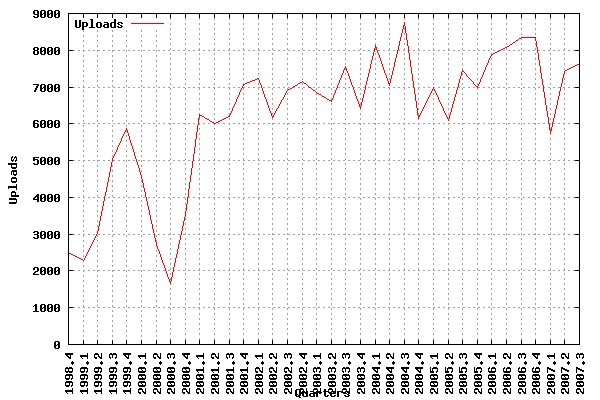
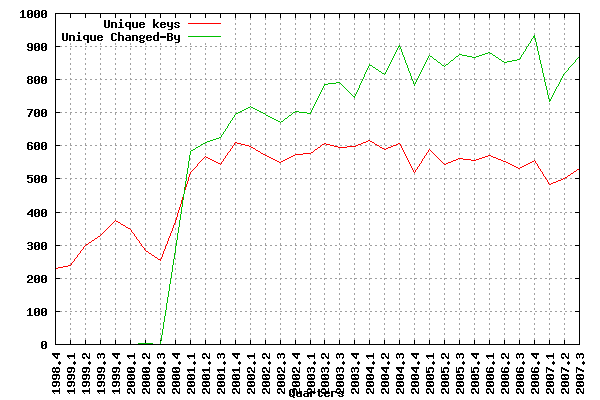
I was wondering how Debian compared, so I made some stats using the debian-devel-changes archives.
First, the number of source uploads per quarter:
 The talks I proposed for FOSS.in, the major
FLOSS conference in India, have been accepted for the Project Days, in the
Debian-Ubuntu sessions.
Thanks to the event organizers who will sponsor my travel to Bangalore, I'll
probably leave as of Sunday Dec. 2nd and attend the entire conference from
Dec. 4th to Dec. 8th.
During earlier weeks, Sam Hocevar, the Debian Project Leader, also agreed to
come to the conference and give two talks there. And, this morning, I had
the nice surprise to discover that Lucas Nussbaum, one of our most tireless
QA animators in Debian, will also come and give a talk about QA in Debian.
So, that should make three French DD attending and, therefore, bring a
strong Debian representation in this conference, which is something I
definitely find interesting as I invested quite a lot of time and energy
last years to increase the Debian presence in South Asia.
This will certainly be a great occasion for us to give credit to the few
people who contribute to Debian (and related projects) in India, and of
course meet them in person.
Please check the list of
talks to get an idea of talks.
Now for the challenge: the organizers expect our slides....by 7 days as of
now. I don't know for Sam and Lucas but I have just begun working on one of
my two talks (the i18n one, of course...you know: the one with the cute
maps....). Would someone have a ready "How to contribute to Debian" talk
somewhere? :-)
I recently sponsored several uploads, and was asked to sponsor even more uploads, and that got me thinking about our sponsorship workflow. It’s a clear bottleneck in Debian, and discourages many new contributors, which obviously sucks.
It’s important to note that the same problems exist in Ubuntu (their equivalent to mentors.debian.net is named REVU).
The best way to improve the process would be to have packages of better quality when a DD first look at them. They would be more likely to be uploaded right away, which frees time for other packages. I think that there’s a lot of room for improvement in the current mentors.debian.net implementation. Here is a small list of features I would like to see.
Christian Perrier is wondering why the official announcement about the Gutsy release does not even contain the word “Debian”.
It’s not new: Debian is virtually nonexistent in Ubuntu’s communication. It seems that the last Ubuntu release to acknowledge its Debian origins was Dapper (June 2006), maybe because that was the “Long Term Support” release.
The fact that there’s no “Ubuntu is based on Debian” paragraph on www.ubuntu.com was raised during Debconf, and it was supposed to get fixed, but it seems that it didn’t happen for some reason (there was such a paragraph before the website redesign).
In other news, I’ve been trying to install Ubuntu Gutsy inside qemu, but it fails miserably while booting the installer. I removed the “quiet” and “splash” options from the kernel cmdline, and discovered that after trying to “mount the root filesystem”, I get dropped into busybox with no error message to google for. Feisty fails as well, but Dapper boots fine. So much for the Ubuntu is an ancient African word, meaning “I can’t install Debian” joke!
Donnie Berkholz wrote an interesting article on Who made Gentoo Linux, and when?. Has someone already done something similar for Debian? It would probably be possible (and easy) to use the debian-devel-changes archives (available since 1998) for that.
In a lot of talks or blog posts (like Sam’s talk at RMLL, or Rapha l’s blog posts - both in french), people have been talking about what people could do inside Debian, and how it would help Debian.
That doesn’t sound like the best approach to me. When describing tasks with the objective of getting potential contributors to pick them up, we should try to make them sexy, to tell users what is exciting about them, what they will learn doing those tasks, where satisfaction will come from. We really need to sell them better.
Of course, some Debian tasks are mainly grunt work. And for some of them, people just do them because someone has to do them. But I believe that most tasks inside Debian are actually more interesting than outsiders would expect. For example, I would be very interested in reading why an i18n expert (hint: Christian!) finds i18n sexy … and I should probably try to write about QA myself.
(As you might have noticed now, the subject of this blog post was misleading on purpose — chosen so that a lot of people would read the post :P)
From the ZFS FAQ:
Can devices be removed from a ZFS pool? You can remove a device from a mirrored ZFS configuration by using the zpool detach command. Removal of a top-level vdev, such as an entire RAID-Z group or a disk in an unmirrored configuration, is not currently supported. This feature is planned for a future release.buzz, buzz, buzz…
From time to time, I try Compiz, to see if how it has evolved. The last time was yesterday (I also switched to the xserver-xorg-driver-ati from experimental).
But as usual, after using it for a few minutes, I can’t help switching back to metacity. I don’t think that Compiz’s visual effects bring anything on the usability POV, and I just find them annoying after the initial “WOW”. Of course, it’s nice to show off, but to do actual work? Are there people really using it all the time?
After that blog post, I decided to write a mail asking a first set of questions. I sent it to developers’ mailing lists of Fedora, Gentoo, Mandriva, openSUSE, and of course Debian and Ubuntu. I got really interesting answers from everyone, except …. Debian and Ubuntu.
if you like to monitor the number of RC bugs, you are probably annoyed by the graph on http://bugs.debian.org/release-critical/. The graph starts in 2003, making it impossible to read short-time changes. There’s a bug about that: #431299: RC bug status graph timescale is too long. And I provided a patch a few months ago, but it hasn’t been included yet.
So, in the meantime, you can use my private copy (generated daily):
 Also, if you like graphs, Yves-Alexis Perez (aka Corsac) generates cool graphs about Debian:
And if you want to have all the interesting graphs on the same page, you can use this page.
Scientific papers always have a “related works” section, where the authors describe how the work they are presenting compares with what others did. In the Free Software world, this is nearly non-existent: in a way, it seems that many of us are thinking of their projects as competing products, fighting for market share. On a project web page, I would love to read something like:
This project is particularly well suited if you want XX. But if YY is more important to you, you might want to have a look at ZZ.Or simply links to similar projects for other environments, etc. All in all, I think that the goal is to improve the global satisfaction. Not to win a few users, who won’t be totally happy, because the project doesn’t really suit their needs. While some projects cooperate and share ideas, like I think desktop environments do inside freedesktop.org, most just ignore each other. I am both a Debian and an Ubuntu developer, and I’m sometimes amazed that Ubuntu discusses technical choices that were discussed (and solved) a few weeks earlier in Debian. And it’s even worse with the other big distros out there. Couldn’t we try to improve this ? We could just create a mailing list, where developers from various distributions could present the way they do things. This would allow to discuss future developments (”We are planning to improve this, what are you doing about that ?“) or simply to improve people’s knowledge of the various distributions. Of course, this could easily turn into flamefests, but they are technical ways to avoid that, like moderating posts from trollers… Does something like that already exist ? Do you think that it would be interesting ? Would you like to contribute to such a forum ? Some examples of things that could be discussed:
After Dell, Lenovo decided to ask users which Linux distribution they should put on Thinkpads. Seriously, who cares? If I buy a laptop that comes with Linux pre-installed, my first step would be to reinstall it from scratch, exactly like with a laptop with Windows pre-installed. Because the choices that were made wouldn’t match mine (think of partitioning, etc). Or simply because I wouldn’t totally trust the hardware manufacturer.
So, what would make me happier about a laptop?
text/html; epiphany-browser '%s'; description=HTML Text; nametemplate=%s.html
This should work fine, but the problem is that mutt creates a temporary file (/tmp/mutt.html) and removes it when the command terminates, which is nearly immediately with epiphany. And epiphany has a really nice feature: it monitors local files for changes and reload them when they change. Which results in seeing the page briefly, then a File "/tmp/mutt.html" not found. error page.
Anyone using mutt and epiphany together successfully?

echo 1 > /proc/sys/net/ipv4/ip_forward

$IPT -t nat -A PREROUTING -p tcp --dport portA -j DNAT --to hostB:portB

$IPT -A FORWARD -i eth0 -o eth0 -d hostB -p tcp --dport portB -j ACCEPT

$IPT -A FORWARD -i eth0 -o eth0 -s hostB -p tcp --sport portB -j ACCEPT

$IPT -t nat -A POSTROUTING -p tcp -d hostB --dport portB -j SNAT --to-source hostA
Connections are masqueraded, that means that, for hostB, all connections are coming from hostA. So be careful.
Next.

