Search Results: "jam"

20 January 2015

Jonathan Wiltshire: Never too late for bug-squashing

With over a hundred RC bugs still outstanding for Jessie, there s never been a better time to host a bug-squashing party in your local area. Here s how I do it.
  1. At home is fine, if you don t mind guests. You don t need to seek out a sponsor and borrow or hire office space. If there isn t room for couch-surfers, the project can help towards travel and accommodation expenses. My address isn t secret, but I still don t announce it it s fine to share it only with the attendees once you know who they are.
  2. You need a good work area. There should be room for people to sit and work comfortably a dining room table and chairs is ideal. It should be quiet and free from distractions. A local mirror is handy, but a good internet connection is essential.
  3. Hungry hackers eat lots of snacks. This past weekend saw five of us get through 15 litres of soft drinks, two loaves of bread, half a kilo of cheese, two litres of soup, 22 bags of crisps, 12 jam tarts, two pints of milk, two packs of chocolate cake bars, and a large bag of biscuits (and we went out for breakfast and supper). Make sure there is plenty available before your attendees arrive, along with a good supply of tea and coffee.
  4. Have a work plan. Pick a shortlist of RC bugs to suit attendees strengths, or work on a particular packaging group s bugs, or have a theme, or something. Make sure there s a common purpose and you don t just end up being a bunch of people round a table.
  5. Be an exemplary host. As the host you re allowed to squash fewer bugs and instead make sure your guests are comfortable, know where the bathroom is, aren t going hungry, etc. It s an acceptable trade-off. (The reverse is true: if you re attending, be an exemplary guest and don t spend the party reading news sites.)
Now, go host a BSP of your own, and let s release!
Never too late for bug-squashing is a post from: jwiltshire.org.uk Flattr

17 January 2015

Diego Escalante Urrelo: Link Pack #03

What s that? The third edition of Link Pack of course!
Playing with Power (7 minutes, Vimeo)
A super awesome story about a stop motion animator that turned a Nintendo Power Glove into the perfect animation tool. It s a fun, inspiring video :-). I love the Power Glove, it s so bad. The Power Glove Angry Video Game Nerd Episode 14 (12 minutes, YouTube)
On the topic of the Power Glove, here s the now classic Angry Video Game Nerd video about it. James Rolfe is funny. Ship Your Enemies Glitter
A rising star in the internet business landscape. You pay them $9.99 and they send an envelope full of glitter to your worst enemy. They promise it will jump into everything, as usual. Damn you glitter. A Guide to Practical Contentment
Be happy with what you have, but understand why:
( ) if you start in this place of fixing what s wrong with you, you keep looking for what else is wrong with you, what else you need to improve. So maybe now feel like you don t have enough muscles, or six pack abs, or you think your calves don t look good, or if it s not about your body, you ll find something else. So it s this never-ending cycle for your entire life. You never reach it. If you start with a place of wanting to improve yourself and feeling stuck, even if you re constantly successful and improving, you re always looking for happiness from external sources. You don t find the happiness from within, so you look to other things.
The Comments Section For Every Video Where Someone Does A Pushup
Comments. From YouTube. Enough said.
These are dips. Not pushups. In the entire history of the world, no one has ever successfully performed a pushup. They re all just dips. STOP DRIVING WITH YOUR HIPS. IF YOU RE DOING A PUSHUP CORRECTLY, YOUR HIPS SHOULD CEASE TO EXIST. You could do 100 pushups like this and it wouldn t improve your strength at all. You re just bending your arms.
Self-Taught Chinese Street Photographer Tao Liu Has an Eye for Peculiar Moments
This Chinese photog uses his lunch break to snap interesting street photography. Funny selection by PetaPixel, his Flickr page has even more stuff. Even more in his photoblog.
From https://www.flickr.com/photos/58083590@N05/14613273495/By Liu Tao. https://www.flickr.com/photos/58083590@N05/14613273495/
Enrique Castro-Mendivil s Agua Dulce photo set
Another interesting photo link. This time it s the most popular beach in Lima, with most people coming from low income neighborhoods, it shows how fragmented the city is.
By Enrique Castro-Mendivil. http://www.castromendivilphoto.com/index.php/component/content/article/11-work/69-agua-dulceBy Enrique Castro-Mendivil. http://www.castromendivilphoto.com/index.php/component/content/article/11-work/69-agua-dulce

Also on Link Pack

6 January 2015

Steve McIntyre: Bootstrapping arm64 in Debian

I promised to write about this a long time, ooops... :-) Another ARM port in Debian - yay! arm64 is officially a release architecture for Jessie, aka Debian version 8. That's taken a lot of manual porting and development effort over the last couple of years, and it's also taken a lot of CPU time - there are ~21,000 source packages in Debian Jessie! As is often the case for a brand new architecture like arm64 (or AArch64, to use ARM's own terminology), hardware can be really difficult to get hold of. In time this will cease to be an issue as hardware becomes more commoditised, but in Debian we really struggled to get hold of equipment for a very long time during the early part of the port. First bring-up in Debian Ports To start with, we could use ARM's own AArch64 software models to build the first few packages. This worked, but only very slowly. Then Chen Baozi and the folks running the Tianhe-2 supercomputer project in Guangzhou, China contacted us to offer access to some arm64 hardware, and this is what Wookey used for bootstrapping the new port in the unofficial Debian Ports archive. This has now become the normal way for new architectures to get into Debian. We got most of the archive built in debian-ports this way, and we could then use those results to seed the initial core set of packages in the main Debian archive. Second bring-up - moving into the main Debian archive By the time that first Debian bring-up was done, ARM was starting to produce its own "Juno" development boards, and with the help of my boss^4 James McNiven we managed to acquire a couple of those machines for use as official Debian build machines. The existing machines in China were faster, but for various reasons quite difficult to maintain as official Debian machines. So I set up the Junos as buildds just before going to DebConf in August 2014. They ran very well, and (for dev boards!) were very fast and stable. They built a large chunk of the Debian archive, but as the release freeze for Jessie grew close we weren't quite there. There was a small but persistent backlog of un-built packages that were causing us issues, plus the Juno machines are/were not quite suitable as porter boxes for Debian developers all over the world to use for debugging their packages on the new architecture. More horsepower - Linaro machines This is where Linaro came to our aid. Linaro's goal is to help improve Free and Open Source Software on ARM, and one of the more recent projects in Linaro is a cluster of servers that are made available for software developers to use to get early access to ARMv8 (arm64) hardware. It's a great way for people who are interested in this new architecture to try things out, port their software or indeed just help with the general porting effort. As Debian is seen as such an important part of the FLOSS ecosystem, we managed to negotiate dedicated access to three of the machines in that cluster for Debian's use and we set those up in October, shortly before the freeze for Jessie. Andy Doan spent a lot of his time getting these machines going for us, and then I set up two of them as build machines and one as the porter box we were still needing. With these extra machines available, we quickly caught up with the ever-busy "Needs-Build" queue and we've got sufficient build power now to keep things going for the Jessie release. We were officially added to the list of release architectures at the Cambridge mini-Debconf in November, and all is looking good now! And in the future? I've organised the loan of another arm64 machine from AMD for Debian to use for further porting and/or building. We're also expecting that more and more machines will be coming out soon as vendors move on from prototyping to producing real customer equipment. Once that's happened, more kit will be available and everybody will be able to have arm64-powered computers in the server room, on their desk and even inside their laptop! Mine will be running Debian Jessie... :-) Thanks! There's been a lot of people involved in the Debian arm64 bootstrapping at various stages, so many that I couldn't possibly credit them all! I'll highlight some, though. :-) First of all, Wookey's life has revolved around this port for the last few years, tirelessly porting, fixing and hacking out package builds to get us going. We've had loads of help from other teams in Debian, particularly the massive patience of the DSA folks with getting early machines up and running and the prodding of the ftpmaster, buildd and release teams when we've been grinding our way through ever more package builds and dependency loops. We've also had really good support from toolchain folks in Debian and ARM, fixing bugs as we've found them by stressing new code and new machines. We've had a number of other people helping by filing bugs and posting patches to help us get things built and working. And (last but not least!) thanks to all the folks who've helped us beg and borrow the hardware to make the Debian arm64 port a reality. Rumours of even more ARM ports coming soon are entirely scurrilous... *grin*

1 January 2015

Simon Kainz: Pigs-in-a-mud-pond Cake

In lack of some New-Years-Charms, this is our attempt at creating something by ourselves: Step 1 Make some pigs (Pigs being a symbol of luck!) 1 2 (Closeup, probably NSFW :-) ) Step 2 Make some pie. We made a simple, two layeres chocolate pie, topped with some jam to prevent that is all gets very dry. We then made the pond "walls" by sticking KitKat on the side of the pie. We used molten chocolate as "glue". 3 Step 3 Add some more chocolate and add the pigs! 4 5 (Piggy relaxing in liquid chocolate! :-) Step 4 Enjoy! Happy 2015!

31 December 2014

Wouter Verhelst: Perl 'issues'

I just watched a CCC talk in which the speaker claims Perl is horribly broken. Watching it was fairly annoying however, since I had to restrain myself from throwing things at the screen. If you're going to complain about the language, better make sure you actually understand the language first. I won't deny that there are a few weird constructions in there, but hey. The talk boils down to a claim that perl is horrible, because the list "data type" is "broken". First of all, Netanel, in Perl, lists are not arrays. Yes, that's confusing if you haven't done more than a few hours of Perl, but hear me out. In Perl, a list is an enumeration of values. A variable with an '@' sigil is an array; a construct consisting of an opening bracket ('(') followed by a number of comma- or arrow-separated values (',' or '=>'), followed by a closing bracket, is a list. Whenever you assign more than one value to an array or a hash, you need to use a list to enumerate the values. Subroutines in perl also use lists as arguments or return values. Yes, that last bit may have been a mistake. Perl has a concept of "scalar context" and "list context". A scalar context is what a sub is in when you assign the return value of your sub to a scalar; a list context is when you assign the return value of your sub to an array or a hash, or when you use the list construct (the thing with brackets and commas) with sub calls (instead of hardcoded values or variables) as the individual values. This works as follows:
sub magic  
    if (wantarray())  
        print "You're asking for a list!";
        return ('a', 'b', 'c');
      else  
        print "You're asking for a scalar!";
        return 'a';
     
 
print ("list: ", magic(), "\n");
print "scalar: " . magic() . "\n";
The above example will produce the following output:
You're asking for a list!
list: abc
You're asking for a scalar!
scalar: a
What happens here? The first print line creates a list (because things are separated by commas); the second one does not (the '.' is perl's string concatenation operator; as you can only concatenate scalars, the result is that you call the magic() sub in scalar context). Yes, seen as how arrays are not lists, the name of the wantarray() sub is horribly chosen. Anyway. It is documented that lists cannot be nested. Lists can only be one-dimensional constructs. If you create a list, and add another list as an element (or something that can be converted to a list, like an array or a hash), then the result is that you get a flattened list. If you don't want a flattened list, you need to use a reference instead. A reference is a scalar value that, very much like a pointer in C, contains a reference to another variable. This other variable can be an array, a hash, or a scalar. But it cannot be a list, because it must be a variable -- and lists cannot be variables. If you need to create multi-dimensional constructs, you need to use references. Taking a reference is done by prepending a backslash to whatever it is you're trying to take a reference of; or, in the case of arrays of hashes, one can create an anonymous array or hash with [] resp . E.g., if you want to add a non-flattened array to a list, you instead create a reference to an array, like so:
$arrayref = [ 'this', 'is', 'an', 'anonymous', 'array'];
you can now create a multi-dimensional construct:
@multiarray = ('elem1', $arrayref);
Or you can do that in one go:
@multiarray = ('elem1', [ 'this', 'is', 'an', 'anonymous', 'array']);
Alternatively, you can create a non-anonymous array first:
@onedimarray = ('this', 'is', 'not', 'an', 'anonymous', 'array');
@multiarray = ('elem1', \@onedimarray);
In perl, curly brackets can be used to create a reference to anonymous hashes, whereas square brackets can be used to create a reference to anonymous arrays. This is all a basic part of the language; if you don't understand that, you simply don't understand Perl. In other words, whenever you see someone doing this:
%hash =  'a' => 'b' ;
or
@array = [ '1', '2' ];
you can say that they don't understand the language. For reference, the assignment to %hash will result in an (unusable) hash with a single key that is a reference to an anonymous hash (which cannot be accessed anymore) and a value of undef; the assignment to @array will result in a two-dimensional array with one element in the first dimension, and two elements in the second. The CGI.pm fix which Natanel dismisses in the Q&A part of the talk as a "warning" which won't help (because it would be too late) is actually a proper fix, which should warn people in all cases. That is, if you do this:
%hash =   'name' => $name, 'password' => $cgi->param('password')  ;
then CGI.pm's param() sub will notice that it's being called in list context, and issue a warning -- regardless of whether the user is passing one or two password query-parameters. It uses the wantarray() sub, and produces a warning if that returns true. In short, Perl is not the horribly broken construct that Natanel claims it to be. Yes, there are a few surprises (most of which exist for historical reasons), and yes, those should be fixed. This is why the Perl community has redone much of perl for Perl 6. But the fact that there are a few surprises doesn't mean the whole language is broken. There are surprises in most languages; that is a fact of life. Yes, the difference between arrays and hashes on the one hand, and lists on the other hand, is fairly confusing; it took me a while to understand this. But once you get the hang of it, it's not all that difficult. And then these two issues that Natanel found (which I suppose could be described as bugs in the core modules) aren't all that surprising anymore. So, in short: What I do agree with is that if you want to use a language, you should understand its features. Unfortunately, this single line in the final slide of Natanel's talk is just about the only thing in the whole talk that sortof made sense to me. Ah well.

30 December 2014

Benjamin Mako Hill: Consider the Redirect

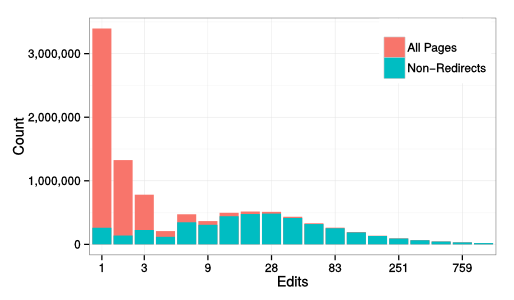
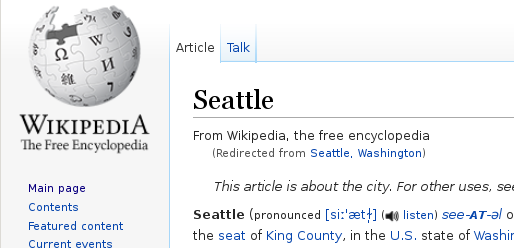
In wikis, redirects are special pages that silently take readers from the page they are visiting to another page. Although their presence is noted in tiny gray text (see the image below) most people use them all the time and never know they exist. Redirects exist to make linking between pages easier, they populate Wikipedia s search autocomplete list, and are generally helpful in organizing information. In the English Wikipedia, redirects make up more than half of all article pages. seattle_redirectOver the years, I ve spent some time contributing to to Redirects for Discussion (RfD). I think of RfD as like an ultra-low stakes version of Articles for Deletion where Wikipedians decide whether to delete or keep articles. If a redirect is deleted, viewers are taken to a search results page and almost nobody notices. That said, because redirects are almost never viewed directly, almost nobody notices if a redirect is kept either! I ve told people that if they want to understand the soul of a Wikipedian, they should spend time participating in RfD. When you understand why arguing about and working hard to come to consensus solutions for how Wikipedia should handle individual redirects is an enjoyable way to spend your spare time where any outcome is invisible you understand what it means to be a Wikipedian. That said, wiki researchers rarely take redirects into account. For years, I ve suspected that accounting for redirects was important for Wikipedia research and that several classes of findings were noisy or misleading because most people haven t done so. As a result, I worked with my colleague Aaron Shaw at Northwestern earlier this year to build a longitudinal dataset of redirects that can capture the dynamic nature of redirects. Our work was published as a short paper at OpenSym several months ago. It turns out, taking redirects into account correctly (especially if you are looking at activity over time) is tricky because redirects are stored as normal pages by MediaWiki except that they happen to start with special redirect text. Like other pages, redirects can be updated and changed over time are frequently are. As a result, taking redirects into account for any study that looks at activity over time requires looking at the text of every revision of every page. Using our dataset, Aaron and I showed that the distribution of edits across pages in English Wikipedia (a relationships that is used in many research projects) looks pretty close to log normal when we remove redirects and very different when you don t. After all, half of articles are really just redirects and, and because they are just redirects, these articles are almost never edited. edits_over_pagesAnother puzzling finding that s been reported in a few places and that I repeated myself several times is that edits and views are surprisingly uncorrelated. I ll write more about this later but the short version is that we found that a big chunk of this can, in fact, be explained by considering redirects. We ve published our code and data and the article itself is online because we paid the ACM s open access fee to ransom the article.
27 December 2014

Benjamin Mako Hill: My Government Portrait

A friend recently commented on my rather unusual portrait on my (out of date) page on the Berkman website. Here s the story. I joined Berkman as a fellow with a fantastic class of fellows that included, among many other incredibly accomplished people, Vivek Kundra: first Chief Information Officer of the United States. At Berkman, all the fellows are all asked for photos and Vivek apparently sent in his official government portrait. You are probably familiar with the genre. In the US at least, official government portraits are mostly pictures of men in dark suits, light shirts, and red or blue ties with flags draped blurrily in the background. Not unaware of the fact that Vivek sat right below me on the alphabetically sorted Berkman fellows page, a small group that included Paul Tagliamonte very familiar with the genre from his work with government photos in Open States decided to create a government portrait of me using the only flag we had on hand late one night. fellows_list_subsetThe result shown in the screenshot above and in the WayBack Machine was almost entirely unnoticed (at least to my knowledge) but was hopefully appreciated by those who did see it.

24 December 2014

Benjamin Mako Hill: Images of Japan

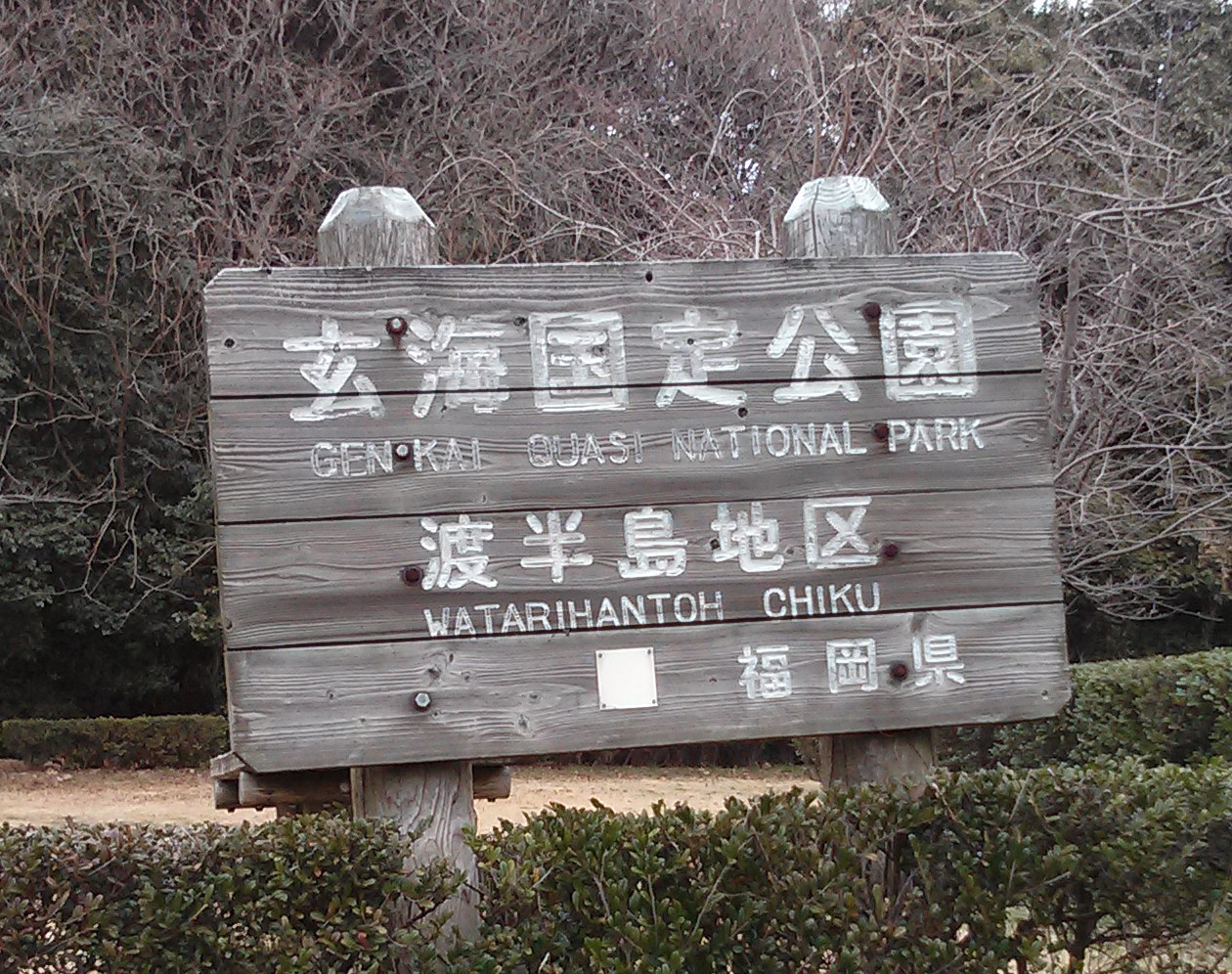
Going through some photos, I was able to revisit some of the more memorable moments of my trip to Japan earlier this year. For example, the time I visited Genkai Quasi National Park a beautiful spot in Fukuoka that had a strong resemblance to, but may not actually have been, a national park. Genkai Quasi National Park There was the time that I saw a Saw a curry fault bread. Saw a Curry Fault Bread And a shrine one could pray at in a barcalounger. Shrine Comfortable Chair There was the also the fact that we had record snowfall while in Tokyo which left the cities drainage system in a rather unhappy state. Japan Unhappy Drain

10 December 2014

Dirk Eddelbuettel: Wilco!!

Wilco at The Riviera With a bit of luck due to a collegue having a spare ticket, I managed to make it to an awesome Wilco show at The Riviera in Uptown. This concert was part of a set a six shows. Tweedy and the band were fast, and loose, and wonderful, and totally beloved by the home crowd. An truly outstanding show, and a great evening. Also: I should get out more often. Last blog entry about Wilco was from 2005. Ouch.

This post by Dirk Eddelbuettel originated on his Thinking inside the box blog. Please report excessive re-aggregation in third-party for-profit settings.

9 December 2014

Joey Hess: podcasts that don't suck, 2014 edition

Also, out of the podcasts I listed previously, I still listen to and enjoy Free As In Freedom, Off the Hook, and the Long Now Seminars. PS: A nice podcatcher, for the technically inclined is git-annex importfeed. Featuring list of feeds in a text file, and distributed podcatching!

26 October 2014

Colin Watson: Moving on, but not too far

The Ubuntu Code of Conduct says:
Step down considerately: When somebody leaves or disengages from the project, we ask that they do so in a way that minimises disruption to the project. They should tell people they are leaving and take the proper steps to ensure that others can pick up where they left off.
I've been working on Ubuntu for over ten years now, almost right from the very start; I'm Canonical's employee #17 due to working out a notice period in my previous job, but I was one of the founding group of developers. I occasionally tell the story that Mark originally hired me mainly to work on what later became Launchpad Bugs due to my experience maintaining the Debian bug tracking system, but then not long afterwards Jeff Waugh got in touch and said "hey Colin, would you mind just sorting out some installable CD images for us?". This is where you imagine one of those movie time-lapse clocks ... At some point it became fairly clear that I was working on Ubuntu, and the bug system work fell to other people. Then, when Matt Zimmerman could no longer manage the entire Ubuntu team in Canonical by himself, Scott James Remnant and I stepped up to help him out. I did that for a couple of years, starting the Foundations team in the process. As the team grew I found that my interests really lay in hands-on development rather than in management, so I switched over to being the technical lead for Foundations, and have made my home there ever since. Over the years this has given me the opportunity to do all sorts of things, particularly working on our installers and on the GRUB boot loader, leading the development work on many of our archive maintenance tools, instituting the +1 maintenance effort and proposed-migration, and developing the Click package manager, and I've had the great pleasure of working with many exceptionally talented people. However. In recent months I've been feeling a general sense of malaise and what I've come to recognise with hindsight as the symptoms of approaching burnout. I've been working long hours for a long time, and while I can draw on a lot of experience by now, it's been getting harder to summon the enthusiasm and creativity to go with that. I have a wonderful wife, amazing children, and lovely friends, and I want to be able to spend a bit more time with them. After ten years doing the same kinds of things, I've accreted history with and responsibility for a lot of projects. One of the things I always loved about Foundations was that it's a broad church, covering a wide range of software and with a correspondingly wide range of opportunities; but, over time, this has made it difficult for me to focus on things that are important because there are so many areas where I might be called upon to help. I thought about simply stepping down from the technical lead position and remaining in the same team, but I decided that that wouldn't make enough of a difference to what matters to me. I need a clean break and an opportunity to reset my habits before I burn out for real. One of the things that has consistently held my interest through all of this has been making sure that the infrastructure for Ubuntu keeps running reliably and that other developers can work efficiently. As part of this, I've been able to do a lot of work over the years on Launchpad where it was a good fit with my remit: this has included significant performance improvements to archive publishing, moving most archive administration operations from excessively-privileged command-line operations to the webservice, making build cancellation reliable across the board, and moving live filesystem building from an unscalable ad-hoc collection of machines into the Launchpad build farm. The Launchpad development team has generally welcomed help with open arms, and in fact I joined the ~launchpad team last year. So, the logical next step for me is to make this informal involvement permanent. As such, at the end of this year I will be moving from Ubuntu Foundations to the Launchpad engineering team. This doesn't mean me leaving Ubuntu. Within Canonical, Launchpad development is currently organised under the Continuous Integration team, which is part of Ubuntu Engineering. I'll still be around in more or less the usual places and available for people to ask me questions. But I will in general be trying to reduce my involvement in Ubuntu proper to things that are closely related to the operation of Launchpad, and a small number of low-effort things that I'm interested enough in to find free time for them. I still need to sort out a lot of details, but it'll very likely involve me handing over project leadership of Click, drastically reducing my involvement in the installer, and looking for at least some help with boot loader work, among others. I don't expect my Debian involvement to change, and I may well find myself more motivated there now that it won't be so closely linked with my day job, although it's possible that I will pare some things back that I was mostly doing on Ubuntu's behalf. If you ask me for help with something over the next few months, expect me to be more likely to direct you to other people or suggest ways you can help yourself out, so that I can start disentangling myself from my current web of projects. Please contact me sooner or later if you're interested in helping out with any of the things I'm visible in right now, and we can see what makes sense. I'm looking forward to this!

19 October 2014

Benjamin Mako Hill: Another Round of Community Data Science Workshops in Seattle

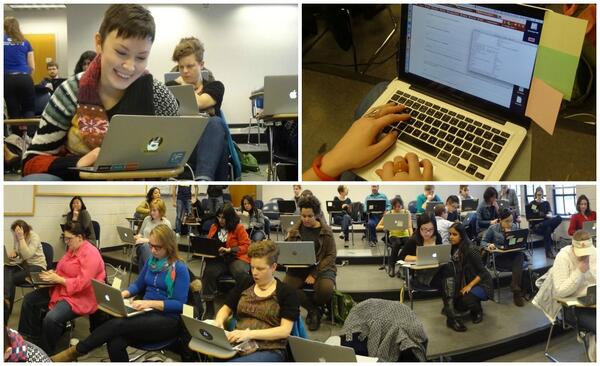
Pictures from the CDSW sessions in Spring 2014Pictures from the CDSW sessions in Spring 2014
I am helping coordinate three and a half day-long workshops in November for anyone interested in learning how to use programming and data science tools to ask and answer questions about online communities like Wikipedia, free and open source software, Twitter, civic media, etc. This will be a new and improved version of the workshops run successfully earlier this year. The workshops are for people with no previous programming experience and will be free of charge and open to anyone. Our goal is that, after the three workshops, participants will be able to use data to produce numbers, hypothesis tests, tables, and graphical visualizations to answer questions like: If you are interested in participating, fill out our registration form here before October 30th. We were heavily oversubscribed last time so registering may help. If you already know how to program in Python, it would be really awesome if you would volunteer as a mentor! Being a mentor will involve working with participants and talking them through the challenges they encounter in programming. No special preparation is required. If you re interested, send me an email.

28 September 2014

Ean Schuessler: RoboJuggy at JavaOne

A few months ago I was showing my friend Bruno Souza the work I had been doing with my childhood friend and robotics genius, David Hanson. I had been watching what David was going through in his process of creating life-like robots with the limited industrial software available for motor control. I had suggested to David that binding motors to Blender control structures was a genuinely viable possibility. David talked with his forward looking CEO, Jong Lee, and they were gracious enough to invite me to Hong Kong to make this exciting idea a reality. Working closely the HRI team (Vytas, Gabrielos, Fabien and Davide) with David s friend and collaborators at OpenCog (Ben Goertzel, Mandeep, David, Jamie, Alex and Samuel) a month long creative hack-fest yielded pretty amazing results. Bruno is an avid puppeteer, a global organizer of java user groups and creator of Juggy the Java Finch, mascot of Java users and user groups everywhere. We started talking about how cool it would be to have a robot version of Juggy. When I was in China I had spent a little time playing with Mark Tilden s RSMedia and various versions of David s hobby servo based emotive heads. Bruno and I did a little research into the ROS Java bindings for the Robot Operating System and decided that if we could make that part of the picture we had a great and fun idea for a JavaOne talk. Hunting and gathering I tracked down a fairly priced RSMedia in Alaska, Bruno put a pair of rubber Juggy puppet heads in the mail and we were on our way.
We had decided that we wanted RoboJuggy to be able to run about untethered and the new RaspberryPi B+ seemed like the perfect low power brain to make that happen. I like the Debian based Raspbian distributions but had lately started using the netinst Pi images. These get your Pi up and running in about 15 minutes with a nicely minimalistic install instead of a pile of dependencies you probably don t need. I d recommend anyone interested I m duplicating our work to stay their journey there: Raspbian UA Net Installer Robots seem like an embedded application but ROS only ships packages for Ubuntu. I was pleasantly surprised that there are very good instructions for building ROS from source on the Pi. I ended up following these instructions: Setting up ROS Hydro on the Raspberry Pi Building from source means that all your install ends up being isolated (in ROS speak) and your file locations and build instructions end up being subtly current. As explained in the linked article, this process is also very time consuming. One thing I would recommend once you get past this step is to use the UNIX dd command to back up your entire SD card to a desktop. This way if you make a mess of things in later steps you can restore your install to a pristine Raspbian+ROS install. If your SD drive was on /dev/sdb you might use something like this to do the job:
sudo dd bs=4M if=/dev/sdb   gzip > /home/your_username/image date +%d%m%y .gz
Getting Java in the mix Once you have your Pi all set up with minimal Raspbian and ROS you are going to want a Java VM. The Pi runs the ARM CPU so you need the corresponding version of Java. I tried getting things going initially with OpenJDK and I had some issues with that. I will work on resolving that in the future because I would like to have a 100% Free Software kit for this but since this was for JavaOne I also wanted JDK8, which isn t available in Debian yet. So, I downloaded the Oracle JDK8 package for ARM. Java 8 JDK for ARM At this point you are ready to start installing the ROS Java packages. I m pretty sure the way I did this initially is wrong but I was trying to reconcile the two install procedures for ROS Java and ROS Hydro for Raspberry Pi. I started by following these directions for ROS Java but with a few exceptions (you have to click the install from source link in the page to see the right stuff: Installing ROS Java on Hydro Now these instructions are good but this is a Pi running Debian and not an Ubuntu install. You won t run the apt-get package commands because those tools were already installed in your earlier steps. Also, this creates its own workspace and we really want these packages all in one workspace. You can apparently chain workspaces in ROS but I didn t understand this well enough to get it working so what I did was this:
> mkdir -p ~/rosjava 
> wstool init -j4 ~/rosjava/src https://raw.github.com/rosjava/rosjava/hydro/rosjava.rosinstall
> source ~/ros_catkin_ws/install_isolated/setup.bash > cd ~/rosjava # Make sure we've got all rosdeps and msg packages.
> rosdep update 
> rosdep install --from-paths src -i -y
and then copied the sources installed into ~/rosjava/src into my main ~/ros_catkin_ws/src. Once those were copied over I was able to run a standard build.
> catkin_make_isolated --install
Like the main ROS install this process will take a little while. The Java gradle builds take an especially long time. One thing I would recommend to speed up your workflow is to have an x86 Debian install (native desktop, QEMU instance, docker, whatever) and do these same build from source installs there. This will let you try your steps out on a much faster system before you try them out in the Pi. That can be a big time saver. Putting together the pieces Around this time my RSMedia had finally showed up from Alaska. At first I thought I had a broken unit because it would power up, complain about not passing system tests and then shut back down. It turns out that if you just put the D batteries in and miss the four AAs that it will kind of pretend to be working so watch for that mistake. Here is a picture of the RSMedia when it first came out of the box: wpid-20140911_142904.jpg Other parts were starting to roll in as well. The rubber puppet heads had made their way through Brazilian customs and my Pololu Mini Maestro 24 had also shown up as well as the my servo motors and pan and tilt camera rig. I had previously bought a set of 10 motors for goofing around so I bought the pan and tilt rig by itself for about $5(!) but you can buy a complete set for around $25 from a number of EBay stores. Complete pan and tilt rig with motors for $25 A bit more about the Pololu. This astonishing little motor controller costs about $25 and gives you control of 24 motors with an easy to use and high level serial API. It is probably also possible to control these servos directly from the Pi and eliminate this board but that will be genuinely difficult because of the real-time timing issues. For $25 this thing is a real gem and you won t regret buying it. Now it was time to start dissecting the RSMedia and getting control of its brain. Unfortunately a lot of great information about the RSMedia has floated away since it was in its heyday 5 years ago but there is still some solid information out there that we need to round up and preserve. A great resource is the SourceForge based website here at http://rsmediadevkit.sourceforge.net. That site has links to a number of useful sites. You will definitely want to check out their wiki. To disassemble the RSMedia I followed their instructions. I will say, it would be smart to take more pictures as you are going because they don t take as many as they should. I took pictures of each board and its associated connections as dismantled the unit and that helped me get things back together later. Another important note is that if all you want to do is solder onto the control board and not replace the head then its feasible to solder the board in place without completely disassembling the unit. Here are some photos of the dis-assembly: wpid-20140921_114742.jpg wpid-20140921_113054.jpg wpid-20140921_112619.jpg Now I also had to start adjusting the puppet head, building an armature for the motors to control it and hooking it into the robot. I need to take some more photos of the actual armature. I like to use cardboard for this kind of stuff because it is so fast to work with and relatively strong. One trick I have also learned about cardboard is that if you get something going with it and you need it to be a little more production strength you can paint it down with fiberglass resin from your local auto store. Once it dries it becomes incredibly tough because it soaks through the fibers of the cardboard and hardens around them. You will want to do this in a well ventilated area but its a great way to build super tough prototypes. Another prototyping trick I can suggest is using a combination of Velcro and zipties to hook things together. The result is surprisingly strong and still easy to take apart if things aren t working out. Velcro self-adhesive pads stick to rubber like magic and that is actually how I hooked the jaw servo onto the mask. You can see me torturing its first initial connection here: Since the puppet head had come all the way from Brazil I decided to cook some chicken hearts in the churrascaria style while I worked on them in the garage. This may sound gross but I m telling you, you need to try it! I soaked mine in soy sauce, Sriracha and chinese cooking wine. Delicious but I digress. wpid-20140920_191551.jpg As I was eating my chicken hearts I was also connecting the pan and tilt armature onto the puppet s jaw and eye assembly. It took me most of the evening to get all this going but by about one in the morning things were starting to look good! I only had a few days left to hack things together before JavaOne and things were starting to get tight. I had so much to do and had also started to run into some nasty surprises with the ROS Java control software. It turns out that ROS Java is less than friendly with ROS message structures that are not built in . I had tried to follow the provided instructions but was not (and still have not) been able to get that working. Using unofficial messages with ROS Java I still needed to get control of the RSMedia. Doing that required the delicate operation of soldering to its control board. On the board there are a set of pins that provide a serial interface to the ARM based embedded Linux computer that controls the robot. To do that I followed these excellent instructions: Connecting to the RSMedia Linux Console Port After some sweaty time bent over a magnifying glass I had success: wpid-20140921_143327.jpg I had previously purchased the USB-TTL232 accessory described in the article from Dallas awesome Tanner Electronics store in Dallas. If you are a geek I would recommend that you go there and say hi to its proprietor (and walking encyclopedia of electronics knowledge) Jim Tanner. It was very gratifying when I started a copy of minicom, set it to 115200, N, 8, 1, plugged in the serial widget to the RSMedia and booted it up. I was greeted with a clearly recognizable Linux startup and console prompt. At first I thought I had done something wrong because I couldn t get it to respond to commands but I quickly realized I had flow control turned on. Once turned off I was able to navigate around the file system, execute commands and have some fun. A little research and I found this useful resource which let me get all kinds of body movements going: A collection of useful commands for the RSMedia At this point, I had a usable set of controls for the body as well as the neck armature. I had a controller running the industry s latest and greatest robotics framework that could run on the RSMedia without being tethered to power and I had most of a connection to Java going. Now I just had to get all those pieces working together. The only problem is that time was running out and I only had a couple of days until my talk and still had to pack and square things away at work. The last day was spent doing things that I wouldn t be able to do on the road. My brother Erik (and fantastic artist) came over to help paint up the juggy head and fix the eyeball armature. He used a mix of oil paint, rubber cement which stuck to the mask beautifully. I bought battery packs for the USB Pi power and the 6v motor control and integrated them into a box that could sit below the neck armature. I fixed up a cloth neck sleeve that could cover everything. Luckily during all this my beautiful and ever so supportive girlfriend Becca had helped me get packed or I probably wouldn t have made it out the door. Welcome to San Francisco THIS ARTICLE IS STILL BEING WRITTEN

Benjamin Mako Hill: Community Data Science Workshops Post-Mortem

Earlier this year, I helped plan and run the Community Data Science Workshops: a series of three (and a half) day-long workshops designed to help people learn basic programming and tools for data science tools in order to ask and answer questions about online communities like Wikipedia and Twitter. You can read our initial announcement for more about the vision. The workshops were organized by myself, Jonathan Morgan from the Wikimedia Foundation, long-time Software Carpentry teacher Tommy Guy, and a group of 15 volunteer mentors who taught project-based afternoon sessions and worked one-on-one with more than 50 participants. With overwhelming interest, we were ultimately constrained by the number of mentors who volunteered. Unfortunately, this meant that we had to turn away most of the people who applied. Although it was not emphasized in recruiting or used as a selection criteria, a majority of the participants were women. The workshops were all free of charge and sponsored by the UW Department of Communication, who provided space, and the eScience Institute, who provided food. cdsw_combo_images-1The curriculum for all four session session is online: The workshops were designed for people with no previous programming experience. Although most our participants were from the University of Washington, we had non-UW participants from as far away as Vancouver, BC. Feedback we collected suggests that the sessions were a huge success, that participants learned enormously, and that the workshops filled a real need in the Seattle community. Between workshops, participants organized meet-ups to practice their programming skills. Most excitingly, just as we based our curriculum for the first session on the Boston Python Workshop s, others have been building off our curriculum. Elana Hashman, who was a mentor at the CDSW, is coordinating a set of Python Workshops for Beginners with a group at the University of Waterloo and with sponsorship from the Python Software Foundation using curriculum based on ours. I also know of two university classes that are tentatively being planned around the curriculum. Because a growing number of groups have been contacting us about running their own events based on the CDSW and because we are currently making plans to run another round of workshops in Seattle late this fall I coordinated with a number of other mentors to go over participant feedback and to put together a long write-up of our reflections in the form of a post-mortem. Although our emphasis is on things we might do differently, we provide a broad range of information that might be useful to people running a CDSW (e.g., our budget). Please let me know if you are planning to run an event so we can coordinate going forward.

12 September 2014

Dariusz Dwornikowski: profanity and libstrophe status in Debian

profanity is a great console based XMPP client written in ncurses and C by James Booth. The code has a great quality, upstream is super collaborative, and willing, so packaging should be pretty straightforward. This post will show that this was not the case here. profanity First obstacle was that profanity depended on libstrophe, an XMPP library, which was not in Debian. As it occurred libstrophe's upstream was not responsive, so any changes that were needed to prepare libstrophe for high quality packaging could not be met.
  1. First of all libstrophe's build system (automake and friends) built only a static library.
  2. The second problem was that libstrophe did not tag releases on github, this was needed to make Debian watch file work.
  3. A third, smaller problem was the presence of debian/ directory in upstream's source. It can be neglected most of the time, since you can tell git-import-orig to delete it.
To solve those 3 problems I created a pull request fixing the build system to build also a shared library, deleting debian/ directory and politely asking for tagging releases. You can see my pull request here dated on April 26th. There was no answer for the libstrophe's upstream but I has some support from profanity's developers and other users wanting to make those changes. Finally metajack (libstrophe upstream) gave us right to the repo and we could merge the pull request on August 6th. The lesson learned - be patient and know autotools (a great tutorial is here). With profanity there were less changes to do. The most important one was that it linked to OpenSSL and due to the license incompatibility with GPL it could not go into Debian. Fortunately upstream added the OpenSSL exception, and profanity could be finally packaged. Now both profanity and libstrophe are in NEW queue and hopefully they will be accepted by ftp masters. When they are, there is plenty to do with them in the future, upstream closed some bugs, new upstream versions are tagged.

6 September 2014

Russ Allbery: Accumulated hauls

I haven't made one of these in a long time, so I have some catching from random purchases to do, which includes a (repurposed) nice parting gift from my previous employer and a trip to Powell's since I was in the area for DebConf14. This also includes the contents of the Hugo voter's packet, which contained a wide variety of random stuff even if some of the novels were represented only by excerpts. John Joseph Adams (ed.) The Mad Scientist's Guide to World Domination (sff anthology)
Roger McBride Allen The Ring of Charon (sff)
Roger McBride Allen The Shattered Sphere (sff)
Iain M. Banks The Hydrogen Sonata (sff)
Julian Barnes The Sense of an Ending (mainstream)
M. David Blake (ed.) 2014 Campbellian Anthology (sff anthology)
Algis Budrys Benchmarks Continued (non-fiction)
Algis Budrys Benchmarks Revisited (non-fiction)
Algis Budrys Benchmarks Concluded (non-fiction)
Edgar Rice Burroughs Carson of Venus (sff)
Wesley Chu The Lives of Tao (sff)
Ernest Cline Ready Player One (sff)
Larry Correia Hard Magic (sff)
Larry Correia Spellbound (sff)
Larry Correia Warbound (sff)
Sigrid Ellis & Michael Damien Thomas (ed.) Queer Chicks Dig Time Lords (non-fiction)
Neil Gaiman The Ocean at the End of the Lane (sff)
Max Gladstone Three Parts Dead (sff)
Max Gladstone Two Serpents Rise (sff)
S.L. Huang Zero Sum Game (sff)
Robert Jordan & Brandon Sanderson The Wheel of Time (sff)
Drew Karpyshyn Mass Effect: Revelation (sff)
Justin Landon & Jared Shurin (ed.) Speculative Fiction 2012 (non-fiction)
John J. Lumpkin Through Struggle, the Stars (sff)
L. David Marquet Turn the Ship Around! (non-fiction)
George R.R. Martin & Raya Golden Meathouse Man (graphic novel)
Ramez Naam Nexus (sff)
Eiichiro Oda One Piece Volume 1 (manga)
Eiichiro Oda One Piece Volume 2 (manga)
Eiichiro Oda One Piece Volume 3 (manga)
Eiichiro Oda One Piece Volume 4 (manga)
Alexei Panshin New Celebrations (sff)
K.J. Parker Devices and Desires (sff)
K.J. Parker Evil for Evil (sff)
Sofia Samatar A Stranger in Olondria (sff)
John Scalzi The Human Division (sff)
Jonathan Straham (ed.) Fearsome Journeys (sff anthology)
Vernor Vinge The Children of the Sky (sff)
Brian Wood & Becky Cloonan Demo (graphic novel)
Charles Yu How to Live Safely in a Science Fictional Universe (sff) A whole bunch of this is from the Hugo voter's packet, and since the Hugos are over, much of that probably won't get prioritized. (I was very happy with the results of the voting, though.) Other than that, it's a very random collection of stuff, including a few things that I picked up based on James Nicoll's reviews. Now that I have a daily train commute, I should pick up the pace of reading, and as long as I can find enough time in my schedule to also write reviews, hopefully there will be more content in this blog shortly.

24 August 2014

Lucas Nussbaum: on the Dark Ages of Free Software: a Free Service Definition ?

Stefano Zacchiroli opened DebConf 14 with an insightful talk titled Debian in the Dark Ages of Free Software (slides available, video available soon). He makes the point (quoting slide 16) that the Free Software community is winning a war that is becoming increasingly pointless: yes, users have 100% Free Software thin client at their fingertips [or are really a few steps from there]. But all their relevant computations happen elsewhere, on remote systems they do not control, in the Cloud. That give-up on control of computing is a huge and important problem, and probably the largest challenge for everybody caring about freedom, free speech, or privacy today. Stefano rightfully points out that we must do something about it. The big question is: how can we, as a community, address it? Towards a Free Service Definition? I believe that we all feel a bit lost with this issue because we are trying to attack it with our current tools & weapons. However, they are largely irrelevant here: the Free Software Definition is about software, and software is even to be understood strictly in it, as software programs. Applying it to services, or to computing in general, doesn t lead anywhere. In order to increase the general awareness about this issue, we should define more precisely what levels of control can be provided, to understand what services are not providing to users, and to make an informed decision about waiving a particular level of control when choosing to use a particular service. Benjamin Mako Hill pointed out yesterday during the post-talk chat that services are not black or white: there aren t impure and pure services. Instead, there s a graduation of possible levels of control for the computing we do. The Free Software Definition lists four freedoms how many freedoms, or types of control, should there be in a Free Service Definition, or a Controlled-Computing Definition? Again, this is not only about software: the platform on which a particular piece of software is executed has a huge impact on the available level of control: running your own instance of WordPress, or using an instance on wordpress.com, provides very different control (even if as Asheesh Laroia pointed out yesterday, WordPress does a pretty good job at providing export and import features to limit data lock-in). The creation of such a definition is an iterative process. I actually just realized today that (according to Wikipedia) the very first occurrence of an attempt at a Free Software Definition was published in 1986 (GNU s bulletin Vol 1 No.1, page 8) I thought it happened a couple of years earlier. Are there existing attempts at defining such freedoms or levels of controls, and at benchmarking such criteria against existing services? Such criteria would not only include control over software modifications and (re)distribution, but also likely include mentions of interoperability and open standards, both to enable the user to move to a compatible service, and to avoid forcing the user to use a particular implementation of a service. A better understanding of network effects is also needed: how much and what type of service lock-in is acceptable on social networks in exchange of functionality? I think that we should inspire from what was achieved during the last 30 years on Free Software. The tools that were produced are probably irrelevant to address this issue, but there s a lot to learn from the way they were designed. I really look forward to the day when we will have: Exciting times!

17 August 2014

Jamie McClelland: Getting to know systemd

Update 2014-08-20: apcid needs tweaking. See update section below. Somehow both my regular work laptop and home entertainment computers (both running Debian Jessie) were switched to systemd without me noticing. Judging from by dpkg.log it may have happened quite a while ago. I'm pretty sure that's a compliment to the backwards compatibility efforts made by the systemd developers and a criticism of me (I should be paying closer attention to what's happening on my own machines!). In any event, I've started trying to pay more attention now - particularly learning how to take advantage of this new software. I'll try to keep this blog updated as I learn. For now, I have made a few changes and discoveries. First - I have a convenient bash wrapper I use that both starts my OpenVPN client to a samba server and then mounts the drive. I only connect when I need to and rarely do I properly disconnect (the OpenVPN connection does not start automatically). So, I've written the script to carefully check if my openvpn connection is present and either restart or start depending on the results. I had something like this:
if ps -eFH   egrep [o]penvpn; then
  sudo /etc/init.d/openvpn restart
else
  sudo /etc/init.d/openvpn start
fi
One of the advertised advantages of systemd is the ability to more accurately detect if a service is running. So, first I changed this to:
if systemctl -q is-active openvpn.service; then
  sudo systemctl restart openvpn.service
else
  sudo systemctl start openvpn.service
fi
However, after reviewing the man page I realized I can shorten if further to simply:
  sudo systemctl restart openvpn.service
According to the man page, restart means:
Restart one or more units specified on the command line. If the units are not
running yet, they will be started.
After discovering this meaning for "restart" in systemd, I tested and realized that "restart" works the same way for openvpn using the old sysv style init system. Oh well. At least there's a man page and a stronger guarantee that it will work with all services, not just the ones that happen to respect that convention in their init.d scripts. The next step was to disable openvpn on start up. I confess, I never bothered to really learn update-rc.d. Everytime I read the manpage I ended up throwing up my hands and renaming symlinks by hand. In the case of openvpn I had previously edited /etc/default/openvpn to indicate that "none" of the virtual private networks should be started. Now, I've returned that file to the default configuration and instead I ran:
systemctl disable openvpn.service
UPDATES 2014-08-20: I've recently noticed strange behavior when I wake my laptop. Seems to sometimes go right back to sleep. After doing some digging I traced the problem to some customizations I have made to my laptop's acpid behavior combined with systemd taking over some apci events. Up to now, I have created my own /etc/acpi files so I have full control over the acpi events. In particular, I don't want my laptop to suspend when I close the lid. I only want it to suspend when I press the suspend key. And, when it does suspend, I want it to run my own personal suspend script so I can do things like lock the screen and restart tint2. I've found that systemd launches it's own acpi event monitoring that ignores my /etc/acpid rules (the systemd "unit" that monitors events is called acpid.socket which exists in addition to acpid.service). The systemd reaction to events is controlled by the systemd-logind.service which has a configuration file: /etc/systemd/logind.conf. By default, systemd-logind.service will put my laptop to sleep when the lid is closed and when the suspend button is pushed. systemd seems to get the signal first, putting the laptop to sleep. After I wake it up, acpid gets the signal - so it goes right back to sleep. Reading man logind.conf helps. I was able to restore my desired behavior by adding these lines to /etc/systemd/logind.conf:
HandleSuspendKey=ignore
HandleLidSwitch=ignore
Then: sudo systemctl restart systemd-logind.service.

14 August 2014

Gregor Herrmann: RC bugs 2014/13 - 2014/33

perl 5.20 got uploaded to debian unstable a few minutes ago; be prepared for some glitches when upgrading sid machines/chroots in the next days, while all 557 reverse dependencies are rebuilt via binNMUs. how does this relate to this blog post's title? it does, since during the last weeks I was mostly trying to help with the preparation of this transition. & we managed to fix quite a few bugs while they were not bumped to serious yet, otherwise the list below would be a bit longer :) anyway, here are the the RC bugs I've worked on in the last 20 or so weeks: p.s.: & now, go & enjoy the new perl 5.20 features :)

9 August 2014

Russell Coker: Being Obviously Wrong About Autism

I m watching a Louis Theroux documentary about Autism (here s the link to the BBC web site [1]). The main thing that strikes me so far (after watching 7.5 minutes of it) is the bad design of the DLC-Warren school for Autistic kids in New Jersey [2]. A significant portion of people on the Autism Spectrum have problems with noisy environments, whether most Autistic people have problems with noise depends on what degree of discomfort is considered a problem. But I think it s reasonable to assume that the majority of kids on the Autism Spectrum will behave better in a quiet environment. So any environment that is noisy will cause more difficult behavior in most Autistic kids and the kids who don t have problems with the noise will have problems with the way the other kids act. Any environment that is more prone to noise pollution than is strictly necessary is hostile to most people on the Autism Spectrum and all groups of Autistic people. The school that is featured in the start of the documentary is obviously wrong in this regard. For starters I haven t seen any carpet anywhere. Carpeted floors are slightly more expensive than lino but the cost isn t significant in terms of the cost of running a special school (such schools are expensive by private-school standards). But carpet makes a significant difference to ambient noise. Most of the footage from that school included obvious echos even though they had an opportunity to film when there was the least disruption presumably noise pollution would be a lot worse when a class finished. It s not difficult to install carpet in all indoor areas in a school. It s also not difficult to install rubber floors in all outdoor areas in a school (it seems that most schools are doing this already in play areas for safety reasons). For a small amount of money spent on installing and maintaining noise absorbing floor surfaces the school could achieve better educational results. The next step would be to install noise absorbing ceiling tiles and wallpaper, that might be a little more expensive to install but it would be cheap to maintain. I think that the hallways in a school for Autistic kids should be as quiet as the lobby of a 5 star hotel. I don t believe that there is any technical difficulty in achieving that goal, making a school look as good as an expensive hotel would be expensive but giving it the same acoustic properties wouldn t be difficult or expensive. How do people even manage to be so wrong about such things? Do they never seek any advice from any adult on the Autism Spectrum about how to run their school? Do they avoid doing any of the most basic Google searches for how to create a good environment for Autistic people? Do they just not care at all and create an environment that looks good to NTs? If they are just trying to impress NTs then why don t they have enough pride to care that people like me will know how bad they are? These aren t just rhetorical questions, I d like to know what s wrong with those people that makes them do their jobs in such an amazingly bad way.

Next.

Previous.