Search Results: "evo"

6 November 2020

Louis-Philippe V ronneau: Book Review: Working in Public by Nadia Eghbal

I have a lot of respect for Nadia Eghbal, partly because I can't help to be jealous of her work on the economics of Free Software1. If you are not already familiar with Eghbal, she is the author of Roads and Bridges: The Unseen Labor Behind Our Digital Infrastructure, a great technical report published for the Ford Foundation in 2016. You may also have caught her excellent keynote at LCA 2017, entitled Consider the Maintainer. Her latest book, Working in Public: The Making and Maintenance of Open Source Software, published by Stripe Press a few months ago, is a great read and if this topic interests you, I highly recommend it. The book itself is simply gorgeous; bright orange, textured hardcover binding, thick paper, wonderful typesetting it has everything to please. Well, nearly everything. Sadly, it is only available on Amazon, exclusively in the United States. A real let down for a book on Free and Open Source Software. The book is divided in five chapters, namely:
  1. Github as a Platform
  2. The Structure of an Open Source Project
  3. Roles, Incentives and Relationships
  4. The Work Required by Software
  5. Managing the Costs of Production
A picture of the book cover Contrary to what I was expecting, the book feels more like an extension of the LCA keynote I previously mentioned than Roads and Bridges. Indeed, as made apparent by the following quote, Eghbal doesn't believe funding to be the primary problem of FOSS anymore:
We still don't have a common understanding about who's doing the work, why they do it, and what work needs to be done. Only when we understand the underlying behavioral dynamics of open source today, and how it differs from its early origins, can we figure out where money fits in. Otherwise, we're just flinging wet paper towels at a brick wall, hoping that something sticks. p.184
That is to say, the behavior of maintainers and the challenges they face not the eternal money problem is the real topic of this book. And it feels refreshing. When was the last time you read something on the economics of Free Software without it being mostly about what licences projects should pick and how business models can be tacked on them? I certainly can't. To be clear, I'm not sure I agree with Eghbal on this. Her having worked at Github for a few years and having interviewed mostly people in the Ruby on Rails and Javascript communities certainly shows in the form of a strong selection bias. As she herself admits, this is a book on how software on Github is produced. As much as this choice irks me (the Free Software community certainly cannot be reduced to Github), this exercise had the merit of forcing me to look at my own selection biases. As such, reading Working in Public did to me something I wasn't expecting it to do: it broke my Free Software echo chamber. Although I consider myself very familiar with the world of Free and Open Source Software, I now understand my somewhat ill-advised contempt for certain programming languages mostly JS skewed my understanding of what FOSS in 2020 really is. My Free Software world very much revolves around Debian, a project with a strong and opinionated view of Free Software, rooted in a historical and political understanding of the term. This, Eghbal argues, is not the case for a large swat of developers anymore. They are The Github Generation, people attached to Github as a platform first and foremost, and who feel "Open Source" is just a convenient way to make things. Although I could intellectualise this, before reading the book, I didn't really grok how communities akin to npm have been reshaping the modern FOSS ecosystem and how different they are from Debian itself. To be honest, I am not sure I like this tangent and it is certainly part of the reason why I had a tendency to dismiss it as a fringe movement I could safely ignore. Thanks to Nadia Eghbal, I come out of this reading more humble and certainly reminded that FOSS' heterogeneity is real and should not be idly dismissed. This book is rich in content and although I could go on (my personal notes clock-in at around 2000 words and I certainly disagree with a number of things), I'll stop here for now. Go and grab a copy already!

  1. She insists on using the term open source, but I won't :)

3 November 2020

Martin-Éric Racine: Adding IPv6 support to my home LAN

A couple of year ago, I moved into a new flat that comes with RJ45 sockets wired for 10 Gigabit (but currently offering 1 Gigabit) Ethernet.This also meant changing the settings on my router box for my new ISP.I took this opportunity to review my router's other settings too. I'll be blogging about these over the next few posts. Adding IPv6 support to my home LAN I have been following the evolution of IPv6 ever since the KAME project produced the first IPv6 implementation. I have also been keeping track of the IPv4 address depletion. Around the time the IPv6 Day was organized in 2011, I started investigating the situation of IPv6 support at local ISPs. Well, never mind all those rumors about Finland being some high-tech mecca. Back then, no ISP went beyond testing their routers for IPv6 compatibility and producing white papers on what their limited test deployments accomplished. Not that it matters much, in practice. Most IPv6 documentation out there, including Debian's own, still focuses on configuring transitional mechanisms, especially how to connect to a public IPv6 tunnel broker. Relocating to a new flat and rethinking my home network to match gave me an opportunity to revisit the topic. Much to my delight, my current ISP offers native IPv6. This prompted me to go back and read up on IPv6 one more time. One important detail: IPv6 hosts are globally reachable. The implications of this don't immediately spring to mind for someone used to IPv4 network address translation (NAT): Any network service running on an IPv6 host can be reached by anyone anywhere. Contrary to IPv4, there is no division between private and public IP addresses. Whereas a device behind an IPv4 NAT essentially is shielded from the outside world, IPv6 breaks this assumption in more than one way. Not only is the host reachable from anywhere, its default IPv6 address is a mathematical conversion (EUI-64) of the network interface's MAC address, which makes every connection forensically traceable to a unique device. Basically, if you hadn't given much thought to firewalls until now, IPv6 should give you enough goose bumps to get around it. Tightening the configuration of every network service is also an absolute must. For instance, I configured sshd to only listen to private IPv4 addresses. What /etc/network/interfaces might look like on an dual-stack (IPv4 + IPv6) host:
allow-hotplug enp9s0
iface enp9s0 inet dhcp
iface enp9s0 inet6 auto
	privext 2
	dhcp 1
The auto method means that IPv6 will be auto-configured using SLAAC; privext 2 enables IPv6 privacy options and specifies that we prefer connecting via the randomly-generated IPv6 address, rather than the EUI-64 calculated MAC specific address; dhcp 1 enables passive DHCPv6 to fetch additional routing information. The above works for most desktop and laptop configurations. Where things got more complicated is on the router. I decided early on to keep NAT to provide an IPv4 route to the outside world. Now how exactly is IPv6 routing done? Every node along the line must have its own IPv6 address... including the router's LAN interface. This is accomplished using the sample script found in Debian's IPv6 prefix delegation wiki page. I modified mine as follows (the rest of the script is omitted for clarity):
#Both LAN interfaces on my private network are bridged via br0
IA_PD_IFACE="br0"
IA_PD_SERVICES="dnsmasq"
IA_PD_IPV6CALC="/usr/bin/ipv6calc"
Just put the script at the suggested location. We'll need to request a prefix on the router's outside interface to utilize it. This gives us the following interfaces file:
allow-hotplug enp2s4 enp2s8 enp2s9
auto br0
iface enp2s4 inet dhcp
iface enp2s4 inet6 auto
	request_prefix 1
	privext 2
	dhcp 1
iface enp2s8 inet manual
iface enp2s8 inet6 manual
iface enp2s9 inet manual
iface enp2s9 inet6 manual
iface br0 inet static
	bridge_ports enp2s8 enp2s9
	address 10.10.10.254
iface br0 inet6 manual
	bridge_ports enp2s8 enp2s9
	# IPv6 from /etc/dhcp/dhclient-exit-hooks.d/prefix_delegation
The IPv4 NAT and IPv6 Bridge script on my router looks as follows:
#!/bin/sh
PATH="/usr/sbin:/sbin:/usr/bin:/bin"
wan=enp2s4
lan=br0
########################################################################
# IPv4 NAT
iptables -F; iptables -t nat -F; iptables -t mangle -F
iptables -X; iptables -t nat -X; iptables -t mangle -X
iptables -Z; iptables -t nat -Z; iptables -t mangle -Z
iptables -t nat -A POSTROUTING -o $wan -j MASQUERADE
echo 1 > /proc/sys/net/ipv4/ip_forward
########################################################################
# IPv6 bridge
ip6tables -F; ip6tables -X; ip6tables -Z
# Default policy DROP
ip6tables -P FORWARD DROP
# Allow ICMPv6 forwarding
ip6tables -A FORWARD -p ipv6-icmp -j ACCEPT
# Allow established connections
ip6tables -I FORWARD -m state --state RELATED,ESTABLISHED -j ACCEPT
# Accept packets FROM LAN to everywhere
ip6tables -I FORWARD -i $lan -j ACCEPT
echo 1 > /proc/sys/net/ipv6/conf/all/forwarding
echo 1 > /proc/sys/net/ipv6/conf/default/forwarding
# IPv6 propagation via /etc/dhcp/dhclient-exit-hooks.d/prefix_delegation
The above already provided enough IPv6 connectivity to pass the IPv6 test on my desktop inside the LAN. To make things more fun, I enabled DHCPv6 support for my LAN on the router's dnsmasq by adding the last 3 lines to the configuration:
dhcp-hostsfile=/etc/dnsmasq-ethersfile
bind-interfaces
interface=br0
except-interface=enp2s4
no-dhcp-interface=enp2s4
dhcp-range=tag:br0,10.10.10.0,static,infinite
dhcp-range=tag:br0,::1,constructor:br0,ra-names,ra-stateless,infinite
enable-ra
dhcp-option=option6:dns-server,[::],[2606:4700:4700::1111],[2001:4860:4860::8888]
The 5 first lines (included here for emphasis) are extremely important: they ensure that dnsmasq won't provide any IPv4 or IPv6 service to the outside interface (enp2s4) and that DHCP will only be provided for LAN hosts whose MAC address is known. Line 6 shows how dnsmasq's DHCP service syntax differs between IPv4 and IPv6. The rest of my configuration was omitted on purpose. Enabling native IPv6 on my LAN has been an interesting experiment. I'm sure that someone could come up with even better ip6tables rules for the router or for my desktop hosts. Feel free to mention them in the blog's comment.

2 November 2020

Vincent Bernat: My collection of vintage PC cards

Recently, I have been gathering some old hardware at my parents house, notably PC extension cards, as they don t take much room and can be converted to a nice display item. Unfortunately, I was not very concerned about keeping stuff around. Compared to all the hardware I have acquired over the years, only a few pieces remain.

Tseng Labs ET4000AX (1989) This SVGA graphics card was installed into a PC powered by a 386SX CPU running at 16 MHz. This was a good card at the time as it was pretty fast. It didn t feature 2D acceleration, unlike the later ET4000/W32. This version only features 512 KB of RAM. It can display 1024 768 images with 16 colors or 800 600 with 256 colors. It was also compatible with CGA, EGA, VGA, MDA, and Hercules modes. No contemporary games were using the SVGA modes but the higher resolutions were useful with Windows 3. This card was manufactured directly by Tseng Labs.
Carte Tseng Labs ET4000AX ISA au-dessus de la bo te "Plan te Aventure"
Tseng Labs ET4000 AX ISA card

AdLib clone (1992) My first sound card was an AdLib. My parents bought it in Canada during the summer holidays in 1992. It uses a Yamaha OPL2 chip to produce sound via FM synthesis. The first game I have tried is Indiana Jones and the Last Crusade. I think I gave this AdLib to a friend once I upgraded my PC with a Sound Blaster Pro 2. Recently, I needed one for a side project, but they are rare and expensive on eBay. Someone mentioned a cheap clone on Vogons, so I bought it. It was sold by Sun Moon Star in 1992 and shipped with a CD-ROM of Doom shareware.
AdLib clone on top of "Alone in the Dark" box
AdLib clone ISA card by Sun Moon Star
On this topic, take a look at OPL2LPT: an AdLib sound card for the parallel port and OPL2 Audio Board: an AdLib sound card for Arduino .

Sound Blaster Pro 2 (1992) Later, I switched the AdLib sound card with a Sound Blaster Pro 2. It features an OPL3 chip and was also able to output digital samples. At the time, this was a welcome addition, but not as important as the FM synthesis introduced earlier by the AdLib.
Sound Blaster Pro 2 on top of "Day of the Tentacle" box
Sound Blaster Pro 2 ISA card

Promise EIDE 2300 Plus (1995) I bought this card mostly for the serial port. I was using a 486DX2 running at 66 MHz with a Creatix LC 288 FC external modem. The serial port was driven by an 8250 UART with no buffer. Thanks to Terminate, I was able to connect to BBSes with DOS, but this was not possible with Windows 3 or OS/2. I needed one of these fancy new cards with a 16550 UART, featuring a 16-byte buffer. At the time, this was quite difficult to find in France. During a holiday trip, I convinced my parent to make a short detour from Los Angeles to San Diego to buy this Promise EIDE 2300 Plus controller card at a shop I located through an advertisement in a local magazine! The card also features an EIDE controller with multi-word DMA mode 2 support. In contrast with the older PIO modes, the CPU didn t have to copy data from disk to memory.
Promise EIDE 2300 Plus next to an OS/2 Warp CD
Promise EIDE 2300 Plus VLB card

3dfx Voodoo2 Magic 3D II (1998) The 3dfx Voodoo2 was one of the first add-in graphics cards implementing hardware acceleration of 3D graphics. I bought it from a friend along with his Pentium II box in 1999. It was a big evolutionary step in PC gaming, as games became more beautiful and fluid. A traditional video controller was still required for 2D. A pass-through VGA cable daisy-chained the video controller to the Voodoo, which was itself connected to the monitor.
3dfx Voodoo 2 Magic 3D II on top of "Jedi Knight: Dark Forces II" box
3dfx Voodoo2 Magic 3D II PCI card

3Com 3C905C-TX-M Tornado (1999) In the early 2000s, in college, the Internet connection on the campus was provided by a student association through a 100 Mbps Ethernet cable. If you wanted to reach the maximum speed, the 3Com 3C905C-TX-M PCI network adapter, nicknamed Tornado , was the card you needed. We would buy it second-hand by the dozen and sell them to other students for around 30 .
3COM 3C905C-TX-M on top of "Red Alert" box
3Com 3C905C-TX-M PCI card

26 October 2020

Molly de Blanc: Digital Self

When we talk about the digital self, we are talking about the self as it exists within digital spaces. This holds differently for different people, as some of us prefer to live within an pseudonymous or anonymous identity online, divested from our physical selves, while others consider the digital a more holistic identity that extends from the physical. Your digital self is gestalt, in that it exists across whatever mediums, web sites, and services you use. These bits are pieces together to form a whole picture of what it means to be you, or some aspect of you. This may be carefully curated, or it may be an emergent property of who you are. The way your physical self has rights, so too does your digital self. Or, perhaps, it would be more accurate to say that your rights extend to your digital self. I do not personally consider that there is a separation between these selves when it comes to rights, as both are aspects of you and you have rights. I am explicitly not going to list what these rights are, because I have my own ideas about them and yours may differ. Instead, I will briefly talk about consent. I think it is essential that we genuinely consent to how others interact with us to maintain the sanctity of our selves. Consent is necessary to the protection and expression of our rights, as it ensures we are able to rely on our rights and creates a space where we are able to express our rights in comfort and safety. We may classically think of consent as it relates to sex and sexual consent: only we have the right to determine what happens to our bodies; no one else has the right to that determination. We are able to give sexual consent, and we are able to revoke it. Sexual consent, in order to be in good faith, must be requested and given from a place of openness and transparency. For this, we discuss with our partners the things about ourselves that may impact their decision to consent: we are sober; we are not ill; we are using (or not) protection as we agree is appropriate; we are making this decision because it is a thing we desire, rather than a thing we feel we ought to do or are being forced to do; as well as other topics. These things also all hold true for technology and the digital spaces in which we reside. Our digital autonomy is not the only thing at stake when we look at digital consent. The ways we interact in digital spaces impact our whole selves, and exploitation of our consent too impacts our whole selves. Private information appearing online can have material consequences it can directly lead to safety issues, like stalking or threats, and it can lead to a loss of psychic safety and have a chilling effect. These are in addition to the threats posed to digital safety and well being. Consent must be actively sought, what one is consenting to is transparent, and the potential consequences must be known and understood. In order to protect and empower the digital self, to treat everyone justly and with respect, we must hold the digital self be as sacrosanct as other aspects of the self and treat it accordingly.

23 October 2020

Birger Schacht: An Analysis of 5 Million OpenPGP Keys

In July I finished my Bachelor s Degree in IT Security at the University of Applied Sciences in St. Poelten. During the studies I did some elective courses, one of which was about Data Analysis using Python, Pandas and Jupyter Notebooks. I found it very interesting to do calculations on different data sets and to visualize them. Towards the end of the Bachelor I had to find a topic for my Bachelor Thesis and as a long time user of OpenPGP I thought it would be interesting to do an analysis of the collection of OpenPGP keys that are available on the keyservers of the SKS keyserver network. So in June 2019 I fetched a copy of one of the key dumps of the one of the keyservers (some keyserver publish these copies of their key database so people who want to join the SKS keyserver network can do an initial import). At that time the copy of the key database contained 5,499,675 keys and was around 12GB. Using the hockeypuck keyserver software I imported the keys into an PostgreSQL database. Hockeypuck uses a table called keys to store the keys and in there the column doc stores the OpenPGP keys in JSON format (always with a data field containing the original unparsed data). For the thesis I split the analysis in three parts, first looking at the Public Key packets, then analysing the User ID packets and finally studying the Signature Packets. To analyse the respective packets I used SQL to export the data to CSV files and then used the pandas read_csv method to create a dataframe of the values. In a couple of cases I did some parsing before converting to a DataFrame to make the analysis step faster. The parsing was done using the pgpdump python library. Together with my advisor I decided to submit the thesis for a journal, so we revised and compressed the whole paper and the outcome was now

PUBLISHED in the Journal of Wireless Mobile Networks, Ubiquitous Computing, and Dependable Applications (JoWUA). I think the work gives some valuable insight in the development of the use of OpenPGP in the last 30 years. Looking at the public key packets we were able to compare the different public key algorithms and for example visualize how DSA was the most used algorithm until around 2010 when it was replaced by RSA. When looking at the less used algorithms a trend towards ECC based crytography is visible. What we also noticed was an increase of RSA keys with algorithm ID 3 (RSA Sign-Only), which are deprecated. When we took a deeper look at those keys we realized that most of those keys used a specific User ID string in the User ID packets which allowed us to attribute those keys to two software projects both using the Bouncy Castle Java Cryptographic API (resp. the Spongy Castle version for Android). We also stumbled over a tutorial on how to create RSA keys with Bouncycastle which also describes how to create RSA keys with code that produces RSA Sign-Only keys. In one of those projects, this was then fixed. By looking at the User ID packets we did some statistics about the most used email providers used by OpenPGP users. One domain stood out, because it is not the domain of an email provider: tellfinder.com is a domain used in around 45,000 keys. Tellfinder is a Big Data analysis software and the UID of all but two of those keys is TellFinder Page Archiver- Signing Key <support@tellfinder.com>. We also looked at the comments used in OpenPGP User ID fields. In 2013 Daniel Kahn Gillmor published a blog post titled OpenPGP User ID Comments considered harmful in which he pointed out that most of the comments in the User ID field of OpenPGP keys are duplicating information that is already present somewhere in the User ID or the key itself. In our dataset 3,133 comments were exactly the same as the name, 3,346 were the same as the domain and 18,246 comments were similar to the local part of the email address Last but not least we looked at the signature subpackets and the development of some of the preferences (Preferred Symmetric Algorithm, Preferred Hash Algorithm) that are being published using signature packets. Analysing this huge dataset of cryptographic keys of the last 20 to 30 years was very interesting and I learned a lot about the history of PGP resp. OpenPGP and the evolution of cryptography overall. I think it would be interesting to look at even more properties of OpenPGP keys and I also think it would be valuable for the OpenPGP ecosystem if these kinds analysis could be done regularly. An approach like Tor Metrics could lead to interesting findings and could also help to back decisions regarding future developments of the OpenPGP standard.

21 October 2020

Reproducible Builds: Supporter spotlight: Civil Infrastructure Platform

The Reproducible Builds project depends on our many projects, supporters and sponsors. We rely on their financial support, but they are also valued ambassadors who spread the word about the Reproducible Builds project and the work that we do. This is the first installment in a series featuring the projects, companies and individuals who support the Reproducible Builds project. If you are a supporter of the Reproducible Builds project (of whatever size) and would like to be featured here, please let get in touch with us at contact@reproducible-builds.org. However, we are kicking off this series by featuring Urs Gleim and Yoshi Kobayashi of the Civil Infrastructure Platform (CIP) project.
Chris Lamb: Hi Urs and Yoshi, great to meet you. How might you relate the importance of the Civil Infrastructure Platform to a user who is non-technical? A: The Civil Infrastructure Platform (CIP) project is focused on establishing an open source base layer of industrial-grade software that acts as building blocks in civil infrastructure projects. End-users of this critical code include systems for electric power generation and energy distribution, oil and gas, water and wastewater, healthcare, communications, transportation, and community management. These systems deliver essential services, provide shelter, and support social interactions and economic development. They are society s lifelines, and CIP aims to contribute to and support these important pillars of modern society.
Chris: We have entered an age where our civilisations have become reliant on technology to keep us alive. Does the CIP believe that the software that underlies our own safety (and the safety of our loved ones) receives enough scrutiny today? A: For companies developing systems running our infrastructure and keeping our factories working, it is part of their business to ensure the availability, uptime, and security of these very systems. However, software complexity continues to increase, and the efforts spent on those systems is now exploding. What is missing is a common way of achieving this through refining the same tools, and cooperating on the hardening and maintenance of standard components such as the Linux operating system.
Chris: How does the Reproducible Builds effort help the Civil Infrastructure Platform achieve its goals? A: Reproducibility helps a great deal in software maintenance. We have a number of use-cases that should have long-term support of more than 10 years. During this period, we encounter issues that need to be fixed in the original source code. But before we make changes to the source code, we need to check whether it is actually the original source code or not. If we can reproduce exactly the same binary from the source code even after 10 years, we can start to invest time and energy into making these fixes.
Chris: Can you give us a brief history of the Civil Infrastructure Platform? Are there any specific success stories that the CIP is particularly proud of? A: The CIP Project formed in 2016 as a project hosted by Linux Foundation. It was launched out of necessity to establish an open source framework and the subsequent software foundation delivers services for civil infrastructure and economic development on a global scale. Some key milestones we have achieved as a project include our collaboration with Debian, where we are helping with the Debian Long Term Support (LTS) initiative, which aims to extend the lifetime of all Debian stable releases to at least 5 years. This is critical because most control systems for transportation, power plants, healthcare and telecommunications run on Debian-based embedded systems. In addition, CIP is focused on IEC 62443, a standards-based approach to counter security vulnerabilities in industrial automation and control systems. Our belief is that this work will help mitigate the risk of cyber attacks, but in order to deal with evolving attacks of this kind, all of the layers that make up these complex systems (such as system services and component functions, in addition to the countless operational layers) must be kept secure. For this reason, the IEC 62443 series is attracting attention as the de facto cyber-security standard.
Chris: The Civil Infrastructure Platform project comprises a number of project members from different industries, with stakeholders across multiple countries and continents. How does working together with a broad group of interests help in your effectiveness and efficiency? A: Although the members have different products, they share the requirements and issues when developing sustainable products. In the end, we are driven by common goals. For the project members, working internationally is simply daily business. We see this as an advantage over regional or efforts that focus on narrower domains or markets.
Chris: The Civil Infrastructure Platform supports a number of other existing projects and initiatives in the open source world too. How much do you feel being a part of the broader free software community helps you achieve your aims? A: Collaboration with other projects is an essential part of how CIP operates we want to enable commonly-used software components. It would not make sense to re-invent solutions that are already established and widely used in product development. To this end, we have an upstream first policy which means that, if existing projects need to be modified to our needs or are already working on issues that we also need, we work directly with them.
Chris: Open source software in desktop or user-facing contexts receives a significant amount of publicity in the media. However, how do you see the future of free software from an industrial-oriented context? A: Open source software has already become an essential part of the industry and civil infrastructure, and the importance of open source software there is still increasing. Without open source software, we cannot achieve, run and maintain future complex systems, such as smart cities and other key pieces of civil infrastructure.
Chris: If someone wanted to know more about the Civil Infrastructure Platform (or even to get involved) where should they go to look? A: We have many avenues to participate and learn more! We have a website, a wiki and you can even follow us on Twitter.

For more about the Reproducible Builds project, please see our website at reproducible-builds.org. If you are interested in ensuring the ongoing security of the software that underpins our civilisation and wish to sponsor the Reproducible Builds project, please reach out to the project by emailing contact@reproducible-builds.org.

16 October 2020

Yves-Alexis Perez: iOS 14 USB tethering broken on Linux: looking for documentation and contact at Apple

It's a bit of a long shot, but maybe someone on Planet Debian or elsewhere can help us reach the right people at Apple. Starting with iOS 14, something apparently changed on the way USB tethering (also called Personal Hotspot) is set up, which broke it for people using Linux. The driver in use is ipheth, developped in 2009 and included in the Linux kernel in 2010. The kernel driver negotiates over USB with the iOS device in order to setup the link. The protocol used by both parties to communicate don't really seemed documented publicly, and it seems the protocol has evolved over time and iOS versions, and the Linux driver hasn't been kept up to date. On macOS and Windows the driver apparently comes with iTunes, and Apple engineers obviously know how to communicate with iOS devices, so iOS 14 is supported just fine. There's an open bug on libimobildevice (the set of userlands tools used to communicate with iOS devices, although the update should be done in the kernel), with some debugging and communication logs between Windows and an iOS device, but so far no real progress has been done. The link is enabled, the host gets an IP from the device, can ping the device IP and can even resolve name using the device DNS resolver, but IP forwarding seems disabled, no packet goes farther than the device itself. That means a lot of people upgrading to iOS 14 will suddenly lose USB tethering. While Wi-Fi and Bluetooth connection sharing still works, it's still suboptimal, so it'd be nice to fix the kernel driver and support the latest protocol used in iOS 14. If someone knows the right contact (or the right way to contact them) at Apple so we can have access to some kind of documentation on the protocol and the state machine to use, please reach us (either to the libimobile device bug or to my email address below). Thanks!

15 October 2020

Rapha&#235;l Hertzog: Freexian s report about Debian Long Term Support, September 2020

A Debian LTS logo Like each month, here comes a report about the work of paid contributors to Debian LTS. Individual reports In September, 208.25 work hours have been dispatched among 13 paid contributors. Their reports are available: Evolution of the situation September was a regular LTS month with an IRC meeting. The security tracker currently lists 45 packages with a known CVE and the dla-needed.txt file has 48 packages needing an update. Thanks to our sponsors Sponsors that joined recently are in bold.

No comment Liked this article? Click here. My blog is Flattr-enabled.

12 October 2020

Markus Koschany: My Free Software Activities in September 2020

Welcome to gambaru.de. Here is my monthly report (+ the first week in October) that covers what I have been doing for Debian. If you re interested in Java, Games and LTS topics, this might be interesting for you. Debian Games
warzone2100
Debian Java
pdfsam
Misc Debian LTS This was my 55. month as a paid contributor and I have been paid to work 31,75 hours on Debian LTS, a project started by Rapha l Hertzog. In that time I did the following: ELTS Extended Long Term Support (ELTS) is a project led by Freexian to further extend the lifetime of Debian releases. It is not an official Debian project but all Debian users benefit from it without cost. The current ELTS release is Debian 8 Jessie . This was my 28. month and I have been paid to work 15 hours on ELTS. Thanks for reading and see you next time.

5 October 2020

Russ Allbery: California general election

As normal, probably of direct interest only to California residents and apologies to everyone else since my hand-rolled blog software doesn't do cut tags. I'm only going to cover propositions, since the state-wide elections aren't very interesting and I both don't have strong opinions about the local elections and would guess that almost no one cares. See the voter guide for the full details on each proposition. Propositions 16 through 19 were put on the ballot by the legislature and thus were written as well as our regular laws. The remaining propositions are initiatives, which means I default to voting against them because they're usually poorly-written crap. Proposition 14: NO. I reluctantly supported the original proposition to fund stem cell research with state bonds because it was in the middle of the George W. Bush administration and his weird obsession with ending stem cell research. It seemed worth the cost to maintain the research, and I don't regret doing this. But since then we've reached a compromise on ongoing research, and this proposition looks a lot more like pork spending than investment. I am in favor of government support of basic research, but I think that's best done by a single grant institution that can pursue a coherent agenda. The federal government, when sane, does a decent job of this, and the California agency created by the previous proposition looks dodgy. The support for this proposition also comes primarily from research institutions that benefit from it. On top of that, there are way higher priorities right now for public investment than a very specific and limited type of medical research that isn't even the most important type of medical research to do right now. There is nothing magic about stem cells other than the fact that they make a certain type of Republican lose their minds. It's time to stop funding this specific research specially and roll it into general basic research funding. Proposition 15: YES. Yes to anything that repeals Proposition 13 in whole or in part. Repealing it for commercial and industrial real estate is a good first step. A rare exception in my general rule to vote against initiatives. Proposition 16: YES. Reverses a bad law to outlaw affirmative action in California. I am in favor of actual reparations, so I am of course in favor of this, which is far, far more mild. Proposition 17: YES. Restores voting rights to felons after completion of their sentence. I think it's inexcusable that any US citizen cannot vote, including people who are currently incarcerated, so of course I'm in favor of this more mild measure. (You may notice a theme.) When we say everyone should be able to vote, that should mean literally everyone. Proposition 18: YES. Allows 17-year-olds to vote in California (but not federal) elections in some specific circumstances. I'm generally in favor of lowering the voting age, and this seems inoffensive. (And the arguments against it are stupid.) Proposition 19: YES. This is a complicated legislative compromise around property tax that strengthens property tax limits for seniors moving within California while removing exemptions against increases for inherited real estate not used as a primary home. Some progressives are opposed to this because it doesn't go far enough and increases exemptions for seniors. I agree that those exemptions aren't needed and shouldn't be added, but closing the inheritance loophole is huge and worth this compromise. It's a tepid improvement for the somewhat better, but it's still worth approving (and was written by the legislature, so it's somewhat better written than the typical initiative). Proposition 20: NO. Another pile of "anyone who has ever committed a crime deserves to be treated as subhuman" bullshit. Typical harsher sentences and harsher parole nonsense. No to everything like this, always. Proposition 21: YES. This is my other exception of voting for an initiative, and that's because the California state legislature is completely incapable of dealing with any housing problem. This is a proposition that overhauls an ill-conceived state-wide restriction on how rent control can be handled. The problem with rent control is that a sane solution to housing problems in this state requires both rent control and massive new construction, and we only get the former and not the latter because the NIMBYism is endemic. (There's a pile of NIMBY crap on my local ballot this year.) I would much rather be approving those things together, because either of them alone makes things worse for a lot of people. So yes, the opponents of this proposition are right: it will make the housing crisis worse, because everyone refuses to deal with the supply side. That said, we need rent control as part of a humane solution, and the current state-wide rules are bad. For example, they disallow rent control on every property newer than a certain date that's forever fixed. This initiative replaces that with a much saner 15-year rolling window for maximizing profit, which is a better balance. I hate voting for this because the legislature should have done their job and passed comprehensive housing reform. But since they didn't, this is part of what they should have passed, and I'll vote for it. Particularly since it's opposed by all the huge commercial landlords. Proposition 22: NO. The "exclude Uber and Lyft from labor law" proposition, which is just as bullshit as it sounds. They're spending all of their venture capital spamming the crap out of everyone in the state to try to get this passed by lying about it. Just stunningly evil companies. If your business model requires exploiting labor, get a better business model. Proposition 23: NO. So, this is another mess. It appears to be part of some unionization fight between dialysis clinic employees and the for-profit dialysis clinics. I hate everything about this situation, starting from the fact that we have such a thing as for-profit dialysis clinics, which is a crime against humanity. But this proposition requires some very dodgy things, such as having a doctor on staff at every clinic for... reasons? This is very reminiscent of the bullshit laws about abortion clinics, which are designed to make it more expensive to operate a clinic for no justifiable reason. I'm happy to believe there is a bit more justification here, but this sort of regulation is tricky and should be done by the legislature in a normal law-making process. Medical regulation by initiative is just a horrible idea in every way. So while I am doubtless politically on the side of the proponents of the proposition, this is the wrong tool. Take it to the legislature. Proposition 24: NO. A deceptively-written supposed consumer privacy law written by tech companies that actually weakens consumer privacy in some critical ways that are profitable for them. No thanks, without even getting to the point that this sort of thing shouldn't be done by initiative. Proposition 25: YES. Yes, we should eliminate cash bail, which is essentially imprisoning people for being poor. No, this doesn't create a system of government profiling; judges already set bail and can revoke bail for flight risks. (This is not legislation by initiative; the state government already passed this law, but we have a dumb law that lets people oppose legislative action via initiative, so we have to vote to approve the law that our representatives already passed and that should have already gone into effect.)

1 October 2020

Russ Allbery: Review: Harrow the Ninth

Review: Harrow the Ninth, by Tamsyn Muir
Series: The Locked Tomb #2
Publisher: Tor
Copyright: 2020
ISBN: 1-250-31320-1
Format: Kindle
Pages: 510
Harrow the Ninth is a direct sequel to Gideon the Ninth and under absolutely no circumstances should you start reading here. You would be so lost. If you plan on reading this series, read the books as closely together as you can so that you can remember the details of the previous book. You may still resort to re-reading or searching through parts of the previous book as you go. Muir is doing some complex structural work with Harrow the Ninth, so it's hard to know how much to say about it without spoiling some aspect of it for someone. I think it's safe to say this much: As advertised by the title, we do get a protagonist switch to Harrowhark. However, unlike Gideon the Ninth, it's not a single linear story. The storyline that picks up after the conclusion of Gideon is interwoven with apparent flashbacks retelling the story of the previous book from Harrowhark's perspective. Or at least it might have been the story of the previous book, except that Ortus is Harrowhark's cavalier, Gideon does not appear, and other divergences from the story we previously read become obvious early on. (You can see why memory of Gideon the Ninth is important.) Oh, and one of those storylines is written in the second person. Unlike some books that use this as a gimmick, this is for reasons that are eventually justified and partly explained in the story, but it's another example of the narrative complexity. Harrow the Ninth is dropping a lot of clues (and later revelations) in both story events and story structure, many of which are likely to upend reader expectations from the first book. I have rarely read a novel that is this good at fulfilling the tricky role of the second book of a trilogy. Gideon the Ninth was, at least on the surface, a highly entertaining, linear, and relatively straightforward escape room mystery, set against a dying-world SF background that was more hinted at than fleshed out. Harrow the Ninth revisits and reinterprets that book in ways that add significant depth without feeling artificial. Bits of scenery in the first book take on new meaning and intention. Characters we saw only in passing get a much larger role (and Abigail is worth the wait). And we get a whole ton of answers: about the God Emperor, about Lyctors, about the world, about Gideon and Harrowhark's own pasts and backgrounds, and about the locked tomb that is at the center of the Ninth House. But there is still more than enough for a third book, including a truly intriguing triple cliffhanger ending. Harrow the Ninth is both satisfying in its own right and raises new questions that I'm desperate to see answered in the third book. Also, to respond to my earlier self on setting, this world is not a Warhammer 40K universe, no matter how much it may have appeared in the glimpses we got in Gideon. The God Emperor appears directly in this book and was not at all what I was expecting, if perhaps even more disturbing. Muir is intentionally playing against type, drawing a sharp contrast between the God Emperor and the dramatic goth feel of the rest of the universe and many of the characters, and it's creepily effective and goes in a much different ethical direction than I had thought. (That said, I will warn that properly untangling the ethical dilemmas of this universe is clearly left to the third book.) I mentioned in my review of Gideon the Ninth that I was happy to see more SF pulling unapologetically from fanfic. I'm going to keep beating that drum in this review in part because I think the influence may be less obvious to the uninitiated. Harrow the Ninth is playing with voice, structure, memory, and chronology in ways that I suspect the average reader unfamiliar with fanfic may associate more with literary fiction, but they would be wrongly underestimating fanfic if they did so. If anything, the callouts to fanfic are even clearer. There are three classic fanfic alternate universe premises that appear in passing, the story relies on the reader's ability to hold a canonical narrative and an alternate narrative in mind simultaneously, and the genre inspiration was obvious enough to me that about halfway through the novel I correctly guessed one of the fanfic universes in which Muir has written. (I'm not naming it here since I think it's a bit of a spoiler.) And of course there's the irreverence. There are some structural reasons why the narrative voice isn't quite as good as Gideon the Ninth at the start, but rest assured that Muir makes up for that by the end of the book. My favorite scenes in the series so far happen at the end of Harrow the Ninth: world-building, revelations, crunchy metaphysics, and irreverent snark all woven beautifully together. Muir has her characters use Internet meme references like teenagers, which is a beautiful bit of characterization because they are teenagers. In a world that's heavy on viscera, skeletons, death, and horrific monsters, it's a much needed contrast and a central part of how the characters show defiance and courage. I don't think this will work for everyone, but it very much works for me. There's a Twitter meme reference late in the book that had me laughing out loud in delight. Harrow the Ninth is an almost perfect second book, in that if you liked Gideon the Ninth, you will probably love Harrow the Ninth and it will make you like Gideon the Ninth even more. It does have one major flaw, though: pacing. This was also my major complaint about Gideon, primarily around the ending. I think Harrow the Ninth is a bit better, but the problem has a different shape. The start of the book is a strong "what the hell is going on" experience, which is very effective, and the revelations are worth the build-up once they start happening. In between, though, the story drags on a bit too long. Harrow is sick and nauseated at the start of the book for rather longer than I wanted to read about, there is one too many Lyctor banquets than I think were necessary to establish the characters, and I think there's a touch too much wandering the halls. Muir also interwove two narrative threads and tried to bring them to a conclusion at the same time, but I think she had more material for one than the other. There are moments near the end of the book where one thread is producing all the payoff revelations the reader has been waiting for, and the other thread is following another interminable and rather uninteresting fight scene. You don't want your reader saying "argh, no" each time you cut away to the other scene. It's better than Gideon the Ninth, where the last fifth of the book is mostly a running battle that went on way longer than it needed to, but I still wish Muir had tightened the story throughout and balanced the two threads so that we could stay with the most interesting one when it mattered. That said, I mostly noticed the pacing issues in retrospect and in talking about them with a friend who was more annoyed than I was. In the moment, there was so much going on here, so many new things to think about, and so much added depth that I devoured Harrow the Ninth over the course of two days and then spent the next day talking to other people who had read it, trading theories about what happened and what will happen in the third book. It was the most enjoyable reading experience I've had so far this year. Gideon the Ninth was fun; Harrow the Ninth was both fun and on the verge of turning this series into something truly great. I can hardly wait for Alecto the Ninth (which doesn't yet have a release date, argh). As with Gideon the Ninth, content warning for lots and lots of gore, rather too detailed descriptions of people's skeletons, restructuring bits of the body that shouldn't be restructured, and more about bone than you ever wanted to know. Rating: 9 out of 10

27 September 2020

Joachim Breitner: Learn Haskell on CodeWorld writing Sokoban

Two years ago, I held the CIS194 minicourse on Haskell at the University of Pennsylvania. In that installment of the course, I changed the first four weeks to teach the basics of Haskell using the online Haskell environment CodeWorld, and lead the students towards implementing the game Sokoban. As it is customary for CIS194, I put my lecture notes and exercises online, and this has been used as a learning resources by people from all over the world. But since I have left the University of Pennsylvania, I lost the ability to update the text, and as the CodeWorld API has evolved, some of the examples and exercises no longer work. Some recent complains about that, in bug reports against CodeWorld and in unrealistically flattering tweets ( Shame, this was the best Haskell course ever!!! ) motivated me to extract that material and turn it into an updated stand-alone tutorial that I can host myself. So if you feel like learning Haskell without worrying about local installation, and while creating a reasonably fun game, head over to https://haskell-via-sokoban.nomeata.de/ and get started! Improvements can now also be contributed at https://github.com/nomeata/haskell-via-sokoban. Credits go to Brent Yorgey, Richard Eisenberg and Noam Zilberstein, who held the previous installments of the course, and Chris Smith for creating the CodeWorld environment.

26 September 2020

Dirk Eddelbuettel: #30: Easy, Reliable, Fast and Portable Linux and macOS Continuous Integration

Welcome to the 30th post in the rarified R recommendation resources series or R4 for short. The last post introduced BSPM. In the four weeks since, we have worked some more on BSPM to bring it to the point where it is ready for use with continuous integration. Building on this, it is now used inside the run.sh script that driven our CI use for many years (via the r-travis repo). Which we actually use right now on three different platforms: All three use the exact same script facilitating this, and run a matrix over Linux and macOS. You read this right: one CI setup that is portable and which you can take to your CI provider of choice. No lock-in or tie-in. Use what works, change at will. Or run on all three if you like burning extra cycles. This is already used by handful of my repos as well as by at least two repos of friends also deploying r-travis. How does it work? In a nutshell we are There are several customizations that are possible via environment variables We find this setup compelling. The scheme is simple: there really is just one shell script behind it which can also be downloaded and altered. The scheme is also portable as we can (as shown) rotate between CI provides. The scheme is also more flexible: in case of debugging needs one can simply run the script on a local Docker or VM instance. Lastly, the scheme moves away from single points of failure or breakage. Currently the script uses only BSPM as I had the hunch that it would a) work and b) be compelling. Adding support for RSPM would be equally easy, but I have no immediate need to do so. Adding BioConductor installation may be next. That is easy when BioConductor uses r-release; it may be little more challenging under r-devel to but it should work too. Stay tuned. In the meantime, if the above sounds compelling, give run.sh from r-travis a go! If you like this or other open-source work I do, you can now sponsor me at GitHub. For the first year, GitHub will match your contributions.

This post by Dirk Eddelbuettel originated on his Thinking inside the box blog. Please report excessive re-aggregation in third-party for-profit settings.

23 September 2020

Vincent Fourmond: Tutorial: analyze Km data of CODHs

This is the first post of a series in which we will provide the readers with simple tutorial approaches to reproduce the data analysis of some of our published papers. All our data analysis is performed using QSoas. Today, we will show you how to analyze the experiments we used to characterize the behaviour of an enzyme, the Nickel-Iron CO dehydrogenase IV from Carboxytothermus hydrogenoformans. The experiments we analyze here are described in much more details in the original publication, Domnik et al, Angewandte Chemie, 2017. The only things you need to know for now are the following: This means that we expect a response of the type: $$i(t) = \frac i_m 1 + \frac K_m [\mathrm CO ](t) $$ in which $$[\mathrm CO ](t) = \begin cases 0, & \text for t < t_0 \\ C_0 \exp \frac t_0 - t \tau , & \text for t\geq t_0 %> \end cases $$ To begin this tutorial, first download the files from the github repository (direct links: data, parameter file and ruby script). Start QSoas, go to the directory where you saved the files, load the data file, and remove spikes in the data using the following commands:
QSoas> cd
QSoas> l Km-CODH-IV.dat
QSoas> R
First fitThen, to fit the above equation to the data, the simplest is to take advantage of the time-dependent parameters features of QSoas. Run simply:
QSoas> fit-arb im/(1+km/s) /with=s:1,exp
This simply launches the fit interface to fit the exact equations above. The im/(1+km/s) is simply the translation of the Michaelis-Menten equation above, and the /with=s:1,exp specifies that s is the result of the sum of 1 exponential like for the definition of above. Then, load the Km-CODH-IV.params parameter files (using the "Parameters.../Load from file" action at the bottom, or the Ctrl+L keyboard shortcut). Your window should now look like this:
To fit the data, just hit the "Fit" button ! (or Ctrl+F). Including an offset The fit is not bad, but not perfect. In particular, it is easy to see why: the current predicted by the fit goes to 0 at large times, but the actual current is below 0. We need therefore to include an offset to take this into consideration. Close the fit window, and re-run a fit, but now with this command:
QSoas> fit-arb im/(1+km/s)+io /with=s:1,exp
Notice the +io bit that corresponds to the addition of an offset current. Load again the base parameters, run the fit again... Your fit window show now look like:
See how the offset current is now much better taken into account. Let's talk a bit more about the parameters: Taking into account mass-transport limitations However, the fit is still unsatisfactory: the predicted curve fails to reproduce the curvature at the beginning and at the end of the decrease. This is due to issues linked to mass-transport limitations, which are discussed in details in Merrouch et al, Electrochimica Acta, 2017. In short, what you need to do is to close the fit window again, load the transport.rb Ruby file that contains the definition of the itrpt function, and re-launch the fit window using:
QSoas> ruby-run transport.rb
QSoas> fit-arb itrprt(s,km,nFAm,nFAmu)+io /with=s:1,exp
Load again the parameter file... but this time you'll have to play a bit more with the starting parameters for QSoas to find the right values when you fit. Here are some tips: A successful fit should look like this:
Here you are ! I hope you enjoyed analyzing our data, and that it will help you analyze yours ! Feel free to comment and ask for clarifications.

About QSoasQSoas is a powerful open source data analysis program that focuses on flexibility and powerful fitting capacities. It is released under the GNU General Public License. It is described in Fourmond, Anal. Chem., 2016, 88 (10), pp 5050 5052. Current version is 2.2. You can download its source code or buy precompiled versions for MacOS and Windows there.

21 September 2020

Kees Cook: security things in Linux v5.7

Previously: v5.6 Linux v5.7 was released at the end of May. Here s my summary of various security things that caught my attention: arm64 kernel pointer authentication
While the ARMv8.3 CPU Pointer Authentication (PAC) feature landed for userspace already, Kristina Martsenko has now landed PAC support in kernel mode. The current implementation uses PACIASP which protects the saved stack pointer, similar to the existing CONFIG_STACKPROTECTOR feature, only faster. This also paves the way to sign and check pointers stored in the heap, as a way to defeat function pointer overwrites in those memory regions too. Since the behavior is different from the traditional stack protector, Amit Daniel Kachhap added an LKDTM test for PAC as well. BPF LSM
The kernel s Linux Security Module (LSM) API provide a way to write security modules that have traditionally implemented various Mandatory Access Control (MAC) systems like SELinux, AppArmor, etc. The LSM hooks are numerous and no one LSM uses them all, as some hooks are much more specialized (like those used by IMA, Yama, LoadPin, etc). There was not, however, any way to externally attach to these hooks (not even through a regular loadable kernel module) nor build fully dynamic security policy, until KP Singh landed the API for building LSM policy using BPF. With this, it is possible (for a privileged process) to write kernel LSM hooks in BPF, allowing for totally custom security policy (and reporting). execve() deadlock refactoring
There have been a number of long-standing races in the kernel s process launching code where ptrace could deadlock. Fixing these has been attempted several times over the last many years, but Eric W. Biederman and Ernd Edlinger decided to dive in, and successfully landed the a series of refactorings, splitting up the problematic locking and refactoring their uses to remove the deadlocks. While he was at it, Eric also extended the exec_id counter to 64 bits to avoid the possibility of the counter wrapping and allowing an attacker to send arbitrary signals to processes they normally shouldn t be able to. slub freelist obfuscation improvements
After Silvio Cesare observed some weaknesses in the implementation of CONFIG_SLAB_FREELIST_HARDENED s freelist pointer content obfuscation, I improved their bit diffusion, which makes attacks require significantly more memory content exposures to defeat the obfuscation. As part of the conversation, Vitaly Nikolenko pointed out that the freelist pointer s location made it relatively easy to target too (for either disclosures or overwrites), so I moved it away from the edge of the slab, making it harder to reach through small-sized overflows (which usually target the freelist pointer). As it turns out, there were a few assumptions in the kernel about the location of the freelist pointer, which had to also get cleaned up. RISCV page table dumping
Following v5.6 s generic page table dumping work, Zong Li landed the RISCV page dumping code. This means it s much easier to examine the kernel s page table layout when running a debug kernel (built with PTDUMP_DEBUGFS), visible in /sys/kernel/debug/kernel_page_tables. array index bounds checking
This is a pretty large area of work that touches a lot of overlapping elements (and history) in the Linux kernel. The short version is: C is bad at noticing when it uses an array index beyond the bounds of the declared array, and we need to fix that. For example, don t do this:
int foo[5];
...
foo[8] = bar;
The long version gets complicated by the evolution of flexible array structure members, so we ll pause for a moment and skim the surface of this topic. While things like CONFIG_FORTIFY_SOURCE try to catch these kinds of cases in the memcpy() and strcpy() family of functions, it doesn t catch it in open-coded array indexing, as seen in the code above. GCC has a warning (-Warray-bounds) for these cases, but it was disabled by Linus because of all the false positives seen due to fake flexible array members. Before flexible arrays were standardized, GNU C supported zero sized array members. And before that, C code would use a 1-element array. These were all designed so that some structure could be the header in front of some data blob that could be addressable through the last structure member:
/* 1-element array */
struct foo  
    ...
    char contents[1];
 ;
/* GNU C extension: 0-element array */
struct foo  
    ...
    char contents[0];
 ;
/* C standard: flexible array */
struct foo  
    ...
    char contents[];
 ;
instance = kmalloc(sizeof(struct foo) + content_size);
Converting all the zero- and one-element array members to flexible arrays is one of Gustavo A. R. Silva s goals, and hundreds of these changes started landing. Once fixed, -Warray-bounds can be re-enabled. Much more detail can be found in the kernel s deprecation docs. However, that will only catch the visible at compile time cases. For runtime checking, the Undefined Behavior Sanitizer has an option for adding runtime array bounds checking for catching things like this where the compiler cannot perform a static analysis of the index values:
int foo[5];
...
for (i = 0; i < some_argument; i++)  
    ...
    foo[i] = bar;
    ...
 
It was, however, not separate (via kernel Kconfig) until Elena Petrova and I split it out into CONFIG_UBSAN_BOUNDS, which is fast enough for production kernel use. With this enabled, it's now possible to instrument the kernel to catch these conditions, which seem to come up with some regularity in Wi-Fi and Bluetooth drivers for some reason. Since UBSAN (and the other Sanitizers) only WARN() by default, system owners need to set panic_on_warn=1 too if they want to defend against attacks targeting these kinds of flaws. Because of this, and to avoid bloating the kernel image with all the warning messages, I introduced CONFIG_UBSAN_TRAP which effectively turns these conditions into a BUG() without needing additional sysctl settings. Fixing "additive" snprintf() usage
A common idiom in C for building up strings is to use sprintf()'s return value to increment a pointer into a string, and build a string with more sprintf() calls:
/* safe if strlen(foo) + 1 < sizeof(string) */
wrote  = sprintf(string, "Foo: %s\n", foo);
/* overflows if strlen(foo) + strlen(bar) > sizeof(string) */
wrote += sprintf(string + wrote, "Bar: %s\n", bar);
/* writing way beyond the end of "string" now ... */
wrote += sprintf(string + wrote, "Baz: %s\n", baz);
The risk is that if these calls eventually walk off the end of the string buffer, it will start writing into other memory and create some bad situations. Switching these to snprintf() does not, however, make anything safer, since snprintf() returns how much it would have written:
/* safe, assuming available <= sizeof(string), and for this example
 * assume strlen(foo) < sizeof(string) */
wrote  = snprintf(string, available, "Foo: %s\n", foo);
/* if (strlen(bar) > available - wrote), this is still safe since the
 * write into "string" will be truncated, but now "wrote" has been
 * incremented by how much snprintf() *would* have written, so "wrote"
 * is now larger than "available". */
wrote += snprintf(string + wrote, available - wrote, "Bar: %s\n", bar);
/* string + wrote is beyond the end of string, and availabe - wrote wraps
 * around to a giant positive value, making the write effectively 
 * unbounded. */
wrote += snprintf(string + wrote, available - wrote, "Baz: %s\n", baz);
So while the first overflowing call would be safe, the next one would be targeting beyond the end of the array and the size calculation will have wrapped around to a giant limit. Replacing this idiom with scnprintf() solves the issue because it only reports what was actually written. To this end, Takashi Iwai has been landing a bunch scnprintf() fixes. That's it for now! Let me know if there is anything else you think I should mention here. Next up: Linux v5.8.

2020, Kees Cook. This work is licensed under a Creative Commons Attribution-ShareAlike 4.0 License.
CC BY-SA 4.0

Russ Allbery: Review: Lower Ed

Review: Lower Ed, by Tressie McMillan Cottom
Publisher: The New Press
Copyright: 2017
Printing: 2018
ISBN: 1-62097-472-X
Format: Kindle
Pages: 217
Lower Ed (subtitled The Troubling Rise of For-Profit Colleges in the New Economy) is the first book by sociologist Tressie McMillan Cottom. (I previously reviewed her second book, the excellent essay collection Thick.) It is a deep look at the sociology of for-profit higher education in the United States based on interviews with students and executives, analysis of Wall Street filings, tests of the admissions process, and her own personal experiences working for two of the schools. One of the questions that McMillan Cottom tries to answer is why students choose to enroll in these institutions, particularly the newer type of institution funded by federal student loans and notorious for being more expensive and less valuable than non-profit colleges and universities. I was hesitant to read this book because I find for-profit schools depressing. I grew up with the ubiquitous commercials, watched the backlash develop, and have a strongly negative impression of the industry, partly influenced by having worked in traditional non-profit higher education for two decades. The prevailing opinion in my social group is that they're a con job. I was half-expecting a reinforcement of that opinion by example, and I don't like reading infuriating stories about people being defrauded. I need not have worried. This is not that sort of book (nor, in retrospect, do I think McMillan Cottom would approach a topic from that angle). Sociology is broader than reporting. Lower Ed positions for-profit colleges within a larger social structure of education, credentialing, and changes in workplace expectations; takes a deep look at why they are attractive to their students; and humanizes and complicates the motives and incentives of everyone involved, including administrators and employees of for-profit colleges as well as the students. McMillan Cottom does of course talk about the profit motive and the deceptions surrounding that, but the context is less that of fraud that people are unable to see through and more a balancing of the drawbacks of a set of poor choices embedded in institutional failures. One of my metrics for a good non-fiction book is whether it introduces me to a new idea that changes how I analyze the world. Lower Ed does that twice. The first idea is the view of higher education through the lens of risk shifting. It used to be common for employers to hire people without prior job-specific training and do the training in-house, possibly through an apprenticeship structure. More notably, once one was employed by a particular company, the company routinely arranged or provided ongoing training. This went hand-in-hand with a workplace culture of long tenure, internal promotion, attempts to avoid layoffs, and some degree of mutual loyalty. Companies expected to invest significantly in an employee over their career and thus also had an incentive to retain that employee rather than train someone for a competitor. However, from a purely financial perspective, this is a risk and an inefficiency, similar to the risk of carrying a large inventory of parts and components. Companies have responded to investor-driven focus on profits and efficiency by reducing overhead and shifting risk. This leads to the lean supply chain, where no one pays for parts to sit around in warehouses and companies aren't caught with large stockpiles of now-useless components, but which is more sensitive to any disruption (such as from a global pandemic). And, for employment, it leads to a desire to hire pre-trained workers, retain only enough workers to do the current amount of work, and replace them with new workers who already have appropriate training rather than retrain them. The effect of the corporate decision to only hire pre-trained employees is to shift the risk and expense of training from the company to the prospective employee. The individual has to seek out training at their own expense in the hope (not guarantee) that at the conclusion of that training they will get or retain a job. People therefore turn to higher education to both provide that training and to help them decide what type of training will eventually be valuable. This has a long history with certain professional fields (doctors and lawyers, for example), but the requirements for completing training in those fields are relatively clear (a professional license to practice) and the compensation reflects the risk. What's new is the shift of training risk to the individual in more mundane jobs, without any corresponding increase in compensation. This, McMillan Cottom explains, is the background for the growth in demand for higher education in general and the the type of education offered by for-profit colleges in particular. Workers who in previous eras would be trained by their employers are now responsible for their own training. That training is no longer judged by the standards of a specific workplace, but is instead evaluated by a hiring process that expects constant job-shifting. This leads to increased demand by both workers and employers for credentials: some simple-to-check certificate of completion of training that says that this person has the skills to immediately start doing some job. It also leads to a demand for more flexible class hours, since the student is now often someone older with a job and a family to balance. Their ongoing training used to be considered a cost of business and happen during their work hours; now it is something they have to fit around the contours of their life because their employer has shifted that risk to them. The risk-shifting frame makes sense of the "investment" language so common in for-profit education. In this job economy, education as investment is not a weird metaphor for the classic benefits of a liberal arts education: broadened perspective, deeper grounding in philosophy and ethics, or heightened aesthetic appreciation. It's an investment in the literal financial sense; it is money that you spend now in order to get a financial benefit (a job) in the future. People have to invest in their own training because employers are no longer doing so, but still require the outcome of that investment. And, worse, it's primarily a station-keeping investment. Rather than an optional expenditure that could reap greater benefits later, it's a mandatory expenditure to prevent, at best, stagnation in a job paying poverty wages, and at worst the disaster of unemployment. This explains renewed demand for higher education, but why for-profit colleges? We know they cost more and have a worse reputation (and therefore their credentials have less value) than traditional non-profit colleges. Flexible hours and class scheduling explains some of this but not all of it. That leads to the second perspective-shifting idea I got from Lower Ed: for-profit colleges are very good at what they focus time and resources on, and they focus on enrolling students. It is hard to enroll in a university! More precisely, enrolling in a university requires bureaucracy navigation skills, and those skills are class-coded. The people who need them the most are the least likely to have them. Universities do not reach out to you, nor do they guide you through the process. You have to go to them and discover how to apply, something that is often made harder by the confusing state of many university web sites. The language and process is opaque unless other people in your family have experience with universities and can explain it. There might be someone you can reach on the phone to ask questions, but they're highly unlikely to proactively guide you through the remaining steps. It's your responsibility to understand deadlines, timing, and sequence of operations, and if you miss any of the steps (due to, for example, the overscheduled life of someone in need of better education for better job prospects), the penalty in time and sometimes money can be substantial. And admission is just the start; navigating financial aid, which most students will need, is an order of magnitude more daunting. Community colleges are somewhat easier (and certainly cheaper) than universities, but still have similar obstacles (and often even worse web sites). It's easy for people like me, who have long professional expertise with bureaucracies, family experience with higher education, and a support network of people to nag me about deadlines, to underestimate this. But the application experience at a for-profit college is entirely different in ways far more profound than I had realized. McMillan Cottom documents this in detail from her own experience working for two different for-profit colleges and from an experiment where she indicated interest in multiple for-profit colleges and then stopped responding before signing admission paperwork. A for-profit college is fully invested in helping a student both apply and get financial aid, devotes someone to helping them through that process, does not expect them to understand how to navigate bureaucracies or decipher forms on their own, does not punish unexpected delays or missed appointments, and goes to considerable lengths to try to keep anyone from falling out of the process before they are enrolled. They do not expect their students to already have the skills that one learns from working in white-collar jobs or from being surrounded by people who do. They provide the kind of support that an educational institution should provide to people who, by definition, don't understand something and need to learn. Reading about this was infuriating. Obviously, this effort to help people enroll is largely for predatory reasons. For-profit schools make their money off federal loans and they don't get that money unless they can get someone to enroll and fill out financial paperwork (and to some extent keep them enrolled), so admissions is their cash cow and they act accordingly. But that's not why I found it infuriating; that's just predictable capitalism. What I think is inexcusable is that nothing they do is that difficult. We could being doing the same thing for prospective community college students but have made the societal choice not to. We believe that education is valuable, we constantly advocate that people get more job training and higher education, and yet we demand prospective students navigate an unnecessarily baroque and confusing application process with very little help, and then stereotype and blame them for failing to do so. This admission support is not a question of resources. For-profit colleges are funded almost entirely by federally-guaranteed student loans. We are paying them to help people apply. It is, in McMillan Cottom's term, a negative social insurance program. Rather than buffering people against the negative effects of risk-shifting of employers by helping them into the least-expensive and most-effective training programs (non-profit community colleges and universities), we are spending tax dollars to enrich the shareholders of for-profit colleges while underfunding the alternatives. We are choosing to create a gap that routes government support to the institution that provides worse training at higher cost but is very good at helping people apply. It's as if the unemployment system required one to use payday lenders to get one's unemployment check. There is more in this book I want to talk about, but this review is already long enough. Suffice it to say that McMillan Cottom's analysis does not stop with market forces and the admission process, and the parts of her analysis that touch on my own personal experience as someone with a somewhat unusual college path ring very true. Speaking as a former community college student, the discussion of class credit transfer policies and the way that institutional prestige gatekeeping and the desire to push back against low-quality instruction becomes a trap that keeps students in the for-profit system deserves another review this length. So do the implications of risk-shifting and credentialism on the morality of "cheating" on schoolwork. As one would expect from the author of the essay "Thick" about bringing context to sociology, Lower Ed is personal and grounded. McMillan Cottom doesn't shy away from including her own experiences and being explicit about her sources and research. This is backed up by one of the best methodological notes sections I've seen in a book. One of the things I love about McMillan Cottom's writing is that it's solidly academic, not in the sense of being opaque or full of jargon (the text can be a bit dense, but I rarely found it hard to follow), but in the sense of being clear about the sources of knowledge and her methods of extrapolation and analysis. She brings her receipts in a refreshingly concrete way. I do have a few caveats. First, I had trouble following a structure and line of reasoning through the whole book. Each individual point is meticulously argued and supported, but they are not always organized into a clear progression or framework. That made Lower Ed feel at times like a collection of high-quality but somewhat unrelated observations about credentials, higher education, for-profit colleges, their student populations, their business models, and their relationships with non-profit schools. Second, there are some related topics that McMillan Cottom touches on but doesn't expand sufficiently for me to be certain I understood them. One of the big ones is credentialism. This is apparently a hot topic in sociology and is obviously important to this book, but it's referenced somewhat glancingly and was not satisfyingly defined (at least for me). There are a few similar places where I almost but didn't quite follow a line of reasoning because the book structure didn't lay enough foundation. Caveats aside, though, this was meaty, thought-provoking, and eye-opening, and I'm very glad that I read it. This is a topic that I care more about than most people, but if you have watched for-profit colleges with distaste but without deep understanding, I highly recommend Lower Ed. Rating: 8 out of 10

18 September 2020

Daniel Lange: Getting rid of the Google cookie consent popup

If you clear your browser cookies regularly (as you should do), Google will annoy you with a full screen cookie consent overlay these days. And - of course - there is no "no tracking consent, technically required cookies only" button. You may log in to Google to set your preference. Yeah, I'm sure this is totally following the intent of the EU Directive 2009/136/EC (the "cookie law"). Google cookie consent pop-up Unfortunately none of the big "anti-annoyances" filter lists seem to have picked that one up yet but the friendly folks from the Computerbase Forum [German] to the rescue. User "Sepp Depp" has created the following filter set that WFM: Add this to your uBlock Origin "My filters" tab:
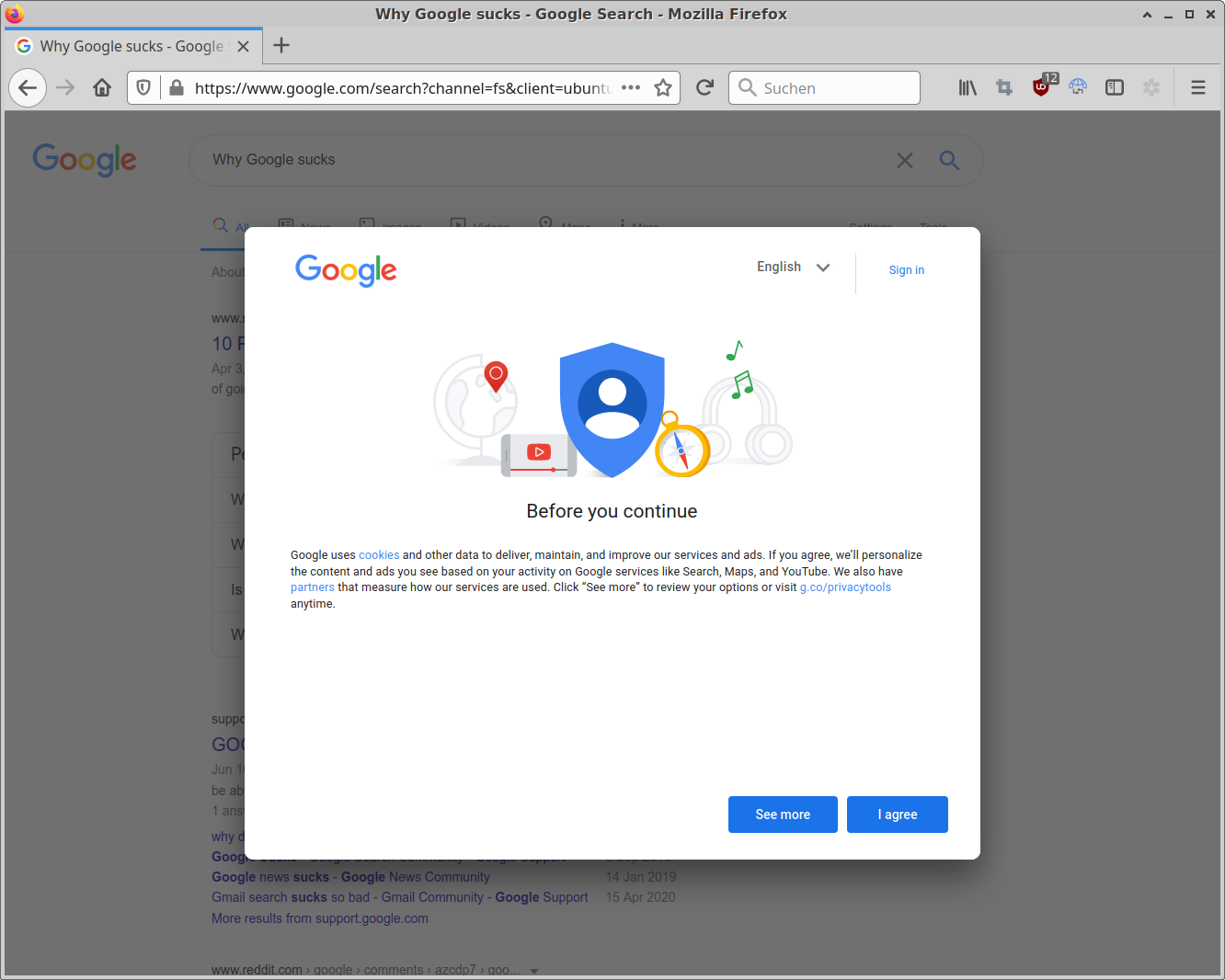

! Google - remove cookie-consent-popup and restore scroll functionality
google.*##.wwYr3.aID8W.bErdLd
google.*##.aID8W.m114nf.t7xA6
google.*##div[jsname][jsaction^="dg_close"]
google.*##html:style(overflow: visible !important;)
google.*##.widget-consent-fullscreen.widget-consent

15 September 2020

Rapha&#235;l Hertzog: Freexian s report about Debian Long Term Support, August 2020

A Debian LTS logo Like each month, here comes a report about the work of paid contributors to Debian LTS. Individual reports In August, 237.25 work hours have been dispatched among 14 paid contributors. Their reports are available: Evolution of the situation August was a regular LTS month once again, even though it was only our 2nd month with Stretch LTS.
At the end of August some of us participated in DebConf 20 online where we held our monthly team meeting. A video is available.
As of now this video is also the only public resource about the LTS survey we held in July, though a written summary is expected to be released soon. The security tracker currently lists 56 packages with a known CVE and the dla-needed.txt file has 55 packages needing an update. Thanks to our sponsors Sponsors that recently joined are in bold.

No comment Liked this article? Click here. My blog is Flattr-enabled.

14 September 2020

Russ Allbery: Review: Who Do You Serve, Who Do You Protect?

Review: Who Do You Serve, Who Do You Protect?, edited by Maya Schenwar, et al.
Editor: Maya Schenwar
Editor: Joe Macar
Editor: Alana Yu-lan Price
Publisher: Haymarket Books
Copyright: June 2016
ISBN: 1-60846-684-1
Format: Kindle
Pages: 250
Who Do You Serve, Who Do You Protect? is an anthology of essays about policing in the United States. It's divided into two sections: one that enumerates ways that police are failing to serve or protect communities, and one that describes how communities are building resistance and alternatives. Haymarket Books (a progressive press in Chicago) has made it available for free in the aftermath of the George Floyd killing and resulting protests in the United States. I'm going to be a bit unfair to this book, so let me start by admitting that the mismatch between it and the book I was looking for is not entirely its fault. My primary goal was to orient myself in the discussion on the left about alternatives to policing. I also wanted to sample something from Haymarket Books; a free book was a good way to do that. I was hoping for a collection of short introductions to current lines of thinking that I could selectively follow in longer writing, and an essay collection seemed ideal for that. What I had not realized (which was my fault for not doing simple research) is that this is a compilation of articles previously published by Truthout, a non-profit progressive journalism site, in 2014 and 2015. The essays are a mix of reporting and opinion but lean towards reporting. The earliest pieces in this book date from shortly after the police killing of Michael Brown, when racist police violence was (again) reaching national white attention. The first half of the book is therefore devoted to providing evidence of police abuse and violence. This is important to do, but it's sadly no longer as revelatory in 2020, when most of us have seen similar things on video, as it was to white America in 2014. If you live in the United States today, while you may not be aware of the specific events described here, you're unlikely to be surprised that Detroit police paid off jailhouse informants to provide false testimony ("Ring of Snitches" by Aaron Miguel Cant ), or that Chicago police routinely use excessive deadly force with no consequences ("Amid Shootings, Chicago Police Department Upholds Culture of Impunity" by Sarah Macaraeg and Alison Flowers), or that there is a long history of police abuse and degradation of pregnant women ("Your Pregnancy May Subject You to Even More Law Enforcement Violence" by Victoria Law). There are about eight essays along those lines. Unfortunately, the people who excuse or disbelieve these stories are rarely willing to seek out new evidence, let alone read a book like this. That raises the question of intended audience for the catalog of horrors part of this book. The answer to that question may also be the publication date; in 2014, the base of evidence and example for discussion had not been fully constructed. This sort of reporting is also obviously relevant in the original publication context of web-based journalism, where people may encounter these accounts individually through social media or other news coverage. In 2020, they offer reinforcement and rhetorical evidence, but I'm dubious that the people who would benefit from this knowledge will ever see it in this form. Those of us who will are already sickened, angry, and depressed. My primary interest was therefore in the second half of the book: the section on how communities are building resistance and alternatives. This is where I'm going to be somewhat unfair because the state of that conversation may have been different in 2015 than it is now in 2020. But these essays were lacking the depth of analysis that I was looking for. There is a human tendency, when one becomes aware of an obvious wrong, to simply publicize the horrible thing that is happening and expect someone to do something about it. It's obviously and egregiously wrong, so if more people knew about it, certainly it would be stopped! That has happened repeatedly with racial violence in the United States. It's also part of the common (and school-taught) understanding of the Civil Rights movement in the 1960s: activists succeeded in getting the violence on the cover of newspapers and on television, people were shocked and appalled, and the backlash against the violence created political change. Putting aside the fact that this is too simplistic of a picture of the Civil Rights era, it's abundantly clear at this point in 2020 that publicizing racist and violent policing isn't going to stop it. We're going to have to do something more than draw attention to the problem. Deciding what to do requires political and social analysis, not just of the better world that we want to see but of how our current world can become that world. There is very little in that direction in this book. Who Do You Serve, Who Do You Protect? does not answer the question of its title beyond "not us" and "white supremacy." While those answers are not exactly wrong, they're also not pushing the analysis in the direction that I wanted to read. For example (and this is a long-standing pet peeve of mine in US political writing), it would be hard to tell from most of the essays in this book that any country besides the United States exists. One essay ("Killing Africa" by William C. Anderson) talks about colonialism and draws comparisons between police violence in the United States and international treatment of African and other majority-Black countries. One essay talks about US military behavior oversees ("Beyond Homan Square" by Adam Hudson). That's about it for international perspective. Notably, there is no analysis here of what other countries might be doing better. Police violence against out-groups is not unique to the United States. No one has entirely solved this problem, but versions of this problem have been handled with far more success than here. The US has a comparatively appalling record; many countries in the world, particularly among comparable liberal democracies in Europe, are doing far better on metrics of racial oppression by agents of the government and of law enforcement violence. And yet it's common to approach these problems as if we have to develop a solution de novo, rather than ask what other countries are doing differently and if we could do some of those things. The US has some unique challenges, both historical and with the nature of endemic violence in the country, so perhaps such an analysis would turn up too many US-specific factors to copy other people's solutions. But we need to do the analysis, not give up before we start. Novel solutions can lead to novel new problems; other countries have tested, working improvements that could provide a starting framework and some map of potential pitfalls. More fundamentally, only the last two essays of this book propose solutions more complex than "stop." The authors are very clear about what the police are doing, seem less interested in why, and are nearly silent on how to change it. I suspect I am largely in political agreement with most of the authors, but obviously a substantial portion of the country (let alone its power structures) is not, and therefore nothing is changing. Part of the project of ending police violence is understanding why the violence exists, picking apart the motives and potential fracture lines in the political forces supporting the status quo, and building a strategy to change the politics. That isn't even attempted here. For example, the "who do you serve?" question of the book's title is more interesting than the essays give it credit. Police are not a monolith. Why do Black people become police officers? What are their experiences? Are there police forces in the United States that are doing better than others? What makes them different? Why do police act with violence in the moment? What set of cultural expectations, training experiences, anxieties, and fears lead to that outcome? How do we change those factors? Or, to take another tack, why are police not held accountable even when there is substantial public outrage? What political coalition supports that immunity from consequences, what are its fault lines and internal frictions, and what portions of that coalition could be broken off, pealed away, or removed from power? To whom, institutionally, are police forces accountable? What public offices can aspiring candidates run for that would give them oversight capability? This varies wildly throughout the United States; political approaches that work in large cities may not work in small towns, or with county sheriffs, or with the FBI, or with prison guards. To treat these organizations as a monolith and their motives as uniform is bad political tactics. It gives up points of leverage. I thought the best essays of this collection were the last two. "Community Groups Work to Provide Emergency Medical Alternatives, Separate from Police," by Candice Bernd, is a profile of several local emergency response systems that divert emergency calls from the police to paramedics, mental health experts, or social workers. This is an idea that's now relatively mainstream, and it seems to be finding modest success where it has been tried. It's more of a harm mitigation strategy than an attempt to deal with the root problem, but we're going to need both. The last essay, "Building Community Safety" by Ejeris Dixon, is the only essay in this book that is pushing in the direction that I was hoping to read. Dixon describes building an alternative system that can intervene in violent situations without using the police. This is fascinating and I'm glad that I read it. It's also frustrating in context because Dixon's essay should be part of a discussion. Dixon describes spending years learning de-escalation techniques, doing hard work of community discussion and collective decision-making, and making deep investment in the skills required to handle violence without calling in a dangerous outside force. I greatly admire this approach (also common in parts of the anarchist community) and the people who are willing to commit to it. But it's an immense amount of work, and as Dixon points out, that work often falls on the people who are least able to afford it. Marginalized communities, for whom the police are often dangerous, are also likely to lack both time and energy to invest in this type of skill training. And many people simply will not do this work even if they do have the resources to do it. More fundamentally, this approach conflicts somewhat with division of labor. De-escalation and social work are both professional skills that require significant time and practice to hone, and as much as I too would love to live in a world where everyone knows how to do some amount of this work, I find it hard to imagine scaling this approach without trained professionals. The point of paying someone to do this work as their job is that the money frees up their time to focus on learning those skills at a level that is difficult to do in one's free time. But once you have an organized group of professionals who do this work, you have to find a way to keep them from falling prey to the problems that plague the police, which requires understanding the origins of those problems. And that's putting aside the question of how large the residual of dangerous crime that cannot be addressed through any form of de-escalation might be, and what organization we should use to address it. Dixon's essay is great; I wouldn't change anything about it. But I wanted to see the next essay engaging with Dixon's perspective and looking for weaknesses and scaling concerns, and then the next essay that attempts to shore up those weaknesses, and yet another essay that grapples with the challenging philosophical question of a government monopoly on force and how that can and should come into play in violent crime. And then essays on grass-roots organizing in the context of police reform or abolition, and on restorative justice, and on the experience of attempting police reform from the inside, and on how to support public defenders, and on the merits and weaknesses of focusing on electing reform-minded district attorneys. Unfortunately, none of those are here. Overall, Who Do You Serve, Who Do You Protect? was a disappointment. It was free, so I suppose I got what I paid for, and I may have had a different reaction if I read it in 2015. But if you're looking for a deep discussion on the trade-offs and challenges of stopping police violence in 2020, I don't think this is the place to start. Rating: 3 out of 10

9 September 2020

Reproducible Builds: Reproducible Builds in August 2020

Welcome to the August 2020 report from the Reproducible Builds project. In our monthly reports, we summarise the things that we have been up to over the past month. The motivation behind the Reproducible Builds effort is to ensure no flaws have been introduced from the original free software source code to the pre-compiled binaries we install on our systems. If you re interested in contributing to the project, please visit our main website.


This month, Jennifer Helsby launched a new reproduciblewheels.com website to address the lack of reproducibility of Python wheels. To quote Jennifer s accompanying explanatory blog post:
One hiccup we ve encountered in SecureDrop development is that not all Python wheels can be built reproducibly. We ship multiple (Python) projects in Debian packages, with Python dependencies included in those packages as wheels. In order for our Debian packages to be reproducible, we need that wheel build process to also be reproducible
Parallel to this, transparencylog.com was also launched, a service that verifies the contents of URLs against a publicly recorded cryptographic log. It keeps an append-only log of the cryptographic digests of all URLs it has seen. (GitHub repo) On 18th September, Bernhard M. Wiedemann will give a presentation in German, titled Wie reproducible builds Software sicherer machen ( How reproducible builds make software more secure ) at the Internet Security Digital Days 2020 conference.

Reproducible builds at DebConf20 There were a number of talks at the recent online-only DebConf20 conference on the topic of reproducible builds. Holger gave a talk titled Reproducing Bullseye in practice , focusing on independently verifying that the binaries distributed from ftp.debian.org are made from their claimed sources. It also served as a general update on the status of reproducible builds within Debian. The video (145 MB) and slides are available. There were also a number of other talks that involved Reproducible Builds too. For example, the Malayalam language mini-conference had a talk titled , ? ( I want to join Debian, what should I do? ) presented by Praveen Arimbrathodiyil, the Clojure Packaging Team BoF session led by Elana Hashman, as well as Where is Salsa CI right now? that was on the topic of Salsa, the collaborative development server that Debian uses to provide the necessary tools for package maintainers, packaging teams and so on. Jonathan Bustillos (Jathan) also gave a talk in Spanish titled Un camino verificable desde el origen hasta el binario ( A verifiable path from source to binary ). (Video, 88MB)

Development work After many years of development work, the compiler for the Rust programming language now generates reproducible binary code. This generated some general discussion on Reddit on the topic of reproducibility in general. Paul Spooren posted a request for comments to OpenWrt s openwrt-devel mailing list asking for clarification on when to raise the PKG_RELEASE identifier of a package. This is needed in order to successfully perform rebuilds in a reproducible builds context. In openSUSE, Bernhard M. Wiedemann published his monthly Reproducible Builds status update. Chris Lamb provided some comments and pointers on an upstream issue regarding the reproducibility of a Snap / SquashFS archive file. [ ]

Debian Holger Levsen identified that a large number of Debian .buildinfo build certificates have been tainted on the official Debian build servers, as these environments have files underneath the /usr/local/sbin directory [ ]. He also filed against bug for debrebuild after spotting that it can fail to download packages from snapshot.debian.org [ ]. This month, several issues were uncovered (or assisted) due to the efforts of reproducible builds. For instance, Debian bug #968710 was filed by Simon McVittie, which describes a problem with detached debug symbol files (required to generate a traceback) that is unlikely to have been discovered without reproducible builds. In addition, Jelmer Vernooij called attention that the new Debian Janitor tool is using the property of reproducibility (as well as diffoscope when applying archive-wide changes to Debian:
New merge proposals also include a link to the diffoscope diff between a vanilla build and the build with changes. Unfortunately these can be a bit noisy for packages that are not reproducible yet, due to the difference in build environment between the two builds. [ ]
56 reviews of Debian packages were added, 38 were updated and 24 were removed this month adding to our knowledge about identified issues. Specifically, Chris Lamb added and categorised the nondeterministic_version_generated_by_python_param and the lessc_nondeterministic_keys toolchain issues. [ ][ ] Holger Levsen sponsored Lukas Puehringer s upload of the python-securesystemslib pacage, which is a dependency of in-toto, a framework to secure the integrity of software supply chains. [ ] Lastly, Chris Lamb further refined his merge request against the debian-installer component to allow all arguments from sources.list files (such as [check-valid-until=no]) in order that we can test the reproducibility of the installer images on the Reproducible Builds own testing infrastructure and sent a ping to the team that maintains that code.

Upstream patches The Reproducible Builds project detects, dissects and attempts to fix as many currently-unreproducible packages as possible. We endeavour to send all of our patches upstream where appropriate. This month, we wrote a large number of these patches, including:

diffoscope diffoscope is our in-depth and content-aware diff utility that can not only locate and diagnose reproducibility issues, it provides human-readable diffs of all kinds. In August, Chris Lamb made the following changes to diffoscope, including preparing and uploading versions 155, 156, 157 and 158 to Debian:
  • New features:
    • Support extracting data of PGP signed data. (#214)
    • Try files named .pgp against pgpdump(1) to determine whether they are Pretty Good Privacy (PGP) files. (#211)
    • Support multiple options for all file extension matching. [ ]
  • Bug fixes:
    • Don t raise an exception when we encounter XML files with <!ENTITY> declarations inside the Document Type Definition (DTD), or when a DTD or entity references an external resource. (#212)
    • pgpdump(1) can successfully parse some binary files, so check that the parsed output contains something sensible before accepting it. [ ]
    • Temporarily drop gnumeric from the Debian build-dependencies as it has been removed from the testing distribution. (#968742)
    • Correctly use fallback_recognises to prevent matching .xsb binary XML files.
    • Correct identify signed PGP files as file(1) returns data . (#211)
  • Logging improvements:
    • Emit a message when ppudump version does not match our file header. [ ]
    • Don t use Python s repr(object) output in Calling external command messages. [ ]
    • Include the filename in the not identified by any comparator message. [ ]
  • Codebase improvements:
    • Bump Python requirement from 3.6 to 3.7. Most distributions are either shipping with Python 3.5 or 3.7, so supporting 3.6 is not only somewhat unnecessary but also cumbersome to test locally. [ ]
    • Drop some unused imports [ ], drop an unnecessary dictionary comprehensions [ ] and some unnecessary control flow [ ].
    • Correct typo of output in a comment. [ ]
  • Release process:
    • Move generation of debian/tests/control to an external script. [ ]
    • Add some URLs for the site that will appear on PyPI.org. [ ]
    • Update author and author email in setup.py for PyPI.org and similar. [ ]
  • Testsuite improvements:
    • Update PPU tests for compatibility with Free Pascal versions 3.2.0 or greater. (#968124)
    • Mark that our identification test for .ppu files requires ppudump version 3.2.0 or higher. [ ]
    • Add an assert_diff helper that loads and compares a fixture output. [ ][ ][ ][ ]
  • Misc:
In addition, Mattia Rizzolo documented in setup.py that diffoscope works with Python version 3.8 [ ] and Frazer Clews applied some Pylint suggestions [ ] and removed some deprecated methods [ ].

Website This month, Chris Lamb updated the main Reproducible Builds website and documentation to:
  • Clarify & fix a few entries on the who page [ ][ ] and ensure that images do not get to large on some viewports [ ].
  • Clarify use of a pronoun re. Conservancy. [ ]
  • Use View all our monthly reports over View all monthly reports . [ ]
  • Move a is a suffix out of the link target on the SOURCE_DATE_EPOCH age. [ ]
In addition, Javier Jard n added the freedesktop-sdk project [ ] and Kushal Das added SecureDrop project [ ] to our projects page. Lastly, Michael P hn added internationalisation and translation support with help from Hans-Christoph Steiner [ ].

Testing framework The Reproducible Builds project operate a Jenkins-based testing framework to power tests.reproducible-builds.org. This month, Holger Levsen made the following changes:
  • System health checks:
    • Improve explanation how the status and scores are calculated. [ ][ ]
    • Update and condense view of detected issues. [ ][ ]
    • Query the canonical configuration file to determine whether a job is disabled instead of duplicating/hardcoding this. [ ]
    • Detect several problems when updating the status of reporting-oriented metapackage sets. [ ]
    • Detect when diffoscope is not installable [ ] and failures in DNS resolution [ ].
  • Debian:
    • Update the URL to the Debian security team bug tracker s Git repository. [ ]
    • Reschedule the unstable and bullseye distributions often for the arm64 architecture. [ ]
    • Schedule buster less often for armhf. [ ][ ][ ]
    • Force the build of certain packages in the work-in-progress package rebuilder. [ ][ ]
    • Only update the stretch and buster base build images when necessary. [ ]
  • Other distributions:
    • For F-Droid, trigger jobs by commits, not by a timer. [ ]
    • Disable the Archlinux HTML page generation job as it has never worked. [ ]
    • Disable the alternative OpenWrt rebuilder jobs. [ ]
  • Misc;
Many other changes were made too, including:
  • Chris Lamb:
    • Use <pre> HTML tags when dumping fixed-width debugging data in the self-serve package scheduler. [ ]
  • Mattia Rizzolo:
  • Vagrant Cascadian:
    • Mark that the u-boot Universal Boot Loader should not build architecture independent packages on the arm64 architecture anymore. [ ]
Finally, build node maintenance was performed by Holger Levsen [ ], Mattia Rizzolo [ ][ ] and Vagrant Cascadian [ ][ ][ ][ ]

Mailing list On our mailing list this month, Leo Wandersleb sent a message to the list after he was wondering how to expand his WalletScrutiny.com project (which aims to improve the security of Bitcoin wallets) from Android wallets to also monitor Linux wallets as well:
If you think you know how to spread the word about reproducibility in the context of Bitcoin wallets through WalletScrutiny, your contributions are highly welcome on this PR [ ]
Julien Lepiller posted to the list linking to a blog post by Tavis Ormandy titled You don t need reproducible builds. Morten Linderud (foxboron) responded with a clear rebuttal that Tavis was only considering the narrow use-case of proprietary vendors and closed-source software. He additionally noted that the criticism that reproducible builds cannot prevent against backdoors being deliberately introduced into the upstream source ( bugdoors ) are decidedly (and deliberately) outside the scope of reproducible builds to begin with. Chris Lamb included the Reproducible Builds mailing list in a wider discussion regarding a tentative proposal to include .buildinfo files in .deb packages, adding his remarks regarding requiring a custom tool in order to determine whether generated build artifacts are identical in a reproducible context. [ ] Jonathan Bustillos (Jathan) posted a quick email to the list requesting whether there was a list of To do tasks in Reproducible Builds. Lastly, Chris Lamb responded at length to a query regarding the status of reproducible builds for Debian ISO or installation images. He noted that most of the technical work has been performed but there are at least four issues until they can be generally advertised as such . He pointed that the privacy-oriented Tails operation system, which is based directly on Debian, has had reproducible builds for a number of years now. [ ]

If you are interested in contributing to the Reproducible Builds project, please visit our Contribute page on our website. However, you can get in touch with us via:

Next.

Previous.