Niels Thykier: Making debputy: Writing declarative parsing logic
In this blog post, I will cover how debputy parses its manifest and the
conceptual improvements I did to make parsing of the manifest easier.
All instructions to debputy are provided via the debian/debputy.manifest file and
said manifest is written in the YAML format. After the YAML parser has read the
basic file structure, debputy does another pass over the data to extract the
information from the basic structure. As an example, the following YAML file:
would be transformed by the YAML parser into a structure resembling:
This structure is then what debputy does a pass on to translate this into
an even higher level format where the "install" part is translated into
an InstallRule.
In the original prototype of debputy, I would hand-write functions to extract
the data that should be transformed into the internal in-memory high level format.
However, it was quite tedious. Especially because I wanted to catch every possible
error condition and report "You are missing the required field X at Y" rather
than the opaque KeyError: X message that would have been the default.
Beyond being tedious, it was also quite error prone. As an example, in
debputy/0.1.4 I added support for the install rule and you should allegedly
have been able to add a dest-dir: or an as: inside it. Except I crewed up the
code and debputy was attempting to look up these keywords from a dict that
could never have them.
Hand-writing these parsers were so annoying that it demotivated me from making
manifest related changes to debputy simply because I did not want to code
the parsing logic. When I got this realization, I figured I had to solve this
problem better.
While reflecting on this, I also considered that I eventually wanted plugins
to be able to add vocabulary to the manifest. If the API was "provide a
callback to extract the details of whatever the user provided here", then the
result would be bad.
At this point, I remembered that I had seen a Python (PYPI) package where
you could give it a TypedDict and an arbitrary input (Sadly, I do not
remember the name). The package would then validate the said input against the
TypedDict. If the match was successful, you would get the result back
casted as the TypedDict. If the match was unsuccessful, the code would
raise an error for you. Conceptually, this seemed to be a good starting
point for where I wanted to be.
Then I looked a bit on the normalization requirement (point 3).
What is really going on here is that you have two "schemas" for the input.
One is what the programmer will see (the normalized form) and the other is
what the user can input (the manifest form). The problem is providing an
automatic normalization from the user input to the simplified programmer
structure. To expand a bit on the following example:
Given that install has the attributes source, sources, dest-dir,
as, into, and when, how exactly would you automatically normalize
"foo" (str) into source: "foo"? Even if the code filtered by "type" for these
attributes, you would end up with at least source, dest-dir, and as
as candidates. Turns out that TypedDict actually got this covered. But
the Python package was not going in this direction, so I parked it here and
started looking into doing my own.
At this point, I had a general idea of what I wanted. When defining an extension
to the manifest, the plugin would provide debputy with one or two
definitions of TypedDict. The first one would be the "parsed" or "target" format, which
would be the normalized form that plugin provider wanted to work on. For this
example, lets look at an earlier version of the install-examples rule:
In this form, the install-examples has two attributes - both are list of
strings. On the flip side, what the user can input would look something like
this:
The idea was that the plugin provider would use these two definitions to tell
debputy how to parse install-examples. Pseudo-registration code could
look something like:
This was my conceptual target and while the current actual API ended up being slightly different,
the core concept remains the same.
manifest-version: "0.1"
installations:
  - install:
      source: foo
      dest-dir: usr/bin
  "manifest-version": "0.1",
  "installations": [

       "install":
         "source": "foo",
         "dest-dir": "usr/bin",


  ]
So beyond me being unsatisfied with the current situation, it was also clear to me that I needed to come up with a better solution if I wanted externally provided plugins for debputy. To put a bit more perspective on what I expected from the end result:
- Most plugins would probably throw KeyError: X or ValueError style errors for quite a while. Worst case, they would end on my table because the user would have a hard time telling where debputy ends and where the plugins starts. "Best" case, I would teach debputy to say "This poor error message was brought to you by plugin foo. Go complain to them". Either way, it would be a bad user experience.
- This even assumes plugin providers would actually bother writing manifest parsing code. If it is that difficult, then just providing a custom file in debian might tempt plugin providers and that would undermine the idea of having the manifest be the sole input for debputy.
- It had to cover as many parsing errors as possible. An error case this code would handle for you, would be an error where I could ensure it sufficient degree of detail and context for the user.
- It should be type-safe / provide typing support such that IDEs/mypy could help you when you work on the parsed result.
- It had to support "normalization" of the input, such as
           # User provides
           - install: "foo"
           # Which is normalized into:
           - install:
               source: "foo"
4) It must be simple to tell  debputy  what input you expected.
# User provides
- install: "foo"
# Which is normalized into:
- install:
    source: "foo"
# Example input matching this typed dict.
#
#       "source": ["foo"]
#       "into": ["pkg"]
#
class InstallExamplesTargetFormat(TypedDict):
    # Which source files to install (dest-dir is fixed)
    sources: List[str]
    # Which package(s) that should have these files installed.
    into: NotRequired[List[str]]
# Example input matching this typed dict.
#
#       "source": "foo"
#       "into": "pkg"
#
#
class InstallExamplesManifestFormat(TypedDict):
    # Note that sources here is split into source (str) vs. sources (List[str])
    sources: NotRequired[List[str]]
    source: NotRequired[str]
    # We allow the user to write  into: foo  in addition to  into: [foo]
    into: Union[str, List[str]]
FullInstallExamplesManifestFormat = Union[
    InstallExamplesManifestFormat,
    List[str],
    str,
]
def _handler(
    normalized_form: InstallExamplesTargetFormat,
) -> InstallRule:
    ...  # Do something with the normalized form and return an InstallRule.
concept_debputy_api.add_install_rule(
  keyword="install-examples",
  target_form=InstallExamplesTargetFormat,
  manifest_form=FullInstallExamplesManifestFormat,
  handler=_handler,
)
From concept to basic implementation
Building this code is kind like swallowing an elephant. There was no way I would just sit down
and write it from one end to the other. So the first prototype of this did not have all the
features it has now.
Spoiler warning, these next couple of sections will contain some Python typing details.
When reading this, it might be helpful to know things such as Union[str, List[str]] being
the Python type for either a str (string) or a List[str] (list of strings). If typing
makes your head spin, these sections might less interesting for you.
To build this required a lot of playing around with Python's introspection and
typing APIs. My very first draft only had one "schema" (the normalized form) and
had the following features:
This basic form basically works for all types (assuming none of the types will have List[List[...]]).
The logic for determining when this rule is applicable is slightly more involved. My current code
is about 100 lines of Python code that would probably lose most of the casual readers.
For the interested, you are looking for _union_narrowing in declarative_parser.py
With this, when the manifest format had Union[str, List[str]] and the target format
had List[str] the generated parser would silently map a string into a list of strings
for the plugin provider.
But with that in place, I had covered the basics of what I needed to get started. I was
quite excited about this milestone of having my first keyword parsed without handwriting
the parser logic (at the expense of writing a more generic parse-generator framework).
This prototype did not take a long (I remember it being within a day) and worked surprisingly well though with some poor error messages here and there. Now came the first challenge, adding the manifest format schema plus relevant normalization rules. The very first normalization I did was transforming into: Union[str, List[str]] into into: List[str]. At that time, source was not a separate attribute. Instead, sources was a Union[str, List[str]], so it was the only normalization I needed for all my use-cases at the time. There are two problems when writing a normalization. First is determining what the "source" type is, what the target type is and how they relate. The second is providing a runtime rule for normalizing from the manifest format into the target format. Keeping it simple, the runtime normalizer for Union[str, List[str]] -> List[str] was written as:
- Read TypedDict.__required_attributes__ and TypedDict.__optional_attributes__ to determine which attributes where present and which were required. This was used for reporting errors when the input did not match.
- Read the types of the provided TypedDict, strip the Required / NotRequired markers and use basic isinstance checks based on the resulting type for str and List[str]. Again, used for reporting errors when the input did not match.
def normalize_into_list(x: Union[str, List[str]]) -> List[str]:
    return x if isinstance(x, list) else [x]
Adding the first parse hint
With the basic implementation done, I looked at what to do next. As mentioned, at the time
sources in the manifest format was Union[str, List[str]] and I considered to split
into a source: str and a sources: List[str] on the manifest side while keeping
the normalized form as sources: List[str]. I ended up committing to this change and
that meant I had to solve the problem getting my parser generator to understand the
situation:
There are two related problems to solve here:
The exciting thing is that you can put arbitrary details into the type field and read it
out again in your introspection code. Which meant, I could add "parse hints" into the type.
Some "quick" prototyping later (a day or so), I got the following to work:
Without me (as a plugin provider) writing a line of code, I can have debputy rename
or "merge" attributes from the manifest form into the normalized form. Obviously, this
required me (as the debputy maintainer) to write a lot code so other me and future
plugin providers did not have to write it.
# Map from
class InstallExamplesManifestFormat(TypedDict):
    # Note that sources here is split into source (str) vs. sources (List[str])
    sources: NotRequired[List[str]]
    source: NotRequired[str]
    # We allow the user to write  into: foo  in addition to  into: [foo]
    into: Union[str, List[str]]
# ... into
class InstallExamplesTargetFormat(TypedDict):
    # Which source files to install (dest-dir is fixed)
    sources: List[str]
    # Which package(s) that should have these files installed.
    into: NotRequired[List[str]]
While working on all of this type introspection for Python, I had noted the Annotated[X, ...] type. It is basically a fake type that enables you to attach metadata into the type system. A very random example:
- How will the parser generator understand that source should be normalized and then mapped into sources?
- Once that is solved, the parser generator has to understand that while source and sources are declared as NotRequired, they are part of a exactly one of rule (since sources in the target form is Required). This mainly came down to extra book keeping and an extra layer of validation once the previous step is solved.
# For all intents and purposes,  foo  is a string despite all the  Annotated  stuff.
foo: Annotated[str, "hello world"] = "my string here"
# Map from
#
#        "source": "foo"  # (or "sources": ["foo"])
#        "into": "pkg"
#
class InstallExamplesManifestFormat(TypedDict):
    # Note that sources here is split into source (str) vs. sources (List[str])
    sources: NotRequired[List[str]]
    source: NotRequired[
        Annotated[
            str,
            DebputyParseHint.target_attribute("sources")
        ]
    ]
    # We allow the user to write  into: foo  in addition to  into: [foo]
    into: Union[str, List[str]]
# ... into
#
#        "source": ["foo"]
#        "into": ["pkg"]
#
class InstallExamplesTargetFormat(TypedDict):
    # Which source files to install (dest-dir is fixed)
    sources: List[str]
    # Which package(s) that should have these files installed.
    into: NotRequired[List[str]]
High level typing
At this point, basic normalization between one mapping to another mapping form worked.
But one thing irked me with these install rules. The into was a list of strings
when the parser handed them over to me. However, I needed to map them to the actual
BinaryPackage (for technical reasons). While I felt I was careful with my manual
mapping, I knew this was exactly the kind of case where a busy programmer would skip
the "is this a known package name" check and some user would typo their package
resulting in an opaque KeyError: foo.
Side note: "Some user" was me today and I was super glad to see debputy tell me
that I had typoed a package name (I would have been more happy if I had remembered to
use debputy check-manifest, so I did not have to wait through the upstream part
of the build that happened before debhelper passed control to debputy...)
I thought adding this feature would be simple enough. It basically needs two things:
Code-wise, I still had to check for into being absent and providing a default for that
case (that is still true in the current codebase - I will hopefully fix that eventually). But
I now had less room for mistakes and a standardized error message when you misspell the package
name, which was a plus.
It was not super difficult given the existing infrastructure, but it did take some hours of coding and debugging. Additionally, I added a parse hint to support making the into conditional based on whether it was a single binary package. With this done, you could now write something like:
- Conversion table where the parser generator can tell that BinaryPackage requires an input of str and a callback to map from str to BinaryPackage. (That is probably lie. I think the conversion table came later, but honestly I do remember and I am not digging into the git history for this one)
- At runtime, said callback needed access to the list of known packages, so it could resolve the provided string.
# Map from
class InstallExamplesManifestFormat(TypedDict):
    # Note that sources here is split into source (str) vs. sources (List[str])
    sources: NotRequired[List[str]]
    source: NotRequired[
        Annotated[
            str,
            DebputyParseHint.target_attribute("sources")
        ]
    ]
    # We allow the user to write  into: foo  in addition to  into: [foo]
    into: Union[BinaryPackage, List[BinaryPackage]]
# ... into
class InstallExamplesTargetFormat(TypedDict):
    # Which source files to install (dest-dir is fixed)
    sources: List[str]
    # Which package(s) that should have these files installed.
    into: NotRequired[
        Annotated[
            List[BinaryPackage],
            DebputyParseHint.required_when_multi_binary()
        ]
    ]
The added side-effect - Introspection
A lovely side-effect of all the parsing logic being provided to debputy in a declarative
form was that the generated parser snippets had fields containing all expected attributes
with their types, which attributes were required, etc. This meant that adding an
introspection feature where you can ask debputy "What does an install rule look like?"
was quite easy. The code base already knew all of this, so the "hard" part was resolving the
input the to concrete rule and then rendering it to the user.
I added this feature recently along with the ability to provide online documentation for
parser rules. I covered that in more details in my blog post
Providing online reference documentation for debputy
in case you are interested. :)
Wrapping it up
This was a short insight into how debputy parses your input. With this declarative
technique:
In this way everybody wins. Yes, writing this parser generator code was more enjoyable than writing the ad-hoc manual parsers it replaced. :)
- The parser engine handles most of the error reporting meaning users get most of the errors in a standard format without the plugin provider having to spend any effort on it. There will be some effort in more complex cases. But the common cases are done for you.
- It is easy to provide flexibility to users while avoiding having to write code to normalize the user input into a simplified programmer oriented format.
- The parser handles mapping from basic types into higher forms for you. These days, we have high level types like FileSystemMode (either an octal or a symbolic mode), different kind of file system matches depending on whether globs should be performed, etc. These types includes their own validation and parsing rules that debputy handles for you.
- Introspection and support for providing online reference documentation. Also, debputy checks that the provided attribute documentation covers all the attributes in the manifest form. If you add a new attribute, debputy will remind you if you forget to document it as well. :)


 I can t actually think of a meme with this GIF, that the internal
 In 2022 I read a post on the fediverse by somebody who mentioned that
they had bought on a whim a cute tiny book years ago, and that it
had been a companion through hard times. Right now I can t find the
post, but it was pretty aaaaawwww.
 At the same time, I had discovered Coptic binding, and I wanted to do
some exercise to let my hands learn it, but apparently there is a limit
to the number of notebooks and sketchbooks a person needs (I m not 100%
sure I actually believe this, but I ve heard it is a thing).
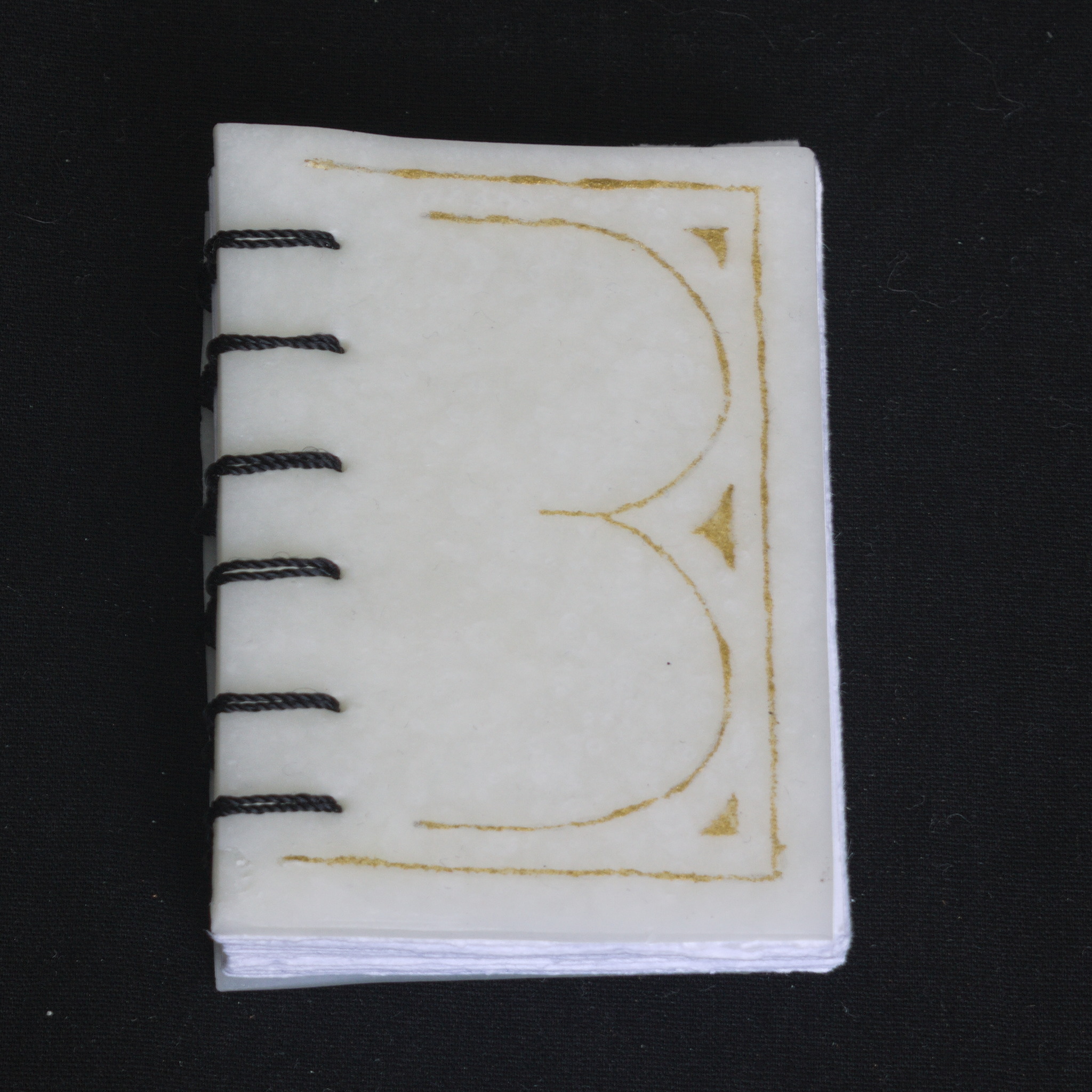 So I decided to start making minibooks with the intent to give them
away: I settled (mostly) on the A8 size, and used a combination of found
materials, leftovers from bigger projects and things I had in the Stash.
As for paper, I ve used a variety of the ones I have that are at the
very least good enough for non-problematic fountain pen inks.
 Thanks to the small size, and the way coptic binding works, I ve been
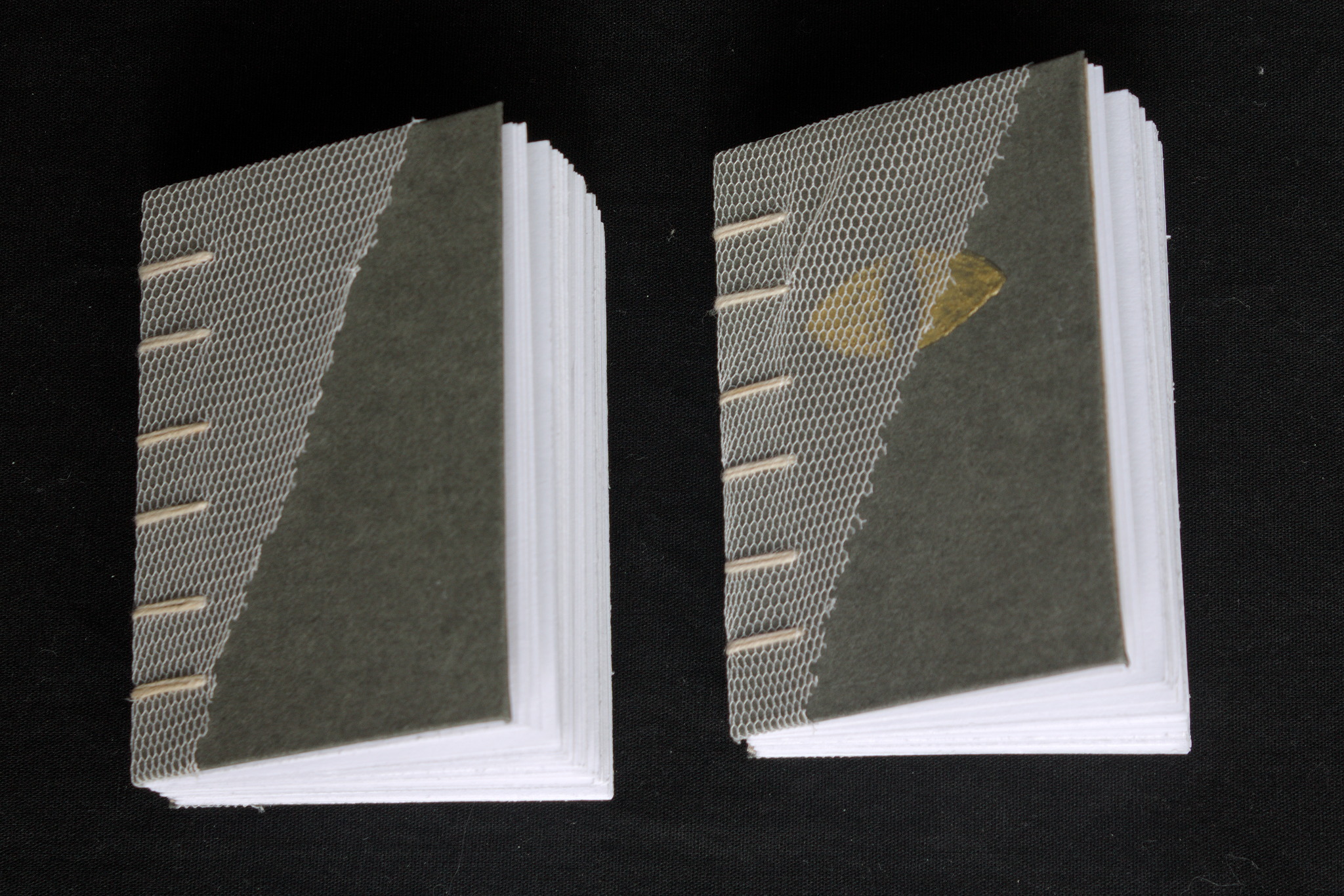
able to play around with the covers, experimenting with different styles
beyond the classic bookbinding cloth / paper covered cardboard,
including adding lace, covering food box cardboard with gesso and
decorating it with acrylic paints, embossing designs by gluing together
two layers of cardboard, one of which has holes, making covers
completely out of cernit, etc. Some of these I will probably also use in
future full-scale projects, but it s nice to find out what works and
what doesn t on a small scale.
 Now, after a year of sporadically making these I have to say that the
making went quite well: I enjoyed the making and the creativity in
making different covers. The giving away was a bit more problematic, as
I didn t really have a lot of chances to do so, so I believe I still
have most of them. In 2024 I ll try to look for more opportunities (and
if you live nearby and want one or a few feel free to ask!)

 Like each month, have a look at the work funded by
 I think while developing Wayland-as-an-ecosystem we are now entrenched into narrow concepts of how a desktop should work. While discussing Wayland protocol additions, a lot of concepts clash, people from different desktops with different design philosophies debate the merits of those over and over again never reaching any conclusion (just as you will never get an answer out of humans whether sushi or pizza is the clearly superior food, or whether CSD or SSD is better). Some people want to use Wayland as a vehicle to force applications to submit to their desktop s design philosophies, others prefer the smallest and leanest protocol possible, other developers want the most elegant behavior possible. To be clear, I think those are all very valid approaches.
But this also creates problems: By switching to Wayland compositors, we are already forcing a lot of porting work onto toolkit developers and application developers. This is annoying, but just work that has to be done. It becomes frustrating though if Wayland provides toolkits with absolutely no way to reach their goal in any reasonable way. For Nate s Photoshop analogy: Of course Linux does not break Photoshop, it is Adobe s responsibility to port it. But what if Linux was missing a crucial syscall that Photoshop needed for proper functionality and Adobe couldn t port it without that? In that case it becomes much less clear on who is to blame for Photoshop not being available.
A lot of Wayland protocol work is focused on the environment and design, while applications and work to port them often is considered less. I think this happens because the overlap between application developers and developers of the desktop environments is not necessarily large, and the overlap with people willing to engage with Wayland upstream is even smaller. The combination of Windows developers porting apps to Linux and having involvement with toolkits or Wayland is pretty much nonexistent. So they have less of a voice.
 I will also bring my two protocol MRs to their conclusion for sure, because as application developers we need clarity on what the platform (either all desktops or even just a few) supports and will or will not support in future. And the only way to get something good done is by contribution and friendly discussion.



















































 CW for body size change mentions
I needed a corset, badly.
Years ago I had a chance to have my measurements taken by a former
professional corset maker and then a lesson in how to draft an underbust
corset, and that lead to me learning how nice wearing a well-fitted
corset feels.
Later I tried to extend that pattern up for a midbust corset, with
success.
And then my body changed suddenly, and I was no longer able to wear
either of those, and after a while I started missing them.
Since my body was still changing (if no longer drastically so), and I
didn t want to use expensive materials for something that had a risk of
not fitting after too little time, I decided to start by making myself a
summer lightweight corset in aida cloth and plastic boning (for which I
had already bought materials). It fitted, but not as well as the first
two ones, and I ve worn it quite a bit.
I still wanted back the feeling of wearing a comfy, heavy contraption of
coutil and steel, however.
After a lot of procrastination I redrafted a new pattern, scrapped
everything, tried again, had my measurements taken by a dressmaker
[#dressmaker], put them in the draft, cut a first mock-up in cheap
cotton, fixed the position of a seam, did a second mock-up in denim
[#jeans] from an old pair of jeans, and then cut into the cheap
herringbone coutil I was planning to use.
And that s when I went to see which one of the busks in my stash would
work, and realized that I had used a wrong vertical measurement and the
front of the corset was way too long for a midbust corset.
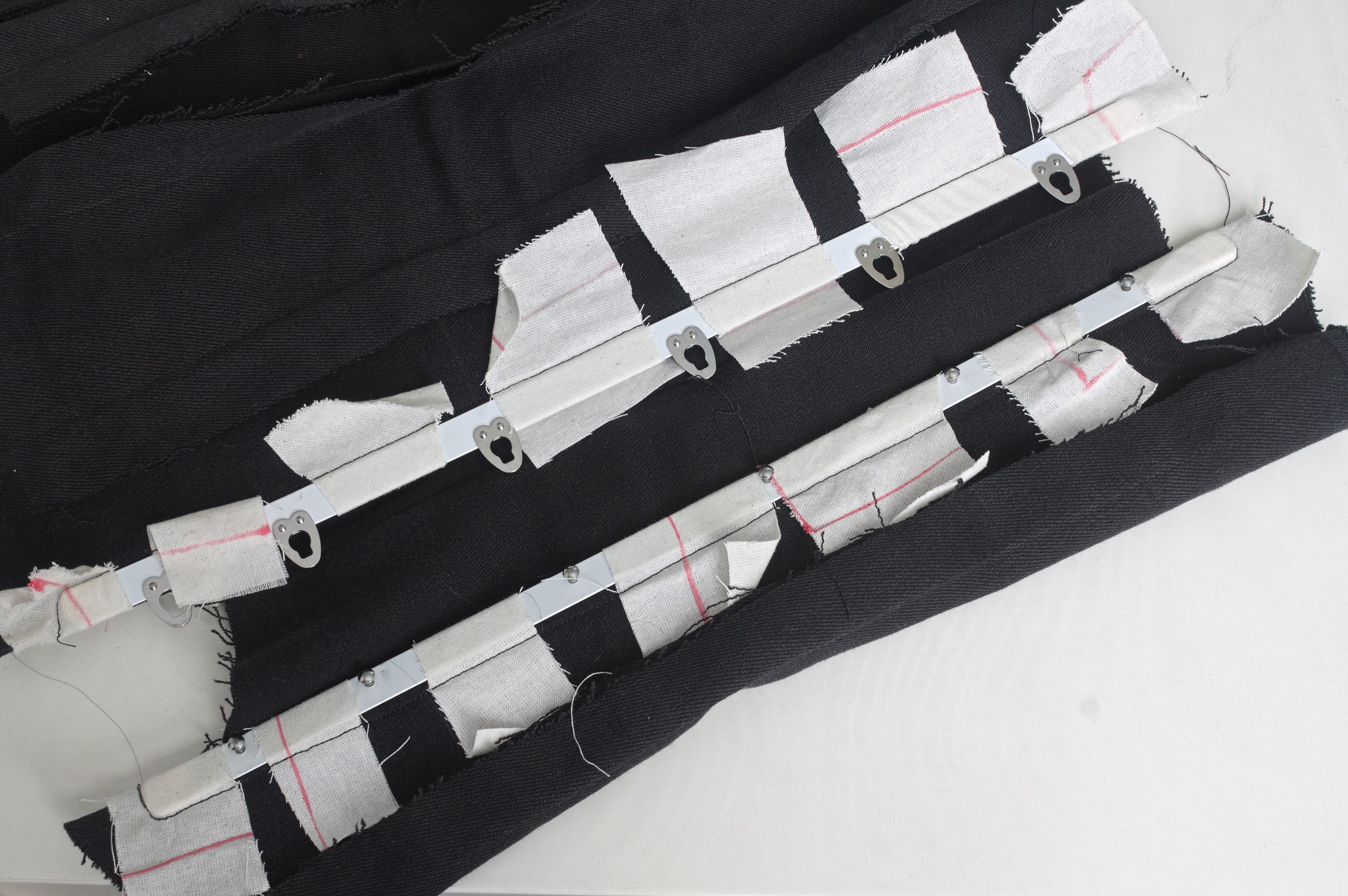 Luckily I also had a few longer busks, I basted one to the denim mock up
and tried to wear it for a few hours, to see if it was too long to be
comfortable. It was just a bit, on the bottom, which could be easily
fixed with the Power Tools
 I could have been a bit more precise with the binding, as it doesn t
align precisely at the front edge, but then again, it s underwear,
nobody other than me and everybody who reads this post is going to see
it and I was in a hurry to see it finished. I will be more careful with
the next one.
 I also think that I haven t been careful enough when pressing the seams
and applying the tape, and I ve lost about a cm of width per part, so
I m using a lacing gap that is a bit wider than I planned for, but that
may change as the corset gets worn, and is still within tolerance.
Also, on the morning after I had finished the corset I woke up and
realized that I had forgotten to add garter tabs at the bottom edge.
I don t know whether I will ever use them, but I wanted the option, so
maybe I ll try to add them later on, especially if I can do it without
undoing the binding.
The next step would have been flossing, which I proceeded to postpone
until I ve worn the corset for a while: not because there is any reason
for it, but because I still don t know how I want to do it :)
What was left was finishing and uploading the
 For the purposes of what I m trying to fix, there are two paths that matter.


 Debian Public Statement about the EU Cyber Resilience Act and the Product Liability Directive
The European Union is currently preparing a regulation "on horizontal
cybersecurity requirements for products with digital elements" known as the
Cyber Resilience Act (CRA). It is currently in the final "trilogue" phase of
the legislative process. The act includes a set of essential cybersecurity and
vulnerability handling requirements for manufacturers. It will require products
to be accompanied by information and instructions to the user. Manufacturers
will need to perform risk assessments and produce technical documentation and,
for critical components, have third-party audits conducted. Discovered security
issues will have to be reported to European authorities within 25 hours (1).
The CRA will be followed up by the Product Liability Directive (PLD) which will
introduce compulsory liability for software.
While a lot of these regulations seem reasonable, the Debian project believes
that there are grave problems for Free Software projects attached to them.
Therefore, the Debian project issues the following statement:
 The Emacs part is superceded by
 This post describes how I m using