Search Results: "az"

1 June 2023

Paul Wise: FLOSS Activities May 2023

Focus This month I didn't have any particular focus. I just worked on issues in my info bubble.

Changes

Issues

Review

Administration
  • Debian IRC: set topic on new #debian-sa channel
  • Debian wiki: unblock IP addresses, approve accounts

Communication
  • Respond to queries from Debian users and contributors on the mailing lists and IRC

Sponsors The SIMDe, gensim, sptag work was sponsored. All other work was done on a volunteer basis.

31 May 2023

Russell Coker: Links May 2023

Petter Reinholdtsen wrote an interesting blog post about their work on packaging speech to text for Debian [1]. The work of the Debian Deep Learning Team seems really interesting and I look forward to playing with this sort of thing after the release of Bookworm (the packages in question will NOT go in Bookworm but I ll run at least one system on Testing after Bookworm). It would be nice to get more information on the hardware used for running such programs, the minimum hardware needed for real-time speech to text would be interesting to know. Brian Krebs wrote an informative article about attacks involving supply chain compromise and fake LinkedIn profiles [2]. The attacks targetted Linux as well as Windows. Interesting video about the Illium cameras, a bit harsh though, they criticise Illium devices for being too low resolution, too expensive, and taking too much CPU time to process [3]. The Illium cameras still sell for decent prices on eBay, I wonder if it s because of curious people like me who would like to play with them and have money to spare or whether some other interesting things are being done. I wonder how a 4*4 array of the rectangular cameras secured together with duct tape would go. The ideas of Illium should work better if implemented for multi-core CPUs or GPUs. Bruce Schneier with Henry Farrell and Nathan Sanders wrote an insightful blog post about how AT Chatbots could improve democracy [4]. Wired has an interesting article about the way DJI drones transmit the location of the drone operator without encryption by design [5]. Apparently this has been used for targetting attacks on drone operators in Ukraine. This video about robot mice navigating mazes is interesting [6]. But I think it became less interesting when they got to the stage of milliseconds counting for the win, it s very optimised for one case just like F1. I think it would be interesting if they had a rally contest where they go across grass or sand, 3D mazes both in air and water, and contests where Tungsten weights have to be transported. They should push some of the other limits of engineering as completing a maze quickly has been solved. The Guardian has an interesting article about a blood test for sleepy driving [7]. Once they have an objective test they can punish people for it. This github repository listing public APIs is interesting [8]. Lots of fun ideas for phone apps there. Simon Josefsson wrote an insightful blog post about the threat model of security devices [9]. Unfortunately the security of most people is way below the level where this is an issue. But it s good to think about future steps needed for good security. Cory Doctorow wrote an interesting article The Swivel Eyed Loons have a Point [10] about the fact that some of the nuttiest people are protesting about real issues, just in the wrong way.

Russ Allbery: Review: Night Watch

Review: Night Watch, by Terry Pratchett
Series: Discworld #29
Publisher: Harper
Copyright: November 2002
Printing: August 2014
ISBN: 0-06-230740-1
Format: Mass market
Pages: 451
Night Watch is the 29th Discworld novel and the sixth Watch novel. I would really like to tell people they could start here if they wanted to, for reasons that I will get into in a moment, but I think I would be doing you a disservice. The emotional heft added by having read the previous Watch novels and followed Vimes's character evolution is significant. It's the 25th of May. Vimes is about to become a father. He and several of the other members of the Watch are wearing sprigs of lilac for reasons that Sergeant Colon is quite vehemently uninterested in explaining. A serial killer named Carcer the Watch has been after for weeks has just murdered an off-duty sergeant. It's a tense and awkward sort of day and Vimes is feeling weird and wistful, remembering the days when he was a copper and not a manager who has to dress up in ceremonial armor and meet with committees. That may be part of why, when the message comes over the clacks that the Watch have Carcer cornered on the roof of the New Hall of the Unseen University, Vimes responds in person. He's grappling with Carcer on the roof of the University Library in the middle of a magical storm when lightning strikes. When he wakes up, he's in the past, shortly after he joined the Watch and shortly before the events of the 25th of May that the older Watch members so vividly remember and don't talk about. I have been saying recently in Discworld reviews that it felt like Pratchett was on the verge of a breakout book that's head and shoulders above Discworld prior to that point. This is it. This is that book. The setup here is masterful: the sprigs of lilac that slowly tell the reader something is going on, the refusal of any of the older Watch members to talk about it, the scene in the graveyard to establish the stakes, the disconcerting fact that Vetinari is wearing a sprig of lilac as well, and the feeling of building tension that matches the growing electrical storm. And Pratchett never gives into the temptation to explain everything and tip his hand prematurely. We know the 25th is coming and something is going to happen, and the reader can put together hints from Vimes's thoughts, but Pratchett lets us guess and sometimes be right and sometimes be wrong. Vimes is trying to change history, which adds another layer of uncertainty and enjoyment as the reader tries to piece together both the true history and the changes. This is a masterful job at a "what if?" story. And, beneath that, the commentary on policing and government and ethics is astonishingly good. In a review of an earlier Watch novel, I compared Pratchett to Dickens in the way that he focuses on a sort of common-sense morality rather than political theory. That is true here too, but oh that moral analysis is sharp enough to slide into you like a knife. This is not the Vimes that we first met in Guards! Guards!. He has has turned his cynical stubbornness into a working theory of policing, and it's subtle and complicated and full of nuance that he only barely knows how to explain. But he knows how to show it to people.
Keep the peace. That was the thing. People often failed to understand what that meant. You'd go to some life-threatening disturbance like a couple of neighbors scrapping in the street over who owned the hedge between their properties, and they'd both be bursting with aggrieved self-righteousness, both yelling, their wives would either be having a private scrap on the side or would have adjourned to a kitchen for a shared pot of tea and a chat, and they all expected you to sort it out. And they could never understand that it wasn't your job. Sorting it out was a job for a good surveyor and a couple of lawyers, maybe. Your job was to quell the impulse to bang their stupid fat heads together, to ignore the affronted speeches of dodgy self-justification, to get them to stop shouting and to get them off the street. Once that had been achieved, your job was over. You weren't some walking god, dispensing finely tuned natural justice. Your job was simply to bring back peace.
When Vimes is thrown back in time, he has to pick up the role of his own mentor, the person who taught him what policing should be like. His younger self is right there, watching everything he does, and he's desperately afraid he'll screw it up and set a worse example. Make history worse when he's trying to make it better. It's a beautifully well-done bit of tension that uses time travel as the hook to show both how difficult mentorship is and also how irritating one's earlier naive self would be.
He wondered if it was at all possible to give this idiot some lessons in basic politics. That was always the dream, wasn't it? "I wish I'd known then what I know now"? But when you got older you found out that you now wasn't you then. You then was a twerp. You then was what you had to be to start out on the rocky road of becoming you now, and one of the rocky patches on that road was being a twerp.
The backdrop of this story, as advertised by the map at the front of the book, is a revolution of sorts. And the revolution does matter, but not in the obvious way. It creates space and circumstance for some other things to happen that are all about the abuse of policing as a tool of politics rather than Vimes's principle of keeping the peace. I mentioned when reviewing Men at Arms that it was an awkward book to read in the United States in 2020. This book tackles the ethics of policing head-on, in exactly the way that book didn't. It's also a marvelous bit of competence porn. Somehow over the years, Vimes has become extremely good at what he does, and not just in the obvious cop-walking-a-beat sort of ways. He's become a leader. It's not something he thinks about, even when thrown back in time, but it's something Pratchett can show the reader directly, and have the other characters in the book comment on. There is so much more that I'd like to say, but so much would be spoilers, and I think Night Watch is more effective when you have the suspense of slowly puzzling out what's going to happen. Pratchett's pacing is exquisite. It's also one of the rare Discworld novels where Pratchett fully commits to a point of view and lets Vimes tell the story. There are a few interludes with other people, but the only other significant protagonist is, quite fittingly, Vetinari. I won't say anything more about that except to note that the relationship between Vimes and Vetinari is one of the best bits of fascinating subtlety in all of Discworld. I think it's also telling that nothing about Night Watch reads as parody. Sure, there is a nod to Back to the Future in the lightning storm, and it's impossible to write a book about police and street revolutions without making the reader think about Les Miserables, but nothing about this plot matches either of those stories. This is Pratchett telling his own story in his own world, unapologetically, and without trying to wedge it into parody shape, and it is so much the better book for it. The one quibble I have with the book is that the bits with the Time Monks don't really work. Lu-Tze is annoying and flippant given the emotional stakes of this story, the interludes with him are frustrating and out of step with the rest of the book, and the time travel hand-waving doesn't add much. I see structurally why Pratchett put this in: it gives Vimes (and the reader) a time frame and a deadline, it establishes some of the ground rules and stakes, and it provides a couple of important opportunities for exposition so that the reader doesn't get lost. But it's not good story. The rest of the book is so amazingly good, though, that it doesn't matter (and the framing stories for "what if?" explorations almost never make much sense). The other thing I have a bit of a quibble with is outside the book. Night Watch, as you may have guessed by now, is the origin of the May 25th Pratchett memes that you will be familiar with if you've spent much time around SFF fandom. But this book is dramatically different from what I was expecting based on the memes. You will, for example see a lot of people posting "Truth, Justice, Freedom, Reasonably Priced Love, And a Hard-Boiled Egg!", and before reading the book it sounds like a Pratchett-style humorous revolutionary slogan. And I guess it is, sort of, but, well... I have to quote the scene:
"You'd like Freedom, Truth, and Justice, wouldn't you, Comrade Sergeant?" said Reg encouragingly. "I'd like a hard-boiled egg," said Vimes, shaking the match out. There was some nervous laughter, but Reg looked offended. "In the circumstances, Sergeant, I think we should set our sights a little higher " "Well, yes, we could," said Vimes, coming down the steps. He glanced at the sheets of papers in front of Reg. The man cared. He really did. And he was serious. He really was. "But...well, Reg, tomorrow the sun will come up again, and I'm pretty sure that whatever happens we won't have found Freedom, and there won't be a whole lot of Justice, and I'm damn sure we won't have found Truth. But it's just possible that I might get a hard-boiled egg."
I think I'm feeling defensive of the heart of this book because it's such an emotional gut punch and says such complicated and nuanced things about politics and ethics (and such deeply cynical things about revolution). But I think if I were to try to represent this story in a meme, it would be the "angels rise up" song, with all the layers of meaning that it gains in this story. I'm still at the point where the lilac sprigs remind me of Sergeant Colon becoming quietly furious at the overstep of someone who wasn't there. There's one other thing I want to say about that scene: I'm not naturally on Vimes's side of this argument. I think it's important to note that Vimes's attitude throughout this book is profoundly, deeply conservative. The hard-boiled egg captures that perfectly: it's a bit of physical comfort, something you can buy or make, something that's part of the day-to-day wheels of the city that Vimes talks about elsewhere in Night Watch. It's a rejection of revolution, something that Vimes does elsewhere far more explicitly. Vimes is a cop. He is in some profound sense a defender of the status quo. He doesn't believe things are going to fundamentally change, and it's not clear he would want them to if they did. And yet. And yet, this is where Pratchett's Dickensian morality comes out. Vimes is a conservative at heart. He's grumpy and cynical and jaded and he doesn't like change. But if you put him in a situation where people are being hurt, he will break every rule and twist every principle to stop it.
He wanted to go home. He wanted it so much that he trembled at the thought. But if the price of that was selling good men to the night, if the price was filling those graves, if the price was not fighting with every trick he knew... then it was too high. It wasn't a decision that he was making, he knew. It was happening far below the areas of the brain that made decisions. It was something built in. There was no universe, anywhere, where a Sam Vimes would give in on this, because if he did then he wouldn't be Sam Vimes any more.
This is truly exceptional stuff. It is the best Discworld novel I have read, by far. I feel like this was the Watch novel that Pratchett was always trying to write, and he had to write five other novels first to figure out how to write it. And maybe to prepare Discworld readers to read it. There are a lot of Discworld novels that are great on their own merits, but also it is 100% worth reading all the Watch novels just so that you can read this book. Followed in publication order by The Wee Free Men and later, thematically, by Thud!. Rating: 10 out of 10

29 May 2023

Russ Allbery: Book haul

I think this is partial because I also have a stack of other books that I missed recording. At some point, I should stop using this method to track book acquisitions in favor of one of the many programs intended for this purpose, but it's in the long list of other things I really should do one of these days. As usual, I have already read and reviewed a few of these. I might be getting marginally better at reading books shortly after I acquire them? Maybe? Steven Brust Tsalmoth (sff)
C.L. Clark The Faithless (sff)
Oliver Darkshire Once Upon a Tome (non-fiction)
Hernan Diaz Trust (mainstream)
S.B. Divya Meru (sff)
Kate Elliott Furious Heaven (sff)
Steven Flavall Before We Go Live (non-fiction)
R.F. Kuang Babel (sff)
Laurie Marks Dancing Jack (sff)
Arkady Martine Rose/House (sff)
Madeline Miller Circe (sff)
Jenny Odell Saving Time (non-fiction)
Malka Older The Mimicking of Known Successes (sff)
Sabaa Tahir An Ember in the Ashes (sff)
Emily Tesh Some Desperate Glory (sff)
Valerie Valdes Chilling Effect (sff)

23 May 2023

Jonathan Dowland: neovim plugins and distributions

I've been watching the neovim community for a while and what seems like a cambrian explosion of plugins emerging. A few weeks back I decided to spend most of a "day of learning" on investigating some of the plugins and technologies that I'd read about: Language Server Protocol, TreeSitter, neorg (a grandiose organiser plugin), etc. It didn't go so well. I spent most of my time fighting version incompatibilities or tracing through scant documentation or code to figure out what plugin was incompatible with which other. There's definitely a line where crossing it is spending too much time playing with your tools instead of creating. On the other hand, there's definitely value in honing your tools and learning about new technologies. Everyone's line is probably in a different place. I've come to the conclusion that I don't have the time or inclination (or both) to approach exploring the neovim universe in this way. There exist a number of plugin "distributions" (such as LunarVim): collections of pre- configured and integrated plugins that you can try to use out-of-the-box. Next time I think I'll pick one up and give that a try &emdash independently from my existing configuration &emdash and see which ideas from it I might like to adopt. shared vimrcs Some folks upload their vim or neovim configurations in their entirety for others to see. I noticed Jess Frazelle had published hers so I took a look. I suppose one could evaluate a bunch of plugins and configuration in isolation using a shared vimrc like this, in the same was as a distribution. bufferline Amongst the plugins she uses was bufferline, a plugin to re-work neovim's tab bar to behave like tab bars from more conventional editors1. I don't make use of neovim's tabs at all2, so I would lose nothing having the (presently hidden) tab bar reworked, so I thought I'd give it a go. I had to disable an existing plugin lightline, which I've had enabled for years but I wasn't sure I was getting much value from. Apparently it also messes with the tab bar! Disabling it, at least for now, at least means I'll find out if I miss it. I am already using vim-buffergator as a means of seeing and managing open buffers: a hotkey opens a sidebar with a list of open buffers, to switch between or close. Bufferline gives me a more immediate, always-present view of open buffers, which is faintly useful: but not much. Perhaps I'd like it more if I was coming from an editor that had made it more of an expected feature. The two things I noticed about it that aren't especially useful for me: when browsing around vimwiki pages, I quickly open a lot of buffers. The horizontal line fills up very quickly. Even when I don't, I habitually have quite a lot of buffers open, and the horizontal line is quickly overwhelmed. I have found myself closing open buffers with the mouse, which I didn't do before. vert Since I have brought up a neovim UI feature (tabs) I thought I'd briefly mention my new favourite neovim built-in command: vert. Quite a few plugins and commands open up a new window (e.g. git-fugitive, Man, etc.) and they typically do so in a horizontal split. I'm increasingly preferring vertical splits. Prefixing any3 such command with vert forces the split to be vertical instead.

  1. in this case the direct influence was apparently DOOM Emacs
  2. (neo)vim's notion of tabs is completely different to what you might expect from other UI models.
  3. at least, I haven't found one that doesn't work yet

18 May 2023

Antoine Beaupr : A terrible Pixel Tablet

In a strange twist of history, Google finally woke and thought "I know what we need to do! We need to make a TABLET!". So some time soon in 2023, Google will release "The tablet that only Google could make", the Pixel Tablet. Having owned a Samsung Galaxy Tab S5e for a few years, I was very curious to see how this would pan out and especially whether it would be easier to flash than the Samsung. As an aside, I figured I would give that a shot, and within a few days managed to completely brick the device. Awesome. See gts4lvwifi for the painful details of that. In any case, Google made a tablet. I own a Pixel phone and I'm moderately happy with it. It's easy to flash with CalyxOS, maybe this is the promise land of tablets?

Compared with the Samsung But it turns out that the Pixel Tablet pales in comparison with the Samsung tablet, produced 4 years ago, in 2019:
  • it's thicker (8.1mm vs 5.5mm)
  • it's heavier (493g vs 400g)
  • it's not AMOLED (IPS LCD)
  • it doesn't have an SD card reader
  • its camera is worse (8MP vs 13MP, 1080p video instead of 4k)
  • it's more expensive (670EUR vs 410EUR)
What the Pixel tablet has going for it:
  • a slightly more powerful CPU
  • a stylus
  • more storage (128GB or 256GB vs 64GB or 128GB)
  • more RAM (8GB vs 4GB or 6GB)
  • Wifi 6
I guess I should probably wait for the actual device to come out to see reviews and how it stacks up, but so far it's kind of impressive how underwhelming this is. Also note that we're comparing against a very old Samsung tablet here, a fairer comparison might be against the Samsung Galaxy Tab S8. There the sizes are comparable, and the Samsung is more expensive than the Pixel, but then the Pixel has absolutely zero advantages and all the other disadvantages.

The Dock The "Dock" is also worth a little aside. See, the tablet comes with a dock that doubles as a speaker. You can't buy the tablet without the dock. You have to have a dock. I shit you not, actual quote: "Can I purchase a Pixel Tablet without the Charging Speaker Dock? No, you can only purchase the Pixel Tablet with the Charging Speaker Dock." In case you really, really like the dock, "You may purchase additional Charging Speaker Docks separately (coming soon)." And no, they can't all play together, only the dock the tablet is docked into will play audio. The dock is not a Bluetooth speaker, it can only play audio from that one tablet that Google made, this one time. It's also not a battery pack. It's just a charger with speakers in it. Promising e-waste. Again, I hope I'm wrong and that this is going to be a fine tablet. But so far, it looks like it doesn't even come close to whatever Samsung threw over the fence before the apocalypse (remember 2019? were we even born yet?). "The tablet that only Google could make." Amazing. Hopefully no one else gets any bright ideas like this.

9 May 2023

C.J. Collier: Instructions for installing Proxmox onto the Qotom device

These instructions are for qotom devices Q515P and Q1075GE. You can order one from Amazon or directly from Cherry Ni <export03@qotom.com>. Instructions are for those coming from Windows. Prerequisites: To find your windows network details, run the following command at the command prompt:
netsh interface ip show addresses
Here s my output:
PS C:\Users\cjcol> netsh interface ip show addresses "Wi-Fi"
Configuration for interface "Wi-Fi"
    DHCP enabled:                         Yes
    IP Address:                           172.16.79.53
    Subnet Prefix:                        172.16.79.0/24 (mask 255.255.255.0)
    Default Gateway:                      172.16.79.1
    Gateway Metric:                       0
    InterfaceMetric:                      50
Did you follow the instructions linked above in the prerequisites section? If not, take a moment to do so now.
Open Rufus and select the proxmox iso which you downloaded. You may be warned that Rufus will be acting as dd.
Don t forget to select the USB drive that you want to write the image to. In my example, the device is creatively called NO_LABEL .
You may be warned that re-imaging the USB disk will result in the previous data on the USB disk being lost.
Once the process is complete, the application will indicate that it is complete.
You should now have a USB disk with the Proxmox installer image on it. Place the USB disk into one of the blue, USB-3.0, USB-A slots on the Qotom device so that the system can read the installer image from it at full speed. The Proxmox installer requires a keyboard, video and mouse. Please attach these to the device along with inserting the USB disk you just created. Press the power button on the Qotom device. Press the F11 key repeatedly until you see the AMI BIOS menu. Press F11 a couple more times. You ll be presented with a boot menu. One of the options will launch the Proxmox installer. By trial and error, I found that the correct boot menu option was UEFI OS Once you select the correct option, you will be presented with a menu that looks like this. Select the default option and install. During the install, you will be presented with an option of the block device to install to. I think there s only a single block device in this celeron, but if there are more than one, I prefer the smaller one for the ProxMox OS. I also make a point to limit the size of the root filesystem to 16G. I think it will take up the entire volume group if you don t set a limit. Okay, I ll do another install and select the correct filesystem. If you read this far and want me to add some more screenshots and better instructions, leave a comment.

1 May 2023

Gunnar Wolf: Scanning heaps of 8mm movies

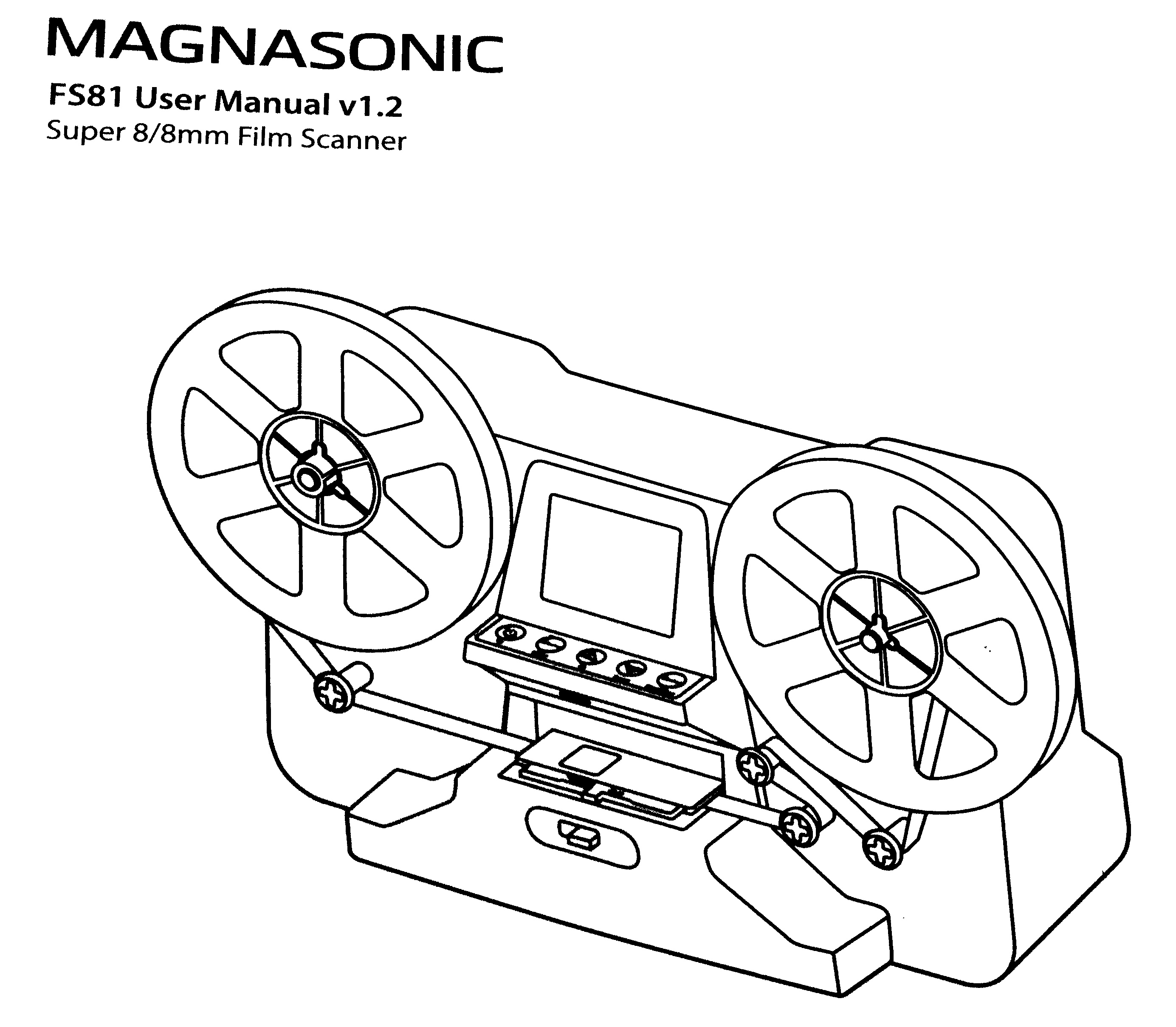
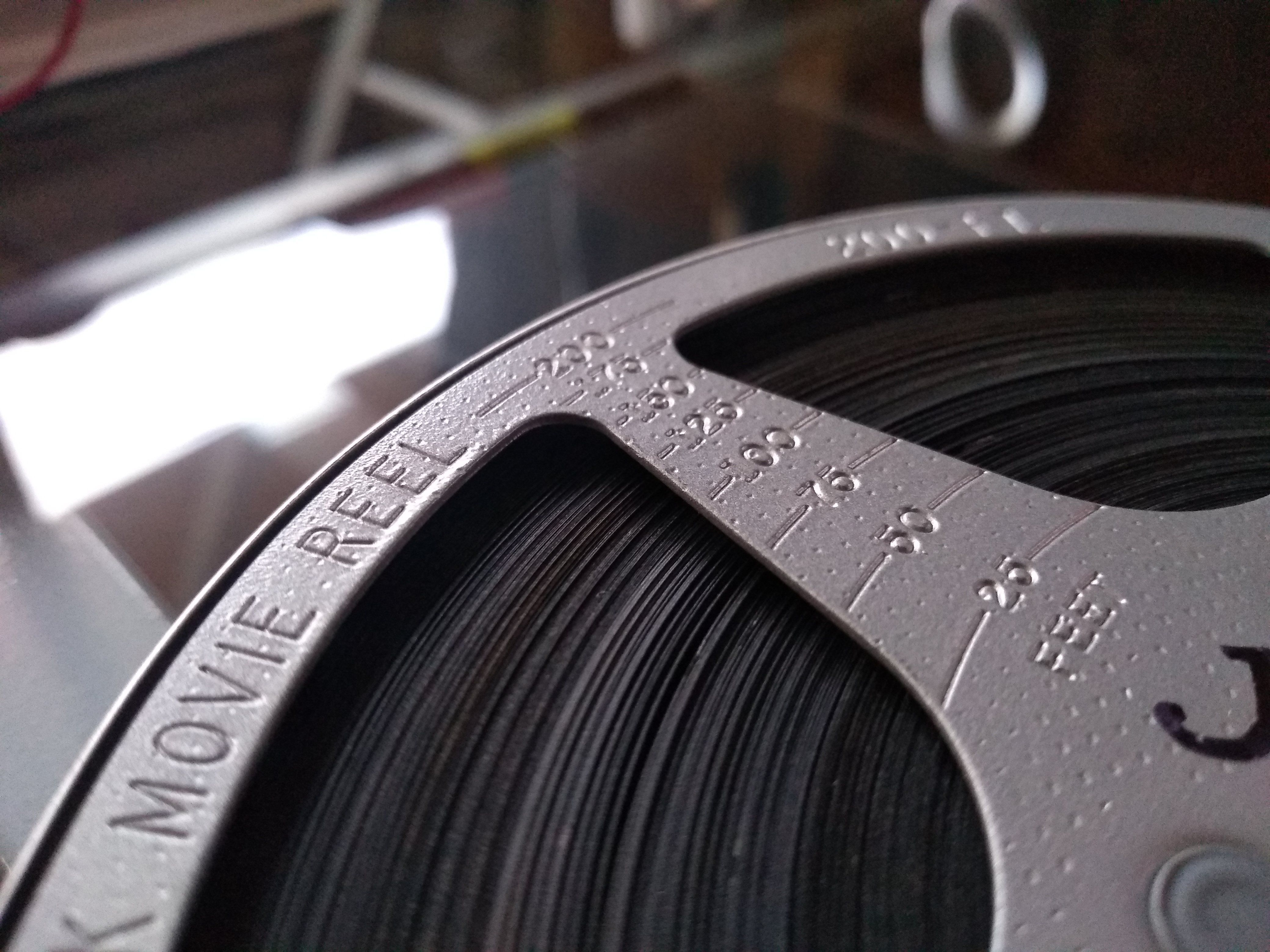
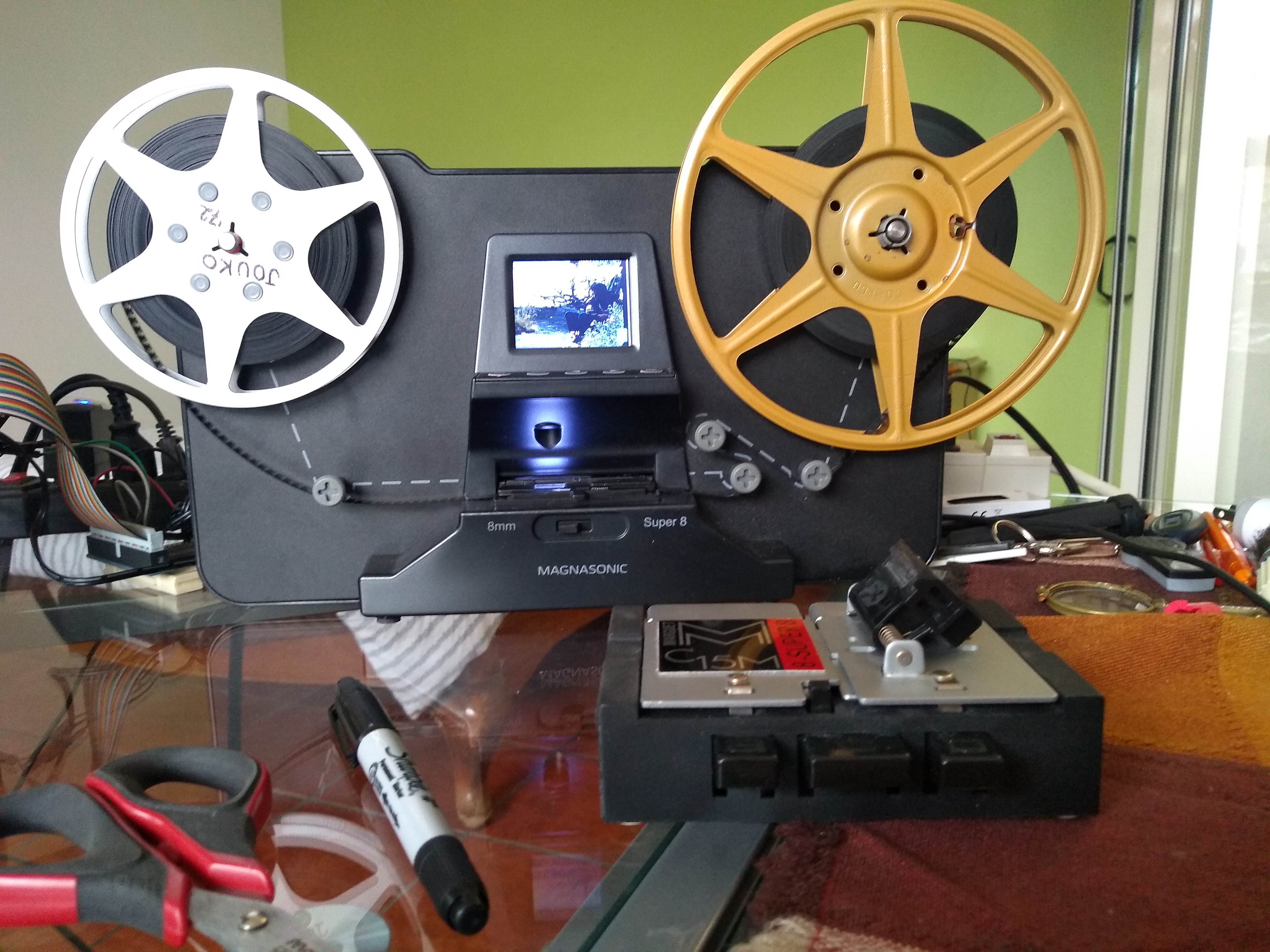
After my father passed away, I brought home most of the personal items he had, both at home and at his office. Among many, many (many, many, many) other things, I brought two of his personal treasures: His photo collection and a box with the 8mm movies he shot approximately between 1956 and 1989, when he was forced into modernity and got a portable videocassette recorder. I have talked with several friends, as I really want to get it all in a digital format, and while I ve been making slow but steady advances scanning the photo reels, I was particularly dismayed (even though it was most expected most personal electronic devices aren t meant to last over 50 years) to find out the 8mm projector was no longer in working conditions; the lamp and the fans work, but the spindles won t spin. Of course, it is quite likely it is easy to fix, but it is beyond my tinkering abilities and finding photographic equipment repair shops is no longer easy. Anyway, even if I got it fixed, filming a movie from a screen, even with a decent camera, is a lousy way to get it digitized. But almost by mere chance, I got in contact with my cousin Daniel, ho came to Mexico to visit his parents, and had precisely brought with him a 8mm/Super8 movie scanner! It is a much simpler piece of equipment than I had expected, and while it does present some minor glitches (i.e. the vertical framing slightly loses alignment over the course of a medium-length film scanning session, and no adjustment is possible while the scan is ongoing), this is something that can be decently fixed in post-processing, and a scanning session can be split with no ill effects. Anyway, it is quite uncommon a mid-length (5min) film can be done without interrupting i.e. to join a splice, mostly given my father didn t just film, but also edited a lot (this is, it s not just family pictures, but all different kinds of fiction and documentary work he did). So, Daniel lent me a great, brand new, entry-level film scanner; I rushed to scan as many movies as possible before his return to the USA this week, but he insisted he bought it to help preserve our family s memory, and given we are still several cousins living in Mexico, I could keep hold of it so any other of the cousins will find it more easily. Of course, I am thankful and delighted! So, this equipment is a Magnasonic FS81. It is entry-level, as it lacks some adjustment abilities a professional one would surely have, and I m sure a better scanner will make the job faster but it s infinitely superior to not having it! The scanner processes roughly two frames per second (while the nominal 8mm/Super8 speed is 24 frames per second), so a 3 minute film reel takes a bit over 35 minutes And a long, ~20 minute film reel takes Close to 4hr, if nothing gets in your way :- And yes, with longer reels, the probability of a splice breaking are way higher than with a short one not only because there is simply a longer film to process, but also because, both at the unwinding and at the receiving reels, mechanics play their roles. The films don t advance smoothly, but jump to position each frame in the scanner s screen, so every bit of film gets its fair share of gentle tugs. My professional consultant on how and what to do is my good friend Chema Serralde, who has stopped me from doing several things I would regret later otherwise (such as joining spliced tapes with acidic chemical adhesives such as Kola Loka, a.k.a. Krazy Glue even if it s a bit trickier to do it, he insisted me on best using simple transparent tape if I m not buying fancy things such as film-adhesive). Chema also explained me the importance of the loopers (las Lupes in his technical Spanish translation), which I feared increased the likelihood of breaking a bit of old glue due to the angle in which the film gets pulled but if skipped, result in films with too much jumping. Not all of the movies I have are for public sharing Some of them are just family movies, with high personal value, but probably of very little interest to others. But some are! I have been uploading some of the movies, after minor post-processing, to the Internet Archive. Among them: Anyway, I have a long way forward for scanning. I have 20 3min reels, 19 5min reels, and 8 20min reels. I want to check the scanning quality, but I think my 20min reels are mostly processed (we paid for scanning them some years ago). I mostly finished the 3min reels, but might have to go over some of them again due to the learning process. And Well, I m having quite a bit of fun in the process!
Russ Allbery: Review: The Amazing Maurice and His Educated Rodents

Review: The Amazing Maurice and His Educated Rodents, by Terry Pratchett
Series: Discworld #28
Publisher: HarperCollins
Copyright: 2001
Printing: 2008
ISBN: 0-06-001235-8
Format: Mass market
Pages: 351
The Amazing Maurice and His Educated Rodents is the 28th Discworld novel and the first marketed for younger readers. Although it has enough references to establish it as taking place on Discworld, it has no obvious connections with the other books and doesn't rely on any knowledge of the series so far. This would not be a bad place to start with Terry Pratchett and see if his writing style and sense of humor is for you. Despite being marketed as young adult, and despite Pratchett's comments in an afterward in the edition I own that writing YA novels is much harder, I didn't think this was that different than a typical Discworld novel. The two main human characters read as about twelve and there were some minor changes in tone, but I'm not sure I would have immediately labeled it as YA if I hadn't already known it was supposed to be. There are considerably fewer obvious pop culture references than average, though; if that's related, I think I'll prefer Pratchett's YA novels, since I think his writing is stronger when he's not playing reference bingo. Maurice (note to US readers: Maurice is pronounced "Morris" in the UK) is a talking cat and the mastermind of a wandering con job. He, a stupid-looking kid with a flute (Maurice's description), and a tribe of talking rats travel the small towns of Discworld. The rats go in first, making a show of breaking into the food, swimming in the cream, and widdling on things that humans don't want widdled on. Once the townspeople are convinced they have a plague of rats, the kid with the flute enters the town and offers to pipe the rats away for a very reasonable fee. He plays his flute, the rats swarm out of town, and they take their money and move on to the next town. It's a successful life that suits Maurice and his growing hoard of gold very well. If only the rats would stop asking pointed questions about the ethics of this scheme. The town of Bad Blintz is the next on their itinerary, and if the rats have their way, will be the last. Their hope is they've gathered enough money by now to find an island, away from humans, where they can live their own lives. But, as is always the case for one last job in fiction, there's something uncannily wrong about Bad Blintz. There are traps everywhere, more brutal and dangerous ones than they've found in any other town, and yet there is no sign of native, unintelligent rats. Meanwhile, Maurice and the boy find a town that looks wealthy but has food shortages, a bounty on rats that is absurdly high, and a pair of sinister-looking rat-catchers who are bringing in collections of rat tails that look suspiciously like bootlaces. The mayor's daughter discovers Maurice can talk and immediately decides she has to take them in hand. Malicia is very certain of her own opinions, not accustomed to taking no for an answer, and is certain that the world follows the logic of stories, even if she has to help it along. This is truly great stuff. I think this might be my favorite Discworld novel to date, although I do have some criticisms that I'll get to in a moment. The best part are the rats, and particularly the blind philosopher rat Dangerous Beans and his assistant Peaches. In the middle of daring infiltration of the trapped sewers in scenes reminiscent of Mission: Impossible, the rats are also having philosophical arguments. They've become something different than the unaltered rats that they call the keekees, but what those differences mean is harder to understand. The older rats are not happy about too many changes and think the rats should keep acting like rats. The younger ones are discovering that they're afraid of shadows because now they understand what the shadows hint at. Dangerous Beans is trying to work out a writing system so that they can keep important thoughts. One of their few guides is a children's book of talking animals, although they quickly discover that the portrayed clothing is annoyingly impractical. But as good as the rats are, Maurice is nearly as much fun in an entirely different way. He is unapologetically out for himself, streetwise and canny in a way that feels apt for a cat, gets bored and mentally wanders off in the middle of conversations, and pretends to agree with people when that's how he can get what he wants. But he also has a weird sense of loyalty and ethics that only shows up when something is truly important. It's a variation on the con man with a heart of gold, but it's a very well-done variation that weaves in a cat's impatience with and inattention to anything that doesn't directly concern them. I was laughing throughout the book. Malicia is an absolute delight, the sort of character who takes over scenes through sheer force of will, and the dumb-looking kid (whose name turns out to be Keith) is a perfect counterbalance: a laid-back, quiet boy who just wants to play his music and is almost entirely unflappable. It's such a great cast. The best part of the plot is the end. I won't spoil it, so I'll only say that Pratchett has the characters do the work on the aftermath that a lot of books skip over. He doesn't have any magical solutions for the world's problems, but he's so very good at restoring one's faith that maybe sometimes those solutions can be constructed. My one complaint with this book is that Pratchett introduces a second villain, and while there are good in-story justifications for it and it's entangled with the primary plot, he added elements of (mild) supernatural horror and evil that I thought were extraneous and unnecessary. He already had enough of a conflict set up without adding that additional element, and I think it undermined the moral complexity of the story. I would have much rather he kept the social dynamics of the town at the core of the story and used that to trigger the moments of sacrifice and philosophy that made the climax work. The Discworld books by this point have gotten very good, but each book seems to have one element like that where it felt like Pratchett took the easy way out of a plot corner or added some story element that didn't really work. I feel like the series is on the verge of having a truly great book that rises above the entire series to date, but never quite gets there. That caveat aside, I thoroughly enjoyed this and had trouble putting it down. Mrs. Frisby and the Rats of Nimh was one of my favorite books as a kid, and this reminded me of it in some good ways (enough so that I think some of the references were intentional). Great stuff. If you were to read only one Discworld book and didn't want to be confused by all the entangled plot threads and established characters, I would seriously consider making it this one. Recommended. Followed by Night Watch in publication order. There doesn't appear to be a direct plot sequel, more's the pity. Rating: 8 out of 10

30 April 2023

Russell Coker: Links April 2023

Cory Doctorow has an insightful article Gig Work is the Opposite of Steampunk [1] about the horrors that companies like Amazon are forcing on their employees. Valerie Aurora and Leigh Honeywell wrote an insightful article about the al Capone theory of sexual harassment [2]. Why people who sexually harass others usually perform other anti-social activity that is also easier to prosecute. The IEEE has an interesting article about using ML for parts of the CPU design process, both the technical issues and the controversy about competing ideas which is probably caused by sexism [3]. Love and taxes are forever my heart is a line from an anime dating sim game that prepares US taxes [4]. Unfortunately it was removed from Steam. The existence of the game is a weird social commentary and removing the game because you can t have an anime hottie do taxes is bizarre but also understandable given liability issues. There s no mention in the review of whether male hotties are available for people who prefer dating guys. As an aside my accountant looks like he is allergic to exercise The Killdozer Book web site (which has an invalid SSL certificate so you have to click on advanced in Chrome to get to the content) has an insightful article debunking some of the stories about the Killdozer [5]. He wasn t some sort of hero of freedom, he was just a jerk who reneged on a deal hoping to get more money, thought that laws shouldn t apply to him, and killed himself because of it. Apparently some big tech companies are knowingly hiring people to not work unlike the usual large corporate case of unknowingly hiring people to not work [6]. Silicon Valley is a good TV show, and it s apparently realistic. Ron Garrett wrote in insightful blog post about theoretical attacks on Bitcoin and how Bitcoin could be used [7]. The conclusion is not good for Bitcoin. Compiler Explorer is a program that shows how various C++ compilers produce assembly code for various architectures, this site hosts the main active instance [8]. There are other instances, here is an instance that produces code for the Ruzzian Elbrus architecture [9]. The Elbrus Wikipedia page is interesting [10]. Apparently the Ruzzians don t want this information to be spread, LOL. The Smithsonian Magazine has an interesting article about pet parrots being taught to video call each other [11]. Apparently parrots are social animals and can develop psychological problems if kept alone, so the video calls can be good for them. Also the owners had to monitor the chats to ensure that they played nicely together, just like play-dates for kids! Phoronix has an amusing article about the drama regarding the AMD Spectral Chicken bit in the Linux kernel source [12]. This page listing bad free software licenses is amusing [13]. The ACS has an interesting article about how Samsung fakes photos of the moon and presumably could fake other photos of notable objects that don t change [14]. The way that they proved the forgery was interesting.

29 April 2023

Andrew Cater: Release testing for 11.7 - pictures (with appropriate identity protection)


Simon Josefsson: How To Trust A Machine

Let s reflect on some of my recent work that started with understanding Trisquel GNU/Linux, improving transparency into apt-archives, working on reproducible builds of Trisquel, strengthening verification of apt-archives with Sigstore, and finally thinking about security device threat models. A theme in all this is improving methods to have trust in machines, or generally any external entity. While I believe that everything starts by trusting something, usually something familiar and well-known, we need to deal with misuse of that trust that leads to failure to deliver what is desired and expected from the trusted entity. How can an entity behave to invite trust? Let s argue for some properties that can be quantitatively measured, with a focus on computer software and hardware: Essentially, this boils down to: Trust, Verify and Hold Accountable. To put this dogma in perspective, it helps to understand that this approach may be harmful to human relationships (which could explain the social awkwardness of hackers), but it remains useful as a method to improve the design of computer systems, and a useful method to evaluate safety of computer systems. When a system fails some of the criteria above, we know we have more work to do to improve it. How far have we come on this journey? Through earlier efforts, we are in a fairly good situation. Richard Stallman through GNU/FSF made us aware of the importance of free software, the Reproducible/Bootstrappable build projects made us aware of the importance of verifiability, and Certificate Transparency highlighted the need for accountable signature logs leading to efforts like Sigstore for software. None of these efforts would have seen the light of day unless people wrote free software and packaged them into distributions that we can use, and built hardware that we can run it on. While there certainly exists more work to be done on the software side, with the recent amazing full-source build of Guix based on a 357-byte hand-written seed, I believe that we are closing that loop on the software engineering side. So what remains? Some inspiration for further work: Onwards and upwards, happy hacking! Update 2023-05-03: Added the Liberating property regarding free software, instead of having it be part of the Verifiability and Transparency .

Abhijith PA: Attending FOSSASIA 2023

I attended FOSSASIA 2023 summit held at Lifelong Learning Institute, Singapore. A 3 day long parallel talk filled conference. Its my second time attending FOSSASIA. The first one was 2018 summit. Like last time, I didn t attend much talks but focussed on networking with people. A lot of familiar faces there. PV Anthony, Harish, etc. I vounteered to run Debian Booth at the exhibition hall distributing stickers, flyers. Rajudev also helped me at the booth. Most of the people there used debian or its derivates or know debian already, its easier for me that way, that I don t have do much explaining compared to other booths. Thanks to Parth for looking after booth in my breaks. debian_booth1 debian_booth2 Sometimes our booth also act as cloak room :). Ours was close to the entrance door and we may be similar faces to folks. So people come and drop their bags before they go to talks. One thing I love about the such conference is that people have very different hardwares that I never able to see otherwise. I remember KDE booth had a Steam Value portable gaming board running KDE plasma. Then a person have this eyeglass which act as a monitor. Then the usual DJI drones but custom programmed. It was very lovely to meet and play around with exotic hardwares. Kurian whom I met during a Debian packaging workshop in Kerala was a speaker at FOSSASIA. He presented a talk titled OpenAI Whisper and it s amazing power to do finetuning . I was his unofficial PR guy, taking pictures :).

Weather Clear sky, little hot and humid. The weather was quite nice for me except the surprise rain and small thunderstorms. Comparing to my place s temperature, its wonderful.

28 April 2023

Scarlett Gately Moore: KDE Snaps, Gear 23.04.0 available in snap store

KDE Digikam 8.0.0 SnapKDE Digikam 8.0.0 Snap
It has been another crazy busy couple of weeks. There are too many snaps released to list here, but you can track my progress here: https://invent.kde.org/packaging/snapcraft-kde-applications/-/issues/30 Some notable releases are: I updated our Frameworks/QT5 content pack to kf5 105 and qt5 5.15.9. I have added more documentation at: https://invent.kde.org/teams/neon/-/wikis/Snaps I am finishing up the last of 23.04.0 snaps and will tackle KDE PIM suite next week. I will also work on more apps that have their own release cycle. Several snap bugs have been resolved and closed! Please remember if you have issues, to file them at bugs.kde.org as I have a hard time finding them at <insert random forum / social network here> On the Debian front, I successfully closed two CVE s for ruby-rack in Buster! I will be doing more ELTS/LTS security updates next month! Thanks for stopping by! If you enjoy my work, consider a dontation. https://gofund.me/2c7b1808

Shirish Agarwal: John Grisham s books, Evolution removed from textbooks

Gray Mountain John Grisham I have been perusing John Grisham s books, some read and some re-read again. Almost all of the books that Mr. Grisham wrote are relevant even today. The Gray Mountain talks about how mountain top removal was done in Applachia, the U.S. (South). In fact NASA made a summary which either was borrowed from this book or the author borrowed from NASA, either could be true although seems it might be the former. And this is when GOI just made a new Forest Conservation Bill 2023 which does the opposite. There are many examples of the same, the latest from my own city as an e.g. Vetal Tekdi is and was a haven for people animals, birds all kinds of ecosystem and is a vital lung of the city, one of the few remaining green spaces in the city but BJP wants to commercialize it as it has been doing for everything, I haven t been to the Himalayas since 4-5 years back as I hear the rape of the land daily. Even after Joshimath tragedy, if people are not opening the eyes what can I do  The more I say, the more depressed I will become so will leave it for now. In many ways the destruction seems similar to the destruction that happened in Brazil under Jair Bolsonaro. So as can be seen from what I have shared this book was mostly about environment and punitive damages and also how punitive damages have been ceiling in America (South). This was done via lobbying by the coal groups and apparently destroyed people s lives, communities, even whole villages. It also shared how most people called black lung and how those claims had been denied by Coal Companies all the time. And there are hardly any unions. While the book itself is a fiction piece, there is a large amount of truth in it. And that is one of the reasons people write a fiction book. You could write about reality using fictional names and nobody can sue you while you set the reality as it is. In many ways, it is a tell-all.

The Testament John Grisham One of the things I have loved about John Grisham is he understands human condition. In this book it starts with an eccentric billionaire who makes a will which leaves all his property to an illegitimate child who coincidentally also lives in Brazil, she is a missionary. The whole book is about human failings as well as about finding the heir. I am not going to give much detail as the book itself is fun.

The Appeal John Grisham In this, we are introduced to a company that does a chemical spill for decades and how that leads to lobbying and funding Judicial elections. It does go into quite a bit of length how private money coming from Big business does all kind of shady things to get their person elected to the Supreme Court. Sadly, this seems to happen all the time, for e.g. two weeks ago. This piece from the Atlantic also says the same. Again, won t tell as there is a bit of irony at the end of the book.

The Rainmaker John Grisham This in short is about how Insurance Companies stiff people. It s a wonderful story that has all people in grey including our hero. An engaging book that sorta tells how the Insurance Industry plays the game. In India, the companies are safe as they ask for continuance for years together and their object is to delay the hearings till the grandchildren are not alive unlike in the U.S. or UK. It also does tell how more lawyers are there then required. Both of which are the same in my country.

The Litigators John Grisham This one is about Product Liability, both medicines as well as toys for young kids. What I do find funny a bit is how the law in States allows people to file cases but doesn t protect people while in EU they try their best that if there is any controversy behind any medicine or product, they will simply ban it. Huge difference between the two cultures.

Evolution no longer part of Indian Education A few days ago, NCERT (one of the major bodies) that looks into Indian Education due to BJP influence has removed Darwin s Theory of Evolution. You can t even debate because the people do not understand adaptability. So the only conclusion is that Man suddenly appeared out of nowhere. If that is so, then we are the true aliens. They discard the notion that we and Chimpanzees are similar. Then they also have to discard this finding that genetically we are 96% similar.

12 April 2023

Russ Allbery: Review: The Last Hero

Review: The Last Hero, by Terry Pratchett
Illustrator: Paul Kidby
Series: Discworld #27
Publisher: Harper
Copyright: 2001, 2002
ISBN: 0-06-050777-2
Format: Graphic novel
Pages: 176
The Last Hero is the 27th Discworld novel and part of the Rincewind subseries. This is something of a sequel to Interesting Times and relies heavily on the cast that was built up in previous books. It's not a good place to start with the series. At last, the rare Rincewind novel that I enjoyed. It helps that Rincewind is mostly along for the ride. Cohen the Barbarian and his band of elderly heroes have decided they're tired of enjoying their spoils and are going on a final adventure. They're going to return fire to the gods, in the form of a giant bomb. The wizards in Ankh-Morpork get wind of this and realize that an explosion at the Hub where the gods live could disrupt the magical field of the entire Disc, effectively destroying it. The only hope seems to be to reach Cori Celesti before Cohen and head him off, but Cohen is already almost there. Enter Lord Vetinari, who has Leonard of Quirm design a machine that will get them there in time by slingshotting under the Disc itself. First off, let me say how much I love the idea of returning fire to the gods with interest. I kind of wish Pratchett had done more with their motivations, but I was laughing about that through the whole book. Second, this is the first of the illustrated Discworld books that I've read in the intended illustrated form (I read the paperback version of Eric), and this book is gorgeous. I enjoyed Paul Kidby's art far more than I had expected to. His style what I will call, for lack of better terminology due to my woeful art education, "highly detailed caricature." That's not normally a style that clicks with me, but it works incredibly well for Discworld. The Last Hero is richly illustrated, with some amount of art, if only subtle background behind the text, on nearly every page. There are several two-page spreads, but oddly I thought those (including the parody of The Scream on the cover) were the worst art of the book. None of them did much for me. The best art is in the figure studies and subtle details: Leonard of Quirm's beautiful calligraphy, his numerous sketches, the labeled illustration of the controls of the flying machine, and the portraits of Cohen's band and the people they encounter. The edition I got is printed on lovely, thick glossy paper, and the subtle art texture behind the writing makes this book a delight to read. I'm not sure if, like Eric, this book comes in other editions, but if so, I highly recommend getting or finding the high-quality illustrated edition for the best reading experience. The plot, like a lot of the Rincewind books, doesn't amount to much, but I enjoyed the mission to intercept Cohen. Leonard of Quirm is a great character, and the slow revelation of his flying machine design (which I will not spoil) is a delightful combination of Leonardo da Vinci parody, Discworld craziness, and NASA homage. Also, the Librarian is involved, which always improves a Discworld book. (The Luggage, sadly, is not; I would have liked to have seen a richly-illustrated story about it, but it looks like I'll have to find the illustrated version of Eric for that.) There is one of Pratchett's philosophical subtexts here, about heroes and stories and what it means for your story to live on. To be honest, it didn't grab me; it's mostly subtext, and this particular set of characters weren't quite introspective enough to make the philosophy central to the story. Also, I was perhaps too sympathetic to Cohen's goals, and thus not very interested in anyone successfully stopping him. But I had a lot more fun with this one than I usually do with Rincewind books, helped considerably by the illustrations. If you've been skipping Rincewind books in your Discworld read-through and have access to the illustrated edition of The Last Hero, consider making an exception for this one. Followed by The Amazing Maurice and His Educated Rodents in publication order and, thematically, by Unseen Academicals. Rating: 7 out of 10

7 April 2023

Matthew Palmer: Database Encryption: If It's So Good, Why Isn't Everyone Doing It?

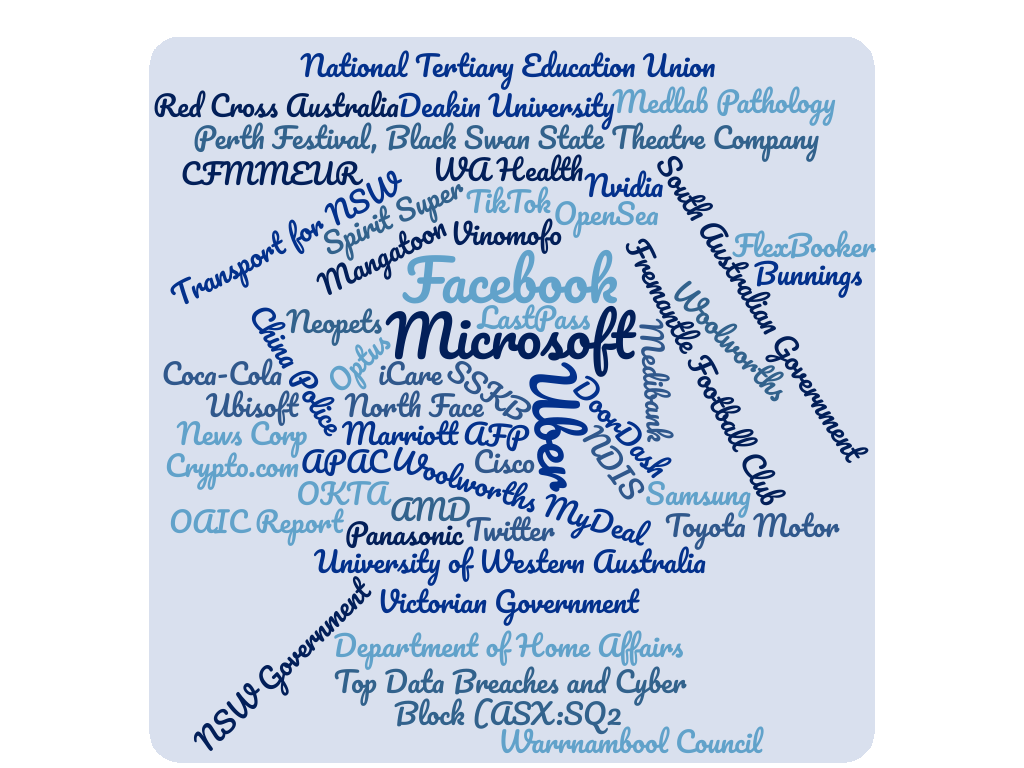
a wordcloud of organisations who have been reported to have had data breaches in 2022 Just some of the organisations that leaked data in 2022

It seems like just about every day there s another report of another company getting hacked and having its sensitive data (or, worse, the sensitive data of its customers) stolen. Sometimes, people s most intimate information gets dumped for the world to see. Other times it s just used for identity theft, extortion, and other crimes. In the least worst case, the attacker gets cold feet, but people suffer stress and inconvenience from having to replace identity documents. A great way to protect information from being leaked is to encrypt it. We encrypt data while it s being sent over the Internet (with TLS), and we encrypt it when it s at rest (with disk or volume encryption). Yet, everyone s data seems to still get stolen on a regular basis. Why? Because the data is kept online in an unencrypted form, sitting in the database while its being used. This means that attackers can just connect to the database, or trick the application into dumping the database, and all the data is just lying there, waiting to be misused.

It s Not the Devs Fault, Though You may be thinking that leaving an entire database full of sensitive data unencrypted seems like a terrible idea. And you re right: it is a terrible idea. But it s seemingly unavoidable. The problem is that in order to do what a database does best (query, sort, and aggregate data), it needs to be able to know what the data is. When you encrypt data, however, all the database sees is a locked box.
a locked box Not very useful for a database
The database can t tell what s in the locked box whether it s a number equal to 42, or a date that s less than 2023-01-01, or a string that contains the substring foo . Every value is just an opaque blob of stuff , and the database is rendered completely useless. Since modern applications usually rely pretty heavily on their database, it s essentially impossible to build an application if you ve turned your database into a glorified flat-file by encrypting everything in it. Thus, it s hardly surprising that developers have to leave the data laying around unencrypted, for anyone to come along and take.

Introducing Enquo I said before that having data unencrypted in a database is seemingly unavoidable. That s because there are some innovative cryptographic techniques that can make it possible to query encrypted data.
Andy Dwyer being amazed Indeed
The purpose of the Enquo project is to provide a common set of cryptographic primitives that implement ENcrypted QUery Operations (ie Enquo ), and integrate those operations into databases, ORMs, and anywhere else that could benefit. The end goal is to provide the ability to encrypt all the data stored in any database server, while still allowing the data to be queried and aggregated. So far, the project consists of these components:
  • the enquo-core library, that implements queryable encrypted integers, dates, and text in Rust and Ruby;
  • a PostgreSQL extension, pg_enquo, that allows PostgreSQL to query encrypted data; and
  • a Rails ActiveRecord extension, ActiveEnquo, that augments ActiveRecord to do the encryption/decryption required.
Support for other languages and ORMs is designed to be as straightforward as possible, and integration with other databases is mostly dependent on their own extensibility. The project s core tenets emphasise both uncompromising security, and a friendly developer experience. Naturally, all Enquo code is open source, released under the MIT licence.

Would You Like To Know More?
Desire to know more intensifies Everyone who uses a database...
If all this sounds relevant to your interests:
  1. If you use Ruby on Rails and PostgreSQL, you re halfway home already. Follow the ActiveEnquo getting started tutorial and see how much of your data Enquo can already protect. When you find data you want to encrypt but can t, tell me about it.
    • If you use Ruby and PostgreSQL with another ORM, such as Sequel, writing a plugin to support Enquo shouldn t be too difficult. The ActiveEnquo code should give you a good start. If you get stuck, get in touch.
  2. If you use PostgreSQL with another programming language, tell me what language you use and we ll work together to get bindings for that library created.
  3. If you use another database server, support is coming for your database of choice eventually, but at present there s no timeline on support. On the off chance that you happen to be a hard-core database hacking expert, and would like to work on getting Enquo support in your preferred database server, I d love to talk to you.

1 April 2023

Debian Brasil: MiniDebConf Bras lia 2023 - 25 a 27 de maio

Nesse ano a MiniDebConf Brasil est de volta! A comunidade brasileira de usu rios(as) e desenvolvedores(as) Debian convida a todos(as) a participarem da MiniDebConf Bras lia 2023 que acontecer durante 3 dias na capital federal. Nos dias 25 e 26 de maio estaremos no Complexo Avan ado da C mara dos Deputados - LabHacker/CEFOR, promovendo palestras, oficinas e outras atividades. E, no - dia 27 de maio (s bado), estaremos em um coworking (local a definir) para - colocar a m o na massa hackeando software e contribuindo para o Projeto Debian. A MiniDebConf Bras lia 2023 um evento aberto a todos(as), independente do seu n vel de conhecimento sobre Debian. O mais importante ser reunir a comunidade para celebrar o maior projeto de Software Livre do mundo, por isso queremos receber desde usu rios(as) inexperientes que est o iniciando o seu contato com o Debian at Desenvolvedores(as) oficiais do projeto. A programa o da MiniDebConf Bras lia 2023 ser composta de palestras de n vel b sico e intermedi rio para aqueles(as) participantes que est o tendo o primeiro contato com o Debian ou querem conhecer mais sobre determinados assuntos, e workshops/oficinas de n vel intermedi rio e avan ado para usu rios(as) do Debian que querem colocar a m o-na-massa durante o evento. No ltimo dia do evento, teremos um Hacking Day em um espa o de coworking para que todos possam interagir e de fato fazerem contribui es para o projeto. Inscri o A inscri o na MiniDebConf Bras lia 2023 totalmente gratuita e poder ser feita no formul rio dispon vel no site do evento. mandat ria a inscri o pr via para que todos(as) possam acessar a C mara dos Deputados - devido a quest es de seguran a da casa. Al m de auxiliar a organiza o no dimensionamento do evento. O evento organizado de forma volunt ria, e toda ajuda bem-vinda. Portanto, se voc gostaria de contribuir para a realiza o do evento, preencha o formul rio para inscri o de volunt rios. Os formul rios para inscri o (na MiniDebConf e para ajudar na organiza o) e submiss o de atividades ser o abertos no dia 1 de abril (n o tem nenhuma pegadinha, se inicia nesse dia mesmo :) Contato Para entrar em contato com o time local, a lista de emails debian-br-eventos, o canal IRC #debian-bsb no OFTC e o grupo no telegram DebianBras lia podem ser utilizados. Al m do endere o de email: brasil.mini@debconf.org.

Debian Brasil: First 2023 translation workshop from the pt_BR team

The Brazilian translation team debian-l10n-portuguese had their first workshop of 2023 in February, with great results: Our focus was to complete the descriptions of the 500 most popular packages (popcon). Although we were unable to reach 100% of the translation cycle, much of these descriptions are in progress and with a little more work will be available to the community. The Brazilian Portuguese translation team

Debian Brasil: Primeira oficina de tradu o em 2023 da equipe pt_BR

The Brazilian translation team debian-l10n-portuguese realizou a primeira oficina de 2023 em fevereiro, com timos resultados: Nosso foco era completar as descri es dos 500 pacotes mais populares (popcon). Apesar de n o termos conseguido chegar 100% do ciclo de tradu o, grande parte dessas descri es est o em andamento e com um pouco mais de trabalho estar o dispon veis comunidade. Agrade o aos( s) participantes pelas contribui es. As oficinas foram bem movimentadas e, muito al m das tradu es em si, conversamos sobre diversas faces da comunidade Debian. Esperamos ter ajudado aos( s) iniciantes a contribuir com o projeto de maneira frequente. Agrade o em especial ao Charles (charles) que ministrou um dos dias da oficina, ao Paulo (phls) que sempre est a dando uma for a, e ao Fred Maranh o pelo seu incans vel trabalho no DDTSS. Equipe de tradu o do portugu s do Brasil

Next.

Previous.